In This Article
Link stakeholders to emissions sources, score influence and exposure, then assign owners and milestones to turn engagement into real emissions cuts.
Stakeholder Mapping for Effective Decarbonization
We turn stakeholder maps into emissions cuts by linking people to decisions, owners, and deadlines. Start with one major emissions source and score each stakeholder from 1–3 on emissions influence, decision authority, and exposure to change - not job title alone.
We use that map to:
Set priorities: Review combined scores of 7–9 and prioritize anyone facing major impacts, even without approval power.
Plan participation: Give affected groups a voice before decisions, set response deadlines, and explain what changed.
Track results: Assign named owners, dated milestones, and proof of completion. Keep participation, project delivery, and emissions reductions separate.
Our test is simple: Did the input change the plan, and did the plan cut emissions? <u>Forecast savings are not achieved reductions.</u> Check results against a documented baseline, review delivery monthly, and update priorities quarterly - or sooner when conditions change.
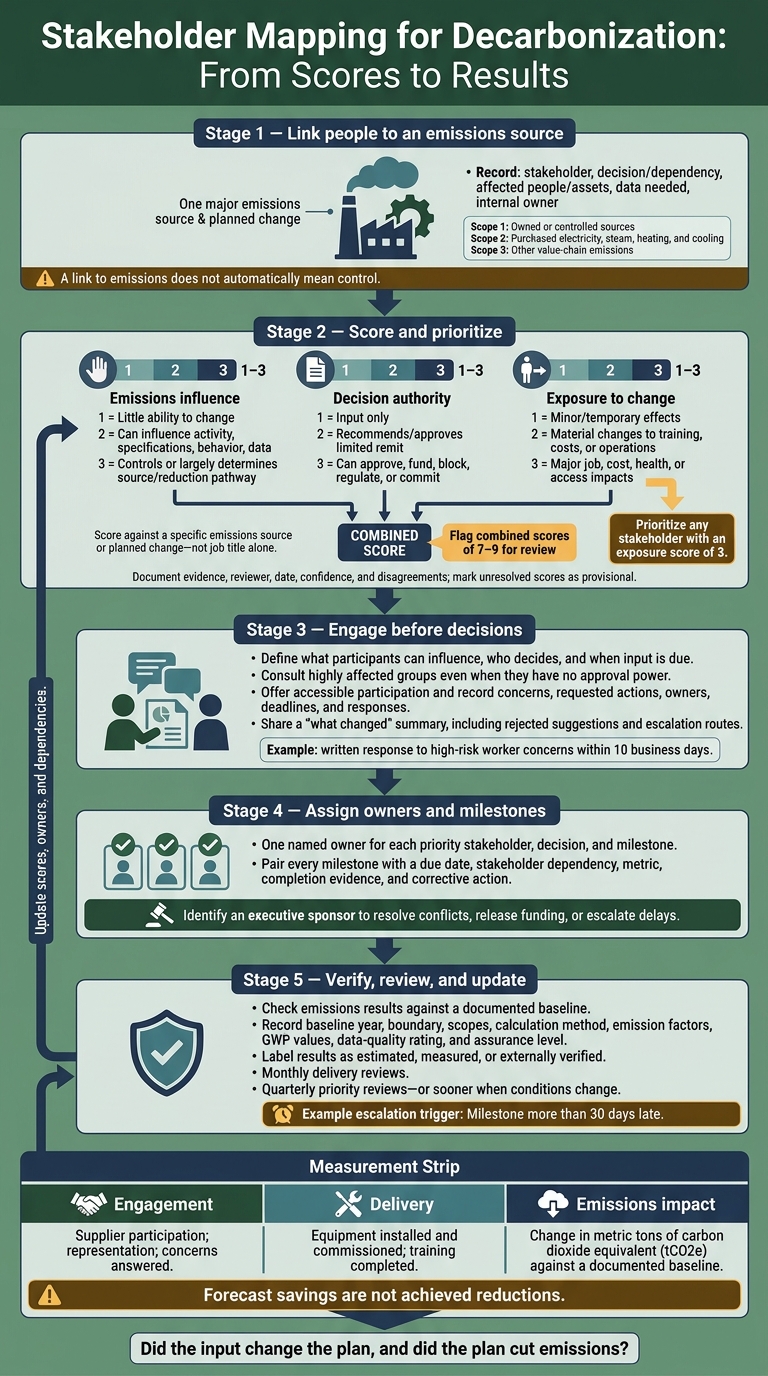
Stakeholder Mapping for Decarbonization: From Scores to Results
How to Facilitate a Stakeholder Mapping Workshop
sbb-itb-8baf5f1
Step 1: Identify and Score Stakeholders
Turn the three scores into a source-by-source worksheet before ranking priorities.
Build one working file that connects each stakeholder to a specific emissions source, planned change, and evidence type. Keep the reporting period, organizational boundary, calculation method, and data quality visible. Label the data source as measured, estimated, or supplier-provided.
Link Stakeholders to Emissions Sources
Use GHG Protocol boundaries to connect stakeholders to the sources they influence, approve, or depend on. Scope 1 covers owned or controlled sources. Scope 2 covers purchased electricity, steam, heating, and cooling. Scope 3 covers other value-chain emissions, including purchased goods and services, transportation, product use, and end-of-life treatment.[3]
For each source, record one decision or dependency point, along with the people or assets affected by change. A link to emissions does not automatically mean control.
| Stakeholder group | Emissions source | Decision or dependency point | Affected people/assets | Data needed | Internal owner |
|---|---|---|---|---|---|
| Board, executives, and finance | Investments affecting Scopes 1–3 | Approve capital, targets, and budgets | Facilities, business units, funded projects | Project costs, expected reductions, approval thresholds | Chief financial officer |
| Facilities and operations | Scope 1 fuel; Scope 2 electricity | Operate equipment and plan replacements | Buildings, operators, occupants | Meter readings, fuel use, equipment age | Facilities director |
| Procurement and suppliers | Scope 3 purchased goods | Set specifications and contract terms; supply materials | Supplier facilities, workers, supply continuity | Purchased quantities, supplier emissions data | Chief procurement officer |
| Logistics providers | Scope 3 transportation | Determine routing, mode, and delivery requirements | Drivers, distribution centers, customers | Shipment weight, distance, fuel use | Supply-chain vice president |
| Employees and labor representatives | Scope 1–2 changes to operations; Scope 3 commuting and travel | Provide operating knowledge and input on workforce changes | Jobs, skills, schedules, transportation access | Training needs, commute patterns, travel records | Human resources leader |
| Customers | Scope 3 use of sold products | Influence product requirements and use patterns | Users, product costs, service access | Use profiles, energy demand, customer requirements | Product director |
| Communities and regulators | Facility-linked emissions and transition impacts | Regulators approve permits; communities experience local effects | Residents, public health, infrastructure | Permit conditions, air-quality and impact data | Government affairs or community-relations lead |
Add named roles, current relationships, and uncertainties. Split broad groups when their roles, impacts, or exposure to a facility differ.
Score Emissions Influence, Decision Authority, and Exposure to Change
Score each stakeholder against a specific emissions source or planned change, rather than the organization as a whole. Support each dimension with separate evidence.
| Dimension | Score 1 | Score 2 | Score 3 | Concrete indicator | Risk if overlooked |
|---|---|---|---|---|---|
| Emissions influence | Little ability to change the source | Can influence activity, specifications, behavior, or data | Controls or largely determines the source or reduction pathway | Equipment control, purchasing leverage, design responsibility | Plans rely on people who cannot deliver the reduction |
| Decision authority | Input only | Recommends or approves within a limited remit | Can approve, fund, block, regulate, or commit | Budget limits, contract signatures, permit authority | Funding or approvals stall |
| Exposure to change | Minor or temporary effects | Material changes to training, costs, or operations | Major job, cost, health, or access impacts | Workforce dependence, cost sensitivity, proximity to a facility | Serious impacts and unequal burdens go unaddressed |
Keep all three scores visible. Flag combined scores of 7–9 for review, and prioritize any stakeholder with an exposure score of 3.
Treat scores as judgments to test and update, not fixed labels. Check them through interviews and document reviews. Record the evidence, reviewer, date, confidence level, and any disagreements. Mark unresolved scores as provisional.
Use the scored list to build targeted engagement plans for the highest-priority groups.
Step 2: Plan Engagement for Priority Groups
Use the scored worksheet from Step 1 to assign approval, planning, and consultation roles for each emissions source. Make clear what participants can influence, who makes the final decision, and when input is due. Groups with high exposure need meaningful consultation, even if they have no decision authority.
Start with the highest scores to set the first approval gate, choose the consultation group, and establish the response deadline.
Choose Engagement Methods for Each Group
Involve executives, finance, and operations in investment and target decisions. Before finalizing the reduction plan, consult workers and communities about jobs, safety, training, costs, and local impacts. Offer paid sessions that fit work shifts, accessible meeting formats, translation where needed, and anonymous feedback. Give other groups brief updates and a way to voice concerns.
For priority suppliers, define the data boundary, evidence standard, deadline, confidentiality terms, and how the data will be used. Provide a template, brief training, and a procurement contact. Accept documented estimates when primary data are missing, and escalate only after offering reminders and support.
A 25-person U.S. manufacturer is evaluating a natural-gas oven replacement to cut Scope 1 fuel use. The owner-manager reviews an electric model’s cost, utility capacity, production impacts, and expected emissions reduction, including Scope 2 electricity. Procurement requests energy-use data and evidence supporting supplier claims. A paid shift meeting and anonymous form reveal training and lockout-procedure gaps. Approval includes training, commissioning checks, and a maintenance plan, with a named follow-up owner.
Set Decisions, Meeting Schedules, and Success Measures
Set a recurring engagement schedule for each priority group, tied to the decisions they will inform. Participation measures show who contributed; decision outcomes show what changed. Attendance and completed questionnaires do not prove that emissions fell.
| Priority group | Desired decision | Engagement purpose | Method | Frequency | Inputs needed | Escalation path | Participation measure | Decision and carbon outcome |
|---|---|---|---|---|---|---|---|---|
| Executives and finance | Approve carbon reduction budget and target | Resolve cost and risk tradeoffs | Decision memo and review | Quarterly; before funding approval | Costs, forecast reductions, risks | CFO → executive sponsor | Questions answered before approval | Budget and reduction target approved, revised, or rejected |
| Procurement and priority suppliers | Agree on data protocol | Obtain usable Scope 3 evidence | Workshop, template, office hours | Monthly during collection | Activity data, boundaries, emission factors | Procurement director → senior supplier owner | Response rate and completeness | Scope 3 data accepted or corrections required |
| Workers and representatives | Set transition controls | Address safety, skills, and job impacts | Paid consultation, safety review, anonymous feedback | Before approval and commissioning; after 90 days | Job impacts, training plan, operating procedures | HR or safety lead → project sponsor | Representation, response rate, concerns answered | Reduction plan or controls changed; training funded |
| Nearby communities | Set mitigation and communication plans | Manage local impacts | Public meeting, translated summary, grievance channel | Before approval; quarterly during rollout | Traffic, noise, air quality, schedule, mitigation data | Community liaison → project sponsor | Affected groups reached; accessibility; timely grievance acknowledgment | Mitigation adopted and monitored during rollout |
Keep an engagement log that records the date, stakeholder, issue, evidence, requested action, responsible owner, status, deadline, and final response. Set response expectations upfront - for example, a written response to high-risk worker concerns within 10 business days.
After each decision, share a “what changed” summary through the channels used for participation. Cover changes, gaps, and open issues, and explain rejected suggestions and escalation routes. Close a concern only after documenting the response and confirming that the agreed change was made.
Carry approved actions, named owners, final responses, and open items into the milestone tracker in Step 3.
Step 3: Assign Owners and Carbon Reduction Milestones
Turn the engagement log into an execution tracker. Give each priority stakeholder a named owner and a dated milestone.
Name Owners and Supporting Roles
Assign one named owner to each priority stakeholder, decision, and milestone. Define their authority, responsibilities, and backup coverage. Add supporting roles for emissions measurement, finance approval, procurement, project delivery, workforce training, communications, and legal review as needed.
Name an executive sponsor who can resolve conflicts, release funding, or escalate delays. Smaller organizations can combine roles, but each person’s authority must remain clear.[2][6]
Set Deadlines, Metrics, and Evidence Requirements
Track engagement, delivery, and emissions impact separately. Supplier participation measures engagement. Commissioning measures delivery. Changes in metric tons of carbon dioxide equivalent (tCO2e) measure impact.
Turn each priority stakeholder dependency into a milestone with a metric and an evidence requirement. Replace every owner placeholder with a person’s name before approval.
| Milestone | Due date | Named owner | Stakeholder dependency | Metric | Evidence | Corrective action |
|---|---|---|---|---|---|---|
| Validate 2025 facility-energy baseline | March 31, 2027 | Enter inventory lead’s name | Facilities, utility, finance | 100% of in-boundary energy records reconciled; tCO2e baseline documented | Utility bills, meter records, calculation workbook, review sign-off | Reconcile gaps and revise estimate |
| Approve electrification business case | May 31, 2027 | Enter capital approver’s name | Finance, facilities, executive sponsor | Capital request approved; expected reduction documented in tCO2e/year | Approved business case and funding decision | Escalate funding or revise scope |
| Obtain primary data from priority suppliers | June 30, 2027 | Enter supplier-data owner’s name | Procurement, suppliers, legal | Supplier data covers at least 80% of targeted spend or emissions | Supplier submissions, data-quality assessment, contract records | Add contract clauses or use documented estimates |
| Complete equipment installation and commissioning | December 15, 2027 | Enter project lead’s name | Contractor, operations, workforce | 100% of approved equipment operational; safety and performance tests passed | Invoices, commissioning report, photographs, training records | Create recovery schedule and assign contractor action |
| Verify annual emissions reduction | March 31, 2028 | Enter inventory lead’s name | Operations, finance, assurance provider if engaged | Estimated or measured reduction of 1,200 tCO2e against the 2025 baseline | Inventory, activity data, emission factors, assurance statement if applicable | Investigate variance and implement a recovery plan |
For every result, record the baseline year, boundary, scopes, calculation method, emission factors, GWP values, data-quality rating, and assurance level. Keep forecast savings separate from achieved reductions, and label results as estimated, measured, or externally verified. Even primary meter data requires emissions calculations.[1][2][7] Use these fields in monthly reviews to track progress, variance, and corrective action.
Review Progress and Update Stakeholder Priorities
Hold monthly delivery reviews and quarterly priority reviews. Reassess sooner after major changes in operations, regulations, finances, or community conditions. Look for overlooked suppliers, blocked approvals, and affected groups without formal authority. Update the original scores, owners, and dependencies, then reflect those changes in capital requests, procurement, and business reviews.[4][5]
Set escalation triggers upfront - for example, a milestone more than 30 days late or supplier coverage below the agreed target. In the decision log, record the cause, stakeholder impacts, effect on expected tCO2e reductions, corrective action, owner, and revised deadline. Close a missed milestone only after completion evidence is accepted and the emissions forecast or measurement is updated.[5]
Conclusion: Turn Stakeholder Priorities Into Action
Use the same format for each priority stakeholder: a clear emissions role, a named owner, an engagement path, a decision point, and a measurable milestone. Record how each stakeholder affects emissions - not just why they matter.
Test the completed map with the people it affects. Start with one major emissions source where both impact and influence are high, and share the draft with affected groups before expanding it. Check roles, authority, and access, along with any missing risks or dependencies. Report what changed based on their input, then revise the map as new data or decisions emerge.
Council Fire helps turn stakeholder maps into coordinated decarbonization action.
FAQs
How do we resolve conflicting stakeholder priorities?
Conflicting priorities are normal. You don’t need everyone to agree, but you do need to understand stakeholders’ views and document differences openly. Use your materiality assessment - impact severity, financial magnitude, and likelihood to weigh competing interests and make decisions you can justify.
Explain your reasoning and trade-offs clearly in disclosures. Spot friction points early, then tailor your approach to each group to ease tension before it escalates.
How can we score stakeholders when evidence is limited?
Start with a two-phase review: examine internal materiality assessments and engagement records, then use industry reports and regulatory data to identify groups that may have been missed.
Check the findings through cross-functional workshops and stakeholder interviews or questionnaires. Rate power and interest on a 1–10 scale, or use low, medium, and high ratings for legitimacy and willingness to engage.
How do we isolate project emissions cuts from production changes?
Set clear performance baselines and collect data consistently to separate gains in production efficiency from changes in output. Track both emissions intensity and absolute emissions to see whether reductions reflect more efficient processes or lower production.
Analyze conditions in detail and track specific carbon reduction milestones to verify that reported reductions come from decarbonization projects - not production shifts. Council Fire supports this work through systems thinking and practical sustainability planning.




FAQ