
Aug 12, 2026
Smart Community Data Privacy: Key Questions
Capacity Building
In This Article
Key questions for smart community data: what’s collected, who controls it, sharing limits, retention, and resident notice.
Smart Community Data Privacy: Key Questions
If you cannot name what data you collect, why you collect it, who controls it, how long you keep it, and who can share it, you are not ready to expand a smart community program.
I see five questions at the center of this issue: what data is gathered, when it can identify a person, which U.S. rules and duties apply, how sharing is limited, and how residents are told what is happening. The article makes one point clear: privacy is not just an IT task. It is a public trust issue tied to records, contracts, oversight, and day-to-day use.
A few facts stand out:
In November 2025, Tulsa’s City Auditor started a governance audit across 15+ departments
The audit pointed to gaps in public-records handling and oversight of tools like ALPR
Data risk shifts fast when separate datasets are linked and a person can be identified again
High-risk uses like public safety and location tracking need tighter limits than system performance data
Resident notice should cover collection, use, access, retention, rights, and outcomes
Here is the short version of what I’d check first:
Data scope: Are you collecting only the minimum data needed?
Identity risk: Is the data personal, masked, or grouped?
Control: Is one public steward clearly named?
Sharing: Do contracts block unrelated uses and downstream pass-offs?
Retention: Is deletion automatic and tied to purpose?
Trust: Can residents see, question, and challenge data use?
The core lesson is simple: privacy risk grows when governance is vague, data lives too long, and sharing rules are loose. If I were reviewing a smart community program, I would start with those basics before looking at any new tool or vendor.
What Resident Data Is Collected and Why It Matters
Types of Data Smart Community Systems Collect
Smart community systems usually collect two broad kinds of data: infrastructure data and individual-level data.
Infrastructure data includes readings from water and sewer systems, capital projects, and sensors. This data shows how systems are working. It speaks to performance, not personal behavior. Individual-level data is more sensitive. It can include mobility patterns from ride-share and bike-share trips, license plate records from Automated License Plate Readers (ALPR), and 911 dispatch logs. Location data deserves special care because it can reveal where someone lives, where they work, their daily routines, and even sensitive visits.
That difference matters. Not all data creates the same level of privacy risk, and the risk shifts based on how the data is collected, linked, and used.
When Data Becomes Personal, Pseudonymous, or Aggregated
Privacy risk depends on more than the type of data collected. It also depends on whether that data can still point back to a person.
Personal data identifies someone directly. Pseudonymous data removes direct identifiers, but a person can still be identified if that data is matched with other datasets. Aggregated data describes groups rather than individuals, so the risk is lower.
The big issue is re-identification. A dataset may look anonymous on its own, then stop looking anonymous the moment it is connected with another source. That’s where many privacy problems begin.
How Privacy Risk Changes by Use Case
The same data can carry very different levels of risk depending on why it is being used. Context changes everything.
Use Case | Typical Data Types | Privacy Risk | Key Safeguards |
|---|---|---|---|
Public Safety | License plate data (ALPR), 911 dispatch | Higher risk | CJIS compliance, redaction controls, strict access and retention audits [1] |
Transportation Management | Mobility patterns, location data | Higher risk | Data minimization, anonymization techniques, operational planning focus |
Utility Optimization | Energy and water usage, sensor readings | Medium risk | Aggregation, de-identification, secure storage |
These categories need to be handled the same way across departments. If one team treats location data with care but another does not, gaps open up fast.
Once the data type and use are clear, the next step is figuring out who is accountable for governing it.
CISO Forum 2020 | Data Governance and Privacy challenges for smart communities
Legal and Ethical Duties That Apply in the United States
Once the data and risk are clear, the next step is figuring out who owns governance.
In the United States, there isn't one federal privacy law that covers every smart community use case. Most programs have to line up with sector-based rules and a set of core privacy principles: transparency, purpose limitation, minimization, retention controls, accountability, and security by design. Where the data calls for it, laws such as HIPAA for health data and FERPA for student records also apply.
Who Is Responsible for Privacy Compliance and Oversight
Privacy compliance is a shared job. Program teams, IT, legal, procurement, leadership, and records staff all have a part to play. Each department should have a data steward who handles day-to-day governance and applies sensitivity standards the same way across the board. It also helps to name one owner for the shared data inventory. That makes audits less painful and helps spot gaps before they turn into problems.
Public-private partnerships need extra care. Even when a private partner provides the technical infrastructure, government agencies should keep decision-making authority over the data and its use.
What Privacy by Design Looks Like in Procurement and Operations
Privacy by design means building safeguards into procurement and operations from day one. Vendor contracts should spell out security protocols, access controls, retention schedules, audit rights, and data portability or exit clauses [1].
In day-to-day operations, the rule is simple: collect only the data you need. Set automated deletion schedules tied to purpose, so data doesn't sit around longer than it should. For example, license plate reader data can be deleted after a set period, such as 30 days, unless a legal hold applies [1]. For high-volume audio and video records, automated redaction tools and tight disclosure controls can help prevent accidental release during public records responses [1].
How Equity and Civil Liberties Shape Privacy Decisions
Legal compliance is only part of the job. Ethical review has to go further, especially in communities that have lived with over-policing for years. Governance should look at community legitimacy and how people are affected, not just whether a program checks the legal boxes.
Surveillance tools such as Automated License Plate Readers can place more pressure on marginalized communities, which means governance should include civil liberties controls and regular audits [1]. A useful gut check is this: does the data use serve a public purpose, or does it push more risk onto people already carrying a heavier load?
Residents also need plain, usable ways to raise concerns or ask for limits on participation.
From there, the next issue is who controls the data and how sharing should be governed.
Who Controls the Data and How Sharing Should Work
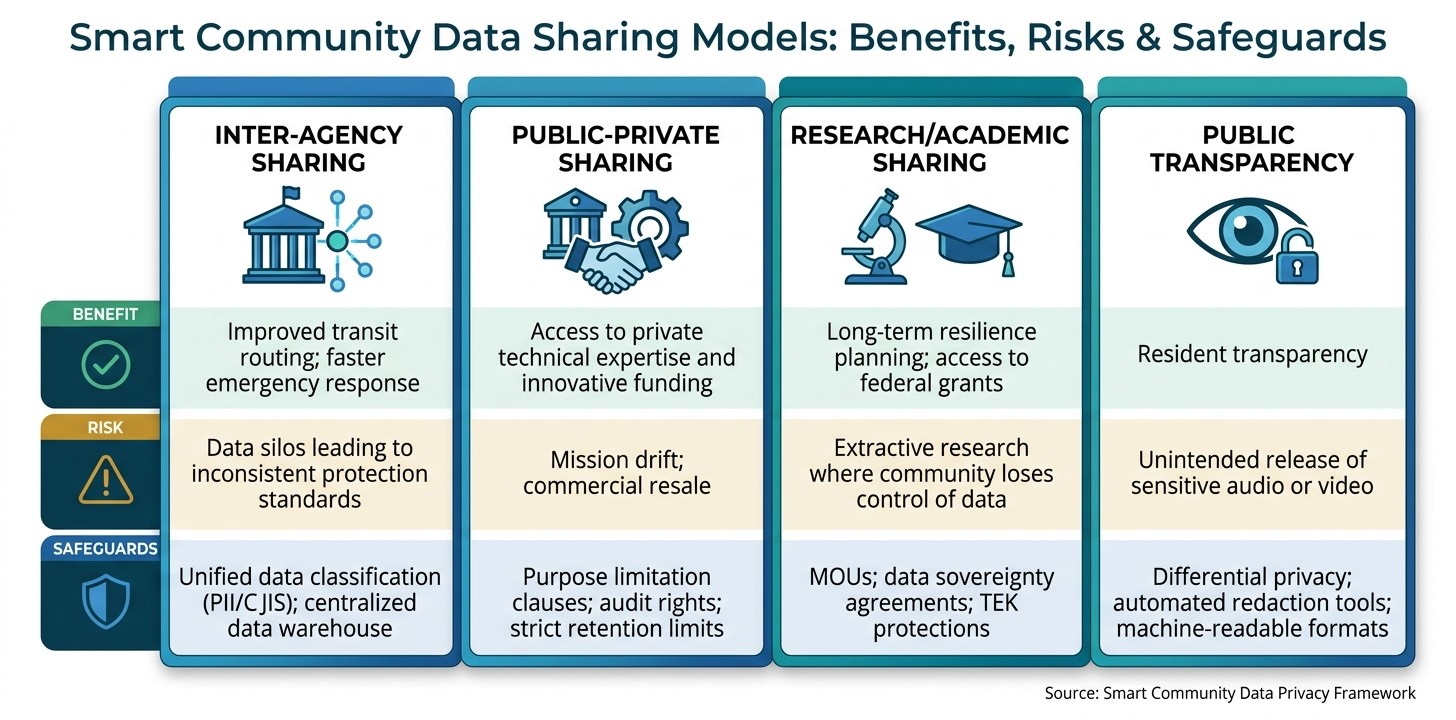
Smart Community Data Sharing Models: Benefits, Risks & Safeguards
Once responsibility is clear, the next issue is access: who can use the data, who can share it, and under what terms. In most smart community programs, control is shared rather than held by one party. Contracts and public policy set the rules for access, use, and disclosure.
Data Ownership, Stewardship, and Resident Interests
Ownership and stewardship are not the same job. A contract may name a city agency as the owner, while daily management sits with the IT team or an outside vendor. That split is common, but it needs one thing to work well: one clearly named public steward for the data.
The four roles below show up in most smart community data arrangements:
Role | Who It Usually Is | Core Responsibility |
|---|---|---|
Data Owner | City agency or public authority | Sets policy and decides who can access or share data |
Data Steward | City IT department or program manager | Manages data quality, security, and day-to-day compliance with policy |
Data Processor | Third-party vendor or software provider | Handles or analyzes data under strict instructions; limited to contracted use rights |
Data Subject | The resident the data describes | Has rights under applicable law and policy |
Once those roles are set, the next step is to put the rules into data-sharing agreements.
What Strong Data Sharing Agreements Should Include
A strong agreement needs to do more than say data can be shared. It should spell out the purpose, the limits, and what happens if those limits are ignored. Each agreement should define the exact reason the data is being shared and clearly ban repurposing it for unrelated uses, including targeted advertising, unless consent has been given.
Good agreements also cover the nuts and bolts:
Access controls
Retention schedules tied to the original purpose
De-identification standards
Breach notification timelines
Audit rights for the data owner
They also need to deal with subcontractors. If a vendor passes data to a downstream partner, the same rules should follow the data. Exit and portability clauses matter just as much. If the partnership ends, the public agency should be able to get its data back in a usable format and confirm that the vendor has deleted all copies.
When Data Can Be Shared Across Sectors and When It Should Not
Data sharing should be tested against purpose fit and the strength of safeguards, not legality alone. A use can be legal and still miss the point. The better question is whether the sharing matches the original purpose for collecting the data in the first place.
Sharing Model | Likely Benefit | Privacy Risk | Standard Safeguards |
|---|---|---|---|
Inter-agency | Improved transit routing; faster emergency response | Data silos leading to inconsistent protection standards | Unified data classification (PII/CJIS); centralized data warehouse |
Public-Private | Access to private technical expertise and innovative funding | Mission drift; commercial resale | Purpose limitation clauses; audit rights; strict retention limits |
Research/Academic | Long-term resilience planning; access to federal grants | Extractive research where community loses control of data | MOUs; data sovereignty agreements; TEK (Traditional Ecological Knowledge) protections |
Public Transparency | Resident transparency | Unintended release of sensitive audio or video | Differential privacy; automated redaction tools; machine-readable formats |
Standards like MDS can build privacy controls into shared mobility data.
How to Build Public Trust and Strong Privacy Governance
Privacy governance is where policy stops being abstract and starts shaping what residents deal with in daily life. If people trust that their data is handled with care, they’re far more likely to take part in the programs that rely on it.
What Transparent Communication Should Tell Residents
Once data-sharing rules are in place, residents need a plain, direct explanation of what those rules mean for their information. A long privacy policy hidden three clicks deep on a website won’t do the job. People need clear disclosure that covers six core areas:
Disclosure Category | Information to Include |
|---|---|
Collection | The exact data points being gathered, such as location or identity, how often they are collected, and the tools used, such as sensors or apps |
Usage | The main public purpose, such as reducing traffic, plus a clear ban on unrelated uses like advertising |
Access | Which agencies and private partners can see the data, and what kind of data-sharing agreements govern that access |
Retention | How long the data is kept, and the rules for anonymization or permanent deletion |
Resident Rights | How residents can request access, opt out, or contact privacy officers |
Outcomes | How the data was used and what changed as a result |
Just as important, report results back to the community so people can see the impact, not just the paperwork. Short summaries and simple visuals go a long way here. If the system uses privacy techniques such as differential privacy or on-device processing, residents should hear that in plain English too.
Governance Structures That Improve Accountability
Transparency means little if there’s no oversight behind it. Good governance puts review and response processes in place before something goes wrong.
Data governance boards should include community representatives, not only agency staff. That extra public voice helps keep decision-making grounded and visible. Teams also need an authoritative inventory and clear incident-response procedures so they can track systems, owners, assets, and data flows without guesswork. The Tulsa audit is a reminder that controls need to exist before gaps come to light.
How Privacy Fits Into Long-Term Infrastructure and Resilience Planning
Long-term resilience depends on building privacy controls into the system from day one. That includes data minimization, on-device processing, and other privacy techniques at the architecture level. Retrofitting those controls later is harder, more expensive, and often less effective.
Conclusion: Key Privacy Questions to Answer Before Expanding Smart Community Data Use
Before a team expands smart community data use, it should be able to state, in plain terms, the minimum data being collected, the public purpose, the steward, the sharing limits, the resident notice process, and the privacy controls built into the system.
FAQs
How do we know when data can identify a resident?
Data can identify a resident if it can be tied back to a specific person, even if it has been anonymized.
That’s the part people often miss. A dataset may look anonymous on its own, but once it’s matched with other datasets, a person can sometimes be identified again. Detailed records - like location history - can also expose daily patterns, home or work addresses, or even medical visits over time. Put it all together, and the person behind the data may no longer be hard to spot.
Who should control smart community data?
Control should balance transparency, privacy, and community sovereignty. In practice, that means shifting power back to the people whose data is being collected, even when government agencies or private companies run the systems.
Residents should be able to access their data, decide how it’s used, and delete it when they choose. That’s the baseline. Clear ownership agreements, privacy-by-design, and models like data trusts or cooperatives help keep data tied to local priorities and community benefit, instead of drifting toward outside interests.
What should residents be told about data use?
Residents need plain, jargon-free information about what data is being collected, why it’s being gathered, and how it will be stored, used, and shared.
They should also be told about informed consent, how their rights are protected, what options they have to limit data collection or delete personal information, and how to raise concerns or withdraw participation at any time.
Related Blog Posts
Latest Articles
©2025

Narrative Change and Power Building: The Missing Half of Advocacy
Narrative change is the process of disrupting dominant narratives that normalize inequity and advancing new narratives from historically marginalized communities.

Funding Resilience Without Federal Grants
BRIC is unreliable and FEMA is shrinking. Here's how cities fund climate resilience with dedicated revenue, blended finance, and a coordinating authority.

The ESG Blind Spot: How AI Is Finding Risks in Companies Nobody Else Is Watching
Norway's sovereign wealth fund uses AI to screen 7,200 portfolio companies for forced labor and corruption within 24 hours. The real story is the emerging-market coverage gap that traditional ESG data vendors miss — and what it means for any company with a global supply chain.
Narrative Change and Power Building: The Missing Half of Advocacy
Narrative change is the process of disrupting dominant narratives that normalize inequity and advancing new narratives from historically marginalized communities.
Funding Resilience Without Federal Grants
BRIC is unreliable and FEMA is shrinking. Here's how cities fund climate resilience with dedicated revenue, blended finance, and a coordinating authority.
The ESG Blind Spot: How AI Is Finding Risks in Companies Nobody Else Is Watching
Norway's sovereign wealth fund uses AI to screen 7,200 portfolio companies for forced labor and corruption within 24 hours. The real story is the emerging-market coverage gap that traditional ESG data vendors miss — and what it means for any company with a global supply chain.
FAQ
01
What does it really mean to “redefine profit”?
02
What makes Council Fire different?
03
Who does Council Fire work with?
04
What does working with Council Fire actually look like?
05
How does Council Fire help organizations turn big goals into action?
06
How does Council Fire define and measure success?
Aug 12, 2026
Smart Community Data Privacy: Key Questions
Capacity Building
In This Article
Key questions for smart community data: what’s collected, who controls it, sharing limits, retention, and resident notice.
Smart Community Data Privacy: Key Questions
If you cannot name what data you collect, why you collect it, who controls it, how long you keep it, and who can share it, you are not ready to expand a smart community program.
I see five questions at the center of this issue: what data is gathered, when it can identify a person, which U.S. rules and duties apply, how sharing is limited, and how residents are told what is happening. The article makes one point clear: privacy is not just an IT task. It is a public trust issue tied to records, contracts, oversight, and day-to-day use.
A few facts stand out:
In November 2025, Tulsa’s City Auditor started a governance audit across 15+ departments
The audit pointed to gaps in public-records handling and oversight of tools like ALPR
Data risk shifts fast when separate datasets are linked and a person can be identified again
High-risk uses like public safety and location tracking need tighter limits than system performance data
Resident notice should cover collection, use, access, retention, rights, and outcomes
Here is the short version of what I’d check first:
Data scope: Are you collecting only the minimum data needed?
Identity risk: Is the data personal, masked, or grouped?
Control: Is one public steward clearly named?
Sharing: Do contracts block unrelated uses and downstream pass-offs?
Retention: Is deletion automatic and tied to purpose?
Trust: Can residents see, question, and challenge data use?
The core lesson is simple: privacy risk grows when governance is vague, data lives too long, and sharing rules are loose. If I were reviewing a smart community program, I would start with those basics before looking at any new tool or vendor.
What Resident Data Is Collected and Why It Matters
Types of Data Smart Community Systems Collect
Smart community systems usually collect two broad kinds of data: infrastructure data and individual-level data.
Infrastructure data includes readings from water and sewer systems, capital projects, and sensors. This data shows how systems are working. It speaks to performance, not personal behavior. Individual-level data is more sensitive. It can include mobility patterns from ride-share and bike-share trips, license plate records from Automated License Plate Readers (ALPR), and 911 dispatch logs. Location data deserves special care because it can reveal where someone lives, where they work, their daily routines, and even sensitive visits.
That difference matters. Not all data creates the same level of privacy risk, and the risk shifts based on how the data is collected, linked, and used.
When Data Becomes Personal, Pseudonymous, or Aggregated
Privacy risk depends on more than the type of data collected. It also depends on whether that data can still point back to a person.
Personal data identifies someone directly. Pseudonymous data removes direct identifiers, but a person can still be identified if that data is matched with other datasets. Aggregated data describes groups rather than individuals, so the risk is lower.
The big issue is re-identification. A dataset may look anonymous on its own, then stop looking anonymous the moment it is connected with another source. That’s where many privacy problems begin.
How Privacy Risk Changes by Use Case
The same data can carry very different levels of risk depending on why it is being used. Context changes everything.
Use Case | Typical Data Types | Privacy Risk | Key Safeguards |
|---|---|---|---|
Public Safety | License plate data (ALPR), 911 dispatch | Higher risk | CJIS compliance, redaction controls, strict access and retention audits [1] |
Transportation Management | Mobility patterns, location data | Higher risk | Data minimization, anonymization techniques, operational planning focus |
Utility Optimization | Energy and water usage, sensor readings | Medium risk | Aggregation, de-identification, secure storage |
These categories need to be handled the same way across departments. If one team treats location data with care but another does not, gaps open up fast.
Once the data type and use are clear, the next step is figuring out who is accountable for governing it.
CISO Forum 2020 | Data Governance and Privacy challenges for smart communities
Legal and Ethical Duties That Apply in the United States
Once the data and risk are clear, the next step is figuring out who owns governance.
In the United States, there isn't one federal privacy law that covers every smart community use case. Most programs have to line up with sector-based rules and a set of core privacy principles: transparency, purpose limitation, minimization, retention controls, accountability, and security by design. Where the data calls for it, laws such as HIPAA for health data and FERPA for student records also apply.
Who Is Responsible for Privacy Compliance and Oversight
Privacy compliance is a shared job. Program teams, IT, legal, procurement, leadership, and records staff all have a part to play. Each department should have a data steward who handles day-to-day governance and applies sensitivity standards the same way across the board. It also helps to name one owner for the shared data inventory. That makes audits less painful and helps spot gaps before they turn into problems.
Public-private partnerships need extra care. Even when a private partner provides the technical infrastructure, government agencies should keep decision-making authority over the data and its use.
What Privacy by Design Looks Like in Procurement and Operations
Privacy by design means building safeguards into procurement and operations from day one. Vendor contracts should spell out security protocols, access controls, retention schedules, audit rights, and data portability or exit clauses [1].
In day-to-day operations, the rule is simple: collect only the data you need. Set automated deletion schedules tied to purpose, so data doesn't sit around longer than it should. For example, license plate reader data can be deleted after a set period, such as 30 days, unless a legal hold applies [1]. For high-volume audio and video records, automated redaction tools and tight disclosure controls can help prevent accidental release during public records responses [1].
How Equity and Civil Liberties Shape Privacy Decisions
Legal compliance is only part of the job. Ethical review has to go further, especially in communities that have lived with over-policing for years. Governance should look at community legitimacy and how people are affected, not just whether a program checks the legal boxes.
Surveillance tools such as Automated License Plate Readers can place more pressure on marginalized communities, which means governance should include civil liberties controls and regular audits [1]. A useful gut check is this: does the data use serve a public purpose, or does it push more risk onto people already carrying a heavier load?
Residents also need plain, usable ways to raise concerns or ask for limits on participation.
From there, the next issue is who controls the data and how sharing should be governed.
Who Controls the Data and How Sharing Should Work
Smart Community Data Sharing Models: Benefits, Risks & Safeguards
Once responsibility is clear, the next issue is access: who can use the data, who can share it, and under what terms. In most smart community programs, control is shared rather than held by one party. Contracts and public policy set the rules for access, use, and disclosure.
Data Ownership, Stewardship, and Resident Interests
Ownership and stewardship are not the same job. A contract may name a city agency as the owner, while daily management sits with the IT team or an outside vendor. That split is common, but it needs one thing to work well: one clearly named public steward for the data.
The four roles below show up in most smart community data arrangements:
Role | Who It Usually Is | Core Responsibility |
|---|---|---|
Data Owner | City agency or public authority | Sets policy and decides who can access or share data |
Data Steward | City IT department or program manager | Manages data quality, security, and day-to-day compliance with policy |
Data Processor | Third-party vendor or software provider | Handles or analyzes data under strict instructions; limited to contracted use rights |
Data Subject | The resident the data describes | Has rights under applicable law and policy |
Once those roles are set, the next step is to put the rules into data-sharing agreements.
What Strong Data Sharing Agreements Should Include
A strong agreement needs to do more than say data can be shared. It should spell out the purpose, the limits, and what happens if those limits are ignored. Each agreement should define the exact reason the data is being shared and clearly ban repurposing it for unrelated uses, including targeted advertising, unless consent has been given.
Good agreements also cover the nuts and bolts:
Access controls
Retention schedules tied to the original purpose
De-identification standards
Breach notification timelines
Audit rights for the data owner
They also need to deal with subcontractors. If a vendor passes data to a downstream partner, the same rules should follow the data. Exit and portability clauses matter just as much. If the partnership ends, the public agency should be able to get its data back in a usable format and confirm that the vendor has deleted all copies.
When Data Can Be Shared Across Sectors and When It Should Not
Data sharing should be tested against purpose fit and the strength of safeguards, not legality alone. A use can be legal and still miss the point. The better question is whether the sharing matches the original purpose for collecting the data in the first place.
Sharing Model | Likely Benefit | Privacy Risk | Standard Safeguards |
|---|---|---|---|
Inter-agency | Improved transit routing; faster emergency response | Data silos leading to inconsistent protection standards | Unified data classification (PII/CJIS); centralized data warehouse |
Public-Private | Access to private technical expertise and innovative funding | Mission drift; commercial resale | Purpose limitation clauses; audit rights; strict retention limits |
Research/Academic | Long-term resilience planning; access to federal grants | Extractive research where community loses control of data | MOUs; data sovereignty agreements; TEK (Traditional Ecological Knowledge) protections |
Public Transparency | Resident transparency | Unintended release of sensitive audio or video | Differential privacy; automated redaction tools; machine-readable formats |
Standards like MDS can build privacy controls into shared mobility data.
How to Build Public Trust and Strong Privacy Governance
Privacy governance is where policy stops being abstract and starts shaping what residents deal with in daily life. If people trust that their data is handled with care, they’re far more likely to take part in the programs that rely on it.
What Transparent Communication Should Tell Residents
Once data-sharing rules are in place, residents need a plain, direct explanation of what those rules mean for their information. A long privacy policy hidden three clicks deep on a website won’t do the job. People need clear disclosure that covers six core areas:
Disclosure Category | Information to Include |
|---|---|
Collection | The exact data points being gathered, such as location or identity, how often they are collected, and the tools used, such as sensors or apps |
Usage | The main public purpose, such as reducing traffic, plus a clear ban on unrelated uses like advertising |
Access | Which agencies and private partners can see the data, and what kind of data-sharing agreements govern that access |
Retention | How long the data is kept, and the rules for anonymization or permanent deletion |
Resident Rights | How residents can request access, opt out, or contact privacy officers |
Outcomes | How the data was used and what changed as a result |
Just as important, report results back to the community so people can see the impact, not just the paperwork. Short summaries and simple visuals go a long way here. If the system uses privacy techniques such as differential privacy or on-device processing, residents should hear that in plain English too.
Governance Structures That Improve Accountability
Transparency means little if there’s no oversight behind it. Good governance puts review and response processes in place before something goes wrong.
Data governance boards should include community representatives, not only agency staff. That extra public voice helps keep decision-making grounded and visible. Teams also need an authoritative inventory and clear incident-response procedures so they can track systems, owners, assets, and data flows without guesswork. The Tulsa audit is a reminder that controls need to exist before gaps come to light.
How Privacy Fits Into Long-Term Infrastructure and Resilience Planning
Long-term resilience depends on building privacy controls into the system from day one. That includes data minimization, on-device processing, and other privacy techniques at the architecture level. Retrofitting those controls later is harder, more expensive, and often less effective.
Conclusion: Key Privacy Questions to Answer Before Expanding Smart Community Data Use
Before a team expands smart community data use, it should be able to state, in plain terms, the minimum data being collected, the public purpose, the steward, the sharing limits, the resident notice process, and the privacy controls built into the system.
FAQs
How do we know when data can identify a resident?
Data can identify a resident if it can be tied back to a specific person, even if it has been anonymized.
That’s the part people often miss. A dataset may look anonymous on its own, but once it’s matched with other datasets, a person can sometimes be identified again. Detailed records - like location history - can also expose daily patterns, home or work addresses, or even medical visits over time. Put it all together, and the person behind the data may no longer be hard to spot.
Who should control smart community data?
Control should balance transparency, privacy, and community sovereignty. In practice, that means shifting power back to the people whose data is being collected, even when government agencies or private companies run the systems.
Residents should be able to access their data, decide how it’s used, and delete it when they choose. That’s the baseline. Clear ownership agreements, privacy-by-design, and models like data trusts or cooperatives help keep data tied to local priorities and community benefit, instead of drifting toward outside interests.
What should residents be told about data use?
Residents need plain, jargon-free information about what data is being collected, why it’s being gathered, and how it will be stored, used, and shared.
They should also be told about informed consent, how their rights are protected, what options they have to limit data collection or delete personal information, and how to raise concerns or withdraw participation at any time.
Related Blog Posts
Latest Articles
©2025
Narrative Change and Power Building: The Missing Half of Advocacy
Narrative change is the process of disrupting dominant narratives that normalize inequity and advancing new narratives from historically marginalized communities.
Funding Resilience Without Federal Grants
BRIC is unreliable and FEMA is shrinking. Here's how cities fund climate resilience with dedicated revenue, blended finance, and a coordinating authority.
The ESG Blind Spot: How AI Is Finding Risks in Companies Nobody Else Is Watching
Norway's sovereign wealth fund uses AI to screen 7,200 portfolio companies for forced labor and corruption within 24 hours. The real story is the emerging-market coverage gap that traditional ESG data vendors miss — and what it means for any company with a global supply chain.
FAQ
01
What does it really mean to “redefine profit”?
02
What makes Council Fire different?
03
Who does Council Fire work with?
04
What does working with Council Fire actually look like?
05
How does Council Fire help organizations turn big goals into action?
06
How does Council Fire define and measure success?
Aug 12, 2026
Smart Community Data Privacy: Key Questions
Capacity Building
In This Article
Key questions for smart community data: what’s collected, who controls it, sharing limits, retention, and resident notice.
Smart Community Data Privacy: Key Questions
If you cannot name what data you collect, why you collect it, who controls it, how long you keep it, and who can share it, you are not ready to expand a smart community program.
I see five questions at the center of this issue: what data is gathered, when it can identify a person, which U.S. rules and duties apply, how sharing is limited, and how residents are told what is happening. The article makes one point clear: privacy is not just an IT task. It is a public trust issue tied to records, contracts, oversight, and day-to-day use.
A few facts stand out:
In November 2025, Tulsa’s City Auditor started a governance audit across 15+ departments
The audit pointed to gaps in public-records handling and oversight of tools like ALPR
Data risk shifts fast when separate datasets are linked and a person can be identified again
High-risk uses like public safety and location tracking need tighter limits than system performance data
Resident notice should cover collection, use, access, retention, rights, and outcomes
Here is the short version of what I’d check first:
Data scope: Are you collecting only the minimum data needed?
Identity risk: Is the data personal, masked, or grouped?
Control: Is one public steward clearly named?
Sharing: Do contracts block unrelated uses and downstream pass-offs?
Retention: Is deletion automatic and tied to purpose?
Trust: Can residents see, question, and challenge data use?
The core lesson is simple: privacy risk grows when governance is vague, data lives too long, and sharing rules are loose. If I were reviewing a smart community program, I would start with those basics before looking at any new tool or vendor.
What Resident Data Is Collected and Why It Matters
Types of Data Smart Community Systems Collect
Smart community systems usually collect two broad kinds of data: infrastructure data and individual-level data.
Infrastructure data includes readings from water and sewer systems, capital projects, and sensors. This data shows how systems are working. It speaks to performance, not personal behavior. Individual-level data is more sensitive. It can include mobility patterns from ride-share and bike-share trips, license plate records from Automated License Plate Readers (ALPR), and 911 dispatch logs. Location data deserves special care because it can reveal where someone lives, where they work, their daily routines, and even sensitive visits.
That difference matters. Not all data creates the same level of privacy risk, and the risk shifts based on how the data is collected, linked, and used.
When Data Becomes Personal, Pseudonymous, or Aggregated
Privacy risk depends on more than the type of data collected. It also depends on whether that data can still point back to a person.
Personal data identifies someone directly. Pseudonymous data removes direct identifiers, but a person can still be identified if that data is matched with other datasets. Aggregated data describes groups rather than individuals, so the risk is lower.
The big issue is re-identification. A dataset may look anonymous on its own, then stop looking anonymous the moment it is connected with another source. That’s where many privacy problems begin.
How Privacy Risk Changes by Use Case
The same data can carry very different levels of risk depending on why it is being used. Context changes everything.
Use Case | Typical Data Types | Privacy Risk | Key Safeguards |
|---|---|---|---|
Public Safety | License plate data (ALPR), 911 dispatch | Higher risk | CJIS compliance, redaction controls, strict access and retention audits [1] |
Transportation Management | Mobility patterns, location data | Higher risk | Data minimization, anonymization techniques, operational planning focus |
Utility Optimization | Energy and water usage, sensor readings | Medium risk | Aggregation, de-identification, secure storage |
These categories need to be handled the same way across departments. If one team treats location data with care but another does not, gaps open up fast.
Once the data type and use are clear, the next step is figuring out who is accountable for governing it.
CISO Forum 2020 | Data Governance and Privacy challenges for smart communities
Legal and Ethical Duties That Apply in the United States
Once the data and risk are clear, the next step is figuring out who owns governance.
In the United States, there isn't one federal privacy law that covers every smart community use case. Most programs have to line up with sector-based rules and a set of core privacy principles: transparency, purpose limitation, minimization, retention controls, accountability, and security by design. Where the data calls for it, laws such as HIPAA for health data and FERPA for student records also apply.
Who Is Responsible for Privacy Compliance and Oversight
Privacy compliance is a shared job. Program teams, IT, legal, procurement, leadership, and records staff all have a part to play. Each department should have a data steward who handles day-to-day governance and applies sensitivity standards the same way across the board. It also helps to name one owner for the shared data inventory. That makes audits less painful and helps spot gaps before they turn into problems.
Public-private partnerships need extra care. Even when a private partner provides the technical infrastructure, government agencies should keep decision-making authority over the data and its use.
What Privacy by Design Looks Like in Procurement and Operations
Privacy by design means building safeguards into procurement and operations from day one. Vendor contracts should spell out security protocols, access controls, retention schedules, audit rights, and data portability or exit clauses [1].
In day-to-day operations, the rule is simple: collect only the data you need. Set automated deletion schedules tied to purpose, so data doesn't sit around longer than it should. For example, license plate reader data can be deleted after a set period, such as 30 days, unless a legal hold applies [1]. For high-volume audio and video records, automated redaction tools and tight disclosure controls can help prevent accidental release during public records responses [1].
How Equity and Civil Liberties Shape Privacy Decisions
Legal compliance is only part of the job. Ethical review has to go further, especially in communities that have lived with over-policing for years. Governance should look at community legitimacy and how people are affected, not just whether a program checks the legal boxes.
Surveillance tools such as Automated License Plate Readers can place more pressure on marginalized communities, which means governance should include civil liberties controls and regular audits [1]. A useful gut check is this: does the data use serve a public purpose, or does it push more risk onto people already carrying a heavier load?
Residents also need plain, usable ways to raise concerns or ask for limits on participation.
From there, the next issue is who controls the data and how sharing should be governed.
Who Controls the Data and How Sharing Should Work
Smart Community Data Sharing Models: Benefits, Risks & Safeguards
Once responsibility is clear, the next issue is access: who can use the data, who can share it, and under what terms. In most smart community programs, control is shared rather than held by one party. Contracts and public policy set the rules for access, use, and disclosure.
Data Ownership, Stewardship, and Resident Interests
Ownership and stewardship are not the same job. A contract may name a city agency as the owner, while daily management sits with the IT team or an outside vendor. That split is common, but it needs one thing to work well: one clearly named public steward for the data.
The four roles below show up in most smart community data arrangements:
Role | Who It Usually Is | Core Responsibility |
|---|---|---|
Data Owner | City agency or public authority | Sets policy and decides who can access or share data |
Data Steward | City IT department or program manager | Manages data quality, security, and day-to-day compliance with policy |
Data Processor | Third-party vendor or software provider | Handles or analyzes data under strict instructions; limited to contracted use rights |
Data Subject | The resident the data describes | Has rights under applicable law and policy |
Once those roles are set, the next step is to put the rules into data-sharing agreements.
What Strong Data Sharing Agreements Should Include
A strong agreement needs to do more than say data can be shared. It should spell out the purpose, the limits, and what happens if those limits are ignored. Each agreement should define the exact reason the data is being shared and clearly ban repurposing it for unrelated uses, including targeted advertising, unless consent has been given.
Good agreements also cover the nuts and bolts:
Access controls
Retention schedules tied to the original purpose
De-identification standards
Breach notification timelines
Audit rights for the data owner
They also need to deal with subcontractors. If a vendor passes data to a downstream partner, the same rules should follow the data. Exit and portability clauses matter just as much. If the partnership ends, the public agency should be able to get its data back in a usable format and confirm that the vendor has deleted all copies.
When Data Can Be Shared Across Sectors and When It Should Not
Data sharing should be tested against purpose fit and the strength of safeguards, not legality alone. A use can be legal and still miss the point. The better question is whether the sharing matches the original purpose for collecting the data in the first place.
Sharing Model | Likely Benefit | Privacy Risk | Standard Safeguards |
|---|---|---|---|
Inter-agency | Improved transit routing; faster emergency response | Data silos leading to inconsistent protection standards | Unified data classification (PII/CJIS); centralized data warehouse |
Public-Private | Access to private technical expertise and innovative funding | Mission drift; commercial resale | Purpose limitation clauses; audit rights; strict retention limits |
Research/Academic | Long-term resilience planning; access to federal grants | Extractive research where community loses control of data | MOUs; data sovereignty agreements; TEK (Traditional Ecological Knowledge) protections |
Public Transparency | Resident transparency | Unintended release of sensitive audio or video | Differential privacy; automated redaction tools; machine-readable formats |
Standards like MDS can build privacy controls into shared mobility data.
How to Build Public Trust and Strong Privacy Governance
Privacy governance is where policy stops being abstract and starts shaping what residents deal with in daily life. If people trust that their data is handled with care, they’re far more likely to take part in the programs that rely on it.
What Transparent Communication Should Tell Residents
Once data-sharing rules are in place, residents need a plain, direct explanation of what those rules mean for their information. A long privacy policy hidden three clicks deep on a website won’t do the job. People need clear disclosure that covers six core areas:
Disclosure Category | Information to Include |
|---|---|
Collection | The exact data points being gathered, such as location or identity, how often they are collected, and the tools used, such as sensors or apps |
Usage | The main public purpose, such as reducing traffic, plus a clear ban on unrelated uses like advertising |
Access | Which agencies and private partners can see the data, and what kind of data-sharing agreements govern that access |
Retention | How long the data is kept, and the rules for anonymization or permanent deletion |
Resident Rights | How residents can request access, opt out, or contact privacy officers |
Outcomes | How the data was used and what changed as a result |
Just as important, report results back to the community so people can see the impact, not just the paperwork. Short summaries and simple visuals go a long way here. If the system uses privacy techniques such as differential privacy or on-device processing, residents should hear that in plain English too.
Governance Structures That Improve Accountability
Transparency means little if there’s no oversight behind it. Good governance puts review and response processes in place before something goes wrong.
Data governance boards should include community representatives, not only agency staff. That extra public voice helps keep decision-making grounded and visible. Teams also need an authoritative inventory and clear incident-response procedures so they can track systems, owners, assets, and data flows without guesswork. The Tulsa audit is a reminder that controls need to exist before gaps come to light.
How Privacy Fits Into Long-Term Infrastructure and Resilience Planning
Long-term resilience depends on building privacy controls into the system from day one. That includes data minimization, on-device processing, and other privacy techniques at the architecture level. Retrofitting those controls later is harder, more expensive, and often less effective.
Conclusion: Key Privacy Questions to Answer Before Expanding Smart Community Data Use
Before a team expands smart community data use, it should be able to state, in plain terms, the minimum data being collected, the public purpose, the steward, the sharing limits, the resident notice process, and the privacy controls built into the system.
FAQs
How do we know when data can identify a resident?
Data can identify a resident if it can be tied back to a specific person, even if it has been anonymized.
That’s the part people often miss. A dataset may look anonymous on its own, but once it’s matched with other datasets, a person can sometimes be identified again. Detailed records - like location history - can also expose daily patterns, home or work addresses, or even medical visits over time. Put it all together, and the person behind the data may no longer be hard to spot.
Who should control smart community data?
Control should balance transparency, privacy, and community sovereignty. In practice, that means shifting power back to the people whose data is being collected, even when government agencies or private companies run the systems.
Residents should be able to access their data, decide how it’s used, and delete it when they choose. That’s the baseline. Clear ownership agreements, privacy-by-design, and models like data trusts or cooperatives help keep data tied to local priorities and community benefit, instead of drifting toward outside interests.
What should residents be told about data use?
Residents need plain, jargon-free information about what data is being collected, why it’s being gathered, and how it will be stored, used, and shared.
They should also be told about informed consent, how their rights are protected, what options they have to limit data collection or delete personal information, and how to raise concerns or withdraw participation at any time.
Related Blog Posts
Latest Articles
©2025
Narrative Change and Power Building: The Missing Half of Advocacy
Narrative change is the process of disrupting dominant narratives that normalize inequity and advancing new narratives from historically marginalized communities.
Funding Resilience Without Federal Grants
BRIC is unreliable and FEMA is shrinking. Here's how cities fund climate resilience with dedicated revenue, blended finance, and a coordinating authority.
The ESG Blind Spot: How AI Is Finding Risks in Companies Nobody Else Is Watching
Norway's sovereign wealth fund uses AI to screen 7,200 portfolio companies for forced labor and corruption within 24 hours. The real story is the emerging-market coverage gap that traditional ESG data vendors miss — and what it means for any company with a global supply chain.
FAQ
What does it really mean to “redefine profit”?
What makes Council Fire different?
Who does Council Fire work with?
What does working with Council Fire actually look like?
How does Council Fire help organizations turn big goals into action?
How does Council Fire define and measure success?