
Jan 28, 2026
Top 5 Regulatory Risks in Carbon Offset Investments
ESG Strategy
In This Article
Assess five regulatory threats to carbon offset investments — overcrediting, greenwashing enforcement, CBAM, shifting additionality rules, and fragmented standards.
Top 5 Regulatory Risks in Carbon Offset Investments
Investing in carbon offsets comes with growing risks as regulations tighten and enforcement actions increase. Here's what you need to know about the top challenges and how they could impact your investments:
Overcrediting and Invalidation: Projects often generate more credits than actual CO₂ reductions. Regulators can revoke these credits, leaving buyers exposed to financial losses.
Greenwashing and Legal Risks: Misleading claims about carbon offsets can trigger penalties from agencies like the FTC, SEC, and CFTC, as seen in recent high-profile enforcement cases.
Cross-Border Compliance: Rules like the EU's Carbon Border Adjustment Mechanism (CBAM) create hurdles for U.S. investors, with inconsistent regulations complicating global operations.
Policy Changes and Additionality Issues: Shifting climate policies and new technologies challenge the validity of older projects, raising uncertainty about future compliance.
Fragmented Standards: The lack of unified global standards for verifying carbon credits leads to inconsistent quality, pricing opacity, and investor skepticism.
With the voluntary carbon market projected to grow to $250 billion by 2050, these risks highlight the need for rigorous due diligence, strong contracts, and expert guidance. Regulatory scrutiny is increasing, and failure to address these challenges could lead to financial and reputational damage.
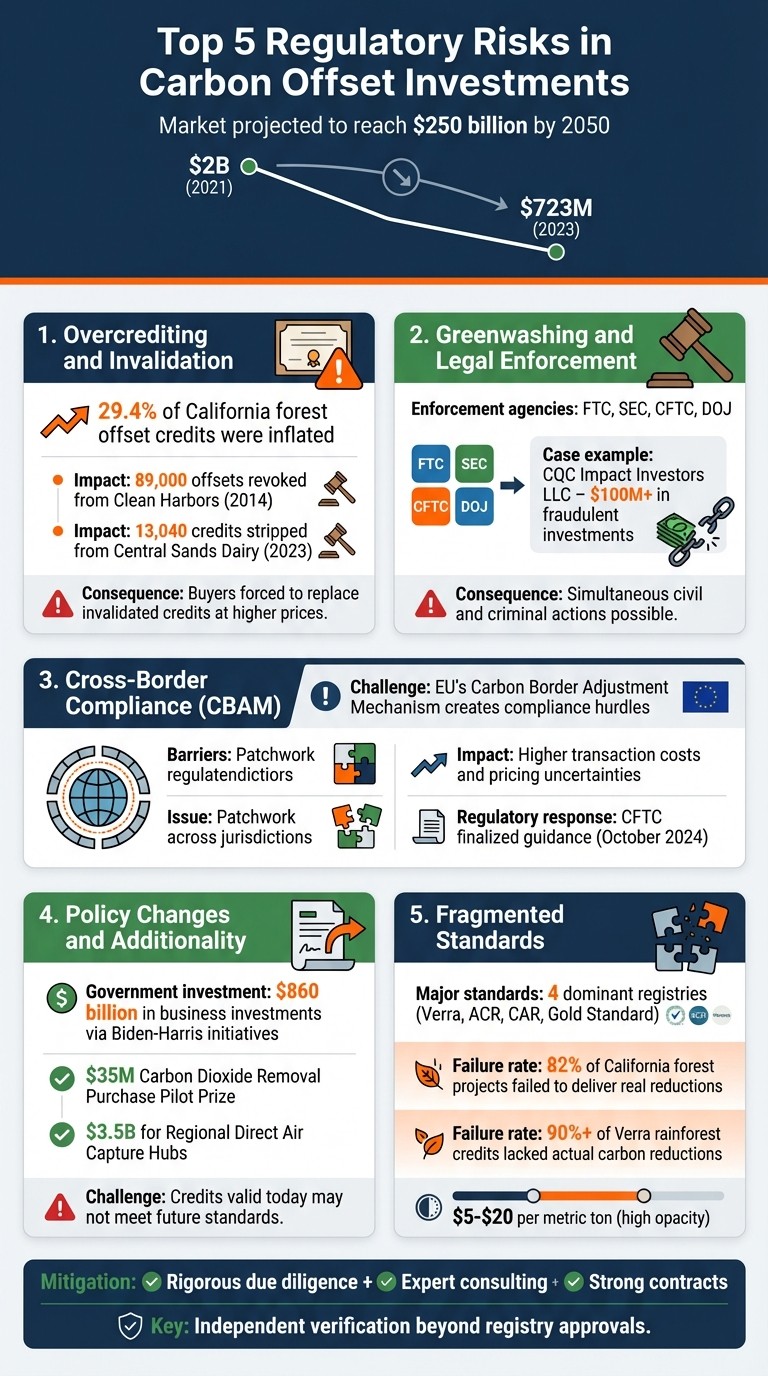
5 Key Regulatory Risks in Carbon Offset Investments
How Policy and Compliance Are Reshaping Voluntary Carbon Markets
1. Overcrediting and Credit Invalidation Risks
Regulators are tightening their grip on carbon markets, and overcrediting has become the elephant in the room. This happens when projects receive more credits than the actual CO2 they keep out of the atmosphere - usually because someone fudged the baseline numbers or used sloppy measurement techniques[9][11].
The real kicker? Regulators can claw back these credits years after the fact, even if you've already bought them and counted them toward your compliance targets. Buyers then get stuck holding the bag, often forced to replace invalidated credits at steeper prices[7][12]. California's track record proves this isn't theoretical - the state yanked nearly 89,000 offsets from Clean Harbors back in November 2014, then stripped another 13,040 credits from Central Sands Dairy in March 2023 after spotting permit and compliance violations[7][10].
The scale of the problem runs deeper than a few bad actors. One study of California's forest offset program found that nearly 29.4% of the credits examined were inflated, thanks to shaky regional carbon averages[9]. Research on cookstove initiatives looked even worse - some approaches were claiming three to five times the actual climate benefit[11]. As Julian Richardson, CEO of Parhelion Underwriting, put it:
"Invalidations are inevitable, though timing and targets remain uncertain."[7]
This unpredictability has shaken faith in the market. The voluntary carbon market cratered from $2 billion in 2021 to just $723 million in 2023 as investors lost patience with questionable credit quality[11]. Without rock-solid validation, these offsets remain a risky bet.
2. Greenwashing and Reputational Enforcement Risks
Federal regulators are keeping a close eye on carbon offset marketing, enforcing strict guidelines to prevent deceptive practices. The Federal Trade Commission (FTC), through its Green Guides under Section 5 of the FTC Act, prohibits misleading environmental claims. A specific clause, Section 260.5, bans companies from labeling something as a carbon offset if the reductions won’t occur for at least two years - unless this delay is clearly disclosed upfront [13][15]. Meanwhile, the Commodity Futures Trading Commission (CFTC) has taken an even tougher stance, using its anti-fraud authority to oversee both carbon credit derivatives and the underlying spot markets. This effort is spearheaded by its Environmental Fraud Task Force [14]. These stringent rules have already led to notable enforcement actions, highlighting the real risks companies face.
These aren’t just hypothetical concerns. In October 2024, the CFTC, Securities and Exchange Commission (SEC), and Department of Justice (DOJ) coordinated actions against CQC Impact Investors LLC and its leadership. The allegations? Inflating emissions data to fraudulently generate carbon credits valued in the tens of millions and securing over $100 million in investments through misrepresentation [3]. CQC avoided DOJ charges by voluntarily disclosing its misconduct and cooperating with the investigation, demonstrating how self-reporting can mitigate penalties [3]. This case underscores the consequences of deceptive carbon claims.
The fallout from such enforcement is severe. Beyond financial penalties, companies can face simultaneous civil and criminal actions [14][3]. Even worse, their reputations can take a massive hit when "carbon-neutral" claims are exposed as false. Regulators refer to these as "ghost credits" - offsets that fail to deliver measurable climate benefits [14]. CFTC Chairman Rostin Behnam summed it up, stating:
"Today's actions show strong enforcement is another critical step in ensuring the integrity of these markets." [3]
The pressure is only growing. The voluntary carbon market was valued at $2 billion in 2022 and is projected to reach $10 billion by 2030, making it a prime focus for regulatory oversight [14]. Companies must now back up their environmental claims with scientifically credible evidence [15]. Without this level of proof, they risk triggering investigations from multiple federal agencies all at once.
3. Compliance with Carbon Border Adjustment Mechanism (CBAM)
The European Union's CBAM, designed to regulate carbon-intensive imports into the EU, is creating significant compliance hurdles for U.S. investors in carbon offset markets. The core problem lies in the patchwork of regulations governing carbon accounting and offset eligibility across jurisdictions. This lack of uniformity extends to how different markets validate and price carbon credits, leaving companies grappling with inconsistent rules.
Carbon markets operate under two main frameworks. Mandatory compliance markets, such as emissions trading systems (ETS) and cap-and-trade programs, are legally enforced by governments, requiring entities to either cut emissions or purchase compliance credits [2][16]. On the other hand, voluntary carbon markets (VCMs) allow companies to buy credits representing one metric ton of carbon dioxide equivalent reductions to complement their own emission reduction efforts [2][16]. However, CBAM-style regulations often fail to recognize voluntary credits uniformly, leading to varying compliance requirements across jurisdictions [17].
This fragmented system results in higher transaction costs and pricing uncertainties. The absence of standardized protocols for quantifying and pricing voluntary carbon credits erodes investor confidence [2][16]. For instance, California enforces strict binding laws with heavy penalties for non-compliance, while federal guidelines remain largely non-binding. This forces companies to juggle conflicting requirements simultaneously [17].
Regulatory efforts to address these challenges are increasing. In October 2024, the CFTC finalized guidance aimed at standardizing voluntary carbon credit derivative contracts, with the goal of improving transparency and market integrity [2][16]. Analysts project that the voluntary carbon market could grow to $250 billion by 2050, making it a focal point for regulatory oversight [6].
For investors, the message is clear: navigating cross-border carbon offset investments now demands managing a maze of regulatory frameworks, each with its own definition of a valid credit. Without internationally aligned standards, compliance becomes a constantly shifting target, increasing the risk of violating regulations in one jurisdiction while adhering to them in another.
4. Policy Changes and Additionality Challenges
Policy changes are reshaping the carbon offset landscape, requiring project baselines to keep pace with evolving national climate goals, emissions trajectories, and advancements in decarbonization technologies. This constant evolution creates a precarious situation for investors, as credits that are valid today may no longer meet future regulatory standards [4].
At the core of this issue lies the additionality test - a critical measure to determine if a carbon offset project delivers emissions reductions that wouldn’t occur without the financial backing of the carbon credit market [4]. However, as governments introduce new subsidies, mandate cleaner technologies, or tighten emissions standards, activities once deemed additional may become standard practice. This forces project developers to repeatedly prove additionality in response to shifting policies.
"Baselines for emissions reduction and removal activities... [must] evolve over time to reflect advancements in national climate policy, emissions pathways and decarbonization practices and technology." - Joint Statement of Policy, U.S. Government [4]
Adding to the complexity, the lack of consistent quantification methods for emissions reductions poses significant challenges. Different protocols can yield vastly different outcomes for the same project, incentivizing developers to select methodologies that maximize credit generation rather than ensuring accurate environmental impact [2].
The Biden-Harris Administration’s climate initiatives have further complicated this landscape. By spurring over $860 billion in business investments through public incentives - such as a $35 million Carbon Dioxide Removal Purchase Pilot Prize and up to $3.5 billion allocated for Regional Direct Air Capture Hubs - these efforts aim to advance carbon removal technologies [18]. However, these investments also raise the bar for additionality. As government-backed solutions become commercially viable, existing offset projects may struggle to prove their relevance. These shifting policies add layers of uncertainty, setting the stage for the upcoming discussion on standardization and verification challenges.
5. Fragmented Standards and Verification Uncertainties
The carbon offset market lacks a unified global standard, leaving investors responsible for verifying the permanence, additionality, and exclusivity of each credit they purchase [8][21]. This fragmented system has resulted in a market dominated by four major standards - Verified Carbon Standard (Verra), American Carbon Registry, Climate Action Reserve, and Gold Standard. While these standards account for nearly all voluntary carbon offsets globally [5], they rely on differing methodologies.
Without standardized protocols, the same project can yield vastly different estimates of emission reductions depending on the approach used. This inconsistency encourages "protocol shopping", where developers favor crediting programs that maximize the number of credits generated, rather than those that most accurately reflect climate impact [2]. For instance, research in California revealed that 82% of forest-based offset projects failed to deliver genuine emissions reductions, and over 90% of rainforest credits certified by Verra did not represent actual carbon reductions [5][20]. Such discrepancies not only undermine trust but also create challenges in determining fair market pricing.
This lack of consistency also leads to pricing opacity. Investors often find it difficult to determine whether a credit's price - typically ranging from $5 to $20 per metric ton [5] - accurately reflects real climate benefits or merely aligns with the methodology of the issuing registry. This opacity can obscure fraudulent practices. In October 2024, U.S. enforcement agencies, including the Department of Justice, the CFTC, and the SEC, took coordinated action against CQC Impact Investors LLC (C-Quest) and its former CEO Kenneth Newcombe. The charges involved manipulated data related to cookstove and LED lightbulb projects in sub-Saharan Africa and Southeast Asia. As a result, the company agreed to pay a $1,000,000 civil penalty and cancel millions of invalid credits, while Newcombe faced securities fraud charges tied to an investor's $250 million commitment [19][20].
Beyond the private registries, similar issues plague other sectors. Standards like LEED and GRESB in real estate often fail to align with international benchmarks, leading to verification gaps [21]. This misalignment forces companies to navigate competing frameworks, even as regulatory scrutiny intensifies. U.S. agencies are increasingly using anti-fraud measures to oversee voluntary carbon markets [19]. These overlapping and inconsistent standards amplify regulatory uncertainties for investors, emphasizing the urgent need for stricter oversight across all segments of the market.
Mitigation Strategies Through Expert Consulting
Navigating the intricate regulatory landscape of carbon offset investments often requires expertise that many organizations lack internally. Expert consulting services fill this gap, bridging ambitious climate goals with the need for regulatory compliance. Recent enforcement actions have highlighted the risks of non-compliance, demonstrating why proactive guidance is so critical [6].
Consultants play a key role in establishing robust internal compliance systems to address potential issues before they arise. These systems include measures like testing data accuracy, setting up whistleblower channels, and conducting independent internal investigations [6]. Such preventative steps not only guard against data manipulation but also help organizations meet increasingly stringent regulatory requirements.
On the contractual front, specialized legal counsel ensures purchase agreements include strong representations, warranties, and indemnification clauses to protect buyers from the risk of credit invalidation [1]. This is especially important in light of findings that 82% of forest-based projects in California’s cap-and-trade program likely failed to achieve real emissions reductions [5]. Consultants also collaborate with sustainability professionals and greenhouse gas modeling experts to ensure that carbon credits meet strict standards for additionality, permanence, and conservative quantification [4].
Organizations like Council Fire assist clients in turning sustainability strategies into actionable results. They help build resilient carbon offset portfolios that align with evolving regulations. This often involves navigating the fragmented landscape of voluntary standards - such as Verra, Gold Standard, American Carbon Registry, and Climate Action Reserve - and aligning strategies with the Biden administration's seven principles for voluntary carbon markets [4].
Another critical focus of expert consulting is prioritizing emissions reductions within the value chain over reliance on offsets. This approach not only meets regulatory expectations but also reduces the risk of greenwashing [4]. As CFTC Commissioner Romero pointed out:
"Greenwashing is one type of fraud that would fall within the prohibited purview of the Commodity Exchange Act" [1].
With the voluntary carbon market expected to grow to $250 billion by 2050 [6], the investment in expert consulting is a small price to pay compared to the potential financial and reputational consequences of non-compliance.
Conclusion
Investing in carbon offsets presents opportunities for climate-conscious organizations, but the regulatory landscape has grown far more stringent. Oversight from agencies like the CFTC, SEC, and DOJ now classifies carbon credits as commodities, bringing them under anti-fraud and anti-manipulation rules. The key risks - overcrediting, greenwashing enforcement, CBAM compliance, additionality verification, and inconsistent standards - make it clear that investors must proceed with caution and diligence.
The stakes are only increasing. With the voluntary carbon market projected to hit $250 billion by 2050 [6], the financial and reputational risks tied to non-compliance are substantial. Recent enforcement actions show regulators are no longer issuing warnings - they are pursuing aggressive legal action. These cases reinforce the tangible risks tied to overcrediting, misleading claims, and fragmented standards.
To navigate these challenges, investors must prioritize thorough verification processes. This includes validating claims of additionality, permanence, accurate quantification, and ensuring no double-counting occurs [2][16]. Relying solely on registry approvals is insufficient; independent assessments of methodologies are crucial. Strong risk management strategies should incorporate robust contracts, internal compliance programs, and regular monitoring to adapt to evolving standards.
Organizations that view regulatory compliance as a strategic imperative are better equipped to seize market opportunities while avoiding costly enforcement actions. As regulatory scrutiny intensifies and agencies collaborate more closely, those implementing comprehensive compliance frameworks today will be well-positioned to succeed in the future carbon market. Council Fire offers expert guidance to help organizations navigate these complexities and build resilient, compliant carbon offset strategies.
FAQs
How can investors reduce the risk of carbon credits becoming invalid in offset investments?
To avoid the risk of carbon credits losing their value, investors need to prioritize the quality and trustworthiness of the credits they acquire. This means keeping an eye on changing regulatory standards, including those from the CFTC and SEC, and performing detailed evaluations of the offset projects. Ensuring these projects meet stringent environmental benchmarks and deliver measurable, long-term results is crucial.
Collaborating with experienced partners and advisors who are well-versed in carbon markets can also help investors manage compliance more effectively and reduce the risk of regulatory uncertainties.
What impact does the EU’s Carbon Border Adjustment Mechanism (CBAM) have on U.S. investors in carbon markets?
The EU’s Carbon Border Adjustment Mechanism (CBAM) introduces a new layer of complexity for U.S. investors in carbon markets, potentially raising compliance costs and creating additional regulatory challenges. CBAM aims to curb carbon leakage by applying tariffs on imports of specific goods that fail to meet the EU’s climate standards. This policy encourages foreign producers, including U.S.-based companies, to cut emissions to avoid these tariffs.
For U.S. investors, this shift could mean heightened scrutiny and increased costs for investments tied to carbon-intensive industries or offset projects, particularly if supply chains or goods fall under CBAM’s scope. However, this mechanism also opens doors for investments in low-carbon technologies and initiatives that align with EU regulations. These evolving policies could create opportunities for those ready to adapt and focus on sustainable projects, ensuring continued market access and a competitive edge.
Why is proving additionality critical for carbon offset projects, and how is it verified?
Proving additionality is a critical aspect of carbon offset projects because it ensures that the emissions reductions or removals are the direct result of the project itself - reductions that wouldn’t have occurred otherwise. This concept is vital for maintaining the integrity of carbon credits, preventing misleading practices like "greenwashing", and ensuring these credits make a genuine contribution to environmental goals. Without additionality, there’s a risk that credits could be issued for reductions that would have happened anyway, undermining their purpose.
To establish additionality, projects go through rigorous assessments to confirm that they depend on revenue from carbon credits to be financially or technically feasible. This process involves creating a baseline scenario to illustrate what would occur in the absence of the project and proving that the initiative goes beyond regulatory obligations or standard practices. Transparent documentation and thorough validation processes further reinforce the credibility of these projects, building confidence in carbon markets and driving impactful climate solutions.
Related Blog Posts
Latest Articles
©2025



FAQ
01
What does it really mean to “redefine profit”?
02
What makes Council Fire different?
03
Who does Council Fire you work with?
04
What does working with Council Fire actually look like?
05
How does Council Fire help organizations turn big goals into action?
06
How does Council Fire define and measure success?
Jan 28, 2026
Top 5 Regulatory Risks in Carbon Offset Investments
ESG Strategy
In This Article
Assess five regulatory threats to carbon offset investments — overcrediting, greenwashing enforcement, CBAM, shifting additionality rules, and fragmented standards.
Top 5 Regulatory Risks in Carbon Offset Investments
Investing in carbon offsets comes with growing risks as regulations tighten and enforcement actions increase. Here's what you need to know about the top challenges and how they could impact your investments:
Overcrediting and Invalidation: Projects often generate more credits than actual CO₂ reductions. Regulators can revoke these credits, leaving buyers exposed to financial losses.
Greenwashing and Legal Risks: Misleading claims about carbon offsets can trigger penalties from agencies like the FTC, SEC, and CFTC, as seen in recent high-profile enforcement cases.
Cross-Border Compliance: Rules like the EU's Carbon Border Adjustment Mechanism (CBAM) create hurdles for U.S. investors, with inconsistent regulations complicating global operations.
Policy Changes and Additionality Issues: Shifting climate policies and new technologies challenge the validity of older projects, raising uncertainty about future compliance.
Fragmented Standards: The lack of unified global standards for verifying carbon credits leads to inconsistent quality, pricing opacity, and investor skepticism.
With the voluntary carbon market projected to grow to $250 billion by 2050, these risks highlight the need for rigorous due diligence, strong contracts, and expert guidance. Regulatory scrutiny is increasing, and failure to address these challenges could lead to financial and reputational damage.
5 Key Regulatory Risks in Carbon Offset Investments
How Policy and Compliance Are Reshaping Voluntary Carbon Markets
1. Overcrediting and Credit Invalidation Risks
Regulators are tightening their grip on carbon markets, and overcrediting has become the elephant in the room. This happens when projects receive more credits than the actual CO2 they keep out of the atmosphere - usually because someone fudged the baseline numbers or used sloppy measurement techniques[9][11].
The real kicker? Regulators can claw back these credits years after the fact, even if you've already bought them and counted them toward your compliance targets. Buyers then get stuck holding the bag, often forced to replace invalidated credits at steeper prices[7][12]. California's track record proves this isn't theoretical - the state yanked nearly 89,000 offsets from Clean Harbors back in November 2014, then stripped another 13,040 credits from Central Sands Dairy in March 2023 after spotting permit and compliance violations[7][10].
The scale of the problem runs deeper than a few bad actors. One study of California's forest offset program found that nearly 29.4% of the credits examined were inflated, thanks to shaky regional carbon averages[9]. Research on cookstove initiatives looked even worse - some approaches were claiming three to five times the actual climate benefit[11]. As Julian Richardson, CEO of Parhelion Underwriting, put it:
"Invalidations are inevitable, though timing and targets remain uncertain."[7]
This unpredictability has shaken faith in the market. The voluntary carbon market cratered from $2 billion in 2021 to just $723 million in 2023 as investors lost patience with questionable credit quality[11]. Without rock-solid validation, these offsets remain a risky bet.
2. Greenwashing and Reputational Enforcement Risks
Federal regulators are keeping a close eye on carbon offset marketing, enforcing strict guidelines to prevent deceptive practices. The Federal Trade Commission (FTC), through its Green Guides under Section 5 of the FTC Act, prohibits misleading environmental claims. A specific clause, Section 260.5, bans companies from labeling something as a carbon offset if the reductions won’t occur for at least two years - unless this delay is clearly disclosed upfront [13][15]. Meanwhile, the Commodity Futures Trading Commission (CFTC) has taken an even tougher stance, using its anti-fraud authority to oversee both carbon credit derivatives and the underlying spot markets. This effort is spearheaded by its Environmental Fraud Task Force [14]. These stringent rules have already led to notable enforcement actions, highlighting the real risks companies face.
These aren’t just hypothetical concerns. In October 2024, the CFTC, Securities and Exchange Commission (SEC), and Department of Justice (DOJ) coordinated actions against CQC Impact Investors LLC and its leadership. The allegations? Inflating emissions data to fraudulently generate carbon credits valued in the tens of millions and securing over $100 million in investments through misrepresentation [3]. CQC avoided DOJ charges by voluntarily disclosing its misconduct and cooperating with the investigation, demonstrating how self-reporting can mitigate penalties [3]. This case underscores the consequences of deceptive carbon claims.
The fallout from such enforcement is severe. Beyond financial penalties, companies can face simultaneous civil and criminal actions [14][3]. Even worse, their reputations can take a massive hit when "carbon-neutral" claims are exposed as false. Regulators refer to these as "ghost credits" - offsets that fail to deliver measurable climate benefits [14]. CFTC Chairman Rostin Behnam summed it up, stating:
"Today's actions show strong enforcement is another critical step in ensuring the integrity of these markets." [3]
The pressure is only growing. The voluntary carbon market was valued at $2 billion in 2022 and is projected to reach $10 billion by 2030, making it a prime focus for regulatory oversight [14]. Companies must now back up their environmental claims with scientifically credible evidence [15]. Without this level of proof, they risk triggering investigations from multiple federal agencies all at once.
3. Compliance with Carbon Border Adjustment Mechanism (CBAM)
The European Union's CBAM, designed to regulate carbon-intensive imports into the EU, is creating significant compliance hurdles for U.S. investors in carbon offset markets. The core problem lies in the patchwork of regulations governing carbon accounting and offset eligibility across jurisdictions. This lack of uniformity extends to how different markets validate and price carbon credits, leaving companies grappling with inconsistent rules.
Carbon markets operate under two main frameworks. Mandatory compliance markets, such as emissions trading systems (ETS) and cap-and-trade programs, are legally enforced by governments, requiring entities to either cut emissions or purchase compliance credits [2][16]. On the other hand, voluntary carbon markets (VCMs) allow companies to buy credits representing one metric ton of carbon dioxide equivalent reductions to complement their own emission reduction efforts [2][16]. However, CBAM-style regulations often fail to recognize voluntary credits uniformly, leading to varying compliance requirements across jurisdictions [17].
This fragmented system results in higher transaction costs and pricing uncertainties. The absence of standardized protocols for quantifying and pricing voluntary carbon credits erodes investor confidence [2][16]. For instance, California enforces strict binding laws with heavy penalties for non-compliance, while federal guidelines remain largely non-binding. This forces companies to juggle conflicting requirements simultaneously [17].
Regulatory efforts to address these challenges are increasing. In October 2024, the CFTC finalized guidance aimed at standardizing voluntary carbon credit derivative contracts, with the goal of improving transparency and market integrity [2][16]. Analysts project that the voluntary carbon market could grow to $250 billion by 2050, making it a focal point for regulatory oversight [6].
For investors, the message is clear: navigating cross-border carbon offset investments now demands managing a maze of regulatory frameworks, each with its own definition of a valid credit. Without internationally aligned standards, compliance becomes a constantly shifting target, increasing the risk of violating regulations in one jurisdiction while adhering to them in another.
4. Policy Changes and Additionality Challenges
Policy changes are reshaping the carbon offset landscape, requiring project baselines to keep pace with evolving national climate goals, emissions trajectories, and advancements in decarbonization technologies. This constant evolution creates a precarious situation for investors, as credits that are valid today may no longer meet future regulatory standards [4].
At the core of this issue lies the additionality test - a critical measure to determine if a carbon offset project delivers emissions reductions that wouldn’t occur without the financial backing of the carbon credit market [4]. However, as governments introduce new subsidies, mandate cleaner technologies, or tighten emissions standards, activities once deemed additional may become standard practice. This forces project developers to repeatedly prove additionality in response to shifting policies.
"Baselines for emissions reduction and removal activities... [must] evolve over time to reflect advancements in national climate policy, emissions pathways and decarbonization practices and technology." - Joint Statement of Policy, U.S. Government [4]
Adding to the complexity, the lack of consistent quantification methods for emissions reductions poses significant challenges. Different protocols can yield vastly different outcomes for the same project, incentivizing developers to select methodologies that maximize credit generation rather than ensuring accurate environmental impact [2].
The Biden-Harris Administration’s climate initiatives have further complicated this landscape. By spurring over $860 billion in business investments through public incentives - such as a $35 million Carbon Dioxide Removal Purchase Pilot Prize and up to $3.5 billion allocated for Regional Direct Air Capture Hubs - these efforts aim to advance carbon removal technologies [18]. However, these investments also raise the bar for additionality. As government-backed solutions become commercially viable, existing offset projects may struggle to prove their relevance. These shifting policies add layers of uncertainty, setting the stage for the upcoming discussion on standardization and verification challenges.
5. Fragmented Standards and Verification Uncertainties
The carbon offset market lacks a unified global standard, leaving investors responsible for verifying the permanence, additionality, and exclusivity of each credit they purchase [8][21]. This fragmented system has resulted in a market dominated by four major standards - Verified Carbon Standard (Verra), American Carbon Registry, Climate Action Reserve, and Gold Standard. While these standards account for nearly all voluntary carbon offsets globally [5], they rely on differing methodologies.
Without standardized protocols, the same project can yield vastly different estimates of emission reductions depending on the approach used. This inconsistency encourages "protocol shopping", where developers favor crediting programs that maximize the number of credits generated, rather than those that most accurately reflect climate impact [2]. For instance, research in California revealed that 82% of forest-based offset projects failed to deliver genuine emissions reductions, and over 90% of rainforest credits certified by Verra did not represent actual carbon reductions [5][20]. Such discrepancies not only undermine trust but also create challenges in determining fair market pricing.
This lack of consistency also leads to pricing opacity. Investors often find it difficult to determine whether a credit's price - typically ranging from $5 to $20 per metric ton [5] - accurately reflects real climate benefits or merely aligns with the methodology of the issuing registry. This opacity can obscure fraudulent practices. In October 2024, U.S. enforcement agencies, including the Department of Justice, the CFTC, and the SEC, took coordinated action against CQC Impact Investors LLC (C-Quest) and its former CEO Kenneth Newcombe. The charges involved manipulated data related to cookstove and LED lightbulb projects in sub-Saharan Africa and Southeast Asia. As a result, the company agreed to pay a $1,000,000 civil penalty and cancel millions of invalid credits, while Newcombe faced securities fraud charges tied to an investor's $250 million commitment [19][20].
Beyond the private registries, similar issues plague other sectors. Standards like LEED and GRESB in real estate often fail to align with international benchmarks, leading to verification gaps [21]. This misalignment forces companies to navigate competing frameworks, even as regulatory scrutiny intensifies. U.S. agencies are increasingly using anti-fraud measures to oversee voluntary carbon markets [19]. These overlapping and inconsistent standards amplify regulatory uncertainties for investors, emphasizing the urgent need for stricter oversight across all segments of the market.
Mitigation Strategies Through Expert Consulting
Navigating the intricate regulatory landscape of carbon offset investments often requires expertise that many organizations lack internally. Expert consulting services fill this gap, bridging ambitious climate goals with the need for regulatory compliance. Recent enforcement actions have highlighted the risks of non-compliance, demonstrating why proactive guidance is so critical [6].
Consultants play a key role in establishing robust internal compliance systems to address potential issues before they arise. These systems include measures like testing data accuracy, setting up whistleblower channels, and conducting independent internal investigations [6]. Such preventative steps not only guard against data manipulation but also help organizations meet increasingly stringent regulatory requirements.
On the contractual front, specialized legal counsel ensures purchase agreements include strong representations, warranties, and indemnification clauses to protect buyers from the risk of credit invalidation [1]. This is especially important in light of findings that 82% of forest-based projects in California’s cap-and-trade program likely failed to achieve real emissions reductions [5]. Consultants also collaborate with sustainability professionals and greenhouse gas modeling experts to ensure that carbon credits meet strict standards for additionality, permanence, and conservative quantification [4].
Organizations like Council Fire assist clients in turning sustainability strategies into actionable results. They help build resilient carbon offset portfolios that align with evolving regulations. This often involves navigating the fragmented landscape of voluntary standards - such as Verra, Gold Standard, American Carbon Registry, and Climate Action Reserve - and aligning strategies with the Biden administration's seven principles for voluntary carbon markets [4].
Another critical focus of expert consulting is prioritizing emissions reductions within the value chain over reliance on offsets. This approach not only meets regulatory expectations but also reduces the risk of greenwashing [4]. As CFTC Commissioner Romero pointed out:
"Greenwashing is one type of fraud that would fall within the prohibited purview of the Commodity Exchange Act" [1].
With the voluntary carbon market expected to grow to $250 billion by 2050 [6], the investment in expert consulting is a small price to pay compared to the potential financial and reputational consequences of non-compliance.
Conclusion
Investing in carbon offsets presents opportunities for climate-conscious organizations, but the regulatory landscape has grown far more stringent. Oversight from agencies like the CFTC, SEC, and DOJ now classifies carbon credits as commodities, bringing them under anti-fraud and anti-manipulation rules. The key risks - overcrediting, greenwashing enforcement, CBAM compliance, additionality verification, and inconsistent standards - make it clear that investors must proceed with caution and diligence.
The stakes are only increasing. With the voluntary carbon market projected to hit $250 billion by 2050 [6], the financial and reputational risks tied to non-compliance are substantial. Recent enforcement actions show regulators are no longer issuing warnings - they are pursuing aggressive legal action. These cases reinforce the tangible risks tied to overcrediting, misleading claims, and fragmented standards.
To navigate these challenges, investors must prioritize thorough verification processes. This includes validating claims of additionality, permanence, accurate quantification, and ensuring no double-counting occurs [2][16]. Relying solely on registry approvals is insufficient; independent assessments of methodologies are crucial. Strong risk management strategies should incorporate robust contracts, internal compliance programs, and regular monitoring to adapt to evolving standards.
Organizations that view regulatory compliance as a strategic imperative are better equipped to seize market opportunities while avoiding costly enforcement actions. As regulatory scrutiny intensifies and agencies collaborate more closely, those implementing comprehensive compliance frameworks today will be well-positioned to succeed in the future carbon market. Council Fire offers expert guidance to help organizations navigate these complexities and build resilient, compliant carbon offset strategies.
FAQs
How can investors reduce the risk of carbon credits becoming invalid in offset investments?
To avoid the risk of carbon credits losing their value, investors need to prioritize the quality and trustworthiness of the credits they acquire. This means keeping an eye on changing regulatory standards, including those from the CFTC and SEC, and performing detailed evaluations of the offset projects. Ensuring these projects meet stringent environmental benchmarks and deliver measurable, long-term results is crucial.
Collaborating with experienced partners and advisors who are well-versed in carbon markets can also help investors manage compliance more effectively and reduce the risk of regulatory uncertainties.
What impact does the EU’s Carbon Border Adjustment Mechanism (CBAM) have on U.S. investors in carbon markets?
The EU’s Carbon Border Adjustment Mechanism (CBAM) introduces a new layer of complexity for U.S. investors in carbon markets, potentially raising compliance costs and creating additional regulatory challenges. CBAM aims to curb carbon leakage by applying tariffs on imports of specific goods that fail to meet the EU’s climate standards. This policy encourages foreign producers, including U.S.-based companies, to cut emissions to avoid these tariffs.
For U.S. investors, this shift could mean heightened scrutiny and increased costs for investments tied to carbon-intensive industries or offset projects, particularly if supply chains or goods fall under CBAM’s scope. However, this mechanism also opens doors for investments in low-carbon technologies and initiatives that align with EU regulations. These evolving policies could create opportunities for those ready to adapt and focus on sustainable projects, ensuring continued market access and a competitive edge.
Why is proving additionality critical for carbon offset projects, and how is it verified?
Proving additionality is a critical aspect of carbon offset projects because it ensures that the emissions reductions or removals are the direct result of the project itself - reductions that wouldn’t have occurred otherwise. This concept is vital for maintaining the integrity of carbon credits, preventing misleading practices like "greenwashing", and ensuring these credits make a genuine contribution to environmental goals. Without additionality, there’s a risk that credits could be issued for reductions that would have happened anyway, undermining their purpose.
To establish additionality, projects go through rigorous assessments to confirm that they depend on revenue from carbon credits to be financially or technically feasible. This process involves creating a baseline scenario to illustrate what would occur in the absence of the project and proving that the initiative goes beyond regulatory obligations or standard practices. Transparent documentation and thorough validation processes further reinforce the credibility of these projects, building confidence in carbon markets and driving impactful climate solutions.
Related Blog Posts
FAQ
01
What does it really mean to “redefine profit”?
02
What makes Council Fire different?
03
Who does Council Fire you work with?
04
What does working with Council Fire actually look like?
05
How does Council Fire help organizations turn big goals into action?
06
How does Council Fire define and measure success?
Jan 28, 2026
Top 5 Regulatory Risks in Carbon Offset Investments
ESG Strategy
In This Article
Assess five regulatory threats to carbon offset investments — overcrediting, greenwashing enforcement, CBAM, shifting additionality rules, and fragmented standards.
Top 5 Regulatory Risks in Carbon Offset Investments
Investing in carbon offsets comes with growing risks as regulations tighten and enforcement actions increase. Here's what you need to know about the top challenges and how they could impact your investments:
Overcrediting and Invalidation: Projects often generate more credits than actual CO₂ reductions. Regulators can revoke these credits, leaving buyers exposed to financial losses.
Greenwashing and Legal Risks: Misleading claims about carbon offsets can trigger penalties from agencies like the FTC, SEC, and CFTC, as seen in recent high-profile enforcement cases.
Cross-Border Compliance: Rules like the EU's Carbon Border Adjustment Mechanism (CBAM) create hurdles for U.S. investors, with inconsistent regulations complicating global operations.
Policy Changes and Additionality Issues: Shifting climate policies and new technologies challenge the validity of older projects, raising uncertainty about future compliance.
Fragmented Standards: The lack of unified global standards for verifying carbon credits leads to inconsistent quality, pricing opacity, and investor skepticism.
With the voluntary carbon market projected to grow to $250 billion by 2050, these risks highlight the need for rigorous due diligence, strong contracts, and expert guidance. Regulatory scrutiny is increasing, and failure to address these challenges could lead to financial and reputational damage.
5 Key Regulatory Risks in Carbon Offset Investments
How Policy and Compliance Are Reshaping Voluntary Carbon Markets
1. Overcrediting and Credit Invalidation Risks
Regulators are tightening their grip on carbon markets, and overcrediting has become the elephant in the room. This happens when projects receive more credits than the actual CO2 they keep out of the atmosphere - usually because someone fudged the baseline numbers or used sloppy measurement techniques[9][11].
The real kicker? Regulators can claw back these credits years after the fact, even if you've already bought them and counted them toward your compliance targets. Buyers then get stuck holding the bag, often forced to replace invalidated credits at steeper prices[7][12]. California's track record proves this isn't theoretical - the state yanked nearly 89,000 offsets from Clean Harbors back in November 2014, then stripped another 13,040 credits from Central Sands Dairy in March 2023 after spotting permit and compliance violations[7][10].
The scale of the problem runs deeper than a few bad actors. One study of California's forest offset program found that nearly 29.4% of the credits examined were inflated, thanks to shaky regional carbon averages[9]. Research on cookstove initiatives looked even worse - some approaches were claiming three to five times the actual climate benefit[11]. As Julian Richardson, CEO of Parhelion Underwriting, put it:
"Invalidations are inevitable, though timing and targets remain uncertain."[7]
This unpredictability has shaken faith in the market. The voluntary carbon market cratered from $2 billion in 2021 to just $723 million in 2023 as investors lost patience with questionable credit quality[11]. Without rock-solid validation, these offsets remain a risky bet.
2. Greenwashing and Reputational Enforcement Risks
Federal regulators are keeping a close eye on carbon offset marketing, enforcing strict guidelines to prevent deceptive practices. The Federal Trade Commission (FTC), through its Green Guides under Section 5 of the FTC Act, prohibits misleading environmental claims. A specific clause, Section 260.5, bans companies from labeling something as a carbon offset if the reductions won’t occur for at least two years - unless this delay is clearly disclosed upfront [13][15]. Meanwhile, the Commodity Futures Trading Commission (CFTC) has taken an even tougher stance, using its anti-fraud authority to oversee both carbon credit derivatives and the underlying spot markets. This effort is spearheaded by its Environmental Fraud Task Force [14]. These stringent rules have already led to notable enforcement actions, highlighting the real risks companies face.
These aren’t just hypothetical concerns. In October 2024, the CFTC, Securities and Exchange Commission (SEC), and Department of Justice (DOJ) coordinated actions against CQC Impact Investors LLC and its leadership. The allegations? Inflating emissions data to fraudulently generate carbon credits valued in the tens of millions and securing over $100 million in investments through misrepresentation [3]. CQC avoided DOJ charges by voluntarily disclosing its misconduct and cooperating with the investigation, demonstrating how self-reporting can mitigate penalties [3]. This case underscores the consequences of deceptive carbon claims.
The fallout from such enforcement is severe. Beyond financial penalties, companies can face simultaneous civil and criminal actions [14][3]. Even worse, their reputations can take a massive hit when "carbon-neutral" claims are exposed as false. Regulators refer to these as "ghost credits" - offsets that fail to deliver measurable climate benefits [14]. CFTC Chairman Rostin Behnam summed it up, stating:
"Today's actions show strong enforcement is another critical step in ensuring the integrity of these markets." [3]
The pressure is only growing. The voluntary carbon market was valued at $2 billion in 2022 and is projected to reach $10 billion by 2030, making it a prime focus for regulatory oversight [14]. Companies must now back up their environmental claims with scientifically credible evidence [15]. Without this level of proof, they risk triggering investigations from multiple federal agencies all at once.
3. Compliance with Carbon Border Adjustment Mechanism (CBAM)
The European Union's CBAM, designed to regulate carbon-intensive imports into the EU, is creating significant compliance hurdles for U.S. investors in carbon offset markets. The core problem lies in the patchwork of regulations governing carbon accounting and offset eligibility across jurisdictions. This lack of uniformity extends to how different markets validate and price carbon credits, leaving companies grappling with inconsistent rules.
Carbon markets operate under two main frameworks. Mandatory compliance markets, such as emissions trading systems (ETS) and cap-and-trade programs, are legally enforced by governments, requiring entities to either cut emissions or purchase compliance credits [2][16]. On the other hand, voluntary carbon markets (VCMs) allow companies to buy credits representing one metric ton of carbon dioxide equivalent reductions to complement their own emission reduction efforts [2][16]. However, CBAM-style regulations often fail to recognize voluntary credits uniformly, leading to varying compliance requirements across jurisdictions [17].
This fragmented system results in higher transaction costs and pricing uncertainties. The absence of standardized protocols for quantifying and pricing voluntary carbon credits erodes investor confidence [2][16]. For instance, California enforces strict binding laws with heavy penalties for non-compliance, while federal guidelines remain largely non-binding. This forces companies to juggle conflicting requirements simultaneously [17].
Regulatory efforts to address these challenges are increasing. In October 2024, the CFTC finalized guidance aimed at standardizing voluntary carbon credit derivative contracts, with the goal of improving transparency and market integrity [2][16]. Analysts project that the voluntary carbon market could grow to $250 billion by 2050, making it a focal point for regulatory oversight [6].
For investors, the message is clear: navigating cross-border carbon offset investments now demands managing a maze of regulatory frameworks, each with its own definition of a valid credit. Without internationally aligned standards, compliance becomes a constantly shifting target, increasing the risk of violating regulations in one jurisdiction while adhering to them in another.
4. Policy Changes and Additionality Challenges
Policy changes are reshaping the carbon offset landscape, requiring project baselines to keep pace with evolving national climate goals, emissions trajectories, and advancements in decarbonization technologies. This constant evolution creates a precarious situation for investors, as credits that are valid today may no longer meet future regulatory standards [4].
At the core of this issue lies the additionality test - a critical measure to determine if a carbon offset project delivers emissions reductions that wouldn’t occur without the financial backing of the carbon credit market [4]. However, as governments introduce new subsidies, mandate cleaner technologies, or tighten emissions standards, activities once deemed additional may become standard practice. This forces project developers to repeatedly prove additionality in response to shifting policies.
"Baselines for emissions reduction and removal activities... [must] evolve over time to reflect advancements in national climate policy, emissions pathways and decarbonization practices and technology." - Joint Statement of Policy, U.S. Government [4]
Adding to the complexity, the lack of consistent quantification methods for emissions reductions poses significant challenges. Different protocols can yield vastly different outcomes for the same project, incentivizing developers to select methodologies that maximize credit generation rather than ensuring accurate environmental impact [2].
The Biden-Harris Administration’s climate initiatives have further complicated this landscape. By spurring over $860 billion in business investments through public incentives - such as a $35 million Carbon Dioxide Removal Purchase Pilot Prize and up to $3.5 billion allocated for Regional Direct Air Capture Hubs - these efforts aim to advance carbon removal technologies [18]. However, these investments also raise the bar for additionality. As government-backed solutions become commercially viable, existing offset projects may struggle to prove their relevance. These shifting policies add layers of uncertainty, setting the stage for the upcoming discussion on standardization and verification challenges.
5. Fragmented Standards and Verification Uncertainties
The carbon offset market lacks a unified global standard, leaving investors responsible for verifying the permanence, additionality, and exclusivity of each credit they purchase [8][21]. This fragmented system has resulted in a market dominated by four major standards - Verified Carbon Standard (Verra), American Carbon Registry, Climate Action Reserve, and Gold Standard. While these standards account for nearly all voluntary carbon offsets globally [5], they rely on differing methodologies.
Without standardized protocols, the same project can yield vastly different estimates of emission reductions depending on the approach used. This inconsistency encourages "protocol shopping", where developers favor crediting programs that maximize the number of credits generated, rather than those that most accurately reflect climate impact [2]. For instance, research in California revealed that 82% of forest-based offset projects failed to deliver genuine emissions reductions, and over 90% of rainforest credits certified by Verra did not represent actual carbon reductions [5][20]. Such discrepancies not only undermine trust but also create challenges in determining fair market pricing.
This lack of consistency also leads to pricing opacity. Investors often find it difficult to determine whether a credit's price - typically ranging from $5 to $20 per metric ton [5] - accurately reflects real climate benefits or merely aligns with the methodology of the issuing registry. This opacity can obscure fraudulent practices. In October 2024, U.S. enforcement agencies, including the Department of Justice, the CFTC, and the SEC, took coordinated action against CQC Impact Investors LLC (C-Quest) and its former CEO Kenneth Newcombe. The charges involved manipulated data related to cookstove and LED lightbulb projects in sub-Saharan Africa and Southeast Asia. As a result, the company agreed to pay a $1,000,000 civil penalty and cancel millions of invalid credits, while Newcombe faced securities fraud charges tied to an investor's $250 million commitment [19][20].
Beyond the private registries, similar issues plague other sectors. Standards like LEED and GRESB in real estate often fail to align with international benchmarks, leading to verification gaps [21]. This misalignment forces companies to navigate competing frameworks, even as regulatory scrutiny intensifies. U.S. agencies are increasingly using anti-fraud measures to oversee voluntary carbon markets [19]. These overlapping and inconsistent standards amplify regulatory uncertainties for investors, emphasizing the urgent need for stricter oversight across all segments of the market.
Mitigation Strategies Through Expert Consulting
Navigating the intricate regulatory landscape of carbon offset investments often requires expertise that many organizations lack internally. Expert consulting services fill this gap, bridging ambitious climate goals with the need for regulatory compliance. Recent enforcement actions have highlighted the risks of non-compliance, demonstrating why proactive guidance is so critical [6].
Consultants play a key role in establishing robust internal compliance systems to address potential issues before they arise. These systems include measures like testing data accuracy, setting up whistleblower channels, and conducting independent internal investigations [6]. Such preventative steps not only guard against data manipulation but also help organizations meet increasingly stringent regulatory requirements.
On the contractual front, specialized legal counsel ensures purchase agreements include strong representations, warranties, and indemnification clauses to protect buyers from the risk of credit invalidation [1]. This is especially important in light of findings that 82% of forest-based projects in California’s cap-and-trade program likely failed to achieve real emissions reductions [5]. Consultants also collaborate with sustainability professionals and greenhouse gas modeling experts to ensure that carbon credits meet strict standards for additionality, permanence, and conservative quantification [4].
Organizations like Council Fire assist clients in turning sustainability strategies into actionable results. They help build resilient carbon offset portfolios that align with evolving regulations. This often involves navigating the fragmented landscape of voluntary standards - such as Verra, Gold Standard, American Carbon Registry, and Climate Action Reserve - and aligning strategies with the Biden administration's seven principles for voluntary carbon markets [4].
Another critical focus of expert consulting is prioritizing emissions reductions within the value chain over reliance on offsets. This approach not only meets regulatory expectations but also reduces the risk of greenwashing [4]. As CFTC Commissioner Romero pointed out:
"Greenwashing is one type of fraud that would fall within the prohibited purview of the Commodity Exchange Act" [1].
With the voluntary carbon market expected to grow to $250 billion by 2050 [6], the investment in expert consulting is a small price to pay compared to the potential financial and reputational consequences of non-compliance.
Conclusion
Investing in carbon offsets presents opportunities for climate-conscious organizations, but the regulatory landscape has grown far more stringent. Oversight from agencies like the CFTC, SEC, and DOJ now classifies carbon credits as commodities, bringing them under anti-fraud and anti-manipulation rules. The key risks - overcrediting, greenwashing enforcement, CBAM compliance, additionality verification, and inconsistent standards - make it clear that investors must proceed with caution and diligence.
The stakes are only increasing. With the voluntary carbon market projected to hit $250 billion by 2050 [6], the financial and reputational risks tied to non-compliance are substantial. Recent enforcement actions show regulators are no longer issuing warnings - they are pursuing aggressive legal action. These cases reinforce the tangible risks tied to overcrediting, misleading claims, and fragmented standards.
To navigate these challenges, investors must prioritize thorough verification processes. This includes validating claims of additionality, permanence, accurate quantification, and ensuring no double-counting occurs [2][16]. Relying solely on registry approvals is insufficient; independent assessments of methodologies are crucial. Strong risk management strategies should incorporate robust contracts, internal compliance programs, and regular monitoring to adapt to evolving standards.
Organizations that view regulatory compliance as a strategic imperative are better equipped to seize market opportunities while avoiding costly enforcement actions. As regulatory scrutiny intensifies and agencies collaborate more closely, those implementing comprehensive compliance frameworks today will be well-positioned to succeed in the future carbon market. Council Fire offers expert guidance to help organizations navigate these complexities and build resilient, compliant carbon offset strategies.
FAQs
How can investors reduce the risk of carbon credits becoming invalid in offset investments?
To avoid the risk of carbon credits losing their value, investors need to prioritize the quality and trustworthiness of the credits they acquire. This means keeping an eye on changing regulatory standards, including those from the CFTC and SEC, and performing detailed evaluations of the offset projects. Ensuring these projects meet stringent environmental benchmarks and deliver measurable, long-term results is crucial.
Collaborating with experienced partners and advisors who are well-versed in carbon markets can also help investors manage compliance more effectively and reduce the risk of regulatory uncertainties.
What impact does the EU’s Carbon Border Adjustment Mechanism (CBAM) have on U.S. investors in carbon markets?
The EU’s Carbon Border Adjustment Mechanism (CBAM) introduces a new layer of complexity for U.S. investors in carbon markets, potentially raising compliance costs and creating additional regulatory challenges. CBAM aims to curb carbon leakage by applying tariffs on imports of specific goods that fail to meet the EU’s climate standards. This policy encourages foreign producers, including U.S.-based companies, to cut emissions to avoid these tariffs.
For U.S. investors, this shift could mean heightened scrutiny and increased costs for investments tied to carbon-intensive industries or offset projects, particularly if supply chains or goods fall under CBAM’s scope. However, this mechanism also opens doors for investments in low-carbon technologies and initiatives that align with EU regulations. These evolving policies could create opportunities for those ready to adapt and focus on sustainable projects, ensuring continued market access and a competitive edge.
Why is proving additionality critical for carbon offset projects, and how is it verified?
Proving additionality is a critical aspect of carbon offset projects because it ensures that the emissions reductions or removals are the direct result of the project itself - reductions that wouldn’t have occurred otherwise. This concept is vital for maintaining the integrity of carbon credits, preventing misleading practices like "greenwashing", and ensuring these credits make a genuine contribution to environmental goals. Without additionality, there’s a risk that credits could be issued for reductions that would have happened anyway, undermining their purpose.
To establish additionality, projects go through rigorous assessments to confirm that they depend on revenue from carbon credits to be financially or technically feasible. This process involves creating a baseline scenario to illustrate what would occur in the absence of the project and proving that the initiative goes beyond regulatory obligations or standard practices. Transparent documentation and thorough validation processes further reinforce the credibility of these projects, building confidence in carbon markets and driving impactful climate solutions.
Related Blog Posts
FAQ
What does it really mean to “redefine profit”?
What makes Council Fire different?
Who does Council Fire you work with?
What does working with Council Fire actually look like?
How does Council Fire help organizations turn big goals into action?
How does Council Fire define and measure success?