In This Article
License fees mislead — total cost, staffing, hosting, and ownership decide whether open-source or paid ESG tools are cheaper.
Open-Source vs. Paid ESG Reporting Tools: Cost Review
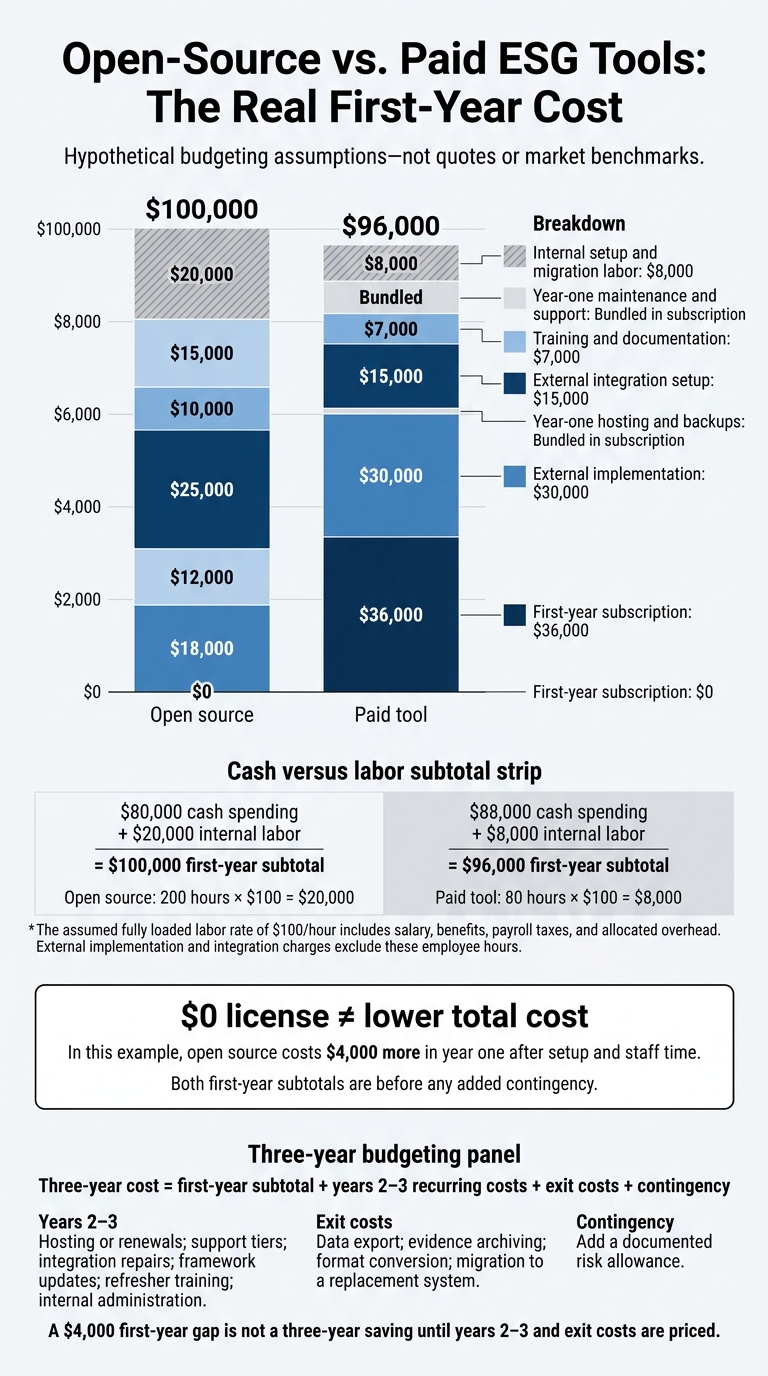
A $0 license does not mean lower ESG reporting costs. In this article’s hypothetical budget, open source costs $100,000 in year one, compared with $96,000 for a paid tool, after setup and staff time. These are planning examples, not market prices.
The better choice depends on the three-year cost and who will own the work. Compare setup, migration, hosting, security, integrations, customization, maintenance, training, support, and fully loaded staff time. Include reporting scope, assurance needs, rule updates, and exit costs - not just subscription fees.
Quick Comparison
| Cost or requirement | Open-source tools | Paid tools |
|---|---|---|
| License and hosting | License may cost $0; hosting is separate | Subscription required; hosting may be bundled |
| Setup and data connections | Staff or contractors handle the work | Implementation and connectors may cost extra |
| Customization and upkeep | Team funds code changes, testing, and patches | Contract defines included updates and custom work |
| Training and support | Internal staff, contractors, or community help | Support tiers and training fees vary |
| Reporting and assurance | Team checks calculations, controls, and records | Team checks features, plan limits, and exports |
| Ownership and exit | Budget for staff continuity and migration | Budget for renewals, vendor oversight, and migration |
Before committing, test both options with the same data and acceptance rules. Use measured pilot hours to update first-year and three-year budgets, confirm written service terms, and price consulting separately. Organizations may also benefit from sustainability consulting to navigate these complex long-term investment decisions.
Open-Source vs. Paid Tools: Costs by Category
Open-Source vs. Paid ESG Tools: The Real First-Year Cost
Setup, Hosting, and Data Connections
The table below breaks down who pays for each cost. Included does not mean free. Before approving the budget, confirm who handles installation, security setup, backup retention, and recovery.
| Cost category | Open-source expense | Paid-tool expense | Timing and expertise | Risk if underfunded |
|---|---|---|---|---|
| Setup | Staff or contractors install and secure the system | Basic provisioning may be included; implementation may cost extra | First year; IT and ESG configuration | Delayed or insecure launch |
| Hosting and security | Organization pays for hosting, backups, monitoring, and security administration | Standard hosting may be bundled; storage, backup retention, disaster recovery, or security testing may cost extra | Recurring; cloud and cybersecurity | Lost evidence or access without permission |
| Migration | Staff or contractors clean and import data | Template imports may be included; historical cleanup may not be | Mainly first year; data management and finance | Unreliable baselines |
| Integrations | Staff or contractors build, configure, and maintain connections | Standard imports may be included; connectors and API access may cost extra | Setup plus recurring; integration engineering | Manual re-entry or missing periods |
| Customization | Staff or contractors configure the system, build extensions, or change code | Configuration may be included; custom reports and modules may cost extra | Initial and recurring; developers and reporting staff | Expensive upgrades |
| Maintenance | Staff or contractors handle patches, testing, dependency updates, and monitoring | Standard updates may be bundled; custom work may need separate support | Recurring; IT and security | Vulnerabilities or broken workflows |
| Training | Organization pays for internal instruction or outside help | Documentation may be included; live training may cost extra | Launch and refresher sessions; process owners | Errors and dependence on one employee |
| Support | Organization relies on staff, contractors, or community help | Standard help desk may be included; premium service may cost extra | Recurring; technical and ESG expertise | Unresolved deadline-critical issues |
| Audit trails and approvals | Staff check built-in controls and configure or commission missing functions | Buyer checks plan limits and evidence-export features; upgrades may cost extra | Setup plus review time; controls specialists | Missing change history or approvals |
| Framework updates | Staff or contractors update mappings and calculations | Framework/content updates may be included; scope varies | Recurring; reporting and emissions expertise | Outdated disclosures |
Data quality and integrations often determine whether a low software price stays low.
Price the entire path from source data to approved figures. That includes utility bills, accounting data, HR and travel records, supplier files, cleansing, unit conversion, historical mapping, duplicate removal, and reconciliation. Ask who spots failed feeds - and who pays to fix them.
Customization, Upkeep, Training, and Support
Separate configuration from code changes. Changing a field isn't the same as maintaining a custom extension through future releases. Require documentation and release testing. Unless the contract says otherwise, don't assume a subscription covers custom work.
Who owns future changes can make the biggest difference in cost.
| Task | Open-source: who performs and pays | Paid tool: who performs and pays | Verify before committing |
|---|---|---|---|
| Custom fields, reports, and extensions | Staff or contracted developers do the work; organization pays | Vendor configuration or professional services; buyer pays fees outside the contract | Extra modules, API limits, upgrade compatibility |
| Updates and security fixes | Maintainers may publish fixes; assigned staff or contractors test and deploy them | Vendor or host handles contracted work; buyer pays for the rest | Are patches guaranteed, tested, and deployed automatically? |
| Training and documentation | Internal experts or consultants; organization pays for their time | Vendor materials or training; buyer pays for sessions outside the contract and internal procedures | Is training live, recorded, role-based, and priced per session or user? |
| Troubleshooting | Staff, contractors, or community | Help desk or premium support under contract | What are response times, escalation rules, hours, and channels? |
| Staff turnover | Internal handover and retraining | Additional onboarding or consulting may cost extra | What happens when the sustainability lead leaves? |
These category-level costs need to feed into both a first-year and a three-year budget.
Calculate First-Year and 3-Year Ownership Costs
More entities, data feeds, and reporting frameworks can push labor and support costs up fast.
The figures below are hypothetical budgeting assumptions, not quotes or market benchmarks. Internal setup and migration labor uses an assumed fully loaded rate of $100 per hour, including salary, benefits, payroll taxes, and allocated overhead. External implementation and integration charges exclude those employee hours, so each expense appears once.
Cost item Open-source assumption Paid-tool assumption First-year subscription $0 $36,000 External implementation $18,000 $30,000 Year-one hosting and backups $12,000 Bundled in subscription External integration setup $25,000 $15,000 Training and documentation $10,000 $7,000 Year-one maintenance and support $15,000 Bundled in subscription First-year cash spending $80,000 $88,000 Internal setup and migration labor 200 hours × $100 = $20,000 80 hours × $100 = $8,000 First-year subtotal $100,000 $96,000 Contingency Add a documented risk allowance Add a documented risk allowance Three-year cost First-year subtotal + years 2–3 recurring costs + exit costs + contingency First-year subtotal + years 2–3 recurring costs + exit costs + contingency
For years 2–3, price hosting or renewals, support tiers, integration repairs, framework updates, refresher training, and internal administration. Don't count bundled services twice. Exit costs include data export, evidence archiving, format conversion, and migration to a replacement system.
A $4,000 first-year gap is not a three-year saving until years 2–3 and exit costs are priced.
The next cost question is whether your team has the capacity to own this work.
sbb-itb-8baf5f1
How Staffing and Reporting Needs Shape the Choice
Use the cost categories above to check whether your team has the time and skills to own the work.
Staff capacity, reporting complexity, and control and evidence requirements affect implementation, support, and update costs more than license price does. Use this matrix as a test, not a scorecard.
| Factor | Open source is worth testing when… | Paid tools are worth testing when… |
|---|---|---|
| Technical capacity | Developers and security staff have funded hours and backup owners | Technical capacity is limited, and contracted support fills the gap |
| Reporting complexity | Nonstandard data structures justify customization your team can maintain | Existing workflows fit the required entities, suppliers, and frameworks |
| Urgency | There’s time to build, test, and stabilize the system | A near-term deadline calls for vendor-backed delivery |
| Assurance | Staff can show traceable records and repeatable controls | Contracted features meet the assurance provider’s evidence needs |
| Customization | You need code-level control | Configuration meets requirements without custom development |
| Three-year budget | Labor, hosting, and continuity costs fit the approved budget | Subscription and implementation costs offset measurable internal work |
Staff Time and System Ownership
Paid software still needs an internal owner for data definitions, calculations, and missing records. Buying support doesn’t transfer all responsibility to the vendor.
| Ownership issue | Open-source staffing and cost | Paid-tool staffing and cost |
|---|---|---|
| Technical operations | Developers or administrators handle deployment and upgrades | An internal administrator coordinates contracted services |
| Security | Security staff own infrastructure controls and incident response | Security staff review vendor controls and manage customer-side access |
| Opportunity cost | Technical work competes with analysis and sustainability delivery | Configuration and vendor management still take staff time |
| Continuity | A developer’s absence can leave undocumented code unsupported | Vendor changes or an exit can disrupt service; retain usable exports |
Once ownership is clear, check how much reporting complexity the system must handle.
Reporting Scope, Records, and Assurance
Reporting for one entity under one framework is simpler than multi-entity Scope 1–3 reporting. Before paying for more capability, trace a reported figure to its source, reproduce the calculation, and confirm its approval.
| Requirement | Open-source cost effect | Paid-tool cost effect |
|---|---|---|
| Limited metrics, one framework | Existing templates may keep implementation small | Check whether the subscription includes more than you need |
| Multiple entities and suppliers | Budget for consolidation rules, permissions, and data checks | Verify hierarchy limits, supplier features, and configuration fees |
| Scope 1–3 emissions | Verify factor versions, boundaries, estimates, and calculation logic | Verify library coverage, update terms, and calculation exports |
| Evidence and external assurance | Verify or add controlled history, review logs, and source links | Confirm these controls are included in the purchased tier |
| Corrections and restatements | Preserve prior versions and reproducible outputs | Test whether corrections retain original records and approvals |
US Disclosure Rules and Update Costs
Verify current SEC, California, and court requirements before each reporting cycle.
| Task and accountable owner | Open-source cost exposure | Paid-tool cost exposure |
|---|---|---|
| Monitor applicability, dates, and litigation - legal/compliance | Adviser time and internal monitoring | Notices may be included; legal interpretation remains internal |
| Update mappings and calculations - reporting lead | Staff or contractor changes, testing, and documentation | Confirm update timing, coverage, and extra fees |
| Retain records - records owner and IT | Storage, backups, access controls, and retention administration | Check retention limits, export access, and storage charges |
| Validate results - sustainability and finance | Review, reconciliation, and independent assurance where required | Automated checks may help; review and assurance remain separate costs |
Budget for regulatory monitoring as recurring work, not a one-time setup task. Record the source, review date, applicability decision, and owner for each requirement. Neither a software license nor a framework update guarantees compliance.
Test these responsibilities and costs in a pilot before committing to a final budget.
Compare Tools Against Your Reporting Plan
Once ownership and reporting scope are confirmed, turn your requirements into a costed workflow. Create a requirements register covering obligations, stakeholder requests, deadlines, and required metrics. Separate mandatory reporting from optional measures. Map each metric to its source file or system, collection frequency, supporting evidence, named owner, and backup. Before requesting prices, estimate the hours needed for setup, collection, review, corrections, and administration.
Ask for itemized costs for setup, hosting, integrations, security review, maintenance, training, and support. For paid tools, break out subscriptions, connectors, usage limits, and renewals. Calculate first-year and three-year costs using the same assumptions and labor rate. Then replace estimated hours with measured pilot results.
Pilot the Reporting Workflow
Keep the pilot limited but representative: use 12 months of utility records from two facilities, one quarter of workforce records, and selected procurement categories. Test imports, calculations, corrections, approvals, evidence retrieval, and exports.
Track hours by role, failed imports, manual corrections, unresolved issues, and incomplete outputs. Set acceptance thresholds before testing. These are buying criteria, not benchmarks.
Use the pilot to replace assumptions with measured effort and documented failure points, then update staffing hours and support needs.
| Criterion | Required evidence | Accountable owner | Acceptance threshold for both models |
|---|---|---|---|
| Imports | Import log reconciled to source totals | IT integration lead | At least 95% of records import without manual re-entry; all exceptions logged |
| Calculations | Independently checked test records and documented methods | Sustainability data lead | Results reconcile within 1%; no unresolved material errors |
| Approvals | Completed workflow with timestamps and reviewer identities | Internal controls owner | 100% of required pilot metrics have an approval trail |
| Evidence retrieval | Timed retrieval of supporting records | Assurance lead | Evidence for every sampled metric retrieved within 5 minutes |
| Portability | Tested export of records, calculations, metadata, and attachments | IT records owner | Complete, usable export in documented formats |
| Usability | Observed task completion after training | Sustainability program owner | At least 80% of participants complete core tasks without live assistance |
| Complete budget | Itemized first-year and three-year budget | Finance owner | Every required activity has a cost, owner, and documented assumption |
Before committing, get written terms covering hosting location, security, backups, response times, renewal pricing, data ownership, export formats, and termination support. For open source, document who will provide these services, whether internally or under contract. Reject a lower price if it leaves critical defects unresolved.
Budget Separately for Sustainability Consulting
Include consulting in the full program budget, but keep it separate from software costs. Council Fire can support ESG strategy, reporting, and implementation planning under a separate statement of work (SOW). Request deliverables, milestones, assumptions, and custom fees in that SOW.
Conclusion: Match Costs to Team Capacity
First-year and three-year costs matter, but team capacity should guide the decision. Open source works when your team can handle hosting, security, customization, and upkeep. Paid subscriptions can reduce technical work, but data quality, assumptions, and approvals remain your team’s responsibility.
More facilities, Scope 3 categories, and assurance work mean greater staffing and support needs. Reliable integrations, controls, and support add value only when you account for their costs in the price.
Choose an option your team can maintain within a three-year budget, including maintenance, training, support, and fully loaded staff time. If no one is funded to own the work, the savings aren’t real.
Track more than report completion: fewer hours spent collecting data, fewer corrections, and more usable ESG data for analysis and action.
FAQs
How do I calculate when a paid ESG tool becomes cheaper?
Compare total cost of ownership over the same period for both options. Count licensing, setup, customization, hosting, maintenance, updates, training, support, and internal staff time. Include exit costs and the cost of moving your data elsewhere.
The crossover point is when the paid tool’s total cost drops below the custom-built option’s.
Paid tools may cost less for standard reporting that needs frequent updates. Custom tools may be a better fit for narrow, stable, or specialized workflows.
How can I tell if my team can maintain open-source software?
Assign a business owner to define the tool’s output and a technical operator to keep it running [1]. If no specific person can take ownership of the system, buying a platform is the safer choice [1].
Open-source or custom software needs a recurring budget and enough staff time for hosting, updates, bug fixes, and documentation [2][1]. Someone already stretched thin by core duties, such as sustainability reporting, won’t have the time to maintain it well [1].
When does reporting complexity justify higher software costs?
Higher software costs are often justified when mandatory, high-stakes disclosures must meet requirements such as CSRD, ISSB, or SB 253. As those requirements change, vendor updates can reduce the work needed to remap custom data models [1].
Complex reporting also favors platforms with audit trails, role-based access, and automated data validation. These features help meet assurance needs and maintain data integrity as reporting scales [2].



FAQ