Apr 6, 2026
How to Mobilize Community Stakeholders Around Sustainability Goals for Municipalities & Government Agencies
Sustainability Strategy
In This Article
Engage and measure community stakeholders to advance municipal sustainability via inclusive forums, digital tools, and local partnerships.
How to Mobilize Community Stakeholders Around Sustainability Goals for Municipalities & Government Agencies
Municipalities and agencies can achieve their sustainability goals by actively involving community stakeholders. Successful engagement builds trust, ensures diverse perspectives, and turns ambitious plans into actionable results. Here’s how you can do it:
Identify Key Stakeholders: Map out internal and external groups, including residents, businesses, nonprofits, and vulnerable populations.
Engage Through Forums and Digital Tools: Use public meetings, hybrid formats, and online platforms to gather input and maintain ongoing dialogue.
Collaborate with Local Organizations: Partner with nonprofits, businesses, and community groups to co-create initiatives like circular economy projects.
Communicate Effectively: Tailor messages to different groups, use trusted community leaders, and share transparent updates on progress.
Measure and Adjust: Track participation, feedback, and impact metrics to refine strategies and ensure long-term success.
Examples like Santa Rosa City in the Philippines and Shimokawa Town in Japan show how inclusive planning can lead to tangible outcomes, such as expanded community gardens and integrated municipal policies. By focusing on trust, collaboration, and clear communication, municipalities can align their actions with community priorities and drive meaningful progress.
Engaging Stakeholders Meaningfully on Sustainable Development Projects
How to Identify and Map Key Stakeholders in Your Community
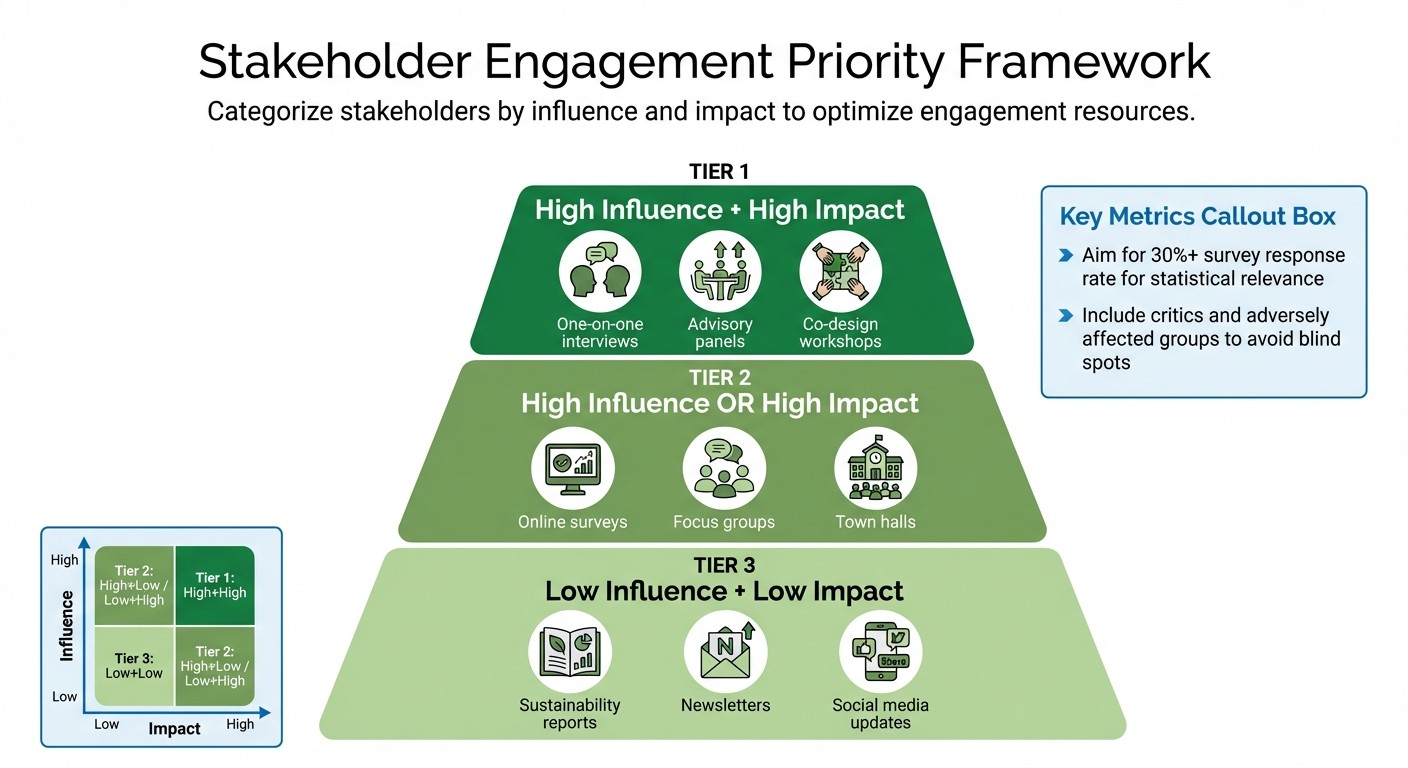
Three-Tier Stakeholder Engagement Framework for Municipal Sustainability
Start by identifying and mapping all relevant groups. This includes internal groups like department heads, municipal employees, and unions, as well as external groups such as residents, local businesses, nonprofits, faith organizations, academic institutions, and regulatory bodies [1].
Take a closer look at community demographics and social networks. Tools like the Social Vulnerability Index (SVI) and environmental justice metrics can help pinpoint vulnerable populations that might otherwise be overlooked [3]. Historical data on redlining, segregation, and disinvestment can reveal communities that have been excluded from past decision-making processes [3]. Additionally, seek out "community navigators" - trusted figures from faith groups, schools, and neighborhood associations - who can encourage participation among residents who may feel hesitant about engaging with government [3].
"Trusted community leaders from nonprofits, faith groups, schools, and industry can have a profound impact on whether community groups feel comfortable and motivated to participate." - Colorado Division of Local Government [3]
Apply Systems Thinking to Map Stakeholders
Using systems thinking can help you understand how various stakeholder groups interact with one another and with your sustainability objectives. Instead of treating each group as isolated, consider their connections within larger systems. For example, think about how local businesses rely on green infrastructure. This perspective is particularly helpful in identifying frontline communities - those most vulnerable to environmental hazards due to factors like age, poverty, or lack of resources to adapt [4].
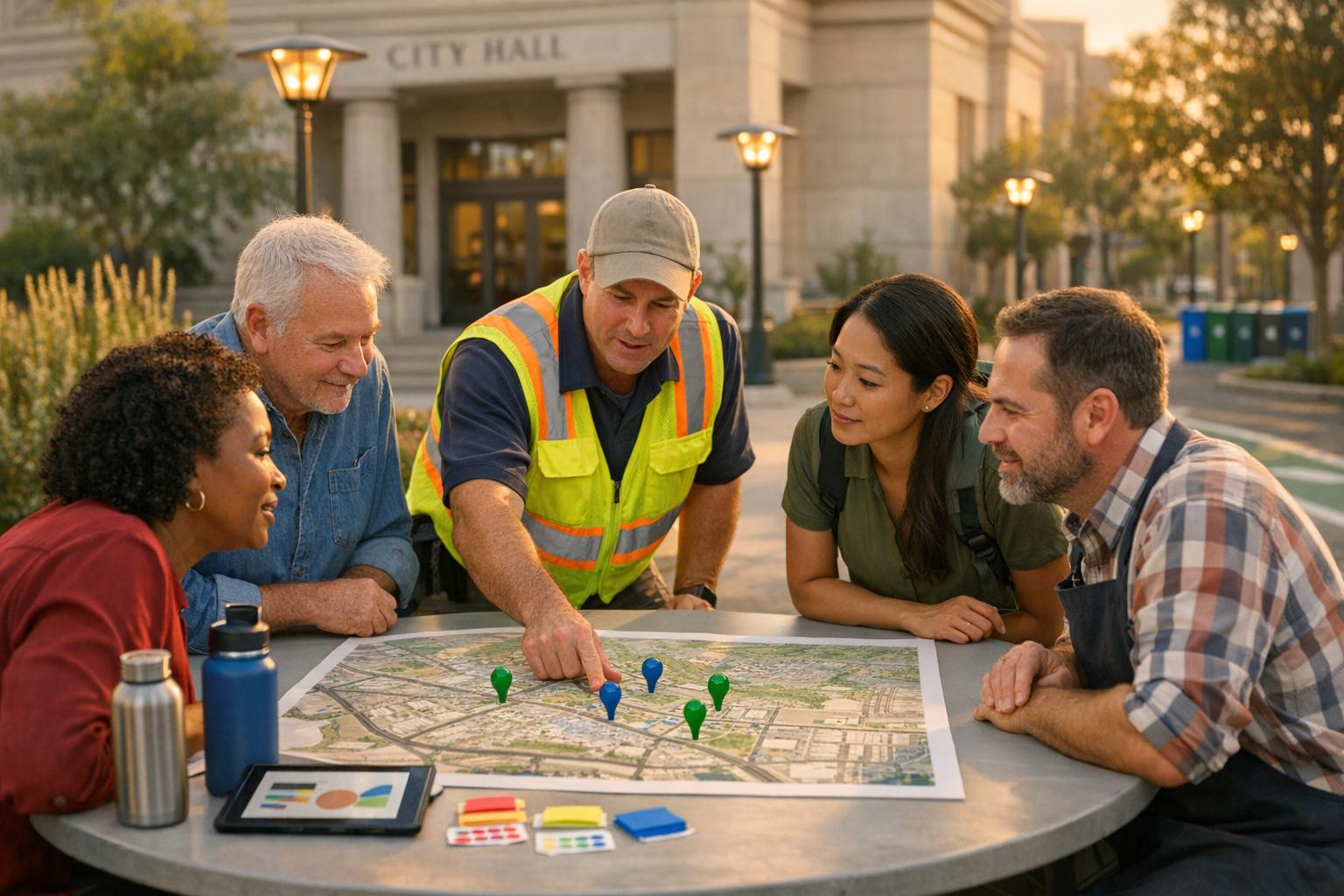
Engage residents in participatory mapping exercises to identify local hazards, resources, and vulnerable areas. By having community members mark these elements on a shared map, you can uncover connections that might otherwise go unnoticed and ensure that those most affected by decisions have a meaningful voice in shaping them [4].
Prioritize Stakeholders by Influence and Impact
Not all stakeholders require the same level of engagement. A 2x2 matrix can help you categorize stakeholders based on two factors: their influence (how much they can affect your strategy) and their impact (how much your actions affect them) [1]. This categorization creates three tiers of engagement:
Tier 1: Stakeholders with both high influence and high impact. These individuals or groups should be engaged deeply through methods like one-on-one interviews, advisory panels, and co-design workshops.
Tier 2: Stakeholders with either high influence or high impact. Engage them through online surveys, focus groups, and town halls.
Tier 3: Stakeholders with low influence and low impact. Keep them informed through reports, newsletters, and social media updates.
Make sure to include critics and those adversely affected by your initiatives to avoid blind spots and align with Global Reporting Initiative Standards. When conducting stakeholder surveys, aim for a response rate of at least 30% to ensure statistically relevant insights [1].
Stakeholder Tier | Characteristics | Recommended Engagement Method |
|---|---|---|
Tier 1 | High influence, high impact | One-on-one interviews, advisory panels, co-design workshops |
Tier 2 | High influence/low impact or low influence/high impact | Online surveys, focus groups, town halls |
Tier 3 | Low influence, low impact | Sustainability reports, newsletters, social media updates |
Accurate stakeholder mapping not only clarifies roles but also builds a solid foundation for inclusive, data-informed sustainability efforts. These insights will guide the targeted engagement strategies discussed in the next section.
Engage Stakeholders Through Public Forums and Town Halls
Once you've identified key community members, the next step is actively involving them through public forums and town halls. These gatherings offer a platform to bring together diverse perspectives on sustainability goals. However, the approach matters - a shift from a traditional presentation model to a facilitation model can make all the difference. Instead of lecturing, municipal leaders should focus on guiding discussions and listening attentively. As Sheryl Trent, Owner of SBrand Solutions, explains, "Facilitation is 80 percent listening and 20 percent presenting" [5]. This shift transforms meetings into collaborative sessions focused on actionable solutions, allowing community members to play a direct role in shaping outcomes.
To encourage participation, address potential barriers like transportation, childcare, or language differences in advance. Partner with trusted local leaders - such as those from faith groups, schools, or neighborhood associations - to reach residents who might otherwise feel hesitant to engage. Establish ground rules like "Every idea matters" and "Respect is paramount" to create an inclusive and respectful environment. Keep the momentum going by inviting typically underrepresented voices to follow-up meetings, ensuring their contributions are acknowledged and integrated into future plans.
Create Structured Agendas for Focused Discussions
A well-planned agenda is essential for productive discussions and ensuring everyone has a chance to contribute. Take the time to design an agenda that encourages open dialogue and creativity. Instead of yes/no questions, focus on open-ended prompts like, "What aspects of our community should always be preserved?" or "What actions can have the greatest impact on this goal?" Sharing relevant data and outlining project limits at the start can help turn skepticism into informed support.
To maintain order, use a unified speaker queue that allows both in-person and virtual participants to contribute equally. Set clear time limits for public comments - three minutes is standard - and display a countdown timer to keep discussions on track [6]. For Q&A sessions, moderators can group written questions by theme to ensure the most pressing issues are addressed. When dealing with complex or contentious topics, breaking the audience into smaller groups - via workshops, world cafes, or charrettes - can encourage deeper discussions and mutual understanding. This structured approach sets the stage for incorporating digital tools effectively in the next step.
Use Hybrid Formats to Increase Accessibility
Modern communities expect hybrid options for participation in sustainability discussions [6]. A true hybrid model ensures that in-person and virtual attendees have equal opportunities to engage. This includes registering through the same system, submitting questions or comments, and accessing high-quality audio and visuals. To support inclusivity, consider platforms that offer real-time AI transcription and captioning in multiple languages - helpful for multilingual communities and individuals who are deaf or hard of hearing.
To enhance audio clarity, connect directly to the room's sound system. For those with limited internet access, supplement digital options with phone surveys, paper forms, or mailed postcards. Live polling during meetings can also provide valuable insights into community sentiment, helping to maintain a structured and respectful dialogue. By embracing these hybrid methods, municipalities can ensure ongoing, meaningful engagement, creating a foundation for sustainable progress.
Use Digital Platforms for Continuous Stakeholder Dialogue
Digital platforms offer a way to maintain ongoing conversations with stakeholders, complementing traditional public forums. These tools allow for broad input collection, reaching community members who may not attend in-person events, and provide valuable data to guide sustainability priorities. Choosing the right platform depends on the type of input needed: surveys are ideal for gathering quantitative data, while interactive maps or videos can capture qualitative insights.
Before launching a digital tool, it’s essential to conduct a network analysis to identify the platforms and channels already popular in your community. Partner with community navigators - such as those from nonprofits, schools, or faith-based groups - to encourage participation and ensure the tools resonate with local residents. For instance, in July 2023, Jalisco’s municipality implemented a hybrid engagement plan combining digital and in-person efforts, successfully involving over 45,000 residents in its planning process [7]. This approach highlights how digital tools can scale participation while ensuring inclusivity for individuals without internet access.
To maximize accessibility, ensure all platforms are mobile-friendly, as many people rely on smartphones for internet access. Use plain, straightforward language to make participation easier - residents don’t need technical expertise to share meaningful insights. For multilingual communities, platforms with real-time translation features can help bridge language gaps. Transparency is also key: clearly communicate how input will be used, outline any budget limitations, and clarify whether feedback will directly influence decisions or serve an advisory role.
Collect Input with Online Surveys and Feedback Tools
Online surveys are a practical way to gather community feedback on specific sustainability questions. To get richer responses, include open-ended prompts and collaborate with local organizations when designing the surveys. This ensures that the questions reflect the community’s context, culture, and language, leading to more inclusive participation. Share surveys through social media, project websites, and email to maximize reach.
Timing is critical - launch surveys at key project moments, such as before infrastructure planning or during budget discussions, so feedback can genuinely shape decisions. Once responses are collected, summarize the findings and share them with the community. Additionally, invite underrepresented groups to review how their input influenced the process. This follow-up, often referred to as "closing the loop", builds trust and reinforces that their voices matter.
Apply Data Insights to Target Sustainability Efforts
The true power of digital engagement lies in how the collected data is analyzed and applied. By cross-referencing stakeholder feedback with demographic data from tools like the Social Vulnerability Index or the State Demography Office, municipalities can identify which groups are most impacted by proposed initiatives. Platforms such as Colorado Enviroscreen or the National Equity Atlas can further support equitable planning efforts, ensuring sustainability goals address existing disparities.
Regularly reviewing participation data can also reveal which segments of the community are underrepresented, helping refine outreach strategies. For GIS-based data, integrating it with existing planning systems allows for more informed, tactical decisions. This approach turns community feedback into actionable insights, ensuring sustainability initiatives are both effective and inclusive. Ongoing analysis of this data strengthens digital engagement and aligns it with broader stakeholder collaboration efforts.
Build Partnerships with Local Organizations
Work with nonprofits, businesses, and community groups to turn municipal sustainability plans into grassroots initiatives. Start by setting SMART objectives - Specific, Measurable, Achievable, Relevant, and Time-bound. For instance, aim to develop three circular economy pilot programs with local retailers within eight months. Clear goals like these align expectations and establish accountability from the outset.
Effective partnerships often follow the "three legs" model, which balances contributions from local governments, businesses, and community organizations [9]. Each group brings unique strengths: governments provide regulatory frameworks and oversight, businesses contribute funding and operational know-how, and community organizations bring local insights and trust. Leveraging established networks, such as chambers of commerce or neighborhood associations, can help streamline efforts and avoid unnecessary red tape [9].
"Governance is the sum of the many ways individuals and institutions, public and private, manage their common affairs. It is a continuing process through which conflicting or diverse interests may be accommodated and co-operative action can be taken" [9].
Transparency and shared accountability are crucial for sustaining partnerships. A great example comes from February 2026, when a coalition of 35 organizations - including 14 municipalities and 12 businesses - formed a regional climate compact targeting a 50% emissions reduction by 2030. They published annual progress reports to ensure peer accountability without relying on legal enforcement. This approach attracted $280 million in climate investments and $48 million in federal funding from FEMA and the Department of Energy [8]. Additionally, the coalition launched a clean energy procurement initiative that pooled 420 GWh of demand, saving participants $12 million annually [8]. These partnerships laid the groundwork for impactful initiatives, beginning with circular economy projects.
Collaborate on Circular Economy Initiatives
Circular economy projects provide tangible opportunities for municipalities and local groups to tackle waste reduction and resource-sharing. These initiatives aim to extend the lifecycle of materials, reduce the need for new resource extraction, and create local economic benefits. In November 2025, under Mayor Takeharu Yamanaka, Yokohama became the first city to sign the Asian Circular Cities Declaration, a regional effort to advance circular practices [10]. Meanwhile, cities like Milan, Seoul, São Paulo, and Melbourne have adopted zero food waste programs as a cornerstone of their circular strategies [10].
Pilot projects are a smart starting point to test these partnerships before scaling city-wide. Documenting lessons learned and creating a "playbook" can help replicate successful approaches. For example, a city might team up with local restaurants and food banks to divert organic waste from landfills, using data from the pilot to design a broader composting program. Framing these initiatives around quality of life improvements connects technical sustainability goals to community benefits, making the outcomes more relatable and meaningful for residents [9].
Develop Joint Projects for Ecosystem Governance
Building on these partnerships, cities can create joint projects that embed stakeholders in long-term environmental governance. Establish steering committees and working groups that include voices from government, businesses, NGOs, and academia to ensure decisions reflect community priorities [8]. Since 2015, Recife, Brazil, has worked with ICLEI to develop its Local Climate Action Plan and Sectoral Adaptation Plan. This collaboration combined technical tools like greenhouse gas inventories and climate risk analysis with inclusive community programs, such as "NUPDEC Mulheres", which focuses on empowering women to build resilience against flooding and sea-level rise [10].
To ensure equity, governance roles should include marginalized and environmental justice communities. Employ consistent methodologies, like joint vulnerability analyses, across all partners to avoid duplication and create a unified data framework [8]. This shared approach helps pool resources efficiently and supports informed decision-making. Regular updates on progress and how stakeholder feedback is incorporated maintain trust and encourage ongoing engagement. Such inclusive governance models align municipal efforts with community-driven sustainability goals, ensuring long-term success.
Develop Communication Strategies for Stakeholder Alignment
Effective communication serves as the bridge that connects sustainability goals with community action. By building on stakeholder mapping and digital engagement strategies, organizations can align diverse groups around shared priorities.
Clear messaging helps turn abstract goals into tangible actions. To make this possible, messages should be tailored to reflect the unique concerns of each stakeholder group. Research identifies six categories in the U.S. population when it comes to climate change: alarmed, concerned, cautious, disengaged, doubtful, and dismissive [11]. Knowing where your stakeholders fall within this spectrum allows you to craft messages that resonate with their specific perspectives.
Equally important is the choice of messenger. Trusted voices often carry more weight than technical expertise [11]. For example, instead of relying solely on government officials, organizations can engage "community navigators" - respected leaders from nonprofits, faith groups, schools, or neighborhood associations. These individuals can translate technical sustainability jargon into relatable terms that align with local priorities [11][3]. By combining tailored messages with credible messengers, organizations can effectively communicate their sustainability narrative.
Tailor Messages to Stakeholder Needs
The same sustainability goal can be framed in different ways to appeal to various audiences. For instance, the Denver Energy Challenge found that business owners responded to energy efficiency messaging emphasizing cost savings, while homeowners were more motivated by promises of increased comfort [11].
Language also matters. Using terminology familiar to your audience ensures clarity and engagement. Salt Lake City exemplifies this with its "Drive Less, Drive Smarter" campaign, which sends SMS alerts on poor air quality days. These alerts provide actionable advice, encouraging behaviors that support environmental goals [11].
Communication efforts should also match the importance of each stakeholder group. High-priority groups deserve more intensive engagement to maximize impact. By aligning message content and delivery with stakeholder priorities, organizations can set the stage for building trust through transparency.
Build Trust Through Transparent Progress Updates
Once messages align with stakeholder needs, maintaining trust requires regular and transparent updates. Share summaries of feedback gathered during engagement activities and explain how that input influenced decisions - or why certain suggestions weren’t implemented [1][3]. To ensure meaningful engagement, aim for at least a 30% response rate on stakeholder surveys and conduct full engagement cycles every two to three years, with annual check-ins in between [1].
"Neglecting to close the loop can quickly diminish future stakeholder engagement." - Council Fire [1]
Documenting engagement efforts is another critical step. Maintain a log that tracks participants, methods, and outcomes to support transparency and meet reporting standards. When stakeholder priorities conflict - such as financial concerns versus environmental impacts - acknowledge the tension openly and explain how decisions were made [1]. Regular updates not only build trust but also transform occasional participants into long-term collaborators invested in achieving shared sustainability goals.
Measure Impact and Maintain Momentum
Once you've established strong stakeholder engagement, the next step is to measure its impact. This ensures sustainability initiatives remain aligned with community needs and continue to grow. By tracking metrics, municipalities can shift stakeholder engagement from a one-off activity to an ongoing, impactful practice. It’s worth noting that government affairs teams already dedicate significant time to this effort - over 65% spend more than six hours weekly managing meetings with key stakeholders [12]. To justify this investment, clear indicators are essential to determine whether these efforts are advancing sustainability goals.
Start by monitoring process metrics that assess how accessible your outreach efforts are. This includes counting the number of engagement activities, the variety of methods used (like town halls versus digital platforms), and the levels of participation offered - whether it’s consultation, discussion, or decision-making. Next, track involvement metrics such as response rates, demographic diversity, and the volume of feedback collected. For survey data to hold statistical weight, aim for a response rate of at least 30% [1]. These metrics help identify whether your efforts are reaching the entire community or overlooking key voices.
The most critical indicators are impact metrics, which demonstrate the tangible value of engagement. Track how often stakeholder input influences official decisions and document the number of policy or project changes driven by public feedback. A Stakeholder Engagement Assessment Matrix can help visualize participants' progress through five stages - Unaware, Resistant, Neutral, Supportive, and Leading. This tool highlights whether your initiatives are fostering genuine community champions or falling into routine box-checking.
Define Metrics for Success
Organizing metrics into categories can provide a clearer picture of engagement quality. For instance, sentiment metrics measure the balance of positive, negative, and neutral feedback, offering insight into public acceptance of sustainability goals. Meanwhile, quality metrics evaluate how actionable the feedback is - detailed suggestions are far more valuable than simple yes-or-no responses.
Segmenting KPIs by stakeholder type is another effective practice. Residents, business owners, and regulators often have different priorities, so analyzing their responses separately can pinpoint areas for improvement. Use consistent rating scales (such as 1–5 or 1–10) across all surveys to enable meaningful comparisons over time. Real-time dashboards can streamline this process, allowing city staff and decision-makers to quickly spot trends and adjust strategies as needed. These metrics not only provide a record of past performance but also guide refinements to future engagement efforts.
Adjust Strategies for Continuous Improvement
The insights gained from data can reveal gaps in your approach, paving the way for targeted improvements. For example, comparing participant demographics - such as age, location, or housing status - with census data can uncover underrepresented groups [13]. If response rates are low, consider offering multiple participation formats. Partnering with trusted community leaders from nonprofits, faith organizations, or using "pop-up" engagement in public spaces can help reach those who might otherwise be overlooked [1][3].
"Failing to close the loop is the fastest way to destroy engagement quality in future cycles. Stakeholders who feel ignored won't participate again." - Council Fire [1]
One effective strategy is adopting a "You Said, We Did" approach, which clearly links stakeholder input to final decisions. This transparency builds trust, which is essential for sustaining long-term engagement [13]. If early analysis shows low participation from key groups, remain flexible and adjust your methods mid-project [3]. Engagement cycles tied to materiality assessments should generally occur every two to three years, with annual check-ins in between to maintain relationships and address emerging issues [1].
Keeping a detailed stakeholder engagement log - including participants, dates, methods, and outcomes - fosters transparency and ensures compliance with reporting standards. This continuous feedback loop allows for adaptive strategies, ensuring the sustainability process remains responsive and effective.
Conclusion
Building strong connections with community stakeholders for sustainability efforts requires trust, open communication, and genuine collaboration. Successful municipalities go beyond simply meeting compliance requirements; they make stakeholder engagement a core part of their sustainability approach. This includes identifying key stakeholders, hosting accessible town hall meetings, utilizing digital tools for ongoing communication, and forming meaningful partnerships with local organizations. Each of these actions strengthens the bond between government agencies and the communities they serve.
When done effectively, these efforts lead to real, measurable outcomes. For example, in Santa Rosa City, Mayor Arcillas expanded the number of community gardens by incorporating residents' feedback into city plans [2]. Similarly, Shimokawa Town integrated its co-created 2030 vision into its highest-level municipal law, ensuring long-term alignment with community priorities [2]. These achievements highlight the power of inclusive and thoughtful engagement.
"What matters most isn't the size of the budget or the number of workshops. It's trust - and the patient work of building it." - Fernando Ortiz-Moya, PhD, Chief Policy Researcher, Institute for Global Environmental Strategies [2]
Equally important is closing the feedback loop. When stakeholders see how their contributions influence decisions, they become advocates rather than critics. Keeping them informed with transparent updates and offering various ways for them to stay involved fosters ongoing participation and support.
Start with clear, SMART objectives for engagement and use every interaction as an opportunity to strengthen trust. Make a concerted effort to include marginalized voices that are often left out of the conversation, and keep detailed records of all interactions in a stakeholder engagement log. Whether you’re hosting your first community forum or refining existing partnerships, these approaches can help turn sustainability goals into shared victories. By adopting these practices, municipalities can transform their sustainability initiatives into collective accomplishments.
FAQs
How do we find overlooked stakeholders fast?
To identify stakeholders who may have been overlooked, begin by thoroughly mapping all groups that are either affected by or have an influence on your organization. Develop a stakeholder engagement plan that accounts for both internal and external participants, such as community members, local organizations, and regulatory bodies. Incorporate structured outreach frameworks with clearly defined objectives and make a deliberate effort to include a variety of perspectives. Taking this organized approach helps ensure no stakeholder is inadvertently excluded, a common risk with less formal methods.
What’s the best hybrid town hall setup?
Creating an effective hybrid town hall setup means blending in-person and virtual participation in a way that prioritizes accessibility, interaction, and clear communication. To achieve this, several elements are essential: high-quality microphones to ensure everyone can hear clearly, dedicated cameras focused on speakers for better visibility, a stable internet connection to avoid disruptions, and real-time transcription tools to make the event inclusive for all attendees.
Equally important is strong moderation to manage speaker queues efficiently and ensure both in-person and virtual participants feel equally valued. The goal is to create a smooth and transparent experience that bridges the gap between physical and digital spaces.
Which engagement metrics matter most?
The most critical engagement metrics revolve around stakeholder participation levels, the quality of their input, and the trust and buy-in established. These elements provide a clear picture of how effective engagement efforts are and how they influence sustainability outcomes. Prioritizing meaningful contributions and cultivating trust can help unify stakeholders around common objectives.
Related Blog Posts
Latest Articles
©2025

Narrative Change and Power Building: The Missing Half of Advocacy
Narrative change is the process of disrupting dominant narratives that normalize inequity and advancing new narratives from historically marginalized communities.

Funding Resilience Without Federal Grants
BRIC is unreliable and FEMA is shrinking. Here's how cities fund climate resilience with dedicated revenue, blended finance, and a coordinating authority.

The ESG Blind Spot: How AI Is Finding Risks in Companies Nobody Else Is Watching
Norway's sovereign wealth fund uses AI to screen 7,200 portfolio companies for forced labor and corruption within 24 hours. The real story is the emerging-market coverage gap that traditional ESG data vendors miss — and what it means for any company with a global supply chain.
Narrative Change and Power Building: The Missing Half of Advocacy
Narrative change is the process of disrupting dominant narratives that normalize inequity and advancing new narratives from historically marginalized communities.
Funding Resilience Without Federal Grants
BRIC is unreliable and FEMA is shrinking. Here's how cities fund climate resilience with dedicated revenue, blended finance, and a coordinating authority.
The ESG Blind Spot: How AI Is Finding Risks in Companies Nobody Else Is Watching
Norway's sovereign wealth fund uses AI to screen 7,200 portfolio companies for forced labor and corruption within 24 hours. The real story is the emerging-market coverage gap that traditional ESG data vendors miss — and what it means for any company with a global supply chain.
FAQ
01
What does it really mean to “redefine profit”?
02
What makes Council Fire different?
03
Who does Council Fire work with?
04
What does working with Council Fire actually look like?
05
How does Council Fire help organizations turn big goals into action?
06
How does Council Fire define and measure success?
Apr 6, 2026
How to Mobilize Community Stakeholders Around Sustainability Goals for Municipalities & Government Agencies
Sustainability Strategy
In This Article
Engage and measure community stakeholders to advance municipal sustainability via inclusive forums, digital tools, and local partnerships.
How to Mobilize Community Stakeholders Around Sustainability Goals for Municipalities & Government Agencies
Municipalities and agencies can achieve their sustainability goals by actively involving community stakeholders. Successful engagement builds trust, ensures diverse perspectives, and turns ambitious plans into actionable results. Here’s how you can do it:
Identify Key Stakeholders: Map out internal and external groups, including residents, businesses, nonprofits, and vulnerable populations.
Engage Through Forums and Digital Tools: Use public meetings, hybrid formats, and online platforms to gather input and maintain ongoing dialogue.
Collaborate with Local Organizations: Partner with nonprofits, businesses, and community groups to co-create initiatives like circular economy projects.
Communicate Effectively: Tailor messages to different groups, use trusted community leaders, and share transparent updates on progress.
Measure and Adjust: Track participation, feedback, and impact metrics to refine strategies and ensure long-term success.
Examples like Santa Rosa City in the Philippines and Shimokawa Town in Japan show how inclusive planning can lead to tangible outcomes, such as expanded community gardens and integrated municipal policies. By focusing on trust, collaboration, and clear communication, municipalities can align their actions with community priorities and drive meaningful progress.
Engaging Stakeholders Meaningfully on Sustainable Development Projects
How to Identify and Map Key Stakeholders in Your Community
Three-Tier Stakeholder Engagement Framework for Municipal Sustainability
Start by identifying and mapping all relevant groups. This includes internal groups like department heads, municipal employees, and unions, as well as external groups such as residents, local businesses, nonprofits, faith organizations, academic institutions, and regulatory bodies [1].
Take a closer look at community demographics and social networks. Tools like the Social Vulnerability Index (SVI) and environmental justice metrics can help pinpoint vulnerable populations that might otherwise be overlooked [3]. Historical data on redlining, segregation, and disinvestment can reveal communities that have been excluded from past decision-making processes [3]. Additionally, seek out "community navigators" - trusted figures from faith groups, schools, and neighborhood associations - who can encourage participation among residents who may feel hesitant about engaging with government [3].
"Trusted community leaders from nonprofits, faith groups, schools, and industry can have a profound impact on whether community groups feel comfortable and motivated to participate." - Colorado Division of Local Government [3]
Apply Systems Thinking to Map Stakeholders
Using systems thinking can help you understand how various stakeholder groups interact with one another and with your sustainability objectives. Instead of treating each group as isolated, consider their connections within larger systems. For example, think about how local businesses rely on green infrastructure. This perspective is particularly helpful in identifying frontline communities - those most vulnerable to environmental hazards due to factors like age, poverty, or lack of resources to adapt [4].
Engage residents in participatory mapping exercises to identify local hazards, resources, and vulnerable areas. By having community members mark these elements on a shared map, you can uncover connections that might otherwise go unnoticed and ensure that those most affected by decisions have a meaningful voice in shaping them [4].
Prioritize Stakeholders by Influence and Impact
Not all stakeholders require the same level of engagement. A 2x2 matrix can help you categorize stakeholders based on two factors: their influence (how much they can affect your strategy) and their impact (how much your actions affect them) [1]. This categorization creates three tiers of engagement:
Tier 1: Stakeholders with both high influence and high impact. These individuals or groups should be engaged deeply through methods like one-on-one interviews, advisory panels, and co-design workshops.
Tier 2: Stakeholders with either high influence or high impact. Engage them through online surveys, focus groups, and town halls.
Tier 3: Stakeholders with low influence and low impact. Keep them informed through reports, newsletters, and social media updates.
Make sure to include critics and those adversely affected by your initiatives to avoid blind spots and align with Global Reporting Initiative Standards. When conducting stakeholder surveys, aim for a response rate of at least 30% to ensure statistically relevant insights [1].
Stakeholder Tier | Characteristics | Recommended Engagement Method |
|---|---|---|
Tier 1 | High influence, high impact | One-on-one interviews, advisory panels, co-design workshops |
Tier 2 | High influence/low impact or low influence/high impact | Online surveys, focus groups, town halls |
Tier 3 | Low influence, low impact | Sustainability reports, newsletters, social media updates |
Accurate stakeholder mapping not only clarifies roles but also builds a solid foundation for inclusive, data-informed sustainability efforts. These insights will guide the targeted engagement strategies discussed in the next section.
Engage Stakeholders Through Public Forums and Town Halls
Once you've identified key community members, the next step is actively involving them through public forums and town halls. These gatherings offer a platform to bring together diverse perspectives on sustainability goals. However, the approach matters - a shift from a traditional presentation model to a facilitation model can make all the difference. Instead of lecturing, municipal leaders should focus on guiding discussions and listening attentively. As Sheryl Trent, Owner of SBrand Solutions, explains, "Facilitation is 80 percent listening and 20 percent presenting" [5]. This shift transforms meetings into collaborative sessions focused on actionable solutions, allowing community members to play a direct role in shaping outcomes.
To encourage participation, address potential barriers like transportation, childcare, or language differences in advance. Partner with trusted local leaders - such as those from faith groups, schools, or neighborhood associations - to reach residents who might otherwise feel hesitant to engage. Establish ground rules like "Every idea matters" and "Respect is paramount" to create an inclusive and respectful environment. Keep the momentum going by inviting typically underrepresented voices to follow-up meetings, ensuring their contributions are acknowledged and integrated into future plans.
Create Structured Agendas for Focused Discussions
A well-planned agenda is essential for productive discussions and ensuring everyone has a chance to contribute. Take the time to design an agenda that encourages open dialogue and creativity. Instead of yes/no questions, focus on open-ended prompts like, "What aspects of our community should always be preserved?" or "What actions can have the greatest impact on this goal?" Sharing relevant data and outlining project limits at the start can help turn skepticism into informed support.
To maintain order, use a unified speaker queue that allows both in-person and virtual participants to contribute equally. Set clear time limits for public comments - three minutes is standard - and display a countdown timer to keep discussions on track [6]. For Q&A sessions, moderators can group written questions by theme to ensure the most pressing issues are addressed. When dealing with complex or contentious topics, breaking the audience into smaller groups - via workshops, world cafes, or charrettes - can encourage deeper discussions and mutual understanding. This structured approach sets the stage for incorporating digital tools effectively in the next step.
Use Hybrid Formats to Increase Accessibility
Modern communities expect hybrid options for participation in sustainability discussions [6]. A true hybrid model ensures that in-person and virtual attendees have equal opportunities to engage. This includes registering through the same system, submitting questions or comments, and accessing high-quality audio and visuals. To support inclusivity, consider platforms that offer real-time AI transcription and captioning in multiple languages - helpful for multilingual communities and individuals who are deaf or hard of hearing.
To enhance audio clarity, connect directly to the room's sound system. For those with limited internet access, supplement digital options with phone surveys, paper forms, or mailed postcards. Live polling during meetings can also provide valuable insights into community sentiment, helping to maintain a structured and respectful dialogue. By embracing these hybrid methods, municipalities can ensure ongoing, meaningful engagement, creating a foundation for sustainable progress.
Use Digital Platforms for Continuous Stakeholder Dialogue
Digital platforms offer a way to maintain ongoing conversations with stakeholders, complementing traditional public forums. These tools allow for broad input collection, reaching community members who may not attend in-person events, and provide valuable data to guide sustainability priorities. Choosing the right platform depends on the type of input needed: surveys are ideal for gathering quantitative data, while interactive maps or videos can capture qualitative insights.
Before launching a digital tool, it’s essential to conduct a network analysis to identify the platforms and channels already popular in your community. Partner with community navigators - such as those from nonprofits, schools, or faith-based groups - to encourage participation and ensure the tools resonate with local residents. For instance, in July 2023, Jalisco’s municipality implemented a hybrid engagement plan combining digital and in-person efforts, successfully involving over 45,000 residents in its planning process [7]. This approach highlights how digital tools can scale participation while ensuring inclusivity for individuals without internet access.
To maximize accessibility, ensure all platforms are mobile-friendly, as many people rely on smartphones for internet access. Use plain, straightforward language to make participation easier - residents don’t need technical expertise to share meaningful insights. For multilingual communities, platforms with real-time translation features can help bridge language gaps. Transparency is also key: clearly communicate how input will be used, outline any budget limitations, and clarify whether feedback will directly influence decisions or serve an advisory role.
Collect Input with Online Surveys and Feedback Tools
Online surveys are a practical way to gather community feedback on specific sustainability questions. To get richer responses, include open-ended prompts and collaborate with local organizations when designing the surveys. This ensures that the questions reflect the community’s context, culture, and language, leading to more inclusive participation. Share surveys through social media, project websites, and email to maximize reach.
Timing is critical - launch surveys at key project moments, such as before infrastructure planning or during budget discussions, so feedback can genuinely shape decisions. Once responses are collected, summarize the findings and share them with the community. Additionally, invite underrepresented groups to review how their input influenced the process. This follow-up, often referred to as "closing the loop", builds trust and reinforces that their voices matter.
Apply Data Insights to Target Sustainability Efforts
The true power of digital engagement lies in how the collected data is analyzed and applied. By cross-referencing stakeholder feedback with demographic data from tools like the Social Vulnerability Index or the State Demography Office, municipalities can identify which groups are most impacted by proposed initiatives. Platforms such as Colorado Enviroscreen or the National Equity Atlas can further support equitable planning efforts, ensuring sustainability goals address existing disparities.
Regularly reviewing participation data can also reveal which segments of the community are underrepresented, helping refine outreach strategies. For GIS-based data, integrating it with existing planning systems allows for more informed, tactical decisions. This approach turns community feedback into actionable insights, ensuring sustainability initiatives are both effective and inclusive. Ongoing analysis of this data strengthens digital engagement and aligns it with broader stakeholder collaboration efforts.
Build Partnerships with Local Organizations
Work with nonprofits, businesses, and community groups to turn municipal sustainability plans into grassroots initiatives. Start by setting SMART objectives - Specific, Measurable, Achievable, Relevant, and Time-bound. For instance, aim to develop three circular economy pilot programs with local retailers within eight months. Clear goals like these align expectations and establish accountability from the outset.
Effective partnerships often follow the "three legs" model, which balances contributions from local governments, businesses, and community organizations [9]. Each group brings unique strengths: governments provide regulatory frameworks and oversight, businesses contribute funding and operational know-how, and community organizations bring local insights and trust. Leveraging established networks, such as chambers of commerce or neighborhood associations, can help streamline efforts and avoid unnecessary red tape [9].
"Governance is the sum of the many ways individuals and institutions, public and private, manage their common affairs. It is a continuing process through which conflicting or diverse interests may be accommodated and co-operative action can be taken" [9].
Transparency and shared accountability are crucial for sustaining partnerships. A great example comes from February 2026, when a coalition of 35 organizations - including 14 municipalities and 12 businesses - formed a regional climate compact targeting a 50% emissions reduction by 2030. They published annual progress reports to ensure peer accountability without relying on legal enforcement. This approach attracted $280 million in climate investments and $48 million in federal funding from FEMA and the Department of Energy [8]. Additionally, the coalition launched a clean energy procurement initiative that pooled 420 GWh of demand, saving participants $12 million annually [8]. These partnerships laid the groundwork for impactful initiatives, beginning with circular economy projects.
Collaborate on Circular Economy Initiatives
Circular economy projects provide tangible opportunities for municipalities and local groups to tackle waste reduction and resource-sharing. These initiatives aim to extend the lifecycle of materials, reduce the need for new resource extraction, and create local economic benefits. In November 2025, under Mayor Takeharu Yamanaka, Yokohama became the first city to sign the Asian Circular Cities Declaration, a regional effort to advance circular practices [10]. Meanwhile, cities like Milan, Seoul, São Paulo, and Melbourne have adopted zero food waste programs as a cornerstone of their circular strategies [10].
Pilot projects are a smart starting point to test these partnerships before scaling city-wide. Documenting lessons learned and creating a "playbook" can help replicate successful approaches. For example, a city might team up with local restaurants and food banks to divert organic waste from landfills, using data from the pilot to design a broader composting program. Framing these initiatives around quality of life improvements connects technical sustainability goals to community benefits, making the outcomes more relatable and meaningful for residents [9].
Develop Joint Projects for Ecosystem Governance
Building on these partnerships, cities can create joint projects that embed stakeholders in long-term environmental governance. Establish steering committees and working groups that include voices from government, businesses, NGOs, and academia to ensure decisions reflect community priorities [8]. Since 2015, Recife, Brazil, has worked with ICLEI to develop its Local Climate Action Plan and Sectoral Adaptation Plan. This collaboration combined technical tools like greenhouse gas inventories and climate risk analysis with inclusive community programs, such as "NUPDEC Mulheres", which focuses on empowering women to build resilience against flooding and sea-level rise [10].
To ensure equity, governance roles should include marginalized and environmental justice communities. Employ consistent methodologies, like joint vulnerability analyses, across all partners to avoid duplication and create a unified data framework [8]. This shared approach helps pool resources efficiently and supports informed decision-making. Regular updates on progress and how stakeholder feedback is incorporated maintain trust and encourage ongoing engagement. Such inclusive governance models align municipal efforts with community-driven sustainability goals, ensuring long-term success.
Develop Communication Strategies for Stakeholder Alignment
Effective communication serves as the bridge that connects sustainability goals with community action. By building on stakeholder mapping and digital engagement strategies, organizations can align diverse groups around shared priorities.
Clear messaging helps turn abstract goals into tangible actions. To make this possible, messages should be tailored to reflect the unique concerns of each stakeholder group. Research identifies six categories in the U.S. population when it comes to climate change: alarmed, concerned, cautious, disengaged, doubtful, and dismissive [11]. Knowing where your stakeholders fall within this spectrum allows you to craft messages that resonate with their specific perspectives.
Equally important is the choice of messenger. Trusted voices often carry more weight than technical expertise [11]. For example, instead of relying solely on government officials, organizations can engage "community navigators" - respected leaders from nonprofits, faith groups, schools, or neighborhood associations. These individuals can translate technical sustainability jargon into relatable terms that align with local priorities [11][3]. By combining tailored messages with credible messengers, organizations can effectively communicate their sustainability narrative.
Tailor Messages to Stakeholder Needs
The same sustainability goal can be framed in different ways to appeal to various audiences. For instance, the Denver Energy Challenge found that business owners responded to energy efficiency messaging emphasizing cost savings, while homeowners were more motivated by promises of increased comfort [11].
Language also matters. Using terminology familiar to your audience ensures clarity and engagement. Salt Lake City exemplifies this with its "Drive Less, Drive Smarter" campaign, which sends SMS alerts on poor air quality days. These alerts provide actionable advice, encouraging behaviors that support environmental goals [11].
Communication efforts should also match the importance of each stakeholder group. High-priority groups deserve more intensive engagement to maximize impact. By aligning message content and delivery with stakeholder priorities, organizations can set the stage for building trust through transparency.
Build Trust Through Transparent Progress Updates
Once messages align with stakeholder needs, maintaining trust requires regular and transparent updates. Share summaries of feedback gathered during engagement activities and explain how that input influenced decisions - or why certain suggestions weren’t implemented [1][3]. To ensure meaningful engagement, aim for at least a 30% response rate on stakeholder surveys and conduct full engagement cycles every two to three years, with annual check-ins in between [1].
"Neglecting to close the loop can quickly diminish future stakeholder engagement." - Council Fire [1]
Documenting engagement efforts is another critical step. Maintain a log that tracks participants, methods, and outcomes to support transparency and meet reporting standards. When stakeholder priorities conflict - such as financial concerns versus environmental impacts - acknowledge the tension openly and explain how decisions were made [1]. Regular updates not only build trust but also transform occasional participants into long-term collaborators invested in achieving shared sustainability goals.
Measure Impact and Maintain Momentum
Once you've established strong stakeholder engagement, the next step is to measure its impact. This ensures sustainability initiatives remain aligned with community needs and continue to grow. By tracking metrics, municipalities can shift stakeholder engagement from a one-off activity to an ongoing, impactful practice. It’s worth noting that government affairs teams already dedicate significant time to this effort - over 65% spend more than six hours weekly managing meetings with key stakeholders [12]. To justify this investment, clear indicators are essential to determine whether these efforts are advancing sustainability goals.
Start by monitoring process metrics that assess how accessible your outreach efforts are. This includes counting the number of engagement activities, the variety of methods used (like town halls versus digital platforms), and the levels of participation offered - whether it’s consultation, discussion, or decision-making. Next, track involvement metrics such as response rates, demographic diversity, and the volume of feedback collected. For survey data to hold statistical weight, aim for a response rate of at least 30% [1]. These metrics help identify whether your efforts are reaching the entire community or overlooking key voices.
The most critical indicators are impact metrics, which demonstrate the tangible value of engagement. Track how often stakeholder input influences official decisions and document the number of policy or project changes driven by public feedback. A Stakeholder Engagement Assessment Matrix can help visualize participants' progress through five stages - Unaware, Resistant, Neutral, Supportive, and Leading. This tool highlights whether your initiatives are fostering genuine community champions or falling into routine box-checking.
Define Metrics for Success
Organizing metrics into categories can provide a clearer picture of engagement quality. For instance, sentiment metrics measure the balance of positive, negative, and neutral feedback, offering insight into public acceptance of sustainability goals. Meanwhile, quality metrics evaluate how actionable the feedback is - detailed suggestions are far more valuable than simple yes-or-no responses.
Segmenting KPIs by stakeholder type is another effective practice. Residents, business owners, and regulators often have different priorities, so analyzing their responses separately can pinpoint areas for improvement. Use consistent rating scales (such as 1–5 or 1–10) across all surveys to enable meaningful comparisons over time. Real-time dashboards can streamline this process, allowing city staff and decision-makers to quickly spot trends and adjust strategies as needed. These metrics not only provide a record of past performance but also guide refinements to future engagement efforts.
Adjust Strategies for Continuous Improvement
The insights gained from data can reveal gaps in your approach, paving the way for targeted improvements. For example, comparing participant demographics - such as age, location, or housing status - with census data can uncover underrepresented groups [13]. If response rates are low, consider offering multiple participation formats. Partnering with trusted community leaders from nonprofits, faith organizations, or using "pop-up" engagement in public spaces can help reach those who might otherwise be overlooked [1][3].
"Failing to close the loop is the fastest way to destroy engagement quality in future cycles. Stakeholders who feel ignored won't participate again." - Council Fire [1]
One effective strategy is adopting a "You Said, We Did" approach, which clearly links stakeholder input to final decisions. This transparency builds trust, which is essential for sustaining long-term engagement [13]. If early analysis shows low participation from key groups, remain flexible and adjust your methods mid-project [3]. Engagement cycles tied to materiality assessments should generally occur every two to three years, with annual check-ins in between to maintain relationships and address emerging issues [1].
Keeping a detailed stakeholder engagement log - including participants, dates, methods, and outcomes - fosters transparency and ensures compliance with reporting standards. This continuous feedback loop allows for adaptive strategies, ensuring the sustainability process remains responsive and effective.
Conclusion
Building strong connections with community stakeholders for sustainability efforts requires trust, open communication, and genuine collaboration. Successful municipalities go beyond simply meeting compliance requirements; they make stakeholder engagement a core part of their sustainability approach. This includes identifying key stakeholders, hosting accessible town hall meetings, utilizing digital tools for ongoing communication, and forming meaningful partnerships with local organizations. Each of these actions strengthens the bond between government agencies and the communities they serve.
When done effectively, these efforts lead to real, measurable outcomes. For example, in Santa Rosa City, Mayor Arcillas expanded the number of community gardens by incorporating residents' feedback into city plans [2]. Similarly, Shimokawa Town integrated its co-created 2030 vision into its highest-level municipal law, ensuring long-term alignment with community priorities [2]. These achievements highlight the power of inclusive and thoughtful engagement.
"What matters most isn't the size of the budget or the number of workshops. It's trust - and the patient work of building it." - Fernando Ortiz-Moya, PhD, Chief Policy Researcher, Institute for Global Environmental Strategies [2]
Equally important is closing the feedback loop. When stakeholders see how their contributions influence decisions, they become advocates rather than critics. Keeping them informed with transparent updates and offering various ways for them to stay involved fosters ongoing participation and support.
Start with clear, SMART objectives for engagement and use every interaction as an opportunity to strengthen trust. Make a concerted effort to include marginalized voices that are often left out of the conversation, and keep detailed records of all interactions in a stakeholder engagement log. Whether you’re hosting your first community forum or refining existing partnerships, these approaches can help turn sustainability goals into shared victories. By adopting these practices, municipalities can transform their sustainability initiatives into collective accomplishments.
FAQs
How do we find overlooked stakeholders fast?
To identify stakeholders who may have been overlooked, begin by thoroughly mapping all groups that are either affected by or have an influence on your organization. Develop a stakeholder engagement plan that accounts for both internal and external participants, such as community members, local organizations, and regulatory bodies. Incorporate structured outreach frameworks with clearly defined objectives and make a deliberate effort to include a variety of perspectives. Taking this organized approach helps ensure no stakeholder is inadvertently excluded, a common risk with less formal methods.
What’s the best hybrid town hall setup?
Creating an effective hybrid town hall setup means blending in-person and virtual participation in a way that prioritizes accessibility, interaction, and clear communication. To achieve this, several elements are essential: high-quality microphones to ensure everyone can hear clearly, dedicated cameras focused on speakers for better visibility, a stable internet connection to avoid disruptions, and real-time transcription tools to make the event inclusive for all attendees.
Equally important is strong moderation to manage speaker queues efficiently and ensure both in-person and virtual participants feel equally valued. The goal is to create a smooth and transparent experience that bridges the gap between physical and digital spaces.
Which engagement metrics matter most?
The most critical engagement metrics revolve around stakeholder participation levels, the quality of their input, and the trust and buy-in established. These elements provide a clear picture of how effective engagement efforts are and how they influence sustainability outcomes. Prioritizing meaningful contributions and cultivating trust can help unify stakeholders around common objectives.
Related Blog Posts
Latest Articles
©2025
Narrative Change and Power Building: The Missing Half of Advocacy
Narrative change is the process of disrupting dominant narratives that normalize inequity and advancing new narratives from historically marginalized communities.
Funding Resilience Without Federal Grants
BRIC is unreliable and FEMA is shrinking. Here's how cities fund climate resilience with dedicated revenue, blended finance, and a coordinating authority.
The ESG Blind Spot: How AI Is Finding Risks in Companies Nobody Else Is Watching
Norway's sovereign wealth fund uses AI to screen 7,200 portfolio companies for forced labor and corruption within 24 hours. The real story is the emerging-market coverage gap that traditional ESG data vendors miss — and what it means for any company with a global supply chain.
FAQ
01
What does it really mean to “redefine profit”?
02
What makes Council Fire different?
03
Who does Council Fire work with?
04
What does working with Council Fire actually look like?
05
How does Council Fire help organizations turn big goals into action?
06
How does Council Fire define and measure success?
Apr 6, 2026
How to Mobilize Community Stakeholders Around Sustainability Goals for Municipalities & Government Agencies
Sustainability Strategy
In This Article
Engage and measure community stakeholders to advance municipal sustainability via inclusive forums, digital tools, and local partnerships.
How to Mobilize Community Stakeholders Around Sustainability Goals for Municipalities & Government Agencies
Municipalities and agencies can achieve their sustainability goals by actively involving community stakeholders. Successful engagement builds trust, ensures diverse perspectives, and turns ambitious plans into actionable results. Here’s how you can do it:
Identify Key Stakeholders: Map out internal and external groups, including residents, businesses, nonprofits, and vulnerable populations.
Engage Through Forums and Digital Tools: Use public meetings, hybrid formats, and online platforms to gather input and maintain ongoing dialogue.
Collaborate with Local Organizations: Partner with nonprofits, businesses, and community groups to co-create initiatives like circular economy projects.
Communicate Effectively: Tailor messages to different groups, use trusted community leaders, and share transparent updates on progress.
Measure and Adjust: Track participation, feedback, and impact metrics to refine strategies and ensure long-term success.
Examples like Santa Rosa City in the Philippines and Shimokawa Town in Japan show how inclusive planning can lead to tangible outcomes, such as expanded community gardens and integrated municipal policies. By focusing on trust, collaboration, and clear communication, municipalities can align their actions with community priorities and drive meaningful progress.
Engaging Stakeholders Meaningfully on Sustainable Development Projects
How to Identify and Map Key Stakeholders in Your Community
Three-Tier Stakeholder Engagement Framework for Municipal Sustainability
Start by identifying and mapping all relevant groups. This includes internal groups like department heads, municipal employees, and unions, as well as external groups such as residents, local businesses, nonprofits, faith organizations, academic institutions, and regulatory bodies [1].
Take a closer look at community demographics and social networks. Tools like the Social Vulnerability Index (SVI) and environmental justice metrics can help pinpoint vulnerable populations that might otherwise be overlooked [3]. Historical data on redlining, segregation, and disinvestment can reveal communities that have been excluded from past decision-making processes [3]. Additionally, seek out "community navigators" - trusted figures from faith groups, schools, and neighborhood associations - who can encourage participation among residents who may feel hesitant about engaging with government [3].
"Trusted community leaders from nonprofits, faith groups, schools, and industry can have a profound impact on whether community groups feel comfortable and motivated to participate." - Colorado Division of Local Government [3]
Apply Systems Thinking to Map Stakeholders
Using systems thinking can help you understand how various stakeholder groups interact with one another and with your sustainability objectives. Instead of treating each group as isolated, consider their connections within larger systems. For example, think about how local businesses rely on green infrastructure. This perspective is particularly helpful in identifying frontline communities - those most vulnerable to environmental hazards due to factors like age, poverty, or lack of resources to adapt [4].
Engage residents in participatory mapping exercises to identify local hazards, resources, and vulnerable areas. By having community members mark these elements on a shared map, you can uncover connections that might otherwise go unnoticed and ensure that those most affected by decisions have a meaningful voice in shaping them [4].
Prioritize Stakeholders by Influence and Impact
Not all stakeholders require the same level of engagement. A 2x2 matrix can help you categorize stakeholders based on two factors: their influence (how much they can affect your strategy) and their impact (how much your actions affect them) [1]. This categorization creates three tiers of engagement:
Tier 1: Stakeholders with both high influence and high impact. These individuals or groups should be engaged deeply through methods like one-on-one interviews, advisory panels, and co-design workshops.
Tier 2: Stakeholders with either high influence or high impact. Engage them through online surveys, focus groups, and town halls.
Tier 3: Stakeholders with low influence and low impact. Keep them informed through reports, newsletters, and social media updates.
Make sure to include critics and those adversely affected by your initiatives to avoid blind spots and align with Global Reporting Initiative Standards. When conducting stakeholder surveys, aim for a response rate of at least 30% to ensure statistically relevant insights [1].
Stakeholder Tier | Characteristics | Recommended Engagement Method |
|---|---|---|
Tier 1 | High influence, high impact | One-on-one interviews, advisory panels, co-design workshops |
Tier 2 | High influence/low impact or low influence/high impact | Online surveys, focus groups, town halls |
Tier 3 | Low influence, low impact | Sustainability reports, newsletters, social media updates |
Accurate stakeholder mapping not only clarifies roles but also builds a solid foundation for inclusive, data-informed sustainability efforts. These insights will guide the targeted engagement strategies discussed in the next section.
Engage Stakeholders Through Public Forums and Town Halls
Once you've identified key community members, the next step is actively involving them through public forums and town halls. These gatherings offer a platform to bring together diverse perspectives on sustainability goals. However, the approach matters - a shift from a traditional presentation model to a facilitation model can make all the difference. Instead of lecturing, municipal leaders should focus on guiding discussions and listening attentively. As Sheryl Trent, Owner of SBrand Solutions, explains, "Facilitation is 80 percent listening and 20 percent presenting" [5]. This shift transforms meetings into collaborative sessions focused on actionable solutions, allowing community members to play a direct role in shaping outcomes.
To encourage participation, address potential barriers like transportation, childcare, or language differences in advance. Partner with trusted local leaders - such as those from faith groups, schools, or neighborhood associations - to reach residents who might otherwise feel hesitant to engage. Establish ground rules like "Every idea matters" and "Respect is paramount" to create an inclusive and respectful environment. Keep the momentum going by inviting typically underrepresented voices to follow-up meetings, ensuring their contributions are acknowledged and integrated into future plans.
Create Structured Agendas for Focused Discussions
A well-planned agenda is essential for productive discussions and ensuring everyone has a chance to contribute. Take the time to design an agenda that encourages open dialogue and creativity. Instead of yes/no questions, focus on open-ended prompts like, "What aspects of our community should always be preserved?" or "What actions can have the greatest impact on this goal?" Sharing relevant data and outlining project limits at the start can help turn skepticism into informed support.
To maintain order, use a unified speaker queue that allows both in-person and virtual participants to contribute equally. Set clear time limits for public comments - three minutes is standard - and display a countdown timer to keep discussions on track [6]. For Q&A sessions, moderators can group written questions by theme to ensure the most pressing issues are addressed. When dealing with complex or contentious topics, breaking the audience into smaller groups - via workshops, world cafes, or charrettes - can encourage deeper discussions and mutual understanding. This structured approach sets the stage for incorporating digital tools effectively in the next step.
Use Hybrid Formats to Increase Accessibility
Modern communities expect hybrid options for participation in sustainability discussions [6]. A true hybrid model ensures that in-person and virtual attendees have equal opportunities to engage. This includes registering through the same system, submitting questions or comments, and accessing high-quality audio and visuals. To support inclusivity, consider platforms that offer real-time AI transcription and captioning in multiple languages - helpful for multilingual communities and individuals who are deaf or hard of hearing.
To enhance audio clarity, connect directly to the room's sound system. For those with limited internet access, supplement digital options with phone surveys, paper forms, or mailed postcards. Live polling during meetings can also provide valuable insights into community sentiment, helping to maintain a structured and respectful dialogue. By embracing these hybrid methods, municipalities can ensure ongoing, meaningful engagement, creating a foundation for sustainable progress.
Use Digital Platforms for Continuous Stakeholder Dialogue
Digital platforms offer a way to maintain ongoing conversations with stakeholders, complementing traditional public forums. These tools allow for broad input collection, reaching community members who may not attend in-person events, and provide valuable data to guide sustainability priorities. Choosing the right platform depends on the type of input needed: surveys are ideal for gathering quantitative data, while interactive maps or videos can capture qualitative insights.
Before launching a digital tool, it’s essential to conduct a network analysis to identify the platforms and channels already popular in your community. Partner with community navigators - such as those from nonprofits, schools, or faith-based groups - to encourage participation and ensure the tools resonate with local residents. For instance, in July 2023, Jalisco’s municipality implemented a hybrid engagement plan combining digital and in-person efforts, successfully involving over 45,000 residents in its planning process [7]. This approach highlights how digital tools can scale participation while ensuring inclusivity for individuals without internet access.
To maximize accessibility, ensure all platforms are mobile-friendly, as many people rely on smartphones for internet access. Use plain, straightforward language to make participation easier - residents don’t need technical expertise to share meaningful insights. For multilingual communities, platforms with real-time translation features can help bridge language gaps. Transparency is also key: clearly communicate how input will be used, outline any budget limitations, and clarify whether feedback will directly influence decisions or serve an advisory role.
Collect Input with Online Surveys and Feedback Tools
Online surveys are a practical way to gather community feedback on specific sustainability questions. To get richer responses, include open-ended prompts and collaborate with local organizations when designing the surveys. This ensures that the questions reflect the community’s context, culture, and language, leading to more inclusive participation. Share surveys through social media, project websites, and email to maximize reach.
Timing is critical - launch surveys at key project moments, such as before infrastructure planning or during budget discussions, so feedback can genuinely shape decisions. Once responses are collected, summarize the findings and share them with the community. Additionally, invite underrepresented groups to review how their input influenced the process. This follow-up, often referred to as "closing the loop", builds trust and reinforces that their voices matter.
Apply Data Insights to Target Sustainability Efforts
The true power of digital engagement lies in how the collected data is analyzed and applied. By cross-referencing stakeholder feedback with demographic data from tools like the Social Vulnerability Index or the State Demography Office, municipalities can identify which groups are most impacted by proposed initiatives. Platforms such as Colorado Enviroscreen or the National Equity Atlas can further support equitable planning efforts, ensuring sustainability goals address existing disparities.
Regularly reviewing participation data can also reveal which segments of the community are underrepresented, helping refine outreach strategies. For GIS-based data, integrating it with existing planning systems allows for more informed, tactical decisions. This approach turns community feedback into actionable insights, ensuring sustainability initiatives are both effective and inclusive. Ongoing analysis of this data strengthens digital engagement and aligns it with broader stakeholder collaboration efforts.
Build Partnerships with Local Organizations
Work with nonprofits, businesses, and community groups to turn municipal sustainability plans into grassroots initiatives. Start by setting SMART objectives - Specific, Measurable, Achievable, Relevant, and Time-bound. For instance, aim to develop three circular economy pilot programs with local retailers within eight months. Clear goals like these align expectations and establish accountability from the outset.
Effective partnerships often follow the "three legs" model, which balances contributions from local governments, businesses, and community organizations [9]. Each group brings unique strengths: governments provide regulatory frameworks and oversight, businesses contribute funding and operational know-how, and community organizations bring local insights and trust. Leveraging established networks, such as chambers of commerce or neighborhood associations, can help streamline efforts and avoid unnecessary red tape [9].
"Governance is the sum of the many ways individuals and institutions, public and private, manage their common affairs. It is a continuing process through which conflicting or diverse interests may be accommodated and co-operative action can be taken" [9].
Transparency and shared accountability are crucial for sustaining partnerships. A great example comes from February 2026, when a coalition of 35 organizations - including 14 municipalities and 12 businesses - formed a regional climate compact targeting a 50% emissions reduction by 2030. They published annual progress reports to ensure peer accountability without relying on legal enforcement. This approach attracted $280 million in climate investments and $48 million in federal funding from FEMA and the Department of Energy [8]. Additionally, the coalition launched a clean energy procurement initiative that pooled 420 GWh of demand, saving participants $12 million annually [8]. These partnerships laid the groundwork for impactful initiatives, beginning with circular economy projects.
Collaborate on Circular Economy Initiatives
Circular economy projects provide tangible opportunities for municipalities and local groups to tackle waste reduction and resource-sharing. These initiatives aim to extend the lifecycle of materials, reduce the need for new resource extraction, and create local economic benefits. In November 2025, under Mayor Takeharu Yamanaka, Yokohama became the first city to sign the Asian Circular Cities Declaration, a regional effort to advance circular practices [10]. Meanwhile, cities like Milan, Seoul, São Paulo, and Melbourne have adopted zero food waste programs as a cornerstone of their circular strategies [10].
Pilot projects are a smart starting point to test these partnerships before scaling city-wide. Documenting lessons learned and creating a "playbook" can help replicate successful approaches. For example, a city might team up with local restaurants and food banks to divert organic waste from landfills, using data from the pilot to design a broader composting program. Framing these initiatives around quality of life improvements connects technical sustainability goals to community benefits, making the outcomes more relatable and meaningful for residents [9].
Develop Joint Projects for Ecosystem Governance
Building on these partnerships, cities can create joint projects that embed stakeholders in long-term environmental governance. Establish steering committees and working groups that include voices from government, businesses, NGOs, and academia to ensure decisions reflect community priorities [8]. Since 2015, Recife, Brazil, has worked with ICLEI to develop its Local Climate Action Plan and Sectoral Adaptation Plan. This collaboration combined technical tools like greenhouse gas inventories and climate risk analysis with inclusive community programs, such as "NUPDEC Mulheres", which focuses on empowering women to build resilience against flooding and sea-level rise [10].
To ensure equity, governance roles should include marginalized and environmental justice communities. Employ consistent methodologies, like joint vulnerability analyses, across all partners to avoid duplication and create a unified data framework [8]. This shared approach helps pool resources efficiently and supports informed decision-making. Regular updates on progress and how stakeholder feedback is incorporated maintain trust and encourage ongoing engagement. Such inclusive governance models align municipal efforts with community-driven sustainability goals, ensuring long-term success.
Develop Communication Strategies for Stakeholder Alignment
Effective communication serves as the bridge that connects sustainability goals with community action. By building on stakeholder mapping and digital engagement strategies, organizations can align diverse groups around shared priorities.
Clear messaging helps turn abstract goals into tangible actions. To make this possible, messages should be tailored to reflect the unique concerns of each stakeholder group. Research identifies six categories in the U.S. population when it comes to climate change: alarmed, concerned, cautious, disengaged, doubtful, and dismissive [11]. Knowing where your stakeholders fall within this spectrum allows you to craft messages that resonate with their specific perspectives.
Equally important is the choice of messenger. Trusted voices often carry more weight than technical expertise [11]. For example, instead of relying solely on government officials, organizations can engage "community navigators" - respected leaders from nonprofits, faith groups, schools, or neighborhood associations. These individuals can translate technical sustainability jargon into relatable terms that align with local priorities [11][3]. By combining tailored messages with credible messengers, organizations can effectively communicate their sustainability narrative.
Tailor Messages to Stakeholder Needs
The same sustainability goal can be framed in different ways to appeal to various audiences. For instance, the Denver Energy Challenge found that business owners responded to energy efficiency messaging emphasizing cost savings, while homeowners were more motivated by promises of increased comfort [11].
Language also matters. Using terminology familiar to your audience ensures clarity and engagement. Salt Lake City exemplifies this with its "Drive Less, Drive Smarter" campaign, which sends SMS alerts on poor air quality days. These alerts provide actionable advice, encouraging behaviors that support environmental goals [11].
Communication efforts should also match the importance of each stakeholder group. High-priority groups deserve more intensive engagement to maximize impact. By aligning message content and delivery with stakeholder priorities, organizations can set the stage for building trust through transparency.
Build Trust Through Transparent Progress Updates
Once messages align with stakeholder needs, maintaining trust requires regular and transparent updates. Share summaries of feedback gathered during engagement activities and explain how that input influenced decisions - or why certain suggestions weren’t implemented [1][3]. To ensure meaningful engagement, aim for at least a 30% response rate on stakeholder surveys and conduct full engagement cycles every two to three years, with annual check-ins in between [1].
"Neglecting to close the loop can quickly diminish future stakeholder engagement." - Council Fire [1]
Documenting engagement efforts is another critical step. Maintain a log that tracks participants, methods, and outcomes to support transparency and meet reporting standards. When stakeholder priorities conflict - such as financial concerns versus environmental impacts - acknowledge the tension openly and explain how decisions were made [1]. Regular updates not only build trust but also transform occasional participants into long-term collaborators invested in achieving shared sustainability goals.
Measure Impact and Maintain Momentum
Once you've established strong stakeholder engagement, the next step is to measure its impact. This ensures sustainability initiatives remain aligned with community needs and continue to grow. By tracking metrics, municipalities can shift stakeholder engagement from a one-off activity to an ongoing, impactful practice. It’s worth noting that government affairs teams already dedicate significant time to this effort - over 65% spend more than six hours weekly managing meetings with key stakeholders [12]. To justify this investment, clear indicators are essential to determine whether these efforts are advancing sustainability goals.
Start by monitoring process metrics that assess how accessible your outreach efforts are. This includes counting the number of engagement activities, the variety of methods used (like town halls versus digital platforms), and the levels of participation offered - whether it’s consultation, discussion, or decision-making. Next, track involvement metrics such as response rates, demographic diversity, and the volume of feedback collected. For survey data to hold statistical weight, aim for a response rate of at least 30% [1]. These metrics help identify whether your efforts are reaching the entire community or overlooking key voices.
The most critical indicators are impact metrics, which demonstrate the tangible value of engagement. Track how often stakeholder input influences official decisions and document the number of policy or project changes driven by public feedback. A Stakeholder Engagement Assessment Matrix can help visualize participants' progress through five stages - Unaware, Resistant, Neutral, Supportive, and Leading. This tool highlights whether your initiatives are fostering genuine community champions or falling into routine box-checking.
Define Metrics for Success
Organizing metrics into categories can provide a clearer picture of engagement quality. For instance, sentiment metrics measure the balance of positive, negative, and neutral feedback, offering insight into public acceptance of sustainability goals. Meanwhile, quality metrics evaluate how actionable the feedback is - detailed suggestions are far more valuable than simple yes-or-no responses.
Segmenting KPIs by stakeholder type is another effective practice. Residents, business owners, and regulators often have different priorities, so analyzing their responses separately can pinpoint areas for improvement. Use consistent rating scales (such as 1–5 or 1–10) across all surveys to enable meaningful comparisons over time. Real-time dashboards can streamline this process, allowing city staff and decision-makers to quickly spot trends and adjust strategies as needed. These metrics not only provide a record of past performance but also guide refinements to future engagement efforts.
Adjust Strategies for Continuous Improvement
The insights gained from data can reveal gaps in your approach, paving the way for targeted improvements. For example, comparing participant demographics - such as age, location, or housing status - with census data can uncover underrepresented groups [13]. If response rates are low, consider offering multiple participation formats. Partnering with trusted community leaders from nonprofits, faith organizations, or using "pop-up" engagement in public spaces can help reach those who might otherwise be overlooked [1][3].
"Failing to close the loop is the fastest way to destroy engagement quality in future cycles. Stakeholders who feel ignored won't participate again." - Council Fire [1]
One effective strategy is adopting a "You Said, We Did" approach, which clearly links stakeholder input to final decisions. This transparency builds trust, which is essential for sustaining long-term engagement [13]. If early analysis shows low participation from key groups, remain flexible and adjust your methods mid-project [3]. Engagement cycles tied to materiality assessments should generally occur every two to three years, with annual check-ins in between to maintain relationships and address emerging issues [1].
Keeping a detailed stakeholder engagement log - including participants, dates, methods, and outcomes - fosters transparency and ensures compliance with reporting standards. This continuous feedback loop allows for adaptive strategies, ensuring the sustainability process remains responsive and effective.
Conclusion
Building strong connections with community stakeholders for sustainability efforts requires trust, open communication, and genuine collaboration. Successful municipalities go beyond simply meeting compliance requirements; they make stakeholder engagement a core part of their sustainability approach. This includes identifying key stakeholders, hosting accessible town hall meetings, utilizing digital tools for ongoing communication, and forming meaningful partnerships with local organizations. Each of these actions strengthens the bond between government agencies and the communities they serve.
When done effectively, these efforts lead to real, measurable outcomes. For example, in Santa Rosa City, Mayor Arcillas expanded the number of community gardens by incorporating residents' feedback into city plans [2]. Similarly, Shimokawa Town integrated its co-created 2030 vision into its highest-level municipal law, ensuring long-term alignment with community priorities [2]. These achievements highlight the power of inclusive and thoughtful engagement.
"What matters most isn't the size of the budget or the number of workshops. It's trust - and the patient work of building it." - Fernando Ortiz-Moya, PhD, Chief Policy Researcher, Institute for Global Environmental Strategies [2]
Equally important is closing the feedback loop. When stakeholders see how their contributions influence decisions, they become advocates rather than critics. Keeping them informed with transparent updates and offering various ways for them to stay involved fosters ongoing participation and support.
Start with clear, SMART objectives for engagement and use every interaction as an opportunity to strengthen trust. Make a concerted effort to include marginalized voices that are often left out of the conversation, and keep detailed records of all interactions in a stakeholder engagement log. Whether you’re hosting your first community forum or refining existing partnerships, these approaches can help turn sustainability goals into shared victories. By adopting these practices, municipalities can transform their sustainability initiatives into collective accomplishments.
FAQs
How do we find overlooked stakeholders fast?
To identify stakeholders who may have been overlooked, begin by thoroughly mapping all groups that are either affected by or have an influence on your organization. Develop a stakeholder engagement plan that accounts for both internal and external participants, such as community members, local organizations, and regulatory bodies. Incorporate structured outreach frameworks with clearly defined objectives and make a deliberate effort to include a variety of perspectives. Taking this organized approach helps ensure no stakeholder is inadvertently excluded, a common risk with less formal methods.
What’s the best hybrid town hall setup?
Creating an effective hybrid town hall setup means blending in-person and virtual participation in a way that prioritizes accessibility, interaction, and clear communication. To achieve this, several elements are essential: high-quality microphones to ensure everyone can hear clearly, dedicated cameras focused on speakers for better visibility, a stable internet connection to avoid disruptions, and real-time transcription tools to make the event inclusive for all attendees.
Equally important is strong moderation to manage speaker queues efficiently and ensure both in-person and virtual participants feel equally valued. The goal is to create a smooth and transparent experience that bridges the gap between physical and digital spaces.
Which engagement metrics matter most?
The most critical engagement metrics revolve around stakeholder participation levels, the quality of their input, and the trust and buy-in established. These elements provide a clear picture of how effective engagement efforts are and how they influence sustainability outcomes. Prioritizing meaningful contributions and cultivating trust can help unify stakeholders around common objectives.
Related Blog Posts
Latest Articles
©2025
Narrative Change and Power Building: The Missing Half of Advocacy
Narrative change is the process of disrupting dominant narratives that normalize inequity and advancing new narratives from historically marginalized communities.
Funding Resilience Without Federal Grants
BRIC is unreliable and FEMA is shrinking. Here's how cities fund climate resilience with dedicated revenue, blended finance, and a coordinating authority.
The ESG Blind Spot: How AI Is Finding Risks in Companies Nobody Else Is Watching
Norway's sovereign wealth fund uses AI to screen 7,200 portfolio companies for forced labor and corruption within 24 hours. The real story is the emerging-market coverage gap that traditional ESG data vendors miss — and what it means for any company with a global supply chain.
FAQ
What does it really mean to “redefine profit”?
What makes Council Fire different?
Who does Council Fire work with?
What does working with Council Fire actually look like?
How does Council Fire help organizations turn big goals into action?
How does Council Fire define and measure success?