
Feb 24, 2026
How to Measure and Report ESG Impact Effectively for Universities & Research Institutions
ESG Strategy
In This Article
A practical framework for universities to measure, normalize, and report ESG impact — covering double materiality, STARS metrics, data quality, and assurance.
How to Measure and Report ESG Impact Effectively for Universities & Research Institutions
Universities and research institutions are increasingly prioritizing ESG (Environmental, Social, and Governance) efforts to align with societal goals, attract stakeholders, and meet evolving expectations. Here's a quick breakdown of how to measure and report ESG impact effectively:
Double Materiality Assessment: Evaluate ESG issues from two perspectives - how they affect your institution financially and how your operations impact society and the environment.
Select Frameworks and Metrics: Use tools like STARS, GRI, or SASB to track progress. Tailor metrics to cover emissions, diversity, and sustainability-focused academics.
Collect and Manage Data: Implement structured processes and tools (e.g., SIMAP) for consistent data collection, ensuring accuracy and transparency.
Structure Reports: Include clear sections on academics, operations, and governance. Use normalization metrics (e.g., emissions per square meter) for comparability.
Assurance and Compliance: Use internal and external reviews to validate data and meet reporting standards like STARS 3.0.
With a systematic approach, institutions can enhance transparency, build trust with stakeholders, and contribute meaningfully to sustainability goals.
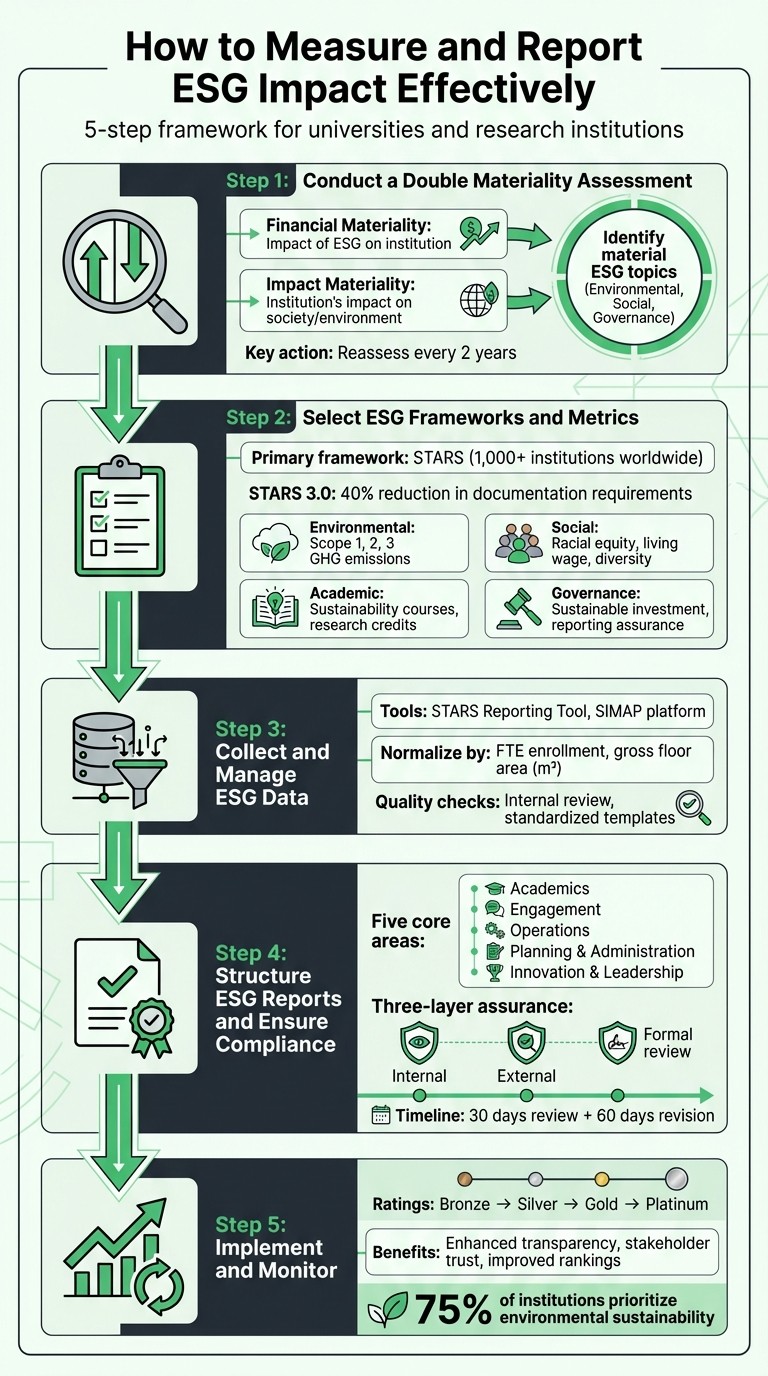
5-Step ESG Impact Measurement Framework for Universities
Making sustainability reporting a strategic asset for universities
Step 1: Conduct a Double Materiality Assessment
For academic institutions, examining ESG (Environmental, Social, and Governance) issues through two perspectives - financial and impact - is key to effective measurement and reporting. A double materiality assessment evaluates these aspects in two ways. Financial materiality focuses on how external ESG factors, such as climate regulations or reputational changes, influence your institution’s funding, reputation, and financial health. Meanwhile, impact materiality examines how your university’s operations affect society and the environment, from campus activities to broader community impacts [7][10].
"Double materiality involves assessing and reporting on two dimensions: Financial Materiality (impact of ESG on the company) and Impact Materiality (impact of the company on society and environment)." – AuditBoard [7]
This process isn’t static. As technologies advance and stakeholder expectations evolve, ESG priorities must be reassessed regularly - ideally every two years [11]. Tools like the Global Reporting Initiative (GRI) Standards and the Sustainability Accounting Standards Board (SASB) provide frameworks for sustainability reporting, with GRI focusing on impact materiality and SASB emphasizing financial disclosures [8].
Identify Material ESG Topics
To start, identify key ESG topics that align with your institution’s operations and stakeholder concerns. These topics generally span three dimensions:
Environmental: Examples include greenhouse gas (GHG) emissions from labs, energy efficiency across campus, waste management practices, and biodiversity preservation.
Social: This includes diversity, equity, and inclusion (DEI) in hiring and admissions, labor practices, and fostering community partnerships.
Governance: Topics may involve ethical research guidelines, board diversity, and anti-corruption measures [7][8].
A materiality matrix can help prioritize these areas by assessing their significance to your institution alongside their importance to stakeholders [7][9]. Comparing your findings with peer institutions can also uncover common priorities and highlight opportunities for leadership [7][11]. For higher education, the STARS framework offers a tailored method for assessing sustainability across academics, engagement, operations, and administration [1].
Combining quantitative data with stakeholder insights ensures a well-rounded and accurate materiality assessment.
Engage Stakeholders
A thorough materiality assessment requires input from a wide range of stakeholders. This includes internal groups like students, faculty, staff, and board members, as well as external parties such as local communities, regulators, research collaborators, and donors [7][10]. For example, Colorado State University partnered with the Brendle Group for third-party verification of its emissions inventory, boosting credibility with funders and external stakeholders [13].
Direct student involvement can significantly improve data collection and outcomes. Institutions such as Agnes Scott College, Amherst College, and Furman University have successfully engaged students in gathering sustainability data [5]. Similarly, the University of Wisconsin-Whitewater fostered collaboration across campuses to ensure comprehensive data collection [5]. Tools like the STARS Technical Manual and review templates can help define reporting criteria and address inconsistencies [12][5].
This collaborative approach not only enhances data quality but also strengthens compliance and transparency, laying a solid foundation for future ESG initiatives.
Step 2: Select ESG Frameworks and Metrics
After completing your materiality assessment, the next logical step is identifying the right frameworks and metrics to guide your environmental, social, and governance (ESG) reporting. While corporate frameworks like GRI and SASB are widely used, academic institutions benefit from frameworks tailored to their specific operations and priorities. Building on the materiality assessment ensures that the chosen frameworks align with the unique mission of academia.
Key ESG Frameworks for Academic Institutions
For higher education, the Sustainability Tracking, Assessment & Rating System (STARS) is the leading global standard. Over 1,000 institutions worldwide use STARS to measure performance in areas like academics, engagement, operations, and leadership [2]. Unlike corporate-focused frameworks, STARS includes sections specifically designed for curriculum integration and research outputs, which are central to the role of academic institutions [16].
"The Sustainability Tracking, Assessment & Rating System™ (STARS®) is a transparent, self-reporting framework for colleges and universities to measure their sustainability performance." - AASHE [1]
In June 2024, the Association for the Advancement of Sustainability in Higher Education (AASHE) launched STARS 3.0, which reduced documentation requirements by 40% while expanding the scope of sustainability tracking [14]. This version emphasizes performance-based metrics over process documentation and introduces stronger indicators for racial equity and social justice [14]. Additionally, it allows institutions to tailor the framework to their specific contexts. For instance, schools with minimal research activity can opt out of research-related credits, ensuring relevance to their mission [15].
"By redesigning credits with accessibility in mind, continuing to prioritize performance over process, and simplifying measurement where feasible, we were able to expand the scope of STARS and still achieve a 40 percent reduction in the number of documentation fields." - AASHE [14]
Beyond STARS, academic institutions can also adapt global frameworks. The Global Reporting Initiative (GRI) is useful for impact materiality reporting, while the Sustainability Accounting Standards Board (SASB) focuses on financial disclosures. For addressing climate risks, the Task Force on Climate-related Financial Disclosures (TCFD) offers valuable insights, particularly for institutions managing large endowments or real estate portfolios [17].
Governance metrics are increasingly important as well. The QS World University Rankings: Sustainability 2025 framework evaluates "Good Governance" using ten indicators, such as open-access publishing, student representation in decision-making, and the citation of institutional policies [18].
Recommended Metrics for Impact Measurement
Choosing the right metrics is essential to ensure your ESG reporting not only captures your environmental impact but also highlights your contributions to sustainability research and education.
Environmental Metrics
A comprehensive greenhouse gas (GHG) inventory is a cornerstone of environmental reporting. Under STARS 3.0, institutions must measure and disclose Scope 1, 2, and 3 emissions, including biogenic emissions, to earn full points [3]. These emissions should be normalized by campus area (in square meters) and full-time equivalent (FTE) population for accurate comparisons [3]. For example, schools like the University of California, Berkeley, and Furman University have documented third-party certified carbon offsets to adjust their net GHG emissions, while American University has achieved carbon-neutral operations as part of its STARS reporting [3]. Additional metrics include energy use per square meter, water consumption, waste diversion rates, and commute modal splits (how students and staff travel to campus) [3].
Social and Governance Metrics
Social metrics should reflect an institution’s commitment to equity and inclusion. Priority areas include racial equity indicators, compliance with living wage standards, sustainability literacy among students, and diversity indices for faculty and staff [14][15]. Governance metrics, such as "Sustainable Investment", are weighted based on the size of an institution’s endowment, reflecting its financial influence on sustainability [15].
Academic Metrics
Academic contributions set higher education apart from corporate ESG reporting. Metrics in this area include the number of sustainability-focused courses, research credits aligned with sustainability goals, and documentation of how campus operations function as a "living laboratory" for sustainability education and research [16]. For instance, National Taiwan Normal University uses keywords from the Sustainable Development Solutions Network (SDSN) to align its academic courses with the UN Sustainable Development Goals [15].
To streamline data collection, tools like the Sustainability Indicator Management and Analysis Platform (SIMAP) can help institutions measure carbon and nitrogen footprints in alignment with STARS requirements [3]. When reporting GHG emissions, be sure to convert floor area measurements to square meters (multiply gross square feet by 0.09290304) and exclude parking structures [3]. Consistency in institutional characteristics, such as FTE enrollment and gross floor area, across all reporting credits ensures accurate data alignment [3].
STARS provides flexibility for institutions at different stages of their sustainability journey. Schools can choose between a scored report (Bronze, Silver, Gold, or Platinum) or an unscored "Reporter" designation if they are just beginning to track their performance [15]. Bonus points are available for "Innovation & Leadership" credits, which reward practices that go beyond standard metrics [15].
| STARS 3.0 Metric Category | Indicators | Normalization |
| --- | --- | --- |
| <strong>Environmental</strong> | Scope 1, 2, & 3 GHG emissions, energy/water use, waste recovery | Per square meter; Per FTE (student/staff) |
| <strong>Social</strong> | Racial equity, living wage, sustainability literacy, diversity indices | Institutional population (FTE) |
| <strong>Academic</strong> | Sustainability course inventory, research credits | Research intensity; Degree levels |
| <strong>Governance</strong> | Sustainable investment, reporting assurance, stakeholder engagement | Investment pool size
| STARS 3.0 Metric Category | Indicators | Normalization |
| --- | --- | --- |
| <strong>Environmental</strong> | Scope 1, 2, & 3 GHG emissions, energy/water use, waste recovery | Per square meter; Per FTE (student/staff) |
| <strong>Social</strong> | Racial equity, living wage, sustainability literacy, diversity indices | Institutional population (FTE) |
| <strong>Academic</strong> | Sustainability course inventory, research credits | Research intensity; Degree levels |
| <strong>Governance</strong> | Sustainable investment, reporting assurance, stakeholder engagement | Investment pool size
Step 3: Collect and Manage ESG Data
Accurate data collection and management form the backbone of any effective ESG report. Once you've chosen your frameworks and metrics, the next step is gathering data from various departments and facilities across your campus.
Data Collection Techniques
A reliable data collection process requires both a structured approach and the right tools to ensure consistency and accuracy. Start by identifying stakeholders across campus who can serve as designated data providers. For instance, your facilities team might handle energy and water consumption data, while academic and administrative departments contribute information on research outputs and other operational metrics. Involving subject matter experts directly in the process can boost accuracy and reduce delays.
Centralized platforms play a critical role in organizing and managing this data. Tools like the STARS Reporting Tool allow you to document, share, and export sustainability data while maintaining clear source tracking. For more complex environmental calculations, specialized tools may be necessary. One widely used option is the Sustainability Indicator Management and Analysis Platform (SIMAP), which helps universities measure and report carbon and nitrogen footprints. Recognized by AASHE STARS, SIMAP is described as "a simple, comprehensive, and affordable online tool" for calculating Scope 1, 2, and 3 emissions [13][21]. These calculations adhere to the Greenhouse Gas Protocol Corporate Standard, offering a standardized framework for measurement [13][3].
To standardize ESG performance metrics, normalize data by factors such as full-time equivalent (FTE) enrollment and gross floor area in square meters. For compliance with STARS 3.0, remember to convert square feet to square meters by multiplying by 0.09290304 [3].
Consistency is key when reporting across categories. Foundational data points - like total FTE population and gross floor area - must remain uniform across metrics such as water use, energy consumption, and waste generation. The table below highlights how these data points feed into various ESG credits:
| Data Point | Relevant ESG Credits/Categories |
| --- | --- |
| <strong>Gross Floor Area</strong> | Institutional Characteristics, Water Use, Energy Use, GHG Emissions, Waste Management <a href="https://stars.aashe.org/resources-support/help-center/v3-operations/greenhouse-gas-emissions-2" target="_blank" style="text-decoration: none;" rel="nofollow noopener noreferrer" data-framer-link="Link:{"url":"https://stars.aashe.org/resources-support/help-center/v3-operations/greenhouse-gas-emissions-2","type":"url"}" data-framer-open-in-new-tab=""><sup>[3]</sup></a> |
| <strong>FTE Students/Employees</strong> | Institutional Characteristics, Water Use, Energy Use, GHG Emissions, Waste Management, Commute Modal Split <a href="https://stars.aashe.org/resources-support/help-center/v3-operations/greenhouse-gas-emissions-2" target="_blank" style="text-decoration: none;" rel="nofollow noopener noreferrer" data-framer-link="Link:{"url":"https://stars.aashe.org/resources-support/help-center/v3-operations/greenhouse-gas-emissions-2","type":"url"}" data-framer-open-in-new-tab=""><sup>[3]</sup></a> |
| <strong>Scope 1, 2, & 3 Emissions</strong> | Air Emissions and Disclosure, Greenhouse Gas Emissions <a href="https://stars.aashe.org/resources-support/help-center/v2-operations/air-emissions-and-disclosure" target="_blank" style="text-decoration: none;" rel="nofollow noopener noreferrer" data-framer-link="Link:{"url":"https://stars.aashe.org/resources-support/help-center/v2-operations/air-emissions-and-disclosure","type":"url"}" data-framer-open-in-new-tab=""><sup>[13]</sup></a><a href="https://stars.aashe.org/resources-support/help-center/v3-operations/greenhouse-gas-emissions-2" target="_blank" style="text-decoration: none;" rel="nofollow noopener noreferrer" data-framer-link="Link:{"url":"https://stars.aashe.org/resources-support/help-center/v3-operations/greenhouse-gas-emissions-2","type":"url"}" data-framer-open-in-new-tab=""><sup>[3]</sup></a> |
| Data Point | Relevant ESG Credits/Categories |
| --- | --- |
| <strong>Gross Floor Area</strong> | Institutional Characteristics, Water Use, Energy Use, GHG Emissions, Waste Management <a href="https://stars.aashe.org/resources-support/help-center/v3-operations/greenhouse-gas-emissions-2" target="_blank" style="text-decoration: none;" rel="nofollow noopener noreferrer" data-framer-link="Link:{"url":"https://stars.aashe.org/resources-support/help-center/v3-operations/greenhouse-gas-emissions-2","type":"url"}" data-framer-open-in-new-tab=""><sup>[3]</sup></a> |
| <strong>FTE Students/Employees</strong> | Institutional Characteristics, Water Use, Energy Use, GHG Emissions, Waste Management, Commute Modal Split <a href="https://stars.aashe.org/resources-support/help-center/v3-operations/greenhouse-gas-emissions-2" target="_blank" style="text-decoration: none;" rel="nofollow noopener noreferrer" data-framer-link="Link:{"url":"https://stars.aashe.org/resources-support/help-center/v3-operations/greenhouse-gas-emissions-2","type":"url"}" data-framer-open-in-new-tab=""><sup>[3]</sup></a> |
| <strong>Scope 1, 2, & 3 Emissions</strong> | Air Emissions and Disclosure, Greenhouse Gas Emissions <a href="https://stars.aashe.org/resources-support/help-center/v2-operations/air-emissions-and-disclosure" target="_blank" style="text-decoration: none;" rel="nofollow noopener noreferrer" data-framer-link="Link:{"url":"https://stars.aashe.org/resources-support/help-center/v2-operations/air-emissions-and-disclosure","type":"url"}" data-framer-open-in-new-tab=""><sup>[13]</sup></a><a href="https://stars.aashe.org/resources-support/help-center/v3-operations/greenhouse-gas-emissions-2" target="_blank" style="text-decoration: none;" rel="nofollow noopener noreferrer" data-framer-link="Link:{"url":"https://stars.aashe.org/resources-support/help-center/v3-operations/greenhouse-gas-emissions-2","type":"url"}" data-framer-open-in-new-tab=""><sup>[3]</sup></a> |After collecting your data, rigorous quality checks are essential to ensure accuracy and reliability.
Ensure Data Quality and Accuracy
The quality of your data directly impacts the credibility of your ESG report. To maintain high standards, an internal review and assurance process is crucial. This process should involve individuals from your institution who are not directly involved in collecting the data [20]. Drawing on staff from different departments - or even engaging students - can provide fresh perspectives and help identify potential errors [5].
Standardized review templates, such as the STARS Review Template, can help flag common inconsistencies before submission [20][5]. These templates make it easier to spot recurring issues early. Additionally, recording explanations for any discrepancies in the "Notes" field creates an audit trail for reviewers [3].
"Completing this [assurance] step can greatly reduce the amount of time it takes to publish your report and receive your rating." - AASHE [12]
For external validation, consider hiring third-party contractors or partnering with peer institutions for independent audits [20]. This is particularly important for greenhouse gas inventories, where precision is critical. AASHE staff typically review submitted sustainability reports within 30 days, and institutions have 60 days to address any flagged issues in a collaborative revision process that usually takes 2–3 weeks [20][12].
Automated data-sharing features in reporting tools can also help minimize manual entry errors. For example, institutional characteristics like floor area can be automatically populated across multiple credits rather than re-entered each time [3]. When reporting Scope 3 emissions, clearly indicate which specific sources are included in your inventory. If certain Scope 3 sources are not yet tracked, update your response to "Not at all" to maintain transparency and data integrity [13][3]. Under STARS Version 3.0, institutions must measure and disclose biogenic emissions and all Scope 3 sources to earn maximum points [3].
Finally, public transparency acts as an additional layer of quality assurance. By making your reported data publicly available, you invite external scrutiny and feedback, which can help identify errors and strengthen the credibility of your sustainability claims [20][19]. As AASHE emphasizes, "AASHE believes that transparency is a key component in communicating sustainability claims" [19].
Step 4: Structure ESG Reports and Ensure Compliance
Once you’ve established standardized data collection and ensured its accuracy, the next step is organizing your ESG report for both compliance and clear communication. A well-structured report not only meets regulatory standards but also fosters trust with stakeholders by transparently showcasing your institution's impact.
Key Components of an ESG Report
An effective ESG report for higher education institutions should include several essential elements. Start with an executive letter from your institution's top leader, which confirms the accuracy of the data and reiterates the institution’s commitment to sustainability. This letter is a requirement for scored reports and serves as a statement of accountability [12].
Next, define your institutional boundary and characteristics. Clearly outline the scope of your report by detailing the buildings, campuses, and populations included. Provide demographic data in terms of full-time equivalent (FTE) counts and document the total floor area using metric measurements [6]. If certain buildings or populations are excluded, explain the reasoning in the public "Notes" field to maintain transparency [6].
The main body of your report should focus on five core functional areas:
Academics: Curriculum and research initiatives.
Engagement: Efforts in campus and public outreach.
Operations: Metrics related to energy, waste, water, and food.
Planning & Administration: Topics like equity, well-being, and investment.
Innovation & Leadership: Unique contributions and forward-thinking initiatives [12].
For each area, include both quantitative data and qualitative context. For example, when reporting greenhouse gas emissions, provide the total metric tons of CO₂ equivalent and include details about your methodology, data sources, and any exclusions.
Transparency about your methodology is crucial. Agnes Scott College, for instance, earned recognition in January 2026 for offering detailed insights into their data collection and quality assurance processes [5]. To build confidence in your report, document your methods, note any anomalies, and explain the quality control measures used.
To streamline the reporting process, consider adopting a three-year staggered reporting cycle. This approach reduces the annual workload by allowing you to update different impact areas in rotation, rather than revisiting every area each year. Reports and ratings remain valid for three years, making this a practical solution [6][12].
This structured reporting framework aligns with academic sustainability standards and emphasizes your institution’s dedication to transparent ESG practices.
Implement Assurance Processes
After structuring your report, it’s important to implement assurance processes to validate your findings. A robust assurance strategy involves three layers of review: internal, external, and formal (conducted by framework administrators) [20][23][24]. These layers ensure the credibility of your report, reinforcing both data accuracy and stakeholder confidence.
For internal reviews, involve staff members who were not part of the data collection process [20]. The University of Wisconsin-Whitewater, for example, successfully utilized intercampus collaboration to bring fresh perspectives to their assurance efforts [5]. Tools like the STARS Review Template, available in Excel or Google Drive formats, can standardize the review process and help identify errors before submission [20][23].
External reviews add another layer of credibility. During the 2022–2023 reporting cycle, Bentley University partnered with GreenerU, a third-party consultant, to review their sustainability data [24]. Similarly, Boise State University collaborated with staff from California State University, Stanislaus for peer verification, while Texas A&M University used a hybrid approach, involving a graduate student for an initial review followed by verification from sustainability staff [24].
Allocate at least 30 days in your timeline for the review and revision process [23]. After submission, AASHE staff typically complete their review within 2–3 weeks, though this may extend to 30 days during busy periods [20]. Once feedback is received, institutions usually have around 60 days to address any issues before publication [20][22]. The collaborative revision phase, which often takes 2–3 weeks, should focus on ensuring evidence supports affirmative responses, aligning data with reporting periods, addressing anomalies, maintaining consistency across sections, and verifying URLs [23][24].
As of January 20, 2026, 30 individuals had earned STARS Data Quality Certification, highlighting the growing emphasis on professional ESG data verification in academia [1]. Encouraging your staff to pursue this certification can enhance your internal assurance capabilities and demonstrate your commitment to high-quality reporting.
Step 5: Work with Council Fire for ESG Implementation

After establishing solid assurance processes, the next step is putting your ESG strategy into action. This phase turns plans into measurable outcomes, and Council Fire offers the specialized expertise needed to make this transition seamless. Their approach combines data-driven insights with stakeholder-focused planning, tailored specifically for universities and research institutions.
With the shift from STARS Version 2.2 to 3.0, institutions now face new qualitative reporting requirements for methodologies and assurance processes [5]. Council Fire helps universities navigate these updates, ensuring compliance with the revised standards. This includes a thorough approach to measuring Scope 1, 2, and 3 emissions [3], which are critical for capturing the full picture of an institution's environmental impact.
A key element of this process is data normalization and benchmarking, which are vital for comparing ESG performance across a range of universities [15]. Council Fire’s technical expertise and systems-based approach ensure that metrics are standardized to reflect the unique characteristics of each institution while remaining comparable to peer organizations.
Achieving successful ESG implementation also requires strong leadership from the top. This begins with active involvement from boards and university presidents and extends to embedding sustainability initiatives across all departments [4]. With 75% of surveyed institutions prioritizing environmental sustainability [4], Council Fire’s strategies for stakeholder engagement build the trust and collaboration necessary to drive meaningful, long-term social, environmental, and economic outcomes.
Conclusion
To effectively measure ESG impact, institutions must focus on identifying key priorities and selecting the right frameworks and metrics. This requires thorough data collection, strict quality controls, and transparent reporting that satisfies both regulatory standards and stakeholder needs. When executed properly, these efforts go beyond mere compliance - they establish trust, enable meaningful comparisons, and reflect a genuine commitment to advancing sustainability goals.
Building on previously discussed methodologies, tools like STARS provide tiered ratings, ranging from Bronze to Platinum [12]. This system helps universities track their progress, engage stakeholders, and benchmark their efforts [5][12]. Additionally, strong ESG reporting enhances operational efficiency, strengthens stakeholder relationships, and can even improve rankings like The Princeton Review's Guide to Green Colleges. Normalizing data by full-time equivalent (FTE) and building square footage further refines performance evaluations [5][3].
"The Sustainability Tracking, Assessment & Rating System™ (STARS®) is a transparent, self-reporting framework for colleges and universities to measure their sustainability performance. STARS is intended to engage and recognize the full spectrum of higher education institutions, from community colleges to research universities." - AASHE [1]
These advantages grow exponentially when institutions collaborate with experts who simplify the journey from planning to measurable results. Specialized partners like Council Fire help navigate changing standards, maintain data accuracy, and translate sustainability strategies into actionable, quantifiable outcomes. With 75% of surveyed institutions prioritizing environmental sustainability [25], the question is no longer if but when systems driving long-term ESG impact will be implemented.
FAQs
Where do we start with ESG reporting if we have limited data?
To kick off ESG reporting, consider adopting a structured framework such as STARS. This framework is designed to support gradual data collection, making it manageable for organizations starting from scratch. Begin by gathering essential data through simple tools like spreadsheets and involve key stakeholders in the process to ensure alignment and support. Assigning a dedicated team to oversee data management is crucial for maintaining consistency and accuracy.
One of the strengths of STARS lies in its flexibility - it accommodates various reporting units and allows for progressive improvements in data quality. This makes it particularly well-suited for institutions that may have limited data available at the outset but aim to enhance their reporting capabilities over time.
Which ESG framework should our university use first?
The Sustainability Tracking, Assessment & Rating System (STARS), developed by AASHE, is widely regarded as the go-to framework for universities aiming to assess and improve their sustainability efforts. This system is designed to be transparent and self-reporting, making it an ideal tool for measuring sustainability performance in higher education institutions.
Getting started is straightforward. Simply register and access the STARS Reporting Tool, which provides a wealth of resources, including a detailed technical manual. These materials are specifically designed to support your efforts in measuring and reporting ESG impact with precision and clarity.
How can we validate ESG data without a big budget?
Universities and research institutions have options to ensure ESG data accuracy without straining their budgets. Tools like the STARS framework offer an affordable way to promote transparency through self-reporting. Conducting internal reviews is another effective method, helping to identify and resolve data inconsistencies at no additional cost. By utilizing the STARS reporting tool alongside its guidance materials, institutions can streamline data collection and validation processes. Prioritizing internal resources and refining existing workflows allows for maintaining high data quality while keeping expenses minimal.
Related Blog Posts
Latest Articles
©2025



FAQ
01
What does it really mean to “redefine profit”?
02
What makes Council Fire different?
03
Who does Council Fire you work with?
04
What does working with Council Fire actually look like?
05
How does Council Fire help organizations turn big goals into action?
06
How does Council Fire define and measure success?
Feb 24, 2026
How to Measure and Report ESG Impact Effectively for Universities & Research Institutions
ESG Strategy
In This Article
A practical framework for universities to measure, normalize, and report ESG impact — covering double materiality, STARS metrics, data quality, and assurance.
How to Measure and Report ESG Impact Effectively for Universities & Research Institutions
Universities and research institutions are increasingly prioritizing ESG (Environmental, Social, and Governance) efforts to align with societal goals, attract stakeholders, and meet evolving expectations. Here's a quick breakdown of how to measure and report ESG impact effectively:
Double Materiality Assessment: Evaluate ESG issues from two perspectives - how they affect your institution financially and how your operations impact society and the environment.
Select Frameworks and Metrics: Use tools like STARS, GRI, or SASB to track progress. Tailor metrics to cover emissions, diversity, and sustainability-focused academics.
Collect and Manage Data: Implement structured processes and tools (e.g., SIMAP) for consistent data collection, ensuring accuracy and transparency.
Structure Reports: Include clear sections on academics, operations, and governance. Use normalization metrics (e.g., emissions per square meter) for comparability.
Assurance and Compliance: Use internal and external reviews to validate data and meet reporting standards like STARS 3.0.
With a systematic approach, institutions can enhance transparency, build trust with stakeholders, and contribute meaningfully to sustainability goals.
5-Step ESG Impact Measurement Framework for Universities
Making sustainability reporting a strategic asset for universities
Step 1: Conduct a Double Materiality Assessment
For academic institutions, examining ESG (Environmental, Social, and Governance) issues through two perspectives - financial and impact - is key to effective measurement and reporting. A double materiality assessment evaluates these aspects in two ways. Financial materiality focuses on how external ESG factors, such as climate regulations or reputational changes, influence your institution’s funding, reputation, and financial health. Meanwhile, impact materiality examines how your university’s operations affect society and the environment, from campus activities to broader community impacts [7][10].
"Double materiality involves assessing and reporting on two dimensions: Financial Materiality (impact of ESG on the company) and Impact Materiality (impact of the company on society and environment)." – AuditBoard [7]
This process isn’t static. As technologies advance and stakeholder expectations evolve, ESG priorities must be reassessed regularly - ideally every two years [11]. Tools like the Global Reporting Initiative (GRI) Standards and the Sustainability Accounting Standards Board (SASB) provide frameworks for sustainability reporting, with GRI focusing on impact materiality and SASB emphasizing financial disclosures [8].
Identify Material ESG Topics
To start, identify key ESG topics that align with your institution’s operations and stakeholder concerns. These topics generally span three dimensions:
Environmental: Examples include greenhouse gas (GHG) emissions from labs, energy efficiency across campus, waste management practices, and biodiversity preservation.
Social: This includes diversity, equity, and inclusion (DEI) in hiring and admissions, labor practices, and fostering community partnerships.
Governance: Topics may involve ethical research guidelines, board diversity, and anti-corruption measures [7][8].
A materiality matrix can help prioritize these areas by assessing their significance to your institution alongside their importance to stakeholders [7][9]. Comparing your findings with peer institutions can also uncover common priorities and highlight opportunities for leadership [7][11]. For higher education, the STARS framework offers a tailored method for assessing sustainability across academics, engagement, operations, and administration [1].
Combining quantitative data with stakeholder insights ensures a well-rounded and accurate materiality assessment.
Engage Stakeholders
A thorough materiality assessment requires input from a wide range of stakeholders. This includes internal groups like students, faculty, staff, and board members, as well as external parties such as local communities, regulators, research collaborators, and donors [7][10]. For example, Colorado State University partnered with the Brendle Group for third-party verification of its emissions inventory, boosting credibility with funders and external stakeholders [13].
Direct student involvement can significantly improve data collection and outcomes. Institutions such as Agnes Scott College, Amherst College, and Furman University have successfully engaged students in gathering sustainability data [5]. Similarly, the University of Wisconsin-Whitewater fostered collaboration across campuses to ensure comprehensive data collection [5]. Tools like the STARS Technical Manual and review templates can help define reporting criteria and address inconsistencies [12][5].
This collaborative approach not only enhances data quality but also strengthens compliance and transparency, laying a solid foundation for future ESG initiatives.
Step 2: Select ESG Frameworks and Metrics
After completing your materiality assessment, the next logical step is identifying the right frameworks and metrics to guide your environmental, social, and governance (ESG) reporting. While corporate frameworks like GRI and SASB are widely used, academic institutions benefit from frameworks tailored to their specific operations and priorities. Building on the materiality assessment ensures that the chosen frameworks align with the unique mission of academia.
Key ESG Frameworks for Academic Institutions
For higher education, the Sustainability Tracking, Assessment & Rating System (STARS) is the leading global standard. Over 1,000 institutions worldwide use STARS to measure performance in areas like academics, engagement, operations, and leadership [2]. Unlike corporate-focused frameworks, STARS includes sections specifically designed for curriculum integration and research outputs, which are central to the role of academic institutions [16].
"The Sustainability Tracking, Assessment & Rating System™ (STARS®) is a transparent, self-reporting framework for colleges and universities to measure their sustainability performance." - AASHE [1]
In June 2024, the Association for the Advancement of Sustainability in Higher Education (AASHE) launched STARS 3.0, which reduced documentation requirements by 40% while expanding the scope of sustainability tracking [14]. This version emphasizes performance-based metrics over process documentation and introduces stronger indicators for racial equity and social justice [14]. Additionally, it allows institutions to tailor the framework to their specific contexts. For instance, schools with minimal research activity can opt out of research-related credits, ensuring relevance to their mission [15].
"By redesigning credits with accessibility in mind, continuing to prioritize performance over process, and simplifying measurement where feasible, we were able to expand the scope of STARS and still achieve a 40 percent reduction in the number of documentation fields." - AASHE [14]
Beyond STARS, academic institutions can also adapt global frameworks. The Global Reporting Initiative (GRI) is useful for impact materiality reporting, while the Sustainability Accounting Standards Board (SASB) focuses on financial disclosures. For addressing climate risks, the Task Force on Climate-related Financial Disclosures (TCFD) offers valuable insights, particularly for institutions managing large endowments or real estate portfolios [17].
Governance metrics are increasingly important as well. The QS World University Rankings: Sustainability 2025 framework evaluates "Good Governance" using ten indicators, such as open-access publishing, student representation in decision-making, and the citation of institutional policies [18].
Recommended Metrics for Impact Measurement
Choosing the right metrics is essential to ensure your ESG reporting not only captures your environmental impact but also highlights your contributions to sustainability research and education.
Environmental Metrics
A comprehensive greenhouse gas (GHG) inventory is a cornerstone of environmental reporting. Under STARS 3.0, institutions must measure and disclose Scope 1, 2, and 3 emissions, including biogenic emissions, to earn full points [3]. These emissions should be normalized by campus area (in square meters) and full-time equivalent (FTE) population for accurate comparisons [3]. For example, schools like the University of California, Berkeley, and Furman University have documented third-party certified carbon offsets to adjust their net GHG emissions, while American University has achieved carbon-neutral operations as part of its STARS reporting [3]. Additional metrics include energy use per square meter, water consumption, waste diversion rates, and commute modal splits (how students and staff travel to campus) [3].
Social and Governance Metrics
Social metrics should reflect an institution’s commitment to equity and inclusion. Priority areas include racial equity indicators, compliance with living wage standards, sustainability literacy among students, and diversity indices for faculty and staff [14][15]. Governance metrics, such as "Sustainable Investment", are weighted based on the size of an institution’s endowment, reflecting its financial influence on sustainability [15].
Academic Metrics
Academic contributions set higher education apart from corporate ESG reporting. Metrics in this area include the number of sustainability-focused courses, research credits aligned with sustainability goals, and documentation of how campus operations function as a "living laboratory" for sustainability education and research [16]. For instance, National Taiwan Normal University uses keywords from the Sustainable Development Solutions Network (SDSN) to align its academic courses with the UN Sustainable Development Goals [15].
To streamline data collection, tools like the Sustainability Indicator Management and Analysis Platform (SIMAP) can help institutions measure carbon and nitrogen footprints in alignment with STARS requirements [3]. When reporting GHG emissions, be sure to convert floor area measurements to square meters (multiply gross square feet by 0.09290304) and exclude parking structures [3]. Consistency in institutional characteristics, such as FTE enrollment and gross floor area, across all reporting credits ensures accurate data alignment [3].
STARS provides flexibility for institutions at different stages of their sustainability journey. Schools can choose between a scored report (Bronze, Silver, Gold, or Platinum) or an unscored "Reporter" designation if they are just beginning to track their performance [15]. Bonus points are available for "Innovation & Leadership" credits, which reward practices that go beyond standard metrics [15].
| STARS 3.0 Metric Category | Indicators | Normalization |
| --- | --- | --- |
| <strong>Environmental</strong> | Scope 1, 2, & 3 GHG emissions, energy/water use, waste recovery | Per square meter; Per FTE (student/staff) |
| <strong>Social</strong> | Racial equity, living wage, sustainability literacy, diversity indices | Institutional population (FTE) |
| <strong>Academic</strong> | Sustainability course inventory, research credits | Research intensity; Degree levels |
| <strong>Governance</strong> | Sustainable investment, reporting assurance, stakeholder engagement | Investment pool size
Step 3: Collect and Manage ESG Data
Accurate data collection and management form the backbone of any effective ESG report. Once you've chosen your frameworks and metrics, the next step is gathering data from various departments and facilities across your campus.
Data Collection Techniques
A reliable data collection process requires both a structured approach and the right tools to ensure consistency and accuracy. Start by identifying stakeholders across campus who can serve as designated data providers. For instance, your facilities team might handle energy and water consumption data, while academic and administrative departments contribute information on research outputs and other operational metrics. Involving subject matter experts directly in the process can boost accuracy and reduce delays.
Centralized platforms play a critical role in organizing and managing this data. Tools like the STARS Reporting Tool allow you to document, share, and export sustainability data while maintaining clear source tracking. For more complex environmental calculations, specialized tools may be necessary. One widely used option is the Sustainability Indicator Management and Analysis Platform (SIMAP), which helps universities measure and report carbon and nitrogen footprints. Recognized by AASHE STARS, SIMAP is described as "a simple, comprehensive, and affordable online tool" for calculating Scope 1, 2, and 3 emissions [13][21]. These calculations adhere to the Greenhouse Gas Protocol Corporate Standard, offering a standardized framework for measurement [13][3].
To standardize ESG performance metrics, normalize data by factors such as full-time equivalent (FTE) enrollment and gross floor area in square meters. For compliance with STARS 3.0, remember to convert square feet to square meters by multiplying by 0.09290304 [3].
Consistency is key when reporting across categories. Foundational data points - like total FTE population and gross floor area - must remain uniform across metrics such as water use, energy consumption, and waste generation. The table below highlights how these data points feed into various ESG credits:
| Data Point | Relevant ESG Credits/Categories |
| --- | --- |
| <strong>Gross Floor Area</strong> | Institutional Characteristics, Water Use, Energy Use, GHG Emissions, Waste Management <a href="https://stars.aashe.org/resources-support/help-center/v3-operations/greenhouse-gas-emissions-2" target="_blank" style="text-decoration: none;" rel="nofollow noopener noreferrer" data-framer-link="Link:{"url":"https://stars.aashe.org/resources-support/help-center/v3-operations/greenhouse-gas-emissions-2","type":"url"}" data-framer-open-in-new-tab=""><sup>[3]</sup></a> |
| <strong>FTE Students/Employees</strong> | Institutional Characteristics, Water Use, Energy Use, GHG Emissions, Waste Management, Commute Modal Split <a href="https://stars.aashe.org/resources-support/help-center/v3-operations/greenhouse-gas-emissions-2" target="_blank" style="text-decoration: none;" rel="nofollow noopener noreferrer" data-framer-link="Link:{"url":"https://stars.aashe.org/resources-support/help-center/v3-operations/greenhouse-gas-emissions-2","type":"url"}" data-framer-open-in-new-tab=""><sup>[3]</sup></a> |
| <strong>Scope 1, 2, & 3 Emissions</strong> | Air Emissions and Disclosure, Greenhouse Gas Emissions <a href="https://stars.aashe.org/resources-support/help-center/v2-operations/air-emissions-and-disclosure" target="_blank" style="text-decoration: none;" rel="nofollow noopener noreferrer" data-framer-link="Link:{"url":"https://stars.aashe.org/resources-support/help-center/v2-operations/air-emissions-and-disclosure","type":"url"}" data-framer-open-in-new-tab=""><sup>[13]</sup></a><a href="https://stars.aashe.org/resources-support/help-center/v3-operations/greenhouse-gas-emissions-2" target="_blank" style="text-decoration: none;" rel="nofollow noopener noreferrer" data-framer-link="Link:{"url":"https://stars.aashe.org/resources-support/help-center/v3-operations/greenhouse-gas-emissions-2","type":"url"}" data-framer-open-in-new-tab=""><sup>[3]</sup></a> |
After collecting your data, rigorous quality checks are essential to ensure accuracy and reliability.
Ensure Data Quality and Accuracy
The quality of your data directly impacts the credibility of your ESG report. To maintain high standards, an internal review and assurance process is crucial. This process should involve individuals from your institution who are not directly involved in collecting the data [20]. Drawing on staff from different departments - or even engaging students - can provide fresh perspectives and help identify potential errors [5].
Standardized review templates, such as the STARS Review Template, can help flag common inconsistencies before submission [20][5]. These templates make it easier to spot recurring issues early. Additionally, recording explanations for any discrepancies in the "Notes" field creates an audit trail for reviewers [3].
"Completing this [assurance] step can greatly reduce the amount of time it takes to publish your report and receive your rating." - AASHE [12]
For external validation, consider hiring third-party contractors or partnering with peer institutions for independent audits [20]. This is particularly important for greenhouse gas inventories, where precision is critical. AASHE staff typically review submitted sustainability reports within 30 days, and institutions have 60 days to address any flagged issues in a collaborative revision process that usually takes 2–3 weeks [20][12].
Automated data-sharing features in reporting tools can also help minimize manual entry errors. For example, institutional characteristics like floor area can be automatically populated across multiple credits rather than re-entered each time [3]. When reporting Scope 3 emissions, clearly indicate which specific sources are included in your inventory. If certain Scope 3 sources are not yet tracked, update your response to "Not at all" to maintain transparency and data integrity [13][3]. Under STARS Version 3.0, institutions must measure and disclose biogenic emissions and all Scope 3 sources to earn maximum points [3].
Finally, public transparency acts as an additional layer of quality assurance. By making your reported data publicly available, you invite external scrutiny and feedback, which can help identify errors and strengthen the credibility of your sustainability claims [20][19]. As AASHE emphasizes, "AASHE believes that transparency is a key component in communicating sustainability claims" [19].
Step 4: Structure ESG Reports and Ensure Compliance
Once you’ve established standardized data collection and ensured its accuracy, the next step is organizing your ESG report for both compliance and clear communication. A well-structured report not only meets regulatory standards but also fosters trust with stakeholders by transparently showcasing your institution's impact.
Key Components of an ESG Report
An effective ESG report for higher education institutions should include several essential elements. Start with an executive letter from your institution's top leader, which confirms the accuracy of the data and reiterates the institution’s commitment to sustainability. This letter is a requirement for scored reports and serves as a statement of accountability [12].
Next, define your institutional boundary and characteristics. Clearly outline the scope of your report by detailing the buildings, campuses, and populations included. Provide demographic data in terms of full-time equivalent (FTE) counts and document the total floor area using metric measurements [6]. If certain buildings or populations are excluded, explain the reasoning in the public "Notes" field to maintain transparency [6].
The main body of your report should focus on five core functional areas:
Academics: Curriculum and research initiatives.
Engagement: Efforts in campus and public outreach.
Operations: Metrics related to energy, waste, water, and food.
Planning & Administration: Topics like equity, well-being, and investment.
Innovation & Leadership: Unique contributions and forward-thinking initiatives [12].
For each area, include both quantitative data and qualitative context. For example, when reporting greenhouse gas emissions, provide the total metric tons of CO₂ equivalent and include details about your methodology, data sources, and any exclusions.
Transparency about your methodology is crucial. Agnes Scott College, for instance, earned recognition in January 2026 for offering detailed insights into their data collection and quality assurance processes [5]. To build confidence in your report, document your methods, note any anomalies, and explain the quality control measures used.
To streamline the reporting process, consider adopting a three-year staggered reporting cycle. This approach reduces the annual workload by allowing you to update different impact areas in rotation, rather than revisiting every area each year. Reports and ratings remain valid for three years, making this a practical solution [6][12].
This structured reporting framework aligns with academic sustainability standards and emphasizes your institution’s dedication to transparent ESG practices.
Implement Assurance Processes
After structuring your report, it’s important to implement assurance processes to validate your findings. A robust assurance strategy involves three layers of review: internal, external, and formal (conducted by framework administrators) [20][23][24]. These layers ensure the credibility of your report, reinforcing both data accuracy and stakeholder confidence.
For internal reviews, involve staff members who were not part of the data collection process [20]. The University of Wisconsin-Whitewater, for example, successfully utilized intercampus collaboration to bring fresh perspectives to their assurance efforts [5]. Tools like the STARS Review Template, available in Excel or Google Drive formats, can standardize the review process and help identify errors before submission [20][23].
External reviews add another layer of credibility. During the 2022–2023 reporting cycle, Bentley University partnered with GreenerU, a third-party consultant, to review their sustainability data [24]. Similarly, Boise State University collaborated with staff from California State University, Stanislaus for peer verification, while Texas A&M University used a hybrid approach, involving a graduate student for an initial review followed by verification from sustainability staff [24].
Allocate at least 30 days in your timeline for the review and revision process [23]. After submission, AASHE staff typically complete their review within 2–3 weeks, though this may extend to 30 days during busy periods [20]. Once feedback is received, institutions usually have around 60 days to address any issues before publication [20][22]. The collaborative revision phase, which often takes 2–3 weeks, should focus on ensuring evidence supports affirmative responses, aligning data with reporting periods, addressing anomalies, maintaining consistency across sections, and verifying URLs [23][24].
As of January 20, 2026, 30 individuals had earned STARS Data Quality Certification, highlighting the growing emphasis on professional ESG data verification in academia [1]. Encouraging your staff to pursue this certification can enhance your internal assurance capabilities and demonstrate your commitment to high-quality reporting.
Step 5: Work with Council Fire for ESG Implementation
After establishing solid assurance processes, the next step is putting your ESG strategy into action. This phase turns plans into measurable outcomes, and Council Fire offers the specialized expertise needed to make this transition seamless. Their approach combines data-driven insights with stakeholder-focused planning, tailored specifically for universities and research institutions.
With the shift from STARS Version 2.2 to 3.0, institutions now face new qualitative reporting requirements for methodologies and assurance processes [5]. Council Fire helps universities navigate these updates, ensuring compliance with the revised standards. This includes a thorough approach to measuring Scope 1, 2, and 3 emissions [3], which are critical for capturing the full picture of an institution's environmental impact.
A key element of this process is data normalization and benchmarking, which are vital for comparing ESG performance across a range of universities [15]. Council Fire’s technical expertise and systems-based approach ensure that metrics are standardized to reflect the unique characteristics of each institution while remaining comparable to peer organizations.
Achieving successful ESG implementation also requires strong leadership from the top. This begins with active involvement from boards and university presidents and extends to embedding sustainability initiatives across all departments [4]. With 75% of surveyed institutions prioritizing environmental sustainability [4], Council Fire’s strategies for stakeholder engagement build the trust and collaboration necessary to drive meaningful, long-term social, environmental, and economic outcomes.
Conclusion
To effectively measure ESG impact, institutions must focus on identifying key priorities and selecting the right frameworks and metrics. This requires thorough data collection, strict quality controls, and transparent reporting that satisfies both regulatory standards and stakeholder needs. When executed properly, these efforts go beyond mere compliance - they establish trust, enable meaningful comparisons, and reflect a genuine commitment to advancing sustainability goals.
Building on previously discussed methodologies, tools like STARS provide tiered ratings, ranging from Bronze to Platinum [12]. This system helps universities track their progress, engage stakeholders, and benchmark their efforts [5][12]. Additionally, strong ESG reporting enhances operational efficiency, strengthens stakeholder relationships, and can even improve rankings like The Princeton Review's Guide to Green Colleges. Normalizing data by full-time equivalent (FTE) and building square footage further refines performance evaluations [5][3].
"The Sustainability Tracking, Assessment & Rating System™ (STARS®) is a transparent, self-reporting framework for colleges and universities to measure their sustainability performance. STARS is intended to engage and recognize the full spectrum of higher education institutions, from community colleges to research universities." - AASHE [1]
These advantages grow exponentially when institutions collaborate with experts who simplify the journey from planning to measurable results. Specialized partners like Council Fire help navigate changing standards, maintain data accuracy, and translate sustainability strategies into actionable, quantifiable outcomes. With 75% of surveyed institutions prioritizing environmental sustainability [25], the question is no longer if but when systems driving long-term ESG impact will be implemented.
FAQs
Where do we start with ESG reporting if we have limited data?
To kick off ESG reporting, consider adopting a structured framework such as STARS. This framework is designed to support gradual data collection, making it manageable for organizations starting from scratch. Begin by gathering essential data through simple tools like spreadsheets and involve key stakeholders in the process to ensure alignment and support. Assigning a dedicated team to oversee data management is crucial for maintaining consistency and accuracy.
One of the strengths of STARS lies in its flexibility - it accommodates various reporting units and allows for progressive improvements in data quality. This makes it particularly well-suited for institutions that may have limited data available at the outset but aim to enhance their reporting capabilities over time.
Which ESG framework should our university use first?
The Sustainability Tracking, Assessment & Rating System (STARS), developed by AASHE, is widely regarded as the go-to framework for universities aiming to assess and improve their sustainability efforts. This system is designed to be transparent and self-reporting, making it an ideal tool for measuring sustainability performance in higher education institutions.
Getting started is straightforward. Simply register and access the STARS Reporting Tool, which provides a wealth of resources, including a detailed technical manual. These materials are specifically designed to support your efforts in measuring and reporting ESG impact with precision and clarity.
How can we validate ESG data without a big budget?
Universities and research institutions have options to ensure ESG data accuracy without straining their budgets. Tools like the STARS framework offer an affordable way to promote transparency through self-reporting. Conducting internal reviews is another effective method, helping to identify and resolve data inconsistencies at no additional cost. By utilizing the STARS reporting tool alongside its guidance materials, institutions can streamline data collection and validation processes. Prioritizing internal resources and refining existing workflows allows for maintaining high data quality while keeping expenses minimal.
Related Blog Posts
FAQ
01
What does it really mean to “redefine profit”?
02
What makes Council Fire different?
03
Who does Council Fire you work with?
04
What does working with Council Fire actually look like?
05
How does Council Fire help organizations turn big goals into action?
06
How does Council Fire define and measure success?
Feb 24, 2026
How to Measure and Report ESG Impact Effectively for Universities & Research Institutions
ESG Strategy
In This Article
A practical framework for universities to measure, normalize, and report ESG impact — covering double materiality, STARS metrics, data quality, and assurance.
How to Measure and Report ESG Impact Effectively for Universities & Research Institutions
Universities and research institutions are increasingly prioritizing ESG (Environmental, Social, and Governance) efforts to align with societal goals, attract stakeholders, and meet evolving expectations. Here's a quick breakdown of how to measure and report ESG impact effectively:
Double Materiality Assessment: Evaluate ESG issues from two perspectives - how they affect your institution financially and how your operations impact society and the environment.
Select Frameworks and Metrics: Use tools like STARS, GRI, or SASB to track progress. Tailor metrics to cover emissions, diversity, and sustainability-focused academics.
Collect and Manage Data: Implement structured processes and tools (e.g., SIMAP) for consistent data collection, ensuring accuracy and transparency.
Structure Reports: Include clear sections on academics, operations, and governance. Use normalization metrics (e.g., emissions per square meter) for comparability.
Assurance and Compliance: Use internal and external reviews to validate data and meet reporting standards like STARS 3.0.
With a systematic approach, institutions can enhance transparency, build trust with stakeholders, and contribute meaningfully to sustainability goals.
5-Step ESG Impact Measurement Framework for Universities
Making sustainability reporting a strategic asset for universities
Step 1: Conduct a Double Materiality Assessment
For academic institutions, examining ESG (Environmental, Social, and Governance) issues through two perspectives - financial and impact - is key to effective measurement and reporting. A double materiality assessment evaluates these aspects in two ways. Financial materiality focuses on how external ESG factors, such as climate regulations or reputational changes, influence your institution’s funding, reputation, and financial health. Meanwhile, impact materiality examines how your university’s operations affect society and the environment, from campus activities to broader community impacts [7][10].
"Double materiality involves assessing and reporting on two dimensions: Financial Materiality (impact of ESG on the company) and Impact Materiality (impact of the company on society and environment)." – AuditBoard [7]
This process isn’t static. As technologies advance and stakeholder expectations evolve, ESG priorities must be reassessed regularly - ideally every two years [11]. Tools like the Global Reporting Initiative (GRI) Standards and the Sustainability Accounting Standards Board (SASB) provide frameworks for sustainability reporting, with GRI focusing on impact materiality and SASB emphasizing financial disclosures [8].
Identify Material ESG Topics
To start, identify key ESG topics that align with your institution’s operations and stakeholder concerns. These topics generally span three dimensions:
Environmental: Examples include greenhouse gas (GHG) emissions from labs, energy efficiency across campus, waste management practices, and biodiversity preservation.
Social: This includes diversity, equity, and inclusion (DEI) in hiring and admissions, labor practices, and fostering community partnerships.
Governance: Topics may involve ethical research guidelines, board diversity, and anti-corruption measures [7][8].
A materiality matrix can help prioritize these areas by assessing their significance to your institution alongside their importance to stakeholders [7][9]. Comparing your findings with peer institutions can also uncover common priorities and highlight opportunities for leadership [7][11]. For higher education, the STARS framework offers a tailored method for assessing sustainability across academics, engagement, operations, and administration [1].
Combining quantitative data with stakeholder insights ensures a well-rounded and accurate materiality assessment.
Engage Stakeholders
A thorough materiality assessment requires input from a wide range of stakeholders. This includes internal groups like students, faculty, staff, and board members, as well as external parties such as local communities, regulators, research collaborators, and donors [7][10]. For example, Colorado State University partnered with the Brendle Group for third-party verification of its emissions inventory, boosting credibility with funders and external stakeholders [13].
Direct student involvement can significantly improve data collection and outcomes. Institutions such as Agnes Scott College, Amherst College, and Furman University have successfully engaged students in gathering sustainability data [5]. Similarly, the University of Wisconsin-Whitewater fostered collaboration across campuses to ensure comprehensive data collection [5]. Tools like the STARS Technical Manual and review templates can help define reporting criteria and address inconsistencies [12][5].
This collaborative approach not only enhances data quality but also strengthens compliance and transparency, laying a solid foundation for future ESG initiatives.
Step 2: Select ESG Frameworks and Metrics
After completing your materiality assessment, the next logical step is identifying the right frameworks and metrics to guide your environmental, social, and governance (ESG) reporting. While corporate frameworks like GRI and SASB are widely used, academic institutions benefit from frameworks tailored to their specific operations and priorities. Building on the materiality assessment ensures that the chosen frameworks align with the unique mission of academia.
Key ESG Frameworks for Academic Institutions
For higher education, the Sustainability Tracking, Assessment & Rating System (STARS) is the leading global standard. Over 1,000 institutions worldwide use STARS to measure performance in areas like academics, engagement, operations, and leadership [2]. Unlike corporate-focused frameworks, STARS includes sections specifically designed for curriculum integration and research outputs, which are central to the role of academic institutions [16].
"The Sustainability Tracking, Assessment & Rating System™ (STARS®) is a transparent, self-reporting framework for colleges and universities to measure their sustainability performance." - AASHE [1]
In June 2024, the Association for the Advancement of Sustainability in Higher Education (AASHE) launched STARS 3.0, which reduced documentation requirements by 40% while expanding the scope of sustainability tracking [14]. This version emphasizes performance-based metrics over process documentation and introduces stronger indicators for racial equity and social justice [14]. Additionally, it allows institutions to tailor the framework to their specific contexts. For instance, schools with minimal research activity can opt out of research-related credits, ensuring relevance to their mission [15].
"By redesigning credits with accessibility in mind, continuing to prioritize performance over process, and simplifying measurement where feasible, we were able to expand the scope of STARS and still achieve a 40 percent reduction in the number of documentation fields." - AASHE [14]
Beyond STARS, academic institutions can also adapt global frameworks. The Global Reporting Initiative (GRI) is useful for impact materiality reporting, while the Sustainability Accounting Standards Board (SASB) focuses on financial disclosures. For addressing climate risks, the Task Force on Climate-related Financial Disclosures (TCFD) offers valuable insights, particularly for institutions managing large endowments or real estate portfolios [17].
Governance metrics are increasingly important as well. The QS World University Rankings: Sustainability 2025 framework evaluates "Good Governance" using ten indicators, such as open-access publishing, student representation in decision-making, and the citation of institutional policies [18].
Recommended Metrics for Impact Measurement
Choosing the right metrics is essential to ensure your ESG reporting not only captures your environmental impact but also highlights your contributions to sustainability research and education.
Environmental Metrics
A comprehensive greenhouse gas (GHG) inventory is a cornerstone of environmental reporting. Under STARS 3.0, institutions must measure and disclose Scope 1, 2, and 3 emissions, including biogenic emissions, to earn full points [3]. These emissions should be normalized by campus area (in square meters) and full-time equivalent (FTE) population for accurate comparisons [3]. For example, schools like the University of California, Berkeley, and Furman University have documented third-party certified carbon offsets to adjust their net GHG emissions, while American University has achieved carbon-neutral operations as part of its STARS reporting [3]. Additional metrics include energy use per square meter, water consumption, waste diversion rates, and commute modal splits (how students and staff travel to campus) [3].
Social and Governance Metrics
Social metrics should reflect an institution’s commitment to equity and inclusion. Priority areas include racial equity indicators, compliance with living wage standards, sustainability literacy among students, and diversity indices for faculty and staff [14][15]. Governance metrics, such as "Sustainable Investment", are weighted based on the size of an institution’s endowment, reflecting its financial influence on sustainability [15].
Academic Metrics
Academic contributions set higher education apart from corporate ESG reporting. Metrics in this area include the number of sustainability-focused courses, research credits aligned with sustainability goals, and documentation of how campus operations function as a "living laboratory" for sustainability education and research [16]. For instance, National Taiwan Normal University uses keywords from the Sustainable Development Solutions Network (SDSN) to align its academic courses with the UN Sustainable Development Goals [15].
To streamline data collection, tools like the Sustainability Indicator Management and Analysis Platform (SIMAP) can help institutions measure carbon and nitrogen footprints in alignment with STARS requirements [3]. When reporting GHG emissions, be sure to convert floor area measurements to square meters (multiply gross square feet by 0.09290304) and exclude parking structures [3]. Consistency in institutional characteristics, such as FTE enrollment and gross floor area, across all reporting credits ensures accurate data alignment [3].
STARS provides flexibility for institutions at different stages of their sustainability journey. Schools can choose between a scored report (Bronze, Silver, Gold, or Platinum) or an unscored "Reporter" designation if they are just beginning to track their performance [15]. Bonus points are available for "Innovation & Leadership" credits, which reward practices that go beyond standard metrics [15].
| STARS 3.0 Metric Category | Indicators | Normalization |
| --- | --- | --- |
| <strong>Environmental</strong> | Scope 1, 2, & 3 GHG emissions, energy/water use, waste recovery | Per square meter; Per FTE (student/staff) |
| <strong>Social</strong> | Racial equity, living wage, sustainability literacy, diversity indices | Institutional population (FTE) |
| <strong>Academic</strong> | Sustainability course inventory, research credits | Research intensity; Degree levels |
| <strong>Governance</strong> | Sustainable investment, reporting assurance, stakeholder engagement | Investment pool size
Step 3: Collect and Manage ESG Data
Accurate data collection and management form the backbone of any effective ESG report. Once you've chosen your frameworks and metrics, the next step is gathering data from various departments and facilities across your campus.
Data Collection Techniques
A reliable data collection process requires both a structured approach and the right tools to ensure consistency and accuracy. Start by identifying stakeholders across campus who can serve as designated data providers. For instance, your facilities team might handle energy and water consumption data, while academic and administrative departments contribute information on research outputs and other operational metrics. Involving subject matter experts directly in the process can boost accuracy and reduce delays.
Centralized platforms play a critical role in organizing and managing this data. Tools like the STARS Reporting Tool allow you to document, share, and export sustainability data while maintaining clear source tracking. For more complex environmental calculations, specialized tools may be necessary. One widely used option is the Sustainability Indicator Management and Analysis Platform (SIMAP), which helps universities measure and report carbon and nitrogen footprints. Recognized by AASHE STARS, SIMAP is described as "a simple, comprehensive, and affordable online tool" for calculating Scope 1, 2, and 3 emissions [13][21]. These calculations adhere to the Greenhouse Gas Protocol Corporate Standard, offering a standardized framework for measurement [13][3].
To standardize ESG performance metrics, normalize data by factors such as full-time equivalent (FTE) enrollment and gross floor area in square meters. For compliance with STARS 3.0, remember to convert square feet to square meters by multiplying by 0.09290304 [3].
Consistency is key when reporting across categories. Foundational data points - like total FTE population and gross floor area - must remain uniform across metrics such as water use, energy consumption, and waste generation. The table below highlights how these data points feed into various ESG credits:
| Data Point | Relevant ESG Credits/Categories |
| --- | --- |
| <strong>Gross Floor Area</strong> | Institutional Characteristics, Water Use, Energy Use, GHG Emissions, Waste Management <a href="https://stars.aashe.org/resources-support/help-center/v3-operations/greenhouse-gas-emissions-2" target="_blank" style="text-decoration: none;" rel="nofollow noopener noreferrer" data-framer-link="Link:{"url":"https://stars.aashe.org/resources-support/help-center/v3-operations/greenhouse-gas-emissions-2","type":"url"}" data-framer-open-in-new-tab=""><sup>[3]</sup></a> |
| <strong>FTE Students/Employees</strong> | Institutional Characteristics, Water Use, Energy Use, GHG Emissions, Waste Management, Commute Modal Split <a href="https://stars.aashe.org/resources-support/help-center/v3-operations/greenhouse-gas-emissions-2" target="_blank" style="text-decoration: none;" rel="nofollow noopener noreferrer" data-framer-link="Link:{"url":"https://stars.aashe.org/resources-support/help-center/v3-operations/greenhouse-gas-emissions-2","type":"url"}" data-framer-open-in-new-tab=""><sup>[3]</sup></a> |
| <strong>Scope 1, 2, & 3 Emissions</strong> | Air Emissions and Disclosure, Greenhouse Gas Emissions <a href="https://stars.aashe.org/resources-support/help-center/v2-operations/air-emissions-and-disclosure" target="_blank" style="text-decoration: none;" rel="nofollow noopener noreferrer" data-framer-link="Link:{"url":"https://stars.aashe.org/resources-support/help-center/v2-operations/air-emissions-and-disclosure","type":"url"}" data-framer-open-in-new-tab=""><sup>[13]</sup></a><a href="https://stars.aashe.org/resources-support/help-center/v3-operations/greenhouse-gas-emissions-2" target="_blank" style="text-decoration: none;" rel="nofollow noopener noreferrer" data-framer-link="Link:{"url":"https://stars.aashe.org/resources-support/help-center/v3-operations/greenhouse-gas-emissions-2","type":"url"}" data-framer-open-in-new-tab=""><sup>[3]</sup></a> |
After collecting your data, rigorous quality checks are essential to ensure accuracy and reliability.
Ensure Data Quality and Accuracy
The quality of your data directly impacts the credibility of your ESG report. To maintain high standards, an internal review and assurance process is crucial. This process should involve individuals from your institution who are not directly involved in collecting the data [20]. Drawing on staff from different departments - or even engaging students - can provide fresh perspectives and help identify potential errors [5].
Standardized review templates, such as the STARS Review Template, can help flag common inconsistencies before submission [20][5]. These templates make it easier to spot recurring issues early. Additionally, recording explanations for any discrepancies in the "Notes" field creates an audit trail for reviewers [3].
"Completing this [assurance] step can greatly reduce the amount of time it takes to publish your report and receive your rating." - AASHE [12]
For external validation, consider hiring third-party contractors or partnering with peer institutions for independent audits [20]. This is particularly important for greenhouse gas inventories, where precision is critical. AASHE staff typically review submitted sustainability reports within 30 days, and institutions have 60 days to address any flagged issues in a collaborative revision process that usually takes 2–3 weeks [20][12].
Automated data-sharing features in reporting tools can also help minimize manual entry errors. For example, institutional characteristics like floor area can be automatically populated across multiple credits rather than re-entered each time [3]. When reporting Scope 3 emissions, clearly indicate which specific sources are included in your inventory. If certain Scope 3 sources are not yet tracked, update your response to "Not at all" to maintain transparency and data integrity [13][3]. Under STARS Version 3.0, institutions must measure and disclose biogenic emissions and all Scope 3 sources to earn maximum points [3].
Finally, public transparency acts as an additional layer of quality assurance. By making your reported data publicly available, you invite external scrutiny and feedback, which can help identify errors and strengthen the credibility of your sustainability claims [20][19]. As AASHE emphasizes, "AASHE believes that transparency is a key component in communicating sustainability claims" [19].
Step 4: Structure ESG Reports and Ensure Compliance
Once you’ve established standardized data collection and ensured its accuracy, the next step is organizing your ESG report for both compliance and clear communication. A well-structured report not only meets regulatory standards but also fosters trust with stakeholders by transparently showcasing your institution's impact.
Key Components of an ESG Report
An effective ESG report for higher education institutions should include several essential elements. Start with an executive letter from your institution's top leader, which confirms the accuracy of the data and reiterates the institution’s commitment to sustainability. This letter is a requirement for scored reports and serves as a statement of accountability [12].
Next, define your institutional boundary and characteristics. Clearly outline the scope of your report by detailing the buildings, campuses, and populations included. Provide demographic data in terms of full-time equivalent (FTE) counts and document the total floor area using metric measurements [6]. If certain buildings or populations are excluded, explain the reasoning in the public "Notes" field to maintain transparency [6].
The main body of your report should focus on five core functional areas:
Academics: Curriculum and research initiatives.
Engagement: Efforts in campus and public outreach.
Operations: Metrics related to energy, waste, water, and food.
Planning & Administration: Topics like equity, well-being, and investment.
Innovation & Leadership: Unique contributions and forward-thinking initiatives [12].
For each area, include both quantitative data and qualitative context. For example, when reporting greenhouse gas emissions, provide the total metric tons of CO₂ equivalent and include details about your methodology, data sources, and any exclusions.
Transparency about your methodology is crucial. Agnes Scott College, for instance, earned recognition in January 2026 for offering detailed insights into their data collection and quality assurance processes [5]. To build confidence in your report, document your methods, note any anomalies, and explain the quality control measures used.
To streamline the reporting process, consider adopting a three-year staggered reporting cycle. This approach reduces the annual workload by allowing you to update different impact areas in rotation, rather than revisiting every area each year. Reports and ratings remain valid for three years, making this a practical solution [6][12].
This structured reporting framework aligns with academic sustainability standards and emphasizes your institution’s dedication to transparent ESG practices.
Implement Assurance Processes
After structuring your report, it’s important to implement assurance processes to validate your findings. A robust assurance strategy involves three layers of review: internal, external, and formal (conducted by framework administrators) [20][23][24]. These layers ensure the credibility of your report, reinforcing both data accuracy and stakeholder confidence.
For internal reviews, involve staff members who were not part of the data collection process [20]. The University of Wisconsin-Whitewater, for example, successfully utilized intercampus collaboration to bring fresh perspectives to their assurance efforts [5]. Tools like the STARS Review Template, available in Excel or Google Drive formats, can standardize the review process and help identify errors before submission [20][23].
External reviews add another layer of credibility. During the 2022–2023 reporting cycle, Bentley University partnered with GreenerU, a third-party consultant, to review their sustainability data [24]. Similarly, Boise State University collaborated with staff from California State University, Stanislaus for peer verification, while Texas A&M University used a hybrid approach, involving a graduate student for an initial review followed by verification from sustainability staff [24].
Allocate at least 30 days in your timeline for the review and revision process [23]. After submission, AASHE staff typically complete their review within 2–3 weeks, though this may extend to 30 days during busy periods [20]. Once feedback is received, institutions usually have around 60 days to address any issues before publication [20][22]. The collaborative revision phase, which often takes 2–3 weeks, should focus on ensuring evidence supports affirmative responses, aligning data with reporting periods, addressing anomalies, maintaining consistency across sections, and verifying URLs [23][24].
As of January 20, 2026, 30 individuals had earned STARS Data Quality Certification, highlighting the growing emphasis on professional ESG data verification in academia [1]. Encouraging your staff to pursue this certification can enhance your internal assurance capabilities and demonstrate your commitment to high-quality reporting.
Step 5: Work with Council Fire for ESG Implementation
After establishing solid assurance processes, the next step is putting your ESG strategy into action. This phase turns plans into measurable outcomes, and Council Fire offers the specialized expertise needed to make this transition seamless. Their approach combines data-driven insights with stakeholder-focused planning, tailored specifically for universities and research institutions.
With the shift from STARS Version 2.2 to 3.0, institutions now face new qualitative reporting requirements for methodologies and assurance processes [5]. Council Fire helps universities navigate these updates, ensuring compliance with the revised standards. This includes a thorough approach to measuring Scope 1, 2, and 3 emissions [3], which are critical for capturing the full picture of an institution's environmental impact.
A key element of this process is data normalization and benchmarking, which are vital for comparing ESG performance across a range of universities [15]. Council Fire’s technical expertise and systems-based approach ensure that metrics are standardized to reflect the unique characteristics of each institution while remaining comparable to peer organizations.
Achieving successful ESG implementation also requires strong leadership from the top. This begins with active involvement from boards and university presidents and extends to embedding sustainability initiatives across all departments [4]. With 75% of surveyed institutions prioritizing environmental sustainability [4], Council Fire’s strategies for stakeholder engagement build the trust and collaboration necessary to drive meaningful, long-term social, environmental, and economic outcomes.
Conclusion
To effectively measure ESG impact, institutions must focus on identifying key priorities and selecting the right frameworks and metrics. This requires thorough data collection, strict quality controls, and transparent reporting that satisfies both regulatory standards and stakeholder needs. When executed properly, these efforts go beyond mere compliance - they establish trust, enable meaningful comparisons, and reflect a genuine commitment to advancing sustainability goals.
Building on previously discussed methodologies, tools like STARS provide tiered ratings, ranging from Bronze to Platinum [12]. This system helps universities track their progress, engage stakeholders, and benchmark their efforts [5][12]. Additionally, strong ESG reporting enhances operational efficiency, strengthens stakeholder relationships, and can even improve rankings like The Princeton Review's Guide to Green Colleges. Normalizing data by full-time equivalent (FTE) and building square footage further refines performance evaluations [5][3].
"The Sustainability Tracking, Assessment & Rating System™ (STARS®) is a transparent, self-reporting framework for colleges and universities to measure their sustainability performance. STARS is intended to engage and recognize the full spectrum of higher education institutions, from community colleges to research universities." - AASHE [1]
These advantages grow exponentially when institutions collaborate with experts who simplify the journey from planning to measurable results. Specialized partners like Council Fire help navigate changing standards, maintain data accuracy, and translate sustainability strategies into actionable, quantifiable outcomes. With 75% of surveyed institutions prioritizing environmental sustainability [25], the question is no longer if but when systems driving long-term ESG impact will be implemented.
FAQs
Where do we start with ESG reporting if we have limited data?
To kick off ESG reporting, consider adopting a structured framework such as STARS. This framework is designed to support gradual data collection, making it manageable for organizations starting from scratch. Begin by gathering essential data through simple tools like spreadsheets and involve key stakeholders in the process to ensure alignment and support. Assigning a dedicated team to oversee data management is crucial for maintaining consistency and accuracy.
One of the strengths of STARS lies in its flexibility - it accommodates various reporting units and allows for progressive improvements in data quality. This makes it particularly well-suited for institutions that may have limited data available at the outset but aim to enhance their reporting capabilities over time.
Which ESG framework should our university use first?
The Sustainability Tracking, Assessment & Rating System (STARS), developed by AASHE, is widely regarded as the go-to framework for universities aiming to assess and improve their sustainability efforts. This system is designed to be transparent and self-reporting, making it an ideal tool for measuring sustainability performance in higher education institutions.
Getting started is straightforward. Simply register and access the STARS Reporting Tool, which provides a wealth of resources, including a detailed technical manual. These materials are specifically designed to support your efforts in measuring and reporting ESG impact with precision and clarity.
How can we validate ESG data without a big budget?
Universities and research institutions have options to ensure ESG data accuracy without straining their budgets. Tools like the STARS framework offer an affordable way to promote transparency through self-reporting. Conducting internal reviews is another effective method, helping to identify and resolve data inconsistencies at no additional cost. By utilizing the STARS reporting tool alongside its guidance materials, institutions can streamline data collection and validation processes. Prioritizing internal resources and refining existing workflows allows for maintaining high data quality while keeping expenses minimal.
Related Blog Posts
FAQ
What does it really mean to “redefine profit”?
What makes Council Fire different?
Who does Council Fire you work with?
What does working with Council Fire actually look like?
How does Council Fire help organizations turn big goals into action?
How does Council Fire define and measure success?