
Feb 25, 2026
How to Measure and Report ESG Impact Effectively for Maritime & Logistics Companies
ESG Strategy
In This Article
Standardized ESG reporting and real-time data turn maritime and logistics operations into verifiable sustainability performance across emissions, safety, supply chain, and compliance.
How to Measure and Report ESG Impact Effectively for Maritime & Logistics Companies
The maritime and logistics sectors are under increasing pressure to improve ESG (Environmental, Social, and Governance) reporting. With new regulations, investor demands, and customer expectations, companies must now prioritize accurate and transparent sustainability disclosures. This guide simplifies the process by outlining key steps:
Choose the right ESG framework: Options include GRI, SASB, ISSB, and EU MRV, tailored to specific business needs and compliance requirements.
Define and track metrics: Focus on measurable indicators like emissions, workforce safety, and supply chain transparency.
Leverage technology: Use tools like IoT sensors, AI analytics, and digital dashboards for real-time data collection and validation.
Meet regulatory requirements: Align with global and regional mandates like the IMO GHG Strategy, EU ETS, and CSRD.
Address challenges: Overcome issues like data collection complexity and regulatory overlap with centralized systems and third-party validation.
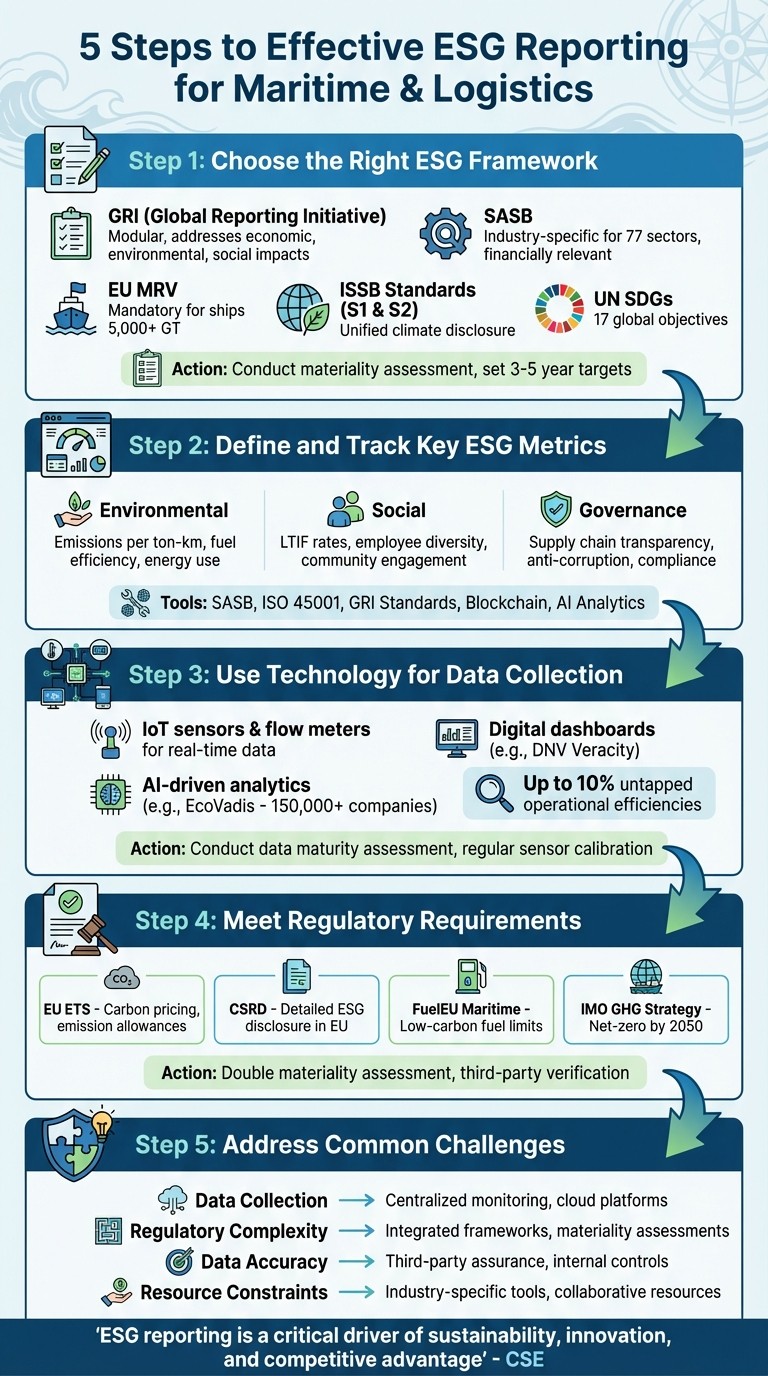
5-Step ESG Reporting Process for Maritime and Logistics Companies
Episode 2: ESG & Sustainability roadmap for maritime SMEs
Step 1: Choose the Right ESG Frameworks
Selecting the most suitable ESG framework is a critical step for aligning your operations with stakeholder expectations and regulatory requirements. Maritime and logistics companies, in particular, operate in a challenging space where voluntary standards intersect with compulsory regulations. A poor choice can lead to wasted resources on irrelevant metrics or missed compliance deadlines.
Review Industry-Specific Frameworks
Several frameworks cater specifically to the maritime industry, offering guidance on addressing both voluntary and mandatory ESG requirements:
GRI (Global Reporting Initiative): This modular framework addresses economic, environmental, and social impacts. It helps companies identify "material" topics relevant to their operations and resonates with diverse stakeholders, including NGOs and customers.
SASB (Sustainability Accounting Standards Board): SASB provides industry-specific standards for 77 sectors, including maritime, focusing on financially relevant factors like fuel efficiency, air quality, and supply chain resilience.
EU Monitoring, Reporting, and Verification (MRV): This regulation is mandatory for ships of 5,000 gross tonnage and above conducting commercial voyages to or from European Economic Area ports. Starting January 1, 2024, it will include methane (CH₄) and nitrous oxide (N₂O) emissions alongside CO₂. By January 1, 2025, it will expand to cover offshore ships above 5,000 GT and general cargo or offshore ships between 400 and 5,000 GT [5].
ISSB Standards (S1 and S2): These standards provide a unified framework for disclosing climate-related risks and opportunities to investors, incorporating the recommendations of the Task Force for Climate-Related Financial Disclosures (TCFD) [2].
UN Sustainable Development Goals (SDGs): These 17 global objectives allow shipping companies to align their strategies with broader environmental and social ambitions.
Understanding these frameworks is essential to selecting one that aligns with your operational needs and strategic goals.
Match Frameworks to Business Goals
After reviewing the available options, conduct a materiality assessment to identify the ESG issues most relevant to your business and stakeholders. The Norwegian Shipowners' Association emphasizes the importance of focusing on material ESG topics:
"A critical success factor is to focus on material ESG topics for the company and its stakeholders; the company needs to assess which topics are material to them, the industry and its stakeholders, and avoid lengthy reporting on less relevant topics" [3].
Tailor your framework selection to your audience. For investor-focused risks, SASB or ISSB standards are ideal, while GRI appeals to a broader range of stakeholders. For companies operating in European markets, compliance with EU MRV is non-negotiable. Many organizations adopt a modular approach, starting with GRI for comprehensive reporting and layering SASB for financial metrics [2][1].
Ensure your chosen framework aligns with your data collection capabilities. For instance, if your fleet utilizes onboard fuel monitoring sensors, frameworks like EU MRV, which require precise emissions data, become easier to implement. Establish clear 3–5-year targets to show measurable ESG progress [3]. Tools such as INTERTANKO’s mapping resources can assist in aligning internal data with multiple frameworks, including GRI, SASB, and the UN SDGs [6].
Choosing the right framework lays the foundation for establishing measurable metrics and transparent reporting practices.
Step 2: Define and Track Key ESG Metrics
Once you’ve selected your ESG framework, the next step is to pinpoint the specific metrics that matter most to your operations. These metrics should focus on the ESG factors that directly impact cash flow, financing, and stakeholder trust [2][1]. To ensure alignment with industry practices, organize these metrics into environmental, social, and governance categories.
Environmental Metrics: Measuring Carbon and Emissions
For maritime companies, greenhouse gas emissions are a top environmental concern. The International Maritime Organization (IMO) aims to promote the adoption of zero or near-zero GHG fuels by 2030 [2]. Key metrics include emissions per ton-kilometer, fuel efficiency, and energy consumption. Aligning with SASB standards for transportation, these metrics can be tracked using onboard sensors and digital monitoring systems that provide real-time data [1][2]. Many companies set measurable goals, such as cutting GHG emissions by 20% within five years, to showcase their progress [1].
Social Metrics: Prioritizing Workforce Safety and Community Engagement
Workplace safety, employee welfare, and human rights are critical social factors. These areas not only help retain talent but also ensure adherence to global labor standards [1][4]. Metrics like Lost Time Injury Frequency (LTIF) rates, employee diversity, and community engagement activities are essential. Frameworks such as ISO 45001 offer guidance for monitoring occupational health and safety, while the GRI Universal Standards provide a broader lens for assessing social impacts. Notably, the revised GRI Standards, effective January 1, 2023, now mandate reporting on human rights and environmental due diligence [4].
Governance Metrics: Ensuring Supply Chain Transparency and Compliance
Governance metrics focus on maintaining ethical operations and transparent supply chains. Track areas like anti-corruption policies, ethical sourcing, and climate-related financial risks. These metrics help mitigate operational risks and attract investors [1]. Collaborating with suppliers to improve Scope 3 emissions data accuracy is crucial, as is leveraging digital tools like blockchain and AI analytics to verify compliance and strengthen data integrity across the value chain [1].
| ESG Category | Key Metrics to Track | Recommended Frameworks/Tools |
| --- | --- | --- |
| <strong>Environmental</strong> | Emissions per ton-kilometer, fuel efficiency, energy use, waste management | SASB, 2023 IMO GHG Strategy, Onboard Sensors <a href="https://cse-net.org/effective-esg-reporting-for-shipping-and-logistics" target="_blank" style="text-decoration: none;" rel="nofollow noopener noreferrer" data-framer-link="Link:{"url":"https://cse-net.org/effective-esg-reporting-for-shipping-and-logistics","type":"url"}" data-framer-open-in-new-tab=""><sup>[1]</sup></a><a href="https://www.ics-shipping.org/esg-reporting-frameworks-and-standards" target="_blank" style="text-decoration: none;" rel="nofollow noopener noreferrer" data-framer-link="Link:{"url":"https://www.ics-shipping.org/esg-reporting-frameworks-and-standards","type":"url"}" data-framer-open-in-new-tab=""><sup>[2]</sup></a> |
| <strong>Social</strong> | Safety incidents (LTIF), employee diversity, worker welfare, community engagement | ISO 45001, GRI Universal Standards, UN SDGs <a href="https://cse-net.org/effective-esg-reporting-for-shipping-and-logistics" target="_blank" style="text-decoration: none;" rel="nofollow noopener noreferrer" data-framer-link="Link:{"url":"https://cse-net.org/effective-esg-reporting-for-shipping-and-logistics","type":"url"}" data-framer-open-in-new-tab=""><sup>[1]</sup></a><a href="https://www.ics-shipping.org/esg-reporting-frameworks-and-standards" target="_blank" style="text-decoration: none;" rel="nofollow noopener noreferrer" data-framer-link="Link:{"url":"https://www.ics-shipping.org/esg-reporting-frameworks-and-standards","type":"url"}" data-framer-open-in-new-tab=""><sup>[2]</sup></a> |
| <strong>Governance</strong> | Supply chain transparency, ethical practices, anti-corruption, compliance | EU Taxonomy, CSRD, Blockchain, AI Analytics <a href="https://cse-net.org/effective-esg-reporting-for-shipping-and-logistics" target="_blank" style="text-decoration: none;" rel="nofollow noopener noreferrer" data-framer-link="Link:{"url":"https://cse-net.org/effective-esg-reporting-for-shipping-and-logistics","type":"url"}" data-framer-open-in-new-tab=""><sup>[1]</sup></a><a href="https://www.ics-shipping.org/esg-reporting-frameworks-and-standards" target="_blank" style="text-decoration: none;" rel="nofollow noopener noreferrer" data-framer-link="Link:{"url":"https://www.ics-shipping.org/esg-reporting-frameworks-and-standards","type":"url"}" data-framer-open-in-new-tab=""><sup>[2]</sup></a> |
| ESG Category | Key Metrics to Track | Recommended Frameworks/Tools |
| --- | --- | --- |
| <strong>Environmental</strong> | Emissions per ton-kilometer, fuel efficiency, energy use, waste management | SASB, 2023 IMO GHG Strategy, Onboard Sensors <a href="https://cse-net.org/effective-esg-reporting-for-shipping-and-logistics" target="_blank" style="text-decoration: none;" rel="nofollow noopener noreferrer" data-framer-link="Link:{"url":"https://cse-net.org/effective-esg-reporting-for-shipping-and-logistics","type":"url"}" data-framer-open-in-new-tab=""><sup>[1]</sup></a><a href="https://www.ics-shipping.org/esg-reporting-frameworks-and-standards" target="_blank" style="text-decoration: none;" rel="nofollow noopener noreferrer" data-framer-link="Link:{"url":"https://www.ics-shipping.org/esg-reporting-frameworks-and-standards","type":"url"}" data-framer-open-in-new-tab=""><sup>[2]</sup></a> |
| <strong>Social</strong> | Safety incidents (LTIF), employee diversity, worker welfare, community engagement | ISO 45001, GRI Universal Standards, UN SDGs <a href="https://cse-net.org/effective-esg-reporting-for-shipping-and-logistics" target="_blank" style="text-decoration: none;" rel="nofollow noopener noreferrer" data-framer-link="Link:{"url":"https://cse-net.org/effective-esg-reporting-for-shipping-and-logistics","type":"url"}" data-framer-open-in-new-tab=""><sup>[1]</sup></a><a href="https://www.ics-shipping.org/esg-reporting-frameworks-and-standards" target="_blank" style="text-decoration: none;" rel="nofollow noopener noreferrer" data-framer-link="Link:{"url":"https://www.ics-shipping.org/esg-reporting-frameworks-and-standards","type":"url"}" data-framer-open-in-new-tab=""><sup>[2]</sup></a> |
| <strong>Governance</strong> | Supply chain transparency, ethical practices, anti-corruption, compliance | EU Taxonomy, CSRD, Blockchain, AI Analytics <a href="https://cse-net.org/effective-esg-reporting-for-shipping-and-logistics" target="_blank" style="text-decoration: none;" rel="nofollow noopener noreferrer" data-framer-link="Link:{"url":"https://cse-net.org/effective-esg-reporting-for-shipping-and-logistics","type":"url"}" data-framer-open-in-new-tab=""><sup>[1]</sup></a><a href="https://www.ics-shipping.org/esg-reporting-frameworks-and-standards" target="_blank" style="text-decoration: none;" rel="nofollow noopener noreferrer" data-framer-link="Link:{"url":"https://www.ics-shipping.org/esg-reporting-frameworks-and-standards","type":"url"}" data-framer-open-in-new-tab=""><sup>[2]</sup></a> |Step 3: Use Technology and Tools for Data Collection
For ESG reporting to be effective, it needs to be grounded in accurate, real-time data. Automated systems play a key role in reducing human error and can reveal up to 10% of untapped operational efficiencies [7][8]. This shift toward advanced technology is driving the adoption of onboard sensors and digital tools.
Deploy Onboard Sensors and Digital Monitoring Tools
IoT sensors and flow meters are revolutionizing how businesses monitor critical metrics like fuel consumption, engine RPM, power output, and emissions. These tools continuously gather data, providing a solid base for smarter decision-making. Lars Pedersen, Chief Technical Officer at Frontline, highlights the importance of this approach:
"The ambition is to capture high frequency data without human involvement, making reliable real-time data easily accessible and visualizing it in a user-friendly way, which is key to making better decisions."
Lars Pedersen, Chief Technical Officer, Frontline [8]
In 2020, Frontline began working with DNV to digitize its fleet performance data through the Veracity maritime cloud platform. This collaboration introduced automated quality checks and a standardized data format, enabling Frontline to accurately track its Annual Efficiency Ratio (AER). The results? The company outperformed International Maritime Organization (IMO) benchmarks and earned an A-rating in its 2021 ESG report [8].
Platforms like DNV's Veracity simplify performance monitoring by consolidating data into intuitive dashboards, making it easier to communicate results to stakeholders. Similarly, tools like EcoVadis, which supports over 150,000 companies, use AI-driven analytics to manage Scope 3 emissions and ensure suppliers adhere to ESG standards [9].
Once automated systems are in place, the next challenge is ensuring the accuracy and reliability of the data.
Verify Data Accuracy and Compliance
Even the most advanced automated systems require rigorous validation. This involves two layers of checks: basic validations, such as confirming that engine power levels fall within acceptable ranges, and cross-referencing metrics, like comparing actual fuel usage against expected values [7].
Start by conducting a data maturity assessment to pinpoint any weaknesses and establish a standardized data framework [8]. Validation processes must align with key regulations, including IMO DCS, EU MRV, CII, and EEXI requirements [7][2]. Regular calibration and maintenance of sensors are also critical - no matter how advanced the technology, consistent upkeep is essential to maintain accuracy over time [7].
Step 4: Meet Regulatory Requirements and Stakeholder Expectations
Once data collection is automated, the next step is aligning ESG reporting with both regulatory demands and stakeholder expectations. The maritime sector faces a maze of regulations that differ widely by region, making compliance a moving target. Simultaneously, stakeholders like investors, customers, and partners increasingly demand transparency to assess progress toward sustainability goals.
Comply with Global and Regional Regulations
The maritime industry must navigate key regulations such as the EU Emissions Trading System (EU ETS), which now includes maritime emissions. This system requires companies to surrender emission allowances based on verified Monitoring, Reporting, and Verification (MRV) data [10]. Additionally, the Corporate Sustainability Reporting Directive (CSRD) mandates detailed ESG impact disclosures for firms operating within or engaging with European markets [1].
Globally, the 2023 IMO GHG Strategy establishes a framework aimed at achieving net-zero emissions by 2050, with interim reduction targets for 2030 and 2040 [2]. This plan also encourages the adoption of alternative zero and near-zero GHG fuels by 2030, offering a structured timeline for decarbonization goals and ESG reporting.
| Regulation/Framework | Scope/Focus | Key Requirement |
| --- | --- | --- |
| <strong>EU ETS</strong> | Carbon pricing for maritime emissions | Surrendering emission allowances based on verified MRV data <a href="https://emsa.europa.eu/faq-monitoring-plan.html" target="_blank" style="text-decoration: none;" rel="nofollow noopener noreferrer" data-framer-link="Link:{"url":"https://emsa.europa.eu/faq-monitoring-plan.html","type":"url"}" data-framer-open-in-new-tab=""><sup>[10]</sup></a> |
| <strong>CSRD</strong> | Sustainability reporting in the EU | Detailed disclosure of environmental, social, and governance impacts <a href="https://cse-net.org/effective-esg-reporting-for-shipping-and-logistics" target="_blank" style="text-decoration: none;" rel="nofollow noopener noreferrer" data-framer-link="Link:{"url":"https://cse-net.org/effective-esg-reporting-for-shipping-and-logistics","type":"url"}" data-framer-open-in-new-tab=""><sup>[1]</sup></a> |
| <strong>FuelEU Maritime</strong> | Renewable and low-carbon fuels | Limits on the greenhouse gas intensity of energy used on board ships <a href="https://emsa.europa.eu/faq-monitoring-plan.html" target="_blank" style="text-decoration: none;" rel="nofollow noopener noreferrer" data-framer-link="Link:{"url":"https://emsa.europa.eu/faq-monitoring-plan.html","type":"url"}" data-framer-open-in-new-tab=""><sup>[10]</sup></a> |
| <strong>IMO GHG Strategy</strong> | Global shipping decarbonization | Achieving net-zero emissions by or around 2050 <a href="https://www.ics-shipping.org/esg-reporting-frameworks-and-standards" target="_blank" style="text-decoration: none;" rel="nofollow noopener noreferrer" data-framer-link="Link:{"url":"https://www.ics-shipping.org/esg-reporting-frameworks-and-standards","type":"url"}" data-framer-open-in-new-tab=""><sup>[2]</sup></a> || Regulation/Framework | Scope/Focus | Key Requirement |
| --- | --- | --- |
| <strong>EU ETS</strong> | Carbon pricing for maritime emissions | Surrendering emission allowances based on verified MRV data <a href="https://emsa.europa.eu/faq-monitoring-plan.html" target="_blank" style="text-decoration: none;" rel="nofollow noopener noreferrer" data-framer-link="Link:{"url":"https://emsa.europa.eu/faq-monitoring-plan.html","type":"url"}" data-framer-open-in-new-tab=""><sup>[10]</sup></a> |
| <strong>CSRD</strong> | Sustainability reporting in the EU | Detailed disclosure of environmental, social, and governance impacts <a href="https://cse-net.org/effective-esg-reporting-for-shipping-and-logistics" target="_blank" style="text-decoration: none;" rel="nofollow noopener noreferrer" data-framer-link="Link:{"url":"https://cse-net.org/effective-esg-reporting-for-shipping-and-logistics","type":"url"}" data-framer-open-in-new-tab=""><sup>[1]</sup></a> |
| <strong>FuelEU Maritime</strong> | Renewable and low-carbon fuels | Limits on the greenhouse gas intensity of energy used on board ships <a href="https://emsa.europa.eu/faq-monitoring-plan.html" target="_blank" style="text-decoration: none;" rel="nofollow noopener noreferrer" data-framer-link="Link:{"url":"https://emsa.europa.eu/faq-monitoring-plan.html","type":"url"}" data-framer-open-in-new-tab=""><sup>[10]</sup></a> |
| <strong>IMO GHG Strategy</strong> | Global shipping decarbonization | Achieving net-zero emissions by or around 2050 <a href="https://www.ics-shipping.org/esg-reporting-frameworks-and-standards" target="_blank" style="text-decoration: none;" rel="nofollow noopener noreferrer" data-framer-link="Link:{"url":"https://www.ics-shipping.org/esg-reporting-frameworks-and-standards","type":"url"}" data-framer-open-in-new-tab=""><sup>[2]</sup></a> |To address regional differences, adopt globally recognized standards like GRI, SASB, or TCFD. Conduct a double materiality assessment to evaluate how ESG issues impact your company’s value and how your operations affect the environment and society. For guidance on monitoring plans and verification processes, consult EMSA’s resources on EU ETS and MRV compliance [10].
Once compliance frameworks are established, the focus should shift to effectively communicating ESG progress to stakeholders.
Engage Stakeholders Through Clear Reporting
Meeting regulatory requirements is just the beginning - effective communication is essential for building trust with stakeholders. Using the robust data systems previously outlined, transparent ESG reporting can reassure environmentally conscious investors and customers. It also helps reduce investment risks, as financial markets increasingly prioritize disclosures that set clear ESG goals and track performance over a 3–5-year period [3].
"ESG reporting is no longer a mere compliance exercise but a critical driver of sustainability, innovation, and competitive advantage in the shipping and logistics sector."
Focus on material ESG topics that resonate most with your company and its stakeholders. Establish measurable goals, such as cutting greenhouse gas emissions by 20% within five years or achieving zero waste, to provide clear benchmarks for success.
Collaboration with supply chain partners is equally important for meeting ESG objectives. Use integrated reporting frameworks like GRI or SASB to ensure consistency and foster stakeholder engagement. Securing third-party verification adds credibility to your reports and strengthens confidence in the accuracy of your data.
Step 5: Address Common ESG Reporting Challenges
Even with advanced ESG frameworks and cutting-edge technology, maritime and logistics companies often encounter challenges that can compromise the accuracy of their reporting. Tackling these obstacles head-on with targeted strategies is essential to ensure reliable, trustworthy, and compliant ESG disclosures.
One of the primary challenges is data collection from dispersed operations. Given the global nature of maritime businesses - with vessels, ports, and supply chain partners spread across continents - ensuring consistent and reliable data remains a significant hurdle [1]. While digital tools and automated systems have improved data collection, the complexity of dispersed operations still calls for centralized monitoring to maintain uniformity across all locations [1].
Another pressing issue is regulatory complexity. Companies must navigate a maze of varying requirements across regions such as the EU, U.S., and Asia [1]. For instance, California's 2023 sustainability disclosure laws are expected to impact over 10,000 U.S. companies, including subsidiaries of non-U.S. firms [11]. To address this, businesses should conduct materiality assessments to identify the most relevant ESG factors for their operations and stakeholders. Using integrated frameworks can also help streamline disclosures and ensure consistency across jurisdictions [1][2]. However, meeting these regulatory demands also requires a strong focus on data precision.
The growing emphasis on data accuracy and stakeholder trust adds another layer of complexity. Investors and regulators are scrutinizing sustainability claims more closely, particularly as the industry shifts from "limited assurance" to "reasonable assurance" for emissions data [11]. Strengthening internal controls and working with independent auditors to validate sustainability data can enhance credibility. Notably, PwC's 28th Annual Global CEO Survey revealed that 33% of CEOs globally have seen increased revenue from climate-friendly investments made in the past five years [11].
The table below highlights key challenges, their impacts, and actionable solutions to help maritime firms align their efforts with relevant frameworks.
| Challenge | Impact on Maritime Firms | Recommended Solution | Framework Alignment |
| --- | --- | --- | --- |
| <strong>Data Collection & Verification</strong> | Difficulty ensuring data reliability across global operations <a href="https://cse-net.org/effective-esg-reporting-for-shipping-and-logistics" target="_blank" style="text-decoration: none;" rel="nofollow noopener noreferrer" data-framer-link="Link:{"url":"https://cse-net.org/effective-esg-reporting-for-shipping-and-logistics","type":"url"}" data-framer-open-in-new-tab=""><sup>[1]</sup></a> | Use digital sensors, onboard monitoring, and cloud platforms <a href="https://cse-net.org/effective-esg-reporting-for-shipping-and-logistics" target="_blank" style="text-decoration: none;" rel="nofollow noopener noreferrer" data-framer-link="Link:{"url":"https://cse-net.org/effective-esg-reporting-for-shipping-and-logistics","type":"url"}" data-framer-open-in-new-tab=""><sup>[1]</sup></a> | GRI, SASB <a href="https://cse-net.org/effective-esg-reporting-for-shipping-and-logistics" target="_blank" style="text-decoration: none;" rel="nofollow noopener noreferrer" data-framer-link="Link:{"url":"https://cse-net.org/effective-esg-reporting-for-shipping-and-logistics","type":"url"}" data-framer-open-in-new-tab=""><sup>[1]</sup></a> |
| <strong>Regulatory Complexity</strong> | Complexity in meeting varied requirements across regions <a href="https://cse-net.org/effective-esg-reporting-for-shipping-and-logistics" target="_blank" style="text-decoration: none;" rel="nofollow noopener noreferrer" data-framer-link="Link:{"url":"https://cse-net.org/effective-esg-reporting-for-shipping-and-logistics","type":"url"}" data-framer-open-in-new-tab=""><sup>[1]</sup></a> | Conduct materiality assessments and adopt integrated frameworks <a href="https://cse-net.org/effective-esg-reporting-for-shipping-and-logistics" target="_blank" style="text-decoration: none;" rel="nofollow noopener noreferrer" data-framer-link="Link:{"url":"https://cse-net.org/effective-esg-reporting-for-shipping-and-logistics","type":"url"}" data-framer-open-in-new-tab=""><sup>[1]</sup></a> | CSRD, EU Taxonomy <a href="https://cse-net.org/effective-esg-reporting-for-shipping-and-logistics" target="_blank" style="text-decoration: none;" rel="nofollow noopener noreferrer" data-framer-link="Link:{"url":"https://cse-net.org/effective-esg-reporting-for-shipping-and-logistics","type":"url"}" data-framer-open-in-new-tab=""><sup>[1]</sup></a><a href="https://pwc.com/us/en/services/esg/esg-reporting.html" target="_blank" style="text-decoration: none;" rel="nofollow noopener noreferrer" data-framer-link="Link:{"url":"https://pwc.com/us/en/services/esg/esg-reporting.html","type":"url"}" data-framer-open-in-new-tab=""><sup>[11]</sup></a> |
| <strong>Data Accuracy & Trust</strong> | Increased scrutiny from investors and regulators <a href="https://pwc.com/us/en/services/esg/esg-reporting.html" target="_blank" style="text-decoration: none;" rel="nofollow noopener noreferrer" data-framer-link="Link:{"url":"https://pwc.com/us/en/services/esg/esg-reporting.html","type":"url"}" data-framer-open-in-new-tab=""><sup>[11]</sup></a> | Strengthen internal controls and use third-party assurance <a href="https://pwc.com/us/en/services/esg/esg-reporting.html" target="_blank" style="text-decoration: none;" rel="nofollow noopener noreferrer" data-framer-link="Link:{"url":"https://pwc.com/us/en/services/esg/esg-reporting.html","type":"url"}" data-framer-open-in-new-tab=""><sup>[11]</sup></a> | ISSB, TCFD <a href="https://www.ics-shipping.org/esg-reporting-frameworks-and-standards" target="_blank" style="text-decoration: none;" rel="nofollow noopener noreferrer" data-framer-link="Link:{"url":"https://www.ics-shipping.org/esg-reporting-frameworks-and-standards","type":"url"}" data-framer-open-in-new-tab=""><sup>[2]</sup></a><a href="https://pwc.com/us/en/services/esg/esg-reporting.html" target="_blank" style="text-decoration: none;" rel="nofollow noopener noreferrer" data-framer-link="Link:{"url":"https://pwc.com/us/en/services/esg/esg-reporting.html","type":"url"}" data-framer-open-in-new-tab=""><sup>[11]</sup></a> |
| <strong>Resource Constraints</strong> | High costs for technology, training, and staff <a href="https://cse-net.org/effective-esg-reporting-for-shipping-and-logistics" target="_blank" style="text-decoration: none;" rel="nofollow noopener noreferrer" data-framer-link="Link:{"url":"https://cse-net.org/effective-esg-reporting-for-shipping-and-logistics","type":"url"}" data-framer-open-in-new-tab=""><sup>[1]</sup></a> | Use industry-specific tools and prioritize materiality <a href="https://www.intertanko.com/info-centre/intertanko-guidance/guidancenotearticle/guide-to-esg-reporting-in-tanker-shipping" target="_blank" style="text-decoration: none;" rel="nofollow noopener noreferrer" data-framer-link="Link:{"url":"https://www.intertanko.com/info-centre/intertanko-guidance/guidancenotearticle/guide-to-esg-reporting-in-tanker-shipping","type":"url"}" data-framer-open-in-new-tab=""><sup>[6]</sup></a><a href="https://cse-net.org/effective-esg-reporting-for-shipping-and-logistics" target="_blank" style="text-decoration: none;" rel="nofollow noopener noreferrer" data-framer-link="Link:{"url":"https://cse-net.org/effective-esg-reporting-for-shipping-and-logistics","type":"url"}" data-framer-open-in-new-tab=""><sup>[1]</sup></a> | GRI, SASB, UN SDGs || Challenge | Impact on Maritime Firms | Recommended Solution | Framework Alignment |
| --- | --- | --- | --- |
| <strong>Data Collection & Verification</strong> | Difficulty ensuring data reliability across global operations <a href="https://cse-net.org/effective-esg-reporting-for-shipping-and-logistics" target="_blank" style="text-decoration: none;" rel="nofollow noopener noreferrer" data-framer-link="Link:{"url":"https://cse-net.org/effective-esg-reporting-for-shipping-and-logistics","type":"url"}" data-framer-open-in-new-tab=""><sup>[1]</sup></a> | Use digital sensors, onboard monitoring, and cloud platforms <a href="https://cse-net.org/effective-esg-reporting-for-shipping-and-logistics" target="_blank" style="text-decoration: none;" rel="nofollow noopener noreferrer" data-framer-link="Link:{"url":"https://cse-net.org/effective-esg-reporting-for-shipping-and-logistics","type":"url"}" data-framer-open-in-new-tab=""><sup>[1]</sup></a> | GRI, SASB <a href="https://cse-net.org/effective-esg-reporting-for-shipping-and-logistics" target="_blank" style="text-decoration: none;" rel="nofollow noopener noreferrer" data-framer-link="Link:{"url":"https://cse-net.org/effective-esg-reporting-for-shipping-and-logistics","type":"url"}" data-framer-open-in-new-tab=""><sup>[1]</sup></a> |
| <strong>Regulatory Complexity</strong> | Complexity in meeting varied requirements across regions <a href="https://cse-net.org/effective-esg-reporting-for-shipping-and-logistics" target="_blank" style="text-decoration: none;" rel="nofollow noopener noreferrer" data-framer-link="Link:{"url":"https://cse-net.org/effective-esg-reporting-for-shipping-and-logistics","type":"url"}" data-framer-open-in-new-tab=""><sup>[1]</sup></a> | Conduct materiality assessments and adopt integrated frameworks <a href="https://cse-net.org/effective-esg-reporting-for-shipping-and-logistics" target="_blank" style="text-decoration: none;" rel="nofollow noopener noreferrer" data-framer-link="Link:{"url":"https://cse-net.org/effective-esg-reporting-for-shipping-and-logistics","type":"url"}" data-framer-open-in-new-tab=""><sup>[1]</sup></a> | CSRD, EU Taxonomy <a href="https://cse-net.org/effective-esg-reporting-for-shipping-and-logistics" target="_blank" style="text-decoration: none;" rel="nofollow noopener noreferrer" data-framer-link="Link:{"url":"https://cse-net.org/effective-esg-reporting-for-shipping-and-logistics","type":"url"}" data-framer-open-in-new-tab=""><sup>[1]</sup></a><a href="https://pwc.com/us/en/services/esg/esg-reporting.html" target="_blank" style="text-decoration: none;" rel="nofollow noopener noreferrer" data-framer-link="Link:{"url":"https://pwc.com/us/en/services/esg/esg-reporting.html","type":"url"}" data-framer-open-in-new-tab=""><sup>[11]</sup></a> |
| <strong>Data Accuracy & Trust</strong> | Increased scrutiny from investors and regulators <a href="https://pwc.com/us/en/services/esg/esg-reporting.html" target="_blank" style="text-decoration: none;" rel="nofollow noopener noreferrer" data-framer-link="Link:{"url":"https://pwc.com/us/en/services/esg/esg-reporting.html","type":"url"}" data-framer-open-in-new-tab=""><sup>[11]</sup></a> | Strengthen internal controls and use third-party assurance <a href="https://pwc.com/us/en/services/esg/esg-reporting.html" target="_blank" style="text-decoration: none;" rel="nofollow noopener noreferrer" data-framer-link="Link:{"url":"https://pwc.com/us/en/services/esg/esg-reporting.html","type":"url"}" data-framer-open-in-new-tab=""><sup>[11]</sup></a> | ISSB, TCFD <a href="https://www.ics-shipping.org/esg-reporting-frameworks-and-standards" target="_blank" style="text-decoration: none;" rel="nofollow noopener noreferrer" data-framer-link="Link:{"url":"https://www.ics-shipping.org/esg-reporting-frameworks-and-standards","type":"url"}" data-framer-open-in-new-tab=""><sup>[2]</sup></a><a href="https://pwc.com/us/en/services/esg/esg-reporting.html" target="_blank" style="text-decoration: none;" rel="nofollow noopener noreferrer" data-framer-link="Link:{"url":"https://pwc.com/us/en/services/esg/esg-reporting.html","type":"url"}" data-framer-open-in-new-tab=""><sup>[11]</sup></a> |
| <strong>Resource Constraints</strong> | High costs for technology, training, and staff <a href="https://cse-net.org/effective-esg-reporting-for-shipping-and-logistics" target="_blank" style="text-decoration: none;" rel="nofollow noopener noreferrer" data-framer-link="Link:{"url":"https://cse-net.org/effective-esg-reporting-for-shipping-and-logistics","type":"url"}" data-framer-open-in-new-tab=""><sup>[1]</sup></a> | Use industry-specific tools and prioritize materiality <a href="https://www.intertanko.com/info-centre/intertanko-guidance/guidancenotearticle/guide-to-esg-reporting-in-tanker-shipping" target="_blank" style="text-decoration: none;" rel="nofollow noopener noreferrer" data-framer-link="Link:{"url":"https://www.intertanko.com/info-centre/intertanko-guidance/guidancenotearticle/guide-to-esg-reporting-in-tanker-shipping","type":"url"}" data-framer-open-in-new-tab=""><sup>[6]</sup></a><a href="https://cse-net.org/effective-esg-reporting-for-shipping-and-logistics" target="_blank" style="text-decoration: none;" rel="nofollow noopener noreferrer" data-framer-link="Link:{"url":"https://cse-net.org/effective-esg-reporting-for-shipping-and-logistics","type":"url"}" data-framer-open-in-new-tab=""><sup>[1]</sup></a> | GRI, SASB, UN SDGs |Resource constraints add another layer of difficulty, as the costs of technology, training, and hiring specialized staff can be prohibitive [1]. Industry-specific tools and collaborative resources can ease this burden. For example, in July 2022, INTERTANKO introduced its "Guide to ESG Reporting in Tanker Shipping", developed by a working group of over 30 member companies. This guide offers standardized mapping tools for GRI, SASB, and the UN SDGs, allowing companies to adopt robust ESG policies without relying heavily on costly external consultants [6].
Conclusion
Effective ESG reporting in the maritime and logistics sectors goes beyond meeting regulatory requirements - it transforms operational data into a strategic advantage. By adopting standardized frameworks, companies can ensure transparent and credible disclosures, making it easier for investors and stakeholders to evaluate performance in comparison to industry peers [2].
Focusing on key ESG priorities is essential for meaningful progress. Conducting materiality assessments helps identify the most relevant factors for your operations and stakeholders. For example, tracking metrics like Scope 1 GHG emissions and the Carbon Intensity Indicator (CII) addresses environmental concerns, while monitoring the Lost Time Incident Rate (LTIR) highlights workforce safety [3]. This targeted approach ensures resources are directed toward issues that have the greatest impact on both business outcomes and the communities served.
Advanced technologies play a pivotal role in ESG reporting. Tools such as onboard sensors, AI-driven analytics, and cloud-based platforms simplify data collection and verification. These innovations improve real-time data accuracy, aiding compliance efforts and driving operational improvements [1].
"ESG reporting is no longer a mere compliance exercise but a critical driver of sustainability, innovation, and competitive advantage in the shipping and logistics sector." - Centre for Sustainability and Excellence (CSE) [1]
The financial markets increasingly favor companies that set clear ESG targets and demonstrate progress over a 3–5 year horizon [3]. By implementing the strategies outlined above, organizations can ensure that every ESG initiative contributes to long-term value creation, positioning them for sustainable success in a rapidly evolving industry.
FAQs
Which ESG framework should my company start with?
When initiating ESG reporting, your company should consider starting with the GRI Standards or SASB Standards, as both are widely acknowledged frameworks. The GRI Standards provide detailed guidance for sustainability disclosures, ensuring a broad view of environmental, social, and governance impacts. On the other hand, the SASB Standards emphasize industry-specific metrics tailored to align with investor priorities. Together, these frameworks offer maritime and logistics companies a reliable starting point to address both industry demands and regulatory requirements efficiently.
What ESG metrics matter most for ships and logistics operations?
Key metrics for environmental, social, and governance (ESG) in the shipping and logistics sector cover a range of critical areas. These include greenhouse gas emissions such as CO2 levels and carbon intensity, fuel consumption, and energy efficiency, which are essential for tracking environmental impact. Additionally, focus is placed on water usage, waste management, and safety incidents, ensuring responsible operational practices. Metrics like crew well-being and adherence to sustainability standards such as GRI (Global Reporting Initiative) or SASB (Sustainability Accounting Standards Board) further align operations with both stakeholder expectations and regulatory requirements. Together, these measurements provide a framework for addressing environmental and social responsibilities effectively.
How can we verify ESG data before regulators or investors review it?
To ensure the reliability of ESG data, businesses should implement thorough data collection systems based on standardized practices and metrics tailored to their industry. Aligning this data with established frameworks like the Global Reporting Initiative (GRI) or Sustainability Accounting Standards Board (SASB) helps maintain consistency and comparability. Regular audits, whether conducted internally or by independent third parties, play a crucial role in verifying accuracy and promoting transparency. Additionally, keeping up with industry regulations, such as the International Maritime Organization’s (IMO) greenhouse gas (GHG) guidelines, strengthens compliance and credibility while helping to spot and address discrepancies before external evaluations.
Related Blog Posts
Latest Articles
©2025



FAQ
01
What does it really mean to “redefine profit”?
02
What makes Council Fire different?
03
Who does Council Fire you work with?
04
What does working with Council Fire actually look like?
05
How does Council Fire help organizations turn big goals into action?
06
How does Council Fire define and measure success?
Feb 25, 2026
How to Measure and Report ESG Impact Effectively for Maritime & Logistics Companies
ESG Strategy
In This Article
Standardized ESG reporting and real-time data turn maritime and logistics operations into verifiable sustainability performance across emissions, safety, supply chain, and compliance.
How to Measure and Report ESG Impact Effectively for Maritime & Logistics Companies
The maritime and logistics sectors are under increasing pressure to improve ESG (Environmental, Social, and Governance) reporting. With new regulations, investor demands, and customer expectations, companies must now prioritize accurate and transparent sustainability disclosures. This guide simplifies the process by outlining key steps:
Choose the right ESG framework: Options include GRI, SASB, ISSB, and EU MRV, tailored to specific business needs and compliance requirements.
Define and track metrics: Focus on measurable indicators like emissions, workforce safety, and supply chain transparency.
Leverage technology: Use tools like IoT sensors, AI analytics, and digital dashboards for real-time data collection and validation.
Meet regulatory requirements: Align with global and regional mandates like the IMO GHG Strategy, EU ETS, and CSRD.
Address challenges: Overcome issues like data collection complexity and regulatory overlap with centralized systems and third-party validation.
5-Step ESG Reporting Process for Maritime and Logistics Companies
Episode 2: ESG & Sustainability roadmap for maritime SMEs
Step 1: Choose the Right ESG Frameworks
Selecting the most suitable ESG framework is a critical step for aligning your operations with stakeholder expectations and regulatory requirements. Maritime and logistics companies, in particular, operate in a challenging space where voluntary standards intersect with compulsory regulations. A poor choice can lead to wasted resources on irrelevant metrics or missed compliance deadlines.
Review Industry-Specific Frameworks
Several frameworks cater specifically to the maritime industry, offering guidance on addressing both voluntary and mandatory ESG requirements:
GRI (Global Reporting Initiative): This modular framework addresses economic, environmental, and social impacts. It helps companies identify "material" topics relevant to their operations and resonates with diverse stakeholders, including NGOs and customers.
SASB (Sustainability Accounting Standards Board): SASB provides industry-specific standards for 77 sectors, including maritime, focusing on financially relevant factors like fuel efficiency, air quality, and supply chain resilience.
EU Monitoring, Reporting, and Verification (MRV): This regulation is mandatory for ships of 5,000 gross tonnage and above conducting commercial voyages to or from European Economic Area ports. Starting January 1, 2024, it will include methane (CH₄) and nitrous oxide (N₂O) emissions alongside CO₂. By January 1, 2025, it will expand to cover offshore ships above 5,000 GT and general cargo or offshore ships between 400 and 5,000 GT [5].
ISSB Standards (S1 and S2): These standards provide a unified framework for disclosing climate-related risks and opportunities to investors, incorporating the recommendations of the Task Force for Climate-Related Financial Disclosures (TCFD) [2].
UN Sustainable Development Goals (SDGs): These 17 global objectives allow shipping companies to align their strategies with broader environmental and social ambitions.
Understanding these frameworks is essential to selecting one that aligns with your operational needs and strategic goals.
Match Frameworks to Business Goals
After reviewing the available options, conduct a materiality assessment to identify the ESG issues most relevant to your business and stakeholders. The Norwegian Shipowners' Association emphasizes the importance of focusing on material ESG topics:
"A critical success factor is to focus on material ESG topics for the company and its stakeholders; the company needs to assess which topics are material to them, the industry and its stakeholders, and avoid lengthy reporting on less relevant topics" [3].
Tailor your framework selection to your audience. For investor-focused risks, SASB or ISSB standards are ideal, while GRI appeals to a broader range of stakeholders. For companies operating in European markets, compliance with EU MRV is non-negotiable. Many organizations adopt a modular approach, starting with GRI for comprehensive reporting and layering SASB for financial metrics [2][1].
Ensure your chosen framework aligns with your data collection capabilities. For instance, if your fleet utilizes onboard fuel monitoring sensors, frameworks like EU MRV, which require precise emissions data, become easier to implement. Establish clear 3–5-year targets to show measurable ESG progress [3]. Tools such as INTERTANKO’s mapping resources can assist in aligning internal data with multiple frameworks, including GRI, SASB, and the UN SDGs [6].
Choosing the right framework lays the foundation for establishing measurable metrics and transparent reporting practices.
Step 2: Define and Track Key ESG Metrics
Once you’ve selected your ESG framework, the next step is to pinpoint the specific metrics that matter most to your operations. These metrics should focus on the ESG factors that directly impact cash flow, financing, and stakeholder trust [2][1]. To ensure alignment with industry practices, organize these metrics into environmental, social, and governance categories.
Environmental Metrics: Measuring Carbon and Emissions
For maritime companies, greenhouse gas emissions are a top environmental concern. The International Maritime Organization (IMO) aims to promote the adoption of zero or near-zero GHG fuels by 2030 [2]. Key metrics include emissions per ton-kilometer, fuel efficiency, and energy consumption. Aligning with SASB standards for transportation, these metrics can be tracked using onboard sensors and digital monitoring systems that provide real-time data [1][2]. Many companies set measurable goals, such as cutting GHG emissions by 20% within five years, to showcase their progress [1].
Social Metrics: Prioritizing Workforce Safety and Community Engagement
Workplace safety, employee welfare, and human rights are critical social factors. These areas not only help retain talent but also ensure adherence to global labor standards [1][4]. Metrics like Lost Time Injury Frequency (LTIF) rates, employee diversity, and community engagement activities are essential. Frameworks such as ISO 45001 offer guidance for monitoring occupational health and safety, while the GRI Universal Standards provide a broader lens for assessing social impacts. Notably, the revised GRI Standards, effective January 1, 2023, now mandate reporting on human rights and environmental due diligence [4].
Governance Metrics: Ensuring Supply Chain Transparency and Compliance
Governance metrics focus on maintaining ethical operations and transparent supply chains. Track areas like anti-corruption policies, ethical sourcing, and climate-related financial risks. These metrics help mitigate operational risks and attract investors [1]. Collaborating with suppliers to improve Scope 3 emissions data accuracy is crucial, as is leveraging digital tools like blockchain and AI analytics to verify compliance and strengthen data integrity across the value chain [1].
| ESG Category | Key Metrics to Track | Recommended Frameworks/Tools |
| --- | --- | --- |
| <strong>Environmental</strong> | Emissions per ton-kilometer, fuel efficiency, energy use, waste management | SASB, 2023 IMO GHG Strategy, Onboard Sensors <a href="https://cse-net.org/effective-esg-reporting-for-shipping-and-logistics" target="_blank" style="text-decoration: none;" rel="nofollow noopener noreferrer" data-framer-link="Link:{"url":"https://cse-net.org/effective-esg-reporting-for-shipping-and-logistics","type":"url"}" data-framer-open-in-new-tab=""><sup>[1]</sup></a><a href="https://www.ics-shipping.org/esg-reporting-frameworks-and-standards" target="_blank" style="text-decoration: none;" rel="nofollow noopener noreferrer" data-framer-link="Link:{"url":"https://www.ics-shipping.org/esg-reporting-frameworks-and-standards","type":"url"}" data-framer-open-in-new-tab=""><sup>[2]</sup></a> |
| <strong>Social</strong> | Safety incidents (LTIF), employee diversity, worker welfare, community engagement | ISO 45001, GRI Universal Standards, UN SDGs <a href="https://cse-net.org/effective-esg-reporting-for-shipping-and-logistics" target="_blank" style="text-decoration: none;" rel="nofollow noopener noreferrer" data-framer-link="Link:{"url":"https://cse-net.org/effective-esg-reporting-for-shipping-and-logistics","type":"url"}" data-framer-open-in-new-tab=""><sup>[1]</sup></a><a href="https://www.ics-shipping.org/esg-reporting-frameworks-and-standards" target="_blank" style="text-decoration: none;" rel="nofollow noopener noreferrer" data-framer-link="Link:{"url":"https://www.ics-shipping.org/esg-reporting-frameworks-and-standards","type":"url"}" data-framer-open-in-new-tab=""><sup>[2]</sup></a> |
| <strong>Governance</strong> | Supply chain transparency, ethical practices, anti-corruption, compliance | EU Taxonomy, CSRD, Blockchain, AI Analytics <a href="https://cse-net.org/effective-esg-reporting-for-shipping-and-logistics" target="_blank" style="text-decoration: none;" rel="nofollow noopener noreferrer" data-framer-link="Link:{"url":"https://cse-net.org/effective-esg-reporting-for-shipping-and-logistics","type":"url"}" data-framer-open-in-new-tab=""><sup>[1]</sup></a><a href="https://www.ics-shipping.org/esg-reporting-frameworks-and-standards" target="_blank" style="text-decoration: none;" rel="nofollow noopener noreferrer" data-framer-link="Link:{"url":"https://www.ics-shipping.org/esg-reporting-frameworks-and-standards","type":"url"}" data-framer-open-in-new-tab=""><sup>[2]</sup></a> |
Step 3: Use Technology and Tools for Data Collection
For ESG reporting to be effective, it needs to be grounded in accurate, real-time data. Automated systems play a key role in reducing human error and can reveal up to 10% of untapped operational efficiencies [7][8]. This shift toward advanced technology is driving the adoption of onboard sensors and digital tools.
Deploy Onboard Sensors and Digital Monitoring Tools
IoT sensors and flow meters are revolutionizing how businesses monitor critical metrics like fuel consumption, engine RPM, power output, and emissions. These tools continuously gather data, providing a solid base for smarter decision-making. Lars Pedersen, Chief Technical Officer at Frontline, highlights the importance of this approach:
"The ambition is to capture high frequency data without human involvement, making reliable real-time data easily accessible and visualizing it in a user-friendly way, which is key to making better decisions."
Lars Pedersen, Chief Technical Officer, Frontline [8]
In 2020, Frontline began working with DNV to digitize its fleet performance data through the Veracity maritime cloud platform. This collaboration introduced automated quality checks and a standardized data format, enabling Frontline to accurately track its Annual Efficiency Ratio (AER). The results? The company outperformed International Maritime Organization (IMO) benchmarks and earned an A-rating in its 2021 ESG report [8].
Platforms like DNV's Veracity simplify performance monitoring by consolidating data into intuitive dashboards, making it easier to communicate results to stakeholders. Similarly, tools like EcoVadis, which supports over 150,000 companies, use AI-driven analytics to manage Scope 3 emissions and ensure suppliers adhere to ESG standards [9].
Once automated systems are in place, the next challenge is ensuring the accuracy and reliability of the data.
Verify Data Accuracy and Compliance
Even the most advanced automated systems require rigorous validation. This involves two layers of checks: basic validations, such as confirming that engine power levels fall within acceptable ranges, and cross-referencing metrics, like comparing actual fuel usage against expected values [7].
Start by conducting a data maturity assessment to pinpoint any weaknesses and establish a standardized data framework [8]. Validation processes must align with key regulations, including IMO DCS, EU MRV, CII, and EEXI requirements [7][2]. Regular calibration and maintenance of sensors are also critical - no matter how advanced the technology, consistent upkeep is essential to maintain accuracy over time [7].
Step 4: Meet Regulatory Requirements and Stakeholder Expectations
Once data collection is automated, the next step is aligning ESG reporting with both regulatory demands and stakeholder expectations. The maritime sector faces a maze of regulations that differ widely by region, making compliance a moving target. Simultaneously, stakeholders like investors, customers, and partners increasingly demand transparency to assess progress toward sustainability goals.
Comply with Global and Regional Regulations
The maritime industry must navigate key regulations such as the EU Emissions Trading System (EU ETS), which now includes maritime emissions. This system requires companies to surrender emission allowances based on verified Monitoring, Reporting, and Verification (MRV) data [10]. Additionally, the Corporate Sustainability Reporting Directive (CSRD) mandates detailed ESG impact disclosures for firms operating within or engaging with European markets [1].
Globally, the 2023 IMO GHG Strategy establishes a framework aimed at achieving net-zero emissions by 2050, with interim reduction targets for 2030 and 2040 [2]. This plan also encourages the adoption of alternative zero and near-zero GHG fuels by 2030, offering a structured timeline for decarbonization goals and ESG reporting.
| Regulation/Framework | Scope/Focus | Key Requirement |
| --- | --- | --- |
| <strong>EU ETS</strong> | Carbon pricing for maritime emissions | Surrendering emission allowances based on verified MRV data <a href="https://emsa.europa.eu/faq-monitoring-plan.html" target="_blank" style="text-decoration: none;" rel="nofollow noopener noreferrer" data-framer-link="Link:{"url":"https://emsa.europa.eu/faq-monitoring-plan.html","type":"url"}" data-framer-open-in-new-tab=""><sup>[10]</sup></a> |
| <strong>CSRD</strong> | Sustainability reporting in the EU | Detailed disclosure of environmental, social, and governance impacts <a href="https://cse-net.org/effective-esg-reporting-for-shipping-and-logistics" target="_blank" style="text-decoration: none;" rel="nofollow noopener noreferrer" data-framer-link="Link:{"url":"https://cse-net.org/effective-esg-reporting-for-shipping-and-logistics","type":"url"}" data-framer-open-in-new-tab=""><sup>[1]</sup></a> |
| <strong>FuelEU Maritime</strong> | Renewable and low-carbon fuels | Limits on the greenhouse gas intensity of energy used on board ships <a href="https://emsa.europa.eu/faq-monitoring-plan.html" target="_blank" style="text-decoration: none;" rel="nofollow noopener noreferrer" data-framer-link="Link:{"url":"https://emsa.europa.eu/faq-monitoring-plan.html","type":"url"}" data-framer-open-in-new-tab=""><sup>[10]</sup></a> |
| <strong>IMO GHG Strategy</strong> | Global shipping decarbonization | Achieving net-zero emissions by or around 2050 <a href="https://www.ics-shipping.org/esg-reporting-frameworks-and-standards" target="_blank" style="text-decoration: none;" rel="nofollow noopener noreferrer" data-framer-link="Link:{"url":"https://www.ics-shipping.org/esg-reporting-frameworks-and-standards","type":"url"}" data-framer-open-in-new-tab=""><sup>[2]</sup></a> |To address regional differences, adopt globally recognized standards like GRI, SASB, or TCFD. Conduct a double materiality assessment to evaluate how ESG issues impact your company’s value and how your operations affect the environment and society. For guidance on monitoring plans and verification processes, consult EMSA’s resources on EU ETS and MRV compliance [10].
Once compliance frameworks are established, the focus should shift to effectively communicating ESG progress to stakeholders.
Engage Stakeholders Through Clear Reporting
Meeting regulatory requirements is just the beginning - effective communication is essential for building trust with stakeholders. Using the robust data systems previously outlined, transparent ESG reporting can reassure environmentally conscious investors and customers. It also helps reduce investment risks, as financial markets increasingly prioritize disclosures that set clear ESG goals and track performance over a 3–5-year period [3].
"ESG reporting is no longer a mere compliance exercise but a critical driver of sustainability, innovation, and competitive advantage in the shipping and logistics sector."
Focus on material ESG topics that resonate most with your company and its stakeholders. Establish measurable goals, such as cutting greenhouse gas emissions by 20% within five years or achieving zero waste, to provide clear benchmarks for success.
Collaboration with supply chain partners is equally important for meeting ESG objectives. Use integrated reporting frameworks like GRI or SASB to ensure consistency and foster stakeholder engagement. Securing third-party verification adds credibility to your reports and strengthens confidence in the accuracy of your data.
Step 5: Address Common ESG Reporting Challenges
Even with advanced ESG frameworks and cutting-edge technology, maritime and logistics companies often encounter challenges that can compromise the accuracy of their reporting. Tackling these obstacles head-on with targeted strategies is essential to ensure reliable, trustworthy, and compliant ESG disclosures.
One of the primary challenges is data collection from dispersed operations. Given the global nature of maritime businesses - with vessels, ports, and supply chain partners spread across continents - ensuring consistent and reliable data remains a significant hurdle [1]. While digital tools and automated systems have improved data collection, the complexity of dispersed operations still calls for centralized monitoring to maintain uniformity across all locations [1].
Another pressing issue is regulatory complexity. Companies must navigate a maze of varying requirements across regions such as the EU, U.S., and Asia [1]. For instance, California's 2023 sustainability disclosure laws are expected to impact over 10,000 U.S. companies, including subsidiaries of non-U.S. firms [11]. To address this, businesses should conduct materiality assessments to identify the most relevant ESG factors for their operations and stakeholders. Using integrated frameworks can also help streamline disclosures and ensure consistency across jurisdictions [1][2]. However, meeting these regulatory demands also requires a strong focus on data precision.
The growing emphasis on data accuracy and stakeholder trust adds another layer of complexity. Investors and regulators are scrutinizing sustainability claims more closely, particularly as the industry shifts from "limited assurance" to "reasonable assurance" for emissions data [11]. Strengthening internal controls and working with independent auditors to validate sustainability data can enhance credibility. Notably, PwC's 28th Annual Global CEO Survey revealed that 33% of CEOs globally have seen increased revenue from climate-friendly investments made in the past five years [11].
The table below highlights key challenges, their impacts, and actionable solutions to help maritime firms align their efforts with relevant frameworks.
| Challenge | Impact on Maritime Firms | Recommended Solution | Framework Alignment |
| --- | --- | --- | --- |
| <strong>Data Collection & Verification</strong> | Difficulty ensuring data reliability across global operations <a href="https://cse-net.org/effective-esg-reporting-for-shipping-and-logistics" target="_blank" style="text-decoration: none;" rel="nofollow noopener noreferrer" data-framer-link="Link:{"url":"https://cse-net.org/effective-esg-reporting-for-shipping-and-logistics","type":"url"}" data-framer-open-in-new-tab=""><sup>[1]</sup></a> | Use digital sensors, onboard monitoring, and cloud platforms <a href="https://cse-net.org/effective-esg-reporting-for-shipping-and-logistics" target="_blank" style="text-decoration: none;" rel="nofollow noopener noreferrer" data-framer-link="Link:{"url":"https://cse-net.org/effective-esg-reporting-for-shipping-and-logistics","type":"url"}" data-framer-open-in-new-tab=""><sup>[1]</sup></a> | GRI, SASB <a href="https://cse-net.org/effective-esg-reporting-for-shipping-and-logistics" target="_blank" style="text-decoration: none;" rel="nofollow noopener noreferrer" data-framer-link="Link:{"url":"https://cse-net.org/effective-esg-reporting-for-shipping-and-logistics","type":"url"}" data-framer-open-in-new-tab=""><sup>[1]</sup></a> |
| <strong>Regulatory Complexity</strong> | Complexity in meeting varied requirements across regions <a href="https://cse-net.org/effective-esg-reporting-for-shipping-and-logistics" target="_blank" style="text-decoration: none;" rel="nofollow noopener noreferrer" data-framer-link="Link:{"url":"https://cse-net.org/effective-esg-reporting-for-shipping-and-logistics","type":"url"}" data-framer-open-in-new-tab=""><sup>[1]</sup></a> | Conduct materiality assessments and adopt integrated frameworks <a href="https://cse-net.org/effective-esg-reporting-for-shipping-and-logistics" target="_blank" style="text-decoration: none;" rel="nofollow noopener noreferrer" data-framer-link="Link:{"url":"https://cse-net.org/effective-esg-reporting-for-shipping-and-logistics","type":"url"}" data-framer-open-in-new-tab=""><sup>[1]</sup></a> | CSRD, EU Taxonomy <a href="https://cse-net.org/effective-esg-reporting-for-shipping-and-logistics" target="_blank" style="text-decoration: none;" rel="nofollow noopener noreferrer" data-framer-link="Link:{"url":"https://cse-net.org/effective-esg-reporting-for-shipping-and-logistics","type":"url"}" data-framer-open-in-new-tab=""><sup>[1]</sup></a><a href="https://pwc.com/us/en/services/esg/esg-reporting.html" target="_blank" style="text-decoration: none;" rel="nofollow noopener noreferrer" data-framer-link="Link:{"url":"https://pwc.com/us/en/services/esg/esg-reporting.html","type":"url"}" data-framer-open-in-new-tab=""><sup>[11]</sup></a> |
| <strong>Data Accuracy & Trust</strong> | Increased scrutiny from investors and regulators <a href="https://pwc.com/us/en/services/esg/esg-reporting.html" target="_blank" style="text-decoration: none;" rel="nofollow noopener noreferrer" data-framer-link="Link:{"url":"https://pwc.com/us/en/services/esg/esg-reporting.html","type":"url"}" data-framer-open-in-new-tab=""><sup>[11]</sup></a> | Strengthen internal controls and use third-party assurance <a href="https://pwc.com/us/en/services/esg/esg-reporting.html" target="_blank" style="text-decoration: none;" rel="nofollow noopener noreferrer" data-framer-link="Link:{"url":"https://pwc.com/us/en/services/esg/esg-reporting.html","type":"url"}" data-framer-open-in-new-tab=""><sup>[11]</sup></a> | ISSB, TCFD <a href="https://www.ics-shipping.org/esg-reporting-frameworks-and-standards" target="_blank" style="text-decoration: none;" rel="nofollow noopener noreferrer" data-framer-link="Link:{"url":"https://www.ics-shipping.org/esg-reporting-frameworks-and-standards","type":"url"}" data-framer-open-in-new-tab=""><sup>[2]</sup></a><a href="https://pwc.com/us/en/services/esg/esg-reporting.html" target="_blank" style="text-decoration: none;" rel="nofollow noopener noreferrer" data-framer-link="Link:{"url":"https://pwc.com/us/en/services/esg/esg-reporting.html","type":"url"}" data-framer-open-in-new-tab=""><sup>[11]</sup></a> |
| <strong>Resource Constraints</strong> | High costs for technology, training, and staff <a href="https://cse-net.org/effective-esg-reporting-for-shipping-and-logistics" target="_blank" style="text-decoration: none;" rel="nofollow noopener noreferrer" data-framer-link="Link:{"url":"https://cse-net.org/effective-esg-reporting-for-shipping-and-logistics","type":"url"}" data-framer-open-in-new-tab=""><sup>[1]</sup></a> | Use industry-specific tools and prioritize materiality <a href="https://www.intertanko.com/info-centre/intertanko-guidance/guidancenotearticle/guide-to-esg-reporting-in-tanker-shipping" target="_blank" style="text-decoration: none;" rel="nofollow noopener noreferrer" data-framer-link="Link:{"url":"https://www.intertanko.com/info-centre/intertanko-guidance/guidancenotearticle/guide-to-esg-reporting-in-tanker-shipping","type":"url"}" data-framer-open-in-new-tab=""><sup>[6]</sup></a><a href="https://cse-net.org/effective-esg-reporting-for-shipping-and-logistics" target="_blank" style="text-decoration: none;" rel="nofollow noopener noreferrer" data-framer-link="Link:{"url":"https://cse-net.org/effective-esg-reporting-for-shipping-and-logistics","type":"url"}" data-framer-open-in-new-tab=""><sup>[1]</sup></a> | GRI, SASB, UN SDGs |Resource constraints add another layer of difficulty, as the costs of technology, training, and hiring specialized staff can be prohibitive [1]. Industry-specific tools and collaborative resources can ease this burden. For example, in July 2022, INTERTANKO introduced its "Guide to ESG Reporting in Tanker Shipping", developed by a working group of over 30 member companies. This guide offers standardized mapping tools for GRI, SASB, and the UN SDGs, allowing companies to adopt robust ESG policies without relying heavily on costly external consultants [6].
Conclusion
Effective ESG reporting in the maritime and logistics sectors goes beyond meeting regulatory requirements - it transforms operational data into a strategic advantage. By adopting standardized frameworks, companies can ensure transparent and credible disclosures, making it easier for investors and stakeholders to evaluate performance in comparison to industry peers [2].
Focusing on key ESG priorities is essential for meaningful progress. Conducting materiality assessments helps identify the most relevant factors for your operations and stakeholders. For example, tracking metrics like Scope 1 GHG emissions and the Carbon Intensity Indicator (CII) addresses environmental concerns, while monitoring the Lost Time Incident Rate (LTIR) highlights workforce safety [3]. This targeted approach ensures resources are directed toward issues that have the greatest impact on both business outcomes and the communities served.
Advanced technologies play a pivotal role in ESG reporting. Tools such as onboard sensors, AI-driven analytics, and cloud-based platforms simplify data collection and verification. These innovations improve real-time data accuracy, aiding compliance efforts and driving operational improvements [1].
"ESG reporting is no longer a mere compliance exercise but a critical driver of sustainability, innovation, and competitive advantage in the shipping and logistics sector." - Centre for Sustainability and Excellence (CSE) [1]
The financial markets increasingly favor companies that set clear ESG targets and demonstrate progress over a 3–5 year horizon [3]. By implementing the strategies outlined above, organizations can ensure that every ESG initiative contributes to long-term value creation, positioning them for sustainable success in a rapidly evolving industry.
FAQs
Which ESG framework should my company start with?
When initiating ESG reporting, your company should consider starting with the GRI Standards or SASB Standards, as both are widely acknowledged frameworks. The GRI Standards provide detailed guidance for sustainability disclosures, ensuring a broad view of environmental, social, and governance impacts. On the other hand, the SASB Standards emphasize industry-specific metrics tailored to align with investor priorities. Together, these frameworks offer maritime and logistics companies a reliable starting point to address both industry demands and regulatory requirements efficiently.
What ESG metrics matter most for ships and logistics operations?
Key metrics for environmental, social, and governance (ESG) in the shipping and logistics sector cover a range of critical areas. These include greenhouse gas emissions such as CO2 levels and carbon intensity, fuel consumption, and energy efficiency, which are essential for tracking environmental impact. Additionally, focus is placed on water usage, waste management, and safety incidents, ensuring responsible operational practices. Metrics like crew well-being and adherence to sustainability standards such as GRI (Global Reporting Initiative) or SASB (Sustainability Accounting Standards Board) further align operations with both stakeholder expectations and regulatory requirements. Together, these measurements provide a framework for addressing environmental and social responsibilities effectively.
How can we verify ESG data before regulators or investors review it?
To ensure the reliability of ESG data, businesses should implement thorough data collection systems based on standardized practices and metrics tailored to their industry. Aligning this data with established frameworks like the Global Reporting Initiative (GRI) or Sustainability Accounting Standards Board (SASB) helps maintain consistency and comparability. Regular audits, whether conducted internally or by independent third parties, play a crucial role in verifying accuracy and promoting transparency. Additionally, keeping up with industry regulations, such as the International Maritime Organization’s (IMO) greenhouse gas (GHG) guidelines, strengthens compliance and credibility while helping to spot and address discrepancies before external evaluations.
Related Blog Posts
FAQ
01
What does it really mean to “redefine profit”?
02
What makes Council Fire different?
03
Who does Council Fire you work with?
04
What does working with Council Fire actually look like?
05
How does Council Fire help organizations turn big goals into action?
06
How does Council Fire define and measure success?
Feb 25, 2026
How to Measure and Report ESG Impact Effectively for Maritime & Logistics Companies
ESG Strategy
In This Article
Standardized ESG reporting and real-time data turn maritime and logistics operations into verifiable sustainability performance across emissions, safety, supply chain, and compliance.
How to Measure and Report ESG Impact Effectively for Maritime & Logistics Companies
The maritime and logistics sectors are under increasing pressure to improve ESG (Environmental, Social, and Governance) reporting. With new regulations, investor demands, and customer expectations, companies must now prioritize accurate and transparent sustainability disclosures. This guide simplifies the process by outlining key steps:
Choose the right ESG framework: Options include GRI, SASB, ISSB, and EU MRV, tailored to specific business needs and compliance requirements.
Define and track metrics: Focus on measurable indicators like emissions, workforce safety, and supply chain transparency.
Leverage technology: Use tools like IoT sensors, AI analytics, and digital dashboards for real-time data collection and validation.
Meet regulatory requirements: Align with global and regional mandates like the IMO GHG Strategy, EU ETS, and CSRD.
Address challenges: Overcome issues like data collection complexity and regulatory overlap with centralized systems and third-party validation.
5-Step ESG Reporting Process for Maritime and Logistics Companies
Episode 2: ESG & Sustainability roadmap for maritime SMEs
Step 1: Choose the Right ESG Frameworks
Selecting the most suitable ESG framework is a critical step for aligning your operations with stakeholder expectations and regulatory requirements. Maritime and logistics companies, in particular, operate in a challenging space where voluntary standards intersect with compulsory regulations. A poor choice can lead to wasted resources on irrelevant metrics or missed compliance deadlines.
Review Industry-Specific Frameworks
Several frameworks cater specifically to the maritime industry, offering guidance on addressing both voluntary and mandatory ESG requirements:
GRI (Global Reporting Initiative): This modular framework addresses economic, environmental, and social impacts. It helps companies identify "material" topics relevant to their operations and resonates with diverse stakeholders, including NGOs and customers.
SASB (Sustainability Accounting Standards Board): SASB provides industry-specific standards for 77 sectors, including maritime, focusing on financially relevant factors like fuel efficiency, air quality, and supply chain resilience.
EU Monitoring, Reporting, and Verification (MRV): This regulation is mandatory for ships of 5,000 gross tonnage and above conducting commercial voyages to or from European Economic Area ports. Starting January 1, 2024, it will include methane (CH₄) and nitrous oxide (N₂O) emissions alongside CO₂. By January 1, 2025, it will expand to cover offshore ships above 5,000 GT and general cargo or offshore ships between 400 and 5,000 GT [5].
ISSB Standards (S1 and S2): These standards provide a unified framework for disclosing climate-related risks and opportunities to investors, incorporating the recommendations of the Task Force for Climate-Related Financial Disclosures (TCFD) [2].
UN Sustainable Development Goals (SDGs): These 17 global objectives allow shipping companies to align their strategies with broader environmental and social ambitions.
Understanding these frameworks is essential to selecting one that aligns with your operational needs and strategic goals.
Match Frameworks to Business Goals
After reviewing the available options, conduct a materiality assessment to identify the ESG issues most relevant to your business and stakeholders. The Norwegian Shipowners' Association emphasizes the importance of focusing on material ESG topics:
"A critical success factor is to focus on material ESG topics for the company and its stakeholders; the company needs to assess which topics are material to them, the industry and its stakeholders, and avoid lengthy reporting on less relevant topics" [3].
Tailor your framework selection to your audience. For investor-focused risks, SASB or ISSB standards are ideal, while GRI appeals to a broader range of stakeholders. For companies operating in European markets, compliance with EU MRV is non-negotiable. Many organizations adopt a modular approach, starting with GRI for comprehensive reporting and layering SASB for financial metrics [2][1].
Ensure your chosen framework aligns with your data collection capabilities. For instance, if your fleet utilizes onboard fuel monitoring sensors, frameworks like EU MRV, which require precise emissions data, become easier to implement. Establish clear 3–5-year targets to show measurable ESG progress [3]. Tools such as INTERTANKO’s mapping resources can assist in aligning internal data with multiple frameworks, including GRI, SASB, and the UN SDGs [6].
Choosing the right framework lays the foundation for establishing measurable metrics and transparent reporting practices.
Step 2: Define and Track Key ESG Metrics
Once you’ve selected your ESG framework, the next step is to pinpoint the specific metrics that matter most to your operations. These metrics should focus on the ESG factors that directly impact cash flow, financing, and stakeholder trust [2][1]. To ensure alignment with industry practices, organize these metrics into environmental, social, and governance categories.
Environmental Metrics: Measuring Carbon and Emissions
For maritime companies, greenhouse gas emissions are a top environmental concern. The International Maritime Organization (IMO) aims to promote the adoption of zero or near-zero GHG fuels by 2030 [2]. Key metrics include emissions per ton-kilometer, fuel efficiency, and energy consumption. Aligning with SASB standards for transportation, these metrics can be tracked using onboard sensors and digital monitoring systems that provide real-time data [1][2]. Many companies set measurable goals, such as cutting GHG emissions by 20% within five years, to showcase their progress [1].
Social Metrics: Prioritizing Workforce Safety and Community Engagement
Workplace safety, employee welfare, and human rights are critical social factors. These areas not only help retain talent but also ensure adherence to global labor standards [1][4]. Metrics like Lost Time Injury Frequency (LTIF) rates, employee diversity, and community engagement activities are essential. Frameworks such as ISO 45001 offer guidance for monitoring occupational health and safety, while the GRI Universal Standards provide a broader lens for assessing social impacts. Notably, the revised GRI Standards, effective January 1, 2023, now mandate reporting on human rights and environmental due diligence [4].
Governance Metrics: Ensuring Supply Chain Transparency and Compliance
Governance metrics focus on maintaining ethical operations and transparent supply chains. Track areas like anti-corruption policies, ethical sourcing, and climate-related financial risks. These metrics help mitigate operational risks and attract investors [1]. Collaborating with suppliers to improve Scope 3 emissions data accuracy is crucial, as is leveraging digital tools like blockchain and AI analytics to verify compliance and strengthen data integrity across the value chain [1].
| ESG Category | Key Metrics to Track | Recommended Frameworks/Tools |
| --- | --- | --- |
| <strong>Environmental</strong> | Emissions per ton-kilometer, fuel efficiency, energy use, waste management | SASB, 2023 IMO GHG Strategy, Onboard Sensors <a href="https://cse-net.org/effective-esg-reporting-for-shipping-and-logistics" target="_blank" style="text-decoration: none;" rel="nofollow noopener noreferrer" data-framer-link="Link:{"url":"https://cse-net.org/effective-esg-reporting-for-shipping-and-logistics","type":"url"}" data-framer-open-in-new-tab=""><sup>[1]</sup></a><a href="https://www.ics-shipping.org/esg-reporting-frameworks-and-standards" target="_blank" style="text-decoration: none;" rel="nofollow noopener noreferrer" data-framer-link="Link:{"url":"https://www.ics-shipping.org/esg-reporting-frameworks-and-standards","type":"url"}" data-framer-open-in-new-tab=""><sup>[2]</sup></a> |
| <strong>Social</strong> | Safety incidents (LTIF), employee diversity, worker welfare, community engagement | ISO 45001, GRI Universal Standards, UN SDGs <a href="https://cse-net.org/effective-esg-reporting-for-shipping-and-logistics" target="_blank" style="text-decoration: none;" rel="nofollow noopener noreferrer" data-framer-link="Link:{"url":"https://cse-net.org/effective-esg-reporting-for-shipping-and-logistics","type":"url"}" data-framer-open-in-new-tab=""><sup>[1]</sup></a><a href="https://www.ics-shipping.org/esg-reporting-frameworks-and-standards" target="_blank" style="text-decoration: none;" rel="nofollow noopener noreferrer" data-framer-link="Link:{"url":"https://www.ics-shipping.org/esg-reporting-frameworks-and-standards","type":"url"}" data-framer-open-in-new-tab=""><sup>[2]</sup></a> |
| <strong>Governance</strong> | Supply chain transparency, ethical practices, anti-corruption, compliance | EU Taxonomy, CSRD, Blockchain, AI Analytics <a href="https://cse-net.org/effective-esg-reporting-for-shipping-and-logistics" target="_blank" style="text-decoration: none;" rel="nofollow noopener noreferrer" data-framer-link="Link:{"url":"https://cse-net.org/effective-esg-reporting-for-shipping-and-logistics","type":"url"}" data-framer-open-in-new-tab=""><sup>[1]</sup></a><a href="https://www.ics-shipping.org/esg-reporting-frameworks-and-standards" target="_blank" style="text-decoration: none;" rel="nofollow noopener noreferrer" data-framer-link="Link:{"url":"https://www.ics-shipping.org/esg-reporting-frameworks-and-standards","type":"url"}" data-framer-open-in-new-tab=""><sup>[2]</sup></a> |Step 3: Use Technology and Tools for Data Collection
For ESG reporting to be effective, it needs to be grounded in accurate, real-time data. Automated systems play a key role in reducing human error and can reveal up to 10% of untapped operational efficiencies [7][8]. This shift toward advanced technology is driving the adoption of onboard sensors and digital tools.
Deploy Onboard Sensors and Digital Monitoring Tools
IoT sensors and flow meters are revolutionizing how businesses monitor critical metrics like fuel consumption, engine RPM, power output, and emissions. These tools continuously gather data, providing a solid base for smarter decision-making. Lars Pedersen, Chief Technical Officer at Frontline, highlights the importance of this approach:
"The ambition is to capture high frequency data without human involvement, making reliable real-time data easily accessible and visualizing it in a user-friendly way, which is key to making better decisions."
Lars Pedersen, Chief Technical Officer, Frontline [8]
In 2020, Frontline began working with DNV to digitize its fleet performance data through the Veracity maritime cloud platform. This collaboration introduced automated quality checks and a standardized data format, enabling Frontline to accurately track its Annual Efficiency Ratio (AER). The results? The company outperformed International Maritime Organization (IMO) benchmarks and earned an A-rating in its 2021 ESG report [8].
Platforms like DNV's Veracity simplify performance monitoring by consolidating data into intuitive dashboards, making it easier to communicate results to stakeholders. Similarly, tools like EcoVadis, which supports over 150,000 companies, use AI-driven analytics to manage Scope 3 emissions and ensure suppliers adhere to ESG standards [9].
Once automated systems are in place, the next challenge is ensuring the accuracy and reliability of the data.
Verify Data Accuracy and Compliance
Even the most advanced automated systems require rigorous validation. This involves two layers of checks: basic validations, such as confirming that engine power levels fall within acceptable ranges, and cross-referencing metrics, like comparing actual fuel usage against expected values [7].
Start by conducting a data maturity assessment to pinpoint any weaknesses and establish a standardized data framework [8]. Validation processes must align with key regulations, including IMO DCS, EU MRV, CII, and EEXI requirements [7][2]. Regular calibration and maintenance of sensors are also critical - no matter how advanced the technology, consistent upkeep is essential to maintain accuracy over time [7].
Step 4: Meet Regulatory Requirements and Stakeholder Expectations
Once data collection is automated, the next step is aligning ESG reporting with both regulatory demands and stakeholder expectations. The maritime sector faces a maze of regulations that differ widely by region, making compliance a moving target. Simultaneously, stakeholders like investors, customers, and partners increasingly demand transparency to assess progress toward sustainability goals.
Comply with Global and Regional Regulations
The maritime industry must navigate key regulations such as the EU Emissions Trading System (EU ETS), which now includes maritime emissions. This system requires companies to surrender emission allowances based on verified Monitoring, Reporting, and Verification (MRV) data [10]. Additionally, the Corporate Sustainability Reporting Directive (CSRD) mandates detailed ESG impact disclosures for firms operating within or engaging with European markets [1].
Globally, the 2023 IMO GHG Strategy establishes a framework aimed at achieving net-zero emissions by 2050, with interim reduction targets for 2030 and 2040 [2]. This plan also encourages the adoption of alternative zero and near-zero GHG fuels by 2030, offering a structured timeline for decarbonization goals and ESG reporting.
| Regulation/Framework | Scope/Focus | Key Requirement |
| --- | --- | --- |
| <strong>EU ETS</strong> | Carbon pricing for maritime emissions | Surrendering emission allowances based on verified MRV data <a href="https://emsa.europa.eu/faq-monitoring-plan.html" target="_blank" style="text-decoration: none;" rel="nofollow noopener noreferrer" data-framer-link="Link:{"url":"https://emsa.europa.eu/faq-monitoring-plan.html","type":"url"}" data-framer-open-in-new-tab=""><sup>[10]</sup></a> |
| <strong>CSRD</strong> | Sustainability reporting in the EU | Detailed disclosure of environmental, social, and governance impacts <a href="https://cse-net.org/effective-esg-reporting-for-shipping-and-logistics" target="_blank" style="text-decoration: none;" rel="nofollow noopener noreferrer" data-framer-link="Link:{"url":"https://cse-net.org/effective-esg-reporting-for-shipping-and-logistics","type":"url"}" data-framer-open-in-new-tab=""><sup>[1]</sup></a> |
| <strong>FuelEU Maritime</strong> | Renewable and low-carbon fuels | Limits on the greenhouse gas intensity of energy used on board ships <a href="https://emsa.europa.eu/faq-monitoring-plan.html" target="_blank" style="text-decoration: none;" rel="nofollow noopener noreferrer" data-framer-link="Link:{"url":"https://emsa.europa.eu/faq-monitoring-plan.html","type":"url"}" data-framer-open-in-new-tab=""><sup>[10]</sup></a> |
| <strong>IMO GHG Strategy</strong> | Global shipping decarbonization | Achieving net-zero emissions by or around 2050 <a href="https://www.ics-shipping.org/esg-reporting-frameworks-and-standards" target="_blank" style="text-decoration: none;" rel="nofollow noopener noreferrer" data-framer-link="Link:{"url":"https://www.ics-shipping.org/esg-reporting-frameworks-and-standards","type":"url"}" data-framer-open-in-new-tab=""><sup>[2]</sup></a> |
To address regional differences, adopt globally recognized standards like GRI, SASB, or TCFD. Conduct a double materiality assessment to evaluate how ESG issues impact your company’s value and how your operations affect the environment and society. For guidance on monitoring plans and verification processes, consult EMSA’s resources on EU ETS and MRV compliance [10].
Once compliance frameworks are established, the focus should shift to effectively communicating ESG progress to stakeholders.
Engage Stakeholders Through Clear Reporting
Meeting regulatory requirements is just the beginning - effective communication is essential for building trust with stakeholders. Using the robust data systems previously outlined, transparent ESG reporting can reassure environmentally conscious investors and customers. It also helps reduce investment risks, as financial markets increasingly prioritize disclosures that set clear ESG goals and track performance over a 3–5-year period [3].
"ESG reporting is no longer a mere compliance exercise but a critical driver of sustainability, innovation, and competitive advantage in the shipping and logistics sector."
Focus on material ESG topics that resonate most with your company and its stakeholders. Establish measurable goals, such as cutting greenhouse gas emissions by 20% within five years or achieving zero waste, to provide clear benchmarks for success.
Collaboration with supply chain partners is equally important for meeting ESG objectives. Use integrated reporting frameworks like GRI or SASB to ensure consistency and foster stakeholder engagement. Securing third-party verification adds credibility to your reports and strengthens confidence in the accuracy of your data.
Step 5: Address Common ESG Reporting Challenges
Even with advanced ESG frameworks and cutting-edge technology, maritime and logistics companies often encounter challenges that can compromise the accuracy of their reporting. Tackling these obstacles head-on with targeted strategies is essential to ensure reliable, trustworthy, and compliant ESG disclosures.
One of the primary challenges is data collection from dispersed operations. Given the global nature of maritime businesses - with vessels, ports, and supply chain partners spread across continents - ensuring consistent and reliable data remains a significant hurdle [1]. While digital tools and automated systems have improved data collection, the complexity of dispersed operations still calls for centralized monitoring to maintain uniformity across all locations [1].
Another pressing issue is regulatory complexity. Companies must navigate a maze of varying requirements across regions such as the EU, U.S., and Asia [1]. For instance, California's 2023 sustainability disclosure laws are expected to impact over 10,000 U.S. companies, including subsidiaries of non-U.S. firms [11]. To address this, businesses should conduct materiality assessments to identify the most relevant ESG factors for their operations and stakeholders. Using integrated frameworks can also help streamline disclosures and ensure consistency across jurisdictions [1][2]. However, meeting these regulatory demands also requires a strong focus on data precision.
The growing emphasis on data accuracy and stakeholder trust adds another layer of complexity. Investors and regulators are scrutinizing sustainability claims more closely, particularly as the industry shifts from "limited assurance" to "reasonable assurance" for emissions data [11]. Strengthening internal controls and working with independent auditors to validate sustainability data can enhance credibility. Notably, PwC's 28th Annual Global CEO Survey revealed that 33% of CEOs globally have seen increased revenue from climate-friendly investments made in the past five years [11].
The table below highlights key challenges, their impacts, and actionable solutions to help maritime firms align their efforts with relevant frameworks.
| Challenge | Impact on Maritime Firms | Recommended Solution | Framework Alignment |
| --- | --- | --- | --- |
| <strong>Data Collection & Verification</strong> | Difficulty ensuring data reliability across global operations <a href="https://cse-net.org/effective-esg-reporting-for-shipping-and-logistics" target="_blank" style="text-decoration: none;" rel="nofollow noopener noreferrer" data-framer-link="Link:{"url":"https://cse-net.org/effective-esg-reporting-for-shipping-and-logistics","type":"url"}" data-framer-open-in-new-tab=""><sup>[1]</sup></a> | Use digital sensors, onboard monitoring, and cloud platforms <a href="https://cse-net.org/effective-esg-reporting-for-shipping-and-logistics" target="_blank" style="text-decoration: none;" rel="nofollow noopener noreferrer" data-framer-link="Link:{"url":"https://cse-net.org/effective-esg-reporting-for-shipping-and-logistics","type":"url"}" data-framer-open-in-new-tab=""><sup>[1]</sup></a> | GRI, SASB <a href="https://cse-net.org/effective-esg-reporting-for-shipping-and-logistics" target="_blank" style="text-decoration: none;" rel="nofollow noopener noreferrer" data-framer-link="Link:{"url":"https://cse-net.org/effective-esg-reporting-for-shipping-and-logistics","type":"url"}" data-framer-open-in-new-tab=""><sup>[1]</sup></a> |
| <strong>Regulatory Complexity</strong> | Complexity in meeting varied requirements across regions <a href="https://cse-net.org/effective-esg-reporting-for-shipping-and-logistics" target="_blank" style="text-decoration: none;" rel="nofollow noopener noreferrer" data-framer-link="Link:{"url":"https://cse-net.org/effective-esg-reporting-for-shipping-and-logistics","type":"url"}" data-framer-open-in-new-tab=""><sup>[1]</sup></a> | Conduct materiality assessments and adopt integrated frameworks <a href="https://cse-net.org/effective-esg-reporting-for-shipping-and-logistics" target="_blank" style="text-decoration: none;" rel="nofollow noopener noreferrer" data-framer-link="Link:{"url":"https://cse-net.org/effective-esg-reporting-for-shipping-and-logistics","type":"url"}" data-framer-open-in-new-tab=""><sup>[1]</sup></a> | CSRD, EU Taxonomy <a href="https://cse-net.org/effective-esg-reporting-for-shipping-and-logistics" target="_blank" style="text-decoration: none;" rel="nofollow noopener noreferrer" data-framer-link="Link:{"url":"https://cse-net.org/effective-esg-reporting-for-shipping-and-logistics","type":"url"}" data-framer-open-in-new-tab=""><sup>[1]</sup></a><a href="https://pwc.com/us/en/services/esg/esg-reporting.html" target="_blank" style="text-decoration: none;" rel="nofollow noopener noreferrer" data-framer-link="Link:{"url":"https://pwc.com/us/en/services/esg/esg-reporting.html","type":"url"}" data-framer-open-in-new-tab=""><sup>[11]</sup></a> |
| <strong>Data Accuracy & Trust</strong> | Increased scrutiny from investors and regulators <a href="https://pwc.com/us/en/services/esg/esg-reporting.html" target="_blank" style="text-decoration: none;" rel="nofollow noopener noreferrer" data-framer-link="Link:{"url":"https://pwc.com/us/en/services/esg/esg-reporting.html","type":"url"}" data-framer-open-in-new-tab=""><sup>[11]</sup></a> | Strengthen internal controls and use third-party assurance <a href="https://pwc.com/us/en/services/esg/esg-reporting.html" target="_blank" style="text-decoration: none;" rel="nofollow noopener noreferrer" data-framer-link="Link:{"url":"https://pwc.com/us/en/services/esg/esg-reporting.html","type":"url"}" data-framer-open-in-new-tab=""><sup>[11]</sup></a> | ISSB, TCFD <a href="https://www.ics-shipping.org/esg-reporting-frameworks-and-standards" target="_blank" style="text-decoration: none;" rel="nofollow noopener noreferrer" data-framer-link="Link:{"url":"https://www.ics-shipping.org/esg-reporting-frameworks-and-standards","type":"url"}" data-framer-open-in-new-tab=""><sup>[2]</sup></a><a href="https://pwc.com/us/en/services/esg/esg-reporting.html" target="_blank" style="text-decoration: none;" rel="nofollow noopener noreferrer" data-framer-link="Link:{"url":"https://pwc.com/us/en/services/esg/esg-reporting.html","type":"url"}" data-framer-open-in-new-tab=""><sup>[11]</sup></a> |
| <strong>Resource Constraints</strong> | High costs for technology, training, and staff <a href="https://cse-net.org/effective-esg-reporting-for-shipping-and-logistics" target="_blank" style="text-decoration: none;" rel="nofollow noopener noreferrer" data-framer-link="Link:{"url":"https://cse-net.org/effective-esg-reporting-for-shipping-and-logistics","type":"url"}" data-framer-open-in-new-tab=""><sup>[1]</sup></a> | Use industry-specific tools and prioritize materiality <a href="https://www.intertanko.com/info-centre/intertanko-guidance/guidancenotearticle/guide-to-esg-reporting-in-tanker-shipping" target="_blank" style="text-decoration: none;" rel="nofollow noopener noreferrer" data-framer-link="Link:{"url":"https://www.intertanko.com/info-centre/intertanko-guidance/guidancenotearticle/guide-to-esg-reporting-in-tanker-shipping","type":"url"}" data-framer-open-in-new-tab=""><sup>[6]</sup></a><a href="https://cse-net.org/effective-esg-reporting-for-shipping-and-logistics" target="_blank" style="text-decoration: none;" rel="nofollow noopener noreferrer" data-framer-link="Link:{"url":"https://cse-net.org/effective-esg-reporting-for-shipping-and-logistics","type":"url"}" data-framer-open-in-new-tab=""><sup>[1]</sup></a> | GRI, SASB, UN SDGs |Resource constraints add another layer of difficulty, as the costs of technology, training, and hiring specialized staff can be prohibitive [1]. Industry-specific tools and collaborative resources can ease this burden. For example, in July 2022, INTERTANKO introduced its "Guide to ESG Reporting in Tanker Shipping", developed by a working group of over 30 member companies. This guide offers standardized mapping tools for GRI, SASB, and the UN SDGs, allowing companies to adopt robust ESG policies without relying heavily on costly external consultants [6].
Conclusion
Effective ESG reporting in the maritime and logistics sectors goes beyond meeting regulatory requirements - it transforms operational data into a strategic advantage. By adopting standardized frameworks, companies can ensure transparent and credible disclosures, making it easier for investors and stakeholders to evaluate performance in comparison to industry peers [2].
Focusing on key ESG priorities is essential for meaningful progress. Conducting materiality assessments helps identify the most relevant factors for your operations and stakeholders. For example, tracking metrics like Scope 1 GHG emissions and the Carbon Intensity Indicator (CII) addresses environmental concerns, while monitoring the Lost Time Incident Rate (LTIR) highlights workforce safety [3]. This targeted approach ensures resources are directed toward issues that have the greatest impact on both business outcomes and the communities served.
Advanced technologies play a pivotal role in ESG reporting. Tools such as onboard sensors, AI-driven analytics, and cloud-based platforms simplify data collection and verification. These innovations improve real-time data accuracy, aiding compliance efforts and driving operational improvements [1].
"ESG reporting is no longer a mere compliance exercise but a critical driver of sustainability, innovation, and competitive advantage in the shipping and logistics sector." - Centre for Sustainability and Excellence (CSE) [1]
The financial markets increasingly favor companies that set clear ESG targets and demonstrate progress over a 3–5 year horizon [3]. By implementing the strategies outlined above, organizations can ensure that every ESG initiative contributes to long-term value creation, positioning them for sustainable success in a rapidly evolving industry.
FAQs
Which ESG framework should my company start with?
When initiating ESG reporting, your company should consider starting with the GRI Standards or SASB Standards, as both are widely acknowledged frameworks. The GRI Standards provide detailed guidance for sustainability disclosures, ensuring a broad view of environmental, social, and governance impacts. On the other hand, the SASB Standards emphasize industry-specific metrics tailored to align with investor priorities. Together, these frameworks offer maritime and logistics companies a reliable starting point to address both industry demands and regulatory requirements efficiently.
What ESG metrics matter most for ships and logistics operations?
Key metrics for environmental, social, and governance (ESG) in the shipping and logistics sector cover a range of critical areas. These include greenhouse gas emissions such as CO2 levels and carbon intensity, fuel consumption, and energy efficiency, which are essential for tracking environmental impact. Additionally, focus is placed on water usage, waste management, and safety incidents, ensuring responsible operational practices. Metrics like crew well-being and adherence to sustainability standards such as GRI (Global Reporting Initiative) or SASB (Sustainability Accounting Standards Board) further align operations with both stakeholder expectations and regulatory requirements. Together, these measurements provide a framework for addressing environmental and social responsibilities effectively.
How can we verify ESG data before regulators or investors review it?
To ensure the reliability of ESG data, businesses should implement thorough data collection systems based on standardized practices and metrics tailored to their industry. Aligning this data with established frameworks like the Global Reporting Initiative (GRI) or Sustainability Accounting Standards Board (SASB) helps maintain consistency and comparability. Regular audits, whether conducted internally or by independent third parties, play a crucial role in verifying accuracy and promoting transparency. Additionally, keeping up with industry regulations, such as the International Maritime Organization’s (IMO) greenhouse gas (GHG) guidelines, strengthens compliance and credibility while helping to spot and address discrepancies before external evaluations.
Related Blog Posts
FAQ
What does it really mean to “redefine profit”?
What makes Council Fire different?
Who does Council Fire you work with?
What does working with Council Fire actually look like?
How does Council Fire help organizations turn big goals into action?
How does Council Fire define and measure success?