
Feb 24, 2026
How to Measure and Report ESG Impact Effectively for Foundations & Philanthropic Organizations
ESG Strategy
In This Article
Practical guide for foundations to pick mission‑aligned ESG metrics, build proportionate data systems, and report clear, verified impact to stakeholders.
How to Measure and Report ESG Impact Effectively for Foundations & Philanthropic Organizations
ESG (Environmental, Social, and Governance) reporting is essential for foundations and philanthropic organizations to showcase their impact, build trust, and improve decision-making. This guide outlines actionable steps to measure and report ESG performance effectively, ensuring transparency and accountability while aligning with stakeholder priorities.
Key Takeaways:
Why ESG Matters: Aligns investments and operations with mission goals, avoiding conflicts of interest and enhancing credibility.
Choosing Metrics: Focus on those that align with your mission and stakeholder needs, combining standard frameworks (like GRI or SASB) with custom indicators.
Data Systems: Simplify collection by using proportional monitoring and tools suited to your organization's size and capacity.
Reporting Frameworks: Select frameworks based on stakeholder focus - GRI for broader impact, SASB for financial materiality.
Engaging Stakeholders: Tailor reports for donors, board members, and beneficiaries, using clear narratives and visuals to communicate results.
By prioritizing relevant metrics, utilizing effective data systems, and tailoring reports to specific audiences, organizations can ensure their ESG efforts drive measurable outcomes and long-term impact.
ESG Principles for Foundations and Philanthropic Organizations
What ESG Means for Philanthropic Organizations
For foundations, managing endowments responsibly while distributing grants for meaningful social impact is a balancing act. ESG principles provide a structured way to align these efforts with the organization's mission and values [5].
At its core, ESG focuses on "material topics" that influence economic, environmental, and community outcomes. The environmental aspect addresses how activities affect air, land, water, and ecosystems. Social principles revolve around the well-being of individuals and communities, including human rights and societal health. Governance emphasizes the policies and frameworks that shape decision-making and ensure accountability.
This approach is becoming more relevant as foundations shift from traditional grantmaking toward impact investing. Over the past decade, impact investing has grown into a $715 billion market, blending financial returns with measurable social impact [10]. This evolution encourages foundations to view their endowments not just as financial assets but as tools for driving positive change.
By embracing ESG principles, foundations can align their operational strategies with their core values, laying the groundwork for meaningful integration of these practices.
Why ESG Alignment Matters
Aligning with ESG principles helps foundations avoid conflicts of interest that might arise when investment strategies clash with their philanthropic goals. Foundations operate under a "social compact", which grants them societal trust and legitimacy [5]. Following ESG guidelines demonstrates accountability to stakeholders and ensures credibility in an era of shifting expectations.
A 2022 analysis of U.S. foundation data revealed that 39% of global grants were directed to locally led development initiatives [8]. This highlights the importance of transparent, values-driven practices. By adopting values-aligned philanthropy, foundations can ensure that their grantmaking and investment decisions reflect their principles, such as avoiding support for hate or extremism [8].
Additionally, integrating Monitoring, Evaluation, and Learning (MEL) systems used in grantmaking with Impact Measurement and Management (IMM) practices for investments creates a unified framework. This consistency enables foundations to better measure and report the full scope of their impact, reinforcing their commitment to both financial and social objectives [11].
How to Select and Prioritize ESG Metrics
Matching Metrics to Your Mission and Stakeholder Needs
Translating your ESG principles into measurable outcomes starts with aligning metrics to your mission and the needs of your stakeholders. This process begins by developing a clear framework - such as an impact thesis, theory of change, or logic model - that outlines your intended outcomes. These elements serve as the backbone of your ESG reporting strategy. Without this clarity, identifying meaningful metrics becomes an uphill battle [7].
The focus should always be on metrics that genuinely matter. As the Laudes Foundation highlights:
"Change cannot be captured by numbers alone because metrics put the focus on what can be counted, not always what's most important" [12].
This is especially relevant for organizations working on systemic change, where progress often involves shifts in policy, stakeholder influence, or investor behavior - elements that can't always be distilled into simple numerical data.
Engage with stakeholders, such as grantees, early in the process to identify one to four key indicators tailored to the goals of each initiative [12]. For example, the Laudes Foundation employs 21 rubrics across four categories (Process, Early/Later Changes, Outcomes, and 2030 Impact). For grants exceeding $100,000, partners select one to four rubrics that align with their objectives and self-assess progress on a five-point scale ranging from "Harmful" to "Thrivable" [12].
To ensure credibility, draw conclusions from multiple sources of evidence. Relying on diverse data points provides independent confirmation and avoids over-dependence on any single source [12]. Collect data that not only tracks progress but also drives meaningful improvements, rather than simply gathering it for reporting purposes [7].
Using Standard and Custom Metrics Together
An effective ESG strategy often combines standardized frameworks with custom indicators. Standard metrics provide a baseline for universal concerns like human rights, environmental impact, and governance, while custom indicators allow you to measure the specific outcomes that align with your mission.
Think of standardized metrics as the foundation - they address broad, universally relevant issues. Custom indicators, on the other hand, capture the unique aspects of your work, such as food security, education access, or climate resiliency.
For example, a foundation focused on food security might track multiple custom metrics such as "meals provided", "households receiving food vouchers", and "community garden participants." By grouping these under a shared theme like "Access to nutritious food" and harmonizing the units (e.g., converting all data to "number of people served"), you can present a unified view of your impact across diverse initiatives [13].
Rubrics are invaluable for creating a consistent assessment scale. They provide a shared language for evaluating both quantitative and qualitative data, helping you compare progress across different projects - even when the activities themselves vary [12].
To build trust and ensure transparency, document your aggregation policies, including rules, assumptions, and conversion methods [13]. This step is crucial for stakeholders who need to understand how conclusions were reached. The Common Framework approach emphasizes this point:
"The Common Framework does not attempt to standardize metrics. Instead, it standardizes how decisions about aggregation are made and documented" [13].
With a combination of clear metrics and organized data, you'll be well-prepared to choose the appropriate reporting frameworks in the next phase.
Demystifying ESG for Nonprofits
Choosing and Using ESG Reporting Frameworks
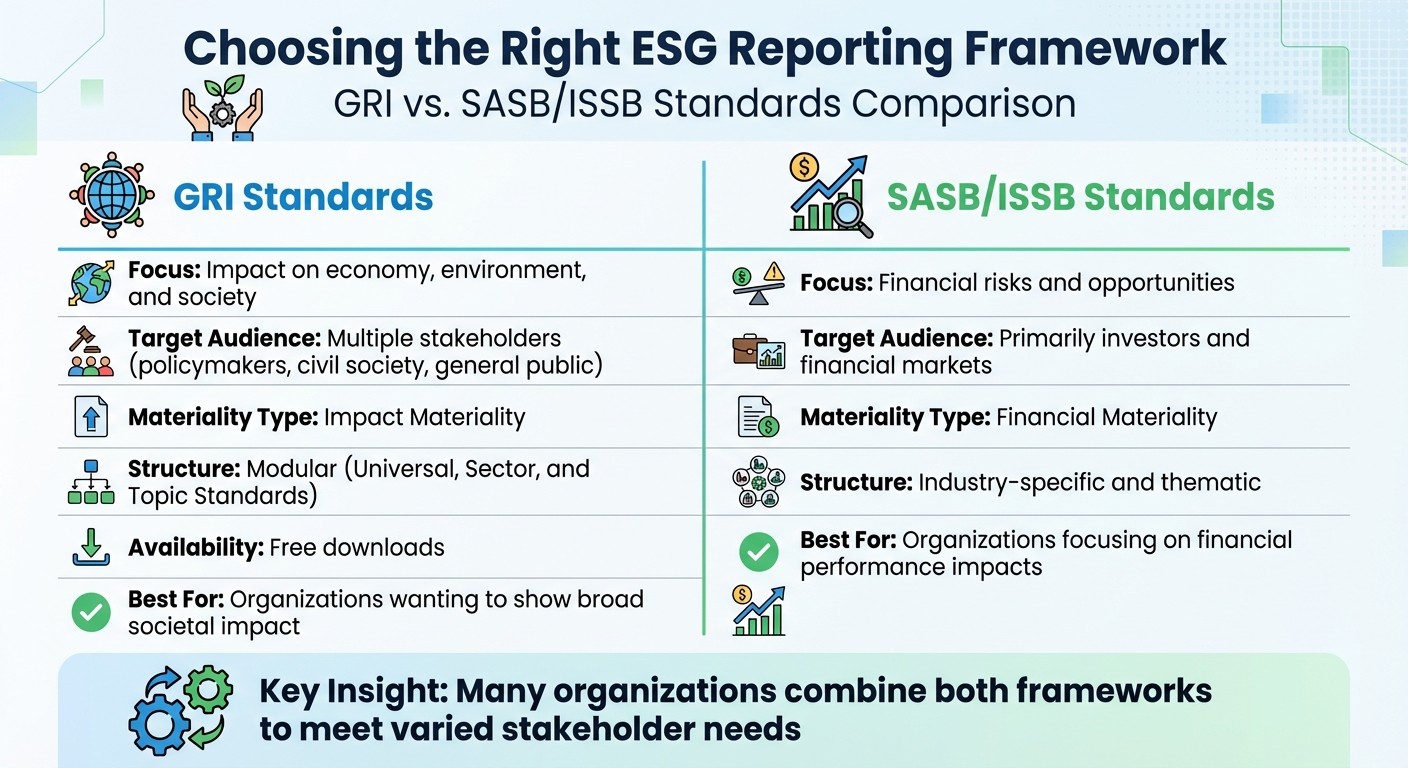
ESG Reporting Frameworks Comparison: GRI vs SASB Standards for Foundations
Once you've identified your key metrics, the next step is selecting a framework that effectively communicates your ESG impact.
Comparing GRI, SASB, and Other Frameworks
Two of the most widely used ESG reporting frameworks serve distinct purposes. The Global Reporting Initiative (GRI) emphasizes impact materiality, focusing on how your organization affects the economy, environment, and society [2]. On the other hand, the SASB/ISSB (International Sustainability Standards Board) prioritizes financial materiality, addressing how ESG factors influence your financial performance [16].
This difference is crucial because it defines your reporting audience. GRI is tailored for a diverse group of stakeholders, including policymakers, civil society, and the general public. In contrast, SASB/ISSB primarily speaks to investors and financial markets [2][16].
Many organizations opt to combine these frameworks to meet varied informational needs. For example, mapping GRI with CDP can streamline climate and energy reporting, reducing redundancy [2][16]. GRI's modular structure - comprising Universal, Sector, and Topic Standards - also allows organizations to scale their reporting efforts as they grow [2].
| Framework | Focus | Target Audience | Materiality | Structure |
| --- | --- | --- | --- | --- |
| <strong>GRI Standards</strong> | Impact on the economy, environment, and society | Multiple stakeholders | Impact Materiality | Modular: Universal, Sector, and Topic Standards |
| <strong>SASB/ISSB Standards</strong> | Financial risks and opportunities | Primarily investors | Financial Materiality | Industry-specific and thematic
| Framework | Focus | Target Audience | Materiality | Structure |
| --- | --- | --- | --- | --- |
| <strong>GRI Standards</strong> | Impact on the economy, environment, and society | Multiple stakeholders | Impact Materiality | Modular: Universal, Sector, and Topic Standards |
| <strong>SASB/ISSB Standards</strong> | Financial risks and opportunities | Primarily investors | Financial Materiality | Industry-specific and thematic
This table underscores how each framework caters to different stakeholder priorities, helping you choose based on your audience and materiality needs.
One advantage of the GRI Standards is their accessibility - they are available as free downloads [2][15]. The updated Universal Standards became effective on January 1, 2023, and new Biodiversity and Mining Standards will take effect in early 2026 [2].
Steps to Implement a Reporting Framework
To integrate a reporting framework successfully, consider these steps:
Conduct a Materiality Assessment
Identify what matters most to your stakeholders. Do they want to know how your organization impacts communities and the environment? Or are they more focused on how ESG factors influence your financial outcomes? This initial step will guide your choice of framework
[16].
Evaluate Internal Capacity
Assess your organization's readiness to handle sustainability reporting. As
PwC emphasizes:
"Sustainability reporting offers clear insights into your company's future and health. How and what you report doesn't just reflect performance. It shapes the story you tell about your company's impact on the world" [16].
Ensure your governance structures and data controls treat ESG data with the same rigor as financial data [14][16].Adopt a Modular Approach
For those new to ESG reporting, starting with Universal Standards is a practical choice. These cover foundational areas like human rights and environmental due diligence. From there, you can expand to Topic Standards that align with your mission, such as labor practices or economic effects
[2]. This gradual approach helps avoid overwhelm while building a solid reporting foundation.
Prepare for Assurance Requirements
Anticipate the need for third-party verification of your sustainability data, particularly for Scope 1 and Scope 2 emissions. Regulations like California's 2023 climate disclosure laws now require independent validation, affecting over 10,000 U.S. companies, including private entities
[16]. Establishing robust data validation procedures early can save time and resources later.
Be Transparent About Omissions
If you're unable to meet specific disclosure requirements - due to data gaps or confidentiality concerns - clearly explain the reasons in your content index. This transparency fosters trust and demonstrates a commitment to improving over time
[9]. ESG reporting is not about perfection from the start; it's about building a system that evolves while maintaining stakeholder confidence.
Setting Up Data Collection and Tracking Systems
Once you've selected your framework, the focus shifts to building effective and manageable data systems. A common pitfall for many organizations is trying to track too much at once or investing in tools that are too complex to maintain.
Creating Data Governance Standards
Data governance doesn't need to disrupt your existing processes. Its primary goal is to simplify impact measurement while avoiding unnecessary burdens [7]. One effective method is the "Common Foundations" approach, which emphasizes five core practices: defining intended outcomes, selecting relevant indicators, gathering actionable data, evaluating performance, and sharing results [7].
The key to effective data collection is starting with clear learning questions. These questions help you determine what you want to learn and how it aligns with your strategy. As Kelleen Kaye, Senior Advisor for Research Strategy at Upstream USA, explains:
"We need to formulate the questions first. What is it we want to learn? What can we learn? These aren't just measurement questions, they're strategy and organization questions." [3]
For instance, ImmSchools created a committee to guide the development of learning questions and evaluate results [3]. This ensures that data collection remains focused and relevant.
When faced with an overwhelming number of metrics, it’s better to narrow your focus to about three high-level outcomes that align with your goals - such as reach, organizational culture, or participant belonging [3]. Laura Mills, Senior Director of Quality and Evaluation at A Place Called Home, emphasizes:
"In practice, most nonprofits don't have time for side quests when it comes to measuring their impact. If everything is important, nothing is important." [3]
For long-term goals like systemic change, consider using interim measures that track short-term shifts in attitudes or behaviors. These provide meaningful insights without requiring years to see results [3].
Once governance standards are in place, the next step is to choose data collection tools that align with your organization’s needs and technical capacity.
Choosing Data Collection Tools
The right tools depend on your portfolio size and technical expertise. Organizations typically choose from four main categories: spreadsheets and forms, standalone survey tools, dedicated impact platforms, and integrated grant management systems [19][1].
One of the biggest challenges is dealing with fragmented data. Using unique stakeholder IDs from the start can help prevent duplicate entries and streamline data management [1].
Here’s a breakdown of tool categories by portfolio size, along with their advantages and limitations:
| Tool Category | Best For | Key Advantage | Main Limitation |
| --- | --- | --- | --- |
| <strong>Spreadsheets/Forms</strong> | 1-10 grants | Free; minimal setup | No automation; manual work |
| <strong>Standalone Surveys</strong> | 10-50 grants | Improved data collection | Lacks portfolio dashboards |
| <strong>Dedicated Impact Platforms</strong> | 20-200+ grants | Outcome libraries; benchmarking | Can create data silos |
| <strong>Integrated Grant Systems</strong> | 20-500+ grants | Full workflow integration | Higher cost; longer setup
| Tool Category | Best For | Key Advantage | Main Limitation |
| --- | --- | --- | --- |
| <strong>Spreadsheets/Forms</strong> | 1-10 grants | Free; minimal setup | No automation; manual work |
| <strong>Standalone Surveys</strong> | 10-50 grants | Improved data collection | Lacks portfolio dashboards |
| <strong>Dedicated Impact Platforms</strong> | 20-200+ grants | Outcome libraries; benchmarking | Can create data silos |
| <strong>Integrated Grant Systems</strong> | 20-500+ grants | Full workflow integration | Higher cost; longer setup
Dedicated impact platforms can cost between $3,000 and $30,000 annually, depending on the portfolio size [19]. However, the cost should match your technical capacity. Over-investing in complex systems often leads to inefficiencies if you lack the staff to manage them [17].
Adopt a proportionate approach to reporting. For smaller grants, use a "light touch" with just a few questions. For medium grants, standard reporting suffices, while larger or high-risk programs may require enhanced monitoring [19]. This strategy balances oversight with administrative efficiency.
To ensure data accuracy, co-design reporting templates with grantees. Align templates with metrics they are already tracking to reduce their workload and improve the quality of data [19]. Additionally, leverage existing data sources, such as funder-required reports or internal records like electronic health records [3]. This minimizes the need for new data collection while still providing valuable insights.
Finally, review your ETL (Extract, Transform, Load) pipelines regularly to ensure data flows accurately from collection points to reporting systems [18][6]. These systems form the backbone of your ESG measurement efforts, enabling clear and impactful reporting.
How to Report ESG Impact to Stakeholders
After establishing a strong data system and customizing reports for various audiences, the next step is to communicate your ESG impact in a way that builds and maintains stakeholder trust. The effectiveness of your data system lies in how well its insights are shared.
Tailoring Reports for Specific Stakeholders
Different stakeholders have different priorities, so your reports need to reflect their specific interests. For example:
Donors and creditors are interested in how ESG factors improve resource allocation. They rely on materiality-based disclosures - information that could influence their funding decisions [4].
Board members require reports focused on governance and risk management. Use discussion guides to explain how aligning with ESG principles mitigates organizational risks and fulfills responsibilities to beneficiaries [8]. For donors, "Values-Aligned Philanthropy" toolkits can clarify the rationale behind ESG policies and how they address funding risks like extremism or hate [8].
Beneficiaries and the public seek transparency about outcomes. Use an impact thesis or Theory of Change to clearly outline how your work leads to specific social or environmental improvements [7].
Regulators need disclosures aligned with frameworks like IFRS S1 or GRI, ensuring compliance and providing comparable data [2][4].
The table below summarizes how to align reporting elements with stakeholder goals:
| Stakeholder Group | Primary Communication Goal | Recommended Reporting Element |
| --- | --- | --- |
| <strong>Donors</strong> | Showcase mission alignment and impact | Impact Thesis / Theory of Change <a href="https://cof.org/resources?ItemNumber=16095&field_term_by_type_target_id=934&page=0&field_term_by_type_target_id=561&field_term_by_type_target_id=938" target="_blank" style="text-decoration: none;" rel="nofollow noopener noreferrer" data-framer-link="Link:{"url":"https://cof.org/resources?ItemNumber=16095&field_term_by_type_target_id=934&page=0&field_term_by_type_target_id=561&field_term_by_type_target_id=938","type":"url"}" data-framer-open-in-new-tab=""><sup>[8]</sup></a><a href="https://www.commonapproach.org/common-foundations" target="_blank" style="text-decoration: none;" rel="nofollow noopener noreferrer" data-framer-link="Link:{"url":"https://www.commonapproach.org/common-foundations","type":"url"}" data-framer-open-in-new-tab=""><sup>[7]</sup></a> |
| <strong>Board Members</strong> | Provide oversight on risk and resilience | Governance and Risk Management processes <a href="https://cof.org/resources?ItemNumber=16095&field_term_by_type_target_id=934&page=0&field_term_by_type_target_id=561&field_term_by_type_target_id=938" target="_blank" style="text-decoration: none;" rel="nofollow noopener noreferrer" data-framer-link="Link:{"url":"https://cof.org/resources?ItemNumber=16095&field_term_by_type_target_id=934&page=0&field_term_by_type_target_id=561&field_term_by_type_target_id=938","type":"url"}" data-framer-open-in-new-tab=""><sup>[8]</sup></a><a href="https://www.ifrs.org/content/dam/ifrs/publications/pdf-standards-issb/english/2023/issued/part-a/issb-2023-a-ifrs-s1-general-requirements-for-disclosure-of-sustainability-related-financial-information.pdf?bypass=on" target="_blank" style="text-decoration: none;" rel="nofollow noopener noreferrer" data-framer-link="Link:{"url":"https://www.ifrs.org/content/dam/ifrs/publications/pdf-standards-issb/english/2023/issued/part-a/issb-2023-a-ifrs-s1-general-requirements-for-disclosure-of-sustainability-related-financial-information.pdf?bypass=on","type":"url"}" data-framer-open-in-new-tab=""><sup>[4]</sup></a> |
| <strong>Regulators</strong> | Ensure compliance and transparency | Materiality assessments and standardized metrics <a href="https://pwc.com/us/en/services/esg/esg-reporting.html" target="_blank" style="text-decoration: none;" rel="nofollow noopener noreferrer" data-framer-link="Link:{"url":"https://pwc.com/us/en/services/esg/esg-reporting.html","type":"url"}" data-framer-open-in-new-tab=""><sup>[16]</sup></a><a href="https://www.ifrs.org/content/dam/ifrs/publications/pdf-standards-issb/english/2023/issued/part-a/issb-2023-a-ifrs-s1-general-requirements-for-disclosure-of-sustainability-related-financial-information.pdf?bypass=on" target="_blank" style="text-decoration: none;" rel="nofollow noopener noreferrer" data-framer-link="Link:{"url":"https://www.ifrs.org/content/dam/ifrs/publications/pdf-standards-issb/english/2023/issued/part-a/issb-2023-a-ifrs-s1-general-requirements-for-disclosure-of-sustainability-related-financial-information.pdf?bypass=on","type":"url"}" data-framer-open-in-new-tab=""><sup>[4]</sup></a> |
| <strong>Beneficiaries</strong> | Share clear outcomes | Performance indicators and progress toward targets <a href="https://www.commonapproach.org/common-foundations" target="_blank" style="text-decoration: none;" rel="nofollow noopener noreferrer" data-framer-link="Link:{"url":"https://www.commonapproach.org/common-foundations","type":"url"}" data-framer-open-in-new-tab=""><sup>[7]</sup></a> |
| Stakeholder Group | Primary Communication Goal | Recommended Reporting Element |
| --- | --- | --- |
| <strong>Donors</strong> | Showcase mission alignment and impact | Impact Thesis / Theory of Change <a href="https://cof.org/resources?ItemNumber=16095&field_term_by_type_target_id=934&page=0&field_term_by_type_target_id=561&field_term_by_type_target_id=938" target="_blank" style="text-decoration: none;" rel="nofollow noopener noreferrer" data-framer-link="Link:{"url":"https://cof.org/resources?ItemNumber=16095&field_term_by_type_target_id=934&page=0&field_term_by_type_target_id=561&field_term_by_type_target_id=938","type":"url"}" data-framer-open-in-new-tab=""><sup>[8]</sup></a><a href="https://www.commonapproach.org/common-foundations" target="_blank" style="text-decoration: none;" rel="nofollow noopener noreferrer" data-framer-link="Link:{"url":"https://www.commonapproach.org/common-foundations","type":"url"}" data-framer-open-in-new-tab=""><sup>[7]</sup></a> |
| <strong>Board Members</strong> | Provide oversight on risk and resilience | Governance and Risk Management processes <a href="https://cof.org/resources?ItemNumber=16095&field_term_by_type_target_id=934&page=0&field_term_by_type_target_id=561&field_term_by_type_target_id=938" target="_blank" style="text-decoration: none;" rel="nofollow noopener noreferrer" data-framer-link="Link:{"url":"https://cof.org/resources?ItemNumber=16095&field_term_by_type_target_id=934&page=0&field_term_by_type_target_id=561&field_term_by_type_target_id=938","type":"url"}" data-framer-open-in-new-tab=""><sup>[8]</sup></a><a href="https://www.ifrs.org/content/dam/ifrs/publications/pdf-standards-issb/english/2023/issued/part-a/issb-2023-a-ifrs-s1-general-requirements-for-disclosure-of-sustainability-related-financial-information.pdf?bypass=on" target="_blank" style="text-decoration: none;" rel="nofollow noopener noreferrer" data-framer-link="Link:{"url":"https://www.ifrs.org/content/dam/ifrs/publications/pdf-standards-issb/english/2023/issued/part-a/issb-2023-a-ifrs-s1-general-requirements-for-disclosure-of-sustainability-related-financial-information.pdf?bypass=on","type":"url"}" data-framer-open-in-new-tab=""><sup>[4]</sup></a> |
| <strong>Regulators</strong> | Ensure compliance and transparency | Materiality assessments and standardized metrics <a href="https://pwc.com/us/en/services/esg/esg-reporting.html" target="_blank" style="text-decoration: none;" rel="nofollow noopener noreferrer" data-framer-link="Link:{"url":"https://pwc.com/us/en/services/esg/esg-reporting.html","type":"url"}" data-framer-open-in-new-tab=""><sup>[16]</sup></a><a href="https://www.ifrs.org/content/dam/ifrs/publications/pdf-standards-issb/english/2023/issued/part-a/issb-2023-a-ifrs-s1-general-requirements-for-disclosure-of-sustainability-related-financial-information.pdf?bypass=on" target="_blank" style="text-decoration: none;" rel="nofollow noopener noreferrer" data-framer-link="Link:{"url":"https://www.ifrs.org/content/dam/ifrs/publications/pdf-standards-issb/english/2023/issued/part-a/issb-2023-a-ifrs-s1-general-requirements-for-disclosure-of-sustainability-related-financial-information.pdf?bypass=on","type":"url"}" data-framer-open-in-new-tab=""><sup>[4]</sup></a> |
| <strong>Beneficiaries</strong> | Share clear outcomes | Performance indicators and progress toward targets <a href="https://www.commonapproach.org/common-foundations" target="_blank" style="text-decoration: none;" rel="nofollow noopener noreferrer" data-framer-link="Link:{"url":"https://www.commonapproach.org/common-foundations","type":"url"}" data-framer-open-in-new-tab=""><sup>[7]</sup></a> |Using modular standards like GRI allows you to address the needs of civil society, policymakers, and investors simultaneously, saving time while meeting diverse expectations [2].
Turning ESG Data into Stories That Resonate
Once reports are tailored to specific audiences, the next step is to transform the data into compelling narratives. Data alone can feel impersonal - stories bring it to life. PwC highlights this approach:
"Sustainability reporting offers a clear view into your company's future - and its overall health. How and what you report doesn't just reflect performance. It shapes the story you tell about your company's impact on the world." [16]
To craft these stories:
Balance data with narrative: Use visuals to simplify complex information, but also explain the meaning behind the numbers [20]. For instance, instead of just listing raw figures, provide context to show how they represent program improvements.
Humanize your data: Include testimonials, quotes, and photos that highlight the real-world impact of your work [20]. For example, the Braille Institute presents stories with photos and offers accessible formats like interactive web content, Word documents, and PDFs [20]. Similarly, Employ Milwaukee uses a dynamic webpage featuring standout metrics and participant testimonials [20].
Offer multiple formats: Provide reports in various accessible formats, such as interactive webpages, downloadable eBooks, PDFs, and videos [20]. Hutt St Centre’s 2024 Annual Report used data visualizations to quickly communicate outcomes, while Laurel House formatted results into an eBook [20].
Ensure financial transparency: Link funding details to outcomes, showing how even small donations support essential services [20]. For example, clearly outline how resources are allocated to achieve measurable impact.
Close your reports with a clear call-to-action, guiding stakeholders on how they can get involved - whether by donating, volunteering, or advocating [20].
The move toward "investor-grade" reporting emphasizes verified data and independent assurance to build trust [16]. Strong validation processes not only boost confidence but also ensure your ESG story holds up under scrutiny. Notably, 33% of CEOs worldwide report that climate-focused investments in the last five years have increased revenue from products and services [16]. This demonstrates that transparent ESG reporting can simultaneously strengthen financial performance and advance your mission.
Solving Common ESG Measurement and Reporting Problems
Even with robust frameworks in place, foundations often face challenges when it comes to effectively measuring and reporting ESG impact. To sustain meaningful outcomes, they must navigate resource constraints and streamline complex processes. Here are some strategies to tackle these common hurdles.
Working with Limited Resources
For smaller foundations, limited staffing and budgets can make advanced measurement systems feel out of reach. It's estimated that charities collectively spend about 15.8 million hours annually on funder reporting - the equivalent of 7,500 full-time roles [19]. Unfortunately, much of this effort goes toward compliance rather than fostering learning or informed decision-making.
The first step is prioritization. Dr. Lorena Tule-Romain, Co-founder and COO of ImmSchools, shared how her organization learned this lesson. After its founding in 2017, ImmSchools realized that tracking too many outcomes was depleting their resources. They narrowed their focus to three critical outcomes - students' sense of belonging, school culture, and organizational reach. Furthermore, they formed a committee of students, parents, and educators to guide their measurement efforts, ensuring that the data collected aligned with their mission of supporting undocumented students [3].
Another practical approach is proportional monitoring. Reporting requirements can be adjusted based on the size and scope of a grant. For example, a small community grant might only require a brief end-of-grant summary, while larger, multi-year initiatives may warrant more detailed reporting [19]. This idea is gaining traction, as evidenced by over 170 UK funders adopting IVAR's "Open and Trusting" commitments, which advocate for streamlined and smarter reporting. Additionally, shared outcome frameworks can help grantees use consistent indicators, enabling automated data aggregation and reducing manual effort.
Addressing resource limitations is just one part of the equation - simplifying overly intricate processes is equally crucial.
Simplifying Complex ESG Processes
Overcomplicating measurement efforts often leads to inefficiency. Organizations can streamline their ESG reporting by focusing on five key practices: defining intended outcomes, selecting relevant indicators, gathering actionable data, assessing performance, and effectively communicating results [7]. Research shows that organizations adhering to these "Common Foundations" principles find the process more manageable and impactful [21].
A practical way to simplify is by adopting a "bricolage" approach - assembling tools and methods that align with your mission [21]. Start with a clear impact thesis or theory of change to outline expected outcomes, and collect data at consistent intervals [7][21]. Tailor reports for different stakeholder groups to ensure they are easy to understand and relevant.
Modular frameworks, such as GRI, also provide flexibility by letting organizations focus on metrics that matter most to their mission, rather than attempting to address every possible indicator. As the Common Approach emphasizes:
"If all five practices are in place, your impact measurement process is 'good enough' to be effective" [7].
The goal is to extract meaningful insights without being overwhelmed by unnecessary complexity. By doing so, organizations can focus their efforts where they matter most, ensuring ESG reporting serves as a tool for progress rather than a burden.
Next Steps for Your ESG Reporting Program
Now that you've explored strategies for selecting metrics and tracking data, it's time to take actionable steps to strengthen your ESG reporting framework. Building an effective program is a continuous process - begin with manageable goals, maintain focus, and improve as you gain insights along the way.
Adopting a "measure to learn" approach can transform how you view ESG reporting. As the Bridgespan Group highlights, measurement isn't just about assessing success; it's a tool for driving improvement [3]. This perspective encourages organizations to move beyond compliance and use ESG reporting as a way to guide strategic decisions, fine-tune initiatives, and allocate resources more effectively. Collaborate with stakeholders to develop a learning agenda that pinpoints key knowledge gaps - questions that, if answered, could significantly enhance your impact over the next three to five years.
Engaging stakeholders is essential at every stage of your reporting journey. Involve groups like students, parents, and educators through advisory committees to ensure your approach remains fair and responsive to community needs. For example, ImmSchools created an eight-person advisory committee in February 2025, compensating members for their time and narrowing their focus to three core outcomes that mattered most to their community [3]. This kind of collaboration builds a strong foundation for improving transparency and accountability by ensuring data is both accurate and meaningful.
As your program evolves, consider obtaining independent assurance to enhance credibility. With ESG claims under increasing scrutiny, moving from limited to reasonable assurance through independent audits can build trust and position your organization to meet shifting regulatory expectations.
Additionally, nearly 70% of philanthropic collaboratives emphasize the importance of strengthening measurement and learning capabilities [22]. Focus on the metrics most aligned with your theory of change, use technology to support ongoing data analysis, and remain flexible as standards continue to develop.
FAQs
Which ESG metrics should our foundation track first?
To begin, choose metrics that directly reflect your foundation’s goals and align with its impact thesis. These should highlight the specific social or environmental challenges you aim to address, the outcomes for stakeholders, and your organization’s contribution to these changes. Established frameworks like GRI (Global Reporting Initiative) or SASB (Sustainability Accounting Standards Board) can help pinpoint metrics that are both relevant and practical. The key is to focus on collecting data that not only tracks progress but also provides insights that can guide meaningful action.
Should we use GRI, SASB/ISSB, or both for reporting?
When it comes to sustainability reporting, combining GRI and SASB/ISSB standards is a smart approach. The GRI framework emphasizes transparency around an organization’s broader effects on the economy, environment, and society. On the other hand, SASB/ISSB zeroes in on industry-specific financial risks and opportunities. Together, they offer a well-rounded perspective, addressing the concerns of both stakeholders and investors while catering to diverse reporting requirements.
How can we measure ESG impact without overburdening grantees?
To assess ESG impact effectively without overwhelming grantees, adopt streamlined methods such as concise, focused surveys and permitting grantees to share existing documentation. Rely on standardized frameworks to gather essential data in a structured way, and offer clear instructions to prevent redundant efforts. These strategies help maintain a balance between meaningful impact measurement and a manageable process for grantees.
Related Blog Posts
Latest Articles
©2025



FAQ
01
What does it really mean to “redefine profit”?
02
What makes Council Fire different?
03
Who does Council Fire you work with?
04
What does working with Council Fire actually look like?
05
How does Council Fire help organizations turn big goals into action?
06
How does Council Fire define and measure success?
Feb 24, 2026
How to Measure and Report ESG Impact Effectively for Foundations & Philanthropic Organizations
ESG Strategy
In This Article
Practical guide for foundations to pick mission‑aligned ESG metrics, build proportionate data systems, and report clear, verified impact to stakeholders.
How to Measure and Report ESG Impact Effectively for Foundations & Philanthropic Organizations
ESG (Environmental, Social, and Governance) reporting is essential for foundations and philanthropic organizations to showcase their impact, build trust, and improve decision-making. This guide outlines actionable steps to measure and report ESG performance effectively, ensuring transparency and accountability while aligning with stakeholder priorities.
Key Takeaways:
Why ESG Matters: Aligns investments and operations with mission goals, avoiding conflicts of interest and enhancing credibility.
Choosing Metrics: Focus on those that align with your mission and stakeholder needs, combining standard frameworks (like GRI or SASB) with custom indicators.
Data Systems: Simplify collection by using proportional monitoring and tools suited to your organization's size and capacity.
Reporting Frameworks: Select frameworks based on stakeholder focus - GRI for broader impact, SASB for financial materiality.
Engaging Stakeholders: Tailor reports for donors, board members, and beneficiaries, using clear narratives and visuals to communicate results.
By prioritizing relevant metrics, utilizing effective data systems, and tailoring reports to specific audiences, organizations can ensure their ESG efforts drive measurable outcomes and long-term impact.
ESG Principles for Foundations and Philanthropic Organizations
What ESG Means for Philanthropic Organizations
For foundations, managing endowments responsibly while distributing grants for meaningful social impact is a balancing act. ESG principles provide a structured way to align these efforts with the organization's mission and values [5].
At its core, ESG focuses on "material topics" that influence economic, environmental, and community outcomes. The environmental aspect addresses how activities affect air, land, water, and ecosystems. Social principles revolve around the well-being of individuals and communities, including human rights and societal health. Governance emphasizes the policies and frameworks that shape decision-making and ensure accountability.
This approach is becoming more relevant as foundations shift from traditional grantmaking toward impact investing. Over the past decade, impact investing has grown into a $715 billion market, blending financial returns with measurable social impact [10]. This evolution encourages foundations to view their endowments not just as financial assets but as tools for driving positive change.
By embracing ESG principles, foundations can align their operational strategies with their core values, laying the groundwork for meaningful integration of these practices.
Why ESG Alignment Matters
Aligning with ESG principles helps foundations avoid conflicts of interest that might arise when investment strategies clash with their philanthropic goals. Foundations operate under a "social compact", which grants them societal trust and legitimacy [5]. Following ESG guidelines demonstrates accountability to stakeholders and ensures credibility in an era of shifting expectations.
A 2022 analysis of U.S. foundation data revealed that 39% of global grants were directed to locally led development initiatives [8]. This highlights the importance of transparent, values-driven practices. By adopting values-aligned philanthropy, foundations can ensure that their grantmaking and investment decisions reflect their principles, such as avoiding support for hate or extremism [8].
Additionally, integrating Monitoring, Evaluation, and Learning (MEL) systems used in grantmaking with Impact Measurement and Management (IMM) practices for investments creates a unified framework. This consistency enables foundations to better measure and report the full scope of their impact, reinforcing their commitment to both financial and social objectives [11].
How to Select and Prioritize ESG Metrics
Matching Metrics to Your Mission and Stakeholder Needs
Translating your ESG principles into measurable outcomes starts with aligning metrics to your mission and the needs of your stakeholders. This process begins by developing a clear framework - such as an impact thesis, theory of change, or logic model - that outlines your intended outcomes. These elements serve as the backbone of your ESG reporting strategy. Without this clarity, identifying meaningful metrics becomes an uphill battle [7].
The focus should always be on metrics that genuinely matter. As the Laudes Foundation highlights:
"Change cannot be captured by numbers alone because metrics put the focus on what can be counted, not always what's most important" [12].
This is especially relevant for organizations working on systemic change, where progress often involves shifts in policy, stakeholder influence, or investor behavior - elements that can't always be distilled into simple numerical data.
Engage with stakeholders, such as grantees, early in the process to identify one to four key indicators tailored to the goals of each initiative [12]. For example, the Laudes Foundation employs 21 rubrics across four categories (Process, Early/Later Changes, Outcomes, and 2030 Impact). For grants exceeding $100,000, partners select one to four rubrics that align with their objectives and self-assess progress on a five-point scale ranging from "Harmful" to "Thrivable" [12].
To ensure credibility, draw conclusions from multiple sources of evidence. Relying on diverse data points provides independent confirmation and avoids over-dependence on any single source [12]. Collect data that not only tracks progress but also drives meaningful improvements, rather than simply gathering it for reporting purposes [7].
Using Standard and Custom Metrics Together
An effective ESG strategy often combines standardized frameworks with custom indicators. Standard metrics provide a baseline for universal concerns like human rights, environmental impact, and governance, while custom indicators allow you to measure the specific outcomes that align with your mission.
Think of standardized metrics as the foundation - they address broad, universally relevant issues. Custom indicators, on the other hand, capture the unique aspects of your work, such as food security, education access, or climate resiliency.
For example, a foundation focused on food security might track multiple custom metrics such as "meals provided", "households receiving food vouchers", and "community garden participants." By grouping these under a shared theme like "Access to nutritious food" and harmonizing the units (e.g., converting all data to "number of people served"), you can present a unified view of your impact across diverse initiatives [13].
Rubrics are invaluable for creating a consistent assessment scale. They provide a shared language for evaluating both quantitative and qualitative data, helping you compare progress across different projects - even when the activities themselves vary [12].
To build trust and ensure transparency, document your aggregation policies, including rules, assumptions, and conversion methods [13]. This step is crucial for stakeholders who need to understand how conclusions were reached. The Common Framework approach emphasizes this point:
"The Common Framework does not attempt to standardize metrics. Instead, it standardizes how decisions about aggregation are made and documented" [13].
With a combination of clear metrics and organized data, you'll be well-prepared to choose the appropriate reporting frameworks in the next phase.
Demystifying ESG for Nonprofits
Choosing and Using ESG Reporting Frameworks
ESG Reporting Frameworks Comparison: GRI vs SASB Standards for Foundations
Once you've identified your key metrics, the next step is selecting a framework that effectively communicates your ESG impact.
Comparing GRI, SASB, and Other Frameworks
Two of the most widely used ESG reporting frameworks serve distinct purposes. The Global Reporting Initiative (GRI) emphasizes impact materiality, focusing on how your organization affects the economy, environment, and society [2]. On the other hand, the SASB/ISSB (International Sustainability Standards Board) prioritizes financial materiality, addressing how ESG factors influence your financial performance [16].
This difference is crucial because it defines your reporting audience. GRI is tailored for a diverse group of stakeholders, including policymakers, civil society, and the general public. In contrast, SASB/ISSB primarily speaks to investors and financial markets [2][16].
Many organizations opt to combine these frameworks to meet varied informational needs. For example, mapping GRI with CDP can streamline climate and energy reporting, reducing redundancy [2][16]. GRI's modular structure - comprising Universal, Sector, and Topic Standards - also allows organizations to scale their reporting efforts as they grow [2].
| Framework | Focus | Target Audience | Materiality | Structure |
| --- | --- | --- | --- | --- |
| <strong>GRI Standards</strong> | Impact on the economy, environment, and society | Multiple stakeholders | Impact Materiality | Modular: Universal, Sector, and Topic Standards |
| <strong>SASB/ISSB Standards</strong> | Financial risks and opportunities | Primarily investors | Financial Materiality | Industry-specific and thematic
This table underscores how each framework caters to different stakeholder priorities, helping you choose based on your audience and materiality needs.
One advantage of the GRI Standards is their accessibility - they are available as free downloads [2][15]. The updated Universal Standards became effective on January 1, 2023, and new Biodiversity and Mining Standards will take effect in early 2026 [2].
Steps to Implement a Reporting Framework
To integrate a reporting framework successfully, consider these steps:
Conduct a Materiality Assessment
Identify what matters most to your stakeholders. Do they want to know how your organization impacts communities and the environment? Or are they more focused on how ESG factors influence your financial outcomes? This initial step will guide your choice of framework
[16].
Evaluate Internal Capacity
Assess your organization's readiness to handle sustainability reporting. As
PwC emphasizes:
"Sustainability reporting offers clear insights into your company's future and health. How and what you report doesn't just reflect performance. It shapes the story you tell about your company's impact on the world" [16].
Ensure your governance structures and data controls treat ESG data with the same rigor as financial data [14][16].Adopt a Modular Approach
For those new to ESG reporting, starting with Universal Standards is a practical choice. These cover foundational areas like human rights and environmental due diligence. From there, you can expand to Topic Standards that align with your mission, such as labor practices or economic effects
[2]. This gradual approach helps avoid overwhelm while building a solid reporting foundation.
Prepare for Assurance Requirements
Anticipate the need for third-party verification of your sustainability data, particularly for Scope 1 and Scope 2 emissions. Regulations like California's 2023 climate disclosure laws now require independent validation, affecting over 10,000 U.S. companies, including private entities
[16]. Establishing robust data validation procedures early can save time and resources later.
Be Transparent About Omissions
If you're unable to meet specific disclosure requirements - due to data gaps or confidentiality concerns - clearly explain the reasons in your content index. This transparency fosters trust and demonstrates a commitment to improving over time
[9]. ESG reporting is not about perfection from the start; it's about building a system that evolves while maintaining stakeholder confidence.
Setting Up Data Collection and Tracking Systems
Once you've selected your framework, the focus shifts to building effective and manageable data systems. A common pitfall for many organizations is trying to track too much at once or investing in tools that are too complex to maintain.
Creating Data Governance Standards
Data governance doesn't need to disrupt your existing processes. Its primary goal is to simplify impact measurement while avoiding unnecessary burdens [7]. One effective method is the "Common Foundations" approach, which emphasizes five core practices: defining intended outcomes, selecting relevant indicators, gathering actionable data, evaluating performance, and sharing results [7].
The key to effective data collection is starting with clear learning questions. These questions help you determine what you want to learn and how it aligns with your strategy. As Kelleen Kaye, Senior Advisor for Research Strategy at Upstream USA, explains:
"We need to formulate the questions first. What is it we want to learn? What can we learn? These aren't just measurement questions, they're strategy and organization questions." [3]
For instance, ImmSchools created a committee to guide the development of learning questions and evaluate results [3]. This ensures that data collection remains focused and relevant.
When faced with an overwhelming number of metrics, it’s better to narrow your focus to about three high-level outcomes that align with your goals - such as reach, organizational culture, or participant belonging [3]. Laura Mills, Senior Director of Quality and Evaluation at A Place Called Home, emphasizes:
"In practice, most nonprofits don't have time for side quests when it comes to measuring their impact. If everything is important, nothing is important." [3]
For long-term goals like systemic change, consider using interim measures that track short-term shifts in attitudes or behaviors. These provide meaningful insights without requiring years to see results [3].
Once governance standards are in place, the next step is to choose data collection tools that align with your organization’s needs and technical capacity.
Choosing Data Collection Tools
The right tools depend on your portfolio size and technical expertise. Organizations typically choose from four main categories: spreadsheets and forms, standalone survey tools, dedicated impact platforms, and integrated grant management systems [19][1].
One of the biggest challenges is dealing with fragmented data. Using unique stakeholder IDs from the start can help prevent duplicate entries and streamline data management [1].
Here’s a breakdown of tool categories by portfolio size, along with their advantages and limitations:
| Tool Category | Best For | Key Advantage | Main Limitation |
| --- | --- | --- | --- |
| <strong>Spreadsheets/Forms</strong> | 1-10 grants | Free; minimal setup | No automation; manual work |
| <strong>Standalone Surveys</strong> | 10-50 grants | Improved data collection | Lacks portfolio dashboards |
| <strong>Dedicated Impact Platforms</strong> | 20-200+ grants | Outcome libraries; benchmarking | Can create data silos |
| <strong>Integrated Grant Systems</strong> | 20-500+ grants | Full workflow integration | Higher cost; longer setup
Dedicated impact platforms can cost between $3,000 and $30,000 annually, depending on the portfolio size [19]. However, the cost should match your technical capacity. Over-investing in complex systems often leads to inefficiencies if you lack the staff to manage them [17].
Adopt a proportionate approach to reporting. For smaller grants, use a "light touch" with just a few questions. For medium grants, standard reporting suffices, while larger or high-risk programs may require enhanced monitoring [19]. This strategy balances oversight with administrative efficiency.
To ensure data accuracy, co-design reporting templates with grantees. Align templates with metrics they are already tracking to reduce their workload and improve the quality of data [19]. Additionally, leverage existing data sources, such as funder-required reports or internal records like electronic health records [3]. This minimizes the need for new data collection while still providing valuable insights.
Finally, review your ETL (Extract, Transform, Load) pipelines regularly to ensure data flows accurately from collection points to reporting systems [18][6]. These systems form the backbone of your ESG measurement efforts, enabling clear and impactful reporting.
How to Report ESG Impact to Stakeholders
After establishing a strong data system and customizing reports for various audiences, the next step is to communicate your ESG impact in a way that builds and maintains stakeholder trust. The effectiveness of your data system lies in how well its insights are shared.
Tailoring Reports for Specific Stakeholders
Different stakeholders have different priorities, so your reports need to reflect their specific interests. For example:
Donors and creditors are interested in how ESG factors improve resource allocation. They rely on materiality-based disclosures - information that could influence their funding decisions [4].
Board members require reports focused on governance and risk management. Use discussion guides to explain how aligning with ESG principles mitigates organizational risks and fulfills responsibilities to beneficiaries [8]. For donors, "Values-Aligned Philanthropy" toolkits can clarify the rationale behind ESG policies and how they address funding risks like extremism or hate [8].
Beneficiaries and the public seek transparency about outcomes. Use an impact thesis or Theory of Change to clearly outline how your work leads to specific social or environmental improvements [7].
Regulators need disclosures aligned with frameworks like IFRS S1 or GRI, ensuring compliance and providing comparable data [2][4].
The table below summarizes how to align reporting elements with stakeholder goals:
| Stakeholder Group | Primary Communication Goal | Recommended Reporting Element |
| --- | --- | --- |
| <strong>Donors</strong> | Showcase mission alignment and impact | Impact Thesis / Theory of Change <a href="https://cof.org/resources?ItemNumber=16095&field_term_by_type_target_id=934&page=0&field_term_by_type_target_id=561&field_term_by_type_target_id=938" target="_blank" style="text-decoration: none;" rel="nofollow noopener noreferrer" data-framer-link="Link:{"url":"https://cof.org/resources?ItemNumber=16095&field_term_by_type_target_id=934&page=0&field_term_by_type_target_id=561&field_term_by_type_target_id=938","type":"url"}" data-framer-open-in-new-tab=""><sup>[8]</sup></a><a href="https://www.commonapproach.org/common-foundations" target="_blank" style="text-decoration: none;" rel="nofollow noopener noreferrer" data-framer-link="Link:{"url":"https://www.commonapproach.org/common-foundations","type":"url"}" data-framer-open-in-new-tab=""><sup>[7]</sup></a> |
| <strong>Board Members</strong> | Provide oversight on risk and resilience | Governance and Risk Management processes <a href="https://cof.org/resources?ItemNumber=16095&field_term_by_type_target_id=934&page=0&field_term_by_type_target_id=561&field_term_by_type_target_id=938" target="_blank" style="text-decoration: none;" rel="nofollow noopener noreferrer" data-framer-link="Link:{"url":"https://cof.org/resources?ItemNumber=16095&field_term_by_type_target_id=934&page=0&field_term_by_type_target_id=561&field_term_by_type_target_id=938","type":"url"}" data-framer-open-in-new-tab=""><sup>[8]</sup></a><a href="https://www.ifrs.org/content/dam/ifrs/publications/pdf-standards-issb/english/2023/issued/part-a/issb-2023-a-ifrs-s1-general-requirements-for-disclosure-of-sustainability-related-financial-information.pdf?bypass=on" target="_blank" style="text-decoration: none;" rel="nofollow noopener noreferrer" data-framer-link="Link:{"url":"https://www.ifrs.org/content/dam/ifrs/publications/pdf-standards-issb/english/2023/issued/part-a/issb-2023-a-ifrs-s1-general-requirements-for-disclosure-of-sustainability-related-financial-information.pdf?bypass=on","type":"url"}" data-framer-open-in-new-tab=""><sup>[4]</sup></a> |
| <strong>Regulators</strong> | Ensure compliance and transparency | Materiality assessments and standardized metrics <a href="https://pwc.com/us/en/services/esg/esg-reporting.html" target="_blank" style="text-decoration: none;" rel="nofollow noopener noreferrer" data-framer-link="Link:{"url":"https://pwc.com/us/en/services/esg/esg-reporting.html","type":"url"}" data-framer-open-in-new-tab=""><sup>[16]</sup></a><a href="https://www.ifrs.org/content/dam/ifrs/publications/pdf-standards-issb/english/2023/issued/part-a/issb-2023-a-ifrs-s1-general-requirements-for-disclosure-of-sustainability-related-financial-information.pdf?bypass=on" target="_blank" style="text-decoration: none;" rel="nofollow noopener noreferrer" data-framer-link="Link:{"url":"https://www.ifrs.org/content/dam/ifrs/publications/pdf-standards-issb/english/2023/issued/part-a/issb-2023-a-ifrs-s1-general-requirements-for-disclosure-of-sustainability-related-financial-information.pdf?bypass=on","type":"url"}" data-framer-open-in-new-tab=""><sup>[4]</sup></a> |
| <strong>Beneficiaries</strong> | Share clear outcomes | Performance indicators and progress toward targets <a href="https://www.commonapproach.org/common-foundations" target="_blank" style="text-decoration: none;" rel="nofollow noopener noreferrer" data-framer-link="Link:{"url":"https://www.commonapproach.org/common-foundations","type":"url"}" data-framer-open-in-new-tab=""><sup>[7]</sup></a> |
Using modular standards like GRI allows you to address the needs of civil society, policymakers, and investors simultaneously, saving time while meeting diverse expectations [2].
Turning ESG Data into Stories That Resonate
Once reports are tailored to specific audiences, the next step is to transform the data into compelling narratives. Data alone can feel impersonal - stories bring it to life. PwC highlights this approach:
"Sustainability reporting offers a clear view into your company's future - and its overall health. How and what you report doesn't just reflect performance. It shapes the story you tell about your company's impact on the world." [16]
To craft these stories:
Balance data with narrative: Use visuals to simplify complex information, but also explain the meaning behind the numbers [20]. For instance, instead of just listing raw figures, provide context to show how they represent program improvements.
Humanize your data: Include testimonials, quotes, and photos that highlight the real-world impact of your work [20]. For example, the Braille Institute presents stories with photos and offers accessible formats like interactive web content, Word documents, and PDFs [20]. Similarly, Employ Milwaukee uses a dynamic webpage featuring standout metrics and participant testimonials [20].
Offer multiple formats: Provide reports in various accessible formats, such as interactive webpages, downloadable eBooks, PDFs, and videos [20]. Hutt St Centre’s 2024 Annual Report used data visualizations to quickly communicate outcomes, while Laurel House formatted results into an eBook [20].
Ensure financial transparency: Link funding details to outcomes, showing how even small donations support essential services [20]. For example, clearly outline how resources are allocated to achieve measurable impact.
Close your reports with a clear call-to-action, guiding stakeholders on how they can get involved - whether by donating, volunteering, or advocating [20].
The move toward "investor-grade" reporting emphasizes verified data and independent assurance to build trust [16]. Strong validation processes not only boost confidence but also ensure your ESG story holds up under scrutiny. Notably, 33% of CEOs worldwide report that climate-focused investments in the last five years have increased revenue from products and services [16]. This demonstrates that transparent ESG reporting can simultaneously strengthen financial performance and advance your mission.
Solving Common ESG Measurement and Reporting Problems
Even with robust frameworks in place, foundations often face challenges when it comes to effectively measuring and reporting ESG impact. To sustain meaningful outcomes, they must navigate resource constraints and streamline complex processes. Here are some strategies to tackle these common hurdles.
Working with Limited Resources
For smaller foundations, limited staffing and budgets can make advanced measurement systems feel out of reach. It's estimated that charities collectively spend about 15.8 million hours annually on funder reporting - the equivalent of 7,500 full-time roles [19]. Unfortunately, much of this effort goes toward compliance rather than fostering learning or informed decision-making.
The first step is prioritization. Dr. Lorena Tule-Romain, Co-founder and COO of ImmSchools, shared how her organization learned this lesson. After its founding in 2017, ImmSchools realized that tracking too many outcomes was depleting their resources. They narrowed their focus to three critical outcomes - students' sense of belonging, school culture, and organizational reach. Furthermore, they formed a committee of students, parents, and educators to guide their measurement efforts, ensuring that the data collected aligned with their mission of supporting undocumented students [3].
Another practical approach is proportional monitoring. Reporting requirements can be adjusted based on the size and scope of a grant. For example, a small community grant might only require a brief end-of-grant summary, while larger, multi-year initiatives may warrant more detailed reporting [19]. This idea is gaining traction, as evidenced by over 170 UK funders adopting IVAR's "Open and Trusting" commitments, which advocate for streamlined and smarter reporting. Additionally, shared outcome frameworks can help grantees use consistent indicators, enabling automated data aggregation and reducing manual effort.
Addressing resource limitations is just one part of the equation - simplifying overly intricate processes is equally crucial.
Simplifying Complex ESG Processes
Overcomplicating measurement efforts often leads to inefficiency. Organizations can streamline their ESG reporting by focusing on five key practices: defining intended outcomes, selecting relevant indicators, gathering actionable data, assessing performance, and effectively communicating results [7]. Research shows that organizations adhering to these "Common Foundations" principles find the process more manageable and impactful [21].
A practical way to simplify is by adopting a "bricolage" approach - assembling tools and methods that align with your mission [21]. Start with a clear impact thesis or theory of change to outline expected outcomes, and collect data at consistent intervals [7][21]. Tailor reports for different stakeholder groups to ensure they are easy to understand and relevant.
Modular frameworks, such as GRI, also provide flexibility by letting organizations focus on metrics that matter most to their mission, rather than attempting to address every possible indicator. As the Common Approach emphasizes:
"If all five practices are in place, your impact measurement process is 'good enough' to be effective" [7].
The goal is to extract meaningful insights without being overwhelmed by unnecessary complexity. By doing so, organizations can focus their efforts where they matter most, ensuring ESG reporting serves as a tool for progress rather than a burden.
Next Steps for Your ESG Reporting Program
Now that you've explored strategies for selecting metrics and tracking data, it's time to take actionable steps to strengthen your ESG reporting framework. Building an effective program is a continuous process - begin with manageable goals, maintain focus, and improve as you gain insights along the way.
Adopting a "measure to learn" approach can transform how you view ESG reporting. As the Bridgespan Group highlights, measurement isn't just about assessing success; it's a tool for driving improvement [3]. This perspective encourages organizations to move beyond compliance and use ESG reporting as a way to guide strategic decisions, fine-tune initiatives, and allocate resources more effectively. Collaborate with stakeholders to develop a learning agenda that pinpoints key knowledge gaps - questions that, if answered, could significantly enhance your impact over the next three to five years.
Engaging stakeholders is essential at every stage of your reporting journey. Involve groups like students, parents, and educators through advisory committees to ensure your approach remains fair and responsive to community needs. For example, ImmSchools created an eight-person advisory committee in February 2025, compensating members for their time and narrowing their focus to three core outcomes that mattered most to their community [3]. This kind of collaboration builds a strong foundation for improving transparency and accountability by ensuring data is both accurate and meaningful.
As your program evolves, consider obtaining independent assurance to enhance credibility. With ESG claims under increasing scrutiny, moving from limited to reasonable assurance through independent audits can build trust and position your organization to meet shifting regulatory expectations.
Additionally, nearly 70% of philanthropic collaboratives emphasize the importance of strengthening measurement and learning capabilities [22]. Focus on the metrics most aligned with your theory of change, use technology to support ongoing data analysis, and remain flexible as standards continue to develop.
FAQs
Which ESG metrics should our foundation track first?
To begin, choose metrics that directly reflect your foundation’s goals and align with its impact thesis. These should highlight the specific social or environmental challenges you aim to address, the outcomes for stakeholders, and your organization’s contribution to these changes. Established frameworks like GRI (Global Reporting Initiative) or SASB (Sustainability Accounting Standards Board) can help pinpoint metrics that are both relevant and practical. The key is to focus on collecting data that not only tracks progress but also provides insights that can guide meaningful action.
Should we use GRI, SASB/ISSB, or both for reporting?
When it comes to sustainability reporting, combining GRI and SASB/ISSB standards is a smart approach. The GRI framework emphasizes transparency around an organization’s broader effects on the economy, environment, and society. On the other hand, SASB/ISSB zeroes in on industry-specific financial risks and opportunities. Together, they offer a well-rounded perspective, addressing the concerns of both stakeholders and investors while catering to diverse reporting requirements.
How can we measure ESG impact without overburdening grantees?
To assess ESG impact effectively without overwhelming grantees, adopt streamlined methods such as concise, focused surveys and permitting grantees to share existing documentation. Rely on standardized frameworks to gather essential data in a structured way, and offer clear instructions to prevent redundant efforts. These strategies help maintain a balance between meaningful impact measurement and a manageable process for grantees.
Related Blog Posts
FAQ
01
What does it really mean to “redefine profit”?
02
What makes Council Fire different?
03
Who does Council Fire you work with?
04
What does working with Council Fire actually look like?
05
How does Council Fire help organizations turn big goals into action?
06
How does Council Fire define and measure success?
Feb 24, 2026
How to Measure and Report ESG Impact Effectively for Foundations & Philanthropic Organizations
ESG Strategy
In This Article
Practical guide for foundations to pick mission‑aligned ESG metrics, build proportionate data systems, and report clear, verified impact to stakeholders.
How to Measure and Report ESG Impact Effectively for Foundations & Philanthropic Organizations
ESG (Environmental, Social, and Governance) reporting is essential for foundations and philanthropic organizations to showcase their impact, build trust, and improve decision-making. This guide outlines actionable steps to measure and report ESG performance effectively, ensuring transparency and accountability while aligning with stakeholder priorities.
Key Takeaways:
Why ESG Matters: Aligns investments and operations with mission goals, avoiding conflicts of interest and enhancing credibility.
Choosing Metrics: Focus on those that align with your mission and stakeholder needs, combining standard frameworks (like GRI or SASB) with custom indicators.
Data Systems: Simplify collection by using proportional monitoring and tools suited to your organization's size and capacity.
Reporting Frameworks: Select frameworks based on stakeholder focus - GRI for broader impact, SASB for financial materiality.
Engaging Stakeholders: Tailor reports for donors, board members, and beneficiaries, using clear narratives and visuals to communicate results.
By prioritizing relevant metrics, utilizing effective data systems, and tailoring reports to specific audiences, organizations can ensure their ESG efforts drive measurable outcomes and long-term impact.
ESG Principles for Foundations and Philanthropic Organizations
What ESG Means for Philanthropic Organizations
For foundations, managing endowments responsibly while distributing grants for meaningful social impact is a balancing act. ESG principles provide a structured way to align these efforts with the organization's mission and values [5].
At its core, ESG focuses on "material topics" that influence economic, environmental, and community outcomes. The environmental aspect addresses how activities affect air, land, water, and ecosystems. Social principles revolve around the well-being of individuals and communities, including human rights and societal health. Governance emphasizes the policies and frameworks that shape decision-making and ensure accountability.
This approach is becoming more relevant as foundations shift from traditional grantmaking toward impact investing. Over the past decade, impact investing has grown into a $715 billion market, blending financial returns with measurable social impact [10]. This evolution encourages foundations to view their endowments not just as financial assets but as tools for driving positive change.
By embracing ESG principles, foundations can align their operational strategies with their core values, laying the groundwork for meaningful integration of these practices.
Why ESG Alignment Matters
Aligning with ESG principles helps foundations avoid conflicts of interest that might arise when investment strategies clash with their philanthropic goals. Foundations operate under a "social compact", which grants them societal trust and legitimacy [5]. Following ESG guidelines demonstrates accountability to stakeholders and ensures credibility in an era of shifting expectations.
A 2022 analysis of U.S. foundation data revealed that 39% of global grants were directed to locally led development initiatives [8]. This highlights the importance of transparent, values-driven practices. By adopting values-aligned philanthropy, foundations can ensure that their grantmaking and investment decisions reflect their principles, such as avoiding support for hate or extremism [8].
Additionally, integrating Monitoring, Evaluation, and Learning (MEL) systems used in grantmaking with Impact Measurement and Management (IMM) practices for investments creates a unified framework. This consistency enables foundations to better measure and report the full scope of their impact, reinforcing their commitment to both financial and social objectives [11].
How to Select and Prioritize ESG Metrics
Matching Metrics to Your Mission and Stakeholder Needs
Translating your ESG principles into measurable outcomes starts with aligning metrics to your mission and the needs of your stakeholders. This process begins by developing a clear framework - such as an impact thesis, theory of change, or logic model - that outlines your intended outcomes. These elements serve as the backbone of your ESG reporting strategy. Without this clarity, identifying meaningful metrics becomes an uphill battle [7].
The focus should always be on metrics that genuinely matter. As the Laudes Foundation highlights:
"Change cannot be captured by numbers alone because metrics put the focus on what can be counted, not always what's most important" [12].
This is especially relevant for organizations working on systemic change, where progress often involves shifts in policy, stakeholder influence, or investor behavior - elements that can't always be distilled into simple numerical data.
Engage with stakeholders, such as grantees, early in the process to identify one to four key indicators tailored to the goals of each initiative [12]. For example, the Laudes Foundation employs 21 rubrics across four categories (Process, Early/Later Changes, Outcomes, and 2030 Impact). For grants exceeding $100,000, partners select one to four rubrics that align with their objectives and self-assess progress on a five-point scale ranging from "Harmful" to "Thrivable" [12].
To ensure credibility, draw conclusions from multiple sources of evidence. Relying on diverse data points provides independent confirmation and avoids over-dependence on any single source [12]. Collect data that not only tracks progress but also drives meaningful improvements, rather than simply gathering it for reporting purposes [7].
Using Standard and Custom Metrics Together
An effective ESG strategy often combines standardized frameworks with custom indicators. Standard metrics provide a baseline for universal concerns like human rights, environmental impact, and governance, while custom indicators allow you to measure the specific outcomes that align with your mission.
Think of standardized metrics as the foundation - they address broad, universally relevant issues. Custom indicators, on the other hand, capture the unique aspects of your work, such as food security, education access, or climate resiliency.
For example, a foundation focused on food security might track multiple custom metrics such as "meals provided", "households receiving food vouchers", and "community garden participants." By grouping these under a shared theme like "Access to nutritious food" and harmonizing the units (e.g., converting all data to "number of people served"), you can present a unified view of your impact across diverse initiatives [13].
Rubrics are invaluable for creating a consistent assessment scale. They provide a shared language for evaluating both quantitative and qualitative data, helping you compare progress across different projects - even when the activities themselves vary [12].
To build trust and ensure transparency, document your aggregation policies, including rules, assumptions, and conversion methods [13]. This step is crucial for stakeholders who need to understand how conclusions were reached. The Common Framework approach emphasizes this point:
"The Common Framework does not attempt to standardize metrics. Instead, it standardizes how decisions about aggregation are made and documented" [13].
With a combination of clear metrics and organized data, you'll be well-prepared to choose the appropriate reporting frameworks in the next phase.
Demystifying ESG for Nonprofits
Choosing and Using ESG Reporting Frameworks
ESG Reporting Frameworks Comparison: GRI vs SASB Standards for Foundations
Once you've identified your key metrics, the next step is selecting a framework that effectively communicates your ESG impact.
Comparing GRI, SASB, and Other Frameworks
Two of the most widely used ESG reporting frameworks serve distinct purposes. The Global Reporting Initiative (GRI) emphasizes impact materiality, focusing on how your organization affects the economy, environment, and society [2]. On the other hand, the SASB/ISSB (International Sustainability Standards Board) prioritizes financial materiality, addressing how ESG factors influence your financial performance [16].
This difference is crucial because it defines your reporting audience. GRI is tailored for a diverse group of stakeholders, including policymakers, civil society, and the general public. In contrast, SASB/ISSB primarily speaks to investors and financial markets [2][16].
Many organizations opt to combine these frameworks to meet varied informational needs. For example, mapping GRI with CDP can streamline climate and energy reporting, reducing redundancy [2][16]. GRI's modular structure - comprising Universal, Sector, and Topic Standards - also allows organizations to scale their reporting efforts as they grow [2].
| Framework | Focus | Target Audience | Materiality | Structure |
| --- | --- | --- | --- | --- |
| <strong>GRI Standards</strong> | Impact on the economy, environment, and society | Multiple stakeholders | Impact Materiality | Modular: Universal, Sector, and Topic Standards |
| <strong>SASB/ISSB Standards</strong> | Financial risks and opportunities | Primarily investors | Financial Materiality | Industry-specific and thematic
This table underscores how each framework caters to different stakeholder priorities, helping you choose based on your audience and materiality needs.
One advantage of the GRI Standards is their accessibility - they are available as free downloads [2][15]. The updated Universal Standards became effective on January 1, 2023, and new Biodiversity and Mining Standards will take effect in early 2026 [2].
Steps to Implement a Reporting Framework
To integrate a reporting framework successfully, consider these steps:
Conduct a Materiality Assessment
Identify what matters most to your stakeholders. Do they want to know how your organization impacts communities and the environment? Or are they more focused on how ESG factors influence your financial outcomes? This initial step will guide your choice of framework
[16].
Evaluate Internal Capacity
Assess your organization's readiness to handle sustainability reporting. As
PwC emphasizes:
"Sustainability reporting offers clear insights into your company's future and health. How and what you report doesn't just reflect performance. It shapes the story you tell about your company's impact on the world" [16].
Ensure your governance structures and data controls treat ESG data with the same rigor as financial data [14][16].Adopt a Modular Approach
For those new to ESG reporting, starting with Universal Standards is a practical choice. These cover foundational areas like human rights and environmental due diligence. From there, you can expand to Topic Standards that align with your mission, such as labor practices or economic effects
[2]. This gradual approach helps avoid overwhelm while building a solid reporting foundation.
Prepare for Assurance Requirements
Anticipate the need for third-party verification of your sustainability data, particularly for Scope 1 and Scope 2 emissions. Regulations like California's 2023 climate disclosure laws now require independent validation, affecting over 10,000 U.S. companies, including private entities
[16]. Establishing robust data validation procedures early can save time and resources later.
Be Transparent About Omissions
If you're unable to meet specific disclosure requirements - due to data gaps or confidentiality concerns - clearly explain the reasons in your content index. This transparency fosters trust and demonstrates a commitment to improving over time
[9]. ESG reporting is not about perfection from the start; it's about building a system that evolves while maintaining stakeholder confidence.
Setting Up Data Collection and Tracking Systems
Once you've selected your framework, the focus shifts to building effective and manageable data systems. A common pitfall for many organizations is trying to track too much at once or investing in tools that are too complex to maintain.
Creating Data Governance Standards
Data governance doesn't need to disrupt your existing processes. Its primary goal is to simplify impact measurement while avoiding unnecessary burdens [7]. One effective method is the "Common Foundations" approach, which emphasizes five core practices: defining intended outcomes, selecting relevant indicators, gathering actionable data, evaluating performance, and sharing results [7].
The key to effective data collection is starting with clear learning questions. These questions help you determine what you want to learn and how it aligns with your strategy. As Kelleen Kaye, Senior Advisor for Research Strategy at Upstream USA, explains:
"We need to formulate the questions first. What is it we want to learn? What can we learn? These aren't just measurement questions, they're strategy and organization questions." [3]
For instance, ImmSchools created a committee to guide the development of learning questions and evaluate results [3]. This ensures that data collection remains focused and relevant.
When faced with an overwhelming number of metrics, it’s better to narrow your focus to about three high-level outcomes that align with your goals - such as reach, organizational culture, or participant belonging [3]. Laura Mills, Senior Director of Quality and Evaluation at A Place Called Home, emphasizes:
"In practice, most nonprofits don't have time for side quests when it comes to measuring their impact. If everything is important, nothing is important." [3]
For long-term goals like systemic change, consider using interim measures that track short-term shifts in attitudes or behaviors. These provide meaningful insights without requiring years to see results [3].
Once governance standards are in place, the next step is to choose data collection tools that align with your organization’s needs and technical capacity.
Choosing Data Collection Tools
The right tools depend on your portfolio size and technical expertise. Organizations typically choose from four main categories: spreadsheets and forms, standalone survey tools, dedicated impact platforms, and integrated grant management systems [19][1].
One of the biggest challenges is dealing with fragmented data. Using unique stakeholder IDs from the start can help prevent duplicate entries and streamline data management [1].
Here’s a breakdown of tool categories by portfolio size, along with their advantages and limitations:
| Tool Category | Best For | Key Advantage | Main Limitation |
| --- | --- | --- | --- |
| <strong>Spreadsheets/Forms</strong> | 1-10 grants | Free; minimal setup | No automation; manual work |
| <strong>Standalone Surveys</strong> | 10-50 grants | Improved data collection | Lacks portfolio dashboards |
| <strong>Dedicated Impact Platforms</strong> | 20-200+ grants | Outcome libraries; benchmarking | Can create data silos |
| <strong>Integrated Grant Systems</strong> | 20-500+ grants | Full workflow integration | Higher cost; longer setup
Dedicated impact platforms can cost between $3,000 and $30,000 annually, depending on the portfolio size [19]. However, the cost should match your technical capacity. Over-investing in complex systems often leads to inefficiencies if you lack the staff to manage them [17].
Adopt a proportionate approach to reporting. For smaller grants, use a "light touch" with just a few questions. For medium grants, standard reporting suffices, while larger or high-risk programs may require enhanced monitoring [19]. This strategy balances oversight with administrative efficiency.
To ensure data accuracy, co-design reporting templates with grantees. Align templates with metrics they are already tracking to reduce their workload and improve the quality of data [19]. Additionally, leverage existing data sources, such as funder-required reports or internal records like electronic health records [3]. This minimizes the need for new data collection while still providing valuable insights.
Finally, review your ETL (Extract, Transform, Load) pipelines regularly to ensure data flows accurately from collection points to reporting systems [18][6]. These systems form the backbone of your ESG measurement efforts, enabling clear and impactful reporting.
How to Report ESG Impact to Stakeholders
After establishing a strong data system and customizing reports for various audiences, the next step is to communicate your ESG impact in a way that builds and maintains stakeholder trust. The effectiveness of your data system lies in how well its insights are shared.
Tailoring Reports for Specific Stakeholders
Different stakeholders have different priorities, so your reports need to reflect their specific interests. For example:
Donors and creditors are interested in how ESG factors improve resource allocation. They rely on materiality-based disclosures - information that could influence their funding decisions [4].
Board members require reports focused on governance and risk management. Use discussion guides to explain how aligning with ESG principles mitigates organizational risks and fulfills responsibilities to beneficiaries [8]. For donors, "Values-Aligned Philanthropy" toolkits can clarify the rationale behind ESG policies and how they address funding risks like extremism or hate [8].
Beneficiaries and the public seek transparency about outcomes. Use an impact thesis or Theory of Change to clearly outline how your work leads to specific social or environmental improvements [7].
Regulators need disclosures aligned with frameworks like IFRS S1 or GRI, ensuring compliance and providing comparable data [2][4].
The table below summarizes how to align reporting elements with stakeholder goals:
| Stakeholder Group | Primary Communication Goal | Recommended Reporting Element |
| --- | --- | --- |
| <strong>Donors</strong> | Showcase mission alignment and impact | Impact Thesis / Theory of Change <a href="https://cof.org/resources?ItemNumber=16095&field_term_by_type_target_id=934&page=0&field_term_by_type_target_id=561&field_term_by_type_target_id=938" target="_blank" style="text-decoration: none;" rel="nofollow noopener noreferrer" data-framer-link="Link:{"url":"https://cof.org/resources?ItemNumber=16095&field_term_by_type_target_id=934&page=0&field_term_by_type_target_id=561&field_term_by_type_target_id=938","type":"url"}" data-framer-open-in-new-tab=""><sup>[8]</sup></a><a href="https://www.commonapproach.org/common-foundations" target="_blank" style="text-decoration: none;" rel="nofollow noopener noreferrer" data-framer-link="Link:{"url":"https://www.commonapproach.org/common-foundations","type":"url"}" data-framer-open-in-new-tab=""><sup>[7]</sup></a> |
| <strong>Board Members</strong> | Provide oversight on risk and resilience | Governance and Risk Management processes <a href="https://cof.org/resources?ItemNumber=16095&field_term_by_type_target_id=934&page=0&field_term_by_type_target_id=561&field_term_by_type_target_id=938" target="_blank" style="text-decoration: none;" rel="nofollow noopener noreferrer" data-framer-link="Link:{"url":"https://cof.org/resources?ItemNumber=16095&field_term_by_type_target_id=934&page=0&field_term_by_type_target_id=561&field_term_by_type_target_id=938","type":"url"}" data-framer-open-in-new-tab=""><sup>[8]</sup></a><a href="https://www.ifrs.org/content/dam/ifrs/publications/pdf-standards-issb/english/2023/issued/part-a/issb-2023-a-ifrs-s1-general-requirements-for-disclosure-of-sustainability-related-financial-information.pdf?bypass=on" target="_blank" style="text-decoration: none;" rel="nofollow noopener noreferrer" data-framer-link="Link:{"url":"https://www.ifrs.org/content/dam/ifrs/publications/pdf-standards-issb/english/2023/issued/part-a/issb-2023-a-ifrs-s1-general-requirements-for-disclosure-of-sustainability-related-financial-information.pdf?bypass=on","type":"url"}" data-framer-open-in-new-tab=""><sup>[4]</sup></a> |
| <strong>Regulators</strong> | Ensure compliance and transparency | Materiality assessments and standardized metrics <a href="https://pwc.com/us/en/services/esg/esg-reporting.html" target="_blank" style="text-decoration: none;" rel="nofollow noopener noreferrer" data-framer-link="Link:{"url":"https://pwc.com/us/en/services/esg/esg-reporting.html","type":"url"}" data-framer-open-in-new-tab=""><sup>[16]</sup></a><a href="https://www.ifrs.org/content/dam/ifrs/publications/pdf-standards-issb/english/2023/issued/part-a/issb-2023-a-ifrs-s1-general-requirements-for-disclosure-of-sustainability-related-financial-information.pdf?bypass=on" target="_blank" style="text-decoration: none;" rel="nofollow noopener noreferrer" data-framer-link="Link:{"url":"https://www.ifrs.org/content/dam/ifrs/publications/pdf-standards-issb/english/2023/issued/part-a/issb-2023-a-ifrs-s1-general-requirements-for-disclosure-of-sustainability-related-financial-information.pdf?bypass=on","type":"url"}" data-framer-open-in-new-tab=""><sup>[4]</sup></a> |
| <strong>Beneficiaries</strong> | Share clear outcomes | Performance indicators and progress toward targets <a href="https://www.commonapproach.org/common-foundations" target="_blank" style="text-decoration: none;" rel="nofollow noopener noreferrer" data-framer-link="Link:{"url":"https://www.commonapproach.org/common-foundations","type":"url"}" data-framer-open-in-new-tab=""><sup>[7]</sup></a> |
Using modular standards like GRI allows you to address the needs of civil society, policymakers, and investors simultaneously, saving time while meeting diverse expectations [2].
Turning ESG Data into Stories That Resonate
Once reports are tailored to specific audiences, the next step is to transform the data into compelling narratives. Data alone can feel impersonal - stories bring it to life. PwC highlights this approach:
"Sustainability reporting offers a clear view into your company's future - and its overall health. How and what you report doesn't just reflect performance. It shapes the story you tell about your company's impact on the world." [16]
To craft these stories:
Balance data with narrative: Use visuals to simplify complex information, but also explain the meaning behind the numbers [20]. For instance, instead of just listing raw figures, provide context to show how they represent program improvements.
Humanize your data: Include testimonials, quotes, and photos that highlight the real-world impact of your work [20]. For example, the Braille Institute presents stories with photos and offers accessible formats like interactive web content, Word documents, and PDFs [20]. Similarly, Employ Milwaukee uses a dynamic webpage featuring standout metrics and participant testimonials [20].
Offer multiple formats: Provide reports in various accessible formats, such as interactive webpages, downloadable eBooks, PDFs, and videos [20]. Hutt St Centre’s 2024 Annual Report used data visualizations to quickly communicate outcomes, while Laurel House formatted results into an eBook [20].
Ensure financial transparency: Link funding details to outcomes, showing how even small donations support essential services [20]. For example, clearly outline how resources are allocated to achieve measurable impact.
Close your reports with a clear call-to-action, guiding stakeholders on how they can get involved - whether by donating, volunteering, or advocating [20].
The move toward "investor-grade" reporting emphasizes verified data and independent assurance to build trust [16]. Strong validation processes not only boost confidence but also ensure your ESG story holds up under scrutiny. Notably, 33% of CEOs worldwide report that climate-focused investments in the last five years have increased revenue from products and services [16]. This demonstrates that transparent ESG reporting can simultaneously strengthen financial performance and advance your mission.
Solving Common ESG Measurement and Reporting Problems
Even with robust frameworks in place, foundations often face challenges when it comes to effectively measuring and reporting ESG impact. To sustain meaningful outcomes, they must navigate resource constraints and streamline complex processes. Here are some strategies to tackle these common hurdles.
Working with Limited Resources
For smaller foundations, limited staffing and budgets can make advanced measurement systems feel out of reach. It's estimated that charities collectively spend about 15.8 million hours annually on funder reporting - the equivalent of 7,500 full-time roles [19]. Unfortunately, much of this effort goes toward compliance rather than fostering learning or informed decision-making.
The first step is prioritization. Dr. Lorena Tule-Romain, Co-founder and COO of ImmSchools, shared how her organization learned this lesson. After its founding in 2017, ImmSchools realized that tracking too many outcomes was depleting their resources. They narrowed their focus to three critical outcomes - students' sense of belonging, school culture, and organizational reach. Furthermore, they formed a committee of students, parents, and educators to guide their measurement efforts, ensuring that the data collected aligned with their mission of supporting undocumented students [3].
Another practical approach is proportional monitoring. Reporting requirements can be adjusted based on the size and scope of a grant. For example, a small community grant might only require a brief end-of-grant summary, while larger, multi-year initiatives may warrant more detailed reporting [19]. This idea is gaining traction, as evidenced by over 170 UK funders adopting IVAR's "Open and Trusting" commitments, which advocate for streamlined and smarter reporting. Additionally, shared outcome frameworks can help grantees use consistent indicators, enabling automated data aggregation and reducing manual effort.
Addressing resource limitations is just one part of the equation - simplifying overly intricate processes is equally crucial.
Simplifying Complex ESG Processes
Overcomplicating measurement efforts often leads to inefficiency. Organizations can streamline their ESG reporting by focusing on five key practices: defining intended outcomes, selecting relevant indicators, gathering actionable data, assessing performance, and effectively communicating results [7]. Research shows that organizations adhering to these "Common Foundations" principles find the process more manageable and impactful [21].
A practical way to simplify is by adopting a "bricolage" approach - assembling tools and methods that align with your mission [21]. Start with a clear impact thesis or theory of change to outline expected outcomes, and collect data at consistent intervals [7][21]. Tailor reports for different stakeholder groups to ensure they are easy to understand and relevant.
Modular frameworks, such as GRI, also provide flexibility by letting organizations focus on metrics that matter most to their mission, rather than attempting to address every possible indicator. As the Common Approach emphasizes:
"If all five practices are in place, your impact measurement process is 'good enough' to be effective" [7].
The goal is to extract meaningful insights without being overwhelmed by unnecessary complexity. By doing so, organizations can focus their efforts where they matter most, ensuring ESG reporting serves as a tool for progress rather than a burden.
Next Steps for Your ESG Reporting Program
Now that you've explored strategies for selecting metrics and tracking data, it's time to take actionable steps to strengthen your ESG reporting framework. Building an effective program is a continuous process - begin with manageable goals, maintain focus, and improve as you gain insights along the way.
Adopting a "measure to learn" approach can transform how you view ESG reporting. As the Bridgespan Group highlights, measurement isn't just about assessing success; it's a tool for driving improvement [3]. This perspective encourages organizations to move beyond compliance and use ESG reporting as a way to guide strategic decisions, fine-tune initiatives, and allocate resources more effectively. Collaborate with stakeholders to develop a learning agenda that pinpoints key knowledge gaps - questions that, if answered, could significantly enhance your impact over the next three to five years.
Engaging stakeholders is essential at every stage of your reporting journey. Involve groups like students, parents, and educators through advisory committees to ensure your approach remains fair and responsive to community needs. For example, ImmSchools created an eight-person advisory committee in February 2025, compensating members for their time and narrowing their focus to three core outcomes that mattered most to their community [3]. This kind of collaboration builds a strong foundation for improving transparency and accountability by ensuring data is both accurate and meaningful.
As your program evolves, consider obtaining independent assurance to enhance credibility. With ESG claims under increasing scrutiny, moving from limited to reasonable assurance through independent audits can build trust and position your organization to meet shifting regulatory expectations.
Additionally, nearly 70% of philanthropic collaboratives emphasize the importance of strengthening measurement and learning capabilities [22]. Focus on the metrics most aligned with your theory of change, use technology to support ongoing data analysis, and remain flexible as standards continue to develop.
FAQs
Which ESG metrics should our foundation track first?
To begin, choose metrics that directly reflect your foundation’s goals and align with its impact thesis. These should highlight the specific social or environmental challenges you aim to address, the outcomes for stakeholders, and your organization’s contribution to these changes. Established frameworks like GRI (Global Reporting Initiative) or SASB (Sustainability Accounting Standards Board) can help pinpoint metrics that are both relevant and practical. The key is to focus on collecting data that not only tracks progress but also provides insights that can guide meaningful action.
Should we use GRI, SASB/ISSB, or both for reporting?
When it comes to sustainability reporting, combining GRI and SASB/ISSB standards is a smart approach. The GRI framework emphasizes transparency around an organization’s broader effects on the economy, environment, and society. On the other hand, SASB/ISSB zeroes in on industry-specific financial risks and opportunities. Together, they offer a well-rounded perspective, addressing the concerns of both stakeholders and investors while catering to diverse reporting requirements.
How can we measure ESG impact without overburdening grantees?
To assess ESG impact effectively without overwhelming grantees, adopt streamlined methods such as concise, focused surveys and permitting grantees to share existing documentation. Rely on standardized frameworks to gather essential data in a structured way, and offer clear instructions to prevent redundant efforts. These strategies help maintain a balance between meaningful impact measurement and a manageable process for grantees.
Related Blog Posts
FAQ
What does it really mean to “redefine profit”?
What makes Council Fire different?
Who does Council Fire you work with?
What does working with Council Fire actually look like?
How does Council Fire help organizations turn big goals into action?
How does Council Fire define and measure success?