
Jun 27, 2026
How to Measure and Communicate Collective Impact for NGOs & Nonprofits
Capacity Building
In This Article
Agree on shared outcomes, standardize partner data, use dashboards and SROI, and tailor reports so nonprofits can measure collective impact.
How to Measure and Communicate Collective Impact for NGOs & Nonprofits
If your partners do not define success the same way, your numbers will not add up. In multi-organization work, the path is simple: agree on shared outcomes, standardize partner data, review results with dashboards or SROI, and report the same evidence in different ways for funders, boards, partners, and communities.
I’d boil the article down to this:
Start with shared outcomes tied to changes in people’s lives, not activity counts.
Set one definition, one collection method, and one reporting schedule for each indicator.
Build a logic model so each partner knows its role and what data to track.
Check data quality early by finding missing values, duplicate records, and definition gaps.
Use dashboards for partner learning and SROI for dollar-based value framing.
Report by audience and state methods, limits, and contribution claims plainly.
Plan for staff time and budget: only 43% of foundation leaders think nonprofits have enough resources to measure collaborative impact well, and nearly 70% of philanthropic collaboratives say measurement and learning capacity is a top need.
A few points matter most. Shared measurement works only when partners agree on the target population, geography, data rules, and privacy terms before reporting starts. Data should be disaggregated - such as by race/ethnicity, age, income, and ZIP code - so gaps do not get hidden in totals. And when several groups shape one result, I should report contribution, not full causation.
If I were setting up a collective impact system today, I’d keep it focused: a short list of outcomes, a shared data dictionary, a simple reporting model partners can maintain, and a review cycle that turns data into action instead of letting it sit in a spreadsheet.
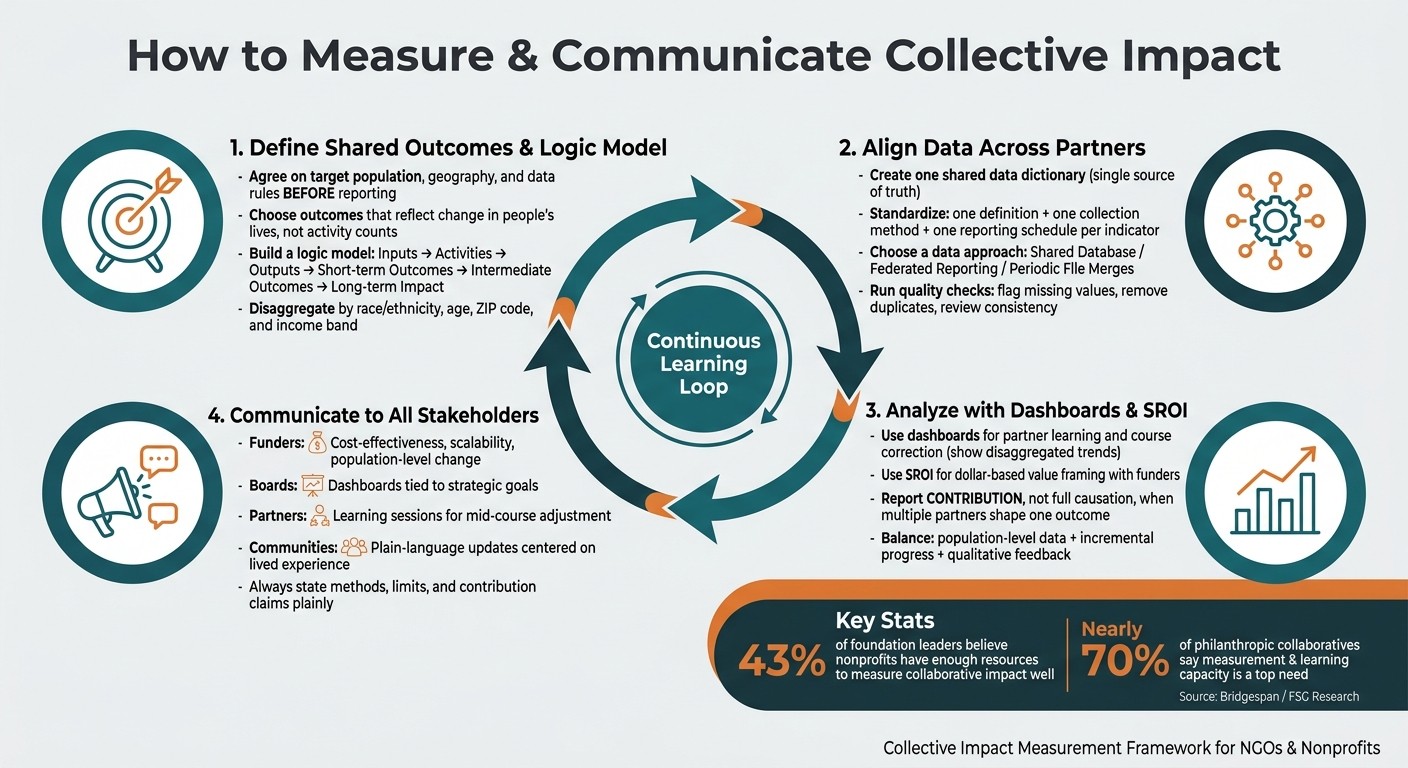
Collective Impact Measurement: 4-Step Framework for NGOs & Nonprofits
Collective Impact Model (The Basics)
1. Define Shared Outcomes, Indicators, and a Common Logic Model
Once the common agenda is set, the next step is to agree on the outcomes, indicators, and logic model partners will track together. A broad goal only becomes useful when everyone gets clear on three things: what change matters, how that change will be tracked, and how all the pieces connect.
Choose Shared Outcomes That Reflect Measurable Social or Environmental Outcomes
A shared outcome should describe a change in people’s lives or in the environment, not just a program task. “Number of job training sessions held” is an activity. “Percentage of participants who secured a living-wage job within 6 months” is an outcome. That gap matters. Funders and communities want to know what changed, not just what got done.
Keep the list of shared outcomes short. If the list gets too long, teams lose focus and end up tracking data they won’t use. From the start, build in disaggregation. Breaking data down by race/ethnicity, age, ZIP code, and income band helps show whether results look different across groups. Those categories should be set before data collection begins, not bolted on later.
After that, turn each outcome into one or two indicators that every partner can collect in the same way.
Build Indicators That Multiple Organizations Can Collect Consistently
A strong indicator is clear enough that two organizations would gather the same data the same way. It should name the population, the metric, the timeframe, and the geography.
Here’s what that looks like in practice:
Indicator | Clarity | Relevance | Measurability |
|---|---|---|---|
"Number of youth attending workshops" | High | Low - tracks activity, not change | Easy to count but lacks impact context |
"% of youth reporting increased confidence in job interviews 6 months post-program" | High | High - reflects real social change | Requires follow-up but tracks actual progress |
"Improve community health" | Low | High | Vague indicators like "improved community health" are too broad to measure consistently |
"Reduction in asthma-related ER visits in ZIP code 06106 over 3 years" | High | High - systemic and long-term | Clear, time-bound, and uses existing health data |
Use both quantitative and qualitative indicators. Numbers show scale. Stories help explain why results moved, or why they didn’t. The Road Map Project in Seattle and South King County used iterative work groups to refine their cradle-to-career indicators across hundreds of stakeholders. [1] That kind of shared revision helps produce indicators people trust and will stick with.
Create a Shared Logic Model or Theory of Change
A logic model shows how partner inputs connect to outputs, outcomes, and long-term impact. In plain terms, it maps what partners put in, what they do, what comes out of that work, and what change they expect to see. Each part should be stated clearly and quantified when it helps.
Component | Description | Examples |
|---|---|---|
Inputs | Resources invested by all partners | Funding (USD), staff FTEs, volunteer hours, technology |
Activities | Actions taken to reach the goal | Workshops, health screenings, policy advocacy, mentoring |
Outputs | Direct products of activities | Number of unique people served, sessions held |
Short-term Outcomes | Immediate changes in participants | Skill change, increased knowledge, attitude shifts |
Intermediate Outcomes | Sustained changes over time | Job retention, household stability, improved health markers |
Long-term Impact | Systemic or population-level change | Reduced poverty rates, closed achievement gaps, policy reform |
One practical note on outputs: track unique people served, not total enrollments. A persistent participant ID makes it possible to follow unique people across programs instead of counting the same person more than once.
The logic model also makes each partner’s role easier to see. When organizations can spot where their work fits on the map - and where the evidence gaps sit - it becomes much simpler to decide what data should be collected and who should collect it.
Once partners agree on outcomes, indicators, and the logic model, the next move is to align data collection so results can be compared.
2. Align Data Across Partners and Build a Shared Measurement System
Once partners agree on outcomes and indicators, the next step is to line up the systems that will track them. Every indicator in the logic model needs one shared definition, one collection method, and one reporting rhythm. If that system-level alignment is missing, you get numbers that seem to match on the surface but point to different things underneath. At that point, group analysis starts to fall apart.
Standardize Definitions, Collection Tools, and Reporting Cycles
Most partnerships hit their first snag around definitions. Teams often think they are tracking the same thing when they are not. A homelessness initiative in Calgary ran into this exact problem: member organizations were using different definitions for "chronic" and "transitional" homelessness, which made service coordination harder until they built a shared data dictionary. [1]
That is why a shared data dictionary should come first. From there, partners can line up intake forms and reporting cycles. The dictionary becomes the single source for key terms: who counts as a participant, what counts as a completed service, and how outcomes should be grouped. Common measures should come from broad, repeated partner review so the definitions match day-to-day work, not just what seems easy on paper.
As FSG notes:
"One key to success is that developing common measures is itself a collective effort, with broad engagement by many organizations in the field and with clear expectations about confidentiality and transparency." [1]
This work usually sits with the backbone organization. That team should maintain the data dictionary, help partners with technical issues, and keep reporting on schedule.
Improve Data Quality and Comparability Before Reporting Results
Even with common tools, clean data does not happen by accident. Frontline staff need training not only on how to complete a form, but also on why steady data entry matters. A backbone organization, or staff assigned to this role, can keep that support going and review submitted data for accuracy.
Before any analysis begins, run a few basic checks:
Flag missing values
Remove duplicate participant records
Review entries for consistency across partners
The Hartford Data Collaborative in Connecticut offers a good example. It matched program data from community agencies against Hartford Public Schools and National Student Clearinghouse records, which made disaggregated tracking of postsecondary enrollment possible. [2]
Just as important, document every assumption you make. If missing data was estimated or a field was left out, say so plainly. Boards and funders are not looking for perfect data. They do expect a clear account of where the limits are.
Choose a Data Alignment Approach That Fits Your Capacity and Risk
There is no one best setup for every collaboration. The right choice depends on budget, partner tech capacity, and the level of trust across the network. The table below lays out three common options.
Approach | Pros | Cons | Resource Requirements | Best-Fit Use Case |
|---|---|---|---|---|
Shared Database | Real-time data access; high consistency; streamlined reporting | High setup cost; complex privacy and security needs; requires technical expertise | High: dedicated IT and funding | Mature, well-funded initiatives with strong backbone support and high trust |
Federated Reporting | Organizations keep their own systems; lower privacy risk; decentralized | Data must be manually harmonized; reporting lag; risk of inconsistent definitions | Moderate: data analyst to aggregate reports; strong data dictionary required | Large networks with diverse, established organizations using legacy systems |
Periodic File Merges | Lowest technical barrier; allows deep ad hoc analysis | Not real-time; labor-intensive each cycle; higher risk of duplicate counts | Low to moderate: project staff time | Early-stage collaborations or pilot projects testing shared metrics |
In many cases, the smarter move is to start with a system partners can keep up over time. A simpler federated model often beats an overbuilt database that no one has the staff or budget to run. Whatever model you choose, lock it in with a data-sharing agreement that spells out what data is shared, how it will be used, who can access it, and what confidentiality protections are in place, especially when sensitive participant data is involved.
Once that alignment is in place, partners can compare results on equal footing and move into analysis.
3. Analyze Results with Dashboards and Social Return on Investment
Once partners share clean data, the next step is making the results easy to read and useful in practice. The flow is simple: aligned data leads to trend analysis, and trend analysis leads to stakeholder-ready evidence. That’s where dashboards and valuation methods like Social Return on Investment (SROI) earn their place. They turn shared data into evidence that helps people make decisions, not just file reports.
Design Outcome Dashboards That Show Progress Over Time
A good collective impact dashboard does more than post current numbers on a screen. It shows movement over time and helps partners tell whether the work is heading in the right direction.
That means showing disaggregated trends, not just totals. If a dashboard only shows the big picture, it can hide who is being left behind. Strong dashboards bring gaps into plain view by race, ethnicity, gender, and other identities. They show trend lines, disparities, and where the work is - or isn’t - changing outcomes.
They also need range. A useful dashboard balances population-level change, incremental progress, systems change, and qualitative participant feedback. Numbers matter, but context matters too. Partners need both to understand what’s happening on the ground.
Metric Type | Data Source | Reporting Frequency | Primary Audience |
|---|---|---|---|
Population-Level | Census, public records, large surveys | Annual or twice a year | Funders, public, policymakers |
Incremental Progress | Partner programmatic data | Quarterly or monthly | Program staff, partners |
Systems Change | Policy trackers, funding reports | Annual or ongoing | Boards, backbone organizations |
Qualitative Participant Feedback | Interviews, focus groups, testimonials | Periodic or ad hoc | All stakeholders, community |
Regular partner review is what turns dashboard data into course correction. A dashboard on its own is just a tool. The shared review process is what gives it teeth and helps partners adjust while the work is still in motion.
Use SROI to Value Social and Environmental Outcomes
SROI puts dollar values on social and environmental outcomes by using financial proxies, such as comparable costs or savings drawn from existing research or government data. The work starts with stakeholder mapping: identifying who experiences the outcomes and what changes for them.
From there, the analysis asks a few hard but necessary questions. What would have happened anyway? How much of the change can the collaboration fairly claim? What took place without the initiative?
In collective work, trust comes from assessing contribution, not trying to carve out one group’s impact as if it happened in a vacuum. When several partners shape the same outcome, no single partner should claim the full result.
"Measurement and learning can help collaboratives... demonstrate the value of their intermediary position in a way that is rarely required of foundations and individual givers." - Mariah Collins et al., Bridgespan [4]
SROI helps explain collective value to funders and boards. Dashboards help partners manage performance. Those are two different jobs, and they support two different kinds of decisions. That’s why they should feed different stakeholder reports rather than getting mashed into one catch-all update.
Choose Between Monetized and Non-Monetized Reporting Methods
Neither SROI nor non-monetized outcome measurement fits every situation. The better choice depends on who the audience is and what decision they need to make.
Feature | SROI (Monetized) | Non-Monetized Outcome Measurement |
|---|---|---|
Strengths | Clear value proposition for donors; can help justify the cost of the backbone or intermediary role | Captures lived experiences and qualitative stories behind the numbers |
Limitations | Risk of overstating results if attribution and deadweight are not handled carefully | Can be harder for funders to compare across different social issues or sectors |
Data Requirements | Financial proxies and rigorous contribution analysis | Shared indicators, consistent reporting cycles, and qualitative input |
Ideal Use Cases | High-level donor updates and making the case for large-scale fundraising | Partner learning communities, mid-course corrections, and continuous improvement |
A simple rule helps here: use dashboards for learning, and use SROI for value framing. One helps teams steer the work. The other helps outside audiences understand what the work is worth.
4. Communicate Collective Impact to Funders, Boards, Partners, and Communities
After the analysis comes the part that often makes or breaks the work: translation. Shared results only matter if people can use them. Once your shared measurement system is set, the job is to turn the same body of evidence into plain, audience-specific communication.
Structure Impact Reports and Donor Updates Around Shared Goals
The strongest collective impact reports are organized around the common agenda, not around what each partner did on its own. The through line should stay the same from start to finish: Are we moving the shared goal forward?
A useful report structure has five parts, and each one does a different job:
Report Component | Primary Metrics | Narrative Focus | Intended Audience |
|---|---|---|---|
Executive Summary | High-level KPIs | Progress toward the common agenda | All Stakeholders |
Systems Change Progress | Policy shifts, funding changes, narrative shifts | How the policies and practices that sustain the problem are changing | Major Funders, Boards |
Partner Results | Aggregated outcomes across partners | Success stories and mutually reinforcing activities | Partners, Donors |
Learning & Adaptation | Process metrics, data gaps, mid-course adjustments | What changed, what didn't, and what the next adjustment is | Steering Committees, Partners |
Community Outcomes | Disaggregated community testimony and qualitative feedback | Qualitative stories behind the numbers and equity outcomes | Community Members, Individual Donors |
The structure can remain steady. What changes is the emphasis. A board may want the headline view. A community member may care more about what the numbers meant on the ground. Same evidence, different lens.
Tailor the Same Evidence for Different Stakeholder Groups
One set of evidence can do a lot of work when you shape it for the people reading it. That may mean concise briefs for major funders, dashboards for boards, learning sessions for partners, and plain-language updates for communities.
Major funders tend to look for cost-effectiveness, scalability, and long-term population-level change. Boards usually need dashboards tied to strategic goals. Partners get the most from regular learning sessions where data helps them adjust course instead of simply proving success. Community members should get updates in plain language that put their lived experience at the center.
The Aspen Institute's Opportunity Youth Forum offers a useful model here. Its annual grantee report asks collaboratives to share progress on both systems changes, such as narrative shifts and policy changes, and individual youth-level education and workforce outcomes. [2] That split matters. It helps groups show near-term gains without losing sight of long-range structural change.
Whatever the format, each report should make clear what the data shows and what it does not show.
State Methods and Limitations Without Weakening Credibility
Being open about how results were measured, and where the data falls short, builds trust. Explain logic models and shared indicators in plain English. Pair that with a direct account of reporting methods and limits. If some populations are undercounted, say so. If the data cannot be broken out by race, ethnicity, and gender, say that plainly too.
"If data masks disparities by race, ethnicity, gender, or other identities in the communities we serve, we fail to address inequity and miss the opportunity to influence change that really matters." - Justin Piff, Author, SSIR [2]
It also helps to name the line between contribution and causation. If the results suggest the collaborative played a part, but the data cannot prove it was the sole cause, state that outright.
Conclusion: Build a Measurement System That Supports Action
Once the data is analyzed, the last step is to use it for decisions and reporting. Collective impact measurement works only when it helps partners decide what to do next. In that sense, the process in this guide is pretty simple: shared outcomes, aligned data, analysis, and clear communication.
That’s why the system should work like a learning loop, not just a reporting exercise. Shared measurement needs to drive action, not live off to the side in a spreadsheet or slide deck. The aim is a partner network that learns and adjusts together - using shared evidence to shift strategy, close gaps, and stay accountable.
For the system to stay useful over time, partners need staff support, shared agreements, and regular review. Nearly 70% of philanthropic collaboratives say measurement and learning capacity is a top need, yet only 43% of foundation leaders believe nonprofits have enough resources to measure collaborative impact well. [4][3] A backbone team helps keep training, facilitation, and data-quality checks in motion, while data-sharing agreements and routine review meetings help the system hold together across partners. Without that support, even well-designed indicators can end up sitting on the shelf.
FAQs
How many shared outcomes should we track?
Track as many shared outcomes as your initiative can handle well. The right number depends on its maturity, strategy, and goals - not on some fixed cap.
Pick a manageable set of indicators that shows clear progress toward your common agenda. Focus first on what matters most to stakeholders, then adjust your measures over time as you learn what’s working and what isn’t.
What if partners use different data systems?
Focus on getting people and processes in sync before you reach for a technical fix. The goal isn’t to hunt down one “perfect” system. It’s to agree on shared language, clear data definitions, and a plain view of what success looks like.
A small pilot usually works best. Start with one working group, learn what holds up in practice, then improve it and roll it out more broadly. For integration, privacy, and storage, lean on internal analysts or outside research partners who know the terrain. Reporting should feel intuitive and useful - not like homework - so partners can submit data the same way, every time.
When should we use SROI instead of a dashboard?
Use an outcome dashboard for day-to-day monitoring, live tracking of shared metrics, and keeping your initiative on course. It gives partners one place to stay in sync, see how things are moving, and catch trends before they turn into bigger issues.
Use SROI when you need to show funders and stakeholders the broader value of your work in a standard format. It fits best for high-level impact reporting and for making a clear case for social change.
Related Blog Posts
Latest Articles
©2025

Narrative Change and Power Building: The Missing Half of Advocacy
Narrative change is the process of disrupting dominant narratives that normalize inequity and advancing new narratives from historically marginalized communities.

Funding Resilience Without Federal Grants
BRIC is unreliable and FEMA is shrinking. Here's how cities fund climate resilience with dedicated revenue, blended finance, and a coordinating authority.

The ESG Blind Spot: How AI Is Finding Risks in Companies Nobody Else Is Watching
Norway's sovereign wealth fund uses AI to screen 7,200 portfolio companies for forced labor and corruption within 24 hours. The real story is the emerging-market coverage gap that traditional ESG data vendors miss — and what it means for any company with a global supply chain.
Narrative Change and Power Building: The Missing Half of Advocacy
Narrative change is the process of disrupting dominant narratives that normalize inequity and advancing new narratives from historically marginalized communities.
Funding Resilience Without Federal Grants
BRIC is unreliable and FEMA is shrinking. Here's how cities fund climate resilience with dedicated revenue, blended finance, and a coordinating authority.
The ESG Blind Spot: How AI Is Finding Risks in Companies Nobody Else Is Watching
Norway's sovereign wealth fund uses AI to screen 7,200 portfolio companies for forced labor and corruption within 24 hours. The real story is the emerging-market coverage gap that traditional ESG data vendors miss — and what it means for any company with a global supply chain.
FAQ
01
What does it really mean to “redefine profit”?
02
What makes Council Fire different?
03
Who does Council Fire work with?
04
What does working with Council Fire actually look like?
05
How does Council Fire help organizations turn big goals into action?
06
How does Council Fire define and measure success?
Jun 27, 2026
How to Measure and Communicate Collective Impact for NGOs & Nonprofits
Capacity Building
In This Article
Agree on shared outcomes, standardize partner data, use dashboards and SROI, and tailor reports so nonprofits can measure collective impact.
How to Measure and Communicate Collective Impact for NGOs & Nonprofits
If your partners do not define success the same way, your numbers will not add up. In multi-organization work, the path is simple: agree on shared outcomes, standardize partner data, review results with dashboards or SROI, and report the same evidence in different ways for funders, boards, partners, and communities.
I’d boil the article down to this:
Start with shared outcomes tied to changes in people’s lives, not activity counts.
Set one definition, one collection method, and one reporting schedule for each indicator.
Build a logic model so each partner knows its role and what data to track.
Check data quality early by finding missing values, duplicate records, and definition gaps.
Use dashboards for partner learning and SROI for dollar-based value framing.
Report by audience and state methods, limits, and contribution claims plainly.
Plan for staff time and budget: only 43% of foundation leaders think nonprofits have enough resources to measure collaborative impact well, and nearly 70% of philanthropic collaboratives say measurement and learning capacity is a top need.
A few points matter most. Shared measurement works only when partners agree on the target population, geography, data rules, and privacy terms before reporting starts. Data should be disaggregated - such as by race/ethnicity, age, income, and ZIP code - so gaps do not get hidden in totals. And when several groups shape one result, I should report contribution, not full causation.
If I were setting up a collective impact system today, I’d keep it focused: a short list of outcomes, a shared data dictionary, a simple reporting model partners can maintain, and a review cycle that turns data into action instead of letting it sit in a spreadsheet.
Collective Impact Measurement: 4-Step Framework for NGOs & Nonprofits
Collective Impact Model (The Basics)
1. Define Shared Outcomes, Indicators, and a Common Logic Model
Once the common agenda is set, the next step is to agree on the outcomes, indicators, and logic model partners will track together. A broad goal only becomes useful when everyone gets clear on three things: what change matters, how that change will be tracked, and how all the pieces connect.
Choose Shared Outcomes That Reflect Measurable Social or Environmental Outcomes
A shared outcome should describe a change in people’s lives or in the environment, not just a program task. “Number of job training sessions held” is an activity. “Percentage of participants who secured a living-wage job within 6 months” is an outcome. That gap matters. Funders and communities want to know what changed, not just what got done.
Keep the list of shared outcomes short. If the list gets too long, teams lose focus and end up tracking data they won’t use. From the start, build in disaggregation. Breaking data down by race/ethnicity, age, ZIP code, and income band helps show whether results look different across groups. Those categories should be set before data collection begins, not bolted on later.
After that, turn each outcome into one or two indicators that every partner can collect in the same way.
Build Indicators That Multiple Organizations Can Collect Consistently
A strong indicator is clear enough that two organizations would gather the same data the same way. It should name the population, the metric, the timeframe, and the geography.
Here’s what that looks like in practice:
Indicator | Clarity | Relevance | Measurability |
|---|---|---|---|
"Number of youth attending workshops" | High | Low - tracks activity, not change | Easy to count but lacks impact context |
"% of youth reporting increased confidence in job interviews 6 months post-program" | High | High - reflects real social change | Requires follow-up but tracks actual progress |
"Improve community health" | Low | High | Vague indicators like "improved community health" are too broad to measure consistently |
"Reduction in asthma-related ER visits in ZIP code 06106 over 3 years" | High | High - systemic and long-term | Clear, time-bound, and uses existing health data |
Use both quantitative and qualitative indicators. Numbers show scale. Stories help explain why results moved, or why they didn’t. The Road Map Project in Seattle and South King County used iterative work groups to refine their cradle-to-career indicators across hundreds of stakeholders. [1] That kind of shared revision helps produce indicators people trust and will stick with.
Create a Shared Logic Model or Theory of Change
A logic model shows how partner inputs connect to outputs, outcomes, and long-term impact. In plain terms, it maps what partners put in, what they do, what comes out of that work, and what change they expect to see. Each part should be stated clearly and quantified when it helps.
Component | Description | Examples |
|---|---|---|
Inputs | Resources invested by all partners | Funding (USD), staff FTEs, volunteer hours, technology |
Activities | Actions taken to reach the goal | Workshops, health screenings, policy advocacy, mentoring |
Outputs | Direct products of activities | Number of unique people served, sessions held |
Short-term Outcomes | Immediate changes in participants | Skill change, increased knowledge, attitude shifts |
Intermediate Outcomes | Sustained changes over time | Job retention, household stability, improved health markers |
Long-term Impact | Systemic or population-level change | Reduced poverty rates, closed achievement gaps, policy reform |
One practical note on outputs: track unique people served, not total enrollments. A persistent participant ID makes it possible to follow unique people across programs instead of counting the same person more than once.
The logic model also makes each partner’s role easier to see. When organizations can spot where their work fits on the map - and where the evidence gaps sit - it becomes much simpler to decide what data should be collected and who should collect it.
Once partners agree on outcomes, indicators, and the logic model, the next move is to align data collection so results can be compared.
2. Align Data Across Partners and Build a Shared Measurement System
Once partners agree on outcomes and indicators, the next step is to line up the systems that will track them. Every indicator in the logic model needs one shared definition, one collection method, and one reporting rhythm. If that system-level alignment is missing, you get numbers that seem to match on the surface but point to different things underneath. At that point, group analysis starts to fall apart.
Standardize Definitions, Collection Tools, and Reporting Cycles
Most partnerships hit their first snag around definitions. Teams often think they are tracking the same thing when they are not. A homelessness initiative in Calgary ran into this exact problem: member organizations were using different definitions for "chronic" and "transitional" homelessness, which made service coordination harder until they built a shared data dictionary. [1]
That is why a shared data dictionary should come first. From there, partners can line up intake forms and reporting cycles. The dictionary becomes the single source for key terms: who counts as a participant, what counts as a completed service, and how outcomes should be grouped. Common measures should come from broad, repeated partner review so the definitions match day-to-day work, not just what seems easy on paper.
As FSG notes:
"One key to success is that developing common measures is itself a collective effort, with broad engagement by many organizations in the field and with clear expectations about confidentiality and transparency." [1]
This work usually sits with the backbone organization. That team should maintain the data dictionary, help partners with technical issues, and keep reporting on schedule.
Improve Data Quality and Comparability Before Reporting Results
Even with common tools, clean data does not happen by accident. Frontline staff need training not only on how to complete a form, but also on why steady data entry matters. A backbone organization, or staff assigned to this role, can keep that support going and review submitted data for accuracy.
Before any analysis begins, run a few basic checks:
Flag missing values
Remove duplicate participant records
Review entries for consistency across partners
The Hartford Data Collaborative in Connecticut offers a good example. It matched program data from community agencies against Hartford Public Schools and National Student Clearinghouse records, which made disaggregated tracking of postsecondary enrollment possible. [2]
Just as important, document every assumption you make. If missing data was estimated or a field was left out, say so plainly. Boards and funders are not looking for perfect data. They do expect a clear account of where the limits are.
Choose a Data Alignment Approach That Fits Your Capacity and Risk
There is no one best setup for every collaboration. The right choice depends on budget, partner tech capacity, and the level of trust across the network. The table below lays out three common options.
Approach | Pros | Cons | Resource Requirements | Best-Fit Use Case |
|---|---|---|---|---|
Shared Database | Real-time data access; high consistency; streamlined reporting | High setup cost; complex privacy and security needs; requires technical expertise | High: dedicated IT and funding | Mature, well-funded initiatives with strong backbone support and high trust |
Federated Reporting | Organizations keep their own systems; lower privacy risk; decentralized | Data must be manually harmonized; reporting lag; risk of inconsistent definitions | Moderate: data analyst to aggregate reports; strong data dictionary required | Large networks with diverse, established organizations using legacy systems |
Periodic File Merges | Lowest technical barrier; allows deep ad hoc analysis | Not real-time; labor-intensive each cycle; higher risk of duplicate counts | Low to moderate: project staff time | Early-stage collaborations or pilot projects testing shared metrics |
In many cases, the smarter move is to start with a system partners can keep up over time. A simpler federated model often beats an overbuilt database that no one has the staff or budget to run. Whatever model you choose, lock it in with a data-sharing agreement that spells out what data is shared, how it will be used, who can access it, and what confidentiality protections are in place, especially when sensitive participant data is involved.
Once that alignment is in place, partners can compare results on equal footing and move into analysis.
3. Analyze Results with Dashboards and Social Return on Investment
Once partners share clean data, the next step is making the results easy to read and useful in practice. The flow is simple: aligned data leads to trend analysis, and trend analysis leads to stakeholder-ready evidence. That’s where dashboards and valuation methods like Social Return on Investment (SROI) earn their place. They turn shared data into evidence that helps people make decisions, not just file reports.
Design Outcome Dashboards That Show Progress Over Time
A good collective impact dashboard does more than post current numbers on a screen. It shows movement over time and helps partners tell whether the work is heading in the right direction.
That means showing disaggregated trends, not just totals. If a dashboard only shows the big picture, it can hide who is being left behind. Strong dashboards bring gaps into plain view by race, ethnicity, gender, and other identities. They show trend lines, disparities, and where the work is - or isn’t - changing outcomes.
They also need range. A useful dashboard balances population-level change, incremental progress, systems change, and qualitative participant feedback. Numbers matter, but context matters too. Partners need both to understand what’s happening on the ground.
Metric Type | Data Source | Reporting Frequency | Primary Audience |
|---|---|---|---|
Population-Level | Census, public records, large surveys | Annual or twice a year | Funders, public, policymakers |
Incremental Progress | Partner programmatic data | Quarterly or monthly | Program staff, partners |
Systems Change | Policy trackers, funding reports | Annual or ongoing | Boards, backbone organizations |
Qualitative Participant Feedback | Interviews, focus groups, testimonials | Periodic or ad hoc | All stakeholders, community |
Regular partner review is what turns dashboard data into course correction. A dashboard on its own is just a tool. The shared review process is what gives it teeth and helps partners adjust while the work is still in motion.
Use SROI to Value Social and Environmental Outcomes
SROI puts dollar values on social and environmental outcomes by using financial proxies, such as comparable costs or savings drawn from existing research or government data. The work starts with stakeholder mapping: identifying who experiences the outcomes and what changes for them.
From there, the analysis asks a few hard but necessary questions. What would have happened anyway? How much of the change can the collaboration fairly claim? What took place without the initiative?
In collective work, trust comes from assessing contribution, not trying to carve out one group’s impact as if it happened in a vacuum. When several partners shape the same outcome, no single partner should claim the full result.
"Measurement and learning can help collaboratives... demonstrate the value of their intermediary position in a way that is rarely required of foundations and individual givers." - Mariah Collins et al., Bridgespan [4]
SROI helps explain collective value to funders and boards. Dashboards help partners manage performance. Those are two different jobs, and they support two different kinds of decisions. That’s why they should feed different stakeholder reports rather than getting mashed into one catch-all update.
Choose Between Monetized and Non-Monetized Reporting Methods
Neither SROI nor non-monetized outcome measurement fits every situation. The better choice depends on who the audience is and what decision they need to make.
Feature | SROI (Monetized) | Non-Monetized Outcome Measurement |
|---|---|---|
Strengths | Clear value proposition for donors; can help justify the cost of the backbone or intermediary role | Captures lived experiences and qualitative stories behind the numbers |
Limitations | Risk of overstating results if attribution and deadweight are not handled carefully | Can be harder for funders to compare across different social issues or sectors |
Data Requirements | Financial proxies and rigorous contribution analysis | Shared indicators, consistent reporting cycles, and qualitative input |
Ideal Use Cases | High-level donor updates and making the case for large-scale fundraising | Partner learning communities, mid-course corrections, and continuous improvement |
A simple rule helps here: use dashboards for learning, and use SROI for value framing. One helps teams steer the work. The other helps outside audiences understand what the work is worth.
4. Communicate Collective Impact to Funders, Boards, Partners, and Communities
After the analysis comes the part that often makes or breaks the work: translation. Shared results only matter if people can use them. Once your shared measurement system is set, the job is to turn the same body of evidence into plain, audience-specific communication.
Structure Impact Reports and Donor Updates Around Shared Goals
The strongest collective impact reports are organized around the common agenda, not around what each partner did on its own. The through line should stay the same from start to finish: Are we moving the shared goal forward?
A useful report structure has five parts, and each one does a different job:
Report Component | Primary Metrics | Narrative Focus | Intended Audience |
|---|---|---|---|
Executive Summary | High-level KPIs | Progress toward the common agenda | All Stakeholders |
Systems Change Progress | Policy shifts, funding changes, narrative shifts | How the policies and practices that sustain the problem are changing | Major Funders, Boards |
Partner Results | Aggregated outcomes across partners | Success stories and mutually reinforcing activities | Partners, Donors |
Learning & Adaptation | Process metrics, data gaps, mid-course adjustments | What changed, what didn't, and what the next adjustment is | Steering Committees, Partners |
Community Outcomes | Disaggregated community testimony and qualitative feedback | Qualitative stories behind the numbers and equity outcomes | Community Members, Individual Donors |
The structure can remain steady. What changes is the emphasis. A board may want the headline view. A community member may care more about what the numbers meant on the ground. Same evidence, different lens.
Tailor the Same Evidence for Different Stakeholder Groups
One set of evidence can do a lot of work when you shape it for the people reading it. That may mean concise briefs for major funders, dashboards for boards, learning sessions for partners, and plain-language updates for communities.
Major funders tend to look for cost-effectiveness, scalability, and long-term population-level change. Boards usually need dashboards tied to strategic goals. Partners get the most from regular learning sessions where data helps them adjust course instead of simply proving success. Community members should get updates in plain language that put their lived experience at the center.
The Aspen Institute's Opportunity Youth Forum offers a useful model here. Its annual grantee report asks collaboratives to share progress on both systems changes, such as narrative shifts and policy changes, and individual youth-level education and workforce outcomes. [2] That split matters. It helps groups show near-term gains without losing sight of long-range structural change.
Whatever the format, each report should make clear what the data shows and what it does not show.
State Methods and Limitations Without Weakening Credibility
Being open about how results were measured, and where the data falls short, builds trust. Explain logic models and shared indicators in plain English. Pair that with a direct account of reporting methods and limits. If some populations are undercounted, say so. If the data cannot be broken out by race, ethnicity, and gender, say that plainly too.
"If data masks disparities by race, ethnicity, gender, or other identities in the communities we serve, we fail to address inequity and miss the opportunity to influence change that really matters." - Justin Piff, Author, SSIR [2]
It also helps to name the line between contribution and causation. If the results suggest the collaborative played a part, but the data cannot prove it was the sole cause, state that outright.
Conclusion: Build a Measurement System That Supports Action
Once the data is analyzed, the last step is to use it for decisions and reporting. Collective impact measurement works only when it helps partners decide what to do next. In that sense, the process in this guide is pretty simple: shared outcomes, aligned data, analysis, and clear communication.
That’s why the system should work like a learning loop, not just a reporting exercise. Shared measurement needs to drive action, not live off to the side in a spreadsheet or slide deck. The aim is a partner network that learns and adjusts together - using shared evidence to shift strategy, close gaps, and stay accountable.
For the system to stay useful over time, partners need staff support, shared agreements, and regular review. Nearly 70% of philanthropic collaboratives say measurement and learning capacity is a top need, yet only 43% of foundation leaders believe nonprofits have enough resources to measure collaborative impact well. [4][3] A backbone team helps keep training, facilitation, and data-quality checks in motion, while data-sharing agreements and routine review meetings help the system hold together across partners. Without that support, even well-designed indicators can end up sitting on the shelf.
FAQs
How many shared outcomes should we track?
Track as many shared outcomes as your initiative can handle well. The right number depends on its maturity, strategy, and goals - not on some fixed cap.
Pick a manageable set of indicators that shows clear progress toward your common agenda. Focus first on what matters most to stakeholders, then adjust your measures over time as you learn what’s working and what isn’t.
What if partners use different data systems?
Focus on getting people and processes in sync before you reach for a technical fix. The goal isn’t to hunt down one “perfect” system. It’s to agree on shared language, clear data definitions, and a plain view of what success looks like.
A small pilot usually works best. Start with one working group, learn what holds up in practice, then improve it and roll it out more broadly. For integration, privacy, and storage, lean on internal analysts or outside research partners who know the terrain. Reporting should feel intuitive and useful - not like homework - so partners can submit data the same way, every time.
When should we use SROI instead of a dashboard?
Use an outcome dashboard for day-to-day monitoring, live tracking of shared metrics, and keeping your initiative on course. It gives partners one place to stay in sync, see how things are moving, and catch trends before they turn into bigger issues.
Use SROI when you need to show funders and stakeholders the broader value of your work in a standard format. It fits best for high-level impact reporting and for making a clear case for social change.
Related Blog Posts
Latest Articles
©2025
Narrative Change and Power Building: The Missing Half of Advocacy
Narrative change is the process of disrupting dominant narratives that normalize inequity and advancing new narratives from historically marginalized communities.
Funding Resilience Without Federal Grants
BRIC is unreliable and FEMA is shrinking. Here's how cities fund climate resilience with dedicated revenue, blended finance, and a coordinating authority.
The ESG Blind Spot: How AI Is Finding Risks in Companies Nobody Else Is Watching
Norway's sovereign wealth fund uses AI to screen 7,200 portfolio companies for forced labor and corruption within 24 hours. The real story is the emerging-market coverage gap that traditional ESG data vendors miss — and what it means for any company with a global supply chain.
FAQ
01
What does it really mean to “redefine profit”?
02
What makes Council Fire different?
03
Who does Council Fire work with?
04
What does working with Council Fire actually look like?
05
How does Council Fire help organizations turn big goals into action?
06
How does Council Fire define and measure success?
Jun 27, 2026
How to Measure and Communicate Collective Impact for NGOs & Nonprofits
Capacity Building
In This Article
Agree on shared outcomes, standardize partner data, use dashboards and SROI, and tailor reports so nonprofits can measure collective impact.
How to Measure and Communicate Collective Impact for NGOs & Nonprofits
If your partners do not define success the same way, your numbers will not add up. In multi-organization work, the path is simple: agree on shared outcomes, standardize partner data, review results with dashboards or SROI, and report the same evidence in different ways for funders, boards, partners, and communities.
I’d boil the article down to this:
Start with shared outcomes tied to changes in people’s lives, not activity counts.
Set one definition, one collection method, and one reporting schedule for each indicator.
Build a logic model so each partner knows its role and what data to track.
Check data quality early by finding missing values, duplicate records, and definition gaps.
Use dashboards for partner learning and SROI for dollar-based value framing.
Report by audience and state methods, limits, and contribution claims plainly.
Plan for staff time and budget: only 43% of foundation leaders think nonprofits have enough resources to measure collaborative impact well, and nearly 70% of philanthropic collaboratives say measurement and learning capacity is a top need.
A few points matter most. Shared measurement works only when partners agree on the target population, geography, data rules, and privacy terms before reporting starts. Data should be disaggregated - such as by race/ethnicity, age, income, and ZIP code - so gaps do not get hidden in totals. And when several groups shape one result, I should report contribution, not full causation.
If I were setting up a collective impact system today, I’d keep it focused: a short list of outcomes, a shared data dictionary, a simple reporting model partners can maintain, and a review cycle that turns data into action instead of letting it sit in a spreadsheet.
Collective Impact Measurement: 4-Step Framework for NGOs & Nonprofits
Collective Impact Model (The Basics)
1. Define Shared Outcomes, Indicators, and a Common Logic Model
Once the common agenda is set, the next step is to agree on the outcomes, indicators, and logic model partners will track together. A broad goal only becomes useful when everyone gets clear on three things: what change matters, how that change will be tracked, and how all the pieces connect.
Choose Shared Outcomes That Reflect Measurable Social or Environmental Outcomes
A shared outcome should describe a change in people’s lives or in the environment, not just a program task. “Number of job training sessions held” is an activity. “Percentage of participants who secured a living-wage job within 6 months” is an outcome. That gap matters. Funders and communities want to know what changed, not just what got done.
Keep the list of shared outcomes short. If the list gets too long, teams lose focus and end up tracking data they won’t use. From the start, build in disaggregation. Breaking data down by race/ethnicity, age, ZIP code, and income band helps show whether results look different across groups. Those categories should be set before data collection begins, not bolted on later.
After that, turn each outcome into one or two indicators that every partner can collect in the same way.
Build Indicators That Multiple Organizations Can Collect Consistently
A strong indicator is clear enough that two organizations would gather the same data the same way. It should name the population, the metric, the timeframe, and the geography.
Here’s what that looks like in practice:
Indicator | Clarity | Relevance | Measurability |
|---|---|---|---|
"Number of youth attending workshops" | High | Low - tracks activity, not change | Easy to count but lacks impact context |
"% of youth reporting increased confidence in job interviews 6 months post-program" | High | High - reflects real social change | Requires follow-up but tracks actual progress |
"Improve community health" | Low | High | Vague indicators like "improved community health" are too broad to measure consistently |
"Reduction in asthma-related ER visits in ZIP code 06106 over 3 years" | High | High - systemic and long-term | Clear, time-bound, and uses existing health data |
Use both quantitative and qualitative indicators. Numbers show scale. Stories help explain why results moved, or why they didn’t. The Road Map Project in Seattle and South King County used iterative work groups to refine their cradle-to-career indicators across hundreds of stakeholders. [1] That kind of shared revision helps produce indicators people trust and will stick with.
Create a Shared Logic Model or Theory of Change
A logic model shows how partner inputs connect to outputs, outcomes, and long-term impact. In plain terms, it maps what partners put in, what they do, what comes out of that work, and what change they expect to see. Each part should be stated clearly and quantified when it helps.
Component | Description | Examples |
|---|---|---|
Inputs | Resources invested by all partners | Funding (USD), staff FTEs, volunteer hours, technology |
Activities | Actions taken to reach the goal | Workshops, health screenings, policy advocacy, mentoring |
Outputs | Direct products of activities | Number of unique people served, sessions held |
Short-term Outcomes | Immediate changes in participants | Skill change, increased knowledge, attitude shifts |
Intermediate Outcomes | Sustained changes over time | Job retention, household stability, improved health markers |
Long-term Impact | Systemic or population-level change | Reduced poverty rates, closed achievement gaps, policy reform |
One practical note on outputs: track unique people served, not total enrollments. A persistent participant ID makes it possible to follow unique people across programs instead of counting the same person more than once.
The logic model also makes each partner’s role easier to see. When organizations can spot where their work fits on the map - and where the evidence gaps sit - it becomes much simpler to decide what data should be collected and who should collect it.
Once partners agree on outcomes, indicators, and the logic model, the next move is to align data collection so results can be compared.
2. Align Data Across Partners and Build a Shared Measurement System
Once partners agree on outcomes and indicators, the next step is to line up the systems that will track them. Every indicator in the logic model needs one shared definition, one collection method, and one reporting rhythm. If that system-level alignment is missing, you get numbers that seem to match on the surface but point to different things underneath. At that point, group analysis starts to fall apart.
Standardize Definitions, Collection Tools, and Reporting Cycles
Most partnerships hit their first snag around definitions. Teams often think they are tracking the same thing when they are not. A homelessness initiative in Calgary ran into this exact problem: member organizations were using different definitions for "chronic" and "transitional" homelessness, which made service coordination harder until they built a shared data dictionary. [1]
That is why a shared data dictionary should come first. From there, partners can line up intake forms and reporting cycles. The dictionary becomes the single source for key terms: who counts as a participant, what counts as a completed service, and how outcomes should be grouped. Common measures should come from broad, repeated partner review so the definitions match day-to-day work, not just what seems easy on paper.
As FSG notes:
"One key to success is that developing common measures is itself a collective effort, with broad engagement by many organizations in the field and with clear expectations about confidentiality and transparency." [1]
This work usually sits with the backbone organization. That team should maintain the data dictionary, help partners with technical issues, and keep reporting on schedule.
Improve Data Quality and Comparability Before Reporting Results
Even with common tools, clean data does not happen by accident. Frontline staff need training not only on how to complete a form, but also on why steady data entry matters. A backbone organization, or staff assigned to this role, can keep that support going and review submitted data for accuracy.
Before any analysis begins, run a few basic checks:
Flag missing values
Remove duplicate participant records
Review entries for consistency across partners
The Hartford Data Collaborative in Connecticut offers a good example. It matched program data from community agencies against Hartford Public Schools and National Student Clearinghouse records, which made disaggregated tracking of postsecondary enrollment possible. [2]
Just as important, document every assumption you make. If missing data was estimated or a field was left out, say so plainly. Boards and funders are not looking for perfect data. They do expect a clear account of where the limits are.
Choose a Data Alignment Approach That Fits Your Capacity and Risk
There is no one best setup for every collaboration. The right choice depends on budget, partner tech capacity, and the level of trust across the network. The table below lays out three common options.
Approach | Pros | Cons | Resource Requirements | Best-Fit Use Case |
|---|---|---|---|---|
Shared Database | Real-time data access; high consistency; streamlined reporting | High setup cost; complex privacy and security needs; requires technical expertise | High: dedicated IT and funding | Mature, well-funded initiatives with strong backbone support and high trust |
Federated Reporting | Organizations keep their own systems; lower privacy risk; decentralized | Data must be manually harmonized; reporting lag; risk of inconsistent definitions | Moderate: data analyst to aggregate reports; strong data dictionary required | Large networks with diverse, established organizations using legacy systems |
Periodic File Merges | Lowest technical barrier; allows deep ad hoc analysis | Not real-time; labor-intensive each cycle; higher risk of duplicate counts | Low to moderate: project staff time | Early-stage collaborations or pilot projects testing shared metrics |
In many cases, the smarter move is to start with a system partners can keep up over time. A simpler federated model often beats an overbuilt database that no one has the staff or budget to run. Whatever model you choose, lock it in with a data-sharing agreement that spells out what data is shared, how it will be used, who can access it, and what confidentiality protections are in place, especially when sensitive participant data is involved.
Once that alignment is in place, partners can compare results on equal footing and move into analysis.
3. Analyze Results with Dashboards and Social Return on Investment
Once partners share clean data, the next step is making the results easy to read and useful in practice. The flow is simple: aligned data leads to trend analysis, and trend analysis leads to stakeholder-ready evidence. That’s where dashboards and valuation methods like Social Return on Investment (SROI) earn their place. They turn shared data into evidence that helps people make decisions, not just file reports.
Design Outcome Dashboards That Show Progress Over Time
A good collective impact dashboard does more than post current numbers on a screen. It shows movement over time and helps partners tell whether the work is heading in the right direction.
That means showing disaggregated trends, not just totals. If a dashboard only shows the big picture, it can hide who is being left behind. Strong dashboards bring gaps into plain view by race, ethnicity, gender, and other identities. They show trend lines, disparities, and where the work is - or isn’t - changing outcomes.
They also need range. A useful dashboard balances population-level change, incremental progress, systems change, and qualitative participant feedback. Numbers matter, but context matters too. Partners need both to understand what’s happening on the ground.
Metric Type | Data Source | Reporting Frequency | Primary Audience |
|---|---|---|---|
Population-Level | Census, public records, large surveys | Annual or twice a year | Funders, public, policymakers |
Incremental Progress | Partner programmatic data | Quarterly or monthly | Program staff, partners |
Systems Change | Policy trackers, funding reports | Annual or ongoing | Boards, backbone organizations |
Qualitative Participant Feedback | Interviews, focus groups, testimonials | Periodic or ad hoc | All stakeholders, community |
Regular partner review is what turns dashboard data into course correction. A dashboard on its own is just a tool. The shared review process is what gives it teeth and helps partners adjust while the work is still in motion.
Use SROI to Value Social and Environmental Outcomes
SROI puts dollar values on social and environmental outcomes by using financial proxies, such as comparable costs or savings drawn from existing research or government data. The work starts with stakeholder mapping: identifying who experiences the outcomes and what changes for them.
From there, the analysis asks a few hard but necessary questions. What would have happened anyway? How much of the change can the collaboration fairly claim? What took place without the initiative?
In collective work, trust comes from assessing contribution, not trying to carve out one group’s impact as if it happened in a vacuum. When several partners shape the same outcome, no single partner should claim the full result.
"Measurement and learning can help collaboratives... demonstrate the value of their intermediary position in a way that is rarely required of foundations and individual givers." - Mariah Collins et al., Bridgespan [4]
SROI helps explain collective value to funders and boards. Dashboards help partners manage performance. Those are two different jobs, and they support two different kinds of decisions. That’s why they should feed different stakeholder reports rather than getting mashed into one catch-all update.
Choose Between Monetized and Non-Monetized Reporting Methods
Neither SROI nor non-monetized outcome measurement fits every situation. The better choice depends on who the audience is and what decision they need to make.
Feature | SROI (Monetized) | Non-Monetized Outcome Measurement |
|---|---|---|
Strengths | Clear value proposition for donors; can help justify the cost of the backbone or intermediary role | Captures lived experiences and qualitative stories behind the numbers |
Limitations | Risk of overstating results if attribution and deadweight are not handled carefully | Can be harder for funders to compare across different social issues or sectors |
Data Requirements | Financial proxies and rigorous contribution analysis | Shared indicators, consistent reporting cycles, and qualitative input |
Ideal Use Cases | High-level donor updates and making the case for large-scale fundraising | Partner learning communities, mid-course corrections, and continuous improvement |
A simple rule helps here: use dashboards for learning, and use SROI for value framing. One helps teams steer the work. The other helps outside audiences understand what the work is worth.
4. Communicate Collective Impact to Funders, Boards, Partners, and Communities
After the analysis comes the part that often makes or breaks the work: translation. Shared results only matter if people can use them. Once your shared measurement system is set, the job is to turn the same body of evidence into plain, audience-specific communication.
Structure Impact Reports and Donor Updates Around Shared Goals
The strongest collective impact reports are organized around the common agenda, not around what each partner did on its own. The through line should stay the same from start to finish: Are we moving the shared goal forward?
A useful report structure has five parts, and each one does a different job:
Report Component | Primary Metrics | Narrative Focus | Intended Audience |
|---|---|---|---|
Executive Summary | High-level KPIs | Progress toward the common agenda | All Stakeholders |
Systems Change Progress | Policy shifts, funding changes, narrative shifts | How the policies and practices that sustain the problem are changing | Major Funders, Boards |
Partner Results | Aggregated outcomes across partners | Success stories and mutually reinforcing activities | Partners, Donors |
Learning & Adaptation | Process metrics, data gaps, mid-course adjustments | What changed, what didn't, and what the next adjustment is | Steering Committees, Partners |
Community Outcomes | Disaggregated community testimony and qualitative feedback | Qualitative stories behind the numbers and equity outcomes | Community Members, Individual Donors |
The structure can remain steady. What changes is the emphasis. A board may want the headline view. A community member may care more about what the numbers meant on the ground. Same evidence, different lens.
Tailor the Same Evidence for Different Stakeholder Groups
One set of evidence can do a lot of work when you shape it for the people reading it. That may mean concise briefs for major funders, dashboards for boards, learning sessions for partners, and plain-language updates for communities.
Major funders tend to look for cost-effectiveness, scalability, and long-term population-level change. Boards usually need dashboards tied to strategic goals. Partners get the most from regular learning sessions where data helps them adjust course instead of simply proving success. Community members should get updates in plain language that put their lived experience at the center.
The Aspen Institute's Opportunity Youth Forum offers a useful model here. Its annual grantee report asks collaboratives to share progress on both systems changes, such as narrative shifts and policy changes, and individual youth-level education and workforce outcomes. [2] That split matters. It helps groups show near-term gains without losing sight of long-range structural change.
Whatever the format, each report should make clear what the data shows and what it does not show.
State Methods and Limitations Without Weakening Credibility
Being open about how results were measured, and where the data falls short, builds trust. Explain logic models and shared indicators in plain English. Pair that with a direct account of reporting methods and limits. If some populations are undercounted, say so. If the data cannot be broken out by race, ethnicity, and gender, say that plainly too.
"If data masks disparities by race, ethnicity, gender, or other identities in the communities we serve, we fail to address inequity and miss the opportunity to influence change that really matters." - Justin Piff, Author, SSIR [2]
It also helps to name the line between contribution and causation. If the results suggest the collaborative played a part, but the data cannot prove it was the sole cause, state that outright.
Conclusion: Build a Measurement System That Supports Action
Once the data is analyzed, the last step is to use it for decisions and reporting. Collective impact measurement works only when it helps partners decide what to do next. In that sense, the process in this guide is pretty simple: shared outcomes, aligned data, analysis, and clear communication.
That’s why the system should work like a learning loop, not just a reporting exercise. Shared measurement needs to drive action, not live off to the side in a spreadsheet or slide deck. The aim is a partner network that learns and adjusts together - using shared evidence to shift strategy, close gaps, and stay accountable.
For the system to stay useful over time, partners need staff support, shared agreements, and regular review. Nearly 70% of philanthropic collaboratives say measurement and learning capacity is a top need, yet only 43% of foundation leaders believe nonprofits have enough resources to measure collaborative impact well. [4][3] A backbone team helps keep training, facilitation, and data-quality checks in motion, while data-sharing agreements and routine review meetings help the system hold together across partners. Without that support, even well-designed indicators can end up sitting on the shelf.
FAQs
How many shared outcomes should we track?
Track as many shared outcomes as your initiative can handle well. The right number depends on its maturity, strategy, and goals - not on some fixed cap.
Pick a manageable set of indicators that shows clear progress toward your common agenda. Focus first on what matters most to stakeholders, then adjust your measures over time as you learn what’s working and what isn’t.
What if partners use different data systems?
Focus on getting people and processes in sync before you reach for a technical fix. The goal isn’t to hunt down one “perfect” system. It’s to agree on shared language, clear data definitions, and a plain view of what success looks like.
A small pilot usually works best. Start with one working group, learn what holds up in practice, then improve it and roll it out more broadly. For integration, privacy, and storage, lean on internal analysts or outside research partners who know the terrain. Reporting should feel intuitive and useful - not like homework - so partners can submit data the same way, every time.
When should we use SROI instead of a dashboard?
Use an outcome dashboard for day-to-day monitoring, live tracking of shared metrics, and keeping your initiative on course. It gives partners one place to stay in sync, see how things are moving, and catch trends before they turn into bigger issues.
Use SROI when you need to show funders and stakeholders the broader value of your work in a standard format. It fits best for high-level impact reporting and for making a clear case for social change.
Related Blog Posts
Latest Articles
©2025
Narrative Change and Power Building: The Missing Half of Advocacy
Narrative change is the process of disrupting dominant narratives that normalize inequity and advancing new narratives from historically marginalized communities.
Funding Resilience Without Federal Grants
BRIC is unreliable and FEMA is shrinking. Here's how cities fund climate resilience with dedicated revenue, blended finance, and a coordinating authority.
The ESG Blind Spot: How AI Is Finding Risks in Companies Nobody Else Is Watching
Norway's sovereign wealth fund uses AI to screen 7,200 portfolio companies for forced labor and corruption within 24 hours. The real story is the emerging-market coverage gap that traditional ESG data vendors miss — and what it means for any company with a global supply chain.
FAQ
What does it really mean to “redefine profit”?
What makes Council Fire different?
Who does Council Fire work with?
What does working with Council Fire actually look like?
How does Council Fire help organizations turn big goals into action?
How does Council Fire define and measure success?