
Jun 26, 2026
How to Measure and Communicate Collective Impact for Municipalities & Government Agencies
Capacity Building
In This Article
Measure fewer shared outcomes with small KPI sets, clear data owners, equity breakdowns, and dashboards for decision-making.
How to Measure and Communicate Collective Impact for Municipalities & Government Agencies
If 10 agencies use 10 definitions and 10 reporting calendars, you do not have shared impact - you have reporting noise.
I’d boil the article down to this: if I want collective impact measurement to work in local government, I need to keep it tight, shared, and tied to decisions. That means 3 to 5 shared outcomes, a small KPI set, clear data owners, and reporting tools that fit each audience. It also means I should report contribution, not sole credit, and break results out by race, gender, age, and ZIP code so citywide averages do not hide gaps.
Here’s the full takeaway in plain English:
Start with outcomes, not activity counts.
Pick 3 to 5 shared outcomes tied to a public goal already in place.
Map partners and roles so each group knows what it affects.
Use a logic model to connect inputs, outputs, and short- and long-term results.
Choose a small KPI set with output, outcome, equity, and participation measures.
Match every KPI to a data source, reporting schedule, and owner.
Use dashboards for leaders, scorecards for residents, and SROI only when a dollar estimate is needed.
Review results on a set schedule and use them to shift funding, tactics, or partnerships.
A few numbers stand out. The article points to 8 to 12 indicators for a citywide dashboard, 10 to 15 for a public scorecard, and 3 to 5 years for long-term outcome reviews or SROI. It also notes one case where 39 metrics were cut to 11 headline indicators to make public reporting easier to follow.
If I had to explain the article in one line, I’d say this: measure fewer things, define them the same way, show them clearly, and use them to make choices.
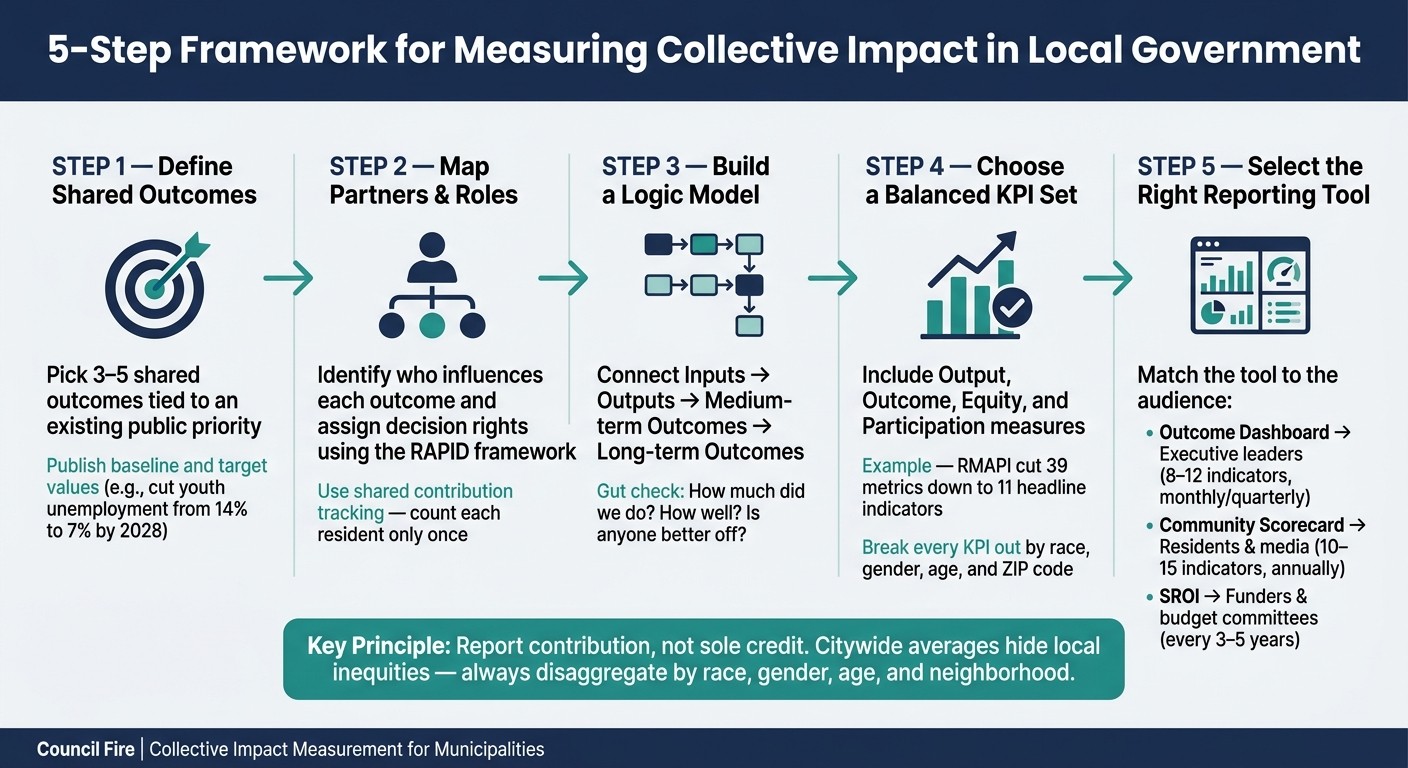
5-Step Framework for Measuring Collective Impact in Local Government
Collective Impact Model (The Basics)
Define shared outcomes before choosing metrics
Start with 3 to 5 shared outcomes that every partner will track.
Select 3 to 5 shared outcomes tied to a public priority
Keep the list short so reporting stays focused. Pick outcomes that show a change in community conditions, not just a count of activity. That means looking at measures like lower rent as a share of income, lower youth unemployment, or less food insecurity.
Each outcome should line up with a local public goal already in place, such as a school district plan or a city-wide initiative. That way, the effort builds on work already moving forward instead of running on a separate track[6]. If you need headline indicators, choose measures people can understand at a glance, that stay close to the outcome itself, and that are backed by data you can actually get[4].
After choosing the outcomes, publish baseline and target values so people can see progress over time. For example, the Pathways 2028 initiative set a goal to cut youth unemployment from 14% to 7% by 2028[3].
Once the outcomes are clear, the next step is to map who affects them and who owns each part of the work.
Map partners, roles, and contribution pathways
After setting outcomes, identify who has influence, who is most affected, and who will carry out the work[6]. A stakeholder map makes each partner’s role easier to see and shows what kind of contribution each one can make.
Use shared contribution tracking, not attribution, and count each resident only once across partners[1].
Decision rights matter as much as participation. The RAPID framework - Recommend, Agree, Perform, Input, Decide - spells out who recommends, agrees, performs, inputs, and decides when funding shifts, policy asks, or strategy pivots come up[3].
That partner map then feeds into the logic model and the KPI set.
Build a logic model that connects actions to results
A logic model turns shared outcomes into a working measurement structure across agencies and partners. It links inputs, activities, outputs, and outcomes. It should also reflect systems change, including policy, practice, resource allocation, relationships, power, and mindsets[4].
Logic Model Component | Definition | Example |
|---|---|---|
Inputs | Resources applied to the work | Funding, staff, partnerships, technology, data[4] |
Outputs | Short-term observable results | Number of meetings held, residents engaged, or people served[4] |
Medium-term Outcomes | Changes in conditions or systems | Jobs paying living wages, reduced food insecurity, policy changes[4] |
Long-term Outcomes | Aspirational community-wide changes | Greater health and well-being, increased life expectancy, homeownership rates[4] |
Use RBA as a final gut check: How much did we do? How well did we do it? Is anyone better off?[4] If the model cannot answer that third question, it is still measuring activity more than impact.
Choose KPIs and data sources that can be used consistently
The logic model now needs a KPI set that turns shared outcomes into measures you can track. Once the model is in place, the hard part is picking indicators that every partner can follow without piling on a reporting load they can’t keep up with. The job here is simple in theory and tricky in practice: turn those outcomes into a small, steady KPI set that all partners can use.
Use a balanced KPI set: output, outcome, equity, and participation measures
The aim is a short, balanced set of measures that answers three questions from the Results-Based Accountability (RBA) framework: How much did we do? How well did we do it? Is anyone better off? [4] Those three questions give teams a good gut check. If your KPI set only counts activity, you’re missing the point. If it only tracks big social change, you may be asking programs to prove more than they can.
The Rochester-Monroe Anti-Poverty Initiative (RMAPI) in Rochester, NY, offers a useful model. From a pool of 39 metrics, it narrowed the list to 11 headline indicators - including "rent as a percentage of income", "kindergarten readiness", and "voter participation rate" - to make public communication easier and keep the initiative pointed in the same direction. [4]
The table below shows one way to shape a balanced KPI set - and the traps teams fall into most often:
KPI Type | Purpose | Sample Municipal Indicator | Common Mistake |
|---|---|---|---|
Output | Countable products of activity | Number of community meetings held; people served | Confusing volume with quality or impact |
Outcome | Change in conditions | Median household income; affordable housing availability | Claiming total causality for broad social shifts |
Equity | Tracking disparities | Disaggregated poverty rates by race or neighborhood | Using citywide averages that hide local inequities |
Participation | Resident engagement | Number of signatures gathered; resident satisfaction ratings | Measuring attendance but not influence on decisions |
Break every outcome out by race, gender, age, and neighborhood. [4] Citywide averages can smooth over sharp gaps from one block or ZIP code to the next. That can lead agencies to make clean-looking decisions based on messy reality.
Once the KPI set is set, confirm how each measure will be collected and reported.
Match each KPI to a reliable data source and reporting cadence
A KPI without a confirmed data source is just a nice idea. Before you lock in any measure, check that a dependable collection system already exists - and that it will stay in place for the full life of the initiative. [2]
For cross-agency reporting, the usual sources are local administrative data, U.S. Census data, resident surveys or polls, and direct observation or community reporting. [4] Each one has trade-offs. Administrative data can be specific, but it often sits in separate systems. Census data helps with benchmarking, but it moves on a slower clock. The best move is to pair each KPI with a source and reporting schedule that fit the measure. That keeps agencies from lining up numbers that look similar but were built in different ways.
In Roswell, Georgia, quarterly reviews with the mayor and council use 3 to 5 core KPIs per department and standardized templates, which makes outcome discussions easier in governing meetings. [7]
A simple reporting rhythm helps keep things sane:
Report inputs twice a year.
Report outputs and early outcomes once a year.
Report long-term outcomes every 3 to 5 years. [4]
Each KPI should also have one named owner. That person needs enough authority to flag data quality problems and call for a review when the numbers stop adding up. [2] And before agencies start sharing data, put formal data-sharing agreements in place to cover confidentiality, definitions, and intended use. [5]
With KPIs and data sources in place, the next move is picking reporting tools that make results easy to read for each audience. After the measurement system is stable, use dashboards, scorecards, and SROI to communicate results.
Use the right reporting tools to track and explain impact
Once shared outcomes and KPIs are in place, the next step is choosing the reporting format that fits the audience and the pace of decisions. Dashboards, scorecards, and SROI each do a different job. One helps leaders manage performance, another helps the public see progress, and another helps justify funding. The key is simple: all of them should tie back to the same shared outcomes, so the work stays aligned instead of splitting into four separate stories.
Build an outcome dashboard for routine performance reviews
An outcome dashboard works well for keeping executive leaders and department managers up to date on a regular schedule. At a glance, it should show baselines, current values, targets, and trend lines.
Keep the set of indicators tight. A good citywide target is 8 to 12 indicators.[3][6] If you wait for year-end rollups, you're too late to steer a shared agenda.
Each indicator should connect to the shared outcome it represents. That link keeps the dashboard grounded in the logic model instead of turning it into a random set of metrics. Use it in monthly working sessions and quarterly leadership reviews.
Use community scorecards and resident feedback to strengthen accountability
A community scorecard pulls a smaller set of dashboard indicators - usually 10 to 15 - and rewrites them in plain language for residents, local media, and community organizations.[4] The goal isn't to show everything. It's to show only what residents need to see.
When deciding which indicators belong on a public scorecard, four filters help:
easy to explain
central to the goal
timely
able to show disparities [4]
Resident feedback adds the human layer that numbers by themselves can miss. Surveys, storytelling, and focus groups help fill that gap.[1][4] Put that feedback next to scorecard data, and elected officials and agency leaders get a more grounded view of how people are experiencing services day to day.
Apply SROI when leaders need a dollar-value estimate
Use Social Return on Investment (SROI) when funders, budget committees, or public agencies need to see the economic case. SROI estimates how much social, economic, and environmental value each $1 invested creates.[3]
Because SROI is periodic, it fits best every 3 to 5 years or at project end, not as an annual reporting method.[3][4] Think of it as a companion to dashboards and scorecards, not a substitute for them.
The table below shows when to use each tool, who it's for, and how often to update it:
Tool | Purpose | Primary Audience | Key Strength | Reporting Frequency |
|---|---|---|---|---|
Logic Model | Shared assumptions and roles | Internal partners and staff | Clarifies strategic assumptions and roles | Updated at key milestones or annually [6] |
Outcome Dashboard | Track performance trends and KPIs | Executive leaders and department managers | Visualizes trends, baselines, and targets | |
Community Scorecard | Communicate progress on community-wide goals | Residents, media, and community members | High accessibility and communication power | |
SROI | Monetize social, economic, and environmental value | Funders, budget committees, and public agencies | Translates impact into a dollar-value ratio |
Use these outputs to report results clearly, test assumptions, and support budget and policy decisions.
Communicate results, improve decisions, and sustain accountability
Report shared outcomes without overstating causality
Once shared outcomes, KPIs, and reporting tools are in place, use them for two jobs: explain progress and steer decisions based on the shared outcomes and logic model already in place.
One of the biggest reporting mistakes in collective impact work is acting as if one agency or one program produced a community-level shift on its own. That’s rarely how change works. Population-level results usually come from many organizations, plus outside forces such as policy, market conditions, and what’s happening in the community. The safer approach is to report contribution, not attribution. Show what the coalition added, while also naming the other factors that shaped the result.
Before sharing results, adjust for deadweight, attribution, displacement, drop-off, and counterfactual so the numbers stay credible. [2] Plain language helps here. Say it directly:
"These results reflect the combined efforts of partner agencies and broader conditions."
That same reporting cycle should also shape funding choices and strategy reviews, not sit on a shelf as a communications exercise.
Use results reviews to adjust funding, tactics, and partnerships
Measurement only matters when it changes decisions. Use the same outcome and KPI set to check whether the strategy is working. Review inputs and shared responsibilities every 6 to 8 months, outputs and early outcomes once a year, and long-term outcomes every 3 to 5 years. [4] Keep the review set tight so leaders can focus on the few measures that matter most.
Results reviews should feel like working sessions, not status meetings. At each session, ask three direct questions: How much did we do? How well did we do it? Is anyone better off? [4] Those questions cut through the noise fast.
When the data shows a gap, don’t just note it and move on. Use the review to shift resources, refine the intervention, or rethink who needs to be at the table.
Conclusion: A simple framework for measuring and communicating collective impact
Taken together, these steps create a practical system for shared measurement and public accountability.
The framework has five steps:
Define 3 to 5 shared outcomes tied to a public priority.
Map which partners contribute to each outcome and how.
Build a logic model that shows those connections.
Choose a consistent KPI set that balances outputs, outcomes, and equity.
Use dashboards and scorecards for performance management and public reporting, and apply SROI only when a dollar-value case is needed.
This system does more than meet reporting requirements. It gives partners a common language for working together, makes progress easier for residents and funders to see, and links data to action so leaders can make better choices. For municipalities and agencies that need help setting up shared measurement systems, aligning multiple stakeholders, or turning technical findings into public-facing communication people can trust, Council Fire can help put this work into practice through systems thinking and stakeholder engagement.
FAQs
How do we choose shared outcomes across agencies?
Build alignment and accountability through a shared process that brings different voices to the same table. Set up an oversight group with leaders from across sectors, along with community representatives - including people with lived experience - to decide which issues matter most based on local needs.
Then turn those priorities into clear outcomes using SMART criteria. Map them in a results framework or theory of change, and lock in formal agreement on accountability and data definitions before any tracking starts.
What if partners use different data systems?
When partners work in different data systems, the make-or-break issue usually isn’t full technical integration. It’s process and coordination. The first step is getting everyone to speak the same language: shared terms, common data definitions, and a clear agreement on the exact data needed to support your goals.
It also helps to start small. Use a pilot group first, work through the rough spots, and then expand from there. Along the way, put the basics in writing: clear data-sharing agreements, privacy protocols, and standardized metrics. Just as important, give staff the support they need, including analysis expertise and ongoing training.
When should we use SROI instead of a dashboard?
Use an outcome dashboard for ongoing, real-time tracking of performance and day-to-day metrics such as service delivery, efficiency, and project milestones. It gives teams a clear view of progress as work unfolds, so they can make tactical adjustments during the initiative instead of waiting until the end.
Use SROI when the goal is to quantify the net social value created beyond financial cost. It asks more from your data and your team: longitudinal tracking, attribution analysis, and specialized economic valuation. That makes it a better fit for high-stakes impact evaluation than routine monitoring.
Related Blog Posts
Latest Articles
©2025

Narrative Change and Power Building: The Missing Half of Advocacy
Narrative change is the process of disrupting dominant narratives that normalize inequity and advancing new narratives from historically marginalized communities.

Funding Resilience Without Federal Grants
BRIC is unreliable and FEMA is shrinking. Here's how cities fund climate resilience with dedicated revenue, blended finance, and a coordinating authority.

The ESG Blind Spot: How AI Is Finding Risks in Companies Nobody Else Is Watching
Norway's sovereign wealth fund uses AI to screen 7,200 portfolio companies for forced labor and corruption within 24 hours. The real story is the emerging-market coverage gap that traditional ESG data vendors miss — and what it means for any company with a global supply chain.
Narrative Change and Power Building: The Missing Half of Advocacy
Narrative change is the process of disrupting dominant narratives that normalize inequity and advancing new narratives from historically marginalized communities.
Funding Resilience Without Federal Grants
BRIC is unreliable and FEMA is shrinking. Here's how cities fund climate resilience with dedicated revenue, blended finance, and a coordinating authority.
The ESG Blind Spot: How AI Is Finding Risks in Companies Nobody Else Is Watching
Norway's sovereign wealth fund uses AI to screen 7,200 portfolio companies for forced labor and corruption within 24 hours. The real story is the emerging-market coverage gap that traditional ESG data vendors miss — and what it means for any company with a global supply chain.
FAQ
01
What does it really mean to “redefine profit”?
02
What makes Council Fire different?
03
Who does Council Fire work with?
04
What does working with Council Fire actually look like?
05
How does Council Fire help organizations turn big goals into action?
06
How does Council Fire define and measure success?
Jun 26, 2026
How to Measure and Communicate Collective Impact for Municipalities & Government Agencies
Capacity Building
In This Article
Measure fewer shared outcomes with small KPI sets, clear data owners, equity breakdowns, and dashboards for decision-making.
How to Measure and Communicate Collective Impact for Municipalities & Government Agencies
If 10 agencies use 10 definitions and 10 reporting calendars, you do not have shared impact - you have reporting noise.
I’d boil the article down to this: if I want collective impact measurement to work in local government, I need to keep it tight, shared, and tied to decisions. That means 3 to 5 shared outcomes, a small KPI set, clear data owners, and reporting tools that fit each audience. It also means I should report contribution, not sole credit, and break results out by race, gender, age, and ZIP code so citywide averages do not hide gaps.
Here’s the full takeaway in plain English:
Start with outcomes, not activity counts.
Pick 3 to 5 shared outcomes tied to a public goal already in place.
Map partners and roles so each group knows what it affects.
Use a logic model to connect inputs, outputs, and short- and long-term results.
Choose a small KPI set with output, outcome, equity, and participation measures.
Match every KPI to a data source, reporting schedule, and owner.
Use dashboards for leaders, scorecards for residents, and SROI only when a dollar estimate is needed.
Review results on a set schedule and use them to shift funding, tactics, or partnerships.
A few numbers stand out. The article points to 8 to 12 indicators for a citywide dashboard, 10 to 15 for a public scorecard, and 3 to 5 years for long-term outcome reviews or SROI. It also notes one case where 39 metrics were cut to 11 headline indicators to make public reporting easier to follow.
If I had to explain the article in one line, I’d say this: measure fewer things, define them the same way, show them clearly, and use them to make choices.
5-Step Framework for Measuring Collective Impact in Local Government
Collective Impact Model (The Basics)
Define shared outcomes before choosing metrics
Start with 3 to 5 shared outcomes that every partner will track.
Select 3 to 5 shared outcomes tied to a public priority
Keep the list short so reporting stays focused. Pick outcomes that show a change in community conditions, not just a count of activity. That means looking at measures like lower rent as a share of income, lower youth unemployment, or less food insecurity.
Each outcome should line up with a local public goal already in place, such as a school district plan or a city-wide initiative. That way, the effort builds on work already moving forward instead of running on a separate track[6]. If you need headline indicators, choose measures people can understand at a glance, that stay close to the outcome itself, and that are backed by data you can actually get[4].
After choosing the outcomes, publish baseline and target values so people can see progress over time. For example, the Pathways 2028 initiative set a goal to cut youth unemployment from 14% to 7% by 2028[3].
Once the outcomes are clear, the next step is to map who affects them and who owns each part of the work.
Map partners, roles, and contribution pathways
After setting outcomes, identify who has influence, who is most affected, and who will carry out the work[6]. A stakeholder map makes each partner’s role easier to see and shows what kind of contribution each one can make.
Use shared contribution tracking, not attribution, and count each resident only once across partners[1].
Decision rights matter as much as participation. The RAPID framework - Recommend, Agree, Perform, Input, Decide - spells out who recommends, agrees, performs, inputs, and decides when funding shifts, policy asks, or strategy pivots come up[3].
That partner map then feeds into the logic model and the KPI set.
Build a logic model that connects actions to results
A logic model turns shared outcomes into a working measurement structure across agencies and partners. It links inputs, activities, outputs, and outcomes. It should also reflect systems change, including policy, practice, resource allocation, relationships, power, and mindsets[4].
Logic Model Component | Definition | Example |
|---|---|---|
Inputs | Resources applied to the work | Funding, staff, partnerships, technology, data[4] |
Outputs | Short-term observable results | Number of meetings held, residents engaged, or people served[4] |
Medium-term Outcomes | Changes in conditions or systems | Jobs paying living wages, reduced food insecurity, policy changes[4] |
Long-term Outcomes | Aspirational community-wide changes | Greater health and well-being, increased life expectancy, homeownership rates[4] |
Use RBA as a final gut check: How much did we do? How well did we do it? Is anyone better off?[4] If the model cannot answer that third question, it is still measuring activity more than impact.
Choose KPIs and data sources that can be used consistently
The logic model now needs a KPI set that turns shared outcomes into measures you can track. Once the model is in place, the hard part is picking indicators that every partner can follow without piling on a reporting load they can’t keep up with. The job here is simple in theory and tricky in practice: turn those outcomes into a small, steady KPI set that all partners can use.
Use a balanced KPI set: output, outcome, equity, and participation measures
The aim is a short, balanced set of measures that answers three questions from the Results-Based Accountability (RBA) framework: How much did we do? How well did we do it? Is anyone better off? [4] Those three questions give teams a good gut check. If your KPI set only counts activity, you’re missing the point. If it only tracks big social change, you may be asking programs to prove more than they can.
The Rochester-Monroe Anti-Poverty Initiative (RMAPI) in Rochester, NY, offers a useful model. From a pool of 39 metrics, it narrowed the list to 11 headline indicators - including "rent as a percentage of income", "kindergarten readiness", and "voter participation rate" - to make public communication easier and keep the initiative pointed in the same direction. [4]
The table below shows one way to shape a balanced KPI set - and the traps teams fall into most often:
KPI Type | Purpose | Sample Municipal Indicator | Common Mistake |
|---|---|---|---|
Output | Countable products of activity | Number of community meetings held; people served | Confusing volume with quality or impact |
Outcome | Change in conditions | Median household income; affordable housing availability | Claiming total causality for broad social shifts |
Equity | Tracking disparities | Disaggregated poverty rates by race or neighborhood | Using citywide averages that hide local inequities |
Participation | Resident engagement | Number of signatures gathered; resident satisfaction ratings | Measuring attendance but not influence on decisions |
Break every outcome out by race, gender, age, and neighborhood. [4] Citywide averages can smooth over sharp gaps from one block or ZIP code to the next. That can lead agencies to make clean-looking decisions based on messy reality.
Once the KPI set is set, confirm how each measure will be collected and reported.
Match each KPI to a reliable data source and reporting cadence
A KPI without a confirmed data source is just a nice idea. Before you lock in any measure, check that a dependable collection system already exists - and that it will stay in place for the full life of the initiative. [2]
For cross-agency reporting, the usual sources are local administrative data, U.S. Census data, resident surveys or polls, and direct observation or community reporting. [4] Each one has trade-offs. Administrative data can be specific, but it often sits in separate systems. Census data helps with benchmarking, but it moves on a slower clock. The best move is to pair each KPI with a source and reporting schedule that fit the measure. That keeps agencies from lining up numbers that look similar but were built in different ways.
In Roswell, Georgia, quarterly reviews with the mayor and council use 3 to 5 core KPIs per department and standardized templates, which makes outcome discussions easier in governing meetings. [7]
A simple reporting rhythm helps keep things sane:
Report inputs twice a year.
Report outputs and early outcomes once a year.
Report long-term outcomes every 3 to 5 years. [4]
Each KPI should also have one named owner. That person needs enough authority to flag data quality problems and call for a review when the numbers stop adding up. [2] And before agencies start sharing data, put formal data-sharing agreements in place to cover confidentiality, definitions, and intended use. [5]
With KPIs and data sources in place, the next move is picking reporting tools that make results easy to read for each audience. After the measurement system is stable, use dashboards, scorecards, and SROI to communicate results.
Use the right reporting tools to track and explain impact
Once shared outcomes and KPIs are in place, the next step is choosing the reporting format that fits the audience and the pace of decisions. Dashboards, scorecards, and SROI each do a different job. One helps leaders manage performance, another helps the public see progress, and another helps justify funding. The key is simple: all of them should tie back to the same shared outcomes, so the work stays aligned instead of splitting into four separate stories.
Build an outcome dashboard for routine performance reviews
An outcome dashboard works well for keeping executive leaders and department managers up to date on a regular schedule. At a glance, it should show baselines, current values, targets, and trend lines.
Keep the set of indicators tight. A good citywide target is 8 to 12 indicators.[3][6] If you wait for year-end rollups, you're too late to steer a shared agenda.
Each indicator should connect to the shared outcome it represents. That link keeps the dashboard grounded in the logic model instead of turning it into a random set of metrics. Use it in monthly working sessions and quarterly leadership reviews.
Use community scorecards and resident feedback to strengthen accountability
A community scorecard pulls a smaller set of dashboard indicators - usually 10 to 15 - and rewrites them in plain language for residents, local media, and community organizations.[4] The goal isn't to show everything. It's to show only what residents need to see.
When deciding which indicators belong on a public scorecard, four filters help:
easy to explain
central to the goal
timely
able to show disparities [4]
Resident feedback adds the human layer that numbers by themselves can miss. Surveys, storytelling, and focus groups help fill that gap.[1][4] Put that feedback next to scorecard data, and elected officials and agency leaders get a more grounded view of how people are experiencing services day to day.
Apply SROI when leaders need a dollar-value estimate
Use Social Return on Investment (SROI) when funders, budget committees, or public agencies need to see the economic case. SROI estimates how much social, economic, and environmental value each $1 invested creates.[3]
Because SROI is periodic, it fits best every 3 to 5 years or at project end, not as an annual reporting method.[3][4] Think of it as a companion to dashboards and scorecards, not a substitute for them.
The table below shows when to use each tool, who it's for, and how often to update it:
Tool | Purpose | Primary Audience | Key Strength | Reporting Frequency |
|---|---|---|---|---|
Logic Model | Shared assumptions and roles | Internal partners and staff | Clarifies strategic assumptions and roles | Updated at key milestones or annually [6] |
Outcome Dashboard | Track performance trends and KPIs | Executive leaders and department managers | Visualizes trends, baselines, and targets | |
Community Scorecard | Communicate progress on community-wide goals | Residents, media, and community members | High accessibility and communication power | |
SROI | Monetize social, economic, and environmental value | Funders, budget committees, and public agencies | Translates impact into a dollar-value ratio |
Use these outputs to report results clearly, test assumptions, and support budget and policy decisions.
Communicate results, improve decisions, and sustain accountability
Report shared outcomes without overstating causality
Once shared outcomes, KPIs, and reporting tools are in place, use them for two jobs: explain progress and steer decisions based on the shared outcomes and logic model already in place.
One of the biggest reporting mistakes in collective impact work is acting as if one agency or one program produced a community-level shift on its own. That’s rarely how change works. Population-level results usually come from many organizations, plus outside forces such as policy, market conditions, and what’s happening in the community. The safer approach is to report contribution, not attribution. Show what the coalition added, while also naming the other factors that shaped the result.
Before sharing results, adjust for deadweight, attribution, displacement, drop-off, and counterfactual so the numbers stay credible. [2] Plain language helps here. Say it directly:
"These results reflect the combined efforts of partner agencies and broader conditions."
That same reporting cycle should also shape funding choices and strategy reviews, not sit on a shelf as a communications exercise.
Use results reviews to adjust funding, tactics, and partnerships
Measurement only matters when it changes decisions. Use the same outcome and KPI set to check whether the strategy is working. Review inputs and shared responsibilities every 6 to 8 months, outputs and early outcomes once a year, and long-term outcomes every 3 to 5 years. [4] Keep the review set tight so leaders can focus on the few measures that matter most.
Results reviews should feel like working sessions, not status meetings. At each session, ask three direct questions: How much did we do? How well did we do it? Is anyone better off? [4] Those questions cut through the noise fast.
When the data shows a gap, don’t just note it and move on. Use the review to shift resources, refine the intervention, or rethink who needs to be at the table.
Conclusion: A simple framework for measuring and communicating collective impact
Taken together, these steps create a practical system for shared measurement and public accountability.
The framework has five steps:
Define 3 to 5 shared outcomes tied to a public priority.
Map which partners contribute to each outcome and how.
Build a logic model that shows those connections.
Choose a consistent KPI set that balances outputs, outcomes, and equity.
Use dashboards and scorecards for performance management and public reporting, and apply SROI only when a dollar-value case is needed.
This system does more than meet reporting requirements. It gives partners a common language for working together, makes progress easier for residents and funders to see, and links data to action so leaders can make better choices. For municipalities and agencies that need help setting up shared measurement systems, aligning multiple stakeholders, or turning technical findings into public-facing communication people can trust, Council Fire can help put this work into practice through systems thinking and stakeholder engagement.
FAQs
How do we choose shared outcomes across agencies?
Build alignment and accountability through a shared process that brings different voices to the same table. Set up an oversight group with leaders from across sectors, along with community representatives - including people with lived experience - to decide which issues matter most based on local needs.
Then turn those priorities into clear outcomes using SMART criteria. Map them in a results framework or theory of change, and lock in formal agreement on accountability and data definitions before any tracking starts.
What if partners use different data systems?
When partners work in different data systems, the make-or-break issue usually isn’t full technical integration. It’s process and coordination. The first step is getting everyone to speak the same language: shared terms, common data definitions, and a clear agreement on the exact data needed to support your goals.
It also helps to start small. Use a pilot group first, work through the rough spots, and then expand from there. Along the way, put the basics in writing: clear data-sharing agreements, privacy protocols, and standardized metrics. Just as important, give staff the support they need, including analysis expertise and ongoing training.
When should we use SROI instead of a dashboard?
Use an outcome dashboard for ongoing, real-time tracking of performance and day-to-day metrics such as service delivery, efficiency, and project milestones. It gives teams a clear view of progress as work unfolds, so they can make tactical adjustments during the initiative instead of waiting until the end.
Use SROI when the goal is to quantify the net social value created beyond financial cost. It asks more from your data and your team: longitudinal tracking, attribution analysis, and specialized economic valuation. That makes it a better fit for high-stakes impact evaluation than routine monitoring.
Related Blog Posts
Latest Articles
©2025
Narrative Change and Power Building: The Missing Half of Advocacy
Narrative change is the process of disrupting dominant narratives that normalize inequity and advancing new narratives from historically marginalized communities.
Funding Resilience Without Federal Grants
BRIC is unreliable and FEMA is shrinking. Here's how cities fund climate resilience with dedicated revenue, blended finance, and a coordinating authority.
The ESG Blind Spot: How AI Is Finding Risks in Companies Nobody Else Is Watching
Norway's sovereign wealth fund uses AI to screen 7,200 portfolio companies for forced labor and corruption within 24 hours. The real story is the emerging-market coverage gap that traditional ESG data vendors miss — and what it means for any company with a global supply chain.
FAQ
01
What does it really mean to “redefine profit”?
02
What makes Council Fire different?
03
Who does Council Fire work with?
04
What does working with Council Fire actually look like?
05
How does Council Fire help organizations turn big goals into action?
06
How does Council Fire define and measure success?
Jun 26, 2026
How to Measure and Communicate Collective Impact for Municipalities & Government Agencies
Capacity Building
In This Article
Measure fewer shared outcomes with small KPI sets, clear data owners, equity breakdowns, and dashboards for decision-making.
How to Measure and Communicate Collective Impact for Municipalities & Government Agencies
If 10 agencies use 10 definitions and 10 reporting calendars, you do not have shared impact - you have reporting noise.
I’d boil the article down to this: if I want collective impact measurement to work in local government, I need to keep it tight, shared, and tied to decisions. That means 3 to 5 shared outcomes, a small KPI set, clear data owners, and reporting tools that fit each audience. It also means I should report contribution, not sole credit, and break results out by race, gender, age, and ZIP code so citywide averages do not hide gaps.
Here’s the full takeaway in plain English:
Start with outcomes, not activity counts.
Pick 3 to 5 shared outcomes tied to a public goal already in place.
Map partners and roles so each group knows what it affects.
Use a logic model to connect inputs, outputs, and short- and long-term results.
Choose a small KPI set with output, outcome, equity, and participation measures.
Match every KPI to a data source, reporting schedule, and owner.
Use dashboards for leaders, scorecards for residents, and SROI only when a dollar estimate is needed.
Review results on a set schedule and use them to shift funding, tactics, or partnerships.
A few numbers stand out. The article points to 8 to 12 indicators for a citywide dashboard, 10 to 15 for a public scorecard, and 3 to 5 years for long-term outcome reviews or SROI. It also notes one case where 39 metrics were cut to 11 headline indicators to make public reporting easier to follow.
If I had to explain the article in one line, I’d say this: measure fewer things, define them the same way, show them clearly, and use them to make choices.
5-Step Framework for Measuring Collective Impact in Local Government
Collective Impact Model (The Basics)
Define shared outcomes before choosing metrics
Start with 3 to 5 shared outcomes that every partner will track.
Select 3 to 5 shared outcomes tied to a public priority
Keep the list short so reporting stays focused. Pick outcomes that show a change in community conditions, not just a count of activity. That means looking at measures like lower rent as a share of income, lower youth unemployment, or less food insecurity.
Each outcome should line up with a local public goal already in place, such as a school district plan or a city-wide initiative. That way, the effort builds on work already moving forward instead of running on a separate track[6]. If you need headline indicators, choose measures people can understand at a glance, that stay close to the outcome itself, and that are backed by data you can actually get[4].
After choosing the outcomes, publish baseline and target values so people can see progress over time. For example, the Pathways 2028 initiative set a goal to cut youth unemployment from 14% to 7% by 2028[3].
Once the outcomes are clear, the next step is to map who affects them and who owns each part of the work.
Map partners, roles, and contribution pathways
After setting outcomes, identify who has influence, who is most affected, and who will carry out the work[6]. A stakeholder map makes each partner’s role easier to see and shows what kind of contribution each one can make.
Use shared contribution tracking, not attribution, and count each resident only once across partners[1].
Decision rights matter as much as participation. The RAPID framework - Recommend, Agree, Perform, Input, Decide - spells out who recommends, agrees, performs, inputs, and decides when funding shifts, policy asks, or strategy pivots come up[3].
That partner map then feeds into the logic model and the KPI set.
Build a logic model that connects actions to results
A logic model turns shared outcomes into a working measurement structure across agencies and partners. It links inputs, activities, outputs, and outcomes. It should also reflect systems change, including policy, practice, resource allocation, relationships, power, and mindsets[4].
Logic Model Component | Definition | Example |
|---|---|---|
Inputs | Resources applied to the work | Funding, staff, partnerships, technology, data[4] |
Outputs | Short-term observable results | Number of meetings held, residents engaged, or people served[4] |
Medium-term Outcomes | Changes in conditions or systems | Jobs paying living wages, reduced food insecurity, policy changes[4] |
Long-term Outcomes | Aspirational community-wide changes | Greater health and well-being, increased life expectancy, homeownership rates[4] |
Use RBA as a final gut check: How much did we do? How well did we do it? Is anyone better off?[4] If the model cannot answer that third question, it is still measuring activity more than impact.
Choose KPIs and data sources that can be used consistently
The logic model now needs a KPI set that turns shared outcomes into measures you can track. Once the model is in place, the hard part is picking indicators that every partner can follow without piling on a reporting load they can’t keep up with. The job here is simple in theory and tricky in practice: turn those outcomes into a small, steady KPI set that all partners can use.
Use a balanced KPI set: output, outcome, equity, and participation measures
The aim is a short, balanced set of measures that answers three questions from the Results-Based Accountability (RBA) framework: How much did we do? How well did we do it? Is anyone better off? [4] Those three questions give teams a good gut check. If your KPI set only counts activity, you’re missing the point. If it only tracks big social change, you may be asking programs to prove more than they can.
The Rochester-Monroe Anti-Poverty Initiative (RMAPI) in Rochester, NY, offers a useful model. From a pool of 39 metrics, it narrowed the list to 11 headline indicators - including "rent as a percentage of income", "kindergarten readiness", and "voter participation rate" - to make public communication easier and keep the initiative pointed in the same direction. [4]
The table below shows one way to shape a balanced KPI set - and the traps teams fall into most often:
KPI Type | Purpose | Sample Municipal Indicator | Common Mistake |
|---|---|---|---|
Output | Countable products of activity | Number of community meetings held; people served | Confusing volume with quality or impact |
Outcome | Change in conditions | Median household income; affordable housing availability | Claiming total causality for broad social shifts |
Equity | Tracking disparities | Disaggregated poverty rates by race or neighborhood | Using citywide averages that hide local inequities |
Participation | Resident engagement | Number of signatures gathered; resident satisfaction ratings | Measuring attendance but not influence on decisions |
Break every outcome out by race, gender, age, and neighborhood. [4] Citywide averages can smooth over sharp gaps from one block or ZIP code to the next. That can lead agencies to make clean-looking decisions based on messy reality.
Once the KPI set is set, confirm how each measure will be collected and reported.
Match each KPI to a reliable data source and reporting cadence
A KPI without a confirmed data source is just a nice idea. Before you lock in any measure, check that a dependable collection system already exists - and that it will stay in place for the full life of the initiative. [2]
For cross-agency reporting, the usual sources are local administrative data, U.S. Census data, resident surveys or polls, and direct observation or community reporting. [4] Each one has trade-offs. Administrative data can be specific, but it often sits in separate systems. Census data helps with benchmarking, but it moves on a slower clock. The best move is to pair each KPI with a source and reporting schedule that fit the measure. That keeps agencies from lining up numbers that look similar but were built in different ways.
In Roswell, Georgia, quarterly reviews with the mayor and council use 3 to 5 core KPIs per department and standardized templates, which makes outcome discussions easier in governing meetings. [7]
A simple reporting rhythm helps keep things sane:
Report inputs twice a year.
Report outputs and early outcomes once a year.
Report long-term outcomes every 3 to 5 years. [4]
Each KPI should also have one named owner. That person needs enough authority to flag data quality problems and call for a review when the numbers stop adding up. [2] And before agencies start sharing data, put formal data-sharing agreements in place to cover confidentiality, definitions, and intended use. [5]
With KPIs and data sources in place, the next move is picking reporting tools that make results easy to read for each audience. After the measurement system is stable, use dashboards, scorecards, and SROI to communicate results.
Use the right reporting tools to track and explain impact
Once shared outcomes and KPIs are in place, the next step is choosing the reporting format that fits the audience and the pace of decisions. Dashboards, scorecards, and SROI each do a different job. One helps leaders manage performance, another helps the public see progress, and another helps justify funding. The key is simple: all of them should tie back to the same shared outcomes, so the work stays aligned instead of splitting into four separate stories.
Build an outcome dashboard for routine performance reviews
An outcome dashboard works well for keeping executive leaders and department managers up to date on a regular schedule. At a glance, it should show baselines, current values, targets, and trend lines.
Keep the set of indicators tight. A good citywide target is 8 to 12 indicators.[3][6] If you wait for year-end rollups, you're too late to steer a shared agenda.
Each indicator should connect to the shared outcome it represents. That link keeps the dashboard grounded in the logic model instead of turning it into a random set of metrics. Use it in monthly working sessions and quarterly leadership reviews.
Use community scorecards and resident feedback to strengthen accountability
A community scorecard pulls a smaller set of dashboard indicators - usually 10 to 15 - and rewrites them in plain language for residents, local media, and community organizations.[4] The goal isn't to show everything. It's to show only what residents need to see.
When deciding which indicators belong on a public scorecard, four filters help:
easy to explain
central to the goal
timely
able to show disparities [4]
Resident feedback adds the human layer that numbers by themselves can miss. Surveys, storytelling, and focus groups help fill that gap.[1][4] Put that feedback next to scorecard data, and elected officials and agency leaders get a more grounded view of how people are experiencing services day to day.
Apply SROI when leaders need a dollar-value estimate
Use Social Return on Investment (SROI) when funders, budget committees, or public agencies need to see the economic case. SROI estimates how much social, economic, and environmental value each $1 invested creates.[3]
Because SROI is periodic, it fits best every 3 to 5 years or at project end, not as an annual reporting method.[3][4] Think of it as a companion to dashboards and scorecards, not a substitute for them.
The table below shows when to use each tool, who it's for, and how often to update it:
Tool | Purpose | Primary Audience | Key Strength | Reporting Frequency |
|---|---|---|---|---|
Logic Model | Shared assumptions and roles | Internal partners and staff | Clarifies strategic assumptions and roles | Updated at key milestones or annually [6] |
Outcome Dashboard | Track performance trends and KPIs | Executive leaders and department managers | Visualizes trends, baselines, and targets | |
Community Scorecard | Communicate progress on community-wide goals | Residents, media, and community members | High accessibility and communication power | |
SROI | Monetize social, economic, and environmental value | Funders, budget committees, and public agencies | Translates impact into a dollar-value ratio |
Use these outputs to report results clearly, test assumptions, and support budget and policy decisions.
Communicate results, improve decisions, and sustain accountability
Report shared outcomes without overstating causality
Once shared outcomes, KPIs, and reporting tools are in place, use them for two jobs: explain progress and steer decisions based on the shared outcomes and logic model already in place.
One of the biggest reporting mistakes in collective impact work is acting as if one agency or one program produced a community-level shift on its own. That’s rarely how change works. Population-level results usually come from many organizations, plus outside forces such as policy, market conditions, and what’s happening in the community. The safer approach is to report contribution, not attribution. Show what the coalition added, while also naming the other factors that shaped the result.
Before sharing results, adjust for deadweight, attribution, displacement, drop-off, and counterfactual so the numbers stay credible. [2] Plain language helps here. Say it directly:
"These results reflect the combined efforts of partner agencies and broader conditions."
That same reporting cycle should also shape funding choices and strategy reviews, not sit on a shelf as a communications exercise.
Use results reviews to adjust funding, tactics, and partnerships
Measurement only matters when it changes decisions. Use the same outcome and KPI set to check whether the strategy is working. Review inputs and shared responsibilities every 6 to 8 months, outputs and early outcomes once a year, and long-term outcomes every 3 to 5 years. [4] Keep the review set tight so leaders can focus on the few measures that matter most.
Results reviews should feel like working sessions, not status meetings. At each session, ask three direct questions: How much did we do? How well did we do it? Is anyone better off? [4] Those questions cut through the noise fast.
When the data shows a gap, don’t just note it and move on. Use the review to shift resources, refine the intervention, or rethink who needs to be at the table.
Conclusion: A simple framework for measuring and communicating collective impact
Taken together, these steps create a practical system for shared measurement and public accountability.
The framework has five steps:
Define 3 to 5 shared outcomes tied to a public priority.
Map which partners contribute to each outcome and how.
Build a logic model that shows those connections.
Choose a consistent KPI set that balances outputs, outcomes, and equity.
Use dashboards and scorecards for performance management and public reporting, and apply SROI only when a dollar-value case is needed.
This system does more than meet reporting requirements. It gives partners a common language for working together, makes progress easier for residents and funders to see, and links data to action so leaders can make better choices. For municipalities and agencies that need help setting up shared measurement systems, aligning multiple stakeholders, or turning technical findings into public-facing communication people can trust, Council Fire can help put this work into practice through systems thinking and stakeholder engagement.
FAQs
How do we choose shared outcomes across agencies?
Build alignment and accountability through a shared process that brings different voices to the same table. Set up an oversight group with leaders from across sectors, along with community representatives - including people with lived experience - to decide which issues matter most based on local needs.
Then turn those priorities into clear outcomes using SMART criteria. Map them in a results framework or theory of change, and lock in formal agreement on accountability and data definitions before any tracking starts.
What if partners use different data systems?
When partners work in different data systems, the make-or-break issue usually isn’t full technical integration. It’s process and coordination. The first step is getting everyone to speak the same language: shared terms, common data definitions, and a clear agreement on the exact data needed to support your goals.
It also helps to start small. Use a pilot group first, work through the rough spots, and then expand from there. Along the way, put the basics in writing: clear data-sharing agreements, privacy protocols, and standardized metrics. Just as important, give staff the support they need, including analysis expertise and ongoing training.
When should we use SROI instead of a dashboard?
Use an outcome dashboard for ongoing, real-time tracking of performance and day-to-day metrics such as service delivery, efficiency, and project milestones. It gives teams a clear view of progress as work unfolds, so they can make tactical adjustments during the initiative instead of waiting until the end.
Use SROI when the goal is to quantify the net social value created beyond financial cost. It asks more from your data and your team: longitudinal tracking, attribution analysis, and specialized economic valuation. That makes it a better fit for high-stakes impact evaluation than routine monitoring.
Related Blog Posts
Latest Articles
©2025
Narrative Change and Power Building: The Missing Half of Advocacy
Narrative change is the process of disrupting dominant narratives that normalize inequity and advancing new narratives from historically marginalized communities.
Funding Resilience Without Federal Grants
BRIC is unreliable and FEMA is shrinking. Here's how cities fund climate resilience with dedicated revenue, blended finance, and a coordinating authority.
The ESG Blind Spot: How AI Is Finding Risks in Companies Nobody Else Is Watching
Norway's sovereign wealth fund uses AI to screen 7,200 portfolio companies for forced labor and corruption within 24 hours. The real story is the emerging-market coverage gap that traditional ESG data vendors miss — and what it means for any company with a global supply chain.
FAQ
What does it really mean to “redefine profit”?
What makes Council Fire different?
Who does Council Fire work with?
What does working with Council Fire actually look like?
How does Council Fire help organizations turn big goals into action?
How does Council Fire define and measure success?