Mar 26, 2026
How to Design Marine Protected Area Governance for Municipalities & Government Agencies
Capacity Building
In This Article
Shared, locally led MPA governance delivers far better ecological outcomes than state-only management.
How to Design Marine Protected Area Governance for Municipalities & Government Agencies
Marine Protected Areas (MPAs) thrive when governance prioritizes local involvement and shared responsibility. Research reveals that MPAs with collaborative governance see up to 98% higher fish biomass compared to state-only management. Effective governance frameworks balance ecological protection with community needs, addressing jurisdictional conflicts, resource limitations, and enforcement challenges.
Key takeaways for municipalities and agencies include:
Governance Models: Shared governance outperforms centralized or decentralized approaches by combining resources and expertise across stakeholders.
Legal Frameworks: Strong laws, clear jurisdictional roles, and formal agreements (e.g., MOUs) ensure accountability and smooth operations.
Stakeholder Engagement: Early and consistent collaboration with local communities, Indigenous groups, NGOs, and private sectors builds trust and legitimacy.
Monitoring and Adaptive Practices: Regular evaluation, data-driven insights, and flexible adjustments ensure MPAs meet conservation goals over time.
Funding Mechanisms: Stable funding sources, such as fees or partnerships, sustain long-term management efforts.
California’s MPA network serves as a model, showcasing the benefits of shared governance, clear legal structures, and community-driven initiatives. Municipalities can replicate these practices to create effective, resilient MPA governance systems.
California's Marine Protected Areas (MPAs): The Importance of Enforcement and Compliance
Comparing Governance Models for MPAs
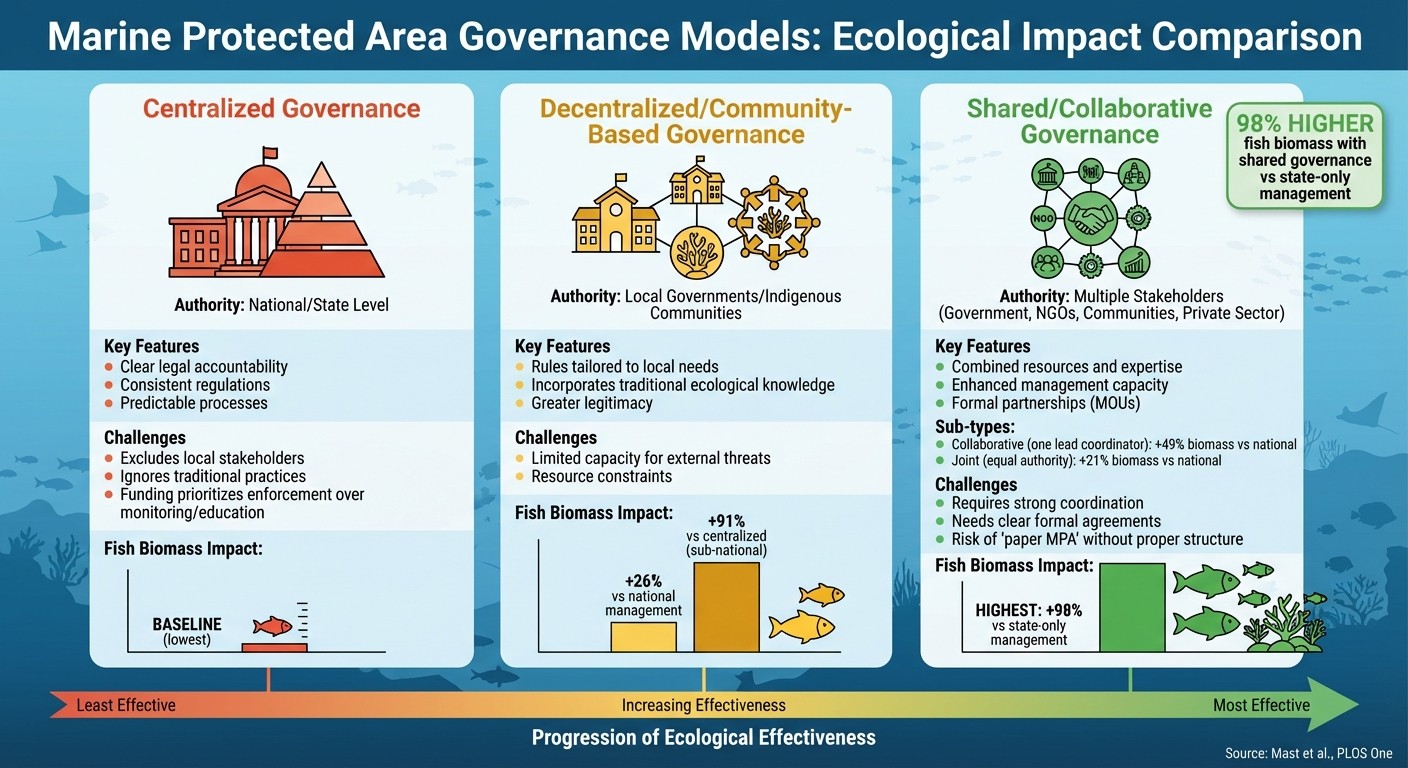
MPA Governance Models: Fish Biomass Impact Comparison
Choosing the right governance model for a Marine Protected Area (MPA) is a crucial step toward ensuring its effectiveness. The decision hinges on factors like the municipality's resources, the stakeholders involved, and the specific conservation objectives. Three main governance models - centralized, decentralized, and shared governance - each bring distinct benefits and challenges. Below is a closer look at these models and how they shape the legal and institutional frameworks for MPA management.
Centralized Governance
In centralized governance, decision-making authority is concentrated at the national or state level. This model provides a clear structure for legal accountability and ensures consistent regulations across different sites. For municipalities working within state systems, it offers predictable processes and a straightforward chain of command. However, this approach often sidelines local stakeholders and may disregard traditional community practices that have been in place for generations. Research shows that MPAs managed solely at the state level tend to have lower fish biomass [2]. Additionally, centralized systems often allocate more funding to enforcement rather than to critical areas like monitoring, education, and community engagement [3].
Decentralized and Community-Based Governance
Decentralized governance transfers authority to local governments or Indigenous communities, creating a system where rules are tailored to local ecological and social needs. This approach not only fosters greater legitimacy but also incorporates traditional ecological knowledge, which can be invaluable for defining MPA boundaries and crafting conservation rules. Studies indicate that sub-national governance leads to a 26% increase in fish biomass compared to national-level management [2]. However, one of the major challenges lies in addressing external threats that may exceed the capacity of local institutions [2].
Shared and Collaborative Governance
Shared governance involves multiple stakeholders - government agencies, NGOs, private organizations, and local communities - working together to manage MPAs. This model combines resources and expertise, significantly enhancing management capacity [2]. Evidence suggests that MPAs under shared governance are 98% more likely to achieve higher fish biomass than those managed solely by state agencies [2]. Collaborative arrangements, where one organization leads while coordinating with others, support fish biomass levels that are 49% higher than those under national governance. Joint governance models, where authority is equally distributed among stakeholders, see a 21% increase in biomass [2].
"MPAs with shared governance arrangements are 98% more likely to have higher fish biomass than state-only management."
Despite these ecological advantages, shared governance requires strong coordination between partners and clear, formal agreements. Without such structures, the MPA risks becoming a "paper MPA" - existing only on paper without effective on-the-ground implementation [6]. Municipalities need to carefully evaluate their technical and financial resources before adopting this model [4]. Establishing formal partnerships through Memorandums of Understanding can help ensure long-term stability and effective collaboration [5]. Successfully balancing these coordination demands with ecological benefits is key to making shared governance work.
Building Legal and Institutional Frameworks
Once you’ve chosen a governance model, the next step is to establish the legal and institutional structures that will support your Marine Protected Area (MPA). This involves drafting formal documents, defining roles, and securing funding mechanisms. Without these critical elements, an MPA risks falling short of its goals. These frameworks not only ensure compliance with regulations but also promote transparency and accountability.
Strong legal foundations are essential for implementing the shared and collaborative governance models discussed earlier.
Setting Goals and Defining Jurisdictions
Start by creating enabling legislation that provides a clear legal foundation for your MPA network. A standout example is California’s Marine Life Protection Act (MLPA), passed in 1999. It was the first state law in the U.S. to require redesigning a state’s MPA system into a cohesive network [5]. This legislation tasked the California Department of Fish and Wildlife with developing a Master Plan to guide the design and management of the network.
A detailed Master Plan is vital for defining both conservation goals and socio-economic considerations. In 2016, the California Fish and Game Commission approved the final draft of the MLPA Master Plan, which prioritizes protecting marine habitats and ecosystems while also enhancing recreational and educational opportunities [5].
To clarify jurisdictional boundaries and formalize inter-agency roles, use Memoranda of Understanding (MOUs). With over 100 state, territorial, and commonwealth agencies managing area-based regulations nationwide [9], clear jurisdictional agreements are essential. For instance, MOUs can help bridge gaps between state water boards and natural resource agencies [5].
Develop a multi-year Work Plan - typically covering 3–4 years - that outlines specific agency responsibilities, stakeholder roles, and timelines. California’s "Statewide Leadership Team" serves as an example, managing overlapping jurisdictions and coordinating enforcement, outreach, and education [5][7].
Meeting Regulatory Requirements
Your MPA governance structure must align with existing laws at the federal, state, and local levels. Federal regulations like the Coastal Zone Management Act, the Endangered Species Act, and the Magnuson-Stevens Fishery Conservation and Management Act are key considerations [8]. Historically, overlapping jurisdictions between federal and state agencies have posed challenges, highlighting the need for better coordination [10].
Rather than creating new enforcement agencies, partner with existing ones. For example, California relies on its Department of Fish and Wildlife Law Enforcement Division, which reduces costs and leverages existing expertise [7]. Design enforcement strategies that encourage public involvement, as is often required under laws like the MLPA, to boost compliance [7].
A Monitoring Action Plan is also critical. This plan should focus on specific metrics, species, and habitats to evaluate whether the MPA network is meeting its objectives. Standardized data collection protocols and an Information Management System can facilitate data sharing among agencies [5]. Incorporating citizen science can also expand monitoring efforts, enabling agencies to meet regulatory requirements on a larger scale [5].
Improving Transparency and Accountability
Once legal mandates and monitoring plans are in place, focus on enhancing transparency and accountability. Clear and detailed budget reporting is a key step. For example, in January 2016, the California Natural Resources Agency submitted a detailed MPA Management Program Budget Report to the state legislature. This report outlined management costs, identified funding sources, and specified department staffing roles [5]. Such practices ensure financial accountability and help legislators understand the costs involved in effective MPA management.
In the 2015/2016 fiscal year, California allocated $2.5 million through the Budget Act to support MPA monitoring [5]. Additionally, the state uses "Once-Through Cooling" interim mitigation fees to fund related projects [5]. Exploring similar funding mechanisms in your region can help secure long-term financial support.
Accountability improves when diverse stakeholders are involved not only in planning but also in monitoring and implementation. This shared responsibility fosters trust and increases the legitimacy of regulations. Research shows that including local and traditional knowledge in conservation planning leads to rules that better reflect local conditions [2]. Decentralizing decision-making also strengthens compliance by reducing the gap between authorities and affected communities.
Component | Purpose | Key Document Example |
|---|---|---|
Legal Mandate | Establishes the creation and goals of the MPA network | Marine Life Protection Act (MLPA) [5] |
Strategic Guidance | Provides design and management protocols | Master Plan [5] |
Operational Roles | Defines tasks for agencies and stakeholders | MPA Statewide Leadership Team Work Plan [5] |
Inter-agency Agreement | Formalizes commitments between agencies | Memorandum of Understanding (MOU) [5] |
Performance Tracking | Sets metrics for adaptive management | MPA Monitoring Action Plan [5] |
Creating Stakeholder Collaboration
Turning policy into effective Marine Protected Area (MPA) management requires more than just solid legal frameworks - it demands real partnerships with those who have a stake in the outcomes. Success hinges on recognizing the unique roles of various groups, setting up formal partnership structures, and using practical tools to foster communication and resolve disputes.
Engaging Local Communities and Indigenous Groups
Indigenous communities play a distinct and critical role in MPA governance. According to the National Marine Protected Areas Center, these groups "are not just another stakeholder group, but have unique and important legal and cultural status that requires additional engagement outside a typical stakeholder engagement process" [11]. This involves formal government-to-government consultations with federally recognized tribes, starting early in the planning stages and continuing through implementation and monitoring [11].
Evidence from governance models highlights the ecological advantages of approaches that actively involve local stakeholders. To ensure meaningful participation, allocate sufficient financial resources for consultations, including covering time and travel costs [11]. Always secure free, prior, and informed consent (FPIC) before using indigenous traditional knowledge, treating it as intellectual property under the law [11]. Be transparent about confidentiality limits, especially with legal obligations like the Freedom of Information Act [11]. A joint communication plan can help clarify roles, foster accountability, and establish mutual understanding [11].
Building Partnerships with NGOs and the Private Sector
After engaging local communities, partnerships with NGOs and private organizations can bring additional expertise, funding, and operational capacity to MPA management. California’s MPA network showcases this through its MPA Statewide Leadership Team (MSLT), which includes groups like the California Department of Fish and Wildlife, National Marine Sanctuaries, and the MPA Collaborative Network. Guided by a formal Charter and Work Plan through fiscal years 2025/26 to 2029/30, the MSLT focuses on outreach, enforcement, research, and policy.
Another example is California's collaboration with the Resources Legacy Fund (RLF), a non-profit that partnered with the state under a Memorandum of Understanding (MOU). This agreement enabled the RLF to design and manage philanthropic initiatives supporting the Marine Life Protection Act, helping the state complete its redesigned MPA network in 2012.
To ensure clarity and commitment, use MOUs to define roles and responsibilities. A two-tiered leadership structure - an Executive Committee for policy decisions and a Working Group for technical tasks - can streamline operations. For larger networks, dividing representation by region ensures local input informs broader policies. Aim for consensus-based decisions, and if consensus isn’t possible, document all opinions to maintain transparency.
Tools for Communication and Consensus Building
Effective collaboration relies on tools that turn stakeholder engagement into action. Early engagement with clear expectations is key, and spatial mapping tools can help resolve conflicts over resource use [12][13].
Experiential activities often create stronger bonds than meetings alone. Guided snorkeling, diving trips, and field visits can help stakeholders connect with the ecosystems they’re protecting [12]. Volunteer programs, like docent initiatives or "Friends of..." groups, build community ownership and pride in MPAs [12]. Citizen science programs not only enhance monitoring efforts but also give participants a direct role in management [12].
Sanctuary Advisory Councils offer a formal way for diverse groups to contribute to ongoing management decisions [12]. These councils work best when they include varied representation and operate transparently. Long-term relationships are far more effective than one-off meetings, so listen to specific community concerns and respond proactively [12]. Tailoring your approach to the needs of each group will go a long way in building trust and lasting partnerships.
Adaptive Management and Continuous Improvement
Adaptive management builds on strong legal frameworks and collaboration among stakeholders to ensure Marine Protected Areas (MPAs) can adapt to changing ecological and community needs. This approach treats MPA governance as a systematic way to refine policies and practices by learning from the outcomes of prior actions [1]. It acknowledges that environmental conditions, community priorities, and scientific understanding are constantly evolving, requiring flexibility in decision-making.
Monitoring and Evaluating MPA Performance
Monitoring is essential for understanding both the ecological health of MPAs and their impact on human activities. California has implemented a system that begins with establishing regional baselines near the time of MPA creation. These baselines capture the initial environmental and human activity conditions, forming a benchmark for comparison. A long-term monitoring program follows, designed to distinguish natural environmental fluctuations from changes driven by management decisions.
In 2022, the California Department of Fish and Wildlife, in collaboration with the Fish and Game Commission, conducted the first Decadal Management Review (DMR) of the state's 124 MPAs and 14 special closures. This review analyzed ten years of monitoring data since the network's completion in 2012, ensuring that governance remains informed by data and responsive to findings [1]. Insights from this monitoring process guide timely adjustments to MPA management strategies.
Adjusting Governance Over Time
Global studies highlight the benefits of shared governance, which shows an average 32% increase in biomass compared to other models, while collaborative approaches deliver a 49% higher biomass than national strategies [2]. In response to recommendations from the 2022 Decadal Management Review, California's MPA Statewide Leadership Team released the Work Plan for 2025–2030. This initiative, led by the California Ocean Protection Council and involving state and federal agencies as well as tribal representatives, emphasizes adaptive management to address climate change and improve enforcement transparency. These efforts have earned California's MPA network recognition as the first nature network worldwide to be included on the IUCN Green List [15]. Such adjustments create opportunities to integrate economic incentives and restoration initiatives, further strengthening outcomes.
Using Economic Incentives and Restoration Programs
Economic strategies can support conservation goals while benefiting local communities impacted by MPA restrictions. Research shows that sub-national governance, which allows for local responsiveness, can lead to a 91% higher biomass [2]. Additionally, the passage of time enhances the effectiveness of MPAs, with each additional year of establishment linked to a 21%–24% increase in biomass. Prioritizing no-take zones - areas where all extractive activities are prohibited - also strongly correlates with higher fish biomass [2]. These tools and approaches demonstrate how economic and ecological goals can work hand in hand to strengthen MPA outcomes.
Case Study: California's MPA Network
California's management of its Marine Protected Area (MPA) network highlights a well-coordinated approach involving multiple agencies and adaptive strategies. Completed in 2012, the state's network of 124 MPAs became the first of its kind to be recognized on the IUCN Green List, a prestigious global standard for conservation success [15].
Key Agencies in California's MPA Governance
California's MPA governance relies on a collaborative effort among three key agencies. The Fish and Game Commission establishes regulations, the Department of Fish and Wildlife oversees enforcement, and the Ocean Protection Council develops policies and funds critical initiatives [17].
This structure operates within the MPA Statewide Leadership Team (MSLT), which was established in April 2014. The MSLT includes eight Tribal Representative seats - one primary and one alternate for each of California's four coastal regions - alongside federal agencies and non-profit partners [17]. Guided by a formal Charter, the team creates multi-year Work Plans to align activities across the network. In late 2024, the Ocean Protection Council allocated $500,000 to SeaSketch California, a public mapping tool that allows stakeholders to visualize proposed MPA changes. Using data from this tool, the Fish and Game Commission approved five public petitions for MPA modifications [18].
California's governance framework is built around four core management pillars: Outreach and Education, Policy and Permitting, Enforcement and Compliance, and Research and Monitoring [15]. Municipalities can adopt similar roles to streamline their MPA governance efforts. Additionally, innovative funding mechanisms, such as interim mitigation fees from noncompliant power plants, help sustain MPA monitoring and management [5].
These coordinated efforts form the backbone of California's adaptive practices, as demonstrated through its Marine Life Protection Act (MLPA) implementation.
Lessons from the Marine Life Protection Act
The MLPA provides a compelling example of how integrated legal mandates and active public engagement can enhance adaptive MPA governance. By shifting its focus from isolated site management to a unified statewide network, California has significantly advanced ecosystem protection [5]. Recently, the Department of Fish and Wildlife released its first Decadal Management Review, summarizing a decade of activities and outlining 28 priority recommendations for adaptive management [16]. This process underscores the importance of ongoing evaluation in successful MPA governance.
A structured petition system allows community members to propose network changes, which are assessed using a two-tier review process for either immediate action or further consideration [18]. This transparent approach fosters trust and ensures governance remains attuned to local needs. The California Ocean Protection Council emphasizes the value of this collaboration:
"The Network... is increasingly a hub for collaborative marine science. Together, academic researchers, tribal members, fishers, and other ocean users are producing one of the most valuable long-term ecological datasets to assess the health of our oceans in real time" [18].
California's model offers several strategies that other municipalities and agencies can replicate. These include forming advisory bodies with diverse representation, conducting regular comprehensive reviews to refine management strategies, partnering with non-profits to link science and policy, and creating regional collaboratives that engage local fishing communities and officials in stewardship efforts [17]. The state's legislature has also demonstrated its commitment by allocating $2.5 million specifically for MPA monitoring, highlighting the importance of stable funding for long-term success [5].
Implementing MPA Governance with Council Fire

Planning and Systems Thinking
Council Fire takes a systems-based approach to facilitate multi-municipality Marine Protected Area (MPA) governance. Instead of viewing municipalities as separate entities, they create a regional authority model that integrates conservation efforts with local land-use priorities. For instance, in February 2026, Council Fire completed an 18-month collaboration with 12 municipalities representing a combined population of 420,000. This effort involved conducting 48 stakeholder interviews and performing regional vulnerability assessments, culminating in a unanimous decision to establish a Municipal Resilience Authority and prioritize over 80 infrastructure projects [19]. Their work included detailed regional vulnerability assessments, modeling risks such as sea-level rise, compound flooding, and saltwater intrusion. The resulting unified risk maps provided a foundation for collaborative decision-making across jurisdictions, ensuring a consistent and cooperative regional strategy.
Stakeholder Collaboration and Impact Analysis
Council Fire emphasizes the importance of engaging stakeholders and employing data-driven approaches to assess impacts. For one coastal county project, they formed a 15-member board that included representatives from each municipality as well as technical experts. To prioritize infrastructure projects, they used equity-weighted scoring, which balanced factors like benefit-cost ratios, social equity, and environmental impact. Additionally, they implemented a resilience fee based on impervious surface areas, which generated $14 million annually in stable funding. This revenue stream unlocked $340 million in infrastructure funding within three years, including $120 million through authority bonds and $85 million from FEMA BRIC grants. As Council Fire explains:
"Dedicated funding changes everything. The resilience fee provided stable, predictable revenue that unlocked bond financing [and] satisfied federal match requirements" [19].
By combining consistent funding with collaborative decision-making, Council Fire lays the groundwork for achieving both immediate and long-term conservation goals.
Meeting Long-Term Conservation Goals
Council Fire ensures measurable conservation progress by focusing on early wins that build support for broader objectives. In the coastal county project, they launched a living shoreline program that used nature-based solutions to protect 4.2 miles of critical coastline. Impressively, initial projects were completed within the first year, helping to secure ongoing political backing for larger conservation initiatives. Their approach also incorporates structural equity by offering targeted funding exemptions and establishing community resilience hubs in areas facing environmental justice challenges. This strategy not only supports adaptive management but also maintains the political momentum needed for long-term MPA success. By embedding collaboration into governance from the beginning, Council Fire enables municipalities to create MPA frameworks that balance ecological goals with social and economic priorities while remaining flexible enough to adapt to future changes [19].
Conclusion
Key Takeaways
Effective management of Marine Protected Areas (MPAs) thrives on a balance of scientific insight and inclusive stakeholder collaboration. Research shows that shared and decentralized governance models can lead to significantly higher fish biomass - up to 98% more than state-only governance - by incorporating local expertise and community input effectively [2].
In many cases, stakeholder collaboration is not just an option but a legal necessity. Failing to engage the public meaningfully can lead to legal disputes and disrupt the process [14]. Strong governance frameworks must address overlapping jurisdictions, manage conflicts proactively, and define clear leadership roles to handle the political intricacies of marine resource management. The National Marine Protected Areas Center's review of five recent planning efforts highlights that successful governance relies on a factual foundation, tools like maps for building consensus, and evaluation systems designed for adaptive management [14][13].
California’s MPA network offers a compelling example of adaptive governance in action. Their five-year work plans integrate climate change impacts into monitoring and foster collaborative leadership among federal, state, and tribal partners. This approach has earned the network global recognition as the first to receive IUCN Green List status [15]. Regular evaluation cycles remain critical for assessing both operational efficiency and conservation outcomes.
Next Steps
The next logical step is turning these insights into action. Council Fire specializes in translating complex sustainability challenges into practical governance frameworks. Their systems-based approach to multi-municipality collaboration has achieved measurable progress toward long-term conservation goals. For municipalities or agencies looking to create MPA governance that balances ecological and socio-economic priorities, Council Fire’s expertise in stakeholder engagement, adaptive management, and equity-focused decision-making can help establish frameworks that deliver enduring benefits for both the environment and local communities.
FAQs
How do we choose the right MPA governance model for our municipality?
To choose the best governance model for a Marine Protected Area (MPA), it's crucial to match the framework with your specific conservation objectives, socio-economic priorities, and the needs of stakeholders. Successful approaches often find a middle ground between resource use and protection, highlighting the importance of community involvement, flexible management strategies, and cooperative efforts. Take time to evaluate local conditions and leverage insights from effective MPAs to inform your choice.
What legal documents are needed to prevent jurisdiction conflicts in an MPA?
To address jurisdictional conflicts in a Marine Protected Area (MPA), several key legal documents are crucial:
MPA management plans: These plans, such as the Marine Life Protection Act, set clear goals and define the roles of involved agencies.
Boundary guidelines: They provide precise geographic limits to prevent overlapping jurisdictions.
Governance agreements: These agreements clarify jurisdictional authority and promote coordination among agencies.
By using these documents, responsibilities are clearly defined, reducing potential disputes among agencies and stakeholders.
How can we fund long-term MPA monitoring and enforcement without new taxes?
To ensure long-term funding for Marine Protected Area (MPA) monitoring and enforcement without introducing new taxes, tapping into existing revenue streams is a practical approach. These can include user fees, permits, and benefit-sharing programs. Collaborations with local communities, industries, and conservation organizations can also help secure financial backing through grants or corporate social responsibility programs. Moreover, tools like conservation trust funds and market-based instruments offer innovative ways to establish consistent funding for the continuous management and enforcement of MPAs.
Related Blog Posts
Ocean and natural‑resource stewardship: balancing conservation and sustainable use
How to Implement Fisheries Co-Management for Municipalities & Government Agencies
How to Implement Fisheries Co-Management for NGOs & Nonprofits
How to Implement Fisheries Co-Management for Universities & Research Institutions
Latest Articles
©2025



FAQ
01
What does it really mean to “redefine profit”?
02
What makes Council Fire different?
03
Who does Council Fire you work with?
04
What does working with Council Fire actually look like?
05
How does Council Fire help organizations turn big goals into action?
06
How does Council Fire define and measure success?
Mar 26, 2026
How to Design Marine Protected Area Governance for Municipalities & Government Agencies
Capacity Building
In This Article
Shared, locally led MPA governance delivers far better ecological outcomes than state-only management.
How to Design Marine Protected Area Governance for Municipalities & Government Agencies
Marine Protected Areas (MPAs) thrive when governance prioritizes local involvement and shared responsibility. Research reveals that MPAs with collaborative governance see up to 98% higher fish biomass compared to state-only management. Effective governance frameworks balance ecological protection with community needs, addressing jurisdictional conflicts, resource limitations, and enforcement challenges.
Key takeaways for municipalities and agencies include:
Governance Models: Shared governance outperforms centralized or decentralized approaches by combining resources and expertise across stakeholders.
Legal Frameworks: Strong laws, clear jurisdictional roles, and formal agreements (e.g., MOUs) ensure accountability and smooth operations.
Stakeholder Engagement: Early and consistent collaboration with local communities, Indigenous groups, NGOs, and private sectors builds trust and legitimacy.
Monitoring and Adaptive Practices: Regular evaluation, data-driven insights, and flexible adjustments ensure MPAs meet conservation goals over time.
Funding Mechanisms: Stable funding sources, such as fees or partnerships, sustain long-term management efforts.
California’s MPA network serves as a model, showcasing the benefits of shared governance, clear legal structures, and community-driven initiatives. Municipalities can replicate these practices to create effective, resilient MPA governance systems.
California's Marine Protected Areas (MPAs): The Importance of Enforcement and Compliance
Comparing Governance Models for MPAs
MPA Governance Models: Fish Biomass Impact Comparison
Choosing the right governance model for a Marine Protected Area (MPA) is a crucial step toward ensuring its effectiveness. The decision hinges on factors like the municipality's resources, the stakeholders involved, and the specific conservation objectives. Three main governance models - centralized, decentralized, and shared governance - each bring distinct benefits and challenges. Below is a closer look at these models and how they shape the legal and institutional frameworks for MPA management.
Centralized Governance
In centralized governance, decision-making authority is concentrated at the national or state level. This model provides a clear structure for legal accountability and ensures consistent regulations across different sites. For municipalities working within state systems, it offers predictable processes and a straightforward chain of command. However, this approach often sidelines local stakeholders and may disregard traditional community practices that have been in place for generations. Research shows that MPAs managed solely at the state level tend to have lower fish biomass [2]. Additionally, centralized systems often allocate more funding to enforcement rather than to critical areas like monitoring, education, and community engagement [3].
Decentralized and Community-Based Governance
Decentralized governance transfers authority to local governments or Indigenous communities, creating a system where rules are tailored to local ecological and social needs. This approach not only fosters greater legitimacy but also incorporates traditional ecological knowledge, which can be invaluable for defining MPA boundaries and crafting conservation rules. Studies indicate that sub-national governance leads to a 26% increase in fish biomass compared to national-level management [2]. However, one of the major challenges lies in addressing external threats that may exceed the capacity of local institutions [2].
Shared and Collaborative Governance
Shared governance involves multiple stakeholders - government agencies, NGOs, private organizations, and local communities - working together to manage MPAs. This model combines resources and expertise, significantly enhancing management capacity [2]. Evidence suggests that MPAs under shared governance are 98% more likely to achieve higher fish biomass than those managed solely by state agencies [2]. Collaborative arrangements, where one organization leads while coordinating with others, support fish biomass levels that are 49% higher than those under national governance. Joint governance models, where authority is equally distributed among stakeholders, see a 21% increase in biomass [2].
"MPAs with shared governance arrangements are 98% more likely to have higher fish biomass than state-only management."
Despite these ecological advantages, shared governance requires strong coordination between partners and clear, formal agreements. Without such structures, the MPA risks becoming a "paper MPA" - existing only on paper without effective on-the-ground implementation [6]. Municipalities need to carefully evaluate their technical and financial resources before adopting this model [4]. Establishing formal partnerships through Memorandums of Understanding can help ensure long-term stability and effective collaboration [5]. Successfully balancing these coordination demands with ecological benefits is key to making shared governance work.
Building Legal and Institutional Frameworks
Once you’ve chosen a governance model, the next step is to establish the legal and institutional structures that will support your Marine Protected Area (MPA). This involves drafting formal documents, defining roles, and securing funding mechanisms. Without these critical elements, an MPA risks falling short of its goals. These frameworks not only ensure compliance with regulations but also promote transparency and accountability.
Strong legal foundations are essential for implementing the shared and collaborative governance models discussed earlier.
Setting Goals and Defining Jurisdictions
Start by creating enabling legislation that provides a clear legal foundation for your MPA network. A standout example is California’s Marine Life Protection Act (MLPA), passed in 1999. It was the first state law in the U.S. to require redesigning a state’s MPA system into a cohesive network [5]. This legislation tasked the California Department of Fish and Wildlife with developing a Master Plan to guide the design and management of the network.
A detailed Master Plan is vital for defining both conservation goals and socio-economic considerations. In 2016, the California Fish and Game Commission approved the final draft of the MLPA Master Plan, which prioritizes protecting marine habitats and ecosystems while also enhancing recreational and educational opportunities [5].
To clarify jurisdictional boundaries and formalize inter-agency roles, use Memoranda of Understanding (MOUs). With over 100 state, territorial, and commonwealth agencies managing area-based regulations nationwide [9], clear jurisdictional agreements are essential. For instance, MOUs can help bridge gaps between state water boards and natural resource agencies [5].
Develop a multi-year Work Plan - typically covering 3–4 years - that outlines specific agency responsibilities, stakeholder roles, and timelines. California’s "Statewide Leadership Team" serves as an example, managing overlapping jurisdictions and coordinating enforcement, outreach, and education [5][7].
Meeting Regulatory Requirements
Your MPA governance structure must align with existing laws at the federal, state, and local levels. Federal regulations like the Coastal Zone Management Act, the Endangered Species Act, and the Magnuson-Stevens Fishery Conservation and Management Act are key considerations [8]. Historically, overlapping jurisdictions between federal and state agencies have posed challenges, highlighting the need for better coordination [10].
Rather than creating new enforcement agencies, partner with existing ones. For example, California relies on its Department of Fish and Wildlife Law Enforcement Division, which reduces costs and leverages existing expertise [7]. Design enforcement strategies that encourage public involvement, as is often required under laws like the MLPA, to boost compliance [7].
A Monitoring Action Plan is also critical. This plan should focus on specific metrics, species, and habitats to evaluate whether the MPA network is meeting its objectives. Standardized data collection protocols and an Information Management System can facilitate data sharing among agencies [5]. Incorporating citizen science can also expand monitoring efforts, enabling agencies to meet regulatory requirements on a larger scale [5].
Improving Transparency and Accountability
Once legal mandates and monitoring plans are in place, focus on enhancing transparency and accountability. Clear and detailed budget reporting is a key step. For example, in January 2016, the California Natural Resources Agency submitted a detailed MPA Management Program Budget Report to the state legislature. This report outlined management costs, identified funding sources, and specified department staffing roles [5]. Such practices ensure financial accountability and help legislators understand the costs involved in effective MPA management.
In the 2015/2016 fiscal year, California allocated $2.5 million through the Budget Act to support MPA monitoring [5]. Additionally, the state uses "Once-Through Cooling" interim mitigation fees to fund related projects [5]. Exploring similar funding mechanisms in your region can help secure long-term financial support.
Accountability improves when diverse stakeholders are involved not only in planning but also in monitoring and implementation. This shared responsibility fosters trust and increases the legitimacy of regulations. Research shows that including local and traditional knowledge in conservation planning leads to rules that better reflect local conditions [2]. Decentralizing decision-making also strengthens compliance by reducing the gap between authorities and affected communities.
Component | Purpose | Key Document Example |
|---|---|---|
Legal Mandate | Establishes the creation and goals of the MPA network | Marine Life Protection Act (MLPA) [5] |
Strategic Guidance | Provides design and management protocols | Master Plan [5] |
Operational Roles | Defines tasks for agencies and stakeholders | MPA Statewide Leadership Team Work Plan [5] |
Inter-agency Agreement | Formalizes commitments between agencies | Memorandum of Understanding (MOU) [5] |
Performance Tracking | Sets metrics for adaptive management | MPA Monitoring Action Plan [5] |
Creating Stakeholder Collaboration
Turning policy into effective Marine Protected Area (MPA) management requires more than just solid legal frameworks - it demands real partnerships with those who have a stake in the outcomes. Success hinges on recognizing the unique roles of various groups, setting up formal partnership structures, and using practical tools to foster communication and resolve disputes.
Engaging Local Communities and Indigenous Groups
Indigenous communities play a distinct and critical role in MPA governance. According to the National Marine Protected Areas Center, these groups "are not just another stakeholder group, but have unique and important legal and cultural status that requires additional engagement outside a typical stakeholder engagement process" [11]. This involves formal government-to-government consultations with federally recognized tribes, starting early in the planning stages and continuing through implementation and monitoring [11].
Evidence from governance models highlights the ecological advantages of approaches that actively involve local stakeholders. To ensure meaningful participation, allocate sufficient financial resources for consultations, including covering time and travel costs [11]. Always secure free, prior, and informed consent (FPIC) before using indigenous traditional knowledge, treating it as intellectual property under the law [11]. Be transparent about confidentiality limits, especially with legal obligations like the Freedom of Information Act [11]. A joint communication plan can help clarify roles, foster accountability, and establish mutual understanding [11].
Building Partnerships with NGOs and the Private Sector
After engaging local communities, partnerships with NGOs and private organizations can bring additional expertise, funding, and operational capacity to MPA management. California’s MPA network showcases this through its MPA Statewide Leadership Team (MSLT), which includes groups like the California Department of Fish and Wildlife, National Marine Sanctuaries, and the MPA Collaborative Network. Guided by a formal Charter and Work Plan through fiscal years 2025/26 to 2029/30, the MSLT focuses on outreach, enforcement, research, and policy.
Another example is California's collaboration with the Resources Legacy Fund (RLF), a non-profit that partnered with the state under a Memorandum of Understanding (MOU). This agreement enabled the RLF to design and manage philanthropic initiatives supporting the Marine Life Protection Act, helping the state complete its redesigned MPA network in 2012.
To ensure clarity and commitment, use MOUs to define roles and responsibilities. A two-tiered leadership structure - an Executive Committee for policy decisions and a Working Group for technical tasks - can streamline operations. For larger networks, dividing representation by region ensures local input informs broader policies. Aim for consensus-based decisions, and if consensus isn’t possible, document all opinions to maintain transparency.
Tools for Communication and Consensus Building
Effective collaboration relies on tools that turn stakeholder engagement into action. Early engagement with clear expectations is key, and spatial mapping tools can help resolve conflicts over resource use [12][13].
Experiential activities often create stronger bonds than meetings alone. Guided snorkeling, diving trips, and field visits can help stakeholders connect with the ecosystems they’re protecting [12]. Volunteer programs, like docent initiatives or "Friends of..." groups, build community ownership and pride in MPAs [12]. Citizen science programs not only enhance monitoring efforts but also give participants a direct role in management [12].
Sanctuary Advisory Councils offer a formal way for diverse groups to contribute to ongoing management decisions [12]. These councils work best when they include varied representation and operate transparently. Long-term relationships are far more effective than one-off meetings, so listen to specific community concerns and respond proactively [12]. Tailoring your approach to the needs of each group will go a long way in building trust and lasting partnerships.
Adaptive Management and Continuous Improvement
Adaptive management builds on strong legal frameworks and collaboration among stakeholders to ensure Marine Protected Areas (MPAs) can adapt to changing ecological and community needs. This approach treats MPA governance as a systematic way to refine policies and practices by learning from the outcomes of prior actions [1]. It acknowledges that environmental conditions, community priorities, and scientific understanding are constantly evolving, requiring flexibility in decision-making.
Monitoring and Evaluating MPA Performance
Monitoring is essential for understanding both the ecological health of MPAs and their impact on human activities. California has implemented a system that begins with establishing regional baselines near the time of MPA creation. These baselines capture the initial environmental and human activity conditions, forming a benchmark for comparison. A long-term monitoring program follows, designed to distinguish natural environmental fluctuations from changes driven by management decisions.
In 2022, the California Department of Fish and Wildlife, in collaboration with the Fish and Game Commission, conducted the first Decadal Management Review (DMR) of the state's 124 MPAs and 14 special closures. This review analyzed ten years of monitoring data since the network's completion in 2012, ensuring that governance remains informed by data and responsive to findings [1]. Insights from this monitoring process guide timely adjustments to MPA management strategies.
Adjusting Governance Over Time
Global studies highlight the benefits of shared governance, which shows an average 32% increase in biomass compared to other models, while collaborative approaches deliver a 49% higher biomass than national strategies [2]. In response to recommendations from the 2022 Decadal Management Review, California's MPA Statewide Leadership Team released the Work Plan for 2025–2030. This initiative, led by the California Ocean Protection Council and involving state and federal agencies as well as tribal representatives, emphasizes adaptive management to address climate change and improve enforcement transparency. These efforts have earned California's MPA network recognition as the first nature network worldwide to be included on the IUCN Green List [15]. Such adjustments create opportunities to integrate economic incentives and restoration initiatives, further strengthening outcomes.
Using Economic Incentives and Restoration Programs
Economic strategies can support conservation goals while benefiting local communities impacted by MPA restrictions. Research shows that sub-national governance, which allows for local responsiveness, can lead to a 91% higher biomass [2]. Additionally, the passage of time enhances the effectiveness of MPAs, with each additional year of establishment linked to a 21%–24% increase in biomass. Prioritizing no-take zones - areas where all extractive activities are prohibited - also strongly correlates with higher fish biomass [2]. These tools and approaches demonstrate how economic and ecological goals can work hand in hand to strengthen MPA outcomes.
Case Study: California's MPA Network
California's management of its Marine Protected Area (MPA) network highlights a well-coordinated approach involving multiple agencies and adaptive strategies. Completed in 2012, the state's network of 124 MPAs became the first of its kind to be recognized on the IUCN Green List, a prestigious global standard for conservation success [15].
Key Agencies in California's MPA Governance
California's MPA governance relies on a collaborative effort among three key agencies. The Fish and Game Commission establishes regulations, the Department of Fish and Wildlife oversees enforcement, and the Ocean Protection Council develops policies and funds critical initiatives [17].
This structure operates within the MPA Statewide Leadership Team (MSLT), which was established in April 2014. The MSLT includes eight Tribal Representative seats - one primary and one alternate for each of California's four coastal regions - alongside federal agencies and non-profit partners [17]. Guided by a formal Charter, the team creates multi-year Work Plans to align activities across the network. In late 2024, the Ocean Protection Council allocated $500,000 to SeaSketch California, a public mapping tool that allows stakeholders to visualize proposed MPA changes. Using data from this tool, the Fish and Game Commission approved five public petitions for MPA modifications [18].
California's governance framework is built around four core management pillars: Outreach and Education, Policy and Permitting, Enforcement and Compliance, and Research and Monitoring [15]. Municipalities can adopt similar roles to streamline their MPA governance efforts. Additionally, innovative funding mechanisms, such as interim mitigation fees from noncompliant power plants, help sustain MPA monitoring and management [5].
These coordinated efforts form the backbone of California's adaptive practices, as demonstrated through its Marine Life Protection Act (MLPA) implementation.
Lessons from the Marine Life Protection Act
The MLPA provides a compelling example of how integrated legal mandates and active public engagement can enhance adaptive MPA governance. By shifting its focus from isolated site management to a unified statewide network, California has significantly advanced ecosystem protection [5]. Recently, the Department of Fish and Wildlife released its first Decadal Management Review, summarizing a decade of activities and outlining 28 priority recommendations for adaptive management [16]. This process underscores the importance of ongoing evaluation in successful MPA governance.
A structured petition system allows community members to propose network changes, which are assessed using a two-tier review process for either immediate action or further consideration [18]. This transparent approach fosters trust and ensures governance remains attuned to local needs. The California Ocean Protection Council emphasizes the value of this collaboration:
"The Network... is increasingly a hub for collaborative marine science. Together, academic researchers, tribal members, fishers, and other ocean users are producing one of the most valuable long-term ecological datasets to assess the health of our oceans in real time" [18].
California's model offers several strategies that other municipalities and agencies can replicate. These include forming advisory bodies with diverse representation, conducting regular comprehensive reviews to refine management strategies, partnering with non-profits to link science and policy, and creating regional collaboratives that engage local fishing communities and officials in stewardship efforts [17]. The state's legislature has also demonstrated its commitment by allocating $2.5 million specifically for MPA monitoring, highlighting the importance of stable funding for long-term success [5].
Implementing MPA Governance with Council Fire
Planning and Systems Thinking
Council Fire takes a systems-based approach to facilitate multi-municipality Marine Protected Area (MPA) governance. Instead of viewing municipalities as separate entities, they create a regional authority model that integrates conservation efforts with local land-use priorities. For instance, in February 2026, Council Fire completed an 18-month collaboration with 12 municipalities representing a combined population of 420,000. This effort involved conducting 48 stakeholder interviews and performing regional vulnerability assessments, culminating in a unanimous decision to establish a Municipal Resilience Authority and prioritize over 80 infrastructure projects [19]. Their work included detailed regional vulnerability assessments, modeling risks such as sea-level rise, compound flooding, and saltwater intrusion. The resulting unified risk maps provided a foundation for collaborative decision-making across jurisdictions, ensuring a consistent and cooperative regional strategy.
Stakeholder Collaboration and Impact Analysis
Council Fire emphasizes the importance of engaging stakeholders and employing data-driven approaches to assess impacts. For one coastal county project, they formed a 15-member board that included representatives from each municipality as well as technical experts. To prioritize infrastructure projects, they used equity-weighted scoring, which balanced factors like benefit-cost ratios, social equity, and environmental impact. Additionally, they implemented a resilience fee based on impervious surface areas, which generated $14 million annually in stable funding. This revenue stream unlocked $340 million in infrastructure funding within three years, including $120 million through authority bonds and $85 million from FEMA BRIC grants. As Council Fire explains:
"Dedicated funding changes everything. The resilience fee provided stable, predictable revenue that unlocked bond financing [and] satisfied federal match requirements" [19].
By combining consistent funding with collaborative decision-making, Council Fire lays the groundwork for achieving both immediate and long-term conservation goals.
Meeting Long-Term Conservation Goals
Council Fire ensures measurable conservation progress by focusing on early wins that build support for broader objectives. In the coastal county project, they launched a living shoreline program that used nature-based solutions to protect 4.2 miles of critical coastline. Impressively, initial projects were completed within the first year, helping to secure ongoing political backing for larger conservation initiatives. Their approach also incorporates structural equity by offering targeted funding exemptions and establishing community resilience hubs in areas facing environmental justice challenges. This strategy not only supports adaptive management but also maintains the political momentum needed for long-term MPA success. By embedding collaboration into governance from the beginning, Council Fire enables municipalities to create MPA frameworks that balance ecological goals with social and economic priorities while remaining flexible enough to adapt to future changes [19].
Conclusion
Key Takeaways
Effective management of Marine Protected Areas (MPAs) thrives on a balance of scientific insight and inclusive stakeholder collaboration. Research shows that shared and decentralized governance models can lead to significantly higher fish biomass - up to 98% more than state-only governance - by incorporating local expertise and community input effectively [2].
In many cases, stakeholder collaboration is not just an option but a legal necessity. Failing to engage the public meaningfully can lead to legal disputes and disrupt the process [14]. Strong governance frameworks must address overlapping jurisdictions, manage conflicts proactively, and define clear leadership roles to handle the political intricacies of marine resource management. The National Marine Protected Areas Center's review of five recent planning efforts highlights that successful governance relies on a factual foundation, tools like maps for building consensus, and evaluation systems designed for adaptive management [14][13].
California’s MPA network offers a compelling example of adaptive governance in action. Their five-year work plans integrate climate change impacts into monitoring and foster collaborative leadership among federal, state, and tribal partners. This approach has earned the network global recognition as the first to receive IUCN Green List status [15]. Regular evaluation cycles remain critical for assessing both operational efficiency and conservation outcomes.
Next Steps
The next logical step is turning these insights into action. Council Fire specializes in translating complex sustainability challenges into practical governance frameworks. Their systems-based approach to multi-municipality collaboration has achieved measurable progress toward long-term conservation goals. For municipalities or agencies looking to create MPA governance that balances ecological and socio-economic priorities, Council Fire’s expertise in stakeholder engagement, adaptive management, and equity-focused decision-making can help establish frameworks that deliver enduring benefits for both the environment and local communities.
FAQs
How do we choose the right MPA governance model for our municipality?
To choose the best governance model for a Marine Protected Area (MPA), it's crucial to match the framework with your specific conservation objectives, socio-economic priorities, and the needs of stakeholders. Successful approaches often find a middle ground between resource use and protection, highlighting the importance of community involvement, flexible management strategies, and cooperative efforts. Take time to evaluate local conditions and leverage insights from effective MPAs to inform your choice.
What legal documents are needed to prevent jurisdiction conflicts in an MPA?
To address jurisdictional conflicts in a Marine Protected Area (MPA), several key legal documents are crucial:
MPA management plans: These plans, such as the Marine Life Protection Act, set clear goals and define the roles of involved agencies.
Boundary guidelines: They provide precise geographic limits to prevent overlapping jurisdictions.
Governance agreements: These agreements clarify jurisdictional authority and promote coordination among agencies.
By using these documents, responsibilities are clearly defined, reducing potential disputes among agencies and stakeholders.
How can we fund long-term MPA monitoring and enforcement without new taxes?
To ensure long-term funding for Marine Protected Area (MPA) monitoring and enforcement without introducing new taxes, tapping into existing revenue streams is a practical approach. These can include user fees, permits, and benefit-sharing programs. Collaborations with local communities, industries, and conservation organizations can also help secure financial backing through grants or corporate social responsibility programs. Moreover, tools like conservation trust funds and market-based instruments offer innovative ways to establish consistent funding for the continuous management and enforcement of MPAs.
Related Blog Posts
Ocean and natural‑resource stewardship: balancing conservation and sustainable use
How to Implement Fisheries Co-Management for Municipalities & Government Agencies
How to Implement Fisheries Co-Management for NGOs & Nonprofits
How to Implement Fisheries Co-Management for Universities & Research Institutions
FAQ
01
What does it really mean to “redefine profit”?
02
What makes Council Fire different?
03
Who does Council Fire you work with?
04
What does working with Council Fire actually look like?
05
How does Council Fire help organizations turn big goals into action?
06
How does Council Fire define and measure success?
Mar 26, 2026
How to Design Marine Protected Area Governance for Municipalities & Government Agencies
Capacity Building
In This Article
Shared, locally led MPA governance delivers far better ecological outcomes than state-only management.
How to Design Marine Protected Area Governance for Municipalities & Government Agencies
Marine Protected Areas (MPAs) thrive when governance prioritizes local involvement and shared responsibility. Research reveals that MPAs with collaborative governance see up to 98% higher fish biomass compared to state-only management. Effective governance frameworks balance ecological protection with community needs, addressing jurisdictional conflicts, resource limitations, and enforcement challenges.
Key takeaways for municipalities and agencies include:
Governance Models: Shared governance outperforms centralized or decentralized approaches by combining resources and expertise across stakeholders.
Legal Frameworks: Strong laws, clear jurisdictional roles, and formal agreements (e.g., MOUs) ensure accountability and smooth operations.
Stakeholder Engagement: Early and consistent collaboration with local communities, Indigenous groups, NGOs, and private sectors builds trust and legitimacy.
Monitoring and Adaptive Practices: Regular evaluation, data-driven insights, and flexible adjustments ensure MPAs meet conservation goals over time.
Funding Mechanisms: Stable funding sources, such as fees or partnerships, sustain long-term management efforts.
California’s MPA network serves as a model, showcasing the benefits of shared governance, clear legal structures, and community-driven initiatives. Municipalities can replicate these practices to create effective, resilient MPA governance systems.
California's Marine Protected Areas (MPAs): The Importance of Enforcement and Compliance
Comparing Governance Models for MPAs
MPA Governance Models: Fish Biomass Impact Comparison
Choosing the right governance model for a Marine Protected Area (MPA) is a crucial step toward ensuring its effectiveness. The decision hinges on factors like the municipality's resources, the stakeholders involved, and the specific conservation objectives. Three main governance models - centralized, decentralized, and shared governance - each bring distinct benefits and challenges. Below is a closer look at these models and how they shape the legal and institutional frameworks for MPA management.
Centralized Governance
In centralized governance, decision-making authority is concentrated at the national or state level. This model provides a clear structure for legal accountability and ensures consistent regulations across different sites. For municipalities working within state systems, it offers predictable processes and a straightforward chain of command. However, this approach often sidelines local stakeholders and may disregard traditional community practices that have been in place for generations. Research shows that MPAs managed solely at the state level tend to have lower fish biomass [2]. Additionally, centralized systems often allocate more funding to enforcement rather than to critical areas like monitoring, education, and community engagement [3].
Decentralized and Community-Based Governance
Decentralized governance transfers authority to local governments or Indigenous communities, creating a system where rules are tailored to local ecological and social needs. This approach not only fosters greater legitimacy but also incorporates traditional ecological knowledge, which can be invaluable for defining MPA boundaries and crafting conservation rules. Studies indicate that sub-national governance leads to a 26% increase in fish biomass compared to national-level management [2]. However, one of the major challenges lies in addressing external threats that may exceed the capacity of local institutions [2].
Shared and Collaborative Governance
Shared governance involves multiple stakeholders - government agencies, NGOs, private organizations, and local communities - working together to manage MPAs. This model combines resources and expertise, significantly enhancing management capacity [2]. Evidence suggests that MPAs under shared governance are 98% more likely to achieve higher fish biomass than those managed solely by state agencies [2]. Collaborative arrangements, where one organization leads while coordinating with others, support fish biomass levels that are 49% higher than those under national governance. Joint governance models, where authority is equally distributed among stakeholders, see a 21% increase in biomass [2].
"MPAs with shared governance arrangements are 98% more likely to have higher fish biomass than state-only management."
Despite these ecological advantages, shared governance requires strong coordination between partners and clear, formal agreements. Without such structures, the MPA risks becoming a "paper MPA" - existing only on paper without effective on-the-ground implementation [6]. Municipalities need to carefully evaluate their technical and financial resources before adopting this model [4]. Establishing formal partnerships through Memorandums of Understanding can help ensure long-term stability and effective collaboration [5]. Successfully balancing these coordination demands with ecological benefits is key to making shared governance work.
Building Legal and Institutional Frameworks
Once you’ve chosen a governance model, the next step is to establish the legal and institutional structures that will support your Marine Protected Area (MPA). This involves drafting formal documents, defining roles, and securing funding mechanisms. Without these critical elements, an MPA risks falling short of its goals. These frameworks not only ensure compliance with regulations but also promote transparency and accountability.
Strong legal foundations are essential for implementing the shared and collaborative governance models discussed earlier.
Setting Goals and Defining Jurisdictions
Start by creating enabling legislation that provides a clear legal foundation for your MPA network. A standout example is California’s Marine Life Protection Act (MLPA), passed in 1999. It was the first state law in the U.S. to require redesigning a state’s MPA system into a cohesive network [5]. This legislation tasked the California Department of Fish and Wildlife with developing a Master Plan to guide the design and management of the network.
A detailed Master Plan is vital for defining both conservation goals and socio-economic considerations. In 2016, the California Fish and Game Commission approved the final draft of the MLPA Master Plan, which prioritizes protecting marine habitats and ecosystems while also enhancing recreational and educational opportunities [5].
To clarify jurisdictional boundaries and formalize inter-agency roles, use Memoranda of Understanding (MOUs). With over 100 state, territorial, and commonwealth agencies managing area-based regulations nationwide [9], clear jurisdictional agreements are essential. For instance, MOUs can help bridge gaps between state water boards and natural resource agencies [5].
Develop a multi-year Work Plan - typically covering 3–4 years - that outlines specific agency responsibilities, stakeholder roles, and timelines. California’s "Statewide Leadership Team" serves as an example, managing overlapping jurisdictions and coordinating enforcement, outreach, and education [5][7].
Meeting Regulatory Requirements
Your MPA governance structure must align with existing laws at the federal, state, and local levels. Federal regulations like the Coastal Zone Management Act, the Endangered Species Act, and the Magnuson-Stevens Fishery Conservation and Management Act are key considerations [8]. Historically, overlapping jurisdictions between federal and state agencies have posed challenges, highlighting the need for better coordination [10].
Rather than creating new enforcement agencies, partner with existing ones. For example, California relies on its Department of Fish and Wildlife Law Enforcement Division, which reduces costs and leverages existing expertise [7]. Design enforcement strategies that encourage public involvement, as is often required under laws like the MLPA, to boost compliance [7].
A Monitoring Action Plan is also critical. This plan should focus on specific metrics, species, and habitats to evaluate whether the MPA network is meeting its objectives. Standardized data collection protocols and an Information Management System can facilitate data sharing among agencies [5]. Incorporating citizen science can also expand monitoring efforts, enabling agencies to meet regulatory requirements on a larger scale [5].
Improving Transparency and Accountability
Once legal mandates and monitoring plans are in place, focus on enhancing transparency and accountability. Clear and detailed budget reporting is a key step. For example, in January 2016, the California Natural Resources Agency submitted a detailed MPA Management Program Budget Report to the state legislature. This report outlined management costs, identified funding sources, and specified department staffing roles [5]. Such practices ensure financial accountability and help legislators understand the costs involved in effective MPA management.
In the 2015/2016 fiscal year, California allocated $2.5 million through the Budget Act to support MPA monitoring [5]. Additionally, the state uses "Once-Through Cooling" interim mitigation fees to fund related projects [5]. Exploring similar funding mechanisms in your region can help secure long-term financial support.
Accountability improves when diverse stakeholders are involved not only in planning but also in monitoring and implementation. This shared responsibility fosters trust and increases the legitimacy of regulations. Research shows that including local and traditional knowledge in conservation planning leads to rules that better reflect local conditions [2]. Decentralizing decision-making also strengthens compliance by reducing the gap between authorities and affected communities.
Component | Purpose | Key Document Example |
|---|---|---|
Legal Mandate | Establishes the creation and goals of the MPA network | Marine Life Protection Act (MLPA) [5] |
Strategic Guidance | Provides design and management protocols | Master Plan [5] |
Operational Roles | Defines tasks for agencies and stakeholders | MPA Statewide Leadership Team Work Plan [5] |
Inter-agency Agreement | Formalizes commitments between agencies | Memorandum of Understanding (MOU) [5] |
Performance Tracking | Sets metrics for adaptive management | MPA Monitoring Action Plan [5] |
Creating Stakeholder Collaboration
Turning policy into effective Marine Protected Area (MPA) management requires more than just solid legal frameworks - it demands real partnerships with those who have a stake in the outcomes. Success hinges on recognizing the unique roles of various groups, setting up formal partnership structures, and using practical tools to foster communication and resolve disputes.
Engaging Local Communities and Indigenous Groups
Indigenous communities play a distinct and critical role in MPA governance. According to the National Marine Protected Areas Center, these groups "are not just another stakeholder group, but have unique and important legal and cultural status that requires additional engagement outside a typical stakeholder engagement process" [11]. This involves formal government-to-government consultations with federally recognized tribes, starting early in the planning stages and continuing through implementation and monitoring [11].
Evidence from governance models highlights the ecological advantages of approaches that actively involve local stakeholders. To ensure meaningful participation, allocate sufficient financial resources for consultations, including covering time and travel costs [11]. Always secure free, prior, and informed consent (FPIC) before using indigenous traditional knowledge, treating it as intellectual property under the law [11]. Be transparent about confidentiality limits, especially with legal obligations like the Freedom of Information Act [11]. A joint communication plan can help clarify roles, foster accountability, and establish mutual understanding [11].
Building Partnerships with NGOs and the Private Sector
After engaging local communities, partnerships with NGOs and private organizations can bring additional expertise, funding, and operational capacity to MPA management. California’s MPA network showcases this through its MPA Statewide Leadership Team (MSLT), which includes groups like the California Department of Fish and Wildlife, National Marine Sanctuaries, and the MPA Collaborative Network. Guided by a formal Charter and Work Plan through fiscal years 2025/26 to 2029/30, the MSLT focuses on outreach, enforcement, research, and policy.
Another example is California's collaboration with the Resources Legacy Fund (RLF), a non-profit that partnered with the state under a Memorandum of Understanding (MOU). This agreement enabled the RLF to design and manage philanthropic initiatives supporting the Marine Life Protection Act, helping the state complete its redesigned MPA network in 2012.
To ensure clarity and commitment, use MOUs to define roles and responsibilities. A two-tiered leadership structure - an Executive Committee for policy decisions and a Working Group for technical tasks - can streamline operations. For larger networks, dividing representation by region ensures local input informs broader policies. Aim for consensus-based decisions, and if consensus isn’t possible, document all opinions to maintain transparency.
Tools for Communication and Consensus Building
Effective collaboration relies on tools that turn stakeholder engagement into action. Early engagement with clear expectations is key, and spatial mapping tools can help resolve conflicts over resource use [12][13].
Experiential activities often create stronger bonds than meetings alone. Guided snorkeling, diving trips, and field visits can help stakeholders connect with the ecosystems they’re protecting [12]. Volunteer programs, like docent initiatives or "Friends of..." groups, build community ownership and pride in MPAs [12]. Citizen science programs not only enhance monitoring efforts but also give participants a direct role in management [12].
Sanctuary Advisory Councils offer a formal way for diverse groups to contribute to ongoing management decisions [12]. These councils work best when they include varied representation and operate transparently. Long-term relationships are far more effective than one-off meetings, so listen to specific community concerns and respond proactively [12]. Tailoring your approach to the needs of each group will go a long way in building trust and lasting partnerships.
Adaptive Management and Continuous Improvement
Adaptive management builds on strong legal frameworks and collaboration among stakeholders to ensure Marine Protected Areas (MPAs) can adapt to changing ecological and community needs. This approach treats MPA governance as a systematic way to refine policies and practices by learning from the outcomes of prior actions [1]. It acknowledges that environmental conditions, community priorities, and scientific understanding are constantly evolving, requiring flexibility in decision-making.
Monitoring and Evaluating MPA Performance
Monitoring is essential for understanding both the ecological health of MPAs and their impact on human activities. California has implemented a system that begins with establishing regional baselines near the time of MPA creation. These baselines capture the initial environmental and human activity conditions, forming a benchmark for comparison. A long-term monitoring program follows, designed to distinguish natural environmental fluctuations from changes driven by management decisions.
In 2022, the California Department of Fish and Wildlife, in collaboration with the Fish and Game Commission, conducted the first Decadal Management Review (DMR) of the state's 124 MPAs and 14 special closures. This review analyzed ten years of monitoring data since the network's completion in 2012, ensuring that governance remains informed by data and responsive to findings [1]. Insights from this monitoring process guide timely adjustments to MPA management strategies.
Adjusting Governance Over Time
Global studies highlight the benefits of shared governance, which shows an average 32% increase in biomass compared to other models, while collaborative approaches deliver a 49% higher biomass than national strategies [2]. In response to recommendations from the 2022 Decadal Management Review, California's MPA Statewide Leadership Team released the Work Plan for 2025–2030. This initiative, led by the California Ocean Protection Council and involving state and federal agencies as well as tribal representatives, emphasizes adaptive management to address climate change and improve enforcement transparency. These efforts have earned California's MPA network recognition as the first nature network worldwide to be included on the IUCN Green List [15]. Such adjustments create opportunities to integrate economic incentives and restoration initiatives, further strengthening outcomes.
Using Economic Incentives and Restoration Programs
Economic strategies can support conservation goals while benefiting local communities impacted by MPA restrictions. Research shows that sub-national governance, which allows for local responsiveness, can lead to a 91% higher biomass [2]. Additionally, the passage of time enhances the effectiveness of MPAs, with each additional year of establishment linked to a 21%–24% increase in biomass. Prioritizing no-take zones - areas where all extractive activities are prohibited - also strongly correlates with higher fish biomass [2]. These tools and approaches demonstrate how economic and ecological goals can work hand in hand to strengthen MPA outcomes.
Case Study: California's MPA Network
California's management of its Marine Protected Area (MPA) network highlights a well-coordinated approach involving multiple agencies and adaptive strategies. Completed in 2012, the state's network of 124 MPAs became the first of its kind to be recognized on the IUCN Green List, a prestigious global standard for conservation success [15].
Key Agencies in California's MPA Governance
California's MPA governance relies on a collaborative effort among three key agencies. The Fish and Game Commission establishes regulations, the Department of Fish and Wildlife oversees enforcement, and the Ocean Protection Council develops policies and funds critical initiatives [17].
This structure operates within the MPA Statewide Leadership Team (MSLT), which was established in April 2014. The MSLT includes eight Tribal Representative seats - one primary and one alternate for each of California's four coastal regions - alongside federal agencies and non-profit partners [17]. Guided by a formal Charter, the team creates multi-year Work Plans to align activities across the network. In late 2024, the Ocean Protection Council allocated $500,000 to SeaSketch California, a public mapping tool that allows stakeholders to visualize proposed MPA changes. Using data from this tool, the Fish and Game Commission approved five public petitions for MPA modifications [18].
California's governance framework is built around four core management pillars: Outreach and Education, Policy and Permitting, Enforcement and Compliance, and Research and Monitoring [15]. Municipalities can adopt similar roles to streamline their MPA governance efforts. Additionally, innovative funding mechanisms, such as interim mitigation fees from noncompliant power plants, help sustain MPA monitoring and management [5].
These coordinated efforts form the backbone of California's adaptive practices, as demonstrated through its Marine Life Protection Act (MLPA) implementation.
Lessons from the Marine Life Protection Act
The MLPA provides a compelling example of how integrated legal mandates and active public engagement can enhance adaptive MPA governance. By shifting its focus from isolated site management to a unified statewide network, California has significantly advanced ecosystem protection [5]. Recently, the Department of Fish and Wildlife released its first Decadal Management Review, summarizing a decade of activities and outlining 28 priority recommendations for adaptive management [16]. This process underscores the importance of ongoing evaluation in successful MPA governance.
A structured petition system allows community members to propose network changes, which are assessed using a two-tier review process for either immediate action or further consideration [18]. This transparent approach fosters trust and ensures governance remains attuned to local needs. The California Ocean Protection Council emphasizes the value of this collaboration:
"The Network... is increasingly a hub for collaborative marine science. Together, academic researchers, tribal members, fishers, and other ocean users are producing one of the most valuable long-term ecological datasets to assess the health of our oceans in real time" [18].
California's model offers several strategies that other municipalities and agencies can replicate. These include forming advisory bodies with diverse representation, conducting regular comprehensive reviews to refine management strategies, partnering with non-profits to link science and policy, and creating regional collaboratives that engage local fishing communities and officials in stewardship efforts [17]. The state's legislature has also demonstrated its commitment by allocating $2.5 million specifically for MPA monitoring, highlighting the importance of stable funding for long-term success [5].
Implementing MPA Governance with Council Fire
Planning and Systems Thinking
Council Fire takes a systems-based approach to facilitate multi-municipality Marine Protected Area (MPA) governance. Instead of viewing municipalities as separate entities, they create a regional authority model that integrates conservation efforts with local land-use priorities. For instance, in February 2026, Council Fire completed an 18-month collaboration with 12 municipalities representing a combined population of 420,000. This effort involved conducting 48 stakeholder interviews and performing regional vulnerability assessments, culminating in a unanimous decision to establish a Municipal Resilience Authority and prioritize over 80 infrastructure projects [19]. Their work included detailed regional vulnerability assessments, modeling risks such as sea-level rise, compound flooding, and saltwater intrusion. The resulting unified risk maps provided a foundation for collaborative decision-making across jurisdictions, ensuring a consistent and cooperative regional strategy.
Stakeholder Collaboration and Impact Analysis
Council Fire emphasizes the importance of engaging stakeholders and employing data-driven approaches to assess impacts. For one coastal county project, they formed a 15-member board that included representatives from each municipality as well as technical experts. To prioritize infrastructure projects, they used equity-weighted scoring, which balanced factors like benefit-cost ratios, social equity, and environmental impact. Additionally, they implemented a resilience fee based on impervious surface areas, which generated $14 million annually in stable funding. This revenue stream unlocked $340 million in infrastructure funding within three years, including $120 million through authority bonds and $85 million from FEMA BRIC grants. As Council Fire explains:
"Dedicated funding changes everything. The resilience fee provided stable, predictable revenue that unlocked bond financing [and] satisfied federal match requirements" [19].
By combining consistent funding with collaborative decision-making, Council Fire lays the groundwork for achieving both immediate and long-term conservation goals.
Meeting Long-Term Conservation Goals
Council Fire ensures measurable conservation progress by focusing on early wins that build support for broader objectives. In the coastal county project, they launched a living shoreline program that used nature-based solutions to protect 4.2 miles of critical coastline. Impressively, initial projects were completed within the first year, helping to secure ongoing political backing for larger conservation initiatives. Their approach also incorporates structural equity by offering targeted funding exemptions and establishing community resilience hubs in areas facing environmental justice challenges. This strategy not only supports adaptive management but also maintains the political momentum needed for long-term MPA success. By embedding collaboration into governance from the beginning, Council Fire enables municipalities to create MPA frameworks that balance ecological goals with social and economic priorities while remaining flexible enough to adapt to future changes [19].
Conclusion
Key Takeaways
Effective management of Marine Protected Areas (MPAs) thrives on a balance of scientific insight and inclusive stakeholder collaboration. Research shows that shared and decentralized governance models can lead to significantly higher fish biomass - up to 98% more than state-only governance - by incorporating local expertise and community input effectively [2].
In many cases, stakeholder collaboration is not just an option but a legal necessity. Failing to engage the public meaningfully can lead to legal disputes and disrupt the process [14]. Strong governance frameworks must address overlapping jurisdictions, manage conflicts proactively, and define clear leadership roles to handle the political intricacies of marine resource management. The National Marine Protected Areas Center's review of five recent planning efforts highlights that successful governance relies on a factual foundation, tools like maps for building consensus, and evaluation systems designed for adaptive management [14][13].
California’s MPA network offers a compelling example of adaptive governance in action. Their five-year work plans integrate climate change impacts into monitoring and foster collaborative leadership among federal, state, and tribal partners. This approach has earned the network global recognition as the first to receive IUCN Green List status [15]. Regular evaluation cycles remain critical for assessing both operational efficiency and conservation outcomes.
Next Steps
The next logical step is turning these insights into action. Council Fire specializes in translating complex sustainability challenges into practical governance frameworks. Their systems-based approach to multi-municipality collaboration has achieved measurable progress toward long-term conservation goals. For municipalities or agencies looking to create MPA governance that balances ecological and socio-economic priorities, Council Fire’s expertise in stakeholder engagement, adaptive management, and equity-focused decision-making can help establish frameworks that deliver enduring benefits for both the environment and local communities.
FAQs
How do we choose the right MPA governance model for our municipality?
To choose the best governance model for a Marine Protected Area (MPA), it's crucial to match the framework with your specific conservation objectives, socio-economic priorities, and the needs of stakeholders. Successful approaches often find a middle ground between resource use and protection, highlighting the importance of community involvement, flexible management strategies, and cooperative efforts. Take time to evaluate local conditions and leverage insights from effective MPAs to inform your choice.
What legal documents are needed to prevent jurisdiction conflicts in an MPA?
To address jurisdictional conflicts in a Marine Protected Area (MPA), several key legal documents are crucial:
MPA management plans: These plans, such as the Marine Life Protection Act, set clear goals and define the roles of involved agencies.
Boundary guidelines: They provide precise geographic limits to prevent overlapping jurisdictions.
Governance agreements: These agreements clarify jurisdictional authority and promote coordination among agencies.
By using these documents, responsibilities are clearly defined, reducing potential disputes among agencies and stakeholders.
How can we fund long-term MPA monitoring and enforcement without new taxes?
To ensure long-term funding for Marine Protected Area (MPA) monitoring and enforcement without introducing new taxes, tapping into existing revenue streams is a practical approach. These can include user fees, permits, and benefit-sharing programs. Collaborations with local communities, industries, and conservation organizations can also help secure financial backing through grants or corporate social responsibility programs. Moreover, tools like conservation trust funds and market-based instruments offer innovative ways to establish consistent funding for the continuous management and enforcement of MPAs.
Related Blog Posts
Ocean and natural‑resource stewardship: balancing conservation and sustainable use
How to Implement Fisheries Co-Management for Municipalities & Government Agencies
How to Implement Fisheries Co-Management for NGOs & Nonprofits
How to Implement Fisheries Co-Management for Universities & Research Institutions
FAQ
What does it really mean to “redefine profit”?
What makes Council Fire different?
Who does Council Fire you work with?
What does working with Council Fire actually look like?
How does Council Fire help organizations turn big goals into action?
How does Council Fire define and measure success?