Mar 28, 2026
How to Design Marine Protected Area Governance for Foundations & Philanthropic Organizations
Sustainability Strategy
In This Article
Practical guide for foundations on designing MPA governance: stakeholder engagement, co-management, sustainable finance, monitoring, and adaptive management.
How to Design Marine Protected Area Governance for Foundations & Philanthropic Organizations
Marine Protected Areas (MPAs) are critical zones in oceans designated to protect ecosystems, resources, and communities. However, many MPAs fail to deliver on their goals due to weak management systems, often becoming "paper parks" with no real ecological benefit. Effective governance is the key to bridging this gap, and foundations play a crucial role in driving impactful change.
Here’s how your organization can strengthen MPA governance:
Focus Resources: Shift from scattered funding to targeted investments in management, policy changes, and local collaboration.
Engage Stakeholders: Work with communities, scientists, and policymakers to align goals and ensure shared responsibility.
Set Clear Goals: Define measurable ecological and social objectives tied to your foundation’s mission.
Support Co-Management: Involve local communities in decision-making to build trust and improve outcomes.
Ensure Transparency: Use clear decision-making processes and accountability systems to track progress.
Diversify Funding: Combine grants, blue bonds, carbon credits, and other tools to ensure long-term financial stability.
Monitor and Adapt: Use tools like METT to measure outcomes and refine strategies.
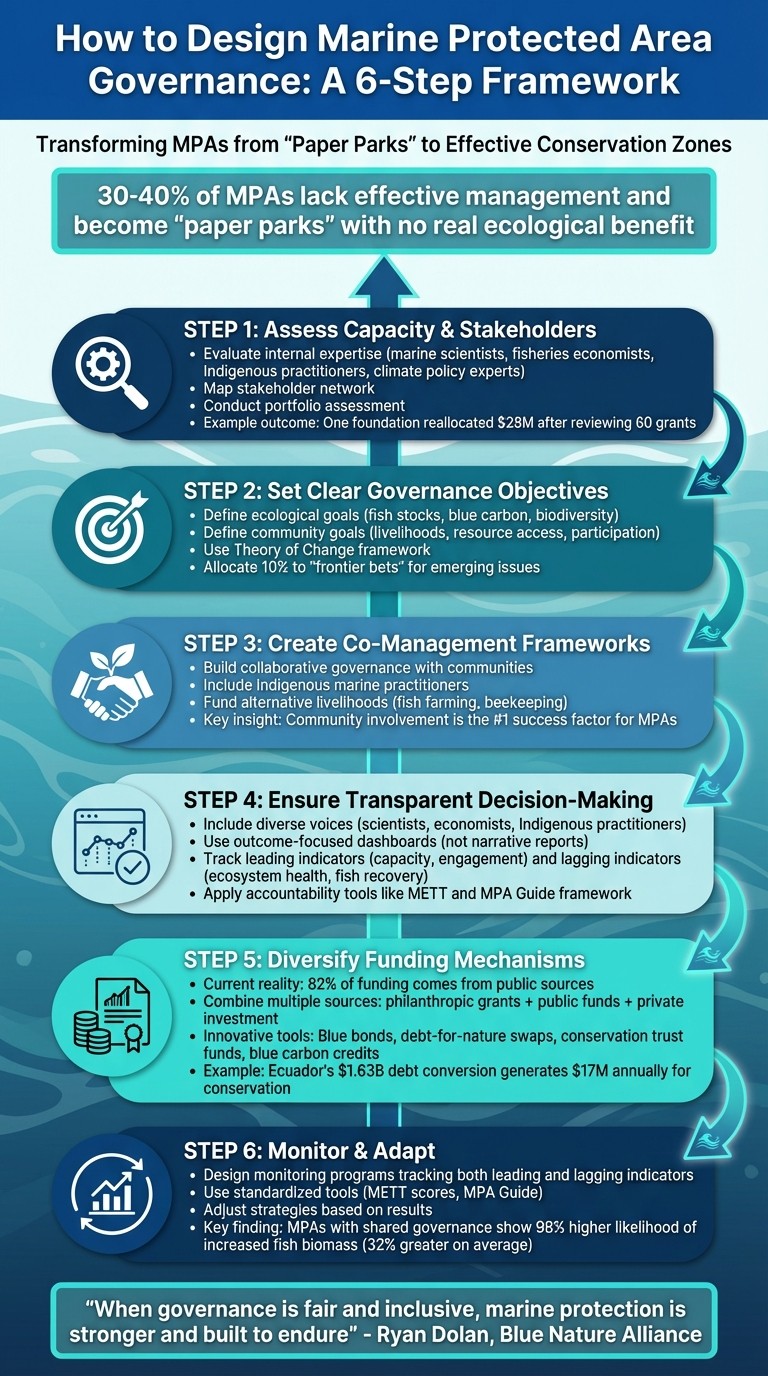
6-Step Framework for Designing Effective Marine Protected Area Governance
Social Aspects of MPA Management – Building Effective and Equitable Ocean Conservation
Step 1: Assess Your Organization's Capacity and Stakeholder Environment
Building a strong foundation for Marine Protected Area (MPA) governance starts with understanding your organization's resources and the dynamics of your stakeholder network. A well-rounded assessment ensures your efforts are grounded in realistic capabilities and address actual needs.
Evaluate Your Foundation's Capacity
Start by examining the internal resources your organization has at its disposal. Successful MPA governance requires a combination of expertise, reliable measurement systems, and a clear, long-term strategy.
Your team should include professionals with diverse skill sets. For instance, marine scientists can analyze ecosystem health, fisheries economists can evaluate sustainable practices, Indigenous marine practitioners bring valuable traditional knowledge, and climate policy experts can guide blue carbon strategies [3]. If your organization lacks this expertise, consider forming partnerships or creating advisory panels to fill the gaps.
Equally important are robust systems for tracking outcomes. Many organizations focus on outputs like reports or events, but these don't necessarily reflect actual conservation progress. It's crucial to establish systems that monitor both short-term milestones, such as policy development, and long-term impacts, like fish stock recovery and ecosystem health [3]. Without these systems, it becomes difficult to evaluate the effectiveness of your investments.
A portfolio assessment can also provide clarity. For example, between February 2025 and February 2026, a private foundation managing $200 million in ocean-focused assets collaborated with Council Fire to review over 60 grants. Through interviews with 35 grantees and a four-month analysis, the foundation discovered significant gaps - particularly in MPA management effectiveness, which had been underfunded compared to designation advocacy. This insight led to reallocating $28 million toward impactful areas like ranger training and monitoring technologies [3].
With a clear understanding of your internal strengths and gaps, you can better align your resources with your governance objectives.
Identify and Engage Key Stakeholders
Mapping out your stakeholder network is the next step to ensure collaboration and alignment.
Stakeholders often include local communities, government agencies, marine scientists, fisheries economists, Indigenous marine practitioners, and climate policy experts [3]. Each group brings unique perspectives and priorities. For example, local communities may focus on sustainable livelihoods, while government agencies prioritize regulatory frameworks, and Indigenous practitioners offer traditional ecological insights.
Effective stakeholder engagement goes beyond just providing funding. It’s about fostering meaningful collaboration. One foundation demonstrated this by assembling a diverse advisory panel that included Indigenous practitioners, marine scientists, and fisheries economists. Together, they developed a theory of change that aligned goals and identified areas where the foundation's resources could make the greatest impact [3].
This approach is supported by industry leaders:
"The key to success is to develop partnerships, and for developed nations, NGOs, and technology providers to really step up and provide the tools and resources to governments who have the political will to pass protective legislation." - Keobel Sakuma, Kenton Miller Award winner [1]
Finding synergies among stakeholders can amplify results. For instance, governments may have the political drive for conservation but lack the necessary funding or technical know-how. Your organization can bridge this gap by offering tools like monitoring technology or funding ranger training programs. This strategy has already shown results, improving Management Effectiveness Tracking Tool (METT) scores at 8 of 12 priority sites within 18 months and attracting $45 million in additional funding from three aligned philanthropic groups [3].
Step 2: Set Clear Governance Objectives That Match Your Mission
Establishing precise governance objectives is essential to avoid wasting resources and to achieve conservation results that go beyond mere activity tracking.
Define Conservation and Community Goals
Governance objectives should focus on tangible ecological and social improvements. For example, ecological goals might include enhancing fish stocks, safeguarding blue carbon ecosystems, or increasing biodiversity in critical habitats [3]. At the same time, community goals could aim to support coastal livelihoods, ensure fair access to resources, and encourage local participation [2][3].
Using a Theory of Change framework can help connect investments to specific outcomes. This approach outlines how funding supports intermediate steps - like policy reforms or stronger institutional capacity - that lead to long-term results. Measurement systems should monitor both leading indicators (e.g., policy advancements and partnership growth) and lagging indicators (e.g., fish stock health and carbon sequestration levels). Tools like the Management Effectiveness Tracking Tool (METT) offer a standardized way to assess management quality. For instance, one foundation reported improved METT scores at 8 of its 12 priority sites within just 18 months after realigning its focus [3].
Once ecological and community goals are defined, refine them to reflect your foundation’s mission in the next stage.
Align Objectives with Your Foundation's Mission
By leveraging internal expertise and feedback from stakeholders, ensure that governance objectives align directly with your philanthropic mission. Your goals should reflect your foundation’s strengths, whether in policy reform, capacity building, Indigenous-led initiatives, or innovative financing methods. Prioritize regions where concentrated efforts can drive systemic change. For instance, one foundation focused its efforts in specific regions, which led to additional co-funding and successful fisheries governance reforms in key areas [3].
To remain flexible as environmental challenges evolve, consider allocating roughly 10% of your resources to "frontier bets" on emerging issues such as deep-sea mining governance or marine genetic resources. This approach not only allows for adaptability but also supports a learning agenda with clear questions to refine your grantmaking strategy over time [3].
These well-defined, mission-focused objectives will lay the groundwork for the decision-making frameworks explored in the upcoming sections.
Step 3: Create Co-Management Frameworks with Coastal Communities
Co-management shifts MPA governance from a top-down model to a shared responsibility involving foundations, government agencies, and the coastal communities that rely on marine resources every day. Studies highlight that community involvement is the most critical factor in determining the success of Marine Protected Areas (MPAs) [5]. Without engaging locals from the start, MPAs risk becoming ineffective "paper parks" - failing to meet conservation goals while neglecting community needs.
Core Principles of Co-Management
Effective co-management starts by building governance frameworks collaboratively, encouraging an open dialogue between local stakeholders and the state rather than enforcing external mandates. This process includes identifying potential conflicts and areas for cooperation early on, integrating these insights into the MPA’s design. For example, in areas where MPA restrictions impact fishing-related income, economic incentives can help communities shift from harvesting to conservation-focused activities. Co-management addresses the shortcomings of centralized systems by incorporating local expertise. However, until conservation efforts provide greater financial benefits than fishing, unsustainable practices may persist. Foundations can help bridge this gap by funding alternative livelihoods such as fish farming or beekeeping [5].
These principles lay the groundwork for deeper community involvement, as detailed below.
Build Community Participation in Governance
Direct community involvement is essential for turning governance into a truly collaborative process. Building trust with coastal communities means addressing their dependence on fishing - particularly in areas where it is the primary source of income. Initiatives like gear exchange programs and empowering local patrols can reduce compliance costs and enhance MPA monitoring, as demonstrated in the Mesoamerican Reef [5].
Equally important is shifting the focus from merely designating MPAs to ensuring their effective management. To achieve lasting co-management, include Indigenous marine practitioners and local community experts in developing your Theory of Change. This ensures governance models respect local knowledge and align with economic realities [3].
Step 4: Create Transparent Decision-Making Processes
Establishing transparent decision-making processes is essential to ensure that governance systems are both effective and trusted. This goes beyond simply sharing reports - it involves creating frameworks where stakeholders can clearly see how decisions are made, who is responsible for making them, and the results of those choices. Without this openness, even the best intentions can fall short. As Council Fire aptly states, "A poorly managed MPA is a paper park - it provides political cover without ecological benefit" [3].
Design Decision-Making Structures That Include All Voices
For decision-making to succeed, it must incorporate a wide range of perspectives. This means actively involving marine scientists, fisheries economists, Indigenous marine practitioners, and climate policy experts when shaping conservation strategies [3]. The aim is to ensure that governance reflects the diverse expertise and experiences connected to the marine protected area (MPA).
A great example of this inclusive approach is the Monterey Bay National Marine Sanctuary. In September 2023, after ten years of collaboration, the sanctuary updated Essential Fish Habitat conservation areas. This effort brought together local trawl fishermen and conservation groups to develop a balanced proposal. The final rule, issued in 2020, safeguarded 237 square miles of biogenic habitat while reopening 99 square miles of historically productive fishing grounds [6]. This outcome highlights how transparent processes that include all voices can lead to sustainable solutions.
A strong foundation also requires a clear Theory of Change. This framework should link investments to measurable conservation outcomes, making all assumptions explicit and easy for stakeholders to understand [3]. Indigenous marine practitioners should play a central role in shaping this framework, ensuring it aligns with local knowledge and economic realities [3].
Ryan Dolan, Managing Director of Blue Nature Alliance, underscores the importance of inclusivity:
"When governance is fair and inclusive, marine protection is stronger and built to endure" [8].
By fostering diverse stakeholder involvement, you not only enhance resource availability but also ensure that conservation efforts remain resilient, even through political changes [7].
Set Up Accountability Systems
Transparency thrives on accountability, which requires robust systems to measure and share progress. Replace traditional narrative grant summaries with outcome-focused dashboards that track progress against your Theory of Change. These dashboards should provide quarterly updates and include both leading indicators (like grantee capacity and stakeholder engagement) and lagging indicators (such as ecosystem health and fish stock recovery). This approach shifts the focus from merely reporting activities to showcasing tangible results [3].
Standardized tools, such as the MPA Guide framework or the Management Effectiveness Tracking Tool, can offer independent, objective evaluations of governance effectiveness [3]. It’s crucial to design your accountability framework alongside your governance strategy to ensure that data collection is seamless from the start [3].
To address social equity, consider using frameworks like the IUCN Guidebook for Assessing and Improving Social Equity in Marine Conservation. These tools help evaluate key areas such as the recognition of rights, participation in decision-making, and the fair distribution of costs and benefits [8]. As Kira Sullivan-Wiley, Ph.D., Senior Officer at The Pew Charitable Trusts, explains:
"Efforts that fail to consider who is included, who decides, and who benefits often lead to conflict, reduced compliance, and social harm" [8].
Finally, embed learning agendas within your governance structures. Use these agendas to test strategies, incorporate emerging evidence, and adapt based on feedback from stakeholders [3]. This creates a culture of ongoing improvement, where transparency becomes a driver of better decision-making over time.
With this transparent, results-oriented framework in place, you’ll be ready to explore innovative funding mechanisms in the next step.
Step 5: Use Creative Financing and Funding Mechanisms
Ensuring the long-term success of Marine Protected Areas (MPAs) depends heavily on securing reliable and diverse financing. While transparent governance sets the stage, sustainable funding is what keeps these initiatives thriving over time.
One of the biggest hurdles MPAs face is financial sustainability. Currently, public funds account for 82% of financing for nature-based solutions [9]. However, government funding often fluctuates due to political shifts, introducing uncertainty into MPA operations. Keith Lawrence, Project Director at Pew Charitable Trusts, highlights this challenge:
"Establishing and maintaining effective MPAs requires significant financial resources, including for design, ongoing research, monitoring, enforcement, and management." [9]
To overcome this, MPAs must move beyond traditional grant cycles and diversify their funding sources. Many foundations are now prioritizing management effectiveness over merely advocating for MPA designation. This shift supports initiatives like ranger training, advanced monitoring technologies, and sustainable financing systems to ensure MPAs are more than just "paper parks." It’s a strategic pivot that emphasizes robust management alongside sustainable funding.
Combine Multiple Funding Sources
A resilient financial strategy for MPAs relies on blending multiple funding streams rather than depending on a single source. Blended finance models - which mix philanthropic grants, public funds, and private investments - are proving effective in expanding resources. For instance, the Global Fund for Coral Reefs exemplifies how combining diverse capital sources can protect marine biodiversity at scale [9].
One successful approach is Project Finance for Permanence (PFP), which secures long-term funding by uniting governments, rights-holders, and philanthropic organizations. Instead of relying on short-term grants, PFP ties sustained financial commitments to measurable environmental and social outcomes [9]. This model ensures funding stability even as political landscapes shift.
Another innovative mechanism is debt-for-nature conversions, which are particularly useful for nations with rich marine ecosystems. In May 2023, Ecuador finalized a debt conversion for the Galápagos Islands with support from the Pew Bertarelli Ocean Legacy Project and other partners. This deal generates approximately $17 million annually for conservation in the Hermandad and Galápagos marine reserves, while also reducing Ecuador’s borrowing costs by over $1 billion [9].
Explore Blue Bonds and Conservation Trust Funds
Blue bonds are a specialized form of debt financing designed to support marine conservation projects while delivering financial returns. These bonds are part of the broader green bond market, which issued over half a trillion dollars globally in 2021 [9]. Blue bonds allow governments and corporations to access capital markets while committing to measurable marine protection goals.
Another effective tool is the Conservation Trust Fund (CTF). These funds provide stable, long-term financial support, shielding MPAs from the unpredictability of annual grant cycles. CTFs, which are typically funded by governments and philanthropies, now operate in over 50 countries [10]. They can pool resources from various streams - blue bonds, carbon credits, and even tourism fees - creating a steady financial base for MPA operations.
Emerging markets like blue carbon credits offer additional funding opportunities. Coastal ecosystems such as mangroves, seagrasses, and salt marshes are exceptional at capturing carbon - sequestering it at rates 2 to 4 times higher than terrestrial forests per unit area [3]. Early projects have already generated verified carbon credits using methodologies like Verra's VM0033, providing a roadmap for others looking to align conservation with climate action [3].
When crafting a financing strategy, it’s wise to start with simpler options like grants or land donations before tackling more complex mechanisms like carbon markets [10]. Establishing robust measurement systems early on is also critical - designing clear indicators ensures that funding leads to measurable outcomes from the start [3]. Additionally, focusing efforts geographically can help achieve critical mass and attract co-funding from aligned partners.
Step 6: Set Up Monitoring, Enforcement, and Adaptive Management
Once you've secured diverse funding, the next step is ensuring that your Marine Protected Area (MPA) achieves real conservation goals. As Council Fire aptly states, "A poorly managed MPA is a paper park - it provides political cover without ecological benefit" [3]. Alarmingly, research reveals that 30% to 40% of MPAs lack effective management, highlighting the need for strong monitoring and enforcement systems [3].
To make a difference, monitoring must shift its focus from tracking outputs (like meetings or reports) to measuring real-world outcomes. These include ecosystem health, policy changes, and community well-being [3]. Achieving this requires investing in tools, ranger training, and scientific frameworks that provide measurable evidence. Once these elements are in place, the focus can shift to creating monitoring systems that support adaptive management.
Design Monitoring Programs That Track Progress
A well-designed monitoring program begins with integrating the measurement framework into your governance strategy from the start - not as an afterthought [3]. This alignment ensures that grants are structured to produce measurable results from day one. Tools like the Management Effectiveness Tracking Tool (METT) and the MPA Guide framework offer science-based, standardized metrics to track progress [3].
Such programs should monitor both leading indicators (like grantee capacity, policy advancements, and partnerships) and lagging indicators (such as fish stock recovery, blue carbon storage, and management effectiveness scores). This dual focus allows for tracking immediate progress while also assessing long-term conservation impact [3]. Including local stakeholders - such as fishers and community members - in the monitoring process can further enhance collaboration and management capacity by incorporating local knowledge and shared resources [4].
A recent example showed that reallocating funds to improve monitoring efforts directly contributed to better METT scores and stronger fisheries governance outcomes [3].
Adjust Strategies Based on Results
Monitoring data is essential for refining strategies over time. Developing a Theory of Change with clear assumptions allows for annual testing and adjustments as new data and conditions arise [3]. Adaptive management ensures that insights from monitoring directly inform decision-making, building on governance and funding strategies already in place. Establishing a dedicated learning agenda within your grantmaking can also help fine-tune strategies based on emerging evidence.
Shared governance plays a critical role in adaptive management by engaging a diverse range of stakeholders in the design, monitoring, and adjustment process. Studies show that MPAs with shared governance are 98% more likely to achieve higher fish biomass, with biomass levels averaging 32% greater than those managed solely by state agencies [4]. This collaborative approach promotes shared responsibility and results in rules that are better suited to local ecological and social conditions.
To stay prepared for new challenges, consider setting aside about 10% of your portfolio for emerging issues - such as deep-sea mining governance or marine genetic resources [3]. This "frontier bet" strategy ensures your approach remains flexible while staying focused on core priorities.
The table below outlines key indicators to guide both immediate adjustments and long-term conservation goals:
Indicator Type | Key Metrics | Purpose |
|---|---|---|
Ecological Outcomes | Fish biomass, fish stock recovery, blue carbon sequestration volumes | Tracks biological health and conservation impact |
Governance/Management | METT scores, policy adoption milestones, staff capacity, enforcement levels | Assesses the effectiveness of the institutional structure |
Social/Community | Community livelihood metrics, stakeholder participation rates, fisher perceptions | Evaluates social equity and local support for the MPA |
Leading Indicators | Grantee capacity, partnership development, policy progress | Monitors early progress and predicts long-term success |
Case Study: How Foundations Contribute to MPA Success
In February 2026, a private environmental foundation managing $200 million in assets made a bold shift in focus, moving from advocacy to prioritizing management effectiveness. As part of this transition, $28 million was allocated to improve governance at existing Marine Protected Areas (MPAs), while $12 million supported a new blue carbon initiative. Within just 18 months, this strategic change led to significant improvements in management effectiveness at 8 out of 12 priority sites, as measured by the Management Effectiveness Tracking Tool (METT). The foundation also achieved a milestone by producing the first mangrove conservation project to generate verified carbon credits under Verra's VM0033 methodology [3].
This shift wasn't just about ecological results - it also revolutionized governance practices. By aligning its measurement framework with its strategy, the foundation moved from traditional narrative-based reporting to outcome-focused dashboards. This approach attracted $45 million in additional funding from three other foundations, further amplifying its impact [3].
Another groundbreaking example of innovative financing comes from the Pew Bertarelli Ocean Legacy partnership with Ecuador's government. In May 2023, this collaboration facilitated the largest debt-for-nature swap in history, converting $1.63 billion of Ecuador's international debt into a $656 million conservation loan. Dona Bertarelli Philanthropy, a co-founding member of the Galápagos Life Fund (GLF), played a pivotal role in this initiative. Over 18 years, this transaction will channel $450 million toward marine protection. By 2041, the fully capitalized endowment is expected to generate approximately $12 million annually in grants, ensuring a steady funding source that transcends political changes [12].
In Mexico's Gulf of California, the Mexican Fund for the Conservation of Nature (FMCN) established the Gulf of California Marine Endowment (GCME) in 2007 with an initial $2.5 million trust fund contributed by four foundations. By March 2019, the endowment's capital had grown to $9.5 million. This financial boost enabled protected area staff to triple marine patrols, significantly curbing illegal fishing in the Mid Riff Islands region. Additionally, hiring specialized staff to help fishers secure legal permits not only protected their rights but also encouraged their active participation in enforcement efforts [11].
These examples highlight how foundations can create lasting success for MPAs by combining effective governance, innovative financing, and community involvement. They demonstrate that transparent and robust governance systems are critical for transforming MPAs into resilient ecosystems that deliver enduring social and ecological benefits.
Work with Council Fire to Implement Your MPA Governance Strategy
Managing Marine Protected Areas (MPAs) effectively requires a well-defined strategy, alignment among stakeholders, and a solid framework for measuring outcomes. Council Fire collaborates with foundations to transform broad grant-making efforts into targeted, results-oriented strategies that yield tangible ecological and social benefits.
From 2025 to February 2026, Council Fire partnered with a private environmental foundation overseeing $200 million in ocean-focused assets to overhaul its portfolio. Over 12 months, they conducted interviews with 35 grantees, assessed more than 60 grants against global targets, and facilitated a Theory of Change workshop with Indigenous practitioners and marine scientists. This effort led to a streamlined portfolio of 38 grants centered on three key goals: managing 10 million hectares of high-biodiversity ocean, reforming fisheries in eight priority regions, and sequestering 5 million tonnes of CO2 via blue carbon initiatives. This strategic shift reallocated $28 million toward MPA management and blue carbon projects, resulting in fisheries governance reform in three of the eight targeted regions within the first year [3]. This reorganization also established a foundation for rigorous outcome measurement.
Building on this transformation, Council Fire employs sophisticated measurement frameworks to monitor progress at every step. Traditional reporting methods are replaced with dynamic outcome dashboards that use both leading and lagging indicators. These include metrics like grantee capacity, policy advancements, fish stock assessments, blue carbon verification under Verra's VM0033 methodology, and MPA management effectiveness scores based on the MPA Guide framework. This data-driven approach enabled one foundation to secure $45 million in co-funding from other philanthropic organizations, creating a unified funding effort with greater collective impact [3].
Council Fire's expertise spans portfolio evaluation, stakeholder engagement, and innovative financial solutions. By embedding advanced governance metrics and sustainable financing models, they help MPAs achieve enduring ecological and community benefits. Their approach ensures investments in critical areas like ranger training, monitoring systems, and sustainable funding mechanisms, paving the way for resilient MPAs that support both nature and coastal communities.
Conclusion
Strengthening Marine Protected Area (MPA) governance requires more than just designating areas on a map. It demands ongoing investment in management, collaboration with stakeholders, and creative funding solutions. Alarmingly, research indicates that 30% to 40% of designated MPAs lack proper management, effectively reducing them to "paper parks" that fail to deliver on conservation promises [3]. Achieving real conservation outcomes depends on prioritizing efforts such as ranger training, advanced monitoring tools, institutional strengthening, and decision-making processes that actively involve coastal communities from the outset.
Addressing these challenges calls for trusted partnerships. The most effective MPA governance strategies integrate co-management frameworks with Indigenous-led practices, ensuring conservation efforts align with local needs, traditions, and livelihoods. This collaborative approach fosters trust and secures community support, which are critical for long-term success. As Keobel Sakuma, a Kenton Miller Award recipient, emphasizes, partnerships among governments, NGOs, and technology providers are key to achieving meaningful progress [1].
When it comes to funding, innovative solutions like conservation trust funds, blue bonds, and blue carbon markets offer a path to sustained financial support. These mechanisms go beyond initial grants, providing MPAs with the resources needed for consistent, adaptive management that can respond to evolving environmental and social conditions. For foundations, this means shifting from scattered grantmaking to structured, results-oriented funding that ensures MPAs thrive in the long run.
FAQs
How do we pick which MPAs to fund?
When deciding which Marine Protected Areas (MPAs) to support, focus on their ability to deliver clear conservation results and examine how they are managed. MPAs with shared governance models often yield stronger ecological benefits, such as increased fish biomass, making them a worthwhile investment. Pay attention to key factors like the MPA's age and whether it includes no-take zones, as these elements play a critical role in ecological success. Ensure that your selections align with your foundation's conservation objectives and commitment to engaging stakeholders.
What does co-management look like in practice?
Co-management brings together diverse stakeholders - government agencies, local communities, scientists, and NGOs - to share decision-making responsibilities and work collaboratively. This model emphasizes transparency, mutual respect, and active involvement from all parties. Essential practices include clearly defining roles, blending local knowledge with scientific research, and maintaining open, consistent communication. By addressing ecological conservation alongside social and economic priorities, co-management supports flexible strategies and promotes the sustainable management of Marine Protected Areas (MPAs) over the long term.
How do we measure MPA governance success?
Measuring the success of Marine Protected Area (MPA) governance requires a balanced evaluation of both natural and social factors. This involves assessing how well management plans are implemented, tracking conservation impacts, and using indicators to gauge ecological health, policy enforcement, and the well-being of local communities. Strong governance relies on clear metrics and effective management practices to deliver tangible conservation results, aligning with global efforts to protect biodiversity.
Related Blog Posts
How to Design Marine Protected Area Governance for Municipalities & Government Agencies
How to Design Marine Protected Area Governance for Corporations
How to Design Marine Protected Area Governance for NGOs & Nonprofits
How to Design Marine Protected Area Governance for Universities & Research Institutions
Latest Articles
©2025
Narrative Change and Power Building: The Missing Half of Advocacy
Narrative change is the process of disrupting dominant narratives that normalize inequity and advancing new narratives from historically marginalized communities.

Funding Resilience Without Federal Grants
BRIC is unreliable and FEMA is shrinking. Here's how cities fund climate resilience with dedicated revenue, blended finance, and a coordinating authority.

The ESG Blind Spot: How AI Is Finding Risks in Companies Nobody Else Is Watching
Norway's sovereign wealth fund uses AI to screen 7,200 portfolio companies for forced labor and corruption within 24 hours. The real story is the emerging-market coverage gap that traditional ESG data vendors miss — and what it means for any company with a global supply chain.
Narrative Change and Power Building: The Missing Half of Advocacy
Narrative change is the process of disrupting dominant narratives that normalize inequity and advancing new narratives from historically marginalized communities.
Funding Resilience Without Federal Grants
BRIC is unreliable and FEMA is shrinking. Here's how cities fund climate resilience with dedicated revenue, blended finance, and a coordinating authority.
The ESG Blind Spot: How AI Is Finding Risks in Companies Nobody Else Is Watching
Norway's sovereign wealth fund uses AI to screen 7,200 portfolio companies for forced labor and corruption within 24 hours. The real story is the emerging-market coverage gap that traditional ESG data vendors miss — and what it means for any company with a global supply chain.
FAQ
01
What does it really mean to “redefine profit”?
02
What makes Council Fire different?
03
Who does Council Fire work with?
04
What does working with Council Fire actually look like?
05
How does Council Fire help organizations turn big goals into action?
06
How does Council Fire define and measure success?
Mar 28, 2026
How to Design Marine Protected Area Governance for Foundations & Philanthropic Organizations
Sustainability Strategy
In This Article
Practical guide for foundations on designing MPA governance: stakeholder engagement, co-management, sustainable finance, monitoring, and adaptive management.
How to Design Marine Protected Area Governance for Foundations & Philanthropic Organizations
Marine Protected Areas (MPAs) are critical zones in oceans designated to protect ecosystems, resources, and communities. However, many MPAs fail to deliver on their goals due to weak management systems, often becoming "paper parks" with no real ecological benefit. Effective governance is the key to bridging this gap, and foundations play a crucial role in driving impactful change.
Here’s how your organization can strengthen MPA governance:
Focus Resources: Shift from scattered funding to targeted investments in management, policy changes, and local collaboration.
Engage Stakeholders: Work with communities, scientists, and policymakers to align goals and ensure shared responsibility.
Set Clear Goals: Define measurable ecological and social objectives tied to your foundation’s mission.
Support Co-Management: Involve local communities in decision-making to build trust and improve outcomes.
Ensure Transparency: Use clear decision-making processes and accountability systems to track progress.
Diversify Funding: Combine grants, blue bonds, carbon credits, and other tools to ensure long-term financial stability.
Monitor and Adapt: Use tools like METT to measure outcomes and refine strategies.
6-Step Framework for Designing Effective Marine Protected Area Governance
Social Aspects of MPA Management – Building Effective and Equitable Ocean Conservation
Step 1: Assess Your Organization's Capacity and Stakeholder Environment
Building a strong foundation for Marine Protected Area (MPA) governance starts with understanding your organization's resources and the dynamics of your stakeholder network. A well-rounded assessment ensures your efforts are grounded in realistic capabilities and address actual needs.
Evaluate Your Foundation's Capacity
Start by examining the internal resources your organization has at its disposal. Successful MPA governance requires a combination of expertise, reliable measurement systems, and a clear, long-term strategy.
Your team should include professionals with diverse skill sets. For instance, marine scientists can analyze ecosystem health, fisheries economists can evaluate sustainable practices, Indigenous marine practitioners bring valuable traditional knowledge, and climate policy experts can guide blue carbon strategies [3]. If your organization lacks this expertise, consider forming partnerships or creating advisory panels to fill the gaps.
Equally important are robust systems for tracking outcomes. Many organizations focus on outputs like reports or events, but these don't necessarily reflect actual conservation progress. It's crucial to establish systems that monitor both short-term milestones, such as policy development, and long-term impacts, like fish stock recovery and ecosystem health [3]. Without these systems, it becomes difficult to evaluate the effectiveness of your investments.
A portfolio assessment can also provide clarity. For example, between February 2025 and February 2026, a private foundation managing $200 million in ocean-focused assets collaborated with Council Fire to review over 60 grants. Through interviews with 35 grantees and a four-month analysis, the foundation discovered significant gaps - particularly in MPA management effectiveness, which had been underfunded compared to designation advocacy. This insight led to reallocating $28 million toward impactful areas like ranger training and monitoring technologies [3].
With a clear understanding of your internal strengths and gaps, you can better align your resources with your governance objectives.
Identify and Engage Key Stakeholders
Mapping out your stakeholder network is the next step to ensure collaboration and alignment.
Stakeholders often include local communities, government agencies, marine scientists, fisheries economists, Indigenous marine practitioners, and climate policy experts [3]. Each group brings unique perspectives and priorities. For example, local communities may focus on sustainable livelihoods, while government agencies prioritize regulatory frameworks, and Indigenous practitioners offer traditional ecological insights.
Effective stakeholder engagement goes beyond just providing funding. It’s about fostering meaningful collaboration. One foundation demonstrated this by assembling a diverse advisory panel that included Indigenous practitioners, marine scientists, and fisheries economists. Together, they developed a theory of change that aligned goals and identified areas where the foundation's resources could make the greatest impact [3].
This approach is supported by industry leaders:
"The key to success is to develop partnerships, and for developed nations, NGOs, and technology providers to really step up and provide the tools and resources to governments who have the political will to pass protective legislation." - Keobel Sakuma, Kenton Miller Award winner [1]
Finding synergies among stakeholders can amplify results. For instance, governments may have the political drive for conservation but lack the necessary funding or technical know-how. Your organization can bridge this gap by offering tools like monitoring technology or funding ranger training programs. This strategy has already shown results, improving Management Effectiveness Tracking Tool (METT) scores at 8 of 12 priority sites within 18 months and attracting $45 million in additional funding from three aligned philanthropic groups [3].
Step 2: Set Clear Governance Objectives That Match Your Mission
Establishing precise governance objectives is essential to avoid wasting resources and to achieve conservation results that go beyond mere activity tracking.
Define Conservation and Community Goals
Governance objectives should focus on tangible ecological and social improvements. For example, ecological goals might include enhancing fish stocks, safeguarding blue carbon ecosystems, or increasing biodiversity in critical habitats [3]. At the same time, community goals could aim to support coastal livelihoods, ensure fair access to resources, and encourage local participation [2][3].
Using a Theory of Change framework can help connect investments to specific outcomes. This approach outlines how funding supports intermediate steps - like policy reforms or stronger institutional capacity - that lead to long-term results. Measurement systems should monitor both leading indicators (e.g., policy advancements and partnership growth) and lagging indicators (e.g., fish stock health and carbon sequestration levels). Tools like the Management Effectiveness Tracking Tool (METT) offer a standardized way to assess management quality. For instance, one foundation reported improved METT scores at 8 of its 12 priority sites within just 18 months after realigning its focus [3].
Once ecological and community goals are defined, refine them to reflect your foundation’s mission in the next stage.
Align Objectives with Your Foundation's Mission
By leveraging internal expertise and feedback from stakeholders, ensure that governance objectives align directly with your philanthropic mission. Your goals should reflect your foundation’s strengths, whether in policy reform, capacity building, Indigenous-led initiatives, or innovative financing methods. Prioritize regions where concentrated efforts can drive systemic change. For instance, one foundation focused its efforts in specific regions, which led to additional co-funding and successful fisheries governance reforms in key areas [3].
To remain flexible as environmental challenges evolve, consider allocating roughly 10% of your resources to "frontier bets" on emerging issues such as deep-sea mining governance or marine genetic resources. This approach not only allows for adaptability but also supports a learning agenda with clear questions to refine your grantmaking strategy over time [3].
These well-defined, mission-focused objectives will lay the groundwork for the decision-making frameworks explored in the upcoming sections.
Step 3: Create Co-Management Frameworks with Coastal Communities
Co-management shifts MPA governance from a top-down model to a shared responsibility involving foundations, government agencies, and the coastal communities that rely on marine resources every day. Studies highlight that community involvement is the most critical factor in determining the success of Marine Protected Areas (MPAs) [5]. Without engaging locals from the start, MPAs risk becoming ineffective "paper parks" - failing to meet conservation goals while neglecting community needs.
Core Principles of Co-Management
Effective co-management starts by building governance frameworks collaboratively, encouraging an open dialogue between local stakeholders and the state rather than enforcing external mandates. This process includes identifying potential conflicts and areas for cooperation early on, integrating these insights into the MPA’s design. For example, in areas where MPA restrictions impact fishing-related income, economic incentives can help communities shift from harvesting to conservation-focused activities. Co-management addresses the shortcomings of centralized systems by incorporating local expertise. However, until conservation efforts provide greater financial benefits than fishing, unsustainable practices may persist. Foundations can help bridge this gap by funding alternative livelihoods such as fish farming or beekeeping [5].
These principles lay the groundwork for deeper community involvement, as detailed below.
Build Community Participation in Governance
Direct community involvement is essential for turning governance into a truly collaborative process. Building trust with coastal communities means addressing their dependence on fishing - particularly in areas where it is the primary source of income. Initiatives like gear exchange programs and empowering local patrols can reduce compliance costs and enhance MPA monitoring, as demonstrated in the Mesoamerican Reef [5].
Equally important is shifting the focus from merely designating MPAs to ensuring their effective management. To achieve lasting co-management, include Indigenous marine practitioners and local community experts in developing your Theory of Change. This ensures governance models respect local knowledge and align with economic realities [3].
Step 4: Create Transparent Decision-Making Processes
Establishing transparent decision-making processes is essential to ensure that governance systems are both effective and trusted. This goes beyond simply sharing reports - it involves creating frameworks where stakeholders can clearly see how decisions are made, who is responsible for making them, and the results of those choices. Without this openness, even the best intentions can fall short. As Council Fire aptly states, "A poorly managed MPA is a paper park - it provides political cover without ecological benefit" [3].
Design Decision-Making Structures That Include All Voices
For decision-making to succeed, it must incorporate a wide range of perspectives. This means actively involving marine scientists, fisheries economists, Indigenous marine practitioners, and climate policy experts when shaping conservation strategies [3]. The aim is to ensure that governance reflects the diverse expertise and experiences connected to the marine protected area (MPA).
A great example of this inclusive approach is the Monterey Bay National Marine Sanctuary. In September 2023, after ten years of collaboration, the sanctuary updated Essential Fish Habitat conservation areas. This effort brought together local trawl fishermen and conservation groups to develop a balanced proposal. The final rule, issued in 2020, safeguarded 237 square miles of biogenic habitat while reopening 99 square miles of historically productive fishing grounds [6]. This outcome highlights how transparent processes that include all voices can lead to sustainable solutions.
A strong foundation also requires a clear Theory of Change. This framework should link investments to measurable conservation outcomes, making all assumptions explicit and easy for stakeholders to understand [3]. Indigenous marine practitioners should play a central role in shaping this framework, ensuring it aligns with local knowledge and economic realities [3].
Ryan Dolan, Managing Director of Blue Nature Alliance, underscores the importance of inclusivity:
"When governance is fair and inclusive, marine protection is stronger and built to endure" [8].
By fostering diverse stakeholder involvement, you not only enhance resource availability but also ensure that conservation efforts remain resilient, even through political changes [7].
Set Up Accountability Systems
Transparency thrives on accountability, which requires robust systems to measure and share progress. Replace traditional narrative grant summaries with outcome-focused dashboards that track progress against your Theory of Change. These dashboards should provide quarterly updates and include both leading indicators (like grantee capacity and stakeholder engagement) and lagging indicators (such as ecosystem health and fish stock recovery). This approach shifts the focus from merely reporting activities to showcasing tangible results [3].
Standardized tools, such as the MPA Guide framework or the Management Effectiveness Tracking Tool, can offer independent, objective evaluations of governance effectiveness [3]. It’s crucial to design your accountability framework alongside your governance strategy to ensure that data collection is seamless from the start [3].
To address social equity, consider using frameworks like the IUCN Guidebook for Assessing and Improving Social Equity in Marine Conservation. These tools help evaluate key areas such as the recognition of rights, participation in decision-making, and the fair distribution of costs and benefits [8]. As Kira Sullivan-Wiley, Ph.D., Senior Officer at The Pew Charitable Trusts, explains:
"Efforts that fail to consider who is included, who decides, and who benefits often lead to conflict, reduced compliance, and social harm" [8].
Finally, embed learning agendas within your governance structures. Use these agendas to test strategies, incorporate emerging evidence, and adapt based on feedback from stakeholders [3]. This creates a culture of ongoing improvement, where transparency becomes a driver of better decision-making over time.
With this transparent, results-oriented framework in place, you’ll be ready to explore innovative funding mechanisms in the next step.
Step 5: Use Creative Financing and Funding Mechanisms
Ensuring the long-term success of Marine Protected Areas (MPAs) depends heavily on securing reliable and diverse financing. While transparent governance sets the stage, sustainable funding is what keeps these initiatives thriving over time.
One of the biggest hurdles MPAs face is financial sustainability. Currently, public funds account for 82% of financing for nature-based solutions [9]. However, government funding often fluctuates due to political shifts, introducing uncertainty into MPA operations. Keith Lawrence, Project Director at Pew Charitable Trusts, highlights this challenge:
"Establishing and maintaining effective MPAs requires significant financial resources, including for design, ongoing research, monitoring, enforcement, and management." [9]
To overcome this, MPAs must move beyond traditional grant cycles and diversify their funding sources. Many foundations are now prioritizing management effectiveness over merely advocating for MPA designation. This shift supports initiatives like ranger training, advanced monitoring technologies, and sustainable financing systems to ensure MPAs are more than just "paper parks." It’s a strategic pivot that emphasizes robust management alongside sustainable funding.
Combine Multiple Funding Sources
A resilient financial strategy for MPAs relies on blending multiple funding streams rather than depending on a single source. Blended finance models - which mix philanthropic grants, public funds, and private investments - are proving effective in expanding resources. For instance, the Global Fund for Coral Reefs exemplifies how combining diverse capital sources can protect marine biodiversity at scale [9].
One successful approach is Project Finance for Permanence (PFP), which secures long-term funding by uniting governments, rights-holders, and philanthropic organizations. Instead of relying on short-term grants, PFP ties sustained financial commitments to measurable environmental and social outcomes [9]. This model ensures funding stability even as political landscapes shift.
Another innovative mechanism is debt-for-nature conversions, which are particularly useful for nations with rich marine ecosystems. In May 2023, Ecuador finalized a debt conversion for the Galápagos Islands with support from the Pew Bertarelli Ocean Legacy Project and other partners. This deal generates approximately $17 million annually for conservation in the Hermandad and Galápagos marine reserves, while also reducing Ecuador’s borrowing costs by over $1 billion [9].
Explore Blue Bonds and Conservation Trust Funds
Blue bonds are a specialized form of debt financing designed to support marine conservation projects while delivering financial returns. These bonds are part of the broader green bond market, which issued over half a trillion dollars globally in 2021 [9]. Blue bonds allow governments and corporations to access capital markets while committing to measurable marine protection goals.
Another effective tool is the Conservation Trust Fund (CTF). These funds provide stable, long-term financial support, shielding MPAs from the unpredictability of annual grant cycles. CTFs, which are typically funded by governments and philanthropies, now operate in over 50 countries [10]. They can pool resources from various streams - blue bonds, carbon credits, and even tourism fees - creating a steady financial base for MPA operations.
Emerging markets like blue carbon credits offer additional funding opportunities. Coastal ecosystems such as mangroves, seagrasses, and salt marshes are exceptional at capturing carbon - sequestering it at rates 2 to 4 times higher than terrestrial forests per unit area [3]. Early projects have already generated verified carbon credits using methodologies like Verra's VM0033, providing a roadmap for others looking to align conservation with climate action [3].
When crafting a financing strategy, it’s wise to start with simpler options like grants or land donations before tackling more complex mechanisms like carbon markets [10]. Establishing robust measurement systems early on is also critical - designing clear indicators ensures that funding leads to measurable outcomes from the start [3]. Additionally, focusing efforts geographically can help achieve critical mass and attract co-funding from aligned partners.
Step 6: Set Up Monitoring, Enforcement, and Adaptive Management
Once you've secured diverse funding, the next step is ensuring that your Marine Protected Area (MPA) achieves real conservation goals. As Council Fire aptly states, "A poorly managed MPA is a paper park - it provides political cover without ecological benefit" [3]. Alarmingly, research reveals that 30% to 40% of MPAs lack effective management, highlighting the need for strong monitoring and enforcement systems [3].
To make a difference, monitoring must shift its focus from tracking outputs (like meetings or reports) to measuring real-world outcomes. These include ecosystem health, policy changes, and community well-being [3]. Achieving this requires investing in tools, ranger training, and scientific frameworks that provide measurable evidence. Once these elements are in place, the focus can shift to creating monitoring systems that support adaptive management.
Design Monitoring Programs That Track Progress
A well-designed monitoring program begins with integrating the measurement framework into your governance strategy from the start - not as an afterthought [3]. This alignment ensures that grants are structured to produce measurable results from day one. Tools like the Management Effectiveness Tracking Tool (METT) and the MPA Guide framework offer science-based, standardized metrics to track progress [3].
Such programs should monitor both leading indicators (like grantee capacity, policy advancements, and partnerships) and lagging indicators (such as fish stock recovery, blue carbon storage, and management effectiveness scores). This dual focus allows for tracking immediate progress while also assessing long-term conservation impact [3]. Including local stakeholders - such as fishers and community members - in the monitoring process can further enhance collaboration and management capacity by incorporating local knowledge and shared resources [4].
A recent example showed that reallocating funds to improve monitoring efforts directly contributed to better METT scores and stronger fisheries governance outcomes [3].
Adjust Strategies Based on Results
Monitoring data is essential for refining strategies over time. Developing a Theory of Change with clear assumptions allows for annual testing and adjustments as new data and conditions arise [3]. Adaptive management ensures that insights from monitoring directly inform decision-making, building on governance and funding strategies already in place. Establishing a dedicated learning agenda within your grantmaking can also help fine-tune strategies based on emerging evidence.
Shared governance plays a critical role in adaptive management by engaging a diverse range of stakeholders in the design, monitoring, and adjustment process. Studies show that MPAs with shared governance are 98% more likely to achieve higher fish biomass, with biomass levels averaging 32% greater than those managed solely by state agencies [4]. This collaborative approach promotes shared responsibility and results in rules that are better suited to local ecological and social conditions.
To stay prepared for new challenges, consider setting aside about 10% of your portfolio for emerging issues - such as deep-sea mining governance or marine genetic resources [3]. This "frontier bet" strategy ensures your approach remains flexible while staying focused on core priorities.
The table below outlines key indicators to guide both immediate adjustments and long-term conservation goals:
Indicator Type | Key Metrics | Purpose |
|---|---|---|
Ecological Outcomes | Fish biomass, fish stock recovery, blue carbon sequestration volumes | Tracks biological health and conservation impact |
Governance/Management | METT scores, policy adoption milestones, staff capacity, enforcement levels | Assesses the effectiveness of the institutional structure |
Social/Community | Community livelihood metrics, stakeholder participation rates, fisher perceptions | Evaluates social equity and local support for the MPA |
Leading Indicators | Grantee capacity, partnership development, policy progress | Monitors early progress and predicts long-term success |
Case Study: How Foundations Contribute to MPA Success
In February 2026, a private environmental foundation managing $200 million in assets made a bold shift in focus, moving from advocacy to prioritizing management effectiveness. As part of this transition, $28 million was allocated to improve governance at existing Marine Protected Areas (MPAs), while $12 million supported a new blue carbon initiative. Within just 18 months, this strategic change led to significant improvements in management effectiveness at 8 out of 12 priority sites, as measured by the Management Effectiveness Tracking Tool (METT). The foundation also achieved a milestone by producing the first mangrove conservation project to generate verified carbon credits under Verra's VM0033 methodology [3].
This shift wasn't just about ecological results - it also revolutionized governance practices. By aligning its measurement framework with its strategy, the foundation moved from traditional narrative-based reporting to outcome-focused dashboards. This approach attracted $45 million in additional funding from three other foundations, further amplifying its impact [3].
Another groundbreaking example of innovative financing comes from the Pew Bertarelli Ocean Legacy partnership with Ecuador's government. In May 2023, this collaboration facilitated the largest debt-for-nature swap in history, converting $1.63 billion of Ecuador's international debt into a $656 million conservation loan. Dona Bertarelli Philanthropy, a co-founding member of the Galápagos Life Fund (GLF), played a pivotal role in this initiative. Over 18 years, this transaction will channel $450 million toward marine protection. By 2041, the fully capitalized endowment is expected to generate approximately $12 million annually in grants, ensuring a steady funding source that transcends political changes [12].
In Mexico's Gulf of California, the Mexican Fund for the Conservation of Nature (FMCN) established the Gulf of California Marine Endowment (GCME) in 2007 with an initial $2.5 million trust fund contributed by four foundations. By March 2019, the endowment's capital had grown to $9.5 million. This financial boost enabled protected area staff to triple marine patrols, significantly curbing illegal fishing in the Mid Riff Islands region. Additionally, hiring specialized staff to help fishers secure legal permits not only protected their rights but also encouraged their active participation in enforcement efforts [11].
These examples highlight how foundations can create lasting success for MPAs by combining effective governance, innovative financing, and community involvement. They demonstrate that transparent and robust governance systems are critical for transforming MPAs into resilient ecosystems that deliver enduring social and ecological benefits.
Work with Council Fire to Implement Your MPA Governance Strategy
Managing Marine Protected Areas (MPAs) effectively requires a well-defined strategy, alignment among stakeholders, and a solid framework for measuring outcomes. Council Fire collaborates with foundations to transform broad grant-making efforts into targeted, results-oriented strategies that yield tangible ecological and social benefits.
From 2025 to February 2026, Council Fire partnered with a private environmental foundation overseeing $200 million in ocean-focused assets to overhaul its portfolio. Over 12 months, they conducted interviews with 35 grantees, assessed more than 60 grants against global targets, and facilitated a Theory of Change workshop with Indigenous practitioners and marine scientists. This effort led to a streamlined portfolio of 38 grants centered on three key goals: managing 10 million hectares of high-biodiversity ocean, reforming fisheries in eight priority regions, and sequestering 5 million tonnes of CO2 via blue carbon initiatives. This strategic shift reallocated $28 million toward MPA management and blue carbon projects, resulting in fisheries governance reform in three of the eight targeted regions within the first year [3]. This reorganization also established a foundation for rigorous outcome measurement.
Building on this transformation, Council Fire employs sophisticated measurement frameworks to monitor progress at every step. Traditional reporting methods are replaced with dynamic outcome dashboards that use both leading and lagging indicators. These include metrics like grantee capacity, policy advancements, fish stock assessments, blue carbon verification under Verra's VM0033 methodology, and MPA management effectiveness scores based on the MPA Guide framework. This data-driven approach enabled one foundation to secure $45 million in co-funding from other philanthropic organizations, creating a unified funding effort with greater collective impact [3].
Council Fire's expertise spans portfolio evaluation, stakeholder engagement, and innovative financial solutions. By embedding advanced governance metrics and sustainable financing models, they help MPAs achieve enduring ecological and community benefits. Their approach ensures investments in critical areas like ranger training, monitoring systems, and sustainable funding mechanisms, paving the way for resilient MPAs that support both nature and coastal communities.
Conclusion
Strengthening Marine Protected Area (MPA) governance requires more than just designating areas on a map. It demands ongoing investment in management, collaboration with stakeholders, and creative funding solutions. Alarmingly, research indicates that 30% to 40% of designated MPAs lack proper management, effectively reducing them to "paper parks" that fail to deliver on conservation promises [3]. Achieving real conservation outcomes depends on prioritizing efforts such as ranger training, advanced monitoring tools, institutional strengthening, and decision-making processes that actively involve coastal communities from the outset.
Addressing these challenges calls for trusted partnerships. The most effective MPA governance strategies integrate co-management frameworks with Indigenous-led practices, ensuring conservation efforts align with local needs, traditions, and livelihoods. This collaborative approach fosters trust and secures community support, which are critical for long-term success. As Keobel Sakuma, a Kenton Miller Award recipient, emphasizes, partnerships among governments, NGOs, and technology providers are key to achieving meaningful progress [1].
When it comes to funding, innovative solutions like conservation trust funds, blue bonds, and blue carbon markets offer a path to sustained financial support. These mechanisms go beyond initial grants, providing MPAs with the resources needed for consistent, adaptive management that can respond to evolving environmental and social conditions. For foundations, this means shifting from scattered grantmaking to structured, results-oriented funding that ensures MPAs thrive in the long run.
FAQs
How do we pick which MPAs to fund?
When deciding which Marine Protected Areas (MPAs) to support, focus on their ability to deliver clear conservation results and examine how they are managed. MPAs with shared governance models often yield stronger ecological benefits, such as increased fish biomass, making them a worthwhile investment. Pay attention to key factors like the MPA's age and whether it includes no-take zones, as these elements play a critical role in ecological success. Ensure that your selections align with your foundation's conservation objectives and commitment to engaging stakeholders.
What does co-management look like in practice?
Co-management brings together diverse stakeholders - government agencies, local communities, scientists, and NGOs - to share decision-making responsibilities and work collaboratively. This model emphasizes transparency, mutual respect, and active involvement from all parties. Essential practices include clearly defining roles, blending local knowledge with scientific research, and maintaining open, consistent communication. By addressing ecological conservation alongside social and economic priorities, co-management supports flexible strategies and promotes the sustainable management of Marine Protected Areas (MPAs) over the long term.
How do we measure MPA governance success?
Measuring the success of Marine Protected Area (MPA) governance requires a balanced evaluation of both natural and social factors. This involves assessing how well management plans are implemented, tracking conservation impacts, and using indicators to gauge ecological health, policy enforcement, and the well-being of local communities. Strong governance relies on clear metrics and effective management practices to deliver tangible conservation results, aligning with global efforts to protect biodiversity.
Related Blog Posts
How to Design Marine Protected Area Governance for Municipalities & Government Agencies
How to Design Marine Protected Area Governance for Corporations
How to Design Marine Protected Area Governance for NGOs & Nonprofits
How to Design Marine Protected Area Governance for Universities & Research Institutions
Latest Articles
©2025
Narrative Change and Power Building: The Missing Half of Advocacy
Narrative change is the process of disrupting dominant narratives that normalize inequity and advancing new narratives from historically marginalized communities.
Funding Resilience Without Federal Grants
BRIC is unreliable and FEMA is shrinking. Here's how cities fund climate resilience with dedicated revenue, blended finance, and a coordinating authority.
The ESG Blind Spot: How AI Is Finding Risks in Companies Nobody Else Is Watching
Norway's sovereign wealth fund uses AI to screen 7,200 portfolio companies for forced labor and corruption within 24 hours. The real story is the emerging-market coverage gap that traditional ESG data vendors miss — and what it means for any company with a global supply chain.
FAQ
01
What does it really mean to “redefine profit”?
02
What makes Council Fire different?
03
Who does Council Fire work with?
04
What does working with Council Fire actually look like?
05
How does Council Fire help organizations turn big goals into action?
06
How does Council Fire define and measure success?
Mar 28, 2026
How to Design Marine Protected Area Governance for Foundations & Philanthropic Organizations
Sustainability Strategy
In This Article
Practical guide for foundations on designing MPA governance: stakeholder engagement, co-management, sustainable finance, monitoring, and adaptive management.
How to Design Marine Protected Area Governance for Foundations & Philanthropic Organizations
Marine Protected Areas (MPAs) are critical zones in oceans designated to protect ecosystems, resources, and communities. However, many MPAs fail to deliver on their goals due to weak management systems, often becoming "paper parks" with no real ecological benefit. Effective governance is the key to bridging this gap, and foundations play a crucial role in driving impactful change.
Here’s how your organization can strengthen MPA governance:
Focus Resources: Shift from scattered funding to targeted investments in management, policy changes, and local collaboration.
Engage Stakeholders: Work with communities, scientists, and policymakers to align goals and ensure shared responsibility.
Set Clear Goals: Define measurable ecological and social objectives tied to your foundation’s mission.
Support Co-Management: Involve local communities in decision-making to build trust and improve outcomes.
Ensure Transparency: Use clear decision-making processes and accountability systems to track progress.
Diversify Funding: Combine grants, blue bonds, carbon credits, and other tools to ensure long-term financial stability.
Monitor and Adapt: Use tools like METT to measure outcomes and refine strategies.
6-Step Framework for Designing Effective Marine Protected Area Governance
Social Aspects of MPA Management – Building Effective and Equitable Ocean Conservation
Step 1: Assess Your Organization's Capacity and Stakeholder Environment
Building a strong foundation for Marine Protected Area (MPA) governance starts with understanding your organization's resources and the dynamics of your stakeholder network. A well-rounded assessment ensures your efforts are grounded in realistic capabilities and address actual needs.
Evaluate Your Foundation's Capacity
Start by examining the internal resources your organization has at its disposal. Successful MPA governance requires a combination of expertise, reliable measurement systems, and a clear, long-term strategy.
Your team should include professionals with diverse skill sets. For instance, marine scientists can analyze ecosystem health, fisheries economists can evaluate sustainable practices, Indigenous marine practitioners bring valuable traditional knowledge, and climate policy experts can guide blue carbon strategies [3]. If your organization lacks this expertise, consider forming partnerships or creating advisory panels to fill the gaps.
Equally important are robust systems for tracking outcomes. Many organizations focus on outputs like reports or events, but these don't necessarily reflect actual conservation progress. It's crucial to establish systems that monitor both short-term milestones, such as policy development, and long-term impacts, like fish stock recovery and ecosystem health [3]. Without these systems, it becomes difficult to evaluate the effectiveness of your investments.
A portfolio assessment can also provide clarity. For example, between February 2025 and February 2026, a private foundation managing $200 million in ocean-focused assets collaborated with Council Fire to review over 60 grants. Through interviews with 35 grantees and a four-month analysis, the foundation discovered significant gaps - particularly in MPA management effectiveness, which had been underfunded compared to designation advocacy. This insight led to reallocating $28 million toward impactful areas like ranger training and monitoring technologies [3].
With a clear understanding of your internal strengths and gaps, you can better align your resources with your governance objectives.
Identify and Engage Key Stakeholders
Mapping out your stakeholder network is the next step to ensure collaboration and alignment.
Stakeholders often include local communities, government agencies, marine scientists, fisheries economists, Indigenous marine practitioners, and climate policy experts [3]. Each group brings unique perspectives and priorities. For example, local communities may focus on sustainable livelihoods, while government agencies prioritize regulatory frameworks, and Indigenous practitioners offer traditional ecological insights.
Effective stakeholder engagement goes beyond just providing funding. It’s about fostering meaningful collaboration. One foundation demonstrated this by assembling a diverse advisory panel that included Indigenous practitioners, marine scientists, and fisheries economists. Together, they developed a theory of change that aligned goals and identified areas where the foundation's resources could make the greatest impact [3].
This approach is supported by industry leaders:
"The key to success is to develop partnerships, and for developed nations, NGOs, and technology providers to really step up and provide the tools and resources to governments who have the political will to pass protective legislation." - Keobel Sakuma, Kenton Miller Award winner [1]
Finding synergies among stakeholders can amplify results. For instance, governments may have the political drive for conservation but lack the necessary funding or technical know-how. Your organization can bridge this gap by offering tools like monitoring technology or funding ranger training programs. This strategy has already shown results, improving Management Effectiveness Tracking Tool (METT) scores at 8 of 12 priority sites within 18 months and attracting $45 million in additional funding from three aligned philanthropic groups [3].
Step 2: Set Clear Governance Objectives That Match Your Mission
Establishing precise governance objectives is essential to avoid wasting resources and to achieve conservation results that go beyond mere activity tracking.
Define Conservation and Community Goals
Governance objectives should focus on tangible ecological and social improvements. For example, ecological goals might include enhancing fish stocks, safeguarding blue carbon ecosystems, or increasing biodiversity in critical habitats [3]. At the same time, community goals could aim to support coastal livelihoods, ensure fair access to resources, and encourage local participation [2][3].
Using a Theory of Change framework can help connect investments to specific outcomes. This approach outlines how funding supports intermediate steps - like policy reforms or stronger institutional capacity - that lead to long-term results. Measurement systems should monitor both leading indicators (e.g., policy advancements and partnership growth) and lagging indicators (e.g., fish stock health and carbon sequestration levels). Tools like the Management Effectiveness Tracking Tool (METT) offer a standardized way to assess management quality. For instance, one foundation reported improved METT scores at 8 of its 12 priority sites within just 18 months after realigning its focus [3].
Once ecological and community goals are defined, refine them to reflect your foundation’s mission in the next stage.
Align Objectives with Your Foundation's Mission
By leveraging internal expertise and feedback from stakeholders, ensure that governance objectives align directly with your philanthropic mission. Your goals should reflect your foundation’s strengths, whether in policy reform, capacity building, Indigenous-led initiatives, or innovative financing methods. Prioritize regions where concentrated efforts can drive systemic change. For instance, one foundation focused its efforts in specific regions, which led to additional co-funding and successful fisheries governance reforms in key areas [3].
To remain flexible as environmental challenges evolve, consider allocating roughly 10% of your resources to "frontier bets" on emerging issues such as deep-sea mining governance or marine genetic resources. This approach not only allows for adaptability but also supports a learning agenda with clear questions to refine your grantmaking strategy over time [3].
These well-defined, mission-focused objectives will lay the groundwork for the decision-making frameworks explored in the upcoming sections.
Step 3: Create Co-Management Frameworks with Coastal Communities
Co-management shifts MPA governance from a top-down model to a shared responsibility involving foundations, government agencies, and the coastal communities that rely on marine resources every day. Studies highlight that community involvement is the most critical factor in determining the success of Marine Protected Areas (MPAs) [5]. Without engaging locals from the start, MPAs risk becoming ineffective "paper parks" - failing to meet conservation goals while neglecting community needs.
Core Principles of Co-Management
Effective co-management starts by building governance frameworks collaboratively, encouraging an open dialogue between local stakeholders and the state rather than enforcing external mandates. This process includes identifying potential conflicts and areas for cooperation early on, integrating these insights into the MPA’s design. For example, in areas where MPA restrictions impact fishing-related income, economic incentives can help communities shift from harvesting to conservation-focused activities. Co-management addresses the shortcomings of centralized systems by incorporating local expertise. However, until conservation efforts provide greater financial benefits than fishing, unsustainable practices may persist. Foundations can help bridge this gap by funding alternative livelihoods such as fish farming or beekeeping [5].
These principles lay the groundwork for deeper community involvement, as detailed below.
Build Community Participation in Governance
Direct community involvement is essential for turning governance into a truly collaborative process. Building trust with coastal communities means addressing their dependence on fishing - particularly in areas where it is the primary source of income. Initiatives like gear exchange programs and empowering local patrols can reduce compliance costs and enhance MPA monitoring, as demonstrated in the Mesoamerican Reef [5].
Equally important is shifting the focus from merely designating MPAs to ensuring their effective management. To achieve lasting co-management, include Indigenous marine practitioners and local community experts in developing your Theory of Change. This ensures governance models respect local knowledge and align with economic realities [3].
Step 4: Create Transparent Decision-Making Processes
Establishing transparent decision-making processes is essential to ensure that governance systems are both effective and trusted. This goes beyond simply sharing reports - it involves creating frameworks where stakeholders can clearly see how decisions are made, who is responsible for making them, and the results of those choices. Without this openness, even the best intentions can fall short. As Council Fire aptly states, "A poorly managed MPA is a paper park - it provides political cover without ecological benefit" [3].
Design Decision-Making Structures That Include All Voices
For decision-making to succeed, it must incorporate a wide range of perspectives. This means actively involving marine scientists, fisheries economists, Indigenous marine practitioners, and climate policy experts when shaping conservation strategies [3]. The aim is to ensure that governance reflects the diverse expertise and experiences connected to the marine protected area (MPA).
A great example of this inclusive approach is the Monterey Bay National Marine Sanctuary. In September 2023, after ten years of collaboration, the sanctuary updated Essential Fish Habitat conservation areas. This effort brought together local trawl fishermen and conservation groups to develop a balanced proposal. The final rule, issued in 2020, safeguarded 237 square miles of biogenic habitat while reopening 99 square miles of historically productive fishing grounds [6]. This outcome highlights how transparent processes that include all voices can lead to sustainable solutions.
A strong foundation also requires a clear Theory of Change. This framework should link investments to measurable conservation outcomes, making all assumptions explicit and easy for stakeholders to understand [3]. Indigenous marine practitioners should play a central role in shaping this framework, ensuring it aligns with local knowledge and economic realities [3].
Ryan Dolan, Managing Director of Blue Nature Alliance, underscores the importance of inclusivity:
"When governance is fair and inclusive, marine protection is stronger and built to endure" [8].
By fostering diverse stakeholder involvement, you not only enhance resource availability but also ensure that conservation efforts remain resilient, even through political changes [7].
Set Up Accountability Systems
Transparency thrives on accountability, which requires robust systems to measure and share progress. Replace traditional narrative grant summaries with outcome-focused dashboards that track progress against your Theory of Change. These dashboards should provide quarterly updates and include both leading indicators (like grantee capacity and stakeholder engagement) and lagging indicators (such as ecosystem health and fish stock recovery). This approach shifts the focus from merely reporting activities to showcasing tangible results [3].
Standardized tools, such as the MPA Guide framework or the Management Effectiveness Tracking Tool, can offer independent, objective evaluations of governance effectiveness [3]. It’s crucial to design your accountability framework alongside your governance strategy to ensure that data collection is seamless from the start [3].
To address social equity, consider using frameworks like the IUCN Guidebook for Assessing and Improving Social Equity in Marine Conservation. These tools help evaluate key areas such as the recognition of rights, participation in decision-making, and the fair distribution of costs and benefits [8]. As Kira Sullivan-Wiley, Ph.D., Senior Officer at The Pew Charitable Trusts, explains:
"Efforts that fail to consider who is included, who decides, and who benefits often lead to conflict, reduced compliance, and social harm" [8].
Finally, embed learning agendas within your governance structures. Use these agendas to test strategies, incorporate emerging evidence, and adapt based on feedback from stakeholders [3]. This creates a culture of ongoing improvement, where transparency becomes a driver of better decision-making over time.
With this transparent, results-oriented framework in place, you’ll be ready to explore innovative funding mechanisms in the next step.
Step 5: Use Creative Financing and Funding Mechanisms
Ensuring the long-term success of Marine Protected Areas (MPAs) depends heavily on securing reliable and diverse financing. While transparent governance sets the stage, sustainable funding is what keeps these initiatives thriving over time.
One of the biggest hurdles MPAs face is financial sustainability. Currently, public funds account for 82% of financing for nature-based solutions [9]. However, government funding often fluctuates due to political shifts, introducing uncertainty into MPA operations. Keith Lawrence, Project Director at Pew Charitable Trusts, highlights this challenge:
"Establishing and maintaining effective MPAs requires significant financial resources, including for design, ongoing research, monitoring, enforcement, and management." [9]
To overcome this, MPAs must move beyond traditional grant cycles and diversify their funding sources. Many foundations are now prioritizing management effectiveness over merely advocating for MPA designation. This shift supports initiatives like ranger training, advanced monitoring technologies, and sustainable financing systems to ensure MPAs are more than just "paper parks." It’s a strategic pivot that emphasizes robust management alongside sustainable funding.
Combine Multiple Funding Sources
A resilient financial strategy for MPAs relies on blending multiple funding streams rather than depending on a single source. Blended finance models - which mix philanthropic grants, public funds, and private investments - are proving effective in expanding resources. For instance, the Global Fund for Coral Reefs exemplifies how combining diverse capital sources can protect marine biodiversity at scale [9].
One successful approach is Project Finance for Permanence (PFP), which secures long-term funding by uniting governments, rights-holders, and philanthropic organizations. Instead of relying on short-term grants, PFP ties sustained financial commitments to measurable environmental and social outcomes [9]. This model ensures funding stability even as political landscapes shift.
Another innovative mechanism is debt-for-nature conversions, which are particularly useful for nations with rich marine ecosystems. In May 2023, Ecuador finalized a debt conversion for the Galápagos Islands with support from the Pew Bertarelli Ocean Legacy Project and other partners. This deal generates approximately $17 million annually for conservation in the Hermandad and Galápagos marine reserves, while also reducing Ecuador’s borrowing costs by over $1 billion [9].
Explore Blue Bonds and Conservation Trust Funds
Blue bonds are a specialized form of debt financing designed to support marine conservation projects while delivering financial returns. These bonds are part of the broader green bond market, which issued over half a trillion dollars globally in 2021 [9]. Blue bonds allow governments and corporations to access capital markets while committing to measurable marine protection goals.
Another effective tool is the Conservation Trust Fund (CTF). These funds provide stable, long-term financial support, shielding MPAs from the unpredictability of annual grant cycles. CTFs, which are typically funded by governments and philanthropies, now operate in over 50 countries [10]. They can pool resources from various streams - blue bonds, carbon credits, and even tourism fees - creating a steady financial base for MPA operations.
Emerging markets like blue carbon credits offer additional funding opportunities. Coastal ecosystems such as mangroves, seagrasses, and salt marshes are exceptional at capturing carbon - sequestering it at rates 2 to 4 times higher than terrestrial forests per unit area [3]. Early projects have already generated verified carbon credits using methodologies like Verra's VM0033, providing a roadmap for others looking to align conservation with climate action [3].
When crafting a financing strategy, it’s wise to start with simpler options like grants or land donations before tackling more complex mechanisms like carbon markets [10]. Establishing robust measurement systems early on is also critical - designing clear indicators ensures that funding leads to measurable outcomes from the start [3]. Additionally, focusing efforts geographically can help achieve critical mass and attract co-funding from aligned partners.
Step 6: Set Up Monitoring, Enforcement, and Adaptive Management
Once you've secured diverse funding, the next step is ensuring that your Marine Protected Area (MPA) achieves real conservation goals. As Council Fire aptly states, "A poorly managed MPA is a paper park - it provides political cover without ecological benefit" [3]. Alarmingly, research reveals that 30% to 40% of MPAs lack effective management, highlighting the need for strong monitoring and enforcement systems [3].
To make a difference, monitoring must shift its focus from tracking outputs (like meetings or reports) to measuring real-world outcomes. These include ecosystem health, policy changes, and community well-being [3]. Achieving this requires investing in tools, ranger training, and scientific frameworks that provide measurable evidence. Once these elements are in place, the focus can shift to creating monitoring systems that support adaptive management.
Design Monitoring Programs That Track Progress
A well-designed monitoring program begins with integrating the measurement framework into your governance strategy from the start - not as an afterthought [3]. This alignment ensures that grants are structured to produce measurable results from day one. Tools like the Management Effectiveness Tracking Tool (METT) and the MPA Guide framework offer science-based, standardized metrics to track progress [3].
Such programs should monitor both leading indicators (like grantee capacity, policy advancements, and partnerships) and lagging indicators (such as fish stock recovery, blue carbon storage, and management effectiveness scores). This dual focus allows for tracking immediate progress while also assessing long-term conservation impact [3]. Including local stakeholders - such as fishers and community members - in the monitoring process can further enhance collaboration and management capacity by incorporating local knowledge and shared resources [4].
A recent example showed that reallocating funds to improve monitoring efforts directly contributed to better METT scores and stronger fisheries governance outcomes [3].
Adjust Strategies Based on Results
Monitoring data is essential for refining strategies over time. Developing a Theory of Change with clear assumptions allows for annual testing and adjustments as new data and conditions arise [3]. Adaptive management ensures that insights from monitoring directly inform decision-making, building on governance and funding strategies already in place. Establishing a dedicated learning agenda within your grantmaking can also help fine-tune strategies based on emerging evidence.
Shared governance plays a critical role in adaptive management by engaging a diverse range of stakeholders in the design, monitoring, and adjustment process. Studies show that MPAs with shared governance are 98% more likely to achieve higher fish biomass, with biomass levels averaging 32% greater than those managed solely by state agencies [4]. This collaborative approach promotes shared responsibility and results in rules that are better suited to local ecological and social conditions.
To stay prepared for new challenges, consider setting aside about 10% of your portfolio for emerging issues - such as deep-sea mining governance or marine genetic resources [3]. This "frontier bet" strategy ensures your approach remains flexible while staying focused on core priorities.
The table below outlines key indicators to guide both immediate adjustments and long-term conservation goals:
Indicator Type | Key Metrics | Purpose |
|---|---|---|
Ecological Outcomes | Fish biomass, fish stock recovery, blue carbon sequestration volumes | Tracks biological health and conservation impact |
Governance/Management | METT scores, policy adoption milestones, staff capacity, enforcement levels | Assesses the effectiveness of the institutional structure |
Social/Community | Community livelihood metrics, stakeholder participation rates, fisher perceptions | Evaluates social equity and local support for the MPA |
Leading Indicators | Grantee capacity, partnership development, policy progress | Monitors early progress and predicts long-term success |
Case Study: How Foundations Contribute to MPA Success
In February 2026, a private environmental foundation managing $200 million in assets made a bold shift in focus, moving from advocacy to prioritizing management effectiveness. As part of this transition, $28 million was allocated to improve governance at existing Marine Protected Areas (MPAs), while $12 million supported a new blue carbon initiative. Within just 18 months, this strategic change led to significant improvements in management effectiveness at 8 out of 12 priority sites, as measured by the Management Effectiveness Tracking Tool (METT). The foundation also achieved a milestone by producing the first mangrove conservation project to generate verified carbon credits under Verra's VM0033 methodology [3].
This shift wasn't just about ecological results - it also revolutionized governance practices. By aligning its measurement framework with its strategy, the foundation moved from traditional narrative-based reporting to outcome-focused dashboards. This approach attracted $45 million in additional funding from three other foundations, further amplifying its impact [3].
Another groundbreaking example of innovative financing comes from the Pew Bertarelli Ocean Legacy partnership with Ecuador's government. In May 2023, this collaboration facilitated the largest debt-for-nature swap in history, converting $1.63 billion of Ecuador's international debt into a $656 million conservation loan. Dona Bertarelli Philanthropy, a co-founding member of the Galápagos Life Fund (GLF), played a pivotal role in this initiative. Over 18 years, this transaction will channel $450 million toward marine protection. By 2041, the fully capitalized endowment is expected to generate approximately $12 million annually in grants, ensuring a steady funding source that transcends political changes [12].
In Mexico's Gulf of California, the Mexican Fund for the Conservation of Nature (FMCN) established the Gulf of California Marine Endowment (GCME) in 2007 with an initial $2.5 million trust fund contributed by four foundations. By March 2019, the endowment's capital had grown to $9.5 million. This financial boost enabled protected area staff to triple marine patrols, significantly curbing illegal fishing in the Mid Riff Islands region. Additionally, hiring specialized staff to help fishers secure legal permits not only protected their rights but also encouraged their active participation in enforcement efforts [11].
These examples highlight how foundations can create lasting success for MPAs by combining effective governance, innovative financing, and community involvement. They demonstrate that transparent and robust governance systems are critical for transforming MPAs into resilient ecosystems that deliver enduring social and ecological benefits.
Work with Council Fire to Implement Your MPA Governance Strategy
Managing Marine Protected Areas (MPAs) effectively requires a well-defined strategy, alignment among stakeholders, and a solid framework for measuring outcomes. Council Fire collaborates with foundations to transform broad grant-making efforts into targeted, results-oriented strategies that yield tangible ecological and social benefits.
From 2025 to February 2026, Council Fire partnered with a private environmental foundation overseeing $200 million in ocean-focused assets to overhaul its portfolio. Over 12 months, they conducted interviews with 35 grantees, assessed more than 60 grants against global targets, and facilitated a Theory of Change workshop with Indigenous practitioners and marine scientists. This effort led to a streamlined portfolio of 38 grants centered on three key goals: managing 10 million hectares of high-biodiversity ocean, reforming fisheries in eight priority regions, and sequestering 5 million tonnes of CO2 via blue carbon initiatives. This strategic shift reallocated $28 million toward MPA management and blue carbon projects, resulting in fisheries governance reform in three of the eight targeted regions within the first year [3]. This reorganization also established a foundation for rigorous outcome measurement.
Building on this transformation, Council Fire employs sophisticated measurement frameworks to monitor progress at every step. Traditional reporting methods are replaced with dynamic outcome dashboards that use both leading and lagging indicators. These include metrics like grantee capacity, policy advancements, fish stock assessments, blue carbon verification under Verra's VM0033 methodology, and MPA management effectiveness scores based on the MPA Guide framework. This data-driven approach enabled one foundation to secure $45 million in co-funding from other philanthropic organizations, creating a unified funding effort with greater collective impact [3].
Council Fire's expertise spans portfolio evaluation, stakeholder engagement, and innovative financial solutions. By embedding advanced governance metrics and sustainable financing models, they help MPAs achieve enduring ecological and community benefits. Their approach ensures investments in critical areas like ranger training, monitoring systems, and sustainable funding mechanisms, paving the way for resilient MPAs that support both nature and coastal communities.
Conclusion
Strengthening Marine Protected Area (MPA) governance requires more than just designating areas on a map. It demands ongoing investment in management, collaboration with stakeholders, and creative funding solutions. Alarmingly, research indicates that 30% to 40% of designated MPAs lack proper management, effectively reducing them to "paper parks" that fail to deliver on conservation promises [3]. Achieving real conservation outcomes depends on prioritizing efforts such as ranger training, advanced monitoring tools, institutional strengthening, and decision-making processes that actively involve coastal communities from the outset.
Addressing these challenges calls for trusted partnerships. The most effective MPA governance strategies integrate co-management frameworks with Indigenous-led practices, ensuring conservation efforts align with local needs, traditions, and livelihoods. This collaborative approach fosters trust and secures community support, which are critical for long-term success. As Keobel Sakuma, a Kenton Miller Award recipient, emphasizes, partnerships among governments, NGOs, and technology providers are key to achieving meaningful progress [1].
When it comes to funding, innovative solutions like conservation trust funds, blue bonds, and blue carbon markets offer a path to sustained financial support. These mechanisms go beyond initial grants, providing MPAs with the resources needed for consistent, adaptive management that can respond to evolving environmental and social conditions. For foundations, this means shifting from scattered grantmaking to structured, results-oriented funding that ensures MPAs thrive in the long run.
FAQs
How do we pick which MPAs to fund?
When deciding which Marine Protected Areas (MPAs) to support, focus on their ability to deliver clear conservation results and examine how they are managed. MPAs with shared governance models often yield stronger ecological benefits, such as increased fish biomass, making them a worthwhile investment. Pay attention to key factors like the MPA's age and whether it includes no-take zones, as these elements play a critical role in ecological success. Ensure that your selections align with your foundation's conservation objectives and commitment to engaging stakeholders.
What does co-management look like in practice?
Co-management brings together diverse stakeholders - government agencies, local communities, scientists, and NGOs - to share decision-making responsibilities and work collaboratively. This model emphasizes transparency, mutual respect, and active involvement from all parties. Essential practices include clearly defining roles, blending local knowledge with scientific research, and maintaining open, consistent communication. By addressing ecological conservation alongside social and economic priorities, co-management supports flexible strategies and promotes the sustainable management of Marine Protected Areas (MPAs) over the long term.
How do we measure MPA governance success?
Measuring the success of Marine Protected Area (MPA) governance requires a balanced evaluation of both natural and social factors. This involves assessing how well management plans are implemented, tracking conservation impacts, and using indicators to gauge ecological health, policy enforcement, and the well-being of local communities. Strong governance relies on clear metrics and effective management practices to deliver tangible conservation results, aligning with global efforts to protect biodiversity.
Related Blog Posts
How to Design Marine Protected Area Governance for Municipalities & Government Agencies
How to Design Marine Protected Area Governance for Corporations
How to Design Marine Protected Area Governance for NGOs & Nonprofits
How to Design Marine Protected Area Governance for Universities & Research Institutions
Latest Articles
©2025
Narrative Change and Power Building: The Missing Half of Advocacy
Narrative change is the process of disrupting dominant narratives that normalize inequity and advancing new narratives from historically marginalized communities.
Funding Resilience Without Federal Grants
BRIC is unreliable and FEMA is shrinking. Here's how cities fund climate resilience with dedicated revenue, blended finance, and a coordinating authority.
The ESG Blind Spot: How AI Is Finding Risks in Companies Nobody Else Is Watching
Norway's sovereign wealth fund uses AI to screen 7,200 portfolio companies for forced labor and corruption within 24 hours. The real story is the emerging-market coverage gap that traditional ESG data vendors miss — and what it means for any company with a global supply chain.
FAQ
What does it really mean to “redefine profit”?
What makes Council Fire different?
Who does Council Fire work with?
What does working with Council Fire actually look like?
How does Council Fire help organizations turn big goals into action?
How does Council Fire define and measure success?