Oct 14, 2026 · 12 min read
Sustainability Strategy
In This Article
Five-step playbook to map supplier dependencies, quantify climate exposure, harden controls, and test recovery to protect production.
Manufacturing Supplier Risk: Climate Playbook
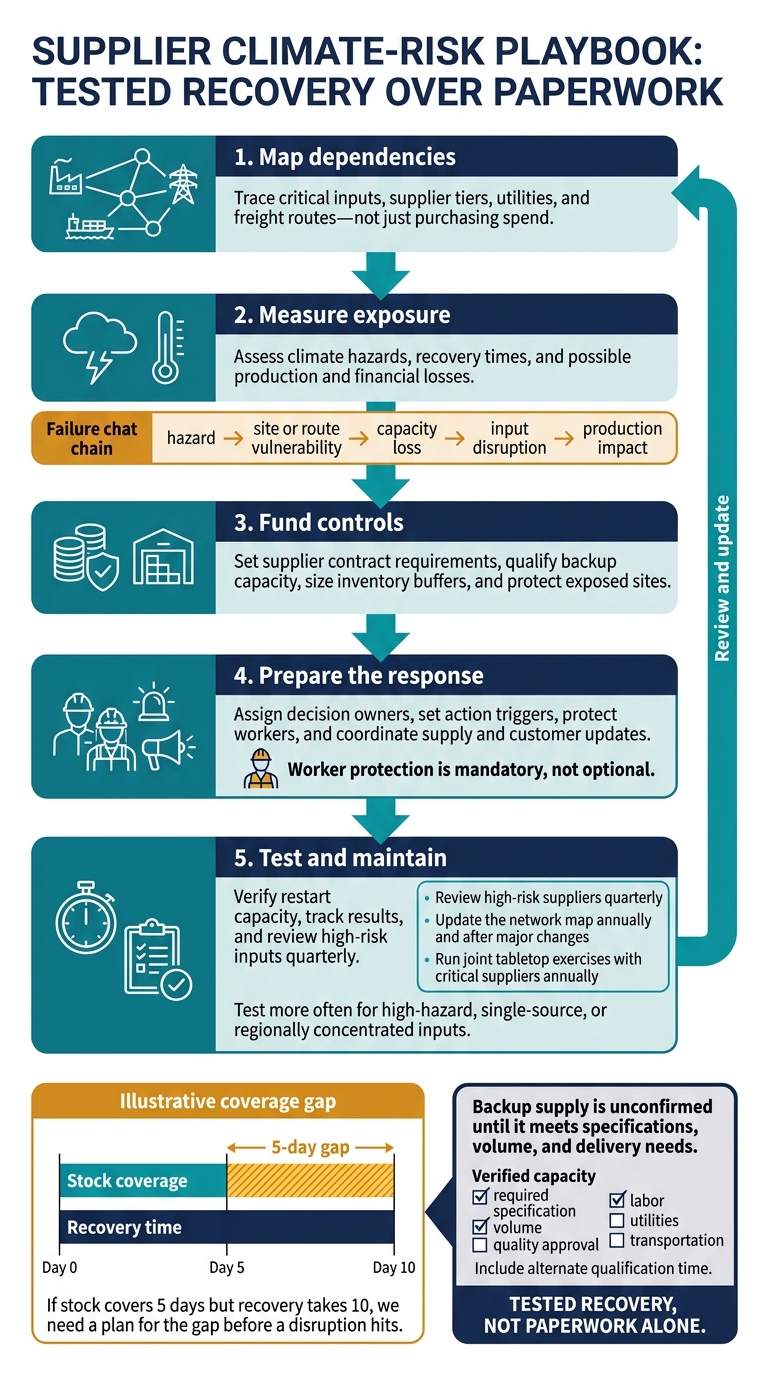
We protect production by knowing which inputs can fail - and testing how we will replace them. If stock covers 5 days but recovery takes 10, we need a plan for the gap before a disruption hits.
Our supplier climate playbook turns that work into five steps:
Map dependencies: Trace critical inputs, supplier tiers, utilities, and freight routes - not just purchasing spend.
Measure exposure: Assess climate hazards, recovery times, and possible production and financial losses.
Fund controls: Set supplier contract requirements, qualify backup capacity, size inventory buffers, and protect exposed sites.
Prepare the response: Assign decision owners, set action triggers, protect workers, and coordinate supply and customer updates.
Test and maintain: Verify restart capacity, track results, and review high-risk inputs quarterly.
We treat backup supply as unconfirmed until it meets our specifications, volume, and delivery needs. The goal is <u>tested recovery, not paperwork alone</u>.
Manufacturing Supplier Climate Risk: 5-Step Playbook
Navigating Supplier Risk Management
sbb-itb-8baf5f1
Assess Climate Risks and Business Impact
Use the critical-input register to identify where each dependency could fail - and what that failure would mean for production.
Review Hazards at Sites and Transport Routes
Assess flooding, hurricanes, storm surge, heat, drought, wildfire, smoke, winter storms, outages, and water or raw-material shortages using the register data. NOAA records can support this review [7][8][9]. Separate acute events, such as flash floods, from chronic stresses, such as rising sea levels and water scarcity.
Check current conditions, the next 5–10 years, and the full contract or asset life. For each projection, record its baseline, emissions scenario, spatial resolution, date, and confidence. Projections are not precise forecasts.
Map exposure into a failure chain: hazard → site or route vulnerability → capacity loss → input disruption → production impact. Look beyond building damage. Check loading docks, equipment, worker access, cooling, water supply, product quality, and route restrictions. A supplier may remain open even when its bridge or power supply fails.
Separate storm duration from recovery time. Flag missing utility data and recovery estimates that haven't been verified, then carry the highest-exposure sites and routes into the ranking step.
Rank Risks by Production and Financial Impact
Score likelihood and consequence on a consistent 1–5 scale. Then account for site weaknesses, response capacity, input criticality, supplier concentration, alternate-source availability, qualification time, inventory coverage, customer commitments, worker safety, and financial loss.
Compare survival time - how long stock and remaining capacity can sustain production - with time to recover [6]. Estimate losses using unfilled units × unit contribution margin, then add expediting, scrap, requalification, overtime, penalties, customer credits, and recovery investment. State the assumptions and confidence levels behind each estimate.
Hazard Exposed site or route Affected input Disruption duration Impact Existing controls Action River flooding Midwest supplier plant and 40-mile inbound route Sealed motor housing 3–7 days; medium confidence Production stoppage; $250,000–$600,000 loss, assuming $50,000–$100,000 daily contribution margin 5 days of inventory; flood insurance; one alternate carrier Move loading equipment higher, validate a second supplier, and increase coverage to 10 days Hurricane and storm surge Gulf Coast chemical supplier and port route Resin additive 2–4 weeks; low-to-medium confidence Line shutdown and customer delays; $1.2 million–$2.0 million exposure 7 days of stock; emergency freight clause Qualify a geographically separate source and pre-book alternate transport Extreme heat and grid outages Southwest supplier Precision-machined part 1–3 days per event; medium confidence Reduced output, worker-safety constraints, and overtime; $100,000–$300,000 loss Backup generator for essential loads Add cooling and backup-power requirements to the contract
Use these rankings to test failures across multiple sites and suppliers.
Test Regional and Cascading Disruptions
Run tabletop exercises that become progressively harder: a local outage, a regional disaster, and simultaneous failures across utilities, suppliers, freight, and customer deliveries. Clearly label each scenario as hypothetical and document its assumptions.
Calculate which inputs stop, how inventory gets consumed, and when production must change. Check which alternate suppliers are qualified and whether alternate transport can actually operate.
Hypothetical scenario Affected dependencies Inventory coverage Verified alternate capacity Estimated shortfall Action Flood blocks packaging supplier and inbound route Supplier dock, bridge, carrier, plant receiving 6 days 40% at a qualified supplier, available after 3 days 2 production days Reroute freight, ration packaging, prioritize highest-value orders, and activate alternate supplier Regional hurricane closes two suppliers and a port Two plants, port, electricity, common carrier 8 days None immediately; unqualified supplier has 70% capacity, with 30-day qualification 10–15 days Expedite qualification, substitute approved material where possible, and allocate inventory by customer priority Heat wave causes rolling outages at a component supplier Grid, cooling, worker availability, quality controls 4 days 25% spare capacity at a qualified supplier 3 days Shift production, add temporary cooling and generation, and use overtime after safety review
“Verified capacity” means capacity confirmed for the required specification, volume, quality approval, labor, utilities, and transportation - not simply a supplier’s stated maximum. Include alternate qualification time: a supplier that cannot deliver approved parts during the disruption window is not an immediate contingency.
Strengthen Supplier Contracts and Supply Controls
Use the highest-ranked exposures in the risk assessment to set contract terms, inventory levels, and site-hardening priorities.
Define Supplier Continuity Requirements
Procurement, operations, legal, and risk teams should turn each priority exposure into a measurable supplier obligation. Base requirements on the register’s site, hazard, and recovery-time data. Document the input, site, hazard, maximum tolerated outage, recovery-time objective (RTO), minimum recovery capacity (MBCO), and required proof.
Requirements may cover a written continuity plan, named incident contacts, alternate production or warehousing sites, backup utilities, reserve capacity, emergency transport, sub-tier supplier disclosure, and annual testing. Add data-recovery targets when data loss could delay deliveries. Require Tier 2 and Tier 3 disclosure in both supplier contracts and supplier continuity plans.[10][11][13]
Set notification triggers, deadlines, required information, and update frequency.
Notice within 4 hours of a disruption that could affect delivery is one possible requirement.
Request recovery-test results, alternate-site agreements, maintenance records, and annual exercises. Support these requests with audit rights proportionate to the risk and confidentiality protections. Legal counsel should review force majeure, mitigation duties, cost allocation, escalation, service levels, corrective-action deadlines, liability, insurance, termination, and change control. A force-majeure clause allocates legal consequences after an event; it does not guarantee supply or prevent disruption.[13][15]
Compare Sourcing and Inventory Options
Use the ranges below to compare controls.[10][12][16] Start with inputs that have the greatest production and financial impact. Before qualifying alternate sources, check whether they share upstream dependencies. Qualification should cover engineering specifications, quality testing, customer or regulatory approvals, tooling, commercial terms, and a production trial at the required volume.[11][16]
| Control | Planning timeframe | Cost profile | Continuity benefit | Quality risk | Emissions trade-off | Accountable owner |
|---|---|---|---|---|---|---|
| Multisourcing | 6–24 months | Medium to high supplier-management and qualification cost | High for single-source exposure; lower if suppliers share the same region | Medium until qualification is complete | Potentially higher freight and duplicated production | Procurement and engineering |
| Inventory buffers | Weeks to months | Working capital, storage, and obsolescence costs | High for short disruptions | Low if stored correctly; risk of obsolescence | Usually higher warehousing emissions; may reduce emergency freight | Operations and supply planning |
| Alternate materials | 6–18 months | Medium testing, tooling, and approval cost | High if technically validated | High during testing and customer approval | May increase or decrease emissions depending on processing and transport | Engineering and quality |
| Supplier hardening | 3–24 months | Medium to high capital cost | High for site-specific hazards | Low if process controls remain unchanged | Often improves energy and water efficiency | Supplier, procurement, and risk |
| Alternate logistics | Days to months | Low to medium route or carrier premiums | Medium to high for route or port disruption | Low to medium, depending on handling | Rerouting may increase distance and emissions | Logistics and operations |
Size inventory using disruption demand + recovery demand + buffer − reliable recovery supply. Include replenishment lead time and recovery ramp-up. Check shelf life, storage conditions, minimum order quantities, working capital, and warehousing emissions.
Compare each control’s annualized cost with avoided lost margin, expediting, scrap, customer penalties, restart costs, and reputational effects. The lowest unit price may not deliver the best result if it increases concentration or climate vulnerability.[10][12][16]
Prioritize Supplier Site Protection
Fund controls at the bottleneck - the single point that most limits output.
Controls include raised electrical equipment, barriers, and drainage for flooding; cooling capacity and worker heat controls for extreme heat; backup power and fuel for outages; water reuse, storage, leak controls, and backup supply for shortages; and detection, suppression, and protected access routes for fire.
Assign responsibility for paying, installing, maintaining, and verifying each measure. The supplier may own the upgrades while the buyer supports them through co-investment or a longer contract. Rank spending by downtime avoided, delivery capacity protected, implementation time, maintenance burden, residual risk, worker safety, and emissions. Worker protection is mandatory, not optional.[10][14]
Translate these controls into trigger-based response actions and recovery roles.
Respond to Disruptions and Restore Production
When a hazard exceeds contract controls or inventory buffers, activate the response playbook.
Set Response Triggers and Decision Roles
In the first hours, protect people, confirm the incident, identify affected suppliers, and stop unsafe shipments. Assign an incident owner with authority to activate the playbook, guided by the same critical-input register and impact ranking. Also name leads for procurement, operations, quality, logistics, EHS, and finance.
Confirm worker safety, site access, utilities, inventory, transport, and sub-tier capacity. Set clear approval limits for each role, reserving emergency spending and major commercial decisions for the executive sponsor. Match escalations to the notification and recovery terms in supplier contracts.
Set input-specific triggers using TTR, inventory coverage, and interruption tolerance. Compare supplier TTR against remaining coverage and the maximum tolerable interruption.[19]
| Trigger | Decision owner | Immediate action | Escalation threshold | Alternate supply option | Recovery milestone |
|---|---|---|---|---|---|
| National Weather Service warning affects a supplier region | Incident owner | Confirm exposure, worker safety, stock, and access | Projected outage exceeds available stock coverage | Approved alternate site or regional stock | Safe access and verified delivery capacity |
| Supplier reports site closure for more than 24 hours | Incident owner | Confirm safety, inventory, and estimated restart | Closure exceeds the input’s recovery-time objective | Release approved secondary supplier or regional stock | Supplier passes restart inspection and ships verified material |
| Inventory falls below 5 production days | Operations lead | Recalculate demand and pause allocations that aren't needed | Inventory falls below 2 production days | Reallocate stock, expedite freight, or approve qualified substitute | Inventory returns to target coverage |
| Utility outage affects supplier production | Supplier continuity lead | Request outage status and capacity estimate | No reliable restoration estimate within 12 hours | Shift volume to alternate site or supplier | Normal capacity sustained for an agreed period |
| Transport route or port closes | Logistics lead | Confirm alternate route and carrier capacity | Closure threatens customer or production commitment | Use alternate carrier, port, rail, or truck route | Transit times and delivery performance normalize |
Once a trigger is met, move from detection to allocation and communication.
Coordinate Supply Allocation and Communications
Allocate scarce inputs according to agreed priorities: worker and public safety, contractual and regulatory obligations, critical customers, restart efficiency, and financial impact. Recalculate supply daily - or more often during severe shortages.
Procurement submits contingency purchases. Quality and engineering verify specifications, certificates, traceability, compatibility, testing requirements, and required customer or regulatory approvals. Require dual approval for safety- or compliance-critical sourcing. Approve expedited freight only with a documented business case: airfreight, emergency trucking, and partial loads can sharply increase costs and emissions.
Assign one spokesperson and a backup. Suppliers and carriers provide capacity and route updates; customers receive confirmed impacts and revised dates; executives receive exposure, cash impact, and decisions needed. Notify insurers promptly and regulators when required.
Log quantities, decisions, approvers, costs, and the next review time. State deadlines in both local time and Eastern Time, including the date and daylight-saving status.
Verify Recovery and Test the Plan
After stabilization, shift to controlled recovery and restart in stages. Obtain clearance for site safety, utilities, equipment, environmental controls, workforce availability, information systems, material quality, and transportation. Requalify materials and processes damaged or changed by the event.
Inspect, run a controlled pilot, verify results, then ramp up production. Rebuild inventory, monitor on-time delivery and defect rates, reconcile costs and claims, and compare actual recovery time with the RTO. Close the incident only after capacity remains stable for an agreed period and actions have owners and deadlines.
Run joint tabletop exercises with critical suppliers annually. Test more often for high-hazard, single-source, or regionally concentrated inputs. Check communications, alternate capacity, decision rights, and recovery assumptions - not just whether participants can find the plan.[17][18]
Maintain the Playbook and Plan Next Steps
Assign Owners and Track Results
Name an executive sponsor with authority to fund controls, and document decision rights in a RACI matrix. Assign owners and backups for procurement, operations, engineering, finance, legal, logistics, and sustainability/risk. Build that accountability into sourcing, scorecards, S&OP, capital planning, and ERM.
Track readiness separately from outcomes. Readiness measures include critical inputs mapped through Tier 2 or deeper, high-risk sites assessed, qualified alternate capacity as a percentage of demand, inventory days, and exercise completion. Outcome measures include actual notification and recovery times compared with targets.
Give every metric a data owner, calculation, threshold, and escalation path. Label estimated avoided downtime as modeled, not observed. Use the metrics to guide quarterly reviews and close overdue actions.
Review Risks and Fix Control Gaps
Use the tracker to identify gaps that need correction. Review high-risk suppliers quarterly, and update the network map annually and after major changes.[20][21] Revisit risk scores, contracts, inventory policies, and design specifications after disruptions, exercises, acquisitions, product changes, or major climate-risk updates. Maintain version control so users can see what changed, who approved it, when it took effect, and which training or exercise is required.[22][23]
Require corrective-action plans for weak controls. For each gap, document the affected input and site, business consequence, interim safeguard, accountable owner, budget, deadline, and evidence needed for closure. Address gaps involving safety, production stoppages, no qualified alternative, or long recovery times first. Do not close a gap until evidence shows the control works.
Set Implementation Priorities
Turn the largest gaps from the review into funded work. Start with critical dependencies where high impact meets weak controls: assign owners, fund priority safeguards and fixes, and schedule a supplier exercise.
Organizations seeking outside help may consider Council Fire for climate-resilience planning and implementation support. Keep supplier decisions and recovery validation under internal ownership. Fund implementation and tested recovery, not reporting alone: fix, test, validate, and recover.
FAQs
How can we map risks when sub-tier data is missing?
Map beyond Tier 1 to find hidden dependencies, especially for high-risk commodities such as cobalt or palm oil [1]. Catalog every supplier and logistics partner, then use digital platforms and geospatial tools to pinpoint geographic risk hotspots [2][3][4].
When facility-level data isn't available, group facilities by region to assess risk. National averages can hide local climate differences [5].
How much backup inventory is worth the cost?
The right inventory buffer balances resilience with day-to-day efficiency. How much you hold depends on your organization’s risk tolerance, so leaders should agree on which risks to reduce and which to accept [1].
Use supply chain metrics from prior years to estimate inventory needs, and apply an Inventory Optimization Ratio to weigh buffers against efficiency [1]. Ground the decision in financial estimates of disruption costs, including both direct and indirect impacts [2].
How can we verify a supplier’s recovery claims?
Use third-party verification and objective documentation to support your assessments. This includes independent climate risk audits, resilient infrastructure certifications, and peer reviews of adaptation plans [1].
Look for assessments that link historical extreme weather data to actual financial impacts [2]. Track supply chain risks consistently with standardized templates, such as a Vulnerability and Risk Synthesis Report. These records provide a clear audit trail of recovery readiness and contingency preparedness [2][3].

FAQ