
Feb 24, 2026
How ISO 59000 Series Supports Collaboration
Sustainability Strategy
In This Article
How the ISO 59000 series creates shared language, principles, and metrics to enable circular economy collaboration and measurable progress.
How ISO 59000 Series Supports Collaboration
The ISO 59000 series, introduced in May 2024, provides the first global framework for managing the circular economy. By creating a shared language and principles, it helps industries align efforts, improve resource use, and reduce waste. Key standards include:
ISO 59004: Establishes core principles like systems thinking and resource traceability.
ISO 59010: Guides organizations in building circular value networks.
ISO 59020: Defines metrics to measure circularity and track progress.
These standards enable organizations to collaborate effectively, transforming supply chains and creating resilient ecosystems. They align with global sustainability goals, offering practical steps for adopting circular practices while addressing climate and resource challenges.
Key Takeaways:
Introduces shared terminology to ease collaboration.
Focuses on principles, network restructuring, and measurable outcomes.
Supports industries in aligning with UN Agenda 2030.
ISO 59000 - The New Gold Standard in Circularity?
Core Standards in the ISO 59000 Series
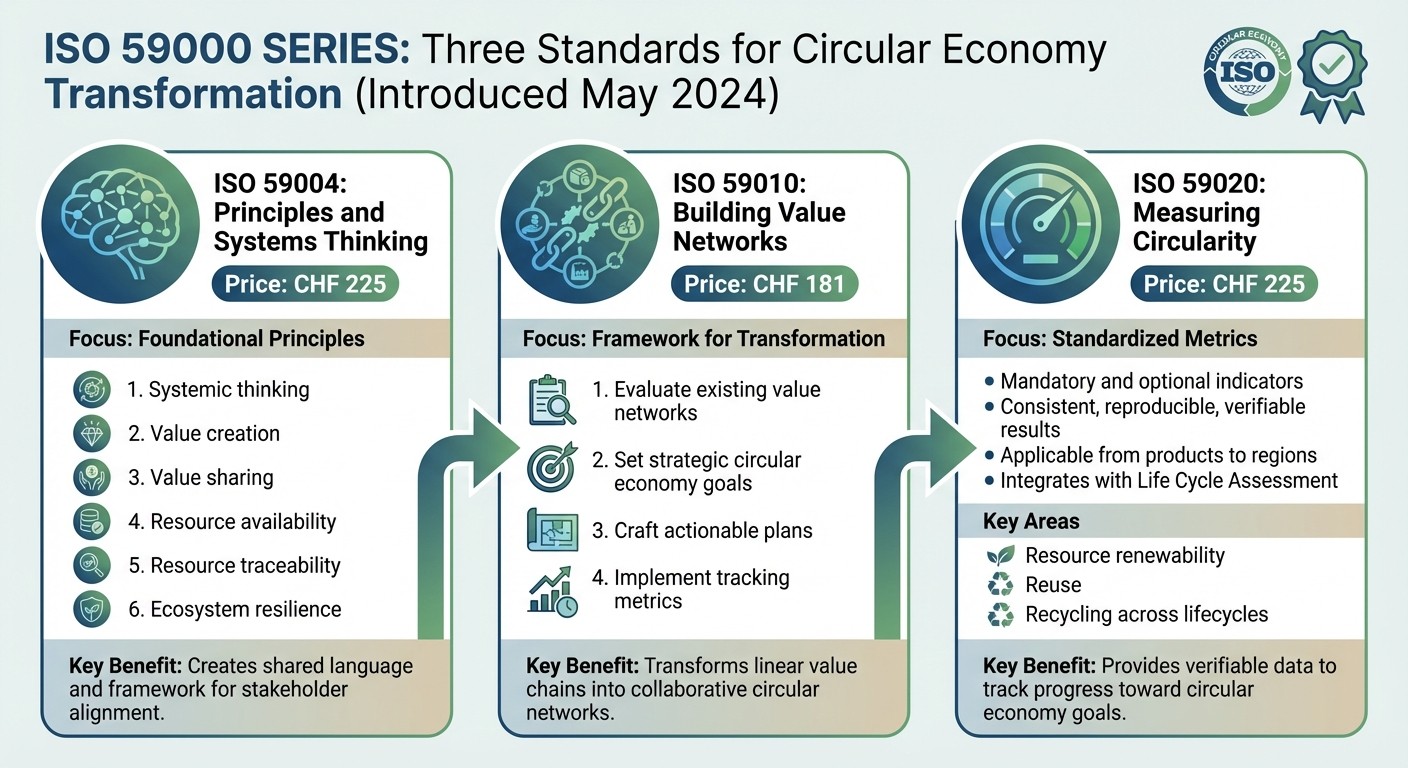
ISO 59000 Series Standards Overview: Principles, Networks, and Metrics
The ISO 59000 series introduces three key standards designed to guide organizations through the shift to a circular economy. These standards align with global sustainability objectives and provide structured approaches for organizations to adopt shared strategies. Each standard focuses on a specific element of this transformation: ISO 59004 defines the core principles, ISO 59010 outlines how to restructure value networks, and ISO 59020 establishes metrics for tracking progress.
ISO 59004: Principles and Systems Thinking
ISO 59004:2024 lays out six foundational principles essential for implementing a circular economy: systemic thinking, value creation, value sharing, resource availability, resource traceability, and ecosystem resilience [4]. At its core, systemic thinking encourages organizations to integrate environmental, economic, and social impacts into their strategies, fostering collaboration across industries.
This principle prompts businesses to rethink their offerings, promoting industrial symbiosis to keep resources in circulation [4]. By introducing a shared language and framework, ISO 59004 facilitates alignment among stakeholders of varying industries, sizes, and geographic locations [1][3]. Available for CHF 225 through the ISO Store [1], this standard provides the foundational mindset for fostering cooperation and achieving circular economy goals.
ISO 59010: Framework for Building Value Networks
ISO 59010:2024 focuses on transforming traditional linear value chains into interconnected, circular networks [5][7]. The framework emphasizes the creation of collaborative value networks that unite stakeholders under shared objectives [8][3].
The process involves several key steps: evaluating existing value networks, setting strategic circular economy goals, crafting actionable plans, and implementing metrics to track progress [5][3]. Organizations can purchase ISO 59010 for CHF 181 [5]. This standard bridges the gap between principles and practice, offering a clear pathway to redesign value networks.
ISO 59020: Metrics for Measuring Circularity
ISO 59020:2024 provides a standardized approach to measuring circularity using a mix of mandatory and optional indicators. These metrics ensure that results are consistent, reproducible, and verifiable across collaborative efforts [2][9]. The standard applies to various levels - from individual products to entire regions - allowing organizations to measure progress at the scale that suits their needs [2][9].
Key areas of focus include resource renewability, reuse, and recycling across product lifecycles [4]. Ferdinand Zotz, Principal of Circular Economy and Resource Management at Ramboll, highlights the importance of this standard:
"The published standards support the circular economy theme of the Sustainability Reporting Directive (CSRD) and will be very relevant for measuring progress on circularity in the context of ESRS E5" [4].
Priced at CHF 225 [2], ISO 59020 integrates its metrics with Life Cycle Assessment, offering a detailed picture of environmental impacts [4]. Together, these standards provide a comprehensive toolkit for organizations to innovate and collaborate effectively, paving the way for sustainable business practices.
Using ISO 59000 for Collaborative Innovation
The ISO 59000 series provides structured frameworks that reshape how organizations collaborate, particularly in fostering industrial symbiosis. By establishing a shared foundation, these standards enable businesses to pool resources and recover value collectively, aligning diverse stakeholders around common sustainability goals.
Aligning Stakeholders with Shared Objectives
At the heart of the ISO 59000 series, ISO 59004 serves as a key tool for uniting sectors in sustainability efforts. This framework is especially valuable when government bodies, private companies, and nonprofits need to work together. With input from organizations across more than 100 countries [4], it ensures that all parties can communicate effectively, bridging gaps between different sectors.
ISO 59010 takes this further by helping organizations shift from traditional linear value chains to more dynamic, collaborative value networks [5]. Instead of treating suppliers and partners as isolated links in a chain, this standard encourages mapping out interconnected relationships where resource efficiency becomes a shared responsibility. It also suggests that stakeholders convene in neutral settings to define shared goals, ethical guidelines, and system designs before embarking on innovation projects [6]. Prof. Christopher Hodges and Scott Steedman highlight the importance of this approach:
"Co-creating a system of legislative rules, stakeholder‐led standards and accredited conformity assessment to deliver a policy objective will accelerate outcomes by building consensus, ownership and accountability" [6].
By establishing common objectives, organizations lay the groundwork for stronger, data-driven systems that can adapt and thrive.
Building Resilient Ecosystems Through Collaboration
One of the core principles of ISO 59004 is ecosystem resilience - the ability of environmental, social, and economic systems to adapt to and thrive under changing circumstances [1]. To support this resilience, ISO 59020 introduces standardized metrics that enhance transparency within collaborative networks. These metrics help build trust among partners by providing verifiable data to track progress toward shared goals [2].
Expanding on these aligned objectives, ISO 59040's Product Circularity Data Sheets (PCDS) offer a secure and standardized way to share data across supply chains. This tool integrates partners more deeply into resource management, enabling informed decision-making and uncovering opportunities for collaboration [10]. Ferdinand Zotz, Principal of Environment & Health at Ramboll, underscores the potential for businesses:
"Our hope is to help clients see the standards as a business opportunity rather than a compliance exercise" [4].
These frameworks empower organizations to create resilient ecosystems where partners work together on resource stewardship, share risks, and collectively respond to regulatory changes and market shifts. Standardized policies thus become a driving force for collaborative innovation aimed at sustainability.
Implementing the ISO 59000 Standards
Steps for Implementation
Adopting ISO 59000 involves a structured five-step process rooted in teamwork and ongoing learning. To begin, organizations should evaluate their current situation by analyzing existing value networks, identifying system conditions, and assessing risks and opportunities related to circular transitions. Following this, they need to define a strategic vision by creating a mission statement and setting circular economy goals that align with the six core principles outlined in ISO 59004. During the planning stage, teams focus on designing for durability and reparability, developing circular sourcing strategies, and initiating pilot projects. These pilot projects are essential for testing assumptions and fine-tuning processes before scaling up.
The implementation phase emphasizes building organizational capacity and raising departmental awareness to ensure the successful execution of action plans. In the final review phase, ISO 59020's indicators are used to monitor progress by tracking metrics such as resource flows, energy use, and economic outcomes. Transparent reporting of these findings to stakeholders is crucial [2]. To stay relevant with advancing technologies and regulatory changes, ISO standards are reviewed every five years [1].
Before integrating new standards, it’s essential to map out existing frameworks to identify gaps and ensure alignment with current regulations and internal systems [6].
This methodical approach lays a solid foundation for practical applications, as demonstrated by Council Fire's collaborative model.
Case Study: Council Fire's Approach to Collaboration
Council Fire provides a compelling example of how to bring the ISO 59000 series to life through systems thinking and deep collaboration. Instead of viewing sustainability as a compliance task, Council Fire partners with governments, NGOs, foundations, and companies to create circular economies and regenerative infrastructure that yield tangible results. Their strategy aligns with ISO 59010's emphasis on transforming traditional value chains into cooperative value networks, where resource efficiency becomes a shared responsibility among all stakeholders. By following these steps, Council Fire fosters the development of circular economies and resilient ecosystems, moving beyond ESG compliance to achieve meaningful, system-wide outcomes.
Conclusion
The ISO 59000 series reshapes how we approach sustainability, encouraging organizations to move beyond isolated initiatives toward collaborative efforts that deliver measurable outcomes. With the backing of 75 standardization bodies across more than 100 countries, this framework establishes a shared global language for sustainable practices [3][4].
At its heart, the series promotes industrial symbiosis, where resource efficiency becomes a shared responsibility rather than a competitive edge. By making these practices accessible, the framework enables organizations of all sizes to participate in meaningful sustainability efforts.
These standards go beyond compliance, equipping organizations to address resource challenges, navigate changing regulations, and contribute to advancing the UN Agenda 2030 [4].
Real-world examples, such as Council Fire's application of these standards, highlight the potential for sustainability to thrive when organizations adopt systems thinking and prioritize partnerships. By viewing ISO 59000 as a strategic business opportunity rather than a regulatory requirement, organizations can create resilient ecosystems, foster circular value networks, and achieve lasting competitive gains.
The ISO 59000 series offers the roadmap - it's through collaboration that the impact becomes tangible.
FAQs
Which ISO 59000 standard should we start with?
ISO 59004:2024 lays out the key vocabulary, principles, and guidance necessary for embracing a circular economy. It serves as the cornerstone for aligning with the broader ISO 59000 series standards. For organizations aiming to integrate circular economy practices, this standard is the logical first step.
How do ISO 59020 metrics help partners trust shared results?
ISO 59020 metrics establish trust by creating a standardized approach to measuring and assessing circularity performance. This ensures that data remains consistent, verifiable, and straightforward to interpret, no matter the organization. Such a reliable framework promotes transparency and boosts confidence among stakeholders. Additionally, it helps align initiatives and encourages stronger collaboration between partners.
How can Council Fire help implement ISO 59000 collaboration?
Council Fire contributes to the ISO 59000 framework by promoting planning processes that prioritize stakeholder input, encouraging systems thinking, and building partnerships across various sectors. These initiatives are designed to help organizations align their activities with the standard’s emphasis on circular economy principles and advancing sustainable practices. By offering actionable strategies, we assist organizations in integrating sustainability into their operations and achieving clear, measurable outcomes.
Related Blog Posts
Latest Articles
©2025



FAQ
01
What does it really mean to “redefine profit”?
02
What makes Council Fire different?
03
Who does Council Fire you work with?
04
What does working with Council Fire actually look like?
05
How does Council Fire help organizations turn big goals into action?
06
How does Council Fire define and measure success?
Feb 24, 2026
How ISO 59000 Series Supports Collaboration
Sustainability Strategy
In This Article
How the ISO 59000 series creates shared language, principles, and metrics to enable circular economy collaboration and measurable progress.
How ISO 59000 Series Supports Collaboration
The ISO 59000 series, introduced in May 2024, provides the first global framework for managing the circular economy. By creating a shared language and principles, it helps industries align efforts, improve resource use, and reduce waste. Key standards include:
ISO 59004: Establishes core principles like systems thinking and resource traceability.
ISO 59010: Guides organizations in building circular value networks.
ISO 59020: Defines metrics to measure circularity and track progress.
These standards enable organizations to collaborate effectively, transforming supply chains and creating resilient ecosystems. They align with global sustainability goals, offering practical steps for adopting circular practices while addressing climate and resource challenges.
Key Takeaways:
Introduces shared terminology to ease collaboration.
Focuses on principles, network restructuring, and measurable outcomes.
Supports industries in aligning with UN Agenda 2030.
ISO 59000 - The New Gold Standard in Circularity?
Core Standards in the ISO 59000 Series
ISO 59000 Series Standards Overview: Principles, Networks, and Metrics
The ISO 59000 series introduces three key standards designed to guide organizations through the shift to a circular economy. These standards align with global sustainability objectives and provide structured approaches for organizations to adopt shared strategies. Each standard focuses on a specific element of this transformation: ISO 59004 defines the core principles, ISO 59010 outlines how to restructure value networks, and ISO 59020 establishes metrics for tracking progress.
ISO 59004: Principles and Systems Thinking
ISO 59004:2024 lays out six foundational principles essential for implementing a circular economy: systemic thinking, value creation, value sharing, resource availability, resource traceability, and ecosystem resilience [4]. At its core, systemic thinking encourages organizations to integrate environmental, economic, and social impacts into their strategies, fostering collaboration across industries.
This principle prompts businesses to rethink their offerings, promoting industrial symbiosis to keep resources in circulation [4]. By introducing a shared language and framework, ISO 59004 facilitates alignment among stakeholders of varying industries, sizes, and geographic locations [1][3]. Available for CHF 225 through the ISO Store [1], this standard provides the foundational mindset for fostering cooperation and achieving circular economy goals.
ISO 59010: Framework for Building Value Networks
ISO 59010:2024 focuses on transforming traditional linear value chains into interconnected, circular networks [5][7]. The framework emphasizes the creation of collaborative value networks that unite stakeholders under shared objectives [8][3].
The process involves several key steps: evaluating existing value networks, setting strategic circular economy goals, crafting actionable plans, and implementing metrics to track progress [5][3]. Organizations can purchase ISO 59010 for CHF 181 [5]. This standard bridges the gap between principles and practice, offering a clear pathway to redesign value networks.
ISO 59020: Metrics for Measuring Circularity
ISO 59020:2024 provides a standardized approach to measuring circularity using a mix of mandatory and optional indicators. These metrics ensure that results are consistent, reproducible, and verifiable across collaborative efforts [2][9]. The standard applies to various levels - from individual products to entire regions - allowing organizations to measure progress at the scale that suits their needs [2][9].
Key areas of focus include resource renewability, reuse, and recycling across product lifecycles [4]. Ferdinand Zotz, Principal of Circular Economy and Resource Management at Ramboll, highlights the importance of this standard:
"The published standards support the circular economy theme of the Sustainability Reporting Directive (CSRD) and will be very relevant for measuring progress on circularity in the context of ESRS E5" [4].
Priced at CHF 225 [2], ISO 59020 integrates its metrics with Life Cycle Assessment, offering a detailed picture of environmental impacts [4]. Together, these standards provide a comprehensive toolkit for organizations to innovate and collaborate effectively, paving the way for sustainable business practices.
Using ISO 59000 for Collaborative Innovation
The ISO 59000 series provides structured frameworks that reshape how organizations collaborate, particularly in fostering industrial symbiosis. By establishing a shared foundation, these standards enable businesses to pool resources and recover value collectively, aligning diverse stakeholders around common sustainability goals.
Aligning Stakeholders with Shared Objectives
At the heart of the ISO 59000 series, ISO 59004 serves as a key tool for uniting sectors in sustainability efforts. This framework is especially valuable when government bodies, private companies, and nonprofits need to work together. With input from organizations across more than 100 countries [4], it ensures that all parties can communicate effectively, bridging gaps between different sectors.
ISO 59010 takes this further by helping organizations shift from traditional linear value chains to more dynamic, collaborative value networks [5]. Instead of treating suppliers and partners as isolated links in a chain, this standard encourages mapping out interconnected relationships where resource efficiency becomes a shared responsibility. It also suggests that stakeholders convene in neutral settings to define shared goals, ethical guidelines, and system designs before embarking on innovation projects [6]. Prof. Christopher Hodges and Scott Steedman highlight the importance of this approach:
"Co-creating a system of legislative rules, stakeholder‐led standards and accredited conformity assessment to deliver a policy objective will accelerate outcomes by building consensus, ownership and accountability" [6].
By establishing common objectives, organizations lay the groundwork for stronger, data-driven systems that can adapt and thrive.
Building Resilient Ecosystems Through Collaboration
One of the core principles of ISO 59004 is ecosystem resilience - the ability of environmental, social, and economic systems to adapt to and thrive under changing circumstances [1]. To support this resilience, ISO 59020 introduces standardized metrics that enhance transparency within collaborative networks. These metrics help build trust among partners by providing verifiable data to track progress toward shared goals [2].
Expanding on these aligned objectives, ISO 59040's Product Circularity Data Sheets (PCDS) offer a secure and standardized way to share data across supply chains. This tool integrates partners more deeply into resource management, enabling informed decision-making and uncovering opportunities for collaboration [10]. Ferdinand Zotz, Principal of Environment & Health at Ramboll, underscores the potential for businesses:
"Our hope is to help clients see the standards as a business opportunity rather than a compliance exercise" [4].
These frameworks empower organizations to create resilient ecosystems where partners work together on resource stewardship, share risks, and collectively respond to regulatory changes and market shifts. Standardized policies thus become a driving force for collaborative innovation aimed at sustainability.
Implementing the ISO 59000 Standards
Steps for Implementation
Adopting ISO 59000 involves a structured five-step process rooted in teamwork and ongoing learning. To begin, organizations should evaluate their current situation by analyzing existing value networks, identifying system conditions, and assessing risks and opportunities related to circular transitions. Following this, they need to define a strategic vision by creating a mission statement and setting circular economy goals that align with the six core principles outlined in ISO 59004. During the planning stage, teams focus on designing for durability and reparability, developing circular sourcing strategies, and initiating pilot projects. These pilot projects are essential for testing assumptions and fine-tuning processes before scaling up.
The implementation phase emphasizes building organizational capacity and raising departmental awareness to ensure the successful execution of action plans. In the final review phase, ISO 59020's indicators are used to monitor progress by tracking metrics such as resource flows, energy use, and economic outcomes. Transparent reporting of these findings to stakeholders is crucial [2]. To stay relevant with advancing technologies and regulatory changes, ISO standards are reviewed every five years [1].
Before integrating new standards, it’s essential to map out existing frameworks to identify gaps and ensure alignment with current regulations and internal systems [6].
This methodical approach lays a solid foundation for practical applications, as demonstrated by Council Fire's collaborative model.
Case Study: Council Fire's Approach to Collaboration
Council Fire provides a compelling example of how to bring the ISO 59000 series to life through systems thinking and deep collaboration. Instead of viewing sustainability as a compliance task, Council Fire partners with governments, NGOs, foundations, and companies to create circular economies and regenerative infrastructure that yield tangible results. Their strategy aligns with ISO 59010's emphasis on transforming traditional value chains into cooperative value networks, where resource efficiency becomes a shared responsibility among all stakeholders. By following these steps, Council Fire fosters the development of circular economies and resilient ecosystems, moving beyond ESG compliance to achieve meaningful, system-wide outcomes.
Conclusion
The ISO 59000 series reshapes how we approach sustainability, encouraging organizations to move beyond isolated initiatives toward collaborative efforts that deliver measurable outcomes. With the backing of 75 standardization bodies across more than 100 countries, this framework establishes a shared global language for sustainable practices [3][4].
At its heart, the series promotes industrial symbiosis, where resource efficiency becomes a shared responsibility rather than a competitive edge. By making these practices accessible, the framework enables organizations of all sizes to participate in meaningful sustainability efforts.
These standards go beyond compliance, equipping organizations to address resource challenges, navigate changing regulations, and contribute to advancing the UN Agenda 2030 [4].
Real-world examples, such as Council Fire's application of these standards, highlight the potential for sustainability to thrive when organizations adopt systems thinking and prioritize partnerships. By viewing ISO 59000 as a strategic business opportunity rather than a regulatory requirement, organizations can create resilient ecosystems, foster circular value networks, and achieve lasting competitive gains.
The ISO 59000 series offers the roadmap - it's through collaboration that the impact becomes tangible.
FAQs
Which ISO 59000 standard should we start with?
ISO 59004:2024 lays out the key vocabulary, principles, and guidance necessary for embracing a circular economy. It serves as the cornerstone for aligning with the broader ISO 59000 series standards. For organizations aiming to integrate circular economy practices, this standard is the logical first step.
How do ISO 59020 metrics help partners trust shared results?
ISO 59020 metrics establish trust by creating a standardized approach to measuring and assessing circularity performance. This ensures that data remains consistent, verifiable, and straightforward to interpret, no matter the organization. Such a reliable framework promotes transparency and boosts confidence among stakeholders. Additionally, it helps align initiatives and encourages stronger collaboration between partners.
How can Council Fire help implement ISO 59000 collaboration?
Council Fire contributes to the ISO 59000 framework by promoting planning processes that prioritize stakeholder input, encouraging systems thinking, and building partnerships across various sectors. These initiatives are designed to help organizations align their activities with the standard’s emphasis on circular economy principles and advancing sustainable practices. By offering actionable strategies, we assist organizations in integrating sustainability into their operations and achieving clear, measurable outcomes.
Related Blog Posts
FAQ
01
What does it really mean to “redefine profit”?
02
What makes Council Fire different?
03
Who does Council Fire you work with?
04
What does working with Council Fire actually look like?
05
How does Council Fire help organizations turn big goals into action?
06
How does Council Fire define and measure success?
Feb 24, 2026
How ISO 59000 Series Supports Collaboration
Sustainability Strategy
In This Article
How the ISO 59000 series creates shared language, principles, and metrics to enable circular economy collaboration and measurable progress.
How ISO 59000 Series Supports Collaboration
The ISO 59000 series, introduced in May 2024, provides the first global framework for managing the circular economy. By creating a shared language and principles, it helps industries align efforts, improve resource use, and reduce waste. Key standards include:
ISO 59004: Establishes core principles like systems thinking and resource traceability.
ISO 59010: Guides organizations in building circular value networks.
ISO 59020: Defines metrics to measure circularity and track progress.
These standards enable organizations to collaborate effectively, transforming supply chains and creating resilient ecosystems. They align with global sustainability goals, offering practical steps for adopting circular practices while addressing climate and resource challenges.
Key Takeaways:
Introduces shared terminology to ease collaboration.
Focuses on principles, network restructuring, and measurable outcomes.
Supports industries in aligning with UN Agenda 2030.
ISO 59000 - The New Gold Standard in Circularity?
Core Standards in the ISO 59000 Series
ISO 59000 Series Standards Overview: Principles, Networks, and Metrics
The ISO 59000 series introduces three key standards designed to guide organizations through the shift to a circular economy. These standards align with global sustainability objectives and provide structured approaches for organizations to adopt shared strategies. Each standard focuses on a specific element of this transformation: ISO 59004 defines the core principles, ISO 59010 outlines how to restructure value networks, and ISO 59020 establishes metrics for tracking progress.
ISO 59004: Principles and Systems Thinking
ISO 59004:2024 lays out six foundational principles essential for implementing a circular economy: systemic thinking, value creation, value sharing, resource availability, resource traceability, and ecosystem resilience [4]. At its core, systemic thinking encourages organizations to integrate environmental, economic, and social impacts into their strategies, fostering collaboration across industries.
This principle prompts businesses to rethink their offerings, promoting industrial symbiosis to keep resources in circulation [4]. By introducing a shared language and framework, ISO 59004 facilitates alignment among stakeholders of varying industries, sizes, and geographic locations [1][3]. Available for CHF 225 through the ISO Store [1], this standard provides the foundational mindset for fostering cooperation and achieving circular economy goals.
ISO 59010: Framework for Building Value Networks
ISO 59010:2024 focuses on transforming traditional linear value chains into interconnected, circular networks [5][7]. The framework emphasizes the creation of collaborative value networks that unite stakeholders under shared objectives [8][3].
The process involves several key steps: evaluating existing value networks, setting strategic circular economy goals, crafting actionable plans, and implementing metrics to track progress [5][3]. Organizations can purchase ISO 59010 for CHF 181 [5]. This standard bridges the gap between principles and practice, offering a clear pathway to redesign value networks.
ISO 59020: Metrics for Measuring Circularity
ISO 59020:2024 provides a standardized approach to measuring circularity using a mix of mandatory and optional indicators. These metrics ensure that results are consistent, reproducible, and verifiable across collaborative efforts [2][9]. The standard applies to various levels - from individual products to entire regions - allowing organizations to measure progress at the scale that suits their needs [2][9].
Key areas of focus include resource renewability, reuse, and recycling across product lifecycles [4]. Ferdinand Zotz, Principal of Circular Economy and Resource Management at Ramboll, highlights the importance of this standard:
"The published standards support the circular economy theme of the Sustainability Reporting Directive (CSRD) and will be very relevant for measuring progress on circularity in the context of ESRS E5" [4].
Priced at CHF 225 [2], ISO 59020 integrates its metrics with Life Cycle Assessment, offering a detailed picture of environmental impacts [4]. Together, these standards provide a comprehensive toolkit for organizations to innovate and collaborate effectively, paving the way for sustainable business practices.
Using ISO 59000 for Collaborative Innovation
The ISO 59000 series provides structured frameworks that reshape how organizations collaborate, particularly in fostering industrial symbiosis. By establishing a shared foundation, these standards enable businesses to pool resources and recover value collectively, aligning diverse stakeholders around common sustainability goals.
Aligning Stakeholders with Shared Objectives
At the heart of the ISO 59000 series, ISO 59004 serves as a key tool for uniting sectors in sustainability efforts. This framework is especially valuable when government bodies, private companies, and nonprofits need to work together. With input from organizations across more than 100 countries [4], it ensures that all parties can communicate effectively, bridging gaps between different sectors.
ISO 59010 takes this further by helping organizations shift from traditional linear value chains to more dynamic, collaborative value networks [5]. Instead of treating suppliers and partners as isolated links in a chain, this standard encourages mapping out interconnected relationships where resource efficiency becomes a shared responsibility. It also suggests that stakeholders convene in neutral settings to define shared goals, ethical guidelines, and system designs before embarking on innovation projects [6]. Prof. Christopher Hodges and Scott Steedman highlight the importance of this approach:
"Co-creating a system of legislative rules, stakeholder‐led standards and accredited conformity assessment to deliver a policy objective will accelerate outcomes by building consensus, ownership and accountability" [6].
By establishing common objectives, organizations lay the groundwork for stronger, data-driven systems that can adapt and thrive.
Building Resilient Ecosystems Through Collaboration
One of the core principles of ISO 59004 is ecosystem resilience - the ability of environmental, social, and economic systems to adapt to and thrive under changing circumstances [1]. To support this resilience, ISO 59020 introduces standardized metrics that enhance transparency within collaborative networks. These metrics help build trust among partners by providing verifiable data to track progress toward shared goals [2].
Expanding on these aligned objectives, ISO 59040's Product Circularity Data Sheets (PCDS) offer a secure and standardized way to share data across supply chains. This tool integrates partners more deeply into resource management, enabling informed decision-making and uncovering opportunities for collaboration [10]. Ferdinand Zotz, Principal of Environment & Health at Ramboll, underscores the potential for businesses:
"Our hope is to help clients see the standards as a business opportunity rather than a compliance exercise" [4].
These frameworks empower organizations to create resilient ecosystems where partners work together on resource stewardship, share risks, and collectively respond to regulatory changes and market shifts. Standardized policies thus become a driving force for collaborative innovation aimed at sustainability.
Implementing the ISO 59000 Standards
Steps for Implementation
Adopting ISO 59000 involves a structured five-step process rooted in teamwork and ongoing learning. To begin, organizations should evaluate their current situation by analyzing existing value networks, identifying system conditions, and assessing risks and opportunities related to circular transitions. Following this, they need to define a strategic vision by creating a mission statement and setting circular economy goals that align with the six core principles outlined in ISO 59004. During the planning stage, teams focus on designing for durability and reparability, developing circular sourcing strategies, and initiating pilot projects. These pilot projects are essential for testing assumptions and fine-tuning processes before scaling up.
The implementation phase emphasizes building organizational capacity and raising departmental awareness to ensure the successful execution of action plans. In the final review phase, ISO 59020's indicators are used to monitor progress by tracking metrics such as resource flows, energy use, and economic outcomes. Transparent reporting of these findings to stakeholders is crucial [2]. To stay relevant with advancing technologies and regulatory changes, ISO standards are reviewed every five years [1].
Before integrating new standards, it’s essential to map out existing frameworks to identify gaps and ensure alignment with current regulations and internal systems [6].
This methodical approach lays a solid foundation for practical applications, as demonstrated by Council Fire's collaborative model.
Case Study: Council Fire's Approach to Collaboration
Council Fire provides a compelling example of how to bring the ISO 59000 series to life through systems thinking and deep collaboration. Instead of viewing sustainability as a compliance task, Council Fire partners with governments, NGOs, foundations, and companies to create circular economies and regenerative infrastructure that yield tangible results. Their strategy aligns with ISO 59010's emphasis on transforming traditional value chains into cooperative value networks, where resource efficiency becomes a shared responsibility among all stakeholders. By following these steps, Council Fire fosters the development of circular economies and resilient ecosystems, moving beyond ESG compliance to achieve meaningful, system-wide outcomes.
Conclusion
The ISO 59000 series reshapes how we approach sustainability, encouraging organizations to move beyond isolated initiatives toward collaborative efforts that deliver measurable outcomes. With the backing of 75 standardization bodies across more than 100 countries, this framework establishes a shared global language for sustainable practices [3][4].
At its heart, the series promotes industrial symbiosis, where resource efficiency becomes a shared responsibility rather than a competitive edge. By making these practices accessible, the framework enables organizations of all sizes to participate in meaningful sustainability efforts.
These standards go beyond compliance, equipping organizations to address resource challenges, navigate changing regulations, and contribute to advancing the UN Agenda 2030 [4].
Real-world examples, such as Council Fire's application of these standards, highlight the potential for sustainability to thrive when organizations adopt systems thinking and prioritize partnerships. By viewing ISO 59000 as a strategic business opportunity rather than a regulatory requirement, organizations can create resilient ecosystems, foster circular value networks, and achieve lasting competitive gains.
The ISO 59000 series offers the roadmap - it's through collaboration that the impact becomes tangible.
FAQs
Which ISO 59000 standard should we start with?
ISO 59004:2024 lays out the key vocabulary, principles, and guidance necessary for embracing a circular economy. It serves as the cornerstone for aligning with the broader ISO 59000 series standards. For organizations aiming to integrate circular economy practices, this standard is the logical first step.
How do ISO 59020 metrics help partners trust shared results?
ISO 59020 metrics establish trust by creating a standardized approach to measuring and assessing circularity performance. This ensures that data remains consistent, verifiable, and straightforward to interpret, no matter the organization. Such a reliable framework promotes transparency and boosts confidence among stakeholders. Additionally, it helps align initiatives and encourages stronger collaboration between partners.
How can Council Fire help implement ISO 59000 collaboration?
Council Fire contributes to the ISO 59000 framework by promoting planning processes that prioritize stakeholder input, encouraging systems thinking, and building partnerships across various sectors. These initiatives are designed to help organizations align their activities with the standard’s emphasis on circular economy principles and advancing sustainable practices. By offering actionable strategies, we assist organizations in integrating sustainability into their operations and achieving clear, measurable outcomes.
Related Blog Posts
FAQ
What does it really mean to “redefine profit”?
What makes Council Fire different?
Who does Council Fire you work with?
What does working with Council Fire actually look like?
How does Council Fire help organizations turn big goals into action?
How does Council Fire define and measure success?