
Feb 21, 2026
How to Integrate ESG into Core Business Operations for Universities & Research Institutions
ESG Strategy
In This Article
Practical roadmap for universities to audit ESG performance, set SMART targets, embed sustainability in curriculum, operations, investments, and reporting.
How to Integrate ESG into Core Business Operations for Universities & Research Institutions
Universities and research institutions face growing pressure to align their operations and education with Environmental, Social, and Governance (ESG) principles. This approach not only addresses environmental challenges but also meets the expectations of students, faculty, and communities. Here’s a quick guide to embedding ESG into academic institutions:
Audit Current ESG Performance: Use frameworks like STARS to assess environmental impact, social policies, and governance practices.
Develop a Tailored ESG Framework: Align ESG goals with your institution’s values, set measurable targets, and involve stakeholders.
Incorporate ESG into Curriculum and Research: Expand course offerings, integrate sustainability into research, and promote ethical practices.
Transform Campus Operations and Investments: Upgrade infrastructure, reduce emissions, and adopt responsible investment strategies.
Engage Stakeholders and Track Progress: Build collaboration across groups, implement transparent reporting, and use tools like STARS for consistent measurement.
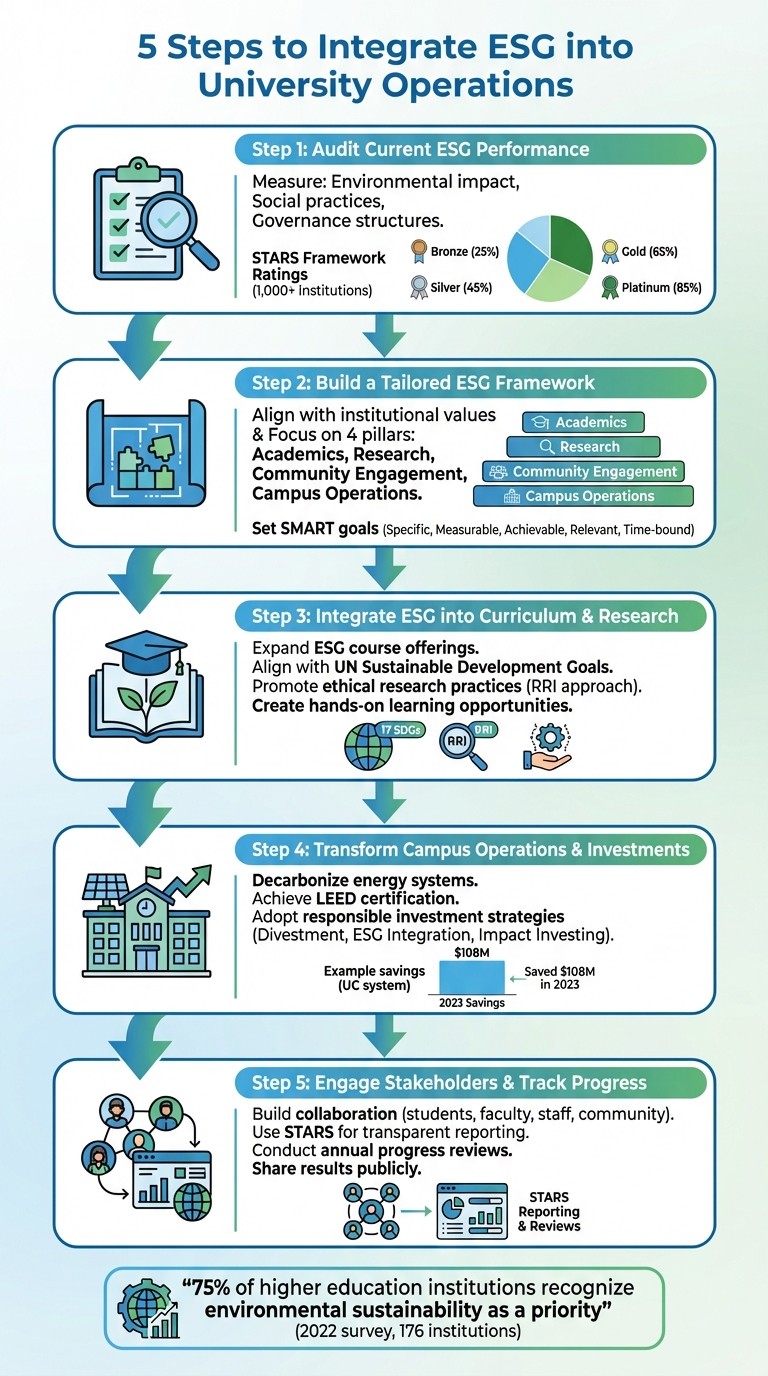
5-Step ESG Integration Framework for Universities and Research Institutions
Integrating Environmental, Social, and Governance (ESG) Factors – Ivy Exec & Wharton School Webinar
Step 1: Audit Your Current ESG Performance
Before diving into new ESG initiatives, universities need a clear picture of their current standing. Conducting a thorough audit helps pinpoint performance gaps and areas for improvement across environmental, social, and governance dimensions. This process should rely on systematic, data-driven methods and established frameworks, steering clear of anecdotal evidence or isolated metrics. Each ESG area requires focused attention through targeted audits.
The Sustainability Tracking, Assessment & Rating System (STARS) is the most widely used framework in higher education, with over 1,000 institutions registered [12]. STARS offers a self-reporting structure that assigns ratings based on the percentage of points earned: Bronze (25%), Silver (45%), Gold (65%), and Platinum (85%) [8]. These ratings are valid for three years, encouraging sustained progress rather than one-off achievements.
Measure Environmental Impact
Environmental audits should focus on key areas such as energy use, greenhouse gas emissions, water consumption, waste management, and building maintenance [6][7]. The STARS technical manual and credit checklist are essential resources for precise reporting guidelines [8]. They clarify distinctions between "plans" - future measurable goals like reducing greenhouse gas emissions by 50% by 2030 - and "policies", which are current mandates such as ENERGY STAR procurement requirements [7].
Collaborate with departments like Facilities, Estates, and Procurement to establish baseline data [8][9]. Beyond emissions, institutions should also perform a climate resilience assessment to gauge their preparedness for and ability to recover from climate-related disruptions [7]. Benchmarking tools can further help compare your institution’s energy and waste performance against peer institutions or broader averages, identifying specific areas for improvement [5].
Review Social Practices and Policies
Social audits examine areas such as diversity, equity, and inclusion (DEI) programs, community engagement, and labor practices. The STARS framework provides structured evaluation through credits like "Assessing Diversity & Equity" and "Institutional Climate" [5][10][11]. Institutions should also conduct equity and just transition analyses to understand how operational changes - like moving to electric energy infrastructure - affect labor and resource distribution, ensuring fair treatment for all employees during transitions [11].
Evaluate Governance Structures
After assessing environmental and social dimensions, governance reviews focus on decision-making processes, transparency, and accountability. The STARS framework addresses these areas through "Planning & Administration" credits, which evaluate sustainability coordination, inclusive governance, and institutional climate [10]. Internal auditors can play a critical role in ESG risk assessments and independent data reviews, helping break down departmental silos [12]. As Dan Graves and Greg Englert from ACUA emphasize:
Internal auditors will have an important role in helping to lay the groundwork for success. They have an opportunity to play a key role in improving internal controls and the overall adoption of these processes [12].
Conducting internal or independent assurances helps resolve data inconsistencies and ensures accuracy [8]. This step can also earn additional points within the STARS framework. To reinforce institutional accountability, ESG reports should include a cover letter signed by a senior executive, such as the President or Chancellor [8].
Step 2: Build an ESG Framework That Fits Your Institution
Once you've audited your ESG performance, the next move is to create a framework that genuinely reflects your institution's mission and values. This isn’t about adopting a one-size-fits-all template - it’s about crafting a structure that aligns with your academic goals, community needs, and operational realities. A tailored framework ensures actionable steps across academics, research, community involvement, and campus operations.
Align ESG Goals with Institutional Values
To make sustainability a priority, embed it into your institution’s core strategic documents. The most effective ESG frameworks focus on four key pillars: academics, research, community engagement, and campus operations [1]. For instance, the University of Southern California (USC) introduced "Assignment: Earth" in 2021, a comprehensive plan designed by its Presidential Working Group on Sustainability. Mick Dalrymple, USC’s Chief Sustainability Officer, described the initiative:
"Assignment: Earth is our plan for a healthy, just and thriving campus and world... It establishes a vision, aspirations and goals for USC across five domains: Education, Research, Inclusion, Operations and Engagement." [13]
This example highlights how aligning leadership vision with sustainability goals strengthens institutional resilience.
Modern ESG frameworks also weave DEIJ (Diversity, Equity, Inclusion, and Justice) principles into environmental goals. For example, the University of California system updated its Sustainable Practices Policy in 2024 to include a "just transition and equity analysis" in its state-funded decarbonization studies. This ensured that efforts to electrify energy infrastructure considered labor equity and avoided unfairly impacting specific employee groups.
Engaging stakeholders - students, faculty, staff, and local communities - is crucial for authenticity. Formal committees with diverse representation can help address genuine concerns rather than theoretical ones. Additionally, regular evaluations by audit committees and boards ensure ESG efforts align with the institution’s long-term objectives [12][13].
Set Measurable ESG Targets
General ambitions like "becoming more sustainable" won’t lead to real progress. Using your audit results, set SMART goals - Specific, Measurable, Achievable, Relevant, and Time-bound - to ensure accountability and measurable results [13]. For example, USC refined its sustainability goals into actionable targets, including achieving climate neutrality for Scopes 1 and 2 by 2025, Scope 3 neutrality by 2035, and a 90% waste diversion rate by 2028. They also aimed for a cultural milestone: ensuring 80% of students, faculty, and staff feel the institution fosters sustainability by 2028 [13].
Organizing goals across institutional domains helps maintain balance. The AASHE STARS Version 3.0 framework provides a useful model, covering areas like teaching, research, stakeholder engagement, campus operations, racial equity, and finance [7]. Assigning at least one measurable objective to each category ensures no area - like curriculum development or social justice - is overlooked in favor of easier operational wins.
| Target Category | Objective |
| --- | --- |
| <strong>Teaching & Research</strong> | Add 10 new undergraduate sustainability courses annually through 2028 <a href="https://sustainability.usc.edu/assignment-earth/framework" target="_blank" style="text-decoration: none;" rel="nofollow noopener noreferrer" data-framer-link="Link:{"url":"https://sustainability.usc.edu/assignment-earth/framework","type":"url"}" data-framer-open-in-new-tab=""><sup>[13]</sup></a> |
| <strong>Campus Operations</strong> | Achieve a 90% waste diversion rate (Zero Waste) by fiscal year 2028 <a href="https://sustainability.usc.edu/assignment-earth/framework" target="_blank" style="text-decoration: none;" rel="nofollow noopener noreferrer" data-framer-link="Link:{"url":"https://sustainability.usc.edu/assignment-earth/framework","type":"url"}" data-framer-open-in-new-tab=""><sup>[13]</sup></a> |
| <strong>Social Justice</strong> | Ensure 80% of students and staff perceive a strong culture of sustainability by 2028 <a href="https://sustainability.usc.edu/assignment-earth/framework" target="_blank" style="text-decoration: none;" rel="nofollow noopener noreferrer" data-framer-link="Link:{"url":"https://sustainability.usc.edu/assignment-earth/framework","type":"url"}" data-framer-open-in-new-tab=""><sup>[13]</sup></a> |
| <strong>Finance</strong> | Fully divest from fossil fuel investments by the end of fiscal year 2031 <a href="https://sustainability.usc.edu/assignment-earth/framework" target="_blank" style="text-decoration: none;" rel="nofollow noopener noreferrer" data-framer-link="Link:{"url":"https://sustainability.usc.edu/assignment-earth/framework","type":"url"}" data-framer-open-in-new-tab=""><sup>[13]</sup></a> |
| <strong>Water Management</strong> | Reduce potable water use by 20% per square foot by 2028 <a href="https://sustainability.usc.edu/assignment-earth/framework" target="_blank" style="text-decoration: none;" rel="nofollow noopener noreferrer" data-framer-link="Link:{"url":"https://sustainability.usc.edu/assignment-earth/framework","type":"url"}" data-framer-open-in-new-tab=""><sup>[13]</sup></a> |
| Target Category | Objective |
| --- | --- |
| <strong>Teaching & Research</strong> | Add 10 new undergraduate sustainability courses annually through 2028 <a href="https://sustainability.usc.edu/assignment-earth/framework" target="_blank" style="text-decoration: none;" rel="nofollow noopener noreferrer" data-framer-link="Link:{"url":"https://sustainability.usc.edu/assignment-earth/framework","type":"url"}" data-framer-open-in-new-tab=""><sup>[13]</sup></a> |
| <strong>Campus Operations</strong> | Achieve a 90% waste diversion rate (Zero Waste) by fiscal year 2028 <a href="https://sustainability.usc.edu/assignment-earth/framework" target="_blank" style="text-decoration: none;" rel="nofollow noopener noreferrer" data-framer-link="Link:{"url":"https://sustainability.usc.edu/assignment-earth/framework","type":"url"}" data-framer-open-in-new-tab=""><sup>[13]</sup></a> |
| <strong>Social Justice</strong> | Ensure 80% of students and staff perceive a strong culture of sustainability by 2028 <a href="https://sustainability.usc.edu/assignment-earth/framework" target="_blank" style="text-decoration: none;" rel="nofollow noopener noreferrer" data-framer-link="Link:{"url":"https://sustainability.usc.edu/assignment-earth/framework","type":"url"}" data-framer-open-in-new-tab=""><sup>[13]</sup></a> |
| <strong>Finance</strong> | Fully divest from fossil fuel investments by the end of fiscal year 2031 <a href="https://sustainability.usc.edu/assignment-earth/framework" target="_blank" style="text-decoration: none;" rel="nofollow noopener noreferrer" data-framer-link="Link:{"url":"https://sustainability.usc.edu/assignment-earth/framework","type":"url"}" data-framer-open-in-new-tab=""><sup>[13]</sup></a> |
| <strong>Water Management</strong> | Reduce potable water use by 20% per square foot by 2028 <a href="https://sustainability.usc.edu/assignment-earth/framework" target="_blank" style="text-decoration: none;" rel="nofollow noopener noreferrer" data-framer-link="Link:{"url":"https://sustainability.usc.edu/assignment-earth/framework","type":"url"}" data-framer-open-in-new-tab=""><sup>[13]</sup></a> |Transparency is key to maintaining community trust and engagement. Use online dashboards to provide real-time updates on resource metrics and publish annual progress reports within six months of the fiscal year’s end [13]. For example, the University of California saved $108 million in 2023 through energy efficiency and green building practices - a clear demonstration of ESG benefits [11].
Finally, tying sustainability goals to operational performance reviews ensures accountability. When career advancement depends on meeting these targets, sustainability becomes a shared responsibility rather than an optional initiative [13].
Step 3: Integrate ESG into Curriculum and Research
With the tailored ESG framework established in Step 2, the next step is embedding these principles into both academic instruction and research. This approach goes beyond creating standalone courses - it's about reshaping how your institution equips students for future careers and contributes to scholarship that addresses pressing global issues.
Add ESG Topics to Academic Programs
To build ESG awareness across the student body, institutions should expand course offerings and make existing content more accessible. Start by auditing your course catalog to identify and clearly label ESG-related classes.
For instance, the University of Southern California (USC) revamped its framework to significantly increase ESG course availability and promote sustainability education. These efforts align with USC’s goal to achieve a "STARS Platinum" rating by 2028 [13].
In addition to course expansion, align your programs with the United Nations Sustainable Development Goals (SDGs). This global framework helps students connect their studies to worldwide priorities and equips them for roles in both the private and public sectors [15]. Shift the focus toward competency- and skill-based learning, as employers increasingly value graduates who can apply ESG principles to practical challenges [15].
To support this shift, invest in faculty development by hiring sustainability experts and providing training for integrating ESG topics into various disciplines. Create hands-on learning opportunities where students collaborate with staff, alumni, or community groups on real-world ESG projects. Use your campus as a living laboratory, where classroom concepts are applied to actual sustainability initiatives [13][18].
However, curriculum changes alone are not enough. Integrating ESG into research practices is equally critical for a comprehensive transformation.
Promote Ethical Research Practices
Ethical research is a cornerstone of ESG integration. This goes beyond avoiding plagiarism - it involves conducting studies that address societal and environmental challenges transparently and inclusively. Publish a clear ethical code to guide research integrity procedures [16].
Adopt a Responsible Research and Innovation (RRI) approach, which includes open access policies to ensure research is widely accessible. This means encouraging or requiring researchers to publish in formats that are available to the global community, not just those with access to costly journals [16].
Rethink how research is evaluated. Responsible Research Assessment (RRA) provides a broader view of academic contributions by valuing community engagement and societal impact over traditional citation metrics [16][17]. The Declaration on Research Assessment (DORA) offers practical tools for revising institutional policies to promote more inclusive evaluation methods [17].
Encourage collaboration across disciplines by establishing dedicated Centers for Sustainability Research, where faculty from various departments can address complex ESG challenges together [18]. Additionally, join global networks like the Responsible Research and Innovation Networked Globally (RRING) to compare practices with international standards and share advancements with peer institutions [16].
Step 4: Apply ESG to Campus Operations and Investments
Once ESG principles are integrated into curriculum and research, the next step is to reshape campus operations and financial strategies to align with these values. By focusing on physical infrastructure and investment decisions, your institution can bring ESG commitments to life in a measurable and impactful way.
Build Sustainable Campus Infrastructure
Campus operations offer a significant opportunity to make ESG principles tangible. A good starting point is decarbonizing energy systems. Conduct thorough evaluations to identify ways to reduce Scope 1 emissions, such as transitioning to electrified systems and phasing out fossil fuels. Use metrics like Energy Use Intensity (EUI) - total energy consumption divided by building square footage - to measure and track efficiency across campus facilities.
For new construction and major renovations, aim for LEED certification and prioritize all-electric designs that eliminate the need for gas-powered heating systems. The University of California (UC) has successfully certified 445 projects under LEED standards, showing how scalable this approach can be [11]. Additionally, the UC system launched the "UC Low Carbon Showcase Project" in 2023–24, which highlights facilities built with innovative materials like advanced timber and green steel. This initiative also includes training materials and guidelines for adaptive reuse [11].
Efforts to reduce waste can also have a significant impact. For instance, eliminating single-use plastics in dining services, introducing organic waste recycling programs, and certifying research spaces as "Green Labs" can drive meaningful change. UC has already certified 401 green labs and achieved partial or complete elimination of single-use plastic foodware at 94% of its locations as of 2024 [11].
The financial benefits of these initiatives are undeniable. In 2023, energy efficiency and green building practices saved the UC system $108 million, contributing to cumulative savings of $524 million since 2010 [11]. Additional efforts, such as medical device reprocessing, saved $7.8 million and avoided 230,000 pounds of medical waste in just one year [11]. Water conservation measures have also demonstrated potential, with targeted strategies reducing potable water use per capita by up to 36% [11].
Renewable energy procurement is another area to explore. In 2023, UC made its largest renewable energy commitment by signing an 85-megawatt wind energy contract with SunZia Wind. This agreement supplies clean electricity through a 550-mile transmission line, advancing decarbonization efforts across campuses [11].
Adopt Responsible Investment Strategies
Operational improvements should be complemented by financial strategies that reflect ESG values. Endowments and investment portfolios can align with institutional goals by integrating sustainability considerations across all asset classes. A thoughtful investment approach ensures that financial activities mirror the ESG principles taught in classrooms.
There are three key strategies for responsible investing:
Divestment: Exclude industries like fossil fuels or private prisons that conflict with institutional values or pose long-term financial risks.
ESG Integration: Incorporate environmental, social, and governance factors into investment decisions to balance risk and returns, often guided by Principles for Responsible Investment (PRI).
Impact Investing: Focus on investments that deliver measurable environmental or social benefits alongside financial returns.
Start by revising your Investment Policy Statement (IPS) to explicitly include ESG criteria and align investment practices with your mission. A structured approach works best: understand how sustainable investing fits fiduciary responsibilities, build consensus among stakeholders, establish formal policies, evaluate your current portfolio, and maintain transparency through regular updates to alumni and faculty.
Consider launching a Green Revolving Loan Fund (GRF) to finance energy efficiency projects on campus. These funds not only reduce operational costs and emissions but also create a self-sustaining cycle of capital for future initiatives. Expand ESG-aligned options in employee retirement plans to reflect institutional values, and establish student-managed ESG funds to provide hands-on learning opportunities while generating innovative investment ideas.
Active ownership also plays a critical role. Use tools like proxy voting, shareholder resolutions, and investor statements to influence corporate sustainability practices and manage investment risks. Additionally, prioritize asset management firms led by women and people of color to strengthen governance and social outcomes. With the global sustainable economy projected to be worth $12 trillion and capable of generating 380 million jobs, aligning investments with ESG values can drive both financial and societal progress [19].
Step 5: Engage Stakeholders and Track Progress
Integrating ESG principles into your organization requires active collaboration across all levels and a commitment to consistent, transparent measurement. Building on internal audits and framework development, the next step involves engaging stakeholders to ensure your sustainability initiatives gain traction and deliver meaningful results.
Build Stakeholder Collaboration
For ESG initiatives to succeed, engaging both internal and external stakeholders from the outset is critical. Internally, this includes students, faculty, staff, and administrators. Externally, partnerships can extend to alumni, local authorities, industry leaders, and community organizations. The Quadruple Helix Model exemplifies this approach by uniting higher education institutions, community members, government entities, and industry partners to craft well-rounded sustainability solutions [20].
Springer Nature emphasizes the importance of collaboration in achieving impactful ESG outcomes:
"Stakeholder engagement is recognised as an important strategy, since involving diverse groups in decision-making processes, HEIs can harness a wealth of perspectives, expertise, and resources, fostering more inclusive, innovative, and effective approaches to sustainability." [20]
This highlights how diverse perspectives can strengthen the foundation of ESG efforts.
Start by forming a "Change Coalition" with a small team to introduce ideas in existing forums. As these ideas gain momentum, expand this group into a formal coalition with representation from various stakeholders to ensure alignment and prevent fragmentation [20]. Conduct a materiality analysis to ensure that sustainability priorities align with regional needs [20].
Tailor engagement strategies to fit the needs of each stakeholder group. For example:
Students: Involve them through co-curricular activities and living labs.
Faculty: Encourage participation via interdisciplinary committees.
Industry Partners: Collaborate on project-based initiatives.
Community Members: Include them in climate resilience task forces [18][20].
Establish regular feedback loops to maintain accountability and encourage long-term commitment [20]. Once stakeholder collaboration is in place, focus on transparent reporting to ensure progress is measurable and visible.
Implement Transparent Reporting Practices
Tracking progress requires standardized frameworks that provide consistent and comparable data. The Sustainability Tracking, Assessment & Rating System (STARS) is a widely used tool designed specifically for higher education. It evaluates performance across academics, engagement, operations, and administration. Over 1,000 institutions have adopted STARS, with ratings valid for three years, though updates can be submitted annually [5][8][12].
Set SMART objectives - Specific, Measurable, Achievable, Relevant, and Time-bound - to clearly define goals and facilitate effective tracking [7]. Benchmarking tools can help compare performance against peer institutions or past results. STARS provides recognition levels ranging from Bronze (a minimum of 25 points) to Platinum (a minimum of 85 points), offering clear milestones for progress [8].
To ensure accountability, establish strong internal governance. Assign an Implementation Liaison and create a sustainability task force to oversee progress [21]. Engage your internal audit team to independently verify ESG data, manage risks, and ensure the accuracy of disclosures [12]. Finally, publicly share evaluations, greenhouse gas inventories, and Climate Action Plans to build trust and demonstrate your commitment to transparency [21].
Conclusion: Long-Term Impact Through ESG Integration
Integrating ESG principles into the core operations of universities represents a transformative approach to how these institutions function, educate, and contribute to broader societal goals. Each action taken builds upon the last, forming a cohesive strategy that aligns with the institution’s mission while achieving measurable environmental and social outcomes.
Urban areas, where most major universities are located, account for 60–80% of global greenhouse gas emissions and only meet 12% of WHO air quality standards [2][3]. This highlights the pressing need for universities to adopt systemic ESG measures. The United Nations Environment Programme underscores this potential:
The sustainable university can help catalyse a more sustainable world [3].
Universities have the unique ability to drive meaningful change - not only on their campuses but also within the communities they serve.
Leadership plays a pivotal role in this transformation. A 2022 survey of 176 higher education institutions revealed that 75% recognized environmental sustainability as a priority for both their operations and their stakeholders [4]. However, many struggle to progress beyond basic initiatives to more advanced strategies, such as renewable energy collaborations or comprehensive carbon reduction plans. The key lies in adopting formal policies, establishing dedicated sustainability offices, and fostering collaboration through structured committees [14].
Institutions that embrace ESG as a strategic advantage are better positioned for long-term success. As EY-Parthenon observes:
A deliberate environment, social and governance (ESG) strategy... can go a long way in helping an institution attract and retain students, faculty and staff, while also enhancing relationships with the wider community [4].
An effective ESG strategy becomes a powerful tool for recruitment, reputation building, and ensuring resilience over time.
Partner with Council Fire for Customized ESG Strategies

Turning ESG goals into actionable outcomes requires specialized expertise and a comprehensive approach. Council Fire helps universities move beyond compliance, delivering impactful results through climate resilience planning, stakeholder engagement, and data-driven strategies. Whether you’re crafting your first sustainability policy or scaling up renewable energy partnerships, Council Fire provides the guidance and technical solutions needed to translate your vision into measurable progress. By working with Council Fire, your institution can achieve meaningful environmental, social, and economic outcomes that align with and strengthen its mission.
FAQs
Where do we start if our ESG data is incomplete?
To get started, take a close look at your current sustainability efforts and identify where data might be lacking. Begin by collecting any available information, even if it’s not comprehensive, and involve key stakeholders to help fill in the blanks. Crafting a clear sustainability policy can provide direction, while frameworks like STARS can help highlight specific data needs. By following this methodical process, you can establish a solid baseline and gradually enhance the quality of your ESG data.
How can we tie ESG goals to budgets and staff accountability?
To connect ESG goals with budgets and staff responsibilities, universities can adjust their budget models to prioritize initiatives that promote sustainability and social impact. Establishing clear policies with specific, measurable targets helps create a framework for accountability. By incorporating ESG metrics into staff performance evaluations, institutions can ensure that individual contributions align with larger goals. Regular reporting and active involvement from stakeholders also play a key role in enhancing transparency and tracking progress. This strategy weaves ESG objectives into both financial planning and personal accountability, fostering a unified effort across the organization.
What are the fastest campus projects to cut emissions and costs?
Improving energy efficiency and upgrading infrastructure are among the fastest ways for campuses to cut emissions and lower costs. Simple yet effective steps like switching to LED lighting, fine-tuning HVAC systems, and adding solar panels can deliver immediate, measurable results. These initiatives not only align with institutional objectives but also balance environmental and financial priorities. By pairing these efforts with thoughtful planning and involving key stakeholders, campuses can achieve even greater success in a shorter timeframe.
Related Blog Posts
Latest Articles
©2025



FAQ
01
What does it really mean to “redefine profit”?
02
What makes Council Fire different?
03
Who does Council Fire you work with?
04
What does working with Council Fire actually look like?
05
How does Council Fire help organizations turn big goals into action?
06
How does Council Fire define and measure success?
Feb 21, 2026
How to Integrate ESG into Core Business Operations for Universities & Research Institutions
ESG Strategy
In This Article
Practical roadmap for universities to audit ESG performance, set SMART targets, embed sustainability in curriculum, operations, investments, and reporting.
How to Integrate ESG into Core Business Operations for Universities & Research Institutions
Universities and research institutions face growing pressure to align their operations and education with Environmental, Social, and Governance (ESG) principles. This approach not only addresses environmental challenges but also meets the expectations of students, faculty, and communities. Here’s a quick guide to embedding ESG into academic institutions:
Audit Current ESG Performance: Use frameworks like STARS to assess environmental impact, social policies, and governance practices.
Develop a Tailored ESG Framework: Align ESG goals with your institution’s values, set measurable targets, and involve stakeholders.
Incorporate ESG into Curriculum and Research: Expand course offerings, integrate sustainability into research, and promote ethical practices.
Transform Campus Operations and Investments: Upgrade infrastructure, reduce emissions, and adopt responsible investment strategies.
Engage Stakeholders and Track Progress: Build collaboration across groups, implement transparent reporting, and use tools like STARS for consistent measurement.
5-Step ESG Integration Framework for Universities and Research Institutions
Integrating Environmental, Social, and Governance (ESG) Factors – Ivy Exec & Wharton School Webinar
Step 1: Audit Your Current ESG Performance
Before diving into new ESG initiatives, universities need a clear picture of their current standing. Conducting a thorough audit helps pinpoint performance gaps and areas for improvement across environmental, social, and governance dimensions. This process should rely on systematic, data-driven methods and established frameworks, steering clear of anecdotal evidence or isolated metrics. Each ESG area requires focused attention through targeted audits.
The Sustainability Tracking, Assessment & Rating System (STARS) is the most widely used framework in higher education, with over 1,000 institutions registered [12]. STARS offers a self-reporting structure that assigns ratings based on the percentage of points earned: Bronze (25%), Silver (45%), Gold (65%), and Platinum (85%) [8]. These ratings are valid for three years, encouraging sustained progress rather than one-off achievements.
Measure Environmental Impact
Environmental audits should focus on key areas such as energy use, greenhouse gas emissions, water consumption, waste management, and building maintenance [6][7]. The STARS technical manual and credit checklist are essential resources for precise reporting guidelines [8]. They clarify distinctions between "plans" - future measurable goals like reducing greenhouse gas emissions by 50% by 2030 - and "policies", which are current mandates such as ENERGY STAR procurement requirements [7].
Collaborate with departments like Facilities, Estates, and Procurement to establish baseline data [8][9]. Beyond emissions, institutions should also perform a climate resilience assessment to gauge their preparedness for and ability to recover from climate-related disruptions [7]. Benchmarking tools can further help compare your institution’s energy and waste performance against peer institutions or broader averages, identifying specific areas for improvement [5].
Review Social Practices and Policies
Social audits examine areas such as diversity, equity, and inclusion (DEI) programs, community engagement, and labor practices. The STARS framework provides structured evaluation through credits like "Assessing Diversity & Equity" and "Institutional Climate" [5][10][11]. Institutions should also conduct equity and just transition analyses to understand how operational changes - like moving to electric energy infrastructure - affect labor and resource distribution, ensuring fair treatment for all employees during transitions [11].
Evaluate Governance Structures
After assessing environmental and social dimensions, governance reviews focus on decision-making processes, transparency, and accountability. The STARS framework addresses these areas through "Planning & Administration" credits, which evaluate sustainability coordination, inclusive governance, and institutional climate [10]. Internal auditors can play a critical role in ESG risk assessments and independent data reviews, helping break down departmental silos [12]. As Dan Graves and Greg Englert from ACUA emphasize:
Internal auditors will have an important role in helping to lay the groundwork for success. They have an opportunity to play a key role in improving internal controls and the overall adoption of these processes [12].
Conducting internal or independent assurances helps resolve data inconsistencies and ensures accuracy [8]. This step can also earn additional points within the STARS framework. To reinforce institutional accountability, ESG reports should include a cover letter signed by a senior executive, such as the President or Chancellor [8].
Step 2: Build an ESG Framework That Fits Your Institution
Once you've audited your ESG performance, the next move is to create a framework that genuinely reflects your institution's mission and values. This isn’t about adopting a one-size-fits-all template - it’s about crafting a structure that aligns with your academic goals, community needs, and operational realities. A tailored framework ensures actionable steps across academics, research, community involvement, and campus operations.
Align ESG Goals with Institutional Values
To make sustainability a priority, embed it into your institution’s core strategic documents. The most effective ESG frameworks focus on four key pillars: academics, research, community engagement, and campus operations [1]. For instance, the University of Southern California (USC) introduced "Assignment: Earth" in 2021, a comprehensive plan designed by its Presidential Working Group on Sustainability. Mick Dalrymple, USC’s Chief Sustainability Officer, described the initiative:
"Assignment: Earth is our plan for a healthy, just and thriving campus and world... It establishes a vision, aspirations and goals for USC across five domains: Education, Research, Inclusion, Operations and Engagement." [13]
This example highlights how aligning leadership vision with sustainability goals strengthens institutional resilience.
Modern ESG frameworks also weave DEIJ (Diversity, Equity, Inclusion, and Justice) principles into environmental goals. For example, the University of California system updated its Sustainable Practices Policy in 2024 to include a "just transition and equity analysis" in its state-funded decarbonization studies. This ensured that efforts to electrify energy infrastructure considered labor equity and avoided unfairly impacting specific employee groups.
Engaging stakeholders - students, faculty, staff, and local communities - is crucial for authenticity. Formal committees with diverse representation can help address genuine concerns rather than theoretical ones. Additionally, regular evaluations by audit committees and boards ensure ESG efforts align with the institution’s long-term objectives [12][13].
Set Measurable ESG Targets
General ambitions like "becoming more sustainable" won’t lead to real progress. Using your audit results, set SMART goals - Specific, Measurable, Achievable, Relevant, and Time-bound - to ensure accountability and measurable results [13]. For example, USC refined its sustainability goals into actionable targets, including achieving climate neutrality for Scopes 1 and 2 by 2025, Scope 3 neutrality by 2035, and a 90% waste diversion rate by 2028. They also aimed for a cultural milestone: ensuring 80% of students, faculty, and staff feel the institution fosters sustainability by 2028 [13].
Organizing goals across institutional domains helps maintain balance. The AASHE STARS Version 3.0 framework provides a useful model, covering areas like teaching, research, stakeholder engagement, campus operations, racial equity, and finance [7]. Assigning at least one measurable objective to each category ensures no area - like curriculum development or social justice - is overlooked in favor of easier operational wins.
| Target Category | Objective |
| --- | --- |
| <strong>Teaching & Research</strong> | Add 10 new undergraduate sustainability courses annually through 2028 <a href="https://sustainability.usc.edu/assignment-earth/framework" target="_blank" style="text-decoration: none;" rel="nofollow noopener noreferrer" data-framer-link="Link:{"url":"https://sustainability.usc.edu/assignment-earth/framework","type":"url"}" data-framer-open-in-new-tab=""><sup>[13]</sup></a> |
| <strong>Campus Operations</strong> | Achieve a 90% waste diversion rate (Zero Waste) by fiscal year 2028 <a href="https://sustainability.usc.edu/assignment-earth/framework" target="_blank" style="text-decoration: none;" rel="nofollow noopener noreferrer" data-framer-link="Link:{"url":"https://sustainability.usc.edu/assignment-earth/framework","type":"url"}" data-framer-open-in-new-tab=""><sup>[13]</sup></a> |
| <strong>Social Justice</strong> | Ensure 80% of students and staff perceive a strong culture of sustainability by 2028 <a href="https://sustainability.usc.edu/assignment-earth/framework" target="_blank" style="text-decoration: none;" rel="nofollow noopener noreferrer" data-framer-link="Link:{"url":"https://sustainability.usc.edu/assignment-earth/framework","type":"url"}" data-framer-open-in-new-tab=""><sup>[13]</sup></a> |
| <strong>Finance</strong> | Fully divest from fossil fuel investments by the end of fiscal year 2031 <a href="https://sustainability.usc.edu/assignment-earth/framework" target="_blank" style="text-decoration: none;" rel="nofollow noopener noreferrer" data-framer-link="Link:{"url":"https://sustainability.usc.edu/assignment-earth/framework","type":"url"}" data-framer-open-in-new-tab=""><sup>[13]</sup></a> |
| <strong>Water Management</strong> | Reduce potable water use by 20% per square foot by 2028 <a href="https://sustainability.usc.edu/assignment-earth/framework" target="_blank" style="text-decoration: none;" rel="nofollow noopener noreferrer" data-framer-link="Link:{"url":"https://sustainability.usc.edu/assignment-earth/framework","type":"url"}" data-framer-open-in-new-tab=""><sup>[13]</sup></a> |
Transparency is key to maintaining community trust and engagement. Use online dashboards to provide real-time updates on resource metrics and publish annual progress reports within six months of the fiscal year’s end [13]. For example, the University of California saved $108 million in 2023 through energy efficiency and green building practices - a clear demonstration of ESG benefits [11].
Finally, tying sustainability goals to operational performance reviews ensures accountability. When career advancement depends on meeting these targets, sustainability becomes a shared responsibility rather than an optional initiative [13].
Step 3: Integrate ESG into Curriculum and Research
With the tailored ESG framework established in Step 2, the next step is embedding these principles into both academic instruction and research. This approach goes beyond creating standalone courses - it's about reshaping how your institution equips students for future careers and contributes to scholarship that addresses pressing global issues.
Add ESG Topics to Academic Programs
To build ESG awareness across the student body, institutions should expand course offerings and make existing content more accessible. Start by auditing your course catalog to identify and clearly label ESG-related classes.
For instance, the University of Southern California (USC) revamped its framework to significantly increase ESG course availability and promote sustainability education. These efforts align with USC’s goal to achieve a "STARS Platinum" rating by 2028 [13].
In addition to course expansion, align your programs with the United Nations Sustainable Development Goals (SDGs). This global framework helps students connect their studies to worldwide priorities and equips them for roles in both the private and public sectors [15]. Shift the focus toward competency- and skill-based learning, as employers increasingly value graduates who can apply ESG principles to practical challenges [15].
To support this shift, invest in faculty development by hiring sustainability experts and providing training for integrating ESG topics into various disciplines. Create hands-on learning opportunities where students collaborate with staff, alumni, or community groups on real-world ESG projects. Use your campus as a living laboratory, where classroom concepts are applied to actual sustainability initiatives [13][18].
However, curriculum changes alone are not enough. Integrating ESG into research practices is equally critical for a comprehensive transformation.
Promote Ethical Research Practices
Ethical research is a cornerstone of ESG integration. This goes beyond avoiding plagiarism - it involves conducting studies that address societal and environmental challenges transparently and inclusively. Publish a clear ethical code to guide research integrity procedures [16].
Adopt a Responsible Research and Innovation (RRI) approach, which includes open access policies to ensure research is widely accessible. This means encouraging or requiring researchers to publish in formats that are available to the global community, not just those with access to costly journals [16].
Rethink how research is evaluated. Responsible Research Assessment (RRA) provides a broader view of academic contributions by valuing community engagement and societal impact over traditional citation metrics [16][17]. The Declaration on Research Assessment (DORA) offers practical tools for revising institutional policies to promote more inclusive evaluation methods [17].
Encourage collaboration across disciplines by establishing dedicated Centers for Sustainability Research, where faculty from various departments can address complex ESG challenges together [18]. Additionally, join global networks like the Responsible Research and Innovation Networked Globally (RRING) to compare practices with international standards and share advancements with peer institutions [16].
Step 4: Apply ESG to Campus Operations and Investments
Once ESG principles are integrated into curriculum and research, the next step is to reshape campus operations and financial strategies to align with these values. By focusing on physical infrastructure and investment decisions, your institution can bring ESG commitments to life in a measurable and impactful way.
Build Sustainable Campus Infrastructure
Campus operations offer a significant opportunity to make ESG principles tangible. A good starting point is decarbonizing energy systems. Conduct thorough evaluations to identify ways to reduce Scope 1 emissions, such as transitioning to electrified systems and phasing out fossil fuels. Use metrics like Energy Use Intensity (EUI) - total energy consumption divided by building square footage - to measure and track efficiency across campus facilities.
For new construction and major renovations, aim for LEED certification and prioritize all-electric designs that eliminate the need for gas-powered heating systems. The University of California (UC) has successfully certified 445 projects under LEED standards, showing how scalable this approach can be [11]. Additionally, the UC system launched the "UC Low Carbon Showcase Project" in 2023–24, which highlights facilities built with innovative materials like advanced timber and green steel. This initiative also includes training materials and guidelines for adaptive reuse [11].
Efforts to reduce waste can also have a significant impact. For instance, eliminating single-use plastics in dining services, introducing organic waste recycling programs, and certifying research spaces as "Green Labs" can drive meaningful change. UC has already certified 401 green labs and achieved partial or complete elimination of single-use plastic foodware at 94% of its locations as of 2024 [11].
The financial benefits of these initiatives are undeniable. In 2023, energy efficiency and green building practices saved the UC system $108 million, contributing to cumulative savings of $524 million since 2010 [11]. Additional efforts, such as medical device reprocessing, saved $7.8 million and avoided 230,000 pounds of medical waste in just one year [11]. Water conservation measures have also demonstrated potential, with targeted strategies reducing potable water use per capita by up to 36% [11].
Renewable energy procurement is another area to explore. In 2023, UC made its largest renewable energy commitment by signing an 85-megawatt wind energy contract with SunZia Wind. This agreement supplies clean electricity through a 550-mile transmission line, advancing decarbonization efforts across campuses [11].
Adopt Responsible Investment Strategies
Operational improvements should be complemented by financial strategies that reflect ESG values. Endowments and investment portfolios can align with institutional goals by integrating sustainability considerations across all asset classes. A thoughtful investment approach ensures that financial activities mirror the ESG principles taught in classrooms.
There are three key strategies for responsible investing:
Divestment: Exclude industries like fossil fuels or private prisons that conflict with institutional values or pose long-term financial risks.
ESG Integration: Incorporate environmental, social, and governance factors into investment decisions to balance risk and returns, often guided by Principles for Responsible Investment (PRI).
Impact Investing: Focus on investments that deliver measurable environmental or social benefits alongside financial returns.
Start by revising your Investment Policy Statement (IPS) to explicitly include ESG criteria and align investment practices with your mission. A structured approach works best: understand how sustainable investing fits fiduciary responsibilities, build consensus among stakeholders, establish formal policies, evaluate your current portfolio, and maintain transparency through regular updates to alumni and faculty.
Consider launching a Green Revolving Loan Fund (GRF) to finance energy efficiency projects on campus. These funds not only reduce operational costs and emissions but also create a self-sustaining cycle of capital for future initiatives. Expand ESG-aligned options in employee retirement plans to reflect institutional values, and establish student-managed ESG funds to provide hands-on learning opportunities while generating innovative investment ideas.
Active ownership also plays a critical role. Use tools like proxy voting, shareholder resolutions, and investor statements to influence corporate sustainability practices and manage investment risks. Additionally, prioritize asset management firms led by women and people of color to strengthen governance and social outcomes. With the global sustainable economy projected to be worth $12 trillion and capable of generating 380 million jobs, aligning investments with ESG values can drive both financial and societal progress [19].
Step 5: Engage Stakeholders and Track Progress
Integrating ESG principles into your organization requires active collaboration across all levels and a commitment to consistent, transparent measurement. Building on internal audits and framework development, the next step involves engaging stakeholders to ensure your sustainability initiatives gain traction and deliver meaningful results.
Build Stakeholder Collaboration
For ESG initiatives to succeed, engaging both internal and external stakeholders from the outset is critical. Internally, this includes students, faculty, staff, and administrators. Externally, partnerships can extend to alumni, local authorities, industry leaders, and community organizations. The Quadruple Helix Model exemplifies this approach by uniting higher education institutions, community members, government entities, and industry partners to craft well-rounded sustainability solutions [20].
Springer Nature emphasizes the importance of collaboration in achieving impactful ESG outcomes:
"Stakeholder engagement is recognised as an important strategy, since involving diverse groups in decision-making processes, HEIs can harness a wealth of perspectives, expertise, and resources, fostering more inclusive, innovative, and effective approaches to sustainability." [20]
This highlights how diverse perspectives can strengthen the foundation of ESG efforts.
Start by forming a "Change Coalition" with a small team to introduce ideas in existing forums. As these ideas gain momentum, expand this group into a formal coalition with representation from various stakeholders to ensure alignment and prevent fragmentation [20]. Conduct a materiality analysis to ensure that sustainability priorities align with regional needs [20].
Tailor engagement strategies to fit the needs of each stakeholder group. For example:
Students: Involve them through co-curricular activities and living labs.
Faculty: Encourage participation via interdisciplinary committees.
Industry Partners: Collaborate on project-based initiatives.
Community Members: Include them in climate resilience task forces [18][20].
Establish regular feedback loops to maintain accountability and encourage long-term commitment [20]. Once stakeholder collaboration is in place, focus on transparent reporting to ensure progress is measurable and visible.
Implement Transparent Reporting Practices
Tracking progress requires standardized frameworks that provide consistent and comparable data. The Sustainability Tracking, Assessment & Rating System (STARS) is a widely used tool designed specifically for higher education. It evaluates performance across academics, engagement, operations, and administration. Over 1,000 institutions have adopted STARS, with ratings valid for three years, though updates can be submitted annually [5][8][12].
Set SMART objectives - Specific, Measurable, Achievable, Relevant, and Time-bound - to clearly define goals and facilitate effective tracking [7]. Benchmarking tools can help compare performance against peer institutions or past results. STARS provides recognition levels ranging from Bronze (a minimum of 25 points) to Platinum (a minimum of 85 points), offering clear milestones for progress [8].
To ensure accountability, establish strong internal governance. Assign an Implementation Liaison and create a sustainability task force to oversee progress [21]. Engage your internal audit team to independently verify ESG data, manage risks, and ensure the accuracy of disclosures [12]. Finally, publicly share evaluations, greenhouse gas inventories, and Climate Action Plans to build trust and demonstrate your commitment to transparency [21].
Conclusion: Long-Term Impact Through ESG Integration
Integrating ESG principles into the core operations of universities represents a transformative approach to how these institutions function, educate, and contribute to broader societal goals. Each action taken builds upon the last, forming a cohesive strategy that aligns with the institution’s mission while achieving measurable environmental and social outcomes.
Urban areas, where most major universities are located, account for 60–80% of global greenhouse gas emissions and only meet 12% of WHO air quality standards [2][3]. This highlights the pressing need for universities to adopt systemic ESG measures. The United Nations Environment Programme underscores this potential:
The sustainable university can help catalyse a more sustainable world [3].
Universities have the unique ability to drive meaningful change - not only on their campuses but also within the communities they serve.
Leadership plays a pivotal role in this transformation. A 2022 survey of 176 higher education institutions revealed that 75% recognized environmental sustainability as a priority for both their operations and their stakeholders [4]. However, many struggle to progress beyond basic initiatives to more advanced strategies, such as renewable energy collaborations or comprehensive carbon reduction plans. The key lies in adopting formal policies, establishing dedicated sustainability offices, and fostering collaboration through structured committees [14].
Institutions that embrace ESG as a strategic advantage are better positioned for long-term success. As EY-Parthenon observes:
A deliberate environment, social and governance (ESG) strategy... can go a long way in helping an institution attract and retain students, faculty and staff, while also enhancing relationships with the wider community [4].
An effective ESG strategy becomes a powerful tool for recruitment, reputation building, and ensuring resilience over time.
Partner with Council Fire for Customized ESG Strategies
Turning ESG goals into actionable outcomes requires specialized expertise and a comprehensive approach. Council Fire helps universities move beyond compliance, delivering impactful results through climate resilience planning, stakeholder engagement, and data-driven strategies. Whether you’re crafting your first sustainability policy or scaling up renewable energy partnerships, Council Fire provides the guidance and technical solutions needed to translate your vision into measurable progress. By working with Council Fire, your institution can achieve meaningful environmental, social, and economic outcomes that align with and strengthen its mission.
FAQs
Where do we start if our ESG data is incomplete?
To get started, take a close look at your current sustainability efforts and identify where data might be lacking. Begin by collecting any available information, even if it’s not comprehensive, and involve key stakeholders to help fill in the blanks. Crafting a clear sustainability policy can provide direction, while frameworks like STARS can help highlight specific data needs. By following this methodical process, you can establish a solid baseline and gradually enhance the quality of your ESG data.
How can we tie ESG goals to budgets and staff accountability?
To connect ESG goals with budgets and staff responsibilities, universities can adjust their budget models to prioritize initiatives that promote sustainability and social impact. Establishing clear policies with specific, measurable targets helps create a framework for accountability. By incorporating ESG metrics into staff performance evaluations, institutions can ensure that individual contributions align with larger goals. Regular reporting and active involvement from stakeholders also play a key role in enhancing transparency and tracking progress. This strategy weaves ESG objectives into both financial planning and personal accountability, fostering a unified effort across the organization.
What are the fastest campus projects to cut emissions and costs?
Improving energy efficiency and upgrading infrastructure are among the fastest ways for campuses to cut emissions and lower costs. Simple yet effective steps like switching to LED lighting, fine-tuning HVAC systems, and adding solar panels can deliver immediate, measurable results. These initiatives not only align with institutional objectives but also balance environmental and financial priorities. By pairing these efforts with thoughtful planning and involving key stakeholders, campuses can achieve even greater success in a shorter timeframe.
Related Blog Posts
FAQ
01
What does it really mean to “redefine profit”?
02
What makes Council Fire different?
03
Who does Council Fire you work with?
04
What does working with Council Fire actually look like?
05
How does Council Fire help organizations turn big goals into action?
06
How does Council Fire define and measure success?
Feb 21, 2026
How to Integrate ESG into Core Business Operations for Universities & Research Institutions
ESG Strategy
In This Article
Practical roadmap for universities to audit ESG performance, set SMART targets, embed sustainability in curriculum, operations, investments, and reporting.
How to Integrate ESG into Core Business Operations for Universities & Research Institutions
Universities and research institutions face growing pressure to align their operations and education with Environmental, Social, and Governance (ESG) principles. This approach not only addresses environmental challenges but also meets the expectations of students, faculty, and communities. Here’s a quick guide to embedding ESG into academic institutions:
Audit Current ESG Performance: Use frameworks like STARS to assess environmental impact, social policies, and governance practices.
Develop a Tailored ESG Framework: Align ESG goals with your institution’s values, set measurable targets, and involve stakeholders.
Incorporate ESG into Curriculum and Research: Expand course offerings, integrate sustainability into research, and promote ethical practices.
Transform Campus Operations and Investments: Upgrade infrastructure, reduce emissions, and adopt responsible investment strategies.
Engage Stakeholders and Track Progress: Build collaboration across groups, implement transparent reporting, and use tools like STARS for consistent measurement.
5-Step ESG Integration Framework for Universities and Research Institutions
Integrating Environmental, Social, and Governance (ESG) Factors – Ivy Exec & Wharton School Webinar
Step 1: Audit Your Current ESG Performance
Before diving into new ESG initiatives, universities need a clear picture of their current standing. Conducting a thorough audit helps pinpoint performance gaps and areas for improvement across environmental, social, and governance dimensions. This process should rely on systematic, data-driven methods and established frameworks, steering clear of anecdotal evidence or isolated metrics. Each ESG area requires focused attention through targeted audits.
The Sustainability Tracking, Assessment & Rating System (STARS) is the most widely used framework in higher education, with over 1,000 institutions registered [12]. STARS offers a self-reporting structure that assigns ratings based on the percentage of points earned: Bronze (25%), Silver (45%), Gold (65%), and Platinum (85%) [8]. These ratings are valid for three years, encouraging sustained progress rather than one-off achievements.
Measure Environmental Impact
Environmental audits should focus on key areas such as energy use, greenhouse gas emissions, water consumption, waste management, and building maintenance [6][7]. The STARS technical manual and credit checklist are essential resources for precise reporting guidelines [8]. They clarify distinctions between "plans" - future measurable goals like reducing greenhouse gas emissions by 50% by 2030 - and "policies", which are current mandates such as ENERGY STAR procurement requirements [7].
Collaborate with departments like Facilities, Estates, and Procurement to establish baseline data [8][9]. Beyond emissions, institutions should also perform a climate resilience assessment to gauge their preparedness for and ability to recover from climate-related disruptions [7]. Benchmarking tools can further help compare your institution’s energy and waste performance against peer institutions or broader averages, identifying specific areas for improvement [5].
Review Social Practices and Policies
Social audits examine areas such as diversity, equity, and inclusion (DEI) programs, community engagement, and labor practices. The STARS framework provides structured evaluation through credits like "Assessing Diversity & Equity" and "Institutional Climate" [5][10][11]. Institutions should also conduct equity and just transition analyses to understand how operational changes - like moving to electric energy infrastructure - affect labor and resource distribution, ensuring fair treatment for all employees during transitions [11].
Evaluate Governance Structures
After assessing environmental and social dimensions, governance reviews focus on decision-making processes, transparency, and accountability. The STARS framework addresses these areas through "Planning & Administration" credits, which evaluate sustainability coordination, inclusive governance, and institutional climate [10]. Internal auditors can play a critical role in ESG risk assessments and independent data reviews, helping break down departmental silos [12]. As Dan Graves and Greg Englert from ACUA emphasize:
Internal auditors will have an important role in helping to lay the groundwork for success. They have an opportunity to play a key role in improving internal controls and the overall adoption of these processes [12].
Conducting internal or independent assurances helps resolve data inconsistencies and ensures accuracy [8]. This step can also earn additional points within the STARS framework. To reinforce institutional accountability, ESG reports should include a cover letter signed by a senior executive, such as the President or Chancellor [8].
Step 2: Build an ESG Framework That Fits Your Institution
Once you've audited your ESG performance, the next move is to create a framework that genuinely reflects your institution's mission and values. This isn’t about adopting a one-size-fits-all template - it’s about crafting a structure that aligns with your academic goals, community needs, and operational realities. A tailored framework ensures actionable steps across academics, research, community involvement, and campus operations.
Align ESG Goals with Institutional Values
To make sustainability a priority, embed it into your institution’s core strategic documents. The most effective ESG frameworks focus on four key pillars: academics, research, community engagement, and campus operations [1]. For instance, the University of Southern California (USC) introduced "Assignment: Earth" in 2021, a comprehensive plan designed by its Presidential Working Group on Sustainability. Mick Dalrymple, USC’s Chief Sustainability Officer, described the initiative:
"Assignment: Earth is our plan for a healthy, just and thriving campus and world... It establishes a vision, aspirations and goals for USC across five domains: Education, Research, Inclusion, Operations and Engagement." [13]
This example highlights how aligning leadership vision with sustainability goals strengthens institutional resilience.
Modern ESG frameworks also weave DEIJ (Diversity, Equity, Inclusion, and Justice) principles into environmental goals. For example, the University of California system updated its Sustainable Practices Policy in 2024 to include a "just transition and equity analysis" in its state-funded decarbonization studies. This ensured that efforts to electrify energy infrastructure considered labor equity and avoided unfairly impacting specific employee groups.
Engaging stakeholders - students, faculty, staff, and local communities - is crucial for authenticity. Formal committees with diverse representation can help address genuine concerns rather than theoretical ones. Additionally, regular evaluations by audit committees and boards ensure ESG efforts align with the institution’s long-term objectives [12][13].
Set Measurable ESG Targets
General ambitions like "becoming more sustainable" won’t lead to real progress. Using your audit results, set SMART goals - Specific, Measurable, Achievable, Relevant, and Time-bound - to ensure accountability and measurable results [13]. For example, USC refined its sustainability goals into actionable targets, including achieving climate neutrality for Scopes 1 and 2 by 2025, Scope 3 neutrality by 2035, and a 90% waste diversion rate by 2028. They also aimed for a cultural milestone: ensuring 80% of students, faculty, and staff feel the institution fosters sustainability by 2028 [13].
Organizing goals across institutional domains helps maintain balance. The AASHE STARS Version 3.0 framework provides a useful model, covering areas like teaching, research, stakeholder engagement, campus operations, racial equity, and finance [7]. Assigning at least one measurable objective to each category ensures no area - like curriculum development or social justice - is overlooked in favor of easier operational wins.
| Target Category | Objective |
| --- | --- |
| <strong>Teaching & Research</strong> | Add 10 new undergraduate sustainability courses annually through 2028 <a href="https://sustainability.usc.edu/assignment-earth/framework" target="_blank" style="text-decoration: none;" rel="nofollow noopener noreferrer" data-framer-link="Link:{"url":"https://sustainability.usc.edu/assignment-earth/framework","type":"url"}" data-framer-open-in-new-tab=""><sup>[13]</sup></a> |
| <strong>Campus Operations</strong> | Achieve a 90% waste diversion rate (Zero Waste) by fiscal year 2028 <a href="https://sustainability.usc.edu/assignment-earth/framework" target="_blank" style="text-decoration: none;" rel="nofollow noopener noreferrer" data-framer-link="Link:{"url":"https://sustainability.usc.edu/assignment-earth/framework","type":"url"}" data-framer-open-in-new-tab=""><sup>[13]</sup></a> |
| <strong>Social Justice</strong> | Ensure 80% of students and staff perceive a strong culture of sustainability by 2028 <a href="https://sustainability.usc.edu/assignment-earth/framework" target="_blank" style="text-decoration: none;" rel="nofollow noopener noreferrer" data-framer-link="Link:{"url":"https://sustainability.usc.edu/assignment-earth/framework","type":"url"}" data-framer-open-in-new-tab=""><sup>[13]</sup></a> |
| <strong>Finance</strong> | Fully divest from fossil fuel investments by the end of fiscal year 2031 <a href="https://sustainability.usc.edu/assignment-earth/framework" target="_blank" style="text-decoration: none;" rel="nofollow noopener noreferrer" data-framer-link="Link:{"url":"https://sustainability.usc.edu/assignment-earth/framework","type":"url"}" data-framer-open-in-new-tab=""><sup>[13]</sup></a> |
| <strong>Water Management</strong> | Reduce potable water use by 20% per square foot by 2028 <a href="https://sustainability.usc.edu/assignment-earth/framework" target="_blank" style="text-decoration: none;" rel="nofollow noopener noreferrer" data-framer-link="Link:{"url":"https://sustainability.usc.edu/assignment-earth/framework","type":"url"}" data-framer-open-in-new-tab=""><sup>[13]</sup></a> |
Transparency is key to maintaining community trust and engagement. Use online dashboards to provide real-time updates on resource metrics and publish annual progress reports within six months of the fiscal year’s end [13]. For example, the University of California saved $108 million in 2023 through energy efficiency and green building practices - a clear demonstration of ESG benefits [11].
Finally, tying sustainability goals to operational performance reviews ensures accountability. When career advancement depends on meeting these targets, sustainability becomes a shared responsibility rather than an optional initiative [13].
Step 3: Integrate ESG into Curriculum and Research
With the tailored ESG framework established in Step 2, the next step is embedding these principles into both academic instruction and research. This approach goes beyond creating standalone courses - it's about reshaping how your institution equips students for future careers and contributes to scholarship that addresses pressing global issues.
Add ESG Topics to Academic Programs
To build ESG awareness across the student body, institutions should expand course offerings and make existing content more accessible. Start by auditing your course catalog to identify and clearly label ESG-related classes.
For instance, the University of Southern California (USC) revamped its framework to significantly increase ESG course availability and promote sustainability education. These efforts align with USC’s goal to achieve a "STARS Platinum" rating by 2028 [13].
In addition to course expansion, align your programs with the United Nations Sustainable Development Goals (SDGs). This global framework helps students connect their studies to worldwide priorities and equips them for roles in both the private and public sectors [15]. Shift the focus toward competency- and skill-based learning, as employers increasingly value graduates who can apply ESG principles to practical challenges [15].
To support this shift, invest in faculty development by hiring sustainability experts and providing training for integrating ESG topics into various disciplines. Create hands-on learning opportunities where students collaborate with staff, alumni, or community groups on real-world ESG projects. Use your campus as a living laboratory, where classroom concepts are applied to actual sustainability initiatives [13][18].
However, curriculum changes alone are not enough. Integrating ESG into research practices is equally critical for a comprehensive transformation.
Promote Ethical Research Practices
Ethical research is a cornerstone of ESG integration. This goes beyond avoiding plagiarism - it involves conducting studies that address societal and environmental challenges transparently and inclusively. Publish a clear ethical code to guide research integrity procedures [16].
Adopt a Responsible Research and Innovation (RRI) approach, which includes open access policies to ensure research is widely accessible. This means encouraging or requiring researchers to publish in formats that are available to the global community, not just those with access to costly journals [16].
Rethink how research is evaluated. Responsible Research Assessment (RRA) provides a broader view of academic contributions by valuing community engagement and societal impact over traditional citation metrics [16][17]. The Declaration on Research Assessment (DORA) offers practical tools for revising institutional policies to promote more inclusive evaluation methods [17].
Encourage collaboration across disciplines by establishing dedicated Centers for Sustainability Research, where faculty from various departments can address complex ESG challenges together [18]. Additionally, join global networks like the Responsible Research and Innovation Networked Globally (RRING) to compare practices with international standards and share advancements with peer institutions [16].
Step 4: Apply ESG to Campus Operations and Investments
Once ESG principles are integrated into curriculum and research, the next step is to reshape campus operations and financial strategies to align with these values. By focusing on physical infrastructure and investment decisions, your institution can bring ESG commitments to life in a measurable and impactful way.
Build Sustainable Campus Infrastructure
Campus operations offer a significant opportunity to make ESG principles tangible. A good starting point is decarbonizing energy systems. Conduct thorough evaluations to identify ways to reduce Scope 1 emissions, such as transitioning to electrified systems and phasing out fossil fuels. Use metrics like Energy Use Intensity (EUI) - total energy consumption divided by building square footage - to measure and track efficiency across campus facilities.
For new construction and major renovations, aim for LEED certification and prioritize all-electric designs that eliminate the need for gas-powered heating systems. The University of California (UC) has successfully certified 445 projects under LEED standards, showing how scalable this approach can be [11]. Additionally, the UC system launched the "UC Low Carbon Showcase Project" in 2023–24, which highlights facilities built with innovative materials like advanced timber and green steel. This initiative also includes training materials and guidelines for adaptive reuse [11].
Efforts to reduce waste can also have a significant impact. For instance, eliminating single-use plastics in dining services, introducing organic waste recycling programs, and certifying research spaces as "Green Labs" can drive meaningful change. UC has already certified 401 green labs and achieved partial or complete elimination of single-use plastic foodware at 94% of its locations as of 2024 [11].
The financial benefits of these initiatives are undeniable. In 2023, energy efficiency and green building practices saved the UC system $108 million, contributing to cumulative savings of $524 million since 2010 [11]. Additional efforts, such as medical device reprocessing, saved $7.8 million and avoided 230,000 pounds of medical waste in just one year [11]. Water conservation measures have also demonstrated potential, with targeted strategies reducing potable water use per capita by up to 36% [11].
Renewable energy procurement is another area to explore. In 2023, UC made its largest renewable energy commitment by signing an 85-megawatt wind energy contract with SunZia Wind. This agreement supplies clean electricity through a 550-mile transmission line, advancing decarbonization efforts across campuses [11].
Adopt Responsible Investment Strategies
Operational improvements should be complemented by financial strategies that reflect ESG values. Endowments and investment portfolios can align with institutional goals by integrating sustainability considerations across all asset classes. A thoughtful investment approach ensures that financial activities mirror the ESG principles taught in classrooms.
There are three key strategies for responsible investing:
Divestment: Exclude industries like fossil fuels or private prisons that conflict with institutional values or pose long-term financial risks.
ESG Integration: Incorporate environmental, social, and governance factors into investment decisions to balance risk and returns, often guided by Principles for Responsible Investment (PRI).
Impact Investing: Focus on investments that deliver measurable environmental or social benefits alongside financial returns.
Start by revising your Investment Policy Statement (IPS) to explicitly include ESG criteria and align investment practices with your mission. A structured approach works best: understand how sustainable investing fits fiduciary responsibilities, build consensus among stakeholders, establish formal policies, evaluate your current portfolio, and maintain transparency through regular updates to alumni and faculty.
Consider launching a Green Revolving Loan Fund (GRF) to finance energy efficiency projects on campus. These funds not only reduce operational costs and emissions but also create a self-sustaining cycle of capital for future initiatives. Expand ESG-aligned options in employee retirement plans to reflect institutional values, and establish student-managed ESG funds to provide hands-on learning opportunities while generating innovative investment ideas.
Active ownership also plays a critical role. Use tools like proxy voting, shareholder resolutions, and investor statements to influence corporate sustainability practices and manage investment risks. Additionally, prioritize asset management firms led by women and people of color to strengthen governance and social outcomes. With the global sustainable economy projected to be worth $12 trillion and capable of generating 380 million jobs, aligning investments with ESG values can drive both financial and societal progress [19].
Step 5: Engage Stakeholders and Track Progress
Integrating ESG principles into your organization requires active collaboration across all levels and a commitment to consistent, transparent measurement. Building on internal audits and framework development, the next step involves engaging stakeholders to ensure your sustainability initiatives gain traction and deliver meaningful results.
Build Stakeholder Collaboration
For ESG initiatives to succeed, engaging both internal and external stakeholders from the outset is critical. Internally, this includes students, faculty, staff, and administrators. Externally, partnerships can extend to alumni, local authorities, industry leaders, and community organizations. The Quadruple Helix Model exemplifies this approach by uniting higher education institutions, community members, government entities, and industry partners to craft well-rounded sustainability solutions [20].
Springer Nature emphasizes the importance of collaboration in achieving impactful ESG outcomes:
"Stakeholder engagement is recognised as an important strategy, since involving diverse groups in decision-making processes, HEIs can harness a wealth of perspectives, expertise, and resources, fostering more inclusive, innovative, and effective approaches to sustainability." [20]
This highlights how diverse perspectives can strengthen the foundation of ESG efforts.
Start by forming a "Change Coalition" with a small team to introduce ideas in existing forums. As these ideas gain momentum, expand this group into a formal coalition with representation from various stakeholders to ensure alignment and prevent fragmentation [20]. Conduct a materiality analysis to ensure that sustainability priorities align with regional needs [20].
Tailor engagement strategies to fit the needs of each stakeholder group. For example:
Students: Involve them through co-curricular activities and living labs.
Faculty: Encourage participation via interdisciplinary committees.
Industry Partners: Collaborate on project-based initiatives.
Community Members: Include them in climate resilience task forces [18][20].
Establish regular feedback loops to maintain accountability and encourage long-term commitment [20]. Once stakeholder collaboration is in place, focus on transparent reporting to ensure progress is measurable and visible.
Implement Transparent Reporting Practices
Tracking progress requires standardized frameworks that provide consistent and comparable data. The Sustainability Tracking, Assessment & Rating System (STARS) is a widely used tool designed specifically for higher education. It evaluates performance across academics, engagement, operations, and administration. Over 1,000 institutions have adopted STARS, with ratings valid for three years, though updates can be submitted annually [5][8][12].
Set SMART objectives - Specific, Measurable, Achievable, Relevant, and Time-bound - to clearly define goals and facilitate effective tracking [7]. Benchmarking tools can help compare performance against peer institutions or past results. STARS provides recognition levels ranging from Bronze (a minimum of 25 points) to Platinum (a minimum of 85 points), offering clear milestones for progress [8].
To ensure accountability, establish strong internal governance. Assign an Implementation Liaison and create a sustainability task force to oversee progress [21]. Engage your internal audit team to independently verify ESG data, manage risks, and ensure the accuracy of disclosures [12]. Finally, publicly share evaluations, greenhouse gas inventories, and Climate Action Plans to build trust and demonstrate your commitment to transparency [21].
Conclusion: Long-Term Impact Through ESG Integration
Integrating ESG principles into the core operations of universities represents a transformative approach to how these institutions function, educate, and contribute to broader societal goals. Each action taken builds upon the last, forming a cohesive strategy that aligns with the institution’s mission while achieving measurable environmental and social outcomes.
Urban areas, where most major universities are located, account for 60–80% of global greenhouse gas emissions and only meet 12% of WHO air quality standards [2][3]. This highlights the pressing need for universities to adopt systemic ESG measures. The United Nations Environment Programme underscores this potential:
The sustainable university can help catalyse a more sustainable world [3].
Universities have the unique ability to drive meaningful change - not only on their campuses but also within the communities they serve.
Leadership plays a pivotal role in this transformation. A 2022 survey of 176 higher education institutions revealed that 75% recognized environmental sustainability as a priority for both their operations and their stakeholders [4]. However, many struggle to progress beyond basic initiatives to more advanced strategies, such as renewable energy collaborations or comprehensive carbon reduction plans. The key lies in adopting formal policies, establishing dedicated sustainability offices, and fostering collaboration through structured committees [14].
Institutions that embrace ESG as a strategic advantage are better positioned for long-term success. As EY-Parthenon observes:
A deliberate environment, social and governance (ESG) strategy... can go a long way in helping an institution attract and retain students, faculty and staff, while also enhancing relationships with the wider community [4].
An effective ESG strategy becomes a powerful tool for recruitment, reputation building, and ensuring resilience over time.
Partner with Council Fire for Customized ESG Strategies
Turning ESG goals into actionable outcomes requires specialized expertise and a comprehensive approach. Council Fire helps universities move beyond compliance, delivering impactful results through climate resilience planning, stakeholder engagement, and data-driven strategies. Whether you’re crafting your first sustainability policy or scaling up renewable energy partnerships, Council Fire provides the guidance and technical solutions needed to translate your vision into measurable progress. By working with Council Fire, your institution can achieve meaningful environmental, social, and economic outcomes that align with and strengthen its mission.
FAQs
Where do we start if our ESG data is incomplete?
To get started, take a close look at your current sustainability efforts and identify where data might be lacking. Begin by collecting any available information, even if it’s not comprehensive, and involve key stakeholders to help fill in the blanks. Crafting a clear sustainability policy can provide direction, while frameworks like STARS can help highlight specific data needs. By following this methodical process, you can establish a solid baseline and gradually enhance the quality of your ESG data.
How can we tie ESG goals to budgets and staff accountability?
To connect ESG goals with budgets and staff responsibilities, universities can adjust their budget models to prioritize initiatives that promote sustainability and social impact. Establishing clear policies with specific, measurable targets helps create a framework for accountability. By incorporating ESG metrics into staff performance evaluations, institutions can ensure that individual contributions align with larger goals. Regular reporting and active involvement from stakeholders also play a key role in enhancing transparency and tracking progress. This strategy weaves ESG objectives into both financial planning and personal accountability, fostering a unified effort across the organization.
What are the fastest campus projects to cut emissions and costs?
Improving energy efficiency and upgrading infrastructure are among the fastest ways for campuses to cut emissions and lower costs. Simple yet effective steps like switching to LED lighting, fine-tuning HVAC systems, and adding solar panels can deliver immediate, measurable results. These initiatives not only align with institutional objectives but also balance environmental and financial priorities. By pairing these efforts with thoughtful planning and involving key stakeholders, campuses can achieve even greater success in a shorter timeframe.
Related Blog Posts
FAQ
What does it really mean to “redefine profit”?
What makes Council Fire different?
Who does Council Fire you work with?
What does working with Council Fire actually look like?
How does Council Fire help organizations turn big goals into action?
How does Council Fire define and measure success?