
Feb 20, 2026
How to Integrate ESG into Core Business Operations for NGOs & Nonprofits
ESG Strategy
In This Article
Embed ESG into nonprofits' core operations to strengthen governance, attract funding, and deliver measurable mission impact through clear targets and reporting.
How to Integrate ESG into Core Business Operations for NGOs & Nonprofits
Nonprofits are increasingly adopting ESG (Environmental, Social, and Governance) principles to align their missions with measurable impact, attract funding, and improve operations. ESG focuses on three key areas: environmental impacts (e.g., energy use, waste), social commitments (e.g., diversity, community relationships), and governance practices (e.g., transparency, board oversight). For nonprofits, integrating ESG helps build trust with donors, improve volunteer engagement, and ensure long-term mission success.
Key Takeaways:
Why ESG Matters: ESG is becoming a critical factor for donors, grantmakers, and corporate partners when evaluating nonprofits.
Common Challenges: Limited funding, legal complexities, and knowledge gaps often hinder ESG adoption.
Action Steps: Establish governance structures, set measurable goals, and align ESG strategies with the organization’s mission.
Benefits: ESG integration can lead to increased funding, operational efficiency, and stronger stakeholder relationships.
This guide outlines how nonprofits can embed ESG into their operations, from governance and strategy development to daily practices and reporting.
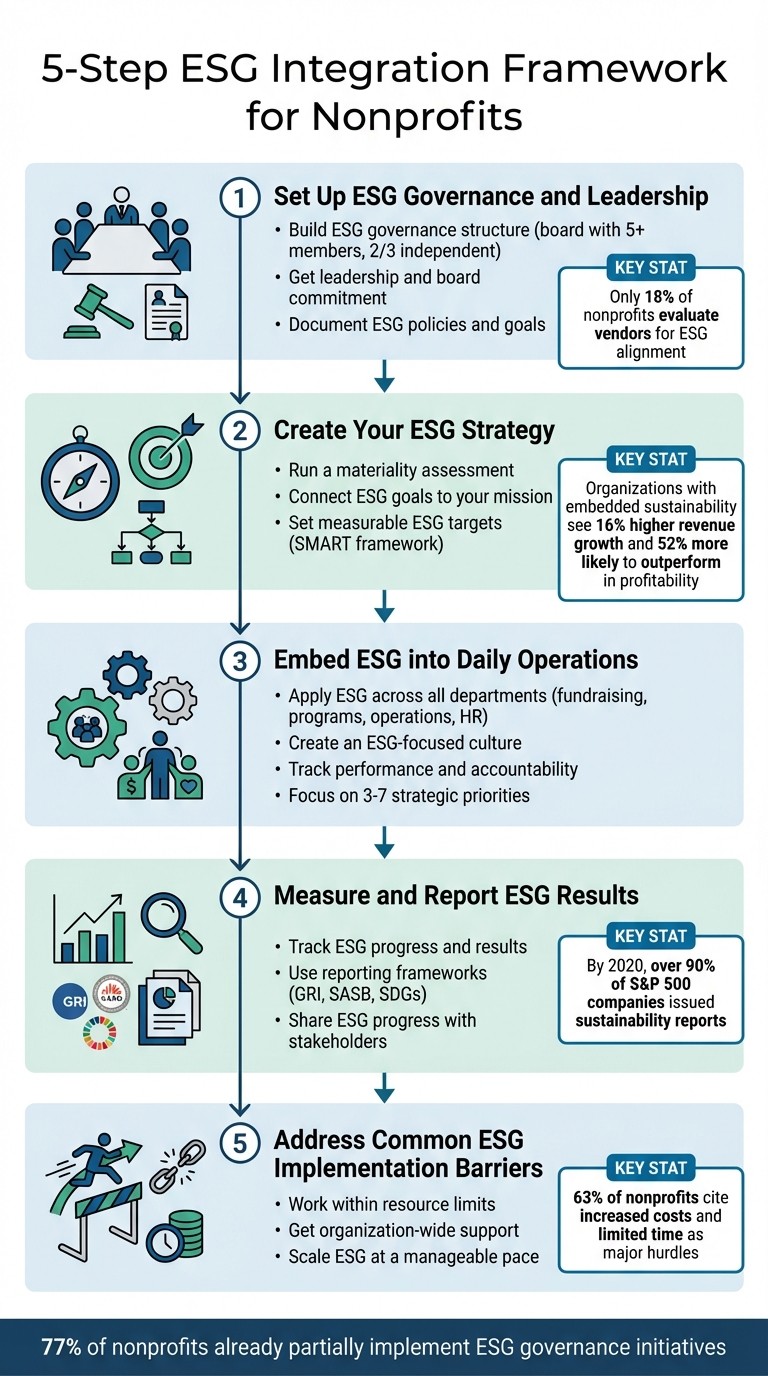
5-Step ESG Integration Framework for Nonprofits
Step 1: Set Up ESG Governance and Leadership
Build an ESG Governance Structure
A solid governance framework is the cornerstone of integrating ESG (Environmental, Social, and Governance) principles effectively. Your board must oversee and approve ESG-related policies, ensuring they align with your organization's mission and broader strategic goals [7][9]. To emphasize its importance, make ESG a regular agenda item at board meetings, tying it to national or global targets like the UN Sustainable Development Goals [4].
Start by structuring your board with clear role distinctions: the chief executive officer, board chair, and treasurer should be separate individuals. Additionally, aim for a board with at least five members, ensuring two-thirds are independent and not employed or contracted by the organization [7][9].
Develop a capability map tailored to your organization's needs over the next three years. Instead of focusing solely on professional titles, identify skills that align with your mission - such as legal expertise, financial know-how, technical proficiency, or even lived experience within the community you serve [8]. This targeted approach helps fill gaps and recruit board members strategically. As Nonprofits Insights puts it:
"Governance is the commitment to keep promises in public" [8].
Incorporate Enterprise Risk Management into your governance practices. Annually review risks across key areas like mission, personnel, finances, and reputation. Use pre-meeting briefings to update directors, allowing meeting time to focus on decisions rather than updates [8].
Once the governance structure is in place, leadership must fully embrace and advocate for ESG priorities.
Get Leadership and Board Commitment
To secure leadership’s commitment, position ESG as a strategic opportunity rather than a compliance task. Clear governance and operational boundaries, supported by alignment between the board chair and CEO, set a strong foundation [8].
Begin board discussions by exploring ESG issues, weaving them into strategic planning, and outlining plans for public reporting [10]. These conversations help leaders see ESG as a way to translate organizational values into tangible actions, such as selecting ethical vendors or making responsible investment decisions [10].
Onboarding plays a key role in equipping leadership. Provide new board members with a concise handbook that includes bylaws, committee charters, strategic plans, and a six-month cash forecast. This allows them to contribute meaningfully within a single meeting cycle [8]. Additionally, set up ongoing education for all board members to clarify their legal and ethical responsibilities in ESG oversight [7].
Currently, only 18% of nonprofits evaluate their vendors, partners, and funders for ESG alignment [6]. Leadership commitment means bridging this gap and making ESG considerations a standard part of partnership decisions.
Document Your ESG Policies and Goals
Converting ESG commitments into action requires clear documentation. Your policies should include a written code of ethics, annual conflict of interest disclosures, and whistleblower protections that ensure confidentiality and non-retaliation [7][8][9].
Establish a gift acceptance policy to ensure donations align with your mission and values, protecting the organization from potential conflicts [7][9]. Review governing documents every five years to keep them relevant to your mission [7].
Align your goals with established frameworks like the UN Sustainable Development Goals, Global Reporting Initiative (GRI), or International Sustainability Standards Board (ISSB). This alignment enhances transparency and provides measurable benchmarks for progress [6]. Formalize Diversity, Equity, and Inclusion (DEI) goals with specific metrics to demonstrate progress to stakeholders [6].
To streamline compliance, create a calendar to track monthly regulatory filings and renewals. This shifts compliance efforts from reactive crisis management to a routine administrative process [8]. As Nonprofits Insights highlights:
"Management and governance are not a compliance tax on mission; they are the architecture that lets mission scale without breaking" [8].
Turning Awareness into Action: Implementing ESG in Your Organization
Step 2: Create Your ESG Strategy
With a governance framework in place, it's time to craft an ESG strategy that aligns with your nonprofit's mission and resources. Instead of mimicking corporate models, focus on identifying the ESG issues that resonate most with your stakeholders while staying mindful of resource constraints.
Run a Materiality Assessment
A materiality assessment helps pinpoint the ESG issues that matter most to your organization and its stakeholders. It’s a strategic tool that filters out distractions and highlights priorities. This involves examining both inside-out impacts (how your organization affects society and the environment) and outside-in risks (how ESG challenges might impact your ability to fulfill your mission).
Start by defining the scope of your assessment - whether it applies to your entire organization or specific programs. Use established frameworks like the UN Sustainable Development Goals or GRI to list potential ESG topics. Then, engage key stakeholders - donors, beneficiaries, employees, and volunteers - through surveys, interviews, or workshops. Ask them to rank these issues based on their importance and impact. Finally, plot these insights on a materiality matrix to visualize priorities.
Consider this: organizations with embedded sustainability initiatives often experience a 16% higher revenue growth rate and are 52% more likely to outperform peers in profitability. Moreover, 81% of respondents in a global trade study highlighted ESG as a crucial factor in decision-making processes [11]. As KPMG aptly notes:
"As in financial reporting, you need to provide your stakeholders with information about the topics that matter and ensure less-relevant information doesn't get in the way." [11]
Treat your materiality assessment as a living process. Update it whenever significant changes occur in your mission or operating environment. Use the results to align your mission with ESG objectives that reflect your priorities.
Connect ESG Goals to Your Mission
The insights from your materiality assessment should seamlessly integrate ESG goals with your nonprofit’s mission. Aligning ESG objectives with your Theory of Change - a framework that connects activities to meaningful outcomes - ensures that your strategy amplifies your mission rather than competing with it.
Take Generation Hope as an example. During its 2021–2024 strategic planning, the DC-based nonprofit expanded its focus beyond direct service to include technical assistance and advocacy. This shift allowed them to set measurable goals, such as forming 10 new collaborations by FY24 and reaching 20,000 student parents through their technical assistance program [5]. Founder and CEO Nicole Lynn Lewis explained:
"We couldn't serve every teen student parent in the US - but we knew we could help drive larger changes to benefit them." [5]
Similarly, Living Goods adjusted its approach to emphasize government ownership of health worker models, reserving its own delivery efforts for "learning laboratories." This pivot supported their ESG goals while advancing government-led healthcare systems, achieving community health care delivery at an annual per capita cost of just $3 to $4 [5].
Focus on a small number of high-impact outcomes - usually five to seven strategic priorities. As Laura Mills, Senior Director of Quality and Evaluation at A Place Called Home, succinctly states:
"If everything is important, nothing is important." [3]
Set Measurable ESG Targets
Once your strategy is refined, establish clear, measurable goals that reflect your mission. The SMART framework - Specific, Measurable, Achievable, Relevant, and Time-bound - can help you set credible targets that inspire confidence among donors and prevent greenwashing [12].
For instance, ImmSchools refined its focus to three core metrics: students’ sense of belonging, school culture, and organizational reach. An eight-person committee, including students, parents, and educators, ensured these metrics stayed aligned with their mission of supporting undocumented K–12 students [3].
Balance ambition with practicality. Set targets based on solid research and resource availability. For long-term goals that are harder to measure, use interim outputs - like completed research or established partnerships - as indicators of progress.
Before finalizing your targets, evaluate the resources needed to achieve them and adjust plans accordingly [5]. Kelleen Kaye, Senior Advisor for Research Strategy at Upstream USA, underscores the importance of this step:
"We need to formulate the questions first. What is it we want to learn? What can we learn? These aren't just measurement questions, they're strategy and organization questions." [3]
Step 3: Embed ESG into Daily Operations
Once your strategy is in place, the next step is weaving ESG principles into the day-to-day operations of your organization. This means turning high-level goals into actionable practices that resonate across all departments, ensuring ESG becomes part of the organization's core rather than an isolated initiative.
Apply ESG Across All Departments
Every department within your nonprofit has a role to play in advancing ESG objectives. For example, in fundraising and development, you can incorporate ESG-related outcomes into grant proposals and donor communications. Carefully vet corporate partners to ensure their values align with your mission, protecting your reputation. Highlight efforts like energy-efficient projects or waste reduction in your narratives to attract ESG-conscious funders.
In program delivery, ESG themes can be integrated directly into your services. Educational programs, for instance, might include lessons on environmental responsibility. Strengthen governance by creating beneficiary advisory councils, giving those you serve a voice in program design. Some organizations even go a step further by inviting beneficiaries to join their boards, ensuring their perspectives shape decision-making.
For operations and procurement, focus on tracking and increasing participation from minority-owned and local vendors to boost diversity. Facility management is another area ripe for ESG improvements - install LED lighting, set up solar panels, or establish recycling programs. Digital tools can help cut down on paper use, and you can track metrics like energy consumption or paper usage to measure progress. In human resources, incorporate DEI metrics - such as board diversity or recruitment outreach efforts - into regular reporting, ensuring accountability in fostering an inclusive workplace.
These adjustments not only advance ESG goals but also lay the groundwork for a workplace culture that fully embraces these values.
Create an ESG-Focused Culture
For ESG integration to succeed, it must go beyond a top-down directive. It needs to become a shared responsibility, involving everyone from leadership to front-line staff, volunteers, and even the broader community. ImmSchools has shown how engaging diverse voices can strengthen ESG efforts, creating a culture that reflects the values of all stakeholders.
Upstream USA offers another example of this approach. Instead of focusing solely on metrics, Senior Advisor for Research Strategy Kelleen Kaye emphasizes "learning questions" to guide improvements. This ensures staff understand the reasons behind ESG initiatives, framing them as opportunities for growth rather than mere compliance tasks [3]. ESG can also be embedded into HR processes by tying performance reviews and incentives to ESG goals, incorporating sustainability into onboarding, and encouraging employees to propose their own ESG ideas. As Deloitte consultants note, aligning organizational values with stakeholder expectations is critical to maintaining a "social license to operate" [14].
When ESG values permeate workplace culture, it becomes easier to sustain progress and hold the organization accountable.
Track Performance and Accountability
To connect daily activities with broader ESG objectives, establish robust tracking systems. A Sustainability Management Plan (SMP) can bridge project-level data with global reporting frameworks. Tools like an impact register, material topics table, and benefits tracker help verify commitments and monitor progress [15]. For agile organizations, embedding sustainability KPIs into sprint reviews or operational backlogs ensures ESG remains part of routine workflows [15].
Focus on a few critical metrics that align closely with your mission. Choose three high-level outcomes that matter most, avoiding the pitfall of overwhelming staff with excessive data collection. Use interim indicators, such as completed partnerships or behavioral changes, to measure progress while waiting for long-term results to take shape [3]. By 2020, over 90% of S&P 500 companies had issued sustainability reports, and nonprofits are increasingly adopting frameworks like GRI, SASB, or the UN Sustainable Development Goals to ensure data remains transparent and auditable [13].
Regular measurement not only highlights successes but also identifies areas for improvement, allowing you to refine programs based on what the data reveals [3].
Step 4: Measure and Report ESG Results
Track ESG Progress and Results
Getting a handle on ESG performance begins with selecting the right metrics. A materiality-driven approach is key - focus on the environmental, social, and governance factors that carry the most weight for your mission [16]. Instead of drowning in data, zero in on a few metrics that align with your organization's Theory of Change. For example, ImmSchools, under CEO Viridiana Carrizales, has tracked just three core metrics since 2017: students' sense of belonging, school culture, and organizational reach. To keep these metrics relevant, they created an eight-person committee of students and educators to guide the evaluation process [3].
Your chosen metrics should cover all three ESG dimensions. For environmental factors, consider tracking greenhouse gas emissions (Scope 1, 2, and 3), water use in high-stress areas, and waste diverted from landfills. Social metrics might include diversity ratios, participant outcomes like a "sense of belonging", or health improvements. Governance indicators could include board diversity, documented ESG policies, anti-corruption training completion rates, and regulatory compliance [16][17]. Pair hard numbers - like percentage changes in behavior - with qualitative insights, such as quotes or focus group feedback, to give more depth to your findings [17].
For long-term goals, use interim benchmarks to monitor progress. For instance, if your overarching goal is poverty reduction, track short-term impacts like changes in participant behavior or improved service delivery [3]. Before locking in any metric, ask yourself: what decisions are you unable to make because you lack certain data? Kelleen Kaye from Upstream USA emphasizes starting with these strategic questions to ensure your metrics directly support your ESG goals [3].
Use Reporting Frameworks for Transparency
Once you've gathered your data, use established reporting frameworks to ensure clarity and openness. The Global Reporting Initiative (GRI) is widely recognized and breaks down into three parts: Universal Standards (applicable to all organizations), Sector Standards (specific impacts), and Topic Standards (detailed disclosures) [18]. Begin with GRI 1: Foundation 2021, which provides essential guidance on managing impacts on people and the planet [19]. As of January 1, 2023, the revised GRI Universal Standards, which include human rights and environmental due diligence, became mandatory for all reporting [18].
You can also combine frameworks. While GRI focuses on the broader impact on the economy, environment, and people, SASB (Sustainability Accounting Standards Board) hones in on industry-specific ESG factors relevant to investors [16]. Many organizations also align their data with the UN Sustainable Development Goals (SDGs) to tie local outcomes to global priorities. By 2019, about 72% of publicly traded companies referenced the SDGs in their reports [16].
| Framework/Standard | Primary Focus | Target Audience |
| --- | --- | --- |
| <strong>GRI (Global Reporting Initiative)</strong> | Impact on economy, environment, and people | Multi-stakeholder (Investors, policymakers, civil society) |
| <strong>SASB / ISSB</strong> | Financial materiality; risks/opportunities affecting the organization | Investors and capital markets |
| <strong>SDGs (Sustainable Development Goals)</strong> | Contribution to global sustainable development targets | Global community and governments
| Framework/Standard | Primary Focus | Target Audience |
| --- | --- | --- |
| <strong>GRI (Global Reporting Initiative)</strong> | Impact on economy, environment, and people | Multi-stakeholder (Investors, policymakers, civil society) |
| <strong>SASB / ISSB</strong> | Financial materiality; risks/opportunities affecting the organization | Investors and capital markets |
| <strong>SDGs (Sustainable Development Goals)</strong> | Contribution to global sustainable development targets | Global community and governments
To demonstrate accountability, formally register your ESG reports with GRI [19]. For added credibility, consider independent audits of sustainability data, such as greenhouse gas emissions, to assure stakeholders of your report's accuracy [20]. Standardize methodologies and validate data promptly to ensure reliability and maintain "investor-grade" quality metrics [20][21].
Share ESG Progress with Stakeholders
Once your reports are ready, tailor your communication to meet the needs of various stakeholders. Funders often want measurable outcomes, boards need concise strategic updates, and community members value seeing their input reflected in your learning process [23]. Go beyond merely counting activities, like the number of attendees, and focus on explaining the actual changes your efforts brought to people’s lives [23].
Real-time dashboards are becoming more popular than static annual reports, as they allow for quicker program adjustments [23]. Many organizations face challenges here - up to 80% of reporting time is spent cleaning up data manually, leaving only 20% for analysis [23]. To streamline this, assign unique IDs to stakeholders from their first interaction. This helps track their progress across different programs without the headache of manual data matching [23].
Being transparent about failures is just as important as highlighting successes. Reporting should be a tool for ongoing learning, not just a compliance task [23][24]. Combine quantitative data - like employment rates - with qualitative stories from stakeholders to add depth. For instance, in 2024, KPMG in the UK partnered with Key4Life to reduce reoffending rates among ex-prisoners. Through mentoring and "meet the employer" sessions, the program achieved a 14% reoffending rate, compared to the UK’s national rate of 65%. Over 70% of participants also secured employment [17].
"Reporting signals a responsible organization: one that is dedicated to being open and honest with its stakeholders." - Global Reporting Initiative [19]
Involve beneficiaries and front-line staff in determining which outcomes matter most to ensure your reporting reflects community priorities [3][24]. Map your internal data to established frameworks like GRI, IRIS+, or the SDGs to build trust with sophisticated donors [22][23].
Step 5: Address Common ESG Implementation Barriers
Work Within Resource Limits
For many nonprofits, the biggest challenges in adopting ESG initiatives are increased costs and limited time, with 63% citing these as major hurdles. Additionally, 51% face difficulties in measuring and reporting their efforts [25]. A practical starting point is to focus on low-cost, mission-aligned projects that bring immediate value to stakeholders. Take, for instance, Friends of Trees, a small Oregon-based nonprofit. By collaborating with the U.S. Forest Service and sharing their extensive tree-planting data, they contributed to a peer-reviewed study on the health benefits of greenery. This partnership not only amplified their environmental impact but also garnered national recognition and inspired similar endeavors [1].
Nonprofits can also integrate ESG reporting into their existing governance and financial oversight structures. With 77% of nonprofits already partially implementing ESG governance initiatives, there’s an opportunity to build on this foundation. Partnerships can help share the burden of costs, expertise, and reporting frameworks. To make progress, nonprofits might first focus on social impact metrics, an area where they often excel, before tackling more complex environmental measures [25].
Once resource-efficient practices are in place, engaging the entire organization becomes the next critical step.
Get Organization-Wide Support
A lack of ESG expertise is a common issue for nonprofits [2]. To address this, organizations need to go beyond treating reporting as a routine task and instead foster a culture of accountability. Appointing ESG champions and offering targeted training can help build internal expertise and embed ESG principles into the organization’s ethos [2].
A noteworthy example comes from Ukraine, where the Association of Sustainable Development Experts (ASDE) became the first public organization to publish a comprehensive ESG report in 2024. Adhering to GRI and SASB principles, the report covered activities from 2023 to 2024, setting a standard for transparency and accountability in the local nonprofit sector [2].
"ESG is not just a temporary trend for NGOs, but a strategic direction that will define their future role and effectiveness." – Anastasiia Skok, ESG Manager, BDO in Ukraine [2]
Formalizing policies like a Code of Ethics, Environmental Policy, and Gender Equality Policy can provide clear guidelines for ESG integration. With two-thirds of U.S. adults actively following sustainability issues and Generation Z making up roughly 27% of the U.S. population, embracing ESG can also attract and retain passionate team members [26].
After securing internal buy-in, organizations can focus on scaling their ESG efforts step by step.
Scale ESG at a Manageable Pace
Breaking the ESG journey into stages - starting with board alignment, defining a tailored strategy, and implementing targeted initiatives - can help nonprofits make steady progress while conserving resources [4].
A great example comes from Generation Hope, a Washington, DC-based nonprofit. Under the leadership of CEO Nicole Lynn Lewis, the organization adopted a three-year strategic plan in 2023 to expand its impact. Transitioning from solely offering direct services to teen parents, they introduced a model blending direct service with technical assistance and advocacy. Their goal? To establish 10 new collaborations and impact at least 20,000 student parents through a technical assistance program by the end of FY24 [5].
"Our work in DC was a proof point for what this could look like across the country. We couldn't serve every teen student parent in the US - but we knew we could help drive larger changes to benefit them." – Nicole Lynn Lewis, Founder and CEO, Generation Hope [5]
To ensure success, limit the focus to five to seven key multiyear initiatives. This approach allows organizations to allocate the necessary time, money, and skills to execute effectively [5]. Using specific programs or locations as testing grounds - or "learning laboratories" - can also be a smart way to refine ESG models before rolling them out more broadly. Living Goods in Kenya adopted this strategy during its 2023 strategic planning. After training 12,000 health workers who reached 9 million people, they decided to limit direct delivery to these learning laboratories, while prioritizing support for government-funded programs to ensure long-term sustainability [5].
Setting clear boundaries is essential to avoid spreading resources too thinly across too many ESG initiatives. Regularly reviewing ESG goals during annual budgeting cycles can help embed them into the organization’s core operations without overwhelming the team.
Conclusion: Moving Forward with ESG Integration
Incorporating ESG principles into your nonprofit's operations not only reinforces your mission but also ensures long-term sustainability. This process begins with establishing strong ESG governance at the leadership level. When the board is committed and provides clear oversight, it sets the stage for organization-wide adoption. Tracking progress through established frameworks and maintaining open communication with stakeholders helps uphold your social license to operate [14]. These steps pave the way for operational improvements and increased funding opportunities.
The advantages of ESG go well beyond meeting regulatory requirements. As BDO highlights, "Nonprofits are uniquely positioned to leverage ESG to enhance their mission and brand" [6]. Organizations that embrace ESG early are already seeing greater donor support, reflecting a growing understanding that ESG-related issues are central to resilience and stability in today’s world [14].
"The integration of environmental and social sustainability principles into nonprofits' operational lifecycles will be key to ensuring donor retention and programmatic success for years to come." – BDO [6]
To take these efforts further, engage your board in meaningful discussions and adopt widely recognized frameworks like the Global Reporting Initiative (GRI) or the Task Force on Climate-related Financial Disclosures (TCFD) for effective and flexible reporting. As Veronica Poole, Deloitte Global IFRS and Corporate Reporting Leader, explains:
"Integrated thinking is a journey, not a destination. It is a dynamic, iterative process that requires continuous learning and improvement" [14].
FAQs
Where should a nonprofit start with ESG?
To embrace ESG principles, nonprofits should first grasp the essentials: Environmental, Social, and Governance. Start by evaluating where your organization currently stands in these areas. Focus on aspects that closely align with your mission and values. Engage your leadership team early in the process and make ESG a regular topic on board meeting agendas. From there, create a customized strategy and a practical action plan that reflects your objectives and serves the needs of your community. This approach ensures your efforts remain purposeful and aligned with your mission.
How do we pick ESG metrics that fit our mission?
To select ESG metrics that align with your mission, begin by clearly outlining your mission, vision, and strategic objectives. Pinpoint impact indicators that resonate with your core values and desired outcomes. Collaborate with stakeholders - such as community members and strategic partners - to ensure the metrics are meaningful and relevant. Tools like materiality matrices can help prioritize the most pressing issues. Additionally, aligning your metrics with established standards like IRIS or SDGs ensures consistency, clarity, and alignment with your mission.
What’s the simplest way to report ESG results to donors?
Creating a straightforward ESG report is an effective way to highlight your efforts in sustainability, social responsibility, and governance. Keep the focus on summarizing key initiatives, measurable outcomes, and future objectives in a clear and accessible format. Leveraging established frameworks like GRI or ISSB can ensure your report aligns with stakeholder expectations. By emphasizing transparency and demonstrating tangible impact, you can foster trust and strengthen engagement with donors while adhering to ESG reporting standards.
Related Blog Posts
Latest Articles
©2025



FAQ
01
What does it really mean to “redefine profit”?
02
What makes Council Fire different?
03
Who does Council Fire you work with?
04
What does working with Council Fire actually look like?
05
How does Council Fire help organizations turn big goals into action?
06
How does Council Fire define and measure success?
Feb 20, 2026
How to Integrate ESG into Core Business Operations for NGOs & Nonprofits
ESG Strategy
In This Article
Embed ESG into nonprofits' core operations to strengthen governance, attract funding, and deliver measurable mission impact through clear targets and reporting.
How to Integrate ESG into Core Business Operations for NGOs & Nonprofits
Nonprofits are increasingly adopting ESG (Environmental, Social, and Governance) principles to align their missions with measurable impact, attract funding, and improve operations. ESG focuses on three key areas: environmental impacts (e.g., energy use, waste), social commitments (e.g., diversity, community relationships), and governance practices (e.g., transparency, board oversight). For nonprofits, integrating ESG helps build trust with donors, improve volunteer engagement, and ensure long-term mission success.
Key Takeaways:
Why ESG Matters: ESG is becoming a critical factor for donors, grantmakers, and corporate partners when evaluating nonprofits.
Common Challenges: Limited funding, legal complexities, and knowledge gaps often hinder ESG adoption.
Action Steps: Establish governance structures, set measurable goals, and align ESG strategies with the organization’s mission.
Benefits: ESG integration can lead to increased funding, operational efficiency, and stronger stakeholder relationships.
This guide outlines how nonprofits can embed ESG into their operations, from governance and strategy development to daily practices and reporting.
5-Step ESG Integration Framework for Nonprofits
Step 1: Set Up ESG Governance and Leadership
Build an ESG Governance Structure
A solid governance framework is the cornerstone of integrating ESG (Environmental, Social, and Governance) principles effectively. Your board must oversee and approve ESG-related policies, ensuring they align with your organization's mission and broader strategic goals [7][9]. To emphasize its importance, make ESG a regular agenda item at board meetings, tying it to national or global targets like the UN Sustainable Development Goals [4].
Start by structuring your board with clear role distinctions: the chief executive officer, board chair, and treasurer should be separate individuals. Additionally, aim for a board with at least five members, ensuring two-thirds are independent and not employed or contracted by the organization [7][9].
Develop a capability map tailored to your organization's needs over the next three years. Instead of focusing solely on professional titles, identify skills that align with your mission - such as legal expertise, financial know-how, technical proficiency, or even lived experience within the community you serve [8]. This targeted approach helps fill gaps and recruit board members strategically. As Nonprofits Insights puts it:
"Governance is the commitment to keep promises in public" [8].
Incorporate Enterprise Risk Management into your governance practices. Annually review risks across key areas like mission, personnel, finances, and reputation. Use pre-meeting briefings to update directors, allowing meeting time to focus on decisions rather than updates [8].
Once the governance structure is in place, leadership must fully embrace and advocate for ESG priorities.
Get Leadership and Board Commitment
To secure leadership’s commitment, position ESG as a strategic opportunity rather than a compliance task. Clear governance and operational boundaries, supported by alignment between the board chair and CEO, set a strong foundation [8].
Begin board discussions by exploring ESG issues, weaving them into strategic planning, and outlining plans for public reporting [10]. These conversations help leaders see ESG as a way to translate organizational values into tangible actions, such as selecting ethical vendors or making responsible investment decisions [10].
Onboarding plays a key role in equipping leadership. Provide new board members with a concise handbook that includes bylaws, committee charters, strategic plans, and a six-month cash forecast. This allows them to contribute meaningfully within a single meeting cycle [8]. Additionally, set up ongoing education for all board members to clarify their legal and ethical responsibilities in ESG oversight [7].
Currently, only 18% of nonprofits evaluate their vendors, partners, and funders for ESG alignment [6]. Leadership commitment means bridging this gap and making ESG considerations a standard part of partnership decisions.
Document Your ESG Policies and Goals
Converting ESG commitments into action requires clear documentation. Your policies should include a written code of ethics, annual conflict of interest disclosures, and whistleblower protections that ensure confidentiality and non-retaliation [7][8][9].
Establish a gift acceptance policy to ensure donations align with your mission and values, protecting the organization from potential conflicts [7][9]. Review governing documents every five years to keep them relevant to your mission [7].
Align your goals with established frameworks like the UN Sustainable Development Goals, Global Reporting Initiative (GRI), or International Sustainability Standards Board (ISSB). This alignment enhances transparency and provides measurable benchmarks for progress [6]. Formalize Diversity, Equity, and Inclusion (DEI) goals with specific metrics to demonstrate progress to stakeholders [6].
To streamline compliance, create a calendar to track monthly regulatory filings and renewals. This shifts compliance efforts from reactive crisis management to a routine administrative process [8]. As Nonprofits Insights highlights:
"Management and governance are not a compliance tax on mission; they are the architecture that lets mission scale without breaking" [8].
Turning Awareness into Action: Implementing ESG in Your Organization
Step 2: Create Your ESG Strategy
With a governance framework in place, it's time to craft an ESG strategy that aligns with your nonprofit's mission and resources. Instead of mimicking corporate models, focus on identifying the ESG issues that resonate most with your stakeholders while staying mindful of resource constraints.
Run a Materiality Assessment
A materiality assessment helps pinpoint the ESG issues that matter most to your organization and its stakeholders. It’s a strategic tool that filters out distractions and highlights priorities. This involves examining both inside-out impacts (how your organization affects society and the environment) and outside-in risks (how ESG challenges might impact your ability to fulfill your mission).
Start by defining the scope of your assessment - whether it applies to your entire organization or specific programs. Use established frameworks like the UN Sustainable Development Goals or GRI to list potential ESG topics. Then, engage key stakeholders - donors, beneficiaries, employees, and volunteers - through surveys, interviews, or workshops. Ask them to rank these issues based on their importance and impact. Finally, plot these insights on a materiality matrix to visualize priorities.
Consider this: organizations with embedded sustainability initiatives often experience a 16% higher revenue growth rate and are 52% more likely to outperform peers in profitability. Moreover, 81% of respondents in a global trade study highlighted ESG as a crucial factor in decision-making processes [11]. As KPMG aptly notes:
"As in financial reporting, you need to provide your stakeholders with information about the topics that matter and ensure less-relevant information doesn't get in the way." [11]
Treat your materiality assessment as a living process. Update it whenever significant changes occur in your mission or operating environment. Use the results to align your mission with ESG objectives that reflect your priorities.
Connect ESG Goals to Your Mission
The insights from your materiality assessment should seamlessly integrate ESG goals with your nonprofit’s mission. Aligning ESG objectives with your Theory of Change - a framework that connects activities to meaningful outcomes - ensures that your strategy amplifies your mission rather than competing with it.
Take Generation Hope as an example. During its 2021–2024 strategic planning, the DC-based nonprofit expanded its focus beyond direct service to include technical assistance and advocacy. This shift allowed them to set measurable goals, such as forming 10 new collaborations by FY24 and reaching 20,000 student parents through their technical assistance program [5]. Founder and CEO Nicole Lynn Lewis explained:
"We couldn't serve every teen student parent in the US - but we knew we could help drive larger changes to benefit them." [5]
Similarly, Living Goods adjusted its approach to emphasize government ownership of health worker models, reserving its own delivery efforts for "learning laboratories." This pivot supported their ESG goals while advancing government-led healthcare systems, achieving community health care delivery at an annual per capita cost of just $3 to $4 [5].
Focus on a small number of high-impact outcomes - usually five to seven strategic priorities. As Laura Mills, Senior Director of Quality and Evaluation at A Place Called Home, succinctly states:
"If everything is important, nothing is important." [3]
Set Measurable ESG Targets
Once your strategy is refined, establish clear, measurable goals that reflect your mission. The SMART framework - Specific, Measurable, Achievable, Relevant, and Time-bound - can help you set credible targets that inspire confidence among donors and prevent greenwashing [12].
For instance, ImmSchools refined its focus to three core metrics: students’ sense of belonging, school culture, and organizational reach. An eight-person committee, including students, parents, and educators, ensured these metrics stayed aligned with their mission of supporting undocumented K–12 students [3].
Balance ambition with practicality. Set targets based on solid research and resource availability. For long-term goals that are harder to measure, use interim outputs - like completed research or established partnerships - as indicators of progress.
Before finalizing your targets, evaluate the resources needed to achieve them and adjust plans accordingly [5]. Kelleen Kaye, Senior Advisor for Research Strategy at Upstream USA, underscores the importance of this step:
"We need to formulate the questions first. What is it we want to learn? What can we learn? These aren't just measurement questions, they're strategy and organization questions." [3]
Step 3: Embed ESG into Daily Operations
Once your strategy is in place, the next step is weaving ESG principles into the day-to-day operations of your organization. This means turning high-level goals into actionable practices that resonate across all departments, ensuring ESG becomes part of the organization's core rather than an isolated initiative.
Apply ESG Across All Departments
Every department within your nonprofit has a role to play in advancing ESG objectives. For example, in fundraising and development, you can incorporate ESG-related outcomes into grant proposals and donor communications. Carefully vet corporate partners to ensure their values align with your mission, protecting your reputation. Highlight efforts like energy-efficient projects or waste reduction in your narratives to attract ESG-conscious funders.
In program delivery, ESG themes can be integrated directly into your services. Educational programs, for instance, might include lessons on environmental responsibility. Strengthen governance by creating beneficiary advisory councils, giving those you serve a voice in program design. Some organizations even go a step further by inviting beneficiaries to join their boards, ensuring their perspectives shape decision-making.
For operations and procurement, focus on tracking and increasing participation from minority-owned and local vendors to boost diversity. Facility management is another area ripe for ESG improvements - install LED lighting, set up solar panels, or establish recycling programs. Digital tools can help cut down on paper use, and you can track metrics like energy consumption or paper usage to measure progress. In human resources, incorporate DEI metrics - such as board diversity or recruitment outreach efforts - into regular reporting, ensuring accountability in fostering an inclusive workplace.
These adjustments not only advance ESG goals but also lay the groundwork for a workplace culture that fully embraces these values.
Create an ESG-Focused Culture
For ESG integration to succeed, it must go beyond a top-down directive. It needs to become a shared responsibility, involving everyone from leadership to front-line staff, volunteers, and even the broader community. ImmSchools has shown how engaging diverse voices can strengthen ESG efforts, creating a culture that reflects the values of all stakeholders.
Upstream USA offers another example of this approach. Instead of focusing solely on metrics, Senior Advisor for Research Strategy Kelleen Kaye emphasizes "learning questions" to guide improvements. This ensures staff understand the reasons behind ESG initiatives, framing them as opportunities for growth rather than mere compliance tasks [3]. ESG can also be embedded into HR processes by tying performance reviews and incentives to ESG goals, incorporating sustainability into onboarding, and encouraging employees to propose their own ESG ideas. As Deloitte consultants note, aligning organizational values with stakeholder expectations is critical to maintaining a "social license to operate" [14].
When ESG values permeate workplace culture, it becomes easier to sustain progress and hold the organization accountable.
Track Performance and Accountability
To connect daily activities with broader ESG objectives, establish robust tracking systems. A Sustainability Management Plan (SMP) can bridge project-level data with global reporting frameworks. Tools like an impact register, material topics table, and benefits tracker help verify commitments and monitor progress [15]. For agile organizations, embedding sustainability KPIs into sprint reviews or operational backlogs ensures ESG remains part of routine workflows [15].
Focus on a few critical metrics that align closely with your mission. Choose three high-level outcomes that matter most, avoiding the pitfall of overwhelming staff with excessive data collection. Use interim indicators, such as completed partnerships or behavioral changes, to measure progress while waiting for long-term results to take shape [3]. By 2020, over 90% of S&P 500 companies had issued sustainability reports, and nonprofits are increasingly adopting frameworks like GRI, SASB, or the UN Sustainable Development Goals to ensure data remains transparent and auditable [13].
Regular measurement not only highlights successes but also identifies areas for improvement, allowing you to refine programs based on what the data reveals [3].
Step 4: Measure and Report ESG Results
Track ESG Progress and Results
Getting a handle on ESG performance begins with selecting the right metrics. A materiality-driven approach is key - focus on the environmental, social, and governance factors that carry the most weight for your mission [16]. Instead of drowning in data, zero in on a few metrics that align with your organization's Theory of Change. For example, ImmSchools, under CEO Viridiana Carrizales, has tracked just three core metrics since 2017: students' sense of belonging, school culture, and organizational reach. To keep these metrics relevant, they created an eight-person committee of students and educators to guide the evaluation process [3].
Your chosen metrics should cover all three ESG dimensions. For environmental factors, consider tracking greenhouse gas emissions (Scope 1, 2, and 3), water use in high-stress areas, and waste diverted from landfills. Social metrics might include diversity ratios, participant outcomes like a "sense of belonging", or health improvements. Governance indicators could include board diversity, documented ESG policies, anti-corruption training completion rates, and regulatory compliance [16][17]. Pair hard numbers - like percentage changes in behavior - with qualitative insights, such as quotes or focus group feedback, to give more depth to your findings [17].
For long-term goals, use interim benchmarks to monitor progress. For instance, if your overarching goal is poverty reduction, track short-term impacts like changes in participant behavior or improved service delivery [3]. Before locking in any metric, ask yourself: what decisions are you unable to make because you lack certain data? Kelleen Kaye from Upstream USA emphasizes starting with these strategic questions to ensure your metrics directly support your ESG goals [3].
Use Reporting Frameworks for Transparency
Once you've gathered your data, use established reporting frameworks to ensure clarity and openness. The Global Reporting Initiative (GRI) is widely recognized and breaks down into three parts: Universal Standards (applicable to all organizations), Sector Standards (specific impacts), and Topic Standards (detailed disclosures) [18]. Begin with GRI 1: Foundation 2021, which provides essential guidance on managing impacts on people and the planet [19]. As of January 1, 2023, the revised GRI Universal Standards, which include human rights and environmental due diligence, became mandatory for all reporting [18].
You can also combine frameworks. While GRI focuses on the broader impact on the economy, environment, and people, SASB (Sustainability Accounting Standards Board) hones in on industry-specific ESG factors relevant to investors [16]. Many organizations also align their data with the UN Sustainable Development Goals (SDGs) to tie local outcomes to global priorities. By 2019, about 72% of publicly traded companies referenced the SDGs in their reports [16].
| Framework/Standard | Primary Focus | Target Audience |
| --- | --- | --- |
| <strong>GRI (Global Reporting Initiative)</strong> | Impact on economy, environment, and people | Multi-stakeholder (Investors, policymakers, civil society) |
| <strong>SASB / ISSB</strong> | Financial materiality; risks/opportunities affecting the organization | Investors and capital markets |
| <strong>SDGs (Sustainable Development Goals)</strong> | Contribution to global sustainable development targets | Global community and governments
To demonstrate accountability, formally register your ESG reports with GRI [19]. For added credibility, consider independent audits of sustainability data, such as greenhouse gas emissions, to assure stakeholders of your report's accuracy [20]. Standardize methodologies and validate data promptly to ensure reliability and maintain "investor-grade" quality metrics [20][21].
Share ESG Progress with Stakeholders
Once your reports are ready, tailor your communication to meet the needs of various stakeholders. Funders often want measurable outcomes, boards need concise strategic updates, and community members value seeing their input reflected in your learning process [23]. Go beyond merely counting activities, like the number of attendees, and focus on explaining the actual changes your efforts brought to people’s lives [23].
Real-time dashboards are becoming more popular than static annual reports, as they allow for quicker program adjustments [23]. Many organizations face challenges here - up to 80% of reporting time is spent cleaning up data manually, leaving only 20% for analysis [23]. To streamline this, assign unique IDs to stakeholders from their first interaction. This helps track their progress across different programs without the headache of manual data matching [23].
Being transparent about failures is just as important as highlighting successes. Reporting should be a tool for ongoing learning, not just a compliance task [23][24]. Combine quantitative data - like employment rates - with qualitative stories from stakeholders to add depth. For instance, in 2024, KPMG in the UK partnered with Key4Life to reduce reoffending rates among ex-prisoners. Through mentoring and "meet the employer" sessions, the program achieved a 14% reoffending rate, compared to the UK’s national rate of 65%. Over 70% of participants also secured employment [17].
"Reporting signals a responsible organization: one that is dedicated to being open and honest with its stakeholders." - Global Reporting Initiative [19]
Involve beneficiaries and front-line staff in determining which outcomes matter most to ensure your reporting reflects community priorities [3][24]. Map your internal data to established frameworks like GRI, IRIS+, or the SDGs to build trust with sophisticated donors [22][23].
Step 5: Address Common ESG Implementation Barriers
Work Within Resource Limits
For many nonprofits, the biggest challenges in adopting ESG initiatives are increased costs and limited time, with 63% citing these as major hurdles. Additionally, 51% face difficulties in measuring and reporting their efforts [25]. A practical starting point is to focus on low-cost, mission-aligned projects that bring immediate value to stakeholders. Take, for instance, Friends of Trees, a small Oregon-based nonprofit. By collaborating with the U.S. Forest Service and sharing their extensive tree-planting data, they contributed to a peer-reviewed study on the health benefits of greenery. This partnership not only amplified their environmental impact but also garnered national recognition and inspired similar endeavors [1].
Nonprofits can also integrate ESG reporting into their existing governance and financial oversight structures. With 77% of nonprofits already partially implementing ESG governance initiatives, there’s an opportunity to build on this foundation. Partnerships can help share the burden of costs, expertise, and reporting frameworks. To make progress, nonprofits might first focus on social impact metrics, an area where they often excel, before tackling more complex environmental measures [25].
Once resource-efficient practices are in place, engaging the entire organization becomes the next critical step.
Get Organization-Wide Support
A lack of ESG expertise is a common issue for nonprofits [2]. To address this, organizations need to go beyond treating reporting as a routine task and instead foster a culture of accountability. Appointing ESG champions and offering targeted training can help build internal expertise and embed ESG principles into the organization’s ethos [2].
A noteworthy example comes from Ukraine, where the Association of Sustainable Development Experts (ASDE) became the first public organization to publish a comprehensive ESG report in 2024. Adhering to GRI and SASB principles, the report covered activities from 2023 to 2024, setting a standard for transparency and accountability in the local nonprofit sector [2].
"ESG is not just a temporary trend for NGOs, but a strategic direction that will define their future role and effectiveness." – Anastasiia Skok, ESG Manager, BDO in Ukraine [2]
Formalizing policies like a Code of Ethics, Environmental Policy, and Gender Equality Policy can provide clear guidelines for ESG integration. With two-thirds of U.S. adults actively following sustainability issues and Generation Z making up roughly 27% of the U.S. population, embracing ESG can also attract and retain passionate team members [26].
After securing internal buy-in, organizations can focus on scaling their ESG efforts step by step.
Scale ESG at a Manageable Pace
Breaking the ESG journey into stages - starting with board alignment, defining a tailored strategy, and implementing targeted initiatives - can help nonprofits make steady progress while conserving resources [4].
A great example comes from Generation Hope, a Washington, DC-based nonprofit. Under the leadership of CEO Nicole Lynn Lewis, the organization adopted a three-year strategic plan in 2023 to expand its impact. Transitioning from solely offering direct services to teen parents, they introduced a model blending direct service with technical assistance and advocacy. Their goal? To establish 10 new collaborations and impact at least 20,000 student parents through a technical assistance program by the end of FY24 [5].
"Our work in DC was a proof point for what this could look like across the country. We couldn't serve every teen student parent in the US - but we knew we could help drive larger changes to benefit them." – Nicole Lynn Lewis, Founder and CEO, Generation Hope [5]
To ensure success, limit the focus to five to seven key multiyear initiatives. This approach allows organizations to allocate the necessary time, money, and skills to execute effectively [5]. Using specific programs or locations as testing grounds - or "learning laboratories" - can also be a smart way to refine ESG models before rolling them out more broadly. Living Goods in Kenya adopted this strategy during its 2023 strategic planning. After training 12,000 health workers who reached 9 million people, they decided to limit direct delivery to these learning laboratories, while prioritizing support for government-funded programs to ensure long-term sustainability [5].
Setting clear boundaries is essential to avoid spreading resources too thinly across too many ESG initiatives. Regularly reviewing ESG goals during annual budgeting cycles can help embed them into the organization’s core operations without overwhelming the team.
Conclusion: Moving Forward with ESG Integration
Incorporating ESG principles into your nonprofit's operations not only reinforces your mission but also ensures long-term sustainability. This process begins with establishing strong ESG governance at the leadership level. When the board is committed and provides clear oversight, it sets the stage for organization-wide adoption. Tracking progress through established frameworks and maintaining open communication with stakeholders helps uphold your social license to operate [14]. These steps pave the way for operational improvements and increased funding opportunities.
The advantages of ESG go well beyond meeting regulatory requirements. As BDO highlights, "Nonprofits are uniquely positioned to leverage ESG to enhance their mission and brand" [6]. Organizations that embrace ESG early are already seeing greater donor support, reflecting a growing understanding that ESG-related issues are central to resilience and stability in today’s world [14].
"The integration of environmental and social sustainability principles into nonprofits' operational lifecycles will be key to ensuring donor retention and programmatic success for years to come." – BDO [6]
To take these efforts further, engage your board in meaningful discussions and adopt widely recognized frameworks like the Global Reporting Initiative (GRI) or the Task Force on Climate-related Financial Disclosures (TCFD) for effective and flexible reporting. As Veronica Poole, Deloitte Global IFRS and Corporate Reporting Leader, explains:
"Integrated thinking is a journey, not a destination. It is a dynamic, iterative process that requires continuous learning and improvement" [14].
FAQs
Where should a nonprofit start with ESG?
To embrace ESG principles, nonprofits should first grasp the essentials: Environmental, Social, and Governance. Start by evaluating where your organization currently stands in these areas. Focus on aspects that closely align with your mission and values. Engage your leadership team early in the process and make ESG a regular topic on board meeting agendas. From there, create a customized strategy and a practical action plan that reflects your objectives and serves the needs of your community. This approach ensures your efforts remain purposeful and aligned with your mission.
How do we pick ESG metrics that fit our mission?
To select ESG metrics that align with your mission, begin by clearly outlining your mission, vision, and strategic objectives. Pinpoint impact indicators that resonate with your core values and desired outcomes. Collaborate with stakeholders - such as community members and strategic partners - to ensure the metrics are meaningful and relevant. Tools like materiality matrices can help prioritize the most pressing issues. Additionally, aligning your metrics with established standards like IRIS or SDGs ensures consistency, clarity, and alignment with your mission.
What’s the simplest way to report ESG results to donors?
Creating a straightforward ESG report is an effective way to highlight your efforts in sustainability, social responsibility, and governance. Keep the focus on summarizing key initiatives, measurable outcomes, and future objectives in a clear and accessible format. Leveraging established frameworks like GRI or ISSB can ensure your report aligns with stakeholder expectations. By emphasizing transparency and demonstrating tangible impact, you can foster trust and strengthen engagement with donors while adhering to ESG reporting standards.
Related Blog Posts
FAQ
01
What does it really mean to “redefine profit”?
02
What makes Council Fire different?
03
Who does Council Fire you work with?
04
What does working with Council Fire actually look like?
05
How does Council Fire help organizations turn big goals into action?
06
How does Council Fire define and measure success?
Feb 20, 2026
How to Integrate ESG into Core Business Operations for NGOs & Nonprofits
ESG Strategy
In This Article
Embed ESG into nonprofits' core operations to strengthen governance, attract funding, and deliver measurable mission impact through clear targets and reporting.
How to Integrate ESG into Core Business Operations for NGOs & Nonprofits
Nonprofits are increasingly adopting ESG (Environmental, Social, and Governance) principles to align their missions with measurable impact, attract funding, and improve operations. ESG focuses on three key areas: environmental impacts (e.g., energy use, waste), social commitments (e.g., diversity, community relationships), and governance practices (e.g., transparency, board oversight). For nonprofits, integrating ESG helps build trust with donors, improve volunteer engagement, and ensure long-term mission success.
Key Takeaways:
Why ESG Matters: ESG is becoming a critical factor for donors, grantmakers, and corporate partners when evaluating nonprofits.
Common Challenges: Limited funding, legal complexities, and knowledge gaps often hinder ESG adoption.
Action Steps: Establish governance structures, set measurable goals, and align ESG strategies with the organization’s mission.
Benefits: ESG integration can lead to increased funding, operational efficiency, and stronger stakeholder relationships.
This guide outlines how nonprofits can embed ESG into their operations, from governance and strategy development to daily practices and reporting.
5-Step ESG Integration Framework for Nonprofits
Step 1: Set Up ESG Governance and Leadership
Build an ESG Governance Structure
A solid governance framework is the cornerstone of integrating ESG (Environmental, Social, and Governance) principles effectively. Your board must oversee and approve ESG-related policies, ensuring they align with your organization's mission and broader strategic goals [7][9]. To emphasize its importance, make ESG a regular agenda item at board meetings, tying it to national or global targets like the UN Sustainable Development Goals [4].
Start by structuring your board with clear role distinctions: the chief executive officer, board chair, and treasurer should be separate individuals. Additionally, aim for a board with at least five members, ensuring two-thirds are independent and not employed or contracted by the organization [7][9].
Develop a capability map tailored to your organization's needs over the next three years. Instead of focusing solely on professional titles, identify skills that align with your mission - such as legal expertise, financial know-how, technical proficiency, or even lived experience within the community you serve [8]. This targeted approach helps fill gaps and recruit board members strategically. As Nonprofits Insights puts it:
"Governance is the commitment to keep promises in public" [8].
Incorporate Enterprise Risk Management into your governance practices. Annually review risks across key areas like mission, personnel, finances, and reputation. Use pre-meeting briefings to update directors, allowing meeting time to focus on decisions rather than updates [8].
Once the governance structure is in place, leadership must fully embrace and advocate for ESG priorities.
Get Leadership and Board Commitment
To secure leadership’s commitment, position ESG as a strategic opportunity rather than a compliance task. Clear governance and operational boundaries, supported by alignment between the board chair and CEO, set a strong foundation [8].
Begin board discussions by exploring ESG issues, weaving them into strategic planning, and outlining plans for public reporting [10]. These conversations help leaders see ESG as a way to translate organizational values into tangible actions, such as selecting ethical vendors or making responsible investment decisions [10].
Onboarding plays a key role in equipping leadership. Provide new board members with a concise handbook that includes bylaws, committee charters, strategic plans, and a six-month cash forecast. This allows them to contribute meaningfully within a single meeting cycle [8]. Additionally, set up ongoing education for all board members to clarify their legal and ethical responsibilities in ESG oversight [7].
Currently, only 18% of nonprofits evaluate their vendors, partners, and funders for ESG alignment [6]. Leadership commitment means bridging this gap and making ESG considerations a standard part of partnership decisions.
Document Your ESG Policies and Goals
Converting ESG commitments into action requires clear documentation. Your policies should include a written code of ethics, annual conflict of interest disclosures, and whistleblower protections that ensure confidentiality and non-retaliation [7][8][9].
Establish a gift acceptance policy to ensure donations align with your mission and values, protecting the organization from potential conflicts [7][9]. Review governing documents every five years to keep them relevant to your mission [7].
Align your goals with established frameworks like the UN Sustainable Development Goals, Global Reporting Initiative (GRI), or International Sustainability Standards Board (ISSB). This alignment enhances transparency and provides measurable benchmarks for progress [6]. Formalize Diversity, Equity, and Inclusion (DEI) goals with specific metrics to demonstrate progress to stakeholders [6].
To streamline compliance, create a calendar to track monthly regulatory filings and renewals. This shifts compliance efforts from reactive crisis management to a routine administrative process [8]. As Nonprofits Insights highlights:
"Management and governance are not a compliance tax on mission; they are the architecture that lets mission scale without breaking" [8].
Turning Awareness into Action: Implementing ESG in Your Organization
Step 2: Create Your ESG Strategy
With a governance framework in place, it's time to craft an ESG strategy that aligns with your nonprofit's mission and resources. Instead of mimicking corporate models, focus on identifying the ESG issues that resonate most with your stakeholders while staying mindful of resource constraints.
Run a Materiality Assessment
A materiality assessment helps pinpoint the ESG issues that matter most to your organization and its stakeholders. It’s a strategic tool that filters out distractions and highlights priorities. This involves examining both inside-out impacts (how your organization affects society and the environment) and outside-in risks (how ESG challenges might impact your ability to fulfill your mission).
Start by defining the scope of your assessment - whether it applies to your entire organization or specific programs. Use established frameworks like the UN Sustainable Development Goals or GRI to list potential ESG topics. Then, engage key stakeholders - donors, beneficiaries, employees, and volunteers - through surveys, interviews, or workshops. Ask them to rank these issues based on their importance and impact. Finally, plot these insights on a materiality matrix to visualize priorities.
Consider this: organizations with embedded sustainability initiatives often experience a 16% higher revenue growth rate and are 52% more likely to outperform peers in profitability. Moreover, 81% of respondents in a global trade study highlighted ESG as a crucial factor in decision-making processes [11]. As KPMG aptly notes:
"As in financial reporting, you need to provide your stakeholders with information about the topics that matter and ensure less-relevant information doesn't get in the way." [11]
Treat your materiality assessment as a living process. Update it whenever significant changes occur in your mission or operating environment. Use the results to align your mission with ESG objectives that reflect your priorities.
Connect ESG Goals to Your Mission
The insights from your materiality assessment should seamlessly integrate ESG goals with your nonprofit’s mission. Aligning ESG objectives with your Theory of Change - a framework that connects activities to meaningful outcomes - ensures that your strategy amplifies your mission rather than competing with it.
Take Generation Hope as an example. During its 2021–2024 strategic planning, the DC-based nonprofit expanded its focus beyond direct service to include technical assistance and advocacy. This shift allowed them to set measurable goals, such as forming 10 new collaborations by FY24 and reaching 20,000 student parents through their technical assistance program [5]. Founder and CEO Nicole Lynn Lewis explained:
"We couldn't serve every teen student parent in the US - but we knew we could help drive larger changes to benefit them." [5]
Similarly, Living Goods adjusted its approach to emphasize government ownership of health worker models, reserving its own delivery efforts for "learning laboratories." This pivot supported their ESG goals while advancing government-led healthcare systems, achieving community health care delivery at an annual per capita cost of just $3 to $4 [5].
Focus on a small number of high-impact outcomes - usually five to seven strategic priorities. As Laura Mills, Senior Director of Quality and Evaluation at A Place Called Home, succinctly states:
"If everything is important, nothing is important." [3]
Set Measurable ESG Targets
Once your strategy is refined, establish clear, measurable goals that reflect your mission. The SMART framework - Specific, Measurable, Achievable, Relevant, and Time-bound - can help you set credible targets that inspire confidence among donors and prevent greenwashing [12].
For instance, ImmSchools refined its focus to three core metrics: students’ sense of belonging, school culture, and organizational reach. An eight-person committee, including students, parents, and educators, ensured these metrics stayed aligned with their mission of supporting undocumented K–12 students [3].
Balance ambition with practicality. Set targets based on solid research and resource availability. For long-term goals that are harder to measure, use interim outputs - like completed research or established partnerships - as indicators of progress.
Before finalizing your targets, evaluate the resources needed to achieve them and adjust plans accordingly [5]. Kelleen Kaye, Senior Advisor for Research Strategy at Upstream USA, underscores the importance of this step:
"We need to formulate the questions first. What is it we want to learn? What can we learn? These aren't just measurement questions, they're strategy and organization questions." [3]
Step 3: Embed ESG into Daily Operations
Once your strategy is in place, the next step is weaving ESG principles into the day-to-day operations of your organization. This means turning high-level goals into actionable practices that resonate across all departments, ensuring ESG becomes part of the organization's core rather than an isolated initiative.
Apply ESG Across All Departments
Every department within your nonprofit has a role to play in advancing ESG objectives. For example, in fundraising and development, you can incorporate ESG-related outcomes into grant proposals and donor communications. Carefully vet corporate partners to ensure their values align with your mission, protecting your reputation. Highlight efforts like energy-efficient projects or waste reduction in your narratives to attract ESG-conscious funders.
In program delivery, ESG themes can be integrated directly into your services. Educational programs, for instance, might include lessons on environmental responsibility. Strengthen governance by creating beneficiary advisory councils, giving those you serve a voice in program design. Some organizations even go a step further by inviting beneficiaries to join their boards, ensuring their perspectives shape decision-making.
For operations and procurement, focus on tracking and increasing participation from minority-owned and local vendors to boost diversity. Facility management is another area ripe for ESG improvements - install LED lighting, set up solar panels, or establish recycling programs. Digital tools can help cut down on paper use, and you can track metrics like energy consumption or paper usage to measure progress. In human resources, incorporate DEI metrics - such as board diversity or recruitment outreach efforts - into regular reporting, ensuring accountability in fostering an inclusive workplace.
These adjustments not only advance ESG goals but also lay the groundwork for a workplace culture that fully embraces these values.
Create an ESG-Focused Culture
For ESG integration to succeed, it must go beyond a top-down directive. It needs to become a shared responsibility, involving everyone from leadership to front-line staff, volunteers, and even the broader community. ImmSchools has shown how engaging diverse voices can strengthen ESG efforts, creating a culture that reflects the values of all stakeholders.
Upstream USA offers another example of this approach. Instead of focusing solely on metrics, Senior Advisor for Research Strategy Kelleen Kaye emphasizes "learning questions" to guide improvements. This ensures staff understand the reasons behind ESG initiatives, framing them as opportunities for growth rather than mere compliance tasks [3]. ESG can also be embedded into HR processes by tying performance reviews and incentives to ESG goals, incorporating sustainability into onboarding, and encouraging employees to propose their own ESG ideas. As Deloitte consultants note, aligning organizational values with stakeholder expectations is critical to maintaining a "social license to operate" [14].
When ESG values permeate workplace culture, it becomes easier to sustain progress and hold the organization accountable.
Track Performance and Accountability
To connect daily activities with broader ESG objectives, establish robust tracking systems. A Sustainability Management Plan (SMP) can bridge project-level data with global reporting frameworks. Tools like an impact register, material topics table, and benefits tracker help verify commitments and monitor progress [15]. For agile organizations, embedding sustainability KPIs into sprint reviews or operational backlogs ensures ESG remains part of routine workflows [15].
Focus on a few critical metrics that align closely with your mission. Choose three high-level outcomes that matter most, avoiding the pitfall of overwhelming staff with excessive data collection. Use interim indicators, such as completed partnerships or behavioral changes, to measure progress while waiting for long-term results to take shape [3]. By 2020, over 90% of S&P 500 companies had issued sustainability reports, and nonprofits are increasingly adopting frameworks like GRI, SASB, or the UN Sustainable Development Goals to ensure data remains transparent and auditable [13].
Regular measurement not only highlights successes but also identifies areas for improvement, allowing you to refine programs based on what the data reveals [3].
Step 4: Measure and Report ESG Results
Track ESG Progress and Results
Getting a handle on ESG performance begins with selecting the right metrics. A materiality-driven approach is key - focus on the environmental, social, and governance factors that carry the most weight for your mission [16]. Instead of drowning in data, zero in on a few metrics that align with your organization's Theory of Change. For example, ImmSchools, under CEO Viridiana Carrizales, has tracked just three core metrics since 2017: students' sense of belonging, school culture, and organizational reach. To keep these metrics relevant, they created an eight-person committee of students and educators to guide the evaluation process [3].
Your chosen metrics should cover all three ESG dimensions. For environmental factors, consider tracking greenhouse gas emissions (Scope 1, 2, and 3), water use in high-stress areas, and waste diverted from landfills. Social metrics might include diversity ratios, participant outcomes like a "sense of belonging", or health improvements. Governance indicators could include board diversity, documented ESG policies, anti-corruption training completion rates, and regulatory compliance [16][17]. Pair hard numbers - like percentage changes in behavior - with qualitative insights, such as quotes or focus group feedback, to give more depth to your findings [17].
For long-term goals, use interim benchmarks to monitor progress. For instance, if your overarching goal is poverty reduction, track short-term impacts like changes in participant behavior or improved service delivery [3]. Before locking in any metric, ask yourself: what decisions are you unable to make because you lack certain data? Kelleen Kaye from Upstream USA emphasizes starting with these strategic questions to ensure your metrics directly support your ESG goals [3].
Use Reporting Frameworks for Transparency
Once you've gathered your data, use established reporting frameworks to ensure clarity and openness. The Global Reporting Initiative (GRI) is widely recognized and breaks down into three parts: Universal Standards (applicable to all organizations), Sector Standards (specific impacts), and Topic Standards (detailed disclosures) [18]. Begin with GRI 1: Foundation 2021, which provides essential guidance on managing impacts on people and the planet [19]. As of January 1, 2023, the revised GRI Universal Standards, which include human rights and environmental due diligence, became mandatory for all reporting [18].
You can also combine frameworks. While GRI focuses on the broader impact on the economy, environment, and people, SASB (Sustainability Accounting Standards Board) hones in on industry-specific ESG factors relevant to investors [16]. Many organizations also align their data with the UN Sustainable Development Goals (SDGs) to tie local outcomes to global priorities. By 2019, about 72% of publicly traded companies referenced the SDGs in their reports [16].
| Framework/Standard | Primary Focus | Target Audience |
| --- | --- | --- |
| <strong>GRI (Global Reporting Initiative)</strong> | Impact on economy, environment, and people | Multi-stakeholder (Investors, policymakers, civil society) |
| <strong>SASB / ISSB</strong> | Financial materiality; risks/opportunities affecting the organization | Investors and capital markets |
| <strong>SDGs (Sustainable Development Goals)</strong> | Contribution to global sustainable development targets | Global community and governments
To demonstrate accountability, formally register your ESG reports with GRI [19]. For added credibility, consider independent audits of sustainability data, such as greenhouse gas emissions, to assure stakeholders of your report's accuracy [20]. Standardize methodologies and validate data promptly to ensure reliability and maintain "investor-grade" quality metrics [20][21].
Share ESG Progress with Stakeholders
Once your reports are ready, tailor your communication to meet the needs of various stakeholders. Funders often want measurable outcomes, boards need concise strategic updates, and community members value seeing their input reflected in your learning process [23]. Go beyond merely counting activities, like the number of attendees, and focus on explaining the actual changes your efforts brought to people’s lives [23].
Real-time dashboards are becoming more popular than static annual reports, as they allow for quicker program adjustments [23]. Many organizations face challenges here - up to 80% of reporting time is spent cleaning up data manually, leaving only 20% for analysis [23]. To streamline this, assign unique IDs to stakeholders from their first interaction. This helps track their progress across different programs without the headache of manual data matching [23].
Being transparent about failures is just as important as highlighting successes. Reporting should be a tool for ongoing learning, not just a compliance task [23][24]. Combine quantitative data - like employment rates - with qualitative stories from stakeholders to add depth. For instance, in 2024, KPMG in the UK partnered with Key4Life to reduce reoffending rates among ex-prisoners. Through mentoring and "meet the employer" sessions, the program achieved a 14% reoffending rate, compared to the UK’s national rate of 65%. Over 70% of participants also secured employment [17].
"Reporting signals a responsible organization: one that is dedicated to being open and honest with its stakeholders." - Global Reporting Initiative [19]
Involve beneficiaries and front-line staff in determining which outcomes matter most to ensure your reporting reflects community priorities [3][24]. Map your internal data to established frameworks like GRI, IRIS+, or the SDGs to build trust with sophisticated donors [22][23].
Step 5: Address Common ESG Implementation Barriers
Work Within Resource Limits
For many nonprofits, the biggest challenges in adopting ESG initiatives are increased costs and limited time, with 63% citing these as major hurdles. Additionally, 51% face difficulties in measuring and reporting their efforts [25]. A practical starting point is to focus on low-cost, mission-aligned projects that bring immediate value to stakeholders. Take, for instance, Friends of Trees, a small Oregon-based nonprofit. By collaborating with the U.S. Forest Service and sharing their extensive tree-planting data, they contributed to a peer-reviewed study on the health benefits of greenery. This partnership not only amplified their environmental impact but also garnered national recognition and inspired similar endeavors [1].
Nonprofits can also integrate ESG reporting into their existing governance and financial oversight structures. With 77% of nonprofits already partially implementing ESG governance initiatives, there’s an opportunity to build on this foundation. Partnerships can help share the burden of costs, expertise, and reporting frameworks. To make progress, nonprofits might first focus on social impact metrics, an area where they often excel, before tackling more complex environmental measures [25].
Once resource-efficient practices are in place, engaging the entire organization becomes the next critical step.
Get Organization-Wide Support
A lack of ESG expertise is a common issue for nonprofits [2]. To address this, organizations need to go beyond treating reporting as a routine task and instead foster a culture of accountability. Appointing ESG champions and offering targeted training can help build internal expertise and embed ESG principles into the organization’s ethos [2].
A noteworthy example comes from Ukraine, where the Association of Sustainable Development Experts (ASDE) became the first public organization to publish a comprehensive ESG report in 2024. Adhering to GRI and SASB principles, the report covered activities from 2023 to 2024, setting a standard for transparency and accountability in the local nonprofit sector [2].
"ESG is not just a temporary trend for NGOs, but a strategic direction that will define their future role and effectiveness." – Anastasiia Skok, ESG Manager, BDO in Ukraine [2]
Formalizing policies like a Code of Ethics, Environmental Policy, and Gender Equality Policy can provide clear guidelines for ESG integration. With two-thirds of U.S. adults actively following sustainability issues and Generation Z making up roughly 27% of the U.S. population, embracing ESG can also attract and retain passionate team members [26].
After securing internal buy-in, organizations can focus on scaling their ESG efforts step by step.
Scale ESG at a Manageable Pace
Breaking the ESG journey into stages - starting with board alignment, defining a tailored strategy, and implementing targeted initiatives - can help nonprofits make steady progress while conserving resources [4].
A great example comes from Generation Hope, a Washington, DC-based nonprofit. Under the leadership of CEO Nicole Lynn Lewis, the organization adopted a three-year strategic plan in 2023 to expand its impact. Transitioning from solely offering direct services to teen parents, they introduced a model blending direct service with technical assistance and advocacy. Their goal? To establish 10 new collaborations and impact at least 20,000 student parents through a technical assistance program by the end of FY24 [5].
"Our work in DC was a proof point for what this could look like across the country. We couldn't serve every teen student parent in the US - but we knew we could help drive larger changes to benefit them." – Nicole Lynn Lewis, Founder and CEO, Generation Hope [5]
To ensure success, limit the focus to five to seven key multiyear initiatives. This approach allows organizations to allocate the necessary time, money, and skills to execute effectively [5]. Using specific programs or locations as testing grounds - or "learning laboratories" - can also be a smart way to refine ESG models before rolling them out more broadly. Living Goods in Kenya adopted this strategy during its 2023 strategic planning. After training 12,000 health workers who reached 9 million people, they decided to limit direct delivery to these learning laboratories, while prioritizing support for government-funded programs to ensure long-term sustainability [5].
Setting clear boundaries is essential to avoid spreading resources too thinly across too many ESG initiatives. Regularly reviewing ESG goals during annual budgeting cycles can help embed them into the organization’s core operations without overwhelming the team.
Conclusion: Moving Forward with ESG Integration
Incorporating ESG principles into your nonprofit's operations not only reinforces your mission but also ensures long-term sustainability. This process begins with establishing strong ESG governance at the leadership level. When the board is committed and provides clear oversight, it sets the stage for organization-wide adoption. Tracking progress through established frameworks and maintaining open communication with stakeholders helps uphold your social license to operate [14]. These steps pave the way for operational improvements and increased funding opportunities.
The advantages of ESG go well beyond meeting regulatory requirements. As BDO highlights, "Nonprofits are uniquely positioned to leverage ESG to enhance their mission and brand" [6]. Organizations that embrace ESG early are already seeing greater donor support, reflecting a growing understanding that ESG-related issues are central to resilience and stability in today’s world [14].
"The integration of environmental and social sustainability principles into nonprofits' operational lifecycles will be key to ensuring donor retention and programmatic success for years to come." – BDO [6]
To take these efforts further, engage your board in meaningful discussions and adopt widely recognized frameworks like the Global Reporting Initiative (GRI) or the Task Force on Climate-related Financial Disclosures (TCFD) for effective and flexible reporting. As Veronica Poole, Deloitte Global IFRS and Corporate Reporting Leader, explains:
"Integrated thinking is a journey, not a destination. It is a dynamic, iterative process that requires continuous learning and improvement" [14].
FAQs
Where should a nonprofit start with ESG?
To embrace ESG principles, nonprofits should first grasp the essentials: Environmental, Social, and Governance. Start by evaluating where your organization currently stands in these areas. Focus on aspects that closely align with your mission and values. Engage your leadership team early in the process and make ESG a regular topic on board meeting agendas. From there, create a customized strategy and a practical action plan that reflects your objectives and serves the needs of your community. This approach ensures your efforts remain purposeful and aligned with your mission.
How do we pick ESG metrics that fit our mission?
To select ESG metrics that align with your mission, begin by clearly outlining your mission, vision, and strategic objectives. Pinpoint impact indicators that resonate with your core values and desired outcomes. Collaborate with stakeholders - such as community members and strategic partners - to ensure the metrics are meaningful and relevant. Tools like materiality matrices can help prioritize the most pressing issues. Additionally, aligning your metrics with established standards like IRIS or SDGs ensures consistency, clarity, and alignment with your mission.
What’s the simplest way to report ESG results to donors?
Creating a straightforward ESG report is an effective way to highlight your efforts in sustainability, social responsibility, and governance. Keep the focus on summarizing key initiatives, measurable outcomes, and future objectives in a clear and accessible format. Leveraging established frameworks like GRI or ISSB can ensure your report aligns with stakeholder expectations. By emphasizing transparency and demonstrating tangible impact, you can foster trust and strengthen engagement with donors while adhering to ESG reporting standards.
Related Blog Posts
FAQ
What does it really mean to “redefine profit”?
What makes Council Fire different?
Who does Council Fire you work with?
What does working with Council Fire actually look like?
How does Council Fire help organizations turn big goals into action?
How does Council Fire define and measure success?