
Feb 19, 2026
How to Integrate ESG into Core Business Operations for Municipalities & Government Agencies
ESG Strategy
In This Article
Five-step framework for municipalities to embed ESG into governance, data, budgets and projects—align KPIs, funding, and community engagement for resilience.
How to Integrate ESG into Core Business Operations for Municipalities & Government Agencies
Municipalities and government agencies are increasingly prioritizing Environmental, Social, and Governance (ESG) principles to build resilient communities and improve service delivery. ESG integration enhances financial transparency, supports community well-being, and addresses risks like climate change and social inequities. With credit rating agencies factoring ESG into evaluations, embedding these principles into governance and operations is more important than ever.
Key Takeaways:
Leadership & Accountability: Assign roles like a Chief Data Officer and create oversight committees to ensure ESG goals are implemented across departments.
Policy Alignment: Integrate ESG into existing policies, such as budgeting, zoning, and procurement, and set measurable objectives (e.g., reduce waste by 25% in 3 years).
Community Engagement: Involve residents directly through town halls and remove barriers like language or childcare to foster participation.
Data-Driven Decisions: Use centralized systems to track ESG metrics, such as emissions or housing equity, and align them with credit rating criteria.
Budget Integration: Incorporate ESG risks into capital planning and secure funding through grants, bonds, or utility fees.
By embedding ESG into policies, data systems, and budgets, municipalities can address challenges while improving financial stability and community trust.
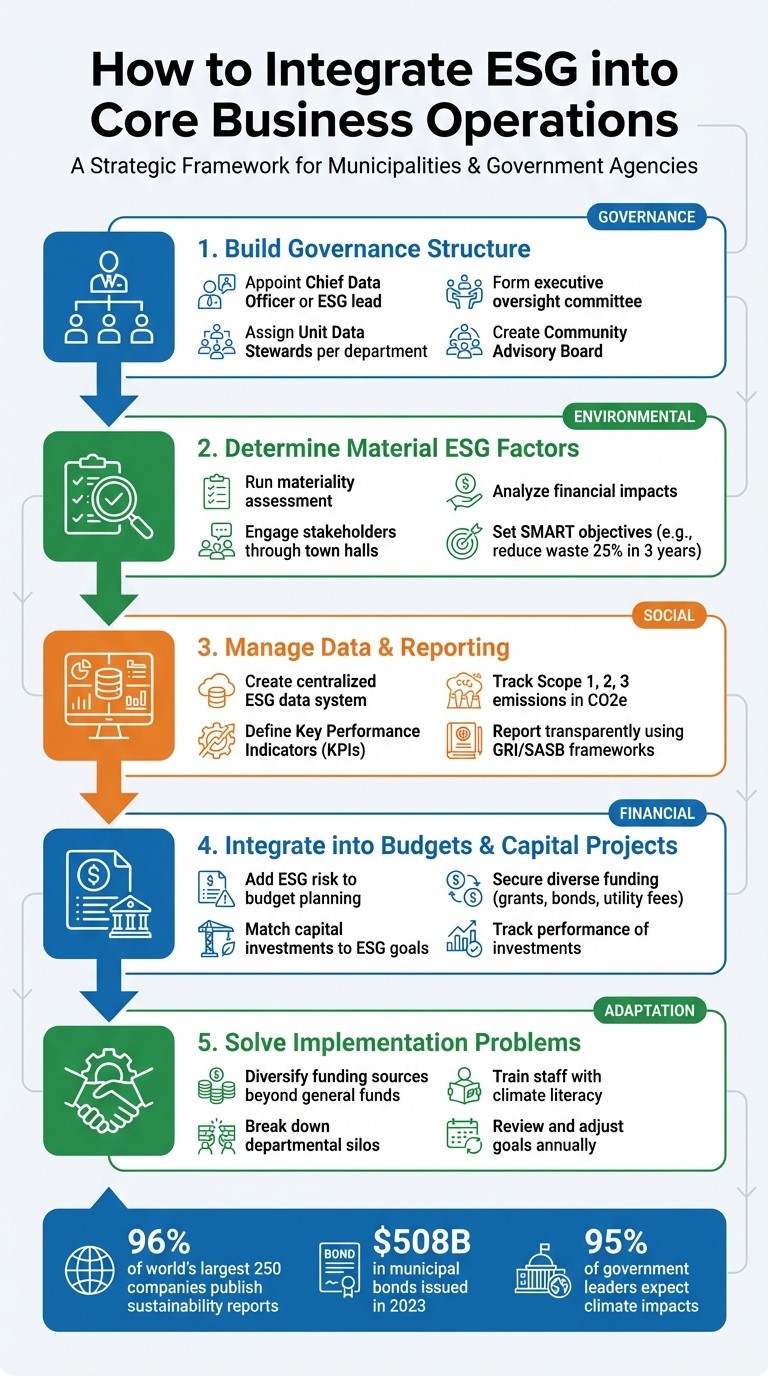
5-Step Framework for Integrating ESG into Municipal Operations
Challenges to Financing Greener Solutions in Cities | Bloomberg Philanthropies
1. Building a Governance Structure for ESG
Effective ESG integration requires strong leadership and clear accountability. Without these, ESG efforts risk being sidelined or stuck in departmental silos. Municipalities need to define decision-making roles, assign responsibility for tracking progress, and ensure coordination across departments.
1.1 Assigning ESG Leadership and Responsibility
Start by appointing a lead officer to oversee ESG compliance and coordination. This role could be filled by a Chief Data Officer, Sustainability Director, or another senior leader with the authority to drive initiatives across departments. The Federation of American Scientists underscores this, stating, "The Controlling Authority should designate a Chief Data Officer to oversee all significant aspects of Data Handling and compliance with this Policy" [9]. If hiring a new leader isn’t feasible, training current staff to take on ESG responsibilities can be a practical alternative.
In addition to central leadership, appoint Unit Data Stewards within each department to track progress and report results [6][9]. This ensures ESG efforts remain visible and actionable at every level.
Form an executive oversight committee with members like the CIO, Legal Counsel, and Finance Director. This committee serves as the governing body to ensure ESG principles align with broader municipal goals [9]. To further build public trust, create a Community Advisory Board [9].
Once leadership roles are set, embed these responsibilities into the municipality's existing policy framework for seamless integration.
1.2 Connecting ESG Goals to Municipal Policies
For ESG objectives to succeed, they need to be woven into existing policies rather than treated as standalone projects. Review current policies - such as those related to zoning, transportation, budgeting, and procurement - to identify where ESG principles already exist and where gaps remain [6]. Credit rating agencies already assess factors like organizational structure, debt issuance authority, and financial reporting systems as part of their evaluations, making this alignment even more critical [8].
Define SMART objectives tailored to your municipality’s priorities. For instance, set a goal to reduce municipal waste by 25% within three years or transition 40% of your vehicle fleet to electric by 2028. Tie these objectives directly to areas like debt management, capital planning, and fiscal health to maintain strong credit ratings through economic fluctuations [6][8]. The GFOA advises, "Issuers should take the opportunity to verify that key elements of its good governance policies and practices are described in its official statements" [8].
To ensure all departments work toward shared goals, use centralized tools like dashboards and task management systems. These tools can help prevent ESG initiatives from operating in isolation [6]. Conduct annual reviews to adjust goals as community needs and regulations evolve.
1.3 Working with Stakeholders to Build Agreement
Community involvement is essential for building consensus around ESG initiatives. Direct engagement is more effective than relying solely on surveys. The Washington State Department of Ecology highlights the importance of this approach, noting, "Meaningful participation in decision-making processes related to one's health and environment is critical to mitigating environmental harms" [10]. This is especially vital for rebuilding trust with communities historically excluded from governance.
Remove barriers to participation by offering practical support like childcare, travel reimbursements, and language services, including translation and interpretation [10]. Use tools like environmental health disparity maps to identify and prioritize communities facing the greatest challenges. Research shows a stark reality: individuals in areas with fewer environmental health disparities can live up to six years longer than those in the most affected areas [10].
Implement formal engagement plans that evolve based on feedback. Clearly outline how community input will influence decisions, the timeline for projects, and how final outcomes will be communicated. This approach ensures ESG practices remain relevant and actionable, strengthening resilience across all municipal functions.
2. Determining Which ESG Factors Matter Most
Not all ESG factors hold equal importance for every municipality. Prioritization is crucial because resources are often stretched, and community needs can differ significantly. For instance, a coastal city may face challenges like rising sea levels, while a landlocked county might deal with drought. Similarly, a fast-growing suburb may prioritize infrastructure, while a rural township might focus on healthcare access. The goal is to pinpoint the ESG factors that have the greatest impact on your municipality’s operations, financial health, and overall community well-being. The following sections explore how to assess, align, and validate these priorities effectively.
2.1 Running a Materiality Assessment
A materiality assessment helps distinguish what truly matters from what sounds appealing but lacks practical impact. Start by reviewing your municipality’s current operations to understand where ESG principles are already embedded. This step not only prevents redundant efforts but also highlights any gaps needing attention [6].
Engaging stakeholders is essential. Organize town halls, focus groups, or public forums to gather input from residents, employees, and local businesses. This ensures that your ESG priorities reflect real concerns rather than abstract goals [6]. With investors increasingly focusing on ESG-linked instruments, these assessments are becoming vital for securing financing.
Financial analysis is another critical component. Assess how climate risks might affect your tax revenue or how social inequalities could increase service delivery costs. Understanding these connections helps identify risks and opportunities that directly influence your budget and credit standing [3].
Established frameworks like those from the International Capital Markets Association (ICMA) and Climate Bond Initiative (CBI) can help structure your findings. These frameworks align your priorities with industry standards and ensure you address factors that credit rating agencies - such as Fitch, KBRA, Moody's, and S&P - are now integrating into municipal bond evaluations [4][11].
"ESG factors could begin to impact bond performance as the connection between credit risk and environmental and social variables becomes harder to ignore." - Samantha Favis, Strategist on the Municipal Fixed-Income team at Morgan Stanley Research [11]
Document your findings in a climate action plan, which has become a standard expectation for medium-to-large government entities. Set SMART objectives based on your assessment, such as reducing carbon emissions by 15% within five years or increasing affordable housing by 20% over three years [6]. Update these goals annually to adapt to regulatory changes and evolving community needs [6].
2.2 Connecting ESG Priorities to Department Functions
Once you’ve identified key ESG factors, assign them to the departments best equipped to address them. For example, Public Works might handle environmental issues like water management, while Emergency Management focuses on climate resiliency. Human Resources could oversee workforce diversity initiatives [1]. This targeted approach ensures ESG efforts are actionable and effective.
Designate Unit Data Stewards to link overarching ESG goals with daily departmental activities [6][9]. These stewards monitor progress, report outcomes, and explore new data sources to refine decision-making. They also translate broad ESG objectives into specific tasks that staff can implement.
Rather than treating ESG as an add-on, embed it into existing workflows. For instance, incorporate environmental considerations into zoning decisions, equity metrics into transportation planning, and governance standards into procurement processes [6]. A noteworthy example is King County Metro Transit in Washington, which shifted its operational focus in late 2021. Instead of prioritizing routes based on ridership, they began emphasizing areas with the greatest community needs. This change, part of the "True North" initiative led by County Executive Dow Constantine, aimed to make equity a core public value. The project involved a three-month collaboration with the Centre for Public Impact to test ideas that challenged the status quo [7].
Set department-specific SMART goals that align with your overall ESG objectives. For instance, the sanitation department might aim to reduce waste by 10% within two years [6]. These tailored targets make ESG initiatives measurable and actionable across all levels of the organization.
2.3 Using Data to Confirm Priorities
Data transforms ESG priorities into actionable decisions. By analyzing quantitative data, you can demonstrate how specific factors impact your municipality’s financial health, operational stability, and ability to serve residents effectively [13]. This is particularly crucial for communicating with credit rating agencies and investors, who need to see the material financial implications of ESG risks.
Long-term trend analysis is key. Look at population growth, property values, employment opportunities, educational attainment, and income levels to identify patterns that affect your community’s prosperity. For example, a one-time protest differs significantly from a steady decline in educational outcomes, which may require sustained intervention [13].
"Look for trends that pose a challenge to population growth, property values, educational attainment, employment opportunities, or other factors that may impact the long-term growth and prosperity of your community." - Government Finance Officers Association (GFOA) [13]
External data sources can also validate your findings. Resources like the National Climate Assessment and National Risk Index provide regional climate data, which smaller municipalities can use without the expense of independent studies [1]. Historical data from extreme weather events or natural disasters can further document risk frequency and intensity [1]. Smaller jurisdictions can often leverage the planning and data resources of larger neighboring governments to address shared environmental risks [1].
Providing economic impact data is crucial for building investor confidence. In 2019, state and local governments increased sustainable investment portfolios to $2.9 trillion, underscoring the importance of data-backed ESG strategies [12]. Track progress toward goals like greenhouse gas reductions to show measurable results and support your SMART objectives [1].
Finally, review bond offering documents from neighboring jurisdictions to identify regional ESG trends that might apply to your community [1]. When presenting technical data to stakeholders, focus on summarizing the most relevant points. This makes the information more accessible and actionable, avoiding the overwhelm of lengthy reports [1].
3. Managing ESG Data and Reporting
For ESG initiatives to succeed, it’s not enough to set ambitious goals - managing and transparently reporting data is equally critical. Without a reliable system to collect, track, and report ESG information, even the best-intentioned plans can lose momentum. Fragmented data across departments creates confusion, weakens impact measurement, and erodes stakeholder trust. Consolidating this data into a single, centralized system allows municipalities to turn abstract commitments into measurable, actionable outcomes that resonate with their communities.
3.1 Creating a Central ESG Data System
Many municipalities operate with decentralized data systems, which often result in inconsistent practices. Shifting to a centralized model can resolve this. Start by appointing a Chief Data Officer (CDO) to oversee data management, ensure compliance with privacy laws, and coordinate cybersecurity efforts. Alongside the CDO, designate Unit Data Stewards within each department to link day-to-day operations with the broader data strategy. A Data Governance Oversight Committee - comprising the CDO, Chief Information Officer, and Legal Counsel - can further ensure the system remains efficient and adaptable.
The Federation of American Scientists emphasizes the importance of this approach:
"As the data team matures it should move away from a consulting model to a central data authority model responsible for setting standards for data handling throughout its lifecycle."
They add:
"Data is an asset only if it is responsibly used to enhance the efficiency of cities and counties and improve residents' quality of life."
To maintain consistency, develop a data catalog that prioritizes key datasets, ensuring they are standardized, accessible, and secure. This centralized approach not only improves data integrity but also sets the stage for establishing meaningful KPIs.
3.2 Setting Key Performance Indicators (KPIs) for ESG
Once a centralized data system is in place, the next step is defining clear KPIs to measure ESG progress. These KPIs should align with the community’s unique priorities, taking into account population size, economic conditions, and available technologies. Start by defining the organizational boundaries to determine whether KPIs will cover areas under "Operational Control" or "Financial Control" [14].
For environmental performance, emissions data is typically categorized into three scopes:
Scope 1: Direct emissions from city-owned facilities and vehicles.
Scope 2: Indirect emissions from purchased electricity.
Scope 3: Other indirect emissions, such as those from employee commutes or outsourced services.
The standard for reporting greenhouse gas (GHG) emissions is metric tons of carbon dioxide equivalent (CO2e) [14]. According to the US EPA:
"You cannot use a top-down approach to measure your progress toward reducing GHG emissions. To measure whether sustainability efforts are working, you must use actual measurements of energy use and other metrics in a bottom-up analysis."
Focus on bottom-up data sources like utility bills, vehicle mileage, and facility energy consumption rather than relying on regional averages. Establish a base year to reflect typical conditions and account for weather variations using "degree-days" to ensure performance changes accurately reflect efficiency gains.
Key data needs for KPIs include:
| Sector | Common KPI Data Needs | Possible Data Sources |
| --- | --- | --- |
| <strong>Facilities</strong> | Electricity and fuel use | Utility bills, facility managers, <a href="https://www.energystar.gov/buildings/benchmark" target="_blank" rel="nofollow noopener noreferrer" data-framer-link="Link:{"url":"https://www.energystar.gov/buildings/benchmark","type":"url"}" data-framer-open-in-new-tab="">ENERGY STAR Portfolio Manager</a> |
| <strong>Transportation</strong> | Vehicle fuel use, vehicle miles traveled (VMT) | Fleet managers, fuel vendors, mileage reimbursement records |
| <strong>Solid Waste</strong> | Waste composition, landfill gas collected | Landfill managers, waste audits, hauling companies |
| <strong>Wastewater</strong> | Biological Oxygen Demand (BOD5) load, population served | Wastewater treatment department records
| Sector | Common KPI Data Needs | Possible Data Sources |
| --- | --- | --- |
| <strong>Facilities</strong> | Electricity and fuel use | Utility bills, facility managers, <a href="https://www.energystar.gov/buildings/benchmark" target="_blank" rel="nofollow noopener noreferrer" data-framer-link="Link:{"url":"https://www.energystar.gov/buildings/benchmark","type":"url"}" data-framer-open-in-new-tab="">ENERGY STAR Portfolio Manager</a> |
| <strong>Transportation</strong> | Vehicle fuel use, vehicle miles traveled (VMT) | Fleet managers, fuel vendors, mileage reimbursement records |
| <strong>Solid Waste</strong> | Waste composition, landfill gas collected | Landfill managers, waste audits, hauling companies |
| <strong>Wastewater</strong> | Biological Oxygen Demand (BOD5) load, population served | Wastewater treatment department records
To make ESG data relatable, consider translating complex metrics into everyday terms. For instance, use the EPA’s GHG Equivalencies Calculator to compare CO2e to "annual emissions from X number of cars." Standardized frameworks like the Local Government Operations Protocol also ensure that KPIs remain clear and comparable across organizations.
3.3 Reporting ESG Performance Clearly
Transparent reporting is essential for building stakeholder trust and meeting the expectations of credit rating agencies and investors. Today, 96% of the world’s largest 250 companies publish sustainability reports, and 12 of the 15 largest pension funds incorporate ESG metrics into their investment decisions [17]. Municipalities face similar scrutiny, particularly when issuing bonds or seeking financing.
Brooke Stout, Assistant Professor of Accounting at Eastern Oregon University, highlights the stakes:
"Issuers of governmental securities should be aware that there could be credit rating differentiation depending on their approach to addressing ESG factors."
To ensure credibility, adopt standardized reporting frameworks like the Global Reporting Initiative (GRI), Sustainability Accounting Standards Board (SASB), or the Task Force on Climate-related Financial Disclosures (TCFD). Incorporating ESG metrics into the Annual Comprehensive Financial Report (ACFR) can also meet the growing demands of investors and credit rating agencies [23,26]. Public-facing Climate Action Plans further enhance transparency by outlining governance structures, climate risks, and specific targets or KPIs [16].
Honesty is key to avoiding accusations of greenwashing. By openly sharing both successes and areas needing improvement, municipalities can build long-term trust [23,24]. Cloud-based platforms and AI-powered analytics can also enhance accountability by creating audit trails that track data changes [15]. Across the U.S., around 50 cities are implementing building performance standards (BPS) to reduce energy consumption - showing how thorough reporting can drive real change [17].
Here are examples of ESG metrics municipalities might report:
| ESG Category | Municipal Disclosure Examples |
| --- | --- |
| <strong>Environmental</strong> | Energy diversity, water availability, natural disaster risk, greenhouse gas emissions (Scope 1, 2, 3) |
| <strong>Social</strong> | Affordable housing, social equity, public health, diversity and inclusion, employee welfare |
| <strong>Governance</strong> | Financial reporting transparency, cybersecurity, internal controls, board/leadership diversity
| ESG Category | Municipal Disclosure Examples |
| --- | --- |
| <strong>Environmental</strong> | Energy diversity, water availability, natural disaster risk, greenhouse gas emissions (Scope 1, 2, 3) |
| <strong>Social</strong> | Affordable housing, social equity, public health, diversity and inclusion, employee welfare |
| <strong>Governance</strong> | Financial reporting transparency, cybersecurity, internal controls, board/leadership diversity
4. Integrating ESG into Budgets and Capital Projects
To truly benefit from ESG data and reporting, municipalities should weave these insights into their budget and capital planning processes. By using centralized ESG data and KPIs, governments can ensure every dollar spent and every project undertaken reflects these priorities. This approach not only promotes responsible funding but also strengthens financial stability. With the municipal bond market valued at $4 trillion and $508 billion in bonds issued in 2023 alone [19], the stakes are high. Consider the 2025 Los Angeles wildfires, which caused $250 billion in damages and led to bond downgrades impacting issuers with over $70 billion in outstanding debt [19]. These figures underscore the financial necessity of integrating ESG principles into planning.
4.1 Adding ESG Risk to Budget Planning
Budget planning should begin with a clear understanding of environmental risks that could threaten a municipality's financial health. With 17% of U.S. counties facing compound climate hazards [19], addressing these risks is essential to protect tax bases, revenue sources, and infrastructure investments.
The Government Finance Officers Association (GFOA) advises finance officers to collaborate with public works directors, emergency managers, and sustainability officers to assess risks and develop strategies that prioritize resilience [1]. Federal resources like the National Climate Assessment and the National Risk Index can be invaluable, especially for smaller jurisdictions that may lack local expertise [1].
"Investors and rating analysts are not just looking to see if risks are present, but also want information regarding what plans a government has to address these risks." – Government Finance Officers Association (GFOA) [1]
Tailoring risk assessments to specific enterprises and aligning budgets with climate action plans and local regulations can provide a clear path forward. Smaller municipalities can leverage planning materials from larger neighbors or state hazard mitigation plans for guidance [1].
It’s also critical to integrate ESG considerations early in the Capital Improvement Plan (CIP) process rather than waiting until bond issuance [18]. Identifying ESG-aligned projects at the planning stage allows finance officers to secure specialized financing, such as green or social bonds, more effectively.
Once risks are quantified, investments should target projects that promote both sustainability and equity.
4.2 Matching Capital Investments to ESG Goals
Using sector-specific materiality frameworks can help prioritize capital projects that address identified ESG risks. Infrastructure investments should be evaluated based on their long-term resilience and the benefits they bring to the community.
For example, in 2021, the Maryland State Retirement and Pension System adopted a Responsible Contractor Policy for its real estate and infrastructure assets. This policy supports union neutrality during organizing campaigns and enforces adherence to International Labour Organization (ILO) core conventions, strengthening the social aspect of ESG [20]. Similarly, Illinois amended its Sustainable Investing Act in 2023, requiring asset managers to disclose how they incorporate five sustainability factors - corporate governance, environmental and social impact, human capital, and business model innovation - into their decisions [20].
"Governments of all sizes should expand their focus from the financing stage all the way to the initial planning phase to truly maximize the potential of ESG." – Kevin Bain, Teresa T. Smith, and Diana A. Ramirez [18]
Materiality frameworks can help identify the most critical ESG issues for specific projects. For instance, the environmental concerns for a wastewater treatment facility differ from those of a public transit expansion. Tools like climate risk scores from providers such as the Intercontinental Exchange (ICE) or the Notre Dame Global Adaptation Initiative can flag high-risk sites for further review [21].
When drafting the CIP, explicitly label projects that meet specific ESG criteria. This labeling helps debt and grant managers identify opportunities for specialized financing, such as green or social bonds [18]. Additionally, incorporating responsible contractor requirements for large-scale projects can promote fair labor practices and boost local economic health [20].
Once projects are aligned with ESG principles, tracking their performance is key to maintaining transparency and accountability.
4.3 Tracking ESG Performance of Investments
Monitoring ESG performance requires consistent measurement and open reporting. Investors and analysts want to see not just the risks but also the steps municipalities are taking to address them and the progress being made [1].
Assigning leaders with expertise in climate risk to measure the economic impacts on tax bases and revenue streams is a good starting point [1]. ESG metrics should be integrated into the CIP, using external resources like the National Climate Assessment and state hazard mitigation plans to track progress [1][18]. Smaller jurisdictions can collaborate regionally, borrowing planning and reporting materials from larger governments to streamline efforts [1].
"ESG disclosure provides governments the opportunity to tell their story of what they are facing and how they are addressing the issues, a point of view that is valuable to the broader municipal market." – Government Finance Officers Association (GFOA) [1]
ESG disclosures should be updated with each bond offering to reflect new events, strategies, and the impacts of completed projects. Instead of linking to extensive technical reports, summarize key points and progress toward climate goals to make the information accessible to the municipal market [1]. Setting clear climate policy targets and providing regular updates ensures accountability. However, it’s important to include cautionary language, given the unpredictability of environmental events.
Beyond required bond documents, municipalities can enhance transparency by publishing voluntary sustainability and climate action reports. These updates can strengthen investor confidence and help protect credit ratings in an era where ESG scrutiny is increasingly rigorous.
5. Solving Common ESG Implementation Problems
Effective ESG strategies require more than just solid data management and strategic investments. The real challenge often lies in addressing practical obstacles like funding limitations, siloed departments, and staffing shortages. Tackling these issues involves finding creative funding solutions, encouraging cross-departmental collaboration, and prioritizing workforce development.
5.1 Working with Limited Funding
One of the biggest hurdles for ESG initiatives is insufficient funding. Relying entirely on general funds pits ESG projects against other critical services, leaving them vulnerable to shifting political priorities [22]. A more sustainable approach involves diversifying funding sources and designing projects that offer multiple benefits. For example, the 2021 Infrastructure Investment and Jobs Act (IIJA) allocates $1.2 trillion for climate and resilience efforts [23]. Additionally, states participating in the Clean Water State Revolving Fund (CWSRF) provide a 20% funding match for federal grants.
Maximizing co-benefits is key to unlocking new funding opportunities. The City of Chicago’s Green Alley Program, for instance, achieves stormwater management at a fraction of the cost of traditional methods.
"Designing green infrastructure programs to maximize co-benefits may open up funding sources that would otherwise not be available for stormwater management projects or programs." – Georgetown Climate Center [22]
Collaboration between agencies can also reduce costs. In Los Angeles, the Bureau of Street Services and the Bureau of Sanitation partnered on the $1 million Oros Street project, sharing expenses for bio-retention areas and an infiltration basin. Similarly, Lancaster, Pennsylvania, used grants from state and national resources to fund a stormwater management program for parking lots, securing a loan from the Pennsylvania infrastructure bank.
Establishing dedicated revenue streams, such as stormwater utility fees, provides a reliable funding source that avoids the uncertainties of annual budget debates. Municipalities should conduct feasibility studies before implementing such fees to ensure they align with state laws and avoid being classified as taxes. Timing is also critical - coordinating ESG projects with planned maintenance, like street repairs, can significantly cut costs. While competitive grants can be helpful, formula-based programs like Community Development Block Grants (CDBG) offer more consistent, long-term support.
| Funding Source | Availability | Flexibility | Budget Impact |
| --- | --- | --- | --- |
| Federal Grants | Highly competitive; often one-time | Limited to specific agency mandates | Low; supplements local funds |
| General Fund | Subject to annual political priorities | High; local discretion on use | High; competes with other services |
| Utility Fees | Consistent and predictable | High; dedicated to specific ESG goals | Low; creates new revenue |
| CWSRF Loans | Reliable; state-administered | Limited to capital costs (excludes operations) | Moderate; requires repayment
| Funding Source | Availability | Flexibility | Budget Impact |
| --- | --- | --- | --- |
| Federal Grants | Highly competitive; often one-time | Limited to specific agency mandates | Low; supplements local funds |
| General Fund | Subject to annual political priorities | High; local discretion on use | High; competes with other services |
| Utility Fees | Consistent and predictable | High; dedicated to specific ESG goals | Low; creates new revenue |
| CWSRF Loans | Reliable; state-administered | Limited to capital costs (excludes operations) | Moderate; requires repayment
Source: Georgetown Climate Center [22]
5.2 Improving Collaboration Across Departments
Funding isn’t the only roadblock - ESG success also depends on breaking down departmental silos. Many municipal agencies operate with separate priorities, budgets, and reporting systems, making collaboration challenging. Addressing this requires both structural adjustments and a shift in mindset.
One effective approach is transitioning from a consulting model to a centralized governance structure. Instead of ESG teams merely advising departments, a unified governance body can set standards for data management and metrics across all agencies [9].
"Data is an asset only if it is responsibly used to enhance the efficiency of cities and counties and improve residents' quality of life." – FAS Model Data Governance Policy & Practice Guide [9]
Standardizing definitions is also crucial. For example, inconsistent interpretations of "research and development" at nuclear waste cleanup sites led the GAO to recommend a common definition to improve coordination [24]. Similarly, municipalities should define terms like "sustainability" or "resilience" to ensure consistent reporting.
The Town of Preble, NY, successfully reduced the payback period for an energy upgrade project by forming a diverse advisory committee [2]. Meanwhile, Portland’s "Community Lead" model hired local leaders as consultants to bridge the gap between frontline communities and broader initiatives, such as digital justice and data governance [9]. Formal agreements on data sharing clarify access, use, and retention policies, while partnerships with third parties can help sustain ESG efforts in resource-limited municipalities [25].
5.3 Training Staff for ESG Work
No ESG framework can succeed without a well-trained workforce. Between March 2020 and March 2022, municipal labor losses reached -4.48%, surpassing overall government and nonfarm job losses. By October 2022, staffing levels were still down by 147,700 jobs (-2.20%) compared to pre-pandemic numbers [26]. With 33% of municipal employees citing limited advancement opportunities as a key reason for leaving, investing in staff training is critical for both ESG capacity and retention.
A "grow your own" approach can help tackle staffing challenges [26]. Instead of rigid degree requirements, municipalities should focus on skills-based training tailored to the competencies needed for ESG roles.
Broad climate literacy is a foundational step. Employees should understand how climate factors influence their specific duties through a "climate lens" [5]. Beyond general education, role-specific training is essential. For instance, park managers might focus on resource impacts, while educators could emphasize behavioral change. The National Park Service offers targeted climate change training for various roles, illustrating how climate considerations affect daily operations [5].
"Every agency is a climate agency now." – Sam Ricketts, Cofounder, Evergreen Action [5]
The City of Greensboro, North Carolina, has implemented innovative programs to enhance employee skills and retention. Its "G-School" program allows participants to shadow different departments, exploring internal advancement opportunities. Meanwhile, the "GSO Speaks" initiative provides Spanish language training to over 120 staff members, improving service delivery for non-English-speaking residents and offering financial incentives for proficiency [26].
"Our 3,500 employees have education ranging from GED to PhD. Across all departments, we have 22 different 'micro cultures' and very different training needs." – Katie Croft, Organizational Effectiveness and Development Supervisor, City of Greensboro, NC [26]
Conclusion
Integrating ESG principles into government operations is proving to be a critical strategy for building resilience against climate disruptions. With 95% of government leaders expecting extreme weather events to affect their operations in the near future, embedding these principles has shifted from being a choice to a strategic priority [27].
Achieving this requires strong leadership, a prepared workforce, and decisions guided by reliable data [5]. When Chief Sustainability Officers are actively involved in budget and resource allocation discussions, ESG initiatives gain the authority and funding necessary to create lasting impact. Additionally, applying a "climate lens" across departments ensures that employees understand how environmental and social factors influence their responsibilities, whether in emergency response or infrastructure planning. This alignment not only strengthens operational capabilities but also delivers financial benefits.
The financial case for ESG is compelling. Over $500 billion is projected for climate resilience and low-carbon transitions within the next decade [27]. Studies indicate that climate initiatives could add as much as $885 billion annually to the U.S. GDP by 2070 [27]. For municipalities, transparent ESG reporting can improve credit ratings and bond pricing, offering a distinct financial edge beyond meeting basic compliance requirements [1].
Accountability is key to success. Metrics such as carbon reduction, energy efficiency, and workforce diversity should be tracked through centralized systems and reviewed annually [6]. Making these metrics relatable helps residents see the tangible benefits of these efforts [2].
A State CxO from Deloitte's 2024 Public Sector Report emphasized the importance of leadership in this area:
"Senior management must demonstrate a strong commitment to and leadership in sustainability initiatives. Without this assistance, it may be difficult for us to give sustainability a top priority and to allot the resources required to meet objectives" [27].
With 57% of public sector leaders believing that sustainability goals will enhance their agency's mission resilience, the question is no longer whether to integrate ESG, but how quickly it can be accomplished [27].
FAQs
Where should we start with ESG?
To make meaningful progress in addressing ESG priorities, start by defining clear, actionable goals. These could include reducing your carbon footprint or strengthening connections with local communities. Implementing practical measures - such as boosting energy efficiency or transitioning to renewable energy sources - not only supports these objectives but also delivers tangible benefits. These efforts can reduce costs, improve operational capacity, and promote transparency, fostering trust among stakeholders. At the same time, they align seamlessly with broader strategies for sustainability and resilience.
What ESG metrics matter most for us?
Municipalities and government agencies track key ESG metrics to address a range of priorities. For environmental factors, this includes monitoring greenhouse gas emissions, improving energy efficiency, and reducing waste. On the social side, the focus shifts to initiatives that promote community well-being, diversity, and equity. Governance metrics, meanwhile, highlight the importance of transparency, leadership integrity, and effective risk management.
By consistently measuring progress toward sustainability goals, enhancing climate resilience, and ensuring regulatory compliance, these entities not only maintain accountability but also align with broader objectives. This approach underscores their dedication to stakeholders and reinforces trust in their efforts.
How do we fund ESG projects?
Funding for ESG projects frequently taps into municipal bonds, including green bonds, which are specifically designed to support environmentally friendly projects and often come with the benefit of lower interest rates. Federal and state initiatives also play a key role, with programs under the Bipartisan Infrastructure Law and the Inflation Reduction Act offering extensive financial backing. Beyond these, other avenues include grants, loans from development banks, and the strategic allocation of recovery funds. These resources can be directed toward projects that enhance community health, housing, and infrastructure, all while aligning with ESG objectives.
Related Blog Posts
Latest Articles
©2025



FAQ
01
What does it really mean to “redefine profit”?
02
What makes Council Fire different?
03
Who does Council Fire you work with?
04
What does working with Council Fire actually look like?
05
How does Council Fire help organizations turn big goals into action?
06
How does Council Fire define and measure success?
Feb 19, 2026
How to Integrate ESG into Core Business Operations for Municipalities & Government Agencies
ESG Strategy
In This Article
Five-step framework for municipalities to embed ESG into governance, data, budgets and projects—align KPIs, funding, and community engagement for resilience.
How to Integrate ESG into Core Business Operations for Municipalities & Government Agencies
Municipalities and government agencies are increasingly prioritizing Environmental, Social, and Governance (ESG) principles to build resilient communities and improve service delivery. ESG integration enhances financial transparency, supports community well-being, and addresses risks like climate change and social inequities. With credit rating agencies factoring ESG into evaluations, embedding these principles into governance and operations is more important than ever.
Key Takeaways:
Leadership & Accountability: Assign roles like a Chief Data Officer and create oversight committees to ensure ESG goals are implemented across departments.
Policy Alignment: Integrate ESG into existing policies, such as budgeting, zoning, and procurement, and set measurable objectives (e.g., reduce waste by 25% in 3 years).
Community Engagement: Involve residents directly through town halls and remove barriers like language or childcare to foster participation.
Data-Driven Decisions: Use centralized systems to track ESG metrics, such as emissions or housing equity, and align them with credit rating criteria.
Budget Integration: Incorporate ESG risks into capital planning and secure funding through grants, bonds, or utility fees.
By embedding ESG into policies, data systems, and budgets, municipalities can address challenges while improving financial stability and community trust.
5-Step Framework for Integrating ESG into Municipal Operations
Challenges to Financing Greener Solutions in Cities | Bloomberg Philanthropies
1. Building a Governance Structure for ESG
Effective ESG integration requires strong leadership and clear accountability. Without these, ESG efforts risk being sidelined or stuck in departmental silos. Municipalities need to define decision-making roles, assign responsibility for tracking progress, and ensure coordination across departments.
1.1 Assigning ESG Leadership and Responsibility
Start by appointing a lead officer to oversee ESG compliance and coordination. This role could be filled by a Chief Data Officer, Sustainability Director, or another senior leader with the authority to drive initiatives across departments. The Federation of American Scientists underscores this, stating, "The Controlling Authority should designate a Chief Data Officer to oversee all significant aspects of Data Handling and compliance with this Policy" [9]. If hiring a new leader isn’t feasible, training current staff to take on ESG responsibilities can be a practical alternative.
In addition to central leadership, appoint Unit Data Stewards within each department to track progress and report results [6][9]. This ensures ESG efforts remain visible and actionable at every level.
Form an executive oversight committee with members like the CIO, Legal Counsel, and Finance Director. This committee serves as the governing body to ensure ESG principles align with broader municipal goals [9]. To further build public trust, create a Community Advisory Board [9].
Once leadership roles are set, embed these responsibilities into the municipality's existing policy framework for seamless integration.
1.2 Connecting ESG Goals to Municipal Policies
For ESG objectives to succeed, they need to be woven into existing policies rather than treated as standalone projects. Review current policies - such as those related to zoning, transportation, budgeting, and procurement - to identify where ESG principles already exist and where gaps remain [6]. Credit rating agencies already assess factors like organizational structure, debt issuance authority, and financial reporting systems as part of their evaluations, making this alignment even more critical [8].
Define SMART objectives tailored to your municipality’s priorities. For instance, set a goal to reduce municipal waste by 25% within three years or transition 40% of your vehicle fleet to electric by 2028. Tie these objectives directly to areas like debt management, capital planning, and fiscal health to maintain strong credit ratings through economic fluctuations [6][8]. The GFOA advises, "Issuers should take the opportunity to verify that key elements of its good governance policies and practices are described in its official statements" [8].
To ensure all departments work toward shared goals, use centralized tools like dashboards and task management systems. These tools can help prevent ESG initiatives from operating in isolation [6]. Conduct annual reviews to adjust goals as community needs and regulations evolve.
1.3 Working with Stakeholders to Build Agreement
Community involvement is essential for building consensus around ESG initiatives. Direct engagement is more effective than relying solely on surveys. The Washington State Department of Ecology highlights the importance of this approach, noting, "Meaningful participation in decision-making processes related to one's health and environment is critical to mitigating environmental harms" [10]. This is especially vital for rebuilding trust with communities historically excluded from governance.
Remove barriers to participation by offering practical support like childcare, travel reimbursements, and language services, including translation and interpretation [10]. Use tools like environmental health disparity maps to identify and prioritize communities facing the greatest challenges. Research shows a stark reality: individuals in areas with fewer environmental health disparities can live up to six years longer than those in the most affected areas [10].
Implement formal engagement plans that evolve based on feedback. Clearly outline how community input will influence decisions, the timeline for projects, and how final outcomes will be communicated. This approach ensures ESG practices remain relevant and actionable, strengthening resilience across all municipal functions.
2. Determining Which ESG Factors Matter Most
Not all ESG factors hold equal importance for every municipality. Prioritization is crucial because resources are often stretched, and community needs can differ significantly. For instance, a coastal city may face challenges like rising sea levels, while a landlocked county might deal with drought. Similarly, a fast-growing suburb may prioritize infrastructure, while a rural township might focus on healthcare access. The goal is to pinpoint the ESG factors that have the greatest impact on your municipality’s operations, financial health, and overall community well-being. The following sections explore how to assess, align, and validate these priorities effectively.
2.1 Running a Materiality Assessment
A materiality assessment helps distinguish what truly matters from what sounds appealing but lacks practical impact. Start by reviewing your municipality’s current operations to understand where ESG principles are already embedded. This step not only prevents redundant efforts but also highlights any gaps needing attention [6].
Engaging stakeholders is essential. Organize town halls, focus groups, or public forums to gather input from residents, employees, and local businesses. This ensures that your ESG priorities reflect real concerns rather than abstract goals [6]. With investors increasingly focusing on ESG-linked instruments, these assessments are becoming vital for securing financing.
Financial analysis is another critical component. Assess how climate risks might affect your tax revenue or how social inequalities could increase service delivery costs. Understanding these connections helps identify risks and opportunities that directly influence your budget and credit standing [3].
Established frameworks like those from the International Capital Markets Association (ICMA) and Climate Bond Initiative (CBI) can help structure your findings. These frameworks align your priorities with industry standards and ensure you address factors that credit rating agencies - such as Fitch, KBRA, Moody's, and S&P - are now integrating into municipal bond evaluations [4][11].
"ESG factors could begin to impact bond performance as the connection between credit risk and environmental and social variables becomes harder to ignore." - Samantha Favis, Strategist on the Municipal Fixed-Income team at Morgan Stanley Research [11]
Document your findings in a climate action plan, which has become a standard expectation for medium-to-large government entities. Set SMART objectives based on your assessment, such as reducing carbon emissions by 15% within five years or increasing affordable housing by 20% over three years [6]. Update these goals annually to adapt to regulatory changes and evolving community needs [6].
2.2 Connecting ESG Priorities to Department Functions
Once you’ve identified key ESG factors, assign them to the departments best equipped to address them. For example, Public Works might handle environmental issues like water management, while Emergency Management focuses on climate resiliency. Human Resources could oversee workforce diversity initiatives [1]. This targeted approach ensures ESG efforts are actionable and effective.
Designate Unit Data Stewards to link overarching ESG goals with daily departmental activities [6][9]. These stewards monitor progress, report outcomes, and explore new data sources to refine decision-making. They also translate broad ESG objectives into specific tasks that staff can implement.
Rather than treating ESG as an add-on, embed it into existing workflows. For instance, incorporate environmental considerations into zoning decisions, equity metrics into transportation planning, and governance standards into procurement processes [6]. A noteworthy example is King County Metro Transit in Washington, which shifted its operational focus in late 2021. Instead of prioritizing routes based on ridership, they began emphasizing areas with the greatest community needs. This change, part of the "True North" initiative led by County Executive Dow Constantine, aimed to make equity a core public value. The project involved a three-month collaboration with the Centre for Public Impact to test ideas that challenged the status quo [7].
Set department-specific SMART goals that align with your overall ESG objectives. For instance, the sanitation department might aim to reduce waste by 10% within two years [6]. These tailored targets make ESG initiatives measurable and actionable across all levels of the organization.
2.3 Using Data to Confirm Priorities
Data transforms ESG priorities into actionable decisions. By analyzing quantitative data, you can demonstrate how specific factors impact your municipality’s financial health, operational stability, and ability to serve residents effectively [13]. This is particularly crucial for communicating with credit rating agencies and investors, who need to see the material financial implications of ESG risks.
Long-term trend analysis is key. Look at population growth, property values, employment opportunities, educational attainment, and income levels to identify patterns that affect your community’s prosperity. For example, a one-time protest differs significantly from a steady decline in educational outcomes, which may require sustained intervention [13].
"Look for trends that pose a challenge to population growth, property values, educational attainment, employment opportunities, or other factors that may impact the long-term growth and prosperity of your community." - Government Finance Officers Association (GFOA) [13]
External data sources can also validate your findings. Resources like the National Climate Assessment and National Risk Index provide regional climate data, which smaller municipalities can use without the expense of independent studies [1]. Historical data from extreme weather events or natural disasters can further document risk frequency and intensity [1]. Smaller jurisdictions can often leverage the planning and data resources of larger neighboring governments to address shared environmental risks [1].
Providing economic impact data is crucial for building investor confidence. In 2019, state and local governments increased sustainable investment portfolios to $2.9 trillion, underscoring the importance of data-backed ESG strategies [12]. Track progress toward goals like greenhouse gas reductions to show measurable results and support your SMART objectives [1].
Finally, review bond offering documents from neighboring jurisdictions to identify regional ESG trends that might apply to your community [1]. When presenting technical data to stakeholders, focus on summarizing the most relevant points. This makes the information more accessible and actionable, avoiding the overwhelm of lengthy reports [1].
3. Managing ESG Data and Reporting
For ESG initiatives to succeed, it’s not enough to set ambitious goals - managing and transparently reporting data is equally critical. Without a reliable system to collect, track, and report ESG information, even the best-intentioned plans can lose momentum. Fragmented data across departments creates confusion, weakens impact measurement, and erodes stakeholder trust. Consolidating this data into a single, centralized system allows municipalities to turn abstract commitments into measurable, actionable outcomes that resonate with their communities.
3.1 Creating a Central ESG Data System
Many municipalities operate with decentralized data systems, which often result in inconsistent practices. Shifting to a centralized model can resolve this. Start by appointing a Chief Data Officer (CDO) to oversee data management, ensure compliance with privacy laws, and coordinate cybersecurity efforts. Alongside the CDO, designate Unit Data Stewards within each department to link day-to-day operations with the broader data strategy. A Data Governance Oversight Committee - comprising the CDO, Chief Information Officer, and Legal Counsel - can further ensure the system remains efficient and adaptable.
The Federation of American Scientists emphasizes the importance of this approach:
"As the data team matures it should move away from a consulting model to a central data authority model responsible for setting standards for data handling throughout its lifecycle."
They add:
"Data is an asset only if it is responsibly used to enhance the efficiency of cities and counties and improve residents' quality of life."
To maintain consistency, develop a data catalog that prioritizes key datasets, ensuring they are standardized, accessible, and secure. This centralized approach not only improves data integrity but also sets the stage for establishing meaningful KPIs.
3.2 Setting Key Performance Indicators (KPIs) for ESG
Once a centralized data system is in place, the next step is defining clear KPIs to measure ESG progress. These KPIs should align with the community’s unique priorities, taking into account population size, economic conditions, and available technologies. Start by defining the organizational boundaries to determine whether KPIs will cover areas under "Operational Control" or "Financial Control" [14].
For environmental performance, emissions data is typically categorized into three scopes:
Scope 1: Direct emissions from city-owned facilities and vehicles.
Scope 2: Indirect emissions from purchased electricity.
Scope 3: Other indirect emissions, such as those from employee commutes or outsourced services.
The standard for reporting greenhouse gas (GHG) emissions is metric tons of carbon dioxide equivalent (CO2e) [14]. According to the US EPA:
"You cannot use a top-down approach to measure your progress toward reducing GHG emissions. To measure whether sustainability efforts are working, you must use actual measurements of energy use and other metrics in a bottom-up analysis."
Focus on bottom-up data sources like utility bills, vehicle mileage, and facility energy consumption rather than relying on regional averages. Establish a base year to reflect typical conditions and account for weather variations using "degree-days" to ensure performance changes accurately reflect efficiency gains.
Key data needs for KPIs include:
| Sector | Common KPI Data Needs | Possible Data Sources |
| --- | --- | --- |
| <strong>Facilities</strong> | Electricity and fuel use | Utility bills, facility managers, <a href="https://www.energystar.gov/buildings/benchmark" target="_blank" rel="nofollow noopener noreferrer" data-framer-link="Link:{"url":"https://www.energystar.gov/buildings/benchmark","type":"url"}" data-framer-open-in-new-tab="">ENERGY STAR Portfolio Manager</a> |
| <strong>Transportation</strong> | Vehicle fuel use, vehicle miles traveled (VMT) | Fleet managers, fuel vendors, mileage reimbursement records |
| <strong>Solid Waste</strong> | Waste composition, landfill gas collected | Landfill managers, waste audits, hauling companies |
| <strong>Wastewater</strong> | Biological Oxygen Demand (BOD5) load, population served | Wastewater treatment department records
To make ESG data relatable, consider translating complex metrics into everyday terms. For instance, use the EPA’s GHG Equivalencies Calculator to compare CO2e to "annual emissions from X number of cars." Standardized frameworks like the Local Government Operations Protocol also ensure that KPIs remain clear and comparable across organizations.
3.3 Reporting ESG Performance Clearly
Transparent reporting is essential for building stakeholder trust and meeting the expectations of credit rating agencies and investors. Today, 96% of the world’s largest 250 companies publish sustainability reports, and 12 of the 15 largest pension funds incorporate ESG metrics into their investment decisions [17]. Municipalities face similar scrutiny, particularly when issuing bonds or seeking financing.
Brooke Stout, Assistant Professor of Accounting at Eastern Oregon University, highlights the stakes:
"Issuers of governmental securities should be aware that there could be credit rating differentiation depending on their approach to addressing ESG factors."
To ensure credibility, adopt standardized reporting frameworks like the Global Reporting Initiative (GRI), Sustainability Accounting Standards Board (SASB), or the Task Force on Climate-related Financial Disclosures (TCFD). Incorporating ESG metrics into the Annual Comprehensive Financial Report (ACFR) can also meet the growing demands of investors and credit rating agencies [23,26]. Public-facing Climate Action Plans further enhance transparency by outlining governance structures, climate risks, and specific targets or KPIs [16].
Honesty is key to avoiding accusations of greenwashing. By openly sharing both successes and areas needing improvement, municipalities can build long-term trust [23,24]. Cloud-based platforms and AI-powered analytics can also enhance accountability by creating audit trails that track data changes [15]. Across the U.S., around 50 cities are implementing building performance standards (BPS) to reduce energy consumption - showing how thorough reporting can drive real change [17].
Here are examples of ESG metrics municipalities might report:
| ESG Category | Municipal Disclosure Examples |
| --- | --- |
| <strong>Environmental</strong> | Energy diversity, water availability, natural disaster risk, greenhouse gas emissions (Scope 1, 2, 3) |
| <strong>Social</strong> | Affordable housing, social equity, public health, diversity and inclusion, employee welfare |
| <strong>Governance</strong> | Financial reporting transparency, cybersecurity, internal controls, board/leadership diversity
4. Integrating ESG into Budgets and Capital Projects
To truly benefit from ESG data and reporting, municipalities should weave these insights into their budget and capital planning processes. By using centralized ESG data and KPIs, governments can ensure every dollar spent and every project undertaken reflects these priorities. This approach not only promotes responsible funding but also strengthens financial stability. With the municipal bond market valued at $4 trillion and $508 billion in bonds issued in 2023 alone [19], the stakes are high. Consider the 2025 Los Angeles wildfires, which caused $250 billion in damages and led to bond downgrades impacting issuers with over $70 billion in outstanding debt [19]. These figures underscore the financial necessity of integrating ESG principles into planning.
4.1 Adding ESG Risk to Budget Planning
Budget planning should begin with a clear understanding of environmental risks that could threaten a municipality's financial health. With 17% of U.S. counties facing compound climate hazards [19], addressing these risks is essential to protect tax bases, revenue sources, and infrastructure investments.
The Government Finance Officers Association (GFOA) advises finance officers to collaborate with public works directors, emergency managers, and sustainability officers to assess risks and develop strategies that prioritize resilience [1]. Federal resources like the National Climate Assessment and the National Risk Index can be invaluable, especially for smaller jurisdictions that may lack local expertise [1].
"Investors and rating analysts are not just looking to see if risks are present, but also want information regarding what plans a government has to address these risks." – Government Finance Officers Association (GFOA) [1]
Tailoring risk assessments to specific enterprises and aligning budgets with climate action plans and local regulations can provide a clear path forward. Smaller municipalities can leverage planning materials from larger neighbors or state hazard mitigation plans for guidance [1].
It’s also critical to integrate ESG considerations early in the Capital Improvement Plan (CIP) process rather than waiting until bond issuance [18]. Identifying ESG-aligned projects at the planning stage allows finance officers to secure specialized financing, such as green or social bonds, more effectively.
Once risks are quantified, investments should target projects that promote both sustainability and equity.
4.2 Matching Capital Investments to ESG Goals
Using sector-specific materiality frameworks can help prioritize capital projects that address identified ESG risks. Infrastructure investments should be evaluated based on their long-term resilience and the benefits they bring to the community.
For example, in 2021, the Maryland State Retirement and Pension System adopted a Responsible Contractor Policy for its real estate and infrastructure assets. This policy supports union neutrality during organizing campaigns and enforces adherence to International Labour Organization (ILO) core conventions, strengthening the social aspect of ESG [20]. Similarly, Illinois amended its Sustainable Investing Act in 2023, requiring asset managers to disclose how they incorporate five sustainability factors - corporate governance, environmental and social impact, human capital, and business model innovation - into their decisions [20].
"Governments of all sizes should expand their focus from the financing stage all the way to the initial planning phase to truly maximize the potential of ESG." – Kevin Bain, Teresa T. Smith, and Diana A. Ramirez [18]
Materiality frameworks can help identify the most critical ESG issues for specific projects. For instance, the environmental concerns for a wastewater treatment facility differ from those of a public transit expansion. Tools like climate risk scores from providers such as the Intercontinental Exchange (ICE) or the Notre Dame Global Adaptation Initiative can flag high-risk sites for further review [21].
When drafting the CIP, explicitly label projects that meet specific ESG criteria. This labeling helps debt and grant managers identify opportunities for specialized financing, such as green or social bonds [18]. Additionally, incorporating responsible contractor requirements for large-scale projects can promote fair labor practices and boost local economic health [20].
Once projects are aligned with ESG principles, tracking their performance is key to maintaining transparency and accountability.
4.3 Tracking ESG Performance of Investments
Monitoring ESG performance requires consistent measurement and open reporting. Investors and analysts want to see not just the risks but also the steps municipalities are taking to address them and the progress being made [1].
Assigning leaders with expertise in climate risk to measure the economic impacts on tax bases and revenue streams is a good starting point [1]. ESG metrics should be integrated into the CIP, using external resources like the National Climate Assessment and state hazard mitigation plans to track progress [1][18]. Smaller jurisdictions can collaborate regionally, borrowing planning and reporting materials from larger governments to streamline efforts [1].
"ESG disclosure provides governments the opportunity to tell their story of what they are facing and how they are addressing the issues, a point of view that is valuable to the broader municipal market." – Government Finance Officers Association (GFOA) [1]
ESG disclosures should be updated with each bond offering to reflect new events, strategies, and the impacts of completed projects. Instead of linking to extensive technical reports, summarize key points and progress toward climate goals to make the information accessible to the municipal market [1]. Setting clear climate policy targets and providing regular updates ensures accountability. However, it’s important to include cautionary language, given the unpredictability of environmental events.
Beyond required bond documents, municipalities can enhance transparency by publishing voluntary sustainability and climate action reports. These updates can strengthen investor confidence and help protect credit ratings in an era where ESG scrutiny is increasingly rigorous.
5. Solving Common ESG Implementation Problems
Effective ESG strategies require more than just solid data management and strategic investments. The real challenge often lies in addressing practical obstacles like funding limitations, siloed departments, and staffing shortages. Tackling these issues involves finding creative funding solutions, encouraging cross-departmental collaboration, and prioritizing workforce development.
5.1 Working with Limited Funding
One of the biggest hurdles for ESG initiatives is insufficient funding. Relying entirely on general funds pits ESG projects against other critical services, leaving them vulnerable to shifting political priorities [22]. A more sustainable approach involves diversifying funding sources and designing projects that offer multiple benefits. For example, the 2021 Infrastructure Investment and Jobs Act (IIJA) allocates $1.2 trillion for climate and resilience efforts [23]. Additionally, states participating in the Clean Water State Revolving Fund (CWSRF) provide a 20% funding match for federal grants.
Maximizing co-benefits is key to unlocking new funding opportunities. The City of Chicago’s Green Alley Program, for instance, achieves stormwater management at a fraction of the cost of traditional methods.
"Designing green infrastructure programs to maximize co-benefits may open up funding sources that would otherwise not be available for stormwater management projects or programs." – Georgetown Climate Center [22]
Collaboration between agencies can also reduce costs. In Los Angeles, the Bureau of Street Services and the Bureau of Sanitation partnered on the $1 million Oros Street project, sharing expenses for bio-retention areas and an infiltration basin. Similarly, Lancaster, Pennsylvania, used grants from state and national resources to fund a stormwater management program for parking lots, securing a loan from the Pennsylvania infrastructure bank.
Establishing dedicated revenue streams, such as stormwater utility fees, provides a reliable funding source that avoids the uncertainties of annual budget debates. Municipalities should conduct feasibility studies before implementing such fees to ensure they align with state laws and avoid being classified as taxes. Timing is also critical - coordinating ESG projects with planned maintenance, like street repairs, can significantly cut costs. While competitive grants can be helpful, formula-based programs like Community Development Block Grants (CDBG) offer more consistent, long-term support.
| Funding Source | Availability | Flexibility | Budget Impact |
| --- | --- | --- | --- |
| Federal Grants | Highly competitive; often one-time | Limited to specific agency mandates | Low; supplements local funds |
| General Fund | Subject to annual political priorities | High; local discretion on use | High; competes with other services |
| Utility Fees | Consistent and predictable | High; dedicated to specific ESG goals | Low; creates new revenue |
| CWSRF Loans | Reliable; state-administered | Limited to capital costs (excludes operations) | Moderate; requires repayment
Source: Georgetown Climate Center [22]
5.2 Improving Collaboration Across Departments
Funding isn’t the only roadblock - ESG success also depends on breaking down departmental silos. Many municipal agencies operate with separate priorities, budgets, and reporting systems, making collaboration challenging. Addressing this requires both structural adjustments and a shift in mindset.
One effective approach is transitioning from a consulting model to a centralized governance structure. Instead of ESG teams merely advising departments, a unified governance body can set standards for data management and metrics across all agencies [9].
"Data is an asset only if it is responsibly used to enhance the efficiency of cities and counties and improve residents' quality of life." – FAS Model Data Governance Policy & Practice Guide [9]
Standardizing definitions is also crucial. For example, inconsistent interpretations of "research and development" at nuclear waste cleanup sites led the GAO to recommend a common definition to improve coordination [24]. Similarly, municipalities should define terms like "sustainability" or "resilience" to ensure consistent reporting.
The Town of Preble, NY, successfully reduced the payback period for an energy upgrade project by forming a diverse advisory committee [2]. Meanwhile, Portland’s "Community Lead" model hired local leaders as consultants to bridge the gap between frontline communities and broader initiatives, such as digital justice and data governance [9]. Formal agreements on data sharing clarify access, use, and retention policies, while partnerships with third parties can help sustain ESG efforts in resource-limited municipalities [25].
5.3 Training Staff for ESG Work
No ESG framework can succeed without a well-trained workforce. Between March 2020 and March 2022, municipal labor losses reached -4.48%, surpassing overall government and nonfarm job losses. By October 2022, staffing levels were still down by 147,700 jobs (-2.20%) compared to pre-pandemic numbers [26]. With 33% of municipal employees citing limited advancement opportunities as a key reason for leaving, investing in staff training is critical for both ESG capacity and retention.
A "grow your own" approach can help tackle staffing challenges [26]. Instead of rigid degree requirements, municipalities should focus on skills-based training tailored to the competencies needed for ESG roles.
Broad climate literacy is a foundational step. Employees should understand how climate factors influence their specific duties through a "climate lens" [5]. Beyond general education, role-specific training is essential. For instance, park managers might focus on resource impacts, while educators could emphasize behavioral change. The National Park Service offers targeted climate change training for various roles, illustrating how climate considerations affect daily operations [5].
"Every agency is a climate agency now." – Sam Ricketts, Cofounder, Evergreen Action [5]
The City of Greensboro, North Carolina, has implemented innovative programs to enhance employee skills and retention. Its "G-School" program allows participants to shadow different departments, exploring internal advancement opportunities. Meanwhile, the "GSO Speaks" initiative provides Spanish language training to over 120 staff members, improving service delivery for non-English-speaking residents and offering financial incentives for proficiency [26].
"Our 3,500 employees have education ranging from GED to PhD. Across all departments, we have 22 different 'micro cultures' and very different training needs." – Katie Croft, Organizational Effectiveness and Development Supervisor, City of Greensboro, NC [26]
Conclusion
Integrating ESG principles into government operations is proving to be a critical strategy for building resilience against climate disruptions. With 95% of government leaders expecting extreme weather events to affect their operations in the near future, embedding these principles has shifted from being a choice to a strategic priority [27].
Achieving this requires strong leadership, a prepared workforce, and decisions guided by reliable data [5]. When Chief Sustainability Officers are actively involved in budget and resource allocation discussions, ESG initiatives gain the authority and funding necessary to create lasting impact. Additionally, applying a "climate lens" across departments ensures that employees understand how environmental and social factors influence their responsibilities, whether in emergency response or infrastructure planning. This alignment not only strengthens operational capabilities but also delivers financial benefits.
The financial case for ESG is compelling. Over $500 billion is projected for climate resilience and low-carbon transitions within the next decade [27]. Studies indicate that climate initiatives could add as much as $885 billion annually to the U.S. GDP by 2070 [27]. For municipalities, transparent ESG reporting can improve credit ratings and bond pricing, offering a distinct financial edge beyond meeting basic compliance requirements [1].
Accountability is key to success. Metrics such as carbon reduction, energy efficiency, and workforce diversity should be tracked through centralized systems and reviewed annually [6]. Making these metrics relatable helps residents see the tangible benefits of these efforts [2].
A State CxO from Deloitte's 2024 Public Sector Report emphasized the importance of leadership in this area:
"Senior management must demonstrate a strong commitment to and leadership in sustainability initiatives. Without this assistance, it may be difficult for us to give sustainability a top priority and to allot the resources required to meet objectives" [27].
With 57% of public sector leaders believing that sustainability goals will enhance their agency's mission resilience, the question is no longer whether to integrate ESG, but how quickly it can be accomplished [27].
FAQs
Where should we start with ESG?
To make meaningful progress in addressing ESG priorities, start by defining clear, actionable goals. These could include reducing your carbon footprint or strengthening connections with local communities. Implementing practical measures - such as boosting energy efficiency or transitioning to renewable energy sources - not only supports these objectives but also delivers tangible benefits. These efforts can reduce costs, improve operational capacity, and promote transparency, fostering trust among stakeholders. At the same time, they align seamlessly with broader strategies for sustainability and resilience.
What ESG metrics matter most for us?
Municipalities and government agencies track key ESG metrics to address a range of priorities. For environmental factors, this includes monitoring greenhouse gas emissions, improving energy efficiency, and reducing waste. On the social side, the focus shifts to initiatives that promote community well-being, diversity, and equity. Governance metrics, meanwhile, highlight the importance of transparency, leadership integrity, and effective risk management.
By consistently measuring progress toward sustainability goals, enhancing climate resilience, and ensuring regulatory compliance, these entities not only maintain accountability but also align with broader objectives. This approach underscores their dedication to stakeholders and reinforces trust in their efforts.
How do we fund ESG projects?
Funding for ESG projects frequently taps into municipal bonds, including green bonds, which are specifically designed to support environmentally friendly projects and often come with the benefit of lower interest rates. Federal and state initiatives also play a key role, with programs under the Bipartisan Infrastructure Law and the Inflation Reduction Act offering extensive financial backing. Beyond these, other avenues include grants, loans from development banks, and the strategic allocation of recovery funds. These resources can be directed toward projects that enhance community health, housing, and infrastructure, all while aligning with ESG objectives.
Related Blog Posts
FAQ
01
What does it really mean to “redefine profit”?
02
What makes Council Fire different?
03
Who does Council Fire you work with?
04
What does working with Council Fire actually look like?
05
How does Council Fire help organizations turn big goals into action?
06
How does Council Fire define and measure success?
Feb 19, 2026
How to Integrate ESG into Core Business Operations for Municipalities & Government Agencies
ESG Strategy
In This Article
Five-step framework for municipalities to embed ESG into governance, data, budgets and projects—align KPIs, funding, and community engagement for resilience.
How to Integrate ESG into Core Business Operations for Municipalities & Government Agencies
Municipalities and government agencies are increasingly prioritizing Environmental, Social, and Governance (ESG) principles to build resilient communities and improve service delivery. ESG integration enhances financial transparency, supports community well-being, and addresses risks like climate change and social inequities. With credit rating agencies factoring ESG into evaluations, embedding these principles into governance and operations is more important than ever.
Key Takeaways:
Leadership & Accountability: Assign roles like a Chief Data Officer and create oversight committees to ensure ESG goals are implemented across departments.
Policy Alignment: Integrate ESG into existing policies, such as budgeting, zoning, and procurement, and set measurable objectives (e.g., reduce waste by 25% in 3 years).
Community Engagement: Involve residents directly through town halls and remove barriers like language or childcare to foster participation.
Data-Driven Decisions: Use centralized systems to track ESG metrics, such as emissions or housing equity, and align them with credit rating criteria.
Budget Integration: Incorporate ESG risks into capital planning and secure funding through grants, bonds, or utility fees.
By embedding ESG into policies, data systems, and budgets, municipalities can address challenges while improving financial stability and community trust.
5-Step Framework for Integrating ESG into Municipal Operations
Challenges to Financing Greener Solutions in Cities | Bloomberg Philanthropies
1. Building a Governance Structure for ESG
Effective ESG integration requires strong leadership and clear accountability. Without these, ESG efforts risk being sidelined or stuck in departmental silos. Municipalities need to define decision-making roles, assign responsibility for tracking progress, and ensure coordination across departments.
1.1 Assigning ESG Leadership and Responsibility
Start by appointing a lead officer to oversee ESG compliance and coordination. This role could be filled by a Chief Data Officer, Sustainability Director, or another senior leader with the authority to drive initiatives across departments. The Federation of American Scientists underscores this, stating, "The Controlling Authority should designate a Chief Data Officer to oversee all significant aspects of Data Handling and compliance with this Policy" [9]. If hiring a new leader isn’t feasible, training current staff to take on ESG responsibilities can be a practical alternative.
In addition to central leadership, appoint Unit Data Stewards within each department to track progress and report results [6][9]. This ensures ESG efforts remain visible and actionable at every level.
Form an executive oversight committee with members like the CIO, Legal Counsel, and Finance Director. This committee serves as the governing body to ensure ESG principles align with broader municipal goals [9]. To further build public trust, create a Community Advisory Board [9].
Once leadership roles are set, embed these responsibilities into the municipality's existing policy framework for seamless integration.
1.2 Connecting ESG Goals to Municipal Policies
For ESG objectives to succeed, they need to be woven into existing policies rather than treated as standalone projects. Review current policies - such as those related to zoning, transportation, budgeting, and procurement - to identify where ESG principles already exist and where gaps remain [6]. Credit rating agencies already assess factors like organizational structure, debt issuance authority, and financial reporting systems as part of their evaluations, making this alignment even more critical [8].
Define SMART objectives tailored to your municipality’s priorities. For instance, set a goal to reduce municipal waste by 25% within three years or transition 40% of your vehicle fleet to electric by 2028. Tie these objectives directly to areas like debt management, capital planning, and fiscal health to maintain strong credit ratings through economic fluctuations [6][8]. The GFOA advises, "Issuers should take the opportunity to verify that key elements of its good governance policies and practices are described in its official statements" [8].
To ensure all departments work toward shared goals, use centralized tools like dashboards and task management systems. These tools can help prevent ESG initiatives from operating in isolation [6]. Conduct annual reviews to adjust goals as community needs and regulations evolve.
1.3 Working with Stakeholders to Build Agreement
Community involvement is essential for building consensus around ESG initiatives. Direct engagement is more effective than relying solely on surveys. The Washington State Department of Ecology highlights the importance of this approach, noting, "Meaningful participation in decision-making processes related to one's health and environment is critical to mitigating environmental harms" [10]. This is especially vital for rebuilding trust with communities historically excluded from governance.
Remove barriers to participation by offering practical support like childcare, travel reimbursements, and language services, including translation and interpretation [10]. Use tools like environmental health disparity maps to identify and prioritize communities facing the greatest challenges. Research shows a stark reality: individuals in areas with fewer environmental health disparities can live up to six years longer than those in the most affected areas [10].
Implement formal engagement plans that evolve based on feedback. Clearly outline how community input will influence decisions, the timeline for projects, and how final outcomes will be communicated. This approach ensures ESG practices remain relevant and actionable, strengthening resilience across all municipal functions.
2. Determining Which ESG Factors Matter Most
Not all ESG factors hold equal importance for every municipality. Prioritization is crucial because resources are often stretched, and community needs can differ significantly. For instance, a coastal city may face challenges like rising sea levels, while a landlocked county might deal with drought. Similarly, a fast-growing suburb may prioritize infrastructure, while a rural township might focus on healthcare access. The goal is to pinpoint the ESG factors that have the greatest impact on your municipality’s operations, financial health, and overall community well-being. The following sections explore how to assess, align, and validate these priorities effectively.
2.1 Running a Materiality Assessment
A materiality assessment helps distinguish what truly matters from what sounds appealing but lacks practical impact. Start by reviewing your municipality’s current operations to understand where ESG principles are already embedded. This step not only prevents redundant efforts but also highlights any gaps needing attention [6].
Engaging stakeholders is essential. Organize town halls, focus groups, or public forums to gather input from residents, employees, and local businesses. This ensures that your ESG priorities reflect real concerns rather than abstract goals [6]. With investors increasingly focusing on ESG-linked instruments, these assessments are becoming vital for securing financing.
Financial analysis is another critical component. Assess how climate risks might affect your tax revenue or how social inequalities could increase service delivery costs. Understanding these connections helps identify risks and opportunities that directly influence your budget and credit standing [3].
Established frameworks like those from the International Capital Markets Association (ICMA) and Climate Bond Initiative (CBI) can help structure your findings. These frameworks align your priorities with industry standards and ensure you address factors that credit rating agencies - such as Fitch, KBRA, Moody's, and S&P - are now integrating into municipal bond evaluations [4][11].
"ESG factors could begin to impact bond performance as the connection between credit risk and environmental and social variables becomes harder to ignore." - Samantha Favis, Strategist on the Municipal Fixed-Income team at Morgan Stanley Research [11]
Document your findings in a climate action plan, which has become a standard expectation for medium-to-large government entities. Set SMART objectives based on your assessment, such as reducing carbon emissions by 15% within five years or increasing affordable housing by 20% over three years [6]. Update these goals annually to adapt to regulatory changes and evolving community needs [6].
2.2 Connecting ESG Priorities to Department Functions
Once you’ve identified key ESG factors, assign them to the departments best equipped to address them. For example, Public Works might handle environmental issues like water management, while Emergency Management focuses on climate resiliency. Human Resources could oversee workforce diversity initiatives [1]. This targeted approach ensures ESG efforts are actionable and effective.
Designate Unit Data Stewards to link overarching ESG goals with daily departmental activities [6][9]. These stewards monitor progress, report outcomes, and explore new data sources to refine decision-making. They also translate broad ESG objectives into specific tasks that staff can implement.
Rather than treating ESG as an add-on, embed it into existing workflows. For instance, incorporate environmental considerations into zoning decisions, equity metrics into transportation planning, and governance standards into procurement processes [6]. A noteworthy example is King County Metro Transit in Washington, which shifted its operational focus in late 2021. Instead of prioritizing routes based on ridership, they began emphasizing areas with the greatest community needs. This change, part of the "True North" initiative led by County Executive Dow Constantine, aimed to make equity a core public value. The project involved a three-month collaboration with the Centre for Public Impact to test ideas that challenged the status quo [7].
Set department-specific SMART goals that align with your overall ESG objectives. For instance, the sanitation department might aim to reduce waste by 10% within two years [6]. These tailored targets make ESG initiatives measurable and actionable across all levels of the organization.
2.3 Using Data to Confirm Priorities
Data transforms ESG priorities into actionable decisions. By analyzing quantitative data, you can demonstrate how specific factors impact your municipality’s financial health, operational stability, and ability to serve residents effectively [13]. This is particularly crucial for communicating with credit rating agencies and investors, who need to see the material financial implications of ESG risks.
Long-term trend analysis is key. Look at population growth, property values, employment opportunities, educational attainment, and income levels to identify patterns that affect your community’s prosperity. For example, a one-time protest differs significantly from a steady decline in educational outcomes, which may require sustained intervention [13].
"Look for trends that pose a challenge to population growth, property values, educational attainment, employment opportunities, or other factors that may impact the long-term growth and prosperity of your community." - Government Finance Officers Association (GFOA) [13]
External data sources can also validate your findings. Resources like the National Climate Assessment and National Risk Index provide regional climate data, which smaller municipalities can use without the expense of independent studies [1]. Historical data from extreme weather events or natural disasters can further document risk frequency and intensity [1]. Smaller jurisdictions can often leverage the planning and data resources of larger neighboring governments to address shared environmental risks [1].
Providing economic impact data is crucial for building investor confidence. In 2019, state and local governments increased sustainable investment portfolios to $2.9 trillion, underscoring the importance of data-backed ESG strategies [12]. Track progress toward goals like greenhouse gas reductions to show measurable results and support your SMART objectives [1].
Finally, review bond offering documents from neighboring jurisdictions to identify regional ESG trends that might apply to your community [1]. When presenting technical data to stakeholders, focus on summarizing the most relevant points. This makes the information more accessible and actionable, avoiding the overwhelm of lengthy reports [1].
3. Managing ESG Data and Reporting
For ESG initiatives to succeed, it’s not enough to set ambitious goals - managing and transparently reporting data is equally critical. Without a reliable system to collect, track, and report ESG information, even the best-intentioned plans can lose momentum. Fragmented data across departments creates confusion, weakens impact measurement, and erodes stakeholder trust. Consolidating this data into a single, centralized system allows municipalities to turn abstract commitments into measurable, actionable outcomes that resonate with their communities.
3.1 Creating a Central ESG Data System
Many municipalities operate with decentralized data systems, which often result in inconsistent practices. Shifting to a centralized model can resolve this. Start by appointing a Chief Data Officer (CDO) to oversee data management, ensure compliance with privacy laws, and coordinate cybersecurity efforts. Alongside the CDO, designate Unit Data Stewards within each department to link day-to-day operations with the broader data strategy. A Data Governance Oversight Committee - comprising the CDO, Chief Information Officer, and Legal Counsel - can further ensure the system remains efficient and adaptable.
The Federation of American Scientists emphasizes the importance of this approach:
"As the data team matures it should move away from a consulting model to a central data authority model responsible for setting standards for data handling throughout its lifecycle."
They add:
"Data is an asset only if it is responsibly used to enhance the efficiency of cities and counties and improve residents' quality of life."
To maintain consistency, develop a data catalog that prioritizes key datasets, ensuring they are standardized, accessible, and secure. This centralized approach not only improves data integrity but also sets the stage for establishing meaningful KPIs.
3.2 Setting Key Performance Indicators (KPIs) for ESG
Once a centralized data system is in place, the next step is defining clear KPIs to measure ESG progress. These KPIs should align with the community’s unique priorities, taking into account population size, economic conditions, and available technologies. Start by defining the organizational boundaries to determine whether KPIs will cover areas under "Operational Control" or "Financial Control" [14].
For environmental performance, emissions data is typically categorized into three scopes:
Scope 1: Direct emissions from city-owned facilities and vehicles.
Scope 2: Indirect emissions from purchased electricity.
Scope 3: Other indirect emissions, such as those from employee commutes or outsourced services.
The standard for reporting greenhouse gas (GHG) emissions is metric tons of carbon dioxide equivalent (CO2e) [14]. According to the US EPA:
"You cannot use a top-down approach to measure your progress toward reducing GHG emissions. To measure whether sustainability efforts are working, you must use actual measurements of energy use and other metrics in a bottom-up analysis."
Focus on bottom-up data sources like utility bills, vehicle mileage, and facility energy consumption rather than relying on regional averages. Establish a base year to reflect typical conditions and account for weather variations using "degree-days" to ensure performance changes accurately reflect efficiency gains.
Key data needs for KPIs include:
| Sector | Common KPI Data Needs | Possible Data Sources |
| --- | --- | --- |
| <strong>Facilities</strong> | Electricity and fuel use | Utility bills, facility managers, <a href="https://www.energystar.gov/buildings/benchmark" target="_blank" rel="nofollow noopener noreferrer" data-framer-link="Link:{"url":"https://www.energystar.gov/buildings/benchmark","type":"url"}" data-framer-open-in-new-tab="">ENERGY STAR Portfolio Manager</a> |
| <strong>Transportation</strong> | Vehicle fuel use, vehicle miles traveled (VMT) | Fleet managers, fuel vendors, mileage reimbursement records |
| <strong>Solid Waste</strong> | Waste composition, landfill gas collected | Landfill managers, waste audits, hauling companies |
| <strong>Wastewater</strong> | Biological Oxygen Demand (BOD5) load, population served | Wastewater treatment department records
To make ESG data relatable, consider translating complex metrics into everyday terms. For instance, use the EPA’s GHG Equivalencies Calculator to compare CO2e to "annual emissions from X number of cars." Standardized frameworks like the Local Government Operations Protocol also ensure that KPIs remain clear and comparable across organizations.
3.3 Reporting ESG Performance Clearly
Transparent reporting is essential for building stakeholder trust and meeting the expectations of credit rating agencies and investors. Today, 96% of the world’s largest 250 companies publish sustainability reports, and 12 of the 15 largest pension funds incorporate ESG metrics into their investment decisions [17]. Municipalities face similar scrutiny, particularly when issuing bonds or seeking financing.
Brooke Stout, Assistant Professor of Accounting at Eastern Oregon University, highlights the stakes:
"Issuers of governmental securities should be aware that there could be credit rating differentiation depending on their approach to addressing ESG factors."
To ensure credibility, adopt standardized reporting frameworks like the Global Reporting Initiative (GRI), Sustainability Accounting Standards Board (SASB), or the Task Force on Climate-related Financial Disclosures (TCFD). Incorporating ESG metrics into the Annual Comprehensive Financial Report (ACFR) can also meet the growing demands of investors and credit rating agencies [23,26]. Public-facing Climate Action Plans further enhance transparency by outlining governance structures, climate risks, and specific targets or KPIs [16].
Honesty is key to avoiding accusations of greenwashing. By openly sharing both successes and areas needing improvement, municipalities can build long-term trust [23,24]. Cloud-based platforms and AI-powered analytics can also enhance accountability by creating audit trails that track data changes [15]. Across the U.S., around 50 cities are implementing building performance standards (BPS) to reduce energy consumption - showing how thorough reporting can drive real change [17].
Here are examples of ESG metrics municipalities might report:
| ESG Category | Municipal Disclosure Examples |
| --- | --- |
| <strong>Environmental</strong> | Energy diversity, water availability, natural disaster risk, greenhouse gas emissions (Scope 1, 2, 3) |
| <strong>Social</strong> | Affordable housing, social equity, public health, diversity and inclusion, employee welfare |
| <strong>Governance</strong> | Financial reporting transparency, cybersecurity, internal controls, board/leadership diversity
4. Integrating ESG into Budgets and Capital Projects
To truly benefit from ESG data and reporting, municipalities should weave these insights into their budget and capital planning processes. By using centralized ESG data and KPIs, governments can ensure every dollar spent and every project undertaken reflects these priorities. This approach not only promotes responsible funding but also strengthens financial stability. With the municipal bond market valued at $4 trillion and $508 billion in bonds issued in 2023 alone [19], the stakes are high. Consider the 2025 Los Angeles wildfires, which caused $250 billion in damages and led to bond downgrades impacting issuers with over $70 billion in outstanding debt [19]. These figures underscore the financial necessity of integrating ESG principles into planning.
4.1 Adding ESG Risk to Budget Planning
Budget planning should begin with a clear understanding of environmental risks that could threaten a municipality's financial health. With 17% of U.S. counties facing compound climate hazards [19], addressing these risks is essential to protect tax bases, revenue sources, and infrastructure investments.
The Government Finance Officers Association (GFOA) advises finance officers to collaborate with public works directors, emergency managers, and sustainability officers to assess risks and develop strategies that prioritize resilience [1]. Federal resources like the National Climate Assessment and the National Risk Index can be invaluable, especially for smaller jurisdictions that may lack local expertise [1].
"Investors and rating analysts are not just looking to see if risks are present, but also want information regarding what plans a government has to address these risks." – Government Finance Officers Association (GFOA) [1]
Tailoring risk assessments to specific enterprises and aligning budgets with climate action plans and local regulations can provide a clear path forward. Smaller municipalities can leverage planning materials from larger neighbors or state hazard mitigation plans for guidance [1].
It’s also critical to integrate ESG considerations early in the Capital Improvement Plan (CIP) process rather than waiting until bond issuance [18]. Identifying ESG-aligned projects at the planning stage allows finance officers to secure specialized financing, such as green or social bonds, more effectively.
Once risks are quantified, investments should target projects that promote both sustainability and equity.
4.2 Matching Capital Investments to ESG Goals
Using sector-specific materiality frameworks can help prioritize capital projects that address identified ESG risks. Infrastructure investments should be evaluated based on their long-term resilience and the benefits they bring to the community.
For example, in 2021, the Maryland State Retirement and Pension System adopted a Responsible Contractor Policy for its real estate and infrastructure assets. This policy supports union neutrality during organizing campaigns and enforces adherence to International Labour Organization (ILO) core conventions, strengthening the social aspect of ESG [20]. Similarly, Illinois amended its Sustainable Investing Act in 2023, requiring asset managers to disclose how they incorporate five sustainability factors - corporate governance, environmental and social impact, human capital, and business model innovation - into their decisions [20].
"Governments of all sizes should expand their focus from the financing stage all the way to the initial planning phase to truly maximize the potential of ESG." – Kevin Bain, Teresa T. Smith, and Diana A. Ramirez [18]
Materiality frameworks can help identify the most critical ESG issues for specific projects. For instance, the environmental concerns for a wastewater treatment facility differ from those of a public transit expansion. Tools like climate risk scores from providers such as the Intercontinental Exchange (ICE) or the Notre Dame Global Adaptation Initiative can flag high-risk sites for further review [21].
When drafting the CIP, explicitly label projects that meet specific ESG criteria. This labeling helps debt and grant managers identify opportunities for specialized financing, such as green or social bonds [18]. Additionally, incorporating responsible contractor requirements for large-scale projects can promote fair labor practices and boost local economic health [20].
Once projects are aligned with ESG principles, tracking their performance is key to maintaining transparency and accountability.
4.3 Tracking ESG Performance of Investments
Monitoring ESG performance requires consistent measurement and open reporting. Investors and analysts want to see not just the risks but also the steps municipalities are taking to address them and the progress being made [1].
Assigning leaders with expertise in climate risk to measure the economic impacts on tax bases and revenue streams is a good starting point [1]. ESG metrics should be integrated into the CIP, using external resources like the National Climate Assessment and state hazard mitigation plans to track progress [1][18]. Smaller jurisdictions can collaborate regionally, borrowing planning and reporting materials from larger governments to streamline efforts [1].
"ESG disclosure provides governments the opportunity to tell their story of what they are facing and how they are addressing the issues, a point of view that is valuable to the broader municipal market." – Government Finance Officers Association (GFOA) [1]
ESG disclosures should be updated with each bond offering to reflect new events, strategies, and the impacts of completed projects. Instead of linking to extensive technical reports, summarize key points and progress toward climate goals to make the information accessible to the municipal market [1]. Setting clear climate policy targets and providing regular updates ensures accountability. However, it’s important to include cautionary language, given the unpredictability of environmental events.
Beyond required bond documents, municipalities can enhance transparency by publishing voluntary sustainability and climate action reports. These updates can strengthen investor confidence and help protect credit ratings in an era where ESG scrutiny is increasingly rigorous.
5. Solving Common ESG Implementation Problems
Effective ESG strategies require more than just solid data management and strategic investments. The real challenge often lies in addressing practical obstacles like funding limitations, siloed departments, and staffing shortages. Tackling these issues involves finding creative funding solutions, encouraging cross-departmental collaboration, and prioritizing workforce development.
5.1 Working with Limited Funding
One of the biggest hurdles for ESG initiatives is insufficient funding. Relying entirely on general funds pits ESG projects against other critical services, leaving them vulnerable to shifting political priorities [22]. A more sustainable approach involves diversifying funding sources and designing projects that offer multiple benefits. For example, the 2021 Infrastructure Investment and Jobs Act (IIJA) allocates $1.2 trillion for climate and resilience efforts [23]. Additionally, states participating in the Clean Water State Revolving Fund (CWSRF) provide a 20% funding match for federal grants.
Maximizing co-benefits is key to unlocking new funding opportunities. The City of Chicago’s Green Alley Program, for instance, achieves stormwater management at a fraction of the cost of traditional methods.
"Designing green infrastructure programs to maximize co-benefits may open up funding sources that would otherwise not be available for stormwater management projects or programs." – Georgetown Climate Center [22]
Collaboration between agencies can also reduce costs. In Los Angeles, the Bureau of Street Services and the Bureau of Sanitation partnered on the $1 million Oros Street project, sharing expenses for bio-retention areas and an infiltration basin. Similarly, Lancaster, Pennsylvania, used grants from state and national resources to fund a stormwater management program for parking lots, securing a loan from the Pennsylvania infrastructure bank.
Establishing dedicated revenue streams, such as stormwater utility fees, provides a reliable funding source that avoids the uncertainties of annual budget debates. Municipalities should conduct feasibility studies before implementing such fees to ensure they align with state laws and avoid being classified as taxes. Timing is also critical - coordinating ESG projects with planned maintenance, like street repairs, can significantly cut costs. While competitive grants can be helpful, formula-based programs like Community Development Block Grants (CDBG) offer more consistent, long-term support.
| Funding Source | Availability | Flexibility | Budget Impact |
| --- | --- | --- | --- |
| Federal Grants | Highly competitive; often one-time | Limited to specific agency mandates | Low; supplements local funds |
| General Fund | Subject to annual political priorities | High; local discretion on use | High; competes with other services |
| Utility Fees | Consistent and predictable | High; dedicated to specific ESG goals | Low; creates new revenue |
| CWSRF Loans | Reliable; state-administered | Limited to capital costs (excludes operations) | Moderate; requires repayment
Source: Georgetown Climate Center [22]
5.2 Improving Collaboration Across Departments
Funding isn’t the only roadblock - ESG success also depends on breaking down departmental silos. Many municipal agencies operate with separate priorities, budgets, and reporting systems, making collaboration challenging. Addressing this requires both structural adjustments and a shift in mindset.
One effective approach is transitioning from a consulting model to a centralized governance structure. Instead of ESG teams merely advising departments, a unified governance body can set standards for data management and metrics across all agencies [9].
"Data is an asset only if it is responsibly used to enhance the efficiency of cities and counties and improve residents' quality of life." – FAS Model Data Governance Policy & Practice Guide [9]
Standardizing definitions is also crucial. For example, inconsistent interpretations of "research and development" at nuclear waste cleanup sites led the GAO to recommend a common definition to improve coordination [24]. Similarly, municipalities should define terms like "sustainability" or "resilience" to ensure consistent reporting.
The Town of Preble, NY, successfully reduced the payback period for an energy upgrade project by forming a diverse advisory committee [2]. Meanwhile, Portland’s "Community Lead" model hired local leaders as consultants to bridge the gap between frontline communities and broader initiatives, such as digital justice and data governance [9]. Formal agreements on data sharing clarify access, use, and retention policies, while partnerships with third parties can help sustain ESG efforts in resource-limited municipalities [25].
5.3 Training Staff for ESG Work
No ESG framework can succeed without a well-trained workforce. Between March 2020 and March 2022, municipal labor losses reached -4.48%, surpassing overall government and nonfarm job losses. By October 2022, staffing levels were still down by 147,700 jobs (-2.20%) compared to pre-pandemic numbers [26]. With 33% of municipal employees citing limited advancement opportunities as a key reason for leaving, investing in staff training is critical for both ESG capacity and retention.
A "grow your own" approach can help tackle staffing challenges [26]. Instead of rigid degree requirements, municipalities should focus on skills-based training tailored to the competencies needed for ESG roles.
Broad climate literacy is a foundational step. Employees should understand how climate factors influence their specific duties through a "climate lens" [5]. Beyond general education, role-specific training is essential. For instance, park managers might focus on resource impacts, while educators could emphasize behavioral change. The National Park Service offers targeted climate change training for various roles, illustrating how climate considerations affect daily operations [5].
"Every agency is a climate agency now." – Sam Ricketts, Cofounder, Evergreen Action [5]
The City of Greensboro, North Carolina, has implemented innovative programs to enhance employee skills and retention. Its "G-School" program allows participants to shadow different departments, exploring internal advancement opportunities. Meanwhile, the "GSO Speaks" initiative provides Spanish language training to over 120 staff members, improving service delivery for non-English-speaking residents and offering financial incentives for proficiency [26].
"Our 3,500 employees have education ranging from GED to PhD. Across all departments, we have 22 different 'micro cultures' and very different training needs." – Katie Croft, Organizational Effectiveness and Development Supervisor, City of Greensboro, NC [26]
Conclusion
Integrating ESG principles into government operations is proving to be a critical strategy for building resilience against climate disruptions. With 95% of government leaders expecting extreme weather events to affect their operations in the near future, embedding these principles has shifted from being a choice to a strategic priority [27].
Achieving this requires strong leadership, a prepared workforce, and decisions guided by reliable data [5]. When Chief Sustainability Officers are actively involved in budget and resource allocation discussions, ESG initiatives gain the authority and funding necessary to create lasting impact. Additionally, applying a "climate lens" across departments ensures that employees understand how environmental and social factors influence their responsibilities, whether in emergency response or infrastructure planning. This alignment not only strengthens operational capabilities but also delivers financial benefits.
The financial case for ESG is compelling. Over $500 billion is projected for climate resilience and low-carbon transitions within the next decade [27]. Studies indicate that climate initiatives could add as much as $885 billion annually to the U.S. GDP by 2070 [27]. For municipalities, transparent ESG reporting can improve credit ratings and bond pricing, offering a distinct financial edge beyond meeting basic compliance requirements [1].
Accountability is key to success. Metrics such as carbon reduction, energy efficiency, and workforce diversity should be tracked through centralized systems and reviewed annually [6]. Making these metrics relatable helps residents see the tangible benefits of these efforts [2].
A State CxO from Deloitte's 2024 Public Sector Report emphasized the importance of leadership in this area:
"Senior management must demonstrate a strong commitment to and leadership in sustainability initiatives. Without this assistance, it may be difficult for us to give sustainability a top priority and to allot the resources required to meet objectives" [27].
With 57% of public sector leaders believing that sustainability goals will enhance their agency's mission resilience, the question is no longer whether to integrate ESG, but how quickly it can be accomplished [27].
FAQs
Where should we start with ESG?
To make meaningful progress in addressing ESG priorities, start by defining clear, actionable goals. These could include reducing your carbon footprint or strengthening connections with local communities. Implementing practical measures - such as boosting energy efficiency or transitioning to renewable energy sources - not only supports these objectives but also delivers tangible benefits. These efforts can reduce costs, improve operational capacity, and promote transparency, fostering trust among stakeholders. At the same time, they align seamlessly with broader strategies for sustainability and resilience.
What ESG metrics matter most for us?
Municipalities and government agencies track key ESG metrics to address a range of priorities. For environmental factors, this includes monitoring greenhouse gas emissions, improving energy efficiency, and reducing waste. On the social side, the focus shifts to initiatives that promote community well-being, diversity, and equity. Governance metrics, meanwhile, highlight the importance of transparency, leadership integrity, and effective risk management.
By consistently measuring progress toward sustainability goals, enhancing climate resilience, and ensuring regulatory compliance, these entities not only maintain accountability but also align with broader objectives. This approach underscores their dedication to stakeholders and reinforces trust in their efforts.
How do we fund ESG projects?
Funding for ESG projects frequently taps into municipal bonds, including green bonds, which are specifically designed to support environmentally friendly projects and often come with the benefit of lower interest rates. Federal and state initiatives also play a key role, with programs under the Bipartisan Infrastructure Law and the Inflation Reduction Act offering extensive financial backing. Beyond these, other avenues include grants, loans from development banks, and the strategic allocation of recovery funds. These resources can be directed toward projects that enhance community health, housing, and infrastructure, all while aligning with ESG objectives.
Related Blog Posts
FAQ
What does it really mean to “redefine profit”?
What makes Council Fire different?
Who does Council Fire you work with?
What does working with Council Fire actually look like?
How does Council Fire help organizations turn big goals into action?
How does Council Fire define and measure success?