
Feb 22, 2026
How to Integrate ESG into Core Business Operations for Maritime & Logistics Companies
ESG Strategy
In This Article
Practical steps to embed ESG across maritime and logistics operations — from decarbonization and workforce standards to tech-enabled reporting and metrics.
How to Integrate ESG into Core Business Operations for Maritime & Logistics Companies
The maritime and logistics industry is under pressure to address environmental, social, and governance (ESG) challenges while maintaining profitability. With over 80% of global goods transported by sea and the sector contributing 3% of greenhouse gas emissions, ESG integration is no longer optional - it’s a business necessity. Here's how companies can embed ESG principles into their operations to reduce risks, unlock financial opportunities, and meet regulatory expectations.
Key Takeaways:
Why ESG Matters: Companies with strong ESG practices see profit margins improve by 1–3% and stock market premiums exceed 10%.
Challenges: Decarbonization, labor conditions, and inconsistent governance reporting are major hurdles.
Steps to Integration:
Evaluate Current ESG Performance: Conduct materiality assessments and align with global standards like GRI or SASB.
Build ESG into Operations: Create decarbonization plans, improve workforce conditions, and strengthen governance practices.
Leverage Technology: Use IoT, AI, and ESG data platforms for real-time monitoring and reporting.
Track and Improve: Define ESG metrics like emissions intensity (EEOI) and establish feedback loops for ongoing improvement.
By embedding ESG into core strategies, maritime and logistics companies can secure green financing, meet customer demands for sustainability, and ensure compliance with evolving regulations - all while improving financial performance.
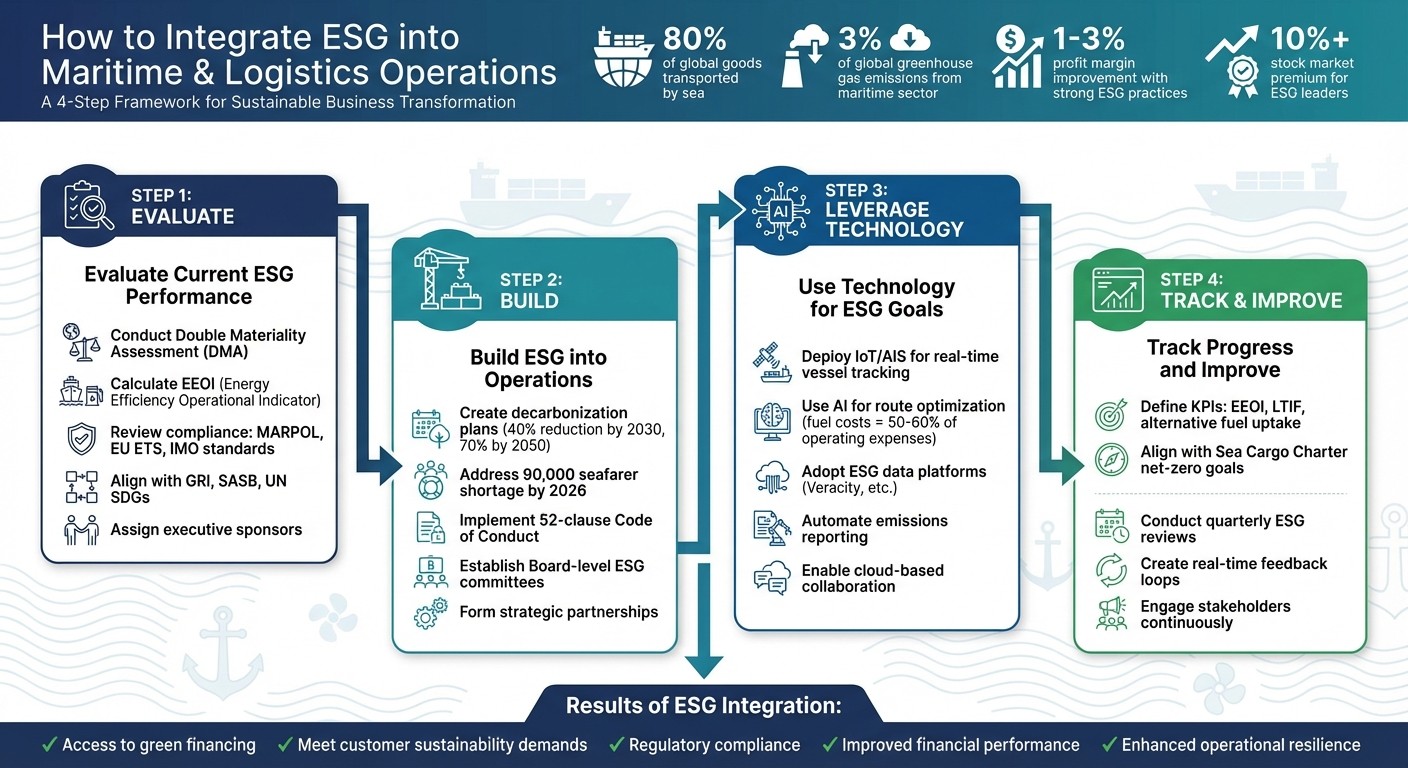
4-Step ESG Integration Framework for Maritime and Logistics Companies
Episode 2: ESG & Sustainability roadmap for maritime SMEs
Step 1: Evaluate Your Current ESG Performance
Start by thoroughly examining your current ESG (Environmental, Social, and Governance) performance. This involves a detailed review of your environmental impact, social practices, and governance structures. Incorporating a Double Materiality Assessment (DMA) can provide critical insights into how ESG issues influence your financial outcomes and how your operations affect the environment and society [1][7]. For instance, in 2025, A.P. Moller – Maersk conducted a comprehensive review of its sustainability strategy using a DMA. This process identified financial risks tied to climate change, pollution, and ship recycling, with oversight provided by an Audit Committee to ensure data accuracy and robust internal controls [1].
Conduct Environmental Impact Assessments
Once the initial evaluation is complete, focus on quantifying your environmental impact. A key step is calculating your greenhouse gas emissions intensity using the Energy Efficiency Operational Indicator (EEOI). This metric evaluates emissions during vessel operations by factoring in elements such as fuel consumption by type, greenhouse gas emission factors, distance traveled while carrying cargo, and the weight of the cargo itself [5]. Organizations adhering to the Sea Cargo Charter use the EEOI to gauge climate alignment by comparing their emissions intensity with decarbonization trajectories measured in grams of CO₂e per ton-mile [5].
Climate alignment is defined as the degree to which voyage emissions intensity of a vessel category is in line with a decarbonisation trajectory that meets the IMO ambition of reaching net-zero GHG emissions by or around 2050. - Sea Cargo Charter [5]
Your environmental assessment should also ensure compliance with regulations such as MARPOL Annex VI, the EU Emissions Trading System (ETS), and IMO standards like EEXI and CII [6][4]. Beyond emissions, examine operational aspects such as the use of oily water separators, ballast water management, hull biofouling, underwater noise levels, and the reduction of single-use plastics [6]. Internal checklists can help confirm that safety management systems align with current environmental standards and MARPOL requirements [6].
Review Social and Governance Practices
Equally important is a review of your social and governance practices to ensure a comprehensive ESG strategy. For the social component, focus on areas like health and safety, talent management, working conditions, equal treatment, forced labor prevention, and data privacy [1][4]. On the governance side, assess policies related to corruption and bribery, tax transparency, supplier relationships, ethical AI usage, and board-level oversight [1].
Incorporate these evaluations into your Enterprise Risk Management (ERM) framework to anticipate risks over a five-year period [1]. Tools like the INTERTANKO ESG Materiality Questionnaire can help pinpoint the most critical social and governance issues for your operations [8]. Compare your current practices with global benchmarks such as GRI, SASB, or the UN Sustainable Development Goals to identify any gaps in reporting [7][8]. Assign executive sponsors to each key sustainability area to ensure accountability and progress toward established goals [1].
| Evaluation Area | Key Focus Topics |
| --- | --- |
| <strong>Social Practices</strong> | Health and safety, talent attraction and retention, working conditions, equal treatment, forced labor, data privacy <a href="https://www.maersk.com/sustainability/our-approach/strategy" target="_blank" style="text-decoration: none;" rel="nofollow noopener noreferrer" data-framer-link="Link:{"url":"https://www.maersk.com/sustainability/our-approach/strategy","type":"url"}" data-framer-open-in-new-tab=""><sup>[1]</sup></a><a href="https://on.bcg.com/3OEVwPf" target="_blank" style="text-decoration: none;" rel="nofollow noopener noreferrer" data-framer-link="Link:{"url":"https://on.bcg.com/3OEVwPf","type":"url"}" data-framer-open-in-new-tab=""><sup>[4]</sup></a> |
| <strong>Governance Practices</strong> | Corruption and bribery, tax transparency, supplier relationships, ethical use of AI, board-level oversight <a href="https://www.maersk.com/sustainability/our-approach/strategy" target="_blank" style="text-decoration: none;" rel="nofollow noopener noreferrer" data-framer-link="Link:{"url":"https://www.maersk.com/sustainability/our-approach/strategy","type":"url"}" data-framer-open-in-new-tab=""><sup>[1]</sup></a> |
| <strong>Alignment Standards</strong> | GRI, SASB, UN SDGs, ISSB (S1 and S2), EU CSRD <a href="https://www.ics-shipping.org/esg-reporting-frameworks-and-standards" target="_blank" style="text-decoration: none;" rel="nofollow noopener noreferrer" data-framer-link="Link:{"url":"https://www.ics-shipping.org/esg-reporting-frameworks-and-standards","type":"url"}" data-framer-open-in-new-tab=""><sup>[7]</sup></a> |
| Evaluation Area | Key Focus Topics |
| --- | --- |
| <strong>Social Practices</strong> | Health and safety, talent attraction and retention, working conditions, equal treatment, forced labor, data privacy <a href="https://www.maersk.com/sustainability/our-approach/strategy" target="_blank" style="text-decoration: none;" rel="nofollow noopener noreferrer" data-framer-link="Link:{"url":"https://www.maersk.com/sustainability/our-approach/strategy","type":"url"}" data-framer-open-in-new-tab=""><sup>[1]</sup></a><a href="https://on.bcg.com/3OEVwPf" target="_blank" style="text-decoration: none;" rel="nofollow noopener noreferrer" data-framer-link="Link:{"url":"https://on.bcg.com/3OEVwPf","type":"url"}" data-framer-open-in-new-tab=""><sup>[4]</sup></a> |
| <strong>Governance Practices</strong> | Corruption and bribery, tax transparency, supplier relationships, ethical use of AI, board-level oversight <a href="https://www.maersk.com/sustainability/our-approach/strategy" target="_blank" style="text-decoration: none;" rel="nofollow noopener noreferrer" data-framer-link="Link:{"url":"https://www.maersk.com/sustainability/our-approach/strategy","type":"url"}" data-framer-open-in-new-tab=""><sup>[1]</sup></a> |
| <strong>Alignment Standards</strong> | GRI, SASB, UN SDGs, ISSB (S1 and S2), EU CSRD <a href="https://www.ics-shipping.org/esg-reporting-frameworks-and-standards" target="_blank" style="text-decoration: none;" rel="nofollow noopener noreferrer" data-framer-link="Link:{"url":"https://www.ics-shipping.org/esg-reporting-frameworks-and-standards","type":"url"}" data-framer-open-in-new-tab=""><sup>[7]</sup></a> |Step 2: Build ESG into Your Operations
Incorporate ESG principles into your daily activities to cut emissions, enhance workforce conditions, and promote transparency.
Create Decarbonization Plans
Crafting a decarbonization strategy means tailoring solutions to specific segments. For instance, deep-sea shipping might require investment in dual-fuel vessels that can transition to green methanol or LNG, while short-sea shipping could focus on electrifying ports and terminals [9]. The International Maritime Organization (IMO) has set ambitious goals to reduce carbon emissions per transport work by at least 40% by 2030 and 70% by 2050, using 2008 as a baseline [10].
Immediate steps can include improving operational efficiency. Solar panels on warehouse roofs and digital tools to optimize cold chain logistics are quick wins [11]. Since cold chain logistics can consume up to 20% more fuel than standard transport, switching to refrigerants with lower greenhouse gas impacts is another effective measure [11]. Establishing green corridors - designated trade routes to test zero-emission solutions - offers a controlled way to scale up sustainable practices [9].
For long-term progress, alternative fuels are essential. Green methanol is gaining traction for container vessels, while Sustainable Aviation Fuel (SAF) can cut aviation emissions by 53% without requiring new infrastructure [11]. The "book-and-claim" model allows customers to pay a green premium, creating demand for low-carbon fuels without the need for physical fuel segregation [9]. Additionally, shifting freight from road to rail or waterborne transport can significantly lower emissions per mile traveled [11].
"Decarbonization of shipping requires collaboration across industry stakeholders... there is still more to be done, with urgency, to scale up early solutions." - Wendy Rudder, Partner, Deloitte Netherlands [9]
Improve Labor Standards and Training Programs
The shipping industry faces a looming shortage of 90,000 trained seafarers by 2026, making workforce development a central ESG challenge [13]. Key actions include:
Adopting enhanced codes of conduct, such as the 52-clause Code of Conduct from the Sustainable Shipping Initiative (SSI) and the Institute for Human Rights and Business (IHRB), which go beyond the ILO Maritime Labour Convention (MLC) [12].
Using tools like the RightShip Crew Welfare Tool to monitor seafarers' rights, welfare, and grievance mechanisms [12].
Implementing decarbonization-linked training programs to prepare workers for alternative fuels and green technologies.
Establishing Culture & Inclusion teams with zero-tolerance policies against bullying, harassment, and discrimination to promote psychological safety [14].
Developing multi-year crew welfare roadmaps with measurable goals, shared publicly to enhance transparency in ESG reporting [12].
A.P. Moller - Maersk provides a strong example. In 2025, the company conducted 15,000 leader-led "gemba walks", which led to 1,850 safety improvements at warehouses and depots. They also launched AI upskilling programs and introduced a tracking app for third-party labor due diligence, ensuring compliance with global standards [14]. Maersk aims to achieve a top-quartile "People Pulse" engagement score of 84% by 2026 and ensure 100% completion of "Learning teams" for every high-potential safety incident by the same year [14].
"The S in ESG must not be forgotten, and the work being done to protect and respect seafarers' rights should remain a priority for lenders, investors, and other stakeholders in the maritime sector." - Samantha Bramley, Director Environmental & Social Risk Management, Standard Chartered Bank [12]
Improve Governance Through Reporting and Partnerships
Embed ESG accountability at the highest levels, such as the Board of Directors, through dedicated committees like an Energy Transition Committee or an Audit Committee to oversee external reporting and data quality [1]. Establish clear internal rules to integrate ESG goals into everyday actions, assigning specific owners for compliance and reporting [1]. Regular Double Materiality Assessments can help identify key risks - like fuel price volatility or weak governance - over a five-year horizon [1].
To close the "reporting gap", where only 33% of essential ESG factors are reported accurately, adopt maritime-specific frameworks [3]. Strengthen internal audit functions to ensure sustainability reports are as rigorous as financial ones [1]. Research shows companies with robust ESG practices enjoy profit margins 1–3% higher than their peers and can command stock market premiums exceeding 10% [2].
Forming strategic partnerships can help achieve goals that no single company can tackle alone. For example, in November 2025, A.P. Moller - Maersk and Unilever launched their first electric van operation in Saudi Arabia to decarbonize logistics [15]. Similarly, Maersk partnered with CATL in October 2025 to leverage battery technology for supply chain electrification [15]. Regional collaborations, like Maersk’s electric truck operations in Chile with Sotraser, demonstrate how global ESG strategies can be implemented locally [15].
| Governance Component | Purpose | Oversight Body |
| --- | --- | --- |
| <strong>Energy Transition Committee</strong> | Guides net-zero ambitions and energy transition strategies | Board of Directors <a href="https://www.maersk.com/sustainability/our-approach/strategy" target="_blank" style="text-decoration: none;" rel="nofollow noopener noreferrer" data-framer-link="Link:{"url":"https://www.maersk.com/sustainability/our-approach/strategy","type":"url"}" data-framer-open-in-new-tab=""><sup>[1]</sup></a> |
| <strong>Audit Committee</strong> | Ensures accuracy in ESG reporting and oversees double materiality | Board of Directors <a href="https://www.maersk.com/sustainability/our-approach/strategy" target="_blank" style="text-decoration: none;" rel="nofollow noopener noreferrer" data-framer-link="Link:{"url":"https://www.maersk.com/sustainability/our-approach/strategy","type":"url"}" data-framer-open-in-new-tab=""><sup>[1]</sup></a> |
| <strong>Risk & Compliance Committee</strong> | Manages ESG risks and enforces internal governance rules | Executive Leadership <a href="https://www.maersk.com/sustainability/our-approach/strategy" target="_blank" style="text-decoration: none;" rel="nofollow noopener noreferrer" data-framer-link="Link:{"url":"https://www.maersk.com/sustainability/our-approach/strategy","type":"url"}" data-framer-open-in-new-tab=""><sup>[1]</sup></a> || Governance Component | Purpose | Oversight Body |
| --- | --- | --- |
| <strong>Energy Transition Committee</strong> | Guides net-zero ambitions and energy transition strategies | Board of Directors <a href="https://www.maersk.com/sustainability/our-approach/strategy" target="_blank" style="text-decoration: none;" rel="nofollow noopener noreferrer" data-framer-link="Link:{"url":"https://www.maersk.com/sustainability/our-approach/strategy","type":"url"}" data-framer-open-in-new-tab=""><sup>[1]</sup></a> |
| <strong>Audit Committee</strong> | Ensures accuracy in ESG reporting and oversees double materiality | Board of Directors <a href="https://www.maersk.com/sustainability/our-approach/strategy" target="_blank" style="text-decoration: none;" rel="nofollow noopener noreferrer" data-framer-link="Link:{"url":"https://www.maersk.com/sustainability/our-approach/strategy","type":"url"}" data-framer-open-in-new-tab=""><sup>[1]</sup></a> |
| <strong>Risk & Compliance Committee</strong> | Manages ESG risks and enforces internal governance rules | Executive Leadership <a href="https://www.maersk.com/sustainability/our-approach/strategy" target="_blank" style="text-decoration: none;" rel="nofollow noopener noreferrer" data-framer-link="Link:{"url":"https://www.maersk.com/sustainability/our-approach/strategy","type":"url"}" data-framer-open-in-new-tab=""><sup>[1]</sup></a> |These foundational steps prepare companies to leverage technology further in advancing their ESG objectives.
Step 3: Use Technology to Support ESG Goals
Digital tools play a key role in managing emissions, improving operational efficiency, and streamlining ESG performance reporting. By leveraging real-time data and AI analytics, businesses can make measurable progress toward their ESG objectives.
Use IoT and AI for Environmental Monitoring
The Automatic Identification System (AIS) functions as a real-time IoT data feed, tracking vessel location, speed, and heading across global shipping routes [16]. This publicly accessible information allows companies to monitor fleet efficiency continuously. Considering that fuel costs account for 50%-60% of operating expenses, even small route adjustments can lead to substantial savings [16].
AI-powered Markov chain models enhance this process by analyzing AIS data to predict vessel destinations and simulate the most fuel-efficient routes [16]. Tools like Uber's H3 hexagonal indexing system further refine this data by grouping millions of isolated IoT signals into actionable insights, defining precise "catchment areas" around ports [16]. This automation simplifies data consolidation and analysis.
Additionally, real-time anomaly detection using the Bhattacharyya coefficient identifies sudden changes in vessel behavior, enabling immediate interventions to prevent safety or environmental issues [16]. For example, in 2018, analysts processed 2 billion AIS data points from the shipping carrier PEAK PEGASUS in the Gulf of Mexico using Delta Lake and Apache Spark. This analysis uncovered a pattern of the vessel frequently changing "flags of convenience" between Liberia and Gabon - an indicator of potential regulatory evasion hidden within large datasets [16].
"The ambition is to capture high frequency data without human involvement, making reliable real-time data easily accessible and visualizing it in a user-friendly way, which is key to making better decisions and growing a culture where energy optimization has priority." - Lars Pedersen, Chief Technical Officer, Frontline [17]
Adopt ESG Data Platforms
Digital dashboards offer a centralized view of ESG indicators - such as air emissions and environmental impact - making data more accessible and actionable [17]. This consolidation supports both reporting and the development of performance metrics. For instance, starting in 2020, tanker operator Frontline collaborated with DNV to digitize ship performance and ESG data on the Veracity maritime cloud platform. By implementing a standardized data schema and automating quality checks, Frontline exceeded International Maritime Organization (IMO) targets for Annual Efficiency Ratio (AER) and earned an A-rating in their 2021 ESG report [17].
When selecting a platform, prioritize those that align with reporting standards like GRI, SASB, and TCFD, and employ GLEC-compliant methods to meet global emissions reporting requirements [18][19]. Choose platforms capable of aggregating emissions data across all transportation modes - not just your own fleet - for a more comprehensive view [18].
Before adopting a platform, conduct a data maturity assessment to pinpoint areas for improvement and address gaps in data quality [17]. Use real-time data to create feedback loops for optimizing operations - such as adjusting sailing speeds or re-routing to save fuel [16]. Cloud-based platforms also facilitate collaboration with partners and suppliers, ensuring better data accuracy and compliance throughout the supply chain [19].
| Technology | ESG Application | Primary Benefit |
| --- | --- | --- |
| IoT (AIS) | Real-time vessel tracking | Improved visibility of fleet efficiency <a href="https://databricks.com/blog/2020/11/11/leveraging-esg-data-to-operationalize-sustainability.html" target="_blank" style="text-decoration: none;" rel="nofollow noopener noreferrer" data-framer-link="Link:{"url":"https://databricks.com/blog/2020/11/11/leveraging-esg-data-to-operationalize-sustainability.html","type":"url"}" data-framer-open-in-new-tab=""><sup>[16]</sup></a> |
| AI (Markov Chains) | Route & destination prediction | Reduced fuel consumption and emissions <a href="https://databricks.com/blog/2020/11/11/leveraging-esg-data-to-operationalize-sustainability.html" target="_blank" style="text-decoration: none;" rel="nofollow noopener noreferrer" data-framer-link="Link:{"url":"https://databricks.com/blog/2020/11/11/leveraging-esg-data-to-operationalize-sustainability.html","type":"url"}" data-framer-open-in-new-tab=""><sup>[16]</sup></a> |
| Geospatial Analytics | Catchment area mapping | Automated port-to-port trip identification <a href="https://databricks.com/blog/2020/11/11/leveraging-esg-data-to-operationalize-sustainability.html" target="_blank" style="text-decoration: none;" rel="nofollow noopener noreferrer" data-framer-link="Link:{"url":"https://databricks.com/blog/2020/11/11/leveraging-esg-data-to-operationalize-sustainability.html","type":"url"}" data-framer-open-in-new-tab=""><sup>[16]</sup></a> |
| Data Platforms | ESG dashboards | Streamlined reporting and data accuracy <a href="https://www.dnv.com/sustainable-practices/frontline-esg-data.html" target="_blank" style="text-decoration: none;" rel="nofollow noopener noreferrer" data-framer-link="Link:{"url":"https://www.dnv.com/sustainable-practices/frontline-esg-data.html","type":"url"}" data-framer-open-in-new-tab=""><sup>[17]</sup></a><a href="https://maersk.com/news/articles/2022/11/15/optimising-digitalization-for-tangible-sustainable-logistics" target="_blank" style="text-decoration: none;" rel="nofollow noopener noreferrer" data-framer-link="Link:{"url":"https://maersk.com/news/articles/2022/11/15/optimising-digitalization-for-tangible-sustainable-logistics","type":"url"}" data-framer-open-in-new-tab=""><sup>[18]</sup></a> || Technology | ESG Application | Primary Benefit |
| --- | --- | --- |
| IoT (AIS) | Real-time vessel tracking | Improved visibility of fleet efficiency <a href="https://databricks.com/blog/2020/11/11/leveraging-esg-data-to-operationalize-sustainability.html" target="_blank" style="text-decoration: none;" rel="nofollow noopener noreferrer" data-framer-link="Link:{"url":"https://databricks.com/blog/2020/11/11/leveraging-esg-data-to-operationalize-sustainability.html","type":"url"}" data-framer-open-in-new-tab=""><sup>[16]</sup></a> |
| AI (Markov Chains) | Route & destination prediction | Reduced fuel consumption and emissions <a href="https://databricks.com/blog/2020/11/11/leveraging-esg-data-to-operationalize-sustainability.html" target="_blank" style="text-decoration: none;" rel="nofollow noopener noreferrer" data-framer-link="Link:{"url":"https://databricks.com/blog/2020/11/11/leveraging-esg-data-to-operationalize-sustainability.html","type":"url"}" data-framer-open-in-new-tab=""><sup>[16]</sup></a> |
| Geospatial Analytics | Catchment area mapping | Automated port-to-port trip identification <a href="https://databricks.com/blog/2020/11/11/leveraging-esg-data-to-operationalize-sustainability.html" target="_blank" style="text-decoration: none;" rel="nofollow noopener noreferrer" data-framer-link="Link:{"url":"https://databricks.com/blog/2020/11/11/leveraging-esg-data-to-operationalize-sustainability.html","type":"url"}" data-framer-open-in-new-tab=""><sup>[16]</sup></a> |
| Data Platforms | ESG dashboards | Streamlined reporting and data accuracy <a href="https://www.dnv.com/sustainable-practices/frontline-esg-data.html" target="_blank" style="text-decoration: none;" rel="nofollow noopener noreferrer" data-framer-link="Link:{"url":"https://www.dnv.com/sustainable-practices/frontline-esg-data.html","type":"url"}" data-framer-open-in-new-tab=""><sup>[17]</sup></a><a href="https://maersk.com/news/articles/2022/11/15/optimising-digitalization-for-tangible-sustainable-logistics" target="_blank" style="text-decoration: none;" rel="nofollow noopener noreferrer" data-framer-link="Link:{"url":"https://maersk.com/news/articles/2022/11/15/optimising-digitalization-for-tangible-sustainable-logistics","type":"url"}" data-framer-open-in-new-tab=""><sup>[18]</sup></a> |Step 4: Track Progress and Improve Over Time
As technology continues to reshape businesses, keeping an eye on performance ensures ESG initiatives lead to tangible improvements. To make progress measurable, companies need well-defined metrics and systems that turn data into actionable insights. Without clear benchmarks, it's impossible to determine if sustainability efforts are effective or where adjustments are needed.
Define Key ESG Metrics
Once digital tools are in place, the next step is to establish precise ESG metrics that reflect progress. In maritime operations, the Energy Efficiency Operational Indicator (EEOI) is a key measure for tracking emissions intensity [5]. Other important metrics include the alternative fuel uptake percentage to evaluate progress toward low-emission fuels, critical talent retention rate and Lost Time Injury Frequency (LTIF) to monitor workforce well-being, and supplier ESG compliance rates alongside data privacy incidents to uphold ethical supply chain practices [1][7][19].
The Sea Cargo Charter requires its members to measure climate alignment against the International Maritime Organization's (IMO) net-zero goals for 2050. This involves following decarbonization trajectories that set limits on grams of CO2 per ton-nautical mile [5]. Aligning with standards like ISO 14001 for environmental management and ISO 45001 for workplace safety ensures a solid foundation for tracking and accountability [19].
Create Feedback Loops
With metrics defined, the focus shifts to creating systems that turn data into ongoing improvements. Regular reviews of ESG metrics can help translate insights into operational enhancements. For instance, A.P. Moller - Maersk has implemented a Risk and Compliance Committee, where three senior executives meet quarterly to assess progress on ESG KPIs. This process is guided by their "Commit" framework, which includes 35 governance rules with specific owners responsible for compliance and reporting [1]. In 2025, Maersk revisited its sustainability strategy using insights from its Audit Committee to adapt to evolving regulations [1].
Frontline, a tanker operator, has taken a digital-first approach by collaborating with DNV since 2020. Using the Veracity dashboard, they automated ship performance data collection and applied standardized data schemas with built-in quality checks. This system allowed Frontline to monitor its Annual Efficiency Ratio in real time, outperform IMO trajectories, and secure an A-rating for ESG performance in its 2021 report [17]. Lars Pedersen, Frontline’s Chief Technical Officer, highlighted the value of this system:
The ambition is to capture high frequency data without human involvement, making reliable real-time data easily accessible and visualizing it in a user-friendly way, which is key to making better decisions and growing a culture where energy optimization has priority [17].
Beyond quarterly reviews, companies should dive deeper into specific ESG areas, such as ship recycling or labor rights, to address strategic risks. Engaging with stakeholders like climate experts, investors, and customers can provide valuable input for refining materiality assessments and initiatives [1]. Regularly assessing data maturity is equally important to identify and address gaps in data quality, ensuring decisions are based on reliable insights [17]. This ongoing review process ensures ESG remains a critical component of long-term operational success.
Conclusion: Building Resilience Through ESG
For maritime and logistics companies, weaving ESG principles into their core operations has shifted from being a competitive edge to an essential business strategy. The gap between current practices and industry goals presents both a challenge and a chance for organizations ready to adapt.
The financial upside of integrating ESG initiatives is clear. Companies that embrace sustainability can see profit margins rise by 1%–3%, along with stock market premiums exceeding 10% [2]. But the benefits extend beyond financial metrics. ESG integration strengthens operational resilience, enabling businesses to adapt to stricter regulations, cater to growing customer demands for greener supply chains, and reduce both financial and reputational risks [1].
Success in this area hinges on transparent reporting aligned with global standards, the use of digital tools for ongoing monitoring, and fostering collaboration throughout the supply chain [1]. These steps collectively create a foundation for sustainable and resilient operations. As the Mærsk Mc-Kinney Møller Center for Zero Carbon Shipping points out, excelling in sustainability is fast becoming a prerequisite for doing business in the future [20].
FAQs
Which ESG issues should we prioritize first?
Maritime and logistics companies must place a strong emphasis on decarbonization and the reduction of greenhouse gas emissions due to the sector’s considerable impact on the environment. Key efforts should center on lowering carbon intensity, transitioning to green fuels, and adhering to regulations such as the EU Emission Trading Scheme and standards set by the International Maritime Organization (IMO). Beyond environmental concerns, enhancing safety, governance, and social responsibility - including areas like diversity, ethical practices, and data governance - is vital to ensure compliance and build resilience for the future.
What ESG metrics should we track for ships and logistics?
Key metrics for assessing ESG performance in shipping and logistics focus on areas like environmental impact, safety, and workforce inclusivity. Examples include carbon intensity (such as the Energy Efficiency Operational Indicator, or EEOI), the proportion of cargo transported using green fuels, and incident rates related to safety and security. Companies also track diversity and inclusion goals, such as the percentage of women in management roles and the representation of executives from varied nationalities. Additional measures include employee engagement scores and compliance with ethical guidelines, such as codes of conduct. These metrics are essential for aligning operations with sustainability and governance priorities while fostering accountability.
How do we set up reliable ESG data collection and reporting?
To build reliable ESG data collection and reporting processes, it's crucial to focus on automation and standardization. Leveraging digital tools can simplify the task by consolidating fleet performance and ESG metrics into unified dashboards, making it easier to manage data from multiple sources. Conducting a data maturity assessment helps pinpoint any gaps in your current processes, while introducing automated quality checks ensures the data's accuracy and reliability. Additionally, aligning your efforts with recognized ESG frameworks promotes consistency in reporting and fosters trust among decision-makers and stakeholders.
Related Blog Posts
Latest Articles
©2025



FAQ
01
What does it really mean to “redefine profit”?
02
What makes Council Fire different?
03
Who does Council Fire you work with?
04
What does working with Council Fire actually look like?
05
How does Council Fire help organizations turn big goals into action?
06
How does Council Fire define and measure success?
Feb 22, 2026
How to Integrate ESG into Core Business Operations for Maritime & Logistics Companies
ESG Strategy
In This Article
Practical steps to embed ESG across maritime and logistics operations — from decarbonization and workforce standards to tech-enabled reporting and metrics.
How to Integrate ESG into Core Business Operations for Maritime & Logistics Companies
The maritime and logistics industry is under pressure to address environmental, social, and governance (ESG) challenges while maintaining profitability. With over 80% of global goods transported by sea and the sector contributing 3% of greenhouse gas emissions, ESG integration is no longer optional - it’s a business necessity. Here's how companies can embed ESG principles into their operations to reduce risks, unlock financial opportunities, and meet regulatory expectations.
Key Takeaways:
Why ESG Matters: Companies with strong ESG practices see profit margins improve by 1–3% and stock market premiums exceed 10%.
Challenges: Decarbonization, labor conditions, and inconsistent governance reporting are major hurdles.
Steps to Integration:
Evaluate Current ESG Performance: Conduct materiality assessments and align with global standards like GRI or SASB.
Build ESG into Operations: Create decarbonization plans, improve workforce conditions, and strengthen governance practices.
Leverage Technology: Use IoT, AI, and ESG data platforms for real-time monitoring and reporting.
Track and Improve: Define ESG metrics like emissions intensity (EEOI) and establish feedback loops for ongoing improvement.
By embedding ESG into core strategies, maritime and logistics companies can secure green financing, meet customer demands for sustainability, and ensure compliance with evolving regulations - all while improving financial performance.
4-Step ESG Integration Framework for Maritime and Logistics Companies
Episode 2: ESG & Sustainability roadmap for maritime SMEs
Step 1: Evaluate Your Current ESG Performance
Start by thoroughly examining your current ESG (Environmental, Social, and Governance) performance. This involves a detailed review of your environmental impact, social practices, and governance structures. Incorporating a Double Materiality Assessment (DMA) can provide critical insights into how ESG issues influence your financial outcomes and how your operations affect the environment and society [1][7]. For instance, in 2025, A.P. Moller – Maersk conducted a comprehensive review of its sustainability strategy using a DMA. This process identified financial risks tied to climate change, pollution, and ship recycling, with oversight provided by an Audit Committee to ensure data accuracy and robust internal controls [1].
Conduct Environmental Impact Assessments
Once the initial evaluation is complete, focus on quantifying your environmental impact. A key step is calculating your greenhouse gas emissions intensity using the Energy Efficiency Operational Indicator (EEOI). This metric evaluates emissions during vessel operations by factoring in elements such as fuel consumption by type, greenhouse gas emission factors, distance traveled while carrying cargo, and the weight of the cargo itself [5]. Organizations adhering to the Sea Cargo Charter use the EEOI to gauge climate alignment by comparing their emissions intensity with decarbonization trajectories measured in grams of CO₂e per ton-mile [5].
Climate alignment is defined as the degree to which voyage emissions intensity of a vessel category is in line with a decarbonisation trajectory that meets the IMO ambition of reaching net-zero GHG emissions by or around 2050. - Sea Cargo Charter [5]
Your environmental assessment should also ensure compliance with regulations such as MARPOL Annex VI, the EU Emissions Trading System (ETS), and IMO standards like EEXI and CII [6][4]. Beyond emissions, examine operational aspects such as the use of oily water separators, ballast water management, hull biofouling, underwater noise levels, and the reduction of single-use plastics [6]. Internal checklists can help confirm that safety management systems align with current environmental standards and MARPOL requirements [6].
Review Social and Governance Practices
Equally important is a review of your social and governance practices to ensure a comprehensive ESG strategy. For the social component, focus on areas like health and safety, talent management, working conditions, equal treatment, forced labor prevention, and data privacy [1][4]. On the governance side, assess policies related to corruption and bribery, tax transparency, supplier relationships, ethical AI usage, and board-level oversight [1].
Incorporate these evaluations into your Enterprise Risk Management (ERM) framework to anticipate risks over a five-year period [1]. Tools like the INTERTANKO ESG Materiality Questionnaire can help pinpoint the most critical social and governance issues for your operations [8]. Compare your current practices with global benchmarks such as GRI, SASB, or the UN Sustainable Development Goals to identify any gaps in reporting [7][8]. Assign executive sponsors to each key sustainability area to ensure accountability and progress toward established goals [1].
| Evaluation Area | Key Focus Topics |
| --- | --- |
| <strong>Social Practices</strong> | Health and safety, talent attraction and retention, working conditions, equal treatment, forced labor, data privacy <a href="https://www.maersk.com/sustainability/our-approach/strategy" target="_blank" style="text-decoration: none;" rel="nofollow noopener noreferrer" data-framer-link="Link:{"url":"https://www.maersk.com/sustainability/our-approach/strategy","type":"url"}" data-framer-open-in-new-tab=""><sup>[1]</sup></a><a href="https://on.bcg.com/3OEVwPf" target="_blank" style="text-decoration: none;" rel="nofollow noopener noreferrer" data-framer-link="Link:{"url":"https://on.bcg.com/3OEVwPf","type":"url"}" data-framer-open-in-new-tab=""><sup>[4]</sup></a> |
| <strong>Governance Practices</strong> | Corruption and bribery, tax transparency, supplier relationships, ethical use of AI, board-level oversight <a href="https://www.maersk.com/sustainability/our-approach/strategy" target="_blank" style="text-decoration: none;" rel="nofollow noopener noreferrer" data-framer-link="Link:{"url":"https://www.maersk.com/sustainability/our-approach/strategy","type":"url"}" data-framer-open-in-new-tab=""><sup>[1]</sup></a> |
| <strong>Alignment Standards</strong> | GRI, SASB, UN SDGs, ISSB (S1 and S2), EU CSRD <a href="https://www.ics-shipping.org/esg-reporting-frameworks-and-standards" target="_blank" style="text-decoration: none;" rel="nofollow noopener noreferrer" data-framer-link="Link:{"url":"https://www.ics-shipping.org/esg-reporting-frameworks-and-standards","type":"url"}" data-framer-open-in-new-tab=""><sup>[7]</sup></a> |
Step 2: Build ESG into Your Operations
Incorporate ESG principles into your daily activities to cut emissions, enhance workforce conditions, and promote transparency.
Create Decarbonization Plans
Crafting a decarbonization strategy means tailoring solutions to specific segments. For instance, deep-sea shipping might require investment in dual-fuel vessels that can transition to green methanol or LNG, while short-sea shipping could focus on electrifying ports and terminals [9]. The International Maritime Organization (IMO) has set ambitious goals to reduce carbon emissions per transport work by at least 40% by 2030 and 70% by 2050, using 2008 as a baseline [10].
Immediate steps can include improving operational efficiency. Solar panels on warehouse roofs and digital tools to optimize cold chain logistics are quick wins [11]. Since cold chain logistics can consume up to 20% more fuel than standard transport, switching to refrigerants with lower greenhouse gas impacts is another effective measure [11]. Establishing green corridors - designated trade routes to test zero-emission solutions - offers a controlled way to scale up sustainable practices [9].
For long-term progress, alternative fuels are essential. Green methanol is gaining traction for container vessels, while Sustainable Aviation Fuel (SAF) can cut aviation emissions by 53% without requiring new infrastructure [11]. The "book-and-claim" model allows customers to pay a green premium, creating demand for low-carbon fuels without the need for physical fuel segregation [9]. Additionally, shifting freight from road to rail or waterborne transport can significantly lower emissions per mile traveled [11].
"Decarbonization of shipping requires collaboration across industry stakeholders... there is still more to be done, with urgency, to scale up early solutions." - Wendy Rudder, Partner, Deloitte Netherlands [9]
Improve Labor Standards and Training Programs
The shipping industry faces a looming shortage of 90,000 trained seafarers by 2026, making workforce development a central ESG challenge [13]. Key actions include:
Adopting enhanced codes of conduct, such as the 52-clause Code of Conduct from the Sustainable Shipping Initiative (SSI) and the Institute for Human Rights and Business (IHRB), which go beyond the ILO Maritime Labour Convention (MLC) [12].
Using tools like the RightShip Crew Welfare Tool to monitor seafarers' rights, welfare, and grievance mechanisms [12].
Implementing decarbonization-linked training programs to prepare workers for alternative fuels and green technologies.
Establishing Culture & Inclusion teams with zero-tolerance policies against bullying, harassment, and discrimination to promote psychological safety [14].
Developing multi-year crew welfare roadmaps with measurable goals, shared publicly to enhance transparency in ESG reporting [12].
A.P. Moller - Maersk provides a strong example. In 2025, the company conducted 15,000 leader-led "gemba walks", which led to 1,850 safety improvements at warehouses and depots. They also launched AI upskilling programs and introduced a tracking app for third-party labor due diligence, ensuring compliance with global standards [14]. Maersk aims to achieve a top-quartile "People Pulse" engagement score of 84% by 2026 and ensure 100% completion of "Learning teams" for every high-potential safety incident by the same year [14].
"The S in ESG must not be forgotten, and the work being done to protect and respect seafarers' rights should remain a priority for lenders, investors, and other stakeholders in the maritime sector." - Samantha Bramley, Director Environmental & Social Risk Management, Standard Chartered Bank [12]
Improve Governance Through Reporting and Partnerships
Embed ESG accountability at the highest levels, such as the Board of Directors, through dedicated committees like an Energy Transition Committee or an Audit Committee to oversee external reporting and data quality [1]. Establish clear internal rules to integrate ESG goals into everyday actions, assigning specific owners for compliance and reporting [1]. Regular Double Materiality Assessments can help identify key risks - like fuel price volatility or weak governance - over a five-year horizon [1].
To close the "reporting gap", where only 33% of essential ESG factors are reported accurately, adopt maritime-specific frameworks [3]. Strengthen internal audit functions to ensure sustainability reports are as rigorous as financial ones [1]. Research shows companies with robust ESG practices enjoy profit margins 1–3% higher than their peers and can command stock market premiums exceeding 10% [2].
Forming strategic partnerships can help achieve goals that no single company can tackle alone. For example, in November 2025, A.P. Moller - Maersk and Unilever launched their first electric van operation in Saudi Arabia to decarbonize logistics [15]. Similarly, Maersk partnered with CATL in October 2025 to leverage battery technology for supply chain electrification [15]. Regional collaborations, like Maersk’s electric truck operations in Chile with Sotraser, demonstrate how global ESG strategies can be implemented locally [15].
| Governance Component | Purpose | Oversight Body |
| --- | --- | --- |
| <strong>Energy Transition Committee</strong> | Guides net-zero ambitions and energy transition strategies | Board of Directors <a href="https://www.maersk.com/sustainability/our-approach/strategy" target="_blank" style="text-decoration: none;" rel="nofollow noopener noreferrer" data-framer-link="Link:{"url":"https://www.maersk.com/sustainability/our-approach/strategy","type":"url"}" data-framer-open-in-new-tab=""><sup>[1]</sup></a> |
| <strong>Audit Committee</strong> | Ensures accuracy in ESG reporting and oversees double materiality | Board of Directors <a href="https://www.maersk.com/sustainability/our-approach/strategy" target="_blank" style="text-decoration: none;" rel="nofollow noopener noreferrer" data-framer-link="Link:{"url":"https://www.maersk.com/sustainability/our-approach/strategy","type":"url"}" data-framer-open-in-new-tab=""><sup>[1]</sup></a> |
| <strong>Risk & Compliance Committee</strong> | Manages ESG risks and enforces internal governance rules | Executive Leadership <a href="https://www.maersk.com/sustainability/our-approach/strategy" target="_blank" style="text-decoration: none;" rel="nofollow noopener noreferrer" data-framer-link="Link:{"url":"https://www.maersk.com/sustainability/our-approach/strategy","type":"url"}" data-framer-open-in-new-tab=""><sup>[1]</sup></a> |These foundational steps prepare companies to leverage technology further in advancing their ESG objectives.
Step 3: Use Technology to Support ESG Goals
Digital tools play a key role in managing emissions, improving operational efficiency, and streamlining ESG performance reporting. By leveraging real-time data and AI analytics, businesses can make measurable progress toward their ESG objectives.
Use IoT and AI for Environmental Monitoring
The Automatic Identification System (AIS) functions as a real-time IoT data feed, tracking vessel location, speed, and heading across global shipping routes [16]. This publicly accessible information allows companies to monitor fleet efficiency continuously. Considering that fuel costs account for 50%-60% of operating expenses, even small route adjustments can lead to substantial savings [16].
AI-powered Markov chain models enhance this process by analyzing AIS data to predict vessel destinations and simulate the most fuel-efficient routes [16]. Tools like Uber's H3 hexagonal indexing system further refine this data by grouping millions of isolated IoT signals into actionable insights, defining precise "catchment areas" around ports [16]. This automation simplifies data consolidation and analysis.
Additionally, real-time anomaly detection using the Bhattacharyya coefficient identifies sudden changes in vessel behavior, enabling immediate interventions to prevent safety or environmental issues [16]. For example, in 2018, analysts processed 2 billion AIS data points from the shipping carrier PEAK PEGASUS in the Gulf of Mexico using Delta Lake and Apache Spark. This analysis uncovered a pattern of the vessel frequently changing "flags of convenience" between Liberia and Gabon - an indicator of potential regulatory evasion hidden within large datasets [16].
"The ambition is to capture high frequency data without human involvement, making reliable real-time data easily accessible and visualizing it in a user-friendly way, which is key to making better decisions and growing a culture where energy optimization has priority." - Lars Pedersen, Chief Technical Officer, Frontline [17]
Adopt ESG Data Platforms
Digital dashboards offer a centralized view of ESG indicators - such as air emissions and environmental impact - making data more accessible and actionable [17]. This consolidation supports both reporting and the development of performance metrics. For instance, starting in 2020, tanker operator Frontline collaborated with DNV to digitize ship performance and ESG data on the Veracity maritime cloud platform. By implementing a standardized data schema and automating quality checks, Frontline exceeded International Maritime Organization (IMO) targets for Annual Efficiency Ratio (AER) and earned an A-rating in their 2021 ESG report [17].
When selecting a platform, prioritize those that align with reporting standards like GRI, SASB, and TCFD, and employ GLEC-compliant methods to meet global emissions reporting requirements [18][19]. Choose platforms capable of aggregating emissions data across all transportation modes - not just your own fleet - for a more comprehensive view [18].
Before adopting a platform, conduct a data maturity assessment to pinpoint areas for improvement and address gaps in data quality [17]. Use real-time data to create feedback loops for optimizing operations - such as adjusting sailing speeds or re-routing to save fuel [16]. Cloud-based platforms also facilitate collaboration with partners and suppliers, ensuring better data accuracy and compliance throughout the supply chain [19].
| Technology | ESG Application | Primary Benefit |
| --- | --- | --- |
| IoT (AIS) | Real-time vessel tracking | Improved visibility of fleet efficiency <a href="https://databricks.com/blog/2020/11/11/leveraging-esg-data-to-operationalize-sustainability.html" target="_blank" style="text-decoration: none;" rel="nofollow noopener noreferrer" data-framer-link="Link:{"url":"https://databricks.com/blog/2020/11/11/leveraging-esg-data-to-operationalize-sustainability.html","type":"url"}" data-framer-open-in-new-tab=""><sup>[16]</sup></a> |
| AI (Markov Chains) | Route & destination prediction | Reduced fuel consumption and emissions <a href="https://databricks.com/blog/2020/11/11/leveraging-esg-data-to-operationalize-sustainability.html" target="_blank" style="text-decoration: none;" rel="nofollow noopener noreferrer" data-framer-link="Link:{"url":"https://databricks.com/blog/2020/11/11/leveraging-esg-data-to-operationalize-sustainability.html","type":"url"}" data-framer-open-in-new-tab=""><sup>[16]</sup></a> |
| Geospatial Analytics | Catchment area mapping | Automated port-to-port trip identification <a href="https://databricks.com/blog/2020/11/11/leveraging-esg-data-to-operationalize-sustainability.html" target="_blank" style="text-decoration: none;" rel="nofollow noopener noreferrer" data-framer-link="Link:{"url":"https://databricks.com/blog/2020/11/11/leveraging-esg-data-to-operationalize-sustainability.html","type":"url"}" data-framer-open-in-new-tab=""><sup>[16]</sup></a> |
| Data Platforms | ESG dashboards | Streamlined reporting and data accuracy <a href="https://www.dnv.com/sustainable-practices/frontline-esg-data.html" target="_blank" style="text-decoration: none;" rel="nofollow noopener noreferrer" data-framer-link="Link:{"url":"https://www.dnv.com/sustainable-practices/frontline-esg-data.html","type":"url"}" data-framer-open-in-new-tab=""><sup>[17]</sup></a><a href="https://maersk.com/news/articles/2022/11/15/optimising-digitalization-for-tangible-sustainable-logistics" target="_blank" style="text-decoration: none;" rel="nofollow noopener noreferrer" data-framer-link="Link:{"url":"https://maersk.com/news/articles/2022/11/15/optimising-digitalization-for-tangible-sustainable-logistics","type":"url"}" data-framer-open-in-new-tab=""><sup>[18]</sup></a> |Step 4: Track Progress and Improve Over Time
As technology continues to reshape businesses, keeping an eye on performance ensures ESG initiatives lead to tangible improvements. To make progress measurable, companies need well-defined metrics and systems that turn data into actionable insights. Without clear benchmarks, it's impossible to determine if sustainability efforts are effective or where adjustments are needed.
Define Key ESG Metrics
Once digital tools are in place, the next step is to establish precise ESG metrics that reflect progress. In maritime operations, the Energy Efficiency Operational Indicator (EEOI) is a key measure for tracking emissions intensity [5]. Other important metrics include the alternative fuel uptake percentage to evaluate progress toward low-emission fuels, critical talent retention rate and Lost Time Injury Frequency (LTIF) to monitor workforce well-being, and supplier ESG compliance rates alongside data privacy incidents to uphold ethical supply chain practices [1][7][19].
The Sea Cargo Charter requires its members to measure climate alignment against the International Maritime Organization's (IMO) net-zero goals for 2050. This involves following decarbonization trajectories that set limits on grams of CO2 per ton-nautical mile [5]. Aligning with standards like ISO 14001 for environmental management and ISO 45001 for workplace safety ensures a solid foundation for tracking and accountability [19].
Create Feedback Loops
With metrics defined, the focus shifts to creating systems that turn data into ongoing improvements. Regular reviews of ESG metrics can help translate insights into operational enhancements. For instance, A.P. Moller - Maersk has implemented a Risk and Compliance Committee, where three senior executives meet quarterly to assess progress on ESG KPIs. This process is guided by their "Commit" framework, which includes 35 governance rules with specific owners responsible for compliance and reporting [1]. In 2025, Maersk revisited its sustainability strategy using insights from its Audit Committee to adapt to evolving regulations [1].
Frontline, a tanker operator, has taken a digital-first approach by collaborating with DNV since 2020. Using the Veracity dashboard, they automated ship performance data collection and applied standardized data schemas with built-in quality checks. This system allowed Frontline to monitor its Annual Efficiency Ratio in real time, outperform IMO trajectories, and secure an A-rating for ESG performance in its 2021 report [17]. Lars Pedersen, Frontline’s Chief Technical Officer, highlighted the value of this system:
The ambition is to capture high frequency data without human involvement, making reliable real-time data easily accessible and visualizing it in a user-friendly way, which is key to making better decisions and growing a culture where energy optimization has priority [17].
Beyond quarterly reviews, companies should dive deeper into specific ESG areas, such as ship recycling or labor rights, to address strategic risks. Engaging with stakeholders like climate experts, investors, and customers can provide valuable input for refining materiality assessments and initiatives [1]. Regularly assessing data maturity is equally important to identify and address gaps in data quality, ensuring decisions are based on reliable insights [17]. This ongoing review process ensures ESG remains a critical component of long-term operational success.
Conclusion: Building Resilience Through ESG
For maritime and logistics companies, weaving ESG principles into their core operations has shifted from being a competitive edge to an essential business strategy. The gap between current practices and industry goals presents both a challenge and a chance for organizations ready to adapt.
The financial upside of integrating ESG initiatives is clear. Companies that embrace sustainability can see profit margins rise by 1%–3%, along with stock market premiums exceeding 10% [2]. But the benefits extend beyond financial metrics. ESG integration strengthens operational resilience, enabling businesses to adapt to stricter regulations, cater to growing customer demands for greener supply chains, and reduce both financial and reputational risks [1].
Success in this area hinges on transparent reporting aligned with global standards, the use of digital tools for ongoing monitoring, and fostering collaboration throughout the supply chain [1]. These steps collectively create a foundation for sustainable and resilient operations. As the Mærsk Mc-Kinney Møller Center for Zero Carbon Shipping points out, excelling in sustainability is fast becoming a prerequisite for doing business in the future [20].
FAQs
Which ESG issues should we prioritize first?
Maritime and logistics companies must place a strong emphasis on decarbonization and the reduction of greenhouse gas emissions due to the sector’s considerable impact on the environment. Key efforts should center on lowering carbon intensity, transitioning to green fuels, and adhering to regulations such as the EU Emission Trading Scheme and standards set by the International Maritime Organization (IMO). Beyond environmental concerns, enhancing safety, governance, and social responsibility - including areas like diversity, ethical practices, and data governance - is vital to ensure compliance and build resilience for the future.
What ESG metrics should we track for ships and logistics?
Key metrics for assessing ESG performance in shipping and logistics focus on areas like environmental impact, safety, and workforce inclusivity. Examples include carbon intensity (such as the Energy Efficiency Operational Indicator, or EEOI), the proportion of cargo transported using green fuels, and incident rates related to safety and security. Companies also track diversity and inclusion goals, such as the percentage of women in management roles and the representation of executives from varied nationalities. Additional measures include employee engagement scores and compliance with ethical guidelines, such as codes of conduct. These metrics are essential for aligning operations with sustainability and governance priorities while fostering accountability.
How do we set up reliable ESG data collection and reporting?
To build reliable ESG data collection and reporting processes, it's crucial to focus on automation and standardization. Leveraging digital tools can simplify the task by consolidating fleet performance and ESG metrics into unified dashboards, making it easier to manage data from multiple sources. Conducting a data maturity assessment helps pinpoint any gaps in your current processes, while introducing automated quality checks ensures the data's accuracy and reliability. Additionally, aligning your efforts with recognized ESG frameworks promotes consistency in reporting and fosters trust among decision-makers and stakeholders.
Related Blog Posts
FAQ
01
What does it really mean to “redefine profit”?
02
What makes Council Fire different?
03
Who does Council Fire you work with?
04
What does working with Council Fire actually look like?
05
How does Council Fire help organizations turn big goals into action?
06
How does Council Fire define and measure success?
Feb 22, 2026
How to Integrate ESG into Core Business Operations for Maritime & Logistics Companies
ESG Strategy
In This Article
Practical steps to embed ESG across maritime and logistics operations — from decarbonization and workforce standards to tech-enabled reporting and metrics.
How to Integrate ESG into Core Business Operations for Maritime & Logistics Companies
The maritime and logistics industry is under pressure to address environmental, social, and governance (ESG) challenges while maintaining profitability. With over 80% of global goods transported by sea and the sector contributing 3% of greenhouse gas emissions, ESG integration is no longer optional - it’s a business necessity. Here's how companies can embed ESG principles into their operations to reduce risks, unlock financial opportunities, and meet regulatory expectations.
Key Takeaways:
Why ESG Matters: Companies with strong ESG practices see profit margins improve by 1–3% and stock market premiums exceed 10%.
Challenges: Decarbonization, labor conditions, and inconsistent governance reporting are major hurdles.
Steps to Integration:
Evaluate Current ESG Performance: Conduct materiality assessments and align with global standards like GRI or SASB.
Build ESG into Operations: Create decarbonization plans, improve workforce conditions, and strengthen governance practices.
Leverage Technology: Use IoT, AI, and ESG data platforms for real-time monitoring and reporting.
Track and Improve: Define ESG metrics like emissions intensity (EEOI) and establish feedback loops for ongoing improvement.
By embedding ESG into core strategies, maritime and logistics companies can secure green financing, meet customer demands for sustainability, and ensure compliance with evolving regulations - all while improving financial performance.
4-Step ESG Integration Framework for Maritime and Logistics Companies
Episode 2: ESG & Sustainability roadmap for maritime SMEs
Step 1: Evaluate Your Current ESG Performance
Start by thoroughly examining your current ESG (Environmental, Social, and Governance) performance. This involves a detailed review of your environmental impact, social practices, and governance structures. Incorporating a Double Materiality Assessment (DMA) can provide critical insights into how ESG issues influence your financial outcomes and how your operations affect the environment and society [1][7]. For instance, in 2025, A.P. Moller – Maersk conducted a comprehensive review of its sustainability strategy using a DMA. This process identified financial risks tied to climate change, pollution, and ship recycling, with oversight provided by an Audit Committee to ensure data accuracy and robust internal controls [1].
Conduct Environmental Impact Assessments
Once the initial evaluation is complete, focus on quantifying your environmental impact. A key step is calculating your greenhouse gas emissions intensity using the Energy Efficiency Operational Indicator (EEOI). This metric evaluates emissions during vessel operations by factoring in elements such as fuel consumption by type, greenhouse gas emission factors, distance traveled while carrying cargo, and the weight of the cargo itself [5]. Organizations adhering to the Sea Cargo Charter use the EEOI to gauge climate alignment by comparing their emissions intensity with decarbonization trajectories measured in grams of CO₂e per ton-mile [5].
Climate alignment is defined as the degree to which voyage emissions intensity of a vessel category is in line with a decarbonisation trajectory that meets the IMO ambition of reaching net-zero GHG emissions by or around 2050. - Sea Cargo Charter [5]
Your environmental assessment should also ensure compliance with regulations such as MARPOL Annex VI, the EU Emissions Trading System (ETS), and IMO standards like EEXI and CII [6][4]. Beyond emissions, examine operational aspects such as the use of oily water separators, ballast water management, hull biofouling, underwater noise levels, and the reduction of single-use plastics [6]. Internal checklists can help confirm that safety management systems align with current environmental standards and MARPOL requirements [6].
Review Social and Governance Practices
Equally important is a review of your social and governance practices to ensure a comprehensive ESG strategy. For the social component, focus on areas like health and safety, talent management, working conditions, equal treatment, forced labor prevention, and data privacy [1][4]. On the governance side, assess policies related to corruption and bribery, tax transparency, supplier relationships, ethical AI usage, and board-level oversight [1].
Incorporate these evaluations into your Enterprise Risk Management (ERM) framework to anticipate risks over a five-year period [1]. Tools like the INTERTANKO ESG Materiality Questionnaire can help pinpoint the most critical social and governance issues for your operations [8]. Compare your current practices with global benchmarks such as GRI, SASB, or the UN Sustainable Development Goals to identify any gaps in reporting [7][8]. Assign executive sponsors to each key sustainability area to ensure accountability and progress toward established goals [1].
| Evaluation Area | Key Focus Topics |
| --- | --- |
| <strong>Social Practices</strong> | Health and safety, talent attraction and retention, working conditions, equal treatment, forced labor, data privacy <a href="https://www.maersk.com/sustainability/our-approach/strategy" target="_blank" style="text-decoration: none;" rel="nofollow noopener noreferrer" data-framer-link="Link:{"url":"https://www.maersk.com/sustainability/our-approach/strategy","type":"url"}" data-framer-open-in-new-tab=""><sup>[1]</sup></a><a href="https://on.bcg.com/3OEVwPf" target="_blank" style="text-decoration: none;" rel="nofollow noopener noreferrer" data-framer-link="Link:{"url":"https://on.bcg.com/3OEVwPf","type":"url"}" data-framer-open-in-new-tab=""><sup>[4]</sup></a> |
| <strong>Governance Practices</strong> | Corruption and bribery, tax transparency, supplier relationships, ethical use of AI, board-level oversight <a href="https://www.maersk.com/sustainability/our-approach/strategy" target="_blank" style="text-decoration: none;" rel="nofollow noopener noreferrer" data-framer-link="Link:{"url":"https://www.maersk.com/sustainability/our-approach/strategy","type":"url"}" data-framer-open-in-new-tab=""><sup>[1]</sup></a> |
| <strong>Alignment Standards</strong> | GRI, SASB, UN SDGs, ISSB (S1 and S2), EU CSRD <a href="https://www.ics-shipping.org/esg-reporting-frameworks-and-standards" target="_blank" style="text-decoration: none;" rel="nofollow noopener noreferrer" data-framer-link="Link:{"url":"https://www.ics-shipping.org/esg-reporting-frameworks-and-standards","type":"url"}" data-framer-open-in-new-tab=""><sup>[7]</sup></a> |Step 2: Build ESG into Your Operations
Incorporate ESG principles into your daily activities to cut emissions, enhance workforce conditions, and promote transparency.
Create Decarbonization Plans
Crafting a decarbonization strategy means tailoring solutions to specific segments. For instance, deep-sea shipping might require investment in dual-fuel vessels that can transition to green methanol or LNG, while short-sea shipping could focus on electrifying ports and terminals [9]. The International Maritime Organization (IMO) has set ambitious goals to reduce carbon emissions per transport work by at least 40% by 2030 and 70% by 2050, using 2008 as a baseline [10].
Immediate steps can include improving operational efficiency. Solar panels on warehouse roofs and digital tools to optimize cold chain logistics are quick wins [11]. Since cold chain logistics can consume up to 20% more fuel than standard transport, switching to refrigerants with lower greenhouse gas impacts is another effective measure [11]. Establishing green corridors - designated trade routes to test zero-emission solutions - offers a controlled way to scale up sustainable practices [9].
For long-term progress, alternative fuels are essential. Green methanol is gaining traction for container vessels, while Sustainable Aviation Fuel (SAF) can cut aviation emissions by 53% without requiring new infrastructure [11]. The "book-and-claim" model allows customers to pay a green premium, creating demand for low-carbon fuels without the need for physical fuel segregation [9]. Additionally, shifting freight from road to rail or waterborne transport can significantly lower emissions per mile traveled [11].
"Decarbonization of shipping requires collaboration across industry stakeholders... there is still more to be done, with urgency, to scale up early solutions." - Wendy Rudder, Partner, Deloitte Netherlands [9]
Improve Labor Standards and Training Programs
The shipping industry faces a looming shortage of 90,000 trained seafarers by 2026, making workforce development a central ESG challenge [13]. Key actions include:
Adopting enhanced codes of conduct, such as the 52-clause Code of Conduct from the Sustainable Shipping Initiative (SSI) and the Institute for Human Rights and Business (IHRB), which go beyond the ILO Maritime Labour Convention (MLC) [12].
Using tools like the RightShip Crew Welfare Tool to monitor seafarers' rights, welfare, and grievance mechanisms [12].
Implementing decarbonization-linked training programs to prepare workers for alternative fuels and green technologies.
Establishing Culture & Inclusion teams with zero-tolerance policies against bullying, harassment, and discrimination to promote psychological safety [14].
Developing multi-year crew welfare roadmaps with measurable goals, shared publicly to enhance transparency in ESG reporting [12].
A.P. Moller - Maersk provides a strong example. In 2025, the company conducted 15,000 leader-led "gemba walks", which led to 1,850 safety improvements at warehouses and depots. They also launched AI upskilling programs and introduced a tracking app for third-party labor due diligence, ensuring compliance with global standards [14]. Maersk aims to achieve a top-quartile "People Pulse" engagement score of 84% by 2026 and ensure 100% completion of "Learning teams" for every high-potential safety incident by the same year [14].
"The S in ESG must not be forgotten, and the work being done to protect and respect seafarers' rights should remain a priority for lenders, investors, and other stakeholders in the maritime sector." - Samantha Bramley, Director Environmental & Social Risk Management, Standard Chartered Bank [12]
Improve Governance Through Reporting and Partnerships
Embed ESG accountability at the highest levels, such as the Board of Directors, through dedicated committees like an Energy Transition Committee or an Audit Committee to oversee external reporting and data quality [1]. Establish clear internal rules to integrate ESG goals into everyday actions, assigning specific owners for compliance and reporting [1]. Regular Double Materiality Assessments can help identify key risks - like fuel price volatility or weak governance - over a five-year horizon [1].
To close the "reporting gap", where only 33% of essential ESG factors are reported accurately, adopt maritime-specific frameworks [3]. Strengthen internal audit functions to ensure sustainability reports are as rigorous as financial ones [1]. Research shows companies with robust ESG practices enjoy profit margins 1–3% higher than their peers and can command stock market premiums exceeding 10% [2].
Forming strategic partnerships can help achieve goals that no single company can tackle alone. For example, in November 2025, A.P. Moller - Maersk and Unilever launched their first electric van operation in Saudi Arabia to decarbonize logistics [15]. Similarly, Maersk partnered with CATL in October 2025 to leverage battery technology for supply chain electrification [15]. Regional collaborations, like Maersk’s electric truck operations in Chile with Sotraser, demonstrate how global ESG strategies can be implemented locally [15].
| Governance Component | Purpose | Oversight Body |
| --- | --- | --- |
| <strong>Energy Transition Committee</strong> | Guides net-zero ambitions and energy transition strategies | Board of Directors <a href="https://www.maersk.com/sustainability/our-approach/strategy" target="_blank" style="text-decoration: none;" rel="nofollow noopener noreferrer" data-framer-link="Link:{"url":"https://www.maersk.com/sustainability/our-approach/strategy","type":"url"}" data-framer-open-in-new-tab=""><sup>[1]</sup></a> |
| <strong>Audit Committee</strong> | Ensures accuracy in ESG reporting and oversees double materiality | Board of Directors <a href="https://www.maersk.com/sustainability/our-approach/strategy" target="_blank" style="text-decoration: none;" rel="nofollow noopener noreferrer" data-framer-link="Link:{"url":"https://www.maersk.com/sustainability/our-approach/strategy","type":"url"}" data-framer-open-in-new-tab=""><sup>[1]</sup></a> |
| <strong>Risk & Compliance Committee</strong> | Manages ESG risks and enforces internal governance rules | Executive Leadership <a href="https://www.maersk.com/sustainability/our-approach/strategy" target="_blank" style="text-decoration: none;" rel="nofollow noopener noreferrer" data-framer-link="Link:{"url":"https://www.maersk.com/sustainability/our-approach/strategy","type":"url"}" data-framer-open-in-new-tab=""><sup>[1]</sup></a> |
These foundational steps prepare companies to leverage technology further in advancing their ESG objectives.
Step 3: Use Technology to Support ESG Goals
Digital tools play a key role in managing emissions, improving operational efficiency, and streamlining ESG performance reporting. By leveraging real-time data and AI analytics, businesses can make measurable progress toward their ESG objectives.
Use IoT and AI for Environmental Monitoring
The Automatic Identification System (AIS) functions as a real-time IoT data feed, tracking vessel location, speed, and heading across global shipping routes [16]. This publicly accessible information allows companies to monitor fleet efficiency continuously. Considering that fuel costs account for 50%-60% of operating expenses, even small route adjustments can lead to substantial savings [16].
AI-powered Markov chain models enhance this process by analyzing AIS data to predict vessel destinations and simulate the most fuel-efficient routes [16]. Tools like Uber's H3 hexagonal indexing system further refine this data by grouping millions of isolated IoT signals into actionable insights, defining precise "catchment areas" around ports [16]. This automation simplifies data consolidation and analysis.
Additionally, real-time anomaly detection using the Bhattacharyya coefficient identifies sudden changes in vessel behavior, enabling immediate interventions to prevent safety or environmental issues [16]. For example, in 2018, analysts processed 2 billion AIS data points from the shipping carrier PEAK PEGASUS in the Gulf of Mexico using Delta Lake and Apache Spark. This analysis uncovered a pattern of the vessel frequently changing "flags of convenience" between Liberia and Gabon - an indicator of potential regulatory evasion hidden within large datasets [16].
"The ambition is to capture high frequency data without human involvement, making reliable real-time data easily accessible and visualizing it in a user-friendly way, which is key to making better decisions and growing a culture where energy optimization has priority." - Lars Pedersen, Chief Technical Officer, Frontline [17]
Adopt ESG Data Platforms
Digital dashboards offer a centralized view of ESG indicators - such as air emissions and environmental impact - making data more accessible and actionable [17]. This consolidation supports both reporting and the development of performance metrics. For instance, starting in 2020, tanker operator Frontline collaborated with DNV to digitize ship performance and ESG data on the Veracity maritime cloud platform. By implementing a standardized data schema and automating quality checks, Frontline exceeded International Maritime Organization (IMO) targets for Annual Efficiency Ratio (AER) and earned an A-rating in their 2021 ESG report [17].
When selecting a platform, prioritize those that align with reporting standards like GRI, SASB, and TCFD, and employ GLEC-compliant methods to meet global emissions reporting requirements [18][19]. Choose platforms capable of aggregating emissions data across all transportation modes - not just your own fleet - for a more comprehensive view [18].
Before adopting a platform, conduct a data maturity assessment to pinpoint areas for improvement and address gaps in data quality [17]. Use real-time data to create feedback loops for optimizing operations - such as adjusting sailing speeds or re-routing to save fuel [16]. Cloud-based platforms also facilitate collaboration with partners and suppliers, ensuring better data accuracy and compliance throughout the supply chain [19].
| Technology | ESG Application | Primary Benefit |
| --- | --- | --- |
| IoT (AIS) | Real-time vessel tracking | Improved visibility of fleet efficiency <a href="https://databricks.com/blog/2020/11/11/leveraging-esg-data-to-operationalize-sustainability.html" target="_blank" style="text-decoration: none;" rel="nofollow noopener noreferrer" data-framer-link="Link:{"url":"https://databricks.com/blog/2020/11/11/leveraging-esg-data-to-operationalize-sustainability.html","type":"url"}" data-framer-open-in-new-tab=""><sup>[16]</sup></a> |
| AI (Markov Chains) | Route & destination prediction | Reduced fuel consumption and emissions <a href="https://databricks.com/blog/2020/11/11/leveraging-esg-data-to-operationalize-sustainability.html" target="_blank" style="text-decoration: none;" rel="nofollow noopener noreferrer" data-framer-link="Link:{"url":"https://databricks.com/blog/2020/11/11/leveraging-esg-data-to-operationalize-sustainability.html","type":"url"}" data-framer-open-in-new-tab=""><sup>[16]</sup></a> |
| Geospatial Analytics | Catchment area mapping | Automated port-to-port trip identification <a href="https://databricks.com/blog/2020/11/11/leveraging-esg-data-to-operationalize-sustainability.html" target="_blank" style="text-decoration: none;" rel="nofollow noopener noreferrer" data-framer-link="Link:{"url":"https://databricks.com/blog/2020/11/11/leveraging-esg-data-to-operationalize-sustainability.html","type":"url"}" data-framer-open-in-new-tab=""><sup>[16]</sup></a> |
| Data Platforms | ESG dashboards | Streamlined reporting and data accuracy <a href="https://www.dnv.com/sustainable-practices/frontline-esg-data.html" target="_blank" style="text-decoration: none;" rel="nofollow noopener noreferrer" data-framer-link="Link:{"url":"https://www.dnv.com/sustainable-practices/frontline-esg-data.html","type":"url"}" data-framer-open-in-new-tab=""><sup>[17]</sup></a><a href="https://maersk.com/news/articles/2022/11/15/optimising-digitalization-for-tangible-sustainable-logistics" target="_blank" style="text-decoration: none;" rel="nofollow noopener noreferrer" data-framer-link="Link:{"url":"https://maersk.com/news/articles/2022/11/15/optimising-digitalization-for-tangible-sustainable-logistics","type":"url"}" data-framer-open-in-new-tab=""><sup>[18]</sup></a> |Step 4: Track Progress and Improve Over Time
As technology continues to reshape businesses, keeping an eye on performance ensures ESG initiatives lead to tangible improvements. To make progress measurable, companies need well-defined metrics and systems that turn data into actionable insights. Without clear benchmarks, it's impossible to determine if sustainability efforts are effective or where adjustments are needed.
Define Key ESG Metrics
Once digital tools are in place, the next step is to establish precise ESG metrics that reflect progress. In maritime operations, the Energy Efficiency Operational Indicator (EEOI) is a key measure for tracking emissions intensity [5]. Other important metrics include the alternative fuel uptake percentage to evaluate progress toward low-emission fuels, critical talent retention rate and Lost Time Injury Frequency (LTIF) to monitor workforce well-being, and supplier ESG compliance rates alongside data privacy incidents to uphold ethical supply chain practices [1][7][19].
The Sea Cargo Charter requires its members to measure climate alignment against the International Maritime Organization's (IMO) net-zero goals for 2050. This involves following decarbonization trajectories that set limits on grams of CO2 per ton-nautical mile [5]. Aligning with standards like ISO 14001 for environmental management and ISO 45001 for workplace safety ensures a solid foundation for tracking and accountability [19].
Create Feedback Loops
With metrics defined, the focus shifts to creating systems that turn data into ongoing improvements. Regular reviews of ESG metrics can help translate insights into operational enhancements. For instance, A.P. Moller - Maersk has implemented a Risk and Compliance Committee, where three senior executives meet quarterly to assess progress on ESG KPIs. This process is guided by their "Commit" framework, which includes 35 governance rules with specific owners responsible for compliance and reporting [1]. In 2025, Maersk revisited its sustainability strategy using insights from its Audit Committee to adapt to evolving regulations [1].
Frontline, a tanker operator, has taken a digital-first approach by collaborating with DNV since 2020. Using the Veracity dashboard, they automated ship performance data collection and applied standardized data schemas with built-in quality checks. This system allowed Frontline to monitor its Annual Efficiency Ratio in real time, outperform IMO trajectories, and secure an A-rating for ESG performance in its 2021 report [17]. Lars Pedersen, Frontline’s Chief Technical Officer, highlighted the value of this system:
The ambition is to capture high frequency data without human involvement, making reliable real-time data easily accessible and visualizing it in a user-friendly way, which is key to making better decisions and growing a culture where energy optimization has priority [17].
Beyond quarterly reviews, companies should dive deeper into specific ESG areas, such as ship recycling or labor rights, to address strategic risks. Engaging with stakeholders like climate experts, investors, and customers can provide valuable input for refining materiality assessments and initiatives [1]. Regularly assessing data maturity is equally important to identify and address gaps in data quality, ensuring decisions are based on reliable insights [17]. This ongoing review process ensures ESG remains a critical component of long-term operational success.
Conclusion: Building Resilience Through ESG
For maritime and logistics companies, weaving ESG principles into their core operations has shifted from being a competitive edge to an essential business strategy. The gap between current practices and industry goals presents both a challenge and a chance for organizations ready to adapt.
The financial upside of integrating ESG initiatives is clear. Companies that embrace sustainability can see profit margins rise by 1%–3%, along with stock market premiums exceeding 10% [2]. But the benefits extend beyond financial metrics. ESG integration strengthens operational resilience, enabling businesses to adapt to stricter regulations, cater to growing customer demands for greener supply chains, and reduce both financial and reputational risks [1].
Success in this area hinges on transparent reporting aligned with global standards, the use of digital tools for ongoing monitoring, and fostering collaboration throughout the supply chain [1]. These steps collectively create a foundation for sustainable and resilient operations. As the Mærsk Mc-Kinney Møller Center for Zero Carbon Shipping points out, excelling in sustainability is fast becoming a prerequisite for doing business in the future [20].
FAQs
Which ESG issues should we prioritize first?
Maritime and logistics companies must place a strong emphasis on decarbonization and the reduction of greenhouse gas emissions due to the sector’s considerable impact on the environment. Key efforts should center on lowering carbon intensity, transitioning to green fuels, and adhering to regulations such as the EU Emission Trading Scheme and standards set by the International Maritime Organization (IMO). Beyond environmental concerns, enhancing safety, governance, and social responsibility - including areas like diversity, ethical practices, and data governance - is vital to ensure compliance and build resilience for the future.
What ESG metrics should we track for ships and logistics?
Key metrics for assessing ESG performance in shipping and logistics focus on areas like environmental impact, safety, and workforce inclusivity. Examples include carbon intensity (such as the Energy Efficiency Operational Indicator, or EEOI), the proportion of cargo transported using green fuels, and incident rates related to safety and security. Companies also track diversity and inclusion goals, such as the percentage of women in management roles and the representation of executives from varied nationalities. Additional measures include employee engagement scores and compliance with ethical guidelines, such as codes of conduct. These metrics are essential for aligning operations with sustainability and governance priorities while fostering accountability.
How do we set up reliable ESG data collection and reporting?
To build reliable ESG data collection and reporting processes, it's crucial to focus on automation and standardization. Leveraging digital tools can simplify the task by consolidating fleet performance and ESG metrics into unified dashboards, making it easier to manage data from multiple sources. Conducting a data maturity assessment helps pinpoint any gaps in your current processes, while introducing automated quality checks ensures the data's accuracy and reliability. Additionally, aligning your efforts with recognized ESG frameworks promotes consistency in reporting and fosters trust among decision-makers and stakeholders.
Related Blog Posts
FAQ
What does it really mean to “redefine profit”?
What makes Council Fire different?
Who does Council Fire you work with?
What does working with Council Fire actually look like?
How does Council Fire help organizations turn big goals into action?
How does Council Fire define and measure success?