Jan 23, 2026
How to Integrate Climate Risk into Infrastructure Planning for Universities & Research Institutions
Sustainability Strategy
In This Article
Universities must embed climate risk into infrastructure planning: assess hazards, prioritize critical assets, boost energy/water resilience and adapt.
How to Integrate Climate Risk into Infrastructure Planning for Universities & Research Institutions
Universities face growing challenges from climate risks like flooding, heatwaves, and wildfires, which disrupt operations and threaten infrastructure. Addressing these risks requires a structured approach to ensure campuses remain functional and safe. Here's a quick overview of how institutions can integrate climate resilience into their planning:
Assess Risks: Identify vulnerable assets (e.g., labs, utilities) and evaluate their exposure to hazards like extreme weather or rising sea levels.
Use Climate Data: Leverage tools like the Climate Mapping for Resilience and Adaptation (CMRA) to project future risks and inform planning.
Prioritize Solutions: Focus on critical systems, such as energy and water, and implement measures like Combined Heat and Power (CHP) systems or rainwater harvesting.
Plan Long-Term: Align resilience goals with institutional strategies, embedding them into Climate Action Plans.
Track Progress: Regularly measure outcomes to refine strategies and ensure resilience efforts evolve with changing conditions.
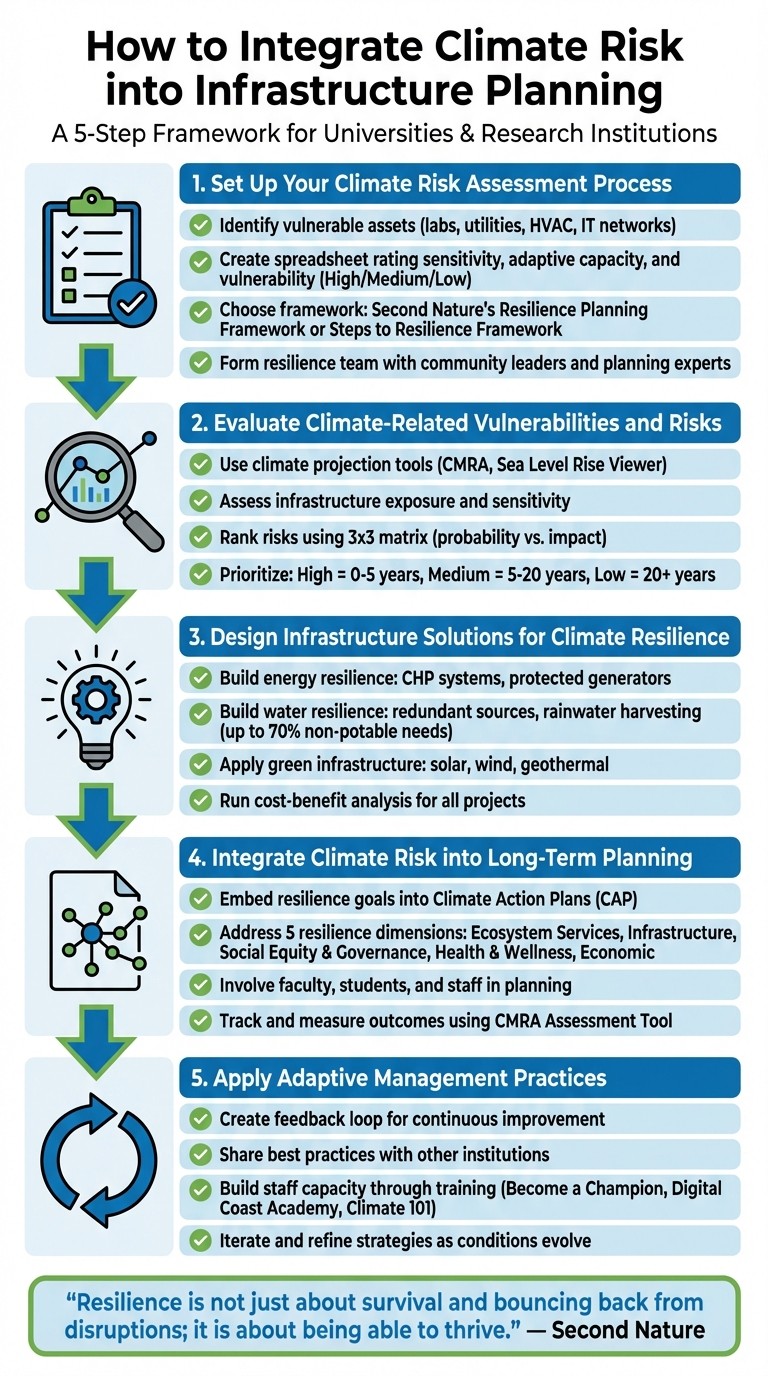
5-Step Framework for Integrating Climate Risk into University Infrastructure Planning
Step 1: Set Up Your Climate Risk Assessment Process
What Climate Risk Means for Campus Infrastructure
For universities, climate risk represents the combination of how likely a hazard is to occur and the scale of its potential impact. These impacts can take the form of financial burdens - like repair costs and lost funding for research - or social disruptions, such as interrupted classes and displaced students [7]. Some of the most pressing hazards for campuses include extreme heat, flooding (both inland and coastal), severe winter storms, wildfires, and drought [6][3].
To fully grasp vulnerability, it’s essential to break it down into two parts. First, sensitivity gauges how much a particular infrastructure system is affected by a specific hazard. Second, adaptive capacity measures how well that system can adjust to or recover from the hazard [7]. For instance, a research lab housing temperature-sensitive equipment would have high sensitivity to power outages during heat waves. However, if the building has backup generators, its adaptive capacity would be higher.
Identify Your Most Vulnerable Infrastructure Systems
Start by creating a spreadsheet that lists each campus asset alongside the climate hazards it may face. Assign ratings - high, medium, or low - for sensitivity, adaptive capacity, and overall vulnerability to each asset-hazard combination [7]. This straightforward method helps pinpoint high-risk systems before committing to more in-depth evaluations.
Critical systems often include HVAC units that struggle with extreme temperatures, IT networks and data centers susceptible to power outages, underground utilities at risk of flooding, and research facilities containing irreplaceable specimens or experiments. Use a risk matrix to assess each asset’s likelihood of exposure (e.g., hazards expected within the next five years rated as high) against the potential consequences. Focus on assets with "high-high" or "high-medium" risk ratings [7].
Choose the Right Climate Risk Assessment Framework
Consider using Second Nature's Resilience Planning Framework, which is specifically designed for higher education institutions. This framework evaluates resilience across five dimensions: Infrastructure, Ecosystem Services, Social Equity & Governance, Health & Wellness, and Economic factors [1]. Another option is the Steps to Resilience Framework, which provides a six-step process to tackle climate challenges. It guides institutions through identifying climate issues, cataloging assets, assessing potential harm, exploring solutions, and implementing actionable plans [4][3]. Both frameworks integrate seamlessly with existing Hazard Mitigation Plans or Climate Action Plans, making them practical tools for campuses [1][4].
Forming a resilience team that includes community leaders and planning experts is essential [4]. Many universities also partner with Architecture and Engineering (A&E) firms or adaptation specialists to handle technical climate concepts and document key risks [7]. The best strategies combine specialized climate knowledge with an understanding of the institution’s unique needs and priorities.
"The most successful campus resilience plans will be those that fully embrace the catalytic nature of resilience assessment and planning, and that incorporate diversity and inclusiveness throughout the process." - Second Nature [1]
Once your assessment process is in place, you can move forward with a detailed evaluation of specific vulnerabilities in your campus infrastructure systems.
Step 2: Evaluate Climate-Related Vulnerabilities and Risks
Use Climate Data and Future Projections
Once your process is established, the next step is to gather forward-looking climate data. Historical records alone won’t cut it - you need projections that anticipate future changes. Tools like the Climate Mapping for Resilience and Adaptation (CMRA) can provide insights into how extreme heat, drought, wildfires, and flooding might evolve over the coming decades [3]. For campuses near coastlines, the Sea Level Rise Viewer is another valuable resource, offering maps that highlight potential flooding and shoreline changes [4][8].
A great example of this in action is MIT's flood vulnerability analysis. In March 2018, MIT conducted a Flood Vulnerability Study that went beyond global climate models, creating campus-specific projections for flooding, sea level rise, storm surges, and heat stress. The findings played a critical role in shaping MIT's Sustainable Stormwater and Ecological Landscape Master Plan [2].
Assess Infrastructure Exposure and Sensitivity
Once you’ve collected relevant climate data, the next step is to evaluate which campus assets are most exposed to potential hazards and how they might be affected. This involves pairing specific assets - such as laboratories, residence halls, or power plants - with particular risks like flooding or extreme heat. For each pairing, assess the asset’s sensitivity and its capacity to adapt, using a simple High/Medium/Low scale [7].
"The assets that are most likely to suffer a negative impact to a hazard are vulnerable to that hazard. Sensitivity and adaptive capacity can help you determine which have the highest vulnerability." - U.S. Climate Resilience Toolkit [7]
Many institutions begin with qualitative assessments to get an initial sense of vulnerabilities, then progress to more detailed geospatial analyses for complex systems.
Rank Risks by Priority
With vulnerability assessments complete, it’s time to rank risks based on their likelihood and potential impact. Risk is determined by combining the probability of a hazard occurring with the magnitude of its consequences, such as financial losses, operational disruptions, or safety concerns. For practical prioritization, categorize hazards expected within the next five years as “High,” those anticipated in five to twenty years as “Medium,” and longer-term risks as “Low.” A 3x3 risk matrix - plotting probability on one axis and impact magnitude on the other - can help pinpoint which assets demand immediate attention. Focus especially on critical systems, like a central power plant or telecommunications hub, whose failure could ripple across the entire campus [7].
"Think about the things your community truly depends upon to function, and use that knowledge to set your priorities." - NOAA Research [7]
Step 3: Design Infrastructure Solutions for Climate Resilience
Build Energy and Water Resilience
Once you’ve pinpointed your top risks, the next step is crafting solutions that safeguard critical systems. For energy resilience, consider implementing Combined Heat and Power (CHP) systems, which provide reliable on-site power during prolonged grid outages [9]. Simply elevating emergency generators isn’t enough. A stark example comes from Hurricane Sandy in October 2012, when New York University Medical Center’s elevated generators failed because critical elements - like fuel pumps, tanks, and electrical switchgear - remained exposed. This led to a complete system breakdown. Since then, the facility has prioritized protecting these components and investigating ecosystem-based flood defenses [9]. These steps are key to ensuring operational continuity and align with broader resilience strategies.
For water resilience, diversify your supply by establishing redundant sources, such as on-site wells, to reduce reliance on municipal systems during disruptions [9]. Facilities with significant non-potable water needs - up to 70% in some cases - can benefit from rainwater harvesting and water reuse systems [9]. To further safeguard water availability, develop a detailed Emergency Water Supply Plan (EWSP). This plan should outline usage patterns, response capabilities, and alternative supply options to prepare for partial or complete interruptions [9].
Apply Green and Smart Infrastructure Technologies
Green infrastructure offers a dual advantage: strengthening resilience while advancing sustainability goals. Tools like the National Renewable Energy Laboratory Atlas can help you evaluate your site’s potential for integrating wind, solar, geothermal, or biomass energy systems [9]. When designing buildings, refer to resources such as the ASHRAE Advanced Energy Design Guides, which provide strategies to cut energy use by up to 50% compared to standard designs. This not only reduces energy demands but also boosts baseline resilience [9]. Once these technologies are identified, a thorough financial assessment becomes the next priority.
Run Cost-Benefit Analysis for Resilience Projects
Securing funding for resilience projects hinges on demonstrating their financial value. Start by estimating avoided losses - calculate the costs of repairs or replacements if no action is taken [11]. Factor in additional benefits, such as ecosystem services, enhanced health outcomes, and social equity improvements [11][1]. Don’t overlook intangible assets, like the ability of your institution to maintain research and academic operations during extreme climate events [2].
"You'll only want to move forward on actions whose expected value exceeds the cost." - NOAA Research [11]
If a project doesn’t immediately show a favorable benefit-to-cost ratio, consider breaking it into smaller, manageable phases. This allows you to identify the most effective sub-solutions [11]. Use regional benchmarks from similar projects to guide initial cost estimates, and focus on highly visible, easy-to-implement measures first. Early successes can help establish credibility and attract additional funding for future initiatives [11].
Step 4: Integrate Climate Risk into Long-Term Planning
Connect Climate Risk Planning to Institutional Goals
Incorporating climate resilience into your institution's long-term strategies is essential. A practical way to do this is by embedding resilience goals into your university's Climate Action Plan (CAP). This creates a unified framework that tackles both emissions reduction and climate adaptation strategies [12].
"Second Nature recommends folding resilience objectives into the overall sustainability approach. The end result should be an integrated CAP that includes emissions mitigation along with adaptation and resilience." - Second Nature [12]
Take MIT, for example. In 2018, the university enhanced its CAP by using localized climate models to inform long-term flood risk management decisions [2].
When refining your plans, consider organizing potential actions using a Resilience Prioritization Quadrant. This tool helps rank initiatives by their importance and urgency [12]. For a well-rounded approach, address all five resilience dimensions: Ecosystem Services, Infrastructure, Social Equity & Governance, Health & Wellness, and Economic [1]. Aligning these efforts with institutional goals ensures a focused and comprehensive strategy.
Equally important is engaging the entire campus community in these efforts.
Involve Faculty, Students, and Staff in Planning
Effective resilience planning thrives on participation from across the campus, not just administrative leadership. Form a Resilience Planning Working Group that includes faculty, students, and staff to oversee the process [1]. This collaborative approach strengthens adaptive capacity and ensures that strategies reflect the diverse needs of the campus community.
Leverage faculty expertise to address technical challenges. Research centers can play a key role by tailoring global climate models to the institution's specific needs, such as assessing flood risks or heat stress. This not only aligns resilience efforts with academic goals but also provides students with hands-on research opportunities [2].
One example of success is the University of Minnesota-Twin Cities. Its Climate Resilience Plan integrates resilience into a broader sustainability framework, complete with measurable targets [12].
To ensure these strategies are effective, consistent tracking and measurement are critical.
Track and Measure Resilience Outcomes
Building resilience is not a one-and-done task - it’s an ongoing process that requires regular evaluation [1]. Start by conducting a formal Resilience Assessment to establish a baseline and identify vulnerabilities before launching new initiatives [1].
Use tools like the CMRA Assessment Tool and Climate Explorer to analyze past and current hazard exposures alongside future projections [3][10].
"Knowing which climate-related hazards could harm the things you care about is the first step in building climate resilience." - U.S. Climate Resilience Toolkit [3]
Assess progress across all five resilience dimensions: Ecosystem Services, Infrastructure, Social Equity & Governance, Health & Wellness, and Economic [1]. Establish clear short-, medium-, and long-term goals using standardized reporting platforms. Engage the broader community by updating key documents, such as Hazard Mitigation Plans, to keep climate considerations at the forefront of institutional planning.
With these metrics in place, your institution can adopt adaptive management practices, allowing for continual refinement of its resilience strategies.
Step 5: Apply Adaptive Management Practices
Create a Feedback Loop for Continuous Improvement
Adaptive management builds on earlier risk assessments by refining strategies as conditions evolve. Climate resilience is not a one-time task but an ongoing cycle of evaluating vulnerabilities, planning, implementing strategies, and reassessing outcomes [1][4]. This iterative approach allows institutions to adjust as climate conditions shift.
"Resilience building is an iterative process. While these steps appear to be linear, in reality campuses may be working on multiple steps simultaneously." - Second Nature [1]
To ensure a well-rounded approach, your feedback loop should address all five resilience dimensions: Ecosystem Services, Infrastructure, Social Equity & Governance, Health & Wellness, and Economic [1]. This concept of "adaptive capacity" focuses on planning for better futures rather than merely recovering to pre-disruption conditions [1]. By continuously improving, institutions can also share valuable insights with others.
Share Best Practices with Other Institutions
Collaboration is a powerful tool for bolstering campus resilience. Joining groups like the Resilience Planning Working Group enables sustainability professionals to exchange ideas, tackle shared challenges, and refine planning frameworks that bridge campus and community efforts [1]. Events like the 2026 Higher Education Climate Leadership Summit, set for March 8–10, 2026, in Chicago, offer opportunities for up to 350 professionals to share strategies and lessons learned [5].
Institutions can also contribute their success stories to resources like the U.S. Climate Resilience Toolkit. Sharing case studies helps other campuses see how resilience strategies work in real-world settings [10]. Using standardized frameworks, such as the "Steps to Resilience", ensures that shared lessons are consistent and useful across different institutions [10][3]. These collaborations not only strengthen individual campuses but enhance the entire higher education sector’s ability to manage climate challenges. Alongside external partnerships, building internal expertise is equally important.
Build Staff Capacity for Climate Risk Management
Effective climate risk management depends on having a skilled team equipped to handle both technical and operational challenges. Staff can gain expertise through programs like the Become a Champion e-learning course, which focuses on the "Steps to Resilience" framework [4][7]. This self-paced training allows institutions to enhance internal capacity without relying on external consultants.
Other valuable resources include the Digital Coast Academy for coastal resilience, Climate 101 for foundational climate science, and specialized training from the Water Utility Climate Alliance for managing water systems [4]. Federal tools like the CMRA Assessment Tool can help staff analyze future climate hazard projections [3]. Additionally, identifying "Community Champions" within your institution - individuals known for driving change - can ensure long-term success by guiding resilience efforts and implementing roadmaps [4].
Top Climate Resilient Infrastructure Solutions for Civil Engineers
Conclusion
Incorporating climate risk into campus infrastructure planning calls for strong leadership, collaboration across various sectors, and a commitment to continual improvement. This five-step framework provides universities and research institutions with a structured approach to safeguard their assets and support their communities.
"Resilience is not just about survival and bouncing back from disruptions; it is about being able to thrive." - Second Nature [1]
Achieving this vision requires dedicated individuals who can connect climate science with operational strategies, while also rallying expertise from across the campus. These leaders play a crucial role in embedding resilience initiatives into official Climate Action Plans and broader institutional objectives. Their efforts help integrate resilience into every facet of campus life.
Effective strategies draw on input from all corners of campus life, ensuring that resilience planning addresses a wide range of needs. By focusing on the five key dimensions - Ecosystem Services, Infrastructure, Social Equity & Governance, Health & Wellness, and Economic - institutions can move beyond just physical infrastructure to create a truly comprehensive approach to resilience.
Ultimately, resilience is an ongoing process. Establishing feedback loops, exchanging insights with peer institutions, and building internal expertise allow universities to refine their strategies and sustain their efforts for the long term. These steps ensure that resilience becomes a permanent and evolving part of campus operations.
FAQs
What steps should universities take to identify and prioritize climate risks in infrastructure planning?
To address climate risks effectively, universities should begin with a vulnerability and risk assessment. This step involves identifying campus assets - such as buildings, utilities, and transportation systems - that face the greatest threats from hazards like flooding, extreme heat, or severe storms. Special attention should be given to assets that are both highly susceptible to damage and essential for daily operations.
The next step is to evaluate the potential consequences of not taking action and the institution's ability to adapt. Factors like financial losses, safety risks, and disruptions to long-term operations should all be considered. With this data, universities can prioritize risks based on their urgency and significance, ensuring the most critical challenges are tackled first.
Equally important is involving key stakeholders - faculty, students, staff, and members of the local community - in these discussions. Their input helps ensure that strategies are not only guided by scientific analysis but also reflect community needs and values, leading to a more inclusive and practical approach to resilience planning.
What are the most effective tools for assessing future climate risks for university campuses?
Universities have access to an array of resources to evaluate future climate risks and develop infrastructure that can withstand these challenges. Among these, the U.S. Climate Resilience Toolkit stands out, offering tools like the Climate Explorer. This tool provides localized climate data and projections, enabling institutions to pinpoint potential hazards specific to their areas. Another valuable resource is the Climate Mapping for Resilience and Adaptation (CMRA), which allows users to visualize future climate exposures and integrate this information into their planning strategies.
The EPA’s climate risk assessment resources also come into play, providing practical tools such as worksheets and federal datasets tailored to assess vulnerabilities in campus-specific projects. For even more precise insights, universities can turn to downscaled climate data from platforms like GDO-DCHP or MACA. These portals deliver detailed, location-specific projections, offering a clearer picture of potential climate impacts.
By utilizing these tools, universities can gain a deeper understanding of climate risks and take proactive steps to protect their campuses, ensuring they remain resilient and prepared for the challenges ahead.
How can universities align climate resilience plans with their long-term goals?
Universities have the opportunity to weave climate resilience strategies into their long-term goals by incorporating them into existing institutional frameworks like strategic plans or Climate Action Plans (CAPs). This involves a careful evaluation of vulnerabilities and strengths across areas such as infrastructure, social equity, and environmental systems. Using these insights, universities can craft plans that not only address immediate needs but also set measurable resilience goals that align with broader sustainability and emissions reduction efforts. This creates a unified, forward-looking approach to tackling climate challenges.
Collaboration plays a key role in keeping these plans relevant and effective. By engaging stakeholders - students, faculty, and community partners - universities can ensure their strategies remain flexible and responsive to changing priorities. Incorporating climate projections and conducting thorough risk assessments further equips institutions to anticipate future challenges. This approach helps maintain campus sustainability and ensures the continuity of operations well into the future.
Related Blog Posts
How to Build a Climate Resilience Plan for Universities & Research Institutions
How to Integrate Climate Risk into Infrastructure Planning for Corporations
How to Integrate Climate Risk into Infrastructure Planning for Municipalities & Government Agencies
How to Integrate Climate Risk into Infrastructure Planning for NGOs & Nonprofits
Latest Articles
©2025



FAQ
01
What does it really mean to “redefine profit”?
02
What makes Council Fire different?
03
Who does Council Fire you work with?
04
What does working with Council Fire actually look like?
05
How does Council Fire help organizations turn big goals into action?
06
How does Council Fire define and measure success?
Jan 23, 2026
How to Integrate Climate Risk into Infrastructure Planning for Universities & Research Institutions
Sustainability Strategy
In This Article
Universities must embed climate risk into infrastructure planning: assess hazards, prioritize critical assets, boost energy/water resilience and adapt.
How to Integrate Climate Risk into Infrastructure Planning for Universities & Research Institutions
Universities face growing challenges from climate risks like flooding, heatwaves, and wildfires, which disrupt operations and threaten infrastructure. Addressing these risks requires a structured approach to ensure campuses remain functional and safe. Here's a quick overview of how institutions can integrate climate resilience into their planning:
Assess Risks: Identify vulnerable assets (e.g., labs, utilities) and evaluate their exposure to hazards like extreme weather or rising sea levels.
Use Climate Data: Leverage tools like the Climate Mapping for Resilience and Adaptation (CMRA) to project future risks and inform planning.
Prioritize Solutions: Focus on critical systems, such as energy and water, and implement measures like Combined Heat and Power (CHP) systems or rainwater harvesting.
Plan Long-Term: Align resilience goals with institutional strategies, embedding them into Climate Action Plans.
Track Progress: Regularly measure outcomes to refine strategies and ensure resilience efforts evolve with changing conditions.
5-Step Framework for Integrating Climate Risk into University Infrastructure Planning
Step 1: Set Up Your Climate Risk Assessment Process
What Climate Risk Means for Campus Infrastructure
For universities, climate risk represents the combination of how likely a hazard is to occur and the scale of its potential impact. These impacts can take the form of financial burdens - like repair costs and lost funding for research - or social disruptions, such as interrupted classes and displaced students [7]. Some of the most pressing hazards for campuses include extreme heat, flooding (both inland and coastal), severe winter storms, wildfires, and drought [6][3].
To fully grasp vulnerability, it’s essential to break it down into two parts. First, sensitivity gauges how much a particular infrastructure system is affected by a specific hazard. Second, adaptive capacity measures how well that system can adjust to or recover from the hazard [7]. For instance, a research lab housing temperature-sensitive equipment would have high sensitivity to power outages during heat waves. However, if the building has backup generators, its adaptive capacity would be higher.
Identify Your Most Vulnerable Infrastructure Systems
Start by creating a spreadsheet that lists each campus asset alongside the climate hazards it may face. Assign ratings - high, medium, or low - for sensitivity, adaptive capacity, and overall vulnerability to each asset-hazard combination [7]. This straightforward method helps pinpoint high-risk systems before committing to more in-depth evaluations.
Critical systems often include HVAC units that struggle with extreme temperatures, IT networks and data centers susceptible to power outages, underground utilities at risk of flooding, and research facilities containing irreplaceable specimens or experiments. Use a risk matrix to assess each asset’s likelihood of exposure (e.g., hazards expected within the next five years rated as high) against the potential consequences. Focus on assets with "high-high" or "high-medium" risk ratings [7].
Choose the Right Climate Risk Assessment Framework
Consider using Second Nature's Resilience Planning Framework, which is specifically designed for higher education institutions. This framework evaluates resilience across five dimensions: Infrastructure, Ecosystem Services, Social Equity & Governance, Health & Wellness, and Economic factors [1]. Another option is the Steps to Resilience Framework, which provides a six-step process to tackle climate challenges. It guides institutions through identifying climate issues, cataloging assets, assessing potential harm, exploring solutions, and implementing actionable plans [4][3]. Both frameworks integrate seamlessly with existing Hazard Mitigation Plans or Climate Action Plans, making them practical tools for campuses [1][4].
Forming a resilience team that includes community leaders and planning experts is essential [4]. Many universities also partner with Architecture and Engineering (A&E) firms or adaptation specialists to handle technical climate concepts and document key risks [7]. The best strategies combine specialized climate knowledge with an understanding of the institution’s unique needs and priorities.
"The most successful campus resilience plans will be those that fully embrace the catalytic nature of resilience assessment and planning, and that incorporate diversity and inclusiveness throughout the process." - Second Nature [1]
Once your assessment process is in place, you can move forward with a detailed evaluation of specific vulnerabilities in your campus infrastructure systems.
Step 2: Evaluate Climate-Related Vulnerabilities and Risks
Use Climate Data and Future Projections
Once your process is established, the next step is to gather forward-looking climate data. Historical records alone won’t cut it - you need projections that anticipate future changes. Tools like the Climate Mapping for Resilience and Adaptation (CMRA) can provide insights into how extreme heat, drought, wildfires, and flooding might evolve over the coming decades [3]. For campuses near coastlines, the Sea Level Rise Viewer is another valuable resource, offering maps that highlight potential flooding and shoreline changes [4][8].
A great example of this in action is MIT's flood vulnerability analysis. In March 2018, MIT conducted a Flood Vulnerability Study that went beyond global climate models, creating campus-specific projections for flooding, sea level rise, storm surges, and heat stress. The findings played a critical role in shaping MIT's Sustainable Stormwater and Ecological Landscape Master Plan [2].
Assess Infrastructure Exposure and Sensitivity
Once you’ve collected relevant climate data, the next step is to evaluate which campus assets are most exposed to potential hazards and how they might be affected. This involves pairing specific assets - such as laboratories, residence halls, or power plants - with particular risks like flooding or extreme heat. For each pairing, assess the asset’s sensitivity and its capacity to adapt, using a simple High/Medium/Low scale [7].
"The assets that are most likely to suffer a negative impact to a hazard are vulnerable to that hazard. Sensitivity and adaptive capacity can help you determine which have the highest vulnerability." - U.S. Climate Resilience Toolkit [7]
Many institutions begin with qualitative assessments to get an initial sense of vulnerabilities, then progress to more detailed geospatial analyses for complex systems.
Rank Risks by Priority
With vulnerability assessments complete, it’s time to rank risks based on their likelihood and potential impact. Risk is determined by combining the probability of a hazard occurring with the magnitude of its consequences, such as financial losses, operational disruptions, or safety concerns. For practical prioritization, categorize hazards expected within the next five years as “High,” those anticipated in five to twenty years as “Medium,” and longer-term risks as “Low.” A 3x3 risk matrix - plotting probability on one axis and impact magnitude on the other - can help pinpoint which assets demand immediate attention. Focus especially on critical systems, like a central power plant or telecommunications hub, whose failure could ripple across the entire campus [7].
"Think about the things your community truly depends upon to function, and use that knowledge to set your priorities." - NOAA Research [7]
Step 3: Design Infrastructure Solutions for Climate Resilience
Build Energy and Water Resilience
Once you’ve pinpointed your top risks, the next step is crafting solutions that safeguard critical systems. For energy resilience, consider implementing Combined Heat and Power (CHP) systems, which provide reliable on-site power during prolonged grid outages [9]. Simply elevating emergency generators isn’t enough. A stark example comes from Hurricane Sandy in October 2012, when New York University Medical Center’s elevated generators failed because critical elements - like fuel pumps, tanks, and electrical switchgear - remained exposed. This led to a complete system breakdown. Since then, the facility has prioritized protecting these components and investigating ecosystem-based flood defenses [9]. These steps are key to ensuring operational continuity and align with broader resilience strategies.
For water resilience, diversify your supply by establishing redundant sources, such as on-site wells, to reduce reliance on municipal systems during disruptions [9]. Facilities with significant non-potable water needs - up to 70% in some cases - can benefit from rainwater harvesting and water reuse systems [9]. To further safeguard water availability, develop a detailed Emergency Water Supply Plan (EWSP). This plan should outline usage patterns, response capabilities, and alternative supply options to prepare for partial or complete interruptions [9].
Apply Green and Smart Infrastructure Technologies
Green infrastructure offers a dual advantage: strengthening resilience while advancing sustainability goals. Tools like the National Renewable Energy Laboratory Atlas can help you evaluate your site’s potential for integrating wind, solar, geothermal, or biomass energy systems [9]. When designing buildings, refer to resources such as the ASHRAE Advanced Energy Design Guides, which provide strategies to cut energy use by up to 50% compared to standard designs. This not only reduces energy demands but also boosts baseline resilience [9]. Once these technologies are identified, a thorough financial assessment becomes the next priority.
Run Cost-Benefit Analysis for Resilience Projects
Securing funding for resilience projects hinges on demonstrating their financial value. Start by estimating avoided losses - calculate the costs of repairs or replacements if no action is taken [11]. Factor in additional benefits, such as ecosystem services, enhanced health outcomes, and social equity improvements [11][1]. Don’t overlook intangible assets, like the ability of your institution to maintain research and academic operations during extreme climate events [2].
"You'll only want to move forward on actions whose expected value exceeds the cost." - NOAA Research [11]
If a project doesn’t immediately show a favorable benefit-to-cost ratio, consider breaking it into smaller, manageable phases. This allows you to identify the most effective sub-solutions [11]. Use regional benchmarks from similar projects to guide initial cost estimates, and focus on highly visible, easy-to-implement measures first. Early successes can help establish credibility and attract additional funding for future initiatives [11].
Step 4: Integrate Climate Risk into Long-Term Planning
Connect Climate Risk Planning to Institutional Goals
Incorporating climate resilience into your institution's long-term strategies is essential. A practical way to do this is by embedding resilience goals into your university's Climate Action Plan (CAP). This creates a unified framework that tackles both emissions reduction and climate adaptation strategies [12].
"Second Nature recommends folding resilience objectives into the overall sustainability approach. The end result should be an integrated CAP that includes emissions mitigation along with adaptation and resilience." - Second Nature [12]
Take MIT, for example. In 2018, the university enhanced its CAP by using localized climate models to inform long-term flood risk management decisions [2].
When refining your plans, consider organizing potential actions using a Resilience Prioritization Quadrant. This tool helps rank initiatives by their importance and urgency [12]. For a well-rounded approach, address all five resilience dimensions: Ecosystem Services, Infrastructure, Social Equity & Governance, Health & Wellness, and Economic [1]. Aligning these efforts with institutional goals ensures a focused and comprehensive strategy.
Equally important is engaging the entire campus community in these efforts.
Involve Faculty, Students, and Staff in Planning
Effective resilience planning thrives on participation from across the campus, not just administrative leadership. Form a Resilience Planning Working Group that includes faculty, students, and staff to oversee the process [1]. This collaborative approach strengthens adaptive capacity and ensures that strategies reflect the diverse needs of the campus community.
Leverage faculty expertise to address technical challenges. Research centers can play a key role by tailoring global climate models to the institution's specific needs, such as assessing flood risks or heat stress. This not only aligns resilience efforts with academic goals but also provides students with hands-on research opportunities [2].
One example of success is the University of Minnesota-Twin Cities. Its Climate Resilience Plan integrates resilience into a broader sustainability framework, complete with measurable targets [12].
To ensure these strategies are effective, consistent tracking and measurement are critical.
Track and Measure Resilience Outcomes
Building resilience is not a one-and-done task - it’s an ongoing process that requires regular evaluation [1]. Start by conducting a formal Resilience Assessment to establish a baseline and identify vulnerabilities before launching new initiatives [1].
Use tools like the CMRA Assessment Tool and Climate Explorer to analyze past and current hazard exposures alongside future projections [3][10].
"Knowing which climate-related hazards could harm the things you care about is the first step in building climate resilience." - U.S. Climate Resilience Toolkit [3]
Assess progress across all five resilience dimensions: Ecosystem Services, Infrastructure, Social Equity & Governance, Health & Wellness, and Economic [1]. Establish clear short-, medium-, and long-term goals using standardized reporting platforms. Engage the broader community by updating key documents, such as Hazard Mitigation Plans, to keep climate considerations at the forefront of institutional planning.
With these metrics in place, your institution can adopt adaptive management practices, allowing for continual refinement of its resilience strategies.
Step 5: Apply Adaptive Management Practices
Create a Feedback Loop for Continuous Improvement
Adaptive management builds on earlier risk assessments by refining strategies as conditions evolve. Climate resilience is not a one-time task but an ongoing cycle of evaluating vulnerabilities, planning, implementing strategies, and reassessing outcomes [1][4]. This iterative approach allows institutions to adjust as climate conditions shift.
"Resilience building is an iterative process. While these steps appear to be linear, in reality campuses may be working on multiple steps simultaneously." - Second Nature [1]
To ensure a well-rounded approach, your feedback loop should address all five resilience dimensions: Ecosystem Services, Infrastructure, Social Equity & Governance, Health & Wellness, and Economic [1]. This concept of "adaptive capacity" focuses on planning for better futures rather than merely recovering to pre-disruption conditions [1]. By continuously improving, institutions can also share valuable insights with others.
Share Best Practices with Other Institutions
Collaboration is a powerful tool for bolstering campus resilience. Joining groups like the Resilience Planning Working Group enables sustainability professionals to exchange ideas, tackle shared challenges, and refine planning frameworks that bridge campus and community efforts [1]. Events like the 2026 Higher Education Climate Leadership Summit, set for March 8–10, 2026, in Chicago, offer opportunities for up to 350 professionals to share strategies and lessons learned [5].
Institutions can also contribute their success stories to resources like the U.S. Climate Resilience Toolkit. Sharing case studies helps other campuses see how resilience strategies work in real-world settings [10]. Using standardized frameworks, such as the "Steps to Resilience", ensures that shared lessons are consistent and useful across different institutions [10][3]. These collaborations not only strengthen individual campuses but enhance the entire higher education sector’s ability to manage climate challenges. Alongside external partnerships, building internal expertise is equally important.
Build Staff Capacity for Climate Risk Management
Effective climate risk management depends on having a skilled team equipped to handle both technical and operational challenges. Staff can gain expertise through programs like the Become a Champion e-learning course, which focuses on the "Steps to Resilience" framework [4][7]. This self-paced training allows institutions to enhance internal capacity without relying on external consultants.
Other valuable resources include the Digital Coast Academy for coastal resilience, Climate 101 for foundational climate science, and specialized training from the Water Utility Climate Alliance for managing water systems [4]. Federal tools like the CMRA Assessment Tool can help staff analyze future climate hazard projections [3]. Additionally, identifying "Community Champions" within your institution - individuals known for driving change - can ensure long-term success by guiding resilience efforts and implementing roadmaps [4].
Top Climate Resilient Infrastructure Solutions for Civil Engineers
Conclusion
Incorporating climate risk into campus infrastructure planning calls for strong leadership, collaboration across various sectors, and a commitment to continual improvement. This five-step framework provides universities and research institutions with a structured approach to safeguard their assets and support their communities.
"Resilience is not just about survival and bouncing back from disruptions; it is about being able to thrive." - Second Nature [1]
Achieving this vision requires dedicated individuals who can connect climate science with operational strategies, while also rallying expertise from across the campus. These leaders play a crucial role in embedding resilience initiatives into official Climate Action Plans and broader institutional objectives. Their efforts help integrate resilience into every facet of campus life.
Effective strategies draw on input from all corners of campus life, ensuring that resilience planning addresses a wide range of needs. By focusing on the five key dimensions - Ecosystem Services, Infrastructure, Social Equity & Governance, Health & Wellness, and Economic - institutions can move beyond just physical infrastructure to create a truly comprehensive approach to resilience.
Ultimately, resilience is an ongoing process. Establishing feedback loops, exchanging insights with peer institutions, and building internal expertise allow universities to refine their strategies and sustain their efforts for the long term. These steps ensure that resilience becomes a permanent and evolving part of campus operations.
FAQs
What steps should universities take to identify and prioritize climate risks in infrastructure planning?
To address climate risks effectively, universities should begin with a vulnerability and risk assessment. This step involves identifying campus assets - such as buildings, utilities, and transportation systems - that face the greatest threats from hazards like flooding, extreme heat, or severe storms. Special attention should be given to assets that are both highly susceptible to damage and essential for daily operations.
The next step is to evaluate the potential consequences of not taking action and the institution's ability to adapt. Factors like financial losses, safety risks, and disruptions to long-term operations should all be considered. With this data, universities can prioritize risks based on their urgency and significance, ensuring the most critical challenges are tackled first.
Equally important is involving key stakeholders - faculty, students, staff, and members of the local community - in these discussions. Their input helps ensure that strategies are not only guided by scientific analysis but also reflect community needs and values, leading to a more inclusive and practical approach to resilience planning.
What are the most effective tools for assessing future climate risks for university campuses?
Universities have access to an array of resources to evaluate future climate risks and develop infrastructure that can withstand these challenges. Among these, the U.S. Climate Resilience Toolkit stands out, offering tools like the Climate Explorer. This tool provides localized climate data and projections, enabling institutions to pinpoint potential hazards specific to their areas. Another valuable resource is the Climate Mapping for Resilience and Adaptation (CMRA), which allows users to visualize future climate exposures and integrate this information into their planning strategies.
The EPA’s climate risk assessment resources also come into play, providing practical tools such as worksheets and federal datasets tailored to assess vulnerabilities in campus-specific projects. For even more precise insights, universities can turn to downscaled climate data from platforms like GDO-DCHP or MACA. These portals deliver detailed, location-specific projections, offering a clearer picture of potential climate impacts.
By utilizing these tools, universities can gain a deeper understanding of climate risks and take proactive steps to protect their campuses, ensuring they remain resilient and prepared for the challenges ahead.
How can universities align climate resilience plans with their long-term goals?
Universities have the opportunity to weave climate resilience strategies into their long-term goals by incorporating them into existing institutional frameworks like strategic plans or Climate Action Plans (CAPs). This involves a careful evaluation of vulnerabilities and strengths across areas such as infrastructure, social equity, and environmental systems. Using these insights, universities can craft plans that not only address immediate needs but also set measurable resilience goals that align with broader sustainability and emissions reduction efforts. This creates a unified, forward-looking approach to tackling climate challenges.
Collaboration plays a key role in keeping these plans relevant and effective. By engaging stakeholders - students, faculty, and community partners - universities can ensure their strategies remain flexible and responsive to changing priorities. Incorporating climate projections and conducting thorough risk assessments further equips institutions to anticipate future challenges. This approach helps maintain campus sustainability and ensures the continuity of operations well into the future.
Related Blog Posts
How to Build a Climate Resilience Plan for Universities & Research Institutions
How to Integrate Climate Risk into Infrastructure Planning for Corporations
How to Integrate Climate Risk into Infrastructure Planning for Municipalities & Government Agencies
How to Integrate Climate Risk into Infrastructure Planning for NGOs & Nonprofits
FAQ
01
What does it really mean to “redefine profit”?
02
What makes Council Fire different?
03
Who does Council Fire you work with?
04
What does working with Council Fire actually look like?
05
How does Council Fire help organizations turn big goals into action?
06
How does Council Fire define and measure success?
Jan 23, 2026
How to Integrate Climate Risk into Infrastructure Planning for Universities & Research Institutions
Sustainability Strategy
In This Article
Universities must embed climate risk into infrastructure planning: assess hazards, prioritize critical assets, boost energy/water resilience and adapt.
How to Integrate Climate Risk into Infrastructure Planning for Universities & Research Institutions
Universities face growing challenges from climate risks like flooding, heatwaves, and wildfires, which disrupt operations and threaten infrastructure. Addressing these risks requires a structured approach to ensure campuses remain functional and safe. Here's a quick overview of how institutions can integrate climate resilience into their planning:
Assess Risks: Identify vulnerable assets (e.g., labs, utilities) and evaluate their exposure to hazards like extreme weather or rising sea levels.
Use Climate Data: Leverage tools like the Climate Mapping for Resilience and Adaptation (CMRA) to project future risks and inform planning.
Prioritize Solutions: Focus on critical systems, such as energy and water, and implement measures like Combined Heat and Power (CHP) systems or rainwater harvesting.
Plan Long-Term: Align resilience goals with institutional strategies, embedding them into Climate Action Plans.
Track Progress: Regularly measure outcomes to refine strategies and ensure resilience efforts evolve with changing conditions.
5-Step Framework for Integrating Climate Risk into University Infrastructure Planning
Step 1: Set Up Your Climate Risk Assessment Process
What Climate Risk Means for Campus Infrastructure
For universities, climate risk represents the combination of how likely a hazard is to occur and the scale of its potential impact. These impacts can take the form of financial burdens - like repair costs and lost funding for research - or social disruptions, such as interrupted classes and displaced students [7]. Some of the most pressing hazards for campuses include extreme heat, flooding (both inland and coastal), severe winter storms, wildfires, and drought [6][3].
To fully grasp vulnerability, it’s essential to break it down into two parts. First, sensitivity gauges how much a particular infrastructure system is affected by a specific hazard. Second, adaptive capacity measures how well that system can adjust to or recover from the hazard [7]. For instance, a research lab housing temperature-sensitive equipment would have high sensitivity to power outages during heat waves. However, if the building has backup generators, its adaptive capacity would be higher.
Identify Your Most Vulnerable Infrastructure Systems
Start by creating a spreadsheet that lists each campus asset alongside the climate hazards it may face. Assign ratings - high, medium, or low - for sensitivity, adaptive capacity, and overall vulnerability to each asset-hazard combination [7]. This straightforward method helps pinpoint high-risk systems before committing to more in-depth evaluations.
Critical systems often include HVAC units that struggle with extreme temperatures, IT networks and data centers susceptible to power outages, underground utilities at risk of flooding, and research facilities containing irreplaceable specimens or experiments. Use a risk matrix to assess each asset’s likelihood of exposure (e.g., hazards expected within the next five years rated as high) against the potential consequences. Focus on assets with "high-high" or "high-medium" risk ratings [7].
Choose the Right Climate Risk Assessment Framework
Consider using Second Nature's Resilience Planning Framework, which is specifically designed for higher education institutions. This framework evaluates resilience across five dimensions: Infrastructure, Ecosystem Services, Social Equity & Governance, Health & Wellness, and Economic factors [1]. Another option is the Steps to Resilience Framework, which provides a six-step process to tackle climate challenges. It guides institutions through identifying climate issues, cataloging assets, assessing potential harm, exploring solutions, and implementing actionable plans [4][3]. Both frameworks integrate seamlessly with existing Hazard Mitigation Plans or Climate Action Plans, making them practical tools for campuses [1][4].
Forming a resilience team that includes community leaders and planning experts is essential [4]. Many universities also partner with Architecture and Engineering (A&E) firms or adaptation specialists to handle technical climate concepts and document key risks [7]. The best strategies combine specialized climate knowledge with an understanding of the institution’s unique needs and priorities.
"The most successful campus resilience plans will be those that fully embrace the catalytic nature of resilience assessment and planning, and that incorporate diversity and inclusiveness throughout the process." - Second Nature [1]
Once your assessment process is in place, you can move forward with a detailed evaluation of specific vulnerabilities in your campus infrastructure systems.
Step 2: Evaluate Climate-Related Vulnerabilities and Risks
Use Climate Data and Future Projections
Once your process is established, the next step is to gather forward-looking climate data. Historical records alone won’t cut it - you need projections that anticipate future changes. Tools like the Climate Mapping for Resilience and Adaptation (CMRA) can provide insights into how extreme heat, drought, wildfires, and flooding might evolve over the coming decades [3]. For campuses near coastlines, the Sea Level Rise Viewer is another valuable resource, offering maps that highlight potential flooding and shoreline changes [4][8].
A great example of this in action is MIT's flood vulnerability analysis. In March 2018, MIT conducted a Flood Vulnerability Study that went beyond global climate models, creating campus-specific projections for flooding, sea level rise, storm surges, and heat stress. The findings played a critical role in shaping MIT's Sustainable Stormwater and Ecological Landscape Master Plan [2].
Assess Infrastructure Exposure and Sensitivity
Once you’ve collected relevant climate data, the next step is to evaluate which campus assets are most exposed to potential hazards and how they might be affected. This involves pairing specific assets - such as laboratories, residence halls, or power plants - with particular risks like flooding or extreme heat. For each pairing, assess the asset’s sensitivity and its capacity to adapt, using a simple High/Medium/Low scale [7].
"The assets that are most likely to suffer a negative impact to a hazard are vulnerable to that hazard. Sensitivity and adaptive capacity can help you determine which have the highest vulnerability." - U.S. Climate Resilience Toolkit [7]
Many institutions begin with qualitative assessments to get an initial sense of vulnerabilities, then progress to more detailed geospatial analyses for complex systems.
Rank Risks by Priority
With vulnerability assessments complete, it’s time to rank risks based on their likelihood and potential impact. Risk is determined by combining the probability of a hazard occurring with the magnitude of its consequences, such as financial losses, operational disruptions, or safety concerns. For practical prioritization, categorize hazards expected within the next five years as “High,” those anticipated in five to twenty years as “Medium,” and longer-term risks as “Low.” A 3x3 risk matrix - plotting probability on one axis and impact magnitude on the other - can help pinpoint which assets demand immediate attention. Focus especially on critical systems, like a central power plant or telecommunications hub, whose failure could ripple across the entire campus [7].
"Think about the things your community truly depends upon to function, and use that knowledge to set your priorities." - NOAA Research [7]
Step 3: Design Infrastructure Solutions for Climate Resilience
Build Energy and Water Resilience
Once you’ve pinpointed your top risks, the next step is crafting solutions that safeguard critical systems. For energy resilience, consider implementing Combined Heat and Power (CHP) systems, which provide reliable on-site power during prolonged grid outages [9]. Simply elevating emergency generators isn’t enough. A stark example comes from Hurricane Sandy in October 2012, when New York University Medical Center’s elevated generators failed because critical elements - like fuel pumps, tanks, and electrical switchgear - remained exposed. This led to a complete system breakdown. Since then, the facility has prioritized protecting these components and investigating ecosystem-based flood defenses [9]. These steps are key to ensuring operational continuity and align with broader resilience strategies.
For water resilience, diversify your supply by establishing redundant sources, such as on-site wells, to reduce reliance on municipal systems during disruptions [9]. Facilities with significant non-potable water needs - up to 70% in some cases - can benefit from rainwater harvesting and water reuse systems [9]. To further safeguard water availability, develop a detailed Emergency Water Supply Plan (EWSP). This plan should outline usage patterns, response capabilities, and alternative supply options to prepare for partial or complete interruptions [9].
Apply Green and Smart Infrastructure Technologies
Green infrastructure offers a dual advantage: strengthening resilience while advancing sustainability goals. Tools like the National Renewable Energy Laboratory Atlas can help you evaluate your site’s potential for integrating wind, solar, geothermal, or biomass energy systems [9]. When designing buildings, refer to resources such as the ASHRAE Advanced Energy Design Guides, which provide strategies to cut energy use by up to 50% compared to standard designs. This not only reduces energy demands but also boosts baseline resilience [9]. Once these technologies are identified, a thorough financial assessment becomes the next priority.
Run Cost-Benefit Analysis for Resilience Projects
Securing funding for resilience projects hinges on demonstrating their financial value. Start by estimating avoided losses - calculate the costs of repairs or replacements if no action is taken [11]. Factor in additional benefits, such as ecosystem services, enhanced health outcomes, and social equity improvements [11][1]. Don’t overlook intangible assets, like the ability of your institution to maintain research and academic operations during extreme climate events [2].
"You'll only want to move forward on actions whose expected value exceeds the cost." - NOAA Research [11]
If a project doesn’t immediately show a favorable benefit-to-cost ratio, consider breaking it into smaller, manageable phases. This allows you to identify the most effective sub-solutions [11]. Use regional benchmarks from similar projects to guide initial cost estimates, and focus on highly visible, easy-to-implement measures first. Early successes can help establish credibility and attract additional funding for future initiatives [11].
Step 4: Integrate Climate Risk into Long-Term Planning
Connect Climate Risk Planning to Institutional Goals
Incorporating climate resilience into your institution's long-term strategies is essential. A practical way to do this is by embedding resilience goals into your university's Climate Action Plan (CAP). This creates a unified framework that tackles both emissions reduction and climate adaptation strategies [12].
"Second Nature recommends folding resilience objectives into the overall sustainability approach. The end result should be an integrated CAP that includes emissions mitigation along with adaptation and resilience." - Second Nature [12]
Take MIT, for example. In 2018, the university enhanced its CAP by using localized climate models to inform long-term flood risk management decisions [2].
When refining your plans, consider organizing potential actions using a Resilience Prioritization Quadrant. This tool helps rank initiatives by their importance and urgency [12]. For a well-rounded approach, address all five resilience dimensions: Ecosystem Services, Infrastructure, Social Equity & Governance, Health & Wellness, and Economic [1]. Aligning these efforts with institutional goals ensures a focused and comprehensive strategy.
Equally important is engaging the entire campus community in these efforts.
Involve Faculty, Students, and Staff in Planning
Effective resilience planning thrives on participation from across the campus, not just administrative leadership. Form a Resilience Planning Working Group that includes faculty, students, and staff to oversee the process [1]. This collaborative approach strengthens adaptive capacity and ensures that strategies reflect the diverse needs of the campus community.
Leverage faculty expertise to address technical challenges. Research centers can play a key role by tailoring global climate models to the institution's specific needs, such as assessing flood risks or heat stress. This not only aligns resilience efforts with academic goals but also provides students with hands-on research opportunities [2].
One example of success is the University of Minnesota-Twin Cities. Its Climate Resilience Plan integrates resilience into a broader sustainability framework, complete with measurable targets [12].
To ensure these strategies are effective, consistent tracking and measurement are critical.
Track and Measure Resilience Outcomes
Building resilience is not a one-and-done task - it’s an ongoing process that requires regular evaluation [1]. Start by conducting a formal Resilience Assessment to establish a baseline and identify vulnerabilities before launching new initiatives [1].
Use tools like the CMRA Assessment Tool and Climate Explorer to analyze past and current hazard exposures alongside future projections [3][10].
"Knowing which climate-related hazards could harm the things you care about is the first step in building climate resilience." - U.S. Climate Resilience Toolkit [3]
Assess progress across all five resilience dimensions: Ecosystem Services, Infrastructure, Social Equity & Governance, Health & Wellness, and Economic [1]. Establish clear short-, medium-, and long-term goals using standardized reporting platforms. Engage the broader community by updating key documents, such as Hazard Mitigation Plans, to keep climate considerations at the forefront of institutional planning.
With these metrics in place, your institution can adopt adaptive management practices, allowing for continual refinement of its resilience strategies.
Step 5: Apply Adaptive Management Practices
Create a Feedback Loop for Continuous Improvement
Adaptive management builds on earlier risk assessments by refining strategies as conditions evolve. Climate resilience is not a one-time task but an ongoing cycle of evaluating vulnerabilities, planning, implementing strategies, and reassessing outcomes [1][4]. This iterative approach allows institutions to adjust as climate conditions shift.
"Resilience building is an iterative process. While these steps appear to be linear, in reality campuses may be working on multiple steps simultaneously." - Second Nature [1]
To ensure a well-rounded approach, your feedback loop should address all five resilience dimensions: Ecosystem Services, Infrastructure, Social Equity & Governance, Health & Wellness, and Economic [1]. This concept of "adaptive capacity" focuses on planning for better futures rather than merely recovering to pre-disruption conditions [1]. By continuously improving, institutions can also share valuable insights with others.
Share Best Practices with Other Institutions
Collaboration is a powerful tool for bolstering campus resilience. Joining groups like the Resilience Planning Working Group enables sustainability professionals to exchange ideas, tackle shared challenges, and refine planning frameworks that bridge campus and community efforts [1]. Events like the 2026 Higher Education Climate Leadership Summit, set for March 8–10, 2026, in Chicago, offer opportunities for up to 350 professionals to share strategies and lessons learned [5].
Institutions can also contribute their success stories to resources like the U.S. Climate Resilience Toolkit. Sharing case studies helps other campuses see how resilience strategies work in real-world settings [10]. Using standardized frameworks, such as the "Steps to Resilience", ensures that shared lessons are consistent and useful across different institutions [10][3]. These collaborations not only strengthen individual campuses but enhance the entire higher education sector’s ability to manage climate challenges. Alongside external partnerships, building internal expertise is equally important.
Build Staff Capacity for Climate Risk Management
Effective climate risk management depends on having a skilled team equipped to handle both technical and operational challenges. Staff can gain expertise through programs like the Become a Champion e-learning course, which focuses on the "Steps to Resilience" framework [4][7]. This self-paced training allows institutions to enhance internal capacity without relying on external consultants.
Other valuable resources include the Digital Coast Academy for coastal resilience, Climate 101 for foundational climate science, and specialized training from the Water Utility Climate Alliance for managing water systems [4]. Federal tools like the CMRA Assessment Tool can help staff analyze future climate hazard projections [3]. Additionally, identifying "Community Champions" within your institution - individuals known for driving change - can ensure long-term success by guiding resilience efforts and implementing roadmaps [4].
Top Climate Resilient Infrastructure Solutions for Civil Engineers
Conclusion
Incorporating climate risk into campus infrastructure planning calls for strong leadership, collaboration across various sectors, and a commitment to continual improvement. This five-step framework provides universities and research institutions with a structured approach to safeguard their assets and support their communities.
"Resilience is not just about survival and bouncing back from disruptions; it is about being able to thrive." - Second Nature [1]
Achieving this vision requires dedicated individuals who can connect climate science with operational strategies, while also rallying expertise from across the campus. These leaders play a crucial role in embedding resilience initiatives into official Climate Action Plans and broader institutional objectives. Their efforts help integrate resilience into every facet of campus life.
Effective strategies draw on input from all corners of campus life, ensuring that resilience planning addresses a wide range of needs. By focusing on the five key dimensions - Ecosystem Services, Infrastructure, Social Equity & Governance, Health & Wellness, and Economic - institutions can move beyond just physical infrastructure to create a truly comprehensive approach to resilience.
Ultimately, resilience is an ongoing process. Establishing feedback loops, exchanging insights with peer institutions, and building internal expertise allow universities to refine their strategies and sustain their efforts for the long term. These steps ensure that resilience becomes a permanent and evolving part of campus operations.
FAQs
What steps should universities take to identify and prioritize climate risks in infrastructure planning?
To address climate risks effectively, universities should begin with a vulnerability and risk assessment. This step involves identifying campus assets - such as buildings, utilities, and transportation systems - that face the greatest threats from hazards like flooding, extreme heat, or severe storms. Special attention should be given to assets that are both highly susceptible to damage and essential for daily operations.
The next step is to evaluate the potential consequences of not taking action and the institution's ability to adapt. Factors like financial losses, safety risks, and disruptions to long-term operations should all be considered. With this data, universities can prioritize risks based on their urgency and significance, ensuring the most critical challenges are tackled first.
Equally important is involving key stakeholders - faculty, students, staff, and members of the local community - in these discussions. Their input helps ensure that strategies are not only guided by scientific analysis but also reflect community needs and values, leading to a more inclusive and practical approach to resilience planning.
What are the most effective tools for assessing future climate risks for university campuses?
Universities have access to an array of resources to evaluate future climate risks and develop infrastructure that can withstand these challenges. Among these, the U.S. Climate Resilience Toolkit stands out, offering tools like the Climate Explorer. This tool provides localized climate data and projections, enabling institutions to pinpoint potential hazards specific to their areas. Another valuable resource is the Climate Mapping for Resilience and Adaptation (CMRA), which allows users to visualize future climate exposures and integrate this information into their planning strategies.
The EPA’s climate risk assessment resources also come into play, providing practical tools such as worksheets and federal datasets tailored to assess vulnerabilities in campus-specific projects. For even more precise insights, universities can turn to downscaled climate data from platforms like GDO-DCHP or MACA. These portals deliver detailed, location-specific projections, offering a clearer picture of potential climate impacts.
By utilizing these tools, universities can gain a deeper understanding of climate risks and take proactive steps to protect their campuses, ensuring they remain resilient and prepared for the challenges ahead.
How can universities align climate resilience plans with their long-term goals?
Universities have the opportunity to weave climate resilience strategies into their long-term goals by incorporating them into existing institutional frameworks like strategic plans or Climate Action Plans (CAPs). This involves a careful evaluation of vulnerabilities and strengths across areas such as infrastructure, social equity, and environmental systems. Using these insights, universities can craft plans that not only address immediate needs but also set measurable resilience goals that align with broader sustainability and emissions reduction efforts. This creates a unified, forward-looking approach to tackling climate challenges.
Collaboration plays a key role in keeping these plans relevant and effective. By engaging stakeholders - students, faculty, and community partners - universities can ensure their strategies remain flexible and responsive to changing priorities. Incorporating climate projections and conducting thorough risk assessments further equips institutions to anticipate future challenges. This approach helps maintain campus sustainability and ensures the continuity of operations well into the future.
Related Blog Posts
How to Build a Climate Resilience Plan for Universities & Research Institutions
How to Integrate Climate Risk into Infrastructure Planning for Corporations
How to Integrate Climate Risk into Infrastructure Planning for Municipalities & Government Agencies
How to Integrate Climate Risk into Infrastructure Planning for NGOs & Nonprofits
FAQ
What does it really mean to “redefine profit”?
What makes Council Fire different?
Who does Council Fire you work with?
What does working with Council Fire actually look like?
How does Council Fire help organizations turn big goals into action?
How does Council Fire define and measure success?