Jan 24, 2026
How to Integrate Climate Risk into Infrastructure Planning for Maritime & Logistics Companies
Sustainability Strategy
In This Article
Assess and price climate hazards for ports and logistics using climate models, geospatial data, and real-time monitoring to plan resilient infrastructure.
How to Integrate Climate Risk into Infrastructure Planning for Maritime & Logistics Companies
Maritime and logistics companies face growing challenges from climate risks, including storms, floods, and rising sea levels. These risks threaten long-term infrastructure, disrupt supply chains, and increase financial losses.
Key takeaways:
Outdated planning: Infrastructure built to last 50+ years often relies on past climate data, making it vulnerable to extreme weather.
Physical risks: Coastal flooding, storm surges, and rising sea levels damage ports, terminals, and logistics networks.
Financial impacts: Delays, route changes, and infrastructure repairs drive up costs, with some events causing billions in damages.
Actionable steps: Use advanced climate models, geospatial data, and real-time monitoring to assess risks and plan for resilience.
Why it matters: Ignoring climate risks leads to higher costs and operational disruptions. Proactively integrating these risks into planning ensures safer, more reliable infrastructure and reduces long-term financial strain.
Climate Risks Facing Maritime and Logistics Infrastructure
Physical Risks: Storms, Floods, and Sea Level Rise
Maritime and logistics infrastructure is increasingly vulnerable to various types of flooding: coastal, riverine, and flash flooding. Coastal flooding occurs when storm surges and high tides force seawater onto land, directly impacting critical facilities like ports and terminals [4]. Riverine flooding, on the other hand, stems from rivers overflowing their banks, disrupting inland waterways and nearby distribution centers [4]. Flash flooding, which can develop within hours of intense rainfall, often affects coastal areas and existing water channels [4].
Storms bring additional challenges by reshaping coastlines through dune erosion, overwash, and inundation, all of which threaten the stability of coastal infrastructure [5]. Rising sea levels compound these risks, accelerating shoreline recession and coastal erosion. Factors such as tidal range, wave height, coastal slope, shoreline change rates, geomorphology, and historical sea level rise contribute to a location's vulnerability [5].
The interconnected nature of logistics networks means that damage to a single asset can ripple across multiple sectors. For instance, the collapse of a key bridge or the flooding of a telecommunications hub can disrupt entire supply chains [1]. FEMA's National Risk Index offers comparative data on 18 natural hazards across the U.S., helping businesses pinpoint the most pressing threats to their operations [1].
These physical risks inevitably translate into steep financial consequences.
Financial Impacts of Climate Disruptions
Climate-related disruptions lead to route changes, delays, and escalating operational expenses. Extreme weather forces vessels to alter their paths, increasing fuel consumption and causing significant delays. High winds and storms lead to berthing delays, terminal shutdowns, and blocked waterways [3]. Additionally, repair costs, insurance premiums, and protection claims for vessels and infrastructure skyrocket during extreme weather events [3].
These challenges are only intensifying. Projections indicate that global tropical cyclone intensities could rise by 1% to 10% due to climate change [3]. Over the past three decades, extreme wave heights in the Southern Ocean have increased by 5% [3]. Some researchers have even suggested adding a "Category 6" to the Saffir-Simpson scale for storms with sustained winds exceeding 192 mph - a threshold met by five storms since 2015 [3].
Real-world events highlight the devastating consequences of underestimating these risks. In October 2015, the cargo ship El Faro sank during Hurricane Joaquin after relying on outdated weather information, resulting in the tragic loss of all 33 crew members and the vessel [3]. Similarly, in September 1980, the OBO carrier Derbyshire went down during Typhoon Orchid, likely due to a "super rogue wave" that caused structural failure, claiming 44 lives [3]. These incidents underscore how climate risks can lead to catastrophic financial and human losses.
"The human-caused rise in greenhouse gases has increased the frequency and intensity of extreme weather events." – Intergovernmental Panel on Climate Change (IPCC), Sixth Assessment Report [3]
Managing climate risks: Building resilience into your net zero strategy
Frameworks for Assessing Climate Risk
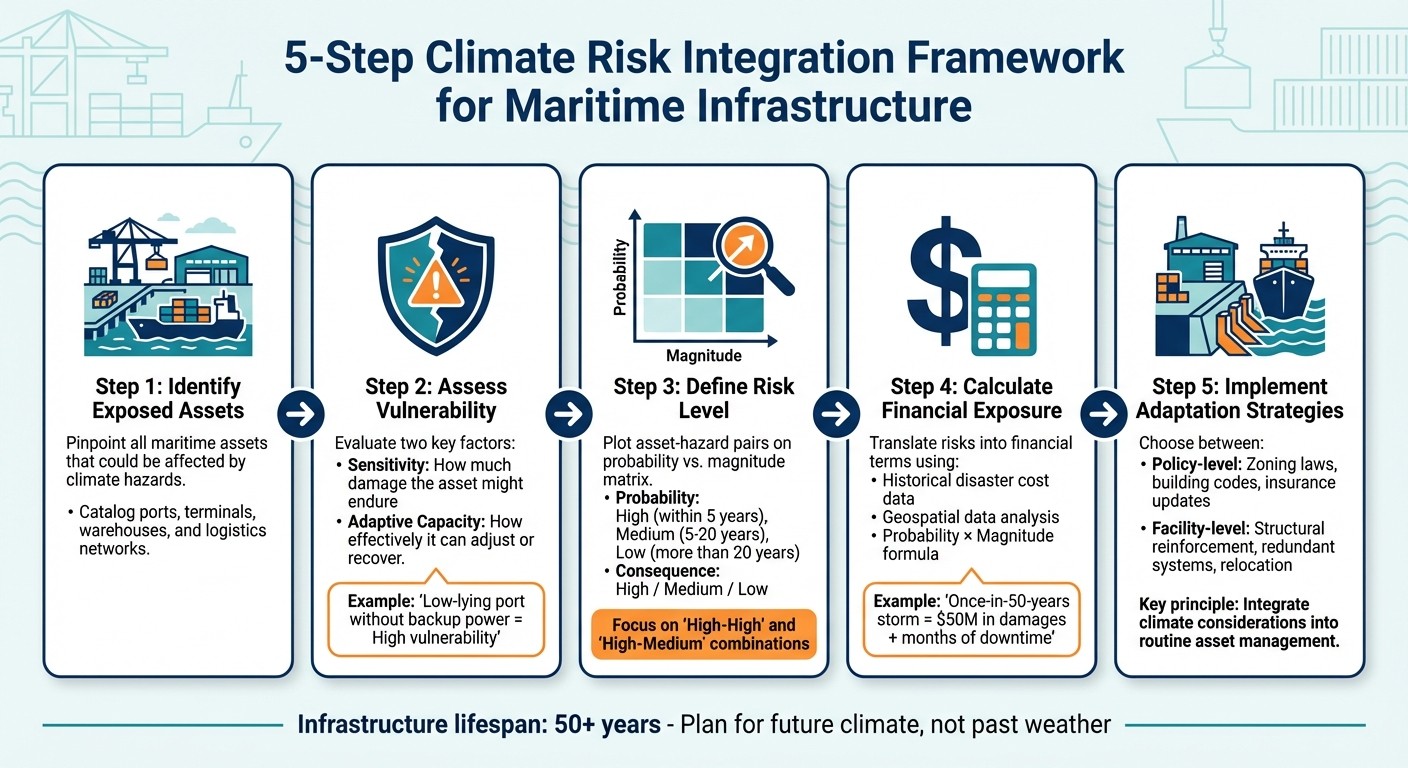
5-Step Climate Risk Integration Framework for Maritime Infrastructure Planning
Climate Risk Assessment Methods
The process of assessing climate risk begins with pinpointing exposed assets - all maritime assets that could be affected by climate hazards [2]. Once identified, the next steps involve evaluating their vulnerability and defining risk through a systematic approach.
Vulnerability is shaped by two key factors: an asset's sensitivity (how much damage it might endure) and its adaptive capacity (how effectively it can adjust or recover) [1]. For example, a low-lying port facility without backup power is highly sensitive and has limited adaptive capacity, making it particularly prone to flooding.
"Risk is a compound concept that describes the chance of sustaining a substantial loss. The first element of risk is the probability of a hazard occurring. The second element is the magnitude of consequences from the event." - U.S. Climate Resilience Toolkit [1]
Most organizations start with qualitative assessments, often using a simple High/Medium/Low rating system. This might involve a spreadsheet listing each asset along with columns for Potential Impact, Sensitivity, Adaptive Capacity, and an overall Vulnerability score. For more precision, quantitative approaches leverage geospatial data and asset values to calculate financial exposure with greater accuracy [1].
Consistency is crucial when defining probability categories. For instance, classify probabilities as High (within 5 years), Medium (5–20 years), or Low (more than 20 years) [1]. Plotting asset-hazard pairs on a 3x3 matrix - with Probability on one axis and Magnitude of Consequence on the other - helps visualize which combinations pose the greatest risks [1]. Assets falling into the "High-High" or "High-Medium" areas of the matrix require immediate attention.
Special focus should be given to assets whose failure could lead to cascading impacts across multiple sectors. For example, while a heavily used bridge or a telecommunications hub might not rank as the most vulnerable on its own, its failure could disrupt supply chains or essential services [1]. Given that transportation infrastructure often has a lifespan of 50 years or more, incorporating climate risks into maintenance and planning today can prevent significantly higher costs down the road [2].
These evaluations form the foundation for turning climate risks into actionable financial insights.
Connecting Climate Risks to Financial Outcomes
Once risks are assessed, the next step is translating those risks into financial terms to inform investment decisions. This involves estimating the potential losses associated with specific climate events. Historical data, such as the financial and social costs of past local disasters or similar incidents in other regions, provides a useful benchmark [1]. For instance, recovery costs from a flood that occurred a decade ago can serve as a reference for estimating future losses.
Geospatial data adds another layer of precision to these financial calculations [1]. By combining risk assessments with financial projections, companies can shift from viewing climate threats as abstract concerns to understanding them as tangible financial challenges.
Even events with a low probability should not be ignored if their potential impact is severe. For example, a once-in-50-years storm might seem unlikely, but if it could cause $50 million in damages and halt operations for months, it demands attention. This "probability-times-magnitude" formula helps create a shared framework for operations teams and financial planners.
"As disruptions in any part of the transportation system can trigger cascading delays and economic impacts across multiple systems, building resilience in the transportation sector can help cities recover from a range of events." - U.S. Department of Transportation [2]
For maritime companies, this financial perspective is critical when deciding whether to relocate facilities, invest in protective measures, or accept residual risk. By framing climate risks as specific budgetary concerns with measurable returns on investment, the process transforms vague anxieties about future impacts into concrete, actionable strategies.
Adaptation Strategies for Climate Resilience
Policy-Level vs. Facility-Level Adaptation
When it comes to safeguarding assets from climate risks, companies have two main approaches: policy-driven measures and facility-specific upgrades. Each plays a distinct role in building resilience against environmental challenges.
Policy-level adaptation focuses on creating systemic safeguards. Examples include revising zoning laws to restrict development in flood-prone areas, updating building codes to ensure new structures are built four feet above base flood levels, and adjusting insurance policies to reflect actual climate risks [2][4]. These measures aim to shape how and where infrastructure is developed, providing long-term protection.
On the other hand, facility-level adaptation zeroes in on specific assets and operations. For instance, companies might reinforce existing buildings to withstand storm surges, install continuous deflection separation units to prevent debris from contaminating water systems during floods, or build redundant infrastructure to maintain operations even if one terminal is out of commission [2][4]. The question often arises: is it more cost-effective to strengthen a vulnerable port or relocate operations to safer ground?
The most effective strategies weave climate considerations into routine asset management processes rather than treating them as isolated projects [2]. This means every maintenance plan, capital investment, and facility upgrade incorporates projections for the next 50 years of climate conditions, rather than relying solely on historical weather data.
These strategic frameworks lay the groundwork for real-world examples of adaptation in action.
Case Studies: Adaptation in Action
One notable example comes from South Carolina's Lowcountry region, where coordinated efforts are addressing climate risks. The "South Carolina's Lowcountry Prepares for Changing Global Conditions" initiative highlights how coastal communities can collaborate across jurisdictions and infrastructure types to bolster resilience [6]. By leveraging tools like NOAA's Sea Level Rise Viewer and the Climate Mapping for Resilience and Adaptation, planners evaluated potential vulnerabilities and exposures before committing to specific engineering solutions [7][6]. This approach showcases the practical application of earlier-discussed risk assessment methods.
Another example is the June 2016 storm in West Virginia, which caused widespread highway washouts and power system failures. This event underscored the importance of redundancy in logistics networks [2]. If backup routes and alternative power sources had been in place, the economic impact could have been far less severe. This case demonstrates how facility-level adaptations, such as redundant systems, can prevent single points of failure from crippling entire supply chains.
Climate Modeling and Monitoring Tools
Climate Modeling for Infrastructure Planning
For maritime and logistics companies, reliable climate projections are essential when making long-term infrastructure investments. Relying solely on historical weather data isn’t enough, especially when infrastructure is expected to last for decades - often 50 years or more [2]. Climate modeling tools provide critical insights into future climate conditions, enabling more informed decisions.
The Coastal Vulnerability Index (CVI) is one such tool that evaluates the risk of sea level rise by analyzing six key factors: tidal range, wave height, coastal slope, shoreline change, geomorphology, and historical sea level trends [5]. This data allows companies to pinpoint ports, terminals, and coastal facilities that are most at risk. For addressing storm surge threats, the Advanced CIRCulation (ADCIRC) tool models water circulation patterns, offering valuable insights for safeguarding port infrastructure against flooding during severe weather events [8].
Other tools, like the Sea Level Rise Viewer and Climate Mapping for Resilience and Adaptation (CMRA), deliver detailed projections on sea level rise and precipitation changes, which are crucial for planning investments [8][6]. These platforms provide GIS-ready datasets, enabling precise vulnerability assessments at the facility level [9]. The Coastal Change Hazards Portal enhances this further by using Bayesian network approaches to offer probabilistic assessments of shoreline changes. This tool is especially useful for understanding how coastal land used in logistics might evolve under changing climate conditions [5].
While these tools focus on forecasting future risks, real-time monitoring systems address immediate operational challenges.
Real-Time Monitoring Systems
Real-time monitoring systems complement long-term climate models by tracking current hazards and issuing early warnings. These systems provide up-to-the-minute data on storm-induced coastal changes - such as dune erosion, overwash, and flooding - helping companies make rapid decisions during extreme weather events [5]. Effective platforms monitor a range of hazards simultaneously, including extreme heat, drought, wildfire, flooding, and coastal inundation [9].
Integrating real-time climate data into asset management systems allows maritime companies to monitor how hazards like high temperatures or flooding impact infrastructure, such as pavement, railroad tracks, and marine cargo facilities [2]. Facility-level dashboards enable staff to activate emergency protocols without delay [4]. For 72-hour resilience planning, these monitoring systems provide the early warnings necessary to relocate operations, deploy backup generators, and prepare emergency supplies [4]. By combining real-time storm scenarios with historical shoreline data, companies can create accurate vulnerability assessments that guide both immediate actions and long-term infrastructure strategies [5].
Conclusion
The growing threat of climate change is reshaping the landscape for maritime and logistics infrastructure, with disruptions rippling through global supply chains and causing economic instability [2]. Infrastructure designed with outdated climate assumptions is increasingly vulnerable, leading to rising costs and damages. For long-term assets, addressing future climate risks proactively is far more economical than dealing with the aftermath of damage.
A structured approach to integrating climate risk is essential. This involves assessing asset vulnerabilities, identifying "High-High" risk areas, and implementing measures to strengthen infrastructure while adding redundancies [1]. These steps not only mitigate risks but also ensure smoother operations during adverse conditions.
Quantitative geospatial data plays a key role by reducing uncertainty and providing evidence to support resilience investments. Pairing real-time monitoring with long-term risk models enables faster, more informed decisions during extreme events.
The broader economic implications of these efforts cannot be overstated. The resilience of the transportation sector is directly tied to economic stability. The U.S. Climate Resilience Toolkit highlights this connection:
"As disruptions in any part of the transportation system can trigger cascading delays and economic impacts across multiple systems, building resilience in the transportation sector can help cities recover from a range of events." [2]
FAQs
How can maritime companies use climate models to strengthen infrastructure resilience?
Maritime companies have a powerful ally in climate models, which provide valuable insights into risks such as rising sea levels, intensified storms, and flooding. These tools enable businesses to pinpoint vulnerable infrastructure and focus efforts on areas that require reinforcement or adjustments.
Incorporating climate data into long-term plans allows organizations to craft forward-thinking strategies that minimize disruptions, safeguard essential assets, and maintain steady operations. This proactive approach not only strengthens resilience but also guides more effective infrastructure investments designed to address future climate-related challenges.
What financial risks do maritime and logistics companies face if they overlook climate impacts in their infrastructure planning?
Ignoring climate risks during infrastructure planning can lead to significant financial losses for maritime and logistics companies. These losses might stem from supply chain interruptions, damage to essential infrastructure, and rising repair and maintenance costs. Such unexpected expenses can undermine profitability and jeopardize long-term financial stability.
Additionally, overlooking climate-related challenges can hurt operational efficiency and expose businesses to legal or regulatory consequences. Taking a proactive approach to these risks helps safeguard assets, improve resilience, and support steady growth.
How do real-time monitoring systems help logistics companies manage climate risks?
Real-time monitoring systems play a crucial role in helping logistics companies navigate climate-related risks by offering continuous updates on environmental conditions and infrastructure performance. These tools provide valuable insights into severe weather patterns, rising sea levels, and other potential threats, enabling businesses to respond promptly and mitigate disruptions.
With the integration of tools like IoT sensors and early warning systems, companies can identify problems before they escalate. This allows them to reroute shipments, adjust schedules, or reinforce infrastructure when necessary. Such proactive measures not only reduce downtime and financial losses but also bolster the resilience of maritime and logistics operations as they adapt to shifting climate realities.
Related Blog Posts
Latest Articles
©2025

FAQ
01
What does it really mean to “redefine profit”?
02
What makes Council Fire different?
03
Who does Council Fire you work with?
04
What does working with Council Fire actually look like?
05
How does Council Fire help organizations turn big goals into action?
06
How does Council Fire define and measure success?
Jan 24, 2026
How to Integrate Climate Risk into Infrastructure Planning for Maritime & Logistics Companies
Sustainability Strategy
In This Article
Assess and price climate hazards for ports and logistics using climate models, geospatial data, and real-time monitoring to plan resilient infrastructure.
How to Integrate Climate Risk into Infrastructure Planning for Maritime & Logistics Companies
Maritime and logistics companies face growing challenges from climate risks, including storms, floods, and rising sea levels. These risks threaten long-term infrastructure, disrupt supply chains, and increase financial losses.
Key takeaways:
Outdated planning: Infrastructure built to last 50+ years often relies on past climate data, making it vulnerable to extreme weather.
Physical risks: Coastal flooding, storm surges, and rising sea levels damage ports, terminals, and logistics networks.
Financial impacts: Delays, route changes, and infrastructure repairs drive up costs, with some events causing billions in damages.
Actionable steps: Use advanced climate models, geospatial data, and real-time monitoring to assess risks and plan for resilience.
Why it matters: Ignoring climate risks leads to higher costs and operational disruptions. Proactively integrating these risks into planning ensures safer, more reliable infrastructure and reduces long-term financial strain.
Climate Risks Facing Maritime and Logistics Infrastructure
Physical Risks: Storms, Floods, and Sea Level Rise
Maritime and logistics infrastructure is increasingly vulnerable to various types of flooding: coastal, riverine, and flash flooding. Coastal flooding occurs when storm surges and high tides force seawater onto land, directly impacting critical facilities like ports and terminals [4]. Riverine flooding, on the other hand, stems from rivers overflowing their banks, disrupting inland waterways and nearby distribution centers [4]. Flash flooding, which can develop within hours of intense rainfall, often affects coastal areas and existing water channels [4].
Storms bring additional challenges by reshaping coastlines through dune erosion, overwash, and inundation, all of which threaten the stability of coastal infrastructure [5]. Rising sea levels compound these risks, accelerating shoreline recession and coastal erosion. Factors such as tidal range, wave height, coastal slope, shoreline change rates, geomorphology, and historical sea level rise contribute to a location's vulnerability [5].
The interconnected nature of logistics networks means that damage to a single asset can ripple across multiple sectors. For instance, the collapse of a key bridge or the flooding of a telecommunications hub can disrupt entire supply chains [1]. FEMA's National Risk Index offers comparative data on 18 natural hazards across the U.S., helping businesses pinpoint the most pressing threats to their operations [1].
These physical risks inevitably translate into steep financial consequences.
Financial Impacts of Climate Disruptions
Climate-related disruptions lead to route changes, delays, and escalating operational expenses. Extreme weather forces vessels to alter their paths, increasing fuel consumption and causing significant delays. High winds and storms lead to berthing delays, terminal shutdowns, and blocked waterways [3]. Additionally, repair costs, insurance premiums, and protection claims for vessels and infrastructure skyrocket during extreme weather events [3].
These challenges are only intensifying. Projections indicate that global tropical cyclone intensities could rise by 1% to 10% due to climate change [3]. Over the past three decades, extreme wave heights in the Southern Ocean have increased by 5% [3]. Some researchers have even suggested adding a "Category 6" to the Saffir-Simpson scale for storms with sustained winds exceeding 192 mph - a threshold met by five storms since 2015 [3].
Real-world events highlight the devastating consequences of underestimating these risks. In October 2015, the cargo ship El Faro sank during Hurricane Joaquin after relying on outdated weather information, resulting in the tragic loss of all 33 crew members and the vessel [3]. Similarly, in September 1980, the OBO carrier Derbyshire went down during Typhoon Orchid, likely due to a "super rogue wave" that caused structural failure, claiming 44 lives [3]. These incidents underscore how climate risks can lead to catastrophic financial and human losses.
"The human-caused rise in greenhouse gases has increased the frequency and intensity of extreme weather events." – Intergovernmental Panel on Climate Change (IPCC), Sixth Assessment Report [3]
Managing climate risks: Building resilience into your net zero strategy
Frameworks for Assessing Climate Risk
5-Step Climate Risk Integration Framework for Maritime Infrastructure Planning
Climate Risk Assessment Methods
The process of assessing climate risk begins with pinpointing exposed assets - all maritime assets that could be affected by climate hazards [2]. Once identified, the next steps involve evaluating their vulnerability and defining risk through a systematic approach.
Vulnerability is shaped by two key factors: an asset's sensitivity (how much damage it might endure) and its adaptive capacity (how effectively it can adjust or recover) [1]. For example, a low-lying port facility without backup power is highly sensitive and has limited adaptive capacity, making it particularly prone to flooding.
"Risk is a compound concept that describes the chance of sustaining a substantial loss. The first element of risk is the probability of a hazard occurring. The second element is the magnitude of consequences from the event." - U.S. Climate Resilience Toolkit [1]
Most organizations start with qualitative assessments, often using a simple High/Medium/Low rating system. This might involve a spreadsheet listing each asset along with columns for Potential Impact, Sensitivity, Adaptive Capacity, and an overall Vulnerability score. For more precision, quantitative approaches leverage geospatial data and asset values to calculate financial exposure with greater accuracy [1].
Consistency is crucial when defining probability categories. For instance, classify probabilities as High (within 5 years), Medium (5–20 years), or Low (more than 20 years) [1]. Plotting asset-hazard pairs on a 3x3 matrix - with Probability on one axis and Magnitude of Consequence on the other - helps visualize which combinations pose the greatest risks [1]. Assets falling into the "High-High" or "High-Medium" areas of the matrix require immediate attention.
Special focus should be given to assets whose failure could lead to cascading impacts across multiple sectors. For example, while a heavily used bridge or a telecommunications hub might not rank as the most vulnerable on its own, its failure could disrupt supply chains or essential services [1]. Given that transportation infrastructure often has a lifespan of 50 years or more, incorporating climate risks into maintenance and planning today can prevent significantly higher costs down the road [2].
These evaluations form the foundation for turning climate risks into actionable financial insights.
Connecting Climate Risks to Financial Outcomes
Once risks are assessed, the next step is translating those risks into financial terms to inform investment decisions. This involves estimating the potential losses associated with specific climate events. Historical data, such as the financial and social costs of past local disasters or similar incidents in other regions, provides a useful benchmark [1]. For instance, recovery costs from a flood that occurred a decade ago can serve as a reference for estimating future losses.
Geospatial data adds another layer of precision to these financial calculations [1]. By combining risk assessments with financial projections, companies can shift from viewing climate threats as abstract concerns to understanding them as tangible financial challenges.
Even events with a low probability should not be ignored if their potential impact is severe. For example, a once-in-50-years storm might seem unlikely, but if it could cause $50 million in damages and halt operations for months, it demands attention. This "probability-times-magnitude" formula helps create a shared framework for operations teams and financial planners.
"As disruptions in any part of the transportation system can trigger cascading delays and economic impacts across multiple systems, building resilience in the transportation sector can help cities recover from a range of events." - U.S. Department of Transportation [2]
For maritime companies, this financial perspective is critical when deciding whether to relocate facilities, invest in protective measures, or accept residual risk. By framing climate risks as specific budgetary concerns with measurable returns on investment, the process transforms vague anxieties about future impacts into concrete, actionable strategies.
Adaptation Strategies for Climate Resilience
Policy-Level vs. Facility-Level Adaptation
When it comes to safeguarding assets from climate risks, companies have two main approaches: policy-driven measures and facility-specific upgrades. Each plays a distinct role in building resilience against environmental challenges.
Policy-level adaptation focuses on creating systemic safeguards. Examples include revising zoning laws to restrict development in flood-prone areas, updating building codes to ensure new structures are built four feet above base flood levels, and adjusting insurance policies to reflect actual climate risks [2][4]. These measures aim to shape how and where infrastructure is developed, providing long-term protection.
On the other hand, facility-level adaptation zeroes in on specific assets and operations. For instance, companies might reinforce existing buildings to withstand storm surges, install continuous deflection separation units to prevent debris from contaminating water systems during floods, or build redundant infrastructure to maintain operations even if one terminal is out of commission [2][4]. The question often arises: is it more cost-effective to strengthen a vulnerable port or relocate operations to safer ground?
The most effective strategies weave climate considerations into routine asset management processes rather than treating them as isolated projects [2]. This means every maintenance plan, capital investment, and facility upgrade incorporates projections for the next 50 years of climate conditions, rather than relying solely on historical weather data.
These strategic frameworks lay the groundwork for real-world examples of adaptation in action.
Case Studies: Adaptation in Action
One notable example comes from South Carolina's Lowcountry region, where coordinated efforts are addressing climate risks. The "South Carolina's Lowcountry Prepares for Changing Global Conditions" initiative highlights how coastal communities can collaborate across jurisdictions and infrastructure types to bolster resilience [6]. By leveraging tools like NOAA's Sea Level Rise Viewer and the Climate Mapping for Resilience and Adaptation, planners evaluated potential vulnerabilities and exposures before committing to specific engineering solutions [7][6]. This approach showcases the practical application of earlier-discussed risk assessment methods.
Another example is the June 2016 storm in West Virginia, which caused widespread highway washouts and power system failures. This event underscored the importance of redundancy in logistics networks [2]. If backup routes and alternative power sources had been in place, the economic impact could have been far less severe. This case demonstrates how facility-level adaptations, such as redundant systems, can prevent single points of failure from crippling entire supply chains.
Climate Modeling and Monitoring Tools
Climate Modeling for Infrastructure Planning
For maritime and logistics companies, reliable climate projections are essential when making long-term infrastructure investments. Relying solely on historical weather data isn’t enough, especially when infrastructure is expected to last for decades - often 50 years or more [2]. Climate modeling tools provide critical insights into future climate conditions, enabling more informed decisions.
The Coastal Vulnerability Index (CVI) is one such tool that evaluates the risk of sea level rise by analyzing six key factors: tidal range, wave height, coastal slope, shoreline change, geomorphology, and historical sea level trends [5]. This data allows companies to pinpoint ports, terminals, and coastal facilities that are most at risk. For addressing storm surge threats, the Advanced CIRCulation (ADCIRC) tool models water circulation patterns, offering valuable insights for safeguarding port infrastructure against flooding during severe weather events [8].
Other tools, like the Sea Level Rise Viewer and Climate Mapping for Resilience and Adaptation (CMRA), deliver detailed projections on sea level rise and precipitation changes, which are crucial for planning investments [8][6]. These platforms provide GIS-ready datasets, enabling precise vulnerability assessments at the facility level [9]. The Coastal Change Hazards Portal enhances this further by using Bayesian network approaches to offer probabilistic assessments of shoreline changes. This tool is especially useful for understanding how coastal land used in logistics might evolve under changing climate conditions [5].
While these tools focus on forecasting future risks, real-time monitoring systems address immediate operational challenges.
Real-Time Monitoring Systems
Real-time monitoring systems complement long-term climate models by tracking current hazards and issuing early warnings. These systems provide up-to-the-minute data on storm-induced coastal changes - such as dune erosion, overwash, and flooding - helping companies make rapid decisions during extreme weather events [5]. Effective platforms monitor a range of hazards simultaneously, including extreme heat, drought, wildfire, flooding, and coastal inundation [9].
Integrating real-time climate data into asset management systems allows maritime companies to monitor how hazards like high temperatures or flooding impact infrastructure, such as pavement, railroad tracks, and marine cargo facilities [2]. Facility-level dashboards enable staff to activate emergency protocols without delay [4]. For 72-hour resilience planning, these monitoring systems provide the early warnings necessary to relocate operations, deploy backup generators, and prepare emergency supplies [4]. By combining real-time storm scenarios with historical shoreline data, companies can create accurate vulnerability assessments that guide both immediate actions and long-term infrastructure strategies [5].
Conclusion
The growing threat of climate change is reshaping the landscape for maritime and logistics infrastructure, with disruptions rippling through global supply chains and causing economic instability [2]. Infrastructure designed with outdated climate assumptions is increasingly vulnerable, leading to rising costs and damages. For long-term assets, addressing future climate risks proactively is far more economical than dealing with the aftermath of damage.
A structured approach to integrating climate risk is essential. This involves assessing asset vulnerabilities, identifying "High-High" risk areas, and implementing measures to strengthen infrastructure while adding redundancies [1]. These steps not only mitigate risks but also ensure smoother operations during adverse conditions.
Quantitative geospatial data plays a key role by reducing uncertainty and providing evidence to support resilience investments. Pairing real-time monitoring with long-term risk models enables faster, more informed decisions during extreme events.
The broader economic implications of these efforts cannot be overstated. The resilience of the transportation sector is directly tied to economic stability. The U.S. Climate Resilience Toolkit highlights this connection:
"As disruptions in any part of the transportation system can trigger cascading delays and economic impacts across multiple systems, building resilience in the transportation sector can help cities recover from a range of events." [2]
FAQs
How can maritime companies use climate models to strengthen infrastructure resilience?
Maritime companies have a powerful ally in climate models, which provide valuable insights into risks such as rising sea levels, intensified storms, and flooding. These tools enable businesses to pinpoint vulnerable infrastructure and focus efforts on areas that require reinforcement or adjustments.
Incorporating climate data into long-term plans allows organizations to craft forward-thinking strategies that minimize disruptions, safeguard essential assets, and maintain steady operations. This proactive approach not only strengthens resilience but also guides more effective infrastructure investments designed to address future climate-related challenges.
What financial risks do maritime and logistics companies face if they overlook climate impacts in their infrastructure planning?
Ignoring climate risks during infrastructure planning can lead to significant financial losses for maritime and logistics companies. These losses might stem from supply chain interruptions, damage to essential infrastructure, and rising repair and maintenance costs. Such unexpected expenses can undermine profitability and jeopardize long-term financial stability.
Additionally, overlooking climate-related challenges can hurt operational efficiency and expose businesses to legal or regulatory consequences. Taking a proactive approach to these risks helps safeguard assets, improve resilience, and support steady growth.
How do real-time monitoring systems help logistics companies manage climate risks?
Real-time monitoring systems play a crucial role in helping logistics companies navigate climate-related risks by offering continuous updates on environmental conditions and infrastructure performance. These tools provide valuable insights into severe weather patterns, rising sea levels, and other potential threats, enabling businesses to respond promptly and mitigate disruptions.
With the integration of tools like IoT sensors and early warning systems, companies can identify problems before they escalate. This allows them to reroute shipments, adjust schedules, or reinforce infrastructure when necessary. Such proactive measures not only reduce downtime and financial losses but also bolster the resilience of maritime and logistics operations as they adapt to shifting climate realities.
Related Blog Posts
FAQ
01
What does it really mean to “redefine profit”?
02
What makes Council Fire different?
03
Who does Council Fire you work with?
04
What does working with Council Fire actually look like?
05
How does Council Fire help organizations turn big goals into action?
06
How does Council Fire define and measure success?
Jan 24, 2026
How to Integrate Climate Risk into Infrastructure Planning for Maritime & Logistics Companies
Sustainability Strategy
In This Article
Assess and price climate hazards for ports and logistics using climate models, geospatial data, and real-time monitoring to plan resilient infrastructure.
How to Integrate Climate Risk into Infrastructure Planning for Maritime & Logistics Companies
Maritime and logistics companies face growing challenges from climate risks, including storms, floods, and rising sea levels. These risks threaten long-term infrastructure, disrupt supply chains, and increase financial losses.
Key takeaways:
Outdated planning: Infrastructure built to last 50+ years often relies on past climate data, making it vulnerable to extreme weather.
Physical risks: Coastal flooding, storm surges, and rising sea levels damage ports, terminals, and logistics networks.
Financial impacts: Delays, route changes, and infrastructure repairs drive up costs, with some events causing billions in damages.
Actionable steps: Use advanced climate models, geospatial data, and real-time monitoring to assess risks and plan for resilience.
Why it matters: Ignoring climate risks leads to higher costs and operational disruptions. Proactively integrating these risks into planning ensures safer, more reliable infrastructure and reduces long-term financial strain.
Climate Risks Facing Maritime and Logistics Infrastructure
Physical Risks: Storms, Floods, and Sea Level Rise
Maritime and logistics infrastructure is increasingly vulnerable to various types of flooding: coastal, riverine, and flash flooding. Coastal flooding occurs when storm surges and high tides force seawater onto land, directly impacting critical facilities like ports and terminals [4]. Riverine flooding, on the other hand, stems from rivers overflowing their banks, disrupting inland waterways and nearby distribution centers [4]. Flash flooding, which can develop within hours of intense rainfall, often affects coastal areas and existing water channels [4].
Storms bring additional challenges by reshaping coastlines through dune erosion, overwash, and inundation, all of which threaten the stability of coastal infrastructure [5]. Rising sea levels compound these risks, accelerating shoreline recession and coastal erosion. Factors such as tidal range, wave height, coastal slope, shoreline change rates, geomorphology, and historical sea level rise contribute to a location's vulnerability [5].
The interconnected nature of logistics networks means that damage to a single asset can ripple across multiple sectors. For instance, the collapse of a key bridge or the flooding of a telecommunications hub can disrupt entire supply chains [1]. FEMA's National Risk Index offers comparative data on 18 natural hazards across the U.S., helping businesses pinpoint the most pressing threats to their operations [1].
These physical risks inevitably translate into steep financial consequences.
Financial Impacts of Climate Disruptions
Climate-related disruptions lead to route changes, delays, and escalating operational expenses. Extreme weather forces vessels to alter their paths, increasing fuel consumption and causing significant delays. High winds and storms lead to berthing delays, terminal shutdowns, and blocked waterways [3]. Additionally, repair costs, insurance premiums, and protection claims for vessels and infrastructure skyrocket during extreme weather events [3].
These challenges are only intensifying. Projections indicate that global tropical cyclone intensities could rise by 1% to 10% due to climate change [3]. Over the past three decades, extreme wave heights in the Southern Ocean have increased by 5% [3]. Some researchers have even suggested adding a "Category 6" to the Saffir-Simpson scale for storms with sustained winds exceeding 192 mph - a threshold met by five storms since 2015 [3].
Real-world events highlight the devastating consequences of underestimating these risks. In October 2015, the cargo ship El Faro sank during Hurricane Joaquin after relying on outdated weather information, resulting in the tragic loss of all 33 crew members and the vessel [3]. Similarly, in September 1980, the OBO carrier Derbyshire went down during Typhoon Orchid, likely due to a "super rogue wave" that caused structural failure, claiming 44 lives [3]. These incidents underscore how climate risks can lead to catastrophic financial and human losses.
"The human-caused rise in greenhouse gases has increased the frequency and intensity of extreme weather events." – Intergovernmental Panel on Climate Change (IPCC), Sixth Assessment Report [3]
Managing climate risks: Building resilience into your net zero strategy
Frameworks for Assessing Climate Risk
5-Step Climate Risk Integration Framework for Maritime Infrastructure Planning
Climate Risk Assessment Methods
The process of assessing climate risk begins with pinpointing exposed assets - all maritime assets that could be affected by climate hazards [2]. Once identified, the next steps involve evaluating their vulnerability and defining risk through a systematic approach.
Vulnerability is shaped by two key factors: an asset's sensitivity (how much damage it might endure) and its adaptive capacity (how effectively it can adjust or recover) [1]. For example, a low-lying port facility without backup power is highly sensitive and has limited adaptive capacity, making it particularly prone to flooding.
"Risk is a compound concept that describes the chance of sustaining a substantial loss. The first element of risk is the probability of a hazard occurring. The second element is the magnitude of consequences from the event." - U.S. Climate Resilience Toolkit [1]
Most organizations start with qualitative assessments, often using a simple High/Medium/Low rating system. This might involve a spreadsheet listing each asset along with columns for Potential Impact, Sensitivity, Adaptive Capacity, and an overall Vulnerability score. For more precision, quantitative approaches leverage geospatial data and asset values to calculate financial exposure with greater accuracy [1].
Consistency is crucial when defining probability categories. For instance, classify probabilities as High (within 5 years), Medium (5–20 years), or Low (more than 20 years) [1]. Plotting asset-hazard pairs on a 3x3 matrix - with Probability on one axis and Magnitude of Consequence on the other - helps visualize which combinations pose the greatest risks [1]. Assets falling into the "High-High" or "High-Medium" areas of the matrix require immediate attention.
Special focus should be given to assets whose failure could lead to cascading impacts across multiple sectors. For example, while a heavily used bridge or a telecommunications hub might not rank as the most vulnerable on its own, its failure could disrupt supply chains or essential services [1]. Given that transportation infrastructure often has a lifespan of 50 years or more, incorporating climate risks into maintenance and planning today can prevent significantly higher costs down the road [2].
These evaluations form the foundation for turning climate risks into actionable financial insights.
Connecting Climate Risks to Financial Outcomes
Once risks are assessed, the next step is translating those risks into financial terms to inform investment decisions. This involves estimating the potential losses associated with specific climate events. Historical data, such as the financial and social costs of past local disasters or similar incidents in other regions, provides a useful benchmark [1]. For instance, recovery costs from a flood that occurred a decade ago can serve as a reference for estimating future losses.
Geospatial data adds another layer of precision to these financial calculations [1]. By combining risk assessments with financial projections, companies can shift from viewing climate threats as abstract concerns to understanding them as tangible financial challenges.
Even events with a low probability should not be ignored if their potential impact is severe. For example, a once-in-50-years storm might seem unlikely, but if it could cause $50 million in damages and halt operations for months, it demands attention. This "probability-times-magnitude" formula helps create a shared framework for operations teams and financial planners.
"As disruptions in any part of the transportation system can trigger cascading delays and economic impacts across multiple systems, building resilience in the transportation sector can help cities recover from a range of events." - U.S. Department of Transportation [2]
For maritime companies, this financial perspective is critical when deciding whether to relocate facilities, invest in protective measures, or accept residual risk. By framing climate risks as specific budgetary concerns with measurable returns on investment, the process transforms vague anxieties about future impacts into concrete, actionable strategies.
Adaptation Strategies for Climate Resilience
Policy-Level vs. Facility-Level Adaptation
When it comes to safeguarding assets from climate risks, companies have two main approaches: policy-driven measures and facility-specific upgrades. Each plays a distinct role in building resilience against environmental challenges.
Policy-level adaptation focuses on creating systemic safeguards. Examples include revising zoning laws to restrict development in flood-prone areas, updating building codes to ensure new structures are built four feet above base flood levels, and adjusting insurance policies to reflect actual climate risks [2][4]. These measures aim to shape how and where infrastructure is developed, providing long-term protection.
On the other hand, facility-level adaptation zeroes in on specific assets and operations. For instance, companies might reinforce existing buildings to withstand storm surges, install continuous deflection separation units to prevent debris from contaminating water systems during floods, or build redundant infrastructure to maintain operations even if one terminal is out of commission [2][4]. The question often arises: is it more cost-effective to strengthen a vulnerable port or relocate operations to safer ground?
The most effective strategies weave climate considerations into routine asset management processes rather than treating them as isolated projects [2]. This means every maintenance plan, capital investment, and facility upgrade incorporates projections for the next 50 years of climate conditions, rather than relying solely on historical weather data.
These strategic frameworks lay the groundwork for real-world examples of adaptation in action.
Case Studies: Adaptation in Action
One notable example comes from South Carolina's Lowcountry region, where coordinated efforts are addressing climate risks. The "South Carolina's Lowcountry Prepares for Changing Global Conditions" initiative highlights how coastal communities can collaborate across jurisdictions and infrastructure types to bolster resilience [6]. By leveraging tools like NOAA's Sea Level Rise Viewer and the Climate Mapping for Resilience and Adaptation, planners evaluated potential vulnerabilities and exposures before committing to specific engineering solutions [7][6]. This approach showcases the practical application of earlier-discussed risk assessment methods.
Another example is the June 2016 storm in West Virginia, which caused widespread highway washouts and power system failures. This event underscored the importance of redundancy in logistics networks [2]. If backup routes and alternative power sources had been in place, the economic impact could have been far less severe. This case demonstrates how facility-level adaptations, such as redundant systems, can prevent single points of failure from crippling entire supply chains.
Climate Modeling and Monitoring Tools
Climate Modeling for Infrastructure Planning
For maritime and logistics companies, reliable climate projections are essential when making long-term infrastructure investments. Relying solely on historical weather data isn’t enough, especially when infrastructure is expected to last for decades - often 50 years or more [2]. Climate modeling tools provide critical insights into future climate conditions, enabling more informed decisions.
The Coastal Vulnerability Index (CVI) is one such tool that evaluates the risk of sea level rise by analyzing six key factors: tidal range, wave height, coastal slope, shoreline change, geomorphology, and historical sea level trends [5]. This data allows companies to pinpoint ports, terminals, and coastal facilities that are most at risk. For addressing storm surge threats, the Advanced CIRCulation (ADCIRC) tool models water circulation patterns, offering valuable insights for safeguarding port infrastructure against flooding during severe weather events [8].
Other tools, like the Sea Level Rise Viewer and Climate Mapping for Resilience and Adaptation (CMRA), deliver detailed projections on sea level rise and precipitation changes, which are crucial for planning investments [8][6]. These platforms provide GIS-ready datasets, enabling precise vulnerability assessments at the facility level [9]. The Coastal Change Hazards Portal enhances this further by using Bayesian network approaches to offer probabilistic assessments of shoreline changes. This tool is especially useful for understanding how coastal land used in logistics might evolve under changing climate conditions [5].
While these tools focus on forecasting future risks, real-time monitoring systems address immediate operational challenges.
Real-Time Monitoring Systems
Real-time monitoring systems complement long-term climate models by tracking current hazards and issuing early warnings. These systems provide up-to-the-minute data on storm-induced coastal changes - such as dune erosion, overwash, and flooding - helping companies make rapid decisions during extreme weather events [5]. Effective platforms monitor a range of hazards simultaneously, including extreme heat, drought, wildfire, flooding, and coastal inundation [9].
Integrating real-time climate data into asset management systems allows maritime companies to monitor how hazards like high temperatures or flooding impact infrastructure, such as pavement, railroad tracks, and marine cargo facilities [2]. Facility-level dashboards enable staff to activate emergency protocols without delay [4]. For 72-hour resilience planning, these monitoring systems provide the early warnings necessary to relocate operations, deploy backup generators, and prepare emergency supplies [4]. By combining real-time storm scenarios with historical shoreline data, companies can create accurate vulnerability assessments that guide both immediate actions and long-term infrastructure strategies [5].
Conclusion
The growing threat of climate change is reshaping the landscape for maritime and logistics infrastructure, with disruptions rippling through global supply chains and causing economic instability [2]. Infrastructure designed with outdated climate assumptions is increasingly vulnerable, leading to rising costs and damages. For long-term assets, addressing future climate risks proactively is far more economical than dealing with the aftermath of damage.
A structured approach to integrating climate risk is essential. This involves assessing asset vulnerabilities, identifying "High-High" risk areas, and implementing measures to strengthen infrastructure while adding redundancies [1]. These steps not only mitigate risks but also ensure smoother operations during adverse conditions.
Quantitative geospatial data plays a key role by reducing uncertainty and providing evidence to support resilience investments. Pairing real-time monitoring with long-term risk models enables faster, more informed decisions during extreme events.
The broader economic implications of these efforts cannot be overstated. The resilience of the transportation sector is directly tied to economic stability. The U.S. Climate Resilience Toolkit highlights this connection:
"As disruptions in any part of the transportation system can trigger cascading delays and economic impacts across multiple systems, building resilience in the transportation sector can help cities recover from a range of events." [2]
FAQs
How can maritime companies use climate models to strengthen infrastructure resilience?
Maritime companies have a powerful ally in climate models, which provide valuable insights into risks such as rising sea levels, intensified storms, and flooding. These tools enable businesses to pinpoint vulnerable infrastructure and focus efforts on areas that require reinforcement or adjustments.
Incorporating climate data into long-term plans allows organizations to craft forward-thinking strategies that minimize disruptions, safeguard essential assets, and maintain steady operations. This proactive approach not only strengthens resilience but also guides more effective infrastructure investments designed to address future climate-related challenges.
What financial risks do maritime and logistics companies face if they overlook climate impacts in their infrastructure planning?
Ignoring climate risks during infrastructure planning can lead to significant financial losses for maritime and logistics companies. These losses might stem from supply chain interruptions, damage to essential infrastructure, and rising repair and maintenance costs. Such unexpected expenses can undermine profitability and jeopardize long-term financial stability.
Additionally, overlooking climate-related challenges can hurt operational efficiency and expose businesses to legal or regulatory consequences. Taking a proactive approach to these risks helps safeguard assets, improve resilience, and support steady growth.
How do real-time monitoring systems help logistics companies manage climate risks?
Real-time monitoring systems play a crucial role in helping logistics companies navigate climate-related risks by offering continuous updates on environmental conditions and infrastructure performance. These tools provide valuable insights into severe weather patterns, rising sea levels, and other potential threats, enabling businesses to respond promptly and mitigate disruptions.
With the integration of tools like IoT sensors and early warning systems, companies can identify problems before they escalate. This allows them to reroute shipments, adjust schedules, or reinforce infrastructure when necessary. Such proactive measures not only reduce downtime and financial losses but also bolster the resilience of maritime and logistics operations as they adapt to shifting climate realities.
Related Blog Posts
FAQ
What does it really mean to “redefine profit”?
What makes Council Fire different?
Who does Council Fire you work with?
What does working with Council Fire actually look like?
How does Council Fire help organizations turn big goals into action?
How does Council Fire define and measure success?