Dec 25, 2025
How to Fund Small-Scale Hydropower Projects
Sustainability Strategy
In This Article
Step-by-step guide to finance small hydropower projects: feasibility, equity and debt options, grants and incentives, PPPs, PPAs, green bonds, and risk mitigation.
How to Fund Small-Scale Hydropower Projects
Funding small-scale hydropower projects requires a clear strategy to overcome high upfront costs, regulatory hurdles, and long development timelines. Here's how you can secure financial support for your project:
Evaluate Feasibility: Conduct a technical and financial feasibility study to ensure your project is viable. Focus on factors like water flow, head height, and cost per watt.
Leverage Incentives: Federal programs like REAP and the Inflation Reduction Act now offer grants, tax credits, and cost-sharing incentives - covering up to 50% of project costs.
Explore Financing Options: Combine equity financing, community ownership models, and debt solutions like green bonds or bank loans. Power Purchase Agreements (PPAs) can secure steady revenue.
Access Grants: Programs under Sections 242, 243, and 247 provide millions in funding for production incentives, efficiency improvements, and grid resiliency.
Form Public-Private Partnerships: Collaborate with private investors and public entities through joint ventures or Build-Operate-Transfer (BOT) models.
Mitigate Risks: Address regulatory, technical, and environmental risks early by securing permits, conducting ecological assessments, and engaging stakeholders.
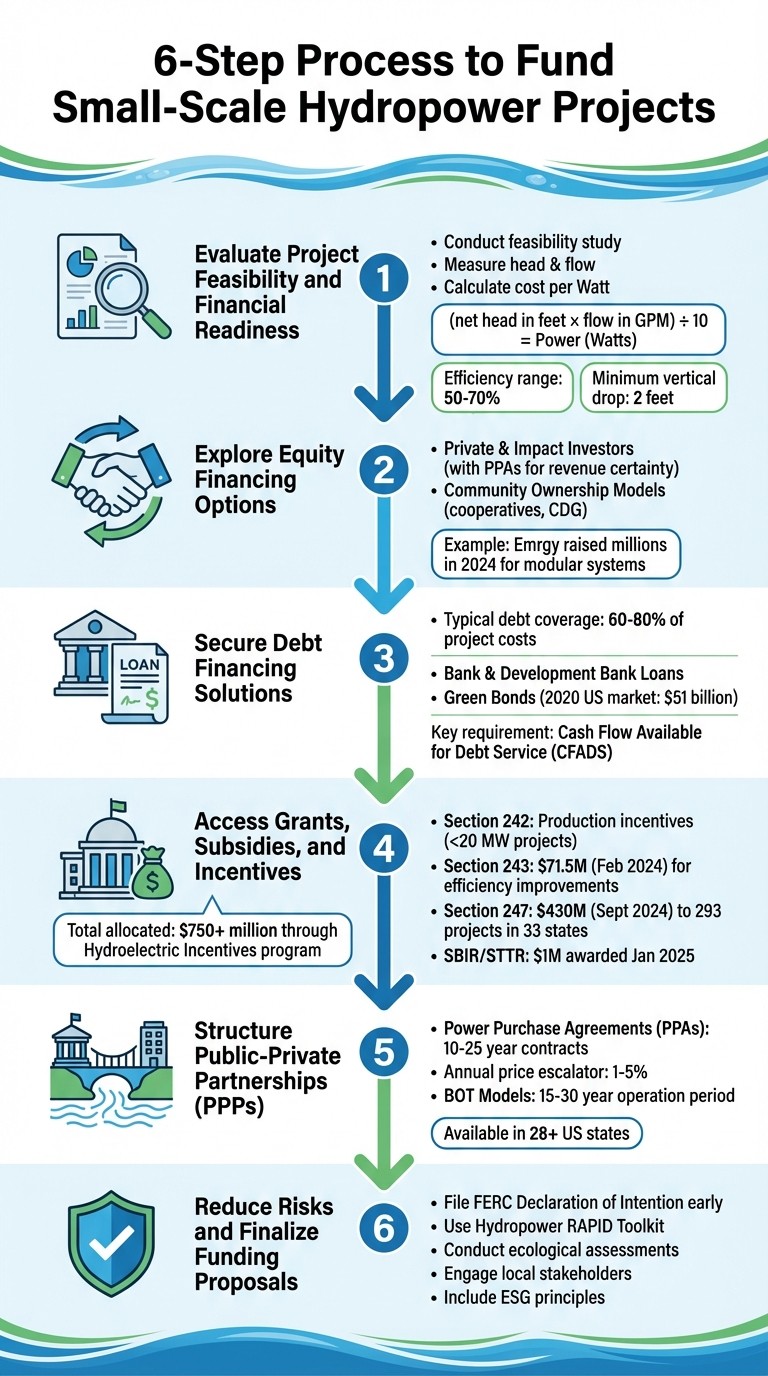
6-Step Process to Fund Small-Scale Hydropower Projects
Funding Small Hydropower | Wesley Williams
Step 1: Evaluate Project Feasibility and Financial Readiness
Showcase your project's technical soundness and financial preparedness with clear feasibility data and detailed financial documentation.
Conduct a Feasibility Study
A feasibility study helps determine if your site can generate enough power to justify the investment. Two key factors come into play: head, the vertical distance water falls, and flow, the volume of water moving through the system. You can estimate power output (in Watts) using the formula:
[(net head in feet × flow in gallons per minute) ÷ 10]
Keep in mind that most micro-hydropower systems operate at an efficiency range of 50% to 70% [6].
"The higher the head the better because you'll need less water to produce a given amount of power and you can use smaller, less expensive equipment." – Department of Energy [6]
To ensure accurate planning, measure seasonal flow using the year's lowest average and obtain precise head measurements. While the hose-tube method provides a rough estimate, professional surveying is often recommended for accuracy. Typically, a vertical drop of less than 2 feet makes small-scale systems impractical [6]. Early engagement with organizations like the U.S. Geological Survey, U.S. Army Corps of Engineers, or your county engineer can provide valuable historical stream data, potentially saving time and resources.
Regulatory requirements are another critical consideration. Verify water rights, land ownership, and necessary permits. Agencies such as FERC may offer exemptions for qualifying sites, including a 10-MW exemption for some projects [7]. Additionally, calculate your system's cost per Watt by dividing total development and maintenance expenses by capacity, and compare this with utility rates or other renewable energy options [6].
Once technical feasibility is established, the next step is preparing the financial documentation to solidify your project's funding profile.
Prepare Detailed Financial Documentation
Using insights from the feasibility study, develop comprehensive financial documentation to demonstrate funding readiness. A well-structured business plan should clearly outline your revenue model - whether through direct ownership, a Power Purchase Agreement (PPA), or Community Distributed Generation (CDG) - to show investors how the electricity will be marketed and utilized [4]. Break down both upfront costs (e.g., permitting, equipment, construction) and ongoing expenses (e.g., maintenance, safety) [4].
Financial projections should align with technical data to meet eligibility for government incentives. For example, projects applying for Hydroelectric Efficiency Improvement Incentives under Section 243 must show capital improvements that boost facility efficiency by at least 3% [1]. In February 2024, the DOE awarded up to $71.5 million in incentive payments to 46 hydroelectric projects across 19 states, all of which demonstrated specific efficiency gains [1]. Use dynamic spreadsheet models to simulate different scenarios and highlight how site-specific factors influence long-term cost-benefit analyses, including potential revenue from Renewable Energy Credits (RECs) [4].
Step 2: Explore Equity Financing Options
Equity financing involves raising funds by offering ownership stakes, making it an attractive option during the early revenue-generating phase of a project. This approach eliminates the pressure of fixed repayment schedules and provides flexibility. Two main strategies stand out: securing private and impact investors or adopting community ownership models that engage local stakeholders.
Attract Private and Impact Investors
Private and impact investors look for opportunities that combine financial returns with measurable environmental benefits. A strong way to de-risk your project and appeal to these investors is by securing a Power Purchase Agreement (PPA) before construction begins. Long-term contracts, often spanning 10 years or more, provide revenue certainty and make your project more attractive to third-party funding sources [8][10].
Government recognition can also strengthen your proposal. Securing federal R&D grants or awards, such as the Fish Protection Prize, not only provides non-dilutive funding but also signals credibility in your technology [5]. For example, in March 2024, Emrgy raised millions in private investment to deploy modular conduit hydropower systems, significantly reducing costs [10]. Similarly, in 2022, ORPC collaborated with the Igiugig Village Council in Alaska to install two RivGen marine renewable energy devices, cutting the community's diesel consumption by 60–90% and delivering substantial cost savings [9].
To further mitigate risks, consider structuring your project through a Special Purpose Vehicle (SPV). This approach isolates project-specific risks and makes the investment more appealing. Highlighting innovative technologies, such as modular systems or hybrid configurations that combine hydropower with solar panels or battery storage, can attract investors seeking scalable opportunities [8][10]. For impact investors, focus on how your project promotes energy independence in remote areas and provide data on its environmental and social benefits alongside financial projections [9].
If private investment isn't the right fit, community-based financing models offer a compelling alternative.
Use Community Ownership Models
Community ownership models, such as cooperatives or Community Distributed Generation (CDG), allow local residents to invest in renewable energy projects while enjoying benefits like renewable generation credits. In a CDG setup, a "CDG Host" operates the facility, recruits local subscribers, and works with the utility to manage electricity delivery and credit allocation [4].
Depending on your project's needs, you can choose between direct cooperative ownership or a shared CDG model. If local capital is limited at the outset, lease-to-own arrangements can help communities gradually acquire assets. It's crucial, however, to ensure your project entity secures all necessary property rights or options, as these are often required for federal exemptions. Engaging with local stakeholders early and conducting ecological assessments can foster trust and reduce potential development risks [4][7].
A great example of this approach is Anzana Electric Group (formerly Virunga Power), which collaborates with rural communities and local developers across Sub-Saharan Africa. By leveraging small hydroelectric potential, they’ve successfully created private utilities in countries like Burundi, Kenya, Malawi, Tanzania, and Zambia [9]. Community ownership models not only expand your funding sources but also create local advocates who can support your project through regulatory and operational challenges.
Step 3: Secure Debt Financing Solutions
Debt financing typically accounts for 60–80% of the funding needed for hydropower projects [8]. Unlike equity, it allows you to raise capital without giving up ownership. However, it requires steady projected cash flows - known as Cash Flow Available for Debt Service (CFADS) - to meet repayment obligations. Before engaging with lenders, ensure you’ve completed all feasibility studies, secured necessary permits like FERC approval, and established a Power Purchase Agreement to guarantee revenue streams. Lenders prioritize projects with consistent returns, so presenting well-documented CFADS projections is crucial.
Apply for Bank and Development Bank Loans
Both commercial and development banks offer loans tailored for renewable energy projects. Structuring your project as a Special Purpose Vehicle (SPV) can help isolate project-specific risks from your balance sheet. This setup enables lenders to assess the project based solely on its own cash flow projections, increasing your borrowing capacity.
Federal programs also play a key role in supporting hydropower initiatives. For instance, in February 2024, the U.S. Department of Energy allocated up to $71.5 million in efficiency improvement incentives to 46 hydroelectric projects across 19 states under Section 243 of the Energy Policy Act of 2005 [1]. Later that year, in September 2024, the DOE Grid Deployment Office awarded over $430 million to 293 projects across 33 states to enhance grid resiliency, dam safety, and environmental performance under Section 247 [1]. These federal incentives not only boost your financial case but also validate your revenue streams, making your loan applications more appealing to lenders.
Maintaining a balanced debt-to-equity ratio is essential. While higher leverage can amplify returns, over-leveraging increases interest rates and financial risks. Most successful hydropower projects use debt to cover 60–80% of costs, with the remaining 15–40% funded through equity or other capital sources [8]. Programs like the DOE Loan Programs Office provide loan guarantees for Innovative Clean Energy and Tribal Energy projects, reducing lender risk and improving loan terms.
If your project requires alternative financing options or lower interest rates, green bonds could be a strong choice.
Use Green Bonds for Sustainability Projects
Green bonds are fixed-income instruments designed to fund environmental projects. They’re particularly appealing because they’re often tax-exempt, allowing issuers to offer lower interest rates compared to standard corporate bonds with similar credit ratings [11]. In 2020, the global green bond market hit $1 trillion, with the United States contributing $51 billion [11].
For small-scale hydropower projects, green bonds can be structured as revenue bonds, where repayments are tied directly to electricity sales. However, the administrative costs for individual small projects can be high. To address this, bundling multiple projects to meet the typical minimum issuance scale - several million dollars - is recommended [11]. For example, between 2018 and 2020, the New York State Energy Research and Development Authority (NYSERDA) issued green bonds ranging from $15 million to $18 million to fund residential solar and energy efficiency programs [11].
To attract institutional investors like pension funds or insurance companies, align your bond issuance with established green bond standards to avoid accusations of "greenwashing" [11]. Third-party verification helps confirm the environmental benefits of your project and ensures credibility. Research on U.S. municipal green bonds revealed a "greenium" of 35 basis points, meaning issuers could secure lower interest rates compared to traditional bonds [13].
"Hydropower projects have longer pre-development, construction and operational timelines than other renewable energy technologies, investment risks are higher, requiring specific policy instruments and incentives as well as a longer-term policy perspective and vision." - International Energy Agency [8]
When selecting debt instruments, consider the scale of your project and your capacity for reporting. Green loans are often better suited for smaller projects or private operations with lower transaction costs, while green bonds are ideal for larger portfolios that can handle the expenses of exchange listings and public disclosures [12][13].
Step 4: Access Grants, Subsidies, and Incentives
In addition to traditional financing options like debt and equity, grants and subsidies can play a critical role in securing funds for small-scale hydropower projects. These non-repayable funds provide a financial boost, enabling projects to move forward with less strain on resources. For instance, the Hydroelectric Incentives program has allocated over $750 million to support projects through production incentives, efficiency improvements, and capital upgrades aimed at enhancing grid resilience, dam safety, and environmental performance.
Identify and Apply for Government Grants
Several government programs focus on providing targeted financial support for hydropower initiatives. Sections 242, 243, and 247 are key examples, each addressing specific areas like production, efficiency, and capital improvements. Section 242, for instance, offers production incentives for small-scale projects under 20 MW in underserved areas. Recent funding under this section includes $12 million awarded in October 2024 for production incentives and up to $71.5 million in February 2024 for efficiency upgrades[1].
Section 247, with a $554 million allocation, targets improvements in grid resilience, dam safety, and environmental measures. In September 2024, $430 million was distributed to 293 projects spanning 33 states under this program[1].
For small businesses, the Small Business Innovation Research (SBIR) and Small Business Technology Transfer (STTR) programs provide phased funding for water power technology research and development. In January 2025, the Water Power Technologies Office awarded $1 million to a small business advancing environmental technology for hydropower facilities[16]. Furthermore, tax credits introduced under the Inflation Reduction Act have significantly reduced development costs for hydropower and marine energy projects[14].
To apply for these programs, early registration through the EERE Program Information Center (EPIC) is essential, as many grants require portal access before submission. Stay updated on new opportunities by monitoring the Infrastructure Funding Opportunity eXCHANGE and the Clean Energy Infrastructure Funding Opportunity eXCHANGE portals[1]. Be prepared for multi-stage application processes, which often include submitting a Concept Paper before the full application[2][17]. If your project doesn’t align with current solicitations, consider submitting directly to the DOE’s Unsolicited Proposal Office for evaluation[14].
Beyond federal programs, international funding sources can also provide valuable support.
Partner with International Funding Organizations
International funding networks can open doors to additional resources and collaborations. Newsletters such as Hydro Headlines, Water Column, and Water Wire provide regular updates on funding opportunities, technical partnerships, and industry events[3]. The Hydropower Technical Collaboration Program offers ongoing chances for developers to engage in research initiatives and receive technical assistance from government agencies[15].
Tribal communities have access to specialized programs through the Office of Indian Energy Policy and Programs, which supports project development and resource evaluation on Tribal lands[14]. Additionally, the Loan Programs Office offers loan guarantees for Tribal energy projects, helping reduce lender risk and improve financing conditions[14][15]. These programs acknowledge the unique challenges of hydropower development, such as longer timelines and higher upfront risks, and aim to provide tailored solutions and sustained support.
Step 5: Structure Public-Private Partnerships (PPPs)
Public-private partnerships (PPPs) are a collaborative way to share financial risks and responsibilities, combining government resources with private investment to support small-scale hydropower projects. These partnerships rely on clearly defined agreements that outline construction, operations, and revenue-sharing terms. By integrating such frameworks, PPPs build on earlier financing strategies, further reducing project risks.
Develop Power Purchase Agreements (PPAs)
Power Purchase Agreements (PPAs) are long-term contracts, typically spanning 10 to 25 years, that secure a fixed revenue stream by guaranteeing electricity sales to a specific buyer. This predictable income makes projects more appealing to lenders and investors. As PF Nexus highlights:
"PPAs play a critical role in the renewable energy sector... they provide revenue stability and offload some of the risks otherwise inherent within renewable energy projects, which changes the risk profile of their financial viability and opens the door to debt and low-cost capital" [18].
Public entities that cannot directly benefit from federal tax credits often gain when private developers secure these credits and pass on the cost savings to buyers [19][21]. This model has proven effective in reducing costs through tax credits and fixed-rate agreements.
When structuring a PPA, it’s wise to include an annual price escalator of 1–5% to adjust for inflation and rising operational expenses [21]. Additionally, it’s crucial to clarify ownership of Renewable Energy Certificates (RECs). Private investors may need RECs to enhance their returns, while public buyers might require them to meet sustainability targets [19]. Ensure your project operates in a state or jurisdiction that allows third-party ownership; currently, at least 28 U.S. states and Washington, D.C. permit these arrangements [19][20].
PPAs often provide a solid foundation for exploring more comprehensive partnership models, such as joint ventures or Build-Operate-Transfer (BOT) agreements, to manage the entire project lifecycle.
Explore Joint Ventures and Build-Operate-Transfer Models
Joint ventures and Build-Operate-Transfer (BOT) models are effective ways to share responsibilities among various stakeholders. In a BOT arrangement, a private entity typically oversees construction and operates the facility for 15 to 30 years before transferring ownership to the public sector. This approach gives governments access to private capital and expertise while minimizing their upfront development risks.
For BOT models to succeed, it’s essential to integrate technical plans, commercial terms, permits, and financing from the very beginning [22]. The World Bank PPP Resource Center underscores this point:
"the guide... emphasizes the importance of interactions among technical, commercial, permitting/licensing, environmental and social, and financing activities" [22].
Revenue guarantees provided through PPAs make joint ventures particularly appealing to private partners by ensuring reliable cash flows [4]. Another option to consider is Community Distributed Generation (CDG) models, where multiple local subscribers benefit from renewable energy credits on their utility bills. This approach diversifies offtaker risk by spreading it across multiple parties [4]. For partnerships involving existing dam sites, it’s important to clearly define maintenance and liability responsibilities during negotiations [4].
Step 6: Reduce Risks and Finalize Funding Proposals
Before submitting your funding proposal, it’s crucial to address regulatory, technical, and environmental risks. The U.S. Department of Energy emphasizes that "navigating federal and state regulations for project approvals can be one of the biggest hurdles hydropower developers face" [24].
Minimize Development Risks
Start by clarifying your project’s regulatory status. Filing a Declaration of Intention or requesting a Declaratory Order from FERC early in the process can help eliminate uncertainty [23].
Make use of the Hydropower RAPID Toolkit, a centralized resource that simplifies permitting by offering clear regulatory roadmaps. This "one-stop shop" can "potentially lower total project costs and investor risk by clarifying the permitting process" [24]. By reducing permitting timelines, the toolkit enhances the credibility of your proposal.
Accurate stream flow data and ecological assessments are essential before approaching investors. Many projects falter when developers underestimate site-specific challenges, such as grid interconnection or the condition of existing dams. Engaging local stakeholders early on can help address environmental concerns and avoid legal complications [4]. For dam-related projects, include a detailed maintenance plan and liability coverage to demonstrate that you’ve accounted for the primary risk of dam failure [4].
Additionally, strengthen your proposal by showcasing eligibility for federal incentives. For example, in September 2024, the Grid Deployment Office allocated over $430 million to 293 hydroelectric projects across 33 states under Section 247 of EPAct 2005, focusing on grid resiliency, dam safety, and environmental upgrades [1]. Similarly, in February 2024, the DOE awarded up to $71.5 million to 46 projects in 19 states under Section 243 for efficiency improvements of at least 3% [1]. Including these incentives in your financial projections can significantly reduce perceived risks for investors.
Once you’ve addressed these risks, refine your proposal with professional guidance to improve its appeal.
Collaborate with Council Fire for Expert Support
Enlist expert assistance to fine-tune your funding proposal. Council Fire specializes in turning sustainability goals into actionable funding strategies for energy and water projects. Their team works with developers to craft proposals that align with both financial targets and environmental standards, ensuring your small-scale hydropower project meets the expectations of impact investors and institutional lenders.
Council Fire also provides stakeholder engagement strategies to address community concerns proactively, reducing the social and legal risks that often hinder funding approval. Their approach combines technical feasibility analysis with strategic communication, helping you clearly demonstrate how your project supports climate resilience and grid modernization - key factors for securing interest from government agencies and private financiers.
Their expertise in integrating ESG principles ensures your proposal highlights measurable environmental and social benefits beyond just electricity generation. By framing your project within broader decarbonization goals, Council Fire makes your proposal more competitive for grants, green bonds, and public-private partnerships. Learn more about their consulting services at councilfire.org to strengthen your funding strategy and accelerate project approval.
Conclusion
Securing funding for a small-scale hydropower project demands thorough preparation, diversified financial strategies, and expert support. Start with a comprehensive feasibility study that evaluates critical site-specific factors like stream flow, grid interconnection, and regulatory compliance. This groundwork is key to attracting a balanced mix of equity investors, bank loans, green bonds, and government incentives.
Government programs focused on production incentives, efficiency upgrades, and maintenance offer significant opportunities for developers. To stand out, your application should include a detailed technical narrative, a skilled project team, and clear alignment with program objectives. Subscribing to the DOE Water Power Technologies Office newsletter and engaging state energy officials early in the process can greatly enhance your chances of securing these funds [5]. Such commitments not only support funding but also pave the way for diverse revenue streams.
Expanding revenue sources can strengthen your financial position. For example, Power Purchase Agreements (PPAs) ensure predictable income even before the project is operational, making your proposal more appealing to lenders. Similarly, Community Distributed Generation models can generate income while fostering local support by allocating energy credits to community subscribers.
Addressing risks early is equally important. Engage with FERC at the outset, conduct extended flow measurements, and complete environmental assessments before approaching investors. Taking these steps demonstrates that you’ve proactively tackled the technical, regulatory, and ecological challenges that could hinder progress. This proactive approach not only reduces risks but also builds credibility with potential partners.
Expert guidance can turn a well-prepared proposal into a funded reality. Council Fire offers specialized support in integrating ESG principles into funding strategies, aligning projects with broader goals like climate resilience and grid modernization. Their expertise in stakeholder engagement and communication ensures your proposal connects with investors, government agencies, and institutional lenders. Visit councilfire.org to refine your funding approach and fast-track project approval.
FAQs
What federal programs offer incentives for small-scale hydropower projects?
The U.S. federal government provides several programs to encourage the development of small-scale hydropower projects. One such program is the Hydroelectric Production Incentive (Section 242 of the Energy Policy Act of 2005), which offers financial payments for electricity that is both generated and sold. Another is the Hydroelectric Efficiency Improvement Incentive (Section 243 of the same act), designed to fund upgrades that boost energy efficiency.
There is also the Maintaining and Enhancing Hydroelectricity Incentive (Section 247), which supports initiatives aimed at enhancing grid resilience, improving dam safety, and minimizing environmental impacts. These programs work together to promote the feasibility of hydropower projects while advancing renewable energy objectives.
What are the benefits of community ownership for small-scale hydropower projects?
Community ownership models have the potential to turn small-scale hydropower projects into meaningful assets that directly benefit local residents. By collectively owning these projects - whether through communities, cooperatives, or groups of landowners - residents can enjoy reduced utility costs or generate income by selling surplus electricity back to the grid. This approach not only keeps revenue circulating within the community but also encourages local economic growth.
Such models also open doors to federal and state funding opportunities designed for rural or community-based initiatives. For instance, the USDA’s Rural Energy for America Program (REAP) provides grants and financing options tailored to smaller projects. Beyond financial advantages, local ownership often garners stronger community support, minimizes resistance, and ensures the project aligns with regional development priorities. It also promotes long-term care of natural resources, reinforcing a sense of shared responsibility.
Council Fire offers expertise in helping communities establish and manage these ownership structures. From navigating financing options to fostering stakeholder collaboration and ensuring compliance with federal programs, their guidance helps communities achieve both economic and environmental goals.
What steps can I take to reduce risks when developing a small-scale hydropower project?
Reducing risks in small-scale hydropower development begins with establishing a solid regulatory and environmental framework. Start by securing the necessary approvals from the Federal Energy Regulatory Commission (FERC), such as a conduit or 10-MW exemption. Conducting an environmental assessment and a water-use analysis is essential to evaluate potential effects on ecosystems, water flow, and downstream users. These preparatory steps not only ensure compliance with permitting requirements but also help identify technical challenges early, potentially saving both time and money.
The next critical step is financial and technical planning. Develop a detailed cost model that accounts for major expenditures like turbines, construction, and ongoing maintenance. Securing stable revenue streams, such as power-purchase agreements or Renewable Energy Credits, is equally important. Consider diversifying funding sources through programs like USDA Rural Energy loans or DOE loan guarantees to mitigate financial risks and ensure project viability.
Finally, prioritize early stakeholder engagement. Building trust with local communities, water-right holders, and tribal groups is key to uncovering potential liabilities and fostering collaboration. Partnering with experts, such as those at Council Fire, can provide valuable insights to align your project with environmental objectives, financial stability, and available incentives. By addressing regulatory, financial, and social factors from the outset, you can significantly reduce risks and set your hydropower project on a path to success.
Related Blog Posts
Latest Articles
©2025


FAQ
01
What does it really mean to “redefine profit”?
02
What makes Council Fire different?
03
Who does Council Fire you work with?
04
What does working with Council Fire actually look like?
05
How does Council Fire help organizations turn big goals into action?
06
How does Council Fire define and measure success?
Dec 25, 2025
How to Fund Small-Scale Hydropower Projects
Sustainability Strategy
In This Article
Step-by-step guide to finance small hydropower projects: feasibility, equity and debt options, grants and incentives, PPPs, PPAs, green bonds, and risk mitigation.
How to Fund Small-Scale Hydropower Projects
Funding small-scale hydropower projects requires a clear strategy to overcome high upfront costs, regulatory hurdles, and long development timelines. Here's how you can secure financial support for your project:
Evaluate Feasibility: Conduct a technical and financial feasibility study to ensure your project is viable. Focus on factors like water flow, head height, and cost per watt.
Leverage Incentives: Federal programs like REAP and the Inflation Reduction Act now offer grants, tax credits, and cost-sharing incentives - covering up to 50% of project costs.
Explore Financing Options: Combine equity financing, community ownership models, and debt solutions like green bonds or bank loans. Power Purchase Agreements (PPAs) can secure steady revenue.
Access Grants: Programs under Sections 242, 243, and 247 provide millions in funding for production incentives, efficiency improvements, and grid resiliency.
Form Public-Private Partnerships: Collaborate with private investors and public entities through joint ventures or Build-Operate-Transfer (BOT) models.
Mitigate Risks: Address regulatory, technical, and environmental risks early by securing permits, conducting ecological assessments, and engaging stakeholders.
6-Step Process to Fund Small-Scale Hydropower Projects
Funding Small Hydropower | Wesley Williams
Step 1: Evaluate Project Feasibility and Financial Readiness
Showcase your project's technical soundness and financial preparedness with clear feasibility data and detailed financial documentation.
Conduct a Feasibility Study
A feasibility study helps determine if your site can generate enough power to justify the investment. Two key factors come into play: head, the vertical distance water falls, and flow, the volume of water moving through the system. You can estimate power output (in Watts) using the formula:
[(net head in feet × flow in gallons per minute) ÷ 10]
Keep in mind that most micro-hydropower systems operate at an efficiency range of 50% to 70% [6].
"The higher the head the better because you'll need less water to produce a given amount of power and you can use smaller, less expensive equipment." – Department of Energy [6]
To ensure accurate planning, measure seasonal flow using the year's lowest average and obtain precise head measurements. While the hose-tube method provides a rough estimate, professional surveying is often recommended for accuracy. Typically, a vertical drop of less than 2 feet makes small-scale systems impractical [6]. Early engagement with organizations like the U.S. Geological Survey, U.S. Army Corps of Engineers, or your county engineer can provide valuable historical stream data, potentially saving time and resources.
Regulatory requirements are another critical consideration. Verify water rights, land ownership, and necessary permits. Agencies such as FERC may offer exemptions for qualifying sites, including a 10-MW exemption for some projects [7]. Additionally, calculate your system's cost per Watt by dividing total development and maintenance expenses by capacity, and compare this with utility rates or other renewable energy options [6].
Once technical feasibility is established, the next step is preparing the financial documentation to solidify your project's funding profile.
Prepare Detailed Financial Documentation
Using insights from the feasibility study, develop comprehensive financial documentation to demonstrate funding readiness. A well-structured business plan should clearly outline your revenue model - whether through direct ownership, a Power Purchase Agreement (PPA), or Community Distributed Generation (CDG) - to show investors how the electricity will be marketed and utilized [4]. Break down both upfront costs (e.g., permitting, equipment, construction) and ongoing expenses (e.g., maintenance, safety) [4].
Financial projections should align with technical data to meet eligibility for government incentives. For example, projects applying for Hydroelectric Efficiency Improvement Incentives under Section 243 must show capital improvements that boost facility efficiency by at least 3% [1]. In February 2024, the DOE awarded up to $71.5 million in incentive payments to 46 hydroelectric projects across 19 states, all of which demonstrated specific efficiency gains [1]. Use dynamic spreadsheet models to simulate different scenarios and highlight how site-specific factors influence long-term cost-benefit analyses, including potential revenue from Renewable Energy Credits (RECs) [4].
Step 2: Explore Equity Financing Options
Equity financing involves raising funds by offering ownership stakes, making it an attractive option during the early revenue-generating phase of a project. This approach eliminates the pressure of fixed repayment schedules and provides flexibility. Two main strategies stand out: securing private and impact investors or adopting community ownership models that engage local stakeholders.
Attract Private and Impact Investors
Private and impact investors look for opportunities that combine financial returns with measurable environmental benefits. A strong way to de-risk your project and appeal to these investors is by securing a Power Purchase Agreement (PPA) before construction begins. Long-term contracts, often spanning 10 years or more, provide revenue certainty and make your project more attractive to third-party funding sources [8][10].
Government recognition can also strengthen your proposal. Securing federal R&D grants or awards, such as the Fish Protection Prize, not only provides non-dilutive funding but also signals credibility in your technology [5]. For example, in March 2024, Emrgy raised millions in private investment to deploy modular conduit hydropower systems, significantly reducing costs [10]. Similarly, in 2022, ORPC collaborated with the Igiugig Village Council in Alaska to install two RivGen marine renewable energy devices, cutting the community's diesel consumption by 60–90% and delivering substantial cost savings [9].
To further mitigate risks, consider structuring your project through a Special Purpose Vehicle (SPV). This approach isolates project-specific risks and makes the investment more appealing. Highlighting innovative technologies, such as modular systems or hybrid configurations that combine hydropower with solar panels or battery storage, can attract investors seeking scalable opportunities [8][10]. For impact investors, focus on how your project promotes energy independence in remote areas and provide data on its environmental and social benefits alongside financial projections [9].
If private investment isn't the right fit, community-based financing models offer a compelling alternative.
Use Community Ownership Models
Community ownership models, such as cooperatives or Community Distributed Generation (CDG), allow local residents to invest in renewable energy projects while enjoying benefits like renewable generation credits. In a CDG setup, a "CDG Host" operates the facility, recruits local subscribers, and works with the utility to manage electricity delivery and credit allocation [4].
Depending on your project's needs, you can choose between direct cooperative ownership or a shared CDG model. If local capital is limited at the outset, lease-to-own arrangements can help communities gradually acquire assets. It's crucial, however, to ensure your project entity secures all necessary property rights or options, as these are often required for federal exemptions. Engaging with local stakeholders early and conducting ecological assessments can foster trust and reduce potential development risks [4][7].
A great example of this approach is Anzana Electric Group (formerly Virunga Power), which collaborates with rural communities and local developers across Sub-Saharan Africa. By leveraging small hydroelectric potential, they’ve successfully created private utilities in countries like Burundi, Kenya, Malawi, Tanzania, and Zambia [9]. Community ownership models not only expand your funding sources but also create local advocates who can support your project through regulatory and operational challenges.
Step 3: Secure Debt Financing Solutions
Debt financing typically accounts for 60–80% of the funding needed for hydropower projects [8]. Unlike equity, it allows you to raise capital without giving up ownership. However, it requires steady projected cash flows - known as Cash Flow Available for Debt Service (CFADS) - to meet repayment obligations. Before engaging with lenders, ensure you’ve completed all feasibility studies, secured necessary permits like FERC approval, and established a Power Purchase Agreement to guarantee revenue streams. Lenders prioritize projects with consistent returns, so presenting well-documented CFADS projections is crucial.
Apply for Bank and Development Bank Loans
Both commercial and development banks offer loans tailored for renewable energy projects. Structuring your project as a Special Purpose Vehicle (SPV) can help isolate project-specific risks from your balance sheet. This setup enables lenders to assess the project based solely on its own cash flow projections, increasing your borrowing capacity.
Federal programs also play a key role in supporting hydropower initiatives. For instance, in February 2024, the U.S. Department of Energy allocated up to $71.5 million in efficiency improvement incentives to 46 hydroelectric projects across 19 states under Section 243 of the Energy Policy Act of 2005 [1]. Later that year, in September 2024, the DOE Grid Deployment Office awarded over $430 million to 293 projects across 33 states to enhance grid resiliency, dam safety, and environmental performance under Section 247 [1]. These federal incentives not only boost your financial case but also validate your revenue streams, making your loan applications more appealing to lenders.
Maintaining a balanced debt-to-equity ratio is essential. While higher leverage can amplify returns, over-leveraging increases interest rates and financial risks. Most successful hydropower projects use debt to cover 60–80% of costs, with the remaining 15–40% funded through equity or other capital sources [8]. Programs like the DOE Loan Programs Office provide loan guarantees for Innovative Clean Energy and Tribal Energy projects, reducing lender risk and improving loan terms.
If your project requires alternative financing options or lower interest rates, green bonds could be a strong choice.
Use Green Bonds for Sustainability Projects
Green bonds are fixed-income instruments designed to fund environmental projects. They’re particularly appealing because they’re often tax-exempt, allowing issuers to offer lower interest rates compared to standard corporate bonds with similar credit ratings [11]. In 2020, the global green bond market hit $1 trillion, with the United States contributing $51 billion [11].
For small-scale hydropower projects, green bonds can be structured as revenue bonds, where repayments are tied directly to electricity sales. However, the administrative costs for individual small projects can be high. To address this, bundling multiple projects to meet the typical minimum issuance scale - several million dollars - is recommended [11]. For example, between 2018 and 2020, the New York State Energy Research and Development Authority (NYSERDA) issued green bonds ranging from $15 million to $18 million to fund residential solar and energy efficiency programs [11].
To attract institutional investors like pension funds or insurance companies, align your bond issuance with established green bond standards to avoid accusations of "greenwashing" [11]. Third-party verification helps confirm the environmental benefits of your project and ensures credibility. Research on U.S. municipal green bonds revealed a "greenium" of 35 basis points, meaning issuers could secure lower interest rates compared to traditional bonds [13].
"Hydropower projects have longer pre-development, construction and operational timelines than other renewable energy technologies, investment risks are higher, requiring specific policy instruments and incentives as well as a longer-term policy perspective and vision." - International Energy Agency [8]
When selecting debt instruments, consider the scale of your project and your capacity for reporting. Green loans are often better suited for smaller projects or private operations with lower transaction costs, while green bonds are ideal for larger portfolios that can handle the expenses of exchange listings and public disclosures [12][13].
Step 4: Access Grants, Subsidies, and Incentives
In addition to traditional financing options like debt and equity, grants and subsidies can play a critical role in securing funds for small-scale hydropower projects. These non-repayable funds provide a financial boost, enabling projects to move forward with less strain on resources. For instance, the Hydroelectric Incentives program has allocated over $750 million to support projects through production incentives, efficiency improvements, and capital upgrades aimed at enhancing grid resilience, dam safety, and environmental performance.
Identify and Apply for Government Grants
Several government programs focus on providing targeted financial support for hydropower initiatives. Sections 242, 243, and 247 are key examples, each addressing specific areas like production, efficiency, and capital improvements. Section 242, for instance, offers production incentives for small-scale projects under 20 MW in underserved areas. Recent funding under this section includes $12 million awarded in October 2024 for production incentives and up to $71.5 million in February 2024 for efficiency upgrades[1].
Section 247, with a $554 million allocation, targets improvements in grid resilience, dam safety, and environmental measures. In September 2024, $430 million was distributed to 293 projects spanning 33 states under this program[1].
For small businesses, the Small Business Innovation Research (SBIR) and Small Business Technology Transfer (STTR) programs provide phased funding for water power technology research and development. In January 2025, the Water Power Technologies Office awarded $1 million to a small business advancing environmental technology for hydropower facilities[16]. Furthermore, tax credits introduced under the Inflation Reduction Act have significantly reduced development costs for hydropower and marine energy projects[14].
To apply for these programs, early registration through the EERE Program Information Center (EPIC) is essential, as many grants require portal access before submission. Stay updated on new opportunities by monitoring the Infrastructure Funding Opportunity eXCHANGE and the Clean Energy Infrastructure Funding Opportunity eXCHANGE portals[1]. Be prepared for multi-stage application processes, which often include submitting a Concept Paper before the full application[2][17]. If your project doesn’t align with current solicitations, consider submitting directly to the DOE’s Unsolicited Proposal Office for evaluation[14].
Beyond federal programs, international funding sources can also provide valuable support.
Partner with International Funding Organizations
International funding networks can open doors to additional resources and collaborations. Newsletters such as Hydro Headlines, Water Column, and Water Wire provide regular updates on funding opportunities, technical partnerships, and industry events[3]. The Hydropower Technical Collaboration Program offers ongoing chances for developers to engage in research initiatives and receive technical assistance from government agencies[15].
Tribal communities have access to specialized programs through the Office of Indian Energy Policy and Programs, which supports project development and resource evaluation on Tribal lands[14]. Additionally, the Loan Programs Office offers loan guarantees for Tribal energy projects, helping reduce lender risk and improve financing conditions[14][15]. These programs acknowledge the unique challenges of hydropower development, such as longer timelines and higher upfront risks, and aim to provide tailored solutions and sustained support.
Step 5: Structure Public-Private Partnerships (PPPs)
Public-private partnerships (PPPs) are a collaborative way to share financial risks and responsibilities, combining government resources with private investment to support small-scale hydropower projects. These partnerships rely on clearly defined agreements that outline construction, operations, and revenue-sharing terms. By integrating such frameworks, PPPs build on earlier financing strategies, further reducing project risks.
Develop Power Purchase Agreements (PPAs)
Power Purchase Agreements (PPAs) are long-term contracts, typically spanning 10 to 25 years, that secure a fixed revenue stream by guaranteeing electricity sales to a specific buyer. This predictable income makes projects more appealing to lenders and investors. As PF Nexus highlights:
"PPAs play a critical role in the renewable energy sector... they provide revenue stability and offload some of the risks otherwise inherent within renewable energy projects, which changes the risk profile of their financial viability and opens the door to debt and low-cost capital" [18].
Public entities that cannot directly benefit from federal tax credits often gain when private developers secure these credits and pass on the cost savings to buyers [19][21]. This model has proven effective in reducing costs through tax credits and fixed-rate agreements.
When structuring a PPA, it’s wise to include an annual price escalator of 1–5% to adjust for inflation and rising operational expenses [21]. Additionally, it’s crucial to clarify ownership of Renewable Energy Certificates (RECs). Private investors may need RECs to enhance their returns, while public buyers might require them to meet sustainability targets [19]. Ensure your project operates in a state or jurisdiction that allows third-party ownership; currently, at least 28 U.S. states and Washington, D.C. permit these arrangements [19][20].
PPAs often provide a solid foundation for exploring more comprehensive partnership models, such as joint ventures or Build-Operate-Transfer (BOT) agreements, to manage the entire project lifecycle.
Explore Joint Ventures and Build-Operate-Transfer Models
Joint ventures and Build-Operate-Transfer (BOT) models are effective ways to share responsibilities among various stakeholders. In a BOT arrangement, a private entity typically oversees construction and operates the facility for 15 to 30 years before transferring ownership to the public sector. This approach gives governments access to private capital and expertise while minimizing their upfront development risks.
For BOT models to succeed, it’s essential to integrate technical plans, commercial terms, permits, and financing from the very beginning [22]. The World Bank PPP Resource Center underscores this point:
"the guide... emphasizes the importance of interactions among technical, commercial, permitting/licensing, environmental and social, and financing activities" [22].
Revenue guarantees provided through PPAs make joint ventures particularly appealing to private partners by ensuring reliable cash flows [4]. Another option to consider is Community Distributed Generation (CDG) models, where multiple local subscribers benefit from renewable energy credits on their utility bills. This approach diversifies offtaker risk by spreading it across multiple parties [4]. For partnerships involving existing dam sites, it’s important to clearly define maintenance and liability responsibilities during negotiations [4].
Step 6: Reduce Risks and Finalize Funding Proposals
Before submitting your funding proposal, it’s crucial to address regulatory, technical, and environmental risks. The U.S. Department of Energy emphasizes that "navigating federal and state regulations for project approvals can be one of the biggest hurdles hydropower developers face" [24].
Minimize Development Risks
Start by clarifying your project’s regulatory status. Filing a Declaration of Intention or requesting a Declaratory Order from FERC early in the process can help eliminate uncertainty [23].
Make use of the Hydropower RAPID Toolkit, a centralized resource that simplifies permitting by offering clear regulatory roadmaps. This "one-stop shop" can "potentially lower total project costs and investor risk by clarifying the permitting process" [24]. By reducing permitting timelines, the toolkit enhances the credibility of your proposal.
Accurate stream flow data and ecological assessments are essential before approaching investors. Many projects falter when developers underestimate site-specific challenges, such as grid interconnection or the condition of existing dams. Engaging local stakeholders early on can help address environmental concerns and avoid legal complications [4]. For dam-related projects, include a detailed maintenance plan and liability coverage to demonstrate that you’ve accounted for the primary risk of dam failure [4].
Additionally, strengthen your proposal by showcasing eligibility for federal incentives. For example, in September 2024, the Grid Deployment Office allocated over $430 million to 293 hydroelectric projects across 33 states under Section 247 of EPAct 2005, focusing on grid resiliency, dam safety, and environmental upgrades [1]. Similarly, in February 2024, the DOE awarded up to $71.5 million to 46 projects in 19 states under Section 243 for efficiency improvements of at least 3% [1]. Including these incentives in your financial projections can significantly reduce perceived risks for investors.
Once you’ve addressed these risks, refine your proposal with professional guidance to improve its appeal.
Collaborate with Council Fire for Expert Support
Enlist expert assistance to fine-tune your funding proposal. Council Fire specializes in turning sustainability goals into actionable funding strategies for energy and water projects. Their team works with developers to craft proposals that align with both financial targets and environmental standards, ensuring your small-scale hydropower project meets the expectations of impact investors and institutional lenders.
Council Fire also provides stakeholder engagement strategies to address community concerns proactively, reducing the social and legal risks that often hinder funding approval. Their approach combines technical feasibility analysis with strategic communication, helping you clearly demonstrate how your project supports climate resilience and grid modernization - key factors for securing interest from government agencies and private financiers.
Their expertise in integrating ESG principles ensures your proposal highlights measurable environmental and social benefits beyond just electricity generation. By framing your project within broader decarbonization goals, Council Fire makes your proposal more competitive for grants, green bonds, and public-private partnerships. Learn more about their consulting services at councilfire.org to strengthen your funding strategy and accelerate project approval.
Conclusion
Securing funding for a small-scale hydropower project demands thorough preparation, diversified financial strategies, and expert support. Start with a comprehensive feasibility study that evaluates critical site-specific factors like stream flow, grid interconnection, and regulatory compliance. This groundwork is key to attracting a balanced mix of equity investors, bank loans, green bonds, and government incentives.
Government programs focused on production incentives, efficiency upgrades, and maintenance offer significant opportunities for developers. To stand out, your application should include a detailed technical narrative, a skilled project team, and clear alignment with program objectives. Subscribing to the DOE Water Power Technologies Office newsletter and engaging state energy officials early in the process can greatly enhance your chances of securing these funds [5]. Such commitments not only support funding but also pave the way for diverse revenue streams.
Expanding revenue sources can strengthen your financial position. For example, Power Purchase Agreements (PPAs) ensure predictable income even before the project is operational, making your proposal more appealing to lenders. Similarly, Community Distributed Generation models can generate income while fostering local support by allocating energy credits to community subscribers.
Addressing risks early is equally important. Engage with FERC at the outset, conduct extended flow measurements, and complete environmental assessments before approaching investors. Taking these steps demonstrates that you’ve proactively tackled the technical, regulatory, and ecological challenges that could hinder progress. This proactive approach not only reduces risks but also builds credibility with potential partners.
Expert guidance can turn a well-prepared proposal into a funded reality. Council Fire offers specialized support in integrating ESG principles into funding strategies, aligning projects with broader goals like climate resilience and grid modernization. Their expertise in stakeholder engagement and communication ensures your proposal connects with investors, government agencies, and institutional lenders. Visit councilfire.org to refine your funding approach and fast-track project approval.
FAQs
What federal programs offer incentives for small-scale hydropower projects?
The U.S. federal government provides several programs to encourage the development of small-scale hydropower projects. One such program is the Hydroelectric Production Incentive (Section 242 of the Energy Policy Act of 2005), which offers financial payments for electricity that is both generated and sold. Another is the Hydroelectric Efficiency Improvement Incentive (Section 243 of the same act), designed to fund upgrades that boost energy efficiency.
There is also the Maintaining and Enhancing Hydroelectricity Incentive (Section 247), which supports initiatives aimed at enhancing grid resilience, improving dam safety, and minimizing environmental impacts. These programs work together to promote the feasibility of hydropower projects while advancing renewable energy objectives.
What are the benefits of community ownership for small-scale hydropower projects?
Community ownership models have the potential to turn small-scale hydropower projects into meaningful assets that directly benefit local residents. By collectively owning these projects - whether through communities, cooperatives, or groups of landowners - residents can enjoy reduced utility costs or generate income by selling surplus electricity back to the grid. This approach not only keeps revenue circulating within the community but also encourages local economic growth.
Such models also open doors to federal and state funding opportunities designed for rural or community-based initiatives. For instance, the USDA’s Rural Energy for America Program (REAP) provides grants and financing options tailored to smaller projects. Beyond financial advantages, local ownership often garners stronger community support, minimizes resistance, and ensures the project aligns with regional development priorities. It also promotes long-term care of natural resources, reinforcing a sense of shared responsibility.
Council Fire offers expertise in helping communities establish and manage these ownership structures. From navigating financing options to fostering stakeholder collaboration and ensuring compliance with federal programs, their guidance helps communities achieve both economic and environmental goals.
What steps can I take to reduce risks when developing a small-scale hydropower project?
Reducing risks in small-scale hydropower development begins with establishing a solid regulatory and environmental framework. Start by securing the necessary approvals from the Federal Energy Regulatory Commission (FERC), such as a conduit or 10-MW exemption. Conducting an environmental assessment and a water-use analysis is essential to evaluate potential effects on ecosystems, water flow, and downstream users. These preparatory steps not only ensure compliance with permitting requirements but also help identify technical challenges early, potentially saving both time and money.
The next critical step is financial and technical planning. Develop a detailed cost model that accounts for major expenditures like turbines, construction, and ongoing maintenance. Securing stable revenue streams, such as power-purchase agreements or Renewable Energy Credits, is equally important. Consider diversifying funding sources through programs like USDA Rural Energy loans or DOE loan guarantees to mitigate financial risks and ensure project viability.
Finally, prioritize early stakeholder engagement. Building trust with local communities, water-right holders, and tribal groups is key to uncovering potential liabilities and fostering collaboration. Partnering with experts, such as those at Council Fire, can provide valuable insights to align your project with environmental objectives, financial stability, and available incentives. By addressing regulatory, financial, and social factors from the outset, you can significantly reduce risks and set your hydropower project on a path to success.
Related Blog Posts
FAQ
01
What does it really mean to “redefine profit”?
02
What makes Council Fire different?
03
Who does Council Fire you work with?
04
What does working with Council Fire actually look like?
05
How does Council Fire help organizations turn big goals into action?
06
How does Council Fire define and measure success?
Dec 25, 2025
How to Fund Small-Scale Hydropower Projects
Sustainability Strategy
In This Article
Step-by-step guide to finance small hydropower projects: feasibility, equity and debt options, grants and incentives, PPPs, PPAs, green bonds, and risk mitigation.
How to Fund Small-Scale Hydropower Projects
Funding small-scale hydropower projects requires a clear strategy to overcome high upfront costs, regulatory hurdles, and long development timelines. Here's how you can secure financial support for your project:
Evaluate Feasibility: Conduct a technical and financial feasibility study to ensure your project is viable. Focus on factors like water flow, head height, and cost per watt.
Leverage Incentives: Federal programs like REAP and the Inflation Reduction Act now offer grants, tax credits, and cost-sharing incentives - covering up to 50% of project costs.
Explore Financing Options: Combine equity financing, community ownership models, and debt solutions like green bonds or bank loans. Power Purchase Agreements (PPAs) can secure steady revenue.
Access Grants: Programs under Sections 242, 243, and 247 provide millions in funding for production incentives, efficiency improvements, and grid resiliency.
Form Public-Private Partnerships: Collaborate with private investors and public entities through joint ventures or Build-Operate-Transfer (BOT) models.
Mitigate Risks: Address regulatory, technical, and environmental risks early by securing permits, conducting ecological assessments, and engaging stakeholders.
6-Step Process to Fund Small-Scale Hydropower Projects
Funding Small Hydropower | Wesley Williams
Step 1: Evaluate Project Feasibility and Financial Readiness
Showcase your project's technical soundness and financial preparedness with clear feasibility data and detailed financial documentation.
Conduct a Feasibility Study
A feasibility study helps determine if your site can generate enough power to justify the investment. Two key factors come into play: head, the vertical distance water falls, and flow, the volume of water moving through the system. You can estimate power output (in Watts) using the formula:
[(net head in feet × flow in gallons per minute) ÷ 10]
Keep in mind that most micro-hydropower systems operate at an efficiency range of 50% to 70% [6].
"The higher the head the better because you'll need less water to produce a given amount of power and you can use smaller, less expensive equipment." – Department of Energy [6]
To ensure accurate planning, measure seasonal flow using the year's lowest average and obtain precise head measurements. While the hose-tube method provides a rough estimate, professional surveying is often recommended for accuracy. Typically, a vertical drop of less than 2 feet makes small-scale systems impractical [6]. Early engagement with organizations like the U.S. Geological Survey, U.S. Army Corps of Engineers, or your county engineer can provide valuable historical stream data, potentially saving time and resources.
Regulatory requirements are another critical consideration. Verify water rights, land ownership, and necessary permits. Agencies such as FERC may offer exemptions for qualifying sites, including a 10-MW exemption for some projects [7]. Additionally, calculate your system's cost per Watt by dividing total development and maintenance expenses by capacity, and compare this with utility rates or other renewable energy options [6].
Once technical feasibility is established, the next step is preparing the financial documentation to solidify your project's funding profile.
Prepare Detailed Financial Documentation
Using insights from the feasibility study, develop comprehensive financial documentation to demonstrate funding readiness. A well-structured business plan should clearly outline your revenue model - whether through direct ownership, a Power Purchase Agreement (PPA), or Community Distributed Generation (CDG) - to show investors how the electricity will be marketed and utilized [4]. Break down both upfront costs (e.g., permitting, equipment, construction) and ongoing expenses (e.g., maintenance, safety) [4].
Financial projections should align with technical data to meet eligibility for government incentives. For example, projects applying for Hydroelectric Efficiency Improvement Incentives under Section 243 must show capital improvements that boost facility efficiency by at least 3% [1]. In February 2024, the DOE awarded up to $71.5 million in incentive payments to 46 hydroelectric projects across 19 states, all of which demonstrated specific efficiency gains [1]. Use dynamic spreadsheet models to simulate different scenarios and highlight how site-specific factors influence long-term cost-benefit analyses, including potential revenue from Renewable Energy Credits (RECs) [4].
Step 2: Explore Equity Financing Options
Equity financing involves raising funds by offering ownership stakes, making it an attractive option during the early revenue-generating phase of a project. This approach eliminates the pressure of fixed repayment schedules and provides flexibility. Two main strategies stand out: securing private and impact investors or adopting community ownership models that engage local stakeholders.
Attract Private and Impact Investors
Private and impact investors look for opportunities that combine financial returns with measurable environmental benefits. A strong way to de-risk your project and appeal to these investors is by securing a Power Purchase Agreement (PPA) before construction begins. Long-term contracts, often spanning 10 years or more, provide revenue certainty and make your project more attractive to third-party funding sources [8][10].
Government recognition can also strengthen your proposal. Securing federal R&D grants or awards, such as the Fish Protection Prize, not only provides non-dilutive funding but also signals credibility in your technology [5]. For example, in March 2024, Emrgy raised millions in private investment to deploy modular conduit hydropower systems, significantly reducing costs [10]. Similarly, in 2022, ORPC collaborated with the Igiugig Village Council in Alaska to install two RivGen marine renewable energy devices, cutting the community's diesel consumption by 60–90% and delivering substantial cost savings [9].
To further mitigate risks, consider structuring your project through a Special Purpose Vehicle (SPV). This approach isolates project-specific risks and makes the investment more appealing. Highlighting innovative technologies, such as modular systems or hybrid configurations that combine hydropower with solar panels or battery storage, can attract investors seeking scalable opportunities [8][10]. For impact investors, focus on how your project promotes energy independence in remote areas and provide data on its environmental and social benefits alongside financial projections [9].
If private investment isn't the right fit, community-based financing models offer a compelling alternative.
Use Community Ownership Models
Community ownership models, such as cooperatives or Community Distributed Generation (CDG), allow local residents to invest in renewable energy projects while enjoying benefits like renewable generation credits. In a CDG setup, a "CDG Host" operates the facility, recruits local subscribers, and works with the utility to manage electricity delivery and credit allocation [4].
Depending on your project's needs, you can choose between direct cooperative ownership or a shared CDG model. If local capital is limited at the outset, lease-to-own arrangements can help communities gradually acquire assets. It's crucial, however, to ensure your project entity secures all necessary property rights or options, as these are often required for federal exemptions. Engaging with local stakeholders early and conducting ecological assessments can foster trust and reduce potential development risks [4][7].
A great example of this approach is Anzana Electric Group (formerly Virunga Power), which collaborates with rural communities and local developers across Sub-Saharan Africa. By leveraging small hydroelectric potential, they’ve successfully created private utilities in countries like Burundi, Kenya, Malawi, Tanzania, and Zambia [9]. Community ownership models not only expand your funding sources but also create local advocates who can support your project through regulatory and operational challenges.
Step 3: Secure Debt Financing Solutions
Debt financing typically accounts for 60–80% of the funding needed for hydropower projects [8]. Unlike equity, it allows you to raise capital without giving up ownership. However, it requires steady projected cash flows - known as Cash Flow Available for Debt Service (CFADS) - to meet repayment obligations. Before engaging with lenders, ensure you’ve completed all feasibility studies, secured necessary permits like FERC approval, and established a Power Purchase Agreement to guarantee revenue streams. Lenders prioritize projects with consistent returns, so presenting well-documented CFADS projections is crucial.
Apply for Bank and Development Bank Loans
Both commercial and development banks offer loans tailored for renewable energy projects. Structuring your project as a Special Purpose Vehicle (SPV) can help isolate project-specific risks from your balance sheet. This setup enables lenders to assess the project based solely on its own cash flow projections, increasing your borrowing capacity.
Federal programs also play a key role in supporting hydropower initiatives. For instance, in February 2024, the U.S. Department of Energy allocated up to $71.5 million in efficiency improvement incentives to 46 hydroelectric projects across 19 states under Section 243 of the Energy Policy Act of 2005 [1]. Later that year, in September 2024, the DOE Grid Deployment Office awarded over $430 million to 293 projects across 33 states to enhance grid resiliency, dam safety, and environmental performance under Section 247 [1]. These federal incentives not only boost your financial case but also validate your revenue streams, making your loan applications more appealing to lenders.
Maintaining a balanced debt-to-equity ratio is essential. While higher leverage can amplify returns, over-leveraging increases interest rates and financial risks. Most successful hydropower projects use debt to cover 60–80% of costs, with the remaining 15–40% funded through equity or other capital sources [8]. Programs like the DOE Loan Programs Office provide loan guarantees for Innovative Clean Energy and Tribal Energy projects, reducing lender risk and improving loan terms.
If your project requires alternative financing options or lower interest rates, green bonds could be a strong choice.
Use Green Bonds for Sustainability Projects
Green bonds are fixed-income instruments designed to fund environmental projects. They’re particularly appealing because they’re often tax-exempt, allowing issuers to offer lower interest rates compared to standard corporate bonds with similar credit ratings [11]. In 2020, the global green bond market hit $1 trillion, with the United States contributing $51 billion [11].
For small-scale hydropower projects, green bonds can be structured as revenue bonds, where repayments are tied directly to electricity sales. However, the administrative costs for individual small projects can be high. To address this, bundling multiple projects to meet the typical minimum issuance scale - several million dollars - is recommended [11]. For example, between 2018 and 2020, the New York State Energy Research and Development Authority (NYSERDA) issued green bonds ranging from $15 million to $18 million to fund residential solar and energy efficiency programs [11].
To attract institutional investors like pension funds or insurance companies, align your bond issuance with established green bond standards to avoid accusations of "greenwashing" [11]. Third-party verification helps confirm the environmental benefits of your project and ensures credibility. Research on U.S. municipal green bonds revealed a "greenium" of 35 basis points, meaning issuers could secure lower interest rates compared to traditional bonds [13].
"Hydropower projects have longer pre-development, construction and operational timelines than other renewable energy technologies, investment risks are higher, requiring specific policy instruments and incentives as well as a longer-term policy perspective and vision." - International Energy Agency [8]
When selecting debt instruments, consider the scale of your project and your capacity for reporting. Green loans are often better suited for smaller projects or private operations with lower transaction costs, while green bonds are ideal for larger portfolios that can handle the expenses of exchange listings and public disclosures [12][13].
Step 4: Access Grants, Subsidies, and Incentives
In addition to traditional financing options like debt and equity, grants and subsidies can play a critical role in securing funds for small-scale hydropower projects. These non-repayable funds provide a financial boost, enabling projects to move forward with less strain on resources. For instance, the Hydroelectric Incentives program has allocated over $750 million to support projects through production incentives, efficiency improvements, and capital upgrades aimed at enhancing grid resilience, dam safety, and environmental performance.
Identify and Apply for Government Grants
Several government programs focus on providing targeted financial support for hydropower initiatives. Sections 242, 243, and 247 are key examples, each addressing specific areas like production, efficiency, and capital improvements. Section 242, for instance, offers production incentives for small-scale projects under 20 MW in underserved areas. Recent funding under this section includes $12 million awarded in October 2024 for production incentives and up to $71.5 million in February 2024 for efficiency upgrades[1].
Section 247, with a $554 million allocation, targets improvements in grid resilience, dam safety, and environmental measures. In September 2024, $430 million was distributed to 293 projects spanning 33 states under this program[1].
For small businesses, the Small Business Innovation Research (SBIR) and Small Business Technology Transfer (STTR) programs provide phased funding for water power technology research and development. In January 2025, the Water Power Technologies Office awarded $1 million to a small business advancing environmental technology for hydropower facilities[16]. Furthermore, tax credits introduced under the Inflation Reduction Act have significantly reduced development costs for hydropower and marine energy projects[14].
To apply for these programs, early registration through the EERE Program Information Center (EPIC) is essential, as many grants require portal access before submission. Stay updated on new opportunities by monitoring the Infrastructure Funding Opportunity eXCHANGE and the Clean Energy Infrastructure Funding Opportunity eXCHANGE portals[1]. Be prepared for multi-stage application processes, which often include submitting a Concept Paper before the full application[2][17]. If your project doesn’t align with current solicitations, consider submitting directly to the DOE’s Unsolicited Proposal Office for evaluation[14].
Beyond federal programs, international funding sources can also provide valuable support.
Partner with International Funding Organizations
International funding networks can open doors to additional resources and collaborations. Newsletters such as Hydro Headlines, Water Column, and Water Wire provide regular updates on funding opportunities, technical partnerships, and industry events[3]. The Hydropower Technical Collaboration Program offers ongoing chances for developers to engage in research initiatives and receive technical assistance from government agencies[15].
Tribal communities have access to specialized programs through the Office of Indian Energy Policy and Programs, which supports project development and resource evaluation on Tribal lands[14]. Additionally, the Loan Programs Office offers loan guarantees for Tribal energy projects, helping reduce lender risk and improve financing conditions[14][15]. These programs acknowledge the unique challenges of hydropower development, such as longer timelines and higher upfront risks, and aim to provide tailored solutions and sustained support.
Step 5: Structure Public-Private Partnerships (PPPs)
Public-private partnerships (PPPs) are a collaborative way to share financial risks and responsibilities, combining government resources with private investment to support small-scale hydropower projects. These partnerships rely on clearly defined agreements that outline construction, operations, and revenue-sharing terms. By integrating such frameworks, PPPs build on earlier financing strategies, further reducing project risks.
Develop Power Purchase Agreements (PPAs)
Power Purchase Agreements (PPAs) are long-term contracts, typically spanning 10 to 25 years, that secure a fixed revenue stream by guaranteeing electricity sales to a specific buyer. This predictable income makes projects more appealing to lenders and investors. As PF Nexus highlights:
"PPAs play a critical role in the renewable energy sector... they provide revenue stability and offload some of the risks otherwise inherent within renewable energy projects, which changes the risk profile of their financial viability and opens the door to debt and low-cost capital" [18].
Public entities that cannot directly benefit from federal tax credits often gain when private developers secure these credits and pass on the cost savings to buyers [19][21]. This model has proven effective in reducing costs through tax credits and fixed-rate agreements.
When structuring a PPA, it’s wise to include an annual price escalator of 1–5% to adjust for inflation and rising operational expenses [21]. Additionally, it’s crucial to clarify ownership of Renewable Energy Certificates (RECs). Private investors may need RECs to enhance their returns, while public buyers might require them to meet sustainability targets [19]. Ensure your project operates in a state or jurisdiction that allows third-party ownership; currently, at least 28 U.S. states and Washington, D.C. permit these arrangements [19][20].
PPAs often provide a solid foundation for exploring more comprehensive partnership models, such as joint ventures or Build-Operate-Transfer (BOT) agreements, to manage the entire project lifecycle.
Explore Joint Ventures and Build-Operate-Transfer Models
Joint ventures and Build-Operate-Transfer (BOT) models are effective ways to share responsibilities among various stakeholders. In a BOT arrangement, a private entity typically oversees construction and operates the facility for 15 to 30 years before transferring ownership to the public sector. This approach gives governments access to private capital and expertise while minimizing their upfront development risks.
For BOT models to succeed, it’s essential to integrate technical plans, commercial terms, permits, and financing from the very beginning [22]. The World Bank PPP Resource Center underscores this point:
"the guide... emphasizes the importance of interactions among technical, commercial, permitting/licensing, environmental and social, and financing activities" [22].
Revenue guarantees provided through PPAs make joint ventures particularly appealing to private partners by ensuring reliable cash flows [4]. Another option to consider is Community Distributed Generation (CDG) models, where multiple local subscribers benefit from renewable energy credits on their utility bills. This approach diversifies offtaker risk by spreading it across multiple parties [4]. For partnerships involving existing dam sites, it’s important to clearly define maintenance and liability responsibilities during negotiations [4].
Step 6: Reduce Risks and Finalize Funding Proposals
Before submitting your funding proposal, it’s crucial to address regulatory, technical, and environmental risks. The U.S. Department of Energy emphasizes that "navigating federal and state regulations for project approvals can be one of the biggest hurdles hydropower developers face" [24].
Minimize Development Risks
Start by clarifying your project’s regulatory status. Filing a Declaration of Intention or requesting a Declaratory Order from FERC early in the process can help eliminate uncertainty [23].
Make use of the Hydropower RAPID Toolkit, a centralized resource that simplifies permitting by offering clear regulatory roadmaps. This "one-stop shop" can "potentially lower total project costs and investor risk by clarifying the permitting process" [24]. By reducing permitting timelines, the toolkit enhances the credibility of your proposal.
Accurate stream flow data and ecological assessments are essential before approaching investors. Many projects falter when developers underestimate site-specific challenges, such as grid interconnection or the condition of existing dams. Engaging local stakeholders early on can help address environmental concerns and avoid legal complications [4]. For dam-related projects, include a detailed maintenance plan and liability coverage to demonstrate that you’ve accounted for the primary risk of dam failure [4].
Additionally, strengthen your proposal by showcasing eligibility for federal incentives. For example, in September 2024, the Grid Deployment Office allocated over $430 million to 293 hydroelectric projects across 33 states under Section 247 of EPAct 2005, focusing on grid resiliency, dam safety, and environmental upgrades [1]. Similarly, in February 2024, the DOE awarded up to $71.5 million to 46 projects in 19 states under Section 243 for efficiency improvements of at least 3% [1]. Including these incentives in your financial projections can significantly reduce perceived risks for investors.
Once you’ve addressed these risks, refine your proposal with professional guidance to improve its appeal.
Collaborate with Council Fire for Expert Support
Enlist expert assistance to fine-tune your funding proposal. Council Fire specializes in turning sustainability goals into actionable funding strategies for energy and water projects. Their team works with developers to craft proposals that align with both financial targets and environmental standards, ensuring your small-scale hydropower project meets the expectations of impact investors and institutional lenders.
Council Fire also provides stakeholder engagement strategies to address community concerns proactively, reducing the social and legal risks that often hinder funding approval. Their approach combines technical feasibility analysis with strategic communication, helping you clearly demonstrate how your project supports climate resilience and grid modernization - key factors for securing interest from government agencies and private financiers.
Their expertise in integrating ESG principles ensures your proposal highlights measurable environmental and social benefits beyond just electricity generation. By framing your project within broader decarbonization goals, Council Fire makes your proposal more competitive for grants, green bonds, and public-private partnerships. Learn more about their consulting services at councilfire.org to strengthen your funding strategy and accelerate project approval.
Conclusion
Securing funding for a small-scale hydropower project demands thorough preparation, diversified financial strategies, and expert support. Start with a comprehensive feasibility study that evaluates critical site-specific factors like stream flow, grid interconnection, and regulatory compliance. This groundwork is key to attracting a balanced mix of equity investors, bank loans, green bonds, and government incentives.
Government programs focused on production incentives, efficiency upgrades, and maintenance offer significant opportunities for developers. To stand out, your application should include a detailed technical narrative, a skilled project team, and clear alignment with program objectives. Subscribing to the DOE Water Power Technologies Office newsletter and engaging state energy officials early in the process can greatly enhance your chances of securing these funds [5]. Such commitments not only support funding but also pave the way for diverse revenue streams.
Expanding revenue sources can strengthen your financial position. For example, Power Purchase Agreements (PPAs) ensure predictable income even before the project is operational, making your proposal more appealing to lenders. Similarly, Community Distributed Generation models can generate income while fostering local support by allocating energy credits to community subscribers.
Addressing risks early is equally important. Engage with FERC at the outset, conduct extended flow measurements, and complete environmental assessments before approaching investors. Taking these steps demonstrates that you’ve proactively tackled the technical, regulatory, and ecological challenges that could hinder progress. This proactive approach not only reduces risks but also builds credibility with potential partners.
Expert guidance can turn a well-prepared proposal into a funded reality. Council Fire offers specialized support in integrating ESG principles into funding strategies, aligning projects with broader goals like climate resilience and grid modernization. Their expertise in stakeholder engagement and communication ensures your proposal connects with investors, government agencies, and institutional lenders. Visit councilfire.org to refine your funding approach and fast-track project approval.
FAQs
What federal programs offer incentives for small-scale hydropower projects?
The U.S. federal government provides several programs to encourage the development of small-scale hydropower projects. One such program is the Hydroelectric Production Incentive (Section 242 of the Energy Policy Act of 2005), which offers financial payments for electricity that is both generated and sold. Another is the Hydroelectric Efficiency Improvement Incentive (Section 243 of the same act), designed to fund upgrades that boost energy efficiency.
There is also the Maintaining and Enhancing Hydroelectricity Incentive (Section 247), which supports initiatives aimed at enhancing grid resilience, improving dam safety, and minimizing environmental impacts. These programs work together to promote the feasibility of hydropower projects while advancing renewable energy objectives.
What are the benefits of community ownership for small-scale hydropower projects?
Community ownership models have the potential to turn small-scale hydropower projects into meaningful assets that directly benefit local residents. By collectively owning these projects - whether through communities, cooperatives, or groups of landowners - residents can enjoy reduced utility costs or generate income by selling surplus electricity back to the grid. This approach not only keeps revenue circulating within the community but also encourages local economic growth.
Such models also open doors to federal and state funding opportunities designed for rural or community-based initiatives. For instance, the USDA’s Rural Energy for America Program (REAP) provides grants and financing options tailored to smaller projects. Beyond financial advantages, local ownership often garners stronger community support, minimizes resistance, and ensures the project aligns with regional development priorities. It also promotes long-term care of natural resources, reinforcing a sense of shared responsibility.
Council Fire offers expertise in helping communities establish and manage these ownership structures. From navigating financing options to fostering stakeholder collaboration and ensuring compliance with federal programs, their guidance helps communities achieve both economic and environmental goals.
What steps can I take to reduce risks when developing a small-scale hydropower project?
Reducing risks in small-scale hydropower development begins with establishing a solid regulatory and environmental framework. Start by securing the necessary approvals from the Federal Energy Regulatory Commission (FERC), such as a conduit or 10-MW exemption. Conducting an environmental assessment and a water-use analysis is essential to evaluate potential effects on ecosystems, water flow, and downstream users. These preparatory steps not only ensure compliance with permitting requirements but also help identify technical challenges early, potentially saving both time and money.
The next critical step is financial and technical planning. Develop a detailed cost model that accounts for major expenditures like turbines, construction, and ongoing maintenance. Securing stable revenue streams, such as power-purchase agreements or Renewable Energy Credits, is equally important. Consider diversifying funding sources through programs like USDA Rural Energy loans or DOE loan guarantees to mitigate financial risks and ensure project viability.
Finally, prioritize early stakeholder engagement. Building trust with local communities, water-right holders, and tribal groups is key to uncovering potential liabilities and fostering collaboration. Partnering with experts, such as those at Council Fire, can provide valuable insights to align your project with environmental objectives, financial stability, and available incentives. By addressing regulatory, financial, and social factors from the outset, you can significantly reduce risks and set your hydropower project on a path to success.
Related Blog Posts
FAQ
What does it really mean to “redefine profit”?
What makes Council Fire different?
Who does Council Fire you work with?
What does working with Council Fire actually look like?
How does Council Fire help organizations turn big goals into action?
How does Council Fire define and measure success?