
Feb 24, 2026
How Technology Simplifies ESG Reporting
ESG Strategy
In This Article
Automation, AI, and real-time dashboards simplify ESG reporting—cutting errors and time while improving compliance, audit trails, and investor confidence.
How Technology Simplifies ESG Reporting
ESG reporting is evolving, and technology plays a key role in making it more efficient and accurate. Organizations face growing regulatory demands, yet nearly half still rely on outdated manual spreadsheets. This leads to errors, wasted time, and higher costs. With ESG-focused investments nearing $53 trillion by 2025, accuracy is critical for maintaining investor confidence and consumer trust.
Key takeaways:
Manual processes increase errors and inefficiencies in ESG reporting.
Automation and AI streamline data collection, validation, and reporting.
Real-time dashboards provide continuous performance tracking.
Automated tools reduce reporting time by up to 96% and errors significantly.
Generative AI to Simplify ESG Reporting and Prioritize Strategic Opportunities
Benefits of Using Technology in ESG Reporting
Integrating technology into ESG reporting transforms it from a tedious obligation into a strategic advantage. By replacing manual spreadsheets with automated systems, organizations can achieve greater accuracy, save time and money, and gain real-time insights into their performance and compliance. Here's a closer look at how technology delivers these benefits.
Better Accuracy and Fewer Errors
Manual processes often open the door to errors like miscalculations, duplications, and inconsistencies. Automated systems address these risks by replacing spreadsheets with integrated platforms. Tools powered by AI and machine learning act as safeguards, identifying anomalies, flagging omissions, and ensuring data is standardized across frameworks like GRI, TCFD, and CSRD [3][6][7]. These systems provide a single source of truth, ensuring consistency and reliability. Additionally, digital audit trails make disclosures easier to verify, while direct data capture through APIs, IoT devices, and sensors reduces transcription errors and boosts data credibility [3][4].
Time and Cost Savings
Automation significantly reduces the time and expense involved in ESG reporting. Tasks that previously took weeks - such as gathering data from various systems and aligning it with multiple reporting frameworks - can now be completed much faster [6][9]. Mark Fischel from Novata highlights that advancements in AI have not only shortened reporting timelines but also enabled organizations to gain deeper insights and act more decisively [7]. Using a "collect once, report many" approach, validated data can be reused across different frameworks and stakeholders, streamlining future reporting cycles [3].
Real-Time Insights and Compliance Tracking
Technology takes ESG reporting beyond static, annual updates by enabling continuous monitoring. Real-time data provides organizations with up-to-date performance metrics and compliance tracking [6]. Automation tools align regulatory requirements with existing reporting templates, ensuring disclosures meet global standards like CSRD, ESRS, and ISSB [1][6]. AI models further enhance this process by analyzing patterns in emissions, supply chains, and workforce trends, helping organizations spot compliance risks that might go unnoticed in manual reviews. As Jarkko Virranta, Director of Finance Consulting at EY, puts it:
"With increasing investor focus on the ESG performance of an organization, access to quality data and analysis of ESG initiatives is becoming a competitive advantage" [4].
Real-time dashboards also give stakeholders instant access to verified data, fostering transparency and building trust through clear audit trails.
| Feature | Manual Processes | Automated Technology Systems |
| --- | --- | --- |
| Data Collection | Emailing spreadsheets and manual entry | Automated via APIs and system integration |
| Accuracy | Prone to human error and inconsistencies | Built-in validation and error flagging |
| Auditability | Difficult to trace with unclear logs | Comprehensive digital audit trails |
| Reporting Cycle | Manual annual process | Real-time insights with continuous updates |
| Data Structure | Fragmented and siloed | Centralized single source of truth
| Feature | Manual Processes | Automated Technology Systems |
| --- | --- | --- |
| Data Collection | Emailing spreadsheets and manual entry | Automated via APIs and system integration |
| Accuracy | Prone to human error and inconsistencies | Built-in validation and error flagging |
| Auditability | Difficult to trace with unclear logs | Comprehensive digital audit trails |
| Reporting Cycle | Manual annual process | Real-time insights with continuous updates |
| Data Structure | Fragmented and siloed | Centralized single source of truth
How to Simplify ESG Reporting with Technology
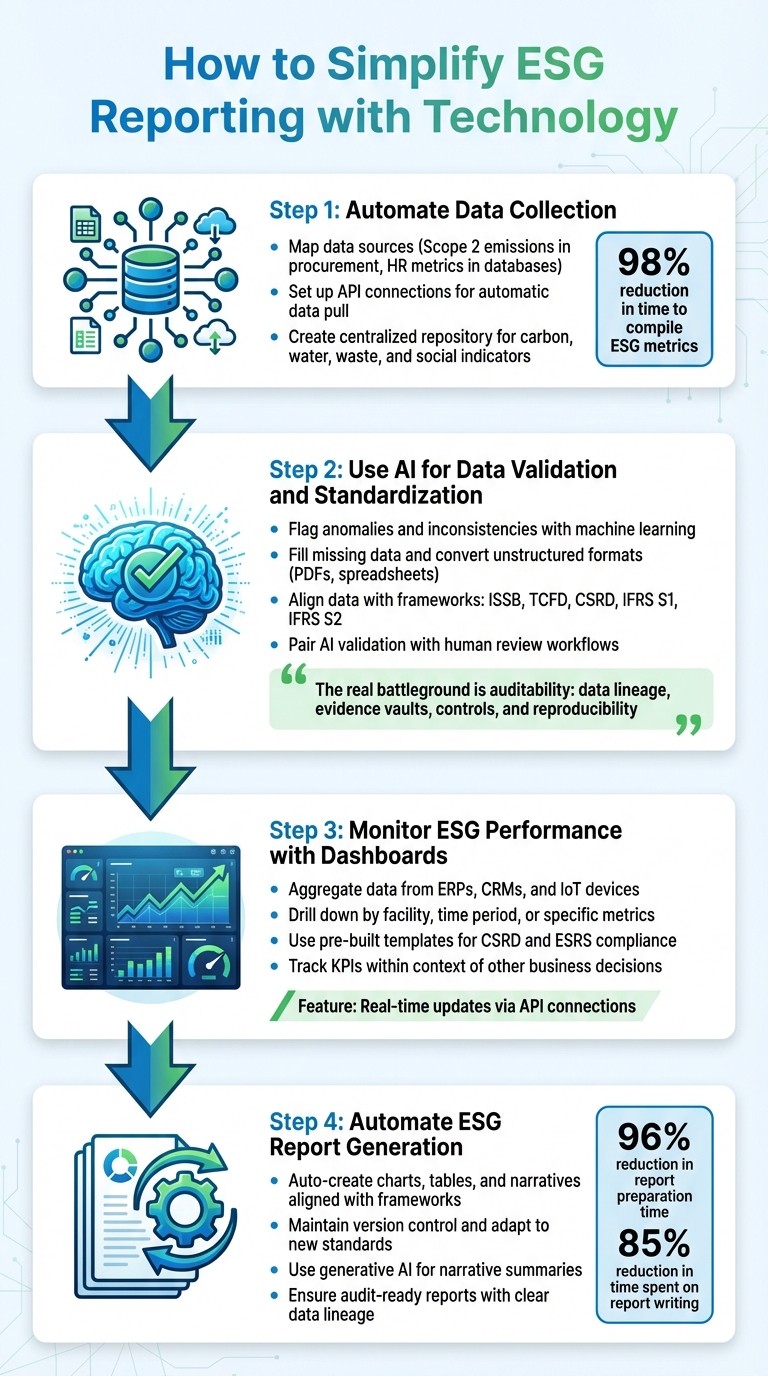
4-Step Process to Automate ESG Reporting with Technology
Shifting from manual spreadsheets to automated systems may seem daunting, but breaking the process into smaller, focused steps can make the transition far easier. By tackling your most pressing challenges first, you can modernize your ESG reporting workflow and lay the groundwork for AI-driven validation and continuous performance tracking.
Step 1: Automate Data Collection
The first step is identifying where your ESG data is stored. For instance, Scope 2 emissions data might be hidden in procurement systems, while HR databases house human capital metrics. Start by mapping your data sources and setting up API connections to pull this data automatically. This eliminates the need for repeated internal data requests across departments [3].
If your organization handles large volumes of data, creating a centralized repository can help consolidate information from scattered sources into a standardized format that covers key metrics like carbon, water, waste, and social indicators [5][10]. Tools like Microsoft Sustainability Manager automate the ingestion of Scope 1-3 emissions, water usage, and waste data directly from utility invoices and activity logs [10]. The benefits are striking: AI-powered sustainability tools can cut the time needed to compile ESG metrics by 98% [8].
Step 2: Use AI for Data Validation and Standardization
Once your data is centralized, AI can ensure its accuracy and compliance. Machine learning algorithms act as quality control, flagging anomalies, addressing inconsistencies, filling in missing data, and converting unstructured formats - like PDFs or spreadsheets - into standardized ones that align with frameworks such as ISSB, TCFD, CSRD, IFRS S1, and IFRS S2 [5][6][11].
AI tools can also scan disclosures against thousands of data points, catching potential errors in seconds [11]. As Adnan Masood, PhD, AI/ML Lead, points out:
"The real battleground is auditability: data lineage, evidence vaults, controls, and reproducibility matter more than model size or novelty" [12].
To ensure accuracy, pair AI validation with human review workflows, allowing for a final check before data reaches stakeholders [12]. Once validated and standardized, this data becomes the foundation for effective ESG performance monitoring.
Step 3: Monitor ESG Performance with Dashboards
Dashboards replace outdated annual reports with real-time monitoring tools. By aggregating data from ERPs, CRMs, and IoT devices, these platforms provide a comprehensive view of ESG performance. You can drill down by facility, time period, or specific metrics, with API connections offering real-time updates instead of outdated figures [3][10][13].
Modern dashboards come with pre-built templates for regulatory frameworks like CSRD and ESRS, simplifying compliance tracking and audit documentation [10][13]. Jessie Miller, Senior Manager of Advisory Services at Novata, advises:
"That's why we encourage companies to not track and analyze sustainability data in a silo, but within the context of other business KPIs and decisions you're making" [7].
Customizable dashboards allow you to focus on KPIs that have the most financial impact, such as carbon accounting and resource efficiency [7].
Step 4: Automate ESG Report Generation
The final step eliminates the tedious process of manually assembling reports. Automation tools can create charts, tables, and narratives aligned with specific frameworks, reducing report preparation time by 96% [8]. These tools also maintain version control and adapt to new standards as they emerge, ensuring data remains aligned with evolving requirements [6][11].
Generative AI features can draft narrative summaries while cross-checking quantitative and qualitative data for consistency, significantly speeding up the reporting process [12][13]. Companies using automated tools experience an 85% reduction in time spent on ESG report writing and finalization [8]. The result? Reports that are ready for audits from day one, complete with clear data lineage and thorough audit trails [12].
How Council Fire Supports ESG Technology Implementation
Expert guidance turns automated ESG tools into strategic assets, ensuring they deliver meaningful outcomes. While technology like automated data collection, AI validation, real-time dashboards, and report generation offers tremendous potential, these tools need a clear strategy to go beyond simply meeting compliance requirements. That’s where Council Fire steps in, connecting technology implementation with broader, impactful sustainability goals.
Tailored ESG Strategies for Long-Term Goals
Council Fire employs a four-step Framework Selection Decision Tree to align technology with both regulatory demands and organizational goals. This process evaluates regulatory requirements, identifies key stakeholders, and assesses resource capacity to ensure a seamless fit between the technology stack and long-term sustainability objectives [1].
For instance, a single dataset can fulfill compliance needs for both CSRD standards and California's SB 253, which mandates Scope 1 and 2 emissions reporting for companies earning over $1 billion starting in 2026 [1]. Recognizing the central role of climate reporting in global regulations, Council Fire prioritizes tools that track greenhouse gas (GHG) emissions and assess climate risks [1].
By setting these tailored strategies, Council Fire ensures that organizations achieve measurable results while addressing both immediate and future ESG challenges.
Turning Data Into Actionable Results
Council Fire’s methodologies go beyond data management to drive meaningful change. Through techniques such as double materiality assessments, stakeholder mapping, and scenario analysis aligned with TCFD guidelines, their approach fosters measurable ESG improvements and enhances long-term resilience [1].
As the push for mandatory assurance gains momentum, with sustainability data audits becoming as standard as financial audits, Council Fire helps organizations establish systems that are audit-ready [1][2]. These systems not only meet compliance standards but also enable impactful initiatives like decarbonization strategies, circular supply chains, and stakeholder-focused planning. The result? Systems that deliver enduring environmental and economic benefits.
Conclusion
Technology has reshaped ESG reporting, turning what was once a labor-intensive compliance task into a tool for strategic growth. Automation, for instance, can cut data collection time by as much as 98% [8]. AI-powered validation reduces the risk of manual errors, while real-time dashboards provide actionable insights, enabling executives to make well-informed decisions with greater confidence.
This evolution highlights the growing importance of efficient ESG reporting in building both investor confidence and consumer trust. Yet, technology alone cannot solve all challenges. As PwC aptly puts it, “Simply adding new technology to outdated or ineffective processes is like renovating your kitchen without fixing the leaky pipes behind your walls” [3]. Success requires expert oversight to align technology with effective strategies and governance. This ensures the identification of key ESG factors and the validation of AI-driven insights.
For organizations aiming to meet these demands, expert guidance becomes essential. Council Fire plays a pivotal role by integrating technology into broader sustainability objectives. Their approach moves beyond treating ESG reporting as a compliance formality. Instead, they focus on enabling tools that drive tangible outcomes, such as decarbonization efforts and circular supply chains. By creating systems ready for audits and equipping internal teams with new skills, Council Fire helps organizations transition from basic compliance to generating meaningful environmental and financial outcomes.
The shift toward mandatory ESG disclosure is reminiscent of the changes brought by the Sarbanes-Oxley Act in 2002 [2]. By leveraging automation and AI, companies can transform compliance into a competitive edge. Those who invest in the right technologies and expertise today will be better equipped to adapt to regulatory changes, meet investor expectations, and explore new revenue opportunities through strategic ESG practices.
FAQs
What ESG data should we automate first?
To get started, prioritize automating ESG data related to regulatory compliance. Key areas include greenhouse gas emissions, energy usage, water consumption, and waste management - essential metrics for adhering to mandatory standards. Beyond compliance, consider automating data for supply chain transparency, social factors like diversity and community involvement, and governance metrics such as board diversity and executive compensation. Automating these processes not only streamlines operations and cuts down on manual workload but also ensures greater accuracy in the data collected.
How do we verify AI-validated ESG data for audits?
Verifying AI-validated ESG data for audits relies on advanced tools to streamline data analysis and enhance accuracy. These AI-powered systems handle vast amounts of unstructured data, cross-reference disclosures with frameworks like CSRD, and identify irregularities. Additionally, many of these tools offer traceable data lineage and apply validation rules, making the process more transparent and audit-ready. This approach strengthens the ability to confirm data integrity with precision and reliability.
How do dashboards help with ongoing ESG compliance?
Dashboards simplify ESG compliance by providing a centralized, real-time platform for managing sustainability data. With these tools, organizations can monitor progress, spot potential challenges early, and stay aligned with regulatory standards. This not only makes tracking more efficient but also aids in making well-informed decisions.
Related Blog Posts
Latest Articles
©2025



FAQ
01
What does it really mean to “redefine profit”?
02
What makes Council Fire different?
03
Who does Council Fire you work with?
04
What does working with Council Fire actually look like?
05
How does Council Fire help organizations turn big goals into action?
06
How does Council Fire define and measure success?
Feb 24, 2026
How Technology Simplifies ESG Reporting
ESG Strategy
In This Article
Automation, AI, and real-time dashboards simplify ESG reporting—cutting errors and time while improving compliance, audit trails, and investor confidence.
How Technology Simplifies ESG Reporting
ESG reporting is evolving, and technology plays a key role in making it more efficient and accurate. Organizations face growing regulatory demands, yet nearly half still rely on outdated manual spreadsheets. This leads to errors, wasted time, and higher costs. With ESG-focused investments nearing $53 trillion by 2025, accuracy is critical for maintaining investor confidence and consumer trust.
Key takeaways:
Manual processes increase errors and inefficiencies in ESG reporting.
Automation and AI streamline data collection, validation, and reporting.
Real-time dashboards provide continuous performance tracking.
Automated tools reduce reporting time by up to 96% and errors significantly.
Generative AI to Simplify ESG Reporting and Prioritize Strategic Opportunities
Benefits of Using Technology in ESG Reporting
Integrating technology into ESG reporting transforms it from a tedious obligation into a strategic advantage. By replacing manual spreadsheets with automated systems, organizations can achieve greater accuracy, save time and money, and gain real-time insights into their performance and compliance. Here's a closer look at how technology delivers these benefits.
Better Accuracy and Fewer Errors
Manual processes often open the door to errors like miscalculations, duplications, and inconsistencies. Automated systems address these risks by replacing spreadsheets with integrated platforms. Tools powered by AI and machine learning act as safeguards, identifying anomalies, flagging omissions, and ensuring data is standardized across frameworks like GRI, TCFD, and CSRD [3][6][7]. These systems provide a single source of truth, ensuring consistency and reliability. Additionally, digital audit trails make disclosures easier to verify, while direct data capture through APIs, IoT devices, and sensors reduces transcription errors and boosts data credibility [3][4].
Time and Cost Savings
Automation significantly reduces the time and expense involved in ESG reporting. Tasks that previously took weeks - such as gathering data from various systems and aligning it with multiple reporting frameworks - can now be completed much faster [6][9]. Mark Fischel from Novata highlights that advancements in AI have not only shortened reporting timelines but also enabled organizations to gain deeper insights and act more decisively [7]. Using a "collect once, report many" approach, validated data can be reused across different frameworks and stakeholders, streamlining future reporting cycles [3].
Real-Time Insights and Compliance Tracking
Technology takes ESG reporting beyond static, annual updates by enabling continuous monitoring. Real-time data provides organizations with up-to-date performance metrics and compliance tracking [6]. Automation tools align regulatory requirements with existing reporting templates, ensuring disclosures meet global standards like CSRD, ESRS, and ISSB [1][6]. AI models further enhance this process by analyzing patterns in emissions, supply chains, and workforce trends, helping organizations spot compliance risks that might go unnoticed in manual reviews. As Jarkko Virranta, Director of Finance Consulting at EY, puts it:
"With increasing investor focus on the ESG performance of an organization, access to quality data and analysis of ESG initiatives is becoming a competitive advantage" [4].
Real-time dashboards also give stakeholders instant access to verified data, fostering transparency and building trust through clear audit trails.
| Feature | Manual Processes | Automated Technology Systems |
| --- | --- | --- |
| Data Collection | Emailing spreadsheets and manual entry | Automated via APIs and system integration |
| Accuracy | Prone to human error and inconsistencies | Built-in validation and error flagging |
| Auditability | Difficult to trace with unclear logs | Comprehensive digital audit trails |
| Reporting Cycle | Manual annual process | Real-time insights with continuous updates |
| Data Structure | Fragmented and siloed | Centralized single source of truth
How to Simplify ESG Reporting with Technology
4-Step Process to Automate ESG Reporting with Technology
Shifting from manual spreadsheets to automated systems may seem daunting, but breaking the process into smaller, focused steps can make the transition far easier. By tackling your most pressing challenges first, you can modernize your ESG reporting workflow and lay the groundwork for AI-driven validation and continuous performance tracking.
Step 1: Automate Data Collection
The first step is identifying where your ESG data is stored. For instance, Scope 2 emissions data might be hidden in procurement systems, while HR databases house human capital metrics. Start by mapping your data sources and setting up API connections to pull this data automatically. This eliminates the need for repeated internal data requests across departments [3].
If your organization handles large volumes of data, creating a centralized repository can help consolidate information from scattered sources into a standardized format that covers key metrics like carbon, water, waste, and social indicators [5][10]. Tools like Microsoft Sustainability Manager automate the ingestion of Scope 1-3 emissions, water usage, and waste data directly from utility invoices and activity logs [10]. The benefits are striking: AI-powered sustainability tools can cut the time needed to compile ESG metrics by 98% [8].
Step 2: Use AI for Data Validation and Standardization
Once your data is centralized, AI can ensure its accuracy and compliance. Machine learning algorithms act as quality control, flagging anomalies, addressing inconsistencies, filling in missing data, and converting unstructured formats - like PDFs or spreadsheets - into standardized ones that align with frameworks such as ISSB, TCFD, CSRD, IFRS S1, and IFRS S2 [5][6][11].
AI tools can also scan disclosures against thousands of data points, catching potential errors in seconds [11]. As Adnan Masood, PhD, AI/ML Lead, points out:
"The real battleground is auditability: data lineage, evidence vaults, controls, and reproducibility matter more than model size or novelty" [12].
To ensure accuracy, pair AI validation with human review workflows, allowing for a final check before data reaches stakeholders [12]. Once validated and standardized, this data becomes the foundation for effective ESG performance monitoring.
Step 3: Monitor ESG Performance with Dashboards
Dashboards replace outdated annual reports with real-time monitoring tools. By aggregating data from ERPs, CRMs, and IoT devices, these platforms provide a comprehensive view of ESG performance. You can drill down by facility, time period, or specific metrics, with API connections offering real-time updates instead of outdated figures [3][10][13].
Modern dashboards come with pre-built templates for regulatory frameworks like CSRD and ESRS, simplifying compliance tracking and audit documentation [10][13]. Jessie Miller, Senior Manager of Advisory Services at Novata, advises:
"That's why we encourage companies to not track and analyze sustainability data in a silo, but within the context of other business KPIs and decisions you're making" [7].
Customizable dashboards allow you to focus on KPIs that have the most financial impact, such as carbon accounting and resource efficiency [7].
Step 4: Automate ESG Report Generation
The final step eliminates the tedious process of manually assembling reports. Automation tools can create charts, tables, and narratives aligned with specific frameworks, reducing report preparation time by 96% [8]. These tools also maintain version control and adapt to new standards as they emerge, ensuring data remains aligned with evolving requirements [6][11].
Generative AI features can draft narrative summaries while cross-checking quantitative and qualitative data for consistency, significantly speeding up the reporting process [12][13]. Companies using automated tools experience an 85% reduction in time spent on ESG report writing and finalization [8]. The result? Reports that are ready for audits from day one, complete with clear data lineage and thorough audit trails [12].
How Council Fire Supports ESG Technology Implementation
Expert guidance turns automated ESG tools into strategic assets, ensuring they deliver meaningful outcomes. While technology like automated data collection, AI validation, real-time dashboards, and report generation offers tremendous potential, these tools need a clear strategy to go beyond simply meeting compliance requirements. That’s where Council Fire steps in, connecting technology implementation with broader, impactful sustainability goals.
Tailored ESG Strategies for Long-Term Goals
Council Fire employs a four-step Framework Selection Decision Tree to align technology with both regulatory demands and organizational goals. This process evaluates regulatory requirements, identifies key stakeholders, and assesses resource capacity to ensure a seamless fit between the technology stack and long-term sustainability objectives [1].
For instance, a single dataset can fulfill compliance needs for both CSRD standards and California's SB 253, which mandates Scope 1 and 2 emissions reporting for companies earning over $1 billion starting in 2026 [1]. Recognizing the central role of climate reporting in global regulations, Council Fire prioritizes tools that track greenhouse gas (GHG) emissions and assess climate risks [1].
By setting these tailored strategies, Council Fire ensures that organizations achieve measurable results while addressing both immediate and future ESG challenges.
Turning Data Into Actionable Results
Council Fire’s methodologies go beyond data management to drive meaningful change. Through techniques such as double materiality assessments, stakeholder mapping, and scenario analysis aligned with TCFD guidelines, their approach fosters measurable ESG improvements and enhances long-term resilience [1].
As the push for mandatory assurance gains momentum, with sustainability data audits becoming as standard as financial audits, Council Fire helps organizations establish systems that are audit-ready [1][2]. These systems not only meet compliance standards but also enable impactful initiatives like decarbonization strategies, circular supply chains, and stakeholder-focused planning. The result? Systems that deliver enduring environmental and economic benefits.
Conclusion
Technology has reshaped ESG reporting, turning what was once a labor-intensive compliance task into a tool for strategic growth. Automation, for instance, can cut data collection time by as much as 98% [8]. AI-powered validation reduces the risk of manual errors, while real-time dashboards provide actionable insights, enabling executives to make well-informed decisions with greater confidence.
This evolution highlights the growing importance of efficient ESG reporting in building both investor confidence and consumer trust. Yet, technology alone cannot solve all challenges. As PwC aptly puts it, “Simply adding new technology to outdated or ineffective processes is like renovating your kitchen without fixing the leaky pipes behind your walls” [3]. Success requires expert oversight to align technology with effective strategies and governance. This ensures the identification of key ESG factors and the validation of AI-driven insights.
For organizations aiming to meet these demands, expert guidance becomes essential. Council Fire plays a pivotal role by integrating technology into broader sustainability objectives. Their approach moves beyond treating ESG reporting as a compliance formality. Instead, they focus on enabling tools that drive tangible outcomes, such as decarbonization efforts and circular supply chains. By creating systems ready for audits and equipping internal teams with new skills, Council Fire helps organizations transition from basic compliance to generating meaningful environmental and financial outcomes.
The shift toward mandatory ESG disclosure is reminiscent of the changes brought by the Sarbanes-Oxley Act in 2002 [2]. By leveraging automation and AI, companies can transform compliance into a competitive edge. Those who invest in the right technologies and expertise today will be better equipped to adapt to regulatory changes, meet investor expectations, and explore new revenue opportunities through strategic ESG practices.
FAQs
What ESG data should we automate first?
To get started, prioritize automating ESG data related to regulatory compliance. Key areas include greenhouse gas emissions, energy usage, water consumption, and waste management - essential metrics for adhering to mandatory standards. Beyond compliance, consider automating data for supply chain transparency, social factors like diversity and community involvement, and governance metrics such as board diversity and executive compensation. Automating these processes not only streamlines operations and cuts down on manual workload but also ensures greater accuracy in the data collected.
How do we verify AI-validated ESG data for audits?
Verifying AI-validated ESG data for audits relies on advanced tools to streamline data analysis and enhance accuracy. These AI-powered systems handle vast amounts of unstructured data, cross-reference disclosures with frameworks like CSRD, and identify irregularities. Additionally, many of these tools offer traceable data lineage and apply validation rules, making the process more transparent and audit-ready. This approach strengthens the ability to confirm data integrity with precision and reliability.
How do dashboards help with ongoing ESG compliance?
Dashboards simplify ESG compliance by providing a centralized, real-time platform for managing sustainability data. With these tools, organizations can monitor progress, spot potential challenges early, and stay aligned with regulatory standards. This not only makes tracking more efficient but also aids in making well-informed decisions.
Related Blog Posts
FAQ
01
What does it really mean to “redefine profit”?
02
What makes Council Fire different?
03
Who does Council Fire you work with?
04
What does working with Council Fire actually look like?
05
How does Council Fire help organizations turn big goals into action?
06
How does Council Fire define and measure success?
Feb 24, 2026
How Technology Simplifies ESG Reporting
ESG Strategy
In This Article
Automation, AI, and real-time dashboards simplify ESG reporting—cutting errors and time while improving compliance, audit trails, and investor confidence.
How Technology Simplifies ESG Reporting
ESG reporting is evolving, and technology plays a key role in making it more efficient and accurate. Organizations face growing regulatory demands, yet nearly half still rely on outdated manual spreadsheets. This leads to errors, wasted time, and higher costs. With ESG-focused investments nearing $53 trillion by 2025, accuracy is critical for maintaining investor confidence and consumer trust.
Key takeaways:
Manual processes increase errors and inefficiencies in ESG reporting.
Automation and AI streamline data collection, validation, and reporting.
Real-time dashboards provide continuous performance tracking.
Automated tools reduce reporting time by up to 96% and errors significantly.
Generative AI to Simplify ESG Reporting and Prioritize Strategic Opportunities
Benefits of Using Technology in ESG Reporting
Integrating technology into ESG reporting transforms it from a tedious obligation into a strategic advantage. By replacing manual spreadsheets with automated systems, organizations can achieve greater accuracy, save time and money, and gain real-time insights into their performance and compliance. Here's a closer look at how technology delivers these benefits.
Better Accuracy and Fewer Errors
Manual processes often open the door to errors like miscalculations, duplications, and inconsistencies. Automated systems address these risks by replacing spreadsheets with integrated platforms. Tools powered by AI and machine learning act as safeguards, identifying anomalies, flagging omissions, and ensuring data is standardized across frameworks like GRI, TCFD, and CSRD [3][6][7]. These systems provide a single source of truth, ensuring consistency and reliability. Additionally, digital audit trails make disclosures easier to verify, while direct data capture through APIs, IoT devices, and sensors reduces transcription errors and boosts data credibility [3][4].
Time and Cost Savings
Automation significantly reduces the time and expense involved in ESG reporting. Tasks that previously took weeks - such as gathering data from various systems and aligning it with multiple reporting frameworks - can now be completed much faster [6][9]. Mark Fischel from Novata highlights that advancements in AI have not only shortened reporting timelines but also enabled organizations to gain deeper insights and act more decisively [7]. Using a "collect once, report many" approach, validated data can be reused across different frameworks and stakeholders, streamlining future reporting cycles [3].
Real-Time Insights and Compliance Tracking
Technology takes ESG reporting beyond static, annual updates by enabling continuous monitoring. Real-time data provides organizations with up-to-date performance metrics and compliance tracking [6]. Automation tools align regulatory requirements with existing reporting templates, ensuring disclosures meet global standards like CSRD, ESRS, and ISSB [1][6]. AI models further enhance this process by analyzing patterns in emissions, supply chains, and workforce trends, helping organizations spot compliance risks that might go unnoticed in manual reviews. As Jarkko Virranta, Director of Finance Consulting at EY, puts it:
"With increasing investor focus on the ESG performance of an organization, access to quality data and analysis of ESG initiatives is becoming a competitive advantage" [4].
Real-time dashboards also give stakeholders instant access to verified data, fostering transparency and building trust through clear audit trails.
| Feature | Manual Processes | Automated Technology Systems |
| --- | --- | --- |
| Data Collection | Emailing spreadsheets and manual entry | Automated via APIs and system integration |
| Accuracy | Prone to human error and inconsistencies | Built-in validation and error flagging |
| Auditability | Difficult to trace with unclear logs | Comprehensive digital audit trails |
| Reporting Cycle | Manual annual process | Real-time insights with continuous updates |
| Data Structure | Fragmented and siloed | Centralized single source of truth
How to Simplify ESG Reporting with Technology
4-Step Process to Automate ESG Reporting with Technology
Shifting from manual spreadsheets to automated systems may seem daunting, but breaking the process into smaller, focused steps can make the transition far easier. By tackling your most pressing challenges first, you can modernize your ESG reporting workflow and lay the groundwork for AI-driven validation and continuous performance tracking.
Step 1: Automate Data Collection
The first step is identifying where your ESG data is stored. For instance, Scope 2 emissions data might be hidden in procurement systems, while HR databases house human capital metrics. Start by mapping your data sources and setting up API connections to pull this data automatically. This eliminates the need for repeated internal data requests across departments [3].
If your organization handles large volumes of data, creating a centralized repository can help consolidate information from scattered sources into a standardized format that covers key metrics like carbon, water, waste, and social indicators [5][10]. Tools like Microsoft Sustainability Manager automate the ingestion of Scope 1-3 emissions, water usage, and waste data directly from utility invoices and activity logs [10]. The benefits are striking: AI-powered sustainability tools can cut the time needed to compile ESG metrics by 98% [8].
Step 2: Use AI for Data Validation and Standardization
Once your data is centralized, AI can ensure its accuracy and compliance. Machine learning algorithms act as quality control, flagging anomalies, addressing inconsistencies, filling in missing data, and converting unstructured formats - like PDFs or spreadsheets - into standardized ones that align with frameworks such as ISSB, TCFD, CSRD, IFRS S1, and IFRS S2 [5][6][11].
AI tools can also scan disclosures against thousands of data points, catching potential errors in seconds [11]. As Adnan Masood, PhD, AI/ML Lead, points out:
"The real battleground is auditability: data lineage, evidence vaults, controls, and reproducibility matter more than model size or novelty" [12].
To ensure accuracy, pair AI validation with human review workflows, allowing for a final check before data reaches stakeholders [12]. Once validated and standardized, this data becomes the foundation for effective ESG performance monitoring.
Step 3: Monitor ESG Performance with Dashboards
Dashboards replace outdated annual reports with real-time monitoring tools. By aggregating data from ERPs, CRMs, and IoT devices, these platforms provide a comprehensive view of ESG performance. You can drill down by facility, time period, or specific metrics, with API connections offering real-time updates instead of outdated figures [3][10][13].
Modern dashboards come with pre-built templates for regulatory frameworks like CSRD and ESRS, simplifying compliance tracking and audit documentation [10][13]. Jessie Miller, Senior Manager of Advisory Services at Novata, advises:
"That's why we encourage companies to not track and analyze sustainability data in a silo, but within the context of other business KPIs and decisions you're making" [7].
Customizable dashboards allow you to focus on KPIs that have the most financial impact, such as carbon accounting and resource efficiency [7].
Step 4: Automate ESG Report Generation
The final step eliminates the tedious process of manually assembling reports. Automation tools can create charts, tables, and narratives aligned with specific frameworks, reducing report preparation time by 96% [8]. These tools also maintain version control and adapt to new standards as they emerge, ensuring data remains aligned with evolving requirements [6][11].
Generative AI features can draft narrative summaries while cross-checking quantitative and qualitative data for consistency, significantly speeding up the reporting process [12][13]. Companies using automated tools experience an 85% reduction in time spent on ESG report writing and finalization [8]. The result? Reports that are ready for audits from day one, complete with clear data lineage and thorough audit trails [12].
How Council Fire Supports ESG Technology Implementation
Expert guidance turns automated ESG tools into strategic assets, ensuring they deliver meaningful outcomes. While technology like automated data collection, AI validation, real-time dashboards, and report generation offers tremendous potential, these tools need a clear strategy to go beyond simply meeting compliance requirements. That’s where Council Fire steps in, connecting technology implementation with broader, impactful sustainability goals.
Tailored ESG Strategies for Long-Term Goals
Council Fire employs a four-step Framework Selection Decision Tree to align technology with both regulatory demands and organizational goals. This process evaluates regulatory requirements, identifies key stakeholders, and assesses resource capacity to ensure a seamless fit between the technology stack and long-term sustainability objectives [1].
For instance, a single dataset can fulfill compliance needs for both CSRD standards and California's SB 253, which mandates Scope 1 and 2 emissions reporting for companies earning over $1 billion starting in 2026 [1]. Recognizing the central role of climate reporting in global regulations, Council Fire prioritizes tools that track greenhouse gas (GHG) emissions and assess climate risks [1].
By setting these tailored strategies, Council Fire ensures that organizations achieve measurable results while addressing both immediate and future ESG challenges.
Turning Data Into Actionable Results
Council Fire’s methodologies go beyond data management to drive meaningful change. Through techniques such as double materiality assessments, stakeholder mapping, and scenario analysis aligned with TCFD guidelines, their approach fosters measurable ESG improvements and enhances long-term resilience [1].
As the push for mandatory assurance gains momentum, with sustainability data audits becoming as standard as financial audits, Council Fire helps organizations establish systems that are audit-ready [1][2]. These systems not only meet compliance standards but also enable impactful initiatives like decarbonization strategies, circular supply chains, and stakeholder-focused planning. The result? Systems that deliver enduring environmental and economic benefits.
Conclusion
Technology has reshaped ESG reporting, turning what was once a labor-intensive compliance task into a tool for strategic growth. Automation, for instance, can cut data collection time by as much as 98% [8]. AI-powered validation reduces the risk of manual errors, while real-time dashboards provide actionable insights, enabling executives to make well-informed decisions with greater confidence.
This evolution highlights the growing importance of efficient ESG reporting in building both investor confidence and consumer trust. Yet, technology alone cannot solve all challenges. As PwC aptly puts it, “Simply adding new technology to outdated or ineffective processes is like renovating your kitchen without fixing the leaky pipes behind your walls” [3]. Success requires expert oversight to align technology with effective strategies and governance. This ensures the identification of key ESG factors and the validation of AI-driven insights.
For organizations aiming to meet these demands, expert guidance becomes essential. Council Fire plays a pivotal role by integrating technology into broader sustainability objectives. Their approach moves beyond treating ESG reporting as a compliance formality. Instead, they focus on enabling tools that drive tangible outcomes, such as decarbonization efforts and circular supply chains. By creating systems ready for audits and equipping internal teams with new skills, Council Fire helps organizations transition from basic compliance to generating meaningful environmental and financial outcomes.
The shift toward mandatory ESG disclosure is reminiscent of the changes brought by the Sarbanes-Oxley Act in 2002 [2]. By leveraging automation and AI, companies can transform compliance into a competitive edge. Those who invest in the right technologies and expertise today will be better equipped to adapt to regulatory changes, meet investor expectations, and explore new revenue opportunities through strategic ESG practices.
FAQs
What ESG data should we automate first?
To get started, prioritize automating ESG data related to regulatory compliance. Key areas include greenhouse gas emissions, energy usage, water consumption, and waste management - essential metrics for adhering to mandatory standards. Beyond compliance, consider automating data for supply chain transparency, social factors like diversity and community involvement, and governance metrics such as board diversity and executive compensation. Automating these processes not only streamlines operations and cuts down on manual workload but also ensures greater accuracy in the data collected.
How do we verify AI-validated ESG data for audits?
Verifying AI-validated ESG data for audits relies on advanced tools to streamline data analysis and enhance accuracy. These AI-powered systems handle vast amounts of unstructured data, cross-reference disclosures with frameworks like CSRD, and identify irregularities. Additionally, many of these tools offer traceable data lineage and apply validation rules, making the process more transparent and audit-ready. This approach strengthens the ability to confirm data integrity with precision and reliability.
How do dashboards help with ongoing ESG compliance?
Dashboards simplify ESG compliance by providing a centralized, real-time platform for managing sustainability data. With these tools, organizations can monitor progress, spot potential challenges early, and stay aligned with regulatory standards. This not only makes tracking more efficient but also aids in making well-informed decisions.
Related Blog Posts
FAQ
What does it really mean to “redefine profit”?
What makes Council Fire different?
Who does Council Fire you work with?
What does working with Council Fire actually look like?
How does Council Fire help organizations turn big goals into action?
How does Council Fire define and measure success?