Dec 31, 2025
How Public-Private Deals Fund Off-Grid Energy
Sustainability Strategy
In This Article
How governments and private investors use grants, loans, PPAs and blended finance to expand off-grid renewable energy and lower costs for underserved communities.
How Public-Private Deals Fund Off-Grid Energy
Delivering electricity to underserved areas requires collaboration between governments and private companies. Public-private partnerships (PPPs) combine public funding with private sector efficiency to finance off-grid renewable energy projects, such as solar systems and mini-grids. These partnerships address two key challenges:
Supply-side funding: Provides capital to energy companies, reducing risks and enabling market entry.
Demand-side subsidies: Makes energy affordable for low-income households through rebates, vouchers, or reduced tariffs.
From 2021 to 2025, these collaborations brought electricity to 58 million people, including 21 million in 2025 alone, while adding 5,552 MW of renewable energy capacity. Key funding tools include grants, concessional loans, and Power Purchase Agreements (PPAs), which secure revenue for energy developers. By structuring partnerships with clear goals, risk-sharing mechanisms, and community engagement, governments and private entities can effectively expand energy access to remote areas.
Panel. Powering progress: public-private partnership investments in energy infrastructure
Funding Mechanisms in Public-Private Deals
Public-Private Partnership Funding Mechanisms for Off-Grid Energy
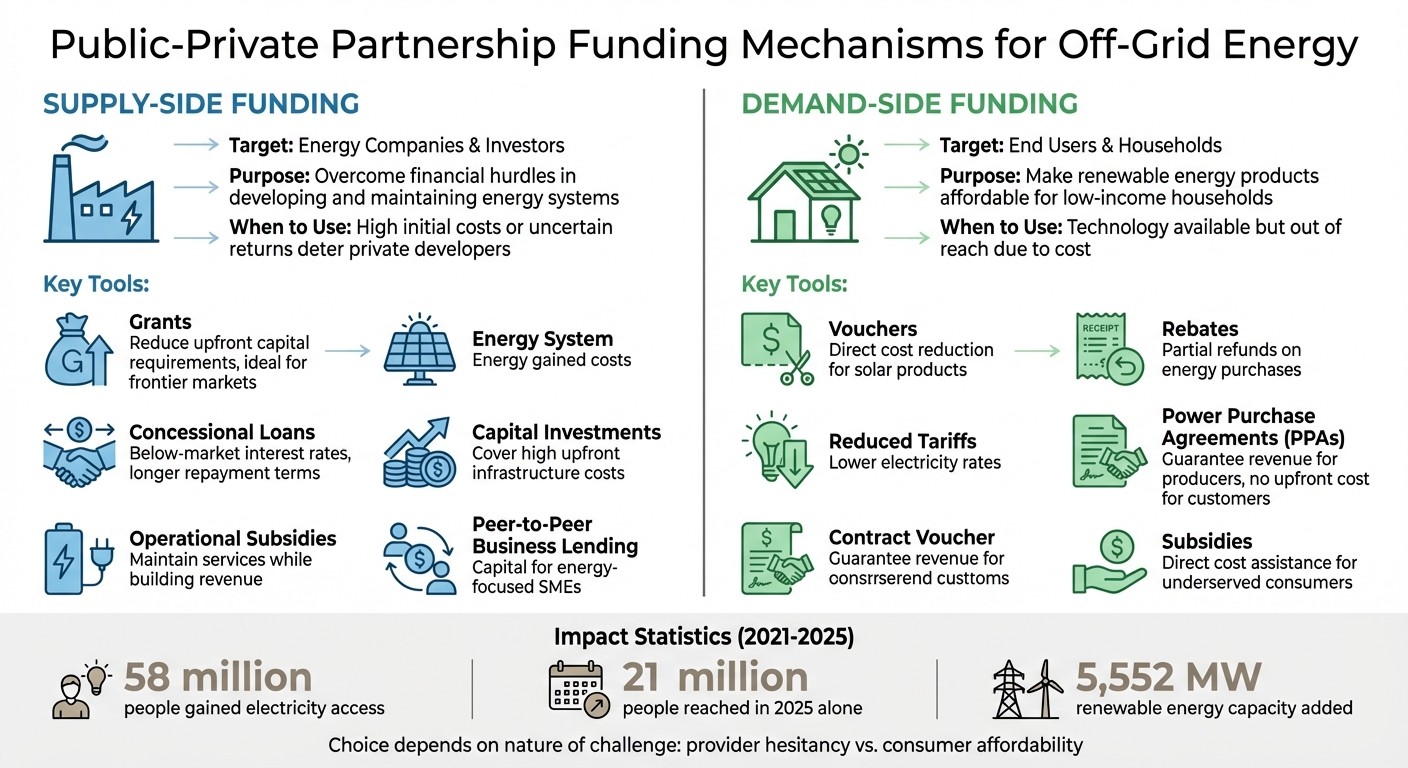
Public-private partnerships use a mix of funding approaches to support off-grid renewable energy projects, each targeting specific challenges. On the supply side, funding flows to energy companies and investors, helping them overcome financial hurdles in developing and maintaining energy systems. On the demand side, subsidies aim to make renewable energy products affordable for households that might otherwise be unable to access them [3].
The choice between these two methods depends on the nature of the challenge. If private developers are hesitant to invest due to high initial costs or uncertain returns, supply-side funding provides the necessary support. On the other hand, when technology is available but remains out of reach for households due to cost, demand-side subsidies step in to bridge the affordability gap. Below, we explore how each approach contributes to advancing off-grid energy initiatives.
Supply-Side Funding for Energy Providers
Supply-side funding plays a critical role in enabling energy companies to establish and sustain off-grid systems, particularly in remote areas. By providing capital for infrastructure development and operational support, these funds reduce the financial risks that often deter private developers from entering underserved markets [3].
Capital investments help cover the high upfront costs of building energy systems, while operational subsidies ensure companies can maintain services as they gradually build revenue from low-income customers. These funding methods have been instrumental in expanding sectors like off-grid solar and pay-as-you-go energy models. Additionally, creative financing options, such as peer-to-peer business lending, have emerged to supply energy-focused small and medium enterprises (SMEs) with much-needed capital [7].
Demand-Side Subsidies for End Users
Demand-side subsidies focus on reducing the cost burden for households, making off-grid solar products more accessible. Mechanisms like vouchers, rebates, and reduced tariffs enable low-income families to afford solar lights, home systems, and energy-efficient appliances [3][9].
For example, in April 2024, the U.S. Environmental Protection Agency (EPA) allocated $7 billion through its Solar for All program to assist state, local, and tribal governments in providing residential solar to millions of low-income households. However, this program faced a setback when the EPA terminated it on August 7, 2025, due to budget adjustments. This decision led to a lawsuit in October 2025 by organizations such as Solar United Neighbors and the Rhode Island AFL-CIO, seeking to restore the funding [8].
Similarly, the USDA's Powering Affordable Clean Energy (PACE) program offered $1 billion in loans, with a cap of $100 million per loan, to support affordable energy solutions in rural communities with populations of 20,000 or fewer. By October 2024, $900 million had already been distributed under this program [10].
These funding strategies are essential in shaping effective public-private partnerships that can deliver sustainable off-grid energy solutions to underserved regions.
How to Structure a Public-Private Partnership for Off-Grid Projects
After securing funding strategies, the next essential step is structuring partnerships to ensure the effective use of those funds.
A strong public-private partnership begins with well-defined goals, whether that’s reducing rates, securing renewable energy certificates (RECs), or both. Early engagement with a broad range of stakeholders - technical, financial, legal experts, and community groups - is vital to ensure technical feasibility, financial stability, and fairness. As of June 2019, third-party solar power purchase agreements (PPAs) were permitted in 28 states and Washington, D.C., with a total of 2.78 GW of solar capacity developed through PPAs by 2017 [6].
Conduct Feasibility Studies and Manage Risks
Feasibility studies are a cornerstone of successful partnerships, confirming both financial and operational viability. Securing revenue through PPAs, which guarantee income for energy producers, is a key element in making high-cost renewable projects attractive to investors [11]. These studies should also outline available government incentives - such as tax credits, grants, and subsidies - that can help lower financial risks. Equally critical is planning for risk allocation, which defines how responsibilities for performance, credit, and operational risks will be divided between public and private entities [11].
Secure Environmental and Grid Connection Approvals
Before construction begins, obtaining the necessary legal and utility interconnection approvals is crucial to avoid project delays. It’s important to confirm whether state or local laws allow third-party agreements and physical PPAs. Collaborating closely with local utilities can help streamline the interconnection process [6]. Environmental compliance is another key step. Partnership agreements must clearly define who owns and retires the RECs. Without REC ownership, public partners cannot legally claim to be using renewable electricity [6].
Negotiate Partnership Agreements and Define Risk Sharing
The partnership agreement outlines roles, responsibilities, and how risks are distributed. Typically, the private developer assumes performance and operational risks, while the public entity takes on payment risk through fixed-rate purchases over a 15–20 year period [6].
A notable example is the District of Columbia’s Department of General Services, which partnered with WGL Energy Systems in 2015 to develop a portfolio of 35 onsite solar projects totaling 10.9 MW. WGL owned the equipment, and the District purchased electricity at a reduced rate, a setup projected to save the city $30 million over the contract term [6]. Similarly, in 2013, the Denver Housing Authority implemented a solar PPA for low-to-moderate income residents, leading to an estimated 15% to 20% reduction in average monthly utility bills [6].
Agreements should also include consumer protections, particularly for projects serving residential or low-income communities. This involves evaluating participants’ ability to pay and ensuring transparency in financing terms to guard against predatory practices. For projects targeting low-to-moderate income households, partnerships can incorporate credit enhancements or connect participants with energy assistance and job training programs to achieve broader social goals [6].
| Risk Type | Primary Bearer | Mitigation Mechanism |
| --- | --- | --- |
| <strong>Performance Risk</strong> | Private Developer | Developer oversees all operations and maintenance (O&M) to ensure energy delivery <a href="https://www.epa.gov/statelocalenergy/customer-power-purchase-agreements" target="_blank" style="text-decoration: none;" rel="nofollow noopener noreferrer" data-framer-link="Link:{"url":"https://www.epa.gov/statelocalenergy/customer-power-purchase-agreements","type":"url"}" data-framer-open-in-new-tab=""><sup>[6]</sup></a> |
| <strong>Credit Risk</strong> | Financier/Developer | Mitigated through prepaid PPAs or credit enhancements, shifting risk to the buyer <a href="https://www.epa.gov/statelocalenergy/customer-power-purchase-agreements" target="_blank" style="text-decoration: none;" rel="nofollow noopener noreferrer" data-framer-link="Link:{"url":"https://www.epa.gov/statelocalenergy/customer-power-purchase-agreements","type":"url"}" data-framer-open-in-new-tab=""><sup>[6]</sup></a> |
| <strong>Upfront Capital Risk</strong> | Private Investor | Third-party investors provide funding, eliminating upfront costs for the public entity <a href="https://www.epa.gov/statelocalenergy/customer-power-purchase-agreements" target="_blank" style="text-decoration: none;" rel="nofollow noopener noreferrer" data-framer-link="Link:{"url":"https://www.epa.gov/statelocalenergy/customer-power-purchase-agreements","type":"url"}" data-framer-open-in-new-tab=""><sup>[6]</sup></a> |
| <strong>Regulatory Risk</strong> | Government | Legislators create enabling laws and consumer protection frameworks <a href="https://www.epa.gov/statelocalenergy/customer-power-purchase-agreements" target="_blank" style="text-decoration: none;" rel="nofollow noopener noreferrer" data-framer-link="Link:{"url":"https://www.epa.gov/statelocalenergy/customer-power-purchase-agreements","type":"url"}" data-framer-open-in-new-tab=""><sup>[6]</sup></a> |
| Risk Type | Primary Bearer | Mitigation Mechanism |
| --- | --- | --- |
| <strong>Performance Risk</strong> | Private Developer | Developer oversees all operations and maintenance (O&M) to ensure energy delivery <a href="https://www.epa.gov/statelocalenergy/customer-power-purchase-agreements" target="_blank" style="text-decoration: none;" rel="nofollow noopener noreferrer" data-framer-link="Link:{"url":"https://www.epa.gov/statelocalenergy/customer-power-purchase-agreements","type":"url"}" data-framer-open-in-new-tab=""><sup>[6]</sup></a> |
| <strong>Credit Risk</strong> | Financier/Developer | Mitigated through prepaid PPAs or credit enhancements, shifting risk to the buyer <a href="https://www.epa.gov/statelocalenergy/customer-power-purchase-agreements" target="_blank" style="text-decoration: none;" rel="nofollow noopener noreferrer" data-framer-link="Link:{"url":"https://www.epa.gov/statelocalenergy/customer-power-purchase-agreements","type":"url"}" data-framer-open-in-new-tab=""><sup>[6]</sup></a> |
| <strong>Upfront Capital Risk</strong> | Private Investor | Third-party investors provide funding, eliminating upfront costs for the public entity <a href="https://www.epa.gov/statelocalenergy/customer-power-purchase-agreements" target="_blank" style="text-decoration: none;" rel="nofollow noopener noreferrer" data-framer-link="Link:{"url":"https://www.epa.gov/statelocalenergy/customer-power-purchase-agreements","type":"url"}" data-framer-open-in-new-tab=""><sup>[6]</sup></a> |
| <strong>Regulatory Risk</strong> | Government | Legislators create enabling laws and consumer protection frameworks <a href="https://www.epa.gov/statelocalenergy/customer-power-purchase-agreements" target="_blank" style="text-decoration: none;" rel="nofollow noopener noreferrer" data-framer-link="Link:{"url":"https://www.epa.gov/statelocalenergy/customer-power-purchase-agreements","type":"url"}" data-framer-open-in-new-tab=""><sup>[6]</sup></a> |For customized guidance in navigating the complexities of public-private partnerships for off-grid energy projects, organizations can turn to expert resources like Council Fire (https://councilfire.org).
Financial Incentives and Blended Finance
Expanding on earlier discussions about funding models and risk-sharing in public-private partnerships, financial incentives and blended finance have emerged as effective ways to close investment gaps in off-grid energy projects. These strategies merge public or philanthropic funding with private capital to reduce risks and improve returns, making high-risk projects more appealing to commercial investors who might otherwise avoid them [3][4].
This approach emphasizes the strategic use of capital. Supply-side funding targets companies and investors, lowering the cost and risk of delivering energy solutions to remote areas through grants or concessional loans. On the other hand, demand-side funding focuses on end users, making off-grid systems more affordable by using subsidies [3]. Supply-side measures are most effective when providers face high risks, while demand-side support is better suited to address affordability challenges for consumers [3].
Below, we delve into the financial tools that bring these approaches to life.
Grants, Loans, and Complementary Financial Instruments
A variety of financial instruments play crucial roles in off-grid energy partnerships, each tailored to meet specific needs:
Grants: These reduce upfront capital requirements, making them particularly useful in frontier markets where commercial viability is uncertain [3].
Concessional loans: Offering below-market interest rates and longer repayment terms, these loans ease the debt burden for small and medium-sized energy enterprises, improving their financial sustainability [3][4].
Power Purchase Agreements (PPAs): These agreements guarantee revenue for energy producers, functioning as an effective demand-side tool. For instance, as of June 2025, 28 U.S. states, along with Washington, D.C., and Puerto Rico, allow third-party PPAs for solar photovoltaic systems [2]. PPAs transfer technical and performance risks to developers while enabling customers to access clean energy without needing upfront capital.
In addition, technology-driven financial innovations are reshaping how off-grid providers access funding. Platforms for peer-to-peer business lending and pay-as-you-go models have become staples in the off-grid solar sector, streamlining payment collection and simplifying capital raising [4][5].
Comparison of Grants, Loans, and Subsidies
Here’s a comparative look at some of the most commonly used financial instruments in off-grid public-private partnerships:
| Instrument | Primary Target | Advantage | Disadvantage |
| --- | --- | --- | --- |
| <strong>Grants</strong> | Supply or Demand | Lowers upfront costs; ideal for high-risk or frontier markets <a href="https://www.esmap.org/Designing%20Public%20Funding%20Mechanisms%20in%20the%20Off-Grid%20Solar%20Sector" target="_blank" style="text-decoration: none;" rel="nofollow noopener noreferrer" data-framer-link="Link:{"url":"https://www.esmap.org/Designing%20Public%20Funding%20Mechanisms%20in%20the%20Off-Grid%20Solar%20Sector","type":"url"}" data-framer-open-in-new-tab=""><sup>[3]</sup></a> | Limited scalability; reliant on donor or government funding <a href="https://www.esmap.org/Designing%20Public%20Funding%20Mechanisms%20in%20the%20Off-Grid%20Solar%20Sector" target="_blank" style="text-decoration: none;" rel="nofollow noopener noreferrer" data-framer-link="Link:{"url":"https://www.esmap.org/Designing%20Public%20Funding%20Mechanisms%20in%20the%20Off-Grid%20Solar%20Sector","type":"url"}" data-framer-open-in-new-tab=""><sup>[3]</sup></a> |
| <strong>Concessional Loans</strong> | Supply-side | Reduces interest rates; improves cash flow for businesses <a href="https://www.esmap.org/Designing%20Public%20Funding%20Mechanisms%20in%20the%20Off-Grid%20Solar%20Sector" target="_blank" style="text-decoration: none;" rel="nofollow noopener noreferrer" data-framer-link="Link:{"url":"https://www.esmap.org/Designing%20Public%20Funding%20Mechanisms%20in%20the%20Off-Grid%20Solar%20Sector","type":"url"}" data-framer-open-in-new-tab=""><sup>[3]</sup></a> | Requires creditworthy borrowers; adds debt to financial statements <a href="https://betterbuildingssolutioncenter.energy.gov/renewables/financing" target="_blank" style="text-decoration: none;" rel="nofollow noopener noreferrer" data-framer-link="Link:{"url":"https://betterbuildingssolutioncenter.energy.gov/renewables/financing","type":"url"}" data-framer-open-in-new-tab=""><sup>[12]</sup></a> |
| <strong>Tax Credits</strong> | Supply-side | Encourages private investment and manufacturing <a href="https://betterbuildingssolutioncenter.energy.gov/renewables/financing" target="_blank" style="text-decoration: none;" rel="nofollow noopener noreferrer" data-framer-link="Link:{"url":"https://betterbuildingssolutioncenter.energy.gov/renewables/financing","type":"url"}" data-framer-open-in-new-tab=""><sup>[12]</sup></a> | Only benefits entities with sufficient tax liability; can be complex to navigate <a href="https://betterbuildingssolutioncenter.energy.gov/renewables/financing" target="_blank" style="text-decoration: none;" rel="nofollow noopener noreferrer" data-framer-link="Link:{"url":"https://betterbuildingssolutioncenter.energy.gov/renewables/financing","type":"url"}" data-framer-open-in-new-tab=""><sup>[12]</sup></a> |
| <strong>PPAs</strong> | Demand-side | No upfront investment needed; shifts operational risks to the developer <a href="https://betterbuildingssolutioncenter.energy.gov/renewables/financing" target="_blank" style="text-decoration: none;" rel="nofollow noopener noreferrer" data-framer-link="Link:{"url":"https://betterbuildingssolutioncenter.energy.gov/renewables/financing","type":"url"}" data-framer-open-in-new-tab=""><sup>[12]</sup></a> | Involves long-term contracts; requires complex legal arrangements <a href="https://betterbuildingssolutioncenter.energy.gov/renewables/financing" target="_blank" style="text-decoration: none;" rel="nofollow noopener noreferrer" data-framer-link="Link:{"url":"https://betterbuildingssolutioncenter.energy.gov/renewables/financing","type":"url"}" data-framer-open-in-new-tab=""><sup>[12]</sup></a> |
| <strong>Subsidies</strong> | Demand-side | Directly reduces costs for underserved consumers <a href="https://www.esmap.org/Designing%20Public%20Funding%20Mechanisms%20in%20the%20Off-Grid%20Solar%20Sector" target="_blank" style="text-decoration: none;" rel="nofollow noopener noreferrer" data-framer-link="Link:{"url":"https://www.esmap.org/Designing%20Public%20Funding%20Mechanisms%20in%20the%20Off-Grid%20Solar%20Sector","type":"url"}" data-framer-open-in-new-tab=""><sup>[3]</sup></a> | Can distort markets; requires consistent long-term funding <a href="https://www.esmap.org/Designing%20Public%20Funding%20Mechanisms%20in%20the%20Off-Grid%20Solar%20Sector" target="_blank" style="text-decoration: none;" rel="nofollow noopener noreferrer" data-framer-link="Link:{"url":"https://www.esmap.org/Designing%20Public%20Funding%20Mechanisms%20in%20the%20Off-Grid%20Solar%20Sector","type":"url"}" data-framer-open-in-new-tab=""><sup>[3]</sup></a> || Instrument | Primary Target | Advantage | Disadvantage |
| --- | --- | --- | --- |
| <strong>Grants</strong> | Supply or Demand | Lowers upfront costs; ideal for high-risk or frontier markets <a href="https://www.esmap.org/Designing%20Public%20Funding%20Mechanisms%20in%20the%20Off-Grid%20Solar%20Sector" target="_blank" style="text-decoration: none;" rel="nofollow noopener noreferrer" data-framer-link="Link:{"url":"https://www.esmap.org/Designing%20Public%20Funding%20Mechanisms%20in%20the%20Off-Grid%20Solar%20Sector","type":"url"}" data-framer-open-in-new-tab=""><sup>[3]</sup></a> | Limited scalability; reliant on donor or government funding <a href="https://www.esmap.org/Designing%20Public%20Funding%20Mechanisms%20in%20the%20Off-Grid%20Solar%20Sector" target="_blank" style="text-decoration: none;" rel="nofollow noopener noreferrer" data-framer-link="Link:{"url":"https://www.esmap.org/Designing%20Public%20Funding%20Mechanisms%20in%20the%20Off-Grid%20Solar%20Sector","type":"url"}" data-framer-open-in-new-tab=""><sup>[3]</sup></a> |
| <strong>Concessional Loans</strong> | Supply-side | Reduces interest rates; improves cash flow for businesses <a href="https://www.esmap.org/Designing%20Public%20Funding%20Mechanisms%20in%20the%20Off-Grid%20Solar%20Sector" target="_blank" style="text-decoration: none;" rel="nofollow noopener noreferrer" data-framer-link="Link:{"url":"https://www.esmap.org/Designing%20Public%20Funding%20Mechanisms%20in%20the%20Off-Grid%20Solar%20Sector","type":"url"}" data-framer-open-in-new-tab=""><sup>[3]</sup></a> | Requires creditworthy borrowers; adds debt to financial statements <a href="https://betterbuildingssolutioncenter.energy.gov/renewables/financing" target="_blank" style="text-decoration: none;" rel="nofollow noopener noreferrer" data-framer-link="Link:{"url":"https://betterbuildingssolutioncenter.energy.gov/renewables/financing","type":"url"}" data-framer-open-in-new-tab=""><sup>[12]</sup></a> |
| <strong>Tax Credits</strong> | Supply-side | Encourages private investment and manufacturing <a href="https://betterbuildingssolutioncenter.energy.gov/renewables/financing" target="_blank" style="text-decoration: none;" rel="nofollow noopener noreferrer" data-framer-link="Link:{"url":"https://betterbuildingssolutioncenter.energy.gov/renewables/financing","type":"url"}" data-framer-open-in-new-tab=""><sup>[12]</sup></a> | Only benefits entities with sufficient tax liability; can be complex to navigate <a href="https://betterbuildingssolutioncenter.energy.gov/renewables/financing" target="_blank" style="text-decoration: none;" rel="nofollow noopener noreferrer" data-framer-link="Link:{"url":"https://betterbuildingssolutioncenter.energy.gov/renewables/financing","type":"url"}" data-framer-open-in-new-tab=""><sup>[12]</sup></a> |
| <strong>PPAs</strong> | Demand-side | No upfront investment needed; shifts operational risks to the developer <a href="https://betterbuildingssolutioncenter.energy.gov/renewables/financing" target="_blank" style="text-decoration: none;" rel="nofollow noopener noreferrer" data-framer-link="Link:{"url":"https://betterbuildingssolutioncenter.energy.gov/renewables/financing","type":"url"}" data-framer-open-in-new-tab=""><sup>[12]</sup></a> | Involves long-term contracts; requires complex legal arrangements <a href="https://betterbuildingssolutioncenter.energy.gov/renewables/financing" target="_blank" style="text-decoration: none;" rel="nofollow noopener noreferrer" data-framer-link="Link:{"url":"https://betterbuildingssolutioncenter.energy.gov/renewables/financing","type":"url"}" data-framer-open-in-new-tab=""><sup>[12]</sup></a> |
| <strong>Subsidies</strong> | Demand-side | Directly reduces costs for underserved consumers <a href="https://www.esmap.org/Designing%20Public%20Funding%20Mechanisms%20in%20the%20Off-Grid%20Solar%20Sector" target="_blank" style="text-decoration: none;" rel="nofollow noopener noreferrer" data-framer-link="Link:{"url":"https://www.esmap.org/Designing%20Public%20Funding%20Mechanisms%20in%20the%20Off-Grid%20Solar%20Sector","type":"url"}" data-framer-open-in-new-tab=""><sup>[3]</sup></a> | Can distort markets; requires consistent long-term funding <a href="https://www.esmap.org/Designing%20Public%20Funding%20Mechanisms%20in%20the%20Off-Grid%20Solar%20Sector" target="_blank" style="text-decoration: none;" rel="nofollow noopener noreferrer" data-framer-link="Link:{"url":"https://www.esmap.org/Designing%20Public%20Funding%20Mechanisms%20in%20the%20Off-Grid%20Solar%20Sector","type":"url"}" data-framer-open-in-new-tab=""><sup>[3]</sup></a> |Organizations like Council Fire (https://councilfire.org) specialize in guiding the development of public-private partnerships that deliver sustainable off-grid energy solutions. By leveraging these financial tools, stakeholders can create impactful and lasting energy initiatives.
Case Studies of Off-Grid PPP Models
Examples from around the globe highlight how public–private partnerships (PPPs) can bridge funding gaps and bring energy solutions to communities that traditional providers often overlook. One standout example is the Connecticut "Solar for All" program, a collaboration between the Connecticut Green Bank and PosiGen, a private solar provider. This initiative focused on low- to moderate-income households, a demographic largely ignored by conventional solar companies.
The Connecticut Green Bank contributed $5 million in subordinated debt and a $3.5 million working capital loan to PosiGen's lease fund. This public investment unlocked $37 million in private funding, achieving a 7-to-1 leverage ratio. By mid-2018, the program had facilitated 1,651 solar installations worth $46 million in equipment [13]. Instead of relying on traditional credit checks, the program used community-focused marketing and guaranteed electricity production. Families in Bridgeport, for instance, reduced their energy bills by over $1,280 annually through a solar lease costing approximately $75 per month, with an optional $10 add-on for efficiency upgrades [13]. The results were striking: solar adoption in low-income communities surged by 188%, with 30% to 40% of new sales coming from customer referrals once the savings became evident [13]. This success story offers a blueprint for similar efforts in other countries.
On the international stage, the IFC's Scaling Solar program demonstrates how standardized solutions can fast-track off-grid energy projects in developing nations. For example, in 2021, the IFC structured a 100-megawatt solar PPP to help diversify Uzbekistan's energy portfolio [14]. The program equips governments with standardized toolkits that lower transaction costs and create investment-ready projects. This model has proven particularly useful in countries with limited fiscal resources, where public funding alone cannot meet renewable energy goals.
These case studies highlight essential strategies for overcoming funding challenges, such as public credit enhancement, community involvement, standardized contracts, and lease-to-own options. Organizations like Council Fire (https://councilfire.org) play a pivotal role in designing these partnerships by aligning financial tools with community priorities and ensuring long-term success through collaborative efforts.
Implementation and Risk Mitigation
Implementing PPP off-grid projects requires careful attention to how risks are distributed. A well-structured project assigns risks to the parties best positioned to manage them. For instance, private companies typically take on technical and operational risks due to their expertise, while governments oversee regulatory and policy risks within their jurisdiction [1].
Power Purchase Agreements (PPAs) play a central role in managing these risks. They establish clear terms for energy sales, payment schedules, and technical performance, while also defining the roles and responsibilities of each party [15]. By setting expectations upfront, PPAs reduce disputes and build investor confidence. Expanding on these frameworks, newer models like the PfPPP incorporate broader social and environmental considerations.
The "People-first Public-Private Partnerships" (PfPPPs) framework, updated in December 2025, has become a key approach in balancing financial returns with social and environmental goals. This model aligns projects with United Nations Sustainable Development Goals, ensuring they remain attractive to private investors while delivering meaningful community benefits [16]. According to UN guidance, achieving this balance is critical for fostering sustainable renewable energy investments [16].
Early engagement with local communities is another vital step in mitigating risks. Securing a social license - essentially, community approval - helps avoid delays, while gender-responsive measures address social risks. For example, implementing safeguards against gender-based violence and creating opportunities for women throughout project operations not only fulfills ethical obligations but also strengthens community relations. These strategies complement the financial and structural elements of off-grid energy partnerships, creating a more resilient foundation.
Transparency is equally important. A zero-tolerance stance on corruption builds trust and attracts quality private partners. Transparent procurement processes and anti-corruption commitments ensure investments remain secure and appealing. Organizations like Council Fire (https://councilfire.org) bring expertise in aligning financial tools with community needs, enhancing both risk management and the overall attractiveness of these investments.
Conclusion
Public-private partnerships play a crucial role in financing off-grid renewable energy projects, effectively bridging the gap between government goals and private sector investment. Tools like Power Purchase Agreements, blended finance, and funding approaches on both the supply and demand sides make it possible to turn previously unviable projects into attractive opportunities for investors. At the same time, these efforts extend energy access to communities that have long been underserved.
In fiscal year 2025, the Energy Sector Management Assistance Program made significant strides, providing electricity access to 21 million people and enabling the development of 5,552 MW of renewable energy through collaborative public-private efforts. Since FY2021, these initiatives have collectively reached 58 million people [3]. Such results underscore the importance of well-structured risk allocation and transparent processes, which align incentives to deliver both financial returns and meaningful social benefits.
"The private sector holds the most promise in financing future efforts... this is necessary in order to achieve the level of investment needed to continue the energy transition that governments do not have the capacity for." - United Nations Environment Programme [11]
Achieving success in these partnerships requires a focus on risk mitigation, clear and transparent procurement practices, and early engagement with local communities. Examples like Nicaragua's tax incentives in 2025 or Morocco's strategic use of PPAs to double electricity generation capacity [11] demonstrate how governments can create the right conditions for private investment. In turn, private partners contribute the capital and technical expertise needed to bring these projects to life.
With strong funding models and well-defined partnership frameworks, public-private collaborations are driving progress in off-grid energy solutions. For organizations aiming to develop their own initiatives, specialized support can make all the difference. Council Fire (https://councilfire.org) offers strategic guidance to help governments, nonprofits, and private companies align financial tools with sustainability objectives. By fostering collaboration among stakeholders and employing systems-based planning, they help translate ambitious energy access goals into actionable, scalable projects. These proven approaches provide a pathway to turning off-grid energy efforts into lasting successes.
FAQs
What are the benefits of public-private partnerships for off-grid energy projects?
Public-private partnerships (PPPs) bring together government support and private-sector know-how to tackle the financial and logistical hurdles of off-grid renewable energy projects. By leveraging public funds or guarantees to minimize risks, these partnerships encourage substantial private investment, paving the way for quicker rollout of solutions like solar home systems and pay-as-you-go (PAYG) models.
In addition to funding, PPPs play a key role in shaping a favorable policy landscape. They simplify permitting processes, establish clear power purchase agreements (PPAs), and introduce reforms that make projects more attractive to investors. This approach delivers multiple benefits: underserved communities gain access to affordable and reliable electricity, users face lower upfront costs, and projects achieve long-term financial stability. PPPs successfully align public objectives - such as increasing energy access and advancing climate goals - with the private sector’s drive for efficiency and innovation.
How do demand-side subsidies help make renewable energy more affordable for low-income households?
Demand-side subsidies, including rebates, vouchers, and tax credits, are designed to make renewable energy systems, such as solar panels, more affordable. These financial incentives not only reduce the initial cost of installation but also help lower electricity bills over time, particularly benefiting low-income households.
By easing the upfront financial burden and offering continued savings, these programs are instrumental in making clean energy options more attainable for families who might otherwise find them out of reach.
How do Power Purchase Agreements help fund off-grid renewable energy projects?
Power Purchase Agreements (PPAs) are essential in financing off-grid renewable energy projects. These long-term contracts establish the terms for purchasing electricity generated by such projects, ensuring a steady and reliable revenue stream. This income helps cover operating expenses, repay loans, and provide returns to investors.
By guaranteeing predictable revenue through agreements with dependable buyers, PPAs enhance the appeal of renewable energy projects to both lenders and investors. This financial security plays a crucial role in obtaining the funding needed to develop and maintain off-grid energy solutions.
Related Blog Posts
Latest Articles
©2025



FAQ
01
What does it really mean to “redefine profit”?
02
What makes Council Fire different?
03
Who does Council Fire you work with?
04
What does working with Council Fire actually look like?
05
How does Council Fire help organizations turn big goals into action?
06
How does Council Fire define and measure success?
Dec 31, 2025
How Public-Private Deals Fund Off-Grid Energy
Sustainability Strategy
In This Article
How governments and private investors use grants, loans, PPAs and blended finance to expand off-grid renewable energy and lower costs for underserved communities.
How Public-Private Deals Fund Off-Grid Energy
Delivering electricity to underserved areas requires collaboration between governments and private companies. Public-private partnerships (PPPs) combine public funding with private sector efficiency to finance off-grid renewable energy projects, such as solar systems and mini-grids. These partnerships address two key challenges:
Supply-side funding: Provides capital to energy companies, reducing risks and enabling market entry.
Demand-side subsidies: Makes energy affordable for low-income households through rebates, vouchers, or reduced tariffs.
From 2021 to 2025, these collaborations brought electricity to 58 million people, including 21 million in 2025 alone, while adding 5,552 MW of renewable energy capacity. Key funding tools include grants, concessional loans, and Power Purchase Agreements (PPAs), which secure revenue for energy developers. By structuring partnerships with clear goals, risk-sharing mechanisms, and community engagement, governments and private entities can effectively expand energy access to remote areas.
Panel. Powering progress: public-private partnership investments in energy infrastructure
Funding Mechanisms in Public-Private Deals
Public-Private Partnership Funding Mechanisms for Off-Grid Energy
Public-private partnerships use a mix of funding approaches to support off-grid renewable energy projects, each targeting specific challenges. On the supply side, funding flows to energy companies and investors, helping them overcome financial hurdles in developing and maintaining energy systems. On the demand side, subsidies aim to make renewable energy products affordable for households that might otherwise be unable to access them [3].
The choice between these two methods depends on the nature of the challenge. If private developers are hesitant to invest due to high initial costs or uncertain returns, supply-side funding provides the necessary support. On the other hand, when technology is available but remains out of reach for households due to cost, demand-side subsidies step in to bridge the affordability gap. Below, we explore how each approach contributes to advancing off-grid energy initiatives.
Supply-Side Funding for Energy Providers
Supply-side funding plays a critical role in enabling energy companies to establish and sustain off-grid systems, particularly in remote areas. By providing capital for infrastructure development and operational support, these funds reduce the financial risks that often deter private developers from entering underserved markets [3].
Capital investments help cover the high upfront costs of building energy systems, while operational subsidies ensure companies can maintain services as they gradually build revenue from low-income customers. These funding methods have been instrumental in expanding sectors like off-grid solar and pay-as-you-go energy models. Additionally, creative financing options, such as peer-to-peer business lending, have emerged to supply energy-focused small and medium enterprises (SMEs) with much-needed capital [7].
Demand-Side Subsidies for End Users
Demand-side subsidies focus on reducing the cost burden for households, making off-grid solar products more accessible. Mechanisms like vouchers, rebates, and reduced tariffs enable low-income families to afford solar lights, home systems, and energy-efficient appliances [3][9].
For example, in April 2024, the U.S. Environmental Protection Agency (EPA) allocated $7 billion through its Solar for All program to assist state, local, and tribal governments in providing residential solar to millions of low-income households. However, this program faced a setback when the EPA terminated it on August 7, 2025, due to budget adjustments. This decision led to a lawsuit in October 2025 by organizations such as Solar United Neighbors and the Rhode Island AFL-CIO, seeking to restore the funding [8].
Similarly, the USDA's Powering Affordable Clean Energy (PACE) program offered $1 billion in loans, with a cap of $100 million per loan, to support affordable energy solutions in rural communities with populations of 20,000 or fewer. By October 2024, $900 million had already been distributed under this program [10].
These funding strategies are essential in shaping effective public-private partnerships that can deliver sustainable off-grid energy solutions to underserved regions.
How to Structure a Public-Private Partnership for Off-Grid Projects
After securing funding strategies, the next essential step is structuring partnerships to ensure the effective use of those funds.
A strong public-private partnership begins with well-defined goals, whether that’s reducing rates, securing renewable energy certificates (RECs), or both. Early engagement with a broad range of stakeholders - technical, financial, legal experts, and community groups - is vital to ensure technical feasibility, financial stability, and fairness. As of June 2019, third-party solar power purchase agreements (PPAs) were permitted in 28 states and Washington, D.C., with a total of 2.78 GW of solar capacity developed through PPAs by 2017 [6].
Conduct Feasibility Studies and Manage Risks
Feasibility studies are a cornerstone of successful partnerships, confirming both financial and operational viability. Securing revenue through PPAs, which guarantee income for energy producers, is a key element in making high-cost renewable projects attractive to investors [11]. These studies should also outline available government incentives - such as tax credits, grants, and subsidies - that can help lower financial risks. Equally critical is planning for risk allocation, which defines how responsibilities for performance, credit, and operational risks will be divided between public and private entities [11].
Secure Environmental and Grid Connection Approvals
Before construction begins, obtaining the necessary legal and utility interconnection approvals is crucial to avoid project delays. It’s important to confirm whether state or local laws allow third-party agreements and physical PPAs. Collaborating closely with local utilities can help streamline the interconnection process [6]. Environmental compliance is another key step. Partnership agreements must clearly define who owns and retires the RECs. Without REC ownership, public partners cannot legally claim to be using renewable electricity [6].
Negotiate Partnership Agreements and Define Risk Sharing
The partnership agreement outlines roles, responsibilities, and how risks are distributed. Typically, the private developer assumes performance and operational risks, while the public entity takes on payment risk through fixed-rate purchases over a 15–20 year period [6].
A notable example is the District of Columbia’s Department of General Services, which partnered with WGL Energy Systems in 2015 to develop a portfolio of 35 onsite solar projects totaling 10.9 MW. WGL owned the equipment, and the District purchased electricity at a reduced rate, a setup projected to save the city $30 million over the contract term [6]. Similarly, in 2013, the Denver Housing Authority implemented a solar PPA for low-to-moderate income residents, leading to an estimated 15% to 20% reduction in average monthly utility bills [6].
Agreements should also include consumer protections, particularly for projects serving residential or low-income communities. This involves evaluating participants’ ability to pay and ensuring transparency in financing terms to guard against predatory practices. For projects targeting low-to-moderate income households, partnerships can incorporate credit enhancements or connect participants with energy assistance and job training programs to achieve broader social goals [6].
| Risk Type | Primary Bearer | Mitigation Mechanism |
| --- | --- | --- |
| <strong>Performance Risk</strong> | Private Developer | Developer oversees all operations and maintenance (O&M) to ensure energy delivery <a href="https://www.epa.gov/statelocalenergy/customer-power-purchase-agreements" target="_blank" style="text-decoration: none;" rel="nofollow noopener noreferrer" data-framer-link="Link:{"url":"https://www.epa.gov/statelocalenergy/customer-power-purchase-agreements","type":"url"}" data-framer-open-in-new-tab=""><sup>[6]</sup></a> |
| <strong>Credit Risk</strong> | Financier/Developer | Mitigated through prepaid PPAs or credit enhancements, shifting risk to the buyer <a href="https://www.epa.gov/statelocalenergy/customer-power-purchase-agreements" target="_blank" style="text-decoration: none;" rel="nofollow noopener noreferrer" data-framer-link="Link:{"url":"https://www.epa.gov/statelocalenergy/customer-power-purchase-agreements","type":"url"}" data-framer-open-in-new-tab=""><sup>[6]</sup></a> |
| <strong>Upfront Capital Risk</strong> | Private Investor | Third-party investors provide funding, eliminating upfront costs for the public entity <a href="https://www.epa.gov/statelocalenergy/customer-power-purchase-agreements" target="_blank" style="text-decoration: none;" rel="nofollow noopener noreferrer" data-framer-link="Link:{"url":"https://www.epa.gov/statelocalenergy/customer-power-purchase-agreements","type":"url"}" data-framer-open-in-new-tab=""><sup>[6]</sup></a> |
| <strong>Regulatory Risk</strong> | Government | Legislators create enabling laws and consumer protection frameworks <a href="https://www.epa.gov/statelocalenergy/customer-power-purchase-agreements" target="_blank" style="text-decoration: none;" rel="nofollow noopener noreferrer" data-framer-link="Link:{"url":"https://www.epa.gov/statelocalenergy/customer-power-purchase-agreements","type":"url"}" data-framer-open-in-new-tab=""><sup>[6]</sup></a> |
For customized guidance in navigating the complexities of public-private partnerships for off-grid energy projects, organizations can turn to expert resources like Council Fire (https://councilfire.org).
Financial Incentives and Blended Finance
Expanding on earlier discussions about funding models and risk-sharing in public-private partnerships, financial incentives and blended finance have emerged as effective ways to close investment gaps in off-grid energy projects. These strategies merge public or philanthropic funding with private capital to reduce risks and improve returns, making high-risk projects more appealing to commercial investors who might otherwise avoid them [3][4].
This approach emphasizes the strategic use of capital. Supply-side funding targets companies and investors, lowering the cost and risk of delivering energy solutions to remote areas through grants or concessional loans. On the other hand, demand-side funding focuses on end users, making off-grid systems more affordable by using subsidies [3]. Supply-side measures are most effective when providers face high risks, while demand-side support is better suited to address affordability challenges for consumers [3].
Below, we delve into the financial tools that bring these approaches to life.
Grants, Loans, and Complementary Financial Instruments
A variety of financial instruments play crucial roles in off-grid energy partnerships, each tailored to meet specific needs:
Grants: These reduce upfront capital requirements, making them particularly useful in frontier markets where commercial viability is uncertain [3].
Concessional loans: Offering below-market interest rates and longer repayment terms, these loans ease the debt burden for small and medium-sized energy enterprises, improving their financial sustainability [3][4].
Power Purchase Agreements (PPAs): These agreements guarantee revenue for energy producers, functioning as an effective demand-side tool. For instance, as of June 2025, 28 U.S. states, along with Washington, D.C., and Puerto Rico, allow third-party PPAs for solar photovoltaic systems [2]. PPAs transfer technical and performance risks to developers while enabling customers to access clean energy without needing upfront capital.
In addition, technology-driven financial innovations are reshaping how off-grid providers access funding. Platforms for peer-to-peer business lending and pay-as-you-go models have become staples in the off-grid solar sector, streamlining payment collection and simplifying capital raising [4][5].
Comparison of Grants, Loans, and Subsidies
Here’s a comparative look at some of the most commonly used financial instruments in off-grid public-private partnerships:
| Instrument | Primary Target | Advantage | Disadvantage |
| --- | --- | --- | --- |
| <strong>Grants</strong> | Supply or Demand | Lowers upfront costs; ideal for high-risk or frontier markets <a href="https://www.esmap.org/Designing%20Public%20Funding%20Mechanisms%20in%20the%20Off-Grid%20Solar%20Sector" target="_blank" style="text-decoration: none;" rel="nofollow noopener noreferrer" data-framer-link="Link:{"url":"https://www.esmap.org/Designing%20Public%20Funding%20Mechanisms%20in%20the%20Off-Grid%20Solar%20Sector","type":"url"}" data-framer-open-in-new-tab=""><sup>[3]</sup></a> | Limited scalability; reliant on donor or government funding <a href="https://www.esmap.org/Designing%20Public%20Funding%20Mechanisms%20in%20the%20Off-Grid%20Solar%20Sector" target="_blank" style="text-decoration: none;" rel="nofollow noopener noreferrer" data-framer-link="Link:{"url":"https://www.esmap.org/Designing%20Public%20Funding%20Mechanisms%20in%20the%20Off-Grid%20Solar%20Sector","type":"url"}" data-framer-open-in-new-tab=""><sup>[3]</sup></a> |
| <strong>Concessional Loans</strong> | Supply-side | Reduces interest rates; improves cash flow for businesses <a href="https://www.esmap.org/Designing%20Public%20Funding%20Mechanisms%20in%20the%20Off-Grid%20Solar%20Sector" target="_blank" style="text-decoration: none;" rel="nofollow noopener noreferrer" data-framer-link="Link:{"url":"https://www.esmap.org/Designing%20Public%20Funding%20Mechanisms%20in%20the%20Off-Grid%20Solar%20Sector","type":"url"}" data-framer-open-in-new-tab=""><sup>[3]</sup></a> | Requires creditworthy borrowers; adds debt to financial statements <a href="https://betterbuildingssolutioncenter.energy.gov/renewables/financing" target="_blank" style="text-decoration: none;" rel="nofollow noopener noreferrer" data-framer-link="Link:{"url":"https://betterbuildingssolutioncenter.energy.gov/renewables/financing","type":"url"}" data-framer-open-in-new-tab=""><sup>[12]</sup></a> |
| <strong>Tax Credits</strong> | Supply-side | Encourages private investment and manufacturing <a href="https://betterbuildingssolutioncenter.energy.gov/renewables/financing" target="_blank" style="text-decoration: none;" rel="nofollow noopener noreferrer" data-framer-link="Link:{"url":"https://betterbuildingssolutioncenter.energy.gov/renewables/financing","type":"url"}" data-framer-open-in-new-tab=""><sup>[12]</sup></a> | Only benefits entities with sufficient tax liability; can be complex to navigate <a href="https://betterbuildingssolutioncenter.energy.gov/renewables/financing" target="_blank" style="text-decoration: none;" rel="nofollow noopener noreferrer" data-framer-link="Link:{"url":"https://betterbuildingssolutioncenter.energy.gov/renewables/financing","type":"url"}" data-framer-open-in-new-tab=""><sup>[12]</sup></a> |
| <strong>PPAs</strong> | Demand-side | No upfront investment needed; shifts operational risks to the developer <a href="https://betterbuildingssolutioncenter.energy.gov/renewables/financing" target="_blank" style="text-decoration: none;" rel="nofollow noopener noreferrer" data-framer-link="Link:{"url":"https://betterbuildingssolutioncenter.energy.gov/renewables/financing","type":"url"}" data-framer-open-in-new-tab=""><sup>[12]</sup></a> | Involves long-term contracts; requires complex legal arrangements <a href="https://betterbuildingssolutioncenter.energy.gov/renewables/financing" target="_blank" style="text-decoration: none;" rel="nofollow noopener noreferrer" data-framer-link="Link:{"url":"https://betterbuildingssolutioncenter.energy.gov/renewables/financing","type":"url"}" data-framer-open-in-new-tab=""><sup>[12]</sup></a> |
| <strong>Subsidies</strong> | Demand-side | Directly reduces costs for underserved consumers <a href="https://www.esmap.org/Designing%20Public%20Funding%20Mechanisms%20in%20the%20Off-Grid%20Solar%20Sector" target="_blank" style="text-decoration: none;" rel="nofollow noopener noreferrer" data-framer-link="Link:{"url":"https://www.esmap.org/Designing%20Public%20Funding%20Mechanisms%20in%20the%20Off-Grid%20Solar%20Sector","type":"url"}" data-framer-open-in-new-tab=""><sup>[3]</sup></a> | Can distort markets; requires consistent long-term funding <a href="https://www.esmap.org/Designing%20Public%20Funding%20Mechanisms%20in%20the%20Off-Grid%20Solar%20Sector" target="_blank" style="text-decoration: none;" rel="nofollow noopener noreferrer" data-framer-link="Link:{"url":"https://www.esmap.org/Designing%20Public%20Funding%20Mechanisms%20in%20the%20Off-Grid%20Solar%20Sector","type":"url"}" data-framer-open-in-new-tab=""><sup>[3]</sup></a> |Organizations like Council Fire (https://councilfire.org) specialize in guiding the development of public-private partnerships that deliver sustainable off-grid energy solutions. By leveraging these financial tools, stakeholders can create impactful and lasting energy initiatives.
Case Studies of Off-Grid PPP Models
Examples from around the globe highlight how public–private partnerships (PPPs) can bridge funding gaps and bring energy solutions to communities that traditional providers often overlook. One standout example is the Connecticut "Solar for All" program, a collaboration between the Connecticut Green Bank and PosiGen, a private solar provider. This initiative focused on low- to moderate-income households, a demographic largely ignored by conventional solar companies.
The Connecticut Green Bank contributed $5 million in subordinated debt and a $3.5 million working capital loan to PosiGen's lease fund. This public investment unlocked $37 million in private funding, achieving a 7-to-1 leverage ratio. By mid-2018, the program had facilitated 1,651 solar installations worth $46 million in equipment [13]. Instead of relying on traditional credit checks, the program used community-focused marketing and guaranteed electricity production. Families in Bridgeport, for instance, reduced their energy bills by over $1,280 annually through a solar lease costing approximately $75 per month, with an optional $10 add-on for efficiency upgrades [13]. The results were striking: solar adoption in low-income communities surged by 188%, with 30% to 40% of new sales coming from customer referrals once the savings became evident [13]. This success story offers a blueprint for similar efforts in other countries.
On the international stage, the IFC's Scaling Solar program demonstrates how standardized solutions can fast-track off-grid energy projects in developing nations. For example, in 2021, the IFC structured a 100-megawatt solar PPP to help diversify Uzbekistan's energy portfolio [14]. The program equips governments with standardized toolkits that lower transaction costs and create investment-ready projects. This model has proven particularly useful in countries with limited fiscal resources, where public funding alone cannot meet renewable energy goals.
These case studies highlight essential strategies for overcoming funding challenges, such as public credit enhancement, community involvement, standardized contracts, and lease-to-own options. Organizations like Council Fire (https://councilfire.org) play a pivotal role in designing these partnerships by aligning financial tools with community priorities and ensuring long-term success through collaborative efforts.
Implementation and Risk Mitigation
Implementing PPP off-grid projects requires careful attention to how risks are distributed. A well-structured project assigns risks to the parties best positioned to manage them. For instance, private companies typically take on technical and operational risks due to their expertise, while governments oversee regulatory and policy risks within their jurisdiction [1].
Power Purchase Agreements (PPAs) play a central role in managing these risks. They establish clear terms for energy sales, payment schedules, and technical performance, while also defining the roles and responsibilities of each party [15]. By setting expectations upfront, PPAs reduce disputes and build investor confidence. Expanding on these frameworks, newer models like the PfPPP incorporate broader social and environmental considerations.
The "People-first Public-Private Partnerships" (PfPPPs) framework, updated in December 2025, has become a key approach in balancing financial returns with social and environmental goals. This model aligns projects with United Nations Sustainable Development Goals, ensuring they remain attractive to private investors while delivering meaningful community benefits [16]. According to UN guidance, achieving this balance is critical for fostering sustainable renewable energy investments [16].
Early engagement with local communities is another vital step in mitigating risks. Securing a social license - essentially, community approval - helps avoid delays, while gender-responsive measures address social risks. For example, implementing safeguards against gender-based violence and creating opportunities for women throughout project operations not only fulfills ethical obligations but also strengthens community relations. These strategies complement the financial and structural elements of off-grid energy partnerships, creating a more resilient foundation.
Transparency is equally important. A zero-tolerance stance on corruption builds trust and attracts quality private partners. Transparent procurement processes and anti-corruption commitments ensure investments remain secure and appealing. Organizations like Council Fire (https://councilfire.org) bring expertise in aligning financial tools with community needs, enhancing both risk management and the overall attractiveness of these investments.
Conclusion
Public-private partnerships play a crucial role in financing off-grid renewable energy projects, effectively bridging the gap between government goals and private sector investment. Tools like Power Purchase Agreements, blended finance, and funding approaches on both the supply and demand sides make it possible to turn previously unviable projects into attractive opportunities for investors. At the same time, these efforts extend energy access to communities that have long been underserved.
In fiscal year 2025, the Energy Sector Management Assistance Program made significant strides, providing electricity access to 21 million people and enabling the development of 5,552 MW of renewable energy through collaborative public-private efforts. Since FY2021, these initiatives have collectively reached 58 million people [3]. Such results underscore the importance of well-structured risk allocation and transparent processes, which align incentives to deliver both financial returns and meaningful social benefits.
"The private sector holds the most promise in financing future efforts... this is necessary in order to achieve the level of investment needed to continue the energy transition that governments do not have the capacity for." - United Nations Environment Programme [11]
Achieving success in these partnerships requires a focus on risk mitigation, clear and transparent procurement practices, and early engagement with local communities. Examples like Nicaragua's tax incentives in 2025 or Morocco's strategic use of PPAs to double electricity generation capacity [11] demonstrate how governments can create the right conditions for private investment. In turn, private partners contribute the capital and technical expertise needed to bring these projects to life.
With strong funding models and well-defined partnership frameworks, public-private collaborations are driving progress in off-grid energy solutions. For organizations aiming to develop their own initiatives, specialized support can make all the difference. Council Fire (https://councilfire.org) offers strategic guidance to help governments, nonprofits, and private companies align financial tools with sustainability objectives. By fostering collaboration among stakeholders and employing systems-based planning, they help translate ambitious energy access goals into actionable, scalable projects. These proven approaches provide a pathway to turning off-grid energy efforts into lasting successes.
FAQs
What are the benefits of public-private partnerships for off-grid energy projects?
Public-private partnerships (PPPs) bring together government support and private-sector know-how to tackle the financial and logistical hurdles of off-grid renewable energy projects. By leveraging public funds or guarantees to minimize risks, these partnerships encourage substantial private investment, paving the way for quicker rollout of solutions like solar home systems and pay-as-you-go (PAYG) models.
In addition to funding, PPPs play a key role in shaping a favorable policy landscape. They simplify permitting processes, establish clear power purchase agreements (PPAs), and introduce reforms that make projects more attractive to investors. This approach delivers multiple benefits: underserved communities gain access to affordable and reliable electricity, users face lower upfront costs, and projects achieve long-term financial stability. PPPs successfully align public objectives - such as increasing energy access and advancing climate goals - with the private sector’s drive for efficiency and innovation.
How do demand-side subsidies help make renewable energy more affordable for low-income households?
Demand-side subsidies, including rebates, vouchers, and tax credits, are designed to make renewable energy systems, such as solar panels, more affordable. These financial incentives not only reduce the initial cost of installation but also help lower electricity bills over time, particularly benefiting low-income households.
By easing the upfront financial burden and offering continued savings, these programs are instrumental in making clean energy options more attainable for families who might otherwise find them out of reach.
How do Power Purchase Agreements help fund off-grid renewable energy projects?
Power Purchase Agreements (PPAs) are essential in financing off-grid renewable energy projects. These long-term contracts establish the terms for purchasing electricity generated by such projects, ensuring a steady and reliable revenue stream. This income helps cover operating expenses, repay loans, and provide returns to investors.
By guaranteeing predictable revenue through agreements with dependable buyers, PPAs enhance the appeal of renewable energy projects to both lenders and investors. This financial security plays a crucial role in obtaining the funding needed to develop and maintain off-grid energy solutions.
Related Blog Posts
FAQ
01
What does it really mean to “redefine profit”?
02
What makes Council Fire different?
03
Who does Council Fire you work with?
04
What does working with Council Fire actually look like?
05
How does Council Fire help organizations turn big goals into action?
06
How does Council Fire define and measure success?
Dec 31, 2025
How Public-Private Deals Fund Off-Grid Energy
Sustainability Strategy
In This Article
How governments and private investors use grants, loans, PPAs and blended finance to expand off-grid renewable energy and lower costs for underserved communities.
How Public-Private Deals Fund Off-Grid Energy
Delivering electricity to underserved areas requires collaboration between governments and private companies. Public-private partnerships (PPPs) combine public funding with private sector efficiency to finance off-grid renewable energy projects, such as solar systems and mini-grids. These partnerships address two key challenges:
Supply-side funding: Provides capital to energy companies, reducing risks and enabling market entry.
Demand-side subsidies: Makes energy affordable for low-income households through rebates, vouchers, or reduced tariffs.
From 2021 to 2025, these collaborations brought electricity to 58 million people, including 21 million in 2025 alone, while adding 5,552 MW of renewable energy capacity. Key funding tools include grants, concessional loans, and Power Purchase Agreements (PPAs), which secure revenue for energy developers. By structuring partnerships with clear goals, risk-sharing mechanisms, and community engagement, governments and private entities can effectively expand energy access to remote areas.
Panel. Powering progress: public-private partnership investments in energy infrastructure
Funding Mechanisms in Public-Private Deals
Public-Private Partnership Funding Mechanisms for Off-Grid Energy
Public-private partnerships use a mix of funding approaches to support off-grid renewable energy projects, each targeting specific challenges. On the supply side, funding flows to energy companies and investors, helping them overcome financial hurdles in developing and maintaining energy systems. On the demand side, subsidies aim to make renewable energy products affordable for households that might otherwise be unable to access them [3].
The choice between these two methods depends on the nature of the challenge. If private developers are hesitant to invest due to high initial costs or uncertain returns, supply-side funding provides the necessary support. On the other hand, when technology is available but remains out of reach for households due to cost, demand-side subsidies step in to bridge the affordability gap. Below, we explore how each approach contributes to advancing off-grid energy initiatives.
Supply-Side Funding for Energy Providers
Supply-side funding plays a critical role in enabling energy companies to establish and sustain off-grid systems, particularly in remote areas. By providing capital for infrastructure development and operational support, these funds reduce the financial risks that often deter private developers from entering underserved markets [3].
Capital investments help cover the high upfront costs of building energy systems, while operational subsidies ensure companies can maintain services as they gradually build revenue from low-income customers. These funding methods have been instrumental in expanding sectors like off-grid solar and pay-as-you-go energy models. Additionally, creative financing options, such as peer-to-peer business lending, have emerged to supply energy-focused small and medium enterprises (SMEs) with much-needed capital [7].
Demand-Side Subsidies for End Users
Demand-side subsidies focus on reducing the cost burden for households, making off-grid solar products more accessible. Mechanisms like vouchers, rebates, and reduced tariffs enable low-income families to afford solar lights, home systems, and energy-efficient appliances [3][9].
For example, in April 2024, the U.S. Environmental Protection Agency (EPA) allocated $7 billion through its Solar for All program to assist state, local, and tribal governments in providing residential solar to millions of low-income households. However, this program faced a setback when the EPA terminated it on August 7, 2025, due to budget adjustments. This decision led to a lawsuit in October 2025 by organizations such as Solar United Neighbors and the Rhode Island AFL-CIO, seeking to restore the funding [8].
Similarly, the USDA's Powering Affordable Clean Energy (PACE) program offered $1 billion in loans, with a cap of $100 million per loan, to support affordable energy solutions in rural communities with populations of 20,000 or fewer. By October 2024, $900 million had already been distributed under this program [10].
These funding strategies are essential in shaping effective public-private partnerships that can deliver sustainable off-grid energy solutions to underserved regions.
How to Structure a Public-Private Partnership for Off-Grid Projects
After securing funding strategies, the next essential step is structuring partnerships to ensure the effective use of those funds.
A strong public-private partnership begins with well-defined goals, whether that’s reducing rates, securing renewable energy certificates (RECs), or both. Early engagement with a broad range of stakeholders - technical, financial, legal experts, and community groups - is vital to ensure technical feasibility, financial stability, and fairness. As of June 2019, third-party solar power purchase agreements (PPAs) were permitted in 28 states and Washington, D.C., with a total of 2.78 GW of solar capacity developed through PPAs by 2017 [6].
Conduct Feasibility Studies and Manage Risks
Feasibility studies are a cornerstone of successful partnerships, confirming both financial and operational viability. Securing revenue through PPAs, which guarantee income for energy producers, is a key element in making high-cost renewable projects attractive to investors [11]. These studies should also outline available government incentives - such as tax credits, grants, and subsidies - that can help lower financial risks. Equally critical is planning for risk allocation, which defines how responsibilities for performance, credit, and operational risks will be divided between public and private entities [11].
Secure Environmental and Grid Connection Approvals
Before construction begins, obtaining the necessary legal and utility interconnection approvals is crucial to avoid project delays. It’s important to confirm whether state or local laws allow third-party agreements and physical PPAs. Collaborating closely with local utilities can help streamline the interconnection process [6]. Environmental compliance is another key step. Partnership agreements must clearly define who owns and retires the RECs. Without REC ownership, public partners cannot legally claim to be using renewable electricity [6].
Negotiate Partnership Agreements and Define Risk Sharing
The partnership agreement outlines roles, responsibilities, and how risks are distributed. Typically, the private developer assumes performance and operational risks, while the public entity takes on payment risk through fixed-rate purchases over a 15–20 year period [6].
A notable example is the District of Columbia’s Department of General Services, which partnered with WGL Energy Systems in 2015 to develop a portfolio of 35 onsite solar projects totaling 10.9 MW. WGL owned the equipment, and the District purchased electricity at a reduced rate, a setup projected to save the city $30 million over the contract term [6]. Similarly, in 2013, the Denver Housing Authority implemented a solar PPA for low-to-moderate income residents, leading to an estimated 15% to 20% reduction in average monthly utility bills [6].
Agreements should also include consumer protections, particularly for projects serving residential or low-income communities. This involves evaluating participants’ ability to pay and ensuring transparency in financing terms to guard against predatory practices. For projects targeting low-to-moderate income households, partnerships can incorporate credit enhancements or connect participants with energy assistance and job training programs to achieve broader social goals [6].
| Risk Type | Primary Bearer | Mitigation Mechanism |
| --- | --- | --- |
| <strong>Performance Risk</strong> | Private Developer | Developer oversees all operations and maintenance (O&M) to ensure energy delivery <a href="https://www.epa.gov/statelocalenergy/customer-power-purchase-agreements" target="_blank" style="text-decoration: none;" rel="nofollow noopener noreferrer" data-framer-link="Link:{"url":"https://www.epa.gov/statelocalenergy/customer-power-purchase-agreements","type":"url"}" data-framer-open-in-new-tab=""><sup>[6]</sup></a> |
| <strong>Credit Risk</strong> | Financier/Developer | Mitigated through prepaid PPAs or credit enhancements, shifting risk to the buyer <a href="https://www.epa.gov/statelocalenergy/customer-power-purchase-agreements" target="_blank" style="text-decoration: none;" rel="nofollow noopener noreferrer" data-framer-link="Link:{"url":"https://www.epa.gov/statelocalenergy/customer-power-purchase-agreements","type":"url"}" data-framer-open-in-new-tab=""><sup>[6]</sup></a> |
| <strong>Upfront Capital Risk</strong> | Private Investor | Third-party investors provide funding, eliminating upfront costs for the public entity <a href="https://www.epa.gov/statelocalenergy/customer-power-purchase-agreements" target="_blank" style="text-decoration: none;" rel="nofollow noopener noreferrer" data-framer-link="Link:{"url":"https://www.epa.gov/statelocalenergy/customer-power-purchase-agreements","type":"url"}" data-framer-open-in-new-tab=""><sup>[6]</sup></a> |
| <strong>Regulatory Risk</strong> | Government | Legislators create enabling laws and consumer protection frameworks <a href="https://www.epa.gov/statelocalenergy/customer-power-purchase-agreements" target="_blank" style="text-decoration: none;" rel="nofollow noopener noreferrer" data-framer-link="Link:{"url":"https://www.epa.gov/statelocalenergy/customer-power-purchase-agreements","type":"url"}" data-framer-open-in-new-tab=""><sup>[6]</sup></a> |For customized guidance in navigating the complexities of public-private partnerships for off-grid energy projects, organizations can turn to expert resources like Council Fire (https://councilfire.org).
Financial Incentives and Blended Finance
Expanding on earlier discussions about funding models and risk-sharing in public-private partnerships, financial incentives and blended finance have emerged as effective ways to close investment gaps in off-grid energy projects. These strategies merge public or philanthropic funding with private capital to reduce risks and improve returns, making high-risk projects more appealing to commercial investors who might otherwise avoid them [3][4].
This approach emphasizes the strategic use of capital. Supply-side funding targets companies and investors, lowering the cost and risk of delivering energy solutions to remote areas through grants or concessional loans. On the other hand, demand-side funding focuses on end users, making off-grid systems more affordable by using subsidies [3]. Supply-side measures are most effective when providers face high risks, while demand-side support is better suited to address affordability challenges for consumers [3].
Below, we delve into the financial tools that bring these approaches to life.
Grants, Loans, and Complementary Financial Instruments
A variety of financial instruments play crucial roles in off-grid energy partnerships, each tailored to meet specific needs:
Grants: These reduce upfront capital requirements, making them particularly useful in frontier markets where commercial viability is uncertain [3].
Concessional loans: Offering below-market interest rates and longer repayment terms, these loans ease the debt burden for small and medium-sized energy enterprises, improving their financial sustainability [3][4].
Power Purchase Agreements (PPAs): These agreements guarantee revenue for energy producers, functioning as an effective demand-side tool. For instance, as of June 2025, 28 U.S. states, along with Washington, D.C., and Puerto Rico, allow third-party PPAs for solar photovoltaic systems [2]. PPAs transfer technical and performance risks to developers while enabling customers to access clean energy without needing upfront capital.
In addition, technology-driven financial innovations are reshaping how off-grid providers access funding. Platforms for peer-to-peer business lending and pay-as-you-go models have become staples in the off-grid solar sector, streamlining payment collection and simplifying capital raising [4][5].
Comparison of Grants, Loans, and Subsidies
Here’s a comparative look at some of the most commonly used financial instruments in off-grid public-private partnerships:
| Instrument | Primary Target | Advantage | Disadvantage |
| --- | --- | --- | --- |
| <strong>Grants</strong> | Supply or Demand | Lowers upfront costs; ideal for high-risk or frontier markets <a href="https://www.esmap.org/Designing%20Public%20Funding%20Mechanisms%20in%20the%20Off-Grid%20Solar%20Sector" target="_blank" style="text-decoration: none;" rel="nofollow noopener noreferrer" data-framer-link="Link:{"url":"https://www.esmap.org/Designing%20Public%20Funding%20Mechanisms%20in%20the%20Off-Grid%20Solar%20Sector","type":"url"}" data-framer-open-in-new-tab=""><sup>[3]</sup></a> | Limited scalability; reliant on donor or government funding <a href="https://www.esmap.org/Designing%20Public%20Funding%20Mechanisms%20in%20the%20Off-Grid%20Solar%20Sector" target="_blank" style="text-decoration: none;" rel="nofollow noopener noreferrer" data-framer-link="Link:{"url":"https://www.esmap.org/Designing%20Public%20Funding%20Mechanisms%20in%20the%20Off-Grid%20Solar%20Sector","type":"url"}" data-framer-open-in-new-tab=""><sup>[3]</sup></a> |
| <strong>Concessional Loans</strong> | Supply-side | Reduces interest rates; improves cash flow for businesses <a href="https://www.esmap.org/Designing%20Public%20Funding%20Mechanisms%20in%20the%20Off-Grid%20Solar%20Sector" target="_blank" style="text-decoration: none;" rel="nofollow noopener noreferrer" data-framer-link="Link:{"url":"https://www.esmap.org/Designing%20Public%20Funding%20Mechanisms%20in%20the%20Off-Grid%20Solar%20Sector","type":"url"}" data-framer-open-in-new-tab=""><sup>[3]</sup></a> | Requires creditworthy borrowers; adds debt to financial statements <a href="https://betterbuildingssolutioncenter.energy.gov/renewables/financing" target="_blank" style="text-decoration: none;" rel="nofollow noopener noreferrer" data-framer-link="Link:{"url":"https://betterbuildingssolutioncenter.energy.gov/renewables/financing","type":"url"}" data-framer-open-in-new-tab=""><sup>[12]</sup></a> |
| <strong>Tax Credits</strong> | Supply-side | Encourages private investment and manufacturing <a href="https://betterbuildingssolutioncenter.energy.gov/renewables/financing" target="_blank" style="text-decoration: none;" rel="nofollow noopener noreferrer" data-framer-link="Link:{"url":"https://betterbuildingssolutioncenter.energy.gov/renewables/financing","type":"url"}" data-framer-open-in-new-tab=""><sup>[12]</sup></a> | Only benefits entities with sufficient tax liability; can be complex to navigate <a href="https://betterbuildingssolutioncenter.energy.gov/renewables/financing" target="_blank" style="text-decoration: none;" rel="nofollow noopener noreferrer" data-framer-link="Link:{"url":"https://betterbuildingssolutioncenter.energy.gov/renewables/financing","type":"url"}" data-framer-open-in-new-tab=""><sup>[12]</sup></a> |
| <strong>PPAs</strong> | Demand-side | No upfront investment needed; shifts operational risks to the developer <a href="https://betterbuildingssolutioncenter.energy.gov/renewables/financing" target="_blank" style="text-decoration: none;" rel="nofollow noopener noreferrer" data-framer-link="Link:{"url":"https://betterbuildingssolutioncenter.energy.gov/renewables/financing","type":"url"}" data-framer-open-in-new-tab=""><sup>[12]</sup></a> | Involves long-term contracts; requires complex legal arrangements <a href="https://betterbuildingssolutioncenter.energy.gov/renewables/financing" target="_blank" style="text-decoration: none;" rel="nofollow noopener noreferrer" data-framer-link="Link:{"url":"https://betterbuildingssolutioncenter.energy.gov/renewables/financing","type":"url"}" data-framer-open-in-new-tab=""><sup>[12]</sup></a> |
| <strong>Subsidies</strong> | Demand-side | Directly reduces costs for underserved consumers <a href="https://www.esmap.org/Designing%20Public%20Funding%20Mechanisms%20in%20the%20Off-Grid%20Solar%20Sector" target="_blank" style="text-decoration: none;" rel="nofollow noopener noreferrer" data-framer-link="Link:{"url":"https://www.esmap.org/Designing%20Public%20Funding%20Mechanisms%20in%20the%20Off-Grid%20Solar%20Sector","type":"url"}" data-framer-open-in-new-tab=""><sup>[3]</sup></a> | Can distort markets; requires consistent long-term funding <a href="https://www.esmap.org/Designing%20Public%20Funding%20Mechanisms%20in%20the%20Off-Grid%20Solar%20Sector" target="_blank" style="text-decoration: none;" rel="nofollow noopener noreferrer" data-framer-link="Link:{"url":"https://www.esmap.org/Designing%20Public%20Funding%20Mechanisms%20in%20the%20Off-Grid%20Solar%20Sector","type":"url"}" data-framer-open-in-new-tab=""><sup>[3]</sup></a> |
Organizations like Council Fire (https://councilfire.org) specialize in guiding the development of public-private partnerships that deliver sustainable off-grid energy solutions. By leveraging these financial tools, stakeholders can create impactful and lasting energy initiatives.
Case Studies of Off-Grid PPP Models
Examples from around the globe highlight how public–private partnerships (PPPs) can bridge funding gaps and bring energy solutions to communities that traditional providers often overlook. One standout example is the Connecticut "Solar for All" program, a collaboration between the Connecticut Green Bank and PosiGen, a private solar provider. This initiative focused on low- to moderate-income households, a demographic largely ignored by conventional solar companies.
The Connecticut Green Bank contributed $5 million in subordinated debt and a $3.5 million working capital loan to PosiGen's lease fund. This public investment unlocked $37 million in private funding, achieving a 7-to-1 leverage ratio. By mid-2018, the program had facilitated 1,651 solar installations worth $46 million in equipment [13]. Instead of relying on traditional credit checks, the program used community-focused marketing and guaranteed electricity production. Families in Bridgeport, for instance, reduced their energy bills by over $1,280 annually through a solar lease costing approximately $75 per month, with an optional $10 add-on for efficiency upgrades [13]. The results were striking: solar adoption in low-income communities surged by 188%, with 30% to 40% of new sales coming from customer referrals once the savings became evident [13]. This success story offers a blueprint for similar efforts in other countries.
On the international stage, the IFC's Scaling Solar program demonstrates how standardized solutions can fast-track off-grid energy projects in developing nations. For example, in 2021, the IFC structured a 100-megawatt solar PPP to help diversify Uzbekistan's energy portfolio [14]. The program equips governments with standardized toolkits that lower transaction costs and create investment-ready projects. This model has proven particularly useful in countries with limited fiscal resources, where public funding alone cannot meet renewable energy goals.
These case studies highlight essential strategies for overcoming funding challenges, such as public credit enhancement, community involvement, standardized contracts, and lease-to-own options. Organizations like Council Fire (https://councilfire.org) play a pivotal role in designing these partnerships by aligning financial tools with community priorities and ensuring long-term success through collaborative efforts.
Implementation and Risk Mitigation
Implementing PPP off-grid projects requires careful attention to how risks are distributed. A well-structured project assigns risks to the parties best positioned to manage them. For instance, private companies typically take on technical and operational risks due to their expertise, while governments oversee regulatory and policy risks within their jurisdiction [1].
Power Purchase Agreements (PPAs) play a central role in managing these risks. They establish clear terms for energy sales, payment schedules, and technical performance, while also defining the roles and responsibilities of each party [15]. By setting expectations upfront, PPAs reduce disputes and build investor confidence. Expanding on these frameworks, newer models like the PfPPP incorporate broader social and environmental considerations.
The "People-first Public-Private Partnerships" (PfPPPs) framework, updated in December 2025, has become a key approach in balancing financial returns with social and environmental goals. This model aligns projects with United Nations Sustainable Development Goals, ensuring they remain attractive to private investors while delivering meaningful community benefits [16]. According to UN guidance, achieving this balance is critical for fostering sustainable renewable energy investments [16].
Early engagement with local communities is another vital step in mitigating risks. Securing a social license - essentially, community approval - helps avoid delays, while gender-responsive measures address social risks. For example, implementing safeguards against gender-based violence and creating opportunities for women throughout project operations not only fulfills ethical obligations but also strengthens community relations. These strategies complement the financial and structural elements of off-grid energy partnerships, creating a more resilient foundation.
Transparency is equally important. A zero-tolerance stance on corruption builds trust and attracts quality private partners. Transparent procurement processes and anti-corruption commitments ensure investments remain secure and appealing. Organizations like Council Fire (https://councilfire.org) bring expertise in aligning financial tools with community needs, enhancing both risk management and the overall attractiveness of these investments.
Conclusion
Public-private partnerships play a crucial role in financing off-grid renewable energy projects, effectively bridging the gap between government goals and private sector investment. Tools like Power Purchase Agreements, blended finance, and funding approaches on both the supply and demand sides make it possible to turn previously unviable projects into attractive opportunities for investors. At the same time, these efforts extend energy access to communities that have long been underserved.
In fiscal year 2025, the Energy Sector Management Assistance Program made significant strides, providing electricity access to 21 million people and enabling the development of 5,552 MW of renewable energy through collaborative public-private efforts. Since FY2021, these initiatives have collectively reached 58 million people [3]. Such results underscore the importance of well-structured risk allocation and transparent processes, which align incentives to deliver both financial returns and meaningful social benefits.
"The private sector holds the most promise in financing future efforts... this is necessary in order to achieve the level of investment needed to continue the energy transition that governments do not have the capacity for." - United Nations Environment Programme [11]
Achieving success in these partnerships requires a focus on risk mitigation, clear and transparent procurement practices, and early engagement with local communities. Examples like Nicaragua's tax incentives in 2025 or Morocco's strategic use of PPAs to double electricity generation capacity [11] demonstrate how governments can create the right conditions for private investment. In turn, private partners contribute the capital and technical expertise needed to bring these projects to life.
With strong funding models and well-defined partnership frameworks, public-private collaborations are driving progress in off-grid energy solutions. For organizations aiming to develop their own initiatives, specialized support can make all the difference. Council Fire (https://councilfire.org) offers strategic guidance to help governments, nonprofits, and private companies align financial tools with sustainability objectives. By fostering collaboration among stakeholders and employing systems-based planning, they help translate ambitious energy access goals into actionable, scalable projects. These proven approaches provide a pathway to turning off-grid energy efforts into lasting successes.
FAQs
What are the benefits of public-private partnerships for off-grid energy projects?
Public-private partnerships (PPPs) bring together government support and private-sector know-how to tackle the financial and logistical hurdles of off-grid renewable energy projects. By leveraging public funds or guarantees to minimize risks, these partnerships encourage substantial private investment, paving the way for quicker rollout of solutions like solar home systems and pay-as-you-go (PAYG) models.
In addition to funding, PPPs play a key role in shaping a favorable policy landscape. They simplify permitting processes, establish clear power purchase agreements (PPAs), and introduce reforms that make projects more attractive to investors. This approach delivers multiple benefits: underserved communities gain access to affordable and reliable electricity, users face lower upfront costs, and projects achieve long-term financial stability. PPPs successfully align public objectives - such as increasing energy access and advancing climate goals - with the private sector’s drive for efficiency and innovation.
How do demand-side subsidies help make renewable energy more affordable for low-income households?
Demand-side subsidies, including rebates, vouchers, and tax credits, are designed to make renewable energy systems, such as solar panels, more affordable. These financial incentives not only reduce the initial cost of installation but also help lower electricity bills over time, particularly benefiting low-income households.
By easing the upfront financial burden and offering continued savings, these programs are instrumental in making clean energy options more attainable for families who might otherwise find them out of reach.
How do Power Purchase Agreements help fund off-grid renewable energy projects?
Power Purchase Agreements (PPAs) are essential in financing off-grid renewable energy projects. These long-term contracts establish the terms for purchasing electricity generated by such projects, ensuring a steady and reliable revenue stream. This income helps cover operating expenses, repay loans, and provide returns to investors.
By guaranteeing predictable revenue through agreements with dependable buyers, PPAs enhance the appeal of renewable energy projects to both lenders and investors. This financial security plays a crucial role in obtaining the funding needed to develop and maintain off-grid energy solutions.
Related Blog Posts
FAQ
What does it really mean to “redefine profit”?
What makes Council Fire different?
Who does Council Fire you work with?
What does working with Council Fire actually look like?
How does Council Fire help organizations turn big goals into action?
How does Council Fire define and measure success?