Oct 3, 2026 · 11 min read
Sustainability Strategy
In This Article
Four-step method to measure hospital and health-system emissions: set boundaries, collect data, calculate tCO₂e, verify and assign reductions.
How Health Systems Measure Carbon Footprint
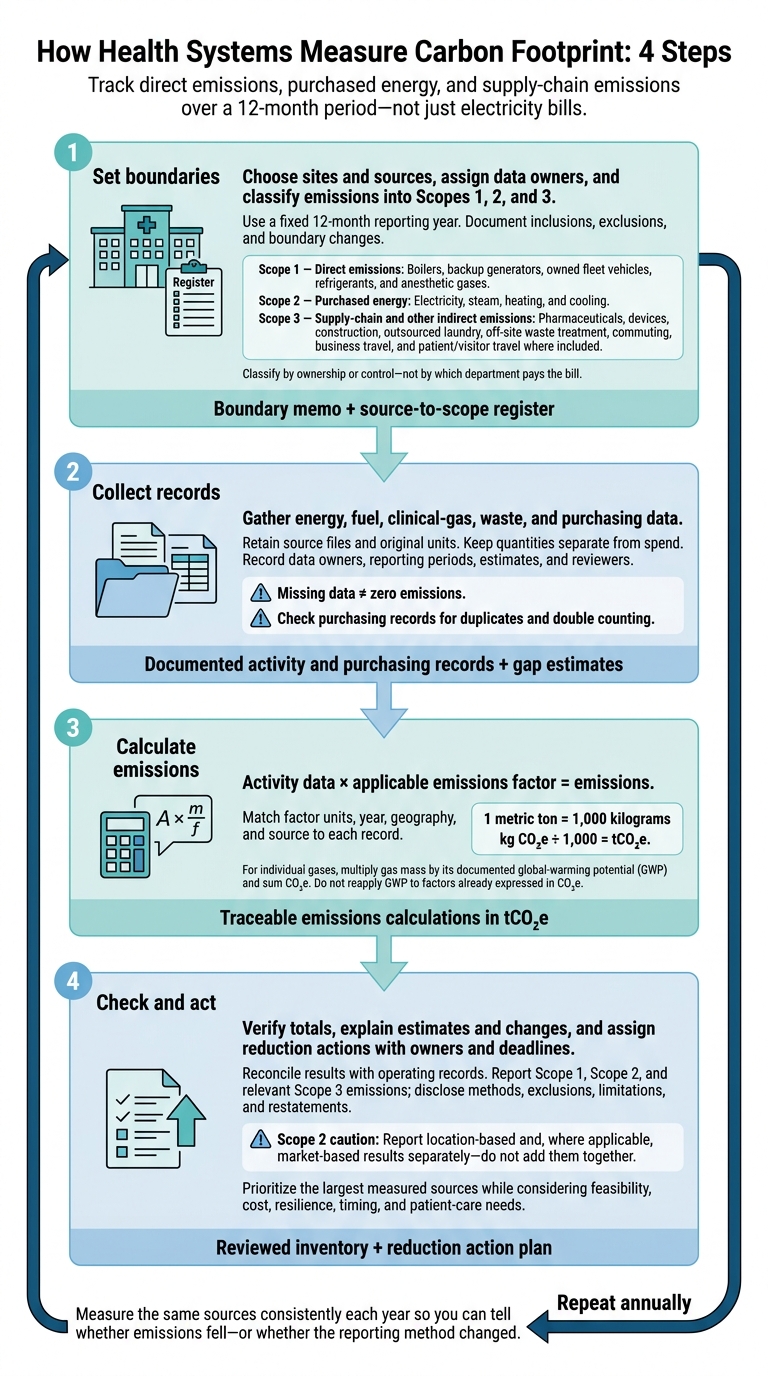
We measure a health system’s carbon footprint by tracking direct emissions, purchased energy, and supply-chain emissions over a 12-month period - not just electricity bills.
We use four steps to turn those records into a report you can act on:
Set boundaries: Choose which sites and sources to include, assign data owners, and classify emissions into Scopes 1, 2, and 3.
Collect records: Gather energy, fuel, clinical-gas, waste, and purchasing data. Document gaps rather than treating missing data as zero.
Calculate emissions: Match each record to an emissions factor and report results in metric tons of carbon dioxide equivalent (tCO₂e). One metric ton equals 1,000 kilograms.
Check and act: Verify totals, explain estimates and changes, and assign reduction actions with owners and deadlines.
Our aim is simple: <u>measure the same sources consistently each year</u> so you can tell whether emissions fell - or whether the reporting method changed.
How Health Systems Measure Carbon Footprint: 4 Steps
Carbon footprinting in healthcare
sbb-itb-8baf5f1
Step 1: Define Inventory Boundaries and Emissions Scopes
Define the inventory using the GHG Protocol Corporate Standard before collecting data.[5] Name one inventory owner to approve boundary decisions and settle classification questions. Assign data owners across facilities, finance, procurement, fleet, and clinical leadership, and document their roles in a RACI matrix.
Use a boundary memo to explain how you’ll treat joint ventures, leases, outsourced services, and contractors. With responsibilities in place, set the reporting year and identify the sites to include.
Choose Facilities and the Reporting Year
Choose a fixed 12-month reporting year and note whether it follows the calendar or fiscal year. Wherever possible, use that same period for utility, fleet, purchasing, and clinical-support data.
Build a register covering hospitals, clinics, laboratories, offices, warehouses, data centers, emergency transport, and fleets. For each site, record its address, size, ownership or lease status, utility accounts, operating dates, function, and inclusion status. Record openings, closures, acquisitions, and divestitures as partial-year activity.
Select one consolidation approach - equity share, financial control, or operational control - and apply it consistently.[10]
| Boundary type | Required decisions | Supporting records | Effect on annual comparisons |
|---|---|---|---|
| Organizational: facilities and fleets | Which owned, leased, or managed operations qualify under the consolidation approach? | Property register, leases, fleet records, operating agreements | Changes in included operations can change totals without changing performance |
| Organizational: joint ventures and transactions | How are ownership interests, mergers, acquisitions, divestitures, openings, and closures treated? | Partnership agreements, transaction dates, operating dates | Structural changes may require historical restatement; partial-year operations need disclosure |
| Operational: emissions sources | Which sources fall into each scope, including outsourced services? | Utility accounts, service contracts, procurement records | Outsourcing can shift emissions between scopes rather than eliminate them |
| Operational: coverage and exclusions | Which value-chain activities are included, estimated, or excluded? | Source register, exclusions log, estimation records | Changing coverage can distort year-over-year comparisons |
Assign Sources to Scopes 1, 2, and 3
Create a source-to-scope register that names a data owner and evidence location for every source. Classify emissions by ownership or control - not by which department pays the bill.
Where feasible, assess patient and visitor travel using appointment volumes, patient-origin data, parking records, or surveys. State whether you include it in Scope 3, report it separately, or exclude it because reliable data are unavailable.
| Scope | Healthcare sources | Records | Calculation basis |
|---|---|---|---|
| 1 | Boilers, backup generators, natural-gas equipment, owned fleet vehicles, refrigerants, anesthetic gases | Utility bills, fuel invoices, fuel-card reports, tank records, fleet mileage, refrigerant servicing logs, gas-cylinder records, and equipment inventories | Activity data, such as fuel volume, miles, or gas released, × applicable fuel- or gas-specific factor |
| 2 | Purchased electricity, steam, heating, and cooling for hospitals, clinics, laboratories, offices, and warehouses | Utility bills, meter data, landlord statements, energy contracts, and grid or supplier emissions factors | Purchased energy consumed × location-based and, where applicable, market-based factors |
| 3 | Pharmaceuticals, devices, construction, outsourced laundry, off-site waste treatment, commuting, business travel, and patient/visitor travel | Procurement ledger, supplier-specific data, spend data, purchase quantities, waste manifests, travel records, and commuting surveys | Supplier-specific, quantity-based, or spend-based calculations |
Next, set the Scope 2 method and the rules for documenting future boundary changes.
Choose Scope 2 Methods and Rules for Boundary Changes
Report Scope 2 using the location-based method for all operations. Where the electricity market offers supplier-specific data or qualifying contractual instruments, also report a clearly labeled market-based result.[6][7]
Retain utility invoices, contracts, and supporting records. Check energy instruments for ownership, quantity, vintage, geographic matching, unique tracking, and retirement or cancellation. A supplier’s “renewable” label alone is not sufficient.
| Accounting method or case | Factor source | Evidence to retain | Reporting use |
|---|---|---|---|
| Location-based | Average emissions factor for the relevant grid | Consumption, service location, factor source and year | Reflects electricity use where facilities operate |
| Market-based: qualifying procurement | Supplier-specific data or qualifying contractual instruments | Contracts, certificates, supplier disclosures, retirement evidence | Reflects supported electricity procurement choices |
| Market-based: uncovered consumption | Applicable residual-mix or fallback factor | Uncovered energy quantity and documented factor hierarchy | Accounts for consumption without qualifying instruments |
Select a base year with reliable, verifiable emissions data and document why you chose it.[5] Adopt a base-year recalculation policy that sets significance thresholds, defines approval responsibilities, and explains how to handle missing historical data. Cover acquisitions, divestitures, mergers, outsourcing, insourcing, method changes, error corrections, and Scope 2 changes.[6][8]
Separate structural changes from ordinary openings and closures. Do not automatically restate emissions for acquired operations that did not exist in the base year.[5][9] Maintain a boundary-change log and disclose exclusions, restatements, and limitations.
Step 2: Collect Activity and Purchasing Data
Collect records only for sources already assigned to the inventory boundary. Use the source-to-scope register from Step 1 as the master collection list, and extend the data register to every included site. Cross-check real estate, finance, facilities, and clinical site lists so outpatient clinics, laboratories, leased sites, warehouses, and fleet records aren’t missed. For each source, record the owner, source document or system, period, frequency, unit, estimation status, data-quality rating, and reviewer.[11][13]
Gather Facilities, Fleet, and Clinical Records
Gather utility bills and meter readings, fleet fuel and charging records, refrigerant inventories and service logs, anesthetic-gas purchases and dispensing records, and waste manifests. Waste records should show quantities, treatment methods, and destinations.
Keep original units - kWh, therms, U.S. gallons, pounds, kilograms, and short tons - and retain the source files. Reconcile gas purchases with inventory changes and clinical use: purchases alone do not equal releases.
For clinics with shared meters, obtain landlord allocations, floor area, and operating hours. Collect square footage, staffed beds, encounters, procedures, and bed-days as well; these support later intensity calculations.
Gather Purchasing and Supplier Records
Collect purchasing data for Scope 3 sources that require quantity- or spend-based calculations. Extract procurement and payment records for pharmaceuticals, supplies, equipment, food, construction, freight, and services. Record the supplier, product identifier, quantity, unit, amount, cost center, and reporting period.
Keep quantities separate from spend. Record spend in U.S. dollars and note the price year used for spend-based estimates. Request product footprints that specify the functional unit, boundary, allocation method, geography, year, included gases, exclusions, and verification status.[11][12]
Assign each transaction to one primary category, then reconcile purchasing totals to the general ledger. Use invoice, purchase-order, project, and shipment identifiers to remove duplicates across procurement and capital-project files.
Check for double counting before adding emissions. Does the supplier footprint already include delivery? Does the contractor estimate already include materials? Confirm both before adding freight emissions or separate material quantities.
These records support the emissions-factor calculations in Step 3, where cleaned activity and purchasing data are used to calculate emissions in CO₂e.
Rate Data Quality and Estimate Missing Records
| Data type | Typical use | Potential precision | Main limitations |
|---|---|---|---|
| Supplier-specific footprint | Product or service purchases with responsive suppliers | High when the boundary, allocation, year, geography, and method are documented and verified | May omit life-cycle stages, use broad allocation, or differ across suppliers |
| Measured activity | Electricity, fuel, refrigerants, anesthetic gases, waste weight, and product quantities | High to moderate, depending on meter coverage and records | May have missing months, shared meters, unit errors, or incomplete site coverage |
| Modeled activity | Allocated utilities, estimated waste, logistics, or sites without direct meters | Moderate to low | Depends on assumptions such as floor area, operating hours, encounters, or average intensity |
| Spend-based estimate | Early screening of diverse purchases and services | Low to moderate | Sensitive to price year, inflation, category mapping, and broad sector-average factors; does not directly represent physical quantities |
Rate each record for date, geography, technology, completeness, and reliability - not just whether it came from a supplier.[11][12] Never treat missing supplier information as zero emissions.
For missing months, prorate only when operating conditions are comparable. Otherwise, use a documented prior-year month or activity driver. For missing sites, extrapolate from comparable facilities using floor area, operating hours, or encounters.
Document the gap, proxy year, adjustment, coverage percentage, uncertainty, and reviewer approval. Do not annualize a partial-year site beyond its actual operating period.[14]
Step 3: Calculate Emissions in CO₂e
Calculate emissions using the cleaned activity data and source register from Steps 1 and 2: activity data × factor. If a factor reports individual gases, calculate the mass of each gas, multiply it by its documented global-warming potential (GWP), and add the CO₂e results. Record the GWP source, values, and version required by your reporting standard.
Do not reapply GWP to factors already expressed in CO₂e. To report metric tons CO₂e, divide kilograms CO₂e by 1,000.[8][17]
Match Emissions Factors to the Data
Use the source-to-scope register to match each activity record to one factor. For U.S. fuel and transportation, use EPA’s GHG Emission Factors Hub. For location-based electricity, use EPA eGRID subregion factors.
For market-based electricity, use qualifying supplier or contract data under the Scope 2 rules, or the residual-mix factor where required. For purchases, use documented product factors or recognized lifecycle or spend-based economic-input-output (EEIO) factors.
Record each factor’s source, version, year, geography, activity unit, gas coverage, CO₂e status, and applicable scope in the factor register. Keep direct combustion in Scope 1 separate from upstream fuel emissions in Scope 3.[15][16]
Calculate Each Source’s Emissions
Apply the matched factors to each source category:
Multiply fuel quantity by the fuel factor; electricity and purchased heating and cooling by the energy factor; travel distance by the transport-mode factor; and waste quantity by the treatment factor.
For goods, multiply product quantities by product factors, or eligible spend by category-specific EEIO factors.
For anesthetic gases, follow the selected methodology to calculate emitted mass as purchases + opening stock − closing stock − returns − documented capture or destruction. Multiply the resulting quantity of each gas by its gas-specific GWP, then convert kilograms to metric tons.
Check Units and Log Assumptions
Before reporting, confirm that each activity unit matches the factor’s required unit and convert where needed. A U.S. short ton is about 907.185 kg; a metric ton is 1,000 kg. Match spend factors to U.S. dollars and the factors’ price year, applying the required inflation adjustment before multiplication.
Link each result to its activity record, factor file, conversion, formula, assumptions, uncertainty, and reviewer approval. Flag incompatible units, negative quantities, and unusual year-over-year changes.
Step 4: Review Results, Report, and Plan Reductions
Verify and Report the Inventory
After calculating emissions for each source, check the totals against operating records before reporting. Match electricity, natural gas, steam, chilled water, and vehicle fuel figures to utility bills, fuel-card statements, building-management records, and the general ledger. Check that every facility and reporting month is covered. Investigate unusual results tied to acquisitions, closures, weather, meter changes, fuel switches, or missing invoices before treating them as reductions. Ask sustainability, finance, facilities, procurement, and clinical teams to review the results. For public reporting, financing, or high-stakes targets, consider a limited or reasonable assurance review.[6][18]
Report Scope 1, Scope 2, and relevant Scope 3 emissions in tCO₂e. Where applicable, show both location-based and market-based Scope 2 results, but do not add them together. Disclose the reporting period, exclusions, estimates, emissions factors, methods, limitations, and restatements. Apply your base-year recalculation policy when structural changes or material errors would otherwise skew trend comparisons. Use intensity metrics only to provide context.[6][18]
Prioritize Energy and Purchasing Actions
Start with the largest measured emissions sources from Step 3 to set the order of reduction actions. Then weigh feasibility, cost, resilience, regulatory exposure, timing, and patient-care needs. Assign each priority an owner responsible for implementation, a deadline, and a verification method. Review major projects at least quarterly. Include supplier emissions-data and methodology requirements in RFPs and contracts without compromising patient safety or reliability.
Conclusion: Use the 4-Step Checklist
Approve boundaries → collect and document → calculate and verify → publish and assign actions. Repeat the inventory annually. Keep boundaries consistent, use suitable factors, retain evidence, explain assumptions, and improve supplier data so reported progress reflects actual reductions - not changes in coverage or methods.[6][18]
FAQs
Where should we start if our emissions data is incomplete?
Build your inventory in phases, starting with high-quality Scope 1 and Scope 2 data on direct fuel consumption and purchased energy. In year two, use spend-based screening for Scope 3, then shift to primary supplier data [1].
Where data is missing, use sector averages, proxy calculations, or conservative estimates. Document your assumptions, methods, and limitations. Aim to get the order of magnitude right first, then improve data quality and traceability over time [2][3][1].
How can we distinguish real reductions from accounting changes?
Keep a clear, rigorous audit trail and use consistent methods [1][2]. Set a base year and a formal recalculation policy so mergers or divestitures don’t distort trends [1][2][3]. Use variance analysis to explain year-over-year changes greater than 10% [1].
Replace spend-based estimates with activity-based or supplier-specific data. Spend-based methods can miss actual reductions - for example, when a supplier switches to renewable energy [4][3].
How can we cut emissions without compromising patient care?
Hospitals can cut energy use in non-clinical areas with LED lighting, HVAC optimization, and building automation while meeting applicable air quality standards, such as ASHRAE Standard 170. Clinical teams can also choose anesthetic gases with lower global warming potential - for example, isoflurane instead of desflurane.
These changes reduce operating costs and impact on the environment while keeping clinical safety, infection control, and patient outcomes the priority.



FAQ