
Oct 2, 2026 · 10 min read
Sustainability Strategy
In This Article
Community microgrids ensure critical services stay powered during outages by pairing generation, storage, controls, and tested plans.
How Community Microgrids Support Energy Resilience
We plan community microgrids around the services that must stay powered - not just the equipment we can install. Start by identifying your critical loads, their power needs, and the outage duration they must withstand. Test designs against 24-hour and multiday outages before choosing resources.
We bring five parts together to keep those services running:
Clear priorities: Define which medical, water, communications, and emergency services need power - and how much interruption each can tolerate.
The right resource mix: Match generation, batteries, and flexible demand to load needs, weather, fuel access, and backup duration.
Safe grid separation: Use controls and protection designed for islanding; grid-tied solar alone does not provide outage power.
A delivery plan: Assign ownership and decision authority, compare lifetime costs and financing, and confirm utility and local approvals.
Proof through testing: Check transfer times, critical-load coverage, reserves, and safe reconnection. Keep maintenance and operator training current.
Our measure of success is simple: <u>critical services stay available when the utility grid cannot supply them</u>.
Microgrids: A Solution for Energy Resilience | Rūdolfs 'Rūdy' Lukaševičs | TEDxCoA
sbb-itb-8baf5f1
Microgrid Components and Energy Sources
Once the operating mode is clear, define the electrical boundary, controls, and energy resources needed to support critical loads.
Electrical Boundaries, Controls, and Critical Loads
Start with a one-line electrical diagram. Show the utility point of common coupling, transformers, feeders, panels, meters, switches, generation, storage, and every proposed building or circuit. Annotate the diagram with measured demand and motor-starting currents.[7] Map which loads stay powered, which shed first, and how switching works. Define minimum service levels - not just which buildings receive power.[8]
| Component | Function | Resilience contribution | Key planning requirement |
|---|---|---|---|
| Defined electrical boundary and critical-load circuits | Identifies included buildings, feeders, and circuits | Keeps critical services powered while other loads disconnect | Map circuit ownership, feeder topology, switching points, and load priorities |
| Microgrid controller and power conversion equipment | Coordinates equipment and stabilizes voltage and frequency in islanded mode | Balances supply and demand to maintain service | Verify island-mode compatibility, operating sequences, and manual overrides |
| Switchgear and protection | Isolates the utility connection and clears faults | Prevents unsafe backfeed and limits damage | Coordinate grounding and protection for both operating modes |
| Meters, sensors, and communications | Measures electrical conditions and sends operating data | Supports detection, control, and verification | Provide secure networks, backup communications, and backup power |
| Distributed generation | Produces electricity | Maintains service beyond stored-energy limits | Verify resource availability, fuel logistics, maintenance, emissions rules, and hazard protection |
| Battery storage and flexible loads | Supply stored energy and adjust demand | Bridges power gaps and extends runtime | Size usable capacity and define safe load-reduction limits |
Configure protection for the lower fault current that inverter-based resources produce in islanded mode. Before reconnecting, confirm stable utility power and synchronized voltage, frequency, and phase angle.
Keep control networks separate from office networks, restrict physical and digital access, and provide backup communications and local fallback controls. Assign authority for switching, load shedding, and manual overrides.[8][10]
With the load boundary defined, match generation to the outage duration and fuel risks it needs to cover.
Renewable and Fuel-Based Generation
Grid-tied generation is not automatically outage-ready. Grid-tied solar shuts down when utility power disappears.[9] To serve loads during an outage, it needs compatible controls, isolation equipment, protection, and a grid-forming source. Choose a resource mix that accounts for weather, critical demand, fuel access, and maintenance capacity during prolonged outages.
| Resource | Availability | Dispatchability | Resilience role | Operating constraints | Planning considerations |
|---|---|---|---|---|---|
| Solar PV | Daylight; affected by clouds, snow, smoke, and shading | Limited without storage | Supplies daytime loads and reduces fuel use | No nighttime output; requires island-compatible equipment | Model seasonal output and protect equipment from hazards |
| Wind | Depends on wind conditions | Limited without storage | Diversifies renewable supply | Icing, storm exposure, noise, setbacks, and maintenance access | Assess wind conditions and turbine survivability |
| Diesel or natural-gas generators | Available when equipment and fuel are ready | High within equipment limits | Provides controllable power during extended outages | Fuel interruptions, emissions, noise, and maintenance | Calculate fuel consumption; verify storage or delivery and protect equipment |
| Combined heat and power (CHP) | Depends on fuel and equipment availability | High, subject to thermal requirements | Supplies electricity and useful heat | Requires heat demand, emissions controls, and maintenance | Match electrical and thermal loads; provide islanding controls and safe heat rejection |
Storage and flexible demand address gaps that generation alone cannot cover.
Battery Storage and Flexible Demand
Kilowatts (kW) measure power; kilowatt-hours (kWh) measure stored energy. Specify both. Batteries can bridge startup, shift energy, manage peaks, and conserve fuel. Batteries designed for black start can also restart the microgrid without utility power.
Use 12 months of interval-load data, ideally at 15-minute resolution, to model outage duration, recharge opportunities, losses, reserves, and aging. Include fire protection and emergency-response requirements.[6]
Efficiency improvements, thermal storage, and controllable loads reduce the demand on batteries and generators, extending runtime and cutting fuel use. Chilled-water or hot-water storage can shift thermal demand. Managed charging and sequenced motor starts can reduce electrical peaks. Set operating limits and restoration priorities so demand reductions do not compromise medical needs, water quality, or safe indoor conditions.
How Microgrids Keep Power Running During Outages
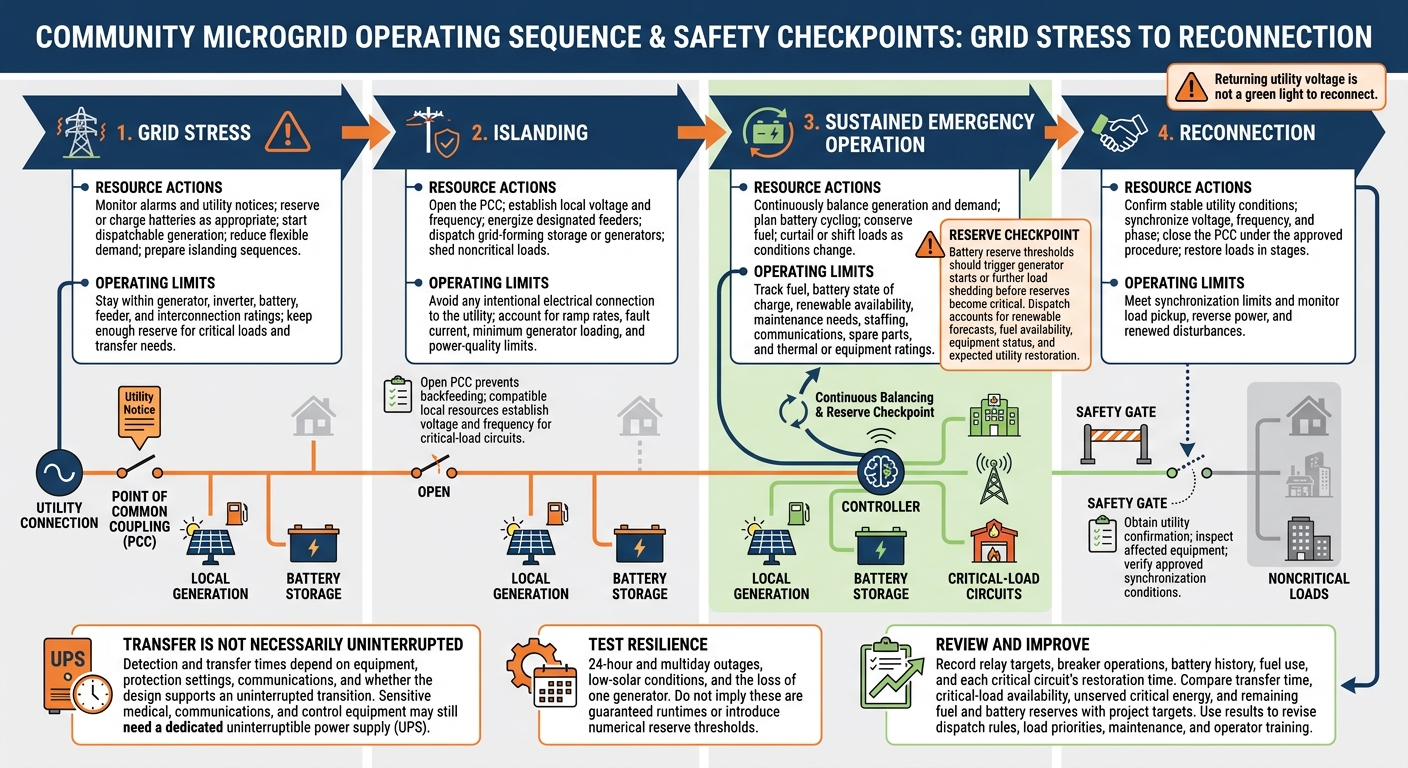
How Community Microgrids Keep Critical Services Powered
Once the boundary, resources, and critical loads are defined, the controller must move cleanly from normal operation to outage mode.
Detect Grid Problems and Prioritize Critical Loads
Relays, meters, monitors, and the controller track utility conditions and breaker status to protect critical loads and control the transfer. When measurements exceed approved thresholds - or the utility requests planned islanding - the controller opens the point of common coupling (PCC) to prevent backfeeding. It then establishes the island and switches local resources into grid-forming mode.[12][13][11]
Not every microgrid can transfer without interruption. Detection and transfer times depend on equipment, protection settings, communications, and whether the design supports an uninterrupted transition. Sensitive medical, communications, and control equipment may still need a dedicated uninterruptible power supply (UPS).[14][16]
The operating plan should spell out the actions and limits for each state.
| Operating state | Resource actions | Operating limits |
|---|---|---|
| Grid stress | Monitor alarms and utility notices; reserve or charge batteries as appropriate; start dispatchable generation; reduce flexible demand; prepare islanding sequences. | Stay within generator, inverter, battery, feeder, and interconnection ratings; keep enough reserve for critical loads and transfer needs. |
| Islanding | Open the PCC; establish local voltage and frequency; energize designated feeders; dispatch grid-forming storage or generators; shed noncritical loads. | Avoid any intentional electrical connection to the utility; account for ramp rates, fault current, minimum generator loading, and power-quality limits. |
| Sustained emergency operation | Continuously balance generation and demand; plan battery cycling; conserve fuel; curtail or shift loads as conditions change. | Track fuel, battery state of charge, renewable availability, maintenance needs, staffing, communications, spare parts, and thermal or equipment ratings. |
| Reconnection | Confirm stable utility conditions; synchronize voltage, frequency, and phase; close the PCC under the approved procedure; restore loads in stages. | Meet synchronization limits and monitor load pickup, reverse power, and renewed disturbances. |
Balance Supply and Extend Backup Power
After islanding, the controller must keep supply and demand aligned hour by hour, including during extended outages. Dispatch decisions should account for renewable forecasts, fuel availability, equipment status, and expected utility restoration. Battery reserve thresholds should trigger generator starts or further load shedding before reserves become critical, while leaving capacity for sudden changes in demand.[15]
Test the system for 24-hour and multiday outages, low-solar conditions, and the loss of one generator. Check that reserve thresholds support the required backup duration. Fuel and stored energy are only part of the runtime equation: maintenance access, overnight staffing, cooling and ventilation, spare parts, and communications can also limit how long the system runs. Define shift handoffs, log remote access, and keep tested local manual controls available in case communications fail.[13]
Reconnect Safely and Review Results
Once utility service stabilizes, the system must resynchronize and restore loads in stages. Returning utility voltage is not a green light to reconnect. Obtain utility confirmation that reconnection is safe, inspect affected equipment, and verify approved synchronization conditions before closing the PCC. Bring loads back in stages while watching for abnormal current or renewed faults.[13][14][15]
Record relay targets, breaker operations, battery history, fuel use, and each critical circuit’s restoration time. Compare transfer time, critical-load availability, unserved critical energy, and remaining fuel and battery reserves with project targets. Use those findings to revise dispatch rules, load priorities, maintenance, and operator training.[13][14][15]
Plan, Finance, and Build a Community Microgrid
Set Resilience Goals and Assign Roles
Once the load boundary and operating mode are defined, assess feasibility and settle roles and ownership. Use the critical-load list and backup-duration target to screen concepts. Define which services take priority, how much interruption they can tolerate, and how long backup power must last. Check each concept for critical-load coverage, readiness for islanded operation, and restoration time.
Assign decision authority for load priorities, interconnection approval, and long-term operations and maintenance.
| Stakeholder | Primary responsibility | Key contribution |
|---|---|---|
| Agencies | Set public priorities; coordinate emergency response; support zoning and permitting | Funding access and regulatory updates |
| Utilities | Evaluate and approve interconnection; share available load data; coordinate grid restoration | Technical feasibility and restoration coordination |
| Site owners | Prioritize facility loads; inventory equipment; assign operations and maintenance responsibility | On-site energy management and critical-load prioritization |
| Community partners | Identify access needs; support outreach to residents most affected by outages | Local expertise and resident outreach |
Compare Designs, Costs, and Required Approvals
Compare designs, ownership models, costs, and approvals against the same resilience targets. Keep service needs and assumptions consistent across options, then estimate lifecycle costs in U.S. dollars.
| Feature | Direct ownership | Power purchase agreement (PPA) |
|---|---|---|
| Upfront capital | Higher owner investment | Often little or none; funded by a third-party developer |
| Maintenance | Site owner’s responsibility | Developer’s responsibility, as contracted |
| Tax incentives | Eligible tax-exempt entities may access qualifying credits through elective pay | Developer may monetize qualifying credits and pass on savings |
| Control | Owner controls operations within regulatory requirements | Contract sets energy pricing, operating rights, and term |
The trade-off is cost versus control: direct ownership requires more upfront capital but gives the site owner full control within regulatory limits. A PPA reduces upfront costs and shifts maintenance to the developer, subject to the contract.
Confirm approval requirements before detailed engineering. Work with the utility and local authorities on interconnection, zoning, permitting, and authorization for islanded operation. Address any occupancy-permit requirement tied to utility connection before final design.
Once approvals are in place, move the concept into delivery through engineering, procurement, and construction.
Commission, Test, and Track Performance
As the selected concept moves through engineering, procurement, and construction, put critical-load coverage, islanding readiness, and restoration-time requirements into procurement documents.
Before acceptance, require documented commissioning, islanding and restoration tests, and periodic drills. Check critical-load coverage, transfer success, and restoration time against the acceptance criteria.
Track critical-load uptime, test results, and maintenance actions.
Conclusion: Design and Test for Critical Power
Capacity alone won’t keep critical services running when the grid fails. Resilience requires generation, storage, controls, priority loads, and tested operating plans to work together.
Before delivery begins, define critical services, assign operating authority, and set maintenance responsibilities. These decisions turn equipment choices into clear operating rules.
Council Fire’s Role in Resilience Planning
Council Fire supports stakeholder-centered sustainability planning, connecting community infrastructure priorities with measurable resilience outcomes.
FAQs
Can existing backup systems become a community microgrid?
Yes, existing backup generators and energy storage can form the base of a community microgrid. Connecting them to local energy sources, such as solar panels or wind turbines, and adding smart controls enables islanding - operation independent of the main grid during outages.
This shift links separate backup systems into a resilient network. Careful planning helps keep critical services running and meet the community’s energy needs.
How should our community choose its backup duration?
For critical infrastructure, plan for at least 72 hours of self-sufficiency [1]. Assess risks to identify which services must stay running during climate-related disruptions [2].
Base planning on forward-looking climate data, not historical trends [3]. Stress-test weather and demand scenarios to determine firm capacity during extended outages [4]. Build backup requirements into capital improvement plans and annual budgets to support long-term reliability and maintenance [5].
How can we share microgrid costs fairly?
Cut upfront costs through federal tax credits, grants, and combined public-private financing. Bundle projects so sites with faster returns help offset those with longer payback periods. Power Purchase Agreements (PPAs) offer clean energy without upfront capital.
Allocate costs through rates that reflect consumption patterns, including time-of-use rates or demand charges. Use on-bill financing or low-income discounts to help protect underserved groups.



FAQ