
Feb 3, 2026
How to Fund Climate Adaptation Projects via Public-Private Partnerships for NGOs & Nonprofits
Sustainability Strategy
In This Article
Practical guide for NGOs to fund climate adaptation through PPPs and blended finance—align partners, structure contracts, and secure scalable, measurable funding.
How to Fund Climate Adaptation Projects via Public-Private Partnerships for NGOs & Nonprofits
Funding climate adaptation projects is challenging, with developing countries needing over $380 billion annually by 2030, but current funding meets less than 20% of this demand. Public-Private Partnerships (PPPs), and their expanded version, Public-Private-Philanthropic Partnerships (4Ps), offer a solution by combining government, private sector, philanthropic, and nonprofit resources to address this gap. Here's how these partnerships work and why they matter:
PPPs: Long-term agreements where private entities fund and manage public services, while governments provide policy and regulatory support.
4Ps: Adds philanthropy and nonprofits to ensure equitable benefits, especially for underserved communities.
Examples: Belize's debt-for-nature swap and Initiative 20x20 in Latin America have mobilized billions in private and public investments.
Key Benefits: Long-term funding, risk-sharing, scalable solutions, and socioeconomic impact.
To succeed, NGOs should align with partners based on shared goals, expertise, and capacity, while structuring clear contracts with measurable outcomes. This approach ensures projects are impactful, financially viable, and resilient over time.
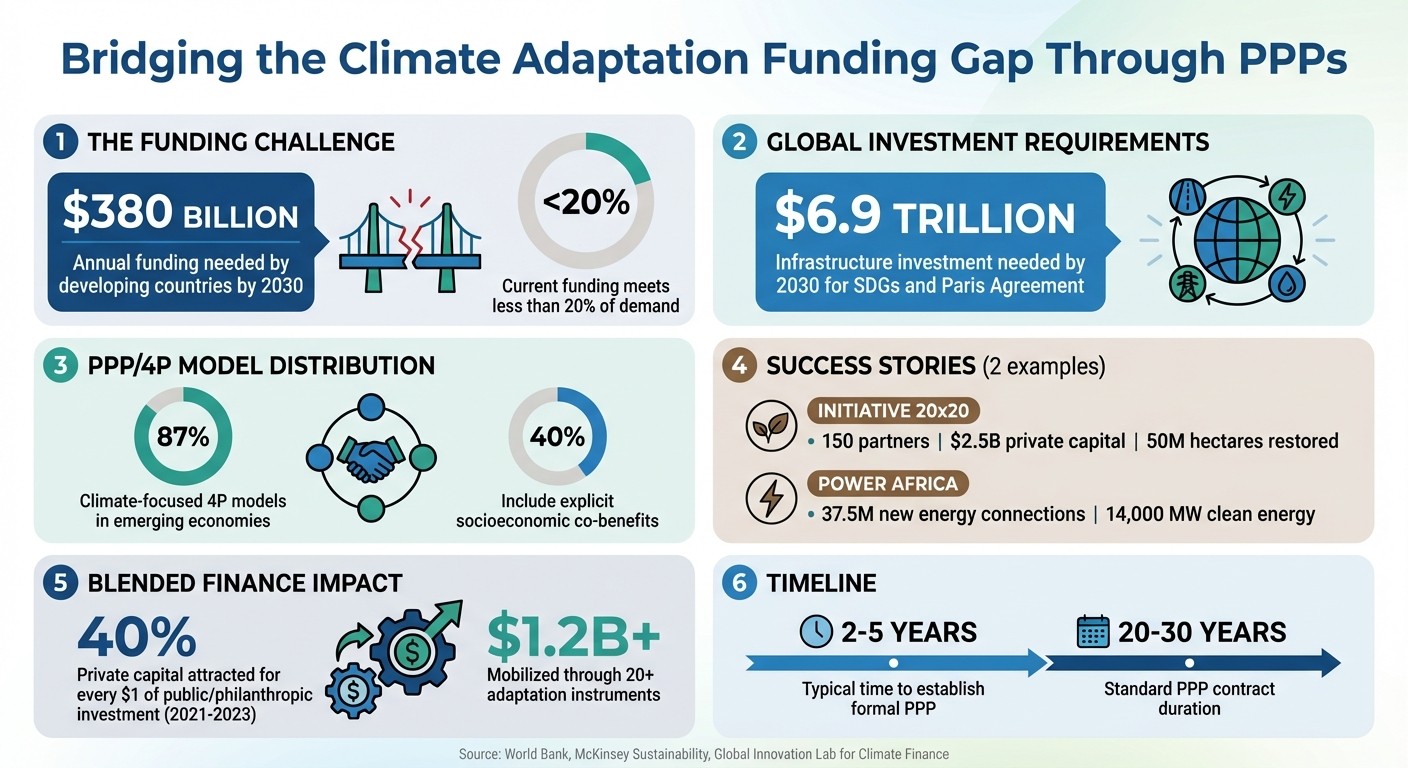
Climate Adaptation Funding Gap and PPP Impact Statistics
WAPPP Roundtable on Blended Finance for Climate Adaptation
What Are Public-Private Partnerships for Climate Adaptation?
A Public-Private Partnership (PPP) is a long-term collaboration where private entities fund and deliver public services - such as resilient infrastructure - while the government ensures a stable policy framework. The evolving 4P model goes a step further, integrating resources from philanthropic and social sectors to support projects that may not yield immediate financial returns [2][3]. For instance, achieving the Sustainable Development Goals and Paris Agreement targets by 2030 will require an estimated $6.9 trillion in infrastructure investments [2]. These partnerships highlight operational and funding benefits that are especially critical for NGOs and nonprofits.
Each partner in a PPP brings unique contributions. Governments establish policies, provide incentives, and regulate to create a stable environment for investment. The private sector supplies capital and develops scalable business models. Philanthropic organizations, with their higher risk tolerance and long-term outlook, fund innovative solutions. Meanwhile, NGOs and nonprofits ensure that projects address socioeconomic needs, particularly for underserved communities [3].
What Makes PPPs Work for Climate Adaptation?
For PPPs to succeed in climate adaptation, shared goals, effective risk-sharing, and strong collaborative governance are essential. Typically, private partners take on design and operational risks, while public partners address regulatory and policy challenges [2].
Blended finance has become a key tool in these partnerships. This approach combines concessional capital from public or philanthropic sources with commercial funding to mitigate risks and lower financing costs [6]. A notable example is Belize's debt-for-nature swap, which integrated discounted bond buybacks, blue bonds, and government commitments to marine conservation. This model shows how blended finance can reduce project risks while achieving environmental goals [3].
Another example is the Climate Resilience and Adaptation Finance and Technology Transfer Facility (CRAFT), a growth equity fund that has supported over 500 adaptation-focused companies [6]. Interestingly, around 87% of climate-focused 4P models are implemented in emerging economies [3]. Establishing these partnerships often takes two to five years [2], and approximately 40% explicitly include socioeconomic benefits - such as improved health and livelihoods - in their objectives [3].
These elements demonstrate why PPPs are particularly valuable for NGOs and nonprofits.
Why NGOs and Nonprofits Need PPPs for Funding
Current funding models for climate adaptation - primarily government grants, philanthropy, and limited private investments - cover less than 20% of the $380 billion annual adaptation funding needed by developing countries by 2030 [7]. These traditional methods often face challenges like short funding cycles, limited scalability, and reliance on taxpayer dollars, making them inadequate to meet growing climate risks.
PPPs provide a long-term alternative for NGOs and nonprofits by creating sustainable, market-based funding mechanisms that go beyond traditional, short-term cycles [3][7]. Unlike grant-based models that require constant fundraising, PPPs enable the development of revenue-generating projects, ensuring ongoing support for adaptation efforts. For example, the Initiative 20x20 partnership, as of September 2023, brought together 150 partners to restore 50 million hectares of land across Latin America and the Caribbean. This effort secured $2.5 billion in private capital to help governments achieve restoration goals [3].
PPPs also offer NGOs and nonprofits access to vital resources. The Power Africa initiative, led by the U.S. government over a decade, brought together political leaders and financial institutions to deliver 37.5 million new energy connections and 14,000 megawatts of clean energy projects [3]. As McKinsey Sustainability notes:
"Philanthropies can leverage their higher risk tolerance, longer time horizons, and knowledge of intergenerational and equity issues to invest in solutions that are not yet widely adopted." [3]
These partnerships not only provide funding but also create opportunities for innovation and long-term impact.
How to Identify and Evaluate Potential Partners
Building the right partnerships for climate adaptation public-private partnerships (PPPs) begins with understanding the unique contributions each stakeholder brings. Public sector entities - such as government agencies focused on public works, housing, public health, or transportation - offer policy consistency, regulatory frameworks, and access to public funding [3]. Private sector players contribute technical expertise, financial resources, and the ability to scale solutions efficiently [3]. Meanwhile, philanthropic organizations often take on higher risks and invest in approaches that are still in early stages of development [3].
The goal is to find partners whose strengths complement your organization’s mission and fill critical capacity gaps. For example, the University of Iowa’s 50-year PPP required bidders to showcase expertise in renewable energy, emission management, and disaster response to achieve a coal-free campus by January 1, 2025 [9]. Below, we delve into the distinct roles played by public, private, and philanthropic partners.
Types of Partners: Public, Private, and Philanthropic
Public Partners: Government agencies with mandates related to climate resilience are natural collaborators. Departments involved in infrastructure, disaster preparedness, or environmental protection can integrate resilience into existing plans, reducing costs and breaking down bureaucratic barriers [10].
Private Partners: Corporations and financial institutions bring the ability to scale and mobilize resources. When evaluating private sector partners, consider their technical expertise in low-carbon solutions and their track record in disaster response. For instance, in Sendai, Japan, a private operator managing a school meal supply center under a Build-Operate-Transfer scheme recovered 2.5 months faster than government-run facilities after a disaster, due to a more flexible supply chain [9].
Philanthropic Partners: These organizations play a distinct role by accepting higher risks and focusing on equity. One example is the Breathe London pilot project, funded by the Clean Air Fund and Bloomberg Philanthropies in collaboration with the Mayor of London and the Social Innovation Partnership. This initiative used a network of sensors to improve air quality in the city through data-driven strategies [3].
Academic and Community Partners: These groups are invaluable for quantifying climate risks, offering local insights, and ensuring alignment with community needs, particularly for vulnerable populations [10]. Academic institutions often bring research capabilities that smaller NGOs may lack, acting as a "brain trust" for projects.
Matching partner strengths to your climate adaptation goals is key to ensuring the resilience and success of long-term initiatives.
How to Evaluate Partner Alignment and Capacity
When assessing potential partners, establish clear minimum criteria. Require evidence of both financial and technical capability to sustain long-term commitments, as PPP contracts typically span 20 to 30 years [11]. Look for certifications or credentials that demonstrate expertise in climate-smart practices, such as green building standards [9].
Focus on partners willing to take on initial project risks, as this can boost investor confidence [10]. Private partners should also demonstrate sufficient insurance coverage for climate-related risks and provide detailed disaster prevention and response plans [9].
Mission alignment is equally important. Around 40% of climate-focused 4P models explicitly include socioeconomic co-benefits - such as improved health, equity, and development - in their mission statements [3]. Partners whose objectives align with multiple Sustainable Development Goals (SDGs) often unlock broader funding opportunities. The more measurable and reportable the impacts, the more likely the project will attract climate finance [8].
Additionally, review a partner's history of collaboration and experience with established technologies, which factors into over 90% of successful 4P models [3][10]. Define success together, clearly agreeing on acceptable risks, returns, and impacts. This shared understanding minimizes conflict and ensures all stakeholders work toward the same objectives.
Why an Anchor Partner Matters
Every successful PPP benefits from having at least one anchor partner - a stakeholder committed to providing startup capital, leadership, and a long-term strategic perspective. McKinsey Sustainability highlights this role:
"Forming novel 4P models in high-need geographies and systems will require an anchor partner who can take a long-term view and provide some of the start-up capital and runway to the multiyear process of getting a 4P model off the ground" [3].
Anchor partners play a critical role in coordinating efforts and maintaining momentum during complex setup and implementation phases. A striking example is Initiative 20x20, which, as of September 2023, has mobilized 150 partners and secured $2.5 billion in private capital to restore 50 million hectares of land in Latin America and the Caribbean by 2030. This initiative features leadership from a subsidiary of The Nature Conservancy and the Development Finance Corporation, which de-risks investments through "blue bonds" [3].
An anchor partner doesn’t need to be the largest or wealthiest stakeholder - it’s their commitment to the partnership’s long-term vision that matters most. Their involvement attracts additional partners and provides stability through inevitable challenges.
How to Structure Agreements and Governance Frameworks
Once you've identified your partners, it's time to formalize the relationship with a well-crafted contract. Public-private partnership (PPP) projects often span decades, making it critical to strike a balance between long-term stability and the flexibility needed to address unpredictable climate challenges. Strong contractual and governance frameworks are key to ensuring sustained funding for climate adaptation efforts. The World Bank emphasizes:
"The aim of PPP contract design is therefore to create certainty where possible, and bounded flexibility where needed - thereby retaining clarity and limiting uncertainty for both parties." [12]
PPP contracts must provide dependable frameworks while allowing for adjustments to accommodate unforeseen climate impacts. This can be achieved by including mechanisms to periodically review service requirements and tariffs as conditions evolve [12].
Key Components of a PPP Agreement
A robust PPP agreement should clearly outline several essential elements. Start with risk allocation, assigning each risk to the party best equipped to manage it. Establish performance requirements using SMART (Specific, Measurable, Achievable, Relevant, and Time-bound) criteria. Define success with clear indicators - such as reducing CO2 emissions, restoring wetlands, or protecting households from flooding - and tie these metrics to monitoring systems and penalties for underperformance [12].
For example, in April 2019, the University of Iowa initiated a 50-year utility PPP, requiring the private partner to help the university achieve zero-carbon goals, including eliminating coal use by January 1, 2025 [9].
Effective dispute resolution mechanisms are another critical component. Tools like expert panels, regulatory oversight, or international arbitration can help resolve conflicts without derailing progress. Chile's Concessions Law, for instance, incorporates such mechanisms into national legislation, providing legal clarity for all parties involved [12]. Additionally, involving your future contract manager during the design phase ensures practical monitoring and change management processes [12].
Governance Models for Effective Collaboration
With the contract in place, governance structures must focus on managing risks and tracking performance. Effective governance emphasizes measurable outcomes rather than rigid procedures, ensuring that climate adaptation goals remain a priority. This approach allows partners to innovate while staying accountable to agreed resilience targets [12].
Your governance framework should include clear monitoring systems tied to key performance indicators (KPIs), along with enforcement tools like financial penalties or rewards. For added transparency, consider adopting international standards such as the Climate Bonds Standard, which provides a verified framework for reporting climate impacts. Certification costs under this standard start at $1,000 for developing countries and $2,000 for developed nations, with an additional fee of 0.00001 of the bond issuance amount [8]. These standards reassure funders that your project delivers measurable climate benefits.
Additionally, build regular review periods into your governance model to reassess risk allocation as conditions evolve. Risks can shift significantly over the lifespan of a project, so the framework should allow for periodic updates without triggering contract termination [2]. Standardizing provisions like force majeure clauses and termination rights - using model agreements from countries such as the UK, Australia, or South Africa - can further streamline preparation and reduce legal expenses [12].
How to Scale the Partnership for Greater Impact
Once your governance structures are established, focus on scaling the PPP to amplify its impact. Scale based on the private partner's capacity and the public partner's long-term resource commitment [12]. PPPs often require a certain scale to justify the high costs of procurement and achieve economic efficiencies [2]. Establishing a formal PPP typically takes two to five years [2].
To enhance scalability, rely on forward-looking climate models rather than just historical data. These models help account for potential future extreme weather events and shifting conditions [5]. A notable example is the Sofia Airport concession in Bulgaria, tendered in 2018. Bidders were required to submit environmental and social programs detailing strategies to boost renewable energy production, with additional evaluation points awarded for innovative greenhouse gas reduction efforts [9].
Finally, tie compensation to climate resilience KPIs to keep all partners focused on adaptation outcomes. Achieving global targets like the Sustainable Development Goals and the Paris Agreement is estimated to require an annual infrastructure investment of $6.9 trillion by 2030 [2]. Scaling your PPP effectively positions it to access this expanding pool of climate finance.
How to Access and Leverage Financial Mechanisms
A well-structured governance framework can unlock various financial tools to improve project feasibility. Blended finance, for instance, merges public, philanthropic, and private funding to reduce costs and mitigate risks. Between 2021 and 2023, blended finance infrastructure deals successfully attracted 40% of private capital for every $1 of public or philanthropic investment [14]. The Global Innovation Lab for Climate Finance has backed over 20 adaptation-focused instruments, mobilizing more than $1.2 billion for resilience projects [6]. These financial strategies complement earlier governance approaches, turning adaptation challenges into actionable, investment-ready opportunities.
Government Incentives and Risk Mitigation Tools
Public-sector mechanisms play a vital role in making projects more appealing to private investors. Tools like risk guarantees shield private partners from issues such as payment defaults or political instability. Meanwhile, tax increment financing and land value capture leverage rising property values from infrastructure upgrades to generate revenue [13]. These approaches align with risk-sharing principles, helping transform high-risk adaptation projects into viable investments.
Project Development Funds (PDFs) are another option, offering centralized government funding to evaluate and prepare public-private partnership (PPP) projects, ensuring they attract private capital [4]. Additionally, asset recycling, where governments lease existing infrastructure to finance new climate-resilient projects, provides a pathway to secure initial funding [13][1].
Blended Finance and De-Risking Mechanisms
Blended finance tools like first-loss guarantees, subordinated debt, and flexible repayment terms help reduce risks for private investors while maintaining project feasibility [14]. The World Bank highlights the importance of concessional finance in this context:
"One of the primary roles of concessional finance is to reduce the risk for the private investors." [14]
Programs such as CRAFT (Climate Resilience and Adaptation Finance and Technology Transfer Facility) offer practical examples. With a portfolio of over 500 companies as of December 2024, CRAFT invests in proven technologies like weather analytics and precision agriculture, using technical assistance to demonstrate commercial viability [6]. Another example, Cooling as a Service (CaaS), eliminates upfront costs for clean cooling systems by adopting a pay-per-use model. This approach has shown benefits like reducing food waste and improving labor productivity [6].
For institutional investors, Climate Bonds offer an appealing option. These bonds, verified under the Climate Bonds Standard, have certification fees starting at $1,000 for developing nations and $2,000 for developed countries [1]. The Climate Bonds Standard Board represents members managing approximately $51 trillion in assets [1].
How to Craft Persuasive Funding Proposals
When seeking funding, tailor your proposals to align with the priorities of different investors. Impact-first investors, such as development finance institutions (DFIs) and philanthropists, focus on social and resilience benefits, while commercial investors prioritize market potential and financial returns [6]. According to the Global Innovation Lab for Climate Finance:
"Fundraising pitches should be tailored toward various investor mandates. Impact-first investors like DFIs and philanthropists are drawn to the social benefits of adaptation, while commercial investors are more receptive to the market potential and financial returns of an instrument." [6]
An example of this in action is One Acre Ventures, a subsidiary of One Acre Fund. They successfully raised capital by tracking metrics like agricultural yields and farmer income to demonstrate their impact. By coordinating debt and equity investments in climate-resilient agricultural value chains in East Africa, they used data-driven projections to overcome the challenges of monitoring climate metrics [6].
To strengthen your case, explicitly link adaptation projects to measurable outcomes like increased labor productivity, reduced food waste, improved food security, and lower losses of temperature-sensitive medicines [6]. Bundling smaller projects into larger portfolios can also achieve the scale needed to attract commercial banks [6]. As the World Bank notes:
"The clearer the impacts and the more easily they can be quantified, evaluated, and reported, the more likely the project is a good candidate for climate finance." [1]
Finally, use technical assistance (TA) and early-stage philanthropic capital to build a strong project pipeline. This approach creates a "demonstration effect", showcasing real-world results that can persuade hesitant private investors [6]. By combining these strategies, theoretical adaptation concepts can evolve into financially viable projects backed by concrete performance data.
How to Design Climate Adaptation Projects for Impact and Longevity
Securing funding through strong public-private partnerships (PPPs) is just the beginning. The real challenge lies in designing projects that deliver measurable benefits over decades while addressing immediate needs. This requires weaving socioeconomic benefits into the project, involving stakeholders from the outset, and setting up systems to monitor progress and adapt over time. Below, we explore how to integrate multiple benefits, engage local stakeholders, and establish effective monitoring frameworks.
Integrating Socioeconomic and Climate Co-Benefits
The most impactful adaptation projects address more than just climate challenges - they tackle structural vulnerabilities and deliver broader benefits like job creation and better health services. For example, Carolyne Mwangi of Kimplanter Seedlings and Nurseries won the 2021 YouthADAPT Solutions Challenge for her work in propagating drought-resistant seedlings. By providing Kenyan farmers with resilient agricultural inputs, her project not only combats harsh weather conditions but also supports livelihoods and food security [15].
During the project preparation phase, tools like Value-for-Money (VfM) and Cost-Benefit Analysis (CBA) can help balance climate considerations with economic outcomes [9][2]. Conducting Environmental and Social Impact Assessments (ESIAs) allows you to identify potential climate impacts and mitigation strategies, enabling adjustments that enhance long-term results [9]. Procurement processes should reward innovative, low-carbon solutions by including criteria like disaster risk management plans and "green" certifications in Request for Proposals (RfPs) [9]. A life-cycle costing approach, which factors in greenhouse gas (GHG) emissions and climate mitigation costs, ensures that decisions go beyond upfront expenses to consider long-term sustainability [9].
Engaging Stakeholders for Better Project Design
Active stakeholder involvement is key to designing projects that align with both short-term needs and long-term goals. Community participation, guided by Locally Led Adaptation (LLA) principles, empowers local institutions and communities to take charge of decision-making and funding allocation [15]. A prime example is the "Mukuru Approach" in Nairobi, Kenya, where residents of the Mukuru informal settlement partnered with the local government to improve water, sanitation, roads, and health services. These infrastructure upgrades were specifically tailored to enhance climate resilience in the area [15]. By involving the community early, the project addressed real priorities rather than relying on external assumptions, fostering trust and ensuring alignment of goals.
It’s also important to differentiate between formal PPP members and external stakeholders, such as local communities and civil society groups. This distinction ensures that all affected parties have a voice in the process [2]. Engaging communities doesn’t just build trust - it strengthens local institutions, enabling them to independently manage adaptation efforts long after donor funding ends [15].
Setting Up Monitoring, Evaluation, and Reporting Frameworks
To demonstrate impact and secure ongoing investment, clear metrics are essential. Embedding Key Performance Indicators (KPIs) within PPP contracts ensures that private partners are held accountable for both technical performance and climate resilience throughout the project’s lifecycle [2]. These KPIs should track how well infrastructure withstands climate shocks and remains functional during the operation and maintenance phase [2].
As the American Society of Adaptation Professionals aptly puts it:
"Resilience is not an end state. It is a process of ongoing monitoring, shifting, and realignment." [10]
Monitoring, Reporting, and Evaluation (MRE) systems are critical for tracking and adjusting adaptation measures over time [2]. Tools like the PIEVC Protocol can integrate climate risk assessments into these frameworks, ensuring that long-term impacts are measurable and adjustments are made when necessary [5]. Metrics should be rooted in local realities, allowing for flexibility and responsiveness as conditions evolve [10]. With clear, quantifiable outcomes, projects are more likely to attract sustained climate financing over their lifespan - often 20 to 30 years under typical PPP agreements [2].
Conclusion
Public-private partnerships are at the heart of efforts to drive sustainable climate adaptation. These collaborations bring together the strengths of different sectors - policy-making from the public sector, scalability from private enterprises, and the philanthropic sector's capacity to take risks. Together, they help bridge the funding gap needed to achieve global climate goals [2].
The results of such partnerships speak for themselves. Programs like Initiative 20x20 and Power Africa show how having reliable anchor partners and clear performance metrics can mobilize billions in private investment, resulting in significant clean energy advancements [3]. Success hinges on elements like effective risk allocation, strong monitoring systems, and clearly defined roles.
To replicate and expand on these outcomes, NGOs and nonprofits should focus on aligning with partners whose capabilities complement their goals. This might mean working with government agencies for regulatory backing, private companies for technical expertise, or philanthropic organizations for early-stage risk absorption. Agreements should be carefully structured to assign risks to those best equipped to handle them, while incorporating climate resilience metrics into contracts to maintain accountability throughout the project lifecycle.
The involvement of local communities is another critical factor for lasting success. Projects that engage communities early, address regional climate risks, and include socioeconomic benefits tend to attract more consistent funding and deliver better results. As Hamid Samandari and his colleagues at McKinsey & Company emphasize:
"solutions are delivering impact for all stakeholders, including women, children, indigenous communities, and those whose voices are less often heard" [3].
With 87% of climate-focused partnerships currently operating in emerging economies and 40% specifically targeting socioeconomic benefits [3], the foundation for progress is growing stronger. By embedding strategic planning, fostering stakeholder inclusion, and forming well-aligned partnerships, NGOs and nonprofits can secure the resources and impact necessary to build long-term climate resilience.
FAQs
How can NGOs find the right partners for climate adaptation projects through PPPs?
To identify the right collaborators for climate adaptation public-private partnerships (PPPs), NGOs should target organizations that share similar objectives and bring complementary capabilities to the table. Begin by researching businesses, government bodies, or institutions with an established history in areas like climate resilience, sustainability, or community-focused initiatives. Assess their capacity to contribute funding, expertise, or technology that matches your project’s specific needs.
Focus on potential partners who show a clear dedication to tackling climate issues and integrating sustainable practices. Dive into their previous projects, mission statements, and strategic goals to confirm there’s alignment with your own vision. Leveraging specialized tools and resources tailored for PPPs can simplify the process, helping you identify key stakeholders and evaluate their potential for collaboration. Aligning with organizations that share your mission significantly boosts the likelihood of achieving meaningful and lasting results.
What are the key elements of a successful public-private partnership (PPP) for climate adaptation projects?
A successful public-private partnership (PPP) for climate adaptation projects relies on several key components to ensure effective collaboration and long-term results. One of the first steps is conducting thorough climate risk assessments. These evaluations help identify potential challenges and incorporate climate resilience directly into the planning and design stages, ensuring that infrastructure and services are robust enough to handle climate-related risks.
Another critical element is establishing clear legal frameworks and contractual agreements. These agreements outline the roles and responsibilities of each partner, define risk-sharing mechanisms, and ensure that all parties are working in alignment with the project's climate adaptation objectives. This clarity fosters accountability and smooth collaboration.
Incorporating climate resilience principles throughout every phase of the project - from initial planning to ongoing monitoring - is equally important. This approach ensures that projects remain adaptable and aligned with evolving environmental conditions.
Finally, tapping into dedicated project development funds (PDFs) can be a game-changer. These funds help bridge resource gaps, making it easier to attract private investment. They also provide critical support for project preparation and structuring, empowering NGOs and nonprofits to secure financing and form meaningful partnerships. Together, these elements lay the groundwork for tackling climate challenges while promoting sustainable growth.
What is blended finance, and how does it support public-private partnerships for climate adaptation?
Blended finance brings together public or philanthropic resources with private sector investment to make climate adaptation projects more appealing and less risky for private investors. This model encourages private capital to flow into projects that might otherwise be considered too uncertain or unprofitable, such as upgrading infrastructure or restoring ecosystems.
By leveraging mechanisms like guarantees, first-loss capital, or technical assistance, blended finance helps lower the risks associated with these investments while enhancing their potential returns. This approach not only addresses funding shortfalls but also ensures that climate resilience efforts can grow and endure over time. When designed properly, blended finance has the power to draw substantial private sector support for essential climate adaptation projects.
Related Blog Posts
Latest Articles
©2025


FAQ
01
What does it really mean to “redefine profit”?
02
What makes Council Fire different?
03
Who does Council Fire you work with?
04
What does working with Council Fire actually look like?
05
How does Council Fire help organizations turn big goals into action?
06
How does Council Fire define and measure success?
Feb 3, 2026
How to Fund Climate Adaptation Projects via Public-Private Partnerships for NGOs & Nonprofits
Sustainability Strategy
In This Article
Practical guide for NGOs to fund climate adaptation through PPPs and blended finance—align partners, structure contracts, and secure scalable, measurable funding.
How to Fund Climate Adaptation Projects via Public-Private Partnerships for NGOs & Nonprofits
Funding climate adaptation projects is challenging, with developing countries needing over $380 billion annually by 2030, but current funding meets less than 20% of this demand. Public-Private Partnerships (PPPs), and their expanded version, Public-Private-Philanthropic Partnerships (4Ps), offer a solution by combining government, private sector, philanthropic, and nonprofit resources to address this gap. Here's how these partnerships work and why they matter:
PPPs: Long-term agreements where private entities fund and manage public services, while governments provide policy and regulatory support.
4Ps: Adds philanthropy and nonprofits to ensure equitable benefits, especially for underserved communities.
Examples: Belize's debt-for-nature swap and Initiative 20x20 in Latin America have mobilized billions in private and public investments.
Key Benefits: Long-term funding, risk-sharing, scalable solutions, and socioeconomic impact.
To succeed, NGOs should align with partners based on shared goals, expertise, and capacity, while structuring clear contracts with measurable outcomes. This approach ensures projects are impactful, financially viable, and resilient over time.
Climate Adaptation Funding Gap and PPP Impact Statistics
WAPPP Roundtable on Blended Finance for Climate Adaptation
What Are Public-Private Partnerships for Climate Adaptation?
A Public-Private Partnership (PPP) is a long-term collaboration where private entities fund and deliver public services - such as resilient infrastructure - while the government ensures a stable policy framework. The evolving 4P model goes a step further, integrating resources from philanthropic and social sectors to support projects that may not yield immediate financial returns [2][3]. For instance, achieving the Sustainable Development Goals and Paris Agreement targets by 2030 will require an estimated $6.9 trillion in infrastructure investments [2]. These partnerships highlight operational and funding benefits that are especially critical for NGOs and nonprofits.
Each partner in a PPP brings unique contributions. Governments establish policies, provide incentives, and regulate to create a stable environment for investment. The private sector supplies capital and develops scalable business models. Philanthropic organizations, with their higher risk tolerance and long-term outlook, fund innovative solutions. Meanwhile, NGOs and nonprofits ensure that projects address socioeconomic needs, particularly for underserved communities [3].
What Makes PPPs Work for Climate Adaptation?
For PPPs to succeed in climate adaptation, shared goals, effective risk-sharing, and strong collaborative governance are essential. Typically, private partners take on design and operational risks, while public partners address regulatory and policy challenges [2].
Blended finance has become a key tool in these partnerships. This approach combines concessional capital from public or philanthropic sources with commercial funding to mitigate risks and lower financing costs [6]. A notable example is Belize's debt-for-nature swap, which integrated discounted bond buybacks, blue bonds, and government commitments to marine conservation. This model shows how blended finance can reduce project risks while achieving environmental goals [3].
Another example is the Climate Resilience and Adaptation Finance and Technology Transfer Facility (CRAFT), a growth equity fund that has supported over 500 adaptation-focused companies [6]. Interestingly, around 87% of climate-focused 4P models are implemented in emerging economies [3]. Establishing these partnerships often takes two to five years [2], and approximately 40% explicitly include socioeconomic benefits - such as improved health and livelihoods - in their objectives [3].
These elements demonstrate why PPPs are particularly valuable for NGOs and nonprofits.
Why NGOs and Nonprofits Need PPPs for Funding
Current funding models for climate adaptation - primarily government grants, philanthropy, and limited private investments - cover less than 20% of the $380 billion annual adaptation funding needed by developing countries by 2030 [7]. These traditional methods often face challenges like short funding cycles, limited scalability, and reliance on taxpayer dollars, making them inadequate to meet growing climate risks.
PPPs provide a long-term alternative for NGOs and nonprofits by creating sustainable, market-based funding mechanisms that go beyond traditional, short-term cycles [3][7]. Unlike grant-based models that require constant fundraising, PPPs enable the development of revenue-generating projects, ensuring ongoing support for adaptation efforts. For example, the Initiative 20x20 partnership, as of September 2023, brought together 150 partners to restore 50 million hectares of land across Latin America and the Caribbean. This effort secured $2.5 billion in private capital to help governments achieve restoration goals [3].
PPPs also offer NGOs and nonprofits access to vital resources. The Power Africa initiative, led by the U.S. government over a decade, brought together political leaders and financial institutions to deliver 37.5 million new energy connections and 14,000 megawatts of clean energy projects [3]. As McKinsey Sustainability notes:
"Philanthropies can leverage their higher risk tolerance, longer time horizons, and knowledge of intergenerational and equity issues to invest in solutions that are not yet widely adopted." [3]
These partnerships not only provide funding but also create opportunities for innovation and long-term impact.
How to Identify and Evaluate Potential Partners
Building the right partnerships for climate adaptation public-private partnerships (PPPs) begins with understanding the unique contributions each stakeholder brings. Public sector entities - such as government agencies focused on public works, housing, public health, or transportation - offer policy consistency, regulatory frameworks, and access to public funding [3]. Private sector players contribute technical expertise, financial resources, and the ability to scale solutions efficiently [3]. Meanwhile, philanthropic organizations often take on higher risks and invest in approaches that are still in early stages of development [3].
The goal is to find partners whose strengths complement your organization’s mission and fill critical capacity gaps. For example, the University of Iowa’s 50-year PPP required bidders to showcase expertise in renewable energy, emission management, and disaster response to achieve a coal-free campus by January 1, 2025 [9]. Below, we delve into the distinct roles played by public, private, and philanthropic partners.
Types of Partners: Public, Private, and Philanthropic
Public Partners: Government agencies with mandates related to climate resilience are natural collaborators. Departments involved in infrastructure, disaster preparedness, or environmental protection can integrate resilience into existing plans, reducing costs and breaking down bureaucratic barriers [10].
Private Partners: Corporations and financial institutions bring the ability to scale and mobilize resources. When evaluating private sector partners, consider their technical expertise in low-carbon solutions and their track record in disaster response. For instance, in Sendai, Japan, a private operator managing a school meal supply center under a Build-Operate-Transfer scheme recovered 2.5 months faster than government-run facilities after a disaster, due to a more flexible supply chain [9].
Philanthropic Partners: These organizations play a distinct role by accepting higher risks and focusing on equity. One example is the Breathe London pilot project, funded by the Clean Air Fund and Bloomberg Philanthropies in collaboration with the Mayor of London and the Social Innovation Partnership. This initiative used a network of sensors to improve air quality in the city through data-driven strategies [3].
Academic and Community Partners: These groups are invaluable for quantifying climate risks, offering local insights, and ensuring alignment with community needs, particularly for vulnerable populations [10]. Academic institutions often bring research capabilities that smaller NGOs may lack, acting as a "brain trust" for projects.
Matching partner strengths to your climate adaptation goals is key to ensuring the resilience and success of long-term initiatives.
How to Evaluate Partner Alignment and Capacity
When assessing potential partners, establish clear minimum criteria. Require evidence of both financial and technical capability to sustain long-term commitments, as PPP contracts typically span 20 to 30 years [11]. Look for certifications or credentials that demonstrate expertise in climate-smart practices, such as green building standards [9].
Focus on partners willing to take on initial project risks, as this can boost investor confidence [10]. Private partners should also demonstrate sufficient insurance coverage for climate-related risks and provide detailed disaster prevention and response plans [9].
Mission alignment is equally important. Around 40% of climate-focused 4P models explicitly include socioeconomic co-benefits - such as improved health, equity, and development - in their mission statements [3]. Partners whose objectives align with multiple Sustainable Development Goals (SDGs) often unlock broader funding opportunities. The more measurable and reportable the impacts, the more likely the project will attract climate finance [8].
Additionally, review a partner's history of collaboration and experience with established technologies, which factors into over 90% of successful 4P models [3][10]. Define success together, clearly agreeing on acceptable risks, returns, and impacts. This shared understanding minimizes conflict and ensures all stakeholders work toward the same objectives.
Why an Anchor Partner Matters
Every successful PPP benefits from having at least one anchor partner - a stakeholder committed to providing startup capital, leadership, and a long-term strategic perspective. McKinsey Sustainability highlights this role:
"Forming novel 4P models in high-need geographies and systems will require an anchor partner who can take a long-term view and provide some of the start-up capital and runway to the multiyear process of getting a 4P model off the ground" [3].
Anchor partners play a critical role in coordinating efforts and maintaining momentum during complex setup and implementation phases. A striking example is Initiative 20x20, which, as of September 2023, has mobilized 150 partners and secured $2.5 billion in private capital to restore 50 million hectares of land in Latin America and the Caribbean by 2030. This initiative features leadership from a subsidiary of The Nature Conservancy and the Development Finance Corporation, which de-risks investments through "blue bonds" [3].
An anchor partner doesn’t need to be the largest or wealthiest stakeholder - it’s their commitment to the partnership’s long-term vision that matters most. Their involvement attracts additional partners and provides stability through inevitable challenges.
How to Structure Agreements and Governance Frameworks
Once you've identified your partners, it's time to formalize the relationship with a well-crafted contract. Public-private partnership (PPP) projects often span decades, making it critical to strike a balance between long-term stability and the flexibility needed to address unpredictable climate challenges. Strong contractual and governance frameworks are key to ensuring sustained funding for climate adaptation efforts. The World Bank emphasizes:
"The aim of PPP contract design is therefore to create certainty where possible, and bounded flexibility where needed - thereby retaining clarity and limiting uncertainty for both parties." [12]
PPP contracts must provide dependable frameworks while allowing for adjustments to accommodate unforeseen climate impacts. This can be achieved by including mechanisms to periodically review service requirements and tariffs as conditions evolve [12].
Key Components of a PPP Agreement
A robust PPP agreement should clearly outline several essential elements. Start with risk allocation, assigning each risk to the party best equipped to manage it. Establish performance requirements using SMART (Specific, Measurable, Achievable, Relevant, and Time-bound) criteria. Define success with clear indicators - such as reducing CO2 emissions, restoring wetlands, or protecting households from flooding - and tie these metrics to monitoring systems and penalties for underperformance [12].
For example, in April 2019, the University of Iowa initiated a 50-year utility PPP, requiring the private partner to help the university achieve zero-carbon goals, including eliminating coal use by January 1, 2025 [9].
Effective dispute resolution mechanisms are another critical component. Tools like expert panels, regulatory oversight, or international arbitration can help resolve conflicts without derailing progress. Chile's Concessions Law, for instance, incorporates such mechanisms into national legislation, providing legal clarity for all parties involved [12]. Additionally, involving your future contract manager during the design phase ensures practical monitoring and change management processes [12].
Governance Models for Effective Collaboration
With the contract in place, governance structures must focus on managing risks and tracking performance. Effective governance emphasizes measurable outcomes rather than rigid procedures, ensuring that climate adaptation goals remain a priority. This approach allows partners to innovate while staying accountable to agreed resilience targets [12].
Your governance framework should include clear monitoring systems tied to key performance indicators (KPIs), along with enforcement tools like financial penalties or rewards. For added transparency, consider adopting international standards such as the Climate Bonds Standard, which provides a verified framework for reporting climate impacts. Certification costs under this standard start at $1,000 for developing countries and $2,000 for developed nations, with an additional fee of 0.00001 of the bond issuance amount [8]. These standards reassure funders that your project delivers measurable climate benefits.
Additionally, build regular review periods into your governance model to reassess risk allocation as conditions evolve. Risks can shift significantly over the lifespan of a project, so the framework should allow for periodic updates without triggering contract termination [2]. Standardizing provisions like force majeure clauses and termination rights - using model agreements from countries such as the UK, Australia, or South Africa - can further streamline preparation and reduce legal expenses [12].
How to Scale the Partnership for Greater Impact
Once your governance structures are established, focus on scaling the PPP to amplify its impact. Scale based on the private partner's capacity and the public partner's long-term resource commitment [12]. PPPs often require a certain scale to justify the high costs of procurement and achieve economic efficiencies [2]. Establishing a formal PPP typically takes two to five years [2].
To enhance scalability, rely on forward-looking climate models rather than just historical data. These models help account for potential future extreme weather events and shifting conditions [5]. A notable example is the Sofia Airport concession in Bulgaria, tendered in 2018. Bidders were required to submit environmental and social programs detailing strategies to boost renewable energy production, with additional evaluation points awarded for innovative greenhouse gas reduction efforts [9].
Finally, tie compensation to climate resilience KPIs to keep all partners focused on adaptation outcomes. Achieving global targets like the Sustainable Development Goals and the Paris Agreement is estimated to require an annual infrastructure investment of $6.9 trillion by 2030 [2]. Scaling your PPP effectively positions it to access this expanding pool of climate finance.
How to Access and Leverage Financial Mechanisms
A well-structured governance framework can unlock various financial tools to improve project feasibility. Blended finance, for instance, merges public, philanthropic, and private funding to reduce costs and mitigate risks. Between 2021 and 2023, blended finance infrastructure deals successfully attracted 40% of private capital for every $1 of public or philanthropic investment [14]. The Global Innovation Lab for Climate Finance has backed over 20 adaptation-focused instruments, mobilizing more than $1.2 billion for resilience projects [6]. These financial strategies complement earlier governance approaches, turning adaptation challenges into actionable, investment-ready opportunities.
Government Incentives and Risk Mitigation Tools
Public-sector mechanisms play a vital role in making projects more appealing to private investors. Tools like risk guarantees shield private partners from issues such as payment defaults or political instability. Meanwhile, tax increment financing and land value capture leverage rising property values from infrastructure upgrades to generate revenue [13]. These approaches align with risk-sharing principles, helping transform high-risk adaptation projects into viable investments.
Project Development Funds (PDFs) are another option, offering centralized government funding to evaluate and prepare public-private partnership (PPP) projects, ensuring they attract private capital [4]. Additionally, asset recycling, where governments lease existing infrastructure to finance new climate-resilient projects, provides a pathway to secure initial funding [13][1].
Blended Finance and De-Risking Mechanisms
Blended finance tools like first-loss guarantees, subordinated debt, and flexible repayment terms help reduce risks for private investors while maintaining project feasibility [14]. The World Bank highlights the importance of concessional finance in this context:
"One of the primary roles of concessional finance is to reduce the risk for the private investors." [14]
Programs such as CRAFT (Climate Resilience and Adaptation Finance and Technology Transfer Facility) offer practical examples. With a portfolio of over 500 companies as of December 2024, CRAFT invests in proven technologies like weather analytics and precision agriculture, using technical assistance to demonstrate commercial viability [6]. Another example, Cooling as a Service (CaaS), eliminates upfront costs for clean cooling systems by adopting a pay-per-use model. This approach has shown benefits like reducing food waste and improving labor productivity [6].
For institutional investors, Climate Bonds offer an appealing option. These bonds, verified under the Climate Bonds Standard, have certification fees starting at $1,000 for developing nations and $2,000 for developed countries [1]. The Climate Bonds Standard Board represents members managing approximately $51 trillion in assets [1].
How to Craft Persuasive Funding Proposals
When seeking funding, tailor your proposals to align with the priorities of different investors. Impact-first investors, such as development finance institutions (DFIs) and philanthropists, focus on social and resilience benefits, while commercial investors prioritize market potential and financial returns [6]. According to the Global Innovation Lab for Climate Finance:
"Fundraising pitches should be tailored toward various investor mandates. Impact-first investors like DFIs and philanthropists are drawn to the social benefits of adaptation, while commercial investors are more receptive to the market potential and financial returns of an instrument." [6]
An example of this in action is One Acre Ventures, a subsidiary of One Acre Fund. They successfully raised capital by tracking metrics like agricultural yields and farmer income to demonstrate their impact. By coordinating debt and equity investments in climate-resilient agricultural value chains in East Africa, they used data-driven projections to overcome the challenges of monitoring climate metrics [6].
To strengthen your case, explicitly link adaptation projects to measurable outcomes like increased labor productivity, reduced food waste, improved food security, and lower losses of temperature-sensitive medicines [6]. Bundling smaller projects into larger portfolios can also achieve the scale needed to attract commercial banks [6]. As the World Bank notes:
"The clearer the impacts and the more easily they can be quantified, evaluated, and reported, the more likely the project is a good candidate for climate finance." [1]
Finally, use technical assistance (TA) and early-stage philanthropic capital to build a strong project pipeline. This approach creates a "demonstration effect", showcasing real-world results that can persuade hesitant private investors [6]. By combining these strategies, theoretical adaptation concepts can evolve into financially viable projects backed by concrete performance data.
How to Design Climate Adaptation Projects for Impact and Longevity
Securing funding through strong public-private partnerships (PPPs) is just the beginning. The real challenge lies in designing projects that deliver measurable benefits over decades while addressing immediate needs. This requires weaving socioeconomic benefits into the project, involving stakeholders from the outset, and setting up systems to monitor progress and adapt over time. Below, we explore how to integrate multiple benefits, engage local stakeholders, and establish effective monitoring frameworks.
Integrating Socioeconomic and Climate Co-Benefits
The most impactful adaptation projects address more than just climate challenges - they tackle structural vulnerabilities and deliver broader benefits like job creation and better health services. For example, Carolyne Mwangi of Kimplanter Seedlings and Nurseries won the 2021 YouthADAPT Solutions Challenge for her work in propagating drought-resistant seedlings. By providing Kenyan farmers with resilient agricultural inputs, her project not only combats harsh weather conditions but also supports livelihoods and food security [15].
During the project preparation phase, tools like Value-for-Money (VfM) and Cost-Benefit Analysis (CBA) can help balance climate considerations with economic outcomes [9][2]. Conducting Environmental and Social Impact Assessments (ESIAs) allows you to identify potential climate impacts and mitigation strategies, enabling adjustments that enhance long-term results [9]. Procurement processes should reward innovative, low-carbon solutions by including criteria like disaster risk management plans and "green" certifications in Request for Proposals (RfPs) [9]. A life-cycle costing approach, which factors in greenhouse gas (GHG) emissions and climate mitigation costs, ensures that decisions go beyond upfront expenses to consider long-term sustainability [9].
Engaging Stakeholders for Better Project Design
Active stakeholder involvement is key to designing projects that align with both short-term needs and long-term goals. Community participation, guided by Locally Led Adaptation (LLA) principles, empowers local institutions and communities to take charge of decision-making and funding allocation [15]. A prime example is the "Mukuru Approach" in Nairobi, Kenya, where residents of the Mukuru informal settlement partnered with the local government to improve water, sanitation, roads, and health services. These infrastructure upgrades were specifically tailored to enhance climate resilience in the area [15]. By involving the community early, the project addressed real priorities rather than relying on external assumptions, fostering trust and ensuring alignment of goals.
It’s also important to differentiate between formal PPP members and external stakeholders, such as local communities and civil society groups. This distinction ensures that all affected parties have a voice in the process [2]. Engaging communities doesn’t just build trust - it strengthens local institutions, enabling them to independently manage adaptation efforts long after donor funding ends [15].
Setting Up Monitoring, Evaluation, and Reporting Frameworks
To demonstrate impact and secure ongoing investment, clear metrics are essential. Embedding Key Performance Indicators (KPIs) within PPP contracts ensures that private partners are held accountable for both technical performance and climate resilience throughout the project’s lifecycle [2]. These KPIs should track how well infrastructure withstands climate shocks and remains functional during the operation and maintenance phase [2].
As the American Society of Adaptation Professionals aptly puts it:
"Resilience is not an end state. It is a process of ongoing monitoring, shifting, and realignment." [10]
Monitoring, Reporting, and Evaluation (MRE) systems are critical for tracking and adjusting adaptation measures over time [2]. Tools like the PIEVC Protocol can integrate climate risk assessments into these frameworks, ensuring that long-term impacts are measurable and adjustments are made when necessary [5]. Metrics should be rooted in local realities, allowing for flexibility and responsiveness as conditions evolve [10]. With clear, quantifiable outcomes, projects are more likely to attract sustained climate financing over their lifespan - often 20 to 30 years under typical PPP agreements [2].
Conclusion
Public-private partnerships are at the heart of efforts to drive sustainable climate adaptation. These collaborations bring together the strengths of different sectors - policy-making from the public sector, scalability from private enterprises, and the philanthropic sector's capacity to take risks. Together, they help bridge the funding gap needed to achieve global climate goals [2].
The results of such partnerships speak for themselves. Programs like Initiative 20x20 and Power Africa show how having reliable anchor partners and clear performance metrics can mobilize billions in private investment, resulting in significant clean energy advancements [3]. Success hinges on elements like effective risk allocation, strong monitoring systems, and clearly defined roles.
To replicate and expand on these outcomes, NGOs and nonprofits should focus on aligning with partners whose capabilities complement their goals. This might mean working with government agencies for regulatory backing, private companies for technical expertise, or philanthropic organizations for early-stage risk absorption. Agreements should be carefully structured to assign risks to those best equipped to handle them, while incorporating climate resilience metrics into contracts to maintain accountability throughout the project lifecycle.
The involvement of local communities is another critical factor for lasting success. Projects that engage communities early, address regional climate risks, and include socioeconomic benefits tend to attract more consistent funding and deliver better results. As Hamid Samandari and his colleagues at McKinsey & Company emphasize:
"solutions are delivering impact for all stakeholders, including women, children, indigenous communities, and those whose voices are less often heard" [3].
With 87% of climate-focused partnerships currently operating in emerging economies and 40% specifically targeting socioeconomic benefits [3], the foundation for progress is growing stronger. By embedding strategic planning, fostering stakeholder inclusion, and forming well-aligned partnerships, NGOs and nonprofits can secure the resources and impact necessary to build long-term climate resilience.
FAQs
How can NGOs find the right partners for climate adaptation projects through PPPs?
To identify the right collaborators for climate adaptation public-private partnerships (PPPs), NGOs should target organizations that share similar objectives and bring complementary capabilities to the table. Begin by researching businesses, government bodies, or institutions with an established history in areas like climate resilience, sustainability, or community-focused initiatives. Assess their capacity to contribute funding, expertise, or technology that matches your project’s specific needs.
Focus on potential partners who show a clear dedication to tackling climate issues and integrating sustainable practices. Dive into their previous projects, mission statements, and strategic goals to confirm there’s alignment with your own vision. Leveraging specialized tools and resources tailored for PPPs can simplify the process, helping you identify key stakeholders and evaluate their potential for collaboration. Aligning with organizations that share your mission significantly boosts the likelihood of achieving meaningful and lasting results.
What are the key elements of a successful public-private partnership (PPP) for climate adaptation projects?
A successful public-private partnership (PPP) for climate adaptation projects relies on several key components to ensure effective collaboration and long-term results. One of the first steps is conducting thorough climate risk assessments. These evaluations help identify potential challenges and incorporate climate resilience directly into the planning and design stages, ensuring that infrastructure and services are robust enough to handle climate-related risks.
Another critical element is establishing clear legal frameworks and contractual agreements. These agreements outline the roles and responsibilities of each partner, define risk-sharing mechanisms, and ensure that all parties are working in alignment with the project's climate adaptation objectives. This clarity fosters accountability and smooth collaboration.
Incorporating climate resilience principles throughout every phase of the project - from initial planning to ongoing monitoring - is equally important. This approach ensures that projects remain adaptable and aligned with evolving environmental conditions.
Finally, tapping into dedicated project development funds (PDFs) can be a game-changer. These funds help bridge resource gaps, making it easier to attract private investment. They also provide critical support for project preparation and structuring, empowering NGOs and nonprofits to secure financing and form meaningful partnerships. Together, these elements lay the groundwork for tackling climate challenges while promoting sustainable growth.
What is blended finance, and how does it support public-private partnerships for climate adaptation?
Blended finance brings together public or philanthropic resources with private sector investment to make climate adaptation projects more appealing and less risky for private investors. This model encourages private capital to flow into projects that might otherwise be considered too uncertain or unprofitable, such as upgrading infrastructure or restoring ecosystems.
By leveraging mechanisms like guarantees, first-loss capital, or technical assistance, blended finance helps lower the risks associated with these investments while enhancing their potential returns. This approach not only addresses funding shortfalls but also ensures that climate resilience efforts can grow and endure over time. When designed properly, blended finance has the power to draw substantial private sector support for essential climate adaptation projects.
Related Blog Posts
FAQ
01
What does it really mean to “redefine profit”?
02
What makes Council Fire different?
03
Who does Council Fire you work with?
04
What does working with Council Fire actually look like?
05
How does Council Fire help organizations turn big goals into action?
06
How does Council Fire define and measure success?
Feb 3, 2026
How to Fund Climate Adaptation Projects via Public-Private Partnerships for NGOs & Nonprofits
Sustainability Strategy
In This Article
Practical guide for NGOs to fund climate adaptation through PPPs and blended finance—align partners, structure contracts, and secure scalable, measurable funding.
How to Fund Climate Adaptation Projects via Public-Private Partnerships for NGOs & Nonprofits
Funding climate adaptation projects is challenging, with developing countries needing over $380 billion annually by 2030, but current funding meets less than 20% of this demand. Public-Private Partnerships (PPPs), and their expanded version, Public-Private-Philanthropic Partnerships (4Ps), offer a solution by combining government, private sector, philanthropic, and nonprofit resources to address this gap. Here's how these partnerships work and why they matter:
PPPs: Long-term agreements where private entities fund and manage public services, while governments provide policy and regulatory support.
4Ps: Adds philanthropy and nonprofits to ensure equitable benefits, especially for underserved communities.
Examples: Belize's debt-for-nature swap and Initiative 20x20 in Latin America have mobilized billions in private and public investments.
Key Benefits: Long-term funding, risk-sharing, scalable solutions, and socioeconomic impact.
To succeed, NGOs should align with partners based on shared goals, expertise, and capacity, while structuring clear contracts with measurable outcomes. This approach ensures projects are impactful, financially viable, and resilient over time.
Climate Adaptation Funding Gap and PPP Impact Statistics
WAPPP Roundtable on Blended Finance for Climate Adaptation
What Are Public-Private Partnerships for Climate Adaptation?
A Public-Private Partnership (PPP) is a long-term collaboration where private entities fund and deliver public services - such as resilient infrastructure - while the government ensures a stable policy framework. The evolving 4P model goes a step further, integrating resources from philanthropic and social sectors to support projects that may not yield immediate financial returns [2][3]. For instance, achieving the Sustainable Development Goals and Paris Agreement targets by 2030 will require an estimated $6.9 trillion in infrastructure investments [2]. These partnerships highlight operational and funding benefits that are especially critical for NGOs and nonprofits.
Each partner in a PPP brings unique contributions. Governments establish policies, provide incentives, and regulate to create a stable environment for investment. The private sector supplies capital and develops scalable business models. Philanthropic organizations, with their higher risk tolerance and long-term outlook, fund innovative solutions. Meanwhile, NGOs and nonprofits ensure that projects address socioeconomic needs, particularly for underserved communities [3].
What Makes PPPs Work for Climate Adaptation?
For PPPs to succeed in climate adaptation, shared goals, effective risk-sharing, and strong collaborative governance are essential. Typically, private partners take on design and operational risks, while public partners address regulatory and policy challenges [2].
Blended finance has become a key tool in these partnerships. This approach combines concessional capital from public or philanthropic sources with commercial funding to mitigate risks and lower financing costs [6]. A notable example is Belize's debt-for-nature swap, which integrated discounted bond buybacks, blue bonds, and government commitments to marine conservation. This model shows how blended finance can reduce project risks while achieving environmental goals [3].
Another example is the Climate Resilience and Adaptation Finance and Technology Transfer Facility (CRAFT), a growth equity fund that has supported over 500 adaptation-focused companies [6]. Interestingly, around 87% of climate-focused 4P models are implemented in emerging economies [3]. Establishing these partnerships often takes two to five years [2], and approximately 40% explicitly include socioeconomic benefits - such as improved health and livelihoods - in their objectives [3].
These elements demonstrate why PPPs are particularly valuable for NGOs and nonprofits.
Why NGOs and Nonprofits Need PPPs for Funding
Current funding models for climate adaptation - primarily government grants, philanthropy, and limited private investments - cover less than 20% of the $380 billion annual adaptation funding needed by developing countries by 2030 [7]. These traditional methods often face challenges like short funding cycles, limited scalability, and reliance on taxpayer dollars, making them inadequate to meet growing climate risks.
PPPs provide a long-term alternative for NGOs and nonprofits by creating sustainable, market-based funding mechanisms that go beyond traditional, short-term cycles [3][7]. Unlike grant-based models that require constant fundraising, PPPs enable the development of revenue-generating projects, ensuring ongoing support for adaptation efforts. For example, the Initiative 20x20 partnership, as of September 2023, brought together 150 partners to restore 50 million hectares of land across Latin America and the Caribbean. This effort secured $2.5 billion in private capital to help governments achieve restoration goals [3].
PPPs also offer NGOs and nonprofits access to vital resources. The Power Africa initiative, led by the U.S. government over a decade, brought together political leaders and financial institutions to deliver 37.5 million new energy connections and 14,000 megawatts of clean energy projects [3]. As McKinsey Sustainability notes:
"Philanthropies can leverage their higher risk tolerance, longer time horizons, and knowledge of intergenerational and equity issues to invest in solutions that are not yet widely adopted." [3]
These partnerships not only provide funding but also create opportunities for innovation and long-term impact.
How to Identify and Evaluate Potential Partners
Building the right partnerships for climate adaptation public-private partnerships (PPPs) begins with understanding the unique contributions each stakeholder brings. Public sector entities - such as government agencies focused on public works, housing, public health, or transportation - offer policy consistency, regulatory frameworks, and access to public funding [3]. Private sector players contribute technical expertise, financial resources, and the ability to scale solutions efficiently [3]. Meanwhile, philanthropic organizations often take on higher risks and invest in approaches that are still in early stages of development [3].
The goal is to find partners whose strengths complement your organization’s mission and fill critical capacity gaps. For example, the University of Iowa’s 50-year PPP required bidders to showcase expertise in renewable energy, emission management, and disaster response to achieve a coal-free campus by January 1, 2025 [9]. Below, we delve into the distinct roles played by public, private, and philanthropic partners.
Types of Partners: Public, Private, and Philanthropic
Public Partners: Government agencies with mandates related to climate resilience are natural collaborators. Departments involved in infrastructure, disaster preparedness, or environmental protection can integrate resilience into existing plans, reducing costs and breaking down bureaucratic barriers [10].
Private Partners: Corporations and financial institutions bring the ability to scale and mobilize resources. When evaluating private sector partners, consider their technical expertise in low-carbon solutions and their track record in disaster response. For instance, in Sendai, Japan, a private operator managing a school meal supply center under a Build-Operate-Transfer scheme recovered 2.5 months faster than government-run facilities after a disaster, due to a more flexible supply chain [9].
Philanthropic Partners: These organizations play a distinct role by accepting higher risks and focusing on equity. One example is the Breathe London pilot project, funded by the Clean Air Fund and Bloomberg Philanthropies in collaboration with the Mayor of London and the Social Innovation Partnership. This initiative used a network of sensors to improve air quality in the city through data-driven strategies [3].
Academic and Community Partners: These groups are invaluable for quantifying climate risks, offering local insights, and ensuring alignment with community needs, particularly for vulnerable populations [10]. Academic institutions often bring research capabilities that smaller NGOs may lack, acting as a "brain trust" for projects.
Matching partner strengths to your climate adaptation goals is key to ensuring the resilience and success of long-term initiatives.
How to Evaluate Partner Alignment and Capacity
When assessing potential partners, establish clear minimum criteria. Require evidence of both financial and technical capability to sustain long-term commitments, as PPP contracts typically span 20 to 30 years [11]. Look for certifications or credentials that demonstrate expertise in climate-smart practices, such as green building standards [9].
Focus on partners willing to take on initial project risks, as this can boost investor confidence [10]. Private partners should also demonstrate sufficient insurance coverage for climate-related risks and provide detailed disaster prevention and response plans [9].
Mission alignment is equally important. Around 40% of climate-focused 4P models explicitly include socioeconomic co-benefits - such as improved health, equity, and development - in their mission statements [3]. Partners whose objectives align with multiple Sustainable Development Goals (SDGs) often unlock broader funding opportunities. The more measurable and reportable the impacts, the more likely the project will attract climate finance [8].
Additionally, review a partner's history of collaboration and experience with established technologies, which factors into over 90% of successful 4P models [3][10]. Define success together, clearly agreeing on acceptable risks, returns, and impacts. This shared understanding minimizes conflict and ensures all stakeholders work toward the same objectives.
Why an Anchor Partner Matters
Every successful PPP benefits from having at least one anchor partner - a stakeholder committed to providing startup capital, leadership, and a long-term strategic perspective. McKinsey Sustainability highlights this role:
"Forming novel 4P models in high-need geographies and systems will require an anchor partner who can take a long-term view and provide some of the start-up capital and runway to the multiyear process of getting a 4P model off the ground" [3].
Anchor partners play a critical role in coordinating efforts and maintaining momentum during complex setup and implementation phases. A striking example is Initiative 20x20, which, as of September 2023, has mobilized 150 partners and secured $2.5 billion in private capital to restore 50 million hectares of land in Latin America and the Caribbean by 2030. This initiative features leadership from a subsidiary of The Nature Conservancy and the Development Finance Corporation, which de-risks investments through "blue bonds" [3].
An anchor partner doesn’t need to be the largest or wealthiest stakeholder - it’s their commitment to the partnership’s long-term vision that matters most. Their involvement attracts additional partners and provides stability through inevitable challenges.
How to Structure Agreements and Governance Frameworks
Once you've identified your partners, it's time to formalize the relationship with a well-crafted contract. Public-private partnership (PPP) projects often span decades, making it critical to strike a balance between long-term stability and the flexibility needed to address unpredictable climate challenges. Strong contractual and governance frameworks are key to ensuring sustained funding for climate adaptation efforts. The World Bank emphasizes:
"The aim of PPP contract design is therefore to create certainty where possible, and bounded flexibility where needed - thereby retaining clarity and limiting uncertainty for both parties." [12]
PPP contracts must provide dependable frameworks while allowing for adjustments to accommodate unforeseen climate impacts. This can be achieved by including mechanisms to periodically review service requirements and tariffs as conditions evolve [12].
Key Components of a PPP Agreement
A robust PPP agreement should clearly outline several essential elements. Start with risk allocation, assigning each risk to the party best equipped to manage it. Establish performance requirements using SMART (Specific, Measurable, Achievable, Relevant, and Time-bound) criteria. Define success with clear indicators - such as reducing CO2 emissions, restoring wetlands, or protecting households from flooding - and tie these metrics to monitoring systems and penalties for underperformance [12].
For example, in April 2019, the University of Iowa initiated a 50-year utility PPP, requiring the private partner to help the university achieve zero-carbon goals, including eliminating coal use by January 1, 2025 [9].
Effective dispute resolution mechanisms are another critical component. Tools like expert panels, regulatory oversight, or international arbitration can help resolve conflicts without derailing progress. Chile's Concessions Law, for instance, incorporates such mechanisms into national legislation, providing legal clarity for all parties involved [12]. Additionally, involving your future contract manager during the design phase ensures practical monitoring and change management processes [12].
Governance Models for Effective Collaboration
With the contract in place, governance structures must focus on managing risks and tracking performance. Effective governance emphasizes measurable outcomes rather than rigid procedures, ensuring that climate adaptation goals remain a priority. This approach allows partners to innovate while staying accountable to agreed resilience targets [12].
Your governance framework should include clear monitoring systems tied to key performance indicators (KPIs), along with enforcement tools like financial penalties or rewards. For added transparency, consider adopting international standards such as the Climate Bonds Standard, which provides a verified framework for reporting climate impacts. Certification costs under this standard start at $1,000 for developing countries and $2,000 for developed nations, with an additional fee of 0.00001 of the bond issuance amount [8]. These standards reassure funders that your project delivers measurable climate benefits.
Additionally, build regular review periods into your governance model to reassess risk allocation as conditions evolve. Risks can shift significantly over the lifespan of a project, so the framework should allow for periodic updates without triggering contract termination [2]. Standardizing provisions like force majeure clauses and termination rights - using model agreements from countries such as the UK, Australia, or South Africa - can further streamline preparation and reduce legal expenses [12].
How to Scale the Partnership for Greater Impact
Once your governance structures are established, focus on scaling the PPP to amplify its impact. Scale based on the private partner's capacity and the public partner's long-term resource commitment [12]. PPPs often require a certain scale to justify the high costs of procurement and achieve economic efficiencies [2]. Establishing a formal PPP typically takes two to five years [2].
To enhance scalability, rely on forward-looking climate models rather than just historical data. These models help account for potential future extreme weather events and shifting conditions [5]. A notable example is the Sofia Airport concession in Bulgaria, tendered in 2018. Bidders were required to submit environmental and social programs detailing strategies to boost renewable energy production, with additional evaluation points awarded for innovative greenhouse gas reduction efforts [9].
Finally, tie compensation to climate resilience KPIs to keep all partners focused on adaptation outcomes. Achieving global targets like the Sustainable Development Goals and the Paris Agreement is estimated to require an annual infrastructure investment of $6.9 trillion by 2030 [2]. Scaling your PPP effectively positions it to access this expanding pool of climate finance.
How to Access and Leverage Financial Mechanisms
A well-structured governance framework can unlock various financial tools to improve project feasibility. Blended finance, for instance, merges public, philanthropic, and private funding to reduce costs and mitigate risks. Between 2021 and 2023, blended finance infrastructure deals successfully attracted 40% of private capital for every $1 of public or philanthropic investment [14]. The Global Innovation Lab for Climate Finance has backed over 20 adaptation-focused instruments, mobilizing more than $1.2 billion for resilience projects [6]. These financial strategies complement earlier governance approaches, turning adaptation challenges into actionable, investment-ready opportunities.
Government Incentives and Risk Mitigation Tools
Public-sector mechanisms play a vital role in making projects more appealing to private investors. Tools like risk guarantees shield private partners from issues such as payment defaults or political instability. Meanwhile, tax increment financing and land value capture leverage rising property values from infrastructure upgrades to generate revenue [13]. These approaches align with risk-sharing principles, helping transform high-risk adaptation projects into viable investments.
Project Development Funds (PDFs) are another option, offering centralized government funding to evaluate and prepare public-private partnership (PPP) projects, ensuring they attract private capital [4]. Additionally, asset recycling, where governments lease existing infrastructure to finance new climate-resilient projects, provides a pathway to secure initial funding [13][1].
Blended Finance and De-Risking Mechanisms
Blended finance tools like first-loss guarantees, subordinated debt, and flexible repayment terms help reduce risks for private investors while maintaining project feasibility [14]. The World Bank highlights the importance of concessional finance in this context:
"One of the primary roles of concessional finance is to reduce the risk for the private investors." [14]
Programs such as CRAFT (Climate Resilience and Adaptation Finance and Technology Transfer Facility) offer practical examples. With a portfolio of over 500 companies as of December 2024, CRAFT invests in proven technologies like weather analytics and precision agriculture, using technical assistance to demonstrate commercial viability [6]. Another example, Cooling as a Service (CaaS), eliminates upfront costs for clean cooling systems by adopting a pay-per-use model. This approach has shown benefits like reducing food waste and improving labor productivity [6].
For institutional investors, Climate Bonds offer an appealing option. These bonds, verified under the Climate Bonds Standard, have certification fees starting at $1,000 for developing nations and $2,000 for developed countries [1]. The Climate Bonds Standard Board represents members managing approximately $51 trillion in assets [1].
How to Craft Persuasive Funding Proposals
When seeking funding, tailor your proposals to align with the priorities of different investors. Impact-first investors, such as development finance institutions (DFIs) and philanthropists, focus on social and resilience benefits, while commercial investors prioritize market potential and financial returns [6]. According to the Global Innovation Lab for Climate Finance:
"Fundraising pitches should be tailored toward various investor mandates. Impact-first investors like DFIs and philanthropists are drawn to the social benefits of adaptation, while commercial investors are more receptive to the market potential and financial returns of an instrument." [6]
An example of this in action is One Acre Ventures, a subsidiary of One Acre Fund. They successfully raised capital by tracking metrics like agricultural yields and farmer income to demonstrate their impact. By coordinating debt and equity investments in climate-resilient agricultural value chains in East Africa, they used data-driven projections to overcome the challenges of monitoring climate metrics [6].
To strengthen your case, explicitly link adaptation projects to measurable outcomes like increased labor productivity, reduced food waste, improved food security, and lower losses of temperature-sensitive medicines [6]. Bundling smaller projects into larger portfolios can also achieve the scale needed to attract commercial banks [6]. As the World Bank notes:
"The clearer the impacts and the more easily they can be quantified, evaluated, and reported, the more likely the project is a good candidate for climate finance." [1]
Finally, use technical assistance (TA) and early-stage philanthropic capital to build a strong project pipeline. This approach creates a "demonstration effect", showcasing real-world results that can persuade hesitant private investors [6]. By combining these strategies, theoretical adaptation concepts can evolve into financially viable projects backed by concrete performance data.
How to Design Climate Adaptation Projects for Impact and Longevity
Securing funding through strong public-private partnerships (PPPs) is just the beginning. The real challenge lies in designing projects that deliver measurable benefits over decades while addressing immediate needs. This requires weaving socioeconomic benefits into the project, involving stakeholders from the outset, and setting up systems to monitor progress and adapt over time. Below, we explore how to integrate multiple benefits, engage local stakeholders, and establish effective monitoring frameworks.
Integrating Socioeconomic and Climate Co-Benefits
The most impactful adaptation projects address more than just climate challenges - they tackle structural vulnerabilities and deliver broader benefits like job creation and better health services. For example, Carolyne Mwangi of Kimplanter Seedlings and Nurseries won the 2021 YouthADAPT Solutions Challenge for her work in propagating drought-resistant seedlings. By providing Kenyan farmers with resilient agricultural inputs, her project not only combats harsh weather conditions but also supports livelihoods and food security [15].
During the project preparation phase, tools like Value-for-Money (VfM) and Cost-Benefit Analysis (CBA) can help balance climate considerations with economic outcomes [9][2]. Conducting Environmental and Social Impact Assessments (ESIAs) allows you to identify potential climate impacts and mitigation strategies, enabling adjustments that enhance long-term results [9]. Procurement processes should reward innovative, low-carbon solutions by including criteria like disaster risk management plans and "green" certifications in Request for Proposals (RfPs) [9]. A life-cycle costing approach, which factors in greenhouse gas (GHG) emissions and climate mitigation costs, ensures that decisions go beyond upfront expenses to consider long-term sustainability [9].
Engaging Stakeholders for Better Project Design
Active stakeholder involvement is key to designing projects that align with both short-term needs and long-term goals. Community participation, guided by Locally Led Adaptation (LLA) principles, empowers local institutions and communities to take charge of decision-making and funding allocation [15]. A prime example is the "Mukuru Approach" in Nairobi, Kenya, where residents of the Mukuru informal settlement partnered with the local government to improve water, sanitation, roads, and health services. These infrastructure upgrades were specifically tailored to enhance climate resilience in the area [15]. By involving the community early, the project addressed real priorities rather than relying on external assumptions, fostering trust and ensuring alignment of goals.
It’s also important to differentiate between formal PPP members and external stakeholders, such as local communities and civil society groups. This distinction ensures that all affected parties have a voice in the process [2]. Engaging communities doesn’t just build trust - it strengthens local institutions, enabling them to independently manage adaptation efforts long after donor funding ends [15].
Setting Up Monitoring, Evaluation, and Reporting Frameworks
To demonstrate impact and secure ongoing investment, clear metrics are essential. Embedding Key Performance Indicators (KPIs) within PPP contracts ensures that private partners are held accountable for both technical performance and climate resilience throughout the project’s lifecycle [2]. These KPIs should track how well infrastructure withstands climate shocks and remains functional during the operation and maintenance phase [2].
As the American Society of Adaptation Professionals aptly puts it:
"Resilience is not an end state. It is a process of ongoing monitoring, shifting, and realignment." [10]
Monitoring, Reporting, and Evaluation (MRE) systems are critical for tracking and adjusting adaptation measures over time [2]. Tools like the PIEVC Protocol can integrate climate risk assessments into these frameworks, ensuring that long-term impacts are measurable and adjustments are made when necessary [5]. Metrics should be rooted in local realities, allowing for flexibility and responsiveness as conditions evolve [10]. With clear, quantifiable outcomes, projects are more likely to attract sustained climate financing over their lifespan - often 20 to 30 years under typical PPP agreements [2].
Conclusion
Public-private partnerships are at the heart of efforts to drive sustainable climate adaptation. These collaborations bring together the strengths of different sectors - policy-making from the public sector, scalability from private enterprises, and the philanthropic sector's capacity to take risks. Together, they help bridge the funding gap needed to achieve global climate goals [2].
The results of such partnerships speak for themselves. Programs like Initiative 20x20 and Power Africa show how having reliable anchor partners and clear performance metrics can mobilize billions in private investment, resulting in significant clean energy advancements [3]. Success hinges on elements like effective risk allocation, strong monitoring systems, and clearly defined roles.
To replicate and expand on these outcomes, NGOs and nonprofits should focus on aligning with partners whose capabilities complement their goals. This might mean working with government agencies for regulatory backing, private companies for technical expertise, or philanthropic organizations for early-stage risk absorption. Agreements should be carefully structured to assign risks to those best equipped to handle them, while incorporating climate resilience metrics into contracts to maintain accountability throughout the project lifecycle.
The involvement of local communities is another critical factor for lasting success. Projects that engage communities early, address regional climate risks, and include socioeconomic benefits tend to attract more consistent funding and deliver better results. As Hamid Samandari and his colleagues at McKinsey & Company emphasize:
"solutions are delivering impact for all stakeholders, including women, children, indigenous communities, and those whose voices are less often heard" [3].
With 87% of climate-focused partnerships currently operating in emerging economies and 40% specifically targeting socioeconomic benefits [3], the foundation for progress is growing stronger. By embedding strategic planning, fostering stakeholder inclusion, and forming well-aligned partnerships, NGOs and nonprofits can secure the resources and impact necessary to build long-term climate resilience.
FAQs
How can NGOs find the right partners for climate adaptation projects through PPPs?
To identify the right collaborators for climate adaptation public-private partnerships (PPPs), NGOs should target organizations that share similar objectives and bring complementary capabilities to the table. Begin by researching businesses, government bodies, or institutions with an established history in areas like climate resilience, sustainability, or community-focused initiatives. Assess their capacity to contribute funding, expertise, or technology that matches your project’s specific needs.
Focus on potential partners who show a clear dedication to tackling climate issues and integrating sustainable practices. Dive into their previous projects, mission statements, and strategic goals to confirm there’s alignment with your own vision. Leveraging specialized tools and resources tailored for PPPs can simplify the process, helping you identify key stakeholders and evaluate their potential for collaboration. Aligning with organizations that share your mission significantly boosts the likelihood of achieving meaningful and lasting results.
What are the key elements of a successful public-private partnership (PPP) for climate adaptation projects?
A successful public-private partnership (PPP) for climate adaptation projects relies on several key components to ensure effective collaboration and long-term results. One of the first steps is conducting thorough climate risk assessments. These evaluations help identify potential challenges and incorporate climate resilience directly into the planning and design stages, ensuring that infrastructure and services are robust enough to handle climate-related risks.
Another critical element is establishing clear legal frameworks and contractual agreements. These agreements outline the roles and responsibilities of each partner, define risk-sharing mechanisms, and ensure that all parties are working in alignment with the project's climate adaptation objectives. This clarity fosters accountability and smooth collaboration.
Incorporating climate resilience principles throughout every phase of the project - from initial planning to ongoing monitoring - is equally important. This approach ensures that projects remain adaptable and aligned with evolving environmental conditions.
Finally, tapping into dedicated project development funds (PDFs) can be a game-changer. These funds help bridge resource gaps, making it easier to attract private investment. They also provide critical support for project preparation and structuring, empowering NGOs and nonprofits to secure financing and form meaningful partnerships. Together, these elements lay the groundwork for tackling climate challenges while promoting sustainable growth.
What is blended finance, and how does it support public-private partnerships for climate adaptation?
Blended finance brings together public or philanthropic resources with private sector investment to make climate adaptation projects more appealing and less risky for private investors. This model encourages private capital to flow into projects that might otherwise be considered too uncertain or unprofitable, such as upgrading infrastructure or restoring ecosystems.
By leveraging mechanisms like guarantees, first-loss capital, or technical assistance, blended finance helps lower the risks associated with these investments while enhancing their potential returns. This approach not only addresses funding shortfalls but also ensures that climate resilience efforts can grow and endure over time. When designed properly, blended finance has the power to draw substantial private sector support for essential climate adaptation projects.
Related Blog Posts
FAQ
What does it really mean to “redefine profit”?
What makes Council Fire different?
Who does Council Fire you work with?
What does working with Council Fire actually look like?
How does Council Fire help organizations turn big goals into action?
How does Council Fire define and measure success?