Feb 3, 2026
How to Fund Climate Adaptation Projects via Public-Private Partnerships for Corporations
Sustainability Strategy
In This Article
Guide for corporations on funding climate adaptation via PPPs: assess readiness, structure long-term contracts, blend public/private finance, and manage climate risks.
How to Fund Climate Adaptation Projects via Public-Private Partnerships for Corporations
Public-private partnerships (PPPs) offer a practical way for corporations to fund climate adaptation projects by combining private sector resources with government support. With climate-related damages projected to cost up to 19% of GDP in vulnerable regions by 2050, and funding needs exceeding $380 billion annually for developing nations by 2030, PPPs present a structured solution to bridge this gap. These long-term agreements - spanning 20–30 years - allow corporations to align their sustainability goals with public climate priorities while accessing financial tools like green bonds, concessional loans, and blended finance models.
Key Takeaways:
What are PPPs? Private firms handle design, construction, and operational risks, while governments provide oversight and regulatory support.
Why PPPs for Climate? They mobilize private capital for resilient infrastructure like flood defenses, green urban spaces, and renewable energy systems.
Corporate Benefits: Faster project delivery, access to climate funding, and alignment with zero-carbon goals.
Steps to Get Started: Assess financial health, technical expertise, and alignment with public climate goals; understand regulatory requirements; and evaluate project feasibility.
Funding Sources: Blended finance, green bonds, and development finance institutions (DFIs) are key tools for financing PPPs.
PPPs are not just about funding - they’re about creating long-term partnerships that deliver measurable outcomes while addressing climate challenges.
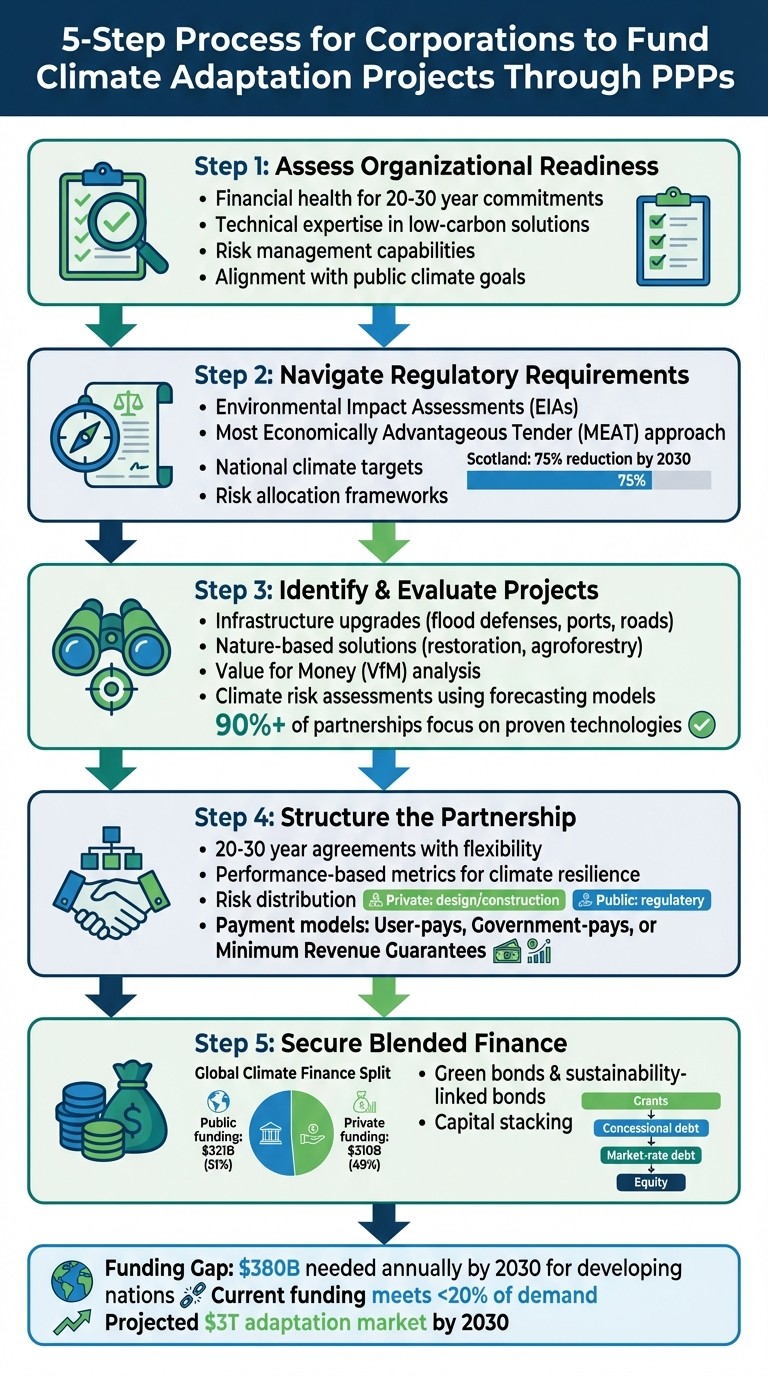
5-Step Process for Corporations to Fund Climate Adaptation Projects Through PPPs
WAPPP Roundtable on Blended Finance for Climate Adaptation
Assessing Your Organization's Readiness for PPPs
Before entering into a climate adaptation partnership, it’s crucial to evaluate your financial health, technical expertise, and risk management capabilities. This ensures you’re prepared to sustain a long-term commitment.
Reviewing Internal Capabilities
Start by assessing your financial readiness for long-term investments, such as the 50-year utility system partnership at the University of Iowa [2][5]. These partnerships often require significant and sustained funding.
Next, evaluate your technical expertise. Your team should have a proven track record in areas like low-carbon solutions, green infrastructure management, and both nature-based and traditional engineering approaches for climate resilience. Many previous public-private partnership (PPP) projects have required expertise in managing greenhouse gas emissions and responding to natural disasters [2][5].
Additionally, ensure you can conduct Environmental and Social Impact Assessments (ESIAs), utilize forecasting models that incorporate future climate risks, and implement disaster prevention plans backed by adequate insurance coverage [2][5].
Finally, confirm that your corporate objectives align with the public sector’s climate goals to ensure a cohesive partnership.
Matching Corporate Goals with Climate Priorities
Once you’ve reviewed your internal strengths, the next step is to align these with public climate priorities. This alignment is key to building a meaningful and effective partnership. Focus on solutions that deliver measurable benefits, such as improvements in public health or economic development, as these are often valued outcomes [6].
The best partnerships tend to focus on implementing established technologies that are approaching scalability. More than 90% of reviewed partnerships emphasize deploying proven technologies rather than investing in early-stage innovations [6].
To demonstrate value for money (VfM), showcase how your solutions can optimize resources and reduce disaster response times. For example, flexible supplier arrangements at the Sendai City School Meal Supply Center enabled recovery 2.5 months faster than government-run facilities, illustrating the importance of adaptive planning [2][5].
Navigating the Regulatory Landscape
Understanding the regulatory framework is essential for successful partnerships. Many jurisdictions now mandate Environmental Impact Assessments (EIAs) that evaluate a project’s climate vulnerability and its greenhouse gas emissions. For instance, the EU Directive 2014/52/EU and Canada’s Impact Assessment Act require such assessments [2].
Procurement processes have also shifted. Instead of focusing solely on cost, the "Most Economically Advantageous Tender" (MEAT) approach considers life-cycle costs, including climate mitigation expenses and environmental performance [2][1].
Your projects must align with national climate targets and action plans. For example, Scotland’s Climate Change Act specifies emissions reduction goals of 75% by 2030, 90% by 2040, and net-zero by 2045 [2]. Similarly, regions like the Philippines require feasibility studies to include a dedicated chapter on climate resilience and natural hazard risks before project approval [2][5].
In most PPP frameworks, political and regulatory risks are typically assigned to the public sector, while private partners are responsible for risks related to design, construction, and operations [1]. Understanding this risk allocation is critical for preparing your resources and safeguards effectively.
Finding Climate Adaptation Projects for PPPs
Common Climate Adaptation Project Types
Climate adaptation projects tackle a wide range of vulnerabilities, often focusing on strengthening infrastructure and ecosystems to withstand climate impacts. Upgrades to infrastructure - like dykes, ports, roads, and railways - help mitigate risks from extreme weather events and rising sea levels [1]. Nature-based solutions are another key approach, encompassing efforts such as river restoration, agroforestry, coastal dune protection, and mountain terracing. Urban areas benefit from green measures like green roofs, bioswales, and detention ponds [7][6]. Additionally, sector-specific projects - such as transitioning energy systems, promoting sustainable agriculture, and protecting mangroves - play a critical role in reducing climate risks [6].
A notable example is the Initiative 20x20 in Latin America and the Caribbean, which has attracted $2.5 billion in private capital to restore over 50 million hectares of degraded land by 2030 [6].
When selecting projects, it's crucial to focus on regions with high vulnerability and limited resources to address climate challenges on their own. Prioritize solutions that not only address environmental concerns but also provide broader benefits, such as improved health and enhanced livelihoods [6]. Interestingly, more than 90% of reviewed partnerships emphasize deploying proven technologies nearing commercial readiness, rather than experimental innovations [6].
After identifying potential projects, the next step is to evaluate their financial and technical feasibility.
Determining Project Feasibility
Assessing financial feasibility begins with a Value for Money (VfM) analysis. This involves comparing whether a public-private partnership (PPP) model delivers better outcomes than traditional public procurement. For instance, you might weigh the costs and benefits of public administration against a private operator under a Build-Operate-Transfer (BOT) scheme [5]. Life-cycle costing is essential here, accounting for greenhouse gas emissions and climate mitigation expenses throughout the project's lifespan [5].
Projects must be large enough to justify transaction costs but also manageable within market and local construction capabilities [8].
Technical feasibility, on the other hand, requires robust climate risk assessments. These assessments should use forecasting models that account for future climate shocks, rather than relying solely on historical data [5]. Ensure that the project's output requirements are clearly defined and that bundling construction with operations and maintenance offers technical advantages [8].
A compelling example of this approach is Belize’s Blue Bonds partnership from November 2021. Collaborating with The Nature Conservancy, Credit Suisse, and the U.S. Development Finance Corporation, Belize reduced its $553 million external commercial debt by purchasing it back at a discount, financed through $364 million in "blue bonds." In exchange, Belize committed to allocating approximately $4 million annually toward marine conservation efforts through 2041 [6].
Once feasibility is established, it’s essential to evaluate the public partner’s ability to sustain the project over the long term.
Evaluating Public Partner Capacity
The success of a PPP hinges on the capabilities of the public partner. Start by verifying their use of forecasting models that incorporate climate uncertainties into feasibility studies and cost-benefit analyses [5]. Check if they adhere to mandates such as the EU’s Environmental Impact Assessment (EIA) Directive or Canada’s "Climate Lens" framework [5][2].
Given that PPPs often span 20–30 years, the public partner must demonstrate a commitment to the project’s full term and ensure that demand for the service remains consistent [10]. Their institutional arrangements for emergency response are equally important, as private partners often enable faster recovery thanks to more flexible supplier selection processes [5].
Evaluate whether the public partner employs "Most Economically Advantageous Tender" (MEAT) criteria. This approach prioritizes environmental and climate performance in technical specifications, rather than focusing solely on the lowest bid price [5]. For example, the Rijkswaterstaat in the Netherlands uses tools like the "CO2 Performance Ladder" and "DuboCalc" life-cycle analysis to assess bidders, encouraging the use of low-carbon materials aligned with specific sustainability metrics [5].
Lastly, assess the public partner’s ability to engage with local stakeholders effectively. Public funding supports approximately 86% of nature-based solution projects in Europe, highlighting opportunities for private sector involvement through PPPs. However, success in these projects often depends on the public partner’s ability to navigate community relationships and foster collaboration [7].
Designing Effective Public-Private Partnerships
Core Elements of a PPP Agreement
Public-private partnerships (PPPs) in climate adaptation require long-term agreements - often spanning 20 to 30 years - that include built-in flexibility. This flexibility allows adjustments for evolving climate conditions, technological advancements, or economic shifts [11].
To ensure accountability, performance metrics are essential. These should focus on measurable climate-resilience outcomes rather than generic operational benchmarks. For instance, the University of Iowa Utility System PPP includes a 50-year agreement mandating a coal-free campus by January 1, 2025. Bidders for this project needed to demonstrate expertise in managing greenhouse gas emissions and responding to natural disasters [5].
Emergency response protocols are another critical component. These should outline clear institutional roles to enable rapid recovery, a key advantage over purely public operations. The Sendai School Meal Supply Center in Japan highlighted this benefit by recovering from a major disaster roughly 2.5 months faster than government-run facilities, thanks to the private partner's adaptable supply chain [5].
Technical specifications in PPPs should aim for lifecycle reductions in greenhouse gas emissions and resilience against extreme weather. For example, the Climate Change (Emissions Reduction Targets) (Scotland) Act 2019 set interim goals for reducing emissions by at least 75% by 2030 and 90% by 2040. Many PPP agreements now reference such regulatory frameworks for guidance [5].
With these foundational elements in place, the next step is to distribute risks effectively within the partnership.
Distributing Risk in PPPs
"The underlying principle is that the risks associated with carrying out a PPP project are allocated to the party best able to control or to manage the consequences of the risk." - World Bank Group [11]
This principle underpins risk allocation in climate adaptation PPPs. Each risk should be assigned to the party best equipped to manage it.
Demand risk is a significant factor in these agreements. In a user-pays model, the private partner assumes revenue risk through mechanisms like tolls or usage fees. Alternatively, a government-pays model shifts demand risk to the public sector, which makes payments based on asset availability and quality. A middle-ground approach, minimum revenue guarantees, ensures the government covers revenue shortfalls below a specific threshold, sharing the risk [11].
Accurate climate risk forecasting is essential. Traditional reliance on past weather data is no longer reliable, making forward-looking models crucial [5]. For technologies with high upfront costs, shared risk approaches combined with benefit-sharing mechanisms can strike a balance between economic stability and innovation [11]. For instance, future energy PPPs could include flexible take-or-pay clauses, allowing project owners to sell surplus electricity to other markets if government utilities fail to meet demand due to shifting climate priorities [11].
"A balanced and reasonable risk allocation requires that all stakeholders in a PPP project have the comfort that situations that are beyond their immediate control... will be dealt with in a way that allows them to arrive at a mutually acceptable solution." - World Bank [11]
Long-term agreements also require flexibility to adapt to changes in technology without leading to disputes or early termination. As infrastructure becomes more digitized, cyber risks should be addressed through shared mitigation strategies and insurance rather than assigning responsibility to a single party [11].
Once risks are allocated, the financial structure becomes the backbone of the partnership's success.
Financial Structure and Payment Models
The financial setup of a PPP determines how funds flow and who ultimately bears financial risk. Blended finance, which combines public funding with private capital, has become a popular way to fund projects that deliver both financial returns and social benefits [12].
Most climate adaptation PPPs rely on project-financed transactions, where repayment is tied to the project's cash flow rather than the sponsor's balance sheet. This approach isolates risks and attracts institutional investors by clearly defining risk boundaries [12].
Performance-based payment structures are another key element. These link compensation to specific outcomes, incorporating life-cycle costs such as greenhouse gas emissions into the total cost of ownership. For example, the Rijkswaterstaat (RWS) Motorway A6 Almere in the Netherlands used a Design, Build, Maintain, and Finance (DBFM) contract. This incentivized bidders to propose designs and materials that minimized CO2 emissions, evaluated using the "DuboCalc" tool [5].
| Payment Model | Risk Bearer | Best Suited For |
| --- | --- | --- |
| <strong>User-pays</strong> | Private Partner | Projects with steady revenue streams (e.g., toll roads) where demand can be influenced <a href="https://ppp.worldbank.org/structuring-ppp-contract" target="_blank" style="text-decoration: none;" rel="nofollow noopener noreferrer" data-framer-link="Link:{"url":"https://ppp.worldbank.org/structuring-ppp-contract","type":"url"}" data-framer-open-in-new-tab=""><sup>[11]</sup></a> |
| <strong>Government-pays</strong> | Public Partner | Social sector projects (e.g., schools, prisons) where the government retains policy control <a href="https://ppp.worldbank.org/structuring-ppp-contract" target="_blank" style="text-decoration: none;" rel="nofollow noopener noreferrer" data-framer-link="Link:{"url":"https://ppp.worldbank.org/structuring-ppp-contract","type":"url"}" data-framer-open-in-new-tab=""><sup>[11]</sup></a> |
| <strong>Minimum Revenue Guarantees</strong> | Shared | Urban transport or energy projects where public entities cover revenue shortfalls <a href="https://ppp.worldbank.org/structuring-ppp-contract" target="_blank" style="text-decoration: none;" rel="nofollow noopener noreferrer" data-framer-link="Link:{"url":"https://ppp.worldbank.org/structuring-ppp-contract","type":"url"}" data-framer-open-in-new-tab=""><sup>[11]</sup></a> |
| Payment Model | Risk Bearer | Best Suited For |
| --- | --- | --- |
| <strong>User-pays</strong> | Private Partner | Projects with steady revenue streams (e.g., toll roads) where demand can be influenced <a href="https://ppp.worldbank.org/structuring-ppp-contract" target="_blank" style="text-decoration: none;" rel="nofollow noopener noreferrer" data-framer-link="Link:{"url":"https://ppp.worldbank.org/structuring-ppp-contract","type":"url"}" data-framer-open-in-new-tab=""><sup>[11]</sup></a> |
| <strong>Government-pays</strong> | Public Partner | Social sector projects (e.g., schools, prisons) where the government retains policy control <a href="https://ppp.worldbank.org/structuring-ppp-contract" target="_blank" style="text-decoration: none;" rel="nofollow noopener noreferrer" data-framer-link="Link:{"url":"https://ppp.worldbank.org/structuring-ppp-contract","type":"url"}" data-framer-open-in-new-tab=""><sup>[11]</sup></a> |
| <strong>Minimum Revenue Guarantees</strong> | Shared | Urban transport or energy projects where public entities cover revenue shortfalls <a href="https://ppp.worldbank.org/structuring-ppp-contract" target="_blank" style="text-decoration: none;" rel="nofollow noopener noreferrer" data-framer-link="Link:{"url":"https://ppp.worldbank.org/structuring-ppp-contract","type":"url"}" data-framer-open-in-new-tab=""><sup>[11]</sup></a> |Commercial value capture (CVC) offers another revenue option. This approach uses tools like land value capture and tax increment financing to generate funds from increased property values due to infrastructure improvements. Additionally, asset recycling - leasing or concessioning public assets - can unlock capital for reinvestment in new, climate-resilient projects [12].
For markets requiring specific financial structures, Islamic finance provides Sharia-compliant options like sukuk (bonds) and ijara (leasing). Local currency financing is also gaining traction, reducing currency risk and improving affordability by sourcing debt domestically [12].
Considering that infrastructure accounts for about 70% of global greenhouse gas emissions, payment models must incentivize low-emission outcomes throughout their lifecycle [13].
Securing Climate Finance and Funding
Efficient public-private partnerships (PPPs) for climate adaptation hinge on easy access to both public and private funding sources.
Public Sector Climate Finance Sources
In 2019/2020, public sector funding accounted for 51% ($321 billion) of global climate finance, totaling $632 billion during that period [16]. Development Finance Institutions (DFIs) contributed 68% of this public funding through tools like concessional loans, guarantees, and risk capital [16].
Under the UNFCCC, multilateral funds such as the Green Climate Fund (GCF), Global Environment Facility (GEF), and other specialized funds (e.g., AF, SCCF, LDCF) address specific adaptation needs. However, corporations typically access these resources via accredited intermediaries rather than direct applications.
At the national and state levels, dedicated climate budgets and Project Development Funds (PDFs) play a crucial role. These funds support preparatory work - such as legal structuring, environmental assessments, and feasibility studies - that make PPP projects financially viable. Research indicates that every $1 invested in adaptation can yield over $10 in benefits within a decade [14].
One example of innovation in public finance is the Green Climate Fund's Climate Investor Two (CI2) initiative, launched in 2021. This program focuses on climate-resilient infrastructure in water, sanitation, and ocean sectors across emerging markets [14]. Similarly, the European Investment Bank, in collaboration with La Banque Agricole, has issued concessional loans in Senegal to support small and medium enterprises in agriculture, prioritizing women and smallholder farmers [14].
Given the intricate governance and data requirements of these funds, businesses are encouraged to engage climate finance experts early in the process. Third-party verifiers like Deloitte, KPMG, or Carbon Trust can help ensure projects meet international standards, improving eligibility for public funding [15].
Private Sector Financing Options
Blended finance models that combine public and private capital are essential for improving project feasibility and managing risks. In 2019/2020, private finance contributed $310 billion to climate action, with commercial financial institutions and corporations providing nearly 80% of this amount [19]. However, adaptation projects often attract less private investment than mitigation efforts, requiring targeted strategies.
Green bonds and sustainability-linked bonds have gained traction as tools for raising large-scale debt. These bonds attract institutional investors by adhering to standards like the Climate Bonds Standard, offering transparency. Certification costs for such bonds typically range from $1,000–$2,000, plus about 0.1% of the bond value [18].
Another path is impact investing and direct corporate equity, which are best suited for projects with clear commercial potential and measurable climate benefits.
"Government resources alone cannot provide the amount of finance needed for the climate transition, making unlocking private sector capital fundamental to achieving transformational and long-term impacts across all economies." - World Bank [19]
Combining Public and Private Capital
Blended finance strategies mix public and private funding to create financially viable projects. Public sector contributions often take the form of concessional capital - offering below-market-rate loans with extended grace periods - to reduce risks and enhance returns for private investors [19].
One effective approach is capital stacking, where funding sources are layered strategically:
Grants from public or philanthropic sources cover non-revenue-generating activities like technical studies or community engagement.
Concessional debt from DFIs improves project economics.
Market-rate debt, such as green bonds, provides large-scale funding.
Private equity fills gaps in projects with commercial potential [19].
Corporations can amplify their impact by combining internal resources with external funding. Public partners often support this process by sharing critical data, facilitating approvals, or providing letters of support. Notably, 76% of all tracked climate finance is raised and spent within the same country [19], highlighting the importance of aligning with national adaptation plans. Using local currency financing also reduces currency risk and makes projects more affordable [12].
| Instrument Type | Primary Source | Role in Combined Structure |
| --- | --- | --- |
| <strong>Grants</strong> | Public/Philanthropic | Seed funding, technical assistance, and project preparation <a href="https://ppp.worldbank.org/overview-climate-finance-asset-recycling" target="_blank" style="text-decoration: none;" rel="nofollow noopener noreferrer" data-framer-link="Link:{"url":"https://ppp.worldbank.org/overview-climate-finance-asset-recycling","type":"url"}" data-framer-open-in-new-tab=""><sup>[19]</sup></a> |
| <strong>Concessional Debt</strong> | Public/DFIs | Low-cost capital to improve the risk-return profile <a href="https://ppp.worldbank.org/overview-climate-finance-asset-recycling" target="_blank" style="text-decoration: none;" rel="nofollow noopener noreferrer" data-framer-link="Link:{"url":"https://ppp.worldbank.org/overview-climate-finance-asset-recycling","type":"url"}" data-framer-open-in-new-tab=""><sup>[19]</sup></a> |
| <strong>Green Bonds</strong> | Private/Market | Large-scale debt for climate-compliant assets <a href="https://ppp.worldbank.org/public-private-partnership/applicable-all-sectors/accessing-climate-finance-asset-recycling" target="_blank" style="text-decoration: none;" rel="nofollow noopener noreferrer" data-framer-link="Link:{"url":"https://ppp.worldbank.org/public-private-partnership/applicable-all-sectors/accessing-climate-finance-asset-recycling","type":"url"}" data-framer-open-in-new-tab=""><sup>[18]</sup></a> |
| <strong>Equity</strong> | Private/Corporate | Direct investment for commercially viable projects <a href="https://ppp.worldbank.org/overview-climate-finance-asset-recycling" target="_blank" style="text-decoration: none;" rel="nofollow noopener noreferrer" data-framer-link="Link:{"url":"https://ppp.worldbank.org/overview-climate-finance-asset-recycling","type":"url"}" data-framer-open-in-new-tab=""><sup>[19]</sup></a> |
| <strong>Guarantees</strong> | Public/Multilateral | Risk mitigation for private investors against regulatory shifts <a href="https://ppp.worldbank.org/overview-climate-finance-asset-recycling" target="_blank" style="text-decoration: none;" rel="nofollow noopener noreferrer" data-framer-link="Link:{"url":"https://ppp.worldbank.org/overview-climate-finance-asset-recycling","type":"url"}" data-framer-open-in-new-tab=""><sup>[19]</sup></a> || Instrument Type | Primary Source | Role in Combined Structure |
| --- | --- | --- |
| <strong>Grants</strong> | Public/Philanthropic | Seed funding, technical assistance, and project preparation <a href="https://ppp.worldbank.org/overview-climate-finance-asset-recycling" target="_blank" style="text-decoration: none;" rel="nofollow noopener noreferrer" data-framer-link="Link:{"url":"https://ppp.worldbank.org/overview-climate-finance-asset-recycling","type":"url"}" data-framer-open-in-new-tab=""><sup>[19]</sup></a> |
| <strong>Concessional Debt</strong> | Public/DFIs | Low-cost capital to improve the risk-return profile <a href="https://ppp.worldbank.org/overview-climate-finance-asset-recycling" target="_blank" style="text-decoration: none;" rel="nofollow noopener noreferrer" data-framer-link="Link:{"url":"https://ppp.worldbank.org/overview-climate-finance-asset-recycling","type":"url"}" data-framer-open-in-new-tab=""><sup>[19]</sup></a> |
| <strong>Green Bonds</strong> | Private/Market | Large-scale debt for climate-compliant assets <a href="https://ppp.worldbank.org/public-private-partnership/applicable-all-sectors/accessing-climate-finance-asset-recycling" target="_blank" style="text-decoration: none;" rel="nofollow noopener noreferrer" data-framer-link="Link:{"url":"https://ppp.worldbank.org/public-private-partnership/applicable-all-sectors/accessing-climate-finance-asset-recycling","type":"url"}" data-framer-open-in-new-tab=""><sup>[18]</sup></a> |
| <strong>Equity</strong> | Private/Corporate | Direct investment for commercially viable projects <a href="https://ppp.worldbank.org/overview-climate-finance-asset-recycling" target="_blank" style="text-decoration: none;" rel="nofollow noopener noreferrer" data-framer-link="Link:{"url":"https://ppp.worldbank.org/overview-climate-finance-asset-recycling","type":"url"}" data-framer-open-in-new-tab=""><sup>[19]</sup></a> |
| <strong>Guarantees</strong> | Public/Multilateral | Risk mitigation for private investors against regulatory shifts <a href="https://ppp.worldbank.org/overview-climate-finance-asset-recycling" target="_blank" style="text-decoration: none;" rel="nofollow noopener noreferrer" data-framer-link="Link:{"url":"https://ppp.worldbank.org/overview-climate-finance-asset-recycling","type":"url"}" data-framer-open-in-new-tab=""><sup>[19]</sup></a> |The Kigali Bulk Water Supply Project exemplifies this approach. In Rwanda, the government partnered with Kigali Water Limited to develop a bulk water facility in Kanzenza, addressing water scarcity. This project combined public sector planning and regulatory support with private financing and operational expertise [14][15].
"To take your dollars further, it's critical to leverage multiple forms of capital, and in coordination with one another. Strategically match financing approaches to the appropriate climate initiative to advance one integrated strategy." - Climate Policy Initiative [17]
Despite progress, adaptation finance remains far short of the $380 billion needed annually by 2030, with public sources dominating current flows [3]. Companies that skillfully integrate public and private funding will be better equipped to close this gap while advancing their climate adaptation goals.
Managing Partnerships and Stakeholder Relationships
Securing funding is just the beginning - maintaining strong partnerships is equally essential for long-term success. Climate adaptation public-private partnerships (PPPs) often span 20 to 30 years [1], meaning collaboration frameworks must evolve over decades to address new climate challenges. These partnerships extend beyond formal stakeholders to include local communities, civil society organizations, and populations directly impacted by project outcomes, even if they don’t control resources [1].
Working with Key Stakeholders
Effective PPPs start with identifying all stakeholders - those who control resources and those affected by the project. Government agencies provide regulatory and policy support, while financiers monitor performance metrics tied to their investments. On-the-ground insights from local communities and civil society groups are indispensable for understanding climate vulnerabilities and social priorities. Notably, around 40% of existing climate PPPs now incorporate socioeconomic goals, such as health, equity, and poverty reduction, into their mission statements to build trust within communities [6].
An anchor partner plays a pivotal role in ensuring long-term success. For instance, the Initiative 20x20 project in Latin America and the Caribbean brought together over 85 partners and 150 organizations to restore 50 million hectares of land by 2030. This ambitious effort secured over $3 billion in private investment commitments. The initiative’s success hinged on its 4P model (public-private-philanthropic partnership), where anchor partners provided initial funding and sustained a long-term vision [6].
"Forming novel 4P models in high-need geographies and systems will require an anchor partner who can take a long-term view and provide some of the start-up capital and runway." – McKinsey Sustainability [6]
Once stakeholders are aligned, establishing structured communication frameworks becomes the next critical step.
Creating Collaboration Frameworks
Partners must clearly define roles and responsibilities from the outset and implement formal governance structures, such as standing committees focused on climate adaptation [20]. Early engagement with communities should include conflict resolution strategies and data-driven communication to address complex issues like displacement or managed retreat [20][4]. Consistency in messaging is also key - partners should aim to "speak in one voice" when addressing affected communities to ensure transparency and trust [1].
With collaboration frameworks in place, ongoing transparency and accountability are crucial for sustaining these partnerships.
Maintaining Transparency and Accountability
Accountability hinges on robust Monitoring, Reporting, and Evaluation (MRE) systems that track performance and enable real-time adjustments [1]. Clear Key Performance Indicators (KPIs) should be embedded into contracts and tender documents. Projects with strong monitoring and flexible supplier arrangements often achieve faster recovery times.
"Risks in a PPP project should be allocated to the party which is best suited to manage them, with the aim to attain the optimum balance between risk shifting and compensation for the risk-bearing party." – Climate-ADAPT [1]
Transparent risk allocation fosters trust. Typically, private partners handle construction and operational risks, while public partners manage regulatory and policy risks [1]. Corporate Social Responsibility (CSR) disclosure frameworks further enhance transparency by allowing corporations to report on joint adaptation efforts. Some partnerships take it a step further by reinvesting cost savings and revenues into future resilience projects. For example, the Community-Based Public-Private Partnership (CBP3) model leverages private equity at a ratio of 10:1, securing $10 of private capital for every $1 of public investment [9].
While setting up a formal PPP can take two to five years [1], the relationships built during this process often determine the partnership’s long-term success. Strong stakeholder engagement, clear communication, and transparent accountability measures lay the groundwork for lasting climate adaptation outcomes. Corporations that prioritize these elements are better equipped to navigate the challenges of climate adaptation over time.
Conclusion
Public-private partnerships (PPPs) go beyond being simple funding mechanisms; they serve as strategic avenues for companies to safeguard assets, explore new revenue opportunities, and tap into the projected $3 trillion adaptation market by 2030 [3][21]. The urgency of the situation is clear: developing nations will need over $380 billion annually for adaptation efforts by 2030, yet current funding meets less than 20% of this demand [3]. Bridging this gap requires collaboration on an unprecedented scale.
The most effective partnerships share a few key traits. They assign risks to the parties best equipped to handle them, establish clear KPIs from the outset, and evaluate opportunities through the Three-Pillar Evaluation Framework - Materiality, Suitability, and Feasibility [6]. Corporations that target high-impact areas like energy, agriculture, and land conservation, while integrating socioeconomic benefits, not only achieve better outcomes but also build stronger alliances with stakeholders. These principles reinforce earlier strategies, demonstrating the power of well-aligned and risk-aware partnerships.
As McKinsey Sustainability highlights:
"The private sector, including corporations supported by investors, can establish the required business models and mobilize resources to grow and deploy solutions at scale." – McKinsey Sustainability [6]
Establishing PPPs demands both time and dedication, with timelines often spanning two to five years [1]. Companies that act now have the chance to shape national adaptation strategies and position themselves as leaders in climate resilience. With 87% of existing public-private-philanthropic models concentrated in emerging economies [6], there are abundant opportunities across various regions and industries.
The stakes are high. Without action, climate-related damages could cost up to 19% of GDP in the most vulnerable regions by 2050 [3]. However, partnerships transform adaptation into a source of value. Businesses that engage anchor partners, align on shared goals, and commit for the long haul will not only navigate the challenges of a changing climate but also create measurable, lasting impact.
FAQs
How can companies determine if they’re ready to engage in climate adaptation public-private partnerships?
To gauge readiness for climate adaptation public-private partnerships (PPPs), businesses should begin by examining their exposure to climate-related risks. This means identifying vulnerabilities in infrastructure, supply chains, and operations, particularly in the face of extreme weather events or gradual environmental shifts. Such an evaluation can help pinpoint areas where resilience needs to be strengthened.
It’s also crucial to take stock of internal resources, including financial capacity, technical skills, and the ability to engage stakeholders. These resources should align with the requirements of PPP involvement and the company’s broader sustainability objectives. Additionally, companies should review how their current risk management practices and investments contribute to building climate resilience.
Lastly, understanding the legal, regulatory, and institutional frameworks tied to climate adaptation is essential. Familiarity with policies, available incentives, and funding opportunities, along with fostering strong connections with public sector entities, can greatly enhance preparedness. Addressing these aspects allows businesses to identify gaps and better position themselves for successful participation in climate-focused PPPs.
What are the main advantages for corporations partnering on climate adaptation projects through PPPs?
Partnering on climate adaptation projects through public-private partnerships (PPPs) offers businesses a practical way to address the escalating challenges posed by climate change. These collaborations enable companies to safeguard their assets, supply chains, and day-to-day operations, ensuring stability and long-term growth even in the face of environmental uncertainties.
Beyond risk management, PPPs introduce businesses to cutting-edge solutions that boost resilience while unlocking new market opportunities. These partnerships can also enhance a company's standing as a forward-thinking leader in addressing climate challenges. Moreover, they provide access to specialized funding and financial tools aimed at supporting adaptation efforts, helping reduce financial exposure and optimize resource use.
By aligning corporate objectives with public climate initiatives, PPPs not only strengthen business resilience but also generate economic and social benefits, creating value for both companies and the communities they serve.
How can corporations and governments work together to fund climate adaptation projects?
Corporations and governments can join forces to fund climate adaptation projects through public-private partnerships (PPPs). These partnerships create opportunities for private companies to invest in resilience initiatives while public entities contribute by offering policy support, sharing risks, and establishing a stable framework for execution.
For these collaborations to work effectively, corporations can direct their investments toward public climate priorities, such as safeguarding essential infrastructure or developing cutting-edge resilience technologies. Meanwhile, governments can lower investment risks by providing financial incentives like tax credits or grants and fostering a regulatory environment that encourages participation. This combined approach ensures consistent funding and meaningful, long-term progress.
By tapping into the strengths of both sectors, PPPs pave the way for scalable climate adaptation efforts that benefit businesses, communities, and the environment.
Related Blog Posts
Latest Articles
©2025


FAQ
01
What does it really mean to “redefine profit”?
02
What makes Council Fire different?
03
Who does Council Fire you work with?
04
What does working with Council Fire actually look like?
05
How does Council Fire help organizations turn big goals into action?
06
How does Council Fire define and measure success?
Feb 3, 2026
How to Fund Climate Adaptation Projects via Public-Private Partnerships for Corporations
Sustainability Strategy
In This Article
Guide for corporations on funding climate adaptation via PPPs: assess readiness, structure long-term contracts, blend public/private finance, and manage climate risks.
How to Fund Climate Adaptation Projects via Public-Private Partnerships for Corporations
Public-private partnerships (PPPs) offer a practical way for corporations to fund climate adaptation projects by combining private sector resources with government support. With climate-related damages projected to cost up to 19% of GDP in vulnerable regions by 2050, and funding needs exceeding $380 billion annually for developing nations by 2030, PPPs present a structured solution to bridge this gap. These long-term agreements - spanning 20–30 years - allow corporations to align their sustainability goals with public climate priorities while accessing financial tools like green bonds, concessional loans, and blended finance models.
Key Takeaways:
What are PPPs? Private firms handle design, construction, and operational risks, while governments provide oversight and regulatory support.
Why PPPs for Climate? They mobilize private capital for resilient infrastructure like flood defenses, green urban spaces, and renewable energy systems.
Corporate Benefits: Faster project delivery, access to climate funding, and alignment with zero-carbon goals.
Steps to Get Started: Assess financial health, technical expertise, and alignment with public climate goals; understand regulatory requirements; and evaluate project feasibility.
Funding Sources: Blended finance, green bonds, and development finance institutions (DFIs) are key tools for financing PPPs.
PPPs are not just about funding - they’re about creating long-term partnerships that deliver measurable outcomes while addressing climate challenges.
5-Step Process for Corporations to Fund Climate Adaptation Projects Through PPPs
WAPPP Roundtable on Blended Finance for Climate Adaptation
Assessing Your Organization's Readiness for PPPs
Before entering into a climate adaptation partnership, it’s crucial to evaluate your financial health, technical expertise, and risk management capabilities. This ensures you’re prepared to sustain a long-term commitment.
Reviewing Internal Capabilities
Start by assessing your financial readiness for long-term investments, such as the 50-year utility system partnership at the University of Iowa [2][5]. These partnerships often require significant and sustained funding.
Next, evaluate your technical expertise. Your team should have a proven track record in areas like low-carbon solutions, green infrastructure management, and both nature-based and traditional engineering approaches for climate resilience. Many previous public-private partnership (PPP) projects have required expertise in managing greenhouse gas emissions and responding to natural disasters [2][5].
Additionally, ensure you can conduct Environmental and Social Impact Assessments (ESIAs), utilize forecasting models that incorporate future climate risks, and implement disaster prevention plans backed by adequate insurance coverage [2][5].
Finally, confirm that your corporate objectives align with the public sector’s climate goals to ensure a cohesive partnership.
Matching Corporate Goals with Climate Priorities
Once you’ve reviewed your internal strengths, the next step is to align these with public climate priorities. This alignment is key to building a meaningful and effective partnership. Focus on solutions that deliver measurable benefits, such as improvements in public health or economic development, as these are often valued outcomes [6].
The best partnerships tend to focus on implementing established technologies that are approaching scalability. More than 90% of reviewed partnerships emphasize deploying proven technologies rather than investing in early-stage innovations [6].
To demonstrate value for money (VfM), showcase how your solutions can optimize resources and reduce disaster response times. For example, flexible supplier arrangements at the Sendai City School Meal Supply Center enabled recovery 2.5 months faster than government-run facilities, illustrating the importance of adaptive planning [2][5].
Navigating the Regulatory Landscape
Understanding the regulatory framework is essential for successful partnerships. Many jurisdictions now mandate Environmental Impact Assessments (EIAs) that evaluate a project’s climate vulnerability and its greenhouse gas emissions. For instance, the EU Directive 2014/52/EU and Canada’s Impact Assessment Act require such assessments [2].
Procurement processes have also shifted. Instead of focusing solely on cost, the "Most Economically Advantageous Tender" (MEAT) approach considers life-cycle costs, including climate mitigation expenses and environmental performance [2][1].
Your projects must align with national climate targets and action plans. For example, Scotland’s Climate Change Act specifies emissions reduction goals of 75% by 2030, 90% by 2040, and net-zero by 2045 [2]. Similarly, regions like the Philippines require feasibility studies to include a dedicated chapter on climate resilience and natural hazard risks before project approval [2][5].
In most PPP frameworks, political and regulatory risks are typically assigned to the public sector, while private partners are responsible for risks related to design, construction, and operations [1]. Understanding this risk allocation is critical for preparing your resources and safeguards effectively.
Finding Climate Adaptation Projects for PPPs
Common Climate Adaptation Project Types
Climate adaptation projects tackle a wide range of vulnerabilities, often focusing on strengthening infrastructure and ecosystems to withstand climate impacts. Upgrades to infrastructure - like dykes, ports, roads, and railways - help mitigate risks from extreme weather events and rising sea levels [1]. Nature-based solutions are another key approach, encompassing efforts such as river restoration, agroforestry, coastal dune protection, and mountain terracing. Urban areas benefit from green measures like green roofs, bioswales, and detention ponds [7][6]. Additionally, sector-specific projects - such as transitioning energy systems, promoting sustainable agriculture, and protecting mangroves - play a critical role in reducing climate risks [6].
A notable example is the Initiative 20x20 in Latin America and the Caribbean, which has attracted $2.5 billion in private capital to restore over 50 million hectares of degraded land by 2030 [6].
When selecting projects, it's crucial to focus on regions with high vulnerability and limited resources to address climate challenges on their own. Prioritize solutions that not only address environmental concerns but also provide broader benefits, such as improved health and enhanced livelihoods [6]. Interestingly, more than 90% of reviewed partnerships emphasize deploying proven technologies nearing commercial readiness, rather than experimental innovations [6].
After identifying potential projects, the next step is to evaluate their financial and technical feasibility.
Determining Project Feasibility
Assessing financial feasibility begins with a Value for Money (VfM) analysis. This involves comparing whether a public-private partnership (PPP) model delivers better outcomes than traditional public procurement. For instance, you might weigh the costs and benefits of public administration against a private operator under a Build-Operate-Transfer (BOT) scheme [5]. Life-cycle costing is essential here, accounting for greenhouse gas emissions and climate mitigation expenses throughout the project's lifespan [5].
Projects must be large enough to justify transaction costs but also manageable within market and local construction capabilities [8].
Technical feasibility, on the other hand, requires robust climate risk assessments. These assessments should use forecasting models that account for future climate shocks, rather than relying solely on historical data [5]. Ensure that the project's output requirements are clearly defined and that bundling construction with operations and maintenance offers technical advantages [8].
A compelling example of this approach is Belize’s Blue Bonds partnership from November 2021. Collaborating with The Nature Conservancy, Credit Suisse, and the U.S. Development Finance Corporation, Belize reduced its $553 million external commercial debt by purchasing it back at a discount, financed through $364 million in "blue bonds." In exchange, Belize committed to allocating approximately $4 million annually toward marine conservation efforts through 2041 [6].
Once feasibility is established, it’s essential to evaluate the public partner’s ability to sustain the project over the long term.
Evaluating Public Partner Capacity
The success of a PPP hinges on the capabilities of the public partner. Start by verifying their use of forecasting models that incorporate climate uncertainties into feasibility studies and cost-benefit analyses [5]. Check if they adhere to mandates such as the EU’s Environmental Impact Assessment (EIA) Directive or Canada’s "Climate Lens" framework [5][2].
Given that PPPs often span 20–30 years, the public partner must demonstrate a commitment to the project’s full term and ensure that demand for the service remains consistent [10]. Their institutional arrangements for emergency response are equally important, as private partners often enable faster recovery thanks to more flexible supplier selection processes [5].
Evaluate whether the public partner employs "Most Economically Advantageous Tender" (MEAT) criteria. This approach prioritizes environmental and climate performance in technical specifications, rather than focusing solely on the lowest bid price [5]. For example, the Rijkswaterstaat in the Netherlands uses tools like the "CO2 Performance Ladder" and "DuboCalc" life-cycle analysis to assess bidders, encouraging the use of low-carbon materials aligned with specific sustainability metrics [5].
Lastly, assess the public partner’s ability to engage with local stakeholders effectively. Public funding supports approximately 86% of nature-based solution projects in Europe, highlighting opportunities for private sector involvement through PPPs. However, success in these projects often depends on the public partner’s ability to navigate community relationships and foster collaboration [7].
Designing Effective Public-Private Partnerships
Core Elements of a PPP Agreement
Public-private partnerships (PPPs) in climate adaptation require long-term agreements - often spanning 20 to 30 years - that include built-in flexibility. This flexibility allows adjustments for evolving climate conditions, technological advancements, or economic shifts [11].
To ensure accountability, performance metrics are essential. These should focus on measurable climate-resilience outcomes rather than generic operational benchmarks. For instance, the University of Iowa Utility System PPP includes a 50-year agreement mandating a coal-free campus by January 1, 2025. Bidders for this project needed to demonstrate expertise in managing greenhouse gas emissions and responding to natural disasters [5].
Emergency response protocols are another critical component. These should outline clear institutional roles to enable rapid recovery, a key advantage over purely public operations. The Sendai School Meal Supply Center in Japan highlighted this benefit by recovering from a major disaster roughly 2.5 months faster than government-run facilities, thanks to the private partner's adaptable supply chain [5].
Technical specifications in PPPs should aim for lifecycle reductions in greenhouse gas emissions and resilience against extreme weather. For example, the Climate Change (Emissions Reduction Targets) (Scotland) Act 2019 set interim goals for reducing emissions by at least 75% by 2030 and 90% by 2040. Many PPP agreements now reference such regulatory frameworks for guidance [5].
With these foundational elements in place, the next step is to distribute risks effectively within the partnership.
Distributing Risk in PPPs
"The underlying principle is that the risks associated with carrying out a PPP project are allocated to the party best able to control or to manage the consequences of the risk." - World Bank Group [11]
This principle underpins risk allocation in climate adaptation PPPs. Each risk should be assigned to the party best equipped to manage it.
Demand risk is a significant factor in these agreements. In a user-pays model, the private partner assumes revenue risk through mechanisms like tolls or usage fees. Alternatively, a government-pays model shifts demand risk to the public sector, which makes payments based on asset availability and quality. A middle-ground approach, minimum revenue guarantees, ensures the government covers revenue shortfalls below a specific threshold, sharing the risk [11].
Accurate climate risk forecasting is essential. Traditional reliance on past weather data is no longer reliable, making forward-looking models crucial [5]. For technologies with high upfront costs, shared risk approaches combined with benefit-sharing mechanisms can strike a balance between economic stability and innovation [11]. For instance, future energy PPPs could include flexible take-or-pay clauses, allowing project owners to sell surplus electricity to other markets if government utilities fail to meet demand due to shifting climate priorities [11].
"A balanced and reasonable risk allocation requires that all stakeholders in a PPP project have the comfort that situations that are beyond their immediate control... will be dealt with in a way that allows them to arrive at a mutually acceptable solution." - World Bank [11]
Long-term agreements also require flexibility to adapt to changes in technology without leading to disputes or early termination. As infrastructure becomes more digitized, cyber risks should be addressed through shared mitigation strategies and insurance rather than assigning responsibility to a single party [11].
Once risks are allocated, the financial structure becomes the backbone of the partnership's success.
Financial Structure and Payment Models
The financial setup of a PPP determines how funds flow and who ultimately bears financial risk. Blended finance, which combines public funding with private capital, has become a popular way to fund projects that deliver both financial returns and social benefits [12].
Most climate adaptation PPPs rely on project-financed transactions, where repayment is tied to the project's cash flow rather than the sponsor's balance sheet. This approach isolates risks and attracts institutional investors by clearly defining risk boundaries [12].
Performance-based payment structures are another key element. These link compensation to specific outcomes, incorporating life-cycle costs such as greenhouse gas emissions into the total cost of ownership. For example, the Rijkswaterstaat (RWS) Motorway A6 Almere in the Netherlands used a Design, Build, Maintain, and Finance (DBFM) contract. This incentivized bidders to propose designs and materials that minimized CO2 emissions, evaluated using the "DuboCalc" tool [5].
| Payment Model | Risk Bearer | Best Suited For |
| --- | --- | --- |
| <strong>User-pays</strong> | Private Partner | Projects with steady revenue streams (e.g., toll roads) where demand can be influenced <a href="https://ppp.worldbank.org/structuring-ppp-contract" target="_blank" style="text-decoration: none;" rel="nofollow noopener noreferrer" data-framer-link="Link:{"url":"https://ppp.worldbank.org/structuring-ppp-contract","type":"url"}" data-framer-open-in-new-tab=""><sup>[11]</sup></a> |
| <strong>Government-pays</strong> | Public Partner | Social sector projects (e.g., schools, prisons) where the government retains policy control <a href="https://ppp.worldbank.org/structuring-ppp-contract" target="_blank" style="text-decoration: none;" rel="nofollow noopener noreferrer" data-framer-link="Link:{"url":"https://ppp.worldbank.org/structuring-ppp-contract","type":"url"}" data-framer-open-in-new-tab=""><sup>[11]</sup></a> |
| <strong>Minimum Revenue Guarantees</strong> | Shared | Urban transport or energy projects where public entities cover revenue shortfalls <a href="https://ppp.worldbank.org/structuring-ppp-contract" target="_blank" style="text-decoration: none;" rel="nofollow noopener noreferrer" data-framer-link="Link:{"url":"https://ppp.worldbank.org/structuring-ppp-contract","type":"url"}" data-framer-open-in-new-tab=""><sup>[11]</sup></a> |
Commercial value capture (CVC) offers another revenue option. This approach uses tools like land value capture and tax increment financing to generate funds from increased property values due to infrastructure improvements. Additionally, asset recycling - leasing or concessioning public assets - can unlock capital for reinvestment in new, climate-resilient projects [12].
For markets requiring specific financial structures, Islamic finance provides Sharia-compliant options like sukuk (bonds) and ijara (leasing). Local currency financing is also gaining traction, reducing currency risk and improving affordability by sourcing debt domestically [12].
Considering that infrastructure accounts for about 70% of global greenhouse gas emissions, payment models must incentivize low-emission outcomes throughout their lifecycle [13].
Securing Climate Finance and Funding
Efficient public-private partnerships (PPPs) for climate adaptation hinge on easy access to both public and private funding sources.
Public Sector Climate Finance Sources
In 2019/2020, public sector funding accounted for 51% ($321 billion) of global climate finance, totaling $632 billion during that period [16]. Development Finance Institutions (DFIs) contributed 68% of this public funding through tools like concessional loans, guarantees, and risk capital [16].
Under the UNFCCC, multilateral funds such as the Green Climate Fund (GCF), Global Environment Facility (GEF), and other specialized funds (e.g., AF, SCCF, LDCF) address specific adaptation needs. However, corporations typically access these resources via accredited intermediaries rather than direct applications.
At the national and state levels, dedicated climate budgets and Project Development Funds (PDFs) play a crucial role. These funds support preparatory work - such as legal structuring, environmental assessments, and feasibility studies - that make PPP projects financially viable. Research indicates that every $1 invested in adaptation can yield over $10 in benefits within a decade [14].
One example of innovation in public finance is the Green Climate Fund's Climate Investor Two (CI2) initiative, launched in 2021. This program focuses on climate-resilient infrastructure in water, sanitation, and ocean sectors across emerging markets [14]. Similarly, the European Investment Bank, in collaboration with La Banque Agricole, has issued concessional loans in Senegal to support small and medium enterprises in agriculture, prioritizing women and smallholder farmers [14].
Given the intricate governance and data requirements of these funds, businesses are encouraged to engage climate finance experts early in the process. Third-party verifiers like Deloitte, KPMG, or Carbon Trust can help ensure projects meet international standards, improving eligibility for public funding [15].
Private Sector Financing Options
Blended finance models that combine public and private capital are essential for improving project feasibility and managing risks. In 2019/2020, private finance contributed $310 billion to climate action, with commercial financial institutions and corporations providing nearly 80% of this amount [19]. However, adaptation projects often attract less private investment than mitigation efforts, requiring targeted strategies.
Green bonds and sustainability-linked bonds have gained traction as tools for raising large-scale debt. These bonds attract institutional investors by adhering to standards like the Climate Bonds Standard, offering transparency. Certification costs for such bonds typically range from $1,000–$2,000, plus about 0.1% of the bond value [18].
Another path is impact investing and direct corporate equity, which are best suited for projects with clear commercial potential and measurable climate benefits.
"Government resources alone cannot provide the amount of finance needed for the climate transition, making unlocking private sector capital fundamental to achieving transformational and long-term impacts across all economies." - World Bank [19]
Combining Public and Private Capital
Blended finance strategies mix public and private funding to create financially viable projects. Public sector contributions often take the form of concessional capital - offering below-market-rate loans with extended grace periods - to reduce risks and enhance returns for private investors [19].
One effective approach is capital stacking, where funding sources are layered strategically:
Grants from public or philanthropic sources cover non-revenue-generating activities like technical studies or community engagement.
Concessional debt from DFIs improves project economics.
Market-rate debt, such as green bonds, provides large-scale funding.
Private equity fills gaps in projects with commercial potential [19].
Corporations can amplify their impact by combining internal resources with external funding. Public partners often support this process by sharing critical data, facilitating approvals, or providing letters of support. Notably, 76% of all tracked climate finance is raised and spent within the same country [19], highlighting the importance of aligning with national adaptation plans. Using local currency financing also reduces currency risk and makes projects more affordable [12].
| Instrument Type | Primary Source | Role in Combined Structure |
| --- | --- | --- |
| <strong>Grants</strong> | Public/Philanthropic | Seed funding, technical assistance, and project preparation <a href="https://ppp.worldbank.org/overview-climate-finance-asset-recycling" target="_blank" style="text-decoration: none;" rel="nofollow noopener noreferrer" data-framer-link="Link:{"url":"https://ppp.worldbank.org/overview-climate-finance-asset-recycling","type":"url"}" data-framer-open-in-new-tab=""><sup>[19]</sup></a> |
| <strong>Concessional Debt</strong> | Public/DFIs | Low-cost capital to improve the risk-return profile <a href="https://ppp.worldbank.org/overview-climate-finance-asset-recycling" target="_blank" style="text-decoration: none;" rel="nofollow noopener noreferrer" data-framer-link="Link:{"url":"https://ppp.worldbank.org/overview-climate-finance-asset-recycling","type":"url"}" data-framer-open-in-new-tab=""><sup>[19]</sup></a> |
| <strong>Green Bonds</strong> | Private/Market | Large-scale debt for climate-compliant assets <a href="https://ppp.worldbank.org/public-private-partnership/applicable-all-sectors/accessing-climate-finance-asset-recycling" target="_blank" style="text-decoration: none;" rel="nofollow noopener noreferrer" data-framer-link="Link:{"url":"https://ppp.worldbank.org/public-private-partnership/applicable-all-sectors/accessing-climate-finance-asset-recycling","type":"url"}" data-framer-open-in-new-tab=""><sup>[18]</sup></a> |
| <strong>Equity</strong> | Private/Corporate | Direct investment for commercially viable projects <a href="https://ppp.worldbank.org/overview-climate-finance-asset-recycling" target="_blank" style="text-decoration: none;" rel="nofollow noopener noreferrer" data-framer-link="Link:{"url":"https://ppp.worldbank.org/overview-climate-finance-asset-recycling","type":"url"}" data-framer-open-in-new-tab=""><sup>[19]</sup></a> |
| <strong>Guarantees</strong> | Public/Multilateral | Risk mitigation for private investors against regulatory shifts <a href="https://ppp.worldbank.org/overview-climate-finance-asset-recycling" target="_blank" style="text-decoration: none;" rel="nofollow noopener noreferrer" data-framer-link="Link:{"url":"https://ppp.worldbank.org/overview-climate-finance-asset-recycling","type":"url"}" data-framer-open-in-new-tab=""><sup>[19]</sup></a> |The Kigali Bulk Water Supply Project exemplifies this approach. In Rwanda, the government partnered with Kigali Water Limited to develop a bulk water facility in Kanzenza, addressing water scarcity. This project combined public sector planning and regulatory support with private financing and operational expertise [14][15].
"To take your dollars further, it's critical to leverage multiple forms of capital, and in coordination with one another. Strategically match financing approaches to the appropriate climate initiative to advance one integrated strategy." - Climate Policy Initiative [17]
Despite progress, adaptation finance remains far short of the $380 billion needed annually by 2030, with public sources dominating current flows [3]. Companies that skillfully integrate public and private funding will be better equipped to close this gap while advancing their climate adaptation goals.
Managing Partnerships and Stakeholder Relationships
Securing funding is just the beginning - maintaining strong partnerships is equally essential for long-term success. Climate adaptation public-private partnerships (PPPs) often span 20 to 30 years [1], meaning collaboration frameworks must evolve over decades to address new climate challenges. These partnerships extend beyond formal stakeholders to include local communities, civil society organizations, and populations directly impacted by project outcomes, even if they don’t control resources [1].
Working with Key Stakeholders
Effective PPPs start with identifying all stakeholders - those who control resources and those affected by the project. Government agencies provide regulatory and policy support, while financiers monitor performance metrics tied to their investments. On-the-ground insights from local communities and civil society groups are indispensable for understanding climate vulnerabilities and social priorities. Notably, around 40% of existing climate PPPs now incorporate socioeconomic goals, such as health, equity, and poverty reduction, into their mission statements to build trust within communities [6].
An anchor partner plays a pivotal role in ensuring long-term success. For instance, the Initiative 20x20 project in Latin America and the Caribbean brought together over 85 partners and 150 organizations to restore 50 million hectares of land by 2030. This ambitious effort secured over $3 billion in private investment commitments. The initiative’s success hinged on its 4P model (public-private-philanthropic partnership), where anchor partners provided initial funding and sustained a long-term vision [6].
"Forming novel 4P models in high-need geographies and systems will require an anchor partner who can take a long-term view and provide some of the start-up capital and runway." – McKinsey Sustainability [6]
Once stakeholders are aligned, establishing structured communication frameworks becomes the next critical step.
Creating Collaboration Frameworks
Partners must clearly define roles and responsibilities from the outset and implement formal governance structures, such as standing committees focused on climate adaptation [20]. Early engagement with communities should include conflict resolution strategies and data-driven communication to address complex issues like displacement or managed retreat [20][4]. Consistency in messaging is also key - partners should aim to "speak in one voice" when addressing affected communities to ensure transparency and trust [1].
With collaboration frameworks in place, ongoing transparency and accountability are crucial for sustaining these partnerships.
Maintaining Transparency and Accountability
Accountability hinges on robust Monitoring, Reporting, and Evaluation (MRE) systems that track performance and enable real-time adjustments [1]. Clear Key Performance Indicators (KPIs) should be embedded into contracts and tender documents. Projects with strong monitoring and flexible supplier arrangements often achieve faster recovery times.
"Risks in a PPP project should be allocated to the party which is best suited to manage them, with the aim to attain the optimum balance between risk shifting and compensation for the risk-bearing party." – Climate-ADAPT [1]
Transparent risk allocation fosters trust. Typically, private partners handle construction and operational risks, while public partners manage regulatory and policy risks [1]. Corporate Social Responsibility (CSR) disclosure frameworks further enhance transparency by allowing corporations to report on joint adaptation efforts. Some partnerships take it a step further by reinvesting cost savings and revenues into future resilience projects. For example, the Community-Based Public-Private Partnership (CBP3) model leverages private equity at a ratio of 10:1, securing $10 of private capital for every $1 of public investment [9].
While setting up a formal PPP can take two to five years [1], the relationships built during this process often determine the partnership’s long-term success. Strong stakeholder engagement, clear communication, and transparent accountability measures lay the groundwork for lasting climate adaptation outcomes. Corporations that prioritize these elements are better equipped to navigate the challenges of climate adaptation over time.
Conclusion
Public-private partnerships (PPPs) go beyond being simple funding mechanisms; they serve as strategic avenues for companies to safeguard assets, explore new revenue opportunities, and tap into the projected $3 trillion adaptation market by 2030 [3][21]. The urgency of the situation is clear: developing nations will need over $380 billion annually for adaptation efforts by 2030, yet current funding meets less than 20% of this demand [3]. Bridging this gap requires collaboration on an unprecedented scale.
The most effective partnerships share a few key traits. They assign risks to the parties best equipped to handle them, establish clear KPIs from the outset, and evaluate opportunities through the Three-Pillar Evaluation Framework - Materiality, Suitability, and Feasibility [6]. Corporations that target high-impact areas like energy, agriculture, and land conservation, while integrating socioeconomic benefits, not only achieve better outcomes but also build stronger alliances with stakeholders. These principles reinforce earlier strategies, demonstrating the power of well-aligned and risk-aware partnerships.
As McKinsey Sustainability highlights:
"The private sector, including corporations supported by investors, can establish the required business models and mobilize resources to grow and deploy solutions at scale." – McKinsey Sustainability [6]
Establishing PPPs demands both time and dedication, with timelines often spanning two to five years [1]. Companies that act now have the chance to shape national adaptation strategies and position themselves as leaders in climate resilience. With 87% of existing public-private-philanthropic models concentrated in emerging economies [6], there are abundant opportunities across various regions and industries.
The stakes are high. Without action, climate-related damages could cost up to 19% of GDP in the most vulnerable regions by 2050 [3]. However, partnerships transform adaptation into a source of value. Businesses that engage anchor partners, align on shared goals, and commit for the long haul will not only navigate the challenges of a changing climate but also create measurable, lasting impact.
FAQs
How can companies determine if they’re ready to engage in climate adaptation public-private partnerships?
To gauge readiness for climate adaptation public-private partnerships (PPPs), businesses should begin by examining their exposure to climate-related risks. This means identifying vulnerabilities in infrastructure, supply chains, and operations, particularly in the face of extreme weather events or gradual environmental shifts. Such an evaluation can help pinpoint areas where resilience needs to be strengthened.
It’s also crucial to take stock of internal resources, including financial capacity, technical skills, and the ability to engage stakeholders. These resources should align with the requirements of PPP involvement and the company’s broader sustainability objectives. Additionally, companies should review how their current risk management practices and investments contribute to building climate resilience.
Lastly, understanding the legal, regulatory, and institutional frameworks tied to climate adaptation is essential. Familiarity with policies, available incentives, and funding opportunities, along with fostering strong connections with public sector entities, can greatly enhance preparedness. Addressing these aspects allows businesses to identify gaps and better position themselves for successful participation in climate-focused PPPs.
What are the main advantages for corporations partnering on climate adaptation projects through PPPs?
Partnering on climate adaptation projects through public-private partnerships (PPPs) offers businesses a practical way to address the escalating challenges posed by climate change. These collaborations enable companies to safeguard their assets, supply chains, and day-to-day operations, ensuring stability and long-term growth even in the face of environmental uncertainties.
Beyond risk management, PPPs introduce businesses to cutting-edge solutions that boost resilience while unlocking new market opportunities. These partnerships can also enhance a company's standing as a forward-thinking leader in addressing climate challenges. Moreover, they provide access to specialized funding and financial tools aimed at supporting adaptation efforts, helping reduce financial exposure and optimize resource use.
By aligning corporate objectives with public climate initiatives, PPPs not only strengthen business resilience but also generate economic and social benefits, creating value for both companies and the communities they serve.
How can corporations and governments work together to fund climate adaptation projects?
Corporations and governments can join forces to fund climate adaptation projects through public-private partnerships (PPPs). These partnerships create opportunities for private companies to invest in resilience initiatives while public entities contribute by offering policy support, sharing risks, and establishing a stable framework for execution.
For these collaborations to work effectively, corporations can direct their investments toward public climate priorities, such as safeguarding essential infrastructure or developing cutting-edge resilience technologies. Meanwhile, governments can lower investment risks by providing financial incentives like tax credits or grants and fostering a regulatory environment that encourages participation. This combined approach ensures consistent funding and meaningful, long-term progress.
By tapping into the strengths of both sectors, PPPs pave the way for scalable climate adaptation efforts that benefit businesses, communities, and the environment.
Related Blog Posts
FAQ
01
What does it really mean to “redefine profit”?
02
What makes Council Fire different?
03
Who does Council Fire you work with?
04
What does working with Council Fire actually look like?
05
How does Council Fire help organizations turn big goals into action?
06
How does Council Fire define and measure success?
Feb 3, 2026
How to Fund Climate Adaptation Projects via Public-Private Partnerships for Corporations
Sustainability Strategy
In This Article
Guide for corporations on funding climate adaptation via PPPs: assess readiness, structure long-term contracts, blend public/private finance, and manage climate risks.
How to Fund Climate Adaptation Projects via Public-Private Partnerships for Corporations
Public-private partnerships (PPPs) offer a practical way for corporations to fund climate adaptation projects by combining private sector resources with government support. With climate-related damages projected to cost up to 19% of GDP in vulnerable regions by 2050, and funding needs exceeding $380 billion annually for developing nations by 2030, PPPs present a structured solution to bridge this gap. These long-term agreements - spanning 20–30 years - allow corporations to align their sustainability goals with public climate priorities while accessing financial tools like green bonds, concessional loans, and blended finance models.
Key Takeaways:
What are PPPs? Private firms handle design, construction, and operational risks, while governments provide oversight and regulatory support.
Why PPPs for Climate? They mobilize private capital for resilient infrastructure like flood defenses, green urban spaces, and renewable energy systems.
Corporate Benefits: Faster project delivery, access to climate funding, and alignment with zero-carbon goals.
Steps to Get Started: Assess financial health, technical expertise, and alignment with public climate goals; understand regulatory requirements; and evaluate project feasibility.
Funding Sources: Blended finance, green bonds, and development finance institutions (DFIs) are key tools for financing PPPs.
PPPs are not just about funding - they’re about creating long-term partnerships that deliver measurable outcomes while addressing climate challenges.
5-Step Process for Corporations to Fund Climate Adaptation Projects Through PPPs
WAPPP Roundtable on Blended Finance for Climate Adaptation
Assessing Your Organization's Readiness for PPPs
Before entering into a climate adaptation partnership, it’s crucial to evaluate your financial health, technical expertise, and risk management capabilities. This ensures you’re prepared to sustain a long-term commitment.
Reviewing Internal Capabilities
Start by assessing your financial readiness for long-term investments, such as the 50-year utility system partnership at the University of Iowa [2][5]. These partnerships often require significant and sustained funding.
Next, evaluate your technical expertise. Your team should have a proven track record in areas like low-carbon solutions, green infrastructure management, and both nature-based and traditional engineering approaches for climate resilience. Many previous public-private partnership (PPP) projects have required expertise in managing greenhouse gas emissions and responding to natural disasters [2][5].
Additionally, ensure you can conduct Environmental and Social Impact Assessments (ESIAs), utilize forecasting models that incorporate future climate risks, and implement disaster prevention plans backed by adequate insurance coverage [2][5].
Finally, confirm that your corporate objectives align with the public sector’s climate goals to ensure a cohesive partnership.
Matching Corporate Goals with Climate Priorities
Once you’ve reviewed your internal strengths, the next step is to align these with public climate priorities. This alignment is key to building a meaningful and effective partnership. Focus on solutions that deliver measurable benefits, such as improvements in public health or economic development, as these are often valued outcomes [6].
The best partnerships tend to focus on implementing established technologies that are approaching scalability. More than 90% of reviewed partnerships emphasize deploying proven technologies rather than investing in early-stage innovations [6].
To demonstrate value for money (VfM), showcase how your solutions can optimize resources and reduce disaster response times. For example, flexible supplier arrangements at the Sendai City School Meal Supply Center enabled recovery 2.5 months faster than government-run facilities, illustrating the importance of adaptive planning [2][5].
Navigating the Regulatory Landscape
Understanding the regulatory framework is essential for successful partnerships. Many jurisdictions now mandate Environmental Impact Assessments (EIAs) that evaluate a project’s climate vulnerability and its greenhouse gas emissions. For instance, the EU Directive 2014/52/EU and Canada’s Impact Assessment Act require such assessments [2].
Procurement processes have also shifted. Instead of focusing solely on cost, the "Most Economically Advantageous Tender" (MEAT) approach considers life-cycle costs, including climate mitigation expenses and environmental performance [2][1].
Your projects must align with national climate targets and action plans. For example, Scotland’s Climate Change Act specifies emissions reduction goals of 75% by 2030, 90% by 2040, and net-zero by 2045 [2]. Similarly, regions like the Philippines require feasibility studies to include a dedicated chapter on climate resilience and natural hazard risks before project approval [2][5].
In most PPP frameworks, political and regulatory risks are typically assigned to the public sector, while private partners are responsible for risks related to design, construction, and operations [1]. Understanding this risk allocation is critical for preparing your resources and safeguards effectively.
Finding Climate Adaptation Projects for PPPs
Common Climate Adaptation Project Types
Climate adaptation projects tackle a wide range of vulnerabilities, often focusing on strengthening infrastructure and ecosystems to withstand climate impacts. Upgrades to infrastructure - like dykes, ports, roads, and railways - help mitigate risks from extreme weather events and rising sea levels [1]. Nature-based solutions are another key approach, encompassing efforts such as river restoration, agroforestry, coastal dune protection, and mountain terracing. Urban areas benefit from green measures like green roofs, bioswales, and detention ponds [7][6]. Additionally, sector-specific projects - such as transitioning energy systems, promoting sustainable agriculture, and protecting mangroves - play a critical role in reducing climate risks [6].
A notable example is the Initiative 20x20 in Latin America and the Caribbean, which has attracted $2.5 billion in private capital to restore over 50 million hectares of degraded land by 2030 [6].
When selecting projects, it's crucial to focus on regions with high vulnerability and limited resources to address climate challenges on their own. Prioritize solutions that not only address environmental concerns but also provide broader benefits, such as improved health and enhanced livelihoods [6]. Interestingly, more than 90% of reviewed partnerships emphasize deploying proven technologies nearing commercial readiness, rather than experimental innovations [6].
After identifying potential projects, the next step is to evaluate their financial and technical feasibility.
Determining Project Feasibility
Assessing financial feasibility begins with a Value for Money (VfM) analysis. This involves comparing whether a public-private partnership (PPP) model delivers better outcomes than traditional public procurement. For instance, you might weigh the costs and benefits of public administration against a private operator under a Build-Operate-Transfer (BOT) scheme [5]. Life-cycle costing is essential here, accounting for greenhouse gas emissions and climate mitigation expenses throughout the project's lifespan [5].
Projects must be large enough to justify transaction costs but also manageable within market and local construction capabilities [8].
Technical feasibility, on the other hand, requires robust climate risk assessments. These assessments should use forecasting models that account for future climate shocks, rather than relying solely on historical data [5]. Ensure that the project's output requirements are clearly defined and that bundling construction with operations and maintenance offers technical advantages [8].
A compelling example of this approach is Belize’s Blue Bonds partnership from November 2021. Collaborating with The Nature Conservancy, Credit Suisse, and the U.S. Development Finance Corporation, Belize reduced its $553 million external commercial debt by purchasing it back at a discount, financed through $364 million in "blue bonds." In exchange, Belize committed to allocating approximately $4 million annually toward marine conservation efforts through 2041 [6].
Once feasibility is established, it’s essential to evaluate the public partner’s ability to sustain the project over the long term.
Evaluating Public Partner Capacity
The success of a PPP hinges on the capabilities of the public partner. Start by verifying their use of forecasting models that incorporate climate uncertainties into feasibility studies and cost-benefit analyses [5]. Check if they adhere to mandates such as the EU’s Environmental Impact Assessment (EIA) Directive or Canada’s "Climate Lens" framework [5][2].
Given that PPPs often span 20–30 years, the public partner must demonstrate a commitment to the project’s full term and ensure that demand for the service remains consistent [10]. Their institutional arrangements for emergency response are equally important, as private partners often enable faster recovery thanks to more flexible supplier selection processes [5].
Evaluate whether the public partner employs "Most Economically Advantageous Tender" (MEAT) criteria. This approach prioritizes environmental and climate performance in technical specifications, rather than focusing solely on the lowest bid price [5]. For example, the Rijkswaterstaat in the Netherlands uses tools like the "CO2 Performance Ladder" and "DuboCalc" life-cycle analysis to assess bidders, encouraging the use of low-carbon materials aligned with specific sustainability metrics [5].
Lastly, assess the public partner’s ability to engage with local stakeholders effectively. Public funding supports approximately 86% of nature-based solution projects in Europe, highlighting opportunities for private sector involvement through PPPs. However, success in these projects often depends on the public partner’s ability to navigate community relationships and foster collaboration [7].
Designing Effective Public-Private Partnerships
Core Elements of a PPP Agreement
Public-private partnerships (PPPs) in climate adaptation require long-term agreements - often spanning 20 to 30 years - that include built-in flexibility. This flexibility allows adjustments for evolving climate conditions, technological advancements, or economic shifts [11].
To ensure accountability, performance metrics are essential. These should focus on measurable climate-resilience outcomes rather than generic operational benchmarks. For instance, the University of Iowa Utility System PPP includes a 50-year agreement mandating a coal-free campus by January 1, 2025. Bidders for this project needed to demonstrate expertise in managing greenhouse gas emissions and responding to natural disasters [5].
Emergency response protocols are another critical component. These should outline clear institutional roles to enable rapid recovery, a key advantage over purely public operations. The Sendai School Meal Supply Center in Japan highlighted this benefit by recovering from a major disaster roughly 2.5 months faster than government-run facilities, thanks to the private partner's adaptable supply chain [5].
Technical specifications in PPPs should aim for lifecycle reductions in greenhouse gas emissions and resilience against extreme weather. For example, the Climate Change (Emissions Reduction Targets) (Scotland) Act 2019 set interim goals for reducing emissions by at least 75% by 2030 and 90% by 2040. Many PPP agreements now reference such regulatory frameworks for guidance [5].
With these foundational elements in place, the next step is to distribute risks effectively within the partnership.
Distributing Risk in PPPs
"The underlying principle is that the risks associated with carrying out a PPP project are allocated to the party best able to control or to manage the consequences of the risk." - World Bank Group [11]
This principle underpins risk allocation in climate adaptation PPPs. Each risk should be assigned to the party best equipped to manage it.
Demand risk is a significant factor in these agreements. In a user-pays model, the private partner assumes revenue risk through mechanisms like tolls or usage fees. Alternatively, a government-pays model shifts demand risk to the public sector, which makes payments based on asset availability and quality. A middle-ground approach, minimum revenue guarantees, ensures the government covers revenue shortfalls below a specific threshold, sharing the risk [11].
Accurate climate risk forecasting is essential. Traditional reliance on past weather data is no longer reliable, making forward-looking models crucial [5]. For technologies with high upfront costs, shared risk approaches combined with benefit-sharing mechanisms can strike a balance between economic stability and innovation [11]. For instance, future energy PPPs could include flexible take-or-pay clauses, allowing project owners to sell surplus electricity to other markets if government utilities fail to meet demand due to shifting climate priorities [11].
"A balanced and reasonable risk allocation requires that all stakeholders in a PPP project have the comfort that situations that are beyond their immediate control... will be dealt with in a way that allows them to arrive at a mutually acceptable solution." - World Bank [11]
Long-term agreements also require flexibility to adapt to changes in technology without leading to disputes or early termination. As infrastructure becomes more digitized, cyber risks should be addressed through shared mitigation strategies and insurance rather than assigning responsibility to a single party [11].
Once risks are allocated, the financial structure becomes the backbone of the partnership's success.
Financial Structure and Payment Models
The financial setup of a PPP determines how funds flow and who ultimately bears financial risk. Blended finance, which combines public funding with private capital, has become a popular way to fund projects that deliver both financial returns and social benefits [12].
Most climate adaptation PPPs rely on project-financed transactions, where repayment is tied to the project's cash flow rather than the sponsor's balance sheet. This approach isolates risks and attracts institutional investors by clearly defining risk boundaries [12].
Performance-based payment structures are another key element. These link compensation to specific outcomes, incorporating life-cycle costs such as greenhouse gas emissions into the total cost of ownership. For example, the Rijkswaterstaat (RWS) Motorway A6 Almere in the Netherlands used a Design, Build, Maintain, and Finance (DBFM) contract. This incentivized bidders to propose designs and materials that minimized CO2 emissions, evaluated using the "DuboCalc" tool [5].
| Payment Model | Risk Bearer | Best Suited For |
| --- | --- | --- |
| <strong>User-pays</strong> | Private Partner | Projects with steady revenue streams (e.g., toll roads) where demand can be influenced <a href="https://ppp.worldbank.org/structuring-ppp-contract" target="_blank" style="text-decoration: none;" rel="nofollow noopener noreferrer" data-framer-link="Link:{"url":"https://ppp.worldbank.org/structuring-ppp-contract","type":"url"}" data-framer-open-in-new-tab=""><sup>[11]</sup></a> |
| <strong>Government-pays</strong> | Public Partner | Social sector projects (e.g., schools, prisons) where the government retains policy control <a href="https://ppp.worldbank.org/structuring-ppp-contract" target="_blank" style="text-decoration: none;" rel="nofollow noopener noreferrer" data-framer-link="Link:{"url":"https://ppp.worldbank.org/structuring-ppp-contract","type":"url"}" data-framer-open-in-new-tab=""><sup>[11]</sup></a> |
| <strong>Minimum Revenue Guarantees</strong> | Shared | Urban transport or energy projects where public entities cover revenue shortfalls <a href="https://ppp.worldbank.org/structuring-ppp-contract" target="_blank" style="text-decoration: none;" rel="nofollow noopener noreferrer" data-framer-link="Link:{"url":"https://ppp.worldbank.org/structuring-ppp-contract","type":"url"}" data-framer-open-in-new-tab=""><sup>[11]</sup></a> |Commercial value capture (CVC) offers another revenue option. This approach uses tools like land value capture and tax increment financing to generate funds from increased property values due to infrastructure improvements. Additionally, asset recycling - leasing or concessioning public assets - can unlock capital for reinvestment in new, climate-resilient projects [12].
For markets requiring specific financial structures, Islamic finance provides Sharia-compliant options like sukuk (bonds) and ijara (leasing). Local currency financing is also gaining traction, reducing currency risk and improving affordability by sourcing debt domestically [12].
Considering that infrastructure accounts for about 70% of global greenhouse gas emissions, payment models must incentivize low-emission outcomes throughout their lifecycle [13].
Securing Climate Finance and Funding
Efficient public-private partnerships (PPPs) for climate adaptation hinge on easy access to both public and private funding sources.
Public Sector Climate Finance Sources
In 2019/2020, public sector funding accounted for 51% ($321 billion) of global climate finance, totaling $632 billion during that period [16]. Development Finance Institutions (DFIs) contributed 68% of this public funding through tools like concessional loans, guarantees, and risk capital [16].
Under the UNFCCC, multilateral funds such as the Green Climate Fund (GCF), Global Environment Facility (GEF), and other specialized funds (e.g., AF, SCCF, LDCF) address specific adaptation needs. However, corporations typically access these resources via accredited intermediaries rather than direct applications.
At the national and state levels, dedicated climate budgets and Project Development Funds (PDFs) play a crucial role. These funds support preparatory work - such as legal structuring, environmental assessments, and feasibility studies - that make PPP projects financially viable. Research indicates that every $1 invested in adaptation can yield over $10 in benefits within a decade [14].
One example of innovation in public finance is the Green Climate Fund's Climate Investor Two (CI2) initiative, launched in 2021. This program focuses on climate-resilient infrastructure in water, sanitation, and ocean sectors across emerging markets [14]. Similarly, the European Investment Bank, in collaboration with La Banque Agricole, has issued concessional loans in Senegal to support small and medium enterprises in agriculture, prioritizing women and smallholder farmers [14].
Given the intricate governance and data requirements of these funds, businesses are encouraged to engage climate finance experts early in the process. Third-party verifiers like Deloitte, KPMG, or Carbon Trust can help ensure projects meet international standards, improving eligibility for public funding [15].
Private Sector Financing Options
Blended finance models that combine public and private capital are essential for improving project feasibility and managing risks. In 2019/2020, private finance contributed $310 billion to climate action, with commercial financial institutions and corporations providing nearly 80% of this amount [19]. However, adaptation projects often attract less private investment than mitigation efforts, requiring targeted strategies.
Green bonds and sustainability-linked bonds have gained traction as tools for raising large-scale debt. These bonds attract institutional investors by adhering to standards like the Climate Bonds Standard, offering transparency. Certification costs for such bonds typically range from $1,000–$2,000, plus about 0.1% of the bond value [18].
Another path is impact investing and direct corporate equity, which are best suited for projects with clear commercial potential and measurable climate benefits.
"Government resources alone cannot provide the amount of finance needed for the climate transition, making unlocking private sector capital fundamental to achieving transformational and long-term impacts across all economies." - World Bank [19]
Combining Public and Private Capital
Blended finance strategies mix public and private funding to create financially viable projects. Public sector contributions often take the form of concessional capital - offering below-market-rate loans with extended grace periods - to reduce risks and enhance returns for private investors [19].
One effective approach is capital stacking, where funding sources are layered strategically:
Grants from public or philanthropic sources cover non-revenue-generating activities like technical studies or community engagement.
Concessional debt from DFIs improves project economics.
Market-rate debt, such as green bonds, provides large-scale funding.
Private equity fills gaps in projects with commercial potential [19].
Corporations can amplify their impact by combining internal resources with external funding. Public partners often support this process by sharing critical data, facilitating approvals, or providing letters of support. Notably, 76% of all tracked climate finance is raised and spent within the same country [19], highlighting the importance of aligning with national adaptation plans. Using local currency financing also reduces currency risk and makes projects more affordable [12].
| Instrument Type | Primary Source | Role in Combined Structure |
| --- | --- | --- |
| <strong>Grants</strong> | Public/Philanthropic | Seed funding, technical assistance, and project preparation <a href="https://ppp.worldbank.org/overview-climate-finance-asset-recycling" target="_blank" style="text-decoration: none;" rel="nofollow noopener noreferrer" data-framer-link="Link:{"url":"https://ppp.worldbank.org/overview-climate-finance-asset-recycling","type":"url"}" data-framer-open-in-new-tab=""><sup>[19]</sup></a> |
| <strong>Concessional Debt</strong> | Public/DFIs | Low-cost capital to improve the risk-return profile <a href="https://ppp.worldbank.org/overview-climate-finance-asset-recycling" target="_blank" style="text-decoration: none;" rel="nofollow noopener noreferrer" data-framer-link="Link:{"url":"https://ppp.worldbank.org/overview-climate-finance-asset-recycling","type":"url"}" data-framer-open-in-new-tab=""><sup>[19]</sup></a> |
| <strong>Green Bonds</strong> | Private/Market | Large-scale debt for climate-compliant assets <a href="https://ppp.worldbank.org/public-private-partnership/applicable-all-sectors/accessing-climate-finance-asset-recycling" target="_blank" style="text-decoration: none;" rel="nofollow noopener noreferrer" data-framer-link="Link:{"url":"https://ppp.worldbank.org/public-private-partnership/applicable-all-sectors/accessing-climate-finance-asset-recycling","type":"url"}" data-framer-open-in-new-tab=""><sup>[18]</sup></a> |
| <strong>Equity</strong> | Private/Corporate | Direct investment for commercially viable projects <a href="https://ppp.worldbank.org/overview-climate-finance-asset-recycling" target="_blank" style="text-decoration: none;" rel="nofollow noopener noreferrer" data-framer-link="Link:{"url":"https://ppp.worldbank.org/overview-climate-finance-asset-recycling","type":"url"}" data-framer-open-in-new-tab=""><sup>[19]</sup></a> |
| <strong>Guarantees</strong> | Public/Multilateral | Risk mitigation for private investors against regulatory shifts <a href="https://ppp.worldbank.org/overview-climate-finance-asset-recycling" target="_blank" style="text-decoration: none;" rel="nofollow noopener noreferrer" data-framer-link="Link:{"url":"https://ppp.worldbank.org/overview-climate-finance-asset-recycling","type":"url"}" data-framer-open-in-new-tab=""><sup>[19]</sup></a> |
The Kigali Bulk Water Supply Project exemplifies this approach. In Rwanda, the government partnered with Kigali Water Limited to develop a bulk water facility in Kanzenza, addressing water scarcity. This project combined public sector planning and regulatory support with private financing and operational expertise [14][15].
"To take your dollars further, it's critical to leverage multiple forms of capital, and in coordination with one another. Strategically match financing approaches to the appropriate climate initiative to advance one integrated strategy." - Climate Policy Initiative [17]
Despite progress, adaptation finance remains far short of the $380 billion needed annually by 2030, with public sources dominating current flows [3]. Companies that skillfully integrate public and private funding will be better equipped to close this gap while advancing their climate adaptation goals.
Managing Partnerships and Stakeholder Relationships
Securing funding is just the beginning - maintaining strong partnerships is equally essential for long-term success. Climate adaptation public-private partnerships (PPPs) often span 20 to 30 years [1], meaning collaboration frameworks must evolve over decades to address new climate challenges. These partnerships extend beyond formal stakeholders to include local communities, civil society organizations, and populations directly impacted by project outcomes, even if they don’t control resources [1].
Working with Key Stakeholders
Effective PPPs start with identifying all stakeholders - those who control resources and those affected by the project. Government agencies provide regulatory and policy support, while financiers monitor performance metrics tied to their investments. On-the-ground insights from local communities and civil society groups are indispensable for understanding climate vulnerabilities and social priorities. Notably, around 40% of existing climate PPPs now incorporate socioeconomic goals, such as health, equity, and poverty reduction, into their mission statements to build trust within communities [6].
An anchor partner plays a pivotal role in ensuring long-term success. For instance, the Initiative 20x20 project in Latin America and the Caribbean brought together over 85 partners and 150 organizations to restore 50 million hectares of land by 2030. This ambitious effort secured over $3 billion in private investment commitments. The initiative’s success hinged on its 4P model (public-private-philanthropic partnership), where anchor partners provided initial funding and sustained a long-term vision [6].
"Forming novel 4P models in high-need geographies and systems will require an anchor partner who can take a long-term view and provide some of the start-up capital and runway." – McKinsey Sustainability [6]
Once stakeholders are aligned, establishing structured communication frameworks becomes the next critical step.
Creating Collaboration Frameworks
Partners must clearly define roles and responsibilities from the outset and implement formal governance structures, such as standing committees focused on climate adaptation [20]. Early engagement with communities should include conflict resolution strategies and data-driven communication to address complex issues like displacement or managed retreat [20][4]. Consistency in messaging is also key - partners should aim to "speak in one voice" when addressing affected communities to ensure transparency and trust [1].
With collaboration frameworks in place, ongoing transparency and accountability are crucial for sustaining these partnerships.
Maintaining Transparency and Accountability
Accountability hinges on robust Monitoring, Reporting, and Evaluation (MRE) systems that track performance and enable real-time adjustments [1]. Clear Key Performance Indicators (KPIs) should be embedded into contracts and tender documents. Projects with strong monitoring and flexible supplier arrangements often achieve faster recovery times.
"Risks in a PPP project should be allocated to the party which is best suited to manage them, with the aim to attain the optimum balance between risk shifting and compensation for the risk-bearing party." – Climate-ADAPT [1]
Transparent risk allocation fosters trust. Typically, private partners handle construction and operational risks, while public partners manage regulatory and policy risks [1]. Corporate Social Responsibility (CSR) disclosure frameworks further enhance transparency by allowing corporations to report on joint adaptation efforts. Some partnerships take it a step further by reinvesting cost savings and revenues into future resilience projects. For example, the Community-Based Public-Private Partnership (CBP3) model leverages private equity at a ratio of 10:1, securing $10 of private capital for every $1 of public investment [9].
While setting up a formal PPP can take two to five years [1], the relationships built during this process often determine the partnership’s long-term success. Strong stakeholder engagement, clear communication, and transparent accountability measures lay the groundwork for lasting climate adaptation outcomes. Corporations that prioritize these elements are better equipped to navigate the challenges of climate adaptation over time.
Conclusion
Public-private partnerships (PPPs) go beyond being simple funding mechanisms; they serve as strategic avenues for companies to safeguard assets, explore new revenue opportunities, and tap into the projected $3 trillion adaptation market by 2030 [3][21]. The urgency of the situation is clear: developing nations will need over $380 billion annually for adaptation efforts by 2030, yet current funding meets less than 20% of this demand [3]. Bridging this gap requires collaboration on an unprecedented scale.
The most effective partnerships share a few key traits. They assign risks to the parties best equipped to handle them, establish clear KPIs from the outset, and evaluate opportunities through the Three-Pillar Evaluation Framework - Materiality, Suitability, and Feasibility [6]. Corporations that target high-impact areas like energy, agriculture, and land conservation, while integrating socioeconomic benefits, not only achieve better outcomes but also build stronger alliances with stakeholders. These principles reinforce earlier strategies, demonstrating the power of well-aligned and risk-aware partnerships.
As McKinsey Sustainability highlights:
"The private sector, including corporations supported by investors, can establish the required business models and mobilize resources to grow and deploy solutions at scale." – McKinsey Sustainability [6]
Establishing PPPs demands both time and dedication, with timelines often spanning two to five years [1]. Companies that act now have the chance to shape national adaptation strategies and position themselves as leaders in climate resilience. With 87% of existing public-private-philanthropic models concentrated in emerging economies [6], there are abundant opportunities across various regions and industries.
The stakes are high. Without action, climate-related damages could cost up to 19% of GDP in the most vulnerable regions by 2050 [3]. However, partnerships transform adaptation into a source of value. Businesses that engage anchor partners, align on shared goals, and commit for the long haul will not only navigate the challenges of a changing climate but also create measurable, lasting impact.
FAQs
How can companies determine if they’re ready to engage in climate adaptation public-private partnerships?
To gauge readiness for climate adaptation public-private partnerships (PPPs), businesses should begin by examining their exposure to climate-related risks. This means identifying vulnerabilities in infrastructure, supply chains, and operations, particularly in the face of extreme weather events or gradual environmental shifts. Such an evaluation can help pinpoint areas where resilience needs to be strengthened.
It’s also crucial to take stock of internal resources, including financial capacity, technical skills, and the ability to engage stakeholders. These resources should align with the requirements of PPP involvement and the company’s broader sustainability objectives. Additionally, companies should review how their current risk management practices and investments contribute to building climate resilience.
Lastly, understanding the legal, regulatory, and institutional frameworks tied to climate adaptation is essential. Familiarity with policies, available incentives, and funding opportunities, along with fostering strong connections with public sector entities, can greatly enhance preparedness. Addressing these aspects allows businesses to identify gaps and better position themselves for successful participation in climate-focused PPPs.
What are the main advantages for corporations partnering on climate adaptation projects through PPPs?
Partnering on climate adaptation projects through public-private partnerships (PPPs) offers businesses a practical way to address the escalating challenges posed by climate change. These collaborations enable companies to safeguard their assets, supply chains, and day-to-day operations, ensuring stability and long-term growth even in the face of environmental uncertainties.
Beyond risk management, PPPs introduce businesses to cutting-edge solutions that boost resilience while unlocking new market opportunities. These partnerships can also enhance a company's standing as a forward-thinking leader in addressing climate challenges. Moreover, they provide access to specialized funding and financial tools aimed at supporting adaptation efforts, helping reduce financial exposure and optimize resource use.
By aligning corporate objectives with public climate initiatives, PPPs not only strengthen business resilience but also generate economic and social benefits, creating value for both companies and the communities they serve.
How can corporations and governments work together to fund climate adaptation projects?
Corporations and governments can join forces to fund climate adaptation projects through public-private partnerships (PPPs). These partnerships create opportunities for private companies to invest in resilience initiatives while public entities contribute by offering policy support, sharing risks, and establishing a stable framework for execution.
For these collaborations to work effectively, corporations can direct their investments toward public climate priorities, such as safeguarding essential infrastructure or developing cutting-edge resilience technologies. Meanwhile, governments can lower investment risks by providing financial incentives like tax credits or grants and fostering a regulatory environment that encourages participation. This combined approach ensures consistent funding and meaningful, long-term progress.
By tapping into the strengths of both sectors, PPPs pave the way for scalable climate adaptation efforts that benefit businesses, communities, and the environment.
Related Blog Posts
FAQ
What does it really mean to “redefine profit”?
What makes Council Fire different?
Who does Council Fire you work with?
What does working with Council Fire actually look like?
How does Council Fire help organizations turn big goals into action?
How does Council Fire define and measure success?