Mar 25, 2026
How to Implement Fisheries Co-Management for Foundations & Philanthropic Organizations
Capacity Building
In This Article
Practical framework for foundations to design, fund, and implement community-led fisheries co-management benefiting livelihoods and ecosystems.
How to Implement Fisheries Co-Management for Foundations & Philanthropic Organizations
Fisheries co-management is a collaborative approach where governments and local communities share responsibility for managing aquatic resources. This method integrates scientific research with local knowledge, ensuring decisions are practical and community-driven. Foundations and philanthropic organizations play a critical role by providing funding, training, and resources to strengthen these initiatives, ultimately supporting food security, economic stability, and marine conservation.
Key Takeaways:
What It Is: Co-management involves shared decision-making between governments and fishers, balancing ecological health with community needs.
Why It Matters: Small-scale fisheries provide 40% of the global fish catch and employ 90% of fishers but often lack resources for effective management.
Role of Foundations: They can fund programs, build capacity, and support long-term efforts to improve fisheries governance.
Steps to Success:
Assess organizational capacity and stakeholder readiness.
Build partnerships with fishers, traders, government, and NGOs.
Develop a clear fisheries management plan with defined roles and rules.
Provide training and secure sustainable funding, such as through blue carbon markets or conservation trust funds.
Regularly evaluate outcomes and adapt strategies to ensure effectiveness.
By focusing on targeted investments and fostering collaboration, organizations can create lasting improvements in fisheries management, benefiting both marine ecosystems and coastal communities.
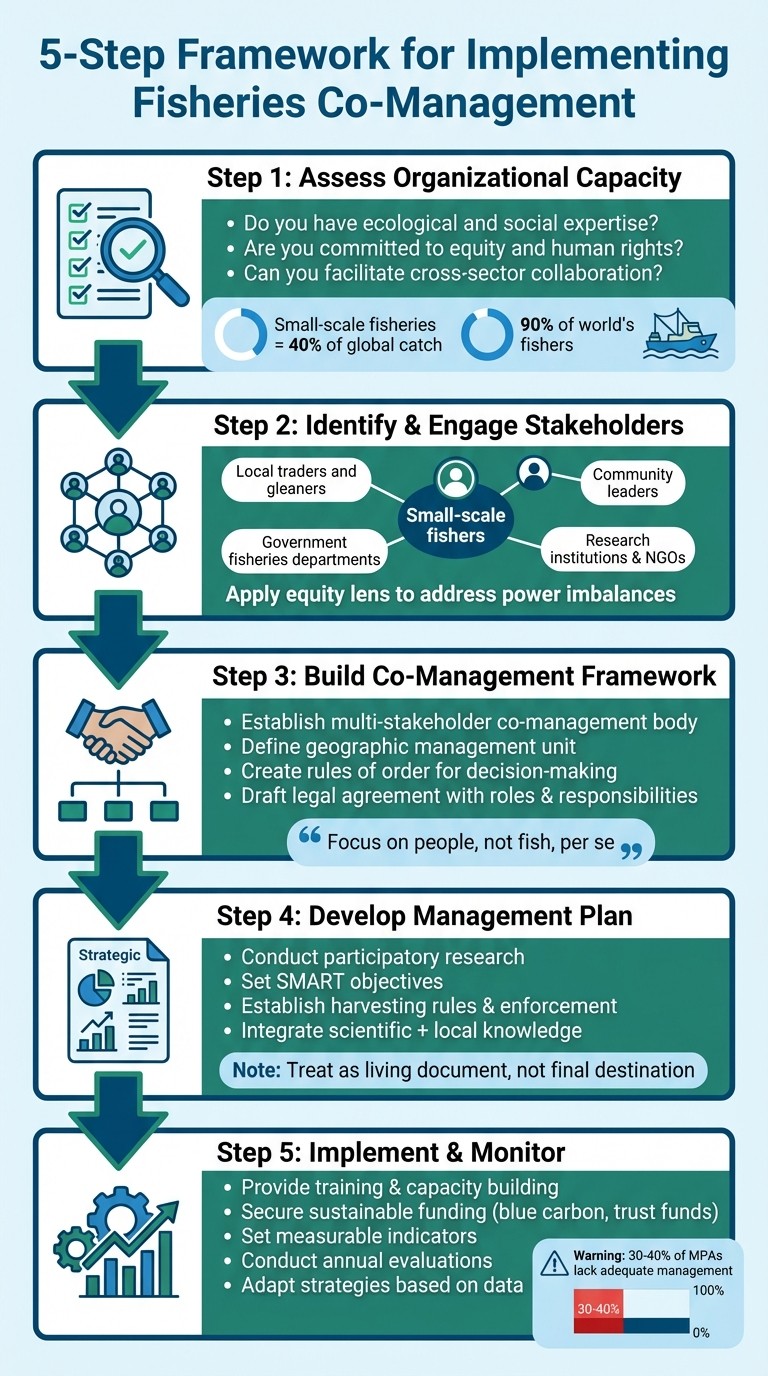
5-Step Fisheries Co-Management Implementation Framework for Foundations
Co-management: a powerful tool to save Mediterranean fisheries
Assessing Your Organization and Engaging Stakeholders
Before diving into fisheries co-management, it’s crucial to take a step back and evaluate both your organization’s readiness and the landscape of potential partners. This initial groundwork can determine whether your efforts lead to meaningful, long-term results or fall short of expectations.
Evaluating Your Organization's Capacity
The first question to ask is whether your organization has the ability to deliver effective, impactful results. A study by the Wildlife Conservation Society and WorldFish underscores this point: "Fewer management programs implemented well might achieve far more than many implemented poorly, and poorly implemented co-management can be worse than no management" [2]. In other words, spreading resources too thin can be counterproductive - it’s better to focus on doing a few things well.
To gauge your readiness, consider the following:
Does your organization have the ecological and social expertise needed for success?
Are you committed to equity, human rights, and gender equality?
Can you facilitate collaboration between conservation and development sectors?
Small-scale fisheries are a critical piece of the puzzle, accounting for 40% of the global fish catch and employing over 90% of the world’s fishers [2]. This means any co-management program must address a mix of food security, nutrition, livelihoods, and biodiversity goals. Conducting a careful capacity assessment ensures your approach aligns with these complex needs.
The "Fisheries Co-Management Guidebook" can serve as a valuable reference for identifying key ecological and social success indicators. If your organization lacks the ability to monitor areas like nutrition or human rights, consider partnering with groups that can fill those gaps.
Identifying Key Stakeholders
When building your stakeholder map, small-scale fishers should be at the center. They are the backbone of global fisheries and are directly impacted by management decisions [2]. But the network doesn’t stop there. Other critical stakeholders include:
Local traders and gleaners
Government fisheries departments
Coastal community leaders
Research institutions
NGOs active in the region
It’s essential to apply an equity lens during this process. This means addressing power imbalances that could undermine the effectiveness of co-management. Focus on stakeholders who can actively contribute to transforming fisheries into engines of prosperity, rather than those who simply attend meetings [2]. A comprehensive situation analysis can help identify potential conflicts, visualize threats to fisheries, and pinpoint influencers who can drive positive change.
How to Engage Stakeholders Effectively
Once you’ve identified the right stakeholders, the next step is building genuine relationships with them. Effective engagement isn’t just about informing communities - it’s about empowering them to have real authority in decision-making.
Here are some ways to foster meaningful engagement:
Focus on long-term relationships: Avoid transactional partnerships and aim for deeper collaboration.
Use consensus-building methods: These approaches ensure all voices are heard and respected.
Incorporate digital tools: These can help gather input more efficiently and expand participation, but be mindful of technology barriers, especially in diverse cultural settings.
Capacity building is also key. Provide training on climate-resilient management practices and gender equity to strengthen local leadership. Keep in mind that poorly executed engagement can erode trust and derail conservation efforts, so take the time to get it right.
With a clear understanding of your internal capacity and a well-mapped network of partners, you’ll be ready to develop a strong co-management framework.
Building the Co-Management Framework
Once stakeholders are identified and relationships are in place, the next step involves creating a structured framework to guide co-management efforts. This framework provides clarity by defining authority, roles, and actionable steps, setting the stage for meaningful engagement and effective management planning.
Establishing a Multi-Stakeholder Co-Management Body
A co-management body unites fishers, government officials, and change agents - such as NGOs or researchers - to share decision-making power and responsibilities. In this collaborative setup, foundations often act as facilitators, offering initial funding, technical expertise, and support to bridge gaps between government authorities and local communities.
Start by clearly defining the management unit. Specify the geographic area - be it a lagoon, reef, or coastline - and identify the fishery resources under management. This ensures that stakeholder roles and responsibilities are well-understood.
Before initiating discussions, establish clear rules of order. Agree on procedures for meetings, decision-making (whether through consensus or voting), and conflict resolution. As noted by Robert S. Pomeroy and Rebecca Rivera-Guieb in the Fishery Co-Management Handbook:
"Fisheries management should focus on people, not fish, per se" [3].
This approach acknowledges that challenges in fisheries often stem from social, economic, and political factors rather than ecological ones alone.
Visioning workshops are an excellent way to build shared purpose among stakeholders. These sessions help develop a collective mission statement that reflects shared values and long-term goals. This process fosters a sense of ownership and aligns conservation objectives with the community's livelihood needs.
To formalize the framework, draft a legal agreement that outlines the roles, rights, and responsibilities of all parties involved.
Developing a Fisheries Management Plan
Once the co-management body is established, the next step is to translate its vision into a detailed fisheries management plan. This plan becomes the operational guide for achieving sustainability and strengthening community resilience.
A fisheries management plan is essentially a living document - designed to guide daily decisions while remaining adaptable to changing circumstances. Begin with participatory research, such as resource mapping, catch monitoring, and habitat assessments, to ensure the plan is grounded in data that the community trusts. This inclusive process not only builds credibility but also lays the foundation for setting SMART objectives (Specific, Measurable, Achievable, Relevant, and Time-bound) that balance ecological and socio-economic priorities. For instance, instead of a vague goal like "improve fish stocks", you could aim to "increase grouper biomass by 25% within three years using seasonal closures and gear restrictions."
The plan should also establish clear rules for harvesting and enforcement. Specify permitted fishing methods, define seasonal closures if necessary, and set catch limits informed by both scientific research and local knowledge. It’s equally important to outline how compliance will be monitored and what penalties will apply for violations. Ensuring that enforcement is a shared responsibility between the community and government strengthens accountability.
Throughout the planning process, integrate both scientific and local knowledge. Indigenous understanding of fish behavior, seasonal cycles, and habitat conditions can complement traditional research, resulting in a plan that is both effective and locally relevant.
It’s important to view co-management as an ongoing process rather than a final destination. As F. Brian Davy, Senior Program Specialist at the International Development Research Centre, explains:
"Co-management is not an end point but rather a process – a process of adaptive learning" [3].
Similarly, Pomeroy and Rivera-Guieb emphasize:
"There is no blueprint formula for managing a fishery; each one is different. Different approaches will need to be tried and integrated" [3].
Treat the management plan as a dynamic tool that evolves over time. Regular reviews and updates, informed by monitoring data and environmental changes, ensure its continued relevance and effectiveness.
With a well-structured co-management body and a comprehensive plan established, the foundation is set to move into the implementation phase, where building capacity and mobilizing resources will take center stage.
Implementing Strategies and Building Capacity
This phase focuses on turning plans into action by equipping stakeholders with the skills, funding, and expertise needed to make co-management effective. It builds on the co-management framework and fisheries plan, emphasizing practical steps like training, securing financial resources, and leveraging expert support.
Training and Capacity Building
Effective co-management depends on stakeholders who are well-trained and prepared. Local fishers, community leaders, and government officials need hands-on training in sustainable fishing practices, monitoring techniques, and decision-making processes. Training programs should cover areas like catch monitoring, habitat assessments, enforcement protocols, and governance skills. These sessions should also teach conflict resolution, running productive meetings, and making transparent decisions that balance ecological health with community livelihoods. Combining scientific methods with local knowledge ensures these programs resonate and are practical.
The Fisheries Co-Management Guidebook serves as a valuable resource, offering research-backed frameworks tailored for small-scale fisheries. These frameworks can be adjusted to suit specific local needs. It's worth noting that small-scale fisheries contribute to 40% of the global fish catch and employ over 90% of the world's fishers [2].
Once stakeholders are trained, the next step is ensuring financial sustainability to support long-term efforts.
Funding and Resource Mobilization
For co-management to thrive, financial resources must extend beyond initial grants. Foundations should shift their focus from simply designating Marine Protected Areas (MPAs) to ensuring their effective management. This includes funding ranger training, monitoring technologies, and enforcement operations. Alarmingly, 30-40% of designated MPAs currently lack adequate management [4].
Innovative funding methods can help create sustainable revenue streams. Blue carbon markets stand out as a promising option, as ecosystems like mangroves and seagrasses absorb carbon 2-4 times faster than terrestrial forests per unit area [4]. Verified carbon credits, such as those developed through Verra's VM0033 methodology, can generate funding for ongoing management. Other options include conservation trust funds and blue bonds, which are specifically tailored to support coastal and marine projects.
Pooling resources can also amplify impact. For instance, in February 2026, a foundation reorganized a $200 million ocean conservation portfolio, redirecting $28 million toward MPA management. This move attracted an additional $45 million in co-funding, leading to measurable improvements in 8 out of 12 priority sites within just 18 months [4]. This example highlights the value of focusing resources on key areas rather than spreading them too thinly.
With funding secured, expert guidance becomes essential to ensure effective implementation.
Working with Council Fire
Navigating the complexities of fisheries co-management requires specialized expertise. Council Fire offers consulting services designed to help foundations translate their co-management goals into actionable strategies. Their approach includes analyzing past initiatives to identify successful practices, facilitating theory of change workshops with expert panels, and creating dashboards to track outcomes for board-level reporting [4].
Council Fire's strengths lie in stakeholder engagement, impact analysis, and communication strategies. They prioritize building trust among diverse groups and linking investments to tangible outcomes, such as fish stock recovery, improved community livelihoods, or policy changes. By addressing both ecological and social aspects, they ensure that co-management strategies are practical and effective. Poorly implemented co-management can sometimes cause more harm than good, making expert guidance critical [2].
For organizations ready to move beyond advocacy and focus on management effectiveness, Council Fire offers the tools and expertise needed to achieve meaningful, system-wide results.
Setting Measurable Indicators
To effectively gauge performance, align your indicators directly with the goals of your fishery management plan. Use a combination of input controls - like gear restrictions, seasonal closures, or Marine Protected Areas (MPAs) - and output controls, such as catch limits or size restrictions, to track progress [5]. For fisheries impacted by climate change, include indicators that monitor species distribution shifts and assess whether fishers need more flexibility in targeting different species. This is especially critical in multispecies fisheries, where reaching the catch limit of a single vulnerable stock can lead to a full closure. To mitigate this, combine various indicator types, such as size limits paired with gear restrictions, and leverage tools like the Mizer package in R to model and forecast outcomes [5]. Establishing mechanisms like risk pools or shared quotas can also help prevent widespread closures [5].
Conducting Regular Evaluations
In the early stages of implementation, conducting annual evaluations is essential for fostering adaptive learning [6]. These evaluations are most effective when guided by a skilled facilitator who helps a multi-stakeholder group achieve consensus on performance and necessary adjustments. Pre-defined Harvest Control Rules (HCRs) streamline this process by outlining agreed-upon actions, such as reducing catch limits, if specific indicators cross established thresholds.
"A harvest control rule is a plan for pre-agreed management actions as a function of variables related to the status of stock in question." - AFAM Toolkit Guidance Document [6]
When interpreting evaluation data, integrate scientific assessments with local knowledge to determine whether adjustments are needed. Early on, tools like data visualization and periodic "spot checks" can help identify and correct sampling issues. Evaluations should extend beyond biological metrics to include socioeconomic factors, such as community perspectives and the impact of management on household incomes. Additionally, track compliance by monitoring violations in No-Take Zones or territorial use rights [6]. Insights from these evaluations should guide timely updates to management measures.
Adapting Strategies for Continuous Improvement
Management strategies must remain flexible to address evolving conditions. According to the Environmental Defense Fund:
"Fisheries management is always a dynamic process that must respond to fluctuations in environmental conditions, fishing behaviors, variable productivity of the resource, and changing market and economic conditions." [5]
Regularly revisit your goals, indicators, and measures to ensure they remain effective. Collaborate with local stakeholders to refine data collection systems, such as catch-per-unit effort and length measurements, which will improve the quality of information used in decision-making [7]. For fisheries affected by climate-driven shifts, regulatory adjustments or market interventions can help fishers adapt to targeting different species [5]. Participatory processes not only empower fishers but also enhance compliance and encourage the integration of local and scientific knowledge [1]. Using tiered assessments and standardized reporting ensures transparency and accountability [6]. By continuously refining strategies, you can transform monitoring data into actionable insights, strengthening co-management outcomes over time.
Conclusion: Key Takeaways and Next Steps
In fisheries co-management, the mantra should always be quality over quantity. Research from WorldFish and the Wildlife Conservation Society underscores this point:
"Fewer management programs implemented well might achieve far more than many implemented poorly, and poorly implemented co-management can be worse than no management" [2].
The success of your initiatives hinges not on the number of projects you start but on how carefully they are designed and executed.
Focus on High-Impact Areas
Small-scale fisheries, which employ over 90% of fishers and account for 40% of the global catch, are a logical starting point [2]. These fisheries are vital to the food security of more than 3 billion people who depend on seafood as their primary protein source [10]. Supporting these fisheries could involve targeted funding strategies, such as seed funding or matching grants. A proven example is the FishAmerica Foundation, which has invested more than $12.1 million in grassroots fisheries restoration since 1983 [9]. In May 2025, their collaboration with the NOAA Restoration Center secured over $2 million in non-federal matching funds and $1.1 million in in-kind services, resulting in the restoration of 105 acres of habitat and the reopening of 32 miles of streams for fish passage [9].
Align Social and Ecological Goals
Effective co-management goes beyond environmental conservation - it tackles hunger, poverty, and biodiversity loss simultaneously. By integrating social and ecological objectives, small-scale fisheries can become drivers of both economic and social progress [2]. This requires setting measurable indicators that track both community well-being and ecosystem health, while ensuring respect for human rights and gender equality. Such an approach strengthens co-management efforts and aligns them with broader capacity-building initiatives.
Build Collaborative Partnerships
Multi-sector partnerships are essential to bridging conservation and development. A compelling example is the National Fish and Wildlife Foundation's Conservation Partners Program, which, in March 2026, awarded $8.7 million in grants to support sustainable solutions that benefit both people and nature. Collaborating with organizations like the NRCS, this initiative highlights the potential of partnerships to drive impactful change [8]. Further investments in capacity building, permit banks, and traceability technologies can ensure that responsibly sourced seafood fetches fair market prices [10].
Turning Strategy into Action
To bring these strategies to life, organizations like Council Fire can help design co-management frameworks that balance stakeholder engagement with clear, measurable outcomes. The key is to start small - focus on one initiative, rigorously measure its impact, and refine your approach based on the results. By building on successes rather than spreading resources too thin, you can create a lasting, scalable impact.
FAQs
How can we tell if our foundation is ready for co-management?
To determine if your foundation is ready for co-management strategies, start by evaluating its current performance and capacity. Look for key indicators such as well-defined goals that align with co-management principles, effective collaboration with stakeholders, and systems in place to track both environmental and social outcomes. An internal review can help confirm whether your investments are achieving tangible conservation results, like healthier marine ecosystems or advancements in policy. If these elements are in place, it’s a strong sign that your foundation is positioned to embrace co-management approaches.
Who must be included in a co-management body to make it work?
An effective co-management body brings together essential stakeholders in fisheries management. This group usually includes fishers, researchers, community representatives, and local organizations. By involving these key players, the process promotes shared responsibility, encourages collaboration, and strengthens the governance of marine resources. Their active participation ensures a balanced approach that supports environmental health while addressing the needs of local communities.
What metrics should we track to prove results to our board?
Tracking essential metrics can provide a clear picture of progress and outcomes. Focus on areas like environmental impact indicators, which include measures such as ecosystem health and reductions in illegal fishing, and fisheries management performance, covering the effectiveness of governance systems. Pay attention to stakeholder engagement, evaluating factors like community participation and the resolution of disputes. Lastly, assess progress toward goals, such as the implementation of co-management plans and improvements in livelihoods. Consistent monitoring of these metrics will offer your board concrete evidence of environmental, social, and governance achievements.
Related Blog Posts
How to Develop a Blue Economy Strategy for Foundations & Philanthropic Organizations
How to Implement Fisheries Co-Management for Municipalities & Government Agencies
How to Implement Fisheries Co-Management for NGOs & Nonprofits
How to Implement Fisheries Co-Management for Universities & Research Institutions
Latest Articles
©2025



FAQ
01
What does it really mean to “redefine profit”?
02
What makes Council Fire different?
03
Who does Council Fire you work with?
04
What does working with Council Fire actually look like?
05
How does Council Fire help organizations turn big goals into action?
06
How does Council Fire define and measure success?
Mar 25, 2026
How to Implement Fisheries Co-Management for Foundations & Philanthropic Organizations
Capacity Building
In This Article
Practical framework for foundations to design, fund, and implement community-led fisheries co-management benefiting livelihoods and ecosystems.
How to Implement Fisheries Co-Management for Foundations & Philanthropic Organizations
Fisheries co-management is a collaborative approach where governments and local communities share responsibility for managing aquatic resources. This method integrates scientific research with local knowledge, ensuring decisions are practical and community-driven. Foundations and philanthropic organizations play a critical role by providing funding, training, and resources to strengthen these initiatives, ultimately supporting food security, economic stability, and marine conservation.
Key Takeaways:
What It Is: Co-management involves shared decision-making between governments and fishers, balancing ecological health with community needs.
Why It Matters: Small-scale fisheries provide 40% of the global fish catch and employ 90% of fishers but often lack resources for effective management.
Role of Foundations: They can fund programs, build capacity, and support long-term efforts to improve fisheries governance.
Steps to Success:
Assess organizational capacity and stakeholder readiness.
Build partnerships with fishers, traders, government, and NGOs.
Develop a clear fisheries management plan with defined roles and rules.
Provide training and secure sustainable funding, such as through blue carbon markets or conservation trust funds.
Regularly evaluate outcomes and adapt strategies to ensure effectiveness.
By focusing on targeted investments and fostering collaboration, organizations can create lasting improvements in fisheries management, benefiting both marine ecosystems and coastal communities.
5-Step Fisheries Co-Management Implementation Framework for Foundations
Co-management: a powerful tool to save Mediterranean fisheries
Assessing Your Organization and Engaging Stakeholders
Before diving into fisheries co-management, it’s crucial to take a step back and evaluate both your organization’s readiness and the landscape of potential partners. This initial groundwork can determine whether your efforts lead to meaningful, long-term results or fall short of expectations.
Evaluating Your Organization's Capacity
The first question to ask is whether your organization has the ability to deliver effective, impactful results. A study by the Wildlife Conservation Society and WorldFish underscores this point: "Fewer management programs implemented well might achieve far more than many implemented poorly, and poorly implemented co-management can be worse than no management" [2]. In other words, spreading resources too thin can be counterproductive - it’s better to focus on doing a few things well.
To gauge your readiness, consider the following:
Does your organization have the ecological and social expertise needed for success?
Are you committed to equity, human rights, and gender equality?
Can you facilitate collaboration between conservation and development sectors?
Small-scale fisheries are a critical piece of the puzzle, accounting for 40% of the global fish catch and employing over 90% of the world’s fishers [2]. This means any co-management program must address a mix of food security, nutrition, livelihoods, and biodiversity goals. Conducting a careful capacity assessment ensures your approach aligns with these complex needs.
The "Fisheries Co-Management Guidebook" can serve as a valuable reference for identifying key ecological and social success indicators. If your organization lacks the ability to monitor areas like nutrition or human rights, consider partnering with groups that can fill those gaps.
Identifying Key Stakeholders
When building your stakeholder map, small-scale fishers should be at the center. They are the backbone of global fisheries and are directly impacted by management decisions [2]. But the network doesn’t stop there. Other critical stakeholders include:
Local traders and gleaners
Government fisheries departments
Coastal community leaders
Research institutions
NGOs active in the region
It’s essential to apply an equity lens during this process. This means addressing power imbalances that could undermine the effectiveness of co-management. Focus on stakeholders who can actively contribute to transforming fisheries into engines of prosperity, rather than those who simply attend meetings [2]. A comprehensive situation analysis can help identify potential conflicts, visualize threats to fisheries, and pinpoint influencers who can drive positive change.
How to Engage Stakeholders Effectively
Once you’ve identified the right stakeholders, the next step is building genuine relationships with them. Effective engagement isn’t just about informing communities - it’s about empowering them to have real authority in decision-making.
Here are some ways to foster meaningful engagement:
Focus on long-term relationships: Avoid transactional partnerships and aim for deeper collaboration.
Use consensus-building methods: These approaches ensure all voices are heard and respected.
Incorporate digital tools: These can help gather input more efficiently and expand participation, but be mindful of technology barriers, especially in diverse cultural settings.
Capacity building is also key. Provide training on climate-resilient management practices and gender equity to strengthen local leadership. Keep in mind that poorly executed engagement can erode trust and derail conservation efforts, so take the time to get it right.
With a clear understanding of your internal capacity and a well-mapped network of partners, you’ll be ready to develop a strong co-management framework.
Building the Co-Management Framework
Once stakeholders are identified and relationships are in place, the next step involves creating a structured framework to guide co-management efforts. This framework provides clarity by defining authority, roles, and actionable steps, setting the stage for meaningful engagement and effective management planning.
Establishing a Multi-Stakeholder Co-Management Body
A co-management body unites fishers, government officials, and change agents - such as NGOs or researchers - to share decision-making power and responsibilities. In this collaborative setup, foundations often act as facilitators, offering initial funding, technical expertise, and support to bridge gaps between government authorities and local communities.
Start by clearly defining the management unit. Specify the geographic area - be it a lagoon, reef, or coastline - and identify the fishery resources under management. This ensures that stakeholder roles and responsibilities are well-understood.
Before initiating discussions, establish clear rules of order. Agree on procedures for meetings, decision-making (whether through consensus or voting), and conflict resolution. As noted by Robert S. Pomeroy and Rebecca Rivera-Guieb in the Fishery Co-Management Handbook:
"Fisheries management should focus on people, not fish, per se" [3].
This approach acknowledges that challenges in fisheries often stem from social, economic, and political factors rather than ecological ones alone.
Visioning workshops are an excellent way to build shared purpose among stakeholders. These sessions help develop a collective mission statement that reflects shared values and long-term goals. This process fosters a sense of ownership and aligns conservation objectives with the community's livelihood needs.
To formalize the framework, draft a legal agreement that outlines the roles, rights, and responsibilities of all parties involved.
Developing a Fisheries Management Plan
Once the co-management body is established, the next step is to translate its vision into a detailed fisheries management plan. This plan becomes the operational guide for achieving sustainability and strengthening community resilience.
A fisheries management plan is essentially a living document - designed to guide daily decisions while remaining adaptable to changing circumstances. Begin with participatory research, such as resource mapping, catch monitoring, and habitat assessments, to ensure the plan is grounded in data that the community trusts. This inclusive process not only builds credibility but also lays the foundation for setting SMART objectives (Specific, Measurable, Achievable, Relevant, and Time-bound) that balance ecological and socio-economic priorities. For instance, instead of a vague goal like "improve fish stocks", you could aim to "increase grouper biomass by 25% within three years using seasonal closures and gear restrictions."
The plan should also establish clear rules for harvesting and enforcement. Specify permitted fishing methods, define seasonal closures if necessary, and set catch limits informed by both scientific research and local knowledge. It’s equally important to outline how compliance will be monitored and what penalties will apply for violations. Ensuring that enforcement is a shared responsibility between the community and government strengthens accountability.
Throughout the planning process, integrate both scientific and local knowledge. Indigenous understanding of fish behavior, seasonal cycles, and habitat conditions can complement traditional research, resulting in a plan that is both effective and locally relevant.
It’s important to view co-management as an ongoing process rather than a final destination. As F. Brian Davy, Senior Program Specialist at the International Development Research Centre, explains:
"Co-management is not an end point but rather a process – a process of adaptive learning" [3].
Similarly, Pomeroy and Rivera-Guieb emphasize:
"There is no blueprint formula for managing a fishery; each one is different. Different approaches will need to be tried and integrated" [3].
Treat the management plan as a dynamic tool that evolves over time. Regular reviews and updates, informed by monitoring data and environmental changes, ensure its continued relevance and effectiveness.
With a well-structured co-management body and a comprehensive plan established, the foundation is set to move into the implementation phase, where building capacity and mobilizing resources will take center stage.
Implementing Strategies and Building Capacity
This phase focuses on turning plans into action by equipping stakeholders with the skills, funding, and expertise needed to make co-management effective. It builds on the co-management framework and fisheries plan, emphasizing practical steps like training, securing financial resources, and leveraging expert support.
Training and Capacity Building
Effective co-management depends on stakeholders who are well-trained and prepared. Local fishers, community leaders, and government officials need hands-on training in sustainable fishing practices, monitoring techniques, and decision-making processes. Training programs should cover areas like catch monitoring, habitat assessments, enforcement protocols, and governance skills. These sessions should also teach conflict resolution, running productive meetings, and making transparent decisions that balance ecological health with community livelihoods. Combining scientific methods with local knowledge ensures these programs resonate and are practical.
The Fisheries Co-Management Guidebook serves as a valuable resource, offering research-backed frameworks tailored for small-scale fisheries. These frameworks can be adjusted to suit specific local needs. It's worth noting that small-scale fisheries contribute to 40% of the global fish catch and employ over 90% of the world's fishers [2].
Once stakeholders are trained, the next step is ensuring financial sustainability to support long-term efforts.
Funding and Resource Mobilization
For co-management to thrive, financial resources must extend beyond initial grants. Foundations should shift their focus from simply designating Marine Protected Areas (MPAs) to ensuring their effective management. This includes funding ranger training, monitoring technologies, and enforcement operations. Alarmingly, 30-40% of designated MPAs currently lack adequate management [4].
Innovative funding methods can help create sustainable revenue streams. Blue carbon markets stand out as a promising option, as ecosystems like mangroves and seagrasses absorb carbon 2-4 times faster than terrestrial forests per unit area [4]. Verified carbon credits, such as those developed through Verra's VM0033 methodology, can generate funding for ongoing management. Other options include conservation trust funds and blue bonds, which are specifically tailored to support coastal and marine projects.
Pooling resources can also amplify impact. For instance, in February 2026, a foundation reorganized a $200 million ocean conservation portfolio, redirecting $28 million toward MPA management. This move attracted an additional $45 million in co-funding, leading to measurable improvements in 8 out of 12 priority sites within just 18 months [4]. This example highlights the value of focusing resources on key areas rather than spreading them too thinly.
With funding secured, expert guidance becomes essential to ensure effective implementation.
Working with Council Fire
Navigating the complexities of fisheries co-management requires specialized expertise. Council Fire offers consulting services designed to help foundations translate their co-management goals into actionable strategies. Their approach includes analyzing past initiatives to identify successful practices, facilitating theory of change workshops with expert panels, and creating dashboards to track outcomes for board-level reporting [4].
Council Fire's strengths lie in stakeholder engagement, impact analysis, and communication strategies. They prioritize building trust among diverse groups and linking investments to tangible outcomes, such as fish stock recovery, improved community livelihoods, or policy changes. By addressing both ecological and social aspects, they ensure that co-management strategies are practical and effective. Poorly implemented co-management can sometimes cause more harm than good, making expert guidance critical [2].
For organizations ready to move beyond advocacy and focus on management effectiveness, Council Fire offers the tools and expertise needed to achieve meaningful, system-wide results.
Setting Measurable Indicators
To effectively gauge performance, align your indicators directly with the goals of your fishery management plan. Use a combination of input controls - like gear restrictions, seasonal closures, or Marine Protected Areas (MPAs) - and output controls, such as catch limits or size restrictions, to track progress [5]. For fisheries impacted by climate change, include indicators that monitor species distribution shifts and assess whether fishers need more flexibility in targeting different species. This is especially critical in multispecies fisheries, where reaching the catch limit of a single vulnerable stock can lead to a full closure. To mitigate this, combine various indicator types, such as size limits paired with gear restrictions, and leverage tools like the Mizer package in R to model and forecast outcomes [5]. Establishing mechanisms like risk pools or shared quotas can also help prevent widespread closures [5].
Conducting Regular Evaluations
In the early stages of implementation, conducting annual evaluations is essential for fostering adaptive learning [6]. These evaluations are most effective when guided by a skilled facilitator who helps a multi-stakeholder group achieve consensus on performance and necessary adjustments. Pre-defined Harvest Control Rules (HCRs) streamline this process by outlining agreed-upon actions, such as reducing catch limits, if specific indicators cross established thresholds.
"A harvest control rule is a plan for pre-agreed management actions as a function of variables related to the status of stock in question." - AFAM Toolkit Guidance Document [6]
When interpreting evaluation data, integrate scientific assessments with local knowledge to determine whether adjustments are needed. Early on, tools like data visualization and periodic "spot checks" can help identify and correct sampling issues. Evaluations should extend beyond biological metrics to include socioeconomic factors, such as community perspectives and the impact of management on household incomes. Additionally, track compliance by monitoring violations in No-Take Zones or territorial use rights [6]. Insights from these evaluations should guide timely updates to management measures.
Adapting Strategies for Continuous Improvement
Management strategies must remain flexible to address evolving conditions. According to the Environmental Defense Fund:
"Fisheries management is always a dynamic process that must respond to fluctuations in environmental conditions, fishing behaviors, variable productivity of the resource, and changing market and economic conditions." [5]
Regularly revisit your goals, indicators, and measures to ensure they remain effective. Collaborate with local stakeholders to refine data collection systems, such as catch-per-unit effort and length measurements, which will improve the quality of information used in decision-making [7]. For fisheries affected by climate-driven shifts, regulatory adjustments or market interventions can help fishers adapt to targeting different species [5]. Participatory processes not only empower fishers but also enhance compliance and encourage the integration of local and scientific knowledge [1]. Using tiered assessments and standardized reporting ensures transparency and accountability [6]. By continuously refining strategies, you can transform monitoring data into actionable insights, strengthening co-management outcomes over time.
Conclusion: Key Takeaways and Next Steps
In fisheries co-management, the mantra should always be quality over quantity. Research from WorldFish and the Wildlife Conservation Society underscores this point:
"Fewer management programs implemented well might achieve far more than many implemented poorly, and poorly implemented co-management can be worse than no management" [2].
The success of your initiatives hinges not on the number of projects you start but on how carefully they are designed and executed.
Focus on High-Impact Areas
Small-scale fisheries, which employ over 90% of fishers and account for 40% of the global catch, are a logical starting point [2]. These fisheries are vital to the food security of more than 3 billion people who depend on seafood as their primary protein source [10]. Supporting these fisheries could involve targeted funding strategies, such as seed funding or matching grants. A proven example is the FishAmerica Foundation, which has invested more than $12.1 million in grassroots fisheries restoration since 1983 [9]. In May 2025, their collaboration with the NOAA Restoration Center secured over $2 million in non-federal matching funds and $1.1 million in in-kind services, resulting in the restoration of 105 acres of habitat and the reopening of 32 miles of streams for fish passage [9].
Align Social and Ecological Goals
Effective co-management goes beyond environmental conservation - it tackles hunger, poverty, and biodiversity loss simultaneously. By integrating social and ecological objectives, small-scale fisheries can become drivers of both economic and social progress [2]. This requires setting measurable indicators that track both community well-being and ecosystem health, while ensuring respect for human rights and gender equality. Such an approach strengthens co-management efforts and aligns them with broader capacity-building initiatives.
Build Collaborative Partnerships
Multi-sector partnerships are essential to bridging conservation and development. A compelling example is the National Fish and Wildlife Foundation's Conservation Partners Program, which, in March 2026, awarded $8.7 million in grants to support sustainable solutions that benefit both people and nature. Collaborating with organizations like the NRCS, this initiative highlights the potential of partnerships to drive impactful change [8]. Further investments in capacity building, permit banks, and traceability technologies can ensure that responsibly sourced seafood fetches fair market prices [10].
Turning Strategy into Action
To bring these strategies to life, organizations like Council Fire can help design co-management frameworks that balance stakeholder engagement with clear, measurable outcomes. The key is to start small - focus on one initiative, rigorously measure its impact, and refine your approach based on the results. By building on successes rather than spreading resources too thin, you can create a lasting, scalable impact.
FAQs
How can we tell if our foundation is ready for co-management?
To determine if your foundation is ready for co-management strategies, start by evaluating its current performance and capacity. Look for key indicators such as well-defined goals that align with co-management principles, effective collaboration with stakeholders, and systems in place to track both environmental and social outcomes. An internal review can help confirm whether your investments are achieving tangible conservation results, like healthier marine ecosystems or advancements in policy. If these elements are in place, it’s a strong sign that your foundation is positioned to embrace co-management approaches.
Who must be included in a co-management body to make it work?
An effective co-management body brings together essential stakeholders in fisheries management. This group usually includes fishers, researchers, community representatives, and local organizations. By involving these key players, the process promotes shared responsibility, encourages collaboration, and strengthens the governance of marine resources. Their active participation ensures a balanced approach that supports environmental health while addressing the needs of local communities.
What metrics should we track to prove results to our board?
Tracking essential metrics can provide a clear picture of progress and outcomes. Focus on areas like environmental impact indicators, which include measures such as ecosystem health and reductions in illegal fishing, and fisheries management performance, covering the effectiveness of governance systems. Pay attention to stakeholder engagement, evaluating factors like community participation and the resolution of disputes. Lastly, assess progress toward goals, such as the implementation of co-management plans and improvements in livelihoods. Consistent monitoring of these metrics will offer your board concrete evidence of environmental, social, and governance achievements.
Related Blog Posts
How to Develop a Blue Economy Strategy for Foundations & Philanthropic Organizations
How to Implement Fisheries Co-Management for Municipalities & Government Agencies
How to Implement Fisheries Co-Management for NGOs & Nonprofits
How to Implement Fisheries Co-Management for Universities & Research Institutions
FAQ
01
What does it really mean to “redefine profit”?
02
What makes Council Fire different?
03
Who does Council Fire you work with?
04
What does working with Council Fire actually look like?
05
How does Council Fire help organizations turn big goals into action?
06
How does Council Fire define and measure success?
Mar 25, 2026
How to Implement Fisheries Co-Management for Foundations & Philanthropic Organizations
Capacity Building
In This Article
Practical framework for foundations to design, fund, and implement community-led fisheries co-management benefiting livelihoods and ecosystems.
How to Implement Fisheries Co-Management for Foundations & Philanthropic Organizations
Fisheries co-management is a collaborative approach where governments and local communities share responsibility for managing aquatic resources. This method integrates scientific research with local knowledge, ensuring decisions are practical and community-driven. Foundations and philanthropic organizations play a critical role by providing funding, training, and resources to strengthen these initiatives, ultimately supporting food security, economic stability, and marine conservation.
Key Takeaways:
What It Is: Co-management involves shared decision-making between governments and fishers, balancing ecological health with community needs.
Why It Matters: Small-scale fisheries provide 40% of the global fish catch and employ 90% of fishers but often lack resources for effective management.
Role of Foundations: They can fund programs, build capacity, and support long-term efforts to improve fisheries governance.
Steps to Success:
Assess organizational capacity and stakeholder readiness.
Build partnerships with fishers, traders, government, and NGOs.
Develop a clear fisheries management plan with defined roles and rules.
Provide training and secure sustainable funding, such as through blue carbon markets or conservation trust funds.
Regularly evaluate outcomes and adapt strategies to ensure effectiveness.
By focusing on targeted investments and fostering collaboration, organizations can create lasting improvements in fisheries management, benefiting both marine ecosystems and coastal communities.
5-Step Fisheries Co-Management Implementation Framework for Foundations
Co-management: a powerful tool to save Mediterranean fisheries
Assessing Your Organization and Engaging Stakeholders
Before diving into fisheries co-management, it’s crucial to take a step back and evaluate both your organization’s readiness and the landscape of potential partners. This initial groundwork can determine whether your efforts lead to meaningful, long-term results or fall short of expectations.
Evaluating Your Organization's Capacity
The first question to ask is whether your organization has the ability to deliver effective, impactful results. A study by the Wildlife Conservation Society and WorldFish underscores this point: "Fewer management programs implemented well might achieve far more than many implemented poorly, and poorly implemented co-management can be worse than no management" [2]. In other words, spreading resources too thin can be counterproductive - it’s better to focus on doing a few things well.
To gauge your readiness, consider the following:
Does your organization have the ecological and social expertise needed for success?
Are you committed to equity, human rights, and gender equality?
Can you facilitate collaboration between conservation and development sectors?
Small-scale fisheries are a critical piece of the puzzle, accounting for 40% of the global fish catch and employing over 90% of the world’s fishers [2]. This means any co-management program must address a mix of food security, nutrition, livelihoods, and biodiversity goals. Conducting a careful capacity assessment ensures your approach aligns with these complex needs.
The "Fisheries Co-Management Guidebook" can serve as a valuable reference for identifying key ecological and social success indicators. If your organization lacks the ability to monitor areas like nutrition or human rights, consider partnering with groups that can fill those gaps.
Identifying Key Stakeholders
When building your stakeholder map, small-scale fishers should be at the center. They are the backbone of global fisheries and are directly impacted by management decisions [2]. But the network doesn’t stop there. Other critical stakeholders include:
Local traders and gleaners
Government fisheries departments
Coastal community leaders
Research institutions
NGOs active in the region
It’s essential to apply an equity lens during this process. This means addressing power imbalances that could undermine the effectiveness of co-management. Focus on stakeholders who can actively contribute to transforming fisheries into engines of prosperity, rather than those who simply attend meetings [2]. A comprehensive situation analysis can help identify potential conflicts, visualize threats to fisheries, and pinpoint influencers who can drive positive change.
How to Engage Stakeholders Effectively
Once you’ve identified the right stakeholders, the next step is building genuine relationships with them. Effective engagement isn’t just about informing communities - it’s about empowering them to have real authority in decision-making.
Here are some ways to foster meaningful engagement:
Focus on long-term relationships: Avoid transactional partnerships and aim for deeper collaboration.
Use consensus-building methods: These approaches ensure all voices are heard and respected.
Incorporate digital tools: These can help gather input more efficiently and expand participation, but be mindful of technology barriers, especially in diverse cultural settings.
Capacity building is also key. Provide training on climate-resilient management practices and gender equity to strengthen local leadership. Keep in mind that poorly executed engagement can erode trust and derail conservation efforts, so take the time to get it right.
With a clear understanding of your internal capacity and a well-mapped network of partners, you’ll be ready to develop a strong co-management framework.
Building the Co-Management Framework
Once stakeholders are identified and relationships are in place, the next step involves creating a structured framework to guide co-management efforts. This framework provides clarity by defining authority, roles, and actionable steps, setting the stage for meaningful engagement and effective management planning.
Establishing a Multi-Stakeholder Co-Management Body
A co-management body unites fishers, government officials, and change agents - such as NGOs or researchers - to share decision-making power and responsibilities. In this collaborative setup, foundations often act as facilitators, offering initial funding, technical expertise, and support to bridge gaps between government authorities and local communities.
Start by clearly defining the management unit. Specify the geographic area - be it a lagoon, reef, or coastline - and identify the fishery resources under management. This ensures that stakeholder roles and responsibilities are well-understood.
Before initiating discussions, establish clear rules of order. Agree on procedures for meetings, decision-making (whether through consensus or voting), and conflict resolution. As noted by Robert S. Pomeroy and Rebecca Rivera-Guieb in the Fishery Co-Management Handbook:
"Fisheries management should focus on people, not fish, per se" [3].
This approach acknowledges that challenges in fisheries often stem from social, economic, and political factors rather than ecological ones alone.
Visioning workshops are an excellent way to build shared purpose among stakeholders. These sessions help develop a collective mission statement that reflects shared values and long-term goals. This process fosters a sense of ownership and aligns conservation objectives with the community's livelihood needs.
To formalize the framework, draft a legal agreement that outlines the roles, rights, and responsibilities of all parties involved.
Developing a Fisheries Management Plan
Once the co-management body is established, the next step is to translate its vision into a detailed fisheries management plan. This plan becomes the operational guide for achieving sustainability and strengthening community resilience.
A fisheries management plan is essentially a living document - designed to guide daily decisions while remaining adaptable to changing circumstances. Begin with participatory research, such as resource mapping, catch monitoring, and habitat assessments, to ensure the plan is grounded in data that the community trusts. This inclusive process not only builds credibility but also lays the foundation for setting SMART objectives (Specific, Measurable, Achievable, Relevant, and Time-bound) that balance ecological and socio-economic priorities. For instance, instead of a vague goal like "improve fish stocks", you could aim to "increase grouper biomass by 25% within three years using seasonal closures and gear restrictions."
The plan should also establish clear rules for harvesting and enforcement. Specify permitted fishing methods, define seasonal closures if necessary, and set catch limits informed by both scientific research and local knowledge. It’s equally important to outline how compliance will be monitored and what penalties will apply for violations. Ensuring that enforcement is a shared responsibility between the community and government strengthens accountability.
Throughout the planning process, integrate both scientific and local knowledge. Indigenous understanding of fish behavior, seasonal cycles, and habitat conditions can complement traditional research, resulting in a plan that is both effective and locally relevant.
It’s important to view co-management as an ongoing process rather than a final destination. As F. Brian Davy, Senior Program Specialist at the International Development Research Centre, explains:
"Co-management is not an end point but rather a process – a process of adaptive learning" [3].
Similarly, Pomeroy and Rivera-Guieb emphasize:
"There is no blueprint formula for managing a fishery; each one is different. Different approaches will need to be tried and integrated" [3].
Treat the management plan as a dynamic tool that evolves over time. Regular reviews and updates, informed by monitoring data and environmental changes, ensure its continued relevance and effectiveness.
With a well-structured co-management body and a comprehensive plan established, the foundation is set to move into the implementation phase, where building capacity and mobilizing resources will take center stage.
Implementing Strategies and Building Capacity
This phase focuses on turning plans into action by equipping stakeholders with the skills, funding, and expertise needed to make co-management effective. It builds on the co-management framework and fisheries plan, emphasizing practical steps like training, securing financial resources, and leveraging expert support.
Training and Capacity Building
Effective co-management depends on stakeholders who are well-trained and prepared. Local fishers, community leaders, and government officials need hands-on training in sustainable fishing practices, monitoring techniques, and decision-making processes. Training programs should cover areas like catch monitoring, habitat assessments, enforcement protocols, and governance skills. These sessions should also teach conflict resolution, running productive meetings, and making transparent decisions that balance ecological health with community livelihoods. Combining scientific methods with local knowledge ensures these programs resonate and are practical.
The Fisheries Co-Management Guidebook serves as a valuable resource, offering research-backed frameworks tailored for small-scale fisheries. These frameworks can be adjusted to suit specific local needs. It's worth noting that small-scale fisheries contribute to 40% of the global fish catch and employ over 90% of the world's fishers [2].
Once stakeholders are trained, the next step is ensuring financial sustainability to support long-term efforts.
Funding and Resource Mobilization
For co-management to thrive, financial resources must extend beyond initial grants. Foundations should shift their focus from simply designating Marine Protected Areas (MPAs) to ensuring their effective management. This includes funding ranger training, monitoring technologies, and enforcement operations. Alarmingly, 30-40% of designated MPAs currently lack adequate management [4].
Innovative funding methods can help create sustainable revenue streams. Blue carbon markets stand out as a promising option, as ecosystems like mangroves and seagrasses absorb carbon 2-4 times faster than terrestrial forests per unit area [4]. Verified carbon credits, such as those developed through Verra's VM0033 methodology, can generate funding for ongoing management. Other options include conservation trust funds and blue bonds, which are specifically tailored to support coastal and marine projects.
Pooling resources can also amplify impact. For instance, in February 2026, a foundation reorganized a $200 million ocean conservation portfolio, redirecting $28 million toward MPA management. This move attracted an additional $45 million in co-funding, leading to measurable improvements in 8 out of 12 priority sites within just 18 months [4]. This example highlights the value of focusing resources on key areas rather than spreading them too thinly.
With funding secured, expert guidance becomes essential to ensure effective implementation.
Working with Council Fire
Navigating the complexities of fisheries co-management requires specialized expertise. Council Fire offers consulting services designed to help foundations translate their co-management goals into actionable strategies. Their approach includes analyzing past initiatives to identify successful practices, facilitating theory of change workshops with expert panels, and creating dashboards to track outcomes for board-level reporting [4].
Council Fire's strengths lie in stakeholder engagement, impact analysis, and communication strategies. They prioritize building trust among diverse groups and linking investments to tangible outcomes, such as fish stock recovery, improved community livelihoods, or policy changes. By addressing both ecological and social aspects, they ensure that co-management strategies are practical and effective. Poorly implemented co-management can sometimes cause more harm than good, making expert guidance critical [2].
For organizations ready to move beyond advocacy and focus on management effectiveness, Council Fire offers the tools and expertise needed to achieve meaningful, system-wide results.
Setting Measurable Indicators
To effectively gauge performance, align your indicators directly with the goals of your fishery management plan. Use a combination of input controls - like gear restrictions, seasonal closures, or Marine Protected Areas (MPAs) - and output controls, such as catch limits or size restrictions, to track progress [5]. For fisheries impacted by climate change, include indicators that monitor species distribution shifts and assess whether fishers need more flexibility in targeting different species. This is especially critical in multispecies fisheries, where reaching the catch limit of a single vulnerable stock can lead to a full closure. To mitigate this, combine various indicator types, such as size limits paired with gear restrictions, and leverage tools like the Mizer package in R to model and forecast outcomes [5]. Establishing mechanisms like risk pools or shared quotas can also help prevent widespread closures [5].
Conducting Regular Evaluations
In the early stages of implementation, conducting annual evaluations is essential for fostering adaptive learning [6]. These evaluations are most effective when guided by a skilled facilitator who helps a multi-stakeholder group achieve consensus on performance and necessary adjustments. Pre-defined Harvest Control Rules (HCRs) streamline this process by outlining agreed-upon actions, such as reducing catch limits, if specific indicators cross established thresholds.
"A harvest control rule is a plan for pre-agreed management actions as a function of variables related to the status of stock in question." - AFAM Toolkit Guidance Document [6]
When interpreting evaluation data, integrate scientific assessments with local knowledge to determine whether adjustments are needed. Early on, tools like data visualization and periodic "spot checks" can help identify and correct sampling issues. Evaluations should extend beyond biological metrics to include socioeconomic factors, such as community perspectives and the impact of management on household incomes. Additionally, track compliance by monitoring violations in No-Take Zones or territorial use rights [6]. Insights from these evaluations should guide timely updates to management measures.
Adapting Strategies for Continuous Improvement
Management strategies must remain flexible to address evolving conditions. According to the Environmental Defense Fund:
"Fisheries management is always a dynamic process that must respond to fluctuations in environmental conditions, fishing behaviors, variable productivity of the resource, and changing market and economic conditions." [5]
Regularly revisit your goals, indicators, and measures to ensure they remain effective. Collaborate with local stakeholders to refine data collection systems, such as catch-per-unit effort and length measurements, which will improve the quality of information used in decision-making [7]. For fisheries affected by climate-driven shifts, regulatory adjustments or market interventions can help fishers adapt to targeting different species [5]. Participatory processes not only empower fishers but also enhance compliance and encourage the integration of local and scientific knowledge [1]. Using tiered assessments and standardized reporting ensures transparency and accountability [6]. By continuously refining strategies, you can transform monitoring data into actionable insights, strengthening co-management outcomes over time.
Conclusion: Key Takeaways and Next Steps
In fisheries co-management, the mantra should always be quality over quantity. Research from WorldFish and the Wildlife Conservation Society underscores this point:
"Fewer management programs implemented well might achieve far more than many implemented poorly, and poorly implemented co-management can be worse than no management" [2].
The success of your initiatives hinges not on the number of projects you start but on how carefully they are designed and executed.
Focus on High-Impact Areas
Small-scale fisheries, which employ over 90% of fishers and account for 40% of the global catch, are a logical starting point [2]. These fisheries are vital to the food security of more than 3 billion people who depend on seafood as their primary protein source [10]. Supporting these fisheries could involve targeted funding strategies, such as seed funding or matching grants. A proven example is the FishAmerica Foundation, which has invested more than $12.1 million in grassroots fisheries restoration since 1983 [9]. In May 2025, their collaboration with the NOAA Restoration Center secured over $2 million in non-federal matching funds and $1.1 million in in-kind services, resulting in the restoration of 105 acres of habitat and the reopening of 32 miles of streams for fish passage [9].
Align Social and Ecological Goals
Effective co-management goes beyond environmental conservation - it tackles hunger, poverty, and biodiversity loss simultaneously. By integrating social and ecological objectives, small-scale fisheries can become drivers of both economic and social progress [2]. This requires setting measurable indicators that track both community well-being and ecosystem health, while ensuring respect for human rights and gender equality. Such an approach strengthens co-management efforts and aligns them with broader capacity-building initiatives.
Build Collaborative Partnerships
Multi-sector partnerships are essential to bridging conservation and development. A compelling example is the National Fish and Wildlife Foundation's Conservation Partners Program, which, in March 2026, awarded $8.7 million in grants to support sustainable solutions that benefit both people and nature. Collaborating with organizations like the NRCS, this initiative highlights the potential of partnerships to drive impactful change [8]. Further investments in capacity building, permit banks, and traceability technologies can ensure that responsibly sourced seafood fetches fair market prices [10].
Turning Strategy into Action
To bring these strategies to life, organizations like Council Fire can help design co-management frameworks that balance stakeholder engagement with clear, measurable outcomes. The key is to start small - focus on one initiative, rigorously measure its impact, and refine your approach based on the results. By building on successes rather than spreading resources too thin, you can create a lasting, scalable impact.
FAQs
How can we tell if our foundation is ready for co-management?
To determine if your foundation is ready for co-management strategies, start by evaluating its current performance and capacity. Look for key indicators such as well-defined goals that align with co-management principles, effective collaboration with stakeholders, and systems in place to track both environmental and social outcomes. An internal review can help confirm whether your investments are achieving tangible conservation results, like healthier marine ecosystems or advancements in policy. If these elements are in place, it’s a strong sign that your foundation is positioned to embrace co-management approaches.
Who must be included in a co-management body to make it work?
An effective co-management body brings together essential stakeholders in fisheries management. This group usually includes fishers, researchers, community representatives, and local organizations. By involving these key players, the process promotes shared responsibility, encourages collaboration, and strengthens the governance of marine resources. Their active participation ensures a balanced approach that supports environmental health while addressing the needs of local communities.
What metrics should we track to prove results to our board?
Tracking essential metrics can provide a clear picture of progress and outcomes. Focus on areas like environmental impact indicators, which include measures such as ecosystem health and reductions in illegal fishing, and fisheries management performance, covering the effectiveness of governance systems. Pay attention to stakeholder engagement, evaluating factors like community participation and the resolution of disputes. Lastly, assess progress toward goals, such as the implementation of co-management plans and improvements in livelihoods. Consistent monitoring of these metrics will offer your board concrete evidence of environmental, social, and governance achievements.
Related Blog Posts
How to Develop a Blue Economy Strategy for Foundations & Philanthropic Organizations
How to Implement Fisheries Co-Management for Municipalities & Government Agencies
How to Implement Fisheries Co-Management for NGOs & Nonprofits
How to Implement Fisheries Co-Management for Universities & Research Institutions
FAQ
What does it really mean to “redefine profit”?
What makes Council Fire different?
Who does Council Fire you work with?
What does working with Council Fire actually look like?
How does Council Fire help organizations turn big goals into action?
How does Council Fire define and measure success?