Mar 18, 2026
How to Finance Ocean Conservation with Impact Investing for Foundations & Philanthropic Organizations
ESG Strategy
In This Article
A practical guide for foundations to finance ocean conservation using impact investing, blended finance, and outcomes-based tools for reefs, fisheries, and blue economy projects.
How to Finance Ocean Conservation with Impact Investing for Foundations & Philanthropic Organizations
Ocean conservation faces a $550 billion annual funding gap, yet less than 1% of philanthropic funds are allocated to protecting marine ecosystems. Impact investing offers a practical solution by channeling capital into projects that combine environmental, social, and financial returns. Foundations can lead this effort through tools like blended finance, blue bonds, and patient capital, bridging the gap between early-stage innovation and commercial investment.
Key Takeaways:
Economic Value of Oceans: Marine ecosystems contribute $2.7 trillion annually to the global economy, supporting 1 billion livelihoods.
Impact Investing Growth: The market now manages $1.571 trillion in assets, proving financial returns can align with conservation goals.
Proven Examples: Initiatives like the Belize Blue Bond and the Seychelles debt restructuring demonstrate how targeted investments yield measurable outcomes.
Investment Opportunities: Coral reef restoration, sustainable fisheries, and blue economy ventures offer scalable, revenue-generating solutions.
Metrics for Success: Effective measurement frameworks ensure accountability and track progress across environmental, financial, and social dimensions.
By aligning their missions with ocean conservation priorities, evaluating risk tolerance, and building expertise, foundations can transform ocean protection into a financially viable and impactful endeavor. This approach not only safeguards marine ecosystems but also delivers long-term value for communities and investors alike.
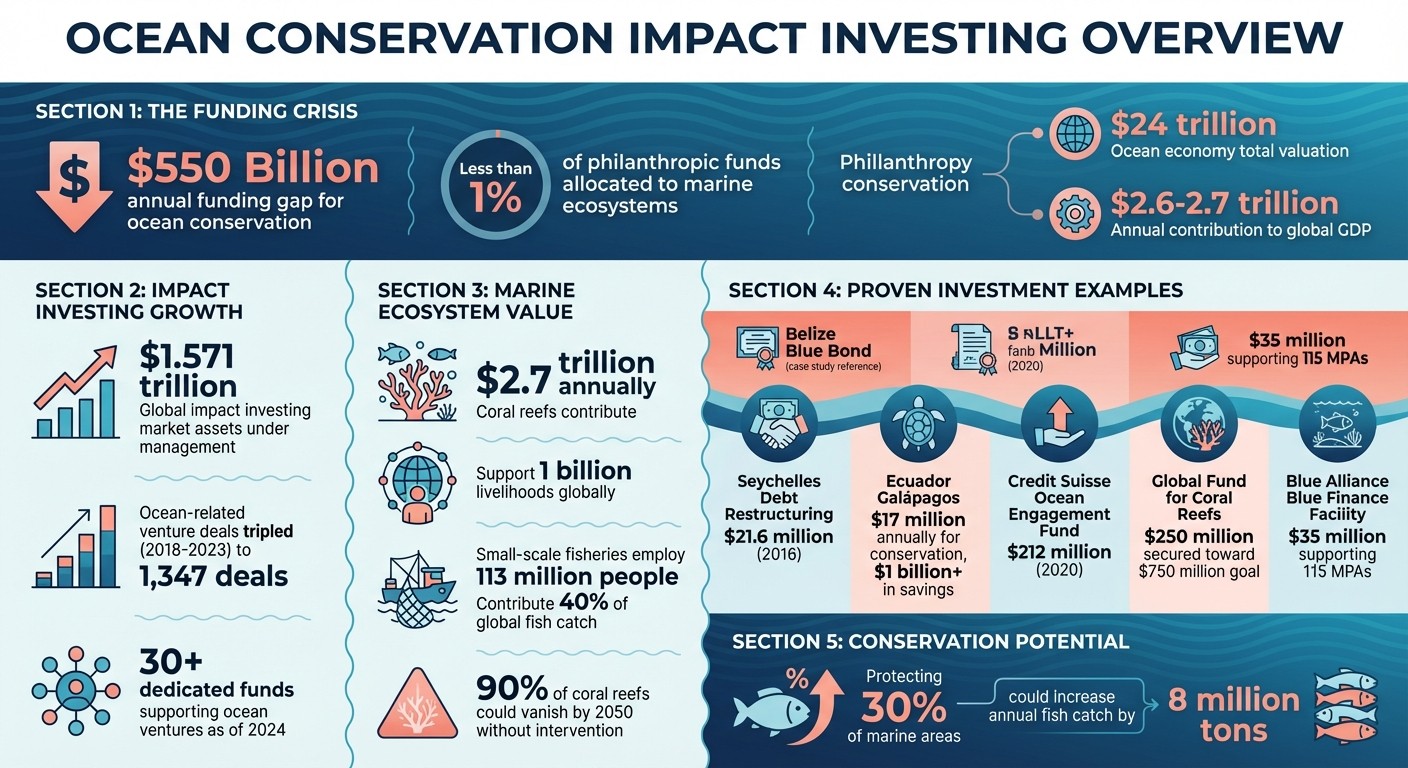
Ocean Conservation Funding Gap and Impact Investing Opportunities
Rethinking Ocean Finance: Innovative Strategies for a Sustainable Blue Economy
Assessing Your Organization's Readiness for Impact Investments
Before diving into ocean conservation investments, it's crucial to evaluate how well your organization aligns with its mission, understands its risk tolerance, and has the necessary expertise to navigate this specialized field.
Aligning Mission with Ocean Conservation Goals
Start by crafting an impact thesis - a clear statement that connects your organization's mission to key ocean priorities like pollution prevention, carbon transition, biodiversity preservation, and fostering blue economies. This approach empowers foundations to provide concessionary capital, which can absorb early-stage risks and support innovative projects[8].
"Philanthropy has a powerful opportunity to become an important navigator and translator among diverse partners and ensure a collective vision for investing in a resilient ocean, fisheries, and communities." - Gayle Peterson, Founder and Managing Director, pfc social impact advisors[8]
Smaller foundations might consider utilizing donor-advised funds (DAFs) to tap into diversified ocean investments. This strategy allows them to benefit from shared due diligence efforts, making it easier to align their mission with impactful ocean initiatives[7].
This alignment of mission and goals lays the groundwork for defining your organization's risk tolerance.
Evaluating Risk Tolerance and Financial Objectives
Decide whether your organization prioritizes "impact-first" investments (accepting zero-to-submarket returns) or aims for market-rate returns. This decision is pivotal, as it shapes your investment strategy. For instance, between 2008 and 2020, aquaculture attracted 66% of sustainable fisheries assets, while wild-caught fisheries received just 20%, largely due to higher governance risks[8].
A notable example of managing risk in ocean conservation comes from 2016, when The Nature Conservancy's NatureVest partnered with the Seychelles government to restructure $21.6 million in debt using blended finance. This move reduced risks and successfully attracted market-rate investments[9].
Foundations and family offices, with their capacity for patient capital and long-term vision, are particularly well-suited to impact investments. In 2020, Credit Suisse and Rockefeller Asset Management introduced the $212 million Ocean Engagement Fund. This fund uses a global equity strategy to invest in 30–50 companies addressing pollution prevention, carbon transition, and ocean conservation[8]. This example highlights how foundations can adopt similar strategies to achieve measurable impact.
Once your financial goals and risk tolerance are clear, the next step is to build the internal expertise needed to execute these investments effectively.
Building Internal Capacity and Expertise
To succeed in ocean conservation investments, organizations need specialized knowledge of marine trends, risks, and opportunities. An example of this is the Rockefeller Climate Solutions Strategy, launched in 2020 as a 40-Act mutual fund. This initiative was the result of nearly a decade of collaboration between Rockefeller Asset Management and The Ocean Foundation, which provided key research to identify publicly traded companies advancing ocean health[6].
Strengthen your organization's capabilities by partnering with marine research institutions, environmental NGOs, and sustainable business alliances. These collaborations can help ensure accurate impact tracking and open doors to commercial financing. For instance, in May 2021, Nippon Yusen Kaisha (NYK) became the first Japanese shipping company to join the Ship Recycling Transparency Initiative. This milestone, achieved in partnership with The Ocean Foundation, included commitments to reduce energy intensity by 30% by 2030 and 50% by 2050[6].
Finally, adopt standardized reporting frameworks to monitor environmental progress, social outcomes, and financial returns. These tools are essential for distinguishing meaningful impact from superficial claims and ensuring accountability in your investments[5].
Identifying Ocean Conservation Investment Opportunities
Once internal capacity is established, the next step is to identify investment opportunities that align with your mission and financial goals. Ocean conservation offers a range of possibilities across various asset classes, from startups to established enterprises. Below, we delve into case studies and asset classifications to help shape your investment strategy.
Coral Reef Restoration and Resilience Projects
Coral reefs contribute an astounding $2.7 trillion annually to the global economy and support the livelihoods of one billion people. However, without intervention, 90% of these reefs could vanish by 2050[1]. This urgency has driven innovative investment models that combine ecological restoration with financial returns.
Take Coral Vita, for example. In October 2025, this company secured over $8 million in a Series A funding round led by Builders Vision. Founders Sam Teicher and Gator Halpern developed a land-based coral farming method that grows resilient corals 50 times faster than natural processes. Coral Vita, a recipient of the 2021 Earthshot Prize, exemplifies how venture capital can support scalable "Restoration Economy" initiatives[1].
Blended finance has also proven effective for large-scale reef restoration. In May 2024, the Global Fund for Coral Reefs (GFCR), managed by Pegasus Capital Advisors, used a first-loss tranche of up to $125 million from the Green Climate Fund to reduce risk for private investors. The fund has already secured over $250 million in commitments toward its $750 million goal to invest in blue economy projects across the Global South[14].
"The blue economy is a huge market and there are investment opportunities... We need to change the trajectory of how companies and businesses and communities and governments interact with the oceans in a much more sustainable way." - Dale Galvin, Manager, Global Fund for Coral Reefs[14]
Sustainable Fisheries and Blue Economy Ventures
Small-scale fisheries play a crucial role, employing 113 million people and contributing 40% of the global fish catch. Despite their importance, these fisheries are often underfunded[13]. Innovative financial tools are now bridging this gap by linking investments to measurable conservation outcomes.
In January 2024, Rare introduced the world's first Small-Scale Fisheries (SSF) Impact Bond in Indonesia's Southeast Sulawesi region. This project, running through December 2025, aims to conserve 21,000 hectares and support 26,866 people. Investors provide upfront funding for Managed Access with Reserves (MA+Rs), and outcome funders like the UK's Blue Planet Fund repay them upon achieving milestones such as stabilized fish biomass and benthic coverage[10].
"This impact bond demonstrates how we can channel both public and private capital into ocean conservation at scale. By reducing investment risk and rewarding measurable outcomes, we are enabling communities to lead the protection of their fisheries." - Kate Schweigart, VP of Innovative Finance, Rare[10]
Another promising model is the "reef-positive business" approach. In April 2025, Blue Alliance made its first impact investments in Zanzibar's North Pemba Channel Conservation Area (PECCA). The funding supported Aquahub Zanzibar, a sea cucumber hatchery benefiting 4,000 households, and BlueWild EcoVentures Zanzibar, an ecotourism business. Profits from these ventures are reinvested into managing 27,000 hectares of coral reef[12].
Additionally, in October 2024, Blue Alliance partnered with BNP Paribas to launch the "Blue Finance" facility, a $35 million impact loan initiative. Starting with an initial $2.4 million investment, the project supports 115 Marine Protected Areas (MPAs) across Indonesia, the Philippines, Tanzania, and Cabo Verde. The goal is to regenerate 1.8 million hectares of coral reef while improving the livelihoods of 110,000 community members[11].
These examples demonstrate how targeted investments can simultaneously achieve conservation goals and generate measurable financial returns, highlighting the potential of impact investing in ocean conservation.
Screening Opportunities by Asset Class
Different asset classes cater to specific needs in ocean conservation, enabling organizations to allocate resources strategically.
Venture capital: Ideal for early-stage innovations like coral farming, cell-cultured fish, and marine data analytics. While high-risk, these investments can scale transformative technologies. Between 2018 and 2023, ocean-related venture deals tripled to 1,347, supported by at least 30 dedicated funds as of 2024[14].
Private equity: Best suited for scaling proven business models, such as sustainable fisheries, aquaculture, and waste management. These investments provide the capital and operational support needed for growth.
Impact loans and debt instruments: Provide working capital for revenue-generating businesses in Marine Protected Areas. Performance-linked debt reduces interest rates as social and environmental targets, such as biodiversity recovery, are achieved[11][12].
Outcomes-based bonds: Tie financial returns to verified conservation milestones. These bonds are particularly effective for community-driven fisheries projects, where success is measured by metrics like fish biomass and benthic coverage[10].
Asset Class | Primary Benefit | Typical Use Case |
|---|---|---|
Venture Capital | High innovation, early growth | Coral farming, ocean-climate tech, analytics |
Private Equity | Scaling proven models | Sustainable fisheries, aquaculture |
Impact Loans | Working capital, equipment | Revenue-sharing in MPAs |
Outcomes-Based Bonds | Verified conservation outcomes | Community-led fisheries projects |
Developing Metrics and Frameworks for Impact Measurement
Measuring impact in ocean conservation involves a three-tier approach: assessing execution (was the investment implemented effectively, and did it lead to changes in practices?), evaluating ocean returns (direct environmental improvements), and analyzing economic and social outcomes (financial gains and community resilience)[17]. Effective metrics should align with each company's operational pathways to ensure relevance and utility.
By identifying opportunities and applying rigorous metrics, organizations can ensure their investments yield both environmental benefits and financial returns.
Key Performance Indicators for Ocean Investments
Environmental key performance indicators (KPIs) should focus on measurable outcomes like carbon sequestration, reductions in greenhouse gases (GHG) and by-catch, increases in biomass, plastic footprint reduction, and nutrient removal to prevent harmful algal blooms[17]. Financial KPIs track metrics such as excess returns, positive ROI, and decreased financial risks associated with marine ecosystem decline. Social KPIs address issues like food security for subsistence fishers, improved storm resilience for coastal infrastructure, and equitable benefits for marginalized communities[17].
The number of KPIs varies by organization. Some funds opt for a streamlined set of metrics, while others adopt broader, more detailed frameworks[15]. The most effective strategy involves collaborating with portfolio companies to identify metrics already used in their business processes. This ensures that impact measurement aligns with and supports their strategic goals rather than simply fulfilling reporting obligations.
"To get the right metrics you've got to go deep into the company's specific operational pathways. You need to identify the things that generate convergent returns – economic and environmental. It doesn't work from the top down – it has to be inside out." - George Duffield, Founding Partner, Ocean 14 Capital[15]
Comparing Impact Measurement Frameworks
Various frameworks have been developed to standardize ocean impact measurement. Among these, the Ocean Impact Navigator (OIN), created by the 1000 Ocean Startups coalition, has become a cornerstone for ocean-focused funds due to its reliance on science-based indicators[15][19]. Many organizations complement OIN with tools like IRIS+ and GRI, which have expanded to include ocean-specific metrics alongside their broader applications[15].
Framework | Primary Application | Key Benefits |
|---|---|---|
Ocean Impact Navigator (OIN) | Ocean startups and innovators | Science-driven, collaborative framework for blue economy[15][16] |
UNEP FI Principles | Financial institutions (banks, insurers) | Provides 14 principles for sustainable blue finance[17] |
IRIS+ / GRI | General impact investing | Standardized metrics that supplement ocean-specific tools[15] |
SFDR Article 9 | European regulatory compliance | Industry-standard practice requiring impact indicators for investments[15][16] |
Blue Natural Capital Framework | Ecosystem-based projects | Focuses on enhancing species and natural habitats[17] |
Ensuring Accountability Through Third-Party Audits
Third-party validation plays a critical role in maintaining credibility in impact reporting. Establishing an Impact Committee with the authority to veto investments that fail to align with the impact thesis ensures robust oversight[16]. External impact managers, such as INNPACT, provide independent validation of impact claims and promote transparency in reporting[16].
Partnerships with NGOs and scientific organizations - such as The Nature Conservancy or the Aquaculture Stewardship Council - help refine methodologies and establish reliable baselines[15][19]. For instance, by mid-2025, the One Ocean Foundation reported tangible results, including 163 tons of plastic removed and 950 square meters of marine forests restored through its Ocean Impact Initiative framework[18].
"By asking partners to select impact indicators that will bring the most value to them, we aim to reinforce the link between impact measurement and management and strategy." - Joanna Cohen, Head of Impact Measurement & Management, Builders Vision[15]
Despite progress, the field remains a work in progress. Fund managers report varying levels of development, with half rating their impact measurement maturity at 6 or 7 out of 10, while the other half rate it between 3 and 5[15]. A notable challenge lies in the lack of standardized tools for measuring biodiversity, which lags behind more established metrics like carbon reduction[15].
These frameworks and accountability measures are crucial for ensuring sustained impact and shaping future investment strategies.
Implementing Ocean Conservation Investments with Council Fire
With metrics and strategies outlined earlier, the next step is turning plans into action. Council Fire specializes in guiding foundations toward impactful ocean conservation efforts. Their approach integrates policy, market dynamics, community needs, and financial tools to deliver measurable outcomes.
Planning and Stakeholder Collaboration
Successful ocean conservation hinges on collaboration across diverse groups, including NGOs, local communities, government bodies, and private investors. Council Fire employs stakeholder mapping to identify key areas of influence and foster cooperation. For instance, in partnership with the Walton Family Foundation, Council Fire unified fragmented fisheries initiatives across South America. Through alignment sessions and collaborative frameworks, they helped competing NGOs work together, leading to a traceability system that curbed illegal fishing, introduced new governance models, and attracted an additional $8 million in USAID funding. This effectively doubled the original philanthropic investment [20]. Such groundwork not only strengthens partnerships but also lays the foundation for precise, data-driven impact tracking.
Data-Driven Impact Analysis for Ocean Projects
Bridging the gap between sustainability science and actionable results requires a tailored approach. Council Fire creates custom impact frameworks that align with an organization’s goals and operational context. Their focus shifts from tracking outputs - such as the number of initiatives completed - to assessing outcomes and, ultimately, the broader impact. As Council Fire puts it:
"Impact measurement moves beyond tracking outputs - what was delivered - to understanding outcomes - what changed - and ultimately impact - what difference it made that wouldn't have happened otherwise." [21]
This approach not only ensures accountability but also provides the adaptability needed to support a wide range of ocean conservation projects, from coral reef restoration to sustainable fisheries.
Communication Strategies for Fundraising and Awareness
Strong planning and impact analysis are only part of the equation; effective communication is key to amplifying conservation efforts. Securing funding often requires persuasive storytelling that ties environmental benefits to financial and social gains. Council Fire helps organizations craft compelling investment cases that appeal to impact investors and government agencies alike. Their communication strategies encourage behavioral change and foster deeper stakeholder engagement. By demonstrating how philanthropic contributions can unlock larger pools of public and private funding through blended finance models, organizations can secure the resources needed to expand their impact [20].
Conclusion
Ocean conservation faces a pivotal moment. Despite the ocean’s staggering $24 trillion valuation, it receives less than 1% of global capital flows [2]. Yet, the potential for growth and impact is immense. The ocean economy contributes $2.6 trillion annually to global GDP, and protecting just 30% of marine areas could increase the annual fish catch by 8 million tons [3][4]. Foundations and philanthropic organizations have a unique opportunity to drive this transformation through strategic impact investing.
The key to success lies in balancing financial returns with tangible environmental outcomes. Tools like blended finance structures, blue bonds, and debt-for-nature swaps have already shown promising results. For example, Ecuador’s 2023 debt conversion for the Galápagos Islands not only secured $17 million annually for conservation efforts but also saved the country over $1 billion in borrowing costs [22].
To truly make a difference, foundations must rethink traditional grant-making approaches and embrace regenerative capital structures. These models reinvest returns into new conservation efforts, ensuring a cycle of ongoing support. As Prime Minister Mia Mottley of Barbados aptly put it:
"Finance is the oxygen, not the destination" [2].
The objective isn’t merely to fund individual projects - it’s about creating systems that sustain ocean-positive initiatives over the long term. This shift in strategy opens the door to proactive leadership in conservation financing.
Council Fire is at the forefront of turning sustainability strategies into actionable results. By fostering collaboration among stakeholders, leveraging data-driven impact analysis, and crafting clear communication strategies, Council Fire helps foundations navigate the complexities of ocean conservation investing. Their efforts have already unlocked significant additional funding for collaborative fisheries initiatives [20].
With the $1.571 trillion global impact investing market ready to support ocean conservation, foundations must take the lead in reducing risks for early-stage projects and showcasing scalable solutions [1]. By aligning mission-driven capital with proven conservation frameworks, foundations can achieve both measurable environmental progress and meaningful financial returns. Partner with Council Fire to transform your vision for ocean conservation into lasting, impactful results.
FAQs
How do we decide impact-first vs. market-rate returns?
When deciding between impact-first investments and those targeting market-rate returns, your choice hinges on your investment priorities and goals. Impact-first investments place a strong emphasis on achieving measurable environmental benefits, often accepting reduced or even no financial returns. These are well-suited for initiatives like establishing marine protected areas, where conservation takes precedence. Meanwhile, investments aiming for market-rate returns strive to deliver competitive financial gains while still advancing environmental objectives. Your decision should reflect your mission, risk tolerance, and whether your primary focus is on environmental outcomes or maintaining financial growth.
What ocean projects can actually generate revenue?
Revenue-generating ocean projects span a variety of activities such as community-based aquaculture, ecotourism within marine protected areas, and sustainable businesses like responsible fisheries and blue carbon credit initiatives. These efforts not only provide livelihoods but also generate steady income while encouraging environmental stewardship. For instance, reef-friendly businesses supported by impact loans and ventures that combine conservation goals with economic opportunities illustrate how these projects can balance ecological health with financial growth.
How can we verify real ocean impact and avoid greenwashing?
To create meaningful change in ocean conservation and steer clear of greenwashing, it's essential to adopt robust impact measurement strategies. These should extend beyond superficial promises, employing transparent frameworks to monitor specific, measurable outcomes. Aligning efforts with established benchmarks, such as Sustainable Development Goal (SDG) 14, can provide credibility and direction. Regular reporting, independent audits, and accountability mechanisms further ensure that environmental benefits are real and not overstated. This approach not only builds trust but also ensures that both ecological and economic goals are genuinely realized.
Related Blog Posts
Latest Articles
©2025



FAQ
01
What does it really mean to “redefine profit”?
02
What makes Council Fire different?
03
Who does Council Fire you work with?
04
What does working with Council Fire actually look like?
05
How does Council Fire help organizations turn big goals into action?
06
How does Council Fire define and measure success?
Mar 18, 2026
How to Finance Ocean Conservation with Impact Investing for Foundations & Philanthropic Organizations
ESG Strategy
In This Article
A practical guide for foundations to finance ocean conservation using impact investing, blended finance, and outcomes-based tools for reefs, fisheries, and blue economy projects.
How to Finance Ocean Conservation with Impact Investing for Foundations & Philanthropic Organizations
Ocean conservation faces a $550 billion annual funding gap, yet less than 1% of philanthropic funds are allocated to protecting marine ecosystems. Impact investing offers a practical solution by channeling capital into projects that combine environmental, social, and financial returns. Foundations can lead this effort through tools like blended finance, blue bonds, and patient capital, bridging the gap between early-stage innovation and commercial investment.
Key Takeaways:
Economic Value of Oceans: Marine ecosystems contribute $2.7 trillion annually to the global economy, supporting 1 billion livelihoods.
Impact Investing Growth: The market now manages $1.571 trillion in assets, proving financial returns can align with conservation goals.
Proven Examples: Initiatives like the Belize Blue Bond and the Seychelles debt restructuring demonstrate how targeted investments yield measurable outcomes.
Investment Opportunities: Coral reef restoration, sustainable fisheries, and blue economy ventures offer scalable, revenue-generating solutions.
Metrics for Success: Effective measurement frameworks ensure accountability and track progress across environmental, financial, and social dimensions.
By aligning their missions with ocean conservation priorities, evaluating risk tolerance, and building expertise, foundations can transform ocean protection into a financially viable and impactful endeavor. This approach not only safeguards marine ecosystems but also delivers long-term value for communities and investors alike.
Ocean Conservation Funding Gap and Impact Investing Opportunities
Rethinking Ocean Finance: Innovative Strategies for a Sustainable Blue Economy
Assessing Your Organization's Readiness for Impact Investments
Before diving into ocean conservation investments, it's crucial to evaluate how well your organization aligns with its mission, understands its risk tolerance, and has the necessary expertise to navigate this specialized field.
Aligning Mission with Ocean Conservation Goals
Start by crafting an impact thesis - a clear statement that connects your organization's mission to key ocean priorities like pollution prevention, carbon transition, biodiversity preservation, and fostering blue economies. This approach empowers foundations to provide concessionary capital, which can absorb early-stage risks and support innovative projects[8].
"Philanthropy has a powerful opportunity to become an important navigator and translator among diverse partners and ensure a collective vision for investing in a resilient ocean, fisheries, and communities." - Gayle Peterson, Founder and Managing Director, pfc social impact advisors[8]
Smaller foundations might consider utilizing donor-advised funds (DAFs) to tap into diversified ocean investments. This strategy allows them to benefit from shared due diligence efforts, making it easier to align their mission with impactful ocean initiatives[7].
This alignment of mission and goals lays the groundwork for defining your organization's risk tolerance.
Evaluating Risk Tolerance and Financial Objectives
Decide whether your organization prioritizes "impact-first" investments (accepting zero-to-submarket returns) or aims for market-rate returns. This decision is pivotal, as it shapes your investment strategy. For instance, between 2008 and 2020, aquaculture attracted 66% of sustainable fisheries assets, while wild-caught fisheries received just 20%, largely due to higher governance risks[8].
A notable example of managing risk in ocean conservation comes from 2016, when The Nature Conservancy's NatureVest partnered with the Seychelles government to restructure $21.6 million in debt using blended finance. This move reduced risks and successfully attracted market-rate investments[9].
Foundations and family offices, with their capacity for patient capital and long-term vision, are particularly well-suited to impact investments. In 2020, Credit Suisse and Rockefeller Asset Management introduced the $212 million Ocean Engagement Fund. This fund uses a global equity strategy to invest in 30–50 companies addressing pollution prevention, carbon transition, and ocean conservation[8]. This example highlights how foundations can adopt similar strategies to achieve measurable impact.
Once your financial goals and risk tolerance are clear, the next step is to build the internal expertise needed to execute these investments effectively.
Building Internal Capacity and Expertise
To succeed in ocean conservation investments, organizations need specialized knowledge of marine trends, risks, and opportunities. An example of this is the Rockefeller Climate Solutions Strategy, launched in 2020 as a 40-Act mutual fund. This initiative was the result of nearly a decade of collaboration between Rockefeller Asset Management and The Ocean Foundation, which provided key research to identify publicly traded companies advancing ocean health[6].
Strengthen your organization's capabilities by partnering with marine research institutions, environmental NGOs, and sustainable business alliances. These collaborations can help ensure accurate impact tracking and open doors to commercial financing. For instance, in May 2021, Nippon Yusen Kaisha (NYK) became the first Japanese shipping company to join the Ship Recycling Transparency Initiative. This milestone, achieved in partnership with The Ocean Foundation, included commitments to reduce energy intensity by 30% by 2030 and 50% by 2050[6].
Finally, adopt standardized reporting frameworks to monitor environmental progress, social outcomes, and financial returns. These tools are essential for distinguishing meaningful impact from superficial claims and ensuring accountability in your investments[5].
Identifying Ocean Conservation Investment Opportunities
Once internal capacity is established, the next step is to identify investment opportunities that align with your mission and financial goals. Ocean conservation offers a range of possibilities across various asset classes, from startups to established enterprises. Below, we delve into case studies and asset classifications to help shape your investment strategy.
Coral Reef Restoration and Resilience Projects
Coral reefs contribute an astounding $2.7 trillion annually to the global economy and support the livelihoods of one billion people. However, without intervention, 90% of these reefs could vanish by 2050[1]. This urgency has driven innovative investment models that combine ecological restoration with financial returns.
Take Coral Vita, for example. In October 2025, this company secured over $8 million in a Series A funding round led by Builders Vision. Founders Sam Teicher and Gator Halpern developed a land-based coral farming method that grows resilient corals 50 times faster than natural processes. Coral Vita, a recipient of the 2021 Earthshot Prize, exemplifies how venture capital can support scalable "Restoration Economy" initiatives[1].
Blended finance has also proven effective for large-scale reef restoration. In May 2024, the Global Fund for Coral Reefs (GFCR), managed by Pegasus Capital Advisors, used a first-loss tranche of up to $125 million from the Green Climate Fund to reduce risk for private investors. The fund has already secured over $250 million in commitments toward its $750 million goal to invest in blue economy projects across the Global South[14].
"The blue economy is a huge market and there are investment opportunities... We need to change the trajectory of how companies and businesses and communities and governments interact with the oceans in a much more sustainable way." - Dale Galvin, Manager, Global Fund for Coral Reefs[14]
Sustainable Fisheries and Blue Economy Ventures
Small-scale fisheries play a crucial role, employing 113 million people and contributing 40% of the global fish catch. Despite their importance, these fisheries are often underfunded[13]. Innovative financial tools are now bridging this gap by linking investments to measurable conservation outcomes.
In January 2024, Rare introduced the world's first Small-Scale Fisheries (SSF) Impact Bond in Indonesia's Southeast Sulawesi region. This project, running through December 2025, aims to conserve 21,000 hectares and support 26,866 people. Investors provide upfront funding for Managed Access with Reserves (MA+Rs), and outcome funders like the UK's Blue Planet Fund repay them upon achieving milestones such as stabilized fish biomass and benthic coverage[10].
"This impact bond demonstrates how we can channel both public and private capital into ocean conservation at scale. By reducing investment risk and rewarding measurable outcomes, we are enabling communities to lead the protection of their fisheries." - Kate Schweigart, VP of Innovative Finance, Rare[10]
Another promising model is the "reef-positive business" approach. In April 2025, Blue Alliance made its first impact investments in Zanzibar's North Pemba Channel Conservation Area (PECCA). The funding supported Aquahub Zanzibar, a sea cucumber hatchery benefiting 4,000 households, and BlueWild EcoVentures Zanzibar, an ecotourism business. Profits from these ventures are reinvested into managing 27,000 hectares of coral reef[12].
Additionally, in October 2024, Blue Alliance partnered with BNP Paribas to launch the "Blue Finance" facility, a $35 million impact loan initiative. Starting with an initial $2.4 million investment, the project supports 115 Marine Protected Areas (MPAs) across Indonesia, the Philippines, Tanzania, and Cabo Verde. The goal is to regenerate 1.8 million hectares of coral reef while improving the livelihoods of 110,000 community members[11].
These examples demonstrate how targeted investments can simultaneously achieve conservation goals and generate measurable financial returns, highlighting the potential of impact investing in ocean conservation.
Screening Opportunities by Asset Class
Different asset classes cater to specific needs in ocean conservation, enabling organizations to allocate resources strategically.
Venture capital: Ideal for early-stage innovations like coral farming, cell-cultured fish, and marine data analytics. While high-risk, these investments can scale transformative technologies. Between 2018 and 2023, ocean-related venture deals tripled to 1,347, supported by at least 30 dedicated funds as of 2024[14].
Private equity: Best suited for scaling proven business models, such as sustainable fisheries, aquaculture, and waste management. These investments provide the capital and operational support needed for growth.
Impact loans and debt instruments: Provide working capital for revenue-generating businesses in Marine Protected Areas. Performance-linked debt reduces interest rates as social and environmental targets, such as biodiversity recovery, are achieved[11][12].
Outcomes-based bonds: Tie financial returns to verified conservation milestones. These bonds are particularly effective for community-driven fisheries projects, where success is measured by metrics like fish biomass and benthic coverage[10].
Asset Class | Primary Benefit | Typical Use Case |
|---|---|---|
Venture Capital | High innovation, early growth | Coral farming, ocean-climate tech, analytics |
Private Equity | Scaling proven models | Sustainable fisheries, aquaculture |
Impact Loans | Working capital, equipment | Revenue-sharing in MPAs |
Outcomes-Based Bonds | Verified conservation outcomes | Community-led fisheries projects |
Developing Metrics and Frameworks for Impact Measurement
Measuring impact in ocean conservation involves a three-tier approach: assessing execution (was the investment implemented effectively, and did it lead to changes in practices?), evaluating ocean returns (direct environmental improvements), and analyzing economic and social outcomes (financial gains and community resilience)[17]. Effective metrics should align with each company's operational pathways to ensure relevance and utility.
By identifying opportunities and applying rigorous metrics, organizations can ensure their investments yield both environmental benefits and financial returns.
Key Performance Indicators for Ocean Investments
Environmental key performance indicators (KPIs) should focus on measurable outcomes like carbon sequestration, reductions in greenhouse gases (GHG) and by-catch, increases in biomass, plastic footprint reduction, and nutrient removal to prevent harmful algal blooms[17]. Financial KPIs track metrics such as excess returns, positive ROI, and decreased financial risks associated with marine ecosystem decline. Social KPIs address issues like food security for subsistence fishers, improved storm resilience for coastal infrastructure, and equitable benefits for marginalized communities[17].
The number of KPIs varies by organization. Some funds opt for a streamlined set of metrics, while others adopt broader, more detailed frameworks[15]. The most effective strategy involves collaborating with portfolio companies to identify metrics already used in their business processes. This ensures that impact measurement aligns with and supports their strategic goals rather than simply fulfilling reporting obligations.
"To get the right metrics you've got to go deep into the company's specific operational pathways. You need to identify the things that generate convergent returns – economic and environmental. It doesn't work from the top down – it has to be inside out." - George Duffield, Founding Partner, Ocean 14 Capital[15]
Comparing Impact Measurement Frameworks
Various frameworks have been developed to standardize ocean impact measurement. Among these, the Ocean Impact Navigator (OIN), created by the 1000 Ocean Startups coalition, has become a cornerstone for ocean-focused funds due to its reliance on science-based indicators[15][19]. Many organizations complement OIN with tools like IRIS+ and GRI, which have expanded to include ocean-specific metrics alongside their broader applications[15].
Framework | Primary Application | Key Benefits |
|---|---|---|
Ocean Impact Navigator (OIN) | Ocean startups and innovators | Science-driven, collaborative framework for blue economy[15][16] |
UNEP FI Principles | Financial institutions (banks, insurers) | Provides 14 principles for sustainable blue finance[17] |
IRIS+ / GRI | General impact investing | Standardized metrics that supplement ocean-specific tools[15] |
SFDR Article 9 | European regulatory compliance | Industry-standard practice requiring impact indicators for investments[15][16] |
Blue Natural Capital Framework | Ecosystem-based projects | Focuses on enhancing species and natural habitats[17] |
Ensuring Accountability Through Third-Party Audits
Third-party validation plays a critical role in maintaining credibility in impact reporting. Establishing an Impact Committee with the authority to veto investments that fail to align with the impact thesis ensures robust oversight[16]. External impact managers, such as INNPACT, provide independent validation of impact claims and promote transparency in reporting[16].
Partnerships with NGOs and scientific organizations - such as The Nature Conservancy or the Aquaculture Stewardship Council - help refine methodologies and establish reliable baselines[15][19]. For instance, by mid-2025, the One Ocean Foundation reported tangible results, including 163 tons of plastic removed and 950 square meters of marine forests restored through its Ocean Impact Initiative framework[18].
"By asking partners to select impact indicators that will bring the most value to them, we aim to reinforce the link between impact measurement and management and strategy." - Joanna Cohen, Head of Impact Measurement & Management, Builders Vision[15]
Despite progress, the field remains a work in progress. Fund managers report varying levels of development, with half rating their impact measurement maturity at 6 or 7 out of 10, while the other half rate it between 3 and 5[15]. A notable challenge lies in the lack of standardized tools for measuring biodiversity, which lags behind more established metrics like carbon reduction[15].
These frameworks and accountability measures are crucial for ensuring sustained impact and shaping future investment strategies.
Implementing Ocean Conservation Investments with Council Fire
With metrics and strategies outlined earlier, the next step is turning plans into action. Council Fire specializes in guiding foundations toward impactful ocean conservation efforts. Their approach integrates policy, market dynamics, community needs, and financial tools to deliver measurable outcomes.
Planning and Stakeholder Collaboration
Successful ocean conservation hinges on collaboration across diverse groups, including NGOs, local communities, government bodies, and private investors. Council Fire employs stakeholder mapping to identify key areas of influence and foster cooperation. For instance, in partnership with the Walton Family Foundation, Council Fire unified fragmented fisheries initiatives across South America. Through alignment sessions and collaborative frameworks, they helped competing NGOs work together, leading to a traceability system that curbed illegal fishing, introduced new governance models, and attracted an additional $8 million in USAID funding. This effectively doubled the original philanthropic investment [20]. Such groundwork not only strengthens partnerships but also lays the foundation for precise, data-driven impact tracking.
Data-Driven Impact Analysis for Ocean Projects
Bridging the gap between sustainability science and actionable results requires a tailored approach. Council Fire creates custom impact frameworks that align with an organization’s goals and operational context. Their focus shifts from tracking outputs - such as the number of initiatives completed - to assessing outcomes and, ultimately, the broader impact. As Council Fire puts it:
"Impact measurement moves beyond tracking outputs - what was delivered - to understanding outcomes - what changed - and ultimately impact - what difference it made that wouldn't have happened otherwise." [21]
This approach not only ensures accountability but also provides the adaptability needed to support a wide range of ocean conservation projects, from coral reef restoration to sustainable fisheries.
Communication Strategies for Fundraising and Awareness
Strong planning and impact analysis are only part of the equation; effective communication is key to amplifying conservation efforts. Securing funding often requires persuasive storytelling that ties environmental benefits to financial and social gains. Council Fire helps organizations craft compelling investment cases that appeal to impact investors and government agencies alike. Their communication strategies encourage behavioral change and foster deeper stakeholder engagement. By demonstrating how philanthropic contributions can unlock larger pools of public and private funding through blended finance models, organizations can secure the resources needed to expand their impact [20].
Conclusion
Ocean conservation faces a pivotal moment. Despite the ocean’s staggering $24 trillion valuation, it receives less than 1% of global capital flows [2]. Yet, the potential for growth and impact is immense. The ocean economy contributes $2.6 trillion annually to global GDP, and protecting just 30% of marine areas could increase the annual fish catch by 8 million tons [3][4]. Foundations and philanthropic organizations have a unique opportunity to drive this transformation through strategic impact investing.
The key to success lies in balancing financial returns with tangible environmental outcomes. Tools like blended finance structures, blue bonds, and debt-for-nature swaps have already shown promising results. For example, Ecuador’s 2023 debt conversion for the Galápagos Islands not only secured $17 million annually for conservation efforts but also saved the country over $1 billion in borrowing costs [22].
To truly make a difference, foundations must rethink traditional grant-making approaches and embrace regenerative capital structures. These models reinvest returns into new conservation efforts, ensuring a cycle of ongoing support. As Prime Minister Mia Mottley of Barbados aptly put it:
"Finance is the oxygen, not the destination" [2].
The objective isn’t merely to fund individual projects - it’s about creating systems that sustain ocean-positive initiatives over the long term. This shift in strategy opens the door to proactive leadership in conservation financing.
Council Fire is at the forefront of turning sustainability strategies into actionable results. By fostering collaboration among stakeholders, leveraging data-driven impact analysis, and crafting clear communication strategies, Council Fire helps foundations navigate the complexities of ocean conservation investing. Their efforts have already unlocked significant additional funding for collaborative fisheries initiatives [20].
With the $1.571 trillion global impact investing market ready to support ocean conservation, foundations must take the lead in reducing risks for early-stage projects and showcasing scalable solutions [1]. By aligning mission-driven capital with proven conservation frameworks, foundations can achieve both measurable environmental progress and meaningful financial returns. Partner with Council Fire to transform your vision for ocean conservation into lasting, impactful results.
FAQs
How do we decide impact-first vs. market-rate returns?
When deciding between impact-first investments and those targeting market-rate returns, your choice hinges on your investment priorities and goals. Impact-first investments place a strong emphasis on achieving measurable environmental benefits, often accepting reduced or even no financial returns. These are well-suited for initiatives like establishing marine protected areas, where conservation takes precedence. Meanwhile, investments aiming for market-rate returns strive to deliver competitive financial gains while still advancing environmental objectives. Your decision should reflect your mission, risk tolerance, and whether your primary focus is on environmental outcomes or maintaining financial growth.
What ocean projects can actually generate revenue?
Revenue-generating ocean projects span a variety of activities such as community-based aquaculture, ecotourism within marine protected areas, and sustainable businesses like responsible fisheries and blue carbon credit initiatives. These efforts not only provide livelihoods but also generate steady income while encouraging environmental stewardship. For instance, reef-friendly businesses supported by impact loans and ventures that combine conservation goals with economic opportunities illustrate how these projects can balance ecological health with financial growth.
How can we verify real ocean impact and avoid greenwashing?
To create meaningful change in ocean conservation and steer clear of greenwashing, it's essential to adopt robust impact measurement strategies. These should extend beyond superficial promises, employing transparent frameworks to monitor specific, measurable outcomes. Aligning efforts with established benchmarks, such as Sustainable Development Goal (SDG) 14, can provide credibility and direction. Regular reporting, independent audits, and accountability mechanisms further ensure that environmental benefits are real and not overstated. This approach not only builds trust but also ensures that both ecological and economic goals are genuinely realized.
Related Blog Posts
FAQ
01
What does it really mean to “redefine profit”?
02
What makes Council Fire different?
03
Who does Council Fire you work with?
04
What does working with Council Fire actually look like?
05
How does Council Fire help organizations turn big goals into action?
06
How does Council Fire define and measure success?
Mar 18, 2026
How to Finance Ocean Conservation with Impact Investing for Foundations & Philanthropic Organizations
ESG Strategy
In This Article
A practical guide for foundations to finance ocean conservation using impact investing, blended finance, and outcomes-based tools for reefs, fisheries, and blue economy projects.
How to Finance Ocean Conservation with Impact Investing for Foundations & Philanthropic Organizations
Ocean conservation faces a $550 billion annual funding gap, yet less than 1% of philanthropic funds are allocated to protecting marine ecosystems. Impact investing offers a practical solution by channeling capital into projects that combine environmental, social, and financial returns. Foundations can lead this effort through tools like blended finance, blue bonds, and patient capital, bridging the gap between early-stage innovation and commercial investment.
Key Takeaways:
Economic Value of Oceans: Marine ecosystems contribute $2.7 trillion annually to the global economy, supporting 1 billion livelihoods.
Impact Investing Growth: The market now manages $1.571 trillion in assets, proving financial returns can align with conservation goals.
Proven Examples: Initiatives like the Belize Blue Bond and the Seychelles debt restructuring demonstrate how targeted investments yield measurable outcomes.
Investment Opportunities: Coral reef restoration, sustainable fisheries, and blue economy ventures offer scalable, revenue-generating solutions.
Metrics for Success: Effective measurement frameworks ensure accountability and track progress across environmental, financial, and social dimensions.
By aligning their missions with ocean conservation priorities, evaluating risk tolerance, and building expertise, foundations can transform ocean protection into a financially viable and impactful endeavor. This approach not only safeguards marine ecosystems but also delivers long-term value for communities and investors alike.
Ocean Conservation Funding Gap and Impact Investing Opportunities
Rethinking Ocean Finance: Innovative Strategies for a Sustainable Blue Economy
Assessing Your Organization's Readiness for Impact Investments
Before diving into ocean conservation investments, it's crucial to evaluate how well your organization aligns with its mission, understands its risk tolerance, and has the necessary expertise to navigate this specialized field.
Aligning Mission with Ocean Conservation Goals
Start by crafting an impact thesis - a clear statement that connects your organization's mission to key ocean priorities like pollution prevention, carbon transition, biodiversity preservation, and fostering blue economies. This approach empowers foundations to provide concessionary capital, which can absorb early-stage risks and support innovative projects[8].
"Philanthropy has a powerful opportunity to become an important navigator and translator among diverse partners and ensure a collective vision for investing in a resilient ocean, fisheries, and communities." - Gayle Peterson, Founder and Managing Director, pfc social impact advisors[8]
Smaller foundations might consider utilizing donor-advised funds (DAFs) to tap into diversified ocean investments. This strategy allows them to benefit from shared due diligence efforts, making it easier to align their mission with impactful ocean initiatives[7].
This alignment of mission and goals lays the groundwork for defining your organization's risk tolerance.
Evaluating Risk Tolerance and Financial Objectives
Decide whether your organization prioritizes "impact-first" investments (accepting zero-to-submarket returns) or aims for market-rate returns. This decision is pivotal, as it shapes your investment strategy. For instance, between 2008 and 2020, aquaculture attracted 66% of sustainable fisheries assets, while wild-caught fisheries received just 20%, largely due to higher governance risks[8].
A notable example of managing risk in ocean conservation comes from 2016, when The Nature Conservancy's NatureVest partnered with the Seychelles government to restructure $21.6 million in debt using blended finance. This move reduced risks and successfully attracted market-rate investments[9].
Foundations and family offices, with their capacity for patient capital and long-term vision, are particularly well-suited to impact investments. In 2020, Credit Suisse and Rockefeller Asset Management introduced the $212 million Ocean Engagement Fund. This fund uses a global equity strategy to invest in 30–50 companies addressing pollution prevention, carbon transition, and ocean conservation[8]. This example highlights how foundations can adopt similar strategies to achieve measurable impact.
Once your financial goals and risk tolerance are clear, the next step is to build the internal expertise needed to execute these investments effectively.
Building Internal Capacity and Expertise
To succeed in ocean conservation investments, organizations need specialized knowledge of marine trends, risks, and opportunities. An example of this is the Rockefeller Climate Solutions Strategy, launched in 2020 as a 40-Act mutual fund. This initiative was the result of nearly a decade of collaboration between Rockefeller Asset Management and The Ocean Foundation, which provided key research to identify publicly traded companies advancing ocean health[6].
Strengthen your organization's capabilities by partnering with marine research institutions, environmental NGOs, and sustainable business alliances. These collaborations can help ensure accurate impact tracking and open doors to commercial financing. For instance, in May 2021, Nippon Yusen Kaisha (NYK) became the first Japanese shipping company to join the Ship Recycling Transparency Initiative. This milestone, achieved in partnership with The Ocean Foundation, included commitments to reduce energy intensity by 30% by 2030 and 50% by 2050[6].
Finally, adopt standardized reporting frameworks to monitor environmental progress, social outcomes, and financial returns. These tools are essential for distinguishing meaningful impact from superficial claims and ensuring accountability in your investments[5].
Identifying Ocean Conservation Investment Opportunities
Once internal capacity is established, the next step is to identify investment opportunities that align with your mission and financial goals. Ocean conservation offers a range of possibilities across various asset classes, from startups to established enterprises. Below, we delve into case studies and asset classifications to help shape your investment strategy.
Coral Reef Restoration and Resilience Projects
Coral reefs contribute an astounding $2.7 trillion annually to the global economy and support the livelihoods of one billion people. However, without intervention, 90% of these reefs could vanish by 2050[1]. This urgency has driven innovative investment models that combine ecological restoration with financial returns.
Take Coral Vita, for example. In October 2025, this company secured over $8 million in a Series A funding round led by Builders Vision. Founders Sam Teicher and Gator Halpern developed a land-based coral farming method that grows resilient corals 50 times faster than natural processes. Coral Vita, a recipient of the 2021 Earthshot Prize, exemplifies how venture capital can support scalable "Restoration Economy" initiatives[1].
Blended finance has also proven effective for large-scale reef restoration. In May 2024, the Global Fund for Coral Reefs (GFCR), managed by Pegasus Capital Advisors, used a first-loss tranche of up to $125 million from the Green Climate Fund to reduce risk for private investors. The fund has already secured over $250 million in commitments toward its $750 million goal to invest in blue economy projects across the Global South[14].
"The blue economy is a huge market and there are investment opportunities... We need to change the trajectory of how companies and businesses and communities and governments interact with the oceans in a much more sustainable way." - Dale Galvin, Manager, Global Fund for Coral Reefs[14]
Sustainable Fisheries and Blue Economy Ventures
Small-scale fisheries play a crucial role, employing 113 million people and contributing 40% of the global fish catch. Despite their importance, these fisheries are often underfunded[13]. Innovative financial tools are now bridging this gap by linking investments to measurable conservation outcomes.
In January 2024, Rare introduced the world's first Small-Scale Fisheries (SSF) Impact Bond in Indonesia's Southeast Sulawesi region. This project, running through December 2025, aims to conserve 21,000 hectares and support 26,866 people. Investors provide upfront funding for Managed Access with Reserves (MA+Rs), and outcome funders like the UK's Blue Planet Fund repay them upon achieving milestones such as stabilized fish biomass and benthic coverage[10].
"This impact bond demonstrates how we can channel both public and private capital into ocean conservation at scale. By reducing investment risk and rewarding measurable outcomes, we are enabling communities to lead the protection of their fisheries." - Kate Schweigart, VP of Innovative Finance, Rare[10]
Another promising model is the "reef-positive business" approach. In April 2025, Blue Alliance made its first impact investments in Zanzibar's North Pemba Channel Conservation Area (PECCA). The funding supported Aquahub Zanzibar, a sea cucumber hatchery benefiting 4,000 households, and BlueWild EcoVentures Zanzibar, an ecotourism business. Profits from these ventures are reinvested into managing 27,000 hectares of coral reef[12].
Additionally, in October 2024, Blue Alliance partnered with BNP Paribas to launch the "Blue Finance" facility, a $35 million impact loan initiative. Starting with an initial $2.4 million investment, the project supports 115 Marine Protected Areas (MPAs) across Indonesia, the Philippines, Tanzania, and Cabo Verde. The goal is to regenerate 1.8 million hectares of coral reef while improving the livelihoods of 110,000 community members[11].
These examples demonstrate how targeted investments can simultaneously achieve conservation goals and generate measurable financial returns, highlighting the potential of impact investing in ocean conservation.
Screening Opportunities by Asset Class
Different asset classes cater to specific needs in ocean conservation, enabling organizations to allocate resources strategically.
Venture capital: Ideal for early-stage innovations like coral farming, cell-cultured fish, and marine data analytics. While high-risk, these investments can scale transformative technologies. Between 2018 and 2023, ocean-related venture deals tripled to 1,347, supported by at least 30 dedicated funds as of 2024[14].
Private equity: Best suited for scaling proven business models, such as sustainable fisheries, aquaculture, and waste management. These investments provide the capital and operational support needed for growth.
Impact loans and debt instruments: Provide working capital for revenue-generating businesses in Marine Protected Areas. Performance-linked debt reduces interest rates as social and environmental targets, such as biodiversity recovery, are achieved[11][12].
Outcomes-based bonds: Tie financial returns to verified conservation milestones. These bonds are particularly effective for community-driven fisheries projects, where success is measured by metrics like fish biomass and benthic coverage[10].
Asset Class | Primary Benefit | Typical Use Case |
|---|---|---|
Venture Capital | High innovation, early growth | Coral farming, ocean-climate tech, analytics |
Private Equity | Scaling proven models | Sustainable fisheries, aquaculture |
Impact Loans | Working capital, equipment | Revenue-sharing in MPAs |
Outcomes-Based Bonds | Verified conservation outcomes | Community-led fisheries projects |
Developing Metrics and Frameworks for Impact Measurement
Measuring impact in ocean conservation involves a three-tier approach: assessing execution (was the investment implemented effectively, and did it lead to changes in practices?), evaluating ocean returns (direct environmental improvements), and analyzing economic and social outcomes (financial gains and community resilience)[17]. Effective metrics should align with each company's operational pathways to ensure relevance and utility.
By identifying opportunities and applying rigorous metrics, organizations can ensure their investments yield both environmental benefits and financial returns.
Key Performance Indicators for Ocean Investments
Environmental key performance indicators (KPIs) should focus on measurable outcomes like carbon sequestration, reductions in greenhouse gases (GHG) and by-catch, increases in biomass, plastic footprint reduction, and nutrient removal to prevent harmful algal blooms[17]. Financial KPIs track metrics such as excess returns, positive ROI, and decreased financial risks associated with marine ecosystem decline. Social KPIs address issues like food security for subsistence fishers, improved storm resilience for coastal infrastructure, and equitable benefits for marginalized communities[17].
The number of KPIs varies by organization. Some funds opt for a streamlined set of metrics, while others adopt broader, more detailed frameworks[15]. The most effective strategy involves collaborating with portfolio companies to identify metrics already used in their business processes. This ensures that impact measurement aligns with and supports their strategic goals rather than simply fulfilling reporting obligations.
"To get the right metrics you've got to go deep into the company's specific operational pathways. You need to identify the things that generate convergent returns – economic and environmental. It doesn't work from the top down – it has to be inside out." - George Duffield, Founding Partner, Ocean 14 Capital[15]
Comparing Impact Measurement Frameworks
Various frameworks have been developed to standardize ocean impact measurement. Among these, the Ocean Impact Navigator (OIN), created by the 1000 Ocean Startups coalition, has become a cornerstone for ocean-focused funds due to its reliance on science-based indicators[15][19]. Many organizations complement OIN with tools like IRIS+ and GRI, which have expanded to include ocean-specific metrics alongside their broader applications[15].
Framework | Primary Application | Key Benefits |
|---|---|---|
Ocean Impact Navigator (OIN) | Ocean startups and innovators | Science-driven, collaborative framework for blue economy[15][16] |
UNEP FI Principles | Financial institutions (banks, insurers) | Provides 14 principles for sustainable blue finance[17] |
IRIS+ / GRI | General impact investing | Standardized metrics that supplement ocean-specific tools[15] |
SFDR Article 9 | European regulatory compliance | Industry-standard practice requiring impact indicators for investments[15][16] |
Blue Natural Capital Framework | Ecosystem-based projects | Focuses on enhancing species and natural habitats[17] |
Ensuring Accountability Through Third-Party Audits
Third-party validation plays a critical role in maintaining credibility in impact reporting. Establishing an Impact Committee with the authority to veto investments that fail to align with the impact thesis ensures robust oversight[16]. External impact managers, such as INNPACT, provide independent validation of impact claims and promote transparency in reporting[16].
Partnerships with NGOs and scientific organizations - such as The Nature Conservancy or the Aquaculture Stewardship Council - help refine methodologies and establish reliable baselines[15][19]. For instance, by mid-2025, the One Ocean Foundation reported tangible results, including 163 tons of plastic removed and 950 square meters of marine forests restored through its Ocean Impact Initiative framework[18].
"By asking partners to select impact indicators that will bring the most value to them, we aim to reinforce the link between impact measurement and management and strategy." - Joanna Cohen, Head of Impact Measurement & Management, Builders Vision[15]
Despite progress, the field remains a work in progress. Fund managers report varying levels of development, with half rating their impact measurement maturity at 6 or 7 out of 10, while the other half rate it between 3 and 5[15]. A notable challenge lies in the lack of standardized tools for measuring biodiversity, which lags behind more established metrics like carbon reduction[15].
These frameworks and accountability measures are crucial for ensuring sustained impact and shaping future investment strategies.
Implementing Ocean Conservation Investments with Council Fire
With metrics and strategies outlined earlier, the next step is turning plans into action. Council Fire specializes in guiding foundations toward impactful ocean conservation efforts. Their approach integrates policy, market dynamics, community needs, and financial tools to deliver measurable outcomes.
Planning and Stakeholder Collaboration
Successful ocean conservation hinges on collaboration across diverse groups, including NGOs, local communities, government bodies, and private investors. Council Fire employs stakeholder mapping to identify key areas of influence and foster cooperation. For instance, in partnership with the Walton Family Foundation, Council Fire unified fragmented fisheries initiatives across South America. Through alignment sessions and collaborative frameworks, they helped competing NGOs work together, leading to a traceability system that curbed illegal fishing, introduced new governance models, and attracted an additional $8 million in USAID funding. This effectively doubled the original philanthropic investment [20]. Such groundwork not only strengthens partnerships but also lays the foundation for precise, data-driven impact tracking.
Data-Driven Impact Analysis for Ocean Projects
Bridging the gap between sustainability science and actionable results requires a tailored approach. Council Fire creates custom impact frameworks that align with an organization’s goals and operational context. Their focus shifts from tracking outputs - such as the number of initiatives completed - to assessing outcomes and, ultimately, the broader impact. As Council Fire puts it:
"Impact measurement moves beyond tracking outputs - what was delivered - to understanding outcomes - what changed - and ultimately impact - what difference it made that wouldn't have happened otherwise." [21]
This approach not only ensures accountability but also provides the adaptability needed to support a wide range of ocean conservation projects, from coral reef restoration to sustainable fisheries.
Communication Strategies for Fundraising and Awareness
Strong planning and impact analysis are only part of the equation; effective communication is key to amplifying conservation efforts. Securing funding often requires persuasive storytelling that ties environmental benefits to financial and social gains. Council Fire helps organizations craft compelling investment cases that appeal to impact investors and government agencies alike. Their communication strategies encourage behavioral change and foster deeper stakeholder engagement. By demonstrating how philanthropic contributions can unlock larger pools of public and private funding through blended finance models, organizations can secure the resources needed to expand their impact [20].
Conclusion
Ocean conservation faces a pivotal moment. Despite the ocean’s staggering $24 trillion valuation, it receives less than 1% of global capital flows [2]. Yet, the potential for growth and impact is immense. The ocean economy contributes $2.6 trillion annually to global GDP, and protecting just 30% of marine areas could increase the annual fish catch by 8 million tons [3][4]. Foundations and philanthropic organizations have a unique opportunity to drive this transformation through strategic impact investing.
The key to success lies in balancing financial returns with tangible environmental outcomes. Tools like blended finance structures, blue bonds, and debt-for-nature swaps have already shown promising results. For example, Ecuador’s 2023 debt conversion for the Galápagos Islands not only secured $17 million annually for conservation efforts but also saved the country over $1 billion in borrowing costs [22].
To truly make a difference, foundations must rethink traditional grant-making approaches and embrace regenerative capital structures. These models reinvest returns into new conservation efforts, ensuring a cycle of ongoing support. As Prime Minister Mia Mottley of Barbados aptly put it:
"Finance is the oxygen, not the destination" [2].
The objective isn’t merely to fund individual projects - it’s about creating systems that sustain ocean-positive initiatives over the long term. This shift in strategy opens the door to proactive leadership in conservation financing.
Council Fire is at the forefront of turning sustainability strategies into actionable results. By fostering collaboration among stakeholders, leveraging data-driven impact analysis, and crafting clear communication strategies, Council Fire helps foundations navigate the complexities of ocean conservation investing. Their efforts have already unlocked significant additional funding for collaborative fisheries initiatives [20].
With the $1.571 trillion global impact investing market ready to support ocean conservation, foundations must take the lead in reducing risks for early-stage projects and showcasing scalable solutions [1]. By aligning mission-driven capital with proven conservation frameworks, foundations can achieve both measurable environmental progress and meaningful financial returns. Partner with Council Fire to transform your vision for ocean conservation into lasting, impactful results.
FAQs
How do we decide impact-first vs. market-rate returns?
When deciding between impact-first investments and those targeting market-rate returns, your choice hinges on your investment priorities and goals. Impact-first investments place a strong emphasis on achieving measurable environmental benefits, often accepting reduced or even no financial returns. These are well-suited for initiatives like establishing marine protected areas, where conservation takes precedence. Meanwhile, investments aiming for market-rate returns strive to deliver competitive financial gains while still advancing environmental objectives. Your decision should reflect your mission, risk tolerance, and whether your primary focus is on environmental outcomes or maintaining financial growth.
What ocean projects can actually generate revenue?
Revenue-generating ocean projects span a variety of activities such as community-based aquaculture, ecotourism within marine protected areas, and sustainable businesses like responsible fisheries and blue carbon credit initiatives. These efforts not only provide livelihoods but also generate steady income while encouraging environmental stewardship. For instance, reef-friendly businesses supported by impact loans and ventures that combine conservation goals with economic opportunities illustrate how these projects can balance ecological health with financial growth.
How can we verify real ocean impact and avoid greenwashing?
To create meaningful change in ocean conservation and steer clear of greenwashing, it's essential to adopt robust impact measurement strategies. These should extend beyond superficial promises, employing transparent frameworks to monitor specific, measurable outcomes. Aligning efforts with established benchmarks, such as Sustainable Development Goal (SDG) 14, can provide credibility and direction. Regular reporting, independent audits, and accountability mechanisms further ensure that environmental benefits are real and not overstated. This approach not only builds trust but also ensures that both ecological and economic goals are genuinely realized.
Related Blog Posts
FAQ
What does it really mean to “redefine profit”?
What makes Council Fire different?
Who does Council Fire you work with?
What does working with Council Fire actually look like?
How does Council Fire help organizations turn big goals into action?
How does Council Fire define and measure success?