
Oct 1, 2026 · 12 min read
Governance
In This Article
Seven-step framework to turn evidence into policy decisions—define scope, map theory of change, choose indicators, assess evidence, and act.
Evidence-Based Policy Impact Frameworks: Guide
I start with the decision - not the dashboard. To decide whether to continue, change, scale, pause, or end a policy, I first name the decision owner, set a review date, and define what results would support each choice.
I use 7 steps to connect policy evidence to action: define, map causes, measure, assess, govern, decide, and learn. That means:
Set the scope: Identify the problem, affected groups, baseline, costs, and limits.
Test the policy’s logic: Map how actions should produce results, then choose measures and methods that can test those expectations.
Check the evidence: Separate what changed from what the policy caused, and explain uncertainty, unequal outcomes, and unintended harm.
Assign responsibility: Give communities a role, protect data and evaluator independence, and name owners for decisions and follow-through.
Act and review: Compare options, document the response, and check results before the next funding or expansion decision.
My rule is simple: <u>better numbers alone do not prove a policy worked</u>. I weigh results alongside costs, legal duties, delivery limits, and effects on people and ecosystems - then record what happens next.
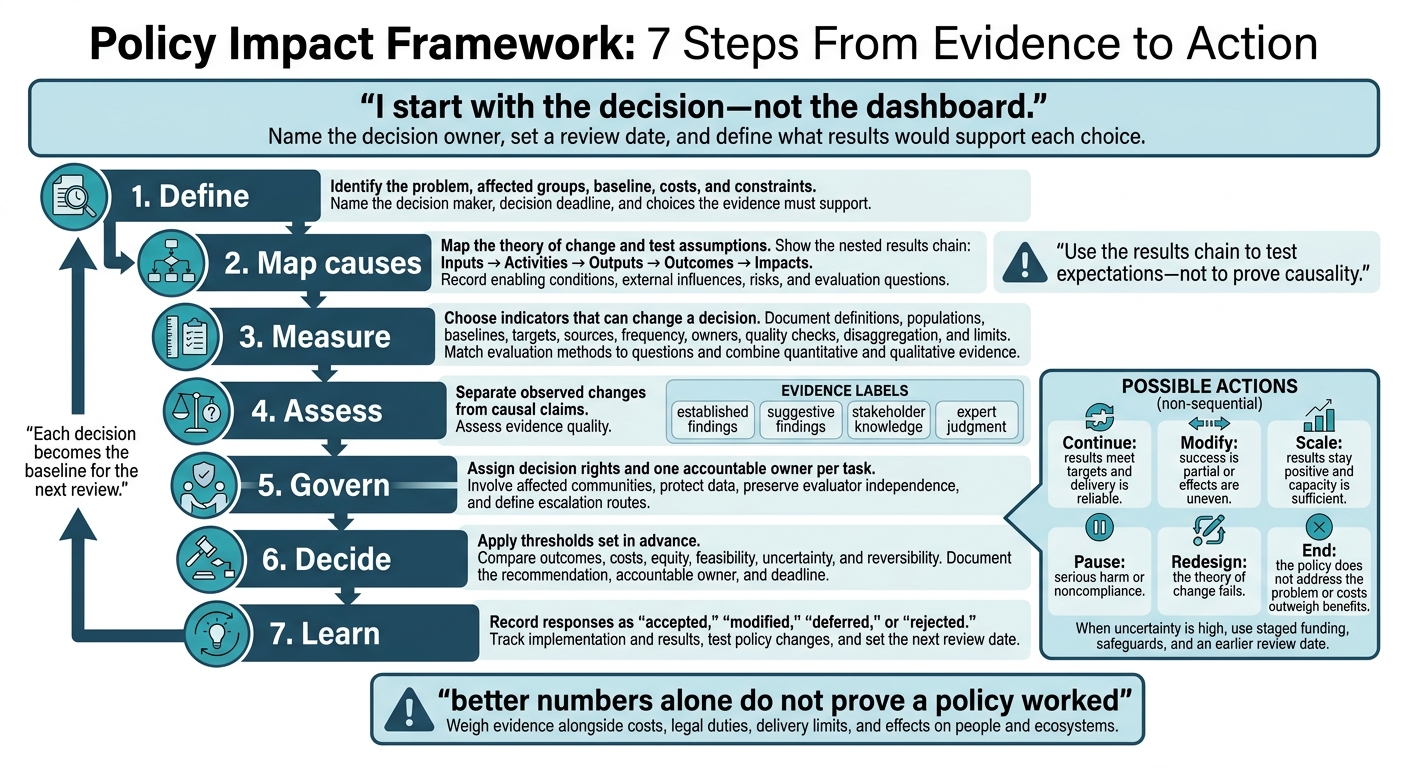
Policy Impact Framework: 7 Steps From Evidence to Action
Design a Policy Impact Framework
Define the Problem and the Decision
Use the agreed decision and review date to set the framework’s boundaries. Write a problem statement that explains what is happening, who is affected, where, when, and compared with what baseline. Record the baseline date, data source, trend, and gaps in coverage. Distinguish the target group from the people actually reached and any comparison group. Identify root causes, unequal burdens, and constraints tied to law, budgets, or eligibility.
Name the decision maker, deadline, and choice the evidence must support: funding, targeting, redesign, continuation, or termination. Specify the outcomes, costs, equity effects, and delivery conditions that will guide that choice. Check whether the proposed response reflects affected people’s priorities and fits existing policy rules.
Map the Theory of Change and Results Chain
With the decision fixed, map how action is expected to produce results. Work backward from the intended long-term change: identify the outcomes needed to achieve it, then connect inputs, activities, and outputs to those outcomes.
For each link, record why one step should lead to the next. Include the assumption or enabling condition being tested, an indicator, a data source, a responsible actor, an expected timeframe, and key risks. Treat staffing, procurement, legal authority, and funding as prerequisites. Map who controls budgets and data, who bears risks, and who can block delivery. Ask affected groups to test these assumptions.
Use the results chain to test expectations - not to prove causality. Attribution asks what the policy caused compared with a sound counterfactual: what would have happened without it. Contribution asks how the policy helped produce change alongside other influences. Track external drivers and feedback loops that could strengthen or weaken results. Before collecting data, check sensitive-data handling, conflicts of interest, and evaluator independence. Turn the chain’s assumptions into testable evaluation questions.
Set Evaluation Questions and Review Dates
Once the causal pathway is clear, translate it into review questions and dates. Keep each question tied to the decision: Does the policy address the problem, follow its design, improve outcomes fairly, justify its costs, and sustain benefits? The OECD’s six criteria - relevance, coherence, effectiveness, efficiency, impact, and sustainability - offer a useful check, not a rigid scorecard.
Schedule pre-launch reviews and early implementation reviews to address delivery failures. Hold outcome reviews only when enough time has passed for effects to appear and for reviewers to judge durability and sustainability. Work backward from decision deadlines, leaving time for analysis and review. Match the evaluation’s scope, budget, and independence to spending, potential harm, uncertainty, and how easily the decision can be reversed. Use these questions to select the indicators and methods that follow.
sbb-itb-8baf5f1
Impact Evaluation Frameworks
Choose Indicators, Methods, and Evidence Standards
Translate each evaluation question into a small set of measures that help people make decisions.
Define Indicators and Data Responsibilities
Keep only indicators that can change a decision. Build a small core dashboard for executives, supported by a diagnostic set for analysts and implementers that tracks implementation quality, equity, mechanisms, and unintended effects.
For every indicator, record its decision use, definition, unit, population, baseline, target, frequency, source, owner, quality checks, disaggregation, and limits. Keep it only if it informs decisions, produces reliable and timely data, and justifies the collection cost. Organize indicators across the results chain:
| Indicator level | Purpose | Sources | Timing | Strength | Limitation | Decision use |
|---|---|---|---|---|---|---|
| Inputs | Track resources | Financial records, staffing logs | Monthly or quarterly | Shows available capacity | Spending does not establish results | Adjust resource allocation |
| Activities | Track work performed | Implementation logs | During delivery | Identifies delivery bottlenecks | Effort is not effectiveness | Change delivery workflows |
| Outputs | Track services delivered | Service records | Short-term | Shows volume and reach | May miss quality and exclusion | Adjust service access |
| Outcomes | Track changes in conditions | Surveys, administrative data, interviews | At planned follow-ups | Measures meaningful change | Does not prove causality | Continue or redesign |
| Impacts | Assess lasting population or system effects | Longitudinal studies, population data | Longer-term | Tests durability | Attribution remains difficult | Inform long-term investment |
Test validity - whether the measure reflects the intended concept - and reliability - whether it stays consistent across sites and time. Record staff hours, respondent time, technology costs, training needs, and privacy requirements. Set checks for missing data, duplicates, and audits before reporting begins.
Pair volume targets with quality and outcome measures. Investigate unusual jumps to discourage metric gaming. Specify how data must be broken down by group, place, and time, along with privacy limits. Administrative records may leave out people who never receive services.
With the measures in place, choose the simplest method that can answer the policy question.
Match Evaluation Methods to Policy Questions
Choose a method based on the claim the decision requires, not the method’s reputation. Assess the quality of comparisons, the ethics of assignment, and whether findings apply to the intended population and setting.
Combine quantitative and qualitative evidence. Connect outcome estimates with implementation records and participant accounts. When they disagree, investigate the differences rather than averaging them away.
| Method | Question fit | Data needs | Causal strength | Practical constraints | Appraisal criteria | Decision use |
|---|---|---|---|---|---|---|
| Experimental | What effect did the policy cause? | Random assignment, outcomes, follow-up | Strong when well implemented | Ethics, assignment feasibility, spillovers | Assignment integrity, attrition, compliance | Continue, scale, or end |
| Quasi-experimental | What effect occurred without random assignment? | Historical data and a sound comparison or threshold | Depends on identification assumptions | Confounding, overlapping policies | Baseline comparability, assumptions, sensitivity | Continue or redesign |
| Process | Was delivery consistent with the design? | Records, observations, interviews | Limited alone | Requires access during implementation | Reach, fidelity, dosage, adaptations | Correct delivery failures |
| Qualitative | How and why did experiences differ? | Interviews, field notes, documents | Explains mechanisms; not a standalone average effect estimate | Sampling and interpretation risks | Inclusion, transparent analysis, contradictory evidence | Adapt targeting or delivery |
| Contribution | Did the policy plausibly help produce change? | Mechanism evidence, context, competing explanations | Supports a contribution claim | Cannot isolate a clean effect estimate | Tested causal links, rival explanations, triangulation | Retain or revise pathways |
| Systems | How do interactions shape results over time? | System data, stakeholder knowledge, model assumptions | Model-dependent; not automatically causal | Complex boundaries and feedback | Assumption transparency, validation, sensitivity | Adjust coordinated interventions |
After choosing the method, define in advance how each claim will be graded.
Assess Evidence Quality and Uncertainty
Maintain an evidence log that records how sources were found, selected, and assessed. Judge each important claim for relevance, rigor, transparency, consistency, equity, and timeliness. Label claims as established findings, suggestive findings, stakeholder knowledge, or expert judgment. Then assign a confidence level and explain the reasoning in writing. These categories complement one another, but agreement alone does not prove causality.
Report gaps in coverage, measurement error, selection bias, confounding, and differences in delivery - not just statistical uncertainty. Present estimates with suitable intervals or sensitivity ranges. Disclose modeling assumptions and flag unstable subgroup results. Missing administrative data do not mean an effect is absent.
State whether the evidence supports action now, a pilot, redesign, or delay. Record the evidence standard alongside the indicator and method.
Set Rules for Participation and Accountability
Once methods are set, decide who participates, who approves, and who can challenge the findings. These governance rules keep evidence usable for policy decisions.
Assign Roles and Involve Affected Communities
Assign authority before collecting evidence. Create a stakeholder register that includes decision-makers, delivery and evaluation teams, funders and oversight bodies, and affected communities and rights holders. Record each group’s decision rights, expertise, access, incentives, and conflicts. Keep funding, implementation, evaluation, and approval responsibilities separate. Paying for an evaluation should not give a sponsor control over its conclusions.
Give affected communities a defined role at five checkpoints: problem definition, assumption review, indicator selection, result interpretation, and response review. Offer accessible materials, interpretation, participation options, and compensation where permitted. Identify missing voices, including people with disabilities, rural communities, relevant tribal partners, and groups facing language or digital-access barriers. Publish a “you said, we did” record showing which suggestions were accepted, modified, or rejected - and why. Treat rights holders as parties with legal standing, not ordinary consultees.
Protect Data and Evaluation Independence
Adopt a written data-governance protocol covering stewardship, validation, consent, access, transfer, retention, disclosure review, and incident response. Follow relevant U.S. federal, state, tribal, contractual, and institutional requirements.
Require conflict disclosures. Protect evaluators’ access to needed data and their ability to report unfavorable results. Use version control for methods, code, review comments, and report revisions. Publish methods and findings where lawful, and explain why any material is withheld without exposing confidential information.
Build an Accountability Matrix
Use the matrix below to assign ownership, safeguards, and publication duties.
| Stakeholder input or activity | Decisions influenced | Safeguards | Collection, quality assurance, and analysis owners | Approval, publication, and follow-through |
|---|---|---|---|---|
| Community-defined harms and priorities | Problem definition and evaluation questions | Accessible, compensated participation; inclusion log | Engagement lead collects; participation reviewer checks coverage; evaluator interprets with participants | Policy sponsor approves scope; public summary documents responses to community priorities |
| Implementer operational data | Delivery adjustments and implementation assessment | Standard definitions; validation checks; version control | Program data steward collects; data manager checks; evaluation team analyzes | Program leadership approves operational response; implementer corrects data gaps and reports progress |
| Administrative or survey data | Outcome and equity assessment | Consent, privacy review, secure access, disclosure control | Data owner supplies; independent reviewer checks quality; evaluator or research partner analyzes | Designated release official publishes lawful findings; agency responds to limitations and corrective findings |
| Evaluation findings | Continuation, redesign, scale, or termination | Conflict disclosure; independent review | Evaluation lead maintains and interprets evidence; independent reviewer checks findings | Oversight body or designated official publishes response; policy owner records the action owner, deadline, and status |
| Public and oversight feedback | Accountability and policy revision | Plain-language communication; appeal channel | Communications and oversight teams record; legal, privacy, and accessibility reviewers check | Sponsor and evaluator respond jointly; authorized official publishes response; unresolved commitments are escalated |
Name one accountable owner per task, backed by realistic staff time, funding, participant support, and review deadlines. Define escalation triggers before findings arrive: major data-quality failures, unresolved methodological disputes, undisclosed conflicts, privacy incidents, missed management responses, or decisions that violate the agreed evidence rules.
Handle issues in stages. Start with the evaluator, data owner, and program lead. Refer unresolved disputes to an independent reviewer or steering committee. Notify oversight, legal, privacy, or inspector-general functions when issues involve compliance, misconduct, or harm. Then document the dispute and response in the public reporting record when disclosure is lawful. These assignments feed the decision rules in the next section.
Turn Findings Into Action and Review Results
Once roles, data, and review dates are set, turn the findings into a decision.
Set Decision Rules and Write Decision Briefs
Set decision thresholds in advance. Continue when results meet targets and delivery is reliable. Modify when success is partial or effects are uneven. Scale when results stay positive and capacity is sufficient. Pause for serious harm or noncompliance. Redesign when the theory of change fails. End when the policy does not address the problem or costs outweigh benefits.
Require stronger evidence for decisions that cannot be reversed. When uncertainty is high, use staged funding, safeguards, and an earlier review date.
Use the owner and deadline already assigned in the accountability matrix. Prepare a brief covering the required decision, evidence, confidence, equity effects, costs, options, recommendation, owner, and deadline. Separate observed results from inferred effects and unknowns. Compare effects on people, ecosystems, and the economy, including long-term consequences. Put the brief into budget or approval workflows before the decision date.[4]
| Policy option | Outcomes | Costs | Equity | Feasibility | Uncertainty | Reversibility |
|---|---|---|---|---|---|---|
| Continue | Compare results with targets | Current and projected spending | Check persistent disparities | Confirm delivery capacity | Identify unresolved effects | Ease of stopping or changing |
| Modify | Identify the mechanism or delivery component to improve | Transition and operating costs | Assess who gains or loses | Check staffing and authority | Test changed assumptions | Preserve rollback options |
| Scale | Assess transfer to new settings | Total and marginal costs | Check access across groups | Confirm capacity at scale | Examine limits to generalizability | Identify lasting commitments |
| Pause or end | Assess harms avoided and benefits lost | Exit and replacement costs | Protect groups during transition | Plan service continuity | Explain confidence in stopping | Assess restart barriers |
Explain trade-offs instead of hiding them in a score. Financial return alone cannot settle legal duties, severe harms, or irreversible ecosystem damage.
Track Responses and Test Policy Changes
After the decision, record the response and set the next review date.
Keep a recommendation-response register that marks each item as accepted, modified, deferred, or rejected. Record the reasons, one owner, required budget or regulatory changes, deadlines, and review dates.
Track spending, delivery, reach, subgroup outcomes, changes in the environment, and unintended harms. Establish a baseline before making changes. Where feasible, use a suitable comparison or phased rollout. Dashboard trends are not causal proof. Schedule findings before the next budget renewal or expansion decision.[4]
Before closing the review, check:
[ ] The problem, theory of change, and causal assumptions are current.
[ ] Indicators, baselines, targets, data owners, and evidence standards are documented.
[ ] Participation shaped interpretation; equity, ecological effects, costs, and feasibility were assessed.
[ ] Decision rules were applied, and exceptions were explained.
[ ] Responses have owners, budget or authority, success measures, and review dates.
Each decision becomes the baseline for the next review.
Conclusion: Keep Evidence Linked to Action
Treat a policy impact framework as a management system: define decisions early, document assumptions, choose useful indicators, and match methods to questions. Disclose uncertainty, assign accountability, revise policy when evidence changes, and review results after each change.
FAQs
How can I evaluate a policy with limited data?
Start by clarifying your theory of change: how your work is expected to lead to the results you want. Focus on meaningful intermediate outcomes rather than trying to measure long-term impact too soon. Pair quantitative data with qualitative input from interviews or oral storytelling to understand both the numbers and the experiences behind them.
When resources are limited, use simple tracking systems, periodic snapshots, or participatory assessments. Match the rigor of your evaluation to your resources and the stakes of the policy decisions involved. Put learning before perfection. Use early findings to test assumptions, refine your approach, and adjust your strategy.
What should I do when evidence conflicts with community priorities?
Your role is not to force consensus. It’s to understand different perspectives and make informed, transparent decisions. Record where evidence and community priorities differ, how you weighed competing views, and why certain priorities came first.
Bring in a professional facilitator if you need help mediating tensions. Keep detailed records, and clearly explain the trade-offs and reasoning behind your final plan. This helps build trust and keeps you accountable to both the evidence and the people you serve.
How can I tell whether a policy will work elsewhere?
First, test whether the policy’s theory of change and assumptions hold in the new setting. Review its fit with the mission, stakeholder engagement needs, data requirements and capacity, flexibility for customization, and implementation complexity and costs. Account for differences in geography, local norms, urban and rural settings, and the populations the policy will serve.
Then set indicators linked to expected outcomes and schedule monitoring checkpoints to guide adjustments. [1][2][3]



FAQ