In This Article
Five checks—serial tracking, registry reconciliation, permanent retirement locks, verified claims, and cross-platform validation—to reduce carbon‑credit double counting.
On this page
Digital Carbon Markets: 5 Double-Counting Safeguards
I would not treat a blockchain record as proof that a carbon credit is counted only once. Each credit represents 1 metric ton of CO₂ equivalent, but buyers still need to check for duplicate issuance, repeated use, and conflicting claims.
Before buying, I would ask for five linked checks:
Serial-number tracking: Trace each credit’s ownership and status.
Cross-registry reconciliation: Check whether the same reduction has been credited elsewhere.
Permanent retirement locks: Confirm that retired credits cannot return to circulation.
Verified claims records: Document who may claim the outcome, for what purpose, and for which period.
Cross-platform checks: Compare registry, marketplace, token, and claims records for conflicts.
My rule: <u>match the records before making the claim</u>. If records conflict, pause the purchase or claim until the issue is resolved. No conflict found means only that the data checked showed none - not that double counting is impossible. These checks also do not prove that a project needed credit revenue or that its carbon storage will last.
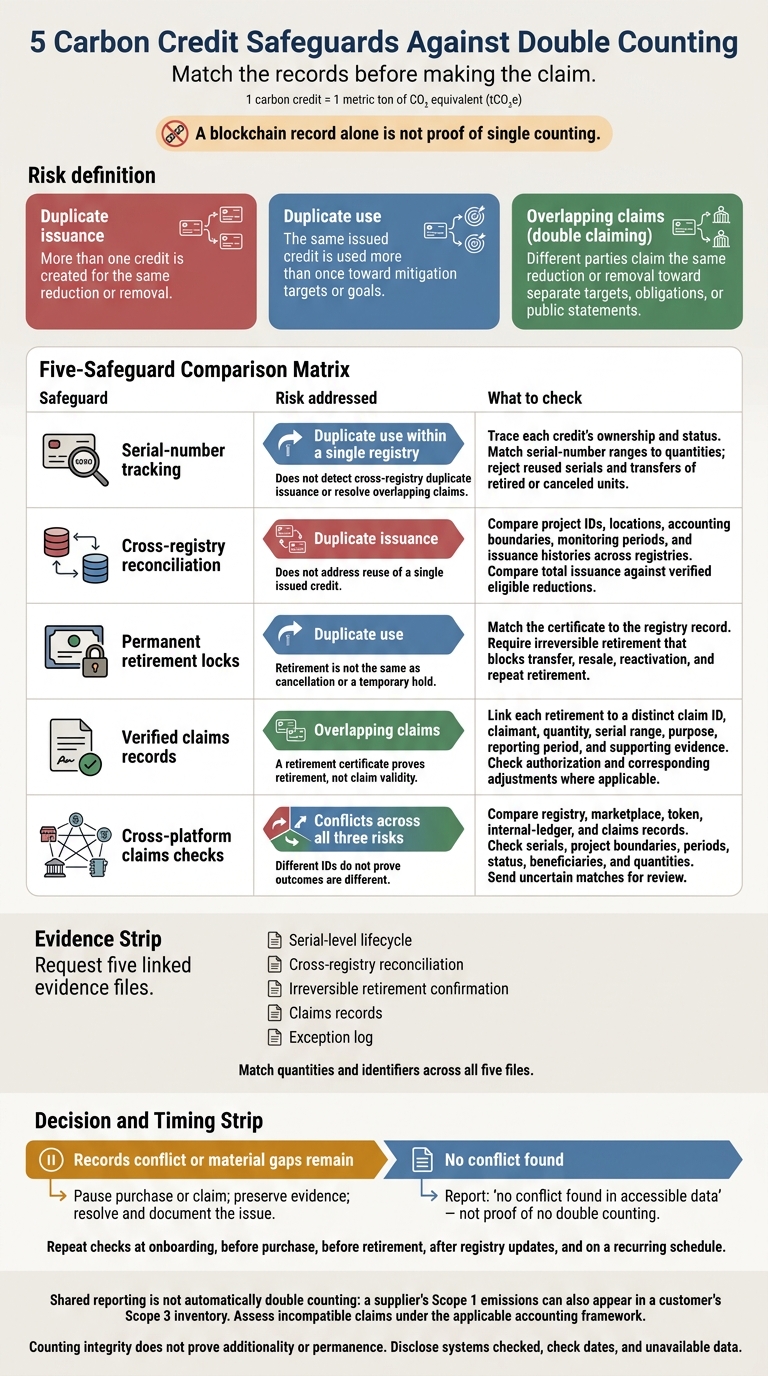
5 Carbon Credit Safeguards Against Double Counting
Double Counting of Carbon Credits- Possible or not?
sbb-itb-8baf5f1
3 Types of Double Counting
One carbon credit represents 1 metric ton of CO2 equivalent (tCO2e), but the unit alone does not prove it was issued only once.[3][9] The three risks below map to the five safeguards that follow.
| Risk | Trigger | Affected record | Primary control |
|---|---|---|---|
| Duplicate issuance | More than one credit is created for the same reduction or removal. | Project records, monitoring reports, issuance batches, and registry inventory. | Unique project IDs, eligibility checks, clear accounting boundaries, independent validation and verification, and a rule allowing only one credit per metric ton.[3][6] |
| Duplicate use | The same issued credit is used more than once toward mitigation targets or goals. | Credit status and transaction history. | Immutable serial-number tracking linked to a status that blocks further transfer, retirement, or cancellation.[3][8] |
| Overlapping claims (double claiming) | Different parties claim the same reduction or removal toward separate targets, obligations, or public statements. | Host-country inventories, corresponding-adjustment or authorization records where applicable, buyer retirement records, and corporate claims documentation. | Reconcile claims to establish who may claim the outcome, for what purpose, and during which period.[4][7] |
Shared reporting is not double counting. A supplier’s Scope 1 emissions can also appear in a customer’s Scope 3 inventory.[1]
The issue is whether the same outcome serves incompatible targets, obligations, or offset claims. Check the accounting framework that applies before treating an overlap as prohibited.[4][7]
Serial-number tracking addresses duplicate use first.
1. Serial-Number Tracking
Double-Counting Risk Addressed
Serial-number tracking assigns each credited metric ton its own record throughout its lifecycle, preventing duplicate use within a single registry. It does not detect duplicate issuance across registries or resolve overlapping claims. [11][14][15]
Buyers therefore need serial-level records - not just aggregate issuance totals.
Required Records and Evidence
Request a machine-readable export with each serial number, project details, methodology, vintage, issuance date, quantity, ownership history, transfers, and final status. Retirement records should include the date, beneficiary, purpose, and transaction ID. Check that serial-number ranges match the recorded quantity exactly. [11][12]
Enforcement Controls
The registry must reject reused serials, overlapping ranges, overdrawn balances, and transfers of retired or canceled units. Compare exported records against the registry display, then use test transactions to verify that these controls work. [12][13]
Exceptions and Audit Trail
An append-only, tamper-evident audit trail should trace each credit from issuance to retirement, recording timestamps, account IDs, quantities, status changes, and approvals. During splits or migrations, preserve original identifiers or traceable parent-child links. Corrections should add linked entries rather than overwrite earlier records. [11][12][13]
2. Cross-Registry Reconciliation
Double-Counting Risk Addressed
Cross-registry reconciliation checks whether the same project or reduction appears in multiple registries, leading to duplicate registration or issuance. It does not address reuse of a single issued credit.[2] It can also flag overlapping boundaries that need project-level review.[19][20] After clearing registry-level duplication, check whether a valid credit can still be used again.
Required Records and Evidence
Request a signed exclusivity or non-duplication declaration that lists every current and former registry, project identifier, methodology, location, crediting period, and issuance history.
Include registry search results, project design files, GIS maps, ownership and authorization records, monitoring-period details, verifier statements, issuance ledgers, and proof of any prior cancellation or transfer. Record the search date, search terms, reviewer, results, and unresolved matches.[17]
Enforcement Controls
Check identifiers, names, geographic areas, and periods before registration, issuance, and transfer.[16][18] Pause issuance or transfer until material matches are resolved. Require the developer, both registries, and the verifier, when needed, to resolve discrepancies under dual approval.[17][14]
Compare total issuance against verified eligible reductions for the same activity and period - not just the smaller registry balance.
Exceptions and Audit Trail
Shared locations or similar names do not, by themselves, prove duplication. For legitimate migrations, require source cancellation, linked destination records, affected quantities, effective dates, and approvals.
Cancel duplicates and keep the reasons, search snapshots, matching rules, reviewer decisions, and supporting evidence so an auditor can reproduce the decision.
3. Permanent Retirement Locks
Double-Counting Risk Addressed
Retirement locks prevent duplicate use: once a credit is retired, it cannot return to circulation or be retired again. This control addresses duplicate use - not duplicate issuance or overlapping claims.[21][2] After cross-registry checks confirm that the credit is not duplicated, retirement locks prevent its reuse.
Required Records and Evidence
Request the registry record and certificate showing the registry name, serial-number range, quantity, project, methodology, vintage, retirement date and time, transaction ID, retiring entity, and purpose. Include the beneficiary/claimant, reporting period, and any applicable authorization or corresponding-adjustment status.
Match the certificate to the registry record. An internal ledger alone does not prove retirement.[2][22][24]
Enforcement Controls
Require a single, irreversible registry transaction that retires the serials and blocks later transfer, resale, reactivation, or repeat retirement. Verify ownership and balance before proceeding, and use role-based permissions, approval controls, and alerts for attempted reuse.
Reconcile the retirement with internal ledgers and any external trading platform so the units are also marked unavailable in those systems.[8][22][25]
Exceptions and Audit Trail
After retirement is recorded, check that the registry status still matches the claim. Retirement is not the same as cancellation or a temporary hold. Review the registry’s formal definitions before treating either as proof of retirement. Cancellation may permanently remove units without supporting an end-use claim, while an account restriction may be reversible.[22][23]
For errors or administrative corrections, keep the original event, affected serials, reason, approver, timestamp, and final status - never silently overwrite records. Auditors should trace sampled units from issuance to retirement and check for transfer, reactivation, or repeat retirement.[2][9][21][22]
4. Verified Claims Records
Once retirement is locked, the next check is whether the claim itself is valid.
Double-Counting Risk Addressed
Claims records address overlapping claims - when different entities claim the same mitigation outcome. Even a retired credit can support an invalid claim if the claimant, wording, or reporting period is wrong.
Required Records and Evidence
Document who may claim what. Assign a claim ID that links each retirement to the claimant, date, quantity, registry, serial range, project, vintage, claim type, reporting period, and supporting evidence. Each claim ID must be distinct.
Keep the registry transaction, verification and monitoring reports, claim wording, publication date, emissions boundary, and any authorization or corresponding-adjustment documentation. A retirement certificate proves retirement, not claim validity.
Enforcement Controls
Before approval, match the registry retirement, internal claims register, and published statement. Check earlier records for incompatible claims involving the same serials or mitigation outcome. Classify each claim as compensation, neutralization, or contribution.
Record the applicable standard, authorization status, and any corresponding adjustment. Where applicable, retain the authorization reference, covered mitigation outcome, first-transfer status, and adjustment evidence.
Exceptions and Audit Trail
Hold approval if quantities conflict, beneficiaries are unclear, or earlier claims appear incompatible. Flag national-inventory overlap for review rather than automatic rejection. When correcting a claim, preserve the original wording, evidence, decision, and any required restatement.
Check that claim records also match the information shown across registries, marketplaces, and public disclosures.
5. Cross-Platform Claims Checks
After validating a claim, check how the same outcome appears across every platform that records it.
Double-Counting Risk Addressed
Cross-platform checks catch conflicts that a single-system review can miss. A valid claim record may still conflict with a marketplace listing, registry entry, or internal ledger.
Different IDs do not prove that mitigation outcomes are different. Compare registries, claims databases, and marketplaces. The same serial number in multiple active claims can signal duplicate use. Matching project or monitoring data can point to duplicate issuance, while different entities claiming the same outcome can indicate overlapping claims.[8][7][3]
Required Records and Evidence
Across systems, compare geographic coordinates or jurisdiction, project and accounting boundaries, crediting and monitoring periods, issuance batches, and serial-number ranges. Check for conflicts in authorization, retirement or cancellation status, beneficiaries, and claim dates.
Keep dated registry extracts or API records, marketplace listings, claims records, and any maps or monitoring reports needed to resolve discrepancies. Preserve search terms, data versions, and access timestamps.[8][7][3][4][5]
Enforcement Controls
Run checks at intake, before purchase or retirement, after registry updates, and on a recurring schedule. Flag:
Duplicate serials across active claims; retired units listed as available elsewhere; post-retirement transfers; and mismatched vintages or unit types.
Duplicate project locations or facility IDs, overlapping monitoring periods, and claims that exceed verified reductions.
Conflicting beneficiaries and beneficiary changes without transfer records.
Use exact identifiers, normalized names and dates, and geospatial or time-based comparisons when systems lack common IDs. Send uncertain matches to reviewers.[8][3]
Exceptions and Audit Trail
Place unresolved records on hold. Block purchase, transfer, retirement, and public claims until the issues are resolved. Preserve original records, conflicting fields, correspondence, decision logs, approval dates, system changes, follow-up monitoring, and immutable source snapshots or hashes.
Registry migrations can produce duplicate display records without duplicating units. Clear these alerts only when supporting evidence confirms the cause.
Inaccessible platforms, private claims, national inventories, and missing historical records limit certainty. Report the finding as:
no conflict found in accessible data
This is not proof of no double counting. Where gaps remain material, obtain registry confirmation or signed attestations, reduce the eligible quantity, delay retirement, or commission an independent review.[10][7]
Pair these checks with serial tracking, registry reconciliation, retirement locks, and verified claims records.
Evidence Buyers Should Request
Once the five safeguards are clear, ask for records that show each one is in place. Request five linked evidence files:
Serial-level lifecycle
Cross-registry reconciliation
Irreversible retirement confirmation
Claims records
Exception log
Match quantities and identifiers across all five files.[26][7]
Make evidence delivery a purchase term. Require access to the underlying registry records. Check that the retired quantity matches the claimed quantity and that the retirement beneficiary matches the claimant.[7][27] Then test the records against the rules governing the credit.
Check applicable ICVCM requirements, program double-counting rules, registry operating rules, and GHG Protocol guidance. For each source, record its title, version, effective date, and review date, and label its authority. These checks verify counting integrity - not overall project quality.
Keep counting integrity separate from additionality and permanence. Clean registry records do not prove that a project needed credit revenue or that its storage will last.[3]
Conclusion: Use All 5 Safeguards Together
No single safeguard is enough. Serial-number tracking and registry reconciliation prevent duplicate issuance. Permanent retirement locks prevent duplicate use. Claims records and cross-platform checks flag overlapping claims. Together, these five controls address the three double-counting risks described above.
Repeat reconciliation at onboarding, before purchase, before retirement, and on a set schedule. If a conflict appears, pause the credits and claims, preserve the records, and notify the registry. Log the decision, corrective action, resolution date, and any unresolved gaps.
State the limits of the checks: disclose which systems were checked, when the checks took place, and which data were unavailable. Even the full control set leaves gaps when registry, government, or claims records are inaccessible.
FAQs
How can I verify a tokenized credit’s registry backing?
Confirm that the tokenized credit matches an entry in a recognized carbon registry and has its own serial number to track issuance, transfers, and final retirement. Cross-check the token’s data against the registry’s public records, and verify that the underlying credit has been permanently retired in the issuing registry to prevent double-counting.
When does my carbon claim need a corresponding adjustment?
A corresponding adjustment is required when a carbon credit is authorized for use toward an international mitigation target, such as those under the Paris Agreement. It prevents both the host country - where the project took place - and the buyer or country using the credit from claiming the same emissions reduction. Recording this adjustment helps prevent double-counting and keeps reporting transparent and accurate.
What should I do if double counting emerges after purchase?
Confirm that your carbon credits were officially retired in a recognized registry, permanently removing them from circulation. Check that their serial numbers match your claim period, and compare your holdings with the registry’s official records to verify their status.
If discrepancies remain, ask your third-party auditor to investigate the registry records and validate the documents supporting your claim.




FAQ