
Dec 29, 2025
Currency Risk vs. Project Viability in Emerging Markets
Sustainability Strategy
In This Article
Currency mismatches inflate financing costs for renewables in emerging markets; solutions include hedging, local loans, blended finance and policy.
Currency Risk vs. Project Viability in Emerging Markets
Currency risk is a major barrier for renewable energy projects in emerging markets, where revenues are often in local currencies, but financing is in hard currencies like USD or EUR. When local currencies lose value, the cost of repaying loans rises sharply, threatening project viability. For example:
Nigeria: The Naira lost 50% of its value in 2023, crippling utilities with foreign debt.
Ghana: The Cedi depreciated 20% annually (2020-2023), causing $500M in forex losses.
Key challenges include:
Currency mismatch: Borrowing in dollars but earning in weaker local currencies.
High financing costs: Africa's energy projects face a 15.6% cost of capital compared to 5.1% in the U.S.
Long repayment periods: Renewable projects require 15-20 years, increasing exposure to currency swings.
Solutions to mitigate these risks:
Hedging tools: Options like cross-currency swaps reduce risks but are costly.
Local currency financing: Aligning loans with revenue currency cuts costs by up to 31%.
Blended finance: Donor funds subsidize hedging costs or protect against extreme devaluation.
Policy reforms: Standardized agreements and government-backed guarantees attract local investors.
Examples of success:
South Africa: Local financing reduced solar tariffs by two-thirds (2011-2023).
Nigeria: InfraCredit mobilized $206M for Naira-denominated projects.
India: Payment security mechanisms halved overdue payments in 18 months.
Addressing currency risk is critical for lowering electricity costs, attracting investment, and achieving climate goals in emerging markets.
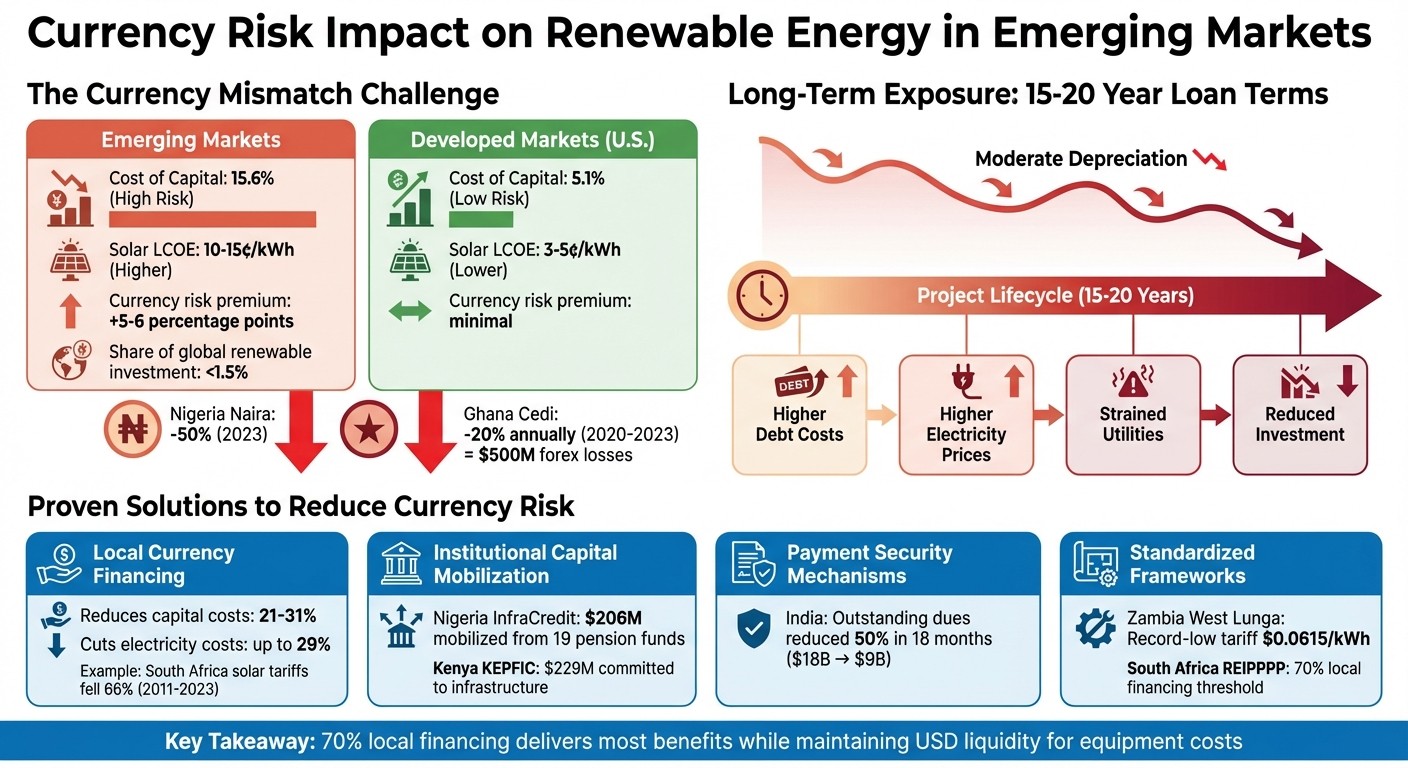
Currency Risk Impact on Renewable Energy Costs in Emerging vs Developed Markets
How Currency Risk Affects Renewable Energy Projects
Currency Mismatches and Financial Pressure
In many emerging markets, renewable energy projects face a daunting financial hurdle: borrowing in hard currencies while generating revenue in local currencies that often lose value over time. This mismatch creates a significant financial strain, as even slight devaluation of the local currency can sharply increase the cost of repaying foreign-denominated debt. This challenge persists even when project revenues grow modestly.
Take utility-scale solar projects in Africa, for instance. These projects often have a levelized cost of electricity (LCOE) ranging from 10¢ to 15¢ per kilowatt-hour - two to three times higher than similar projects in Europe or Asia. While equipment costs remain fairly consistent globally, African markets face an additional burden: financing costs. Currency volatility alone adds an estimated 5 to 6 percentage points to the cost of capital in these regions [2].
The long repayment periods for renewable energy financing - spanning 15 to 20 years - add another layer of risk. Over time, even moderate and steady currency depreciation can erode a project's financial stability. This misalignment not only inflates debt servicing costs but also exposes projects to long-term systemic vulnerabilities.
Additional Risks in Emerging Markets
Currency risk doesn’t just drive up financing costs; it also amplifies other operational and financial challenges. One notable issue is off-taker risk, where state-owned utilities - often the primary buyers of electricity - struggle to meet their payment obligations. When local currencies lose value rapidly, these utilities face tough choices: either raise consumer tariffs to cover the higher costs of dollar-denominated power purchase agreements or absorb the financial losses themselves, further weakening their already fragile balance sheets.
Ghana’s experience highlights these cascading challenges. Currency depreciation has forced the government to step in and cover energy sector shortfalls while grappling with utility payment crises. Similarly, in Senegal, energy subsidies accounted for 3.3% of GDP in 2023 as the government worked to shield consumers from price hikes tied to currency fluctuations [2].
These interconnected risks create a vicious cycle. High currency risk leads to elevated financing costs, which, in turn, drive up electricity prices. Expensive electricity strains utility finances and government budgets, making it increasingly difficult to fund future renewable energy projects. The result? Despite its abundant solar and wind resources, Africa has captured less than 1.5% of global renewable energy investment [2].
Methods to Reduce Currency Risk
Hedging Instruments
Currency hedging tools, such as forwards, swaps, and options, are widely used to manage short-term exchange rate fluctuations. For instance, cross-currency swaps enable developers to lock in exchange rates for both principal and interest payments over the entire duration of a loan, which is often 15 to 20 years for renewable energy projects.
However, these tools come with a hefty price tag in emerging markets. Commercial swap providers frequently demand upfront collateral as high as 25% of the hedge value to mitigate credit risk [3]. These costs can offset the interest rate benefits of borrowing in stronger currencies like dollars or euros rather than local currencies [1]. As a result, standard commercial hedging products often prove too expensive for projects in frontier markets.
Some organizations have found ways to work around these challenges. The Currency Exchange Fund (TCX) collaborated with M-Kopa, a solar electricity provider, to hedge currency risk for projects aimed at connecting 500,000 homes in Kenya, Tanzania, and Uganda to solar power. By offering long-term foreign exchange tools, TCX made it feasible to align local currency revenues with foreign investments [3]. Similarly, entities like the International Finance Corporation (IFC) leverage their AAA credit rating to act as swap counterparties, significantly lowering the collateral requirements for developers [3].
When hedging proves too costly, shifting to local currency financing offers another way to address currency risk.
Local Currency Financing
Financing projects in the same currency as their revenue stream eliminates the risk of currency mismatch. This approach can significantly reduce financial strain, cutting the weighted average cost of capital by 21% to 31% and lowering electricity costs by up to 29% [2]. While local currency loans often carry higher nominal interest rates, they avoid the 5 to 6 percentage point premium typically added to account for currency volatility [2].
"Shifting project finance to local currency - with complementary policies and de-risking tools - can reduce capital cost by up to 31% and provide electricity cost savings of up to 29%." - Dian Baldé and Meron Tesfaye, Energy for Growth Hub [2]
South Africa's Renewable Energy Independent Power Producer Procurement Programme (REIPPPP) illustrates the success of this strategy. Between 2011 and 2023, standardized power purchase agreements allowed local banks to finance up to 70% of project debt in South African Rand. This policy contributed to a dramatic reduction in solar tariffs, which fell by more than two-thirds over 12 years [2]. The 70% local financing threshold balances risk reduction with sufficient dollar liquidity to cover the cost of imported equipment [2].
The main obstacle to this approach is the limited availability of long-term financing in many emerging markets. Some countries have addressed this challenge through innovative solutions. For example, Nigeria established InfraCredit, a government-backed facility that guarantees Naira-denominated infrastructure bonds. By 2023, InfraCredit had mobilized over NGN 159 billion ($206 million) from 19 pension funds to support projects like North South Power's 15-year green bond and Darway Coast's mini-grid portfolio [2].
New Approaches to Currency Risk Management
While hedging and local financing tackle currency mismatch directly, emerging financing mechanisms are helping to further reduce costs in developing markets. These approaches, combined with traditional methods, improve overall project feasibility.
Blended finance models use donor or concessional capital to subsidize hedging costs or cover extreme depreciation risks. For instance, the TCX Donor Facility leverages donor funds to offer below-market hedging rates for frontier market currencies [1]. Similarly, Brazil's Eco Invest Brasil initiative, in partnership with the Inter-American Development Bank, protects against worst-case depreciation scenarios that could inflate hedging expenses [1].
Another innovative example is the proposed CPI FX Facility for India, which activates subsidies only when currency depreciation exceeds 4.5%. This keeps costs manageable while safeguarding against severe currency fluctuations [1]. In Kenya, the government doubled the ceiling for pension fund infrastructure investments from 5% to 10% in 2021. This policy enabled the formation of the Kenya Pension Funds Investment Consortium (KEPFIC), which has since committed KES 25 billion ($229 million) to infrastructure projects [2].
While no single solution completely resolves currency risk, these strategies represent meaningful progress in narrowing the gap between the cost of capital in emerging and developed markets. By combining traditional tools with innovative approaches, developers can better manage the financial risks tied to currency fluctuations.
Case Studies from Emerging Markets
Solar PV Projects in Sub-Saharan Africa
Sub-Saharan Africa faces steep financing hurdles, with currency volatility driving up capital costs. This results in utility-scale solar electricity prices ranging from 10 to 15¢/kWh - two to three times higher than those in Europe or Asia. These challenges have spurred innovative financing models to address the region's unique barriers.
One standout example is Zambia's West Lunga project, which demonstrates how structured support can break through these obstacles. Leveraging the World Bank's Scaling Solar program, the project achieved a record-low tariff of $0.0615/kWh, the lowest in Sub-Saharan Africa at the time [4]. This program's "one-stop shop" model streamlined processes, cut transaction costs, and boosted lender confidence, even in the face of currency instability.
In Nigeria, local currency financing has proven to be a game-changer. Through government-backed InfraCredit, guarantees were issued for infrastructure bonds denominated in Nigerian Naira. By 2023, this initiative mobilized over NGN 159 billion ($206 million) from 19 pension funds, supporting projects like North South Power's 15-year green bond and Darway Coast's mini-grid portfolio [2]. Switching to local currency financing has demonstrated tangible benefits, cutting capital costs by up to 31% and reducing electricity costs by up to 29% [2].
Renewable Energy in India
While Africa's projects showcase localized solutions, India's renewable energy journey underscores centralized risk management strategies. India's renewable energy capacity surged from 30 GW in 2015 to over 120 GW by the end of 2022, despite ongoing challenges like currency fluctuations and off-taker risks that keep capital costs 80% higher than in advanced economies [5].
One key player in this success is the Solar Energy Corporation of India (SECI). Acting as an intermediary between developers and financially unstable state distribution companies (DISCOMs), SECI uses a Payment Security Fund to shield generators from payment delays [5]. Regulatory measures have further reinforced this framework. For instance, the Ministry of Power's 2022 Late Payment Surcharge rules led to a sharp reduction in outstanding dues, from $18 billion in June 2022 to $9 billion by January 2024 - a 50% drop within 18 months [5]. This improved cash flow predictability has made renewable projects more appealing to investors, even amid currency risks.
India has also addressed transmission risks by introducing hybrid tenders that integrate solar, wind, and battery storage. This approach provides developers with geographic flexibility and enhances project economics [5]. These innovations align with broader strategies to manage risks effectively. Looking ahead, the government aims to launch a pipeline of 50 GW of renewable energy capacity bids annually between fiscal years 2023/24 and 2027/28 [5].
The Currency Trap: Why the Renewable Energy Revolution Stalls at the Border
Council Fire's Approach to Project Viability in Emerging Markets

Council Fire addresses a critical challenge in renewable energy projects within emerging markets: the currency mismatch. Revenues are often generated in local currencies, while debt is typically denominated in hard currencies like USD or EUR. This discrepancy increases the cost of capital by 5 to 6 percentage points [2]. Rather than isolating currency risks, Council Fire adopts a systems-based approach that combines local financing, policy reforms, risk diversification, and capital market development. This comprehensive strategy directly tackles the underlying currency risks that have long hindered the viability of such projects.
One key aspect of their approach is mobilizing local institutional capital to reduce dependency on foreign exchange markets. By engaging regulators and adjusting investment limits for pension and insurance funds, Council Fire creates pathways for local financing. This strategy has proven effective, as models show that local financing can reduce capital costs by up to 31% and electricity costs by 29% [2]. Even achieving 70% local financing delivers most of these benefits while maintaining necessary USD liquidity [2].
Council Fire also works to improve the policy landscape surrounding renewable energy projects. It promotes the adoption of standardized Power Purchase Agreements and transparent auction frameworks, both of which help reduce uncertainty for lenders and lower transaction costs. Additionally, the firm uses de-risking tools such as guarantees, blended finance structures, and risk participation agreements to enhance project resilience. These measures enable infrastructure to endure currency fluctuations that can exceed 50% over a project's lifespan [3]. Together, these strategies ensure that renewable energy initiatives remain viable, even in the face of persistent currency challenges.
Conclusion: Managing Currency Risk to Ensure Project Success
Currency risk poses a serious challenge in emerging market renewable energy projects. Evidence highlights that transitioning from hard currency financing to local currency structures can significantly reduce capital costs and cut electricity prices by as much as 29% [2]. These cost savings often mark the difference between projects that falter and those that secure enduring investments.
Addressing this risk directly - through local currency financing, policy adjustments, and diversification strategies - bridges the gap. By integrating local financing with strong policy frameworks and tools designed to mitigate risk, currency challenges can be reframed as opportunities for sustainable investment. Even partial reliance on local financing, around 70%, can deliver most of these advantages while preserving essential hard currency liquidity [2]. When paired with policy measures like standardized Power Purchase Agreements and higher pension fund investment ceilings, this approach lays the groundwork for long-term project success.
Traditional hedging tools fall short, often proving too expensive or unsuitable for the extended timeframes - 15 years or more - that renewable energy projects demand [1]. Effective solutions instead focus on mobilizing domestic institutional capital, leveraging credit enhancement mechanisms like guarantees, and creating policy environments that make projects attractive to local lenders.
Examples from South Africa, Nigeria, and Kenya illustrate how these strategies can succeed. Through coordinated efforts among governments, development institutions, and private investors, high-risk currency exposures can be transformed into stable, long-term investments capable of navigating the currency fluctuations common in emerging markets.
FAQs
How does currency risk affect renewable energy projects in emerging markets?
Currency risk is a major hurdle for renewable energy projects in emerging markets. These projects are often funded using hard currencies like U.S. dollars or euros, while their revenues come in local currencies. When local currencies lose value, the cost of repaying foreign-currency loans rises, cutting into profits and potentially jeopardizing the long-term feasibility of otherwise promising projects.
This risk doesn’t just threaten profitability - it also drives up financing costs. Lenders account for exchange-rate volatility when setting interest rates, which can lead to stark differences in borrowing costs. For instance, in some African markets, the cost of capital can soar to 15.6%, while in Japan it's just 2.4%, and in the U.S., 5.1%. These elevated financing rates often result in higher electricity prices, which can hinder access to affordable clean energy.
To combat these challenges, solutions such as local-currency financing or hedging strategies can play a vital role. These approaches help stabilize cash flows, lower overall costs, and safeguard the financial health of renewable energy projects. Council Fire collaborates with developers to craft financial strategies that mitigate currency risks, ensuring projects remain viable while delivering positive environmental and social outcomes.
What are the advantages of using local currency financing for renewable energy projects in emerging markets?
Using local currency financing instead of relying on traditional hard currency loans brings several advantages for renewable energy projects in emerging markets. One of the most significant benefits is the ability to align debt and revenue within the same currency. This alignment shields projects from exchange rate volatility, which can otherwise lead to soaring repayment costs if the local currency depreciates. By mitigating this risk, local currency financing reduces financial uncertainty and lowers the likelihood of debt distress. It also has the potential to cut the weighted average cost of capital by up to 31%, which, in turn, can reduce electricity costs by as much as 29% compared to loans in foreign currencies.
The benefits extend beyond just cost reductions. Local currency financing plays a pivotal role in strengthening domestic capital markets and enhancing fiscal stability. It also increases the appeal of renewable energy projects to both local and international investors. Furthermore, this approach supports long-term economic growth by mobilizing resources for development without exposing projects to the risks tied to external debt. Council Fire works with organizations to navigate these financing strategies, ensuring that financial success aligns with environmental and social goals to deliver better overall project outcomes.
How can policy reforms help reduce currency risk in renewable energy projects in emerging markets?
Policy changes are essential for reducing currency risk in renewable energy projects within emerging markets. By fostering macroeconomic stability and enhancing local financial systems, these reforms help limit reliance on foreign currency debt, which can become burdensome when local currencies weaken. Efforts like expanding local currency lending programs, building stronger bond markets, and introducing tools to manage exchange rate risks are central to this approach.
These measures tackle the challenge of mismatched finances - where project revenues are typically in local currency, but debt repayments are often tied to foreign currencies. Solutions such as guarantees for local loans, cross-currency swap facilities, and regulations supporting hedging tools make financing more accessible and cost-effective. This, in turn, lowers the cost of capital, paving the way for increased investment in renewable energy and furthering climate initiatives.
Council Fire offers specialized support to help organizations integrate these financial strategies, ensuring renewable energy projects remain both economically sustainable and protected against currency fluctuations.
Related Blog Posts
Latest Articles
©2025



FAQ
01
What does it really mean to “redefine profit”?
02
What makes Council Fire different?
03
Who does Council Fire you work with?
04
What does working with Council Fire actually look like?
05
How does Council Fire help organizations turn big goals into action?
06
How does Council Fire define and measure success?
Dec 29, 2025
Currency Risk vs. Project Viability in Emerging Markets
Sustainability Strategy
In This Article
Currency mismatches inflate financing costs for renewables in emerging markets; solutions include hedging, local loans, blended finance and policy.
Currency Risk vs. Project Viability in Emerging Markets
Currency risk is a major barrier for renewable energy projects in emerging markets, where revenues are often in local currencies, but financing is in hard currencies like USD or EUR. When local currencies lose value, the cost of repaying loans rises sharply, threatening project viability. For example:
Nigeria: The Naira lost 50% of its value in 2023, crippling utilities with foreign debt.
Ghana: The Cedi depreciated 20% annually (2020-2023), causing $500M in forex losses.
Key challenges include:
Currency mismatch: Borrowing in dollars but earning in weaker local currencies.
High financing costs: Africa's energy projects face a 15.6% cost of capital compared to 5.1% in the U.S.
Long repayment periods: Renewable projects require 15-20 years, increasing exposure to currency swings.
Solutions to mitigate these risks:
Hedging tools: Options like cross-currency swaps reduce risks but are costly.
Local currency financing: Aligning loans with revenue currency cuts costs by up to 31%.
Blended finance: Donor funds subsidize hedging costs or protect against extreme devaluation.
Policy reforms: Standardized agreements and government-backed guarantees attract local investors.
Examples of success:
South Africa: Local financing reduced solar tariffs by two-thirds (2011-2023).
Nigeria: InfraCredit mobilized $206M for Naira-denominated projects.
India: Payment security mechanisms halved overdue payments in 18 months.
Addressing currency risk is critical for lowering electricity costs, attracting investment, and achieving climate goals in emerging markets.
Currency Risk Impact on Renewable Energy Costs in Emerging vs Developed Markets
How Currency Risk Affects Renewable Energy Projects
Currency Mismatches and Financial Pressure
In many emerging markets, renewable energy projects face a daunting financial hurdle: borrowing in hard currencies while generating revenue in local currencies that often lose value over time. This mismatch creates a significant financial strain, as even slight devaluation of the local currency can sharply increase the cost of repaying foreign-denominated debt. This challenge persists even when project revenues grow modestly.
Take utility-scale solar projects in Africa, for instance. These projects often have a levelized cost of electricity (LCOE) ranging from 10¢ to 15¢ per kilowatt-hour - two to three times higher than similar projects in Europe or Asia. While equipment costs remain fairly consistent globally, African markets face an additional burden: financing costs. Currency volatility alone adds an estimated 5 to 6 percentage points to the cost of capital in these regions [2].
The long repayment periods for renewable energy financing - spanning 15 to 20 years - add another layer of risk. Over time, even moderate and steady currency depreciation can erode a project's financial stability. This misalignment not only inflates debt servicing costs but also exposes projects to long-term systemic vulnerabilities.
Additional Risks in Emerging Markets
Currency risk doesn’t just drive up financing costs; it also amplifies other operational and financial challenges. One notable issue is off-taker risk, where state-owned utilities - often the primary buyers of electricity - struggle to meet their payment obligations. When local currencies lose value rapidly, these utilities face tough choices: either raise consumer tariffs to cover the higher costs of dollar-denominated power purchase agreements or absorb the financial losses themselves, further weakening their already fragile balance sheets.
Ghana’s experience highlights these cascading challenges. Currency depreciation has forced the government to step in and cover energy sector shortfalls while grappling with utility payment crises. Similarly, in Senegal, energy subsidies accounted for 3.3% of GDP in 2023 as the government worked to shield consumers from price hikes tied to currency fluctuations [2].
These interconnected risks create a vicious cycle. High currency risk leads to elevated financing costs, which, in turn, drive up electricity prices. Expensive electricity strains utility finances and government budgets, making it increasingly difficult to fund future renewable energy projects. The result? Despite its abundant solar and wind resources, Africa has captured less than 1.5% of global renewable energy investment [2].
Methods to Reduce Currency Risk
Hedging Instruments
Currency hedging tools, such as forwards, swaps, and options, are widely used to manage short-term exchange rate fluctuations. For instance, cross-currency swaps enable developers to lock in exchange rates for both principal and interest payments over the entire duration of a loan, which is often 15 to 20 years for renewable energy projects.
However, these tools come with a hefty price tag in emerging markets. Commercial swap providers frequently demand upfront collateral as high as 25% of the hedge value to mitigate credit risk [3]. These costs can offset the interest rate benefits of borrowing in stronger currencies like dollars or euros rather than local currencies [1]. As a result, standard commercial hedging products often prove too expensive for projects in frontier markets.
Some organizations have found ways to work around these challenges. The Currency Exchange Fund (TCX) collaborated with M-Kopa, a solar electricity provider, to hedge currency risk for projects aimed at connecting 500,000 homes in Kenya, Tanzania, and Uganda to solar power. By offering long-term foreign exchange tools, TCX made it feasible to align local currency revenues with foreign investments [3]. Similarly, entities like the International Finance Corporation (IFC) leverage their AAA credit rating to act as swap counterparties, significantly lowering the collateral requirements for developers [3].
When hedging proves too costly, shifting to local currency financing offers another way to address currency risk.
Local Currency Financing
Financing projects in the same currency as their revenue stream eliminates the risk of currency mismatch. This approach can significantly reduce financial strain, cutting the weighted average cost of capital by 21% to 31% and lowering electricity costs by up to 29% [2]. While local currency loans often carry higher nominal interest rates, they avoid the 5 to 6 percentage point premium typically added to account for currency volatility [2].
"Shifting project finance to local currency - with complementary policies and de-risking tools - can reduce capital cost by up to 31% and provide electricity cost savings of up to 29%." - Dian Baldé and Meron Tesfaye, Energy for Growth Hub [2]
South Africa's Renewable Energy Independent Power Producer Procurement Programme (REIPPPP) illustrates the success of this strategy. Between 2011 and 2023, standardized power purchase agreements allowed local banks to finance up to 70% of project debt in South African Rand. This policy contributed to a dramatic reduction in solar tariffs, which fell by more than two-thirds over 12 years [2]. The 70% local financing threshold balances risk reduction with sufficient dollar liquidity to cover the cost of imported equipment [2].
The main obstacle to this approach is the limited availability of long-term financing in many emerging markets. Some countries have addressed this challenge through innovative solutions. For example, Nigeria established InfraCredit, a government-backed facility that guarantees Naira-denominated infrastructure bonds. By 2023, InfraCredit had mobilized over NGN 159 billion ($206 million) from 19 pension funds to support projects like North South Power's 15-year green bond and Darway Coast's mini-grid portfolio [2].
New Approaches to Currency Risk Management
While hedging and local financing tackle currency mismatch directly, emerging financing mechanisms are helping to further reduce costs in developing markets. These approaches, combined with traditional methods, improve overall project feasibility.
Blended finance models use donor or concessional capital to subsidize hedging costs or cover extreme depreciation risks. For instance, the TCX Donor Facility leverages donor funds to offer below-market hedging rates for frontier market currencies [1]. Similarly, Brazil's Eco Invest Brasil initiative, in partnership with the Inter-American Development Bank, protects against worst-case depreciation scenarios that could inflate hedging expenses [1].
Another innovative example is the proposed CPI FX Facility for India, which activates subsidies only when currency depreciation exceeds 4.5%. This keeps costs manageable while safeguarding against severe currency fluctuations [1]. In Kenya, the government doubled the ceiling for pension fund infrastructure investments from 5% to 10% in 2021. This policy enabled the formation of the Kenya Pension Funds Investment Consortium (KEPFIC), which has since committed KES 25 billion ($229 million) to infrastructure projects [2].
While no single solution completely resolves currency risk, these strategies represent meaningful progress in narrowing the gap between the cost of capital in emerging and developed markets. By combining traditional tools with innovative approaches, developers can better manage the financial risks tied to currency fluctuations.
Case Studies from Emerging Markets
Solar PV Projects in Sub-Saharan Africa
Sub-Saharan Africa faces steep financing hurdles, with currency volatility driving up capital costs. This results in utility-scale solar electricity prices ranging from 10 to 15¢/kWh - two to three times higher than those in Europe or Asia. These challenges have spurred innovative financing models to address the region's unique barriers.
One standout example is Zambia's West Lunga project, which demonstrates how structured support can break through these obstacles. Leveraging the World Bank's Scaling Solar program, the project achieved a record-low tariff of $0.0615/kWh, the lowest in Sub-Saharan Africa at the time [4]. This program's "one-stop shop" model streamlined processes, cut transaction costs, and boosted lender confidence, even in the face of currency instability.
In Nigeria, local currency financing has proven to be a game-changer. Through government-backed InfraCredit, guarantees were issued for infrastructure bonds denominated in Nigerian Naira. By 2023, this initiative mobilized over NGN 159 billion ($206 million) from 19 pension funds, supporting projects like North South Power's 15-year green bond and Darway Coast's mini-grid portfolio [2]. Switching to local currency financing has demonstrated tangible benefits, cutting capital costs by up to 31% and reducing electricity costs by up to 29% [2].
Renewable Energy in India
While Africa's projects showcase localized solutions, India's renewable energy journey underscores centralized risk management strategies. India's renewable energy capacity surged from 30 GW in 2015 to over 120 GW by the end of 2022, despite ongoing challenges like currency fluctuations and off-taker risks that keep capital costs 80% higher than in advanced economies [5].
One key player in this success is the Solar Energy Corporation of India (SECI). Acting as an intermediary between developers and financially unstable state distribution companies (DISCOMs), SECI uses a Payment Security Fund to shield generators from payment delays [5]. Regulatory measures have further reinforced this framework. For instance, the Ministry of Power's 2022 Late Payment Surcharge rules led to a sharp reduction in outstanding dues, from $18 billion in June 2022 to $9 billion by January 2024 - a 50% drop within 18 months [5]. This improved cash flow predictability has made renewable projects more appealing to investors, even amid currency risks.
India has also addressed transmission risks by introducing hybrid tenders that integrate solar, wind, and battery storage. This approach provides developers with geographic flexibility and enhances project economics [5]. These innovations align with broader strategies to manage risks effectively. Looking ahead, the government aims to launch a pipeline of 50 GW of renewable energy capacity bids annually between fiscal years 2023/24 and 2027/28 [5].
The Currency Trap: Why the Renewable Energy Revolution Stalls at the Border
Council Fire's Approach to Project Viability in Emerging Markets
Council Fire addresses a critical challenge in renewable energy projects within emerging markets: the currency mismatch. Revenues are often generated in local currencies, while debt is typically denominated in hard currencies like USD or EUR. This discrepancy increases the cost of capital by 5 to 6 percentage points [2]. Rather than isolating currency risks, Council Fire adopts a systems-based approach that combines local financing, policy reforms, risk diversification, and capital market development. This comprehensive strategy directly tackles the underlying currency risks that have long hindered the viability of such projects.
One key aspect of their approach is mobilizing local institutional capital to reduce dependency on foreign exchange markets. By engaging regulators and adjusting investment limits for pension and insurance funds, Council Fire creates pathways for local financing. This strategy has proven effective, as models show that local financing can reduce capital costs by up to 31% and electricity costs by 29% [2]. Even achieving 70% local financing delivers most of these benefits while maintaining necessary USD liquidity [2].
Council Fire also works to improve the policy landscape surrounding renewable energy projects. It promotes the adoption of standardized Power Purchase Agreements and transparent auction frameworks, both of which help reduce uncertainty for lenders and lower transaction costs. Additionally, the firm uses de-risking tools such as guarantees, blended finance structures, and risk participation agreements to enhance project resilience. These measures enable infrastructure to endure currency fluctuations that can exceed 50% over a project's lifespan [3]. Together, these strategies ensure that renewable energy initiatives remain viable, even in the face of persistent currency challenges.
Conclusion: Managing Currency Risk to Ensure Project Success
Currency risk poses a serious challenge in emerging market renewable energy projects. Evidence highlights that transitioning from hard currency financing to local currency structures can significantly reduce capital costs and cut electricity prices by as much as 29% [2]. These cost savings often mark the difference between projects that falter and those that secure enduring investments.
Addressing this risk directly - through local currency financing, policy adjustments, and diversification strategies - bridges the gap. By integrating local financing with strong policy frameworks and tools designed to mitigate risk, currency challenges can be reframed as opportunities for sustainable investment. Even partial reliance on local financing, around 70%, can deliver most of these advantages while preserving essential hard currency liquidity [2]. When paired with policy measures like standardized Power Purchase Agreements and higher pension fund investment ceilings, this approach lays the groundwork for long-term project success.
Traditional hedging tools fall short, often proving too expensive or unsuitable for the extended timeframes - 15 years or more - that renewable energy projects demand [1]. Effective solutions instead focus on mobilizing domestic institutional capital, leveraging credit enhancement mechanisms like guarantees, and creating policy environments that make projects attractive to local lenders.
Examples from South Africa, Nigeria, and Kenya illustrate how these strategies can succeed. Through coordinated efforts among governments, development institutions, and private investors, high-risk currency exposures can be transformed into stable, long-term investments capable of navigating the currency fluctuations common in emerging markets.
FAQs
How does currency risk affect renewable energy projects in emerging markets?
Currency risk is a major hurdle for renewable energy projects in emerging markets. These projects are often funded using hard currencies like U.S. dollars or euros, while their revenues come in local currencies. When local currencies lose value, the cost of repaying foreign-currency loans rises, cutting into profits and potentially jeopardizing the long-term feasibility of otherwise promising projects.
This risk doesn’t just threaten profitability - it also drives up financing costs. Lenders account for exchange-rate volatility when setting interest rates, which can lead to stark differences in borrowing costs. For instance, in some African markets, the cost of capital can soar to 15.6%, while in Japan it's just 2.4%, and in the U.S., 5.1%. These elevated financing rates often result in higher electricity prices, which can hinder access to affordable clean energy.
To combat these challenges, solutions such as local-currency financing or hedging strategies can play a vital role. These approaches help stabilize cash flows, lower overall costs, and safeguard the financial health of renewable energy projects. Council Fire collaborates with developers to craft financial strategies that mitigate currency risks, ensuring projects remain viable while delivering positive environmental and social outcomes.
What are the advantages of using local currency financing for renewable energy projects in emerging markets?
Using local currency financing instead of relying on traditional hard currency loans brings several advantages for renewable energy projects in emerging markets. One of the most significant benefits is the ability to align debt and revenue within the same currency. This alignment shields projects from exchange rate volatility, which can otherwise lead to soaring repayment costs if the local currency depreciates. By mitigating this risk, local currency financing reduces financial uncertainty and lowers the likelihood of debt distress. It also has the potential to cut the weighted average cost of capital by up to 31%, which, in turn, can reduce electricity costs by as much as 29% compared to loans in foreign currencies.
The benefits extend beyond just cost reductions. Local currency financing plays a pivotal role in strengthening domestic capital markets and enhancing fiscal stability. It also increases the appeal of renewable energy projects to both local and international investors. Furthermore, this approach supports long-term economic growth by mobilizing resources for development without exposing projects to the risks tied to external debt. Council Fire works with organizations to navigate these financing strategies, ensuring that financial success aligns with environmental and social goals to deliver better overall project outcomes.
How can policy reforms help reduce currency risk in renewable energy projects in emerging markets?
Policy changes are essential for reducing currency risk in renewable energy projects within emerging markets. By fostering macroeconomic stability and enhancing local financial systems, these reforms help limit reliance on foreign currency debt, which can become burdensome when local currencies weaken. Efforts like expanding local currency lending programs, building stronger bond markets, and introducing tools to manage exchange rate risks are central to this approach.
These measures tackle the challenge of mismatched finances - where project revenues are typically in local currency, but debt repayments are often tied to foreign currencies. Solutions such as guarantees for local loans, cross-currency swap facilities, and regulations supporting hedging tools make financing more accessible and cost-effective. This, in turn, lowers the cost of capital, paving the way for increased investment in renewable energy and furthering climate initiatives.
Council Fire offers specialized support to help organizations integrate these financial strategies, ensuring renewable energy projects remain both economically sustainable and protected against currency fluctuations.
Related Blog Posts
FAQ
01
What does it really mean to “redefine profit”?
02
What makes Council Fire different?
03
Who does Council Fire you work with?
04
What does working with Council Fire actually look like?
05
How does Council Fire help organizations turn big goals into action?
06
How does Council Fire define and measure success?
Dec 29, 2025
Currency Risk vs. Project Viability in Emerging Markets
Sustainability Strategy
In This Article
Currency mismatches inflate financing costs for renewables in emerging markets; solutions include hedging, local loans, blended finance and policy.
Currency Risk vs. Project Viability in Emerging Markets
Currency risk is a major barrier for renewable energy projects in emerging markets, where revenues are often in local currencies, but financing is in hard currencies like USD or EUR. When local currencies lose value, the cost of repaying loans rises sharply, threatening project viability. For example:
Nigeria: The Naira lost 50% of its value in 2023, crippling utilities with foreign debt.
Ghana: The Cedi depreciated 20% annually (2020-2023), causing $500M in forex losses.
Key challenges include:
Currency mismatch: Borrowing in dollars but earning in weaker local currencies.
High financing costs: Africa's energy projects face a 15.6% cost of capital compared to 5.1% in the U.S.
Long repayment periods: Renewable projects require 15-20 years, increasing exposure to currency swings.
Solutions to mitigate these risks:
Hedging tools: Options like cross-currency swaps reduce risks but are costly.
Local currency financing: Aligning loans with revenue currency cuts costs by up to 31%.
Blended finance: Donor funds subsidize hedging costs or protect against extreme devaluation.
Policy reforms: Standardized agreements and government-backed guarantees attract local investors.
Examples of success:
South Africa: Local financing reduced solar tariffs by two-thirds (2011-2023).
Nigeria: InfraCredit mobilized $206M for Naira-denominated projects.
India: Payment security mechanisms halved overdue payments in 18 months.
Addressing currency risk is critical for lowering electricity costs, attracting investment, and achieving climate goals in emerging markets.
Currency Risk Impact on Renewable Energy Costs in Emerging vs Developed Markets
How Currency Risk Affects Renewable Energy Projects
Currency Mismatches and Financial Pressure
In many emerging markets, renewable energy projects face a daunting financial hurdle: borrowing in hard currencies while generating revenue in local currencies that often lose value over time. This mismatch creates a significant financial strain, as even slight devaluation of the local currency can sharply increase the cost of repaying foreign-denominated debt. This challenge persists even when project revenues grow modestly.
Take utility-scale solar projects in Africa, for instance. These projects often have a levelized cost of electricity (LCOE) ranging from 10¢ to 15¢ per kilowatt-hour - two to three times higher than similar projects in Europe or Asia. While equipment costs remain fairly consistent globally, African markets face an additional burden: financing costs. Currency volatility alone adds an estimated 5 to 6 percentage points to the cost of capital in these regions [2].
The long repayment periods for renewable energy financing - spanning 15 to 20 years - add another layer of risk. Over time, even moderate and steady currency depreciation can erode a project's financial stability. This misalignment not only inflates debt servicing costs but also exposes projects to long-term systemic vulnerabilities.
Additional Risks in Emerging Markets
Currency risk doesn’t just drive up financing costs; it also amplifies other operational and financial challenges. One notable issue is off-taker risk, where state-owned utilities - often the primary buyers of electricity - struggle to meet their payment obligations. When local currencies lose value rapidly, these utilities face tough choices: either raise consumer tariffs to cover the higher costs of dollar-denominated power purchase agreements or absorb the financial losses themselves, further weakening their already fragile balance sheets.
Ghana’s experience highlights these cascading challenges. Currency depreciation has forced the government to step in and cover energy sector shortfalls while grappling with utility payment crises. Similarly, in Senegal, energy subsidies accounted for 3.3% of GDP in 2023 as the government worked to shield consumers from price hikes tied to currency fluctuations [2].
These interconnected risks create a vicious cycle. High currency risk leads to elevated financing costs, which, in turn, drive up electricity prices. Expensive electricity strains utility finances and government budgets, making it increasingly difficult to fund future renewable energy projects. The result? Despite its abundant solar and wind resources, Africa has captured less than 1.5% of global renewable energy investment [2].
Methods to Reduce Currency Risk
Hedging Instruments
Currency hedging tools, such as forwards, swaps, and options, are widely used to manage short-term exchange rate fluctuations. For instance, cross-currency swaps enable developers to lock in exchange rates for both principal and interest payments over the entire duration of a loan, which is often 15 to 20 years for renewable energy projects.
However, these tools come with a hefty price tag in emerging markets. Commercial swap providers frequently demand upfront collateral as high as 25% of the hedge value to mitigate credit risk [3]. These costs can offset the interest rate benefits of borrowing in stronger currencies like dollars or euros rather than local currencies [1]. As a result, standard commercial hedging products often prove too expensive for projects in frontier markets.
Some organizations have found ways to work around these challenges. The Currency Exchange Fund (TCX) collaborated with M-Kopa, a solar electricity provider, to hedge currency risk for projects aimed at connecting 500,000 homes in Kenya, Tanzania, and Uganda to solar power. By offering long-term foreign exchange tools, TCX made it feasible to align local currency revenues with foreign investments [3]. Similarly, entities like the International Finance Corporation (IFC) leverage their AAA credit rating to act as swap counterparties, significantly lowering the collateral requirements for developers [3].
When hedging proves too costly, shifting to local currency financing offers another way to address currency risk.
Local Currency Financing
Financing projects in the same currency as their revenue stream eliminates the risk of currency mismatch. This approach can significantly reduce financial strain, cutting the weighted average cost of capital by 21% to 31% and lowering electricity costs by up to 29% [2]. While local currency loans often carry higher nominal interest rates, they avoid the 5 to 6 percentage point premium typically added to account for currency volatility [2].
"Shifting project finance to local currency - with complementary policies and de-risking tools - can reduce capital cost by up to 31% and provide electricity cost savings of up to 29%." - Dian Baldé and Meron Tesfaye, Energy for Growth Hub [2]
South Africa's Renewable Energy Independent Power Producer Procurement Programme (REIPPPP) illustrates the success of this strategy. Between 2011 and 2023, standardized power purchase agreements allowed local banks to finance up to 70% of project debt in South African Rand. This policy contributed to a dramatic reduction in solar tariffs, which fell by more than two-thirds over 12 years [2]. The 70% local financing threshold balances risk reduction with sufficient dollar liquidity to cover the cost of imported equipment [2].
The main obstacle to this approach is the limited availability of long-term financing in many emerging markets. Some countries have addressed this challenge through innovative solutions. For example, Nigeria established InfraCredit, a government-backed facility that guarantees Naira-denominated infrastructure bonds. By 2023, InfraCredit had mobilized over NGN 159 billion ($206 million) from 19 pension funds to support projects like North South Power's 15-year green bond and Darway Coast's mini-grid portfolio [2].
New Approaches to Currency Risk Management
While hedging and local financing tackle currency mismatch directly, emerging financing mechanisms are helping to further reduce costs in developing markets. These approaches, combined with traditional methods, improve overall project feasibility.
Blended finance models use donor or concessional capital to subsidize hedging costs or cover extreme depreciation risks. For instance, the TCX Donor Facility leverages donor funds to offer below-market hedging rates for frontier market currencies [1]. Similarly, Brazil's Eco Invest Brasil initiative, in partnership with the Inter-American Development Bank, protects against worst-case depreciation scenarios that could inflate hedging expenses [1].
Another innovative example is the proposed CPI FX Facility for India, which activates subsidies only when currency depreciation exceeds 4.5%. This keeps costs manageable while safeguarding against severe currency fluctuations [1]. In Kenya, the government doubled the ceiling for pension fund infrastructure investments from 5% to 10% in 2021. This policy enabled the formation of the Kenya Pension Funds Investment Consortium (KEPFIC), which has since committed KES 25 billion ($229 million) to infrastructure projects [2].
While no single solution completely resolves currency risk, these strategies represent meaningful progress in narrowing the gap between the cost of capital in emerging and developed markets. By combining traditional tools with innovative approaches, developers can better manage the financial risks tied to currency fluctuations.
Case Studies from Emerging Markets
Solar PV Projects in Sub-Saharan Africa
Sub-Saharan Africa faces steep financing hurdles, with currency volatility driving up capital costs. This results in utility-scale solar electricity prices ranging from 10 to 15¢/kWh - two to three times higher than those in Europe or Asia. These challenges have spurred innovative financing models to address the region's unique barriers.
One standout example is Zambia's West Lunga project, which demonstrates how structured support can break through these obstacles. Leveraging the World Bank's Scaling Solar program, the project achieved a record-low tariff of $0.0615/kWh, the lowest in Sub-Saharan Africa at the time [4]. This program's "one-stop shop" model streamlined processes, cut transaction costs, and boosted lender confidence, even in the face of currency instability.
In Nigeria, local currency financing has proven to be a game-changer. Through government-backed InfraCredit, guarantees were issued for infrastructure bonds denominated in Nigerian Naira. By 2023, this initiative mobilized over NGN 159 billion ($206 million) from 19 pension funds, supporting projects like North South Power's 15-year green bond and Darway Coast's mini-grid portfolio [2]. Switching to local currency financing has demonstrated tangible benefits, cutting capital costs by up to 31% and reducing electricity costs by up to 29% [2].
Renewable Energy in India
While Africa's projects showcase localized solutions, India's renewable energy journey underscores centralized risk management strategies. India's renewable energy capacity surged from 30 GW in 2015 to over 120 GW by the end of 2022, despite ongoing challenges like currency fluctuations and off-taker risks that keep capital costs 80% higher than in advanced economies [5].
One key player in this success is the Solar Energy Corporation of India (SECI). Acting as an intermediary between developers and financially unstable state distribution companies (DISCOMs), SECI uses a Payment Security Fund to shield generators from payment delays [5]. Regulatory measures have further reinforced this framework. For instance, the Ministry of Power's 2022 Late Payment Surcharge rules led to a sharp reduction in outstanding dues, from $18 billion in June 2022 to $9 billion by January 2024 - a 50% drop within 18 months [5]. This improved cash flow predictability has made renewable projects more appealing to investors, even amid currency risks.
India has also addressed transmission risks by introducing hybrid tenders that integrate solar, wind, and battery storage. This approach provides developers with geographic flexibility and enhances project economics [5]. These innovations align with broader strategies to manage risks effectively. Looking ahead, the government aims to launch a pipeline of 50 GW of renewable energy capacity bids annually between fiscal years 2023/24 and 2027/28 [5].
The Currency Trap: Why the Renewable Energy Revolution Stalls at the Border
Council Fire's Approach to Project Viability in Emerging Markets
Council Fire addresses a critical challenge in renewable energy projects within emerging markets: the currency mismatch. Revenues are often generated in local currencies, while debt is typically denominated in hard currencies like USD or EUR. This discrepancy increases the cost of capital by 5 to 6 percentage points [2]. Rather than isolating currency risks, Council Fire adopts a systems-based approach that combines local financing, policy reforms, risk diversification, and capital market development. This comprehensive strategy directly tackles the underlying currency risks that have long hindered the viability of such projects.
One key aspect of their approach is mobilizing local institutional capital to reduce dependency on foreign exchange markets. By engaging regulators and adjusting investment limits for pension and insurance funds, Council Fire creates pathways for local financing. This strategy has proven effective, as models show that local financing can reduce capital costs by up to 31% and electricity costs by 29% [2]. Even achieving 70% local financing delivers most of these benefits while maintaining necessary USD liquidity [2].
Council Fire also works to improve the policy landscape surrounding renewable energy projects. It promotes the adoption of standardized Power Purchase Agreements and transparent auction frameworks, both of which help reduce uncertainty for lenders and lower transaction costs. Additionally, the firm uses de-risking tools such as guarantees, blended finance structures, and risk participation agreements to enhance project resilience. These measures enable infrastructure to endure currency fluctuations that can exceed 50% over a project's lifespan [3]. Together, these strategies ensure that renewable energy initiatives remain viable, even in the face of persistent currency challenges.
Conclusion: Managing Currency Risk to Ensure Project Success
Currency risk poses a serious challenge in emerging market renewable energy projects. Evidence highlights that transitioning from hard currency financing to local currency structures can significantly reduce capital costs and cut electricity prices by as much as 29% [2]. These cost savings often mark the difference between projects that falter and those that secure enduring investments.
Addressing this risk directly - through local currency financing, policy adjustments, and diversification strategies - bridges the gap. By integrating local financing with strong policy frameworks and tools designed to mitigate risk, currency challenges can be reframed as opportunities for sustainable investment. Even partial reliance on local financing, around 70%, can deliver most of these advantages while preserving essential hard currency liquidity [2]. When paired with policy measures like standardized Power Purchase Agreements and higher pension fund investment ceilings, this approach lays the groundwork for long-term project success.
Traditional hedging tools fall short, often proving too expensive or unsuitable for the extended timeframes - 15 years or more - that renewable energy projects demand [1]. Effective solutions instead focus on mobilizing domestic institutional capital, leveraging credit enhancement mechanisms like guarantees, and creating policy environments that make projects attractive to local lenders.
Examples from South Africa, Nigeria, and Kenya illustrate how these strategies can succeed. Through coordinated efforts among governments, development institutions, and private investors, high-risk currency exposures can be transformed into stable, long-term investments capable of navigating the currency fluctuations common in emerging markets.
FAQs
How does currency risk affect renewable energy projects in emerging markets?
Currency risk is a major hurdle for renewable energy projects in emerging markets. These projects are often funded using hard currencies like U.S. dollars or euros, while their revenues come in local currencies. When local currencies lose value, the cost of repaying foreign-currency loans rises, cutting into profits and potentially jeopardizing the long-term feasibility of otherwise promising projects.
This risk doesn’t just threaten profitability - it also drives up financing costs. Lenders account for exchange-rate volatility when setting interest rates, which can lead to stark differences in borrowing costs. For instance, in some African markets, the cost of capital can soar to 15.6%, while in Japan it's just 2.4%, and in the U.S., 5.1%. These elevated financing rates often result in higher electricity prices, which can hinder access to affordable clean energy.
To combat these challenges, solutions such as local-currency financing or hedging strategies can play a vital role. These approaches help stabilize cash flows, lower overall costs, and safeguard the financial health of renewable energy projects. Council Fire collaborates with developers to craft financial strategies that mitigate currency risks, ensuring projects remain viable while delivering positive environmental and social outcomes.
What are the advantages of using local currency financing for renewable energy projects in emerging markets?
Using local currency financing instead of relying on traditional hard currency loans brings several advantages for renewable energy projects in emerging markets. One of the most significant benefits is the ability to align debt and revenue within the same currency. This alignment shields projects from exchange rate volatility, which can otherwise lead to soaring repayment costs if the local currency depreciates. By mitigating this risk, local currency financing reduces financial uncertainty and lowers the likelihood of debt distress. It also has the potential to cut the weighted average cost of capital by up to 31%, which, in turn, can reduce electricity costs by as much as 29% compared to loans in foreign currencies.
The benefits extend beyond just cost reductions. Local currency financing plays a pivotal role in strengthening domestic capital markets and enhancing fiscal stability. It also increases the appeal of renewable energy projects to both local and international investors. Furthermore, this approach supports long-term economic growth by mobilizing resources for development without exposing projects to the risks tied to external debt. Council Fire works with organizations to navigate these financing strategies, ensuring that financial success aligns with environmental and social goals to deliver better overall project outcomes.
How can policy reforms help reduce currency risk in renewable energy projects in emerging markets?
Policy changes are essential for reducing currency risk in renewable energy projects within emerging markets. By fostering macroeconomic stability and enhancing local financial systems, these reforms help limit reliance on foreign currency debt, which can become burdensome when local currencies weaken. Efforts like expanding local currency lending programs, building stronger bond markets, and introducing tools to manage exchange rate risks are central to this approach.
These measures tackle the challenge of mismatched finances - where project revenues are typically in local currency, but debt repayments are often tied to foreign currencies. Solutions such as guarantees for local loans, cross-currency swap facilities, and regulations supporting hedging tools make financing more accessible and cost-effective. This, in turn, lowers the cost of capital, paving the way for increased investment in renewable energy and furthering climate initiatives.
Council Fire offers specialized support to help organizations integrate these financial strategies, ensuring renewable energy projects remain both economically sustainable and protected against currency fluctuations.
Related Blog Posts
FAQ
What does it really mean to “redefine profit”?
What makes Council Fire different?
Who does Council Fire you work with?
What does working with Council Fire actually look like?
How does Council Fire help organizations turn big goals into action?
How does Council Fire define and measure success?