
Mar 18, 2026
How to Communicate ESG Progress Credibly for NGOs & Nonprofits
ESG Strategy
In This Article
Practical guide for nonprofits to map stakeholders, set SMART ESG goals, report transparently, and combine data with storytelling to show measurable impact.
How to Communicate ESG Progress Credibly for NGOs & Nonprofits
Nonprofits are expected to share not only their results but also how they achieve them, especially in areas like environmental impact, social equity, and governance (ESG). Clear, honest communication builds trust with donors, volunteers, and stakeholders, ensuring transparency and accountability. Here's how nonprofits can effectively share their ESG progress:
Understand ESG Dimensions: Focus on environmental practices (e.g., energy use), social efforts (e.g., diversity), and governance (e.g., financial transparency).
Identify Stakeholders: Map out donors, beneficiaries, volunteers, and others, tailoring messages to their interests.
Set Clear Goals: Use specific, measurable objectives to track and report progress.
Share Stories and Data: Combine personal stories with verified data to highlight impact.
Use the Right Tools: Leverage websites, social media, and visual tools like dashboards to communicate updates.
Be Transparent: Share successes and challenges openly, avoiding exaggerated claims.
Getting started with ESG reporting, metrics and measurements
Identifying Stakeholders and Their ESG Priorities
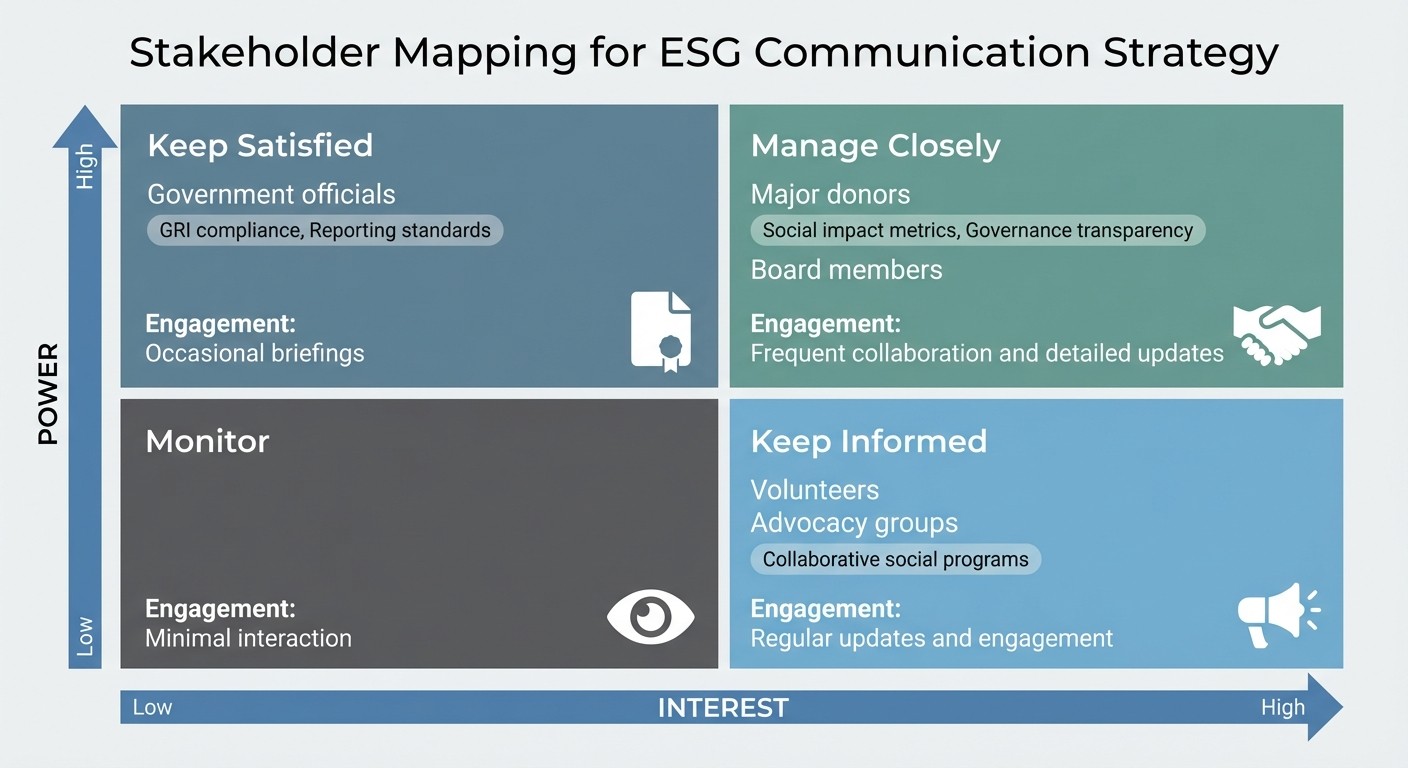
Stakeholder Power-Interest Grid for Nonprofit ESG Communication
To effectively align with ESG goals, it’s crucial to understand your stakeholders and their unique priorities. Nonprofits interact with a wide range of groups - donors, beneficiaries, board members, volunteers, employees, community partners, regulators, and grant-making foundations. Each group has distinct expectations that shape how they assess your organization. Understanding these differences lays the foundation for targeted stakeholder mapping and tailored communication strategies.
Mapping Key Stakeholders
Start by listing all stakeholders and conducting a materiality assessment to identify the ESG issues that matter most to each group. This involves consultations, surveys, and benchmarking against sector norms. Assess each stakeholder group's level of influence and interest - categorizing them as high, medium, or low - and document their specific ESG priorities.
For instance, organizations like the Red Cross use stakeholder consultations to identify varying priorities: donors focus on social impact metrics and governance transparency, beneficiaries prioritize environmental equity and tangible benefits, regulators emphasize compliance with reporting standards like GRI, and community partners value collaborative social programs [2]. These insights help define how to engage with each group effectively.
Customizing Messages for Different Audiences
Effective communication hinges on tailoring your message to address the unique concerns of each audience. Donors often seek detailed metrics and financial accountability, while communities are more likely to respond to personal stories and local impact narratives. Board members, on the other hand, require governance data and strategic overviews.
Using a power-interest grid can help prioritize engagement efforts:
High-power, high-interest stakeholders (e.g., major donors, board members): Require frequent collaboration and detailed updates.
High-power, low-interest groups (e.g., specific government officials): Need occasional briefings.
Low-power, high-interest stakeholders (e.g., volunteers, advocacy groups): Benefit from regular updates and engagement.
Low-power, low-interest groups: Require minimal interaction.
For example, Starbucks adapts its community engagement reports to highlight partnerships with nonprofits and support for local farmers, aligning with community values and enhancing local initiatives [3]. Customizing messages in this way strengthens your ESG strategy and builds stronger connections.
Gathering Stakeholder Feedback
ESG communication should be a two-way conversation. Regularly gathering feedback ensures your messaging stays relevant and aligned with stakeholder expectations. Use tools like annual donor surveys to capture insights on impact metrics, host focus groups with beneficiaries to understand their concerns, monitor social media for real-time feedback, and establish advisory panels for direct discussions.
This feedback can uncover areas for improvement. For instance, surveys might reveal that donors want more transparency about challenges, while focus groups with beneficiaries could highlight overlooked environmental equity issues. Closing the feedback loop - by showing how stakeholder input influences decisions - builds trust and demonstrates that their voices are valued [2]. These ongoing feedback mechanisms ensure that your stakeholder mapping and communication strategies remain dynamic and responsive.
Building a Clear and Honest ESG Communication Strategy
Once you've identified your stakeholders and their priorities, the next step is crafting a communication strategy that authentically represents your ESG efforts. This involves creating a framework that ties your environmental, social, and governance initiatives directly to your mission, backed by measurable actions and transparent reporting.
Aligning ESG Goals with Your Mission
Your ESG goals should naturally align with your organization's Theory of Change - the blueprint that outlines how your work leads to meaningful, lasting impact. If ESG efforts feel disconnected or secondary to your core activities, stakeholders will notice the inconsistency. By leveraging insights from your materiality assessment, you can identify ESG priorities that not only resonate with your mission but also enhance it. This alignment ensures that your ESG initiatives support your primary objectives rather than competing with them.
One way to strengthen this connection is by establishing Beneficiary Advisory Councils, which bring the voices of the communities you serve directly into your governance process. By incorporating lived experiences into your decision-making, your ESG communication becomes more relatable and credible. This approach shifts ESG efforts from being a compliance task to a genuine reflection of your mission and values.
Setting Measurable ESG Goals
To build trust, set SMART goals - Specific, Measurable, Achievable, Relevant, and Time-bound objectives. Avoid vague statements like "improve environmental practices", which can lead to skepticism. Instead, opt for clear targets, such as "reduce facility energy consumption by 20% by December 2027", which demonstrate accountability and commitment. Before rolling out new initiatives, collect at least 12 months of baseline data to establish a credible starting point for tracking progress.
For long-term goals, use interim milestones - such as policy updates, service enhancements, or behavioral shifts - to show progress over time. Break down your data by factors like race, gender, or geography to highlight who benefits from your programs and to ensure fairness in your reporting. This detailed approach not only builds trust but also shows a commitment to learning and improving, rather than just meeting reporting requirements. Once your goals are set, communicate them clearly, focusing on the tangible changes they will bring.
Using Simple Language and Clear Storytelling
Steer clear of jargon and overly technical metrics. Instead, explain how your actions create meaningful outcomes. For example, rather than listing the number of training sessions held, share stories about how those sessions led to job placements or empowered individuals to take on leadership roles in their communities.
Keep your stakeholders updated regularly to maintain accountability. Use your website, social media, and email updates to share progress throughout the year. With 88% of institutional investors now evaluating ESG issues as seriously as financial performance and 64% basing investment decisions on organizational values, consistent and transparent storytelling is essential [4]. Share both your successes and challenges - discussing obstacles openly shows honesty and invites stakeholders to join you in your journey of improvement. This transparency fosters deeper trust and reinforces the credibility of your ESG efforts.
Using Tools and Channels for ESG Communication
Once you've established your strategy, the next step is ensuring your ESG message reaches stakeholders effectively. The key lies in selecting communication tools and channels that align with your audience's preferences and habits. It's all about meeting them where they already are and delivering information in a format they appreciate.
Digital Channels for Outreach
Your website acts as the cornerstone of your ESG communication efforts - a central hub where stakeholders can access detailed reports, impact data, and updates. To make the most of this, ensure the ESG section is easy to navigate and prominently featured. Given that 17% of online donors identify an organization's website as their primary source of inspiration for giving [10], it's clear that a well-organized and accessible web presence can make a big difference.
Email and social media are also powerful tools for delivering concise updates and ESG highlights. Email campaigns, in particular, provide opportunities for personalization, tailoring updates to donor interests and engagement history. With 33% of online donors citing email messages as a key motivator for giving [10], this channel offers a direct and effective way to connect. Meanwhile, social media platforms excel at sharing bite-sized content, such as quick updates, behind-the-scenes moments, or visual stories that bring ESG efforts to life.
For automated reporting and messaging consistency, platforms like Brightest, Ethos Tracking, and Smart Chart 4.0 can streamline data collection and communication planning [5][6][7]. These tools ensure that your ESG strategy remains closely tied to your stakeholder engagement efforts.
Using Visuals and Data to Tell a Story
Raw numbers rarely inspire action on their own. To make your ESG data more engaging, consider transforming it into infographics, heat maps, or icon-based visuals that simplify complex information. Tools like Canva for Nonprofits, Power BI, and Tableau can help create polished, professional visuals [8][9][10]. When presenting statistics, such as carbon reduction metrics or program reach figures, pair the data with testimonials, case studies, or imagery to create a stronger emotional connection [8][9][11].
Interactive dashboards are another effective way to engage stakeholders, allowing them to explore data by geography, program area, or time frame. This level of transparency fosters trust by demonstrating openness. If your data has gaps, be upfront about it by using proxies and clearly labeling estimates [9]. The aim is to present your ESG progress in a way that is both credible and relatable, emphasizing not just the numbers but the tangible impact behind them.
In-Person and Community-Based Storytelling
While digital channels are essential, in-person engagement offers something unique: the chance to build deeper, more personal connections. Site visits, for example, allow donors and partners to see your ESG initiatives in action, meet program participants, and witness the outcomes firsthand. These experiences leave lasting impressions that no report or email can replicate [12].
Similarly, program briefings led by field staff provide unfiltered insights into the real-world impact of your work [12]. Events that feature beneficiaries sharing their stories bring authenticity and accountability to your communication, centering the voices of those your organization serves [12]. These face-to-face interactions complement your digital efforts, creating a well-rounded narrative that resonates with all stakeholders.
Measuring and Reporting ESG Impact with Transparency
Tracking and sharing ESG (Environmental, Social, and Governance) metrics can build trust by offering a clear view of both successes and areas needing improvement. Stakeholders want honesty - showing where you've excelled and where you're still working reinforces credibility. A thoughtful approach to measurement and reporting strengthens relationships with donors, partners, and the communities you serve, while laying the foundation for meaningful ESG communication.
Choosing the Right Reporting Framework
Selecting the right framework depends on your organization's goals, stakeholder priorities, and capacity. For many nonprofits, the Global Reporting Initiative (GRI) is a popular choice. Its focus on economic, environmental, and social impacts makes it an excellent fit for communicating with donors, community members, and beneficiaries. If your organization manages a large endowment or needs to cater to investors and board members, the Sustainability Accounting Standards Board (SASB) framework may be more effective, as it highlights how ESG factors influence financial health.
For nonprofits aiming to link local efforts to broader global goals, the UN Sustainable Development Goals (SDGs) offer a compelling way to frame your impact. Meanwhile, organizations with significant environmental considerations or those focused on long-term climate resilience might benefit from the Task Force on Climate-related Financial Disclosures (TCFD) framework. To avoid being overwhelmed, start small - focus on three to five core metrics that align closely with your mission rather than attempting to track everything at once.
Reporting Both Successes and Challenges
Once you've chosen a framework, it's essential to report results in a balanced way, addressing both achievements and obstacles. Transparency involves sharing the full story, not just the highlights. By openly discussing challenges and your plans to address them, you build trust and show accountability. Creating a "learning agenda" can help frame difficulties as opportunities for progress. This approach emphasizes your commitment to growth and improvement rather than presenting an overly polished narrative. For long-term goals, such as systemic change, consider tracking interim indicators like changes in community behavior or knowledge to demonstrate progress, even when final outcomes are still years away.
Providing Regular Updates to Stakeholders
Consistent communication is key to effective ESG reporting. While annual reports remain useful, modern tools like interactive digital dashboards or living documents allow for real-time updates that are far more engaging. These platforms can present data in a clickable, user-friendly format, moving beyond static PDFs. Centralizing your data on a single platform also helps save time - cutting down the 60–80% typically spent on manual data cleaning - while ensuring stakeholders have easy access to the latest insights. Regular updates not only enhance transparency but also keep stakeholders invested in your ongoing efforts.
Building Trust Through Storytelling
While numbers validate efforts, stories create the emotional connection that inspires action. Data can prove your ESG impact, but it’s the stories about real people that foster belief and engagement. As Vanessa Morgan, Content Marketing Manager at Benevity, explains:
Data earns trust, but stories about people inspire belief and action. [13]
By blending heartfelt narratives with solid evidence, you can showcase both the human impact of your work and the measurable outcomes achieved. This combination of emotion and credibility helps illustrate the true difference being made.
Featuring Beneficiary and Community Voices
Focus your storytelling on the individuals and communities experiencing the change, rather than solely highlighting your organization’s efforts. For instance, instead of simply stating that 200 job trainings were conducted, share the story of one participant who rebuilt her career after facing displacement. Personalizing your narrative with real, relatable voices makes the impact more tangible. Use authentic visuals from beneficiaries and local partners to complement the stories, avoiding generic stock imagery. The emphasis should always be on how lives have improved, not just on the numbers.
Using Case Studies to Show Impact
Case studies are a powerful way to combine emotional storytelling with factual proof. Cisco’s FY24 Purpose Report provides an excellent example. It paired key metrics - like 86% employee participation in community impact programs and $35 million in donations - with stories of employees leading pro bono initiatives and organizing donation drives [13]. Start with a compelling story about an individual or community, then back it up with quantitative data that demonstrates progress over time. Including insights from both beneficiaries and program staff adds depth, showing the impact from multiple perspectives.
Avoiding Greenwashing and Exaggerated Claims
To maintain credibility, every claim must be supported by verifiable data. For example, if you highlight that a program reduced food insecurity by 40%, explain how that figure was calculated, over what timeframe, and acknowledge any limitations in the data. Clearly citing methodologies and sources ensures transparency and allows stakeholders to trust your claims. Using tools for impact reporting can further reinforce this trust by making your approach traceable and evidence-based. Honest, well-documented progress builds trust far more effectively than exaggerated or overly polished narratives.
Conclusion
After delving into stakeholder mapping, strategic alignment, and effective storytelling, one thing stands out: clear and honest ESG reporting is no longer a choice - it’s a necessity. As Lindsey Baker Bower from Donor Box.org highlights, "transparent communication fuels community partnerships and strengthens nonprofit impact" [1]. This kind of openness builds the trust that transforms missions into movements.
To move forward, the roadmap is straightforward: begin by identifying your key stakeholders and understanding their priorities. Craft a communication strategy that ties your ESG goals to your broader mission. Use straightforward language, share authentic stories, and back them with reliable data. Today’s donors are increasingly looking for proof that their contributions are driving real change.
The benefits of transparency are hard to ignore. Studies reveal that nonprofits incorporating sustainability initiatives see a 16% higher revenue growth rate and are 52% more likely to outperform their peers in profitability [1]. But beyond the numbers, the true value lies in the trust you cultivate with donors, volunteers, and the communities you serve.
To make an impact, go beyond the traditional annual report. Adopt a consistent, year-round communication strategy using websites, social media, and direct outreach. Share updates that combine heartfelt stories with measurable outcomes. Involve your beneficiaries and community members in setting benchmarks for success, ensuring your reporting reflects what truly matters to them.
Trust has always been the cornerstone of nonprofit work. In a world of growing scrutiny, transparency is no longer optional - it’s essential. By consistently sharing your ESG progress in an open and honest way, you not only enhance your organization’s reputation but also expand its ability to create lasting, meaningful change.
FAQs
What ESG metrics should we track first?
To begin, identify ESG metrics that resonate with your organization's mission and the priorities of your stakeholders. Narrow your focus to 3–5 key metrics that showcase measurable outcomes. Examples might include environmental metrics like emissions or resource consumption, social indicators such as diversity initiatives or community involvement, and governance measures like transparency or board oversight. Collaborating with stakeholders, including those directly impacted by your work, in selecting these metrics ensures their relevance and strengthens their credibility.
How can we prove impact without greenwashing?
To demonstrate real impact and avoid accusations of greenwashing, prioritize transparent and reliable ESG measurement and reporting. Begin by identifying 3–5 key metrics that align closely with your organization's mission. Involve stakeholders in shaping these metrics to ensure they reflect shared priorities. Leverage established frameworks, such as the GHG Protocol or GRI, to guide your efforts and maintain credibility.
Centralize your data collection process to ensure consistency and accuracy. Share both your achievements and the obstacles you face with honesty, fostering trust through openness. Finally, use data-driven storytelling to communicate measurable outcomes clearly, steering clear of overstatements or inflated claims. This approach not only underscores your commitment to accountability but also strengthens your organization's reputation.
How often should we publish ESG updates?
When it comes to publishing ESG updates, there’s no one-size-fits-all rule for NGOs and nonprofits. However, maintaining open and regular communication is essential. Sharing updates quarterly or semi-annually can foster trust and show steady progress. The key is to align the frequency of these reports with what stakeholders expect and what your organization can realistically manage. Many organizations find that releasing updates at least twice a year or every quarter strikes the right balance between transparency and engagement.
Related Blog Posts
Latest Articles
©2025



FAQ
01
What does it really mean to “redefine profit”?
02
What makes Council Fire different?
03
Who does Council Fire you work with?
04
What does working with Council Fire actually look like?
05
How does Council Fire help organizations turn big goals into action?
06
How does Council Fire define and measure success?
Mar 18, 2026
How to Communicate ESG Progress Credibly for NGOs & Nonprofits
ESG Strategy
In This Article
Practical guide for nonprofits to map stakeholders, set SMART ESG goals, report transparently, and combine data with storytelling to show measurable impact.
How to Communicate ESG Progress Credibly for NGOs & Nonprofits
Nonprofits are expected to share not only their results but also how they achieve them, especially in areas like environmental impact, social equity, and governance (ESG). Clear, honest communication builds trust with donors, volunteers, and stakeholders, ensuring transparency and accountability. Here's how nonprofits can effectively share their ESG progress:
Understand ESG Dimensions: Focus on environmental practices (e.g., energy use), social efforts (e.g., diversity), and governance (e.g., financial transparency).
Identify Stakeholders: Map out donors, beneficiaries, volunteers, and others, tailoring messages to their interests.
Set Clear Goals: Use specific, measurable objectives to track and report progress.
Share Stories and Data: Combine personal stories with verified data to highlight impact.
Use the Right Tools: Leverage websites, social media, and visual tools like dashboards to communicate updates.
Be Transparent: Share successes and challenges openly, avoiding exaggerated claims.
Getting started with ESG reporting, metrics and measurements
Identifying Stakeholders and Their ESG Priorities
Stakeholder Power-Interest Grid for Nonprofit ESG Communication
To effectively align with ESG goals, it’s crucial to understand your stakeholders and their unique priorities. Nonprofits interact with a wide range of groups - donors, beneficiaries, board members, volunteers, employees, community partners, regulators, and grant-making foundations. Each group has distinct expectations that shape how they assess your organization. Understanding these differences lays the foundation for targeted stakeholder mapping and tailored communication strategies.
Mapping Key Stakeholders
Start by listing all stakeholders and conducting a materiality assessment to identify the ESG issues that matter most to each group. This involves consultations, surveys, and benchmarking against sector norms. Assess each stakeholder group's level of influence and interest - categorizing them as high, medium, or low - and document their specific ESG priorities.
For instance, organizations like the Red Cross use stakeholder consultations to identify varying priorities: donors focus on social impact metrics and governance transparency, beneficiaries prioritize environmental equity and tangible benefits, regulators emphasize compliance with reporting standards like GRI, and community partners value collaborative social programs [2]. These insights help define how to engage with each group effectively.
Customizing Messages for Different Audiences
Effective communication hinges on tailoring your message to address the unique concerns of each audience. Donors often seek detailed metrics and financial accountability, while communities are more likely to respond to personal stories and local impact narratives. Board members, on the other hand, require governance data and strategic overviews.
Using a power-interest grid can help prioritize engagement efforts:
High-power, high-interest stakeholders (e.g., major donors, board members): Require frequent collaboration and detailed updates.
High-power, low-interest groups (e.g., specific government officials): Need occasional briefings.
Low-power, high-interest stakeholders (e.g., volunteers, advocacy groups): Benefit from regular updates and engagement.
Low-power, low-interest groups: Require minimal interaction.
For example, Starbucks adapts its community engagement reports to highlight partnerships with nonprofits and support for local farmers, aligning with community values and enhancing local initiatives [3]. Customizing messages in this way strengthens your ESG strategy and builds stronger connections.
Gathering Stakeholder Feedback
ESG communication should be a two-way conversation. Regularly gathering feedback ensures your messaging stays relevant and aligned with stakeholder expectations. Use tools like annual donor surveys to capture insights on impact metrics, host focus groups with beneficiaries to understand their concerns, monitor social media for real-time feedback, and establish advisory panels for direct discussions.
This feedback can uncover areas for improvement. For instance, surveys might reveal that donors want more transparency about challenges, while focus groups with beneficiaries could highlight overlooked environmental equity issues. Closing the feedback loop - by showing how stakeholder input influences decisions - builds trust and demonstrates that their voices are valued [2]. These ongoing feedback mechanisms ensure that your stakeholder mapping and communication strategies remain dynamic and responsive.
Building a Clear and Honest ESG Communication Strategy
Once you've identified your stakeholders and their priorities, the next step is crafting a communication strategy that authentically represents your ESG efforts. This involves creating a framework that ties your environmental, social, and governance initiatives directly to your mission, backed by measurable actions and transparent reporting.
Aligning ESG Goals with Your Mission
Your ESG goals should naturally align with your organization's Theory of Change - the blueprint that outlines how your work leads to meaningful, lasting impact. If ESG efforts feel disconnected or secondary to your core activities, stakeholders will notice the inconsistency. By leveraging insights from your materiality assessment, you can identify ESG priorities that not only resonate with your mission but also enhance it. This alignment ensures that your ESG initiatives support your primary objectives rather than competing with them.
One way to strengthen this connection is by establishing Beneficiary Advisory Councils, which bring the voices of the communities you serve directly into your governance process. By incorporating lived experiences into your decision-making, your ESG communication becomes more relatable and credible. This approach shifts ESG efforts from being a compliance task to a genuine reflection of your mission and values.
Setting Measurable ESG Goals
To build trust, set SMART goals - Specific, Measurable, Achievable, Relevant, and Time-bound objectives. Avoid vague statements like "improve environmental practices", which can lead to skepticism. Instead, opt for clear targets, such as "reduce facility energy consumption by 20% by December 2027", which demonstrate accountability and commitment. Before rolling out new initiatives, collect at least 12 months of baseline data to establish a credible starting point for tracking progress.
For long-term goals, use interim milestones - such as policy updates, service enhancements, or behavioral shifts - to show progress over time. Break down your data by factors like race, gender, or geography to highlight who benefits from your programs and to ensure fairness in your reporting. This detailed approach not only builds trust but also shows a commitment to learning and improving, rather than just meeting reporting requirements. Once your goals are set, communicate them clearly, focusing on the tangible changes they will bring.
Using Simple Language and Clear Storytelling
Steer clear of jargon and overly technical metrics. Instead, explain how your actions create meaningful outcomes. For example, rather than listing the number of training sessions held, share stories about how those sessions led to job placements or empowered individuals to take on leadership roles in their communities.
Keep your stakeholders updated regularly to maintain accountability. Use your website, social media, and email updates to share progress throughout the year. With 88% of institutional investors now evaluating ESG issues as seriously as financial performance and 64% basing investment decisions on organizational values, consistent and transparent storytelling is essential [4]. Share both your successes and challenges - discussing obstacles openly shows honesty and invites stakeholders to join you in your journey of improvement. This transparency fosters deeper trust and reinforces the credibility of your ESG efforts.
Using Tools and Channels for ESG Communication
Once you've established your strategy, the next step is ensuring your ESG message reaches stakeholders effectively. The key lies in selecting communication tools and channels that align with your audience's preferences and habits. It's all about meeting them where they already are and delivering information in a format they appreciate.
Digital Channels for Outreach
Your website acts as the cornerstone of your ESG communication efforts - a central hub where stakeholders can access detailed reports, impact data, and updates. To make the most of this, ensure the ESG section is easy to navigate and prominently featured. Given that 17% of online donors identify an organization's website as their primary source of inspiration for giving [10], it's clear that a well-organized and accessible web presence can make a big difference.
Email and social media are also powerful tools for delivering concise updates and ESG highlights. Email campaigns, in particular, provide opportunities for personalization, tailoring updates to donor interests and engagement history. With 33% of online donors citing email messages as a key motivator for giving [10], this channel offers a direct and effective way to connect. Meanwhile, social media platforms excel at sharing bite-sized content, such as quick updates, behind-the-scenes moments, or visual stories that bring ESG efforts to life.
For automated reporting and messaging consistency, platforms like Brightest, Ethos Tracking, and Smart Chart 4.0 can streamline data collection and communication planning [5][6][7]. These tools ensure that your ESG strategy remains closely tied to your stakeholder engagement efforts.
Using Visuals and Data to Tell a Story
Raw numbers rarely inspire action on their own. To make your ESG data more engaging, consider transforming it into infographics, heat maps, or icon-based visuals that simplify complex information. Tools like Canva for Nonprofits, Power BI, and Tableau can help create polished, professional visuals [8][9][10]. When presenting statistics, such as carbon reduction metrics or program reach figures, pair the data with testimonials, case studies, or imagery to create a stronger emotional connection [8][9][11].
Interactive dashboards are another effective way to engage stakeholders, allowing them to explore data by geography, program area, or time frame. This level of transparency fosters trust by demonstrating openness. If your data has gaps, be upfront about it by using proxies and clearly labeling estimates [9]. The aim is to present your ESG progress in a way that is both credible and relatable, emphasizing not just the numbers but the tangible impact behind them.
In-Person and Community-Based Storytelling
While digital channels are essential, in-person engagement offers something unique: the chance to build deeper, more personal connections. Site visits, for example, allow donors and partners to see your ESG initiatives in action, meet program participants, and witness the outcomes firsthand. These experiences leave lasting impressions that no report or email can replicate [12].
Similarly, program briefings led by field staff provide unfiltered insights into the real-world impact of your work [12]. Events that feature beneficiaries sharing their stories bring authenticity and accountability to your communication, centering the voices of those your organization serves [12]. These face-to-face interactions complement your digital efforts, creating a well-rounded narrative that resonates with all stakeholders.
Measuring and Reporting ESG Impact with Transparency
Tracking and sharing ESG (Environmental, Social, and Governance) metrics can build trust by offering a clear view of both successes and areas needing improvement. Stakeholders want honesty - showing where you've excelled and where you're still working reinforces credibility. A thoughtful approach to measurement and reporting strengthens relationships with donors, partners, and the communities you serve, while laying the foundation for meaningful ESG communication.
Choosing the Right Reporting Framework
Selecting the right framework depends on your organization's goals, stakeholder priorities, and capacity. For many nonprofits, the Global Reporting Initiative (GRI) is a popular choice. Its focus on economic, environmental, and social impacts makes it an excellent fit for communicating with donors, community members, and beneficiaries. If your organization manages a large endowment or needs to cater to investors and board members, the Sustainability Accounting Standards Board (SASB) framework may be more effective, as it highlights how ESG factors influence financial health.
For nonprofits aiming to link local efforts to broader global goals, the UN Sustainable Development Goals (SDGs) offer a compelling way to frame your impact. Meanwhile, organizations with significant environmental considerations or those focused on long-term climate resilience might benefit from the Task Force on Climate-related Financial Disclosures (TCFD) framework. To avoid being overwhelmed, start small - focus on three to five core metrics that align closely with your mission rather than attempting to track everything at once.
Reporting Both Successes and Challenges
Once you've chosen a framework, it's essential to report results in a balanced way, addressing both achievements and obstacles. Transparency involves sharing the full story, not just the highlights. By openly discussing challenges and your plans to address them, you build trust and show accountability. Creating a "learning agenda" can help frame difficulties as opportunities for progress. This approach emphasizes your commitment to growth and improvement rather than presenting an overly polished narrative. For long-term goals, such as systemic change, consider tracking interim indicators like changes in community behavior or knowledge to demonstrate progress, even when final outcomes are still years away.
Providing Regular Updates to Stakeholders
Consistent communication is key to effective ESG reporting. While annual reports remain useful, modern tools like interactive digital dashboards or living documents allow for real-time updates that are far more engaging. These platforms can present data in a clickable, user-friendly format, moving beyond static PDFs. Centralizing your data on a single platform also helps save time - cutting down the 60–80% typically spent on manual data cleaning - while ensuring stakeholders have easy access to the latest insights. Regular updates not only enhance transparency but also keep stakeholders invested in your ongoing efforts.
Building Trust Through Storytelling
While numbers validate efforts, stories create the emotional connection that inspires action. Data can prove your ESG impact, but it’s the stories about real people that foster belief and engagement. As Vanessa Morgan, Content Marketing Manager at Benevity, explains:
Data earns trust, but stories about people inspire belief and action. [13]
By blending heartfelt narratives with solid evidence, you can showcase both the human impact of your work and the measurable outcomes achieved. This combination of emotion and credibility helps illustrate the true difference being made.
Featuring Beneficiary and Community Voices
Focus your storytelling on the individuals and communities experiencing the change, rather than solely highlighting your organization’s efforts. For instance, instead of simply stating that 200 job trainings were conducted, share the story of one participant who rebuilt her career after facing displacement. Personalizing your narrative with real, relatable voices makes the impact more tangible. Use authentic visuals from beneficiaries and local partners to complement the stories, avoiding generic stock imagery. The emphasis should always be on how lives have improved, not just on the numbers.
Using Case Studies to Show Impact
Case studies are a powerful way to combine emotional storytelling with factual proof. Cisco’s FY24 Purpose Report provides an excellent example. It paired key metrics - like 86% employee participation in community impact programs and $35 million in donations - with stories of employees leading pro bono initiatives and organizing donation drives [13]. Start with a compelling story about an individual or community, then back it up with quantitative data that demonstrates progress over time. Including insights from both beneficiaries and program staff adds depth, showing the impact from multiple perspectives.
Avoiding Greenwashing and Exaggerated Claims
To maintain credibility, every claim must be supported by verifiable data. For example, if you highlight that a program reduced food insecurity by 40%, explain how that figure was calculated, over what timeframe, and acknowledge any limitations in the data. Clearly citing methodologies and sources ensures transparency and allows stakeholders to trust your claims. Using tools for impact reporting can further reinforce this trust by making your approach traceable and evidence-based. Honest, well-documented progress builds trust far more effectively than exaggerated or overly polished narratives.
Conclusion
After delving into stakeholder mapping, strategic alignment, and effective storytelling, one thing stands out: clear and honest ESG reporting is no longer a choice - it’s a necessity. As Lindsey Baker Bower from Donor Box.org highlights, "transparent communication fuels community partnerships and strengthens nonprofit impact" [1]. This kind of openness builds the trust that transforms missions into movements.
To move forward, the roadmap is straightforward: begin by identifying your key stakeholders and understanding their priorities. Craft a communication strategy that ties your ESG goals to your broader mission. Use straightforward language, share authentic stories, and back them with reliable data. Today’s donors are increasingly looking for proof that their contributions are driving real change.
The benefits of transparency are hard to ignore. Studies reveal that nonprofits incorporating sustainability initiatives see a 16% higher revenue growth rate and are 52% more likely to outperform their peers in profitability [1]. But beyond the numbers, the true value lies in the trust you cultivate with donors, volunteers, and the communities you serve.
To make an impact, go beyond the traditional annual report. Adopt a consistent, year-round communication strategy using websites, social media, and direct outreach. Share updates that combine heartfelt stories with measurable outcomes. Involve your beneficiaries and community members in setting benchmarks for success, ensuring your reporting reflects what truly matters to them.
Trust has always been the cornerstone of nonprofit work. In a world of growing scrutiny, transparency is no longer optional - it’s essential. By consistently sharing your ESG progress in an open and honest way, you not only enhance your organization’s reputation but also expand its ability to create lasting, meaningful change.
FAQs
What ESG metrics should we track first?
To begin, identify ESG metrics that resonate with your organization's mission and the priorities of your stakeholders. Narrow your focus to 3–5 key metrics that showcase measurable outcomes. Examples might include environmental metrics like emissions or resource consumption, social indicators such as diversity initiatives or community involvement, and governance measures like transparency or board oversight. Collaborating with stakeholders, including those directly impacted by your work, in selecting these metrics ensures their relevance and strengthens their credibility.
How can we prove impact without greenwashing?
To demonstrate real impact and avoid accusations of greenwashing, prioritize transparent and reliable ESG measurement and reporting. Begin by identifying 3–5 key metrics that align closely with your organization's mission. Involve stakeholders in shaping these metrics to ensure they reflect shared priorities. Leverage established frameworks, such as the GHG Protocol or GRI, to guide your efforts and maintain credibility.
Centralize your data collection process to ensure consistency and accuracy. Share both your achievements and the obstacles you face with honesty, fostering trust through openness. Finally, use data-driven storytelling to communicate measurable outcomes clearly, steering clear of overstatements or inflated claims. This approach not only underscores your commitment to accountability but also strengthens your organization's reputation.
How often should we publish ESG updates?
When it comes to publishing ESG updates, there’s no one-size-fits-all rule for NGOs and nonprofits. However, maintaining open and regular communication is essential. Sharing updates quarterly or semi-annually can foster trust and show steady progress. The key is to align the frequency of these reports with what stakeholders expect and what your organization can realistically manage. Many organizations find that releasing updates at least twice a year or every quarter strikes the right balance between transparency and engagement.
Related Blog Posts
FAQ
01
What does it really mean to “redefine profit”?
02
What makes Council Fire different?
03
Who does Council Fire you work with?
04
What does working with Council Fire actually look like?
05
How does Council Fire help organizations turn big goals into action?
06
How does Council Fire define and measure success?
Mar 18, 2026
How to Communicate ESG Progress Credibly for NGOs & Nonprofits
ESG Strategy
In This Article
Practical guide for nonprofits to map stakeholders, set SMART ESG goals, report transparently, and combine data with storytelling to show measurable impact.
How to Communicate ESG Progress Credibly for NGOs & Nonprofits
Nonprofits are expected to share not only their results but also how they achieve them, especially in areas like environmental impact, social equity, and governance (ESG). Clear, honest communication builds trust with donors, volunteers, and stakeholders, ensuring transparency and accountability. Here's how nonprofits can effectively share their ESG progress:
Understand ESG Dimensions: Focus on environmental practices (e.g., energy use), social efforts (e.g., diversity), and governance (e.g., financial transparency).
Identify Stakeholders: Map out donors, beneficiaries, volunteers, and others, tailoring messages to their interests.
Set Clear Goals: Use specific, measurable objectives to track and report progress.
Share Stories and Data: Combine personal stories with verified data to highlight impact.
Use the Right Tools: Leverage websites, social media, and visual tools like dashboards to communicate updates.
Be Transparent: Share successes and challenges openly, avoiding exaggerated claims.
Getting started with ESG reporting, metrics and measurements
Identifying Stakeholders and Their ESG Priorities
Stakeholder Power-Interest Grid for Nonprofit ESG Communication
To effectively align with ESG goals, it’s crucial to understand your stakeholders and their unique priorities. Nonprofits interact with a wide range of groups - donors, beneficiaries, board members, volunteers, employees, community partners, regulators, and grant-making foundations. Each group has distinct expectations that shape how they assess your organization. Understanding these differences lays the foundation for targeted stakeholder mapping and tailored communication strategies.
Mapping Key Stakeholders
Start by listing all stakeholders and conducting a materiality assessment to identify the ESG issues that matter most to each group. This involves consultations, surveys, and benchmarking against sector norms. Assess each stakeholder group's level of influence and interest - categorizing them as high, medium, or low - and document their specific ESG priorities.
For instance, organizations like the Red Cross use stakeholder consultations to identify varying priorities: donors focus on social impact metrics and governance transparency, beneficiaries prioritize environmental equity and tangible benefits, regulators emphasize compliance with reporting standards like GRI, and community partners value collaborative social programs [2]. These insights help define how to engage with each group effectively.
Customizing Messages for Different Audiences
Effective communication hinges on tailoring your message to address the unique concerns of each audience. Donors often seek detailed metrics and financial accountability, while communities are more likely to respond to personal stories and local impact narratives. Board members, on the other hand, require governance data and strategic overviews.
Using a power-interest grid can help prioritize engagement efforts:
High-power, high-interest stakeholders (e.g., major donors, board members): Require frequent collaboration and detailed updates.
High-power, low-interest groups (e.g., specific government officials): Need occasional briefings.
Low-power, high-interest stakeholders (e.g., volunteers, advocacy groups): Benefit from regular updates and engagement.
Low-power, low-interest groups: Require minimal interaction.
For example, Starbucks adapts its community engagement reports to highlight partnerships with nonprofits and support for local farmers, aligning with community values and enhancing local initiatives [3]. Customizing messages in this way strengthens your ESG strategy and builds stronger connections.
Gathering Stakeholder Feedback
ESG communication should be a two-way conversation. Regularly gathering feedback ensures your messaging stays relevant and aligned with stakeholder expectations. Use tools like annual donor surveys to capture insights on impact metrics, host focus groups with beneficiaries to understand their concerns, monitor social media for real-time feedback, and establish advisory panels for direct discussions.
This feedback can uncover areas for improvement. For instance, surveys might reveal that donors want more transparency about challenges, while focus groups with beneficiaries could highlight overlooked environmental equity issues. Closing the feedback loop - by showing how stakeholder input influences decisions - builds trust and demonstrates that their voices are valued [2]. These ongoing feedback mechanisms ensure that your stakeholder mapping and communication strategies remain dynamic and responsive.
Building a Clear and Honest ESG Communication Strategy
Once you've identified your stakeholders and their priorities, the next step is crafting a communication strategy that authentically represents your ESG efforts. This involves creating a framework that ties your environmental, social, and governance initiatives directly to your mission, backed by measurable actions and transparent reporting.
Aligning ESG Goals with Your Mission
Your ESG goals should naturally align with your organization's Theory of Change - the blueprint that outlines how your work leads to meaningful, lasting impact. If ESG efforts feel disconnected or secondary to your core activities, stakeholders will notice the inconsistency. By leveraging insights from your materiality assessment, you can identify ESG priorities that not only resonate with your mission but also enhance it. This alignment ensures that your ESG initiatives support your primary objectives rather than competing with them.
One way to strengthen this connection is by establishing Beneficiary Advisory Councils, which bring the voices of the communities you serve directly into your governance process. By incorporating lived experiences into your decision-making, your ESG communication becomes more relatable and credible. This approach shifts ESG efforts from being a compliance task to a genuine reflection of your mission and values.
Setting Measurable ESG Goals
To build trust, set SMART goals - Specific, Measurable, Achievable, Relevant, and Time-bound objectives. Avoid vague statements like "improve environmental practices", which can lead to skepticism. Instead, opt for clear targets, such as "reduce facility energy consumption by 20% by December 2027", which demonstrate accountability and commitment. Before rolling out new initiatives, collect at least 12 months of baseline data to establish a credible starting point for tracking progress.
For long-term goals, use interim milestones - such as policy updates, service enhancements, or behavioral shifts - to show progress over time. Break down your data by factors like race, gender, or geography to highlight who benefits from your programs and to ensure fairness in your reporting. This detailed approach not only builds trust but also shows a commitment to learning and improving, rather than just meeting reporting requirements. Once your goals are set, communicate them clearly, focusing on the tangible changes they will bring.
Using Simple Language and Clear Storytelling
Steer clear of jargon and overly technical metrics. Instead, explain how your actions create meaningful outcomes. For example, rather than listing the number of training sessions held, share stories about how those sessions led to job placements or empowered individuals to take on leadership roles in their communities.
Keep your stakeholders updated regularly to maintain accountability. Use your website, social media, and email updates to share progress throughout the year. With 88% of institutional investors now evaluating ESG issues as seriously as financial performance and 64% basing investment decisions on organizational values, consistent and transparent storytelling is essential [4]. Share both your successes and challenges - discussing obstacles openly shows honesty and invites stakeholders to join you in your journey of improvement. This transparency fosters deeper trust and reinforces the credibility of your ESG efforts.
Using Tools and Channels for ESG Communication
Once you've established your strategy, the next step is ensuring your ESG message reaches stakeholders effectively. The key lies in selecting communication tools and channels that align with your audience's preferences and habits. It's all about meeting them where they already are and delivering information in a format they appreciate.
Digital Channels for Outreach
Your website acts as the cornerstone of your ESG communication efforts - a central hub where stakeholders can access detailed reports, impact data, and updates. To make the most of this, ensure the ESG section is easy to navigate and prominently featured. Given that 17% of online donors identify an organization's website as their primary source of inspiration for giving [10], it's clear that a well-organized and accessible web presence can make a big difference.
Email and social media are also powerful tools for delivering concise updates and ESG highlights. Email campaigns, in particular, provide opportunities for personalization, tailoring updates to donor interests and engagement history. With 33% of online donors citing email messages as a key motivator for giving [10], this channel offers a direct and effective way to connect. Meanwhile, social media platforms excel at sharing bite-sized content, such as quick updates, behind-the-scenes moments, or visual stories that bring ESG efforts to life.
For automated reporting and messaging consistency, platforms like Brightest, Ethos Tracking, and Smart Chart 4.0 can streamline data collection and communication planning [5][6][7]. These tools ensure that your ESG strategy remains closely tied to your stakeholder engagement efforts.
Using Visuals and Data to Tell a Story
Raw numbers rarely inspire action on their own. To make your ESG data more engaging, consider transforming it into infographics, heat maps, or icon-based visuals that simplify complex information. Tools like Canva for Nonprofits, Power BI, and Tableau can help create polished, professional visuals [8][9][10]. When presenting statistics, such as carbon reduction metrics or program reach figures, pair the data with testimonials, case studies, or imagery to create a stronger emotional connection [8][9][11].
Interactive dashboards are another effective way to engage stakeholders, allowing them to explore data by geography, program area, or time frame. This level of transparency fosters trust by demonstrating openness. If your data has gaps, be upfront about it by using proxies and clearly labeling estimates [9]. The aim is to present your ESG progress in a way that is both credible and relatable, emphasizing not just the numbers but the tangible impact behind them.
In-Person and Community-Based Storytelling
While digital channels are essential, in-person engagement offers something unique: the chance to build deeper, more personal connections. Site visits, for example, allow donors and partners to see your ESG initiatives in action, meet program participants, and witness the outcomes firsthand. These experiences leave lasting impressions that no report or email can replicate [12].
Similarly, program briefings led by field staff provide unfiltered insights into the real-world impact of your work [12]. Events that feature beneficiaries sharing their stories bring authenticity and accountability to your communication, centering the voices of those your organization serves [12]. These face-to-face interactions complement your digital efforts, creating a well-rounded narrative that resonates with all stakeholders.
Measuring and Reporting ESG Impact with Transparency
Tracking and sharing ESG (Environmental, Social, and Governance) metrics can build trust by offering a clear view of both successes and areas needing improvement. Stakeholders want honesty - showing where you've excelled and where you're still working reinforces credibility. A thoughtful approach to measurement and reporting strengthens relationships with donors, partners, and the communities you serve, while laying the foundation for meaningful ESG communication.
Choosing the Right Reporting Framework
Selecting the right framework depends on your organization's goals, stakeholder priorities, and capacity. For many nonprofits, the Global Reporting Initiative (GRI) is a popular choice. Its focus on economic, environmental, and social impacts makes it an excellent fit for communicating with donors, community members, and beneficiaries. If your organization manages a large endowment or needs to cater to investors and board members, the Sustainability Accounting Standards Board (SASB) framework may be more effective, as it highlights how ESG factors influence financial health.
For nonprofits aiming to link local efforts to broader global goals, the UN Sustainable Development Goals (SDGs) offer a compelling way to frame your impact. Meanwhile, organizations with significant environmental considerations or those focused on long-term climate resilience might benefit from the Task Force on Climate-related Financial Disclosures (TCFD) framework. To avoid being overwhelmed, start small - focus on three to five core metrics that align closely with your mission rather than attempting to track everything at once.
Reporting Both Successes and Challenges
Once you've chosen a framework, it's essential to report results in a balanced way, addressing both achievements and obstacles. Transparency involves sharing the full story, not just the highlights. By openly discussing challenges and your plans to address them, you build trust and show accountability. Creating a "learning agenda" can help frame difficulties as opportunities for progress. This approach emphasizes your commitment to growth and improvement rather than presenting an overly polished narrative. For long-term goals, such as systemic change, consider tracking interim indicators like changes in community behavior or knowledge to demonstrate progress, even when final outcomes are still years away.
Providing Regular Updates to Stakeholders
Consistent communication is key to effective ESG reporting. While annual reports remain useful, modern tools like interactive digital dashboards or living documents allow for real-time updates that are far more engaging. These platforms can present data in a clickable, user-friendly format, moving beyond static PDFs. Centralizing your data on a single platform also helps save time - cutting down the 60–80% typically spent on manual data cleaning - while ensuring stakeholders have easy access to the latest insights. Regular updates not only enhance transparency but also keep stakeholders invested in your ongoing efforts.
Building Trust Through Storytelling
While numbers validate efforts, stories create the emotional connection that inspires action. Data can prove your ESG impact, but it’s the stories about real people that foster belief and engagement. As Vanessa Morgan, Content Marketing Manager at Benevity, explains:
Data earns trust, but stories about people inspire belief and action. [13]
By blending heartfelt narratives with solid evidence, you can showcase both the human impact of your work and the measurable outcomes achieved. This combination of emotion and credibility helps illustrate the true difference being made.
Featuring Beneficiary and Community Voices
Focus your storytelling on the individuals and communities experiencing the change, rather than solely highlighting your organization’s efforts. For instance, instead of simply stating that 200 job trainings were conducted, share the story of one participant who rebuilt her career after facing displacement. Personalizing your narrative with real, relatable voices makes the impact more tangible. Use authentic visuals from beneficiaries and local partners to complement the stories, avoiding generic stock imagery. The emphasis should always be on how lives have improved, not just on the numbers.
Using Case Studies to Show Impact
Case studies are a powerful way to combine emotional storytelling with factual proof. Cisco’s FY24 Purpose Report provides an excellent example. It paired key metrics - like 86% employee participation in community impact programs and $35 million in donations - with stories of employees leading pro bono initiatives and organizing donation drives [13]. Start with a compelling story about an individual or community, then back it up with quantitative data that demonstrates progress over time. Including insights from both beneficiaries and program staff adds depth, showing the impact from multiple perspectives.
Avoiding Greenwashing and Exaggerated Claims
To maintain credibility, every claim must be supported by verifiable data. For example, if you highlight that a program reduced food insecurity by 40%, explain how that figure was calculated, over what timeframe, and acknowledge any limitations in the data. Clearly citing methodologies and sources ensures transparency and allows stakeholders to trust your claims. Using tools for impact reporting can further reinforce this trust by making your approach traceable and evidence-based. Honest, well-documented progress builds trust far more effectively than exaggerated or overly polished narratives.
Conclusion
After delving into stakeholder mapping, strategic alignment, and effective storytelling, one thing stands out: clear and honest ESG reporting is no longer a choice - it’s a necessity. As Lindsey Baker Bower from Donor Box.org highlights, "transparent communication fuels community partnerships and strengthens nonprofit impact" [1]. This kind of openness builds the trust that transforms missions into movements.
To move forward, the roadmap is straightforward: begin by identifying your key stakeholders and understanding their priorities. Craft a communication strategy that ties your ESG goals to your broader mission. Use straightforward language, share authentic stories, and back them with reliable data. Today’s donors are increasingly looking for proof that their contributions are driving real change.
The benefits of transparency are hard to ignore. Studies reveal that nonprofits incorporating sustainability initiatives see a 16% higher revenue growth rate and are 52% more likely to outperform their peers in profitability [1]. But beyond the numbers, the true value lies in the trust you cultivate with donors, volunteers, and the communities you serve.
To make an impact, go beyond the traditional annual report. Adopt a consistent, year-round communication strategy using websites, social media, and direct outreach. Share updates that combine heartfelt stories with measurable outcomes. Involve your beneficiaries and community members in setting benchmarks for success, ensuring your reporting reflects what truly matters to them.
Trust has always been the cornerstone of nonprofit work. In a world of growing scrutiny, transparency is no longer optional - it’s essential. By consistently sharing your ESG progress in an open and honest way, you not only enhance your organization’s reputation but also expand its ability to create lasting, meaningful change.
FAQs
What ESG metrics should we track first?
To begin, identify ESG metrics that resonate with your organization's mission and the priorities of your stakeholders. Narrow your focus to 3–5 key metrics that showcase measurable outcomes. Examples might include environmental metrics like emissions or resource consumption, social indicators such as diversity initiatives or community involvement, and governance measures like transparency or board oversight. Collaborating with stakeholders, including those directly impacted by your work, in selecting these metrics ensures their relevance and strengthens their credibility.
How can we prove impact without greenwashing?
To demonstrate real impact and avoid accusations of greenwashing, prioritize transparent and reliable ESG measurement and reporting. Begin by identifying 3–5 key metrics that align closely with your organization's mission. Involve stakeholders in shaping these metrics to ensure they reflect shared priorities. Leverage established frameworks, such as the GHG Protocol or GRI, to guide your efforts and maintain credibility.
Centralize your data collection process to ensure consistency and accuracy. Share both your achievements and the obstacles you face with honesty, fostering trust through openness. Finally, use data-driven storytelling to communicate measurable outcomes clearly, steering clear of overstatements or inflated claims. This approach not only underscores your commitment to accountability but also strengthens your organization's reputation.
How often should we publish ESG updates?
When it comes to publishing ESG updates, there’s no one-size-fits-all rule for NGOs and nonprofits. However, maintaining open and regular communication is essential. Sharing updates quarterly or semi-annually can foster trust and show steady progress. The key is to align the frequency of these reports with what stakeholders expect and what your organization can realistically manage. Many organizations find that releasing updates at least twice a year or every quarter strikes the right balance between transparency and engagement.
Related Blog Posts
FAQ
What does it really mean to “redefine profit”?
What makes Council Fire different?
Who does Council Fire you work with?
What does working with Council Fire actually look like?
How does Council Fire help organizations turn big goals into action?
How does Council Fire define and measure success?