
Jul 29, 2026
Climate Risk Allocation in PPPs: 5 Models
Sustainability Strategy
In This Article
How five PPP models decide who pays for climate damage — and which structures keep projects financeable.
Climate Risk Allocation in PPPs: 5 Models
If you’re setting up a PPP in 2026, the core question is simple: who pays when climate damage hits? In this article, I break the answer into five models, and each one changes cash flow, loss sharing, and lender comfort.
Here’s the short version:
Model 1: Public pays fixed availability payments; private side takes climate performance risk within set limits.
Model 2: Private side depends on tolls, fares, or tariffs; climate shocks can hit both the asset and revenue.
Model 3: Risk is split through insurance, reserve pools, and public support for tail-loss events.
Model 4: Public side keeps major climate loss risk; private side must meet strict resilience standards.
Model 5: Private side takes most climate risk and gets paid more if it beats resilience targets.
A few numbers from the article show why deal structure matters:
$32.5 million per year in availability payments supported the Port of Miami Tunnel.
$180 million was set aside there for geotechnical contingency.
PennDOT’s bridge program used $260 million in milestone payments plus $65 million per year over 25 years.
A World Bank-backed weather deal for Uruguay’s utility used $450 million in coverage and data from 39 weather stations.
What I see across all five models is straightforward:
Models 1 and 4 are often easier to finance because the public side supports cash flow or keeps major downside risk.
Models 2 and 5 put more pressure on the private side because storms, floods, heat, or drought can cut revenue or push up costs.
Model 3 sits in the middle and works when triggers, reserves, and insurance layers are spelled out clearly.
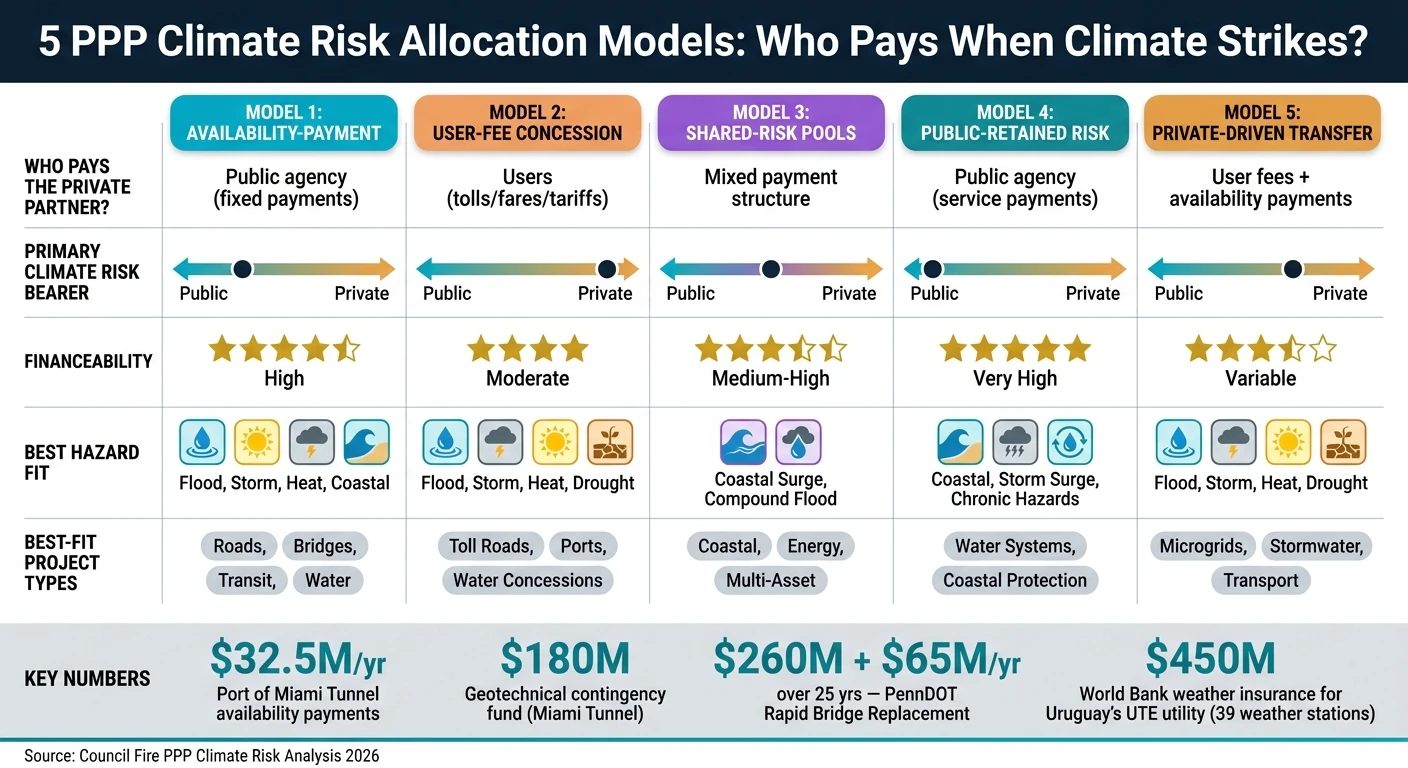
5 PPP Climate Risk Allocation Models: Who Pays When Climate Strikes?
Introduction to PPP Risk Allocation
Quick Comparison
Model | Who pays the private partner? | Main climate risk bearer | Best fit |
|---|---|---|---|
1. Availability-Payment | Public agency through fixed payments | Private side for service performance; public side for extreme tail events | Roads, bridges, transit, water plants |
2. User-Fee Concession | Users through tolls, fares, or tariffs | Mostly private side, sometimes with capped public support | Toll roads, ports, water concessions |
3. Shared-Risk Pools | Mixed payment structure | Shared across private party, insurers, reserve pools, and public backstop | Coastal, water, energy, multi-asset projects |
4. Public-Retained Risk | Public agency through service or availability payments | Public side for major hazard losses | Water systems, transit, coastal protection |
5. Private-Driven Transfer | User fees and/or availability payments with incentive features | Mostly private side | Microgrids, stormwater, special transport assets |
Bottom line: I’d choose the model based on hazard type, revenue structure, and which party can price the risk without making the deal too costly or too weak to finance.
1. Availability-Payment PPPs with Performance-Based Climate Obligations
This model works best for assets that face climate stress often enough to plan for it, see it, and price it through service standards. The public sector makes fixed availability payments when the asset meets those standards. The private partner designs, builds, finances, operates, and maintains the asset, while the public side keeps demand risk. In plain terms, climate resilience becomes part of what "available" means.
Risk Bearer
The private partner takes on day-to-day climate performance risk. That includes keeping drainage clear, maintaining pavement during heat, and getting service back after storms. If flooding or heat pushes availability below the contract threshold, payment deductions kick in.
At the same time, contracts usually draw a line around events that go far beyond what anyone can reasonably manage. An unprecedented surge or hurricane is often treated as force majeure, with relief tied to schedule extensions or compensation. That split matters. It keeps the private partner on the hook for climate stress that is foreseeable and manageable, without letting a single disaster throw the whole project off the rails.
Hazard Fit
Urban flooding, extreme heat, and storm disruption are the strongest match for this setup. Contracts can spell out clear operating standards, such as:
Maximum lane water depth
Drainage-clearance times after heavy rainfall
Pavement rutting thresholds during high temperatures
Coastal risk can fit too, but only inside stated design limits. Once conditions go past that envelope, the event is usually handled as force majeure. Drought tends to matter less here unless the asset depends on landscaping, cooling-system output, or water-system operations.
Financeability
Lenders tend to like this structure because government-backed availability payments create steady cash flow. The Port of Miami Tunnel paired $32.5 million in annual availability payments with a $180 million geotechnical contingency fund, while PennDOT's Rapid Bridge Replacement program uses $260 million in construction milestone payments and $65 million per year in availability payments over 25 years.[11][12][10]
When climate duties are part of the deal, lenders usually look for deduction regimes that are capped, clear, and modeled in advance. They also want plain rules that suspend deductions during declared emergencies so downside cases can be stress-tested. The appeal is straightforward: climate-related losses stay inside a capped payment system instead of rippling through the entire project finance setup.
Contract Tools
The main tools are pretty direct:
SMART KPIs linked to deductions
Force majeure and climate-event clauses
Insurance for insurable hazards
Reserve accounts
Performance bonuses, where needed, for beating resilience targets
Each trigger should run on the same monthly or quarterly cycle as availability payments. That keeps the contract easier to manage and avoids the kind of mismatch that turns routine administration into a headache.
2. User-Fee Concession PPPs with Demand-Linked Climate Risk Sharing
In a user-fee concession, the private partner finances, builds, and runs the asset, then recovers its investment through tolls, transit fares, or utility tariffs. The catch is simple: revenue rises or falls with use. When a climate event shuts down access or cuts service, the hit lands on cash flow almost at once. In this setup, climate exposure is not only an operating issue. It is a revenue issue too.
Risk Bearer
The private concessionaire usually carries normal demand risk and routine weather disruption. In U.S. toll concessions, guidance places demand risk and toll revenue risk mostly on the developer. Still, contracts are starting to spell out a hard truth: catastrophic climate events can drive losses past what a private party can fairly absorb or price into the deal. [16][21]
That is where demand-linked risk sharing comes in. A state DOT may agree that if a 100-year flood shuts a toll facility for more than a set number of days, the public side provides term relief or compensation. The concessionaire still takes care of day-to-day resilience and regular operating pressure. The public side steps in for the tail risk that could otherwise wreck bankability. [6][13]
Once climate losses get too large for one concessionaire to carry alone, the deal often shifts toward shared-risk structures.
Hazard Fit
This model works best when the hazard has a direct and immediate effect on use. Flood and storm risk are the clearest examples, since road closures and bridge outages can cut toll revenue right away. Coastal exposure also fits in many cases. That includes sea-level rise, storm surge, and coastal erosion for ports, coastal highways, and bridges, provided the contract clearly assigns long-term adaptation duties.
Heat risk matters most in transit, rail, and power distribution concessions. A service interruption or track buckling can reduce ridership and disrupt operations fast. Drought shows up most sharply in water and wastewater concessions, where lower consumption can weaken tariff revenue even if the pipes, plants, or treatment systems stay physically sound. [17][19]
Financeability
Lenders tend to be more cautious here than in availability-payment deals. When climate events can swing revenue, cash-flow forecasts become harder to underwrite. That can shorten tenors, increase rates, and reduce leverage. Rating agencies also want more proof before they get comfortable. Many now expect stress-tested revenue cases under 2050 or 2070 climate projections. [15][19][20]
The usual answer is partial risk sharing. Common tools include:
minimum revenue guarantees
revenue-sharing bands
concession term extensions
These tools help steady projected cash flow without letting the concessionaire off the hook for performance. Federal credit programs, tax-exempt bonds, and contingent public support for extraordinary climate events can also strengthen the capital stack when hazard exposure is high. [18][20]
Contract Tools
Good contracts do not leave climate triggers vague. They define them with objective measures such as rainfall intensity, wind speed, flood stage, or tidal height, then use those same measures across force majeure, term extensions, and insurance so the deal works as one system rather than a pile of mismatched clauses. [6][8][13][14]
Insurance terms matter just as much. Requirements for property damage and business interruption coverage should match the hazard profile of the asset, with clear rules showing how proceeds and deductibles are shared between the parties.
3. Shared-Risk PPP Frameworks with Climate Risk Pools and Insurance
When deductions or revenue-sharing caps stop short of covering tail losses, PPPs move into pooled and insured risk. At that point, the private sponsor or concessionaire can't carry the full hit alone, so losses are split across the project company, the public sponsor, insurers, and a reserve pool. In plain terms, the deal needs more than a shared payment formula. It needs a risk pool.
Risk Bearer
Routine climate stress that stays within design limits - minor floods, heat-related performance loss, and moderate storm damage - usually remains with the private partner. Losses in the middle layer move to commercial insurers through property, business interruption, parametric, and catastrophe coverage. Catastrophic tail risk then moves to a public backstop or pooled reserve.
FEMA's NFIP shows how this can work in practice: public flood risk can be transferred to private reinsurance within a defined loss band. [22]
Hazard Fit
This setup fits best for low-frequency, high-severity hazards. Parametric policies can pay fast for flood and coastal surge events based on rainfall totals, river levels, or surge heights. Drought risk in water and energy PPPs can rely on hydrological triggers such as reservoir levels or streamflow data.
The World Bank showed this approach with a $450 million weather and oil price insurance transaction for the Uruguayan utility UTE. The deal used daily rainfall data from 39 weather stations as parametric triggers to protect against drought-driven revenue loss. [13]
Flood, coastal surge, drought, storm, and heat all fit this structure when two things are clear:
The trigger can be measured
The loss layer can be priced
Financeability
Clear risk layering helps make lender exposure smaller and easier to price. Insurance layers and pooled reserves cut the residual risk left after concession terms are set, which gives lenders a defined ceiling on what the project company has to absorb. BRIC grants can also cover the non-federal match and reduce exposure across the capital stack. [23][24]
Contract Tools
The contract should spell out the mechanics in direct terms. A risk allocation matrix should map each hazard to the party that carries it, the financial instrument attached to it, and the threshold that shifts liability. Insurance schedules should set out coverage types, minimum limits, deductibles, co-insurance percentages, and the rules for applying proceeds to repairs, resilience upgrades, or both.
Pool governance rules should also be written clearly. That includes contribution formulas, qualifying events, payout order, and claims authority. On top of that, resilience KPIs - such as maximum downtime after a defined storm event, flood defense standards, and cooling performance thresholds - should tie straight to pool activation.
This model works best when the contract sets clean thresholds for moving risk from the project company to insurance and then to the public backstop.
4. Public-Retained Climate Risk with Mandatory Resilience Requirements
When insurance, pools, and payment deductions don’t reach the tail risk, this model leaves catastrophe risk with the public side and makes resilience a firm private duty. In plain terms, the public sponsor carries the biggest climate shock, while the private partner is still on the hook for building, maintaining, and operating the asset to the resilience standard set in the contract. It’s the fallback option when climate risk is too volatile to price cleanly into a long-term PPP.
Risk Bearer
The public side keeps tail risk. The private side keeps compliance and performance risk.
That split matters. The private partner must keep the asset working, repaired, and in line with the resilience requirements in the agreement. If a storm or flood damages the project because it was not built to the required elevation, drainage, material, or backup-power standard, the contractor can still be liable. Public-retained does not mean private immunity.
Hazard Fit
This model works best for low-frequency, high-impact hazards that are hard to price, such as coastal flooding, storm surge, and major hurricane impacts. It also fits chronic stressors like heat and drought when a public agency wants to require upgrades without forcing bidders to load uncertain long-term climate volatility into their bids.
The core idea is simple: use this setup when service continuity matters more than full risk transfer. That can make a lot of sense for public assets where downtime is the bigger threat.
Financeability
Because the public side keeps the largest losses, lenders need clear relief rules and backup support. In many cases, they’re more comfortable with a stated public commitment than with a vague private duty to absorb climate losses no one can predict with much confidence.
This model is most bankable when the contract spells out:
what the public sponsor covers
which events trigger relief
how resilience standards will be measured and enforced
If those points are fuzzy, bankability drops. Pairing this model with reserve accounts, step-in rights, and clear relief-event procedures helps keep the financing structure tight.[25]
Contract Tools
Resilience duties only work when the contract makes them specific and enforceable. The RFP and technical annex should define design events, minimum performance levels, recovery times, and mitigation measures. Without that level of detail, the whole setup can start to wobble when an actual event hits.
The contract should also include relief events that excuse the private partner from penalties during defined extreme weather, compensation events for costs above set thresholds, and change-in-law clauses that allow adjustment if new climate rules change the project’s cost base. Resilience KPIs can set objective benchmarks for wind, flood recovery, and service restoration. Periodic audits, engineering certifications, and incident logs are what keep the model working over the life of the contract.
5. Private-Driven Climate Risk Transfer with Incentive-Based Adaptation
Where Model 4 leaves tail risk with the public sector, Model 5 pushes more climate risk onto the private partner and links returns to resilience results. In plain terms, the private party prices, manages, and absorbs physical climate risk - flood damage, heat stress, storm impacts, and coastal inundation - while the contract uses rewards or penalties based on how well that risk stays under control.
Risk Bearer
The private concessionaire takes on design, construction, and operating climate risk for the full life of the asset. Lenders respond by pricing that exposure into the deal through tighter climate due diligence and more conservative debt terms. Catastrophic losses are then shared across insurers, the private party, and any public backstop written into the contract, including federal disaster declarations under the Stafford Act. The public sponsor still controls zoning and regulatory shifts, but it can use the contract to place the adaptation response on the private party, as long as that lines up with the standards and permits in place at financial close. [6][9]
Hazard Fit
This model fits best when hazards are local, measurable, and manageable through engineering and operations over a 20- to 40-year term. Urban flood and stormwater risk fit well. So do heat stress on transit and building systems, along with storm and wind events up to agreed intensity thresholds. Coastal exposure can also fit, but only when long-range sea-level rise projections stay within a reasonably bounded range.
The model starts to strain when the hazard is hard to price. Nonlinear coastal erosion, compound flooding, and regional drought are the big examples here. In those cases, a hybrid structure usually makes more sense, with private incentives paired with public backstops or shared risk pools so the deal can still get financed. [6][26]
That means financing gets easier only when the risk can be priced, insured, and tracked.
Financeability
More private risk usually means a higher cost of capital, so financeability depends on a layered setup: insurance, blended finance, and climate-performance-linked revenue support. Layered insurance can limit lender exposure after major events. Blended finance tools - first-loss tranches, public guarantees, or climate-linked loans - can improve pricing when the adaptation plan is credible and can be verified. Availability payments tied to climate performance help protect the base revenue stream lenders need in order to underwrite the deal. [6][27][7]
Contract Tools
This model lives or dies on contract detail. Technical standards should point directly to FEMA flood maps, ASCE climate-resilient engineering standards, and local building codes, with clear room for projected future conditions. Bonuses and deductions should do real work here. If the asset stays fully operational through a defined storm event, for example, that can trigger a performance bonus. If climate downtime goes up, the contract should cut payments.
Force majeure language also needs a clear line between normal climate variability, which sits with the concessionaire, and extraordinary events that trigger relief. Adaptive management clauses and regular resilience audits help keep the model on track across the full contract term. [8][28][6]
Those tradeoffs set up the next comparison: who takes the loss, who funds it, and who can price it with the least guesswork.
How the 5 Models Differ Across Key Decision Points
These five models part ways on a few hard questions: Who carries the climate downside? Who can price it? Who can do something about it over time? The best setup is usually the one that puts each hazard with the party best able to manage it, insure it, or pay for it without breaking the deal. The table below lays that out side by side.
Decision Point | Model 1: Availability-Payment | Model 2: User-Fee Concession | Model 3: Shared-Risk Pools | Model 4: Public-Retained | Model 5: Private-Driven |
|---|---|---|---|---|---|
Primary Risk Bearer | Shared: private performance risk; public catastrophe backstop | Mainly private: demand and physical damage, with possible public guarantees | Shared through pools, parametric insurance, and joint reserves | Public retains climate risk; private meets resilience standards | Private bears design, construction, and operating climate risk |
Hazard Fit | Flood, storm, heat, drought, and coastal exposure within agreed design standards | Moderate flood and storm risk; heat and drought with tariff or revenue protections; coastal exposure only with public guarantees or term-rebalancing options | Tail-risk hazards, especially coastal surge and compound flooding | Large-scale systemic hazards and coastal protection assets | Flood, storm, heat stress, and drought where risk can be priced and insured |
Financeability | High - stable government-backed payments [1] | Moderate - sensitive to climate-driven demand shocks [2] | Medium to high - depends on the robustness of the risk pool [3] | Very high - public retains most downside [4] | Variable - tied to the private partner's ability to price and insure risk [5] |
Core Contract Tools | Performance deductions and bonuses, resilience KPIs, insurance obligations, force majeure and relief-event thresholds | Tariff adjustment clauses, minimum revenue guarantees, step-in rights, major-event rebalancing clauses | Risk pool governance clauses, parametric insurance triggers, joint resilience investment commitments | Mandatory design and construction standards, public relief commitments, data-sharing clauses | Incentive regimes, bonuses or extended terms, enhanced insurance obligations, clauses that update standards as conditions change |
Best-Fit U.S. Project Types | Urban transit and flood defenses | Toll roads and airports | Coastal infrastructure and multi-hazard port facilities | Water utilities and coastal protection | Stormwater systems |
The sharpest contrast is between public-backed cash flow and private-side climate exposure. That’s the fault line running through all five models.
Models 1 and 4 tend to be the easiest to finance because the public side keeps hold of cash-flow support or climate-loss exposure. Models 2 and 5 put more pressure on the private side, since climate shocks can hit revenue, operating costs, or the balance sheet directly. Model 3 sits in the middle. It can work well, but only if the pool mechanics are spelled out with care: clear rules, clear triggers, and enough reserves to matter.
That split shapes the tradeoffs in the next section.
Pros and Cons of Each Model
The next step is deciding which structure gives you the best mix of bankability, affordability, and climate exposure. The short answer sits in the table below. In practice, this section helps you line up an asset’s hazard profile with the least costly way to split risk.
Model | Strengths | Limitations | Best-Use Scenario |
|---|---|---|---|
1. Availability-Payment | Stable, government-backed cash flow supports financing. | Long-term budget exposure and weak price signals for added resilience. | Transportation, bridges, and transit assets exposed to flood, storm, and heat where service continuity is the priority. |
2. User-Fee Concession | Puts revenue volatility on the private side, giving concessionaires a direct financial stake in keeping assets operational. | Higher tolls or tariffs can create affordability pressure; revenue swings in storm- or hurricane-exposed corridors raise financing costs. | Toll corridors exposed to storm closures or coastal access loss; water utilities in drought-prone regions where tariffs can adjust over time. |
3. Shared-Risk Pools | Spreads tail losses and reduces lender exposure. | Rising insurance premiums and insurer withdrawals in high-risk coastal zones can weaken the pool's effectiveness; governance disputes over contributions and payouts can delay recovery. | Multi-asset portfolios exposed to coastal surge or compound flooding across a state or region. |
4. Public-Retained Risk | Best for public assets where affordability and policy control matter more than risk transfer. | Keeps climate losses on the public balance sheet; fragmented enforcement or outdated building codes can lead to under-implementation. | Essential water systems and coastal protection assets exposed to large-scale flood, storm surge, or chronic coastal hazards where downtime is the dominant risk. |
5. Private-Driven Transfer | Creates strong incentives for adaptation while limiting direct public exposure. | Higher cost of capital and harder-to-place catastrophe coverage; complex contracts raise oversight burden. | Revenue-generating energy and industrial infrastructure exposed to priceable flood, heat, storm, or drought risk where private operators have strong technical capability. |
Conclusion
No PPP climate risk model works for every asset. The real decision isn’t whether climate risk should be transferred at all. It’s how to line that risk up with cash flow, hazard severity, and contract control. Payment mechanism, hazard profile, and risk-bearing capacity are the three factors that decide which structure can hold up over time - and which party can manage and price the risk without weakening resilience or value for money.
When risk can’t be priced or pooled cleanly, the public side has to keep the tail risk. Climate risk allocation is a financing decision, an operations decision, and a resilience decision at the same time. The contract details matter: reserve accounts, insurance layers, performance triggers, renegotiation rules, and clear terms that stop either side from carrying exposure that could break the deal over a 20- to 30-year contract life. Council Fire can help turn these principles into contract terms and resilience standards.
FAQs
Which PPP model is easiest to finance?
There’s no one PPP model that’s easiest to finance across the board. The right fit comes down to a project’s size, complexity, and risk profile.
For smaller or simpler projects, guarantees are often the easiest path. They help steady cash flow and improve credit quality without a big upfront price tag. That makes lenders more comfortable and can make financing simpler to secure.
For larger projects, blended finance models often make more sense. A common example is first-loss capital, which takes the first hit if losses occur. That layer of protection can draw in senior private investors by lowering their risk.
How do I choose the right model for flood or coastal risk?
Start with a data-driven climate vulnerability assessment. Use geospatial tools to map climate hazards against your infrastructure assets, then sort those assets by sensitivity, adaptive capacity, and the chance of cascading failures.
That gives you a clear risk profile instead of a pile of disconnected data points. You can see which assets are exposed, which ones are more likely to fail under stress, and where one breakdown could trigger another.
From there, use a 3x3 risk matrix to rank assets by priority. It’s a simple way to separate urgent risks from lower-priority ones and focus time and money where they matter most.
For high-risk, large-scale projects, performance-based contracts and blended finance models can shift part of the financial risk to private partners that have the right expertise. In plain terms, you’re not carrying the whole load alone - you’re pairing funding with delivery models built for complex, high-stakes work.
When should climate tail risk stay with the public sector?
The public sector should keep climate tail risk for extreme, catastrophic events that go beyond pre-set, manageable limits. Private partners can plan for expected climate stress, but they can’t sensibly price or control worst-case disasters.
Public agencies also tend to keep regulatory, political, and system-level uncertainty, along with events that exceed the infrastructure’s agreed operating capacity. That keeps private-side liability within reason and helps protect project viability and long-term stability.
Related Blog Posts
Latest Articles
©2026

Narrative Change and Power Building: The Missing Half of Advocacy
Narrative change is the process of disrupting dominant narratives that normalize inequity and advancing new narratives from historically marginalized communities.

Funding Resilience Without Federal Grants
BRIC is unreliable and FEMA is shrinking. Here's how cities fund climate resilience with dedicated revenue, blended finance, and a coordinating authority.

The ESG Blind Spot: How AI Is Finding Risks in Companies Nobody Else Is Watching
Norway's sovereign wealth fund uses AI to screen 7,200 portfolio companies for forced labor and corruption within 24 hours. The real story is the emerging-market coverage gap that traditional ESG data vendors miss — and what it means for any company with a global supply chain.
Narrative Change and Power Building: The Missing Half of Advocacy
Narrative change is the process of disrupting dominant narratives that normalize inequity and advancing new narratives from historically marginalized communities.
Funding Resilience Without Federal Grants
BRIC is unreliable and FEMA is shrinking. Here's how cities fund climate resilience with dedicated revenue, blended finance, and a coordinating authority.
The ESG Blind Spot: How AI Is Finding Risks in Companies Nobody Else Is Watching
Norway's sovereign wealth fund uses AI to screen 7,200 portfolio companies for forced labor and corruption within 24 hours. The real story is the emerging-market coverage gap that traditional ESG data vendors miss — and what it means for any company with a global supply chain.
FAQ
01
What does it really mean to “redefine profit”?
02
What makes Council Fire different?
03
Who does Council Fire work with?
04
What does working with Council Fire actually look like?
05
How does Council Fire help organizations turn big goals into action?
06
How does Council Fire define and measure success?
07
How does technology fit into Council Fire’s work?
Jul 29, 2026
Climate Risk Allocation in PPPs: 5 Models
Sustainability Strategy
In This Article
How five PPP models decide who pays for climate damage — and which structures keep projects financeable.
Climate Risk Allocation in PPPs: 5 Models
If you’re setting up a PPP in 2026, the core question is simple: who pays when climate damage hits? In this article, I break the answer into five models, and each one changes cash flow, loss sharing, and lender comfort.
Here’s the short version:
Model 1: Public pays fixed availability payments; private side takes climate performance risk within set limits.
Model 2: Private side depends on tolls, fares, or tariffs; climate shocks can hit both the asset and revenue.
Model 3: Risk is split through insurance, reserve pools, and public support for tail-loss events.
Model 4: Public side keeps major climate loss risk; private side must meet strict resilience standards.
Model 5: Private side takes most climate risk and gets paid more if it beats resilience targets.
A few numbers from the article show why deal structure matters:
$32.5 million per year in availability payments supported the Port of Miami Tunnel.
$180 million was set aside there for geotechnical contingency.
PennDOT’s bridge program used $260 million in milestone payments plus $65 million per year over 25 years.
A World Bank-backed weather deal for Uruguay’s utility used $450 million in coverage and data from 39 weather stations.
What I see across all five models is straightforward:
Models 1 and 4 are often easier to finance because the public side supports cash flow or keeps major downside risk.
Models 2 and 5 put more pressure on the private side because storms, floods, heat, or drought can cut revenue or push up costs.
Model 3 sits in the middle and works when triggers, reserves, and insurance layers are spelled out clearly.
5 PPP Climate Risk Allocation Models: Who Pays When Climate Strikes?
Introduction to PPP Risk Allocation
Quick Comparison
Model | Who pays the private partner? | Main climate risk bearer | Best fit |
|---|---|---|---|
1. Availability-Payment | Public agency through fixed payments | Private side for service performance; public side for extreme tail events | Roads, bridges, transit, water plants |
2. User-Fee Concession | Users through tolls, fares, or tariffs | Mostly private side, sometimes with capped public support | Toll roads, ports, water concessions |
3. Shared-Risk Pools | Mixed payment structure | Shared across private party, insurers, reserve pools, and public backstop | Coastal, water, energy, multi-asset projects |
4. Public-Retained Risk | Public agency through service or availability payments | Public side for major hazard losses | Water systems, transit, coastal protection |
5. Private-Driven Transfer | User fees and/or availability payments with incentive features | Mostly private side | Microgrids, stormwater, special transport assets |
Bottom line: I’d choose the model based on hazard type, revenue structure, and which party can price the risk without making the deal too costly or too weak to finance.
1. Availability-Payment PPPs with Performance-Based Climate Obligations
This model works best for assets that face climate stress often enough to plan for it, see it, and price it through service standards. The public sector makes fixed availability payments when the asset meets those standards. The private partner designs, builds, finances, operates, and maintains the asset, while the public side keeps demand risk. In plain terms, climate resilience becomes part of what "available" means.
Risk Bearer
The private partner takes on day-to-day climate performance risk. That includes keeping drainage clear, maintaining pavement during heat, and getting service back after storms. If flooding or heat pushes availability below the contract threshold, payment deductions kick in.
At the same time, contracts usually draw a line around events that go far beyond what anyone can reasonably manage. An unprecedented surge or hurricane is often treated as force majeure, with relief tied to schedule extensions or compensation. That split matters. It keeps the private partner on the hook for climate stress that is foreseeable and manageable, without letting a single disaster throw the whole project off the rails.
Hazard Fit
Urban flooding, extreme heat, and storm disruption are the strongest match for this setup. Contracts can spell out clear operating standards, such as:
Maximum lane water depth
Drainage-clearance times after heavy rainfall
Pavement rutting thresholds during high temperatures
Coastal risk can fit too, but only inside stated design limits. Once conditions go past that envelope, the event is usually handled as force majeure. Drought tends to matter less here unless the asset depends on landscaping, cooling-system output, or water-system operations.
Financeability
Lenders tend to like this structure because government-backed availability payments create steady cash flow. The Port of Miami Tunnel paired $32.5 million in annual availability payments with a $180 million geotechnical contingency fund, while PennDOT's Rapid Bridge Replacement program uses $260 million in construction milestone payments and $65 million per year in availability payments over 25 years.[11][12][10]
When climate duties are part of the deal, lenders usually look for deduction regimes that are capped, clear, and modeled in advance. They also want plain rules that suspend deductions during declared emergencies so downside cases can be stress-tested. The appeal is straightforward: climate-related losses stay inside a capped payment system instead of rippling through the entire project finance setup.
Contract Tools
The main tools are pretty direct:
SMART KPIs linked to deductions
Force majeure and climate-event clauses
Insurance for insurable hazards
Reserve accounts
Performance bonuses, where needed, for beating resilience targets
Each trigger should run on the same monthly or quarterly cycle as availability payments. That keeps the contract easier to manage and avoids the kind of mismatch that turns routine administration into a headache.
2. User-Fee Concession PPPs with Demand-Linked Climate Risk Sharing
In a user-fee concession, the private partner finances, builds, and runs the asset, then recovers its investment through tolls, transit fares, or utility tariffs. The catch is simple: revenue rises or falls with use. When a climate event shuts down access or cuts service, the hit lands on cash flow almost at once. In this setup, climate exposure is not only an operating issue. It is a revenue issue too.
Risk Bearer
The private concessionaire usually carries normal demand risk and routine weather disruption. In U.S. toll concessions, guidance places demand risk and toll revenue risk mostly on the developer. Still, contracts are starting to spell out a hard truth: catastrophic climate events can drive losses past what a private party can fairly absorb or price into the deal. [16][21]
That is where demand-linked risk sharing comes in. A state DOT may agree that if a 100-year flood shuts a toll facility for more than a set number of days, the public side provides term relief or compensation. The concessionaire still takes care of day-to-day resilience and regular operating pressure. The public side steps in for the tail risk that could otherwise wreck bankability. [6][13]
Once climate losses get too large for one concessionaire to carry alone, the deal often shifts toward shared-risk structures.
Hazard Fit
This model works best when the hazard has a direct and immediate effect on use. Flood and storm risk are the clearest examples, since road closures and bridge outages can cut toll revenue right away. Coastal exposure also fits in many cases. That includes sea-level rise, storm surge, and coastal erosion for ports, coastal highways, and bridges, provided the contract clearly assigns long-term adaptation duties.
Heat risk matters most in transit, rail, and power distribution concessions. A service interruption or track buckling can reduce ridership and disrupt operations fast. Drought shows up most sharply in water and wastewater concessions, where lower consumption can weaken tariff revenue even if the pipes, plants, or treatment systems stay physically sound. [17][19]
Financeability
Lenders tend to be more cautious here than in availability-payment deals. When climate events can swing revenue, cash-flow forecasts become harder to underwrite. That can shorten tenors, increase rates, and reduce leverage. Rating agencies also want more proof before they get comfortable. Many now expect stress-tested revenue cases under 2050 or 2070 climate projections. [15][19][20]
The usual answer is partial risk sharing. Common tools include:
minimum revenue guarantees
revenue-sharing bands
concession term extensions
These tools help steady projected cash flow without letting the concessionaire off the hook for performance. Federal credit programs, tax-exempt bonds, and contingent public support for extraordinary climate events can also strengthen the capital stack when hazard exposure is high. [18][20]
Contract Tools
Good contracts do not leave climate triggers vague. They define them with objective measures such as rainfall intensity, wind speed, flood stage, or tidal height, then use those same measures across force majeure, term extensions, and insurance so the deal works as one system rather than a pile of mismatched clauses. [6][8][13][14]
Insurance terms matter just as much. Requirements for property damage and business interruption coverage should match the hazard profile of the asset, with clear rules showing how proceeds and deductibles are shared between the parties.
3. Shared-Risk PPP Frameworks with Climate Risk Pools and Insurance
When deductions or revenue-sharing caps stop short of covering tail losses, PPPs move into pooled and insured risk. At that point, the private sponsor or concessionaire can't carry the full hit alone, so losses are split across the project company, the public sponsor, insurers, and a reserve pool. In plain terms, the deal needs more than a shared payment formula. It needs a risk pool.
Risk Bearer
Routine climate stress that stays within design limits - minor floods, heat-related performance loss, and moderate storm damage - usually remains with the private partner. Losses in the middle layer move to commercial insurers through property, business interruption, parametric, and catastrophe coverage. Catastrophic tail risk then moves to a public backstop or pooled reserve.
FEMA's NFIP shows how this can work in practice: public flood risk can be transferred to private reinsurance within a defined loss band. [22]
Hazard Fit
This setup fits best for low-frequency, high-severity hazards. Parametric policies can pay fast for flood and coastal surge events based on rainfall totals, river levels, or surge heights. Drought risk in water and energy PPPs can rely on hydrological triggers such as reservoir levels or streamflow data.
The World Bank showed this approach with a $450 million weather and oil price insurance transaction for the Uruguayan utility UTE. The deal used daily rainfall data from 39 weather stations as parametric triggers to protect against drought-driven revenue loss. [13]
Flood, coastal surge, drought, storm, and heat all fit this structure when two things are clear:
The trigger can be measured
The loss layer can be priced
Financeability
Clear risk layering helps make lender exposure smaller and easier to price. Insurance layers and pooled reserves cut the residual risk left after concession terms are set, which gives lenders a defined ceiling on what the project company has to absorb. BRIC grants can also cover the non-federal match and reduce exposure across the capital stack. [23][24]
Contract Tools
The contract should spell out the mechanics in direct terms. A risk allocation matrix should map each hazard to the party that carries it, the financial instrument attached to it, and the threshold that shifts liability. Insurance schedules should set out coverage types, minimum limits, deductibles, co-insurance percentages, and the rules for applying proceeds to repairs, resilience upgrades, or both.
Pool governance rules should also be written clearly. That includes contribution formulas, qualifying events, payout order, and claims authority. On top of that, resilience KPIs - such as maximum downtime after a defined storm event, flood defense standards, and cooling performance thresholds - should tie straight to pool activation.
This model works best when the contract sets clean thresholds for moving risk from the project company to insurance and then to the public backstop.
4. Public-Retained Climate Risk with Mandatory Resilience Requirements
When insurance, pools, and payment deductions don’t reach the tail risk, this model leaves catastrophe risk with the public side and makes resilience a firm private duty. In plain terms, the public sponsor carries the biggest climate shock, while the private partner is still on the hook for building, maintaining, and operating the asset to the resilience standard set in the contract. It’s the fallback option when climate risk is too volatile to price cleanly into a long-term PPP.
Risk Bearer
The public side keeps tail risk. The private side keeps compliance and performance risk.
That split matters. The private partner must keep the asset working, repaired, and in line with the resilience requirements in the agreement. If a storm or flood damages the project because it was not built to the required elevation, drainage, material, or backup-power standard, the contractor can still be liable. Public-retained does not mean private immunity.
Hazard Fit
This model works best for low-frequency, high-impact hazards that are hard to price, such as coastal flooding, storm surge, and major hurricane impacts. It also fits chronic stressors like heat and drought when a public agency wants to require upgrades without forcing bidders to load uncertain long-term climate volatility into their bids.
The core idea is simple: use this setup when service continuity matters more than full risk transfer. That can make a lot of sense for public assets where downtime is the bigger threat.
Financeability
Because the public side keeps the largest losses, lenders need clear relief rules and backup support. In many cases, they’re more comfortable with a stated public commitment than with a vague private duty to absorb climate losses no one can predict with much confidence.
This model is most bankable when the contract spells out:
what the public sponsor covers
which events trigger relief
how resilience standards will be measured and enforced
If those points are fuzzy, bankability drops. Pairing this model with reserve accounts, step-in rights, and clear relief-event procedures helps keep the financing structure tight.[25]
Contract Tools
Resilience duties only work when the contract makes them specific and enforceable. The RFP and technical annex should define design events, minimum performance levels, recovery times, and mitigation measures. Without that level of detail, the whole setup can start to wobble when an actual event hits.
The contract should also include relief events that excuse the private partner from penalties during defined extreme weather, compensation events for costs above set thresholds, and change-in-law clauses that allow adjustment if new climate rules change the project’s cost base. Resilience KPIs can set objective benchmarks for wind, flood recovery, and service restoration. Periodic audits, engineering certifications, and incident logs are what keep the model working over the life of the contract.
5. Private-Driven Climate Risk Transfer with Incentive-Based Adaptation
Where Model 4 leaves tail risk with the public sector, Model 5 pushes more climate risk onto the private partner and links returns to resilience results. In plain terms, the private party prices, manages, and absorbs physical climate risk - flood damage, heat stress, storm impacts, and coastal inundation - while the contract uses rewards or penalties based on how well that risk stays under control.
Risk Bearer
The private concessionaire takes on design, construction, and operating climate risk for the full life of the asset. Lenders respond by pricing that exposure into the deal through tighter climate due diligence and more conservative debt terms. Catastrophic losses are then shared across insurers, the private party, and any public backstop written into the contract, including federal disaster declarations under the Stafford Act. The public sponsor still controls zoning and regulatory shifts, but it can use the contract to place the adaptation response on the private party, as long as that lines up with the standards and permits in place at financial close. [6][9]
Hazard Fit
This model fits best when hazards are local, measurable, and manageable through engineering and operations over a 20- to 40-year term. Urban flood and stormwater risk fit well. So do heat stress on transit and building systems, along with storm and wind events up to agreed intensity thresholds. Coastal exposure can also fit, but only when long-range sea-level rise projections stay within a reasonably bounded range.
The model starts to strain when the hazard is hard to price. Nonlinear coastal erosion, compound flooding, and regional drought are the big examples here. In those cases, a hybrid structure usually makes more sense, with private incentives paired with public backstops or shared risk pools so the deal can still get financed. [6][26]
That means financing gets easier only when the risk can be priced, insured, and tracked.
Financeability
More private risk usually means a higher cost of capital, so financeability depends on a layered setup: insurance, blended finance, and climate-performance-linked revenue support. Layered insurance can limit lender exposure after major events. Blended finance tools - first-loss tranches, public guarantees, or climate-linked loans - can improve pricing when the adaptation plan is credible and can be verified. Availability payments tied to climate performance help protect the base revenue stream lenders need in order to underwrite the deal. [6][27][7]
Contract Tools
This model lives or dies on contract detail. Technical standards should point directly to FEMA flood maps, ASCE climate-resilient engineering standards, and local building codes, with clear room for projected future conditions. Bonuses and deductions should do real work here. If the asset stays fully operational through a defined storm event, for example, that can trigger a performance bonus. If climate downtime goes up, the contract should cut payments.
Force majeure language also needs a clear line between normal climate variability, which sits with the concessionaire, and extraordinary events that trigger relief. Adaptive management clauses and regular resilience audits help keep the model on track across the full contract term. [8][28][6]
Those tradeoffs set up the next comparison: who takes the loss, who funds it, and who can price it with the least guesswork.
How the 5 Models Differ Across Key Decision Points
These five models part ways on a few hard questions: Who carries the climate downside? Who can price it? Who can do something about it over time? The best setup is usually the one that puts each hazard with the party best able to manage it, insure it, or pay for it without breaking the deal. The table below lays that out side by side.
Decision Point | Model 1: Availability-Payment | Model 2: User-Fee Concession | Model 3: Shared-Risk Pools | Model 4: Public-Retained | Model 5: Private-Driven |
|---|---|---|---|---|---|
Primary Risk Bearer | Shared: private performance risk; public catastrophe backstop | Mainly private: demand and physical damage, with possible public guarantees | Shared through pools, parametric insurance, and joint reserves | Public retains climate risk; private meets resilience standards | Private bears design, construction, and operating climate risk |
Hazard Fit | Flood, storm, heat, drought, and coastal exposure within agreed design standards | Moderate flood and storm risk; heat and drought with tariff or revenue protections; coastal exposure only with public guarantees or term-rebalancing options | Tail-risk hazards, especially coastal surge and compound flooding | Large-scale systemic hazards and coastal protection assets | Flood, storm, heat stress, and drought where risk can be priced and insured |
Financeability | High - stable government-backed payments [1] | Moderate - sensitive to climate-driven demand shocks [2] | Medium to high - depends on the robustness of the risk pool [3] | Very high - public retains most downside [4] | Variable - tied to the private partner's ability to price and insure risk [5] |
Core Contract Tools | Performance deductions and bonuses, resilience KPIs, insurance obligations, force majeure and relief-event thresholds | Tariff adjustment clauses, minimum revenue guarantees, step-in rights, major-event rebalancing clauses | Risk pool governance clauses, parametric insurance triggers, joint resilience investment commitments | Mandatory design and construction standards, public relief commitments, data-sharing clauses | Incentive regimes, bonuses or extended terms, enhanced insurance obligations, clauses that update standards as conditions change |
Best-Fit U.S. Project Types | Urban transit and flood defenses | Toll roads and airports | Coastal infrastructure and multi-hazard port facilities | Water utilities and coastal protection | Stormwater systems |
The sharpest contrast is between public-backed cash flow and private-side climate exposure. That’s the fault line running through all five models.
Models 1 and 4 tend to be the easiest to finance because the public side keeps hold of cash-flow support or climate-loss exposure. Models 2 and 5 put more pressure on the private side, since climate shocks can hit revenue, operating costs, or the balance sheet directly. Model 3 sits in the middle. It can work well, but only if the pool mechanics are spelled out with care: clear rules, clear triggers, and enough reserves to matter.
That split shapes the tradeoffs in the next section.
Pros and Cons of Each Model
The next step is deciding which structure gives you the best mix of bankability, affordability, and climate exposure. The short answer sits in the table below. In practice, this section helps you line up an asset’s hazard profile with the least costly way to split risk.
Model | Strengths | Limitations | Best-Use Scenario |
|---|---|---|---|
1. Availability-Payment | Stable, government-backed cash flow supports financing. | Long-term budget exposure and weak price signals for added resilience. | Transportation, bridges, and transit assets exposed to flood, storm, and heat where service continuity is the priority. |
2. User-Fee Concession | Puts revenue volatility on the private side, giving concessionaires a direct financial stake in keeping assets operational. | Higher tolls or tariffs can create affordability pressure; revenue swings in storm- or hurricane-exposed corridors raise financing costs. | Toll corridors exposed to storm closures or coastal access loss; water utilities in drought-prone regions where tariffs can adjust over time. |
3. Shared-Risk Pools | Spreads tail losses and reduces lender exposure. | Rising insurance premiums and insurer withdrawals in high-risk coastal zones can weaken the pool's effectiveness; governance disputes over contributions and payouts can delay recovery. | Multi-asset portfolios exposed to coastal surge or compound flooding across a state or region. |
4. Public-Retained Risk | Best for public assets where affordability and policy control matter more than risk transfer. | Keeps climate losses on the public balance sheet; fragmented enforcement or outdated building codes can lead to under-implementation. | Essential water systems and coastal protection assets exposed to large-scale flood, storm surge, or chronic coastal hazards where downtime is the dominant risk. |
5. Private-Driven Transfer | Creates strong incentives for adaptation while limiting direct public exposure. | Higher cost of capital and harder-to-place catastrophe coverage; complex contracts raise oversight burden. | Revenue-generating energy and industrial infrastructure exposed to priceable flood, heat, storm, or drought risk where private operators have strong technical capability. |
Conclusion
No PPP climate risk model works for every asset. The real decision isn’t whether climate risk should be transferred at all. It’s how to line that risk up with cash flow, hazard severity, and contract control. Payment mechanism, hazard profile, and risk-bearing capacity are the three factors that decide which structure can hold up over time - and which party can manage and price the risk without weakening resilience or value for money.
When risk can’t be priced or pooled cleanly, the public side has to keep the tail risk. Climate risk allocation is a financing decision, an operations decision, and a resilience decision at the same time. The contract details matter: reserve accounts, insurance layers, performance triggers, renegotiation rules, and clear terms that stop either side from carrying exposure that could break the deal over a 20- to 30-year contract life. Council Fire can help turn these principles into contract terms and resilience standards.
FAQs
Which PPP model is easiest to finance?
There’s no one PPP model that’s easiest to finance across the board. The right fit comes down to a project’s size, complexity, and risk profile.
For smaller or simpler projects, guarantees are often the easiest path. They help steady cash flow and improve credit quality without a big upfront price tag. That makes lenders more comfortable and can make financing simpler to secure.
For larger projects, blended finance models often make more sense. A common example is first-loss capital, which takes the first hit if losses occur. That layer of protection can draw in senior private investors by lowering their risk.
How do I choose the right model for flood or coastal risk?
Start with a data-driven climate vulnerability assessment. Use geospatial tools to map climate hazards against your infrastructure assets, then sort those assets by sensitivity, adaptive capacity, and the chance of cascading failures.
That gives you a clear risk profile instead of a pile of disconnected data points. You can see which assets are exposed, which ones are more likely to fail under stress, and where one breakdown could trigger another.
From there, use a 3x3 risk matrix to rank assets by priority. It’s a simple way to separate urgent risks from lower-priority ones and focus time and money where they matter most.
For high-risk, large-scale projects, performance-based contracts and blended finance models can shift part of the financial risk to private partners that have the right expertise. In plain terms, you’re not carrying the whole load alone - you’re pairing funding with delivery models built for complex, high-stakes work.
When should climate tail risk stay with the public sector?
The public sector should keep climate tail risk for extreme, catastrophic events that go beyond pre-set, manageable limits. Private partners can plan for expected climate stress, but they can’t sensibly price or control worst-case disasters.
Public agencies also tend to keep regulatory, political, and system-level uncertainty, along with events that exceed the infrastructure’s agreed operating capacity. That keeps private-side liability within reason and helps protect project viability and long-term stability.
Related Blog Posts
Latest Articles
©2026
Narrative Change and Power Building: The Missing Half of Advocacy
Narrative change is the process of disrupting dominant narratives that normalize inequity and advancing new narratives from historically marginalized communities.
Funding Resilience Without Federal Grants
BRIC is unreliable and FEMA is shrinking. Here's how cities fund climate resilience with dedicated revenue, blended finance, and a coordinating authority.
The ESG Blind Spot: How AI Is Finding Risks in Companies Nobody Else Is Watching
Norway's sovereign wealth fund uses AI to screen 7,200 portfolio companies for forced labor and corruption within 24 hours. The real story is the emerging-market coverage gap that traditional ESG data vendors miss — and what it means for any company with a global supply chain.
FAQ
01
What does it really mean to “redefine profit”?
02
What makes Council Fire different?
03
Who does Council Fire work with?
04
What does working with Council Fire actually look like?
05
How does Council Fire help organizations turn big goals into action?
06
How does Council Fire define and measure success?
07
How does technology fit into Council Fire’s work?
Jul 29, 2026
Climate Risk Allocation in PPPs: 5 Models
Sustainability Strategy
In This Article
How five PPP models decide who pays for climate damage — and which structures keep projects financeable.
Climate Risk Allocation in PPPs: 5 Models
If you’re setting up a PPP in 2026, the core question is simple: who pays when climate damage hits? In this article, I break the answer into five models, and each one changes cash flow, loss sharing, and lender comfort.
Here’s the short version:
Model 1: Public pays fixed availability payments; private side takes climate performance risk within set limits.
Model 2: Private side depends on tolls, fares, or tariffs; climate shocks can hit both the asset and revenue.
Model 3: Risk is split through insurance, reserve pools, and public support for tail-loss events.
Model 4: Public side keeps major climate loss risk; private side must meet strict resilience standards.
Model 5: Private side takes most climate risk and gets paid more if it beats resilience targets.
A few numbers from the article show why deal structure matters:
$32.5 million per year in availability payments supported the Port of Miami Tunnel.
$180 million was set aside there for geotechnical contingency.
PennDOT’s bridge program used $260 million in milestone payments plus $65 million per year over 25 years.
A World Bank-backed weather deal for Uruguay’s utility used $450 million in coverage and data from 39 weather stations.
What I see across all five models is straightforward:
Models 1 and 4 are often easier to finance because the public side supports cash flow or keeps major downside risk.
Models 2 and 5 put more pressure on the private side because storms, floods, heat, or drought can cut revenue or push up costs.
Model 3 sits in the middle and works when triggers, reserves, and insurance layers are spelled out clearly.
5 PPP Climate Risk Allocation Models: Who Pays When Climate Strikes?
Introduction to PPP Risk Allocation
Quick Comparison
Model | Who pays the private partner? | Main climate risk bearer | Best fit |
|---|---|---|---|
1. Availability-Payment | Public agency through fixed payments | Private side for service performance; public side for extreme tail events | Roads, bridges, transit, water plants |
2. User-Fee Concession | Users through tolls, fares, or tariffs | Mostly private side, sometimes with capped public support | Toll roads, ports, water concessions |
3. Shared-Risk Pools | Mixed payment structure | Shared across private party, insurers, reserve pools, and public backstop | Coastal, water, energy, multi-asset projects |
4. Public-Retained Risk | Public agency through service or availability payments | Public side for major hazard losses | Water systems, transit, coastal protection |
5. Private-Driven Transfer | User fees and/or availability payments with incentive features | Mostly private side | Microgrids, stormwater, special transport assets |
Bottom line: I’d choose the model based on hazard type, revenue structure, and which party can price the risk without making the deal too costly or too weak to finance.
1. Availability-Payment PPPs with Performance-Based Climate Obligations
This model works best for assets that face climate stress often enough to plan for it, see it, and price it through service standards. The public sector makes fixed availability payments when the asset meets those standards. The private partner designs, builds, finances, operates, and maintains the asset, while the public side keeps demand risk. In plain terms, climate resilience becomes part of what "available" means.
Risk Bearer
The private partner takes on day-to-day climate performance risk. That includes keeping drainage clear, maintaining pavement during heat, and getting service back after storms. If flooding or heat pushes availability below the contract threshold, payment deductions kick in.
At the same time, contracts usually draw a line around events that go far beyond what anyone can reasonably manage. An unprecedented surge or hurricane is often treated as force majeure, with relief tied to schedule extensions or compensation. That split matters. It keeps the private partner on the hook for climate stress that is foreseeable and manageable, without letting a single disaster throw the whole project off the rails.
Hazard Fit
Urban flooding, extreme heat, and storm disruption are the strongest match for this setup. Contracts can spell out clear operating standards, such as:
Maximum lane water depth
Drainage-clearance times after heavy rainfall
Pavement rutting thresholds during high temperatures
Coastal risk can fit too, but only inside stated design limits. Once conditions go past that envelope, the event is usually handled as force majeure. Drought tends to matter less here unless the asset depends on landscaping, cooling-system output, or water-system operations.
Financeability
Lenders tend to like this structure because government-backed availability payments create steady cash flow. The Port of Miami Tunnel paired $32.5 million in annual availability payments with a $180 million geotechnical contingency fund, while PennDOT's Rapid Bridge Replacement program uses $260 million in construction milestone payments and $65 million per year in availability payments over 25 years.[11][12][10]
When climate duties are part of the deal, lenders usually look for deduction regimes that are capped, clear, and modeled in advance. They also want plain rules that suspend deductions during declared emergencies so downside cases can be stress-tested. The appeal is straightforward: climate-related losses stay inside a capped payment system instead of rippling through the entire project finance setup.
Contract Tools
The main tools are pretty direct:
SMART KPIs linked to deductions
Force majeure and climate-event clauses
Insurance for insurable hazards
Reserve accounts
Performance bonuses, where needed, for beating resilience targets
Each trigger should run on the same monthly or quarterly cycle as availability payments. That keeps the contract easier to manage and avoids the kind of mismatch that turns routine administration into a headache.
2. User-Fee Concession PPPs with Demand-Linked Climate Risk Sharing
In a user-fee concession, the private partner finances, builds, and runs the asset, then recovers its investment through tolls, transit fares, or utility tariffs. The catch is simple: revenue rises or falls with use. When a climate event shuts down access or cuts service, the hit lands on cash flow almost at once. In this setup, climate exposure is not only an operating issue. It is a revenue issue too.
Risk Bearer
The private concessionaire usually carries normal demand risk and routine weather disruption. In U.S. toll concessions, guidance places demand risk and toll revenue risk mostly on the developer. Still, contracts are starting to spell out a hard truth: catastrophic climate events can drive losses past what a private party can fairly absorb or price into the deal. [16][21]
That is where demand-linked risk sharing comes in. A state DOT may agree that if a 100-year flood shuts a toll facility for more than a set number of days, the public side provides term relief or compensation. The concessionaire still takes care of day-to-day resilience and regular operating pressure. The public side steps in for the tail risk that could otherwise wreck bankability. [6][13]
Once climate losses get too large for one concessionaire to carry alone, the deal often shifts toward shared-risk structures.
Hazard Fit
This model works best when the hazard has a direct and immediate effect on use. Flood and storm risk are the clearest examples, since road closures and bridge outages can cut toll revenue right away. Coastal exposure also fits in many cases. That includes sea-level rise, storm surge, and coastal erosion for ports, coastal highways, and bridges, provided the contract clearly assigns long-term adaptation duties.
Heat risk matters most in transit, rail, and power distribution concessions. A service interruption or track buckling can reduce ridership and disrupt operations fast. Drought shows up most sharply in water and wastewater concessions, where lower consumption can weaken tariff revenue even if the pipes, plants, or treatment systems stay physically sound. [17][19]
Financeability
Lenders tend to be more cautious here than in availability-payment deals. When climate events can swing revenue, cash-flow forecasts become harder to underwrite. That can shorten tenors, increase rates, and reduce leverage. Rating agencies also want more proof before they get comfortable. Many now expect stress-tested revenue cases under 2050 or 2070 climate projections. [15][19][20]
The usual answer is partial risk sharing. Common tools include:
minimum revenue guarantees
revenue-sharing bands
concession term extensions
These tools help steady projected cash flow without letting the concessionaire off the hook for performance. Federal credit programs, tax-exempt bonds, and contingent public support for extraordinary climate events can also strengthen the capital stack when hazard exposure is high. [18][20]
Contract Tools
Good contracts do not leave climate triggers vague. They define them with objective measures such as rainfall intensity, wind speed, flood stage, or tidal height, then use those same measures across force majeure, term extensions, and insurance so the deal works as one system rather than a pile of mismatched clauses. [6][8][13][14]
Insurance terms matter just as much. Requirements for property damage and business interruption coverage should match the hazard profile of the asset, with clear rules showing how proceeds and deductibles are shared between the parties.
3. Shared-Risk PPP Frameworks with Climate Risk Pools and Insurance
When deductions or revenue-sharing caps stop short of covering tail losses, PPPs move into pooled and insured risk. At that point, the private sponsor or concessionaire can't carry the full hit alone, so losses are split across the project company, the public sponsor, insurers, and a reserve pool. In plain terms, the deal needs more than a shared payment formula. It needs a risk pool.
Risk Bearer
Routine climate stress that stays within design limits - minor floods, heat-related performance loss, and moderate storm damage - usually remains with the private partner. Losses in the middle layer move to commercial insurers through property, business interruption, parametric, and catastrophe coverage. Catastrophic tail risk then moves to a public backstop or pooled reserve.
FEMA's NFIP shows how this can work in practice: public flood risk can be transferred to private reinsurance within a defined loss band. [22]
Hazard Fit
This setup fits best for low-frequency, high-severity hazards. Parametric policies can pay fast for flood and coastal surge events based on rainfall totals, river levels, or surge heights. Drought risk in water and energy PPPs can rely on hydrological triggers such as reservoir levels or streamflow data.
The World Bank showed this approach with a $450 million weather and oil price insurance transaction for the Uruguayan utility UTE. The deal used daily rainfall data from 39 weather stations as parametric triggers to protect against drought-driven revenue loss. [13]
Flood, coastal surge, drought, storm, and heat all fit this structure when two things are clear:
The trigger can be measured
The loss layer can be priced
Financeability
Clear risk layering helps make lender exposure smaller and easier to price. Insurance layers and pooled reserves cut the residual risk left after concession terms are set, which gives lenders a defined ceiling on what the project company has to absorb. BRIC grants can also cover the non-federal match and reduce exposure across the capital stack. [23][24]
Contract Tools
The contract should spell out the mechanics in direct terms. A risk allocation matrix should map each hazard to the party that carries it, the financial instrument attached to it, and the threshold that shifts liability. Insurance schedules should set out coverage types, minimum limits, deductibles, co-insurance percentages, and the rules for applying proceeds to repairs, resilience upgrades, or both.
Pool governance rules should also be written clearly. That includes contribution formulas, qualifying events, payout order, and claims authority. On top of that, resilience KPIs - such as maximum downtime after a defined storm event, flood defense standards, and cooling performance thresholds - should tie straight to pool activation.
This model works best when the contract sets clean thresholds for moving risk from the project company to insurance and then to the public backstop.
4. Public-Retained Climate Risk with Mandatory Resilience Requirements
When insurance, pools, and payment deductions don’t reach the tail risk, this model leaves catastrophe risk with the public side and makes resilience a firm private duty. In plain terms, the public sponsor carries the biggest climate shock, while the private partner is still on the hook for building, maintaining, and operating the asset to the resilience standard set in the contract. It’s the fallback option when climate risk is too volatile to price cleanly into a long-term PPP.
Risk Bearer
The public side keeps tail risk. The private side keeps compliance and performance risk.
That split matters. The private partner must keep the asset working, repaired, and in line with the resilience requirements in the agreement. If a storm or flood damages the project because it was not built to the required elevation, drainage, material, or backup-power standard, the contractor can still be liable. Public-retained does not mean private immunity.
Hazard Fit
This model works best for low-frequency, high-impact hazards that are hard to price, such as coastal flooding, storm surge, and major hurricane impacts. It also fits chronic stressors like heat and drought when a public agency wants to require upgrades without forcing bidders to load uncertain long-term climate volatility into their bids.
The core idea is simple: use this setup when service continuity matters more than full risk transfer. That can make a lot of sense for public assets where downtime is the bigger threat.
Financeability
Because the public side keeps the largest losses, lenders need clear relief rules and backup support. In many cases, they’re more comfortable with a stated public commitment than with a vague private duty to absorb climate losses no one can predict with much confidence.
This model is most bankable when the contract spells out:
what the public sponsor covers
which events trigger relief
how resilience standards will be measured and enforced
If those points are fuzzy, bankability drops. Pairing this model with reserve accounts, step-in rights, and clear relief-event procedures helps keep the financing structure tight.[25]
Contract Tools
Resilience duties only work when the contract makes them specific and enforceable. The RFP and technical annex should define design events, minimum performance levels, recovery times, and mitigation measures. Without that level of detail, the whole setup can start to wobble when an actual event hits.
The contract should also include relief events that excuse the private partner from penalties during defined extreme weather, compensation events for costs above set thresholds, and change-in-law clauses that allow adjustment if new climate rules change the project’s cost base. Resilience KPIs can set objective benchmarks for wind, flood recovery, and service restoration. Periodic audits, engineering certifications, and incident logs are what keep the model working over the life of the contract.
5. Private-Driven Climate Risk Transfer with Incentive-Based Adaptation
Where Model 4 leaves tail risk with the public sector, Model 5 pushes more climate risk onto the private partner and links returns to resilience results. In plain terms, the private party prices, manages, and absorbs physical climate risk - flood damage, heat stress, storm impacts, and coastal inundation - while the contract uses rewards or penalties based on how well that risk stays under control.
Risk Bearer
The private concessionaire takes on design, construction, and operating climate risk for the full life of the asset. Lenders respond by pricing that exposure into the deal through tighter climate due diligence and more conservative debt terms. Catastrophic losses are then shared across insurers, the private party, and any public backstop written into the contract, including federal disaster declarations under the Stafford Act. The public sponsor still controls zoning and regulatory shifts, but it can use the contract to place the adaptation response on the private party, as long as that lines up with the standards and permits in place at financial close. [6][9]
Hazard Fit
This model fits best when hazards are local, measurable, and manageable through engineering and operations over a 20- to 40-year term. Urban flood and stormwater risk fit well. So do heat stress on transit and building systems, along with storm and wind events up to agreed intensity thresholds. Coastal exposure can also fit, but only when long-range sea-level rise projections stay within a reasonably bounded range.
The model starts to strain when the hazard is hard to price. Nonlinear coastal erosion, compound flooding, and regional drought are the big examples here. In those cases, a hybrid structure usually makes more sense, with private incentives paired with public backstops or shared risk pools so the deal can still get financed. [6][26]
That means financing gets easier only when the risk can be priced, insured, and tracked.
Financeability
More private risk usually means a higher cost of capital, so financeability depends on a layered setup: insurance, blended finance, and climate-performance-linked revenue support. Layered insurance can limit lender exposure after major events. Blended finance tools - first-loss tranches, public guarantees, or climate-linked loans - can improve pricing when the adaptation plan is credible and can be verified. Availability payments tied to climate performance help protect the base revenue stream lenders need in order to underwrite the deal. [6][27][7]
Contract Tools
This model lives or dies on contract detail. Technical standards should point directly to FEMA flood maps, ASCE climate-resilient engineering standards, and local building codes, with clear room for projected future conditions. Bonuses and deductions should do real work here. If the asset stays fully operational through a defined storm event, for example, that can trigger a performance bonus. If climate downtime goes up, the contract should cut payments.
Force majeure language also needs a clear line between normal climate variability, which sits with the concessionaire, and extraordinary events that trigger relief. Adaptive management clauses and regular resilience audits help keep the model on track across the full contract term. [8][28][6]
Those tradeoffs set up the next comparison: who takes the loss, who funds it, and who can price it with the least guesswork.
How the 5 Models Differ Across Key Decision Points
These five models part ways on a few hard questions: Who carries the climate downside? Who can price it? Who can do something about it over time? The best setup is usually the one that puts each hazard with the party best able to manage it, insure it, or pay for it without breaking the deal. The table below lays that out side by side.
Decision Point | Model 1: Availability-Payment | Model 2: User-Fee Concession | Model 3: Shared-Risk Pools | Model 4: Public-Retained | Model 5: Private-Driven |
|---|---|---|---|---|---|
Primary Risk Bearer | Shared: private performance risk; public catastrophe backstop | Mainly private: demand and physical damage, with possible public guarantees | Shared through pools, parametric insurance, and joint reserves | Public retains climate risk; private meets resilience standards | Private bears design, construction, and operating climate risk |
Hazard Fit | Flood, storm, heat, drought, and coastal exposure within agreed design standards | Moderate flood and storm risk; heat and drought with tariff or revenue protections; coastal exposure only with public guarantees or term-rebalancing options | Tail-risk hazards, especially coastal surge and compound flooding | Large-scale systemic hazards and coastal protection assets | Flood, storm, heat stress, and drought where risk can be priced and insured |
Financeability | High - stable government-backed payments [1] | Moderate - sensitive to climate-driven demand shocks [2] | Medium to high - depends on the robustness of the risk pool [3] | Very high - public retains most downside [4] | Variable - tied to the private partner's ability to price and insure risk [5] |
Core Contract Tools | Performance deductions and bonuses, resilience KPIs, insurance obligations, force majeure and relief-event thresholds | Tariff adjustment clauses, minimum revenue guarantees, step-in rights, major-event rebalancing clauses | Risk pool governance clauses, parametric insurance triggers, joint resilience investment commitments | Mandatory design and construction standards, public relief commitments, data-sharing clauses | Incentive regimes, bonuses or extended terms, enhanced insurance obligations, clauses that update standards as conditions change |
Best-Fit U.S. Project Types | Urban transit and flood defenses | Toll roads and airports | Coastal infrastructure and multi-hazard port facilities | Water utilities and coastal protection | Stormwater systems |
The sharpest contrast is between public-backed cash flow and private-side climate exposure. That’s the fault line running through all five models.
Models 1 and 4 tend to be the easiest to finance because the public side keeps hold of cash-flow support or climate-loss exposure. Models 2 and 5 put more pressure on the private side, since climate shocks can hit revenue, operating costs, or the balance sheet directly. Model 3 sits in the middle. It can work well, but only if the pool mechanics are spelled out with care: clear rules, clear triggers, and enough reserves to matter.
That split shapes the tradeoffs in the next section.
Pros and Cons of Each Model
The next step is deciding which structure gives you the best mix of bankability, affordability, and climate exposure. The short answer sits in the table below. In practice, this section helps you line up an asset’s hazard profile with the least costly way to split risk.
Model | Strengths | Limitations | Best-Use Scenario |
|---|---|---|---|
1. Availability-Payment | Stable, government-backed cash flow supports financing. | Long-term budget exposure and weak price signals for added resilience. | Transportation, bridges, and transit assets exposed to flood, storm, and heat where service continuity is the priority. |
2. User-Fee Concession | Puts revenue volatility on the private side, giving concessionaires a direct financial stake in keeping assets operational. | Higher tolls or tariffs can create affordability pressure; revenue swings in storm- or hurricane-exposed corridors raise financing costs. | Toll corridors exposed to storm closures or coastal access loss; water utilities in drought-prone regions where tariffs can adjust over time. |
3. Shared-Risk Pools | Spreads tail losses and reduces lender exposure. | Rising insurance premiums and insurer withdrawals in high-risk coastal zones can weaken the pool's effectiveness; governance disputes over contributions and payouts can delay recovery. | Multi-asset portfolios exposed to coastal surge or compound flooding across a state or region. |
4. Public-Retained Risk | Best for public assets where affordability and policy control matter more than risk transfer. | Keeps climate losses on the public balance sheet; fragmented enforcement or outdated building codes can lead to under-implementation. | Essential water systems and coastal protection assets exposed to large-scale flood, storm surge, or chronic coastal hazards where downtime is the dominant risk. |
5. Private-Driven Transfer | Creates strong incentives for adaptation while limiting direct public exposure. | Higher cost of capital and harder-to-place catastrophe coverage; complex contracts raise oversight burden. | Revenue-generating energy and industrial infrastructure exposed to priceable flood, heat, storm, or drought risk where private operators have strong technical capability. |
Conclusion
No PPP climate risk model works for every asset. The real decision isn’t whether climate risk should be transferred at all. It’s how to line that risk up with cash flow, hazard severity, and contract control. Payment mechanism, hazard profile, and risk-bearing capacity are the three factors that decide which structure can hold up over time - and which party can manage and price the risk without weakening resilience or value for money.
When risk can’t be priced or pooled cleanly, the public side has to keep the tail risk. Climate risk allocation is a financing decision, an operations decision, and a resilience decision at the same time. The contract details matter: reserve accounts, insurance layers, performance triggers, renegotiation rules, and clear terms that stop either side from carrying exposure that could break the deal over a 20- to 30-year contract life. Council Fire can help turn these principles into contract terms and resilience standards.
FAQs
Which PPP model is easiest to finance?
There’s no one PPP model that’s easiest to finance across the board. The right fit comes down to a project’s size, complexity, and risk profile.
For smaller or simpler projects, guarantees are often the easiest path. They help steady cash flow and improve credit quality without a big upfront price tag. That makes lenders more comfortable and can make financing simpler to secure.
For larger projects, blended finance models often make more sense. A common example is first-loss capital, which takes the first hit if losses occur. That layer of protection can draw in senior private investors by lowering their risk.
How do I choose the right model for flood or coastal risk?
Start with a data-driven climate vulnerability assessment. Use geospatial tools to map climate hazards against your infrastructure assets, then sort those assets by sensitivity, adaptive capacity, and the chance of cascading failures.
That gives you a clear risk profile instead of a pile of disconnected data points. You can see which assets are exposed, which ones are more likely to fail under stress, and where one breakdown could trigger another.
From there, use a 3x3 risk matrix to rank assets by priority. It’s a simple way to separate urgent risks from lower-priority ones and focus time and money where they matter most.
For high-risk, large-scale projects, performance-based contracts and blended finance models can shift part of the financial risk to private partners that have the right expertise. In plain terms, you’re not carrying the whole load alone - you’re pairing funding with delivery models built for complex, high-stakes work.
When should climate tail risk stay with the public sector?
The public sector should keep climate tail risk for extreme, catastrophic events that go beyond pre-set, manageable limits. Private partners can plan for expected climate stress, but they can’t sensibly price or control worst-case disasters.
Public agencies also tend to keep regulatory, political, and system-level uncertainty, along with events that exceed the infrastructure’s agreed operating capacity. That keeps private-side liability within reason and helps protect project viability and long-term stability.
Related Blog Posts
Latest Articles
©2026
Narrative Change and Power Building: The Missing Half of Advocacy
Narrative change is the process of disrupting dominant narratives that normalize inequity and advancing new narratives from historically marginalized communities.
Funding Resilience Without Federal Grants
BRIC is unreliable and FEMA is shrinking. Here's how cities fund climate resilience with dedicated revenue, blended finance, and a coordinating authority.
The ESG Blind Spot: How AI Is Finding Risks in Companies Nobody Else Is Watching
Norway's sovereign wealth fund uses AI to screen 7,200 portfolio companies for forced labor and corruption within 24 hours. The real story is the emerging-market coverage gap that traditional ESG data vendors miss — and what it means for any company with a global supply chain.
FAQ
What does it really mean to “redefine profit”?
What makes Council Fire different?
Who does Council Fire work with?
What does working with Council Fire actually look like?
How does Council Fire help organizations turn big goals into action?
How does Council Fire define and measure success?
How does technology fit into Council Fire’s work?