
Feb 18, 2026
How to Build a Corporate Sustainability Strategy Aligned to ROI for Universities & Research Institutions
Sustainability Strategy
In This Article
A practical guide for universities and research institutions to set SMART sustainability goals, track KPIs, fund projects, and measure ROI across campus operations and academics.
How to Build a Corporate Sustainability Strategy Aligned to ROI for Universities & Research Institutions
Universities and research institutions are increasingly expected to integrate sustainability into their operations, academics, and research. Beyond environmental benefits, these efforts can drive financial returns, attract students, secure funding, and improve operational efficiency. Success depends on setting measurable goals, tracking ROI, and aligning initiatives with institutional missions.
Key Takeaways:
Financial Impact: Sustainability programs can reduce costs (e.g., $8M annual landfill savings at UC) and boost revenue (e.g., 40% enrollment increase at Arizona State University).
ROI Measurement: Use frameworks like SMART goals and KPIs to track environmental, social, and economic returns.
Campus as a Laboratory: Initiatives like Columbia's "Plan 2030" and Harvard's "living lab" approach integrate campus operations with learning and research goals.
Funding Opportunities: Green Revolving Funds and external grants (e.g., NSF) support sustainability while generating long-term returns.
Governance: Clear policies, oversight committees, and alignment with standards like STARS ensure accountability and progress.
This article outlines actionable steps for universities to align sustainability initiatives with measurable ROI, ensuring both financial success and long-term impact.
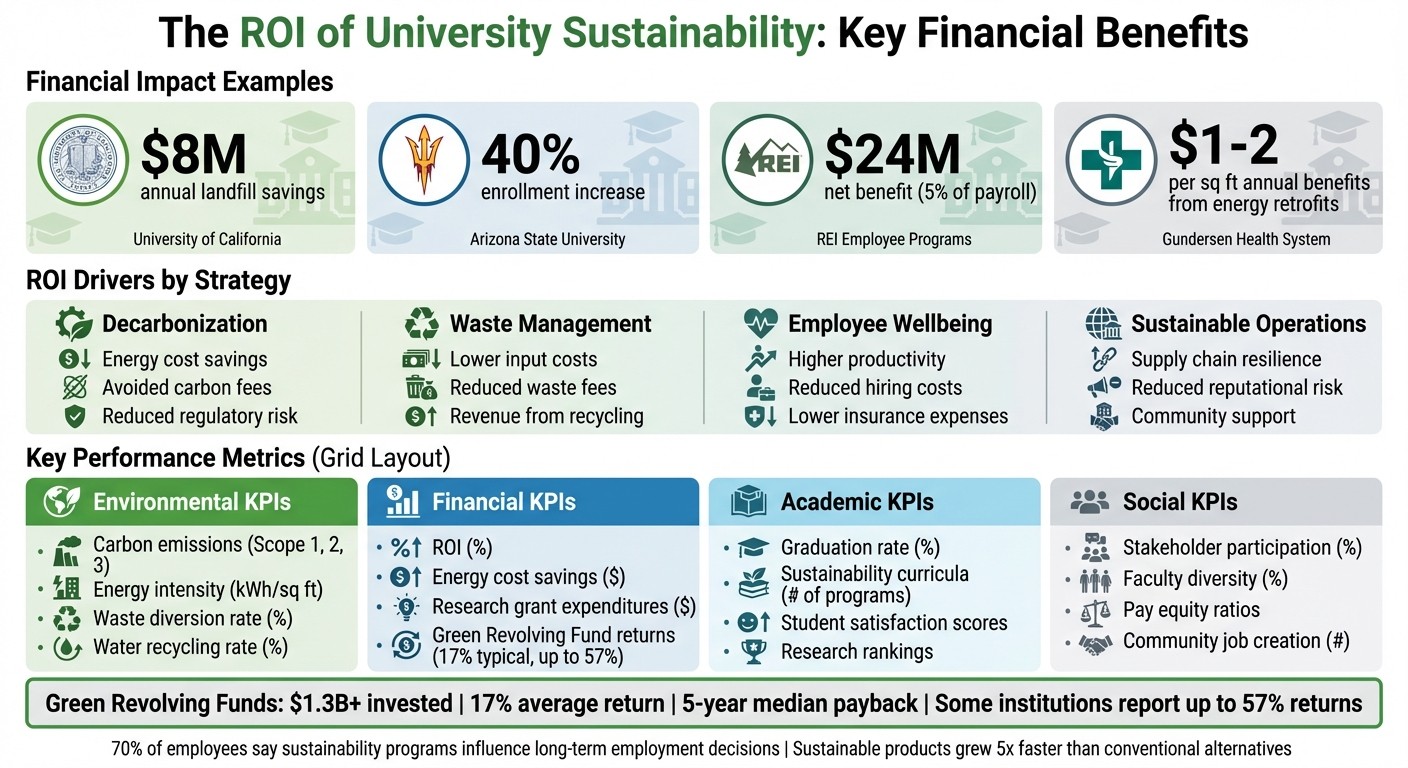
ROI of University Sustainability Initiatives: Key Financial Benefits and Metrics
The ROI of Sustainability ft. Tensie Whelan, NYU Stern Center for Sustainable Business
How to Set Clear and Measurable Sustainability Goals
Vague sustainability goals often fail to drive meaningful progress. Universities must establish actionable objectives that align with their educational and research missions while delivering measurable outcomes. The difference between institutions that succeed and those that falter often lies in how well they define their goals from the outset.
Connecting Goals to Your Institution's Mission
Sustainability goals should build on the strengths of a university - educating students, conducting research, and engaging with the community. When sustainability integrates with an institution's mission, it yields measurable academic and financial benefits.
Columbia University’s "Plan 2030", launched in 2021, exemplifies this approach. Developed with Earth Institute scientists and faculty, the plan focuses on six commitment areas, including "Campus as Living Lab." This initiative uses campus sustainability data and infrastructure as part of the curriculum, enhancing student learning while advancing environmental goals [3]. By turning operational improvements into teaching tools, Columbia aligns its environmental efforts with its academic mission.
Similarly, Harvard University applies the "living laboratory" concept, leveraging its vast community of students, faculty, alumni, and staff to test and expand sustainability practices. Between 2020 and 2022, Harvard’s Office for Sustainability collaborated with stakeholders to create its Sustainability Action Plan, which focuses on four key areas: How We Power, How We Build, How We Operate, and How We Lead [4]. Harvard underscores the importance of institutional engagement:
"Together, we will reimagine and redefine how we power, how we build, how we operate, and how we lead" [4].
This broad participation strengthens sustainability efforts, embedding them into the university’s identity. Columbia University echoes this sentiment:
"Achieving these targets requires an increased commitment across all areas of the University, and the ability to model sustainable values within every part of its culture – the way it educates, operates, designs, constructs, and manages resources" [3].
Applying the SMART Framework to Goal-Setting
To translate ambitious visions into tangible results, universities can use the SMART framework. This method ensures goals are well-defined, measurable, and achievable within a specific timeframe, helping institutions track progress and justify investments.
Specific goals focus on clear areas, like increasing sustainability-focused courses or achieving a STARS Gold rating [5][6].
Measurable objectives rely on quantifiable metrics, such as the number of green career graduates or reductions in emissions.
Achievable targets align with broader benchmarks, like New York State's goal of reducing greenhouse gas emissions by 85% by 2050 [6].
Relevant goals tie directly to academic and research missions, such as funding studies on climate resilience or integrating sustainability into curricula [5].
Time-bound deadlines create urgency, whether aiming for carbon neutrality by 2050 or achieving specific milestones within three years [6].
| SMART Component | Application in Higher Education | Example Objective |
| --- | --- | --- |
| <strong>Specific</strong> | Focus on areas like "Campus Operations" or "Curriculum" | Increase sustainability-focused courses <a href="https://stars.aashe.org/resources-support/help-center/v3/commitments-planning" target="_blank" style="text-decoration: none;" rel="nofollow noopener noreferrer" data-framer-link="Link:{"url":"https://stars.aashe.org/resources-support/help-center/v3/commitments-planning","type":"url"}" data-framer-open-in-new-tab=""><sup>[5]</sup></a> |
| <strong>Measurable</strong> | Use clear metrics or ratings | Achieve STARS Gold rating <a href="https://www.rochester.edu/sustainability/plan/focus-areas/planning-and-administration-goals" target="_blank" style="text-decoration: none;" rel="nofollow noopener noreferrer" data-framer-link="Link:{"url":"https://www.rochester.edu/sustainability/plan/focus-areas/planning-and-administration-goals","type":"url"}" data-framer-open-in-new-tab=""><sup>[6]</sup></a> |
| <strong>Achievable</strong> | Align with external benchmarks | Meet regional climate action plans <a href="https://www.rochester.edu/sustainability/plan/focus-areas/planning-and-administration-goals" target="_blank" style="text-decoration: none;" rel="nofollow noopener noreferrer" data-framer-link="Link:{"url":"https://www.rochester.edu/sustainability/plan/focus-areas/planning-and-administration-goals","type":"url"}" data-framer-open-in-new-tab=""><sup>[6]</sup></a> |
| <strong>Relevant</strong> | Tie to academic and research goals | Fund climate resilience research <a href="https://stars.aashe.org/resources-support/help-center/v3/commitments-planning" target="_blank" style="text-decoration: none;" rel="nofollow noopener noreferrer" data-framer-link="Link:{"url":"https://stars.aashe.org/resources-support/help-center/v3/commitments-planning","type":"url"}" data-framer-open-in-new-tab=""><sup>[5]</sup></a> |
| <strong>Time-bound</strong> | Set deadlines for completion | Reach carbon neutrality by 2050 <a href="https://www.rochester.edu/sustainability/plan/focus-areas/planning-and-administration-goals" target="_blank" style="text-decoration: none;" rel="nofollow noopener noreferrer" data-framer-link="Link:{"url":"https://www.rochester.edu/sustainability/plan/focus-areas/planning-and-administration-goals","type":"url"}" data-framer-open-in-new-tab=""><sup>[6]</sup></a> |
| SMART Component | Application in Higher Education | Example Objective |
| --- | --- | --- |
| <strong>Specific</strong> | Focus on areas like "Campus Operations" or "Curriculum" | Increase sustainability-focused courses <a href="https://stars.aashe.org/resources-support/help-center/v3/commitments-planning" target="_blank" style="text-decoration: none;" rel="nofollow noopener noreferrer" data-framer-link="Link:{"url":"https://stars.aashe.org/resources-support/help-center/v3/commitments-planning","type":"url"}" data-framer-open-in-new-tab=""><sup>[5]</sup></a> |
| <strong>Measurable</strong> | Use clear metrics or ratings | Achieve STARS Gold rating <a href="https://www.rochester.edu/sustainability/plan/focus-areas/planning-and-administration-goals" target="_blank" style="text-decoration: none;" rel="nofollow noopener noreferrer" data-framer-link="Link:{"url":"https://www.rochester.edu/sustainability/plan/focus-areas/planning-and-administration-goals","type":"url"}" data-framer-open-in-new-tab=""><sup>[6]</sup></a> |
| <strong>Achievable</strong> | Align with external benchmarks | Meet regional climate action plans <a href="https://www.rochester.edu/sustainability/plan/focus-areas/planning-and-administration-goals" target="_blank" style="text-decoration: none;" rel="nofollow noopener noreferrer" data-framer-link="Link:{"url":"https://www.rochester.edu/sustainability/plan/focus-areas/planning-and-administration-goals","type":"url"}" data-framer-open-in-new-tab=""><sup>[6]</sup></a> |
| <strong>Relevant</strong> | Tie to academic and research goals | Fund climate resilience research <a href="https://stars.aashe.org/resources-support/help-center/v3/commitments-planning" target="_blank" style="text-decoration: none;" rel="nofollow noopener noreferrer" data-framer-link="Link:{"url":"https://stars.aashe.org/resources-support/help-center/v3/commitments-planning","type":"url"}" data-framer-open-in-new-tab=""><sup>[5]</sup></a> |
| <strong>Time-bound</strong> | Set deadlines for completion | Reach carbon neutrality by 2050 <a href="https://www.rochester.edu/sustainability/plan/focus-areas/planning-and-administration-goals" target="_blank" style="text-decoration: none;" rel="nofollow noopener noreferrer" data-framer-link="Link:{"url":"https://www.rochester.edu/sustainability/plan/focus-areas/planning-and-administration-goals","type":"url"}" data-framer-open-in-new-tab=""><sup>[6]</sup></a> |Defining SMART goals lays the groundwork for success, but breaking these objectives into smaller milestones is essential for sustained progress.
Dividing Large Objectives into Smaller Milestones
Breaking long-term goals into manageable pieces maintains momentum and ensures steady progress. For example, a 30-year net-zero emissions target can feel overwhelming without interim milestones that demonstrate progress and return on investment. Setting short-, medium-, and long-term milestones helps institutions stay on track despite leadership changes or shifting budgets.
Yale University’s Climate Action Strategy, launched in 2021, is a clear example of this phased approach. Yale committed to eliminating actual emissions by 2050, with a critical interim goal of net-zero emissions by 2035, reducing over 65% of 2015 emission levels [8]. To fund this $1.5 billion initiative, Yale adopted three strategies: increasing its internal "Carbon Charge" from $20 to $50 per metric ton of CO2 by 2025, reallocating $10 million annually from its capital budget for greenhouse gas reductions, and expanding future capital budgets [8]. Yale highlights its commitment to balancing financial responsibility across generations:
"We are committed to the principle of intergenerational neutrality, balancing the financial burden over generations as much as possible" [8].
Operational milestones also align with renovation cycles. Yale plans to electrify over 400 buildings across 28 years, coordinating upgrades like HVAC electrification with scheduled renovations to minimize disruption [8].
Massachusetts Institute of Technology (MIT) employs a similar approach with its "Pathway to Sustainability Leadership" strategy (2017–2025). MIT’s Campus Sustainability Task Force identified five key elements: becoming a model of sustainability, transforming organizational practices, advancing research, innovating education, and fostering partnerships [7]. MIT treats its strategy as a "living document", updated annually to reflect new data and evolving priorities. As the institution explains:
"This report is intended to be a living document that requires ongoing engagement from the MIT community and sustained guidance from committed leadership" [7].
Selecting and Tracking Key Performance Indicators (KPIs)
Establishing accurate KPIs is crucial for demonstrating ROI and driving progress in sustainability initiatives. By identifying specific, measurable metrics, institutions can validate their efforts, justify investments, and effectively communicate results.
How to Choose the Right Metrics for Sustainability ROI
A well-rounded approach involves tracking both leading indicators (like current energy intensity or student absenteeism) and lagging indicators (such as total carbon reductions or graduation rates) [10]. This mix helps institutions foresee potential challenges while showcasing tangible accomplishments.
To ensure comprehensive coverage, universities should categorize KPIs into five areas: Teaching, Learning, and Research; Stakeholder Engagement; Campus Operations; Racial Equity and Social Justice; and Administration and Finance [5]. This framework moves beyond just environmental metrics, incorporating social and financial dimensions as well. Examples range from pay equity and living wages to research grant spending and student success rates [5][14].
The Sustainability Tracking, Assessment & Rating System (STARS) offers a self-reporting framework tailored for colleges and universities to measure performance across these categories [9]. In January 2026, AASHE highlighted that 30 individuals earned the STARS Data Quality Certification, improving the reliability of sustainability reporting [9]. MIT's Office of Sustainability underscores the importance of data in driving progress:
"Data and metrics are at the core of all progress on issues related to sustainability. They help us to quantify and benchmark environmental impacts, better understand the dynamics of campus sustainability, and evaluate the success of solutions." [12]
When selecting KPIs, it’s important to differentiate between future-oriented plans (e.g., greenhouse gas reduction targets) and current policies (e.g., procurement standards). Metrics should align with formal institutional documents, such as strategic or climate action plans, and external sustainability commitments should mandate regular reporting for accountability [5].
| KPI Category | Example Metrics | Measurement Units |
| --- | --- | --- |
| <strong>Environmental</strong> | Carbon Emissions (Scope 1, 2, 3), Energy Intensity, Water Recycling Rate, Waste Diversion | Metric tons CO2e, kWh/sq ft, %, % |
| <strong>Financial</strong> | ROI, Energy Cost Savings, Research Grant Expenditures, Endowment Distribution | USD, USD, USD, USD per student |
| <strong>Academic</strong> | Graduation Rate, Student Satisfaction, Research Rankings, Sustainability Curricula | %, Score (1-5), National Rank, Number of programs |
| <strong>Social</strong> | Stakeholder Participation, Faculty Diversity, Community Job Creation, Pay Equity | %, %, Number of jobs, Wage gap ratio
| KPI Category | Example Metrics | Measurement Units |
| --- | --- | --- |
| <strong>Environmental</strong> | Carbon Emissions (Scope 1, 2, 3), Energy Intensity, Water Recycling Rate, Waste Diversion | Metric tons CO2e, kWh/sq ft, %, % |
| <strong>Financial</strong> | ROI, Energy Cost Savings, Research Grant Expenditures, Endowment Distribution | USD, USD, USD, USD per student |
| <strong>Academic</strong> | Graduation Rate, Student Satisfaction, Research Rankings, Sustainability Curricula | %, Score (1-5), National Rank, Number of programs |
| <strong>Social</strong> | Stakeholder Participation, Faculty Diversity, Community Job Creation, Pay Equity | %, %, Number of jobs, Wage gap ratio
Once KPIs are clearly defined, the next step is to implement tools that streamline their monitoring and reporting.
Tools and Software for Monitoring KPIs
With clear metrics in place, selecting the right tools can enhance data tracking and reporting. Moving away from spreadsheets to specialized sustainability data management software improves both data accuracy and reporting efficiency [11]. For instance, MIT employs the MIT Sustainability DataPool to monitor campus metrics such as water and materials usage, waste diversion, greenhouse gas emissions, and energy efficiency. This centralized platform is accessible to students, faculty, and staff, enabling collaborative climate strategy development [12].
The STARS Reporting Tool is another valuable resource, widely used by institutions globally to manage and document sustainability data [9]. Its Benchmarking Tool complements this by allowing institutions to compare their performance against peer averages, past achievements, or specific aspirational targets [9][13]. Databases like the Integrated Postsecondary Education Data System (IPEDS) can help identify relevant peer groups for such comparisons [13].
Most tools support CSV exports, facilitating integration with broader institutional systems [13]. Regular longitudinal analysis - comparing current metrics to a baseline year - further helps institutions track the ROI of sustainability initiatives over time [13].
Calculating ROI for Sustainability Investments
Quantifying sustainability efforts in financial terms is a powerful way to justify investments, secure funding, and showcase measurable benefits beyond environmental outcomes. Let’s break down some methods for evaluating these returns, starting with the basic ROI formula.
Using the Basic ROI Formula
The formula for calculating ROI is straightforward: ROI (%) = (Net Project Benefits / Project Costs) × 100. Net benefits can include direct savings, such as lower energy bills, and avoided costs, like carbon fees or regulatory penalties. For projects spanning multiple years, you can calculate annualized ROI using [(1 + ROI)^(1/n) - 1] × 100, where n represents the number of years [15][16]. This adjustment accounts for differences in time horizons, such as comparing a three-year LED retrofit to a ten-year solar panel installation.
Take Gundersen Health System as an example. In collaboration with NYU Stern Center for Sustainable Business in 2024, they calculated that energy retrofits at an existing facility delivered $1 per square foot in annual benefits, while a net-zero design for a new building offered $2 per square foot annually [15]. This comparison highlights how institutions can quantify and compare the financial impacts of various sustainability strategies.
Measuring Social Return on Investment (SROI)
Traditional ROI calculations often miss critical social and environmental benefits. To address this gap, the Return on Sustainability Investment (ROSI™) framework offers a more comprehensive approach. This five-step process monetizes both tangible and intangible returns, linking sustainability efforts directly to financial performance [15][17].
ROSI identifies "mediating factors" that tie sustainability strategies to measurable outcomes, such as improved efficiency, higher employee retention, reduced risk exposure, and greater innovation [15][17]. For instance, in November 2020, REI partnered with NYU Stern to evaluate its employee sustainability and wellbeing programs. The analysis revealed that mission-aligned initiatives reduced turnover, lowered hiring costs, and boosted productivity - resulting in a net benefit of $24 million, about 5% of their total payroll expenses [15][17].
"Most corporate leaders are not tracking their sustainability-related returns." - NYU Stern Center for Sustainable Business [15]
The ROSI process unfolds in five steps:
Identify material sustainability strategies using tools like SASB or GRI.
Pinpoint specific operational changes, such as adopting a zero-waste program.
Map these changes to financial drivers, like reduced waste disposal or procurement costs.
Quantify the physical results (e.g., tons of waste diverted, kilowatt-hours saved).
Assign monetary values to calculate the final return [17].
Here’s how different strategies align with ROI drivers:
| Sustainability Strategy | Primary ROI Drivers |
| --- | --- |
| <strong>Decarbonization</strong> | Energy cost savings, avoided carbon fees, reduced regulatory risk <a href="https://stern.nyu.edu/experience-stern/about/departments-centers-initiatives/centers-of-research/center-sustainable-business/research/csb-monetization-methodology" target="_blank" style="text-decoration: none;" rel="nofollow noopener noreferrer" data-framer-link="Link:{"url":"https://stern.nyu.edu/experience-stern/about/departments-centers-initiatives/centers-of-research/center-sustainable-business/research/csb-monetization-methodology","type":"url"}" data-framer-open-in-new-tab=""><sup>[15]</sup></a> |
| <strong>Circularity/Waste Management</strong> | Lower input costs, reduced waste fees, revenue from recycled materials <a href="https://stern.nyu.edu/experience-stern/about/departments-centers-initiatives/centers-of-research/center-sustainable-business/research/csb-monetization-methodology" target="_blank" style="text-decoration: none;" rel="nofollow noopener noreferrer" data-framer-link="Link:{"url":"https://stern.nyu.edu/experience-stern/about/departments-centers-initiatives/centers-of-research/center-sustainable-business/research/csb-monetization-methodology","type":"url"}" data-framer-open-in-new-tab=""><sup>[15]</sup></a><a href="https://stern.nyu.edu/experience-stern/about/departments-centers-initiatives/centers-of-research/center-sustainable-business/research/return-sustainability-investment-rosi/rosi-resources-and-tools" target="_blank" style="text-decoration: none;" rel="nofollow noopener noreferrer" data-framer-link="Link:{"url":"https://stern.nyu.edu/experience-stern/about/departments-centers-initiatives/centers-of-research/center-sustainable-business/research/return-sustainability-investment-rosi/rosi-resources-and-tools","type":"url"}" data-framer-open-in-new-tab=""><sup>[17]</sup></a> |
| <strong>Employee Wellbeing</strong> | Higher productivity, reduced hiring costs, lower insurance expenses <a href="https://stern.nyu.edu/experience-stern/about/departments-centers-initiatives/centers-of-research/center-sustainable-business/research/csb-monetization-methodology" target="_blank" style="text-decoration: none;" rel="nofollow noopener noreferrer" data-framer-link="Link:{"url":"https://stern.nyu.edu/experience-stern/about/departments-centers-initiatives/centers-of-research/center-sustainable-business/research/csb-monetization-methodology","type":"url"}" data-framer-open-in-new-tab=""><sup>[15]</sup></a><a href="https://stern.nyu.edu/experience-stern/about/departments-centers-initiatives/centers-of-research/center-sustainable-business/research/return-sustainability-investment-rosi/rosi-resources-and-tools" target="_blank" style="text-decoration: none;" rel="nofollow noopener noreferrer" data-framer-link="Link:{"url":"https://stern.nyu.edu/experience-stern/about/departments-centers-initiatives/centers-of-research/center-sustainable-business/research/return-sustainability-investment-rosi/rosi-resources-and-tools","type":"url"}" data-framer-open-in-new-tab=""><sup>[17]</sup></a> |
| <strong>Sustainable Sourcing</strong> | Stronger supply chain resilience, reduced reputational risk, community support <a href="https://stern.nyu.edu/experience-stern/about/departments-centers-initiatives/centers-of-research/center-sustainable-business/research/csb-monetization-methodology" target="_blank" style="text-decoration: none;" rel="nofollow noopener noreferrer" data-framer-link="Link:{"url":"https://stern.nyu.edu/experience-stern/about/departments-centers-initiatives/centers-of-research/center-sustainable-business/research/csb-monetization-methodology","type":"url"}" data-framer-open-in-new-tab=""><sup>[15]</sup></a> || Sustainability Strategy | Primary ROI Drivers |
| --- | --- |
| <strong>Decarbonization</strong> | Energy cost savings, avoided carbon fees, reduced regulatory risk <a href="https://stern.nyu.edu/experience-stern/about/departments-centers-initiatives/centers-of-research/center-sustainable-business/research/csb-monetization-methodology" target="_blank" style="text-decoration: none;" rel="nofollow noopener noreferrer" data-framer-link="Link:{"url":"https://stern.nyu.edu/experience-stern/about/departments-centers-initiatives/centers-of-research/center-sustainable-business/research/csb-monetization-methodology","type":"url"}" data-framer-open-in-new-tab=""><sup>[15]</sup></a> |
| <strong>Circularity/Waste Management</strong> | Lower input costs, reduced waste fees, revenue from recycled materials <a href="https://stern.nyu.edu/experience-stern/about/departments-centers-initiatives/centers-of-research/center-sustainable-business/research/csb-monetization-methodology" target="_blank" style="text-decoration: none;" rel="nofollow noopener noreferrer" data-framer-link="Link:{"url":"https://stern.nyu.edu/experience-stern/about/departments-centers-initiatives/centers-of-research/center-sustainable-business/research/csb-monetization-methodology","type":"url"}" data-framer-open-in-new-tab=""><sup>[15]</sup></a><a href="https://stern.nyu.edu/experience-stern/about/departments-centers-initiatives/centers-of-research/center-sustainable-business/research/return-sustainability-investment-rosi/rosi-resources-and-tools" target="_blank" style="text-decoration: none;" rel="nofollow noopener noreferrer" data-framer-link="Link:{"url":"https://stern.nyu.edu/experience-stern/about/departments-centers-initiatives/centers-of-research/center-sustainable-business/research/return-sustainability-investment-rosi/rosi-resources-and-tools","type":"url"}" data-framer-open-in-new-tab=""><sup>[17]</sup></a> |
| <strong>Employee Wellbeing</strong> | Higher productivity, reduced hiring costs, lower insurance expenses <a href="https://stern.nyu.edu/experience-stern/about/departments-centers-initiatives/centers-of-research/center-sustainable-business/research/csb-monetization-methodology" target="_blank" style="text-decoration: none;" rel="nofollow noopener noreferrer" data-framer-link="Link:{"url":"https://stern.nyu.edu/experience-stern/about/departments-centers-initiatives/centers-of-research/center-sustainable-business/research/csb-monetization-methodology","type":"url"}" data-framer-open-in-new-tab=""><sup>[15]</sup></a><a href="https://stern.nyu.edu/experience-stern/about/departments-centers-initiatives/centers-of-research/center-sustainable-business/research/return-sustainability-investment-rosi/rosi-resources-and-tools" target="_blank" style="text-decoration: none;" rel="nofollow noopener noreferrer" data-framer-link="Link:{"url":"https://stern.nyu.edu/experience-stern/about/departments-centers-initiatives/centers-of-research/center-sustainable-business/research/return-sustainability-investment-rosi/rosi-resources-and-tools","type":"url"}" data-framer-open-in-new-tab=""><sup>[17]</sup></a> |
| <strong>Sustainable Sourcing</strong> | Stronger supply chain resilience, reduced reputational risk, community support <a href="https://stern.nyu.edu/experience-stern/about/departments-centers-initiatives/centers-of-research/center-sustainable-business/research/csb-monetization-methodology" target="_blank" style="text-decoration: none;" rel="nofollow noopener noreferrer" data-framer-link="Link:{"url":"https://stern.nyu.edu/experience-stern/about/departments-centers-initiatives/centers-of-research/center-sustainable-business/research/csb-monetization-methodology","type":"url"}" data-framer-open-in-new-tab=""><sup>[15]</sup></a> |Conducting Life Cycle Assessments (LCA)
To complement financial metrics, life cycle assessments provide a full-spectrum evaluation of costs. Life Cycle Cost Analysis (LCCA) examines long-term cost effectiveness by assessing total ownership costs, including capital, operational, maintenance, and disposal expenses [18]. The University of California system, for example, uses LCCA to analyze the financial implications of facility designs and capital projects [18].
"Life Cycle Cost Analysis (LCCA) is a method of evaluating the cost effectiveness of project design decisions. It is a holistic approach to capital planning and design that considers the near and long-term financial implications for a facility or project." - UC Facilities Manual [18]
Another tool, Impact-Weighted Accounting (IWA), complements ROSI by assigning monetary values to the broader societal and environmental impacts of a project [17]. While ROSI focuses on how sustainability initiatives affect a company’s bottom line, IWA captures the broader value created for stakeholders such as employees, communities, and the environment. Together, these methods offer a more complete picture of sustainability investments.
For example, in March 2025, Owens Corning applied the ROSI framework to its "Zero Waste to Landfill by 2030" initiative for fiberglass insulation. The analysis demonstrated that recycling materials significantly reduced processing and procurement costs while cutting carbon emissions [17]. This dual-benefit approach - where environmental gains translate into financial returns - is especially relevant for institutions managing resource-intensive facilities like research labs and universities.
Integrating Sustainability into Campus Operations
Campus operations often represent a significant portion of institutional costs, making them a prime area for improvements in energy, waste, and water management. By targeting these areas, institutions can cut expenses while advancing environmental goals. The challenge lies in identifying strategies that balance immediate savings with long-term financial benefits.
Reducing Energy Costs Through Efficiency Improvements
One of the most effective ways to cut costs is by lowering energy usage rather than focusing solely on price negotiations. Lisa Berglund, Director of Research Admin & Management at EAB, emphasizes:
"The biggest opportunity is not in reducing the price of energy but instead by reducing energy utilization." [19]
Many buildings experience inflated energy costs due to deviations from their original design or temporary maintenance fixes [19]. To address this, institutions should collaborate with facilities staff to review technical specifics, perform life-cycle assessments, and align solutions with their core values [21]. Strategic Energy Management (SEM) programs, for example, can reduce greenhouse gas emissions by 5% to 22%, delivering both environmental and financial benefits [21].
Stanford University provides a compelling example. In March 2019, it implemented an Energy and Climate Plan that cut campus greenhouse gas emissions by 68% and reduced potable water use by 15%. This initiative focused on transitioning to sustainable electricity sources, paving the way for full energy sustainability [20].
For institutions planning infrastructure upgrades, the costs and returns vary widely. Behavior change programs, which require no capital investment, can achieve 2% reductions in GHG emissions, with savings often covering program costs [21]. On the other hand, larger investments, such as converting to low-temperature hot water systems or installing ground-source heating and cooling systems, require over $50 million but can yield emission reductions of 23% and 27%, respectively [21].
Beyond energy, improving waste management can further enhance both financial savings and environmental outcomes.
Building Waste Management and Zero-Waste Programs
After addressing energy efficiency, revisiting waste management through a circular model can amplify an institution’s impact [22][23]. Data shows that products marketed as sustainable grow more than five times faster than conventional options, highlighting the financial potential of these initiatives [2].
A key element of zero-waste success is standardized infrastructure. Stanford University, for instance, has maintained over 60% waste diversion from landfills for two decades by implementing unified Recycling/Organics/Trash (R/O/T) systems across campus [25]. These systems reduce confusion and improve sorting accuracy. In 2019, Stanford conducted a comprehensive waste characterization study to identify landfill contributions by material, location, and type. This data informed their Zero Waste Plan and guided a 2024 system upgrade [25].
Institutions like MIT are leveraging data-driven waste hauling partnerships to optimize performance. By embedding technology into their waste management contracts, MIT collects building-specific metrics to reduce contamination and make informed purchasing decisions. As Brian Goldberg from MIT explains:
"By embedding data and tech as a core piece of our new waste hauling partnership we are ensuring we can try and test the collection framework to give us the data to drive decision-making down to building scale." [24]
Organics collection programs also play a crucial role. The University at Buffalo introduced an organics program in Fall 2025, expanding it to all on-campus apartments and offering weekly collection services for office kitchenettes. Both Buffalo and Stanford aim to achieve 90% waste diversion by 2030 [23][25].
Implementing Water Conservation Practices
Efficient water management complements energy and waste improvements, offering additional savings and reduced environmental impact. The University of California system, for example, set an ambitious goal to cut growth-adjusted potable water use by 36% by 2025 compared to a 2005–2008 baseline. As of 2024, nine UC campuses have already surpassed this target [28].
Upgrading infrastructure is key to achieving these reductions. Simple measures like installing low-flow fixtures can yield immediate savings, while eliminating once-through water cooling systems for equipment like lasers and compressors can significantly reduce water waste [26].
Water reuse and reclamation offer substantial returns for larger campuses. Adding parallel piping for reclaimed water in non-potable applications, such as landscape irrigation, can ease demand on municipal supplies [26][27]. Advanced methods, like wastewater heat recovery, provide dual benefits. For instance, UMass Amherst identified this approach as requiring less than $10 million in capital investment while delivering considerable operational savings [21].
Landscape design also plays a role. Choosing drought-tolerant plants over water-intensive options reduces long-term consumption [26]. To track progress effectively, institutions should implement standardized reporting practices, using consistent templates for annual water use reports. This ensures compatibility for audits and allows for accurate measurement of both absolute and per-capita reductions [26][27].
Integrating Sustainability into Academic and Research Programs
Incorporating sustainability into academic and research initiatives not only enhances institutional returns but also equips students to become future leaders in addressing global challenges. By embedding these principles into curricula and research, institutions can create meaningful, long-lasting impacts while attracting external funding and fostering career readiness.
Developing Sustainability-Focused Curricula
Building a strong sustainability curriculum requires more than offering a few elective courses. Research identifies eight key competencies - such as systems thinking, critical thinking, collaboration, and integrated problem-solving - that serve as a foundation for assessing both teaching effectiveness and student learning outcomes [29]. Institutions can either establish dedicated sustainability programs or weave these principles into existing disciplines. Success in this area hinges on leadership's commitment to provide resources and encourage interdisciplinary collaboration [29]. As the National Academies of Sciences, Engineering, and Medicine emphasizes:
"Universities must realize that emphasizing solutions is essential when studying sustainability problems." [29]
This perspective shifts the focus from analyzing challenges to teaching students how to design and implement actionable solutions. Methods like service-learning and community-based projects bridge academic theories with practical applications, ensuring students gain real-world experience. Collaborations with external organizations further align curricula with industry demands. Tools like the STARS 3.0 framework, which evaluates course offerings, literacy assessments, and research output, provide measurable insights into program effectiveness and institutional ROI [30].
Beyond curriculum innovation, targeted research funding plays a critical role in advancing sustainability efforts.
Securing Research Funding for Sustainability Projects
Green Revolving Funds (GRFs) offer a financial mechanism to support sustainability research and infrastructure. These funds reinvest savings from energy efficiency and resource reduction projects, achieving a typical return of 17% with a median payback period of five years. Some institutions report returns as high as 57% [31]. Mark Orlowski, Founder and Executive Director of the Sustainable Endowments Institute, highlights the benefits:
"Revolving funds present an exciting win-win-win opportunity to lower operating costs, reduce resource use, and improve the quality of an institution's facilities all at the same time." [31]
To date, GRFs have collectively invested over $1.3 billion, with more than 90% of institutions reporting that these funds enable them to undertake projects they otherwise couldn't [31]. For example, the University of Arizona's Utility Modification Revolving Fund demonstrates how investments in energy efficiency can generate ongoing financial resources to support climate neutrality goals.
External funding also plays a vital role. The National Science Foundation (NSF), with an annual budget of $8.8 billion (FY 2022), supports research, facilities, and STEM education. Its Technology, Innovation, and Partnerships (TIP) Directorate focuses on translating research into market-ready solutions. Successful funding proposals emphasize both "Intellectual Merit" and "Broader Impacts", showcasing societal benefits [32]. Cross-sector collaborations can further enhance funding opportunities. For instance, in 2020, AstraZeneca partnered with Biogas International and the University of Cambridge to fund biogas stove installations in rural Kenya. This initiative not only reduced CO₂ emissions but also addressed respiratory health challenges while providing critical data on CO₂'s impact on health [2].
These funding mechanisms not only boost research but also open new career pathways for students in sustainability fields.
Tracking Student Outcomes in Sustainability Careers
Measuring student success in sustainability-related careers provides clear evidence of an academic program's value. The STARS v3.0 framework includes "Student Success" as a key indicator under Planning & Administration, emphasizing equitable access and career readiness [5][14]. Institutions can set specific goals, like increasing the percentage of graduates entering sustainability professions by a target year, to drive continuous improvement [5]. Tools such as sustainability literacy assessments evaluate the knowledge and skills students gain, while alumni surveys help track how curricula influence career paths over time [33].
As Discover Sustainability notes:
"Future leaders, as students today, will shape the trajectory of sustainability in the coming decades through their decisions as professionals, policymakers, and citizens." [33]
Centralized reporting systems and multi-criteria analyses are essential for connecting sustainability indicators to student career readiness, ensuring programs remain aligned with industry needs and societal expectations [33].
Building Governance Structures for Accountability
For institutions to maintain the progress made in financial and environmental initiatives, sustainability must be integrated into strong governance systems. Without clear structures, even the best strategies can falter when leadership changes or budgets are constrained. By establishing clear policies, creating oversight groups, and aligning with global benchmarks, organizations can ensure their sustainability efforts continue to provide measurable benefits over time.
Creating Formal Sustainability Policies
Publishing a formal sustainability policy is a critical first step. As EAB Research points out:
"Publishing a sustainability policy before beginning any other sustainability-related efforts establishes sustainability as an institutional priority." [35]
A written policy serves as a foundation, clearly defining responsibilities, setting expectations for stakeholders, and providing a consistent decision-making framework. It should outline the organization's commitment to sustainability, assign roles to specific departments and leaders, and establish reporting requirements to ensure transparency. This formal approach lays the groundwork for accountability.
Institutions can also benefit from creating a Central Sustainability Office staffed with dedicated personnel. This office can coordinate efforts across departments, implement practices, track progress, and use digital tools to gather ideas from faculty and staff. Such initiatives not only streamline processes but also boost engagement and participation [35].
Forming Oversight Committees
Effective governance often requires multiple layers of oversight. A multi-tier committee structure that includes executive, operational, and student representatives can ensure diverse perspectives are considered. For example, Harvard employs a model that incorporates:
A Presidential Committee on Sustainability, led by faculty and executive leadership, to set the overall vision and strategy.
A Management Council, composed of facilities and administrative leaders, to oversee operational policies.
A Student Sustainability Council, which provides input from undergraduate and graduate students on climate and equity issues [34].
Harvard emphasizes the importance of collaboration, stating:
"Achieving success with the Sustainability Action Plan requires extensive collaboration between many disciplines and offices." [34]
In some cases, institutions appoint academic leaders, such as a Vice Provost for Climate and Sustainability, to integrate sustainability into research, teaching, and operations [34]. Cross-functional steering committees facilitate quicker decision-making and ensure resources align with strategic objectives [36]. A hybrid model - where a central team sets standards while departmental liaisons oversee daily implementation - can prevent sustainability efforts from becoming compartmentalized.
Additionally, publishing annual sustainability reports that document progress toward measurable goals increases transparency. Treating the sustainability action plan as a "living document" that evolves through regular reviews and updates reinforces long-term commitment [48,14].
Aligning with National and Global Standards
To ensure accountability and long-term impact, institutions should align their efforts with recognized frameworks and standards. Just as key performance indicators (KPIs) measure operational outcomes, these frameworks validate sustainability initiatives and build trust among stakeholders.
External systems like STARS (Sustainability Tracking, Assessment & Rating System) and SBTi (Science Based Targets initiative) offer valuable tools. STARS, designed for higher education, provides a transparent framework to measure performance across areas like academics, engagement, operations, and governance. Adoption of STARS is growing, with 30 individuals earning the STARS Data Quality Certification for the Fall 2025 period as of January 20, 2026 [9].
For emissions reductions, SBTi aligns with the Paris Agreement's goal of limiting global warming to 1.5°C. Columbia University's "Plan 2030" is a prime example of this approach. Under the leadership of David Greenberg (EVP of Facilities and Operations) and Michael Gerrard (Director of the Sabin Center), Columbia set a target of a 42% reduction in absolute emissions by 2030, with a goal to reach net zero by 2050. By 2020, the university had already reduced emissions by 41% at its Morningside+ and CUIMC campuses, surpassing its initial 35% goal [38].
Other frameworks include the SDG Accord, which aligns with UN Sustainable Development Goals [5], The Climate Registry (TCR) for verified greenhouse gas inventory standards [38], and initiatives like the Principles for Responsible Investment (PRI) and Principles for Responsible Management Education (PRME) for incorporating sustainability into endowment decisions and business education [5]. The UNEP Sustainable University Framework also provides guidance on integrating sustainability into environmental, teaching, societal, and governance practices [37].
Conclusion: Building a Sustainable Future for Higher Education
A well-crafted sustainability strategy not only addresses environmental concerns but also drives financial success by creating shared value. As Rebecca Henderson, a professor at Harvard Business School, aptly puts it:
"The intersection of 'doing good' and 'doing well' - called the creation of shared value - is often highly lucrative" [2].
By adopting this mindset, universities can tackle pressing environmental challenges while unlocking new avenues for research funding, boosting student involvement, and enhancing operational efficiency.
The most forward-thinking institutions integrate sustainability into every aspect of their mission - academics, research, community partnerships, and campus operations [1]. This holistic approach ensures sustainability becomes a defining feature of their identity, rather than a task confined to facilities management.
The financial benefits of sustainability are becoming increasingly clear. Nearly 70% of employees say that robust corporate sustainability programs influence their decision to remain with an organization long-term [2]. Additionally, sustainable products significantly outpaced their non-sustainable counterparts, with sales reaching $114 billion in 2019 - a 29% jump from 2013 [2]. These patterns highlight how sustainability investments can not only mitigate risks but also provide a competitive edge.
Universities are uniquely positioned to amplify their impact by using their campuses as living laboratories. These spaces allow for the development, testing, and refinement of innovative systems and practices, which can then be applied to broader societal challenges [4]. By tapping into alumni networks, securing sustainability-focused research funding, and aligning with global initiatives, institutions can extend their influence well beyond campus boundaries. As Harvard's Office for Sustainability envisions:
"Together, we will reimagine and redefine how we power, how we build, how we operate, and how we lead" [4].
Looking ahead, universities must embrace a new way of thinking. Sustainability should be seen as a strategic investment - one that builds resilience, enhances student value, and drives societal progress. By aligning sustainability efforts with measurable ROI, institutions can reduce their environmental footprint, strengthen their financial standing, and prepare students to address the challenges of tomorrow.
FAQs
What KPIs best prove sustainability ROI on a campus?
Key performance indicators (KPIs) for showcasing sustainability returns on investment (ROI) in campus settings include measurable reductions in greenhouse gas emissions, energy and water savings, and advancements toward established sustainability targets. These metrics also encompass environmental performance benchmarks, aligning with widely accepted frameworks in higher education. Together, they provide clear insights into both the financial and environmental advantages of sustainability efforts.
How do we calculate ROI when benefits are indirect or long-term?
Calculating ROI for benefits that are indirect or unfold over a longer period requires a broader perspective. It’s essential to evaluate both measurable impacts and those that are harder to quantify. Frameworks like ESG (Environmental, Social, and Governance) or the Triple Bottom Line can help capture outcomes that go beyond traditional financial measures. For these long-term benefits, it’s crucial to establish clear, measurable objectives and gather reliable data while considering elements like enhanced brand reputation, stronger customer loyalty, and improved employee retention.
The ROSI™ methodology offers a practical approach to this challenge. By assigning economic value to sustainability initiatives, it helps organizations translate intangible benefits into monetary terms, providing a clearer picture of the potential return on investment over time. This method not only aids in tracking progress but also supports more informed decision-making.
What’s the fastest way to fund sustainability projects without new budget?
The fastest path often involves tapping into internal financing tools such as green revolving funds (GRFs). These funds supply the initial capital for initiatives like energy efficiency upgrades or renewable energy installations. The beauty of GRFs lies in their self-sustaining nature - savings generated from these projects are used to refill the fund, creating a cycle of reinvestment. For instance, many organizations utilize GRFs to carry out projects without needing upfront capital, relying on utility savings to repay interest-free loans. Programs such as the Billion Dollar Green Challenge provide valuable resources and strategies for effectively managing these funds.
Related Blog Posts
Latest Articles
©2025



FAQ
01
What does it really mean to “redefine profit”?
02
What makes Council Fire different?
03
Who does Council Fire you work with?
04
What does working with Council Fire actually look like?
05
How does Council Fire help organizations turn big goals into action?
06
How does Council Fire define and measure success?
Feb 18, 2026
How to Build a Corporate Sustainability Strategy Aligned to ROI for Universities & Research Institutions
Sustainability Strategy
In This Article
A practical guide for universities and research institutions to set SMART sustainability goals, track KPIs, fund projects, and measure ROI across campus operations and academics.
How to Build a Corporate Sustainability Strategy Aligned to ROI for Universities & Research Institutions
Universities and research institutions are increasingly expected to integrate sustainability into their operations, academics, and research. Beyond environmental benefits, these efforts can drive financial returns, attract students, secure funding, and improve operational efficiency. Success depends on setting measurable goals, tracking ROI, and aligning initiatives with institutional missions.
Key Takeaways:
Financial Impact: Sustainability programs can reduce costs (e.g., $8M annual landfill savings at UC) and boost revenue (e.g., 40% enrollment increase at Arizona State University).
ROI Measurement: Use frameworks like SMART goals and KPIs to track environmental, social, and economic returns.
Campus as a Laboratory: Initiatives like Columbia's "Plan 2030" and Harvard's "living lab" approach integrate campus operations with learning and research goals.
Funding Opportunities: Green Revolving Funds and external grants (e.g., NSF) support sustainability while generating long-term returns.
Governance: Clear policies, oversight committees, and alignment with standards like STARS ensure accountability and progress.
This article outlines actionable steps for universities to align sustainability initiatives with measurable ROI, ensuring both financial success and long-term impact.
ROI of University Sustainability Initiatives: Key Financial Benefits and Metrics
The ROI of Sustainability ft. Tensie Whelan, NYU Stern Center for Sustainable Business
How to Set Clear and Measurable Sustainability Goals
Vague sustainability goals often fail to drive meaningful progress. Universities must establish actionable objectives that align with their educational and research missions while delivering measurable outcomes. The difference between institutions that succeed and those that falter often lies in how well they define their goals from the outset.
Connecting Goals to Your Institution's Mission
Sustainability goals should build on the strengths of a university - educating students, conducting research, and engaging with the community. When sustainability integrates with an institution's mission, it yields measurable academic and financial benefits.
Columbia University’s "Plan 2030", launched in 2021, exemplifies this approach. Developed with Earth Institute scientists and faculty, the plan focuses on six commitment areas, including "Campus as Living Lab." This initiative uses campus sustainability data and infrastructure as part of the curriculum, enhancing student learning while advancing environmental goals [3]. By turning operational improvements into teaching tools, Columbia aligns its environmental efforts with its academic mission.
Similarly, Harvard University applies the "living laboratory" concept, leveraging its vast community of students, faculty, alumni, and staff to test and expand sustainability practices. Between 2020 and 2022, Harvard’s Office for Sustainability collaborated with stakeholders to create its Sustainability Action Plan, which focuses on four key areas: How We Power, How We Build, How We Operate, and How We Lead [4]. Harvard underscores the importance of institutional engagement:
"Together, we will reimagine and redefine how we power, how we build, how we operate, and how we lead" [4].
This broad participation strengthens sustainability efforts, embedding them into the university’s identity. Columbia University echoes this sentiment:
"Achieving these targets requires an increased commitment across all areas of the University, and the ability to model sustainable values within every part of its culture – the way it educates, operates, designs, constructs, and manages resources" [3].
Applying the SMART Framework to Goal-Setting
To translate ambitious visions into tangible results, universities can use the SMART framework. This method ensures goals are well-defined, measurable, and achievable within a specific timeframe, helping institutions track progress and justify investments.
Specific goals focus on clear areas, like increasing sustainability-focused courses or achieving a STARS Gold rating [5][6].
Measurable objectives rely on quantifiable metrics, such as the number of green career graduates or reductions in emissions.
Achievable targets align with broader benchmarks, like New York State's goal of reducing greenhouse gas emissions by 85% by 2050 [6].
Relevant goals tie directly to academic and research missions, such as funding studies on climate resilience or integrating sustainability into curricula [5].
Time-bound deadlines create urgency, whether aiming for carbon neutrality by 2050 or achieving specific milestones within three years [6].
| SMART Component | Application in Higher Education | Example Objective |
| --- | --- | --- |
| <strong>Specific</strong> | Focus on areas like "Campus Operations" or "Curriculum" | Increase sustainability-focused courses <a href="https://stars.aashe.org/resources-support/help-center/v3/commitments-planning" target="_blank" style="text-decoration: none;" rel="nofollow noopener noreferrer" data-framer-link="Link:{"url":"https://stars.aashe.org/resources-support/help-center/v3/commitments-planning","type":"url"}" data-framer-open-in-new-tab=""><sup>[5]</sup></a> |
| <strong>Measurable</strong> | Use clear metrics or ratings | Achieve STARS Gold rating <a href="https://www.rochester.edu/sustainability/plan/focus-areas/planning-and-administration-goals" target="_blank" style="text-decoration: none;" rel="nofollow noopener noreferrer" data-framer-link="Link:{"url":"https://www.rochester.edu/sustainability/plan/focus-areas/planning-and-administration-goals","type":"url"}" data-framer-open-in-new-tab=""><sup>[6]</sup></a> |
| <strong>Achievable</strong> | Align with external benchmarks | Meet regional climate action plans <a href="https://www.rochester.edu/sustainability/plan/focus-areas/planning-and-administration-goals" target="_blank" style="text-decoration: none;" rel="nofollow noopener noreferrer" data-framer-link="Link:{"url":"https://www.rochester.edu/sustainability/plan/focus-areas/planning-and-administration-goals","type":"url"}" data-framer-open-in-new-tab=""><sup>[6]</sup></a> |
| <strong>Relevant</strong> | Tie to academic and research goals | Fund climate resilience research <a href="https://stars.aashe.org/resources-support/help-center/v3/commitments-planning" target="_blank" style="text-decoration: none;" rel="nofollow noopener noreferrer" data-framer-link="Link:{"url":"https://stars.aashe.org/resources-support/help-center/v3/commitments-planning","type":"url"}" data-framer-open-in-new-tab=""><sup>[5]</sup></a> |
| <strong>Time-bound</strong> | Set deadlines for completion | Reach carbon neutrality by 2050 <a href="https://www.rochester.edu/sustainability/plan/focus-areas/planning-and-administration-goals" target="_blank" style="text-decoration: none;" rel="nofollow noopener noreferrer" data-framer-link="Link:{"url":"https://www.rochester.edu/sustainability/plan/focus-areas/planning-and-administration-goals","type":"url"}" data-framer-open-in-new-tab=""><sup>[6]</sup></a> |
Defining SMART goals lays the groundwork for success, but breaking these objectives into smaller milestones is essential for sustained progress.
Dividing Large Objectives into Smaller Milestones
Breaking long-term goals into manageable pieces maintains momentum and ensures steady progress. For example, a 30-year net-zero emissions target can feel overwhelming without interim milestones that demonstrate progress and return on investment. Setting short-, medium-, and long-term milestones helps institutions stay on track despite leadership changes or shifting budgets.
Yale University’s Climate Action Strategy, launched in 2021, is a clear example of this phased approach. Yale committed to eliminating actual emissions by 2050, with a critical interim goal of net-zero emissions by 2035, reducing over 65% of 2015 emission levels [8]. To fund this $1.5 billion initiative, Yale adopted three strategies: increasing its internal "Carbon Charge" from $20 to $50 per metric ton of CO2 by 2025, reallocating $10 million annually from its capital budget for greenhouse gas reductions, and expanding future capital budgets [8]. Yale highlights its commitment to balancing financial responsibility across generations:
"We are committed to the principle of intergenerational neutrality, balancing the financial burden over generations as much as possible" [8].
Operational milestones also align with renovation cycles. Yale plans to electrify over 400 buildings across 28 years, coordinating upgrades like HVAC electrification with scheduled renovations to minimize disruption [8].
Massachusetts Institute of Technology (MIT) employs a similar approach with its "Pathway to Sustainability Leadership" strategy (2017–2025). MIT’s Campus Sustainability Task Force identified five key elements: becoming a model of sustainability, transforming organizational practices, advancing research, innovating education, and fostering partnerships [7]. MIT treats its strategy as a "living document", updated annually to reflect new data and evolving priorities. As the institution explains:
"This report is intended to be a living document that requires ongoing engagement from the MIT community and sustained guidance from committed leadership" [7].
Selecting and Tracking Key Performance Indicators (KPIs)
Establishing accurate KPIs is crucial for demonstrating ROI and driving progress in sustainability initiatives. By identifying specific, measurable metrics, institutions can validate their efforts, justify investments, and effectively communicate results.
How to Choose the Right Metrics for Sustainability ROI
A well-rounded approach involves tracking both leading indicators (like current energy intensity or student absenteeism) and lagging indicators (such as total carbon reductions or graduation rates) [10]. This mix helps institutions foresee potential challenges while showcasing tangible accomplishments.
To ensure comprehensive coverage, universities should categorize KPIs into five areas: Teaching, Learning, and Research; Stakeholder Engagement; Campus Operations; Racial Equity and Social Justice; and Administration and Finance [5]. This framework moves beyond just environmental metrics, incorporating social and financial dimensions as well. Examples range from pay equity and living wages to research grant spending and student success rates [5][14].
The Sustainability Tracking, Assessment & Rating System (STARS) offers a self-reporting framework tailored for colleges and universities to measure performance across these categories [9]. In January 2026, AASHE highlighted that 30 individuals earned the STARS Data Quality Certification, improving the reliability of sustainability reporting [9]. MIT's Office of Sustainability underscores the importance of data in driving progress:
"Data and metrics are at the core of all progress on issues related to sustainability. They help us to quantify and benchmark environmental impacts, better understand the dynamics of campus sustainability, and evaluate the success of solutions." [12]
When selecting KPIs, it’s important to differentiate between future-oriented plans (e.g., greenhouse gas reduction targets) and current policies (e.g., procurement standards). Metrics should align with formal institutional documents, such as strategic or climate action plans, and external sustainability commitments should mandate regular reporting for accountability [5].
| KPI Category | Example Metrics | Measurement Units |
| --- | --- | --- |
| <strong>Environmental</strong> | Carbon Emissions (Scope 1, 2, 3), Energy Intensity, Water Recycling Rate, Waste Diversion | Metric tons CO2e, kWh/sq ft, %, % |
| <strong>Financial</strong> | ROI, Energy Cost Savings, Research Grant Expenditures, Endowment Distribution | USD, USD, USD, USD per student |
| <strong>Academic</strong> | Graduation Rate, Student Satisfaction, Research Rankings, Sustainability Curricula | %, Score (1-5), National Rank, Number of programs |
| <strong>Social</strong> | Stakeholder Participation, Faculty Diversity, Community Job Creation, Pay Equity | %, %, Number of jobs, Wage gap ratio
Once KPIs are clearly defined, the next step is to implement tools that streamline their monitoring and reporting.
Tools and Software for Monitoring KPIs
With clear metrics in place, selecting the right tools can enhance data tracking and reporting. Moving away from spreadsheets to specialized sustainability data management software improves both data accuracy and reporting efficiency [11]. For instance, MIT employs the MIT Sustainability DataPool to monitor campus metrics such as water and materials usage, waste diversion, greenhouse gas emissions, and energy efficiency. This centralized platform is accessible to students, faculty, and staff, enabling collaborative climate strategy development [12].
The STARS Reporting Tool is another valuable resource, widely used by institutions globally to manage and document sustainability data [9]. Its Benchmarking Tool complements this by allowing institutions to compare their performance against peer averages, past achievements, or specific aspirational targets [9][13]. Databases like the Integrated Postsecondary Education Data System (IPEDS) can help identify relevant peer groups for such comparisons [13].
Most tools support CSV exports, facilitating integration with broader institutional systems [13]. Regular longitudinal analysis - comparing current metrics to a baseline year - further helps institutions track the ROI of sustainability initiatives over time [13].
Calculating ROI for Sustainability Investments
Quantifying sustainability efforts in financial terms is a powerful way to justify investments, secure funding, and showcase measurable benefits beyond environmental outcomes. Let’s break down some methods for evaluating these returns, starting with the basic ROI formula.
Using the Basic ROI Formula
The formula for calculating ROI is straightforward: ROI (%) = (Net Project Benefits / Project Costs) × 100. Net benefits can include direct savings, such as lower energy bills, and avoided costs, like carbon fees or regulatory penalties. For projects spanning multiple years, you can calculate annualized ROI using [(1 + ROI)^(1/n) - 1] × 100, where n represents the number of years [15][16]. This adjustment accounts for differences in time horizons, such as comparing a three-year LED retrofit to a ten-year solar panel installation.
Take Gundersen Health System as an example. In collaboration with NYU Stern Center for Sustainable Business in 2024, they calculated that energy retrofits at an existing facility delivered $1 per square foot in annual benefits, while a net-zero design for a new building offered $2 per square foot annually [15]. This comparison highlights how institutions can quantify and compare the financial impacts of various sustainability strategies.
Measuring Social Return on Investment (SROI)
Traditional ROI calculations often miss critical social and environmental benefits. To address this gap, the Return on Sustainability Investment (ROSI™) framework offers a more comprehensive approach. This five-step process monetizes both tangible and intangible returns, linking sustainability efforts directly to financial performance [15][17].
ROSI identifies "mediating factors" that tie sustainability strategies to measurable outcomes, such as improved efficiency, higher employee retention, reduced risk exposure, and greater innovation [15][17]. For instance, in November 2020, REI partnered with NYU Stern to evaluate its employee sustainability and wellbeing programs. The analysis revealed that mission-aligned initiatives reduced turnover, lowered hiring costs, and boosted productivity - resulting in a net benefit of $24 million, about 5% of their total payroll expenses [15][17].
"Most corporate leaders are not tracking their sustainability-related returns." - NYU Stern Center for Sustainable Business [15]
The ROSI process unfolds in five steps:
Identify material sustainability strategies using tools like SASB or GRI.
Pinpoint specific operational changes, such as adopting a zero-waste program.
Map these changes to financial drivers, like reduced waste disposal or procurement costs.
Quantify the physical results (e.g., tons of waste diverted, kilowatt-hours saved).
Assign monetary values to calculate the final return [17].
Here’s how different strategies align with ROI drivers:
| Sustainability Strategy | Primary ROI Drivers |
| --- | --- |
| <strong>Decarbonization</strong> | Energy cost savings, avoided carbon fees, reduced regulatory risk <a href="https://stern.nyu.edu/experience-stern/about/departments-centers-initiatives/centers-of-research/center-sustainable-business/research/csb-monetization-methodology" target="_blank" style="text-decoration: none;" rel="nofollow noopener noreferrer" data-framer-link="Link:{"url":"https://stern.nyu.edu/experience-stern/about/departments-centers-initiatives/centers-of-research/center-sustainable-business/research/csb-monetization-methodology","type":"url"}" data-framer-open-in-new-tab=""><sup>[15]</sup></a> |
| <strong>Circularity/Waste Management</strong> | Lower input costs, reduced waste fees, revenue from recycled materials <a href="https://stern.nyu.edu/experience-stern/about/departments-centers-initiatives/centers-of-research/center-sustainable-business/research/csb-monetization-methodology" target="_blank" style="text-decoration: none;" rel="nofollow noopener noreferrer" data-framer-link="Link:{"url":"https://stern.nyu.edu/experience-stern/about/departments-centers-initiatives/centers-of-research/center-sustainable-business/research/csb-monetization-methodology","type":"url"}" data-framer-open-in-new-tab=""><sup>[15]</sup></a><a href="https://stern.nyu.edu/experience-stern/about/departments-centers-initiatives/centers-of-research/center-sustainable-business/research/return-sustainability-investment-rosi/rosi-resources-and-tools" target="_blank" style="text-decoration: none;" rel="nofollow noopener noreferrer" data-framer-link="Link:{"url":"https://stern.nyu.edu/experience-stern/about/departments-centers-initiatives/centers-of-research/center-sustainable-business/research/return-sustainability-investment-rosi/rosi-resources-and-tools","type":"url"}" data-framer-open-in-new-tab=""><sup>[17]</sup></a> |
| <strong>Employee Wellbeing</strong> | Higher productivity, reduced hiring costs, lower insurance expenses <a href="https://stern.nyu.edu/experience-stern/about/departments-centers-initiatives/centers-of-research/center-sustainable-business/research/csb-monetization-methodology" target="_blank" style="text-decoration: none;" rel="nofollow noopener noreferrer" data-framer-link="Link:{"url":"https://stern.nyu.edu/experience-stern/about/departments-centers-initiatives/centers-of-research/center-sustainable-business/research/csb-monetization-methodology","type":"url"}" data-framer-open-in-new-tab=""><sup>[15]</sup></a><a href="https://stern.nyu.edu/experience-stern/about/departments-centers-initiatives/centers-of-research/center-sustainable-business/research/return-sustainability-investment-rosi/rosi-resources-and-tools" target="_blank" style="text-decoration: none;" rel="nofollow noopener noreferrer" data-framer-link="Link:{"url":"https://stern.nyu.edu/experience-stern/about/departments-centers-initiatives/centers-of-research/center-sustainable-business/research/return-sustainability-investment-rosi/rosi-resources-and-tools","type":"url"}" data-framer-open-in-new-tab=""><sup>[17]</sup></a> |
| <strong>Sustainable Sourcing</strong> | Stronger supply chain resilience, reduced reputational risk, community support <a href="https://stern.nyu.edu/experience-stern/about/departments-centers-initiatives/centers-of-research/center-sustainable-business/research/csb-monetization-methodology" target="_blank" style="text-decoration: none;" rel="nofollow noopener noreferrer" data-framer-link="Link:{"url":"https://stern.nyu.edu/experience-stern/about/departments-centers-initiatives/centers-of-research/center-sustainable-business/research/csb-monetization-methodology","type":"url"}" data-framer-open-in-new-tab=""><sup>[15]</sup></a> |Conducting Life Cycle Assessments (LCA)
To complement financial metrics, life cycle assessments provide a full-spectrum evaluation of costs. Life Cycle Cost Analysis (LCCA) examines long-term cost effectiveness by assessing total ownership costs, including capital, operational, maintenance, and disposal expenses [18]. The University of California system, for example, uses LCCA to analyze the financial implications of facility designs and capital projects [18].
"Life Cycle Cost Analysis (LCCA) is a method of evaluating the cost effectiveness of project design decisions. It is a holistic approach to capital planning and design that considers the near and long-term financial implications for a facility or project." - UC Facilities Manual [18]
Another tool, Impact-Weighted Accounting (IWA), complements ROSI by assigning monetary values to the broader societal and environmental impacts of a project [17]. While ROSI focuses on how sustainability initiatives affect a company’s bottom line, IWA captures the broader value created for stakeholders such as employees, communities, and the environment. Together, these methods offer a more complete picture of sustainability investments.
For example, in March 2025, Owens Corning applied the ROSI framework to its "Zero Waste to Landfill by 2030" initiative for fiberglass insulation. The analysis demonstrated that recycling materials significantly reduced processing and procurement costs while cutting carbon emissions [17]. This dual-benefit approach - where environmental gains translate into financial returns - is especially relevant for institutions managing resource-intensive facilities like research labs and universities.
Integrating Sustainability into Campus Operations
Campus operations often represent a significant portion of institutional costs, making them a prime area for improvements in energy, waste, and water management. By targeting these areas, institutions can cut expenses while advancing environmental goals. The challenge lies in identifying strategies that balance immediate savings with long-term financial benefits.
Reducing Energy Costs Through Efficiency Improvements
One of the most effective ways to cut costs is by lowering energy usage rather than focusing solely on price negotiations. Lisa Berglund, Director of Research Admin & Management at EAB, emphasizes:
"The biggest opportunity is not in reducing the price of energy but instead by reducing energy utilization." [19]
Many buildings experience inflated energy costs due to deviations from their original design or temporary maintenance fixes [19]. To address this, institutions should collaborate with facilities staff to review technical specifics, perform life-cycle assessments, and align solutions with their core values [21]. Strategic Energy Management (SEM) programs, for example, can reduce greenhouse gas emissions by 5% to 22%, delivering both environmental and financial benefits [21].
Stanford University provides a compelling example. In March 2019, it implemented an Energy and Climate Plan that cut campus greenhouse gas emissions by 68% and reduced potable water use by 15%. This initiative focused on transitioning to sustainable electricity sources, paving the way for full energy sustainability [20].
For institutions planning infrastructure upgrades, the costs and returns vary widely. Behavior change programs, which require no capital investment, can achieve 2% reductions in GHG emissions, with savings often covering program costs [21]. On the other hand, larger investments, such as converting to low-temperature hot water systems or installing ground-source heating and cooling systems, require over $50 million but can yield emission reductions of 23% and 27%, respectively [21].
Beyond energy, improving waste management can further enhance both financial savings and environmental outcomes.
Building Waste Management and Zero-Waste Programs
After addressing energy efficiency, revisiting waste management through a circular model can amplify an institution’s impact [22][23]. Data shows that products marketed as sustainable grow more than five times faster than conventional options, highlighting the financial potential of these initiatives [2].
A key element of zero-waste success is standardized infrastructure. Stanford University, for instance, has maintained over 60% waste diversion from landfills for two decades by implementing unified Recycling/Organics/Trash (R/O/T) systems across campus [25]. These systems reduce confusion and improve sorting accuracy. In 2019, Stanford conducted a comprehensive waste characterization study to identify landfill contributions by material, location, and type. This data informed their Zero Waste Plan and guided a 2024 system upgrade [25].
Institutions like MIT are leveraging data-driven waste hauling partnerships to optimize performance. By embedding technology into their waste management contracts, MIT collects building-specific metrics to reduce contamination and make informed purchasing decisions. As Brian Goldberg from MIT explains:
"By embedding data and tech as a core piece of our new waste hauling partnership we are ensuring we can try and test the collection framework to give us the data to drive decision-making down to building scale." [24]
Organics collection programs also play a crucial role. The University at Buffalo introduced an organics program in Fall 2025, expanding it to all on-campus apartments and offering weekly collection services for office kitchenettes. Both Buffalo and Stanford aim to achieve 90% waste diversion by 2030 [23][25].
Implementing Water Conservation Practices
Efficient water management complements energy and waste improvements, offering additional savings and reduced environmental impact. The University of California system, for example, set an ambitious goal to cut growth-adjusted potable water use by 36% by 2025 compared to a 2005–2008 baseline. As of 2024, nine UC campuses have already surpassed this target [28].
Upgrading infrastructure is key to achieving these reductions. Simple measures like installing low-flow fixtures can yield immediate savings, while eliminating once-through water cooling systems for equipment like lasers and compressors can significantly reduce water waste [26].
Water reuse and reclamation offer substantial returns for larger campuses. Adding parallel piping for reclaimed water in non-potable applications, such as landscape irrigation, can ease demand on municipal supplies [26][27]. Advanced methods, like wastewater heat recovery, provide dual benefits. For instance, UMass Amherst identified this approach as requiring less than $10 million in capital investment while delivering considerable operational savings [21].
Landscape design also plays a role. Choosing drought-tolerant plants over water-intensive options reduces long-term consumption [26]. To track progress effectively, institutions should implement standardized reporting practices, using consistent templates for annual water use reports. This ensures compatibility for audits and allows for accurate measurement of both absolute and per-capita reductions [26][27].
Integrating Sustainability into Academic and Research Programs
Incorporating sustainability into academic and research initiatives not only enhances institutional returns but also equips students to become future leaders in addressing global challenges. By embedding these principles into curricula and research, institutions can create meaningful, long-lasting impacts while attracting external funding and fostering career readiness.
Developing Sustainability-Focused Curricula
Building a strong sustainability curriculum requires more than offering a few elective courses. Research identifies eight key competencies - such as systems thinking, critical thinking, collaboration, and integrated problem-solving - that serve as a foundation for assessing both teaching effectiveness and student learning outcomes [29]. Institutions can either establish dedicated sustainability programs or weave these principles into existing disciplines. Success in this area hinges on leadership's commitment to provide resources and encourage interdisciplinary collaboration [29]. As the National Academies of Sciences, Engineering, and Medicine emphasizes:
"Universities must realize that emphasizing solutions is essential when studying sustainability problems." [29]
This perspective shifts the focus from analyzing challenges to teaching students how to design and implement actionable solutions. Methods like service-learning and community-based projects bridge academic theories with practical applications, ensuring students gain real-world experience. Collaborations with external organizations further align curricula with industry demands. Tools like the STARS 3.0 framework, which evaluates course offerings, literacy assessments, and research output, provide measurable insights into program effectiveness and institutional ROI [30].
Beyond curriculum innovation, targeted research funding plays a critical role in advancing sustainability efforts.
Securing Research Funding for Sustainability Projects
Green Revolving Funds (GRFs) offer a financial mechanism to support sustainability research and infrastructure. These funds reinvest savings from energy efficiency and resource reduction projects, achieving a typical return of 17% with a median payback period of five years. Some institutions report returns as high as 57% [31]. Mark Orlowski, Founder and Executive Director of the Sustainable Endowments Institute, highlights the benefits:
"Revolving funds present an exciting win-win-win opportunity to lower operating costs, reduce resource use, and improve the quality of an institution's facilities all at the same time." [31]
To date, GRFs have collectively invested over $1.3 billion, with more than 90% of institutions reporting that these funds enable them to undertake projects they otherwise couldn't [31]. For example, the University of Arizona's Utility Modification Revolving Fund demonstrates how investments in energy efficiency can generate ongoing financial resources to support climate neutrality goals.
External funding also plays a vital role. The National Science Foundation (NSF), with an annual budget of $8.8 billion (FY 2022), supports research, facilities, and STEM education. Its Technology, Innovation, and Partnerships (TIP) Directorate focuses on translating research into market-ready solutions. Successful funding proposals emphasize both "Intellectual Merit" and "Broader Impacts", showcasing societal benefits [32]. Cross-sector collaborations can further enhance funding opportunities. For instance, in 2020, AstraZeneca partnered with Biogas International and the University of Cambridge to fund biogas stove installations in rural Kenya. This initiative not only reduced CO₂ emissions but also addressed respiratory health challenges while providing critical data on CO₂'s impact on health [2].
These funding mechanisms not only boost research but also open new career pathways for students in sustainability fields.
Tracking Student Outcomes in Sustainability Careers
Measuring student success in sustainability-related careers provides clear evidence of an academic program's value. The STARS v3.0 framework includes "Student Success" as a key indicator under Planning & Administration, emphasizing equitable access and career readiness [5][14]. Institutions can set specific goals, like increasing the percentage of graduates entering sustainability professions by a target year, to drive continuous improvement [5]. Tools such as sustainability literacy assessments evaluate the knowledge and skills students gain, while alumni surveys help track how curricula influence career paths over time [33].
As Discover Sustainability notes:
"Future leaders, as students today, will shape the trajectory of sustainability in the coming decades through their decisions as professionals, policymakers, and citizens." [33]
Centralized reporting systems and multi-criteria analyses are essential for connecting sustainability indicators to student career readiness, ensuring programs remain aligned with industry needs and societal expectations [33].
Building Governance Structures for Accountability
For institutions to maintain the progress made in financial and environmental initiatives, sustainability must be integrated into strong governance systems. Without clear structures, even the best strategies can falter when leadership changes or budgets are constrained. By establishing clear policies, creating oversight groups, and aligning with global benchmarks, organizations can ensure their sustainability efforts continue to provide measurable benefits over time.
Creating Formal Sustainability Policies
Publishing a formal sustainability policy is a critical first step. As EAB Research points out:
"Publishing a sustainability policy before beginning any other sustainability-related efforts establishes sustainability as an institutional priority." [35]
A written policy serves as a foundation, clearly defining responsibilities, setting expectations for stakeholders, and providing a consistent decision-making framework. It should outline the organization's commitment to sustainability, assign roles to specific departments and leaders, and establish reporting requirements to ensure transparency. This formal approach lays the groundwork for accountability.
Institutions can also benefit from creating a Central Sustainability Office staffed with dedicated personnel. This office can coordinate efforts across departments, implement practices, track progress, and use digital tools to gather ideas from faculty and staff. Such initiatives not only streamline processes but also boost engagement and participation [35].
Forming Oversight Committees
Effective governance often requires multiple layers of oversight. A multi-tier committee structure that includes executive, operational, and student representatives can ensure diverse perspectives are considered. For example, Harvard employs a model that incorporates:
A Presidential Committee on Sustainability, led by faculty and executive leadership, to set the overall vision and strategy.
A Management Council, composed of facilities and administrative leaders, to oversee operational policies.
A Student Sustainability Council, which provides input from undergraduate and graduate students on climate and equity issues [34].
Harvard emphasizes the importance of collaboration, stating:
"Achieving success with the Sustainability Action Plan requires extensive collaboration between many disciplines and offices." [34]
In some cases, institutions appoint academic leaders, such as a Vice Provost for Climate and Sustainability, to integrate sustainability into research, teaching, and operations [34]. Cross-functional steering committees facilitate quicker decision-making and ensure resources align with strategic objectives [36]. A hybrid model - where a central team sets standards while departmental liaisons oversee daily implementation - can prevent sustainability efforts from becoming compartmentalized.
Additionally, publishing annual sustainability reports that document progress toward measurable goals increases transparency. Treating the sustainability action plan as a "living document" that evolves through regular reviews and updates reinforces long-term commitment [48,14].
Aligning with National and Global Standards
To ensure accountability and long-term impact, institutions should align their efforts with recognized frameworks and standards. Just as key performance indicators (KPIs) measure operational outcomes, these frameworks validate sustainability initiatives and build trust among stakeholders.
External systems like STARS (Sustainability Tracking, Assessment & Rating System) and SBTi (Science Based Targets initiative) offer valuable tools. STARS, designed for higher education, provides a transparent framework to measure performance across areas like academics, engagement, operations, and governance. Adoption of STARS is growing, with 30 individuals earning the STARS Data Quality Certification for the Fall 2025 period as of January 20, 2026 [9].
For emissions reductions, SBTi aligns with the Paris Agreement's goal of limiting global warming to 1.5°C. Columbia University's "Plan 2030" is a prime example of this approach. Under the leadership of David Greenberg (EVP of Facilities and Operations) and Michael Gerrard (Director of the Sabin Center), Columbia set a target of a 42% reduction in absolute emissions by 2030, with a goal to reach net zero by 2050. By 2020, the university had already reduced emissions by 41% at its Morningside+ and CUIMC campuses, surpassing its initial 35% goal [38].
Other frameworks include the SDG Accord, which aligns with UN Sustainable Development Goals [5], The Climate Registry (TCR) for verified greenhouse gas inventory standards [38], and initiatives like the Principles for Responsible Investment (PRI) and Principles for Responsible Management Education (PRME) for incorporating sustainability into endowment decisions and business education [5]. The UNEP Sustainable University Framework also provides guidance on integrating sustainability into environmental, teaching, societal, and governance practices [37].
Conclusion: Building a Sustainable Future for Higher Education
A well-crafted sustainability strategy not only addresses environmental concerns but also drives financial success by creating shared value. As Rebecca Henderson, a professor at Harvard Business School, aptly puts it:
"The intersection of 'doing good' and 'doing well' - called the creation of shared value - is often highly lucrative" [2].
By adopting this mindset, universities can tackle pressing environmental challenges while unlocking new avenues for research funding, boosting student involvement, and enhancing operational efficiency.
The most forward-thinking institutions integrate sustainability into every aspect of their mission - academics, research, community partnerships, and campus operations [1]. This holistic approach ensures sustainability becomes a defining feature of their identity, rather than a task confined to facilities management.
The financial benefits of sustainability are becoming increasingly clear. Nearly 70% of employees say that robust corporate sustainability programs influence their decision to remain with an organization long-term [2]. Additionally, sustainable products significantly outpaced their non-sustainable counterparts, with sales reaching $114 billion in 2019 - a 29% jump from 2013 [2]. These patterns highlight how sustainability investments can not only mitigate risks but also provide a competitive edge.
Universities are uniquely positioned to amplify their impact by using their campuses as living laboratories. These spaces allow for the development, testing, and refinement of innovative systems and practices, which can then be applied to broader societal challenges [4]. By tapping into alumni networks, securing sustainability-focused research funding, and aligning with global initiatives, institutions can extend their influence well beyond campus boundaries. As Harvard's Office for Sustainability envisions:
"Together, we will reimagine and redefine how we power, how we build, how we operate, and how we lead" [4].
Looking ahead, universities must embrace a new way of thinking. Sustainability should be seen as a strategic investment - one that builds resilience, enhances student value, and drives societal progress. By aligning sustainability efforts with measurable ROI, institutions can reduce their environmental footprint, strengthen their financial standing, and prepare students to address the challenges of tomorrow.
FAQs
What KPIs best prove sustainability ROI on a campus?
Key performance indicators (KPIs) for showcasing sustainability returns on investment (ROI) in campus settings include measurable reductions in greenhouse gas emissions, energy and water savings, and advancements toward established sustainability targets. These metrics also encompass environmental performance benchmarks, aligning with widely accepted frameworks in higher education. Together, they provide clear insights into both the financial and environmental advantages of sustainability efforts.
How do we calculate ROI when benefits are indirect or long-term?
Calculating ROI for benefits that are indirect or unfold over a longer period requires a broader perspective. It’s essential to evaluate both measurable impacts and those that are harder to quantify. Frameworks like ESG (Environmental, Social, and Governance) or the Triple Bottom Line can help capture outcomes that go beyond traditional financial measures. For these long-term benefits, it’s crucial to establish clear, measurable objectives and gather reliable data while considering elements like enhanced brand reputation, stronger customer loyalty, and improved employee retention.
The ROSI™ methodology offers a practical approach to this challenge. By assigning economic value to sustainability initiatives, it helps organizations translate intangible benefits into monetary terms, providing a clearer picture of the potential return on investment over time. This method not only aids in tracking progress but also supports more informed decision-making.
What’s the fastest way to fund sustainability projects without new budget?
The fastest path often involves tapping into internal financing tools such as green revolving funds (GRFs). These funds supply the initial capital for initiatives like energy efficiency upgrades or renewable energy installations. The beauty of GRFs lies in their self-sustaining nature - savings generated from these projects are used to refill the fund, creating a cycle of reinvestment. For instance, many organizations utilize GRFs to carry out projects without needing upfront capital, relying on utility savings to repay interest-free loans. Programs such as the Billion Dollar Green Challenge provide valuable resources and strategies for effectively managing these funds.
Related Blog Posts
FAQ
01
What does it really mean to “redefine profit”?
02
What makes Council Fire different?
03
Who does Council Fire you work with?
04
What does working with Council Fire actually look like?
05
How does Council Fire help organizations turn big goals into action?
06
How does Council Fire define and measure success?
Feb 18, 2026
How to Build a Corporate Sustainability Strategy Aligned to ROI for Universities & Research Institutions
Sustainability Strategy
In This Article
A practical guide for universities and research institutions to set SMART sustainability goals, track KPIs, fund projects, and measure ROI across campus operations and academics.
How to Build a Corporate Sustainability Strategy Aligned to ROI for Universities & Research Institutions
Universities and research institutions are increasingly expected to integrate sustainability into their operations, academics, and research. Beyond environmental benefits, these efforts can drive financial returns, attract students, secure funding, and improve operational efficiency. Success depends on setting measurable goals, tracking ROI, and aligning initiatives with institutional missions.
Key Takeaways:
Financial Impact: Sustainability programs can reduce costs (e.g., $8M annual landfill savings at UC) and boost revenue (e.g., 40% enrollment increase at Arizona State University).
ROI Measurement: Use frameworks like SMART goals and KPIs to track environmental, social, and economic returns.
Campus as a Laboratory: Initiatives like Columbia's "Plan 2030" and Harvard's "living lab" approach integrate campus operations with learning and research goals.
Funding Opportunities: Green Revolving Funds and external grants (e.g., NSF) support sustainability while generating long-term returns.
Governance: Clear policies, oversight committees, and alignment with standards like STARS ensure accountability and progress.
This article outlines actionable steps for universities to align sustainability initiatives with measurable ROI, ensuring both financial success and long-term impact.
ROI of University Sustainability Initiatives: Key Financial Benefits and Metrics
The ROI of Sustainability ft. Tensie Whelan, NYU Stern Center for Sustainable Business
How to Set Clear and Measurable Sustainability Goals
Vague sustainability goals often fail to drive meaningful progress. Universities must establish actionable objectives that align with their educational and research missions while delivering measurable outcomes. The difference between institutions that succeed and those that falter often lies in how well they define their goals from the outset.
Connecting Goals to Your Institution's Mission
Sustainability goals should build on the strengths of a university - educating students, conducting research, and engaging with the community. When sustainability integrates with an institution's mission, it yields measurable academic and financial benefits.
Columbia University’s "Plan 2030", launched in 2021, exemplifies this approach. Developed with Earth Institute scientists and faculty, the plan focuses on six commitment areas, including "Campus as Living Lab." This initiative uses campus sustainability data and infrastructure as part of the curriculum, enhancing student learning while advancing environmental goals [3]. By turning operational improvements into teaching tools, Columbia aligns its environmental efforts with its academic mission.
Similarly, Harvard University applies the "living laboratory" concept, leveraging its vast community of students, faculty, alumni, and staff to test and expand sustainability practices. Between 2020 and 2022, Harvard’s Office for Sustainability collaborated with stakeholders to create its Sustainability Action Plan, which focuses on four key areas: How We Power, How We Build, How We Operate, and How We Lead [4]. Harvard underscores the importance of institutional engagement:
"Together, we will reimagine and redefine how we power, how we build, how we operate, and how we lead" [4].
This broad participation strengthens sustainability efforts, embedding them into the university’s identity. Columbia University echoes this sentiment:
"Achieving these targets requires an increased commitment across all areas of the University, and the ability to model sustainable values within every part of its culture – the way it educates, operates, designs, constructs, and manages resources" [3].
Applying the SMART Framework to Goal-Setting
To translate ambitious visions into tangible results, universities can use the SMART framework. This method ensures goals are well-defined, measurable, and achievable within a specific timeframe, helping institutions track progress and justify investments.
Specific goals focus on clear areas, like increasing sustainability-focused courses or achieving a STARS Gold rating [5][6].
Measurable objectives rely on quantifiable metrics, such as the number of green career graduates or reductions in emissions.
Achievable targets align with broader benchmarks, like New York State's goal of reducing greenhouse gas emissions by 85% by 2050 [6].
Relevant goals tie directly to academic and research missions, such as funding studies on climate resilience or integrating sustainability into curricula [5].
Time-bound deadlines create urgency, whether aiming for carbon neutrality by 2050 or achieving specific milestones within three years [6].
| SMART Component | Application in Higher Education | Example Objective |
| --- | --- | --- |
| <strong>Specific</strong> | Focus on areas like "Campus Operations" or "Curriculum" | Increase sustainability-focused courses <a href="https://stars.aashe.org/resources-support/help-center/v3/commitments-planning" target="_blank" style="text-decoration: none;" rel="nofollow noopener noreferrer" data-framer-link="Link:{"url":"https://stars.aashe.org/resources-support/help-center/v3/commitments-planning","type":"url"}" data-framer-open-in-new-tab=""><sup>[5]</sup></a> |
| <strong>Measurable</strong> | Use clear metrics or ratings | Achieve STARS Gold rating <a href="https://www.rochester.edu/sustainability/plan/focus-areas/planning-and-administration-goals" target="_blank" style="text-decoration: none;" rel="nofollow noopener noreferrer" data-framer-link="Link:{"url":"https://www.rochester.edu/sustainability/plan/focus-areas/planning-and-administration-goals","type":"url"}" data-framer-open-in-new-tab=""><sup>[6]</sup></a> |
| <strong>Achievable</strong> | Align with external benchmarks | Meet regional climate action plans <a href="https://www.rochester.edu/sustainability/plan/focus-areas/planning-and-administration-goals" target="_blank" style="text-decoration: none;" rel="nofollow noopener noreferrer" data-framer-link="Link:{"url":"https://www.rochester.edu/sustainability/plan/focus-areas/planning-and-administration-goals","type":"url"}" data-framer-open-in-new-tab=""><sup>[6]</sup></a> |
| <strong>Relevant</strong> | Tie to academic and research goals | Fund climate resilience research <a href="https://stars.aashe.org/resources-support/help-center/v3/commitments-planning" target="_blank" style="text-decoration: none;" rel="nofollow noopener noreferrer" data-framer-link="Link:{"url":"https://stars.aashe.org/resources-support/help-center/v3/commitments-planning","type":"url"}" data-framer-open-in-new-tab=""><sup>[5]</sup></a> |
| <strong>Time-bound</strong> | Set deadlines for completion | Reach carbon neutrality by 2050 <a href="https://www.rochester.edu/sustainability/plan/focus-areas/planning-and-administration-goals" target="_blank" style="text-decoration: none;" rel="nofollow noopener noreferrer" data-framer-link="Link:{"url":"https://www.rochester.edu/sustainability/plan/focus-areas/planning-and-administration-goals","type":"url"}" data-framer-open-in-new-tab=""><sup>[6]</sup></a> |Defining SMART goals lays the groundwork for success, but breaking these objectives into smaller milestones is essential for sustained progress.
Dividing Large Objectives into Smaller Milestones
Breaking long-term goals into manageable pieces maintains momentum and ensures steady progress. For example, a 30-year net-zero emissions target can feel overwhelming without interim milestones that demonstrate progress and return on investment. Setting short-, medium-, and long-term milestones helps institutions stay on track despite leadership changes or shifting budgets.
Yale University’s Climate Action Strategy, launched in 2021, is a clear example of this phased approach. Yale committed to eliminating actual emissions by 2050, with a critical interim goal of net-zero emissions by 2035, reducing over 65% of 2015 emission levels [8]. To fund this $1.5 billion initiative, Yale adopted three strategies: increasing its internal "Carbon Charge" from $20 to $50 per metric ton of CO2 by 2025, reallocating $10 million annually from its capital budget for greenhouse gas reductions, and expanding future capital budgets [8]. Yale highlights its commitment to balancing financial responsibility across generations:
"We are committed to the principle of intergenerational neutrality, balancing the financial burden over generations as much as possible" [8].
Operational milestones also align with renovation cycles. Yale plans to electrify over 400 buildings across 28 years, coordinating upgrades like HVAC electrification with scheduled renovations to minimize disruption [8].
Massachusetts Institute of Technology (MIT) employs a similar approach with its "Pathway to Sustainability Leadership" strategy (2017–2025). MIT’s Campus Sustainability Task Force identified five key elements: becoming a model of sustainability, transforming organizational practices, advancing research, innovating education, and fostering partnerships [7]. MIT treats its strategy as a "living document", updated annually to reflect new data and evolving priorities. As the institution explains:
"This report is intended to be a living document that requires ongoing engagement from the MIT community and sustained guidance from committed leadership" [7].
Selecting and Tracking Key Performance Indicators (KPIs)
Establishing accurate KPIs is crucial for demonstrating ROI and driving progress in sustainability initiatives. By identifying specific, measurable metrics, institutions can validate their efforts, justify investments, and effectively communicate results.
How to Choose the Right Metrics for Sustainability ROI
A well-rounded approach involves tracking both leading indicators (like current energy intensity or student absenteeism) and lagging indicators (such as total carbon reductions or graduation rates) [10]. This mix helps institutions foresee potential challenges while showcasing tangible accomplishments.
To ensure comprehensive coverage, universities should categorize KPIs into five areas: Teaching, Learning, and Research; Stakeholder Engagement; Campus Operations; Racial Equity and Social Justice; and Administration and Finance [5]. This framework moves beyond just environmental metrics, incorporating social and financial dimensions as well. Examples range from pay equity and living wages to research grant spending and student success rates [5][14].
The Sustainability Tracking, Assessment & Rating System (STARS) offers a self-reporting framework tailored for colleges and universities to measure performance across these categories [9]. In January 2026, AASHE highlighted that 30 individuals earned the STARS Data Quality Certification, improving the reliability of sustainability reporting [9]. MIT's Office of Sustainability underscores the importance of data in driving progress:
"Data and metrics are at the core of all progress on issues related to sustainability. They help us to quantify and benchmark environmental impacts, better understand the dynamics of campus sustainability, and evaluate the success of solutions." [12]
When selecting KPIs, it’s important to differentiate between future-oriented plans (e.g., greenhouse gas reduction targets) and current policies (e.g., procurement standards). Metrics should align with formal institutional documents, such as strategic or climate action plans, and external sustainability commitments should mandate regular reporting for accountability [5].
| KPI Category | Example Metrics | Measurement Units |
| --- | --- | --- |
| <strong>Environmental</strong> | Carbon Emissions (Scope 1, 2, 3), Energy Intensity, Water Recycling Rate, Waste Diversion | Metric tons CO2e, kWh/sq ft, %, % |
| <strong>Financial</strong> | ROI, Energy Cost Savings, Research Grant Expenditures, Endowment Distribution | USD, USD, USD, USD per student |
| <strong>Academic</strong> | Graduation Rate, Student Satisfaction, Research Rankings, Sustainability Curricula | %, Score (1-5), National Rank, Number of programs |
| <strong>Social</strong> | Stakeholder Participation, Faculty Diversity, Community Job Creation, Pay Equity | %, %, Number of jobs, Wage gap ratio
Once KPIs are clearly defined, the next step is to implement tools that streamline their monitoring and reporting.
Tools and Software for Monitoring KPIs
With clear metrics in place, selecting the right tools can enhance data tracking and reporting. Moving away from spreadsheets to specialized sustainability data management software improves both data accuracy and reporting efficiency [11]. For instance, MIT employs the MIT Sustainability DataPool to monitor campus metrics such as water and materials usage, waste diversion, greenhouse gas emissions, and energy efficiency. This centralized platform is accessible to students, faculty, and staff, enabling collaborative climate strategy development [12].
The STARS Reporting Tool is another valuable resource, widely used by institutions globally to manage and document sustainability data [9]. Its Benchmarking Tool complements this by allowing institutions to compare their performance against peer averages, past achievements, or specific aspirational targets [9][13]. Databases like the Integrated Postsecondary Education Data System (IPEDS) can help identify relevant peer groups for such comparisons [13].
Most tools support CSV exports, facilitating integration with broader institutional systems [13]. Regular longitudinal analysis - comparing current metrics to a baseline year - further helps institutions track the ROI of sustainability initiatives over time [13].
Calculating ROI for Sustainability Investments
Quantifying sustainability efforts in financial terms is a powerful way to justify investments, secure funding, and showcase measurable benefits beyond environmental outcomes. Let’s break down some methods for evaluating these returns, starting with the basic ROI formula.
Using the Basic ROI Formula
The formula for calculating ROI is straightforward: ROI (%) = (Net Project Benefits / Project Costs) × 100. Net benefits can include direct savings, such as lower energy bills, and avoided costs, like carbon fees or regulatory penalties. For projects spanning multiple years, you can calculate annualized ROI using [(1 + ROI)^(1/n) - 1] × 100, where n represents the number of years [15][16]. This adjustment accounts for differences in time horizons, such as comparing a three-year LED retrofit to a ten-year solar panel installation.
Take Gundersen Health System as an example. In collaboration with NYU Stern Center for Sustainable Business in 2024, they calculated that energy retrofits at an existing facility delivered $1 per square foot in annual benefits, while a net-zero design for a new building offered $2 per square foot annually [15]. This comparison highlights how institutions can quantify and compare the financial impacts of various sustainability strategies.
Measuring Social Return on Investment (SROI)
Traditional ROI calculations often miss critical social and environmental benefits. To address this gap, the Return on Sustainability Investment (ROSI™) framework offers a more comprehensive approach. This five-step process monetizes both tangible and intangible returns, linking sustainability efforts directly to financial performance [15][17].
ROSI identifies "mediating factors" that tie sustainability strategies to measurable outcomes, such as improved efficiency, higher employee retention, reduced risk exposure, and greater innovation [15][17]. For instance, in November 2020, REI partnered with NYU Stern to evaluate its employee sustainability and wellbeing programs. The analysis revealed that mission-aligned initiatives reduced turnover, lowered hiring costs, and boosted productivity - resulting in a net benefit of $24 million, about 5% of their total payroll expenses [15][17].
"Most corporate leaders are not tracking their sustainability-related returns." - NYU Stern Center for Sustainable Business [15]
The ROSI process unfolds in five steps:
Identify material sustainability strategies using tools like SASB or GRI.
Pinpoint specific operational changes, such as adopting a zero-waste program.
Map these changes to financial drivers, like reduced waste disposal or procurement costs.
Quantify the physical results (e.g., tons of waste diverted, kilowatt-hours saved).
Assign monetary values to calculate the final return [17].
Here’s how different strategies align with ROI drivers:
| Sustainability Strategy | Primary ROI Drivers |
| --- | --- |
| <strong>Decarbonization</strong> | Energy cost savings, avoided carbon fees, reduced regulatory risk <a href="https://stern.nyu.edu/experience-stern/about/departments-centers-initiatives/centers-of-research/center-sustainable-business/research/csb-monetization-methodology" target="_blank" style="text-decoration: none;" rel="nofollow noopener noreferrer" data-framer-link="Link:{"url":"https://stern.nyu.edu/experience-stern/about/departments-centers-initiatives/centers-of-research/center-sustainable-business/research/csb-monetization-methodology","type":"url"}" data-framer-open-in-new-tab=""><sup>[15]</sup></a> |
| <strong>Circularity/Waste Management</strong> | Lower input costs, reduced waste fees, revenue from recycled materials <a href="https://stern.nyu.edu/experience-stern/about/departments-centers-initiatives/centers-of-research/center-sustainable-business/research/csb-monetization-methodology" target="_blank" style="text-decoration: none;" rel="nofollow noopener noreferrer" data-framer-link="Link:{"url":"https://stern.nyu.edu/experience-stern/about/departments-centers-initiatives/centers-of-research/center-sustainable-business/research/csb-monetization-methodology","type":"url"}" data-framer-open-in-new-tab=""><sup>[15]</sup></a><a href="https://stern.nyu.edu/experience-stern/about/departments-centers-initiatives/centers-of-research/center-sustainable-business/research/return-sustainability-investment-rosi/rosi-resources-and-tools" target="_blank" style="text-decoration: none;" rel="nofollow noopener noreferrer" data-framer-link="Link:{"url":"https://stern.nyu.edu/experience-stern/about/departments-centers-initiatives/centers-of-research/center-sustainable-business/research/return-sustainability-investment-rosi/rosi-resources-and-tools","type":"url"}" data-framer-open-in-new-tab=""><sup>[17]</sup></a> |
| <strong>Employee Wellbeing</strong> | Higher productivity, reduced hiring costs, lower insurance expenses <a href="https://stern.nyu.edu/experience-stern/about/departments-centers-initiatives/centers-of-research/center-sustainable-business/research/csb-monetization-methodology" target="_blank" style="text-decoration: none;" rel="nofollow noopener noreferrer" data-framer-link="Link:{"url":"https://stern.nyu.edu/experience-stern/about/departments-centers-initiatives/centers-of-research/center-sustainable-business/research/csb-monetization-methodology","type":"url"}" data-framer-open-in-new-tab=""><sup>[15]</sup></a><a href="https://stern.nyu.edu/experience-stern/about/departments-centers-initiatives/centers-of-research/center-sustainable-business/research/return-sustainability-investment-rosi/rosi-resources-and-tools" target="_blank" style="text-decoration: none;" rel="nofollow noopener noreferrer" data-framer-link="Link:{"url":"https://stern.nyu.edu/experience-stern/about/departments-centers-initiatives/centers-of-research/center-sustainable-business/research/return-sustainability-investment-rosi/rosi-resources-and-tools","type":"url"}" data-framer-open-in-new-tab=""><sup>[17]</sup></a> |
| <strong>Sustainable Sourcing</strong> | Stronger supply chain resilience, reduced reputational risk, community support <a href="https://stern.nyu.edu/experience-stern/about/departments-centers-initiatives/centers-of-research/center-sustainable-business/research/csb-monetization-methodology" target="_blank" style="text-decoration: none;" rel="nofollow noopener noreferrer" data-framer-link="Link:{"url":"https://stern.nyu.edu/experience-stern/about/departments-centers-initiatives/centers-of-research/center-sustainable-business/research/csb-monetization-methodology","type":"url"}" data-framer-open-in-new-tab=""><sup>[15]</sup></a> |Conducting Life Cycle Assessments (LCA)
To complement financial metrics, life cycle assessments provide a full-spectrum evaluation of costs. Life Cycle Cost Analysis (LCCA) examines long-term cost effectiveness by assessing total ownership costs, including capital, operational, maintenance, and disposal expenses [18]. The University of California system, for example, uses LCCA to analyze the financial implications of facility designs and capital projects [18].
"Life Cycle Cost Analysis (LCCA) is a method of evaluating the cost effectiveness of project design decisions. It is a holistic approach to capital planning and design that considers the near and long-term financial implications for a facility or project." - UC Facilities Manual [18]
Another tool, Impact-Weighted Accounting (IWA), complements ROSI by assigning monetary values to the broader societal and environmental impacts of a project [17]. While ROSI focuses on how sustainability initiatives affect a company’s bottom line, IWA captures the broader value created for stakeholders such as employees, communities, and the environment. Together, these methods offer a more complete picture of sustainability investments.
For example, in March 2025, Owens Corning applied the ROSI framework to its "Zero Waste to Landfill by 2030" initiative for fiberglass insulation. The analysis demonstrated that recycling materials significantly reduced processing and procurement costs while cutting carbon emissions [17]. This dual-benefit approach - where environmental gains translate into financial returns - is especially relevant for institutions managing resource-intensive facilities like research labs and universities.
Integrating Sustainability into Campus Operations
Campus operations often represent a significant portion of institutional costs, making them a prime area for improvements in energy, waste, and water management. By targeting these areas, institutions can cut expenses while advancing environmental goals. The challenge lies in identifying strategies that balance immediate savings with long-term financial benefits.
Reducing Energy Costs Through Efficiency Improvements
One of the most effective ways to cut costs is by lowering energy usage rather than focusing solely on price negotiations. Lisa Berglund, Director of Research Admin & Management at EAB, emphasizes:
"The biggest opportunity is not in reducing the price of energy but instead by reducing energy utilization." [19]
Many buildings experience inflated energy costs due to deviations from their original design or temporary maintenance fixes [19]. To address this, institutions should collaborate with facilities staff to review technical specifics, perform life-cycle assessments, and align solutions with their core values [21]. Strategic Energy Management (SEM) programs, for example, can reduce greenhouse gas emissions by 5% to 22%, delivering both environmental and financial benefits [21].
Stanford University provides a compelling example. In March 2019, it implemented an Energy and Climate Plan that cut campus greenhouse gas emissions by 68% and reduced potable water use by 15%. This initiative focused on transitioning to sustainable electricity sources, paving the way for full energy sustainability [20].
For institutions planning infrastructure upgrades, the costs and returns vary widely. Behavior change programs, which require no capital investment, can achieve 2% reductions in GHG emissions, with savings often covering program costs [21]. On the other hand, larger investments, such as converting to low-temperature hot water systems or installing ground-source heating and cooling systems, require over $50 million but can yield emission reductions of 23% and 27%, respectively [21].
Beyond energy, improving waste management can further enhance both financial savings and environmental outcomes.
Building Waste Management and Zero-Waste Programs
After addressing energy efficiency, revisiting waste management through a circular model can amplify an institution’s impact [22][23]. Data shows that products marketed as sustainable grow more than five times faster than conventional options, highlighting the financial potential of these initiatives [2].
A key element of zero-waste success is standardized infrastructure. Stanford University, for instance, has maintained over 60% waste diversion from landfills for two decades by implementing unified Recycling/Organics/Trash (R/O/T) systems across campus [25]. These systems reduce confusion and improve sorting accuracy. In 2019, Stanford conducted a comprehensive waste characterization study to identify landfill contributions by material, location, and type. This data informed their Zero Waste Plan and guided a 2024 system upgrade [25].
Institutions like MIT are leveraging data-driven waste hauling partnerships to optimize performance. By embedding technology into their waste management contracts, MIT collects building-specific metrics to reduce contamination and make informed purchasing decisions. As Brian Goldberg from MIT explains:
"By embedding data and tech as a core piece of our new waste hauling partnership we are ensuring we can try and test the collection framework to give us the data to drive decision-making down to building scale." [24]
Organics collection programs also play a crucial role. The University at Buffalo introduced an organics program in Fall 2025, expanding it to all on-campus apartments and offering weekly collection services for office kitchenettes. Both Buffalo and Stanford aim to achieve 90% waste diversion by 2030 [23][25].
Implementing Water Conservation Practices
Efficient water management complements energy and waste improvements, offering additional savings and reduced environmental impact. The University of California system, for example, set an ambitious goal to cut growth-adjusted potable water use by 36% by 2025 compared to a 2005–2008 baseline. As of 2024, nine UC campuses have already surpassed this target [28].
Upgrading infrastructure is key to achieving these reductions. Simple measures like installing low-flow fixtures can yield immediate savings, while eliminating once-through water cooling systems for equipment like lasers and compressors can significantly reduce water waste [26].
Water reuse and reclamation offer substantial returns for larger campuses. Adding parallel piping for reclaimed water in non-potable applications, such as landscape irrigation, can ease demand on municipal supplies [26][27]. Advanced methods, like wastewater heat recovery, provide dual benefits. For instance, UMass Amherst identified this approach as requiring less than $10 million in capital investment while delivering considerable operational savings [21].
Landscape design also plays a role. Choosing drought-tolerant plants over water-intensive options reduces long-term consumption [26]. To track progress effectively, institutions should implement standardized reporting practices, using consistent templates for annual water use reports. This ensures compatibility for audits and allows for accurate measurement of both absolute and per-capita reductions [26][27].
Integrating Sustainability into Academic and Research Programs
Incorporating sustainability into academic and research initiatives not only enhances institutional returns but also equips students to become future leaders in addressing global challenges. By embedding these principles into curricula and research, institutions can create meaningful, long-lasting impacts while attracting external funding and fostering career readiness.
Developing Sustainability-Focused Curricula
Building a strong sustainability curriculum requires more than offering a few elective courses. Research identifies eight key competencies - such as systems thinking, critical thinking, collaboration, and integrated problem-solving - that serve as a foundation for assessing both teaching effectiveness and student learning outcomes [29]. Institutions can either establish dedicated sustainability programs or weave these principles into existing disciplines. Success in this area hinges on leadership's commitment to provide resources and encourage interdisciplinary collaboration [29]. As the National Academies of Sciences, Engineering, and Medicine emphasizes:
"Universities must realize that emphasizing solutions is essential when studying sustainability problems." [29]
This perspective shifts the focus from analyzing challenges to teaching students how to design and implement actionable solutions. Methods like service-learning and community-based projects bridge academic theories with practical applications, ensuring students gain real-world experience. Collaborations with external organizations further align curricula with industry demands. Tools like the STARS 3.0 framework, which evaluates course offerings, literacy assessments, and research output, provide measurable insights into program effectiveness and institutional ROI [30].
Beyond curriculum innovation, targeted research funding plays a critical role in advancing sustainability efforts.
Securing Research Funding for Sustainability Projects
Green Revolving Funds (GRFs) offer a financial mechanism to support sustainability research and infrastructure. These funds reinvest savings from energy efficiency and resource reduction projects, achieving a typical return of 17% with a median payback period of five years. Some institutions report returns as high as 57% [31]. Mark Orlowski, Founder and Executive Director of the Sustainable Endowments Institute, highlights the benefits:
"Revolving funds present an exciting win-win-win opportunity to lower operating costs, reduce resource use, and improve the quality of an institution's facilities all at the same time." [31]
To date, GRFs have collectively invested over $1.3 billion, with more than 90% of institutions reporting that these funds enable them to undertake projects they otherwise couldn't [31]. For example, the University of Arizona's Utility Modification Revolving Fund demonstrates how investments in energy efficiency can generate ongoing financial resources to support climate neutrality goals.
External funding also plays a vital role. The National Science Foundation (NSF), with an annual budget of $8.8 billion (FY 2022), supports research, facilities, and STEM education. Its Technology, Innovation, and Partnerships (TIP) Directorate focuses on translating research into market-ready solutions. Successful funding proposals emphasize both "Intellectual Merit" and "Broader Impacts", showcasing societal benefits [32]. Cross-sector collaborations can further enhance funding opportunities. For instance, in 2020, AstraZeneca partnered with Biogas International and the University of Cambridge to fund biogas stove installations in rural Kenya. This initiative not only reduced CO₂ emissions but also addressed respiratory health challenges while providing critical data on CO₂'s impact on health [2].
These funding mechanisms not only boost research but also open new career pathways for students in sustainability fields.
Tracking Student Outcomes in Sustainability Careers
Measuring student success in sustainability-related careers provides clear evidence of an academic program's value. The STARS v3.0 framework includes "Student Success" as a key indicator under Planning & Administration, emphasizing equitable access and career readiness [5][14]. Institutions can set specific goals, like increasing the percentage of graduates entering sustainability professions by a target year, to drive continuous improvement [5]. Tools such as sustainability literacy assessments evaluate the knowledge and skills students gain, while alumni surveys help track how curricula influence career paths over time [33].
As Discover Sustainability notes:
"Future leaders, as students today, will shape the trajectory of sustainability in the coming decades through their decisions as professionals, policymakers, and citizens." [33]
Centralized reporting systems and multi-criteria analyses are essential for connecting sustainability indicators to student career readiness, ensuring programs remain aligned with industry needs and societal expectations [33].
Building Governance Structures for Accountability
For institutions to maintain the progress made in financial and environmental initiatives, sustainability must be integrated into strong governance systems. Without clear structures, even the best strategies can falter when leadership changes or budgets are constrained. By establishing clear policies, creating oversight groups, and aligning with global benchmarks, organizations can ensure their sustainability efforts continue to provide measurable benefits over time.
Creating Formal Sustainability Policies
Publishing a formal sustainability policy is a critical first step. As EAB Research points out:
"Publishing a sustainability policy before beginning any other sustainability-related efforts establishes sustainability as an institutional priority." [35]
A written policy serves as a foundation, clearly defining responsibilities, setting expectations for stakeholders, and providing a consistent decision-making framework. It should outline the organization's commitment to sustainability, assign roles to specific departments and leaders, and establish reporting requirements to ensure transparency. This formal approach lays the groundwork for accountability.
Institutions can also benefit from creating a Central Sustainability Office staffed with dedicated personnel. This office can coordinate efforts across departments, implement practices, track progress, and use digital tools to gather ideas from faculty and staff. Such initiatives not only streamline processes but also boost engagement and participation [35].
Forming Oversight Committees
Effective governance often requires multiple layers of oversight. A multi-tier committee structure that includes executive, operational, and student representatives can ensure diverse perspectives are considered. For example, Harvard employs a model that incorporates:
A Presidential Committee on Sustainability, led by faculty and executive leadership, to set the overall vision and strategy.
A Management Council, composed of facilities and administrative leaders, to oversee operational policies.
A Student Sustainability Council, which provides input from undergraduate and graduate students on climate and equity issues [34].
Harvard emphasizes the importance of collaboration, stating:
"Achieving success with the Sustainability Action Plan requires extensive collaboration between many disciplines and offices." [34]
In some cases, institutions appoint academic leaders, such as a Vice Provost for Climate and Sustainability, to integrate sustainability into research, teaching, and operations [34]. Cross-functional steering committees facilitate quicker decision-making and ensure resources align with strategic objectives [36]. A hybrid model - where a central team sets standards while departmental liaisons oversee daily implementation - can prevent sustainability efforts from becoming compartmentalized.
Additionally, publishing annual sustainability reports that document progress toward measurable goals increases transparency. Treating the sustainability action plan as a "living document" that evolves through regular reviews and updates reinforces long-term commitment [48,14].
Aligning with National and Global Standards
To ensure accountability and long-term impact, institutions should align their efforts with recognized frameworks and standards. Just as key performance indicators (KPIs) measure operational outcomes, these frameworks validate sustainability initiatives and build trust among stakeholders.
External systems like STARS (Sustainability Tracking, Assessment & Rating System) and SBTi (Science Based Targets initiative) offer valuable tools. STARS, designed for higher education, provides a transparent framework to measure performance across areas like academics, engagement, operations, and governance. Adoption of STARS is growing, with 30 individuals earning the STARS Data Quality Certification for the Fall 2025 period as of January 20, 2026 [9].
For emissions reductions, SBTi aligns with the Paris Agreement's goal of limiting global warming to 1.5°C. Columbia University's "Plan 2030" is a prime example of this approach. Under the leadership of David Greenberg (EVP of Facilities and Operations) and Michael Gerrard (Director of the Sabin Center), Columbia set a target of a 42% reduction in absolute emissions by 2030, with a goal to reach net zero by 2050. By 2020, the university had already reduced emissions by 41% at its Morningside+ and CUIMC campuses, surpassing its initial 35% goal [38].
Other frameworks include the SDG Accord, which aligns with UN Sustainable Development Goals [5], The Climate Registry (TCR) for verified greenhouse gas inventory standards [38], and initiatives like the Principles for Responsible Investment (PRI) and Principles for Responsible Management Education (PRME) for incorporating sustainability into endowment decisions and business education [5]. The UNEP Sustainable University Framework also provides guidance on integrating sustainability into environmental, teaching, societal, and governance practices [37].
Conclusion: Building a Sustainable Future for Higher Education
A well-crafted sustainability strategy not only addresses environmental concerns but also drives financial success by creating shared value. As Rebecca Henderson, a professor at Harvard Business School, aptly puts it:
"The intersection of 'doing good' and 'doing well' - called the creation of shared value - is often highly lucrative" [2].
By adopting this mindset, universities can tackle pressing environmental challenges while unlocking new avenues for research funding, boosting student involvement, and enhancing operational efficiency.
The most forward-thinking institutions integrate sustainability into every aspect of their mission - academics, research, community partnerships, and campus operations [1]. This holistic approach ensures sustainability becomes a defining feature of their identity, rather than a task confined to facilities management.
The financial benefits of sustainability are becoming increasingly clear. Nearly 70% of employees say that robust corporate sustainability programs influence their decision to remain with an organization long-term [2]. Additionally, sustainable products significantly outpaced their non-sustainable counterparts, with sales reaching $114 billion in 2019 - a 29% jump from 2013 [2]. These patterns highlight how sustainability investments can not only mitigate risks but also provide a competitive edge.
Universities are uniquely positioned to amplify their impact by using their campuses as living laboratories. These spaces allow for the development, testing, and refinement of innovative systems and practices, which can then be applied to broader societal challenges [4]. By tapping into alumni networks, securing sustainability-focused research funding, and aligning with global initiatives, institutions can extend their influence well beyond campus boundaries. As Harvard's Office for Sustainability envisions:
"Together, we will reimagine and redefine how we power, how we build, how we operate, and how we lead" [4].
Looking ahead, universities must embrace a new way of thinking. Sustainability should be seen as a strategic investment - one that builds resilience, enhances student value, and drives societal progress. By aligning sustainability efforts with measurable ROI, institutions can reduce their environmental footprint, strengthen their financial standing, and prepare students to address the challenges of tomorrow.
FAQs
What KPIs best prove sustainability ROI on a campus?
Key performance indicators (KPIs) for showcasing sustainability returns on investment (ROI) in campus settings include measurable reductions in greenhouse gas emissions, energy and water savings, and advancements toward established sustainability targets. These metrics also encompass environmental performance benchmarks, aligning with widely accepted frameworks in higher education. Together, they provide clear insights into both the financial and environmental advantages of sustainability efforts.
How do we calculate ROI when benefits are indirect or long-term?
Calculating ROI for benefits that are indirect or unfold over a longer period requires a broader perspective. It’s essential to evaluate both measurable impacts and those that are harder to quantify. Frameworks like ESG (Environmental, Social, and Governance) or the Triple Bottom Line can help capture outcomes that go beyond traditional financial measures. For these long-term benefits, it’s crucial to establish clear, measurable objectives and gather reliable data while considering elements like enhanced brand reputation, stronger customer loyalty, and improved employee retention.
The ROSI™ methodology offers a practical approach to this challenge. By assigning economic value to sustainability initiatives, it helps organizations translate intangible benefits into monetary terms, providing a clearer picture of the potential return on investment over time. This method not only aids in tracking progress but also supports more informed decision-making.
What’s the fastest way to fund sustainability projects without new budget?
The fastest path often involves tapping into internal financing tools such as green revolving funds (GRFs). These funds supply the initial capital for initiatives like energy efficiency upgrades or renewable energy installations. The beauty of GRFs lies in their self-sustaining nature - savings generated from these projects are used to refill the fund, creating a cycle of reinvestment. For instance, many organizations utilize GRFs to carry out projects without needing upfront capital, relying on utility savings to repay interest-free loans. Programs such as the Billion Dollar Green Challenge provide valuable resources and strategies for effectively managing these funds.
Related Blog Posts
FAQ
What does it really mean to “redefine profit”?
What makes Council Fire different?
Who does Council Fire you work with?
What does working with Council Fire actually look like?
How does Council Fire help organizations turn big goals into action?
How does Council Fire define and measure success?