
Feb 18, 2026
How to Build a Corporate Sustainability Strategy Aligned to ROI for Municipalities & Government Agencies
Sustainability Strategy
In This Article
Practical steps for municipalities and government agencies to align sustainability projects with measurable financial returns, secure funding, and report ROI.
How to Build a Corporate Sustainability Strategy Aligned to ROI for Municipalities & Government Agencies
Municipalities and government agencies are increasingly tasked with addressing climate challenges while maintaining fiscal accountability. Over $500 billion in U.S. federal funding is available for climate resilience and low-carbon initiatives, making it vital to connect environmental goals with measurable financial returns. This article explains how agencies can build strategies that balance financial, social, and environmental outcomes, ensuring long-term benefits and public support.
Key Takeaways:
ROI for Public Sector: Broader than private ROI, it includes economic savings, social impact, and service reliability.
Challenges: Budget constraints, fragmented governance, and lack of tracking tools hinder progress.
Metrics to Measure ROI: Focus on environmental savings, operational efficiency, and social benefits.
Funding Options: Municipal bonds, federal grants, energy savings contracts, and tax-exempt leases.
Execution Tips: Align projects with existing schedules, use data-driven tools, and prioritize high-ROI initiatives.
This guide also covers how to set financial goals, secure funding, and communicate results effectively to stakeholders. By integrating these steps, agencies can maximize the impact of their efforts while maintaining fiscal responsibility.
How to Measure Sustainability ROI in Government
What ROI Means for Public Sector Sustainability
In the public sector, return on investment (ROI) takes on a broader meaning compared to the private sector. While businesses prioritize profit margins and shareholder returns, government agencies must weigh economic, environmental, and social outcomes together. Traditional financial tools like net present value (NPV) are still relevant but fall short of capturing elements like community resilience, service reliability, and long-term regulatory compliance.
McKinsey research highlights this distinction:
For public sector organizations that often lack clear financial metrics for evaluating the ROI of investment decisions, an expanded ROI approach can be particularly valuable [3].
This expanded approach goes beyond standard financial analysis by incorporating performance indicators such as operational resilience, sustainability outcomes, and social impact. For instance, when assessing a green roof project, agencies should account for not just energy savings but also improved stormwater management and the creation of local jobs. By including these broader metrics, government entities can justify sustainable investments with tangible financial and community benefits.
Metrics for Tracking ROI
To effectively measure this broader ROI, municipalities need to adopt precise metrics that reflect the diverse advantages of their initiatives. These metrics can be grouped into three main categories:
Environmental metrics: Dollars saved per metric ton of CO₂ reduced, water conserved, or energy efficiency gains.
Operational metrics: Improvements in service delivery times and infrastructure reliability.
Social metrics: Community engagement levels, workforce diversity, and public health improvements.
The "advantage-per-dollar" approach has gained traction, enabling agencies to justify higher upfront costs by demonstrating superior long-term benefits. This method emphasizes the value derived per dollar spent, helping decision-makers prioritize sustainable investments [3].
Examples of Measured ROI in Municipalities
Real-world examples illustrate how these metrics translate into actionable public benefits. A notable case is the Water Research Foundation's $398,592 investment in a Triple Bottom Line (TBL) framework, which facilitated the quantification of benefits like reduced flooding, improved air quality, and job creation [4]. Green infrastructure projects, in particular, showcase how sustainability efforts can yield measurable co-benefits. These initiatives not only beautify neighborhoods but also reduce flooding risks, enhance climate resilience, improve air quality, lower rates of respiratory and heat-related illnesses, and generate local employment opportunities.
As the Water Research Foundation explains:
There is a need to better quantify and monetize these benefits through a triple bottom line (TBL) approach [4].
How to Demonstrate ROI of Sustainability Initiatives - Recording May 2025
How to Build a Sustainability Strategy with Financial Goals
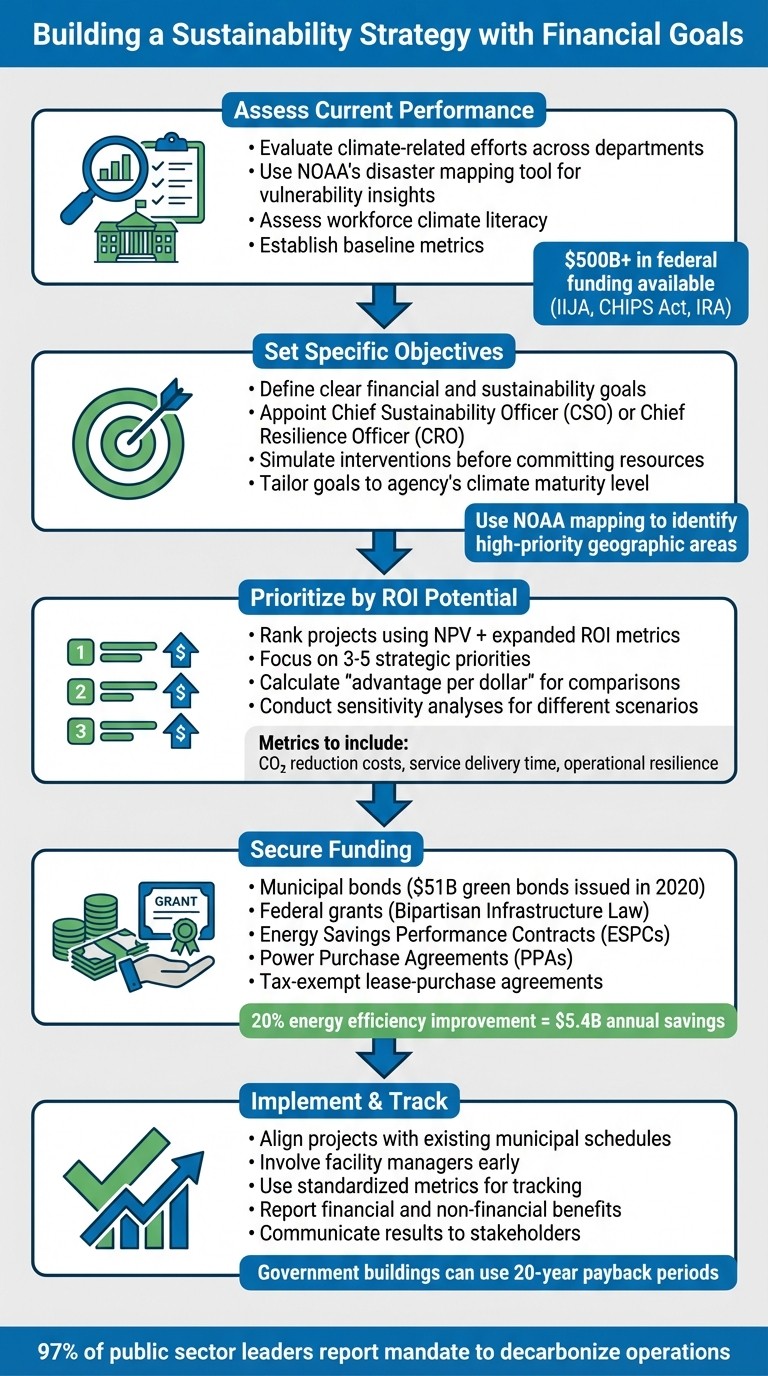
5-Step Process to Build a Municipal Sustainability Strategy with ROI Alignment
Assess Your Current Sustainability Performance
Start by evaluating your agency’s current climate-related efforts and identifying financial risks and opportunities. Go beyond standard energy or emissions audits to get a broader picture. Ask yourself: is your agency operating through scattered, grassroots initiatives, or are climate considerations fully integrated across departments? This analysis will help you determine whether you need a dedicated sustainability team or a more comprehensive cultural shift across the organization [1].
The federal government is allocating over $500 billion toward low-carbon initiatives through the Infrastructure Investment and Jobs Act, CHIPS Act, and Inflation Reduction Act [1]. Understanding your current performance can position your agency to access these funds more effectively.
Leverage data-driven tools to establish a baseline. For instance, NOAA’s interactive disaster mapping tool provides county-level insights into climate vulnerability, helping agencies visualize both physical risks and socioeconomic exposure [1].
Consider how climate impacts your specific operations. The U.S. Army, for example, developed a "Climate 101" course for installation planners and garrison commanders to address challenges like extreme temperatures and drought. Plans are in place to update all training modules by 2028 to include climate considerations [1]. Additionally, assess your workforce’s climate literacy, especially in departments like emergency response or facilities planning, where knowledge gaps could hinder progress [1].
Once you’ve established a clear baseline, the next step is to convert these insights into actionable goals and measurable targets.
Set Specific Objectives and Financial Targets
Using your performance assessment as a foundation, define clear financial and sustainability goals. Each objective should demonstrate how sustainability investments can deliver a return on investment (ROI) for public agencies. Translate your findings into measurable targets that balance environmental benefits with financial outcomes.
Strengthen leadership by appointing a Chief Sustainability Officer (CSO) or Chief Resilience Officer (CRO) who can oversee resource allocation across the organization. These roles have evolved from simply tracking compliance to driving meaningful change [1]. A CSO should act as a coordinator, ensuring cross-departmental alignment rather than just monitoring progress.
Before committing resources, simulate potential interventions to evaluate both carbon reduction and financial impacts. High-fidelity simulations can help avoid costly missteps by revealing what works - and what doesn’t - in practice [1].
Tailor your goals to your agency’s level of climate maturity. If you have a dedicated sustainability team, focus on performance tracking and setting up incentive structures. If your agency has fully integrated sustainability into its operations, prioritize fostering a supportive culture and encouraging ongoing improvement [1].
Federal mapping tools like NOAA’s platform can help identify high-priority areas. By visualizing communities most at risk, agencies can set geographic priorities that maximize financial returns while delivering meaningful benefits to those communities [1].
Prioritize Projects by ROI Potential
Rank your projects based on their expected ROI, using a mix of financial and broader public sector metrics. Start with net present value (NPV) as your foundation, and supplement it with factors like operational resilience, environmental outcomes, and social impact. McKinsey & Company highlights the importance of this expanded ROI approach for public sector agencies, which often lack traditional financial metrics to evaluate investments:
"For public sector organizations that often lack clear financial metrics for evaluating the ROI of investment decisions, an expanded ROI approach can be particularly valuable" [3].
Focus on three to five strategic priorities that align with your agency’s mission - whether it’s decarbonization goals, improved service reliability, or stronger community engagement. Identify metrics that reflect these priorities, such as dollars saved per metric ton of CO₂ reduced or average service delivery time [3].
Use tools like the "advantage per dollar" metric to compare projects with different cost structures. This approach can justify higher upfront costs for sustainable technologies by highlighting their long-term benefits. For example, while solar installations may cost more initially than traditional grid power, this metric can demonstrate added value from energy independence, reduced maintenance, and lower carbon costs.
Factor in climate-related risks when ranking projects. With extreme weather events becoming more frequent - heat-related incidents now claim more lives in the U.S. than any other weather phenomenon - cities are even appointing specialized “Chief Heat Officers” to manage these challenges [1].
Lastly, conduct sensitivity analyses on investment models to understand how changes in macroeconomic conditions or regulations might affect ROI. This can help identify which projects remain viable under different scenarios. Use these findings to phase implementation, balancing service availability with upfront cost management [3].
Financing and Executing Sustainability Projects
Aligning funding with sustainability goals ensures every dollar contributes to measurable returns.
Available Funding Options for Municipalities
Municipalities have access to a variety of funding sources that help protect their operating budgets. Municipal bonds are a key option, offering tax-exempt rates for infrastructure projects. In 2020, the U.S. issued $51 billion in green bonds, contributing to a global market that reached $1 trillion that year [5].
Federal grants also play a vital role. The Bipartisan Infrastructure Law, for instance, provides funding for projects focused on climate mitigation, resilience, and waste reduction [6]. A unique funding avenue, Community Project Requests (earmarks), allows municipalities to submit proposals directly to their Congressional representatives instead of federal agencies. Dante Moreno, Legislative Manager at the National League of Cities, explains:
Unlike a regular grant application, which are submitted to federal agencies, cities submit a project proposal directly to their Senators and respective House Member [7].
Each House Member typically accepts up to 15 requests per fiscal year, with application windows generally open from January to March [7].
For municipalities looking to avoid significant upfront costs, Energy Savings Performance Contracts (ESPCs) offer a solution. Partnering with an Energy Service Company (ESCO), municipalities can fund improvements upfront and repay costs through energy savings [8]. Similarly, Power Purchase Agreements (PPAs) allow third-party developers to install and own renewable energy systems on municipal property, with agencies purchasing power at fixed rates [8]. Another option, tax-exempt lease-purchase agreements, enables agencies to pay for equipment using annual operating revenues instead of capital budgets, often bypassing voter approval due to non-appropriation clauses [8].
The potential for savings is immense. State and local government buildings use nearly 2.9 quadrillion Btus of energy annually. Improving energy efficiency by just 20% could save $5.4 billion annually in avoided energy costs [8].
Advanced Financing Methods
Specialized tools can further enhance funding for sustainability projects. State Infrastructure Banks (SIBs) and Clean Water State Revolving Funds (CWSRF) offer below-market interest rates, loan guarantees, and debt refinancing for water and environmental projects [9][10]. For transportation projects, the TIFIA program provides federal credit assistance, covering up to 49% of project costs through July 2025 [10].
Tax Increment Financing (TIF) is another effective tool, capturing increased property tax revenue from improvements in a designated area to fund projects. This method works particularly well for projects that raise local property values [10]. Additionally, municipalities can explore asset concessions, leasing underutilized public assets like parking garages or fiber networks to private partners. Indianapolis, for example, generated $20 million upfront and up to $600 million in revenue through such agreements, while Mesa's fiber network licenses bring in $22–$25 million annually [10].
Project bundling is another strategic approach, consolidating upgrades across multiple facilities to overcome administrative costs and minimum investment thresholds. Vermont's Municipal Bond Bank, for example, issued $38 million in bonds to fund 19 local loans, including a $3 million loan to replace an oil boiler with a biomass-powered system in the St. Johnsbury School District [5]. Bundling smaller projects into a single package can make them financially viable while delivering broader savings [8].
When choosing financing options, consider factors like funding availability, flexibility, budget impact, administrative requirements, and state-specific legal constraints [9]. Designing projects with multiple benefits - such as combining green infrastructure with transportation upgrades - can also unlock funding from various sources, including DOT TIGER grants and FEMA Hazard Mitigation programs [9].
Project Implementation Best Practices
Once funding is in place, effective execution becomes critical. Coordinating across departments and aligning projects with existing municipal schedules can significantly reduce costs. For example, installing bioswales during planned sidewalk repairs or integrating green infrastructure into scheduled street work allows for shared budgeting [9]. The Los Angeles Bureau of Street Services and Bureau of Sanitation demonstrated this with the Oros Street project, combining bio-retention areas and an infiltration basin through inter-agency cost-sharing for a $1 million investment [9].
Involving facility managers and sustainability teams early ensures high-impact upgrades are identified. King County, Washington, established the Fund to Reduce Energy Demand (FRED), where bonds issued by the budget office fund equipment upgrades. Utility bill savings then repay the bonds, maintaining neutral or positive cash flow [8]. Similarly, the District of Columbia Department of General Services partnered with Sol Systems through a Power Purchase Agreement to complete one of the largest onsite solar projects in the U.S. within 12 months, spanning 35 facilities [8].
When introducing new revenue models like stormwater utility fees, public support is essential. Orlando, Florida, successfully implemented such a fee by tying it directly to local concerns about flooding and water quality [9]. Philadelphia's "Green City, Clean Waters" program showcases the long-term benefits of this approach, with projected savings of $8 billion over 25 years compared to traditional infrastructure methods [9].
Given that government buildings rarely change ownership, municipalities can adopt longer payback periods - sometimes up to 20 years - for sustainability investments [8]. For ESPCs, include performance guarantees to ensure ESCOs are paid from energy savings, transferring technical and performance risks away from the agency [8]. When issuing green bonds, work with bond counsel early to align projects with frameworks like the ICMA Green Bond Principles, ensuring credibility and attracting institutional investors [5].
Tracking, Reporting, and Sharing ROI Results
To showcase the impact of sustainability investments, organizations must prioritize consistent tracking and transparent communication with stakeholders.
Create a System to Monitor Performance
Building an effective tracking system begins with Net Present Value (NPV) as a core financial measure. However, public agencies should expand their focus to include additional factors like operational resilience, service enhancements, and environmental outcomes.
To make comparisons across diverse projects, standardize metrics into a unified scoring system. For instance, you can translate carbon reductions, cost savings, and service reliability into scores that align with your agency's priorities. One chemicals company applied this method to evaluate around 300 capital improvement projects, redirecting over 50% of its spending toward initiatives that boosted both profitability and sustainability goals [3]. Calculating "advantage per dollar" metrics can also help justify higher upfront costs for sustainable technologies [3].
Conducting sensitivity analyses is another key step to prepare for potential shifts, such as regulatory updates or energy price changes, that could influence long-term ROI [3].
This consolidated tracking data lays the groundwork for clear reporting on both financial and operational outcomes.
Report Financial and Non-Financial Benefits
Effective reporting focuses on material information that directly impacts decision-making. As outlined in the UK Government Sustainability Reporting Guidance:
Information is material if omitting, misstating, or obscuring it could reasonably influence decisions of primary users of annual reports and accounts [12].
To make data more relatable, use intensity metrics - for example, report energy savings per employee (FTE) or per square foot of building space instead of providing only total figures [12]. Ensure that sustainability reporting boundaries match financial reporting boundaries [11]. When discussing greenhouse gas emissions, use the standard metric of Carbon Dioxide Equivalent (CO2e) in metric tons [11].
Providing three to five years of historical data helps illustrate performance trends over time [12]. Clearly differentiate between "aspirational goals" and "budgeted targets" to foster trust with stakeholders [12]. Engage Audit Committees in materiality assessments to ensure data accuracy and support sound decision-making [11].
Clear and reliable reporting builds the foundation for effectively sharing results with diverse audiences.
Communicate Results to Build Support
Tailor your communication to resonate with different stakeholder groups. For projects with significant upfront costs but notable non-financial benefits, use an "advantage per dollar" metric to highlight the broader value of these investments [3]. Show how sustainability outcomes align with your agency's strategic goals, emphasizing how green initiatives support the core mission [12].
Consistency in data collection and reporting - ideally aligned with the fiscal year - enables year-over-year performance comparisons [12]. When presenting results, include context such as benchmarks, trends, or targets to help stakeholders assess progress [12]. Be transparent about reporting boundaries, clarifying whether your analysis covers only direct operations or extends to broader impacts, like local economic effects [12].
As McKinsey & Company explains:
Net present value is the bedrock of ROI estimates, but adding other factors to the analyses can help business leaders see how projects can advance corporate priorities beyond financial returns [3].
Conclusion
Developing a sustainability strategy that aligns with return on investment (ROI) can reshape municipal operations while delivering clear financial benefits. Recent findings highlight that such strategies not only enhance mission resilience but also cut operational expenses [2].
To move forward, agencies should expand beyond traditional net present value (NPV) calculations and adopt a broader ROI framework. This approach integrates factors like operational resilience, social responsibility, and innovation alongside financial metrics. By doing so, agencies can justify investments that provide long-term strategic advantages and support priorities that extend beyond monetary gains.
Leadership plays a central role in driving this transformation. With 97% of public sector leaders reporting a mandate to decarbonize at least one aspect of their operations [2], the need for dedicated sustainability officers is more pressing than ever. These leaders, supported by centralized teams, climate-savvy workforces, and AI-powered decision-making tools, can shift agencies from relying on intuition to making evidence-based investments. Such leadership is vital to fully leverage the substantial federal funding opportunities available.
In addition to leadership, strong financial backing is essential. Over $500 billion in federal funding is accessible through initiatives like the IIJA, CHIPS Act, and IRA to support climate resilience and low-carbon transitions over the next decade [1][2]. However, only 15% of agencies bypass routine executive reviews of sustainability progress [2], revealing a critical gap that could limit the effectiveness of these investments. Addressing this oversight is key to maximizing the impact of available resources.
FAQs
How do we calculate ROI for resilience and social benefits?
When evaluating the return on investment (ROI) for resilience and social initiatives, the process involves assigning measurable values to the costs and benefits of efforts like climate resilience strategies, infrastructure projects, and social impact programs. To achieve this, tools such as life cycle cost assessments, economic decision guides, and triple bottom line frameworks are employed. These tools integrate environmental, social, and economic considerations, offering a thorough analysis that captures the broader value of these initiatives.
Which sustainability projects should we fund first?
To make the most of sustainability efforts, focus on projects that offer the best return on investment (ROI) while aligning with broader environmental and social objectives. Prioritize initiatives that take advantage of financial incentives, such as tax credits or grants, to help offset costs. For example, investing in solar energy, wind power, or energy efficiency improvements can deliver both economic and environmental benefits.
Projects that clearly demonstrate environmental advantages - like cutting emissions or conserving water - are especially impactful. Additionally, aligning these efforts with federal funding opportunities not only enhances access to resources but also amplifies the positive effects on the community.
What’s the fastest way to pay for projects without upfront capital?
The quickest route to funding projects without needing upfront capital lies in leveraging government incentives, tax credits, grants, and modern financing tools. Approaches such as municipal bonds, tax-increment financing, or public-private partnerships can significantly lower initial expenses while improving return on investment. These methods are designed specifically for public sector requirements, ensuring they align with both sustainability efforts and financial objectives.
Related Blog Posts
Latest Articles
©2025



FAQ
01
What does it really mean to “redefine profit”?
02
What makes Council Fire different?
03
Who does Council Fire you work with?
04
What does working with Council Fire actually look like?
05
How does Council Fire help organizations turn big goals into action?
06
How does Council Fire define and measure success?
Feb 18, 2026
How to Build a Corporate Sustainability Strategy Aligned to ROI for Municipalities & Government Agencies
Sustainability Strategy
In This Article
Practical steps for municipalities and government agencies to align sustainability projects with measurable financial returns, secure funding, and report ROI.
How to Build a Corporate Sustainability Strategy Aligned to ROI for Municipalities & Government Agencies
Municipalities and government agencies are increasingly tasked with addressing climate challenges while maintaining fiscal accountability. Over $500 billion in U.S. federal funding is available for climate resilience and low-carbon initiatives, making it vital to connect environmental goals with measurable financial returns. This article explains how agencies can build strategies that balance financial, social, and environmental outcomes, ensuring long-term benefits and public support.
Key Takeaways:
ROI for Public Sector: Broader than private ROI, it includes economic savings, social impact, and service reliability.
Challenges: Budget constraints, fragmented governance, and lack of tracking tools hinder progress.
Metrics to Measure ROI: Focus on environmental savings, operational efficiency, and social benefits.
Funding Options: Municipal bonds, federal grants, energy savings contracts, and tax-exempt leases.
Execution Tips: Align projects with existing schedules, use data-driven tools, and prioritize high-ROI initiatives.
This guide also covers how to set financial goals, secure funding, and communicate results effectively to stakeholders. By integrating these steps, agencies can maximize the impact of their efforts while maintaining fiscal responsibility.
How to Measure Sustainability ROI in Government
What ROI Means for Public Sector Sustainability
In the public sector, return on investment (ROI) takes on a broader meaning compared to the private sector. While businesses prioritize profit margins and shareholder returns, government agencies must weigh economic, environmental, and social outcomes together. Traditional financial tools like net present value (NPV) are still relevant but fall short of capturing elements like community resilience, service reliability, and long-term regulatory compliance.
McKinsey research highlights this distinction:
For public sector organizations that often lack clear financial metrics for evaluating the ROI of investment decisions, an expanded ROI approach can be particularly valuable [3].
This expanded approach goes beyond standard financial analysis by incorporating performance indicators such as operational resilience, sustainability outcomes, and social impact. For instance, when assessing a green roof project, agencies should account for not just energy savings but also improved stormwater management and the creation of local jobs. By including these broader metrics, government entities can justify sustainable investments with tangible financial and community benefits.
Metrics for Tracking ROI
To effectively measure this broader ROI, municipalities need to adopt precise metrics that reflect the diverse advantages of their initiatives. These metrics can be grouped into three main categories:
Environmental metrics: Dollars saved per metric ton of CO₂ reduced, water conserved, or energy efficiency gains.
Operational metrics: Improvements in service delivery times and infrastructure reliability.
Social metrics: Community engagement levels, workforce diversity, and public health improvements.
The "advantage-per-dollar" approach has gained traction, enabling agencies to justify higher upfront costs by demonstrating superior long-term benefits. This method emphasizes the value derived per dollar spent, helping decision-makers prioritize sustainable investments [3].
Examples of Measured ROI in Municipalities
Real-world examples illustrate how these metrics translate into actionable public benefits. A notable case is the Water Research Foundation's $398,592 investment in a Triple Bottom Line (TBL) framework, which facilitated the quantification of benefits like reduced flooding, improved air quality, and job creation [4]. Green infrastructure projects, in particular, showcase how sustainability efforts can yield measurable co-benefits. These initiatives not only beautify neighborhoods but also reduce flooding risks, enhance climate resilience, improve air quality, lower rates of respiratory and heat-related illnesses, and generate local employment opportunities.
As the Water Research Foundation explains:
There is a need to better quantify and monetize these benefits through a triple bottom line (TBL) approach [4].
How to Demonstrate ROI of Sustainability Initiatives - Recording May 2025
How to Build a Sustainability Strategy with Financial Goals
5-Step Process to Build a Municipal Sustainability Strategy with ROI Alignment
Assess Your Current Sustainability Performance
Start by evaluating your agency’s current climate-related efforts and identifying financial risks and opportunities. Go beyond standard energy or emissions audits to get a broader picture. Ask yourself: is your agency operating through scattered, grassroots initiatives, or are climate considerations fully integrated across departments? This analysis will help you determine whether you need a dedicated sustainability team or a more comprehensive cultural shift across the organization [1].
The federal government is allocating over $500 billion toward low-carbon initiatives through the Infrastructure Investment and Jobs Act, CHIPS Act, and Inflation Reduction Act [1]. Understanding your current performance can position your agency to access these funds more effectively.
Leverage data-driven tools to establish a baseline. For instance, NOAA’s interactive disaster mapping tool provides county-level insights into climate vulnerability, helping agencies visualize both physical risks and socioeconomic exposure [1].
Consider how climate impacts your specific operations. The U.S. Army, for example, developed a "Climate 101" course for installation planners and garrison commanders to address challenges like extreme temperatures and drought. Plans are in place to update all training modules by 2028 to include climate considerations [1]. Additionally, assess your workforce’s climate literacy, especially in departments like emergency response or facilities planning, where knowledge gaps could hinder progress [1].
Once you’ve established a clear baseline, the next step is to convert these insights into actionable goals and measurable targets.
Set Specific Objectives and Financial Targets
Using your performance assessment as a foundation, define clear financial and sustainability goals. Each objective should demonstrate how sustainability investments can deliver a return on investment (ROI) for public agencies. Translate your findings into measurable targets that balance environmental benefits with financial outcomes.
Strengthen leadership by appointing a Chief Sustainability Officer (CSO) or Chief Resilience Officer (CRO) who can oversee resource allocation across the organization. These roles have evolved from simply tracking compliance to driving meaningful change [1]. A CSO should act as a coordinator, ensuring cross-departmental alignment rather than just monitoring progress.
Before committing resources, simulate potential interventions to evaluate both carbon reduction and financial impacts. High-fidelity simulations can help avoid costly missteps by revealing what works - and what doesn’t - in practice [1].
Tailor your goals to your agency’s level of climate maturity. If you have a dedicated sustainability team, focus on performance tracking and setting up incentive structures. If your agency has fully integrated sustainability into its operations, prioritize fostering a supportive culture and encouraging ongoing improvement [1].
Federal mapping tools like NOAA’s platform can help identify high-priority areas. By visualizing communities most at risk, agencies can set geographic priorities that maximize financial returns while delivering meaningful benefits to those communities [1].
Prioritize Projects by ROI Potential
Rank your projects based on their expected ROI, using a mix of financial and broader public sector metrics. Start with net present value (NPV) as your foundation, and supplement it with factors like operational resilience, environmental outcomes, and social impact. McKinsey & Company highlights the importance of this expanded ROI approach for public sector agencies, which often lack traditional financial metrics to evaluate investments:
"For public sector organizations that often lack clear financial metrics for evaluating the ROI of investment decisions, an expanded ROI approach can be particularly valuable" [3].
Focus on three to five strategic priorities that align with your agency’s mission - whether it’s decarbonization goals, improved service reliability, or stronger community engagement. Identify metrics that reflect these priorities, such as dollars saved per metric ton of CO₂ reduced or average service delivery time [3].
Use tools like the "advantage per dollar" metric to compare projects with different cost structures. This approach can justify higher upfront costs for sustainable technologies by highlighting their long-term benefits. For example, while solar installations may cost more initially than traditional grid power, this metric can demonstrate added value from energy independence, reduced maintenance, and lower carbon costs.
Factor in climate-related risks when ranking projects. With extreme weather events becoming more frequent - heat-related incidents now claim more lives in the U.S. than any other weather phenomenon - cities are even appointing specialized “Chief Heat Officers” to manage these challenges [1].
Lastly, conduct sensitivity analyses on investment models to understand how changes in macroeconomic conditions or regulations might affect ROI. This can help identify which projects remain viable under different scenarios. Use these findings to phase implementation, balancing service availability with upfront cost management [3].
Financing and Executing Sustainability Projects
Aligning funding with sustainability goals ensures every dollar contributes to measurable returns.
Available Funding Options for Municipalities
Municipalities have access to a variety of funding sources that help protect their operating budgets. Municipal bonds are a key option, offering tax-exempt rates for infrastructure projects. In 2020, the U.S. issued $51 billion in green bonds, contributing to a global market that reached $1 trillion that year [5].
Federal grants also play a vital role. The Bipartisan Infrastructure Law, for instance, provides funding for projects focused on climate mitigation, resilience, and waste reduction [6]. A unique funding avenue, Community Project Requests (earmarks), allows municipalities to submit proposals directly to their Congressional representatives instead of federal agencies. Dante Moreno, Legislative Manager at the National League of Cities, explains:
Unlike a regular grant application, which are submitted to federal agencies, cities submit a project proposal directly to their Senators and respective House Member [7].
Each House Member typically accepts up to 15 requests per fiscal year, with application windows generally open from January to March [7].
For municipalities looking to avoid significant upfront costs, Energy Savings Performance Contracts (ESPCs) offer a solution. Partnering with an Energy Service Company (ESCO), municipalities can fund improvements upfront and repay costs through energy savings [8]. Similarly, Power Purchase Agreements (PPAs) allow third-party developers to install and own renewable energy systems on municipal property, with agencies purchasing power at fixed rates [8]. Another option, tax-exempt lease-purchase agreements, enables agencies to pay for equipment using annual operating revenues instead of capital budgets, often bypassing voter approval due to non-appropriation clauses [8].
The potential for savings is immense. State and local government buildings use nearly 2.9 quadrillion Btus of energy annually. Improving energy efficiency by just 20% could save $5.4 billion annually in avoided energy costs [8].
Advanced Financing Methods
Specialized tools can further enhance funding for sustainability projects. State Infrastructure Banks (SIBs) and Clean Water State Revolving Funds (CWSRF) offer below-market interest rates, loan guarantees, and debt refinancing for water and environmental projects [9][10]. For transportation projects, the TIFIA program provides federal credit assistance, covering up to 49% of project costs through July 2025 [10].
Tax Increment Financing (TIF) is another effective tool, capturing increased property tax revenue from improvements in a designated area to fund projects. This method works particularly well for projects that raise local property values [10]. Additionally, municipalities can explore asset concessions, leasing underutilized public assets like parking garages or fiber networks to private partners. Indianapolis, for example, generated $20 million upfront and up to $600 million in revenue through such agreements, while Mesa's fiber network licenses bring in $22–$25 million annually [10].
Project bundling is another strategic approach, consolidating upgrades across multiple facilities to overcome administrative costs and minimum investment thresholds. Vermont's Municipal Bond Bank, for example, issued $38 million in bonds to fund 19 local loans, including a $3 million loan to replace an oil boiler with a biomass-powered system in the St. Johnsbury School District [5]. Bundling smaller projects into a single package can make them financially viable while delivering broader savings [8].
When choosing financing options, consider factors like funding availability, flexibility, budget impact, administrative requirements, and state-specific legal constraints [9]. Designing projects with multiple benefits - such as combining green infrastructure with transportation upgrades - can also unlock funding from various sources, including DOT TIGER grants and FEMA Hazard Mitigation programs [9].
Project Implementation Best Practices
Once funding is in place, effective execution becomes critical. Coordinating across departments and aligning projects with existing municipal schedules can significantly reduce costs. For example, installing bioswales during planned sidewalk repairs or integrating green infrastructure into scheduled street work allows for shared budgeting [9]. The Los Angeles Bureau of Street Services and Bureau of Sanitation demonstrated this with the Oros Street project, combining bio-retention areas and an infiltration basin through inter-agency cost-sharing for a $1 million investment [9].
Involving facility managers and sustainability teams early ensures high-impact upgrades are identified. King County, Washington, established the Fund to Reduce Energy Demand (FRED), where bonds issued by the budget office fund equipment upgrades. Utility bill savings then repay the bonds, maintaining neutral or positive cash flow [8]. Similarly, the District of Columbia Department of General Services partnered with Sol Systems through a Power Purchase Agreement to complete one of the largest onsite solar projects in the U.S. within 12 months, spanning 35 facilities [8].
When introducing new revenue models like stormwater utility fees, public support is essential. Orlando, Florida, successfully implemented such a fee by tying it directly to local concerns about flooding and water quality [9]. Philadelphia's "Green City, Clean Waters" program showcases the long-term benefits of this approach, with projected savings of $8 billion over 25 years compared to traditional infrastructure methods [9].
Given that government buildings rarely change ownership, municipalities can adopt longer payback periods - sometimes up to 20 years - for sustainability investments [8]. For ESPCs, include performance guarantees to ensure ESCOs are paid from energy savings, transferring technical and performance risks away from the agency [8]. When issuing green bonds, work with bond counsel early to align projects with frameworks like the ICMA Green Bond Principles, ensuring credibility and attracting institutional investors [5].
Tracking, Reporting, and Sharing ROI Results
To showcase the impact of sustainability investments, organizations must prioritize consistent tracking and transparent communication with stakeholders.
Create a System to Monitor Performance
Building an effective tracking system begins with Net Present Value (NPV) as a core financial measure. However, public agencies should expand their focus to include additional factors like operational resilience, service enhancements, and environmental outcomes.
To make comparisons across diverse projects, standardize metrics into a unified scoring system. For instance, you can translate carbon reductions, cost savings, and service reliability into scores that align with your agency's priorities. One chemicals company applied this method to evaluate around 300 capital improvement projects, redirecting over 50% of its spending toward initiatives that boosted both profitability and sustainability goals [3]. Calculating "advantage per dollar" metrics can also help justify higher upfront costs for sustainable technologies [3].
Conducting sensitivity analyses is another key step to prepare for potential shifts, such as regulatory updates or energy price changes, that could influence long-term ROI [3].
This consolidated tracking data lays the groundwork for clear reporting on both financial and operational outcomes.
Report Financial and Non-Financial Benefits
Effective reporting focuses on material information that directly impacts decision-making. As outlined in the UK Government Sustainability Reporting Guidance:
Information is material if omitting, misstating, or obscuring it could reasonably influence decisions of primary users of annual reports and accounts [12].
To make data more relatable, use intensity metrics - for example, report energy savings per employee (FTE) or per square foot of building space instead of providing only total figures [12]. Ensure that sustainability reporting boundaries match financial reporting boundaries [11]. When discussing greenhouse gas emissions, use the standard metric of Carbon Dioxide Equivalent (CO2e) in metric tons [11].
Providing three to five years of historical data helps illustrate performance trends over time [12]. Clearly differentiate between "aspirational goals" and "budgeted targets" to foster trust with stakeholders [12]. Engage Audit Committees in materiality assessments to ensure data accuracy and support sound decision-making [11].
Clear and reliable reporting builds the foundation for effectively sharing results with diverse audiences.
Communicate Results to Build Support
Tailor your communication to resonate with different stakeholder groups. For projects with significant upfront costs but notable non-financial benefits, use an "advantage per dollar" metric to highlight the broader value of these investments [3]. Show how sustainability outcomes align with your agency's strategic goals, emphasizing how green initiatives support the core mission [12].
Consistency in data collection and reporting - ideally aligned with the fiscal year - enables year-over-year performance comparisons [12]. When presenting results, include context such as benchmarks, trends, or targets to help stakeholders assess progress [12]. Be transparent about reporting boundaries, clarifying whether your analysis covers only direct operations or extends to broader impacts, like local economic effects [12].
As McKinsey & Company explains:
Net present value is the bedrock of ROI estimates, but adding other factors to the analyses can help business leaders see how projects can advance corporate priorities beyond financial returns [3].
Conclusion
Developing a sustainability strategy that aligns with return on investment (ROI) can reshape municipal operations while delivering clear financial benefits. Recent findings highlight that such strategies not only enhance mission resilience but also cut operational expenses [2].
To move forward, agencies should expand beyond traditional net present value (NPV) calculations and adopt a broader ROI framework. This approach integrates factors like operational resilience, social responsibility, and innovation alongside financial metrics. By doing so, agencies can justify investments that provide long-term strategic advantages and support priorities that extend beyond monetary gains.
Leadership plays a central role in driving this transformation. With 97% of public sector leaders reporting a mandate to decarbonize at least one aspect of their operations [2], the need for dedicated sustainability officers is more pressing than ever. These leaders, supported by centralized teams, climate-savvy workforces, and AI-powered decision-making tools, can shift agencies from relying on intuition to making evidence-based investments. Such leadership is vital to fully leverage the substantial federal funding opportunities available.
In addition to leadership, strong financial backing is essential. Over $500 billion in federal funding is accessible through initiatives like the IIJA, CHIPS Act, and IRA to support climate resilience and low-carbon transitions over the next decade [1][2]. However, only 15% of agencies bypass routine executive reviews of sustainability progress [2], revealing a critical gap that could limit the effectiveness of these investments. Addressing this oversight is key to maximizing the impact of available resources.
FAQs
How do we calculate ROI for resilience and social benefits?
When evaluating the return on investment (ROI) for resilience and social initiatives, the process involves assigning measurable values to the costs and benefits of efforts like climate resilience strategies, infrastructure projects, and social impact programs. To achieve this, tools such as life cycle cost assessments, economic decision guides, and triple bottom line frameworks are employed. These tools integrate environmental, social, and economic considerations, offering a thorough analysis that captures the broader value of these initiatives.
Which sustainability projects should we fund first?
To make the most of sustainability efforts, focus on projects that offer the best return on investment (ROI) while aligning with broader environmental and social objectives. Prioritize initiatives that take advantage of financial incentives, such as tax credits or grants, to help offset costs. For example, investing in solar energy, wind power, or energy efficiency improvements can deliver both economic and environmental benefits.
Projects that clearly demonstrate environmental advantages - like cutting emissions or conserving water - are especially impactful. Additionally, aligning these efforts with federal funding opportunities not only enhances access to resources but also amplifies the positive effects on the community.
What’s the fastest way to pay for projects without upfront capital?
The quickest route to funding projects without needing upfront capital lies in leveraging government incentives, tax credits, grants, and modern financing tools. Approaches such as municipal bonds, tax-increment financing, or public-private partnerships can significantly lower initial expenses while improving return on investment. These methods are designed specifically for public sector requirements, ensuring they align with both sustainability efforts and financial objectives.
Related Blog Posts
FAQ
01
What does it really mean to “redefine profit”?
02
What makes Council Fire different?
03
Who does Council Fire you work with?
04
What does working with Council Fire actually look like?
05
How does Council Fire help organizations turn big goals into action?
06
How does Council Fire define and measure success?
Feb 18, 2026
How to Build a Corporate Sustainability Strategy Aligned to ROI for Municipalities & Government Agencies
Sustainability Strategy
In This Article
Practical steps for municipalities and government agencies to align sustainability projects with measurable financial returns, secure funding, and report ROI.
How to Build a Corporate Sustainability Strategy Aligned to ROI for Municipalities & Government Agencies
Municipalities and government agencies are increasingly tasked with addressing climate challenges while maintaining fiscal accountability. Over $500 billion in U.S. federal funding is available for climate resilience and low-carbon initiatives, making it vital to connect environmental goals with measurable financial returns. This article explains how agencies can build strategies that balance financial, social, and environmental outcomes, ensuring long-term benefits and public support.
Key Takeaways:
ROI for Public Sector: Broader than private ROI, it includes economic savings, social impact, and service reliability.
Challenges: Budget constraints, fragmented governance, and lack of tracking tools hinder progress.
Metrics to Measure ROI: Focus on environmental savings, operational efficiency, and social benefits.
Funding Options: Municipal bonds, federal grants, energy savings contracts, and tax-exempt leases.
Execution Tips: Align projects with existing schedules, use data-driven tools, and prioritize high-ROI initiatives.
This guide also covers how to set financial goals, secure funding, and communicate results effectively to stakeholders. By integrating these steps, agencies can maximize the impact of their efforts while maintaining fiscal responsibility.
How to Measure Sustainability ROI in Government
What ROI Means for Public Sector Sustainability
In the public sector, return on investment (ROI) takes on a broader meaning compared to the private sector. While businesses prioritize profit margins and shareholder returns, government agencies must weigh economic, environmental, and social outcomes together. Traditional financial tools like net present value (NPV) are still relevant but fall short of capturing elements like community resilience, service reliability, and long-term regulatory compliance.
McKinsey research highlights this distinction:
For public sector organizations that often lack clear financial metrics for evaluating the ROI of investment decisions, an expanded ROI approach can be particularly valuable [3].
This expanded approach goes beyond standard financial analysis by incorporating performance indicators such as operational resilience, sustainability outcomes, and social impact. For instance, when assessing a green roof project, agencies should account for not just energy savings but also improved stormwater management and the creation of local jobs. By including these broader metrics, government entities can justify sustainable investments with tangible financial and community benefits.
Metrics for Tracking ROI
To effectively measure this broader ROI, municipalities need to adopt precise metrics that reflect the diverse advantages of their initiatives. These metrics can be grouped into three main categories:
Environmental metrics: Dollars saved per metric ton of CO₂ reduced, water conserved, or energy efficiency gains.
Operational metrics: Improvements in service delivery times and infrastructure reliability.
Social metrics: Community engagement levels, workforce diversity, and public health improvements.
The "advantage-per-dollar" approach has gained traction, enabling agencies to justify higher upfront costs by demonstrating superior long-term benefits. This method emphasizes the value derived per dollar spent, helping decision-makers prioritize sustainable investments [3].
Examples of Measured ROI in Municipalities
Real-world examples illustrate how these metrics translate into actionable public benefits. A notable case is the Water Research Foundation's $398,592 investment in a Triple Bottom Line (TBL) framework, which facilitated the quantification of benefits like reduced flooding, improved air quality, and job creation [4]. Green infrastructure projects, in particular, showcase how sustainability efforts can yield measurable co-benefits. These initiatives not only beautify neighborhoods but also reduce flooding risks, enhance climate resilience, improve air quality, lower rates of respiratory and heat-related illnesses, and generate local employment opportunities.
As the Water Research Foundation explains:
There is a need to better quantify and monetize these benefits through a triple bottom line (TBL) approach [4].
How to Demonstrate ROI of Sustainability Initiatives - Recording May 2025
How to Build a Sustainability Strategy with Financial Goals
5-Step Process to Build a Municipal Sustainability Strategy with ROI Alignment
Assess Your Current Sustainability Performance
Start by evaluating your agency’s current climate-related efforts and identifying financial risks and opportunities. Go beyond standard energy or emissions audits to get a broader picture. Ask yourself: is your agency operating through scattered, grassroots initiatives, or are climate considerations fully integrated across departments? This analysis will help you determine whether you need a dedicated sustainability team or a more comprehensive cultural shift across the organization [1].
The federal government is allocating over $500 billion toward low-carbon initiatives through the Infrastructure Investment and Jobs Act, CHIPS Act, and Inflation Reduction Act [1]. Understanding your current performance can position your agency to access these funds more effectively.
Leverage data-driven tools to establish a baseline. For instance, NOAA’s interactive disaster mapping tool provides county-level insights into climate vulnerability, helping agencies visualize both physical risks and socioeconomic exposure [1].
Consider how climate impacts your specific operations. The U.S. Army, for example, developed a "Climate 101" course for installation planners and garrison commanders to address challenges like extreme temperatures and drought. Plans are in place to update all training modules by 2028 to include climate considerations [1]. Additionally, assess your workforce’s climate literacy, especially in departments like emergency response or facilities planning, where knowledge gaps could hinder progress [1].
Once you’ve established a clear baseline, the next step is to convert these insights into actionable goals and measurable targets.
Set Specific Objectives and Financial Targets
Using your performance assessment as a foundation, define clear financial and sustainability goals. Each objective should demonstrate how sustainability investments can deliver a return on investment (ROI) for public agencies. Translate your findings into measurable targets that balance environmental benefits with financial outcomes.
Strengthen leadership by appointing a Chief Sustainability Officer (CSO) or Chief Resilience Officer (CRO) who can oversee resource allocation across the organization. These roles have evolved from simply tracking compliance to driving meaningful change [1]. A CSO should act as a coordinator, ensuring cross-departmental alignment rather than just monitoring progress.
Before committing resources, simulate potential interventions to evaluate both carbon reduction and financial impacts. High-fidelity simulations can help avoid costly missteps by revealing what works - and what doesn’t - in practice [1].
Tailor your goals to your agency’s level of climate maturity. If you have a dedicated sustainability team, focus on performance tracking and setting up incentive structures. If your agency has fully integrated sustainability into its operations, prioritize fostering a supportive culture and encouraging ongoing improvement [1].
Federal mapping tools like NOAA’s platform can help identify high-priority areas. By visualizing communities most at risk, agencies can set geographic priorities that maximize financial returns while delivering meaningful benefits to those communities [1].
Prioritize Projects by ROI Potential
Rank your projects based on their expected ROI, using a mix of financial and broader public sector metrics. Start with net present value (NPV) as your foundation, and supplement it with factors like operational resilience, environmental outcomes, and social impact. McKinsey & Company highlights the importance of this expanded ROI approach for public sector agencies, which often lack traditional financial metrics to evaluate investments:
"For public sector organizations that often lack clear financial metrics for evaluating the ROI of investment decisions, an expanded ROI approach can be particularly valuable" [3].
Focus on three to five strategic priorities that align with your agency’s mission - whether it’s decarbonization goals, improved service reliability, or stronger community engagement. Identify metrics that reflect these priorities, such as dollars saved per metric ton of CO₂ reduced or average service delivery time [3].
Use tools like the "advantage per dollar" metric to compare projects with different cost structures. This approach can justify higher upfront costs for sustainable technologies by highlighting their long-term benefits. For example, while solar installations may cost more initially than traditional grid power, this metric can demonstrate added value from energy independence, reduced maintenance, and lower carbon costs.
Factor in climate-related risks when ranking projects. With extreme weather events becoming more frequent - heat-related incidents now claim more lives in the U.S. than any other weather phenomenon - cities are even appointing specialized “Chief Heat Officers” to manage these challenges [1].
Lastly, conduct sensitivity analyses on investment models to understand how changes in macroeconomic conditions or regulations might affect ROI. This can help identify which projects remain viable under different scenarios. Use these findings to phase implementation, balancing service availability with upfront cost management [3].
Financing and Executing Sustainability Projects
Aligning funding with sustainability goals ensures every dollar contributes to measurable returns.
Available Funding Options for Municipalities
Municipalities have access to a variety of funding sources that help protect their operating budgets. Municipal bonds are a key option, offering tax-exempt rates for infrastructure projects. In 2020, the U.S. issued $51 billion in green bonds, contributing to a global market that reached $1 trillion that year [5].
Federal grants also play a vital role. The Bipartisan Infrastructure Law, for instance, provides funding for projects focused on climate mitigation, resilience, and waste reduction [6]. A unique funding avenue, Community Project Requests (earmarks), allows municipalities to submit proposals directly to their Congressional representatives instead of federal agencies. Dante Moreno, Legislative Manager at the National League of Cities, explains:
Unlike a regular grant application, which are submitted to federal agencies, cities submit a project proposal directly to their Senators and respective House Member [7].
Each House Member typically accepts up to 15 requests per fiscal year, with application windows generally open from January to March [7].
For municipalities looking to avoid significant upfront costs, Energy Savings Performance Contracts (ESPCs) offer a solution. Partnering with an Energy Service Company (ESCO), municipalities can fund improvements upfront and repay costs through energy savings [8]. Similarly, Power Purchase Agreements (PPAs) allow third-party developers to install and own renewable energy systems on municipal property, with agencies purchasing power at fixed rates [8]. Another option, tax-exempt lease-purchase agreements, enables agencies to pay for equipment using annual operating revenues instead of capital budgets, often bypassing voter approval due to non-appropriation clauses [8].
The potential for savings is immense. State and local government buildings use nearly 2.9 quadrillion Btus of energy annually. Improving energy efficiency by just 20% could save $5.4 billion annually in avoided energy costs [8].
Advanced Financing Methods
Specialized tools can further enhance funding for sustainability projects. State Infrastructure Banks (SIBs) and Clean Water State Revolving Funds (CWSRF) offer below-market interest rates, loan guarantees, and debt refinancing for water and environmental projects [9][10]. For transportation projects, the TIFIA program provides federal credit assistance, covering up to 49% of project costs through July 2025 [10].
Tax Increment Financing (TIF) is another effective tool, capturing increased property tax revenue from improvements in a designated area to fund projects. This method works particularly well for projects that raise local property values [10]. Additionally, municipalities can explore asset concessions, leasing underutilized public assets like parking garages or fiber networks to private partners. Indianapolis, for example, generated $20 million upfront and up to $600 million in revenue through such agreements, while Mesa's fiber network licenses bring in $22–$25 million annually [10].
Project bundling is another strategic approach, consolidating upgrades across multiple facilities to overcome administrative costs and minimum investment thresholds. Vermont's Municipal Bond Bank, for example, issued $38 million in bonds to fund 19 local loans, including a $3 million loan to replace an oil boiler with a biomass-powered system in the St. Johnsbury School District [5]. Bundling smaller projects into a single package can make them financially viable while delivering broader savings [8].
When choosing financing options, consider factors like funding availability, flexibility, budget impact, administrative requirements, and state-specific legal constraints [9]. Designing projects with multiple benefits - such as combining green infrastructure with transportation upgrades - can also unlock funding from various sources, including DOT TIGER grants and FEMA Hazard Mitigation programs [9].
Project Implementation Best Practices
Once funding is in place, effective execution becomes critical. Coordinating across departments and aligning projects with existing municipal schedules can significantly reduce costs. For example, installing bioswales during planned sidewalk repairs or integrating green infrastructure into scheduled street work allows for shared budgeting [9]. The Los Angeles Bureau of Street Services and Bureau of Sanitation demonstrated this with the Oros Street project, combining bio-retention areas and an infiltration basin through inter-agency cost-sharing for a $1 million investment [9].
Involving facility managers and sustainability teams early ensures high-impact upgrades are identified. King County, Washington, established the Fund to Reduce Energy Demand (FRED), where bonds issued by the budget office fund equipment upgrades. Utility bill savings then repay the bonds, maintaining neutral or positive cash flow [8]. Similarly, the District of Columbia Department of General Services partnered with Sol Systems through a Power Purchase Agreement to complete one of the largest onsite solar projects in the U.S. within 12 months, spanning 35 facilities [8].
When introducing new revenue models like stormwater utility fees, public support is essential. Orlando, Florida, successfully implemented such a fee by tying it directly to local concerns about flooding and water quality [9]. Philadelphia's "Green City, Clean Waters" program showcases the long-term benefits of this approach, with projected savings of $8 billion over 25 years compared to traditional infrastructure methods [9].
Given that government buildings rarely change ownership, municipalities can adopt longer payback periods - sometimes up to 20 years - for sustainability investments [8]. For ESPCs, include performance guarantees to ensure ESCOs are paid from energy savings, transferring technical and performance risks away from the agency [8]. When issuing green bonds, work with bond counsel early to align projects with frameworks like the ICMA Green Bond Principles, ensuring credibility and attracting institutional investors [5].
Tracking, Reporting, and Sharing ROI Results
To showcase the impact of sustainability investments, organizations must prioritize consistent tracking and transparent communication with stakeholders.
Create a System to Monitor Performance
Building an effective tracking system begins with Net Present Value (NPV) as a core financial measure. However, public agencies should expand their focus to include additional factors like operational resilience, service enhancements, and environmental outcomes.
To make comparisons across diverse projects, standardize metrics into a unified scoring system. For instance, you can translate carbon reductions, cost savings, and service reliability into scores that align with your agency's priorities. One chemicals company applied this method to evaluate around 300 capital improvement projects, redirecting over 50% of its spending toward initiatives that boosted both profitability and sustainability goals [3]. Calculating "advantage per dollar" metrics can also help justify higher upfront costs for sustainable technologies [3].
Conducting sensitivity analyses is another key step to prepare for potential shifts, such as regulatory updates or energy price changes, that could influence long-term ROI [3].
This consolidated tracking data lays the groundwork for clear reporting on both financial and operational outcomes.
Report Financial and Non-Financial Benefits
Effective reporting focuses on material information that directly impacts decision-making. As outlined in the UK Government Sustainability Reporting Guidance:
Information is material if omitting, misstating, or obscuring it could reasonably influence decisions of primary users of annual reports and accounts [12].
To make data more relatable, use intensity metrics - for example, report energy savings per employee (FTE) or per square foot of building space instead of providing only total figures [12]. Ensure that sustainability reporting boundaries match financial reporting boundaries [11]. When discussing greenhouse gas emissions, use the standard metric of Carbon Dioxide Equivalent (CO2e) in metric tons [11].
Providing three to five years of historical data helps illustrate performance trends over time [12]. Clearly differentiate between "aspirational goals" and "budgeted targets" to foster trust with stakeholders [12]. Engage Audit Committees in materiality assessments to ensure data accuracy and support sound decision-making [11].
Clear and reliable reporting builds the foundation for effectively sharing results with diverse audiences.
Communicate Results to Build Support
Tailor your communication to resonate with different stakeholder groups. For projects with significant upfront costs but notable non-financial benefits, use an "advantage per dollar" metric to highlight the broader value of these investments [3]. Show how sustainability outcomes align with your agency's strategic goals, emphasizing how green initiatives support the core mission [12].
Consistency in data collection and reporting - ideally aligned with the fiscal year - enables year-over-year performance comparisons [12]. When presenting results, include context such as benchmarks, trends, or targets to help stakeholders assess progress [12]. Be transparent about reporting boundaries, clarifying whether your analysis covers only direct operations or extends to broader impacts, like local economic effects [12].
As McKinsey & Company explains:
Net present value is the bedrock of ROI estimates, but adding other factors to the analyses can help business leaders see how projects can advance corporate priorities beyond financial returns [3].
Conclusion
Developing a sustainability strategy that aligns with return on investment (ROI) can reshape municipal operations while delivering clear financial benefits. Recent findings highlight that such strategies not only enhance mission resilience but also cut operational expenses [2].
To move forward, agencies should expand beyond traditional net present value (NPV) calculations and adopt a broader ROI framework. This approach integrates factors like operational resilience, social responsibility, and innovation alongside financial metrics. By doing so, agencies can justify investments that provide long-term strategic advantages and support priorities that extend beyond monetary gains.
Leadership plays a central role in driving this transformation. With 97% of public sector leaders reporting a mandate to decarbonize at least one aspect of their operations [2], the need for dedicated sustainability officers is more pressing than ever. These leaders, supported by centralized teams, climate-savvy workforces, and AI-powered decision-making tools, can shift agencies from relying on intuition to making evidence-based investments. Such leadership is vital to fully leverage the substantial federal funding opportunities available.
In addition to leadership, strong financial backing is essential. Over $500 billion in federal funding is accessible through initiatives like the IIJA, CHIPS Act, and IRA to support climate resilience and low-carbon transitions over the next decade [1][2]. However, only 15% of agencies bypass routine executive reviews of sustainability progress [2], revealing a critical gap that could limit the effectiveness of these investments. Addressing this oversight is key to maximizing the impact of available resources.
FAQs
How do we calculate ROI for resilience and social benefits?
When evaluating the return on investment (ROI) for resilience and social initiatives, the process involves assigning measurable values to the costs and benefits of efforts like climate resilience strategies, infrastructure projects, and social impact programs. To achieve this, tools such as life cycle cost assessments, economic decision guides, and triple bottom line frameworks are employed. These tools integrate environmental, social, and economic considerations, offering a thorough analysis that captures the broader value of these initiatives.
Which sustainability projects should we fund first?
To make the most of sustainability efforts, focus on projects that offer the best return on investment (ROI) while aligning with broader environmental and social objectives. Prioritize initiatives that take advantage of financial incentives, such as tax credits or grants, to help offset costs. For example, investing in solar energy, wind power, or energy efficiency improvements can deliver both economic and environmental benefits.
Projects that clearly demonstrate environmental advantages - like cutting emissions or conserving water - are especially impactful. Additionally, aligning these efforts with federal funding opportunities not only enhances access to resources but also amplifies the positive effects on the community.
What’s the fastest way to pay for projects without upfront capital?
The quickest route to funding projects without needing upfront capital lies in leveraging government incentives, tax credits, grants, and modern financing tools. Approaches such as municipal bonds, tax-increment financing, or public-private partnerships can significantly lower initial expenses while improving return on investment. These methods are designed specifically for public sector requirements, ensuring they align with both sustainability efforts and financial objectives.
Related Blog Posts
FAQ
What does it really mean to “redefine profit”?
What makes Council Fire different?
Who does Council Fire you work with?
What does working with Council Fire actually look like?
How does Council Fire help organizations turn big goals into action?
How does Council Fire define and measure success?