
Feb 19, 2026
How to Build a Corporate Sustainability Strategy Aligned to ROI for Foundations & Philanthropic Organizations
Sustainability Strategy
In This Article
Six steps for foundations to align sustainability with ROI: audit, set SROI metrics, embed in operations, engage stakeholders, track data, and scale programs.
How to Build a Corporate Sustainability Strategy Aligned to ROI for Foundations & Philanthropic Organizations
Creating a sustainability strategy that aligns with ROI is essential for foundations and philanthropic organizations to achieve measurable social and financial outcomes. The approach requires integrating impact goals with financial performance, breaking down silos between grantmaking and asset management, and using data-driven tools to track progress. Here’s a quick guide to get started:
Step 1: Evaluate Current Efforts
Conduct a sustainability audit to assess inputs, outputs, outcomes, and impact. Identify misalignments and opportunities for improvement.
Step 2: Define ROI Metrics
Use frameworks like Social Return on Investment (SROI) to measure financial, social, and environmental impact. Focus on metrics that demonstrate value, such as cost savings, increased earnings, or avoided costs.
Step 3: Integrate into Operations
Align sustainability with organizational goals by involving finance teams and embedding initiatives into core processes.
Step 4: Engage Stakeholders
Shift to a multistakeholder approach, involving employees, grantees, and communities. Build capacity through workshops and partnerships.
Step 5: Use Data for Tracking
Implement tools like IRIS+ or AI-powered platforms for real-time monitoring and reporting. Ensure data is clean and actionable.
Step 6: Scale High-Impact Programs
Focus on initiatives that deliver consistent results. Use marginal SROI and investment scorecards to prioritize scaling efforts.
Key Takeaway: By aligning sustainability with ROI, organizations can maximize their impact while achieving financial returns. Start by evaluating current efforts, defining measurable metrics, and embedding sustainability across operations.
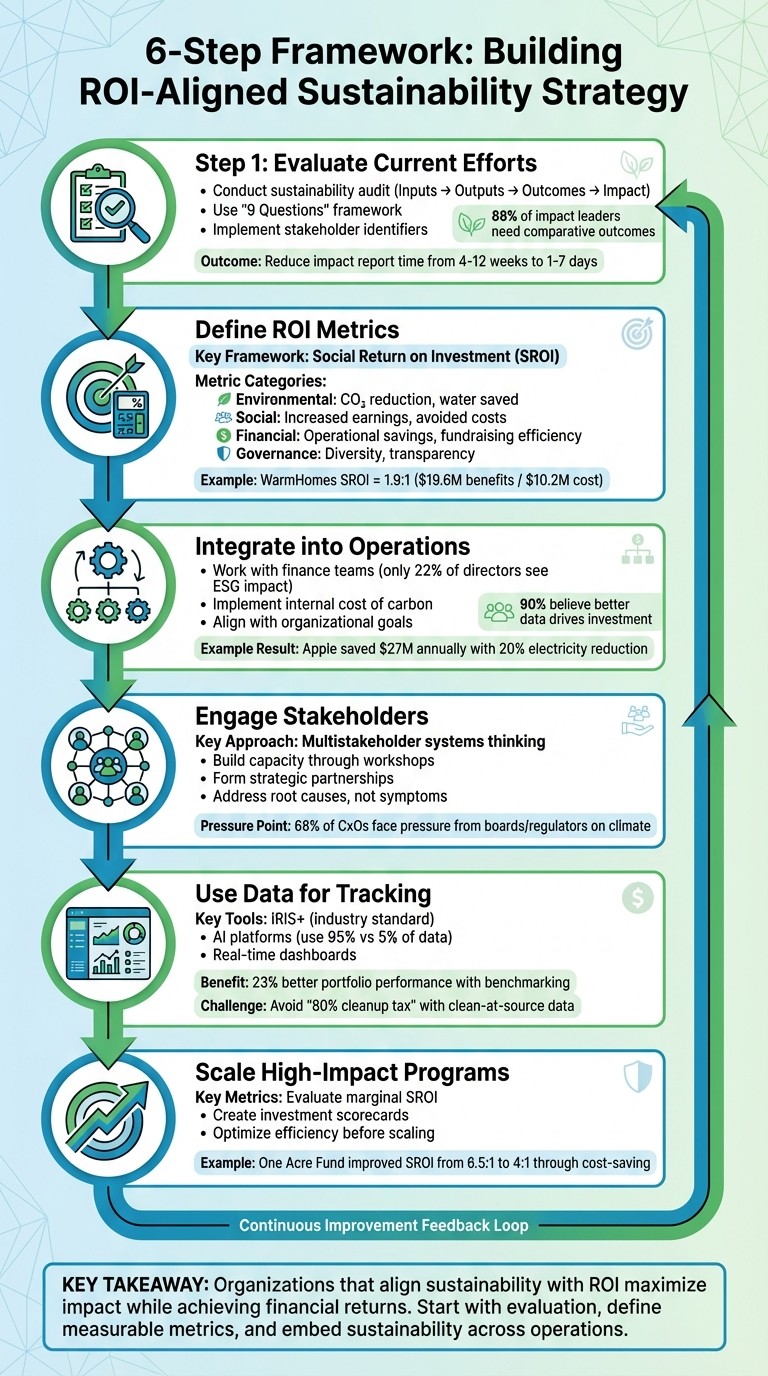
6-Step Framework for Building ROI-Aligned Corporate Sustainability Strategy
Designing the Sustainability Plan – How to score with donors
Step 1: Evaluate Your Current Sustainability Performance
Understanding where your sustainability efforts currently stand is the first step toward meaningful progress. As Melissa Berman, CEO of Rockefeller Philanthropy Advisors, aptly notes:
"If you don't know what kind of change you're trying to make, it's going to be hard to figure out if you're making any progress." [5]
Conduct a Sustainability Audit
Begin by examining your organization through four key layers: Inputs/Activities, Outputs, Outcomes, and Impact. The focus here should be on measurable change rather than just activity. For instance, training 500 people is an output, but the real outcome is when those individuals secure employment [6].
To establish a clear baseline, consider the "9 Questions" framework. These questions help define your goals, assess progress, and identify key metrics:
What problem are you addressing?
How will change occur, and how long will it take?
What resources are required, and what does success look like?
What signs will indicate progress, and how do grantees view these indicators?
Who else is tackling this issue, and how much are you investing in assessments? [5]
This approach ensures you're not overwhelmed by collecting data that lacks purpose or utility [4]. A robust baseline also sets the stage for tracking ROI metrics effectively.
Additionally, implement clear stakeholder identifiers during initial interactions - whether through applications, registrations, or surveys. This small but crucial step prevents fragmented data, saving time on manual cleanup and allowing for more insightful analysis [6]. Many organizations are now moving from static annual PDF reports to live dashboards that provide real-time updates. This shift has significantly reduced the time needed to produce initial impact reports, cutting it from 4–12 weeks to just 1–7 days [6].
Your audit findings will help uncover areas of misalignment and suggest where improvements can be made.
Identify Gaps and Opportunities
After completing your audit, analyze where your stated goals diverge from actual outcomes. For example, a scholarship program evaluation revealed that high-achieving students were deterred by a confusing financial aid process. In response, donors Enrique and Celeste adjusted their strategy, funding financial-aid counseling instead of just scholarships. This change led to a surge in applications and college enrollments [5].
Prioritize outcomes over activities - what truly matters is the impact of your efforts [7]. Tools like the "Philanthropic GPS" can help compare your strategy with actual performance, revealing any deviations that need correction [5]. Look for opportunities at three levels: individual grantees, the larger system or field, and your own organization as donors [8]. Pre-grant assessments can also be valuable for aligning with ROI goals early on [5].
Step 2: Define Measurable ROI Metrics
Once your audit is complete, the next step is to establish metrics that not only track performance but also quantify the broader impact of your sustainability efforts. This involves moving past simple activity counts to measure meaningful changes across environmental, social, and financial areas. As Spera Connect puts it:
"In today's world, impact is currency - and those who can measure it will lead the way" [11].
The goal is to align environmental, social, and financial performance into a cohesive set of measurable outcomes. Environmental metrics might include tangible reductions, like tons of CO₂ emissions avoided or gallons of water conserved compared to a baseline. Social metrics could focus on outcomes such as increased lifetime earnings for scholarship recipients or reduced emergency room visits due to health initiatives. Financial metrics, on the other hand, might highlight operational savings, such as lower utility bills, or improved fundraising efficiency, like a better cost-per-dollar raised. High-net-worth donors often evaluate sustainability initiatives based on cost-per-outcome, scalability, and long-term viability [9].
Key ROI Metrics for Sustainability
A particularly effective framework for monetizing non-financial outcomes is the Social Return on Investment (SROI). This approach assigns monetary values to social and environmental benefits using credible financial proxies, such as avoided healthcare costs or improved earnings, and calculates a ratio of the value created to the investment made [10][11].
Take, for example, the WarmHomes program, which retrofitted 5,000 low-income households with insulation and heat pumps. With an annual cost of $10.2 million, the program generated $19.6 million in benefits over five years, including $8.2 million in energy savings and $4.3 million in avoided healthcare costs. This resulted in an SROI ratio of 1.9:1 [10].
To ensure accurate results, SROI calculations should account for factors like deadweight, attribution, and drop-off, which help avoid overestimating the impact [10]. Data also shows that 88% of impact leaders need comparative outcomes across organizations to make better decisions, and 90% believe that improved access to impact data could drive greater investments in social initiatives [9].
The scale of your investment should guide your evaluation approach. Smaller grants (under $50,000) may only require basic outcome tracking through surveys, while larger investments (over $500,000) often necessitate independent, long-term evaluations [11]. For smaller nonprofits, impact measurement typically consumes 3–5% of their budget, with basic tracking systems costing around $5,000 annually, often managed using existing resources [9].
Comparing Metrics: A Quick Overview
The table below highlights key metrics, their calculation methods, and potential ROI outcomes:
| <strong>Metric Category</strong> | <strong>Key Performance Indicators</strong> | <strong>Calculation Method / Proxy</strong> | <strong>Example ROI Outcome</strong> |
| --- | --- | --- | --- |
| <strong>Environmental</strong> | Carbon footprint reduction, water usage, waste diversion | Tons of CO₂e reduced; gallons saved vs. baseline | Reduced utility bills; lower compliance costs |
| <strong>Social</strong> | Beneficiary outcomes, employee retention, diversity | Increased lifetime earnings; avoided ER visit costs; market wage uplift | 14% higher earnings from direct cash transfers after three years <a href="https://www.fireflygiving.com/blog/measuring-nonprofit-roi-a-guide-to-social-return-on-investment-calculations" target="_blank" style="text-decoration: none;" rel="nofollow noopener noreferrer" data-framer-link="Link:{"url":"https://www.fireflygiving.com/blog/measuring-nonprofit-roi-a-guide-to-social-return-on-investment-calculations","type":"url"}" data-framer-open-in-new-tab=""><sup>[9]</sup></a> |
| <strong>Financial</strong> | Operational savings, fundraising efficiency, cost-per-outcome | (Total funds raised / cost of fundraising); net profit vs. investment | Higher donor loyalty and increased grant success rates <a href="https://www.speraconnect.com/philanthropic-return-on-investment" target="_blank" style="text-decoration: none;" rel="nofollow noopener noreferrer" data-framer-link="Link:{"url":"https://www.speraconnect.com/philanthropic-return-on-investment","type":"url"}" data-framer-open-in-new-tab=""><sup>[11]</sup></a> |
| <strong>Governance</strong> | Transparency, board diversity, ethics compliance | Percentage of diverse leadership; policy adherence rate | Boosted employee engagement by 7.5%, productivity by 13%, and reduced turnover by 50% <a href="https://www.fireflygiving.com/blog/measuring-nonprofit-roi-a-guide-to-social-return-on-investment-calculations" target="_blank" style="text-decoration: none;" rel="nofollow noopener noreferrer" data-framer-link="Link:{"url":"https://www.fireflygiving.com/blog/measuring-nonprofit-roi-a-guide-to-social-return-on-investment-calculations","type":"url"}" data-framer-open-in-new-tab=""><sup>[9]</sup></a> |
| <strong>Metric Category</strong> | <strong>Key Performance Indicators</strong> | <strong>Calculation Method / Proxy</strong> | <strong>Example ROI Outcome</strong> |
| --- | --- | --- | --- |
| <strong>Environmental</strong> | Carbon footprint reduction, water usage, waste diversion | Tons of CO₂e reduced; gallons saved vs. baseline | Reduced utility bills; lower compliance costs |
| <strong>Social</strong> | Beneficiary outcomes, employee retention, diversity | Increased lifetime earnings; avoided ER visit costs; market wage uplift | 14% higher earnings from direct cash transfers after three years <a href="https://www.fireflygiving.com/blog/measuring-nonprofit-roi-a-guide-to-social-return-on-investment-calculations" target="_blank" style="text-decoration: none;" rel="nofollow noopener noreferrer" data-framer-link="Link:{"url":"https://www.fireflygiving.com/blog/measuring-nonprofit-roi-a-guide-to-social-return-on-investment-calculations","type":"url"}" data-framer-open-in-new-tab=""><sup>[9]</sup></a> |
| <strong>Financial</strong> | Operational savings, fundraising efficiency, cost-per-outcome | (Total funds raised / cost of fundraising); net profit vs. investment | Higher donor loyalty and increased grant success rates <a href="https://www.speraconnect.com/philanthropic-return-on-investment" target="_blank" style="text-decoration: none;" rel="nofollow noopener noreferrer" data-framer-link="Link:{"url":"https://www.speraconnect.com/philanthropic-return-on-investment","type":"url"}" data-framer-open-in-new-tab=""><sup>[11]</sup></a> |
| <strong>Governance</strong> | Transparency, board diversity, ethics compliance | Percentage of diverse leadership; policy adherence rate | Boosted employee engagement by 7.5%, productivity by 13%, and reduced turnover by 50% <a href="https://www.fireflygiving.com/blog/measuring-nonprofit-roi-a-guide-to-social-return-on-investment-calculations" target="_blank" style="text-decoration: none;" rel="nofollow noopener noreferrer" data-framer-link="Link:{"url":"https://www.fireflygiving.com/blog/measuring-nonprofit-roi-a-guide-to-social-return-on-investment-calculations","type":"url"}" data-framer-open-in-new-tab=""><sup>[9]</sup></a> |To calculate SROI, use the formula:
(Social Impact Value – Initial Investment) / Initial Investment × 100% [12]. This ratio demonstrates the value generated per dollar invested. For instance, an SROI of 4:1 means that every $1 spent yields $4 in social value [10][11].
Step 3: Integrate Sustainability into Core Operations
Once metrics are defined, the next step is embedding sustainability into the fabric of your organization. This isn't about setting up a separate department that operates on the sidelines. Instead, it's about making sustainability a shared responsibility, ensuring that every team - from finance to leadership - views it as essential to achieving both your mission and financial objectives.
This shift requires moving beyond traditional corporate social responsibility approaches. It’s about aligning sustainability efforts with your business goals and addressing systemic inequities at their roots [1]. To do this effectively, consider identifying your organization’s "operating archetype" - whether it’s akin to a Talent Agency, Think Tank, or Campaign Manager. This framework helps align resources and decision-making processes with your mission, creating a foundation for specialized teams to drive both financial and operational results [13].
Work with Financial Teams
With clear ROI metrics as a foundation, your finance team plays a critical role in translating sustainability goals into actionable financial strategies. However, only 22% of corporate directors currently see ESG as directly impacting the bottom line [15]. Bridging this gap requires speaking the financial team’s language - linking sustainability initiatives to commercial key performance indicators [16].
One practical approach is implementing an internal cost of carbon. This method levels the playing field for sustainability projects by evaluating their costs alongside traditional investments during capital allocation. It also prioritizes decarbonization efforts [15]. Additionally, finance teams can identify immediate savings through energy demand assessments. For example, demand-side energy actions could reduce energy use by up to 31% without compromising operational output [15].
Apple's 2019 investment in energy efficiency upgrades highlights this potential. By cutting electricity needs by nearly 20%, the company saved $27 million annually [17]. This example underscores how sustainability initiatives, when properly assessed, can yield measurable financial returns.
Alan Barbieri, Head of Programmes for The Human Safety Net (Generali's foundation), exemplified this approach. By aligning the foundation’s goals with Generali’s expertise and offerings, he successfully demonstrated its commercial value to the board, securing $4.4 million annually in co-funding for its projects [16].
Finance teams can also explore tax credits, grants, and incentives, such as those offered under the Inflation Reduction Act, to improve the financial viability of sustainability projects [15]. The stakes are high - 84% of finance providers report they won’t work with companies lacking a clear net-zero strategy [17]. By involving financial teams, organizations can ensure sustainability goals are tied to measurable outcomes and fiscal planning.
Align Sustainability with Organizational Goals
With financial strategies in place, the next step is ensuring sustainability initiatives align seamlessly with your organization’s broader goals. These initiatives should enhance your mission and objectives, not compete with them. This requires collaborative planning across teams to identify challenges, find workable solutions, and secure long-term commitment [14].
Sustainability goals often serve different purposes, depending on the organization’s priorities. The table below illustrates how various goal categories align with strategic objectives:
| <strong>Goal Category</strong> | <strong>Focus Area</strong> | <strong>ROI Potential</strong> |
| --- | --- | --- |
| <strong>Regulatory</strong> | Compliance, transitions (e.g., refrigerant changes) | Reducing risks and avoiding penalties |
| <strong>Sustaining</strong> | Maintenance, equipment upgrades | Improving efficiency and reducing costs |
| <strong>Growth</strong> | New products, market expansion, digital initiatives | Increasing revenue and capturing opportunities
| <strong>Goal Category</strong> | <strong>Focus Area</strong> | <strong>ROI Potential</strong> |
| --- | --- | --- |
| <strong>Regulatory</strong> | Compliance, transitions (e.g., refrigerant changes) | Reducing risks and avoiding penalties |
| <strong>Sustaining</strong> | Maintenance, equipment upgrades | Improving efficiency and reducing costs |
| <strong>Growth</strong> | New products, market expansion, digital initiatives | Increasing revenue and capturing opportunities
Step 4: Engage Stakeholders with Systems Thinking
To make sustainability efforts truly impactful, organizations must engage a broad range of stakeholders. This requires shifting from a shareholder-centric mindset to a multistakeholder approach. Systems thinking helps reveal the interconnectedness between various groups - employees, grantees, community partners, board members, and even the environment. Instead of treating sustainability as a set of isolated projects, this approach acknowledges that each stakeholder contributes valuable resources and expects meaningful outcomes in return [20]. This interconnected view underscores why engaging stakeholders has become vital for achieving both financial and social goals.
The pressure to act is mounting - 68% of CxOs report facing moderate to significant pressure from boards, regulators, and consumers to address climate change [20]. While traditional shareholder ROI focuses solely on financial gains, a multistakeholder ROI broadens the scope to include factors like stable climates, thriving communities, and motivated employees, all of which are essential for long-term success [20].
"An expanded view of value creation, one that includes the perspectives of stakeholders beyond shareholders, is central to catalyzing changes that will help generate sustainable, long-term value for everyone."
– Greg Dickinson, Managing Director, Global Sustainability and Climate Practice, Deloitte LLP [20]
One effective tool for this approach is the Sustainable Value Map (SVM), which applies an ROI perspective across four key areas: Shareholder, Employee, Customer/Social, and Environmental value. For foundations, this means recognizing that grantees, staff, and community partners all play a role in, and benefit from, a unified sustainability strategy.
Build Stakeholder Capacity
Engaging stakeholders goes beyond communication - it involves equipping them with the tools, knowledge, and confidence to actively participate. This is particularly critical for foundations, where grantees often work on the frontlines of social and environmental challenges.
Start with alignment workshops. These guided sessions bring stakeholders together to reflect on past achievements and identify areas for improvement [1]. When stakeholders see how sustainability aligns with their priorities - whether it's enhancing program outcomes, boosting operational efficiency, or increasing community impact - they become active collaborators rather than passive participants.
"Tackling problems at their roots, and grounding work with grantee partners in equity, carry the promise of greater, enduring impact and lasting change."
– Heather Grady, Vice President, Rockefeller Philanthropy Advisors [18]
This approach moves beyond traditional corporate social responsibility, focusing instead on solving systemic problems. By addressing the root causes of societal inequities, organizations can achieve more targeted and lasting results [1].
Form Partnerships
Once stakeholders are engaged and empowered, the next step is forging strong partnerships. These collaborations can amplify both sustainability outcomes and ROI by combining the strengths of different organizations. For foundations, this means going beyond standard grantmaking to build networks that tackle complex challenges together.
Managing value for employees, customers, and the environment with the same focus as for shareholders is becoming a critical practice. Organizations that adopt this approach ensure access to the long-term resources they need [21]. Complex sustainability issues cannot be solved in isolation - partnerships create the collective momentum necessary for meaningful change.
In these partnerships, foundations can provide strategic funding, nonprofits contribute on-the-ground expertise, and corporations offer operational resources. By aligning these strengths, organizations can achieve results that surpass what any single entity could accomplish alone. Impact investors are already using total portfolio strategies that span sectors, regions, and asset classes to create broader ecosystem benefits [19]. Foundations can adopt similar strategies by building partnership portfolios that generate value across their entire stakeholder network. Through systems thinking, they can align investments with measurable social and financial outcomes, creating a ripple effect of positive change.
Step 5: Use Data-Driven Tools for ROI Tracking
After engaging stakeholders and forming partnerships, the next critical step is implementing data-driven tools to track ROI. By building on your established metrics, these tools provide measurable insights that validate and improve sustainability outcomes. The key is to move beyond subjective assessments and embrace clear, quantifiable data. However, the success of these tools hinges on selecting ones that align with your organization's size and operational capacity.
One of the biggest hurdles organizations face is what experts call the "80% cleanup tax." Analysts often spend 80% of their time cleaning up fragmented data from spreadsheets and disconnected tools, leaving only 20% for meaningful analysis [6]. The solution lies in adopting systems designed with "clean-at-source" data architecture. These systems assign unique IDs at the point of data collection, ensuring seamless integration and efficient tracking across the program [6]. This systematic approach replaces anecdotal evidence with reliable, structured data, paving the way for effective tool selection and implementation.
Choose the Right Tools
Selecting the right tracking tools depends on your project's scale and budget. For smaller grants under $50,000, simple survey-based outcome tracking may suffice. For larger investments exceeding $500,000, you'll need tools capable of independent evaluations and long-term tracking [11].
IRIS+, developed by the Global Impact Investing Network, is widely recognized as the industry standard for measuring social and environmental impact alongside financial results [22][23]. Eric Lee from Aligned Climate Capital highlights its importance:
"IRIS+ serves as the foundational framework for understanding impact data for many impact investors. It enables the impact investing industry to standardize and compare data and reach a shared understanding of impact across different investments and stakeholders" [22].
This standardization has tangible benefits - investors who benchmark their performance with tools like IRIS+ report 23% better portfolio performance [23].
AI-powered platforms such as Sopact Sense and UpMetrics take data collection and analysis to the next level, utilizing up to 95% of contextual data for decision-making, compared to just 5% in traditional workflows [6]. For data visualization and communication, tools like Tableau, Microsoft Power BI, and Google Looker Studio transform raw ROI data into intuitive dashboards that are easy for stakeholders to understand [11][23].
It's essential to choose tools that match your organization's technical capacity. High-end solutions like Salesforce and Qualtrics XM offer robust tracking capabilities but come with steep costs, often running into tens of thousands of dollars annually, and require significant setup time [6]. On the other hand, budget-friendly options like SurveyMonkey and Google Forms are easy to use but lack advanced features like multi-stage survey linking or AI-driven analytics [6]. The right tools enable organizations to shift focus toward leveraging continuous data streams for timely and actionable insights.
Implement Continuous Monitoring
Static annual PDF reports are becoming a thing of the past. Organizations are now adopting real-time dashboards that update as data is collected [6][11]. This shift allows teams to detect issues early and make adjustments before minor problems escalate into major setbacks.
Unmesh Sheth, Founder & CEO of Sopact, explains the importance of this approach:
"Impact reporting transforms raw stakeholder data into evidence of what changed and why - serving accountability, learning, and credibility simultaneously" [6].
To enable continuous monitoring, integrate your tracking tools with existing systems using automated data feeds. For example, connect directly to utility bills for energy consumption, expense reports for travel emissions, or HR platforms for employee engagement metrics. This eliminates manual errors and ensures dashboards reflect real-time data [24]. Before implementing any software, review your data governance policies to ensure all departments can access and analyze the information they need to optimize sustainability efforts [24]. When executed effectively, continuous monitoring creates a feedback loop that drives ongoing improvement, moving beyond annual compliance to foster real progress.
Step 6: Scale High-ROI Sustainability Programs
After establishing continuous monitoring and collecting reliable data, the next step is to scale initiatives that consistently deliver measurable results. The key challenge is ensuring that these programs maintain their effectiveness as they grow. This requires a structured evaluation process and a clear strategy for allocating resources. Scaling should only occur when programs demonstrate sustained social and financial benefits, reinforcing their integration into core operations.
Evaluate Program Success
Using insights from your monitoring efforts, assess which programs deliver the greatest incremental impact. A crucial tool for this evaluation is Social Return on Investment (SROI), which measures the total social, economic, and environmental value created for every dollar spent [11][25].
However, SROI alone doesn’t provide the full picture. It’s essential to examine marginal SROI, which reveals the additional impact generated by further investment [25]. Jake Goldberg and Matthew Forti from One Acre Fund explain the importance of this distinction:
"Generating a large marginal SROI over 5,000 farmers is not as exciting as a slightly lower SROI over 250,000 farmers" [25].
This perspective helps you focus on programs with the greatest potential for broader impact. For example, One Acre Fund improved its SROI in Burundi from 6.5 to 4:1 by implementing cost-saving measures and scaling strategically, which directly influenced their decision to expand into new regions [25][26].
To make informed decisions, create an investment scorecard that compares programs across multiple dimensions, such as SROI, scalability, confidence in impact data, and potential spillover effects. Establish a "healthy growth path" by setting SROI benchmarks for different stages of program maturity [25][26]. Programs performing above these benchmarks are strong candidates for expansion, while those falling short should focus on refining efficiency before scaling.
Expand Successful Initiatives
Once high-performing programs are identified, prioritize scaling them in a way that preserves their impact. Efficiency should be optimized before expansion. For instance, in 2017, One Acre Fund’s Rwanda program fell below its healthy growth path. Instead of expanding hastily, the team implemented nearly two dozen cost-saving measures, reducing the cost per farmer by over 20%. This boosted the SROI, making the program ready for further growth [26]. Such an efficiency-first approach ensures the program's impact remains intact during scaling.
When scaling, narrow your focus to a few high-priority outcomes. For example, ImmSchools streamlined its metrics to three core areas - student belonging, school culture, and reach - allowing them to maintain their impact while expanding [4].
Use your Theory of Change to adapt program activities to new settings [11]. For long-term goals, track short-term indicators that are linked to future outcomes. Upstream USA follows this strategy by using health centers' electronic health record data to measure immediate practice changes, such as providing contraceptive care during a single patient visit, instead of waiting years to assess long-term health outcomes [4].
Tailor your evaluation methods to the scale of the investment. For programs under $50,000, simple surveys and interviews suffice. For initiatives between $50,000 and $500,000, use a logic model with output and outcome tracking. For investments over $500,000, conduct independent evaluations with cost-benefit analysis and long-term tracking [11]. This approach ensures evaluations remain proportionate to the program's scale, avoiding over-investment in small pilots or under-investment in major expansions.
Conclusion
Creating a sustainability strategy that aligns with ROI requires a shift in mindset. The days of scattered, uncoordinated efforts are being replaced by focused strategies that tackle root causes and deliver clear, measurable results [1]. This approach is not just about doing good - it’s about doing so with purpose and precision, backed by metrics that define success from the outset [3].
The six-step framework offered here serves as a practical guide: assess current performance, define ROI metrics, embed sustainability into core operations, engage stakeholders meaningfully, track progress using data, and expand proven initiatives. Each step builds on the last, forming a cohesive approach that balances environmental, social, and financial objectives.
Kick things off with three key phases: Prepare by identifying your goals and risk tolerance, Build by choosing the right investment structures, and Refine by formalizing systems and scaling successful projects [2]. Update your Investment Policy Statement to incorporate sustainability goals, and monitor these with the same diligence as traditional financial metrics. By embedding these practices into your operations, you create a foundation for sustained progress and measurable results.
This strategic alignment doesn’t just yield financial returns - it strengthens your mission. Organizations that thrive in this evolving landscape will be those that embrace accountability and adaptability, consistently tracking progress, making necessary adjustments, and prioritizing initiatives with the highest impact. Aligning sustainability with ROI enables organizations to maximize both their financial returns and their social contributions, reflecting the shifting priorities of modern philanthropy.
Start by evaluating your impact, revisiting policies, and scaling efforts that deliver measurable results. This integrated approach ensures that your investments create lasting change on multiple fronts.
FAQs
How do we choose ROI metrics that align with our mission?
To choose ROI metrics that align with your mission, concentrate on those that represent financial, environmental, and social outcomes. Examples include cost savings, reduced emissions, and community improvements. Frameworks like ESG and the Triple Bottom Line can help ensure your metrics reflect your objectives. Focus on measurable, mission-driven indicators, such as social return on investment (SROI), to monitor progress and make informed decisions.
How can finance and program teams work together on sustainability?
Finance and program teams can work together effectively on sustainability by aligning their goals and combining their expertise during strategic planning. The finance team plays a key role in quantifying financial outcomes, ranking initiatives based on return on investment (ROI), and incorporating relevant metrics into reporting frameworks. Meanwhile, program teams focus on ensuring that the initiatives are both feasible and meaningful in their impact. By setting clear objectives, maintaining open lines of communication, and sharing accountability, these teams can monitor progress and achieve measurable social benefits while delivering strong financial returns.
What’s the simplest way to start tracking SROI with limited data?
To start measuring Social Return on Investment (SROI) with minimal data, concentrate on three main elements: input costs, output results, and impact duration. Begin by determining the costs involved, tracking the direct outcomes of your initiatives, and assessing how long these effects persist. This method provides a straightforward way to understand social returns without becoming overwhelming.
Related Blog Posts
Latest Articles
©2025



FAQ
01
What does it really mean to “redefine profit”?
02
What makes Council Fire different?
03
Who does Council Fire you work with?
04
What does working with Council Fire actually look like?
05
How does Council Fire help organizations turn big goals into action?
06
How does Council Fire define and measure success?
Feb 19, 2026
How to Build a Corporate Sustainability Strategy Aligned to ROI for Foundations & Philanthropic Organizations
Sustainability Strategy
In This Article
Six steps for foundations to align sustainability with ROI: audit, set SROI metrics, embed in operations, engage stakeholders, track data, and scale programs.
How to Build a Corporate Sustainability Strategy Aligned to ROI for Foundations & Philanthropic Organizations
Creating a sustainability strategy that aligns with ROI is essential for foundations and philanthropic organizations to achieve measurable social and financial outcomes. The approach requires integrating impact goals with financial performance, breaking down silos between grantmaking and asset management, and using data-driven tools to track progress. Here’s a quick guide to get started:
Step 1: Evaluate Current Efforts
Conduct a sustainability audit to assess inputs, outputs, outcomes, and impact. Identify misalignments and opportunities for improvement.
Step 2: Define ROI Metrics
Use frameworks like Social Return on Investment (SROI) to measure financial, social, and environmental impact. Focus on metrics that demonstrate value, such as cost savings, increased earnings, or avoided costs.
Step 3: Integrate into Operations
Align sustainability with organizational goals by involving finance teams and embedding initiatives into core processes.
Step 4: Engage Stakeholders
Shift to a multistakeholder approach, involving employees, grantees, and communities. Build capacity through workshops and partnerships.
Step 5: Use Data for Tracking
Implement tools like IRIS+ or AI-powered platforms for real-time monitoring and reporting. Ensure data is clean and actionable.
Step 6: Scale High-Impact Programs
Focus on initiatives that deliver consistent results. Use marginal SROI and investment scorecards to prioritize scaling efforts.
Key Takeaway: By aligning sustainability with ROI, organizations can maximize their impact while achieving financial returns. Start by evaluating current efforts, defining measurable metrics, and embedding sustainability across operations.
6-Step Framework for Building ROI-Aligned Corporate Sustainability Strategy
Designing the Sustainability Plan – How to score with donors
Step 1: Evaluate Your Current Sustainability Performance
Understanding where your sustainability efforts currently stand is the first step toward meaningful progress. As Melissa Berman, CEO of Rockefeller Philanthropy Advisors, aptly notes:
"If you don't know what kind of change you're trying to make, it's going to be hard to figure out if you're making any progress." [5]
Conduct a Sustainability Audit
Begin by examining your organization through four key layers: Inputs/Activities, Outputs, Outcomes, and Impact. The focus here should be on measurable change rather than just activity. For instance, training 500 people is an output, but the real outcome is when those individuals secure employment [6].
To establish a clear baseline, consider the "9 Questions" framework. These questions help define your goals, assess progress, and identify key metrics:
What problem are you addressing?
How will change occur, and how long will it take?
What resources are required, and what does success look like?
What signs will indicate progress, and how do grantees view these indicators?
Who else is tackling this issue, and how much are you investing in assessments? [5]
This approach ensures you're not overwhelmed by collecting data that lacks purpose or utility [4]. A robust baseline also sets the stage for tracking ROI metrics effectively.
Additionally, implement clear stakeholder identifiers during initial interactions - whether through applications, registrations, or surveys. This small but crucial step prevents fragmented data, saving time on manual cleanup and allowing for more insightful analysis [6]. Many organizations are now moving from static annual PDF reports to live dashboards that provide real-time updates. This shift has significantly reduced the time needed to produce initial impact reports, cutting it from 4–12 weeks to just 1–7 days [6].
Your audit findings will help uncover areas of misalignment and suggest where improvements can be made.
Identify Gaps and Opportunities
After completing your audit, analyze where your stated goals diverge from actual outcomes. For example, a scholarship program evaluation revealed that high-achieving students were deterred by a confusing financial aid process. In response, donors Enrique and Celeste adjusted their strategy, funding financial-aid counseling instead of just scholarships. This change led to a surge in applications and college enrollments [5].
Prioritize outcomes over activities - what truly matters is the impact of your efforts [7]. Tools like the "Philanthropic GPS" can help compare your strategy with actual performance, revealing any deviations that need correction [5]. Look for opportunities at three levels: individual grantees, the larger system or field, and your own organization as donors [8]. Pre-grant assessments can also be valuable for aligning with ROI goals early on [5].
Step 2: Define Measurable ROI Metrics
Once your audit is complete, the next step is to establish metrics that not only track performance but also quantify the broader impact of your sustainability efforts. This involves moving past simple activity counts to measure meaningful changes across environmental, social, and financial areas. As Spera Connect puts it:
"In today's world, impact is currency - and those who can measure it will lead the way" [11].
The goal is to align environmental, social, and financial performance into a cohesive set of measurable outcomes. Environmental metrics might include tangible reductions, like tons of CO₂ emissions avoided or gallons of water conserved compared to a baseline. Social metrics could focus on outcomes such as increased lifetime earnings for scholarship recipients or reduced emergency room visits due to health initiatives. Financial metrics, on the other hand, might highlight operational savings, such as lower utility bills, or improved fundraising efficiency, like a better cost-per-dollar raised. High-net-worth donors often evaluate sustainability initiatives based on cost-per-outcome, scalability, and long-term viability [9].
Key ROI Metrics for Sustainability
A particularly effective framework for monetizing non-financial outcomes is the Social Return on Investment (SROI). This approach assigns monetary values to social and environmental benefits using credible financial proxies, such as avoided healthcare costs or improved earnings, and calculates a ratio of the value created to the investment made [10][11].
Take, for example, the WarmHomes program, which retrofitted 5,000 low-income households with insulation and heat pumps. With an annual cost of $10.2 million, the program generated $19.6 million in benefits over five years, including $8.2 million in energy savings and $4.3 million in avoided healthcare costs. This resulted in an SROI ratio of 1.9:1 [10].
To ensure accurate results, SROI calculations should account for factors like deadweight, attribution, and drop-off, which help avoid overestimating the impact [10]. Data also shows that 88% of impact leaders need comparative outcomes across organizations to make better decisions, and 90% believe that improved access to impact data could drive greater investments in social initiatives [9].
The scale of your investment should guide your evaluation approach. Smaller grants (under $50,000) may only require basic outcome tracking through surveys, while larger investments (over $500,000) often necessitate independent, long-term evaluations [11]. For smaller nonprofits, impact measurement typically consumes 3–5% of their budget, with basic tracking systems costing around $5,000 annually, often managed using existing resources [9].
Comparing Metrics: A Quick Overview
The table below highlights key metrics, their calculation methods, and potential ROI outcomes:
| <strong>Metric Category</strong> | <strong>Key Performance Indicators</strong> | <strong>Calculation Method / Proxy</strong> | <strong>Example ROI Outcome</strong> |
| --- | --- | --- | --- |
| <strong>Environmental</strong> | Carbon footprint reduction, water usage, waste diversion | Tons of CO₂e reduced; gallons saved vs. baseline | Reduced utility bills; lower compliance costs |
| <strong>Social</strong> | Beneficiary outcomes, employee retention, diversity | Increased lifetime earnings; avoided ER visit costs; market wage uplift | 14% higher earnings from direct cash transfers after three years <a href="https://www.fireflygiving.com/blog/measuring-nonprofit-roi-a-guide-to-social-return-on-investment-calculations" target="_blank" style="text-decoration: none;" rel="nofollow noopener noreferrer" data-framer-link="Link:{"url":"https://www.fireflygiving.com/blog/measuring-nonprofit-roi-a-guide-to-social-return-on-investment-calculations","type":"url"}" data-framer-open-in-new-tab=""><sup>[9]</sup></a> |
| <strong>Financial</strong> | Operational savings, fundraising efficiency, cost-per-outcome | (Total funds raised / cost of fundraising); net profit vs. investment | Higher donor loyalty and increased grant success rates <a href="https://www.speraconnect.com/philanthropic-return-on-investment" target="_blank" style="text-decoration: none;" rel="nofollow noopener noreferrer" data-framer-link="Link:{"url":"https://www.speraconnect.com/philanthropic-return-on-investment","type":"url"}" data-framer-open-in-new-tab=""><sup>[11]</sup></a> |
| <strong>Governance</strong> | Transparency, board diversity, ethics compliance | Percentage of diverse leadership; policy adherence rate | Boosted employee engagement by 7.5%, productivity by 13%, and reduced turnover by 50% <a href="https://www.fireflygiving.com/blog/measuring-nonprofit-roi-a-guide-to-social-return-on-investment-calculations" target="_blank" style="text-decoration: none;" rel="nofollow noopener noreferrer" data-framer-link="Link:{"url":"https://www.fireflygiving.com/blog/measuring-nonprofit-roi-a-guide-to-social-return-on-investment-calculations","type":"url"}" data-framer-open-in-new-tab=""><sup>[9]</sup></a> |
To calculate SROI, use the formula:
(Social Impact Value – Initial Investment) / Initial Investment × 100% [12]. This ratio demonstrates the value generated per dollar invested. For instance, an SROI of 4:1 means that every $1 spent yields $4 in social value [10][11].
Step 3: Integrate Sustainability into Core Operations
Once metrics are defined, the next step is embedding sustainability into the fabric of your organization. This isn't about setting up a separate department that operates on the sidelines. Instead, it's about making sustainability a shared responsibility, ensuring that every team - from finance to leadership - views it as essential to achieving both your mission and financial objectives.
This shift requires moving beyond traditional corporate social responsibility approaches. It’s about aligning sustainability efforts with your business goals and addressing systemic inequities at their roots [1]. To do this effectively, consider identifying your organization’s "operating archetype" - whether it’s akin to a Talent Agency, Think Tank, or Campaign Manager. This framework helps align resources and decision-making processes with your mission, creating a foundation for specialized teams to drive both financial and operational results [13].
Work with Financial Teams
With clear ROI metrics as a foundation, your finance team plays a critical role in translating sustainability goals into actionable financial strategies. However, only 22% of corporate directors currently see ESG as directly impacting the bottom line [15]. Bridging this gap requires speaking the financial team’s language - linking sustainability initiatives to commercial key performance indicators [16].
One practical approach is implementing an internal cost of carbon. This method levels the playing field for sustainability projects by evaluating their costs alongside traditional investments during capital allocation. It also prioritizes decarbonization efforts [15]. Additionally, finance teams can identify immediate savings through energy demand assessments. For example, demand-side energy actions could reduce energy use by up to 31% without compromising operational output [15].
Apple's 2019 investment in energy efficiency upgrades highlights this potential. By cutting electricity needs by nearly 20%, the company saved $27 million annually [17]. This example underscores how sustainability initiatives, when properly assessed, can yield measurable financial returns.
Alan Barbieri, Head of Programmes for The Human Safety Net (Generali's foundation), exemplified this approach. By aligning the foundation’s goals with Generali’s expertise and offerings, he successfully demonstrated its commercial value to the board, securing $4.4 million annually in co-funding for its projects [16].
Finance teams can also explore tax credits, grants, and incentives, such as those offered under the Inflation Reduction Act, to improve the financial viability of sustainability projects [15]. The stakes are high - 84% of finance providers report they won’t work with companies lacking a clear net-zero strategy [17]. By involving financial teams, organizations can ensure sustainability goals are tied to measurable outcomes and fiscal planning.
Align Sustainability with Organizational Goals
With financial strategies in place, the next step is ensuring sustainability initiatives align seamlessly with your organization’s broader goals. These initiatives should enhance your mission and objectives, not compete with them. This requires collaborative planning across teams to identify challenges, find workable solutions, and secure long-term commitment [14].
Sustainability goals often serve different purposes, depending on the organization’s priorities. The table below illustrates how various goal categories align with strategic objectives:
| <strong>Goal Category</strong> | <strong>Focus Area</strong> | <strong>ROI Potential</strong> |
| --- | --- | --- |
| <strong>Regulatory</strong> | Compliance, transitions (e.g., refrigerant changes) | Reducing risks and avoiding penalties |
| <strong>Sustaining</strong> | Maintenance, equipment upgrades | Improving efficiency and reducing costs |
| <strong>Growth</strong> | New products, market expansion, digital initiatives | Increasing revenue and capturing opportunities
Step 4: Engage Stakeholders with Systems Thinking
To make sustainability efforts truly impactful, organizations must engage a broad range of stakeholders. This requires shifting from a shareholder-centric mindset to a multistakeholder approach. Systems thinking helps reveal the interconnectedness between various groups - employees, grantees, community partners, board members, and even the environment. Instead of treating sustainability as a set of isolated projects, this approach acknowledges that each stakeholder contributes valuable resources and expects meaningful outcomes in return [20]. This interconnected view underscores why engaging stakeholders has become vital for achieving both financial and social goals.
The pressure to act is mounting - 68% of CxOs report facing moderate to significant pressure from boards, regulators, and consumers to address climate change [20]. While traditional shareholder ROI focuses solely on financial gains, a multistakeholder ROI broadens the scope to include factors like stable climates, thriving communities, and motivated employees, all of which are essential for long-term success [20].
"An expanded view of value creation, one that includes the perspectives of stakeholders beyond shareholders, is central to catalyzing changes that will help generate sustainable, long-term value for everyone."
– Greg Dickinson, Managing Director, Global Sustainability and Climate Practice, Deloitte LLP [20]
One effective tool for this approach is the Sustainable Value Map (SVM), which applies an ROI perspective across four key areas: Shareholder, Employee, Customer/Social, and Environmental value. For foundations, this means recognizing that grantees, staff, and community partners all play a role in, and benefit from, a unified sustainability strategy.
Build Stakeholder Capacity
Engaging stakeholders goes beyond communication - it involves equipping them with the tools, knowledge, and confidence to actively participate. This is particularly critical for foundations, where grantees often work on the frontlines of social and environmental challenges.
Start with alignment workshops. These guided sessions bring stakeholders together to reflect on past achievements and identify areas for improvement [1]. When stakeholders see how sustainability aligns with their priorities - whether it's enhancing program outcomes, boosting operational efficiency, or increasing community impact - they become active collaborators rather than passive participants.
"Tackling problems at their roots, and grounding work with grantee partners in equity, carry the promise of greater, enduring impact and lasting change."
– Heather Grady, Vice President, Rockefeller Philanthropy Advisors [18]
This approach moves beyond traditional corporate social responsibility, focusing instead on solving systemic problems. By addressing the root causes of societal inequities, organizations can achieve more targeted and lasting results [1].
Form Partnerships
Once stakeholders are engaged and empowered, the next step is forging strong partnerships. These collaborations can amplify both sustainability outcomes and ROI by combining the strengths of different organizations. For foundations, this means going beyond standard grantmaking to build networks that tackle complex challenges together.
Managing value for employees, customers, and the environment with the same focus as for shareholders is becoming a critical practice. Organizations that adopt this approach ensure access to the long-term resources they need [21]. Complex sustainability issues cannot be solved in isolation - partnerships create the collective momentum necessary for meaningful change.
In these partnerships, foundations can provide strategic funding, nonprofits contribute on-the-ground expertise, and corporations offer operational resources. By aligning these strengths, organizations can achieve results that surpass what any single entity could accomplish alone. Impact investors are already using total portfolio strategies that span sectors, regions, and asset classes to create broader ecosystem benefits [19]. Foundations can adopt similar strategies by building partnership portfolios that generate value across their entire stakeholder network. Through systems thinking, they can align investments with measurable social and financial outcomes, creating a ripple effect of positive change.
Step 5: Use Data-Driven Tools for ROI Tracking
After engaging stakeholders and forming partnerships, the next critical step is implementing data-driven tools to track ROI. By building on your established metrics, these tools provide measurable insights that validate and improve sustainability outcomes. The key is to move beyond subjective assessments and embrace clear, quantifiable data. However, the success of these tools hinges on selecting ones that align with your organization's size and operational capacity.
One of the biggest hurdles organizations face is what experts call the "80% cleanup tax." Analysts often spend 80% of their time cleaning up fragmented data from spreadsheets and disconnected tools, leaving only 20% for meaningful analysis [6]. The solution lies in adopting systems designed with "clean-at-source" data architecture. These systems assign unique IDs at the point of data collection, ensuring seamless integration and efficient tracking across the program [6]. This systematic approach replaces anecdotal evidence with reliable, structured data, paving the way for effective tool selection and implementation.
Choose the Right Tools
Selecting the right tracking tools depends on your project's scale and budget. For smaller grants under $50,000, simple survey-based outcome tracking may suffice. For larger investments exceeding $500,000, you'll need tools capable of independent evaluations and long-term tracking [11].
IRIS+, developed by the Global Impact Investing Network, is widely recognized as the industry standard for measuring social and environmental impact alongside financial results [22][23]. Eric Lee from Aligned Climate Capital highlights its importance:
"IRIS+ serves as the foundational framework for understanding impact data for many impact investors. It enables the impact investing industry to standardize and compare data and reach a shared understanding of impact across different investments and stakeholders" [22].
This standardization has tangible benefits - investors who benchmark their performance with tools like IRIS+ report 23% better portfolio performance [23].
AI-powered platforms such as Sopact Sense and UpMetrics take data collection and analysis to the next level, utilizing up to 95% of contextual data for decision-making, compared to just 5% in traditional workflows [6]. For data visualization and communication, tools like Tableau, Microsoft Power BI, and Google Looker Studio transform raw ROI data into intuitive dashboards that are easy for stakeholders to understand [11][23].
It's essential to choose tools that match your organization's technical capacity. High-end solutions like Salesforce and Qualtrics XM offer robust tracking capabilities but come with steep costs, often running into tens of thousands of dollars annually, and require significant setup time [6]. On the other hand, budget-friendly options like SurveyMonkey and Google Forms are easy to use but lack advanced features like multi-stage survey linking or AI-driven analytics [6]. The right tools enable organizations to shift focus toward leveraging continuous data streams for timely and actionable insights.
Implement Continuous Monitoring
Static annual PDF reports are becoming a thing of the past. Organizations are now adopting real-time dashboards that update as data is collected [6][11]. This shift allows teams to detect issues early and make adjustments before minor problems escalate into major setbacks.
Unmesh Sheth, Founder & CEO of Sopact, explains the importance of this approach:
"Impact reporting transforms raw stakeholder data into evidence of what changed and why - serving accountability, learning, and credibility simultaneously" [6].
To enable continuous monitoring, integrate your tracking tools with existing systems using automated data feeds. For example, connect directly to utility bills for energy consumption, expense reports for travel emissions, or HR platforms for employee engagement metrics. This eliminates manual errors and ensures dashboards reflect real-time data [24]. Before implementing any software, review your data governance policies to ensure all departments can access and analyze the information they need to optimize sustainability efforts [24]. When executed effectively, continuous monitoring creates a feedback loop that drives ongoing improvement, moving beyond annual compliance to foster real progress.
Step 6: Scale High-ROI Sustainability Programs
After establishing continuous monitoring and collecting reliable data, the next step is to scale initiatives that consistently deliver measurable results. The key challenge is ensuring that these programs maintain their effectiveness as they grow. This requires a structured evaluation process and a clear strategy for allocating resources. Scaling should only occur when programs demonstrate sustained social and financial benefits, reinforcing their integration into core operations.
Evaluate Program Success
Using insights from your monitoring efforts, assess which programs deliver the greatest incremental impact. A crucial tool for this evaluation is Social Return on Investment (SROI), which measures the total social, economic, and environmental value created for every dollar spent [11][25].
However, SROI alone doesn’t provide the full picture. It’s essential to examine marginal SROI, which reveals the additional impact generated by further investment [25]. Jake Goldberg and Matthew Forti from One Acre Fund explain the importance of this distinction:
"Generating a large marginal SROI over 5,000 farmers is not as exciting as a slightly lower SROI over 250,000 farmers" [25].
This perspective helps you focus on programs with the greatest potential for broader impact. For example, One Acre Fund improved its SROI in Burundi from 6.5 to 4:1 by implementing cost-saving measures and scaling strategically, which directly influenced their decision to expand into new regions [25][26].
To make informed decisions, create an investment scorecard that compares programs across multiple dimensions, such as SROI, scalability, confidence in impact data, and potential spillover effects. Establish a "healthy growth path" by setting SROI benchmarks for different stages of program maturity [25][26]. Programs performing above these benchmarks are strong candidates for expansion, while those falling short should focus on refining efficiency before scaling.
Expand Successful Initiatives
Once high-performing programs are identified, prioritize scaling them in a way that preserves their impact. Efficiency should be optimized before expansion. For instance, in 2017, One Acre Fund’s Rwanda program fell below its healthy growth path. Instead of expanding hastily, the team implemented nearly two dozen cost-saving measures, reducing the cost per farmer by over 20%. This boosted the SROI, making the program ready for further growth [26]. Such an efficiency-first approach ensures the program's impact remains intact during scaling.
When scaling, narrow your focus to a few high-priority outcomes. For example, ImmSchools streamlined its metrics to three core areas - student belonging, school culture, and reach - allowing them to maintain their impact while expanding [4].
Use your Theory of Change to adapt program activities to new settings [11]. For long-term goals, track short-term indicators that are linked to future outcomes. Upstream USA follows this strategy by using health centers' electronic health record data to measure immediate practice changes, such as providing contraceptive care during a single patient visit, instead of waiting years to assess long-term health outcomes [4].
Tailor your evaluation methods to the scale of the investment. For programs under $50,000, simple surveys and interviews suffice. For initiatives between $50,000 and $500,000, use a logic model with output and outcome tracking. For investments over $500,000, conduct independent evaluations with cost-benefit analysis and long-term tracking [11]. This approach ensures evaluations remain proportionate to the program's scale, avoiding over-investment in small pilots or under-investment in major expansions.
Conclusion
Creating a sustainability strategy that aligns with ROI requires a shift in mindset. The days of scattered, uncoordinated efforts are being replaced by focused strategies that tackle root causes and deliver clear, measurable results [1]. This approach is not just about doing good - it’s about doing so with purpose and precision, backed by metrics that define success from the outset [3].
The six-step framework offered here serves as a practical guide: assess current performance, define ROI metrics, embed sustainability into core operations, engage stakeholders meaningfully, track progress using data, and expand proven initiatives. Each step builds on the last, forming a cohesive approach that balances environmental, social, and financial objectives.
Kick things off with three key phases: Prepare by identifying your goals and risk tolerance, Build by choosing the right investment structures, and Refine by formalizing systems and scaling successful projects [2]. Update your Investment Policy Statement to incorporate sustainability goals, and monitor these with the same diligence as traditional financial metrics. By embedding these practices into your operations, you create a foundation for sustained progress and measurable results.
This strategic alignment doesn’t just yield financial returns - it strengthens your mission. Organizations that thrive in this evolving landscape will be those that embrace accountability and adaptability, consistently tracking progress, making necessary adjustments, and prioritizing initiatives with the highest impact. Aligning sustainability with ROI enables organizations to maximize both their financial returns and their social contributions, reflecting the shifting priorities of modern philanthropy.
Start by evaluating your impact, revisiting policies, and scaling efforts that deliver measurable results. This integrated approach ensures that your investments create lasting change on multiple fronts.
FAQs
How do we choose ROI metrics that align with our mission?
To choose ROI metrics that align with your mission, concentrate on those that represent financial, environmental, and social outcomes. Examples include cost savings, reduced emissions, and community improvements. Frameworks like ESG and the Triple Bottom Line can help ensure your metrics reflect your objectives. Focus on measurable, mission-driven indicators, such as social return on investment (SROI), to monitor progress and make informed decisions.
How can finance and program teams work together on sustainability?
Finance and program teams can work together effectively on sustainability by aligning their goals and combining their expertise during strategic planning. The finance team plays a key role in quantifying financial outcomes, ranking initiatives based on return on investment (ROI), and incorporating relevant metrics into reporting frameworks. Meanwhile, program teams focus on ensuring that the initiatives are both feasible and meaningful in their impact. By setting clear objectives, maintaining open lines of communication, and sharing accountability, these teams can monitor progress and achieve measurable social benefits while delivering strong financial returns.
What’s the simplest way to start tracking SROI with limited data?
To start measuring Social Return on Investment (SROI) with minimal data, concentrate on three main elements: input costs, output results, and impact duration. Begin by determining the costs involved, tracking the direct outcomes of your initiatives, and assessing how long these effects persist. This method provides a straightforward way to understand social returns without becoming overwhelming.
Related Blog Posts
FAQ
01
What does it really mean to “redefine profit”?
02
What makes Council Fire different?
03
Who does Council Fire you work with?
04
What does working with Council Fire actually look like?
05
How does Council Fire help organizations turn big goals into action?
06
How does Council Fire define and measure success?
Feb 19, 2026
How to Build a Corporate Sustainability Strategy Aligned to ROI for Foundations & Philanthropic Organizations
Sustainability Strategy
In This Article
Six steps for foundations to align sustainability with ROI: audit, set SROI metrics, embed in operations, engage stakeholders, track data, and scale programs.
How to Build a Corporate Sustainability Strategy Aligned to ROI for Foundations & Philanthropic Organizations
Creating a sustainability strategy that aligns with ROI is essential for foundations and philanthropic organizations to achieve measurable social and financial outcomes. The approach requires integrating impact goals with financial performance, breaking down silos between grantmaking and asset management, and using data-driven tools to track progress. Here’s a quick guide to get started:
Step 1: Evaluate Current Efforts
Conduct a sustainability audit to assess inputs, outputs, outcomes, and impact. Identify misalignments and opportunities for improvement.
Step 2: Define ROI Metrics
Use frameworks like Social Return on Investment (SROI) to measure financial, social, and environmental impact. Focus on metrics that demonstrate value, such as cost savings, increased earnings, or avoided costs.
Step 3: Integrate into Operations
Align sustainability with organizational goals by involving finance teams and embedding initiatives into core processes.
Step 4: Engage Stakeholders
Shift to a multistakeholder approach, involving employees, grantees, and communities. Build capacity through workshops and partnerships.
Step 5: Use Data for Tracking
Implement tools like IRIS+ or AI-powered platforms for real-time monitoring and reporting. Ensure data is clean and actionable.
Step 6: Scale High-Impact Programs
Focus on initiatives that deliver consistent results. Use marginal SROI and investment scorecards to prioritize scaling efforts.
Key Takeaway: By aligning sustainability with ROI, organizations can maximize their impact while achieving financial returns. Start by evaluating current efforts, defining measurable metrics, and embedding sustainability across operations.
6-Step Framework for Building ROI-Aligned Corporate Sustainability Strategy
Designing the Sustainability Plan – How to score with donors
Step 1: Evaluate Your Current Sustainability Performance
Understanding where your sustainability efforts currently stand is the first step toward meaningful progress. As Melissa Berman, CEO of Rockefeller Philanthropy Advisors, aptly notes:
"If you don't know what kind of change you're trying to make, it's going to be hard to figure out if you're making any progress." [5]
Conduct a Sustainability Audit
Begin by examining your organization through four key layers: Inputs/Activities, Outputs, Outcomes, and Impact. The focus here should be on measurable change rather than just activity. For instance, training 500 people is an output, but the real outcome is when those individuals secure employment [6].
To establish a clear baseline, consider the "9 Questions" framework. These questions help define your goals, assess progress, and identify key metrics:
What problem are you addressing?
How will change occur, and how long will it take?
What resources are required, and what does success look like?
What signs will indicate progress, and how do grantees view these indicators?
Who else is tackling this issue, and how much are you investing in assessments? [5]
This approach ensures you're not overwhelmed by collecting data that lacks purpose or utility [4]. A robust baseline also sets the stage for tracking ROI metrics effectively.
Additionally, implement clear stakeholder identifiers during initial interactions - whether through applications, registrations, or surveys. This small but crucial step prevents fragmented data, saving time on manual cleanup and allowing for more insightful analysis [6]. Many organizations are now moving from static annual PDF reports to live dashboards that provide real-time updates. This shift has significantly reduced the time needed to produce initial impact reports, cutting it from 4–12 weeks to just 1–7 days [6].
Your audit findings will help uncover areas of misalignment and suggest where improvements can be made.
Identify Gaps and Opportunities
After completing your audit, analyze where your stated goals diverge from actual outcomes. For example, a scholarship program evaluation revealed that high-achieving students were deterred by a confusing financial aid process. In response, donors Enrique and Celeste adjusted their strategy, funding financial-aid counseling instead of just scholarships. This change led to a surge in applications and college enrollments [5].
Prioritize outcomes over activities - what truly matters is the impact of your efforts [7]. Tools like the "Philanthropic GPS" can help compare your strategy with actual performance, revealing any deviations that need correction [5]. Look for opportunities at three levels: individual grantees, the larger system or field, and your own organization as donors [8]. Pre-grant assessments can also be valuable for aligning with ROI goals early on [5].
Step 2: Define Measurable ROI Metrics
Once your audit is complete, the next step is to establish metrics that not only track performance but also quantify the broader impact of your sustainability efforts. This involves moving past simple activity counts to measure meaningful changes across environmental, social, and financial areas. As Spera Connect puts it:
"In today's world, impact is currency - and those who can measure it will lead the way" [11].
The goal is to align environmental, social, and financial performance into a cohesive set of measurable outcomes. Environmental metrics might include tangible reductions, like tons of CO₂ emissions avoided or gallons of water conserved compared to a baseline. Social metrics could focus on outcomes such as increased lifetime earnings for scholarship recipients or reduced emergency room visits due to health initiatives. Financial metrics, on the other hand, might highlight operational savings, such as lower utility bills, or improved fundraising efficiency, like a better cost-per-dollar raised. High-net-worth donors often evaluate sustainability initiatives based on cost-per-outcome, scalability, and long-term viability [9].
Key ROI Metrics for Sustainability
A particularly effective framework for monetizing non-financial outcomes is the Social Return on Investment (SROI). This approach assigns monetary values to social and environmental benefits using credible financial proxies, such as avoided healthcare costs or improved earnings, and calculates a ratio of the value created to the investment made [10][11].
Take, for example, the WarmHomes program, which retrofitted 5,000 low-income households with insulation and heat pumps. With an annual cost of $10.2 million, the program generated $19.6 million in benefits over five years, including $8.2 million in energy savings and $4.3 million in avoided healthcare costs. This resulted in an SROI ratio of 1.9:1 [10].
To ensure accurate results, SROI calculations should account for factors like deadweight, attribution, and drop-off, which help avoid overestimating the impact [10]. Data also shows that 88% of impact leaders need comparative outcomes across organizations to make better decisions, and 90% believe that improved access to impact data could drive greater investments in social initiatives [9].
The scale of your investment should guide your evaluation approach. Smaller grants (under $50,000) may only require basic outcome tracking through surveys, while larger investments (over $500,000) often necessitate independent, long-term evaluations [11]. For smaller nonprofits, impact measurement typically consumes 3–5% of their budget, with basic tracking systems costing around $5,000 annually, often managed using existing resources [9].
Comparing Metrics: A Quick Overview
The table below highlights key metrics, their calculation methods, and potential ROI outcomes:
| <strong>Metric Category</strong> | <strong>Key Performance Indicators</strong> | <strong>Calculation Method / Proxy</strong> | <strong>Example ROI Outcome</strong> |
| --- | --- | --- | --- |
| <strong>Environmental</strong> | Carbon footprint reduction, water usage, waste diversion | Tons of CO₂e reduced; gallons saved vs. baseline | Reduced utility bills; lower compliance costs |
| <strong>Social</strong> | Beneficiary outcomes, employee retention, diversity | Increased lifetime earnings; avoided ER visit costs; market wage uplift | 14% higher earnings from direct cash transfers after three years <a href="https://www.fireflygiving.com/blog/measuring-nonprofit-roi-a-guide-to-social-return-on-investment-calculations" target="_blank" style="text-decoration: none;" rel="nofollow noopener noreferrer" data-framer-link="Link:{"url":"https://www.fireflygiving.com/blog/measuring-nonprofit-roi-a-guide-to-social-return-on-investment-calculations","type":"url"}" data-framer-open-in-new-tab=""><sup>[9]</sup></a> |
| <strong>Financial</strong> | Operational savings, fundraising efficiency, cost-per-outcome | (Total funds raised / cost of fundraising); net profit vs. investment | Higher donor loyalty and increased grant success rates <a href="https://www.speraconnect.com/philanthropic-return-on-investment" target="_blank" style="text-decoration: none;" rel="nofollow noopener noreferrer" data-framer-link="Link:{"url":"https://www.speraconnect.com/philanthropic-return-on-investment","type":"url"}" data-framer-open-in-new-tab=""><sup>[11]</sup></a> |
| <strong>Governance</strong> | Transparency, board diversity, ethics compliance | Percentage of diverse leadership; policy adherence rate | Boosted employee engagement by 7.5%, productivity by 13%, and reduced turnover by 50% <a href="https://www.fireflygiving.com/blog/measuring-nonprofit-roi-a-guide-to-social-return-on-investment-calculations" target="_blank" style="text-decoration: none;" rel="nofollow noopener noreferrer" data-framer-link="Link:{"url":"https://www.fireflygiving.com/blog/measuring-nonprofit-roi-a-guide-to-social-return-on-investment-calculations","type":"url"}" data-framer-open-in-new-tab=""><sup>[9]</sup></a> |To calculate SROI, use the formula:
(Social Impact Value – Initial Investment) / Initial Investment × 100% [12]. This ratio demonstrates the value generated per dollar invested. For instance, an SROI of 4:1 means that every $1 spent yields $4 in social value [10][11].
Step 3: Integrate Sustainability into Core Operations
Once metrics are defined, the next step is embedding sustainability into the fabric of your organization. This isn't about setting up a separate department that operates on the sidelines. Instead, it's about making sustainability a shared responsibility, ensuring that every team - from finance to leadership - views it as essential to achieving both your mission and financial objectives.
This shift requires moving beyond traditional corporate social responsibility approaches. It’s about aligning sustainability efforts with your business goals and addressing systemic inequities at their roots [1]. To do this effectively, consider identifying your organization’s "operating archetype" - whether it’s akin to a Talent Agency, Think Tank, or Campaign Manager. This framework helps align resources and decision-making processes with your mission, creating a foundation for specialized teams to drive both financial and operational results [13].
Work with Financial Teams
With clear ROI metrics as a foundation, your finance team plays a critical role in translating sustainability goals into actionable financial strategies. However, only 22% of corporate directors currently see ESG as directly impacting the bottom line [15]. Bridging this gap requires speaking the financial team’s language - linking sustainability initiatives to commercial key performance indicators [16].
One practical approach is implementing an internal cost of carbon. This method levels the playing field for sustainability projects by evaluating their costs alongside traditional investments during capital allocation. It also prioritizes decarbonization efforts [15]. Additionally, finance teams can identify immediate savings through energy demand assessments. For example, demand-side energy actions could reduce energy use by up to 31% without compromising operational output [15].
Apple's 2019 investment in energy efficiency upgrades highlights this potential. By cutting electricity needs by nearly 20%, the company saved $27 million annually [17]. This example underscores how sustainability initiatives, when properly assessed, can yield measurable financial returns.
Alan Barbieri, Head of Programmes for The Human Safety Net (Generali's foundation), exemplified this approach. By aligning the foundation’s goals with Generali’s expertise and offerings, he successfully demonstrated its commercial value to the board, securing $4.4 million annually in co-funding for its projects [16].
Finance teams can also explore tax credits, grants, and incentives, such as those offered under the Inflation Reduction Act, to improve the financial viability of sustainability projects [15]. The stakes are high - 84% of finance providers report they won’t work with companies lacking a clear net-zero strategy [17]. By involving financial teams, organizations can ensure sustainability goals are tied to measurable outcomes and fiscal planning.
Align Sustainability with Organizational Goals
With financial strategies in place, the next step is ensuring sustainability initiatives align seamlessly with your organization’s broader goals. These initiatives should enhance your mission and objectives, not compete with them. This requires collaborative planning across teams to identify challenges, find workable solutions, and secure long-term commitment [14].
Sustainability goals often serve different purposes, depending on the organization’s priorities. The table below illustrates how various goal categories align with strategic objectives:
| <strong>Goal Category</strong> | <strong>Focus Area</strong> | <strong>ROI Potential</strong> |
| --- | --- | --- |
| <strong>Regulatory</strong> | Compliance, transitions (e.g., refrigerant changes) | Reducing risks and avoiding penalties |
| <strong>Sustaining</strong> | Maintenance, equipment upgrades | Improving efficiency and reducing costs |
| <strong>Growth</strong> | New products, market expansion, digital initiatives | Increasing revenue and capturing opportunities
Step 4: Engage Stakeholders with Systems Thinking
To make sustainability efforts truly impactful, organizations must engage a broad range of stakeholders. This requires shifting from a shareholder-centric mindset to a multistakeholder approach. Systems thinking helps reveal the interconnectedness between various groups - employees, grantees, community partners, board members, and even the environment. Instead of treating sustainability as a set of isolated projects, this approach acknowledges that each stakeholder contributes valuable resources and expects meaningful outcomes in return [20]. This interconnected view underscores why engaging stakeholders has become vital for achieving both financial and social goals.
The pressure to act is mounting - 68% of CxOs report facing moderate to significant pressure from boards, regulators, and consumers to address climate change [20]. While traditional shareholder ROI focuses solely on financial gains, a multistakeholder ROI broadens the scope to include factors like stable climates, thriving communities, and motivated employees, all of which are essential for long-term success [20].
"An expanded view of value creation, one that includes the perspectives of stakeholders beyond shareholders, is central to catalyzing changes that will help generate sustainable, long-term value for everyone."
– Greg Dickinson, Managing Director, Global Sustainability and Climate Practice, Deloitte LLP [20]
One effective tool for this approach is the Sustainable Value Map (SVM), which applies an ROI perspective across four key areas: Shareholder, Employee, Customer/Social, and Environmental value. For foundations, this means recognizing that grantees, staff, and community partners all play a role in, and benefit from, a unified sustainability strategy.
Build Stakeholder Capacity
Engaging stakeholders goes beyond communication - it involves equipping them with the tools, knowledge, and confidence to actively participate. This is particularly critical for foundations, where grantees often work on the frontlines of social and environmental challenges.
Start with alignment workshops. These guided sessions bring stakeholders together to reflect on past achievements and identify areas for improvement [1]. When stakeholders see how sustainability aligns with their priorities - whether it's enhancing program outcomes, boosting operational efficiency, or increasing community impact - they become active collaborators rather than passive participants.
"Tackling problems at their roots, and grounding work with grantee partners in equity, carry the promise of greater, enduring impact and lasting change."
– Heather Grady, Vice President, Rockefeller Philanthropy Advisors [18]
This approach moves beyond traditional corporate social responsibility, focusing instead on solving systemic problems. By addressing the root causes of societal inequities, organizations can achieve more targeted and lasting results [1].
Form Partnerships
Once stakeholders are engaged and empowered, the next step is forging strong partnerships. These collaborations can amplify both sustainability outcomes and ROI by combining the strengths of different organizations. For foundations, this means going beyond standard grantmaking to build networks that tackle complex challenges together.
Managing value for employees, customers, and the environment with the same focus as for shareholders is becoming a critical practice. Organizations that adopt this approach ensure access to the long-term resources they need [21]. Complex sustainability issues cannot be solved in isolation - partnerships create the collective momentum necessary for meaningful change.
In these partnerships, foundations can provide strategic funding, nonprofits contribute on-the-ground expertise, and corporations offer operational resources. By aligning these strengths, organizations can achieve results that surpass what any single entity could accomplish alone. Impact investors are already using total portfolio strategies that span sectors, regions, and asset classes to create broader ecosystem benefits [19]. Foundations can adopt similar strategies by building partnership portfolios that generate value across their entire stakeholder network. Through systems thinking, they can align investments with measurable social and financial outcomes, creating a ripple effect of positive change.
Step 5: Use Data-Driven Tools for ROI Tracking
After engaging stakeholders and forming partnerships, the next critical step is implementing data-driven tools to track ROI. By building on your established metrics, these tools provide measurable insights that validate and improve sustainability outcomes. The key is to move beyond subjective assessments and embrace clear, quantifiable data. However, the success of these tools hinges on selecting ones that align with your organization's size and operational capacity.
One of the biggest hurdles organizations face is what experts call the "80% cleanup tax." Analysts often spend 80% of their time cleaning up fragmented data from spreadsheets and disconnected tools, leaving only 20% for meaningful analysis [6]. The solution lies in adopting systems designed with "clean-at-source" data architecture. These systems assign unique IDs at the point of data collection, ensuring seamless integration and efficient tracking across the program [6]. This systematic approach replaces anecdotal evidence with reliable, structured data, paving the way for effective tool selection and implementation.
Choose the Right Tools
Selecting the right tracking tools depends on your project's scale and budget. For smaller grants under $50,000, simple survey-based outcome tracking may suffice. For larger investments exceeding $500,000, you'll need tools capable of independent evaluations and long-term tracking [11].
IRIS+, developed by the Global Impact Investing Network, is widely recognized as the industry standard for measuring social and environmental impact alongside financial results [22][23]. Eric Lee from Aligned Climate Capital highlights its importance:
"IRIS+ serves as the foundational framework for understanding impact data for many impact investors. It enables the impact investing industry to standardize and compare data and reach a shared understanding of impact across different investments and stakeholders" [22].
This standardization has tangible benefits - investors who benchmark their performance with tools like IRIS+ report 23% better portfolio performance [23].
AI-powered platforms such as Sopact Sense and UpMetrics take data collection and analysis to the next level, utilizing up to 95% of contextual data for decision-making, compared to just 5% in traditional workflows [6]. For data visualization and communication, tools like Tableau, Microsoft Power BI, and Google Looker Studio transform raw ROI data into intuitive dashboards that are easy for stakeholders to understand [11][23].
It's essential to choose tools that match your organization's technical capacity. High-end solutions like Salesforce and Qualtrics XM offer robust tracking capabilities but come with steep costs, often running into tens of thousands of dollars annually, and require significant setup time [6]. On the other hand, budget-friendly options like SurveyMonkey and Google Forms are easy to use but lack advanced features like multi-stage survey linking or AI-driven analytics [6]. The right tools enable organizations to shift focus toward leveraging continuous data streams for timely and actionable insights.
Implement Continuous Monitoring
Static annual PDF reports are becoming a thing of the past. Organizations are now adopting real-time dashboards that update as data is collected [6][11]. This shift allows teams to detect issues early and make adjustments before minor problems escalate into major setbacks.
Unmesh Sheth, Founder & CEO of Sopact, explains the importance of this approach:
"Impact reporting transforms raw stakeholder data into evidence of what changed and why - serving accountability, learning, and credibility simultaneously" [6].
To enable continuous monitoring, integrate your tracking tools with existing systems using automated data feeds. For example, connect directly to utility bills for energy consumption, expense reports for travel emissions, or HR platforms for employee engagement metrics. This eliminates manual errors and ensures dashboards reflect real-time data [24]. Before implementing any software, review your data governance policies to ensure all departments can access and analyze the information they need to optimize sustainability efforts [24]. When executed effectively, continuous monitoring creates a feedback loop that drives ongoing improvement, moving beyond annual compliance to foster real progress.
Step 6: Scale High-ROI Sustainability Programs
After establishing continuous monitoring and collecting reliable data, the next step is to scale initiatives that consistently deliver measurable results. The key challenge is ensuring that these programs maintain their effectiveness as they grow. This requires a structured evaluation process and a clear strategy for allocating resources. Scaling should only occur when programs demonstrate sustained social and financial benefits, reinforcing their integration into core operations.
Evaluate Program Success
Using insights from your monitoring efforts, assess which programs deliver the greatest incremental impact. A crucial tool for this evaluation is Social Return on Investment (SROI), which measures the total social, economic, and environmental value created for every dollar spent [11][25].
However, SROI alone doesn’t provide the full picture. It’s essential to examine marginal SROI, which reveals the additional impact generated by further investment [25]. Jake Goldberg and Matthew Forti from One Acre Fund explain the importance of this distinction:
"Generating a large marginal SROI over 5,000 farmers is not as exciting as a slightly lower SROI over 250,000 farmers" [25].
This perspective helps you focus on programs with the greatest potential for broader impact. For example, One Acre Fund improved its SROI in Burundi from 6.5 to 4:1 by implementing cost-saving measures and scaling strategically, which directly influenced their decision to expand into new regions [25][26].
To make informed decisions, create an investment scorecard that compares programs across multiple dimensions, such as SROI, scalability, confidence in impact data, and potential spillover effects. Establish a "healthy growth path" by setting SROI benchmarks for different stages of program maturity [25][26]. Programs performing above these benchmarks are strong candidates for expansion, while those falling short should focus on refining efficiency before scaling.
Expand Successful Initiatives
Once high-performing programs are identified, prioritize scaling them in a way that preserves their impact. Efficiency should be optimized before expansion. For instance, in 2017, One Acre Fund’s Rwanda program fell below its healthy growth path. Instead of expanding hastily, the team implemented nearly two dozen cost-saving measures, reducing the cost per farmer by over 20%. This boosted the SROI, making the program ready for further growth [26]. Such an efficiency-first approach ensures the program's impact remains intact during scaling.
When scaling, narrow your focus to a few high-priority outcomes. For example, ImmSchools streamlined its metrics to three core areas - student belonging, school culture, and reach - allowing them to maintain their impact while expanding [4].
Use your Theory of Change to adapt program activities to new settings [11]. For long-term goals, track short-term indicators that are linked to future outcomes. Upstream USA follows this strategy by using health centers' electronic health record data to measure immediate practice changes, such as providing contraceptive care during a single patient visit, instead of waiting years to assess long-term health outcomes [4].
Tailor your evaluation methods to the scale of the investment. For programs under $50,000, simple surveys and interviews suffice. For initiatives between $50,000 and $500,000, use a logic model with output and outcome tracking. For investments over $500,000, conduct independent evaluations with cost-benefit analysis and long-term tracking [11]. This approach ensures evaluations remain proportionate to the program's scale, avoiding over-investment in small pilots or under-investment in major expansions.
Conclusion
Creating a sustainability strategy that aligns with ROI requires a shift in mindset. The days of scattered, uncoordinated efforts are being replaced by focused strategies that tackle root causes and deliver clear, measurable results [1]. This approach is not just about doing good - it’s about doing so with purpose and precision, backed by metrics that define success from the outset [3].
The six-step framework offered here serves as a practical guide: assess current performance, define ROI metrics, embed sustainability into core operations, engage stakeholders meaningfully, track progress using data, and expand proven initiatives. Each step builds on the last, forming a cohesive approach that balances environmental, social, and financial objectives.
Kick things off with three key phases: Prepare by identifying your goals and risk tolerance, Build by choosing the right investment structures, and Refine by formalizing systems and scaling successful projects [2]. Update your Investment Policy Statement to incorporate sustainability goals, and monitor these with the same diligence as traditional financial metrics. By embedding these practices into your operations, you create a foundation for sustained progress and measurable results.
This strategic alignment doesn’t just yield financial returns - it strengthens your mission. Organizations that thrive in this evolving landscape will be those that embrace accountability and adaptability, consistently tracking progress, making necessary adjustments, and prioritizing initiatives with the highest impact. Aligning sustainability with ROI enables organizations to maximize both their financial returns and their social contributions, reflecting the shifting priorities of modern philanthropy.
Start by evaluating your impact, revisiting policies, and scaling efforts that deliver measurable results. This integrated approach ensures that your investments create lasting change on multiple fronts.
FAQs
How do we choose ROI metrics that align with our mission?
To choose ROI metrics that align with your mission, concentrate on those that represent financial, environmental, and social outcomes. Examples include cost savings, reduced emissions, and community improvements. Frameworks like ESG and the Triple Bottom Line can help ensure your metrics reflect your objectives. Focus on measurable, mission-driven indicators, such as social return on investment (SROI), to monitor progress and make informed decisions.
How can finance and program teams work together on sustainability?
Finance and program teams can work together effectively on sustainability by aligning their goals and combining their expertise during strategic planning. The finance team plays a key role in quantifying financial outcomes, ranking initiatives based on return on investment (ROI), and incorporating relevant metrics into reporting frameworks. Meanwhile, program teams focus on ensuring that the initiatives are both feasible and meaningful in their impact. By setting clear objectives, maintaining open lines of communication, and sharing accountability, these teams can monitor progress and achieve measurable social benefits while delivering strong financial returns.
What’s the simplest way to start tracking SROI with limited data?
To start measuring Social Return on Investment (SROI) with minimal data, concentrate on three main elements: input costs, output results, and impact duration. Begin by determining the costs involved, tracking the direct outcomes of your initiatives, and assessing how long these effects persist. This method provides a straightforward way to understand social returns without becoming overwhelming.
Related Blog Posts
FAQ
What does it really mean to “redefine profit”?
What makes Council Fire different?
Who does Council Fire you work with?
What does working with Council Fire actually look like?
How does Council Fire help organizations turn big goals into action?
How does Council Fire define and measure success?