
Jan 30, 2026
Best Practices for Emissions Reporting in Manufacturing
Sustainability Strategy
In This Article
Build emissions baselines, track Scope 1–3, use GHG Protocol tools, ensure audit-ready data, and meet EPA reporting and verification requirements.
Best Practices for Emissions Reporting in Manufacturing
Tracking and reporting greenhouse gas (GHG) emissions is no longer just a regulatory requirement - it’s a tool for improving efficiency, reducing costs, and building trust with stakeholders. For manufacturers, accurate emissions data lays the groundwork for managing risks, achieving reduction targets, and aligning with sustainability goals.
Key Takeaways:
Emissions Categories: Emissions are divided into Scope 1 (direct), Scope 2 (indirect from purchased energy), and Scope 3 (indirect across the value chain). Scope 3 is often the largest and hardest to measure.
Baseline Creation: Establish a starting point by selecting a base year, identifying key emission sources, and collecting accurate activity data (e.g., fuel usage, electricity consumption).
Frameworks and Tools: The GHG Protocol is widely used for standardizing emissions reporting. Tools like the EPA’s GHG Emission Factors Hub and Simplified GHG Calculator simplify data collection and calculations.
Data Quality: A solid Inventory Management Plan (IMP) ensures accurate, audit-ready data. Third-party verification builds credibility.
Compliance: U.S. facilities emitting 25,000 metric tons CO2e or more annually must comply with the EPA’s Greenhouse Gas Reporting Program (GHGRP) by March 31 each year.
Continuous Improvement: Use emissions data to track progress, improve energy efficiency, and engage suppliers on Scope 3 emissions.
By following these steps, manufacturers can not only meet compliance requirements but also identify opportunities to cut costs and improve operations. Treat emissions reporting as an ongoing process, leveraging technology and collaboration to refine strategies over time.
Sustainability now: GHG reporting trends and challenges
Creating an Emissions Baseline
Establishing a baseline is a critical first step for tracking emissions and setting reduction targets.
Choosing a Reporting Framework
The GHG Protocol Corporate Standard serves as the global standard for emissions accounting. It covers seven key greenhouse gases: carbon dioxide (CO2), methane (CH4), nitrous oxide (N2O), hydrofluorocarbons (HFCs), perfluorocarbons (PFCs), sulfur hexafluoride (SF6), and nitrogen trifluoride (NF3) [1].
"The GHG Protocol Corporate Accounting and Reporting Standard provides requirements and guidance for companies... to help companies prepare a GHG inventory that represents a true and fair account of their emissions through the use of standardized approaches and principles." - GHG Protocol [1]
Organizations must define both their operational and organizational boundaries before starting data collection. A historical year that accurately reflects normal operations should be selected as the base year, with adjustments made for any structural changes.
Identifying Priority Emission Sources
To create a meaningful baseline, it’s essential to identify emission sources across Scope 1 (direct emissions), Scope 2 (indirect emissions from purchased energy), and Scope 3 (all other indirect emissions). Sector-specific tools provided by the GHG Protocol help address unique emissions, such as those from Aluminum, Iron and Steel, Cement, Ammonia, Pulp and Paper, and Semiconductors industries [4][8]. For example, cement production releases CO2 during clinker production - a process that standard combustion calculations might overlook. The EPA's "Determine Emissions Sources" checklist is a valuable resource for ensuring no major sources are missed during this phase [4].
Once the key sources are identified, gathering accurate activity data becomes the next step.
Gathering Baseline Data
Collecting baseline data involves tracking activity metrics such as fuel consumption (gallons), electricity usage (kilowatt-hours), and waste generation (tons). These metrics are converted into CO2 equivalent (CO2e) using standardized emission factors and Global Warming Potentials (GWPs) [5].
"An accurate and useful inventory can only be developed after careful attention to quality control issues and to the activity data required." - GHG Protocol [8]
To ensure consistency and accuracy, implement an Inventory Management Plan (IMP) that supports audit-ready data collection [5]. When data gaps arise, standardized estimation methods can fill in the blanks. The EPA's GHG Emission Factors Hub offers regularly updated default factors for both stationary and mobile combustion sources, making it a reliable tool for calculating emissions [5].
Collecting Data and Working with Stakeholders
To ensure accurate reporting, it's essential to gather data from both internal operations and external partners. Start by clearly defining organizational boundaries (such as facilities and assets) and operational boundaries (like emission sources) before beginning the data collection process [2][5]. This clarity helps avoid gaps and ensures the emissions inventory captures all relevant sources. Establishing this foundation also supports effective collaboration with suppliers and smooth integration of technology.
Collaborating with Suppliers on Scope 3 Emissions
For many manufacturers, Scope 3 emissions - those generated across the entire value chain - often make up the largest share of their carbon footprint [10]. To address this, manufacturers should engage suppliers through strong internal backing and clear communication. When direct data from suppliers isn't accessible, industry-specific supply chain emission factors for U.S. industries and commodities can be used to estimate emissions from purchased goods, services, and capital goods [7]. Over time, organizations should aim to shift from basic estimates of major sources to publicly disclosing all emissions, verified by third parties - a step that enhances credibility [3]. Tools like the GHG Protocol Corporate Value Chain (Scope 3) Standard can help organizations evaluate their entire value chain, identify emission hotspots, and uncover reduction opportunities [1]. Reliable supplier data is crucial for establishing a thorough emissions baseline.
Leveraging Technology for Data Management
Technology can simplify emissions data management significantly. For smaller manufacturers, the EPA’s Simplified GHG Emissions Calculator automates activity data conversion, making calculations more manageable [7][2]. Larger manufacturers, on the other hand, can benefit from advanced platforms that include features like anomaly detection to catch errors before data finalization [10]. Secure digital systems are increasingly replacing manual processes, enabling a traceable and efficient flow of data from suppliers to centralized dashboards [10].
Ensuring Data Quality and Accuracy
Once data is collected and managed digitally, verifying its quality becomes the next critical step. Robust management practices are essential for ensuring credibility and audit readiness. An Inventory Management Plan (IMP) should include a dedicated section on "Data Management", detailing how data accuracy is verified and how errors are addressed [9]. Organizations can start with limited assurance and gradually move toward reasonable assurance by working with accredited verifiers. For detailed guidance on developing inventory quality management processes, Chapter 7 of the GHG Protocol Corporate Standard serves as a valuable resource [9].
Meeting Compliance and Reporting Standards
Strengthening data collection and quality assurance is only part of the equation; meeting compliance standards ensures the reliability and legitimacy of your emissions reporting. This step is critical for aligning with mandatory regulations and industry expectations.
Complying with Regulatory Requirements
The EPA Greenhouse Gas Reporting Program (GHGRP), outlined in 40 CFR Part 98, mandates that facilities emitting 25,000 metric tons CO2e or more annually submit emissions reports through the electronic Greenhouse Gas Reporting Tool (e-GGRT) by March 31 each year [13][14]. This program accounts for 85-90% of U.S. greenhouse gas emissions, including both direct emitters and upstream suppliers [14]. Compliance requirements are organized into industry-specific subparts, such as Subpart Q for Iron and Steel, Subpart AA for Pulp and Paper, and Subpart H for Cement [11]. To determine whether your facility meets the reporting threshold and identify applicable subparts, use the EPA's "Applicability Tool" [13]. Additionally, manufacturers should monitor the Air Emissions Reporting Requirements (AERR), which oversee criteria air pollutants and will expand to include annual hazardous air pollutant data starting in 2027 [6].
Preparing for Audits and Verification
A well-documented process is essential for audits and verification. Your Inventory Management Plan (IMP) should comprehensively address organizational structure, boundaries, quantification methods, data management, and verification protocols [9]. The EPA employs a multi-step electronic verification system to review submitted reports, flagging discrepancies or potential errors. Facilities must resolve these issues by either correcting the data or providing detailed explanations [12][14]. Maintain clear records as required by § 98.37, and conduct internal audits regularly, including management reviews and corrective measures [11][9]. As your reporting processes evolve, consider transitioning from limited assurance to reasonable assurance through third-party verification, which boosts credibility with both stakeholders and regulators [3]. Detailed documentation of these procedures ensures transparency and accountability.
Following Disclosure Best Practices
Meeting compliance standards is just the baseline. To go further, align with the Greenhouse Gas Protocol Corporate Standard, a globally recognized framework for calculating emissions and defining inventory boundaries [9]. Ensure all greenhouse gases are converted to CO2e using up-to-date Global Warming Potentials to maintain consistency across reporting periods [9]. The EPA publishes reported data each fall, enabling stakeholders to evaluate facility-level performance [14]. By implementing rigorous data management systems and maintaining thorough audit trails, manufacturers can reinforce the accuracy of their emissions reporting, fostering trust with investors, customers, and regulatory bodies.
Improving Reporting and Reducing Emissions Over Time
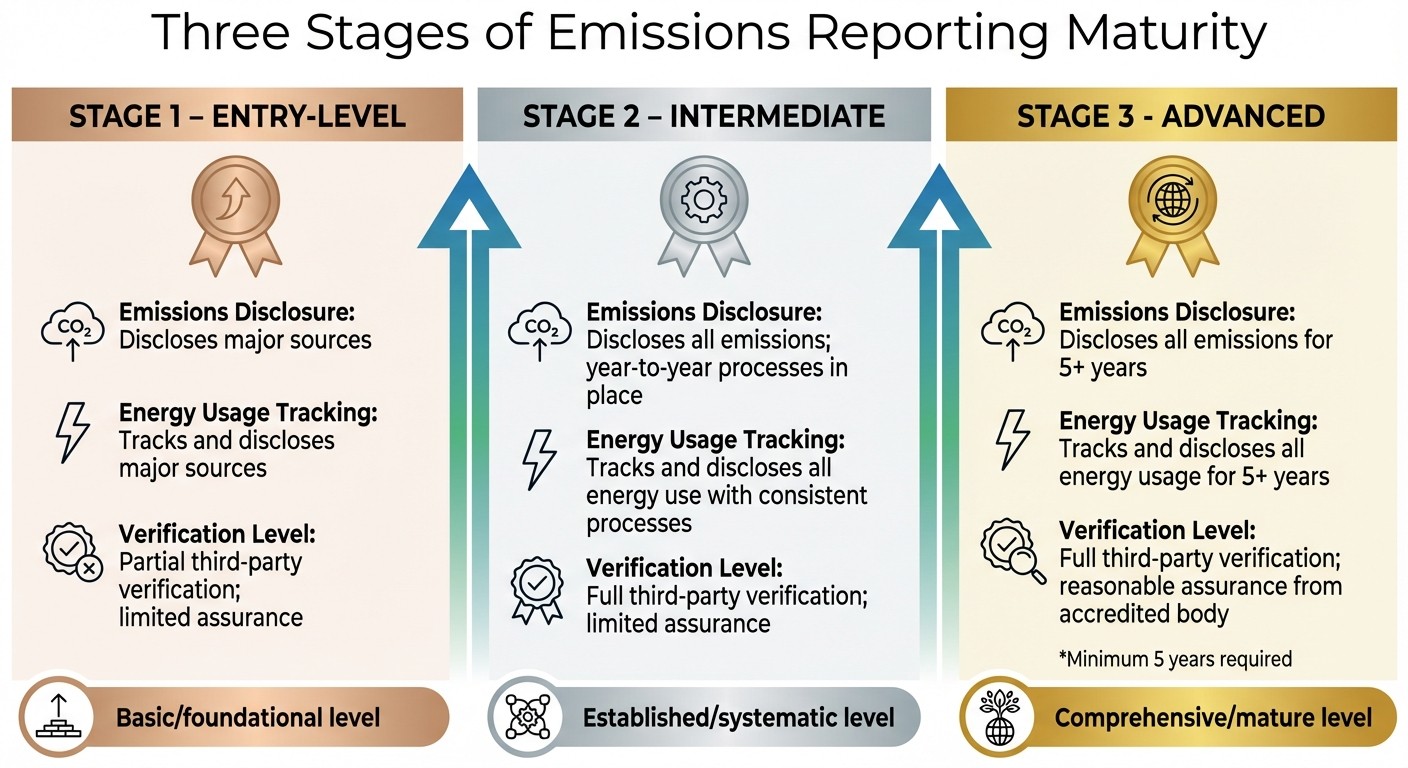
Three Stages of Emissions Reporting Maturity for Manufacturers
Compliance marks the beginning, not the end, of the journey. Leveraging emissions data as a tool for ongoing improvement can lead to both operational cost savings and progress toward long-term sustainability goals. Treating reporting as a continuous process rather than a one-off task allows organizations to refine their strategies over time, enhancing both efficiency and environmental outcomes.
Monitoring Progress Against Sustainability Goals
To effectively track emissions over time, standardized tools are essential. The EPA's "Annual GHG Inventory Summary and Target Tracking Form" offers a simple method to summarize emissions and evaluate progress toward reduction goals [2]. Establishing a formal Inventory Management Plan (IMP) ensures consistency in how greenhouse gas data is collected, calculated, and maintained across all facilities, creating a reliable foundation for year-over-year comparisons [9].
Organizations typically advance through three stages of emissions reporting:
Entry-level: Focuses on calculating and disclosing major emission sources with limited third-party verification.
Intermediate: Tracks all Scope 1 and 2 emissions with established year-to-year processes, supported by full third-party verification.
Advanced: Maintains at least five years of publicly disclosed energy usage and emissions data, verified with reasonable assurance by an accredited body [3].
Achieving the Advanced stage requires a long-term commitment to comprehensive tracking and disclosure, often taking a minimum of five years [3]. Real-time Energy Management Information Systems (EMIS) can accelerate this process by enabling continuous performance monitoring, moving beyond the constraints of annual reporting cycles [15].
Improving Energy Efficiency
Enhancing energy efficiency not only reduces emissions but also cuts operational costs. Using Energy Performance Indicators (EPIs), manufacturers can benchmark their facilities on a scale of 1 to 100 against similar plants nationwide [16]. Facilities scoring 75 or higher may qualify for ENERGY STAR certification, providing third-party validation of their energy performance [16].
By monitoring energy intensity - measured in MMBtu per production unit - manufacturers can identify opportunities to upgrade Scope 1 and 2 processes, achieving both emissions reductions and cost savings [16][3]. Smaller manufacturers can utilize tools like the EPA's free Energy Tracking Tool or Portfolio Manager to monitor energy use and greenhouse gas emissions without the need for significant software investment [16].
Optimizing Supply Chain Emissions
For many manufacturers, Scope 3 emissions from the supply chain represent the largest share of their carbon footprint. The GHG Protocol Corporate Value Chain (Scope 3) Standard offers a framework for evaluating value chain impacts and pinpointing key areas for reduction [1].
Engaging suppliers directly to obtain primary Scope 3 data is ideal, but when this isn’t feasible, industry-specific emission factors can serve as a practical starting point [7]. This approach allows manufacturers to calculate emissions for purchased goods and services while building stronger supplier relationships and improving data collection processes over time.
| <strong>Reporting Stage</strong> | <strong>Emissions Disclosure</strong> | <strong>Energy Usage Tracking</strong> | <strong>Verification Level</strong> |
| --- | --- | --- | --- |
| <strong>Entry-level</strong> | Discloses major sources | Tracks and discloses major sources | Partial third-party verification; limited assurance |
| <strong>Intermediate</strong> | Discloses all emissions; year-to-year processes in place | Tracks and discloses all energy use with consistent processes | Full third-party verification; limited assurance |
| <strong>Advanced</strong> | Discloses all emissions for 5+ years | Tracks and discloses all energy usage for 5+ years | Full third-party verification; reasonable assurance from accredited body
| <strong>Reporting Stage</strong> | <strong>Emissions Disclosure</strong> | <strong>Energy Usage Tracking</strong> | <strong>Verification Level</strong> |
| --- | --- | --- | --- |
| <strong>Entry-level</strong> | Discloses major sources | Tracks and discloses major sources | Partial third-party verification; limited assurance |
| <strong>Intermediate</strong> | Discloses all emissions; year-to-year processes in place | Tracks and discloses all energy use with consistent processes | Full third-party verification; limited assurance |
| <strong>Advanced</strong> | Discloses all emissions for 5+ years | Tracks and discloses all energy usage for 5+ years | Full third-party verification; reasonable assurance from accredited body
To maintain the relevance of long-term reduction targets, organizations should establish procedures for adjusting their base year in response to structural or methodological changes [9]. As reporting capabilities evolve, developing a Climate Transition Plan can help address the financial risks and opportunities tied to the shift toward a low-carbon economy [7]. By integrating these practices, manufacturers can stay ahead in their sustainability journey while aligning with broader environmental goals.
Conclusion
Tackling emissions reporting in manufacturing requires dedication, structured systems, and a focus on constant improvement. A solid starting point is implementing a formal Inventory Management Plan (IMP), which institutionalizes the processes for data collection, calculation, and maintenance [9]. This approach ensures that reporting remains consistent and reliable, even as personnel or organizational structures change.
"Establishing a relevant, complete, consistent, transparent, and accurate scope 1 and scope 2 emissions inventory is a process of continuous improvement." - US EPA [3]
Using the GHG Protocol Corporate Standard as a guide provides a clear framework for managing emissions data. This standard helps manufacturers define organizational boundaries, track emissions over time, and adhere to key accounting principles [7][5]. Standardizing these practices not only simplifies long-term reporting but also fosters greater transparency across industries [1].
The journey involves moving through distinct reporting stages - from initial disclosure of major sources to advanced reporting with a robust five-year dataset and third-party verification [3]. While progressing through these stages demands time and effort, the rewards go beyond regulatory compliance. High-quality emissions inventories empower manufacturers to pinpoint reduction opportunities, mitigate GHG risks, and craft effective long-term strategies [5][1]. These stages, discussed earlier, serve as a roadmap for achieving both environmental and operational goals.
Equally important is collaborating with suppliers to gather Scope 3 data and engaging stakeholders across the value chain. These efforts address the broader carbon footprint and align with the principle of continuous improvement. Staying agile in response to regulatory changes - such as the EPA's proposed annual collection of hazardous air pollutant emissions data starting in 2027 - further strengthens sustainability strategies [6]. By treating emissions reporting as a strategic tool, manufacturers can drive environmental progress while enhancing operational efficiency.
FAQs
What makes measuring Scope 3 emissions in manufacturing so challenging?
Measuring Scope 3 emissions in manufacturing is no small task. The challenge lies in the sheer complexity of gathering precise data across an expansive value chain. This includes tracking emissions tied to suppliers, transportation, product usage, and disposal. Often, data gaps, inconsistent reporting practices, or limited access to primary information make this process even more difficult. On top of that, deciding which emission categories to focus on can be tricky, as not all are equally relevant or straightforward to quantify.
Maintaining consistent and high-quality data over time presents another significant obstacle. Emissions linked to activities like purchased goods or transportation can fluctuate, requiring detailed and often complex calculations. Addressing these data gaps frequently hinges on close collaboration with suppliers, as well as relying on estimation methods when exact figures are unavailable. To tackle these challenges effectively, manufacturers need strong systems for managing data, engaging stakeholders, and ensuring methodical accuracy - all of which are critical for transparent and trustworthy reporting.
What are the best ways for manufacturers to ensure accurate emissions reporting?
Manufacturers can achieve accurate emissions reporting by adhering to standardized calculation methods and incorporating robust verification processes. Following established guidelines, such as those outlined in the EPA's Greenhouse Gas Reporting Program, helps ensure results are consistent and dependable. Whenever feasible, rely on source-specific data, like direct readings from continuous monitoring systems, to achieve the highest level of precision.
To improve accuracy even further, organizations should implement clear and structured data management practices. This includes conducting regular audits, performing quality checks, and maintaining detailed records of the methodologies used. Engaging third-party verification services and aligning with recognized frameworks like the GHG Protocol can also boost credibility and trustworthiness. These measures collectively support the creation of transparent and dependable emissions reports that effectively capture environmental impacts.
What are the best tools for small manufacturers to simplify emissions reporting?
Small manufacturers have access to several tools that can simplify emissions reporting while ensuring data accuracy. The U.S. Environmental Protection Agency (EPA) offers practical resources like the Simplified GHG Emissions Calculator. This tool is specifically designed to help organizations develop a basic greenhouse gas (GHG) inventory with minimal complexity. Alongside this, the EPA provides detailed guidance documents, such as the Guide to Greenhouse Gas Management for Small Business & Low Emitters, which offer step-by-step instructions for calculating emissions, defining boundaries, and organizing data effectively.
For those seeking more comprehensive reporting, the EPA also provides resources to help identify scope 1 and scope 2 emissions. These guidelines assist manufacturers in locating emission sources and quantifying their impact on the environment. By using these tools, small manufacturers can confidently meet reporting requirements while ensuring transparency and regulatory compliance.
Related Blog Posts
Latest Articles
©2025



FAQ
01
What does it really mean to “redefine profit”?
02
What makes Council Fire different?
03
Who does Council Fire you work with?
04
What does working with Council Fire actually look like?
05
How does Council Fire help organizations turn big goals into action?
06
How does Council Fire define and measure success?
Jan 30, 2026
Best Practices for Emissions Reporting in Manufacturing
Sustainability Strategy
In This Article
Build emissions baselines, track Scope 1–3, use GHG Protocol tools, ensure audit-ready data, and meet EPA reporting and verification requirements.
Best Practices for Emissions Reporting in Manufacturing
Tracking and reporting greenhouse gas (GHG) emissions is no longer just a regulatory requirement - it’s a tool for improving efficiency, reducing costs, and building trust with stakeholders. For manufacturers, accurate emissions data lays the groundwork for managing risks, achieving reduction targets, and aligning with sustainability goals.
Key Takeaways:
Emissions Categories: Emissions are divided into Scope 1 (direct), Scope 2 (indirect from purchased energy), and Scope 3 (indirect across the value chain). Scope 3 is often the largest and hardest to measure.
Baseline Creation: Establish a starting point by selecting a base year, identifying key emission sources, and collecting accurate activity data (e.g., fuel usage, electricity consumption).
Frameworks and Tools: The GHG Protocol is widely used for standardizing emissions reporting. Tools like the EPA’s GHG Emission Factors Hub and Simplified GHG Calculator simplify data collection and calculations.
Data Quality: A solid Inventory Management Plan (IMP) ensures accurate, audit-ready data. Third-party verification builds credibility.
Compliance: U.S. facilities emitting 25,000 metric tons CO2e or more annually must comply with the EPA’s Greenhouse Gas Reporting Program (GHGRP) by March 31 each year.
Continuous Improvement: Use emissions data to track progress, improve energy efficiency, and engage suppliers on Scope 3 emissions.
By following these steps, manufacturers can not only meet compliance requirements but also identify opportunities to cut costs and improve operations. Treat emissions reporting as an ongoing process, leveraging technology and collaboration to refine strategies over time.
Sustainability now: GHG reporting trends and challenges
Creating an Emissions Baseline
Establishing a baseline is a critical first step for tracking emissions and setting reduction targets.
Choosing a Reporting Framework
The GHG Protocol Corporate Standard serves as the global standard for emissions accounting. It covers seven key greenhouse gases: carbon dioxide (CO2), methane (CH4), nitrous oxide (N2O), hydrofluorocarbons (HFCs), perfluorocarbons (PFCs), sulfur hexafluoride (SF6), and nitrogen trifluoride (NF3) [1].
"The GHG Protocol Corporate Accounting and Reporting Standard provides requirements and guidance for companies... to help companies prepare a GHG inventory that represents a true and fair account of their emissions through the use of standardized approaches and principles." - GHG Protocol [1]
Organizations must define both their operational and organizational boundaries before starting data collection. A historical year that accurately reflects normal operations should be selected as the base year, with adjustments made for any structural changes.
Identifying Priority Emission Sources
To create a meaningful baseline, it’s essential to identify emission sources across Scope 1 (direct emissions), Scope 2 (indirect emissions from purchased energy), and Scope 3 (all other indirect emissions). Sector-specific tools provided by the GHG Protocol help address unique emissions, such as those from Aluminum, Iron and Steel, Cement, Ammonia, Pulp and Paper, and Semiconductors industries [4][8]. For example, cement production releases CO2 during clinker production - a process that standard combustion calculations might overlook. The EPA's "Determine Emissions Sources" checklist is a valuable resource for ensuring no major sources are missed during this phase [4].
Once the key sources are identified, gathering accurate activity data becomes the next step.
Gathering Baseline Data
Collecting baseline data involves tracking activity metrics such as fuel consumption (gallons), electricity usage (kilowatt-hours), and waste generation (tons). These metrics are converted into CO2 equivalent (CO2e) using standardized emission factors and Global Warming Potentials (GWPs) [5].
"An accurate and useful inventory can only be developed after careful attention to quality control issues and to the activity data required." - GHG Protocol [8]
To ensure consistency and accuracy, implement an Inventory Management Plan (IMP) that supports audit-ready data collection [5]. When data gaps arise, standardized estimation methods can fill in the blanks. The EPA's GHG Emission Factors Hub offers regularly updated default factors for both stationary and mobile combustion sources, making it a reliable tool for calculating emissions [5].
Collecting Data and Working with Stakeholders
To ensure accurate reporting, it's essential to gather data from both internal operations and external partners. Start by clearly defining organizational boundaries (such as facilities and assets) and operational boundaries (like emission sources) before beginning the data collection process [2][5]. This clarity helps avoid gaps and ensures the emissions inventory captures all relevant sources. Establishing this foundation also supports effective collaboration with suppliers and smooth integration of technology.
Collaborating with Suppliers on Scope 3 Emissions
For many manufacturers, Scope 3 emissions - those generated across the entire value chain - often make up the largest share of their carbon footprint [10]. To address this, manufacturers should engage suppliers through strong internal backing and clear communication. When direct data from suppliers isn't accessible, industry-specific supply chain emission factors for U.S. industries and commodities can be used to estimate emissions from purchased goods, services, and capital goods [7]. Over time, organizations should aim to shift from basic estimates of major sources to publicly disclosing all emissions, verified by third parties - a step that enhances credibility [3]. Tools like the GHG Protocol Corporate Value Chain (Scope 3) Standard can help organizations evaluate their entire value chain, identify emission hotspots, and uncover reduction opportunities [1]. Reliable supplier data is crucial for establishing a thorough emissions baseline.
Leveraging Technology for Data Management
Technology can simplify emissions data management significantly. For smaller manufacturers, the EPA’s Simplified GHG Emissions Calculator automates activity data conversion, making calculations more manageable [7][2]. Larger manufacturers, on the other hand, can benefit from advanced platforms that include features like anomaly detection to catch errors before data finalization [10]. Secure digital systems are increasingly replacing manual processes, enabling a traceable and efficient flow of data from suppliers to centralized dashboards [10].
Ensuring Data Quality and Accuracy
Once data is collected and managed digitally, verifying its quality becomes the next critical step. Robust management practices are essential for ensuring credibility and audit readiness. An Inventory Management Plan (IMP) should include a dedicated section on "Data Management", detailing how data accuracy is verified and how errors are addressed [9]. Organizations can start with limited assurance and gradually move toward reasonable assurance by working with accredited verifiers. For detailed guidance on developing inventory quality management processes, Chapter 7 of the GHG Protocol Corporate Standard serves as a valuable resource [9].
Meeting Compliance and Reporting Standards
Strengthening data collection and quality assurance is only part of the equation; meeting compliance standards ensures the reliability and legitimacy of your emissions reporting. This step is critical for aligning with mandatory regulations and industry expectations.
Complying with Regulatory Requirements
The EPA Greenhouse Gas Reporting Program (GHGRP), outlined in 40 CFR Part 98, mandates that facilities emitting 25,000 metric tons CO2e or more annually submit emissions reports through the electronic Greenhouse Gas Reporting Tool (e-GGRT) by March 31 each year [13][14]. This program accounts for 85-90% of U.S. greenhouse gas emissions, including both direct emitters and upstream suppliers [14]. Compliance requirements are organized into industry-specific subparts, such as Subpart Q for Iron and Steel, Subpart AA for Pulp and Paper, and Subpart H for Cement [11]. To determine whether your facility meets the reporting threshold and identify applicable subparts, use the EPA's "Applicability Tool" [13]. Additionally, manufacturers should monitor the Air Emissions Reporting Requirements (AERR), which oversee criteria air pollutants and will expand to include annual hazardous air pollutant data starting in 2027 [6].
Preparing for Audits and Verification
A well-documented process is essential for audits and verification. Your Inventory Management Plan (IMP) should comprehensively address organizational structure, boundaries, quantification methods, data management, and verification protocols [9]. The EPA employs a multi-step electronic verification system to review submitted reports, flagging discrepancies or potential errors. Facilities must resolve these issues by either correcting the data or providing detailed explanations [12][14]. Maintain clear records as required by § 98.37, and conduct internal audits regularly, including management reviews and corrective measures [11][9]. As your reporting processes evolve, consider transitioning from limited assurance to reasonable assurance through third-party verification, which boosts credibility with both stakeholders and regulators [3]. Detailed documentation of these procedures ensures transparency and accountability.
Following Disclosure Best Practices
Meeting compliance standards is just the baseline. To go further, align with the Greenhouse Gas Protocol Corporate Standard, a globally recognized framework for calculating emissions and defining inventory boundaries [9]. Ensure all greenhouse gases are converted to CO2e using up-to-date Global Warming Potentials to maintain consistency across reporting periods [9]. The EPA publishes reported data each fall, enabling stakeholders to evaluate facility-level performance [14]. By implementing rigorous data management systems and maintaining thorough audit trails, manufacturers can reinforce the accuracy of their emissions reporting, fostering trust with investors, customers, and regulatory bodies.
Improving Reporting and Reducing Emissions Over Time
Three Stages of Emissions Reporting Maturity for Manufacturers
Compliance marks the beginning, not the end, of the journey. Leveraging emissions data as a tool for ongoing improvement can lead to both operational cost savings and progress toward long-term sustainability goals. Treating reporting as a continuous process rather than a one-off task allows organizations to refine their strategies over time, enhancing both efficiency and environmental outcomes.
Monitoring Progress Against Sustainability Goals
To effectively track emissions over time, standardized tools are essential. The EPA's "Annual GHG Inventory Summary and Target Tracking Form" offers a simple method to summarize emissions and evaluate progress toward reduction goals [2]. Establishing a formal Inventory Management Plan (IMP) ensures consistency in how greenhouse gas data is collected, calculated, and maintained across all facilities, creating a reliable foundation for year-over-year comparisons [9].
Organizations typically advance through three stages of emissions reporting:
Entry-level: Focuses on calculating and disclosing major emission sources with limited third-party verification.
Intermediate: Tracks all Scope 1 and 2 emissions with established year-to-year processes, supported by full third-party verification.
Advanced: Maintains at least five years of publicly disclosed energy usage and emissions data, verified with reasonable assurance by an accredited body [3].
Achieving the Advanced stage requires a long-term commitment to comprehensive tracking and disclosure, often taking a minimum of five years [3]. Real-time Energy Management Information Systems (EMIS) can accelerate this process by enabling continuous performance monitoring, moving beyond the constraints of annual reporting cycles [15].
Improving Energy Efficiency
Enhancing energy efficiency not only reduces emissions but also cuts operational costs. Using Energy Performance Indicators (EPIs), manufacturers can benchmark their facilities on a scale of 1 to 100 against similar plants nationwide [16]. Facilities scoring 75 or higher may qualify for ENERGY STAR certification, providing third-party validation of their energy performance [16].
By monitoring energy intensity - measured in MMBtu per production unit - manufacturers can identify opportunities to upgrade Scope 1 and 2 processes, achieving both emissions reductions and cost savings [16][3]. Smaller manufacturers can utilize tools like the EPA's free Energy Tracking Tool or Portfolio Manager to monitor energy use and greenhouse gas emissions without the need for significant software investment [16].
Optimizing Supply Chain Emissions
For many manufacturers, Scope 3 emissions from the supply chain represent the largest share of their carbon footprint. The GHG Protocol Corporate Value Chain (Scope 3) Standard offers a framework for evaluating value chain impacts and pinpointing key areas for reduction [1].
Engaging suppliers directly to obtain primary Scope 3 data is ideal, but when this isn’t feasible, industry-specific emission factors can serve as a practical starting point [7]. This approach allows manufacturers to calculate emissions for purchased goods and services while building stronger supplier relationships and improving data collection processes over time.
| <strong>Reporting Stage</strong> | <strong>Emissions Disclosure</strong> | <strong>Energy Usage Tracking</strong> | <strong>Verification Level</strong> |
| --- | --- | --- | --- |
| <strong>Entry-level</strong> | Discloses major sources | Tracks and discloses major sources | Partial third-party verification; limited assurance |
| <strong>Intermediate</strong> | Discloses all emissions; year-to-year processes in place | Tracks and discloses all energy use with consistent processes | Full third-party verification; limited assurance |
| <strong>Advanced</strong> | Discloses all emissions for 5+ years | Tracks and discloses all energy usage for 5+ years | Full third-party verification; reasonable assurance from accredited body
To maintain the relevance of long-term reduction targets, organizations should establish procedures for adjusting their base year in response to structural or methodological changes [9]. As reporting capabilities evolve, developing a Climate Transition Plan can help address the financial risks and opportunities tied to the shift toward a low-carbon economy [7]. By integrating these practices, manufacturers can stay ahead in their sustainability journey while aligning with broader environmental goals.
Conclusion
Tackling emissions reporting in manufacturing requires dedication, structured systems, and a focus on constant improvement. A solid starting point is implementing a formal Inventory Management Plan (IMP), which institutionalizes the processes for data collection, calculation, and maintenance [9]. This approach ensures that reporting remains consistent and reliable, even as personnel or organizational structures change.
"Establishing a relevant, complete, consistent, transparent, and accurate scope 1 and scope 2 emissions inventory is a process of continuous improvement." - US EPA [3]
Using the GHG Protocol Corporate Standard as a guide provides a clear framework for managing emissions data. This standard helps manufacturers define organizational boundaries, track emissions over time, and adhere to key accounting principles [7][5]. Standardizing these practices not only simplifies long-term reporting but also fosters greater transparency across industries [1].
The journey involves moving through distinct reporting stages - from initial disclosure of major sources to advanced reporting with a robust five-year dataset and third-party verification [3]. While progressing through these stages demands time and effort, the rewards go beyond regulatory compliance. High-quality emissions inventories empower manufacturers to pinpoint reduction opportunities, mitigate GHG risks, and craft effective long-term strategies [5][1]. These stages, discussed earlier, serve as a roadmap for achieving both environmental and operational goals.
Equally important is collaborating with suppliers to gather Scope 3 data and engaging stakeholders across the value chain. These efforts address the broader carbon footprint and align with the principle of continuous improvement. Staying agile in response to regulatory changes - such as the EPA's proposed annual collection of hazardous air pollutant emissions data starting in 2027 - further strengthens sustainability strategies [6]. By treating emissions reporting as a strategic tool, manufacturers can drive environmental progress while enhancing operational efficiency.
FAQs
What makes measuring Scope 3 emissions in manufacturing so challenging?
Measuring Scope 3 emissions in manufacturing is no small task. The challenge lies in the sheer complexity of gathering precise data across an expansive value chain. This includes tracking emissions tied to suppliers, transportation, product usage, and disposal. Often, data gaps, inconsistent reporting practices, or limited access to primary information make this process even more difficult. On top of that, deciding which emission categories to focus on can be tricky, as not all are equally relevant or straightforward to quantify.
Maintaining consistent and high-quality data over time presents another significant obstacle. Emissions linked to activities like purchased goods or transportation can fluctuate, requiring detailed and often complex calculations. Addressing these data gaps frequently hinges on close collaboration with suppliers, as well as relying on estimation methods when exact figures are unavailable. To tackle these challenges effectively, manufacturers need strong systems for managing data, engaging stakeholders, and ensuring methodical accuracy - all of which are critical for transparent and trustworthy reporting.
What are the best ways for manufacturers to ensure accurate emissions reporting?
Manufacturers can achieve accurate emissions reporting by adhering to standardized calculation methods and incorporating robust verification processes. Following established guidelines, such as those outlined in the EPA's Greenhouse Gas Reporting Program, helps ensure results are consistent and dependable. Whenever feasible, rely on source-specific data, like direct readings from continuous monitoring systems, to achieve the highest level of precision.
To improve accuracy even further, organizations should implement clear and structured data management practices. This includes conducting regular audits, performing quality checks, and maintaining detailed records of the methodologies used. Engaging third-party verification services and aligning with recognized frameworks like the GHG Protocol can also boost credibility and trustworthiness. These measures collectively support the creation of transparent and dependable emissions reports that effectively capture environmental impacts.
What are the best tools for small manufacturers to simplify emissions reporting?
Small manufacturers have access to several tools that can simplify emissions reporting while ensuring data accuracy. The U.S. Environmental Protection Agency (EPA) offers practical resources like the Simplified GHG Emissions Calculator. This tool is specifically designed to help organizations develop a basic greenhouse gas (GHG) inventory with minimal complexity. Alongside this, the EPA provides detailed guidance documents, such as the Guide to Greenhouse Gas Management for Small Business & Low Emitters, which offer step-by-step instructions for calculating emissions, defining boundaries, and organizing data effectively.
For those seeking more comprehensive reporting, the EPA also provides resources to help identify scope 1 and scope 2 emissions. These guidelines assist manufacturers in locating emission sources and quantifying their impact on the environment. By using these tools, small manufacturers can confidently meet reporting requirements while ensuring transparency and regulatory compliance.
Related Blog Posts
FAQ
01
What does it really mean to “redefine profit”?
02
What makes Council Fire different?
03
Who does Council Fire you work with?
04
What does working with Council Fire actually look like?
05
How does Council Fire help organizations turn big goals into action?
06
How does Council Fire define and measure success?
Jan 30, 2026
Best Practices for Emissions Reporting in Manufacturing
Sustainability Strategy
In This Article
Build emissions baselines, track Scope 1–3, use GHG Protocol tools, ensure audit-ready data, and meet EPA reporting and verification requirements.
Best Practices for Emissions Reporting in Manufacturing
Tracking and reporting greenhouse gas (GHG) emissions is no longer just a regulatory requirement - it’s a tool for improving efficiency, reducing costs, and building trust with stakeholders. For manufacturers, accurate emissions data lays the groundwork for managing risks, achieving reduction targets, and aligning with sustainability goals.
Key Takeaways:
Emissions Categories: Emissions are divided into Scope 1 (direct), Scope 2 (indirect from purchased energy), and Scope 3 (indirect across the value chain). Scope 3 is often the largest and hardest to measure.
Baseline Creation: Establish a starting point by selecting a base year, identifying key emission sources, and collecting accurate activity data (e.g., fuel usage, electricity consumption).
Frameworks and Tools: The GHG Protocol is widely used for standardizing emissions reporting. Tools like the EPA’s GHG Emission Factors Hub and Simplified GHG Calculator simplify data collection and calculations.
Data Quality: A solid Inventory Management Plan (IMP) ensures accurate, audit-ready data. Third-party verification builds credibility.
Compliance: U.S. facilities emitting 25,000 metric tons CO2e or more annually must comply with the EPA’s Greenhouse Gas Reporting Program (GHGRP) by March 31 each year.
Continuous Improvement: Use emissions data to track progress, improve energy efficiency, and engage suppliers on Scope 3 emissions.
By following these steps, manufacturers can not only meet compliance requirements but also identify opportunities to cut costs and improve operations. Treat emissions reporting as an ongoing process, leveraging technology and collaboration to refine strategies over time.
Sustainability now: GHG reporting trends and challenges
Creating an Emissions Baseline
Establishing a baseline is a critical first step for tracking emissions and setting reduction targets.
Choosing a Reporting Framework
The GHG Protocol Corporate Standard serves as the global standard for emissions accounting. It covers seven key greenhouse gases: carbon dioxide (CO2), methane (CH4), nitrous oxide (N2O), hydrofluorocarbons (HFCs), perfluorocarbons (PFCs), sulfur hexafluoride (SF6), and nitrogen trifluoride (NF3) [1].
"The GHG Protocol Corporate Accounting and Reporting Standard provides requirements and guidance for companies... to help companies prepare a GHG inventory that represents a true and fair account of their emissions through the use of standardized approaches and principles." - GHG Protocol [1]
Organizations must define both their operational and organizational boundaries before starting data collection. A historical year that accurately reflects normal operations should be selected as the base year, with adjustments made for any structural changes.
Identifying Priority Emission Sources
To create a meaningful baseline, it’s essential to identify emission sources across Scope 1 (direct emissions), Scope 2 (indirect emissions from purchased energy), and Scope 3 (all other indirect emissions). Sector-specific tools provided by the GHG Protocol help address unique emissions, such as those from Aluminum, Iron and Steel, Cement, Ammonia, Pulp and Paper, and Semiconductors industries [4][8]. For example, cement production releases CO2 during clinker production - a process that standard combustion calculations might overlook. The EPA's "Determine Emissions Sources" checklist is a valuable resource for ensuring no major sources are missed during this phase [4].
Once the key sources are identified, gathering accurate activity data becomes the next step.
Gathering Baseline Data
Collecting baseline data involves tracking activity metrics such as fuel consumption (gallons), electricity usage (kilowatt-hours), and waste generation (tons). These metrics are converted into CO2 equivalent (CO2e) using standardized emission factors and Global Warming Potentials (GWPs) [5].
"An accurate and useful inventory can only be developed after careful attention to quality control issues and to the activity data required." - GHG Protocol [8]
To ensure consistency and accuracy, implement an Inventory Management Plan (IMP) that supports audit-ready data collection [5]. When data gaps arise, standardized estimation methods can fill in the blanks. The EPA's GHG Emission Factors Hub offers regularly updated default factors for both stationary and mobile combustion sources, making it a reliable tool for calculating emissions [5].
Collecting Data and Working with Stakeholders
To ensure accurate reporting, it's essential to gather data from both internal operations and external partners. Start by clearly defining organizational boundaries (such as facilities and assets) and operational boundaries (like emission sources) before beginning the data collection process [2][5]. This clarity helps avoid gaps and ensures the emissions inventory captures all relevant sources. Establishing this foundation also supports effective collaboration with suppliers and smooth integration of technology.
Collaborating with Suppliers on Scope 3 Emissions
For many manufacturers, Scope 3 emissions - those generated across the entire value chain - often make up the largest share of their carbon footprint [10]. To address this, manufacturers should engage suppliers through strong internal backing and clear communication. When direct data from suppliers isn't accessible, industry-specific supply chain emission factors for U.S. industries and commodities can be used to estimate emissions from purchased goods, services, and capital goods [7]. Over time, organizations should aim to shift from basic estimates of major sources to publicly disclosing all emissions, verified by third parties - a step that enhances credibility [3]. Tools like the GHG Protocol Corporate Value Chain (Scope 3) Standard can help organizations evaluate their entire value chain, identify emission hotspots, and uncover reduction opportunities [1]. Reliable supplier data is crucial for establishing a thorough emissions baseline.
Leveraging Technology for Data Management
Technology can simplify emissions data management significantly. For smaller manufacturers, the EPA’s Simplified GHG Emissions Calculator automates activity data conversion, making calculations more manageable [7][2]. Larger manufacturers, on the other hand, can benefit from advanced platforms that include features like anomaly detection to catch errors before data finalization [10]. Secure digital systems are increasingly replacing manual processes, enabling a traceable and efficient flow of data from suppliers to centralized dashboards [10].
Ensuring Data Quality and Accuracy
Once data is collected and managed digitally, verifying its quality becomes the next critical step. Robust management practices are essential for ensuring credibility and audit readiness. An Inventory Management Plan (IMP) should include a dedicated section on "Data Management", detailing how data accuracy is verified and how errors are addressed [9]. Organizations can start with limited assurance and gradually move toward reasonable assurance by working with accredited verifiers. For detailed guidance on developing inventory quality management processes, Chapter 7 of the GHG Protocol Corporate Standard serves as a valuable resource [9].
Meeting Compliance and Reporting Standards
Strengthening data collection and quality assurance is only part of the equation; meeting compliance standards ensures the reliability and legitimacy of your emissions reporting. This step is critical for aligning with mandatory regulations and industry expectations.
Complying with Regulatory Requirements
The EPA Greenhouse Gas Reporting Program (GHGRP), outlined in 40 CFR Part 98, mandates that facilities emitting 25,000 metric tons CO2e or more annually submit emissions reports through the electronic Greenhouse Gas Reporting Tool (e-GGRT) by March 31 each year [13][14]. This program accounts for 85-90% of U.S. greenhouse gas emissions, including both direct emitters and upstream suppliers [14]. Compliance requirements are organized into industry-specific subparts, such as Subpart Q for Iron and Steel, Subpart AA for Pulp and Paper, and Subpart H for Cement [11]. To determine whether your facility meets the reporting threshold and identify applicable subparts, use the EPA's "Applicability Tool" [13]. Additionally, manufacturers should monitor the Air Emissions Reporting Requirements (AERR), which oversee criteria air pollutants and will expand to include annual hazardous air pollutant data starting in 2027 [6].
Preparing for Audits and Verification
A well-documented process is essential for audits and verification. Your Inventory Management Plan (IMP) should comprehensively address organizational structure, boundaries, quantification methods, data management, and verification protocols [9]. The EPA employs a multi-step electronic verification system to review submitted reports, flagging discrepancies or potential errors. Facilities must resolve these issues by either correcting the data or providing detailed explanations [12][14]. Maintain clear records as required by § 98.37, and conduct internal audits regularly, including management reviews and corrective measures [11][9]. As your reporting processes evolve, consider transitioning from limited assurance to reasonable assurance through third-party verification, which boosts credibility with both stakeholders and regulators [3]. Detailed documentation of these procedures ensures transparency and accountability.
Following Disclosure Best Practices
Meeting compliance standards is just the baseline. To go further, align with the Greenhouse Gas Protocol Corporate Standard, a globally recognized framework for calculating emissions and defining inventory boundaries [9]. Ensure all greenhouse gases are converted to CO2e using up-to-date Global Warming Potentials to maintain consistency across reporting periods [9]. The EPA publishes reported data each fall, enabling stakeholders to evaluate facility-level performance [14]. By implementing rigorous data management systems and maintaining thorough audit trails, manufacturers can reinforce the accuracy of their emissions reporting, fostering trust with investors, customers, and regulatory bodies.
Improving Reporting and Reducing Emissions Over Time
Three Stages of Emissions Reporting Maturity for Manufacturers
Compliance marks the beginning, not the end, of the journey. Leveraging emissions data as a tool for ongoing improvement can lead to both operational cost savings and progress toward long-term sustainability goals. Treating reporting as a continuous process rather than a one-off task allows organizations to refine their strategies over time, enhancing both efficiency and environmental outcomes.
Monitoring Progress Against Sustainability Goals
To effectively track emissions over time, standardized tools are essential. The EPA's "Annual GHG Inventory Summary and Target Tracking Form" offers a simple method to summarize emissions and evaluate progress toward reduction goals [2]. Establishing a formal Inventory Management Plan (IMP) ensures consistency in how greenhouse gas data is collected, calculated, and maintained across all facilities, creating a reliable foundation for year-over-year comparisons [9].
Organizations typically advance through three stages of emissions reporting:
Entry-level: Focuses on calculating and disclosing major emission sources with limited third-party verification.
Intermediate: Tracks all Scope 1 and 2 emissions with established year-to-year processes, supported by full third-party verification.
Advanced: Maintains at least five years of publicly disclosed energy usage and emissions data, verified with reasonable assurance by an accredited body [3].
Achieving the Advanced stage requires a long-term commitment to comprehensive tracking and disclosure, often taking a minimum of five years [3]. Real-time Energy Management Information Systems (EMIS) can accelerate this process by enabling continuous performance monitoring, moving beyond the constraints of annual reporting cycles [15].
Improving Energy Efficiency
Enhancing energy efficiency not only reduces emissions but also cuts operational costs. Using Energy Performance Indicators (EPIs), manufacturers can benchmark their facilities on a scale of 1 to 100 against similar plants nationwide [16]. Facilities scoring 75 or higher may qualify for ENERGY STAR certification, providing third-party validation of their energy performance [16].
By monitoring energy intensity - measured in MMBtu per production unit - manufacturers can identify opportunities to upgrade Scope 1 and 2 processes, achieving both emissions reductions and cost savings [16][3]. Smaller manufacturers can utilize tools like the EPA's free Energy Tracking Tool or Portfolio Manager to monitor energy use and greenhouse gas emissions without the need for significant software investment [16].
Optimizing Supply Chain Emissions
For many manufacturers, Scope 3 emissions from the supply chain represent the largest share of their carbon footprint. The GHG Protocol Corporate Value Chain (Scope 3) Standard offers a framework for evaluating value chain impacts and pinpointing key areas for reduction [1].
Engaging suppliers directly to obtain primary Scope 3 data is ideal, but when this isn’t feasible, industry-specific emission factors can serve as a practical starting point [7]. This approach allows manufacturers to calculate emissions for purchased goods and services while building stronger supplier relationships and improving data collection processes over time.
| <strong>Reporting Stage</strong> | <strong>Emissions Disclosure</strong> | <strong>Energy Usage Tracking</strong> | <strong>Verification Level</strong> |
| --- | --- | --- | --- |
| <strong>Entry-level</strong> | Discloses major sources | Tracks and discloses major sources | Partial third-party verification; limited assurance |
| <strong>Intermediate</strong> | Discloses all emissions; year-to-year processes in place | Tracks and discloses all energy use with consistent processes | Full third-party verification; limited assurance |
| <strong>Advanced</strong> | Discloses all emissions for 5+ years | Tracks and discloses all energy usage for 5+ years | Full third-party verification; reasonable assurance from accredited body
To maintain the relevance of long-term reduction targets, organizations should establish procedures for adjusting their base year in response to structural or methodological changes [9]. As reporting capabilities evolve, developing a Climate Transition Plan can help address the financial risks and opportunities tied to the shift toward a low-carbon economy [7]. By integrating these practices, manufacturers can stay ahead in their sustainability journey while aligning with broader environmental goals.
Conclusion
Tackling emissions reporting in manufacturing requires dedication, structured systems, and a focus on constant improvement. A solid starting point is implementing a formal Inventory Management Plan (IMP), which institutionalizes the processes for data collection, calculation, and maintenance [9]. This approach ensures that reporting remains consistent and reliable, even as personnel or organizational structures change.
"Establishing a relevant, complete, consistent, transparent, and accurate scope 1 and scope 2 emissions inventory is a process of continuous improvement." - US EPA [3]
Using the GHG Protocol Corporate Standard as a guide provides a clear framework for managing emissions data. This standard helps manufacturers define organizational boundaries, track emissions over time, and adhere to key accounting principles [7][5]. Standardizing these practices not only simplifies long-term reporting but also fosters greater transparency across industries [1].
The journey involves moving through distinct reporting stages - from initial disclosure of major sources to advanced reporting with a robust five-year dataset and third-party verification [3]. While progressing through these stages demands time and effort, the rewards go beyond regulatory compliance. High-quality emissions inventories empower manufacturers to pinpoint reduction opportunities, mitigate GHG risks, and craft effective long-term strategies [5][1]. These stages, discussed earlier, serve as a roadmap for achieving both environmental and operational goals.
Equally important is collaborating with suppliers to gather Scope 3 data and engaging stakeholders across the value chain. These efforts address the broader carbon footprint and align with the principle of continuous improvement. Staying agile in response to regulatory changes - such as the EPA's proposed annual collection of hazardous air pollutant emissions data starting in 2027 - further strengthens sustainability strategies [6]. By treating emissions reporting as a strategic tool, manufacturers can drive environmental progress while enhancing operational efficiency.
FAQs
What makes measuring Scope 3 emissions in manufacturing so challenging?
Measuring Scope 3 emissions in manufacturing is no small task. The challenge lies in the sheer complexity of gathering precise data across an expansive value chain. This includes tracking emissions tied to suppliers, transportation, product usage, and disposal. Often, data gaps, inconsistent reporting practices, or limited access to primary information make this process even more difficult. On top of that, deciding which emission categories to focus on can be tricky, as not all are equally relevant or straightforward to quantify.
Maintaining consistent and high-quality data over time presents another significant obstacle. Emissions linked to activities like purchased goods or transportation can fluctuate, requiring detailed and often complex calculations. Addressing these data gaps frequently hinges on close collaboration with suppliers, as well as relying on estimation methods when exact figures are unavailable. To tackle these challenges effectively, manufacturers need strong systems for managing data, engaging stakeholders, and ensuring methodical accuracy - all of which are critical for transparent and trustworthy reporting.
What are the best ways for manufacturers to ensure accurate emissions reporting?
Manufacturers can achieve accurate emissions reporting by adhering to standardized calculation methods and incorporating robust verification processes. Following established guidelines, such as those outlined in the EPA's Greenhouse Gas Reporting Program, helps ensure results are consistent and dependable. Whenever feasible, rely on source-specific data, like direct readings from continuous monitoring systems, to achieve the highest level of precision.
To improve accuracy even further, organizations should implement clear and structured data management practices. This includes conducting regular audits, performing quality checks, and maintaining detailed records of the methodologies used. Engaging third-party verification services and aligning with recognized frameworks like the GHG Protocol can also boost credibility and trustworthiness. These measures collectively support the creation of transparent and dependable emissions reports that effectively capture environmental impacts.
What are the best tools for small manufacturers to simplify emissions reporting?
Small manufacturers have access to several tools that can simplify emissions reporting while ensuring data accuracy. The U.S. Environmental Protection Agency (EPA) offers practical resources like the Simplified GHG Emissions Calculator. This tool is specifically designed to help organizations develop a basic greenhouse gas (GHG) inventory with minimal complexity. Alongside this, the EPA provides detailed guidance documents, such as the Guide to Greenhouse Gas Management for Small Business & Low Emitters, which offer step-by-step instructions for calculating emissions, defining boundaries, and organizing data effectively.
For those seeking more comprehensive reporting, the EPA also provides resources to help identify scope 1 and scope 2 emissions. These guidelines assist manufacturers in locating emission sources and quantifying their impact on the environment. By using these tools, small manufacturers can confidently meet reporting requirements while ensuring transparency and regulatory compliance.
Related Blog Posts
FAQ
What does it really mean to “redefine profit”?
What makes Council Fire different?
Who does Council Fire you work with?
What does working with Council Fire actually look like?
How does Council Fire help organizations turn big goals into action?
How does Council Fire define and measure success?