

Mar 6, 2026
How to Align Stakeholders Around a Shared ESG Vision for Maritime & Logistics Companies
ESG Strategy
In This Article
Practical steps for maritime and logistics firms to align investors, regulators, customers and crews around ESG: materiality, governance, emissions data and targets.
How to Align Stakeholders Around a Shared ESG Vision for Maritime & Logistics Companies
The maritime and logistics sector is under increasing pressure to address its environmental impact, contributing 2-3% of global greenhouse gas emissions while handling over 80% of global trade. Stakeholders - including regulators, investors, cargo owners, and employees - are demanding greater accountability and transparency through robust ESG (Environmental, Social, and Governance) strategies. Companies that fail to align these diverse demands risk financial penalties, reputational damage, and operational inefficiencies.
Key takeaways:
Regulatory Pressure: The IMO and EU are introducing stricter rules, with penalties like the EU’s Corporate Sustainability Reporting Directive (CSRD), which can impose fines of up to 5% of global turnover.
Financial Incentives: ESG-aligned companies report profit margins 1-3% higher than peers and enjoy stock market premiums exceeding 10%.
Stakeholder Demands: Cargo owners require emissions data for Scope 3 reporting, while investors prioritize ESG compliance, and employees focus on safety and fair working conditions.
To address these challenges, companies must:
Conduct materiality assessments to identify key ESG priorities.
Build clear communication strategies tailored to stakeholders like investors, regulators, and employees.
Implement governance frameworks to monitor ESG progress, including board-level oversight and executive accountability.
Leverage data-driven tools for accurate emissions tracking and reporting, ensuring transparency and compliance.
Set time-bound ESG goals with input from stakeholders and break them into achievable milestones.
Everything you need to know about ESG in the maritime industry [Gina Panayiotou]
Identifying Stakeholder Needs and Priorities
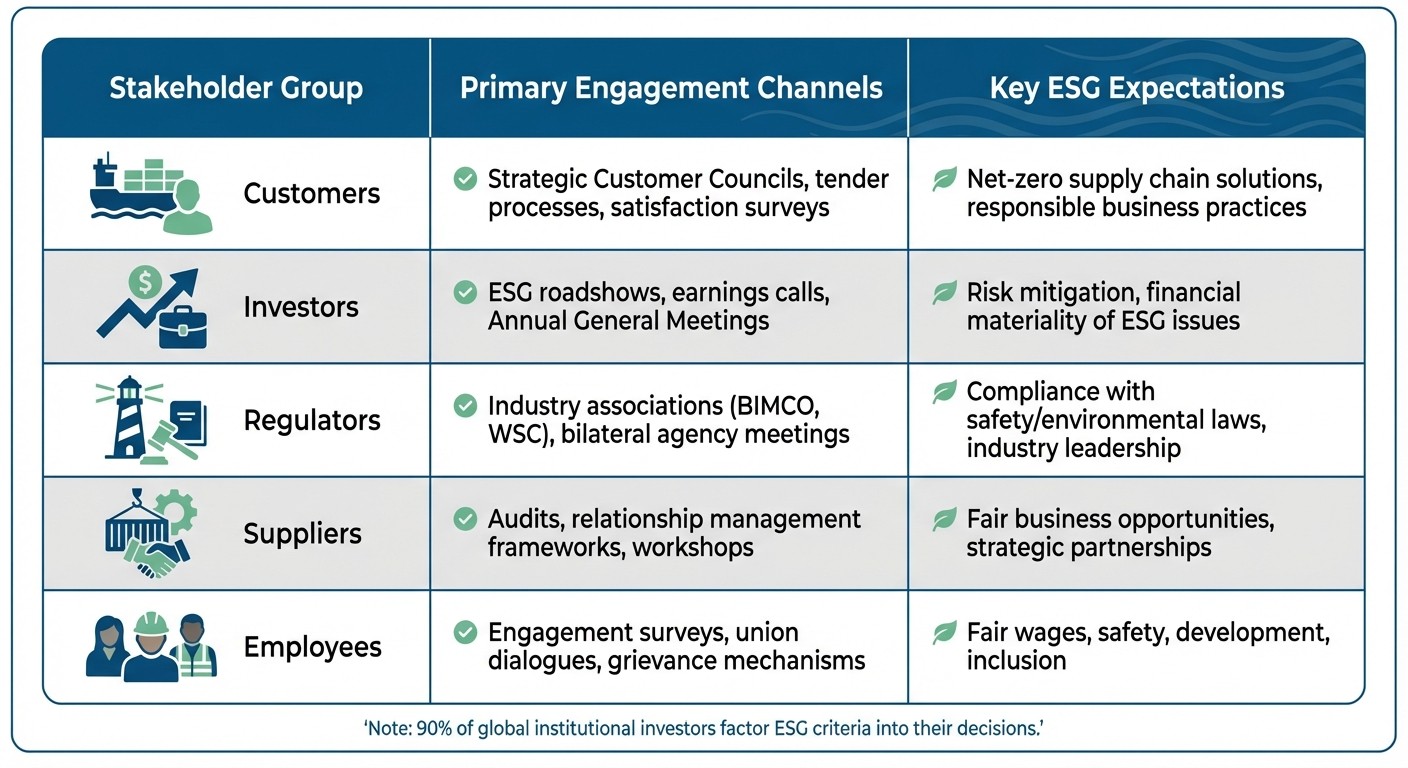
Stakeholder Engagement Channels and ESG Expectations in Maritime Industry
Maritime companies operate at the crossroads of diverse stakeholder expectations. Investors focus on financial returns, regulators demand strict compliance, cargo owners require emissions data for Scope 3 reporting, and crew members prioritize safe working conditions. Without a structured approach to understanding these needs, companies risk allocating resources to initiatives with limited impact.
Double materiality assessments provide a way to evaluate both the societal and environmental impacts of operations and the financial risks or opportunities tied to ESG issues [7][4]. This dual lens ensures that companies can address what matters most to stakeholders while safeguarding their bottom line.
Engaging stakeholders effectively requires tailored approaches. For instance:
Strategic Customer Councils can address customer concerns.
ESG roadshows are ideal for engaging investors.
Industry associations provide a platform for discussions with regulators.
Supplier audits help ensure alignment with ESG goals [6][7].
A.P. Moller-Maersk offers a case study in effective stakeholder engagement. In November 2022, the company hosted a virtual "Investor ESG Day", where executives presented their decarbonization strategies and addressed investor concerns about green fuels and biodiversity [7]. Earlier that year, Maersk collaborated with organizations like the Methanol Institute and World Shipping Council to advocate for Life Cycle Assessment (LCA) in the EU Emissions Trading System (ETS). This effort successfully integrated LCA into the final legislation, ensuring that green fuels are priced accurately to reflect their climate impact [7].
By identifying stakeholder needs through structured assessments, companies can lay the groundwork for targeted ESG investments.
Conducting Materiality Assessments for Maritime Operations
Materiality assessments are essential for determining where to direct resources in the maritime industry, which faces unique ESG challenges. From CO2 taxes and rising fuel costs to regulations on underwater noise pollution, these pressures can become opportunities when addressed strategically [1].
Existing data systems, such as the IMO Data Collection System (DCS), EU Monitoring, Reporting, and Verification (MRV), and Ship Energy Efficiency Management Plan (SEEMP III), provide a wealth of maritime-specific metrics. Leveraging these systems can reduce the workload for crews and shore teams while ensuring data accuracy [1].
The Sustainability Accounting Standards Board (SASB) framework serves as a strong foundation for identifying industry-specific material topics. To address unique gaps, supplement this framework with direct stakeholder input. Common material topics in the maritime sector include:
Climate change and energy transition
Pollution management
Ship recycling practices
Crew training and well-being
Materiality assessments should evaluate both impact materiality (how operations affect society and the environment) and financial materiality (how ESG issues influence business performance). For example, emissions reduction is critical not only for environmental reasons but also for meeting cargo owners' requirements for third-party verified emissions data, which supports their Scope 3 reporting [1].
To ensure ESG priorities influence core business strategies, elevate materiality assessments to board-level committees. Companies that integrate ESG oversight into committees like Audit or Energy Transition Committees embed these considerations into their operations. Additionally, tying executive compensation to measurable ESG targets can drive accountability and focus across the organization [4][5].
After identifying ESG priorities, the next step is aligning stakeholders through effective communication.
Building Agreement Through Clear Communication
Once material ESG priorities are established, the challenge lies in aligning stakeholders with differing interests. While shareholders often emphasize short-term returns, managers and employees may focus on long-term growth and welfare, and regulators prioritize compliance and carbon reduction [8]. Clear communication is key to bridging these gaps.
Use insights from materiality assessments to craft targeted communication strategies. The table below outlines effective engagement channels for different stakeholder groups:
Stakeholder Group | Primary Engagement Channels | Key ESG Expectations |
|---|---|---|
Customers | Strategic Customer Councils, tender processes, satisfaction surveys | Net-zero supply chain solutions, responsible business practices |
Investors | ESG roadshows, earnings calls, Annual General Meetings | Risk mitigation, financial materiality of ESG issues |
Regulators | Industry associations (BIMCO, WSC), bilateral agency meetings | Compliance with safety/environmental laws, industry leadership |
Suppliers | Audits, relationship management frameworks, workshops | Fair business opportunities, strategic partnerships |
Employees | Engagement surveys, union dialogues, grievance mechanisms | Fair wages, safety, development, inclusion |
Monitoring ESG ratings from organizations like EcoVadis, CDP, MSCI, and Sustainalytics can provide valuable insights into stakeholder expectations and highlight areas for improvement [6][7]. With 90% of global institutional investors factoring ESG criteria into their decisions [3], these ratings can directly impact access to capital.
Building trust requires open forums and transparent reporting. Regular employee surveys, quarterly business reviews with ESG performance metrics, and participation in industry coalitions like the Getting to Zero Coalition foster shared understanding and collaboration [3]. These coalitions also help spread financial risks associated with innovation while setting industry standards.
Transparency is crucial for credibility. Share both successes and ongoing challenges in your ESG journey. Stakeholders value honesty and are more likely to support a long-term vision if they see a commitment to continuous improvement rather than a facade of perfection.
Creating a Unified ESG Vision and Roadmap
Transforming stakeholder insights into a clear, actionable ESG vision requires balancing ambitious long-term goals with achievable short-term milestones. This approach ensures that commitments evolve into measurable progress over time.
A strong ESG roadmap begins with scenario analysis, which helps evaluate various potential futures. Building on prior materiality assessments, this method ensures that strategic milestones align with stakeholder priorities. For maritime companies, uncertainties such as fuel availability, regulatory shifts, and technology readiness must be considered. By mapping scenarios like rapid regulatory changes or gradual transitions, organizations can identify realistic pathways that remain adaptable to different outcomes [10].
The roadmap should also account for the interconnected nature of maritime value chains, including marine fuel production, shipbuilding, and operations. Since emissions and value creation span these areas, companies must consider factors beyond their immediate control. For instance, a decarbonization plan reliant on alternative fuels requires collaboration with suppliers and port authorities to establish the necessary infrastructure.
"No company can drive transformative change alone. Maersk depends on collaborative innovation and supply chain partnerships with customers, suppliers, peers and regulators that share our ambition to do better in a constantly changing world." [4]
Governance structures play a critical role in anchoring ESG strategies. Assigning executive sponsors to specific sustainability areas and forming board-level committees - such as an Energy Transition Committee - ensures that strategic direction is consistently monitored [4][9].
Setting Time-Bound Goals with Stakeholder Input
Establishing long-term targets, like achieving net-zero emissions by 2050, is essential. Breaking these down into incremental annual goals provides clarity and builds trust with stakeholders, including banks, insurers, and investors, who require long-term visibility into decarbonization plans. While the Ship Energy Efficiency Management Plan (SEEMP III) mandates a three-year plan, extending beyond this timeline signals serious commitment [1][10].
Collaborative workshops involving operations, finance, procurement, and external partners can help set realistic interim targets. This inclusive approach reduces the risk of setting goals that are either technically unachievable or financially impractical.
In September 2022, CMA CGM committed $1.5 billion to accelerate the energy transition in shipping and logistics, focusing on retrofitting vessels and developing decarbonization infrastructure [10]. Such financial commitments, tied to clear timelines, reinforce accountability and demonstrate intent.
When prioritizing solutions, consider their readiness, availability, and affordability [10]. Immediate measures, such as hull optimization and route planning, can reduce emissions quickly, while alternative fuels like ammonia may require more time to develop. Breaking long-term goals into smaller, measurable milestones allows for adjustments as needed.
Shipping accounts for 1.7% of global greenhouse gas emissions, with the transportation sector contributing 16.2% overall [9]. Since shipping supports nearly 80% of global trade [3], even small improvements can have a meaningful impact.
Creating Frameworks for Shared Accountability
To ensure ESG commitments translate into action, accountability frameworks are essential. Standardized reporting frameworks like the Global Reporting Initiative (GRI), Sustainability Accounting Standards Board (SASB), and Task Force on Climate-related Financial Disclosures (TCFD) provide the consistency and comparability that stakeholders demand [11]. These tools also help organizations benchmark their performance against industry peers and identify areas for improvement.
Internal governance structures are critical. A.P. Moller-Maersk's "Commit" framework, for example, assigns clear responsibilities for compliance, ensuring accountability at the executive level [4].
Digital tools are transforming ESG tracking and reporting. DNV, for instance, has implemented automated ESG dashboard solutions for large vessel fleets, enabling real-time visualization of key performance indicators. These tools help operators manage voyage emissions data for Sea Cargo Charter reporting, reducing manual errors and ensuring transparency [1].
"Data trust is important and verification of the most important ESG KPIs is becoming increasingly important."
Carl Erik Höy-Petersen, Business Development Leader, DNV Maritime [1]
Third-party verification strengthens reporting credibility. Increasingly, cargo owners and charterers require independent validation of voyage emissions for Scope 3 reporting. Engaging external auditors demonstrates transparency and can enhance competitive positioning.
Efficiency in reporting is crucial. A "collect once, use multiple times" strategy simplifies the process by gathering vessel emissions data once and repurposing it for various stakeholders, such as the IMO Data Collection System (DCS), the EU Emissions Trading System (ETS), and customer-specific reports. This reduces the burden on crews while maintaining consistency [1].
Joining industry coalitions also spreads the financial risks of innovation and fosters shared accountability. Over 4,000 companies have joined the Science Based Targets initiative (SBTi) to support corporate climate action [3]. Such collaborations establish common standards and align stakeholder expectations, making investments in emerging technologies more justifiable.
To further strengthen partnerships, establish clear mechanisms for addressing disputes or performance issues [3]. With 90% of institutional investors now considering ESG criteria in their decisions, robust accountability frameworks are increasingly tied to access to capital and insurance coverage.
Implementing Tools and Strategies for ESG Integration
To turn ESG commitments into actionable results, maritime and logistics companies must adopt advanced technology and establish strong governance. These systems are essential for managing the complexity of tracking emissions across global supply chains while meeting stakeholder expectations for transparency.
Using Data-Driven Tools for ESG Reporting
The shift from relying on static averages to leveraging real-time data has reshaped how companies measure their environmental impact. Maersk Emissions Studio, powered by EcoTransIT World, offers a unified platform to track Scope 3 greenhouse gas emissions across ocean, inland, and air transport modes. This tool enables businesses to monitor their entire multi-modal footprint effectively [12][14]. For example, Syngenta, an agricultural technology firm, partnered with Maersk in June 2021 to use the Emissions Dashboard. Under the leadership of Ai May Ong, Global Logistics Capacity Manager, the initiative delivered clear visuals and high-quality GHG data across Syngenta's supply chain, helping identify impactful changes for their decarbonization efforts [15].
For companies requiring voyage-level accuracy, OceanScore CargoFP provides real-time CO2 emissions data using AIS tracking and AI-powered cargo estimation. By validating data against over 2,000 daily vessel noon reports, the tool moves beyond standard assumptions - such as 70% vessel utilization - and instead models actual behaviors based on draught and speed [13]. This precision allows freight forwarders and cargo owners to challenge inflated ETS and FuelEU Maritime surcharges with verified data.
Financial institutions and insurers managing extensive portfolios can benefit from OceanScore ShipReview, which tracks over 150,000 vessels worldwide. It provides ESG indicators such as the Carbon Intensity Indicator (CII), Energy Efficiency Design Index (EEDI), and Energy Efficiency Existing Ship Index (EEXI) [17].
Frontline, a tanker operator, began working with DNV in 2020 to digitize ship performance data via the DNV Veracity platform. Overseen by Chief Technical Officer Lars Pedersen, this project automated the collection of ESG indicators like climate change and safety management metrics. As a result, Frontline surpassed IMO efficiency targets in its 2021 ESG report [16].
"The ambition is to capture high-frequency data without human involvement, making reliable real-time data easily accessible and visualizing it in a user-friendly way, which is key to making better decisions." - Lars Pedersen, Chief Technical Officer, Frontline [16]
When selecting tools, prioritize platforms accredited by the Smart Freight Centre that adhere to the Global Logistics Emissions Council (GLEC) V3 methodology and ISO 14083:2023 standards. These frameworks ensure compliance with international reporting requirements [12][13][15]. Opt for platforms with API integration capabilities, enabling ESG data to flow directly into existing accounting and risk management systems. This eliminates manual entry errors and streamlines operations [13][17].
While these tools provide precise emissions data, their effectiveness depends on embedding them within strong governance frameworks.
Building Governance Structures for ESG Implementation
Advanced tools alone are insufficient; robust governance structures are necessary to turn ESG goals into operational realities. Effective governance starts at the board level, where specialized committees provide strategic oversight. For instance, in 2025, A.P. Moller-Maersk replaced its ESG Committee with a dedicated Energy Transition Committee to focus on achieving net-zero targets while maintaining competitive margins. Maersk also employs a "Commit" framework with 35 internal governance rules, each assigned to an owner responsible for quarterly compliance reporting to a Risk and Compliance Committee [4].
Incorporating ESG risks into an Enterprise Risk Management (ERM) framework ensures alignment between sustainability and long-term business planning. Assessing impacts over a five-year horizon helps integrate ESG goals into broader strategies. Assigning executive sponsors to specific sustainability categories ensures leadership accountability, while cross-functional steering committees and working groups maintain alignment across business areas.
Instead of creating governance structures from scratch, companies can map existing mandatory processes - such as IMO DCS, EU MRV, SEEMP III, and the Ballast Water Management Convention - into their ESG frameworks. This approach builds on existing compliance efforts to manage environmental risks more effectively [1]. Consolidating data collection allows a single verified set of vessel emission data to meet the needs of multiple stakeholders simultaneously [1].
Third-party verification enhances credibility. With nearly 50% of Maersk's top 200 customers setting science-based or zero-carbon targets for their supply chains [15], independent validation of voyage emissions has become essential for Scope 3 reporting. Quarterly dashboards summarizing key performance indicators, achievements, and challenges can provide executive leadership with actionable insights. Additionally, forming stakeholder advisory groups - including representatives from port authorities, government agencies, and local communities - can improve risk assessments and support coordinated implementation.
Case Studies: ESG Alignment in Maritime & Logistics
The following examples highlight how maritime and logistics companies are aligning stakeholders around shared ESG goals through the use of technology, governance, and collaboration. These case studies demonstrate the practical application of frameworks to achieve measurable outcomes in the industry.
Wallenius Wilhelmsen implemented DeepSea's AI-powered Performance Routing solution across its fleet of over 120 ships between 2025 and 2026. Under the guidance of Senior Manager Adam Larsson, this initiative improved vessel efficiency by 6.9% and is expected to reduce emissions by more than 170,000 tonnes across the fleet [19].
"The collaboration with DeepSea is going to be important to improve how we operate and use our vessels more efficiently, bring significant emission reductions and help the fleet over the coming years to stay compliant with air emission regulations." - Adam Larsson, Senior Manager Energy Efficiency and Performance, Wallenius Wilhelmsen [19]
A.P. Moller–Maersk and Swedish retailer ICA formed a partnership to align their net-zero targets through end-to-end decarbonization efforts. By December 2024, ICA utilized Maersk's "ECO Delivery" program - which replaces fossil fuels with alternatives achieving at least a 65% lifecycle reduction in greenhouse gas emissions - for 80% of its ocean inventory. Additionally, ICA deployed electric vehicles to transport 1,300 containers annually from the Port of Gothenburg, resulting in a CO2e reduction of over 3,500 tonnes in 2024 [18].
Maersk's large-scale retrofitting program, launched in October 2025, exemplifies how governance structures can drive fleet-wide transformation. The company collaborated with 50 shipowners to retrofit approximately 200 time-chartered vessels through 1,500 individual projects. These upgrades included hydrodynamic propellers, redesigned bulbous bows, and waste heat recovery systems for auxiliary engines. This initiative brought together diverse stakeholders under shared investment models, leading to fleet modernization aimed at reducing greenhouse gas emissions and lowering slot costs by 2027 [20].
Hafnia demonstrated the power of financial accountability in aligning ESG goals. In March 2021, the company secured a seven-year USD 374 million Sustainability-Linked Senior Secure Term Loan with 10 banks, one of the largest facilities of its kind in the shipping sector. The loan terms were tied to emissions-related KPIs and IMO decarbonization targets, with oversight provided by Sustainalytics. Additionally, Hafnia partnered with Diginex in 2021 to digitize ESG data collection using frameworks such as SASB and TCFD, improving reporting accuracy and strengthening investor trust [21].
Conclusion
Bringing stakeholders together under a unified ESG vision does more than meet regulatory requirements - it builds trust, strengthens resilience, and creates an edge in a sector that handles over 80% of global trade and contributes nearly 3% of global greenhouse gas emissions [2][22]. The maritime and logistics industries face mounting challenges from shifting regulations and rising investor expectations, with 90% of institutional investors now factoring ESG criteria into their decisions [3].
As outlined earlier, strategies such as materiality assessments and advanced reporting tools are foundational to a successful ESG framework. Moving forward demands ongoing engagement with key stakeholders - including employees, customers, authorities, suppliers, investors, local communities, and civil society. This engagement must be backed by strong governance at the board level to ensure accountability. Maersk captures this sentiment well:
"No company can drive transformative change alone. Maersk depends on collaborative innovation and supply chain partnerships with customers, suppliers, peers and regulators that share our ambition to do better in a constantly changing world" [4].
The financial advantages of a well-executed ESG strategy are equally compelling. Companies with transparent ESG practices often see higher valuation metrics and can contribute to cutting global fuel costs by $50 billion annually [2][22]. Additionally, they can tap into the projected $33.9 trillion pool of ESG-focused assets by 2026 [22]. By embedding ESG into their core strategies, businesses not only attract green capital but also reduce operational expenses.
The next step is effective execution. This involves practical measures like conducting double materiality assessments, incorporating regulatory frameworks such as MRV and SEEMP into reporting, and leveraging data-driven tools to ensure accurate metrics. Case studies from the industry highlight how setting clear, aligned goals can lead to measurable improvements in emissions and operational efficiency [18][19][20][21].
A well-integrated ESG strategy transforms sustainability into a competitive advantage, driving progress and growth within the maritime and logistics sectors.
FAQs
How do we choose the right ESG priorities for our fleet and logistics network?
To determine the most relevant ESG priorities, begin by closely examining your operations to pinpoint key risks and opportunities. Align your initiatives with both stakeholder expectations and current regulatory requirements. A good starting point is measuring your Scope 1–3 emissions to create a clear baseline. From there, concentrate efforts on areas with the greatest impact - such as improving fuel efficiency, upgrading technology, and streamlining your supply chain. Actively engage with stakeholders and stay informed about regulatory developments to craft a strategy that tackles climate risks, addresses operational weaknesses, and supports long-term goals.
What’s the fastest way to get stakeholders to agree on ESG goals and timelines?
To bring stakeholders together on ESG goals and timelines swiftly, early and open collaboration is key. By fostering transparency and building trust, you can highlight shared benefits that encourage collective responsibility and a unified sense of purpose. Assessing current operations and identifying realistic, prioritized initiatives also simplifies the process, making it easier for stakeholders to agree on clear objectives and deadlines.
How can we verify and report emissions data without overloading crews?
Maritime companies can simplify emissions verification by adopting automated monitoring systems and utilizing vessel performance data. These technologies cut down on manual tasks and ensure accurate primary data collection, aligning with standards such as GHG Protocol Scope 1, 2, and 3. By automating data processes, crews can focus more on operational duties while still achieving precise and reliable emissions reporting.
Related Blog Posts
How to Build a Climate Resilience Plan for Maritime & Logistics Companies
How to Build a Corporate Sustainability Strategy Aligned to ROI for Maritime & Logistics Companies
How to Integrate ESG into Core Business Operations for Maritime & Logistics Companies
How to Measure and Report ESG Impact Effectively for Maritime & Logistics Companies
Latest Articles
©2025



FAQ
01
What does it really mean to “redefine profit”?
02
What makes Council Fire different?
03
Who does Council Fire you work with?
04
What does working with Council Fire actually look like?
05
How does Council Fire help organizations turn big goals into action?
06
How does Council Fire define and measure success?
Mar 6, 2026
How to Align Stakeholders Around a Shared ESG Vision for Maritime & Logistics Companies
ESG Strategy
In This Article
Practical steps for maritime and logistics firms to align investors, regulators, customers and crews around ESG: materiality, governance, emissions data and targets.
How to Align Stakeholders Around a Shared ESG Vision for Maritime & Logistics Companies
The maritime and logistics sector is under increasing pressure to address its environmental impact, contributing 2-3% of global greenhouse gas emissions while handling over 80% of global trade. Stakeholders - including regulators, investors, cargo owners, and employees - are demanding greater accountability and transparency through robust ESG (Environmental, Social, and Governance) strategies. Companies that fail to align these diverse demands risk financial penalties, reputational damage, and operational inefficiencies.
Key takeaways:
Regulatory Pressure: The IMO and EU are introducing stricter rules, with penalties like the EU’s Corporate Sustainability Reporting Directive (CSRD), which can impose fines of up to 5% of global turnover.
Financial Incentives: ESG-aligned companies report profit margins 1-3% higher than peers and enjoy stock market premiums exceeding 10%.
Stakeholder Demands: Cargo owners require emissions data for Scope 3 reporting, while investors prioritize ESG compliance, and employees focus on safety and fair working conditions.
To address these challenges, companies must:
Conduct materiality assessments to identify key ESG priorities.
Build clear communication strategies tailored to stakeholders like investors, regulators, and employees.
Implement governance frameworks to monitor ESG progress, including board-level oversight and executive accountability.
Leverage data-driven tools for accurate emissions tracking and reporting, ensuring transparency and compliance.
Set time-bound ESG goals with input from stakeholders and break them into achievable milestones.
Everything you need to know about ESG in the maritime industry [Gina Panayiotou]
Identifying Stakeholder Needs and Priorities
Stakeholder Engagement Channels and ESG Expectations in Maritime Industry
Maritime companies operate at the crossroads of diverse stakeholder expectations. Investors focus on financial returns, regulators demand strict compliance, cargo owners require emissions data for Scope 3 reporting, and crew members prioritize safe working conditions. Without a structured approach to understanding these needs, companies risk allocating resources to initiatives with limited impact.
Double materiality assessments provide a way to evaluate both the societal and environmental impacts of operations and the financial risks or opportunities tied to ESG issues [7][4]. This dual lens ensures that companies can address what matters most to stakeholders while safeguarding their bottom line.
Engaging stakeholders effectively requires tailored approaches. For instance:
Strategic Customer Councils can address customer concerns.
ESG roadshows are ideal for engaging investors.
Industry associations provide a platform for discussions with regulators.
Supplier audits help ensure alignment with ESG goals [6][7].
A.P. Moller-Maersk offers a case study in effective stakeholder engagement. In November 2022, the company hosted a virtual "Investor ESG Day", where executives presented their decarbonization strategies and addressed investor concerns about green fuels and biodiversity [7]. Earlier that year, Maersk collaborated with organizations like the Methanol Institute and World Shipping Council to advocate for Life Cycle Assessment (LCA) in the EU Emissions Trading System (ETS). This effort successfully integrated LCA into the final legislation, ensuring that green fuels are priced accurately to reflect their climate impact [7].
By identifying stakeholder needs through structured assessments, companies can lay the groundwork for targeted ESG investments.
Conducting Materiality Assessments for Maritime Operations
Materiality assessments are essential for determining where to direct resources in the maritime industry, which faces unique ESG challenges. From CO2 taxes and rising fuel costs to regulations on underwater noise pollution, these pressures can become opportunities when addressed strategically [1].
Existing data systems, such as the IMO Data Collection System (DCS), EU Monitoring, Reporting, and Verification (MRV), and Ship Energy Efficiency Management Plan (SEEMP III), provide a wealth of maritime-specific metrics. Leveraging these systems can reduce the workload for crews and shore teams while ensuring data accuracy [1].
The Sustainability Accounting Standards Board (SASB) framework serves as a strong foundation for identifying industry-specific material topics. To address unique gaps, supplement this framework with direct stakeholder input. Common material topics in the maritime sector include:
Climate change and energy transition
Pollution management
Ship recycling practices
Crew training and well-being
Materiality assessments should evaluate both impact materiality (how operations affect society and the environment) and financial materiality (how ESG issues influence business performance). For example, emissions reduction is critical not only for environmental reasons but also for meeting cargo owners' requirements for third-party verified emissions data, which supports their Scope 3 reporting [1].
To ensure ESG priorities influence core business strategies, elevate materiality assessments to board-level committees. Companies that integrate ESG oversight into committees like Audit or Energy Transition Committees embed these considerations into their operations. Additionally, tying executive compensation to measurable ESG targets can drive accountability and focus across the organization [4][5].
After identifying ESG priorities, the next step is aligning stakeholders through effective communication.
Building Agreement Through Clear Communication
Once material ESG priorities are established, the challenge lies in aligning stakeholders with differing interests. While shareholders often emphasize short-term returns, managers and employees may focus on long-term growth and welfare, and regulators prioritize compliance and carbon reduction [8]. Clear communication is key to bridging these gaps.
Use insights from materiality assessments to craft targeted communication strategies. The table below outlines effective engagement channels for different stakeholder groups:
Stakeholder Group | Primary Engagement Channels | Key ESG Expectations |
|---|---|---|
Customers | Strategic Customer Councils, tender processes, satisfaction surveys | Net-zero supply chain solutions, responsible business practices |
Investors | ESG roadshows, earnings calls, Annual General Meetings | Risk mitigation, financial materiality of ESG issues |
Regulators | Industry associations (BIMCO, WSC), bilateral agency meetings | Compliance with safety/environmental laws, industry leadership |
Suppliers | Audits, relationship management frameworks, workshops | Fair business opportunities, strategic partnerships |
Employees | Engagement surveys, union dialogues, grievance mechanisms | Fair wages, safety, development, inclusion |
Monitoring ESG ratings from organizations like EcoVadis, CDP, MSCI, and Sustainalytics can provide valuable insights into stakeholder expectations and highlight areas for improvement [6][7]. With 90% of global institutional investors factoring ESG criteria into their decisions [3], these ratings can directly impact access to capital.
Building trust requires open forums and transparent reporting. Regular employee surveys, quarterly business reviews with ESG performance metrics, and participation in industry coalitions like the Getting to Zero Coalition foster shared understanding and collaboration [3]. These coalitions also help spread financial risks associated with innovation while setting industry standards.
Transparency is crucial for credibility. Share both successes and ongoing challenges in your ESG journey. Stakeholders value honesty and are more likely to support a long-term vision if they see a commitment to continuous improvement rather than a facade of perfection.
Creating a Unified ESG Vision and Roadmap
Transforming stakeholder insights into a clear, actionable ESG vision requires balancing ambitious long-term goals with achievable short-term milestones. This approach ensures that commitments evolve into measurable progress over time.
A strong ESG roadmap begins with scenario analysis, which helps evaluate various potential futures. Building on prior materiality assessments, this method ensures that strategic milestones align with stakeholder priorities. For maritime companies, uncertainties such as fuel availability, regulatory shifts, and technology readiness must be considered. By mapping scenarios like rapid regulatory changes or gradual transitions, organizations can identify realistic pathways that remain adaptable to different outcomes [10].
The roadmap should also account for the interconnected nature of maritime value chains, including marine fuel production, shipbuilding, and operations. Since emissions and value creation span these areas, companies must consider factors beyond their immediate control. For instance, a decarbonization plan reliant on alternative fuels requires collaboration with suppliers and port authorities to establish the necessary infrastructure.
"No company can drive transformative change alone. Maersk depends on collaborative innovation and supply chain partnerships with customers, suppliers, peers and regulators that share our ambition to do better in a constantly changing world." [4]
Governance structures play a critical role in anchoring ESG strategies. Assigning executive sponsors to specific sustainability areas and forming board-level committees - such as an Energy Transition Committee - ensures that strategic direction is consistently monitored [4][9].
Setting Time-Bound Goals with Stakeholder Input
Establishing long-term targets, like achieving net-zero emissions by 2050, is essential. Breaking these down into incremental annual goals provides clarity and builds trust with stakeholders, including banks, insurers, and investors, who require long-term visibility into decarbonization plans. While the Ship Energy Efficiency Management Plan (SEEMP III) mandates a three-year plan, extending beyond this timeline signals serious commitment [1][10].
Collaborative workshops involving operations, finance, procurement, and external partners can help set realistic interim targets. This inclusive approach reduces the risk of setting goals that are either technically unachievable or financially impractical.
In September 2022, CMA CGM committed $1.5 billion to accelerate the energy transition in shipping and logistics, focusing on retrofitting vessels and developing decarbonization infrastructure [10]. Such financial commitments, tied to clear timelines, reinforce accountability and demonstrate intent.
When prioritizing solutions, consider their readiness, availability, and affordability [10]. Immediate measures, such as hull optimization and route planning, can reduce emissions quickly, while alternative fuels like ammonia may require more time to develop. Breaking long-term goals into smaller, measurable milestones allows for adjustments as needed.
Shipping accounts for 1.7% of global greenhouse gas emissions, with the transportation sector contributing 16.2% overall [9]. Since shipping supports nearly 80% of global trade [3], even small improvements can have a meaningful impact.
Creating Frameworks for Shared Accountability
To ensure ESG commitments translate into action, accountability frameworks are essential. Standardized reporting frameworks like the Global Reporting Initiative (GRI), Sustainability Accounting Standards Board (SASB), and Task Force on Climate-related Financial Disclosures (TCFD) provide the consistency and comparability that stakeholders demand [11]. These tools also help organizations benchmark their performance against industry peers and identify areas for improvement.
Internal governance structures are critical. A.P. Moller-Maersk's "Commit" framework, for example, assigns clear responsibilities for compliance, ensuring accountability at the executive level [4].
Digital tools are transforming ESG tracking and reporting. DNV, for instance, has implemented automated ESG dashboard solutions for large vessel fleets, enabling real-time visualization of key performance indicators. These tools help operators manage voyage emissions data for Sea Cargo Charter reporting, reducing manual errors and ensuring transparency [1].
"Data trust is important and verification of the most important ESG KPIs is becoming increasingly important."
Carl Erik Höy-Petersen, Business Development Leader, DNV Maritime [1]
Third-party verification strengthens reporting credibility. Increasingly, cargo owners and charterers require independent validation of voyage emissions for Scope 3 reporting. Engaging external auditors demonstrates transparency and can enhance competitive positioning.
Efficiency in reporting is crucial. A "collect once, use multiple times" strategy simplifies the process by gathering vessel emissions data once and repurposing it for various stakeholders, such as the IMO Data Collection System (DCS), the EU Emissions Trading System (ETS), and customer-specific reports. This reduces the burden on crews while maintaining consistency [1].
Joining industry coalitions also spreads the financial risks of innovation and fosters shared accountability. Over 4,000 companies have joined the Science Based Targets initiative (SBTi) to support corporate climate action [3]. Such collaborations establish common standards and align stakeholder expectations, making investments in emerging technologies more justifiable.
To further strengthen partnerships, establish clear mechanisms for addressing disputes or performance issues [3]. With 90% of institutional investors now considering ESG criteria in their decisions, robust accountability frameworks are increasingly tied to access to capital and insurance coverage.
Implementing Tools and Strategies for ESG Integration
To turn ESG commitments into actionable results, maritime and logistics companies must adopt advanced technology and establish strong governance. These systems are essential for managing the complexity of tracking emissions across global supply chains while meeting stakeholder expectations for transparency.
Using Data-Driven Tools for ESG Reporting
The shift from relying on static averages to leveraging real-time data has reshaped how companies measure their environmental impact. Maersk Emissions Studio, powered by EcoTransIT World, offers a unified platform to track Scope 3 greenhouse gas emissions across ocean, inland, and air transport modes. This tool enables businesses to monitor their entire multi-modal footprint effectively [12][14]. For example, Syngenta, an agricultural technology firm, partnered with Maersk in June 2021 to use the Emissions Dashboard. Under the leadership of Ai May Ong, Global Logistics Capacity Manager, the initiative delivered clear visuals and high-quality GHG data across Syngenta's supply chain, helping identify impactful changes for their decarbonization efforts [15].
For companies requiring voyage-level accuracy, OceanScore CargoFP provides real-time CO2 emissions data using AIS tracking and AI-powered cargo estimation. By validating data against over 2,000 daily vessel noon reports, the tool moves beyond standard assumptions - such as 70% vessel utilization - and instead models actual behaviors based on draught and speed [13]. This precision allows freight forwarders and cargo owners to challenge inflated ETS and FuelEU Maritime surcharges with verified data.
Financial institutions and insurers managing extensive portfolios can benefit from OceanScore ShipReview, which tracks over 150,000 vessels worldwide. It provides ESG indicators such as the Carbon Intensity Indicator (CII), Energy Efficiency Design Index (EEDI), and Energy Efficiency Existing Ship Index (EEXI) [17].
Frontline, a tanker operator, began working with DNV in 2020 to digitize ship performance data via the DNV Veracity platform. Overseen by Chief Technical Officer Lars Pedersen, this project automated the collection of ESG indicators like climate change and safety management metrics. As a result, Frontline surpassed IMO efficiency targets in its 2021 ESG report [16].
"The ambition is to capture high-frequency data without human involvement, making reliable real-time data easily accessible and visualizing it in a user-friendly way, which is key to making better decisions." - Lars Pedersen, Chief Technical Officer, Frontline [16]
When selecting tools, prioritize platforms accredited by the Smart Freight Centre that adhere to the Global Logistics Emissions Council (GLEC) V3 methodology and ISO 14083:2023 standards. These frameworks ensure compliance with international reporting requirements [12][13][15]. Opt for platforms with API integration capabilities, enabling ESG data to flow directly into existing accounting and risk management systems. This eliminates manual entry errors and streamlines operations [13][17].
While these tools provide precise emissions data, their effectiveness depends on embedding them within strong governance frameworks.
Building Governance Structures for ESG Implementation
Advanced tools alone are insufficient; robust governance structures are necessary to turn ESG goals into operational realities. Effective governance starts at the board level, where specialized committees provide strategic oversight. For instance, in 2025, A.P. Moller-Maersk replaced its ESG Committee with a dedicated Energy Transition Committee to focus on achieving net-zero targets while maintaining competitive margins. Maersk also employs a "Commit" framework with 35 internal governance rules, each assigned to an owner responsible for quarterly compliance reporting to a Risk and Compliance Committee [4].
Incorporating ESG risks into an Enterprise Risk Management (ERM) framework ensures alignment between sustainability and long-term business planning. Assessing impacts over a five-year horizon helps integrate ESG goals into broader strategies. Assigning executive sponsors to specific sustainability categories ensures leadership accountability, while cross-functional steering committees and working groups maintain alignment across business areas.
Instead of creating governance structures from scratch, companies can map existing mandatory processes - such as IMO DCS, EU MRV, SEEMP III, and the Ballast Water Management Convention - into their ESG frameworks. This approach builds on existing compliance efforts to manage environmental risks more effectively [1]. Consolidating data collection allows a single verified set of vessel emission data to meet the needs of multiple stakeholders simultaneously [1].
Third-party verification enhances credibility. With nearly 50% of Maersk's top 200 customers setting science-based or zero-carbon targets for their supply chains [15], independent validation of voyage emissions has become essential for Scope 3 reporting. Quarterly dashboards summarizing key performance indicators, achievements, and challenges can provide executive leadership with actionable insights. Additionally, forming stakeholder advisory groups - including representatives from port authorities, government agencies, and local communities - can improve risk assessments and support coordinated implementation.
Case Studies: ESG Alignment in Maritime & Logistics
The following examples highlight how maritime and logistics companies are aligning stakeholders around shared ESG goals through the use of technology, governance, and collaboration. These case studies demonstrate the practical application of frameworks to achieve measurable outcomes in the industry.
Wallenius Wilhelmsen implemented DeepSea's AI-powered Performance Routing solution across its fleet of over 120 ships between 2025 and 2026. Under the guidance of Senior Manager Adam Larsson, this initiative improved vessel efficiency by 6.9% and is expected to reduce emissions by more than 170,000 tonnes across the fleet [19].
"The collaboration with DeepSea is going to be important to improve how we operate and use our vessels more efficiently, bring significant emission reductions and help the fleet over the coming years to stay compliant with air emission regulations." - Adam Larsson, Senior Manager Energy Efficiency and Performance, Wallenius Wilhelmsen [19]
A.P. Moller–Maersk and Swedish retailer ICA formed a partnership to align their net-zero targets through end-to-end decarbonization efforts. By December 2024, ICA utilized Maersk's "ECO Delivery" program - which replaces fossil fuels with alternatives achieving at least a 65% lifecycle reduction in greenhouse gas emissions - for 80% of its ocean inventory. Additionally, ICA deployed electric vehicles to transport 1,300 containers annually from the Port of Gothenburg, resulting in a CO2e reduction of over 3,500 tonnes in 2024 [18].
Maersk's large-scale retrofitting program, launched in October 2025, exemplifies how governance structures can drive fleet-wide transformation. The company collaborated with 50 shipowners to retrofit approximately 200 time-chartered vessels through 1,500 individual projects. These upgrades included hydrodynamic propellers, redesigned bulbous bows, and waste heat recovery systems for auxiliary engines. This initiative brought together diverse stakeholders under shared investment models, leading to fleet modernization aimed at reducing greenhouse gas emissions and lowering slot costs by 2027 [20].
Hafnia demonstrated the power of financial accountability in aligning ESG goals. In March 2021, the company secured a seven-year USD 374 million Sustainability-Linked Senior Secure Term Loan with 10 banks, one of the largest facilities of its kind in the shipping sector. The loan terms were tied to emissions-related KPIs and IMO decarbonization targets, with oversight provided by Sustainalytics. Additionally, Hafnia partnered with Diginex in 2021 to digitize ESG data collection using frameworks such as SASB and TCFD, improving reporting accuracy and strengthening investor trust [21].
Conclusion
Bringing stakeholders together under a unified ESG vision does more than meet regulatory requirements - it builds trust, strengthens resilience, and creates an edge in a sector that handles over 80% of global trade and contributes nearly 3% of global greenhouse gas emissions [2][22]. The maritime and logistics industries face mounting challenges from shifting regulations and rising investor expectations, with 90% of institutional investors now factoring ESG criteria into their decisions [3].
As outlined earlier, strategies such as materiality assessments and advanced reporting tools are foundational to a successful ESG framework. Moving forward demands ongoing engagement with key stakeholders - including employees, customers, authorities, suppliers, investors, local communities, and civil society. This engagement must be backed by strong governance at the board level to ensure accountability. Maersk captures this sentiment well:
"No company can drive transformative change alone. Maersk depends on collaborative innovation and supply chain partnerships with customers, suppliers, peers and regulators that share our ambition to do better in a constantly changing world" [4].
The financial advantages of a well-executed ESG strategy are equally compelling. Companies with transparent ESG practices often see higher valuation metrics and can contribute to cutting global fuel costs by $50 billion annually [2][22]. Additionally, they can tap into the projected $33.9 trillion pool of ESG-focused assets by 2026 [22]. By embedding ESG into their core strategies, businesses not only attract green capital but also reduce operational expenses.
The next step is effective execution. This involves practical measures like conducting double materiality assessments, incorporating regulatory frameworks such as MRV and SEEMP into reporting, and leveraging data-driven tools to ensure accurate metrics. Case studies from the industry highlight how setting clear, aligned goals can lead to measurable improvements in emissions and operational efficiency [18][19][20][21].
A well-integrated ESG strategy transforms sustainability into a competitive advantage, driving progress and growth within the maritime and logistics sectors.
FAQs
How do we choose the right ESG priorities for our fleet and logistics network?
To determine the most relevant ESG priorities, begin by closely examining your operations to pinpoint key risks and opportunities. Align your initiatives with both stakeholder expectations and current regulatory requirements. A good starting point is measuring your Scope 1–3 emissions to create a clear baseline. From there, concentrate efforts on areas with the greatest impact - such as improving fuel efficiency, upgrading technology, and streamlining your supply chain. Actively engage with stakeholders and stay informed about regulatory developments to craft a strategy that tackles climate risks, addresses operational weaknesses, and supports long-term goals.
What’s the fastest way to get stakeholders to agree on ESG goals and timelines?
To bring stakeholders together on ESG goals and timelines swiftly, early and open collaboration is key. By fostering transparency and building trust, you can highlight shared benefits that encourage collective responsibility and a unified sense of purpose. Assessing current operations and identifying realistic, prioritized initiatives also simplifies the process, making it easier for stakeholders to agree on clear objectives and deadlines.
How can we verify and report emissions data without overloading crews?
Maritime companies can simplify emissions verification by adopting automated monitoring systems and utilizing vessel performance data. These technologies cut down on manual tasks and ensure accurate primary data collection, aligning with standards such as GHG Protocol Scope 1, 2, and 3. By automating data processes, crews can focus more on operational duties while still achieving precise and reliable emissions reporting.
Related Blog Posts
How to Build a Climate Resilience Plan for Maritime & Logistics Companies
How to Build a Corporate Sustainability Strategy Aligned to ROI for Maritime & Logistics Companies
How to Integrate ESG into Core Business Operations for Maritime & Logistics Companies
How to Measure and Report ESG Impact Effectively for Maritime & Logistics Companies
FAQ
01
What does it really mean to “redefine profit”?
02
What makes Council Fire different?
03
Who does Council Fire you work with?
04
What does working with Council Fire actually look like?
05
How does Council Fire help organizations turn big goals into action?
06
How does Council Fire define and measure success?
Mar 6, 2026
How to Align Stakeholders Around a Shared ESG Vision for Maritime & Logistics Companies
ESG Strategy
In This Article
Practical steps for maritime and logistics firms to align investors, regulators, customers and crews around ESG: materiality, governance, emissions data and targets.
How to Align Stakeholders Around a Shared ESG Vision for Maritime & Logistics Companies
The maritime and logistics sector is under increasing pressure to address its environmental impact, contributing 2-3% of global greenhouse gas emissions while handling over 80% of global trade. Stakeholders - including regulators, investors, cargo owners, and employees - are demanding greater accountability and transparency through robust ESG (Environmental, Social, and Governance) strategies. Companies that fail to align these diverse demands risk financial penalties, reputational damage, and operational inefficiencies.
Key takeaways:
Regulatory Pressure: The IMO and EU are introducing stricter rules, with penalties like the EU’s Corporate Sustainability Reporting Directive (CSRD), which can impose fines of up to 5% of global turnover.
Financial Incentives: ESG-aligned companies report profit margins 1-3% higher than peers and enjoy stock market premiums exceeding 10%.
Stakeholder Demands: Cargo owners require emissions data for Scope 3 reporting, while investors prioritize ESG compliance, and employees focus on safety and fair working conditions.
To address these challenges, companies must:
Conduct materiality assessments to identify key ESG priorities.
Build clear communication strategies tailored to stakeholders like investors, regulators, and employees.
Implement governance frameworks to monitor ESG progress, including board-level oversight and executive accountability.
Leverage data-driven tools for accurate emissions tracking and reporting, ensuring transparency and compliance.
Set time-bound ESG goals with input from stakeholders and break them into achievable milestones.
Everything you need to know about ESG in the maritime industry [Gina Panayiotou]
Identifying Stakeholder Needs and Priorities
Stakeholder Engagement Channels and ESG Expectations in Maritime Industry
Maritime companies operate at the crossroads of diverse stakeholder expectations. Investors focus on financial returns, regulators demand strict compliance, cargo owners require emissions data for Scope 3 reporting, and crew members prioritize safe working conditions. Without a structured approach to understanding these needs, companies risk allocating resources to initiatives with limited impact.
Double materiality assessments provide a way to evaluate both the societal and environmental impacts of operations and the financial risks or opportunities tied to ESG issues [7][4]. This dual lens ensures that companies can address what matters most to stakeholders while safeguarding their bottom line.
Engaging stakeholders effectively requires tailored approaches. For instance:
Strategic Customer Councils can address customer concerns.
ESG roadshows are ideal for engaging investors.
Industry associations provide a platform for discussions with regulators.
Supplier audits help ensure alignment with ESG goals [6][7].
A.P. Moller-Maersk offers a case study in effective stakeholder engagement. In November 2022, the company hosted a virtual "Investor ESG Day", where executives presented their decarbonization strategies and addressed investor concerns about green fuels and biodiversity [7]. Earlier that year, Maersk collaborated with organizations like the Methanol Institute and World Shipping Council to advocate for Life Cycle Assessment (LCA) in the EU Emissions Trading System (ETS). This effort successfully integrated LCA into the final legislation, ensuring that green fuels are priced accurately to reflect their climate impact [7].
By identifying stakeholder needs through structured assessments, companies can lay the groundwork for targeted ESG investments.
Conducting Materiality Assessments for Maritime Operations
Materiality assessments are essential for determining where to direct resources in the maritime industry, which faces unique ESG challenges. From CO2 taxes and rising fuel costs to regulations on underwater noise pollution, these pressures can become opportunities when addressed strategically [1].
Existing data systems, such as the IMO Data Collection System (DCS), EU Monitoring, Reporting, and Verification (MRV), and Ship Energy Efficiency Management Plan (SEEMP III), provide a wealth of maritime-specific metrics. Leveraging these systems can reduce the workload for crews and shore teams while ensuring data accuracy [1].
The Sustainability Accounting Standards Board (SASB) framework serves as a strong foundation for identifying industry-specific material topics. To address unique gaps, supplement this framework with direct stakeholder input. Common material topics in the maritime sector include:
Climate change and energy transition
Pollution management
Ship recycling practices
Crew training and well-being
Materiality assessments should evaluate both impact materiality (how operations affect society and the environment) and financial materiality (how ESG issues influence business performance). For example, emissions reduction is critical not only for environmental reasons but also for meeting cargo owners' requirements for third-party verified emissions data, which supports their Scope 3 reporting [1].
To ensure ESG priorities influence core business strategies, elevate materiality assessments to board-level committees. Companies that integrate ESG oversight into committees like Audit or Energy Transition Committees embed these considerations into their operations. Additionally, tying executive compensation to measurable ESG targets can drive accountability and focus across the organization [4][5].
After identifying ESG priorities, the next step is aligning stakeholders through effective communication.
Building Agreement Through Clear Communication
Once material ESG priorities are established, the challenge lies in aligning stakeholders with differing interests. While shareholders often emphasize short-term returns, managers and employees may focus on long-term growth and welfare, and regulators prioritize compliance and carbon reduction [8]. Clear communication is key to bridging these gaps.
Use insights from materiality assessments to craft targeted communication strategies. The table below outlines effective engagement channels for different stakeholder groups:
Stakeholder Group | Primary Engagement Channels | Key ESG Expectations |
|---|---|---|
Customers | Strategic Customer Councils, tender processes, satisfaction surveys | Net-zero supply chain solutions, responsible business practices |
Investors | ESG roadshows, earnings calls, Annual General Meetings | Risk mitigation, financial materiality of ESG issues |
Regulators | Industry associations (BIMCO, WSC), bilateral agency meetings | Compliance with safety/environmental laws, industry leadership |
Suppliers | Audits, relationship management frameworks, workshops | Fair business opportunities, strategic partnerships |
Employees | Engagement surveys, union dialogues, grievance mechanisms | Fair wages, safety, development, inclusion |
Monitoring ESG ratings from organizations like EcoVadis, CDP, MSCI, and Sustainalytics can provide valuable insights into stakeholder expectations and highlight areas for improvement [6][7]. With 90% of global institutional investors factoring ESG criteria into their decisions [3], these ratings can directly impact access to capital.
Building trust requires open forums and transparent reporting. Regular employee surveys, quarterly business reviews with ESG performance metrics, and participation in industry coalitions like the Getting to Zero Coalition foster shared understanding and collaboration [3]. These coalitions also help spread financial risks associated with innovation while setting industry standards.
Transparency is crucial for credibility. Share both successes and ongoing challenges in your ESG journey. Stakeholders value honesty and are more likely to support a long-term vision if they see a commitment to continuous improvement rather than a facade of perfection.
Creating a Unified ESG Vision and Roadmap
Transforming stakeholder insights into a clear, actionable ESG vision requires balancing ambitious long-term goals with achievable short-term milestones. This approach ensures that commitments evolve into measurable progress over time.
A strong ESG roadmap begins with scenario analysis, which helps evaluate various potential futures. Building on prior materiality assessments, this method ensures that strategic milestones align with stakeholder priorities. For maritime companies, uncertainties such as fuel availability, regulatory shifts, and technology readiness must be considered. By mapping scenarios like rapid regulatory changes or gradual transitions, organizations can identify realistic pathways that remain adaptable to different outcomes [10].
The roadmap should also account for the interconnected nature of maritime value chains, including marine fuel production, shipbuilding, and operations. Since emissions and value creation span these areas, companies must consider factors beyond their immediate control. For instance, a decarbonization plan reliant on alternative fuels requires collaboration with suppliers and port authorities to establish the necessary infrastructure.
"No company can drive transformative change alone. Maersk depends on collaborative innovation and supply chain partnerships with customers, suppliers, peers and regulators that share our ambition to do better in a constantly changing world." [4]
Governance structures play a critical role in anchoring ESG strategies. Assigning executive sponsors to specific sustainability areas and forming board-level committees - such as an Energy Transition Committee - ensures that strategic direction is consistently monitored [4][9].
Setting Time-Bound Goals with Stakeholder Input
Establishing long-term targets, like achieving net-zero emissions by 2050, is essential. Breaking these down into incremental annual goals provides clarity and builds trust with stakeholders, including banks, insurers, and investors, who require long-term visibility into decarbonization plans. While the Ship Energy Efficiency Management Plan (SEEMP III) mandates a three-year plan, extending beyond this timeline signals serious commitment [1][10].
Collaborative workshops involving operations, finance, procurement, and external partners can help set realistic interim targets. This inclusive approach reduces the risk of setting goals that are either technically unachievable or financially impractical.
In September 2022, CMA CGM committed $1.5 billion to accelerate the energy transition in shipping and logistics, focusing on retrofitting vessels and developing decarbonization infrastructure [10]. Such financial commitments, tied to clear timelines, reinforce accountability and demonstrate intent.
When prioritizing solutions, consider their readiness, availability, and affordability [10]. Immediate measures, such as hull optimization and route planning, can reduce emissions quickly, while alternative fuels like ammonia may require more time to develop. Breaking long-term goals into smaller, measurable milestones allows for adjustments as needed.
Shipping accounts for 1.7% of global greenhouse gas emissions, with the transportation sector contributing 16.2% overall [9]. Since shipping supports nearly 80% of global trade [3], even small improvements can have a meaningful impact.
Creating Frameworks for Shared Accountability
To ensure ESG commitments translate into action, accountability frameworks are essential. Standardized reporting frameworks like the Global Reporting Initiative (GRI), Sustainability Accounting Standards Board (SASB), and Task Force on Climate-related Financial Disclosures (TCFD) provide the consistency and comparability that stakeholders demand [11]. These tools also help organizations benchmark their performance against industry peers and identify areas for improvement.
Internal governance structures are critical. A.P. Moller-Maersk's "Commit" framework, for example, assigns clear responsibilities for compliance, ensuring accountability at the executive level [4].
Digital tools are transforming ESG tracking and reporting. DNV, for instance, has implemented automated ESG dashboard solutions for large vessel fleets, enabling real-time visualization of key performance indicators. These tools help operators manage voyage emissions data for Sea Cargo Charter reporting, reducing manual errors and ensuring transparency [1].
"Data trust is important and verification of the most important ESG KPIs is becoming increasingly important."
Carl Erik Höy-Petersen, Business Development Leader, DNV Maritime [1]
Third-party verification strengthens reporting credibility. Increasingly, cargo owners and charterers require independent validation of voyage emissions for Scope 3 reporting. Engaging external auditors demonstrates transparency and can enhance competitive positioning.
Efficiency in reporting is crucial. A "collect once, use multiple times" strategy simplifies the process by gathering vessel emissions data once and repurposing it for various stakeholders, such as the IMO Data Collection System (DCS), the EU Emissions Trading System (ETS), and customer-specific reports. This reduces the burden on crews while maintaining consistency [1].
Joining industry coalitions also spreads the financial risks of innovation and fosters shared accountability. Over 4,000 companies have joined the Science Based Targets initiative (SBTi) to support corporate climate action [3]. Such collaborations establish common standards and align stakeholder expectations, making investments in emerging technologies more justifiable.
To further strengthen partnerships, establish clear mechanisms for addressing disputes or performance issues [3]. With 90% of institutional investors now considering ESG criteria in their decisions, robust accountability frameworks are increasingly tied to access to capital and insurance coverage.
Implementing Tools and Strategies for ESG Integration
To turn ESG commitments into actionable results, maritime and logistics companies must adopt advanced technology and establish strong governance. These systems are essential for managing the complexity of tracking emissions across global supply chains while meeting stakeholder expectations for transparency.
Using Data-Driven Tools for ESG Reporting
The shift from relying on static averages to leveraging real-time data has reshaped how companies measure their environmental impact. Maersk Emissions Studio, powered by EcoTransIT World, offers a unified platform to track Scope 3 greenhouse gas emissions across ocean, inland, and air transport modes. This tool enables businesses to monitor their entire multi-modal footprint effectively [12][14]. For example, Syngenta, an agricultural technology firm, partnered with Maersk in June 2021 to use the Emissions Dashboard. Under the leadership of Ai May Ong, Global Logistics Capacity Manager, the initiative delivered clear visuals and high-quality GHG data across Syngenta's supply chain, helping identify impactful changes for their decarbonization efforts [15].
For companies requiring voyage-level accuracy, OceanScore CargoFP provides real-time CO2 emissions data using AIS tracking and AI-powered cargo estimation. By validating data against over 2,000 daily vessel noon reports, the tool moves beyond standard assumptions - such as 70% vessel utilization - and instead models actual behaviors based on draught and speed [13]. This precision allows freight forwarders and cargo owners to challenge inflated ETS and FuelEU Maritime surcharges with verified data.
Financial institutions and insurers managing extensive portfolios can benefit from OceanScore ShipReview, which tracks over 150,000 vessels worldwide. It provides ESG indicators such as the Carbon Intensity Indicator (CII), Energy Efficiency Design Index (EEDI), and Energy Efficiency Existing Ship Index (EEXI) [17].
Frontline, a tanker operator, began working with DNV in 2020 to digitize ship performance data via the DNV Veracity platform. Overseen by Chief Technical Officer Lars Pedersen, this project automated the collection of ESG indicators like climate change and safety management metrics. As a result, Frontline surpassed IMO efficiency targets in its 2021 ESG report [16].
"The ambition is to capture high-frequency data without human involvement, making reliable real-time data easily accessible and visualizing it in a user-friendly way, which is key to making better decisions." - Lars Pedersen, Chief Technical Officer, Frontline [16]
When selecting tools, prioritize platforms accredited by the Smart Freight Centre that adhere to the Global Logistics Emissions Council (GLEC) V3 methodology and ISO 14083:2023 standards. These frameworks ensure compliance with international reporting requirements [12][13][15]. Opt for platforms with API integration capabilities, enabling ESG data to flow directly into existing accounting and risk management systems. This eliminates manual entry errors and streamlines operations [13][17].
While these tools provide precise emissions data, their effectiveness depends on embedding them within strong governance frameworks.
Building Governance Structures for ESG Implementation
Advanced tools alone are insufficient; robust governance structures are necessary to turn ESG goals into operational realities. Effective governance starts at the board level, where specialized committees provide strategic oversight. For instance, in 2025, A.P. Moller-Maersk replaced its ESG Committee with a dedicated Energy Transition Committee to focus on achieving net-zero targets while maintaining competitive margins. Maersk also employs a "Commit" framework with 35 internal governance rules, each assigned to an owner responsible for quarterly compliance reporting to a Risk and Compliance Committee [4].
Incorporating ESG risks into an Enterprise Risk Management (ERM) framework ensures alignment between sustainability and long-term business planning. Assessing impacts over a five-year horizon helps integrate ESG goals into broader strategies. Assigning executive sponsors to specific sustainability categories ensures leadership accountability, while cross-functional steering committees and working groups maintain alignment across business areas.
Instead of creating governance structures from scratch, companies can map existing mandatory processes - such as IMO DCS, EU MRV, SEEMP III, and the Ballast Water Management Convention - into their ESG frameworks. This approach builds on existing compliance efforts to manage environmental risks more effectively [1]. Consolidating data collection allows a single verified set of vessel emission data to meet the needs of multiple stakeholders simultaneously [1].
Third-party verification enhances credibility. With nearly 50% of Maersk's top 200 customers setting science-based or zero-carbon targets for their supply chains [15], independent validation of voyage emissions has become essential for Scope 3 reporting. Quarterly dashboards summarizing key performance indicators, achievements, and challenges can provide executive leadership with actionable insights. Additionally, forming stakeholder advisory groups - including representatives from port authorities, government agencies, and local communities - can improve risk assessments and support coordinated implementation.
Case Studies: ESG Alignment in Maritime & Logistics
The following examples highlight how maritime and logistics companies are aligning stakeholders around shared ESG goals through the use of technology, governance, and collaboration. These case studies demonstrate the practical application of frameworks to achieve measurable outcomes in the industry.
Wallenius Wilhelmsen implemented DeepSea's AI-powered Performance Routing solution across its fleet of over 120 ships between 2025 and 2026. Under the guidance of Senior Manager Adam Larsson, this initiative improved vessel efficiency by 6.9% and is expected to reduce emissions by more than 170,000 tonnes across the fleet [19].
"The collaboration with DeepSea is going to be important to improve how we operate and use our vessels more efficiently, bring significant emission reductions and help the fleet over the coming years to stay compliant with air emission regulations." - Adam Larsson, Senior Manager Energy Efficiency and Performance, Wallenius Wilhelmsen [19]
A.P. Moller–Maersk and Swedish retailer ICA formed a partnership to align their net-zero targets through end-to-end decarbonization efforts. By December 2024, ICA utilized Maersk's "ECO Delivery" program - which replaces fossil fuels with alternatives achieving at least a 65% lifecycle reduction in greenhouse gas emissions - for 80% of its ocean inventory. Additionally, ICA deployed electric vehicles to transport 1,300 containers annually from the Port of Gothenburg, resulting in a CO2e reduction of over 3,500 tonnes in 2024 [18].
Maersk's large-scale retrofitting program, launched in October 2025, exemplifies how governance structures can drive fleet-wide transformation. The company collaborated with 50 shipowners to retrofit approximately 200 time-chartered vessels through 1,500 individual projects. These upgrades included hydrodynamic propellers, redesigned bulbous bows, and waste heat recovery systems for auxiliary engines. This initiative brought together diverse stakeholders under shared investment models, leading to fleet modernization aimed at reducing greenhouse gas emissions and lowering slot costs by 2027 [20].
Hafnia demonstrated the power of financial accountability in aligning ESG goals. In March 2021, the company secured a seven-year USD 374 million Sustainability-Linked Senior Secure Term Loan with 10 banks, one of the largest facilities of its kind in the shipping sector. The loan terms were tied to emissions-related KPIs and IMO decarbonization targets, with oversight provided by Sustainalytics. Additionally, Hafnia partnered with Diginex in 2021 to digitize ESG data collection using frameworks such as SASB and TCFD, improving reporting accuracy and strengthening investor trust [21].
Conclusion
Bringing stakeholders together under a unified ESG vision does more than meet regulatory requirements - it builds trust, strengthens resilience, and creates an edge in a sector that handles over 80% of global trade and contributes nearly 3% of global greenhouse gas emissions [2][22]. The maritime and logistics industries face mounting challenges from shifting regulations and rising investor expectations, with 90% of institutional investors now factoring ESG criteria into their decisions [3].
As outlined earlier, strategies such as materiality assessments and advanced reporting tools are foundational to a successful ESG framework. Moving forward demands ongoing engagement with key stakeholders - including employees, customers, authorities, suppliers, investors, local communities, and civil society. This engagement must be backed by strong governance at the board level to ensure accountability. Maersk captures this sentiment well:
"No company can drive transformative change alone. Maersk depends on collaborative innovation and supply chain partnerships with customers, suppliers, peers and regulators that share our ambition to do better in a constantly changing world" [4].
The financial advantages of a well-executed ESG strategy are equally compelling. Companies with transparent ESG practices often see higher valuation metrics and can contribute to cutting global fuel costs by $50 billion annually [2][22]. Additionally, they can tap into the projected $33.9 trillion pool of ESG-focused assets by 2026 [22]. By embedding ESG into their core strategies, businesses not only attract green capital but also reduce operational expenses.
The next step is effective execution. This involves practical measures like conducting double materiality assessments, incorporating regulatory frameworks such as MRV and SEEMP into reporting, and leveraging data-driven tools to ensure accurate metrics. Case studies from the industry highlight how setting clear, aligned goals can lead to measurable improvements in emissions and operational efficiency [18][19][20][21].
A well-integrated ESG strategy transforms sustainability into a competitive advantage, driving progress and growth within the maritime and logistics sectors.
FAQs
How do we choose the right ESG priorities for our fleet and logistics network?
To determine the most relevant ESG priorities, begin by closely examining your operations to pinpoint key risks and opportunities. Align your initiatives with both stakeholder expectations and current regulatory requirements. A good starting point is measuring your Scope 1–3 emissions to create a clear baseline. From there, concentrate efforts on areas with the greatest impact - such as improving fuel efficiency, upgrading technology, and streamlining your supply chain. Actively engage with stakeholders and stay informed about regulatory developments to craft a strategy that tackles climate risks, addresses operational weaknesses, and supports long-term goals.
What’s the fastest way to get stakeholders to agree on ESG goals and timelines?
To bring stakeholders together on ESG goals and timelines swiftly, early and open collaboration is key. By fostering transparency and building trust, you can highlight shared benefits that encourage collective responsibility and a unified sense of purpose. Assessing current operations and identifying realistic, prioritized initiatives also simplifies the process, making it easier for stakeholders to agree on clear objectives and deadlines.
How can we verify and report emissions data without overloading crews?
Maritime companies can simplify emissions verification by adopting automated monitoring systems and utilizing vessel performance data. These technologies cut down on manual tasks and ensure accurate primary data collection, aligning with standards such as GHG Protocol Scope 1, 2, and 3. By automating data processes, crews can focus more on operational duties while still achieving precise and reliable emissions reporting.
Related Blog Posts
How to Build a Climate Resilience Plan for Maritime & Logistics Companies
How to Build a Corporate Sustainability Strategy Aligned to ROI for Maritime & Logistics Companies
How to Integrate ESG into Core Business Operations for Maritime & Logistics Companies
How to Measure and Report ESG Impact Effectively for Maritime & Logistics Companies
FAQ
What does it really mean to “redefine profit”?
What makes Council Fire different?
Who does Council Fire you work with?
What does working with Council Fire actually look like?
How does Council Fire help organizations turn big goals into action?
How does Council Fire define and measure success?