In This Article
AI wildfire forecasts turn weather and equipment data into prioritized inspections, safer shutoffs, and accountable grid decisions.
AI Wildfire Forecasts Help Utilities Plan Grid Safety
AI can help utilities decide where to inspect, repair, and prepare for wildfire risk - but people remain responsible for power shutoffs. Weather, vegetation, and equipment data help crews target hazards and guide spending on grid upgrades to improve climate resilience.
The challenge is reducing fire risk without overlooking outage harm. Public Safety Power Shutoffs (PSPS) can last 24–72 hours or longer, affecting medical devices, food storage, and communications. Utilities must weigh those risks, verify conditions in the field, explain uncertainty, and document decisions.
Not every fire forecast uses AI. The goal is the same across tools: turn risk estimates into completed maintenance, clear public alerts, and safe restoration - not replace field checks or human judgment.
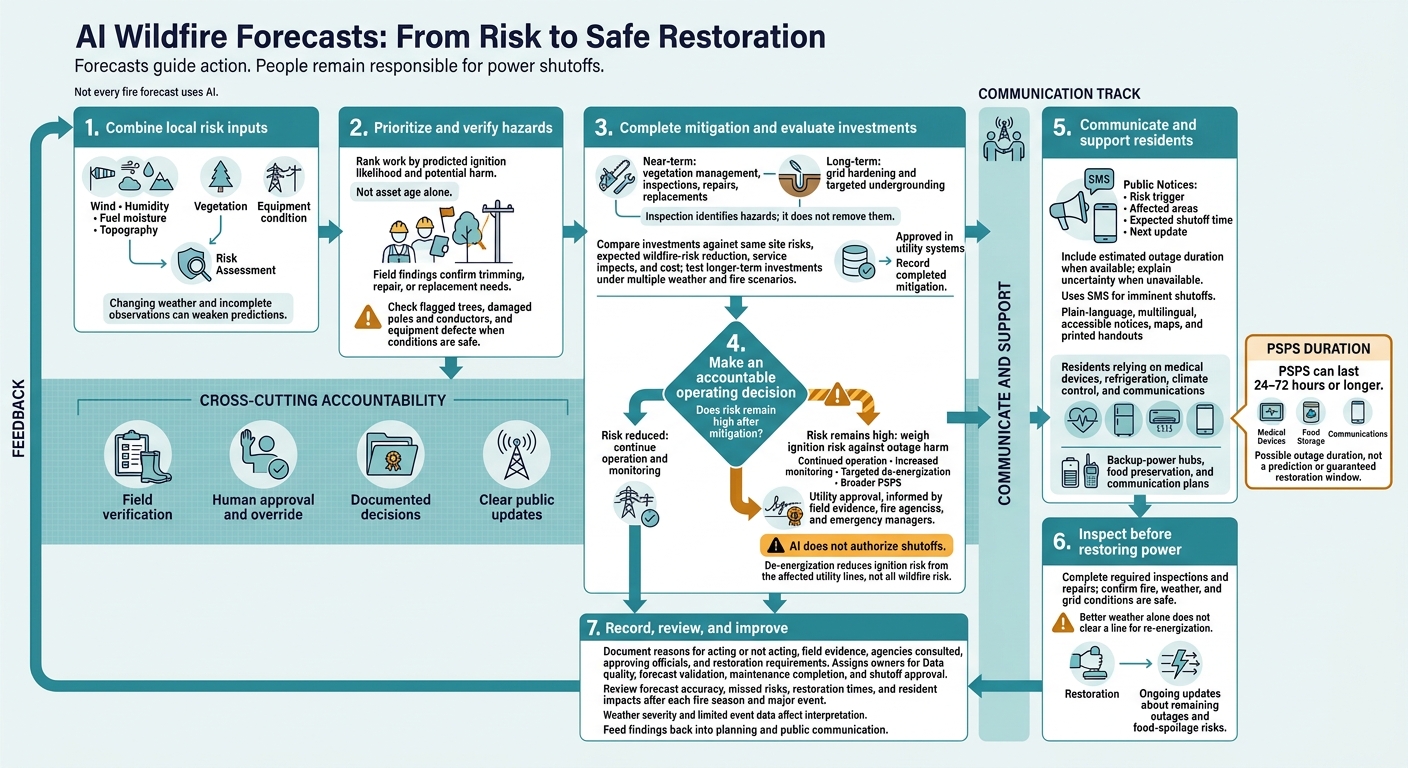
AI Wildfire Forecasts: From Risk to Safe Restoration
AI Is Helping Utilities Prevent Wildfires
sbb-itb-8baf5f1
Set Maintenance and Grid Investment Priorities
Forecasts that combine weather, vegetation, and equipment data help utilities identify risks. The next step is turning those forecasts into a maintenance queue. Rank work by predicted ignition likelihood and potential harm, not asset age alone. Give priority to locations where equipment failure could start a fire and cause the most damage.[1]
Check Equipment and Vegetation Risks in the Field
Before forecast wind and dry weather arrive, send crews out when conditions are safe. Inspect flagged trees, damaged poles and conductors, and equipment defects. Use those field findings to confirm where trimming, repairs, or replacements are needed, then enter approved work into the utility system.[2]
Compare Maintenance and Grid Hardening Options
Once crews confirm hazards, compare short-term fixes with longer-term grid hardening against the same site risks.[1][2] The table below offers a qualitative planning screen - not a forecast of costs or outcomes.
| Option | Risk reduction | Time | Cost | Outage impact | Inputs |
|---|---|---|---|---|---|
| Vegetation management | High; reduces fuel load | Recurring/seasonal | Moderate, recurring | Low | Satellite imagery, LiDAR, and field surveys |
| Equipment inspection | Identifies hazards; does not remove them | Very short | Low to moderate | Low | IoT, drones, and field data |
| Grid hardening | High; improves structural resilience | Long-term | High | Moderate | Asset and climate data |
| Targeted undergrounding | Very high | Very long-term | Very high | High during construction | Topography and soil data |
For each grid-hardening option, compare the hazard it addresses, expected wildfire-risk reduction, service impacts, and cost. Address confirmed hazards through near-term maintenance while evaluating longer-term investments. Test those investments under multiple weather and fire scenarios.[4] Keep records of risk assessments and completed mitigation work for compliance and coverage reviews.[1]
If risk remains high after mitigation, utilities must decide whether to monitor conditions or shut off power.
Evaluate Power Shutoffs When Forecasts Are Uncertain
When mitigation cannot reduce risk fast enough, use forecasts to assess whether a public safety power shutoff (PSPS) is justified. The utility weighs ignition risk against outage harm, with input from fire agencies and emergency managers, and makes the final decision to de-energize or restore service.[5][2] If forecasts and field reports point to fast-moving ignition risk, the options are continued monitoring, targeted de-energization, or a broader PSPS.
Assess Weather, Circuit Conditions, and Outage Risks
Base the decision on local conditions and potential outage harm. Review the same site-level inputs: wind, humidity, fuel moisture, topography, vegetation, and equipment condition. Have field crews verify conditions, and coordinate with emergency managers on evacuation centers and critical facilities. Account for residents who depend on medical devices, refrigeration, climate control, or communications.[5]
Look beyond customer counts. Assess business disruption, expected outage duration, backup-power limits, and readiness to restore service.[1][5]
Compare Monitoring and Shutoff Choices
Use local conditions to choose among the options below, and name the official responsible for approval. Before restoring service, complete required inspections and repairs, then confirm that fire, weather, and grid conditions are safe. Better weather alone does not clear a line for re-energization.[5]
| Choice | Remaining ignition risk | Customer and reliability impact | Required actions |
|---|---|---|---|
| Continued operation | Highest; equipment-related ignition risk in high winds | Maintains service and business continuity | Standard monitoring and routine maintenance |
| Increased monitoring | Risk remains | Service continues unless escalation is needed | Observation coverage and escalation triggers |
| Targeted de-energization | Low on de-energized circuits | Affects specific neighborhoods or industrial zones | Coordination with emergency services and medical baseline customers[5] |
| Broader PSPS | Lowest from de-energized utility lines | Highest; spoilage, production stops, and safety risks[1] | Emergency protocols and backup generators for hubs[5] |
Explain Forecast Uncertainty and Record Decisions
Require forecasts to spell out their limits. Changing weather and incomplete observations can weaken predictions. Record the reasons for acting - or not acting - along with field evidence, agencies consulted, the approving official, and requirements for restoring service.
Maintain human override procedures that identify who may approve, extend, or end a shutoff. Decision logs support accountability, regulatory and insurance reviews, and later communication with residents.[1][4]
Turn those decisions into clear public notices that explain what changed, what triggered action, which areas are affected, and when residents can expect updates.
Communicate Wildfire Forecasts and Outage Plans
Once a utility decides whether to monitor conditions or de-energize, communication is the next task. Before high-risk conditions arrive, coordinate with local officials, fire services, and emergency managers on roles, timing, and consistent messages.[5] Turn AI-driven forecasts into clear public actions, explaining uncertainty in plain language without suggesting the forecast is certain.
Explain Triggers, Affected Areas, and Update Times
Every notice should name the risk trigger, likely outage areas, and expected shutoff time. Use SMS alerts when shutoffs are imminent.[5]
Share restoration status and when residents can expect the next update. Include an estimated outage duration when available; PSPS events can last 24–72 hours or longer.[1] If the restoration time is still uncertain, explain which inspections or safety checks crews must finish before power can return.
Help Residents Prepare and Recover Safely
Tell residents how to prepare and where to get support. Provide plain-language, multilingual, accessible notices, along with maps and printed handouts distributed through community partners.[5]
Put residents who depend on electricity for medical devices first. Before fire season, ask households to plan for backup power, food preservation, and communication needs.[5] Share the locations of backup-power hubs where residents can charge devices and stay connected.[5]
As power returns, keep residents informed about remaining outages and food-spoilage risks.[1]
Conclusion: Turn Wildfire Forecasts Into Accountable Action
Once utilities rank risks and take steps to reduce them, forecasts must lead to clear responsibilities and documented decisions. That means validating forecasts, assigning owners, and completing mitigation work. Human approval should remain the final control, supported by documented thresholds and review.
Assign Responsibility and Track Results
Assign owners for data quality, forecast validation, maintenance completion, and shutoff approval. Use forecasts to update asset records and work orders, turning identified risks into assigned tasks. Document each handoff through inspection, mitigation, shutoff decisions, and restoration review.
Record completed mitigation work to support compliance, insurance, and after-action review. After each fire season and major event, assess forecast accuracy, missed risks, restoration times, and resident impacts. Account for weather severity and limited event data when interpreting results, then use those records to inform emergency planning and public communication.
Link Grid Planning With Community Resilience
Bring together input from utilities, emergency managers, fire departments, critical-service providers, and resident representatives. Use it to align grid investments with evacuation, shelter, and critical-service needs. Keep decisions grounded in locally important circuits, facilities, and outage impacts - not just model outputs.[4]
FAQs
How can I tell if a wildfire forecast is reliable?
Look for utilities that use detailed weather models and verify them against local weather station readings and field measurements of moisture in dead vegetation [1]. Weather alone isn’t enough. Reliable forecasts also account for each circuit’s condition, the potential for fire to spread through urban areas, and fire suppression levels [1].
Can better wildfire forecasts reduce unnecessary power shutoffs?
Yes. Better wildfire forecasts help utilities make more precise, risk-informed shutoff decisions. High-resolution weather models, satellite data, and machine learning refine their Fire Potential Index, helping operators assess risk for individual circuit segments [1][2][3]. Operators can then target shutoffs to high-risk segments instead of broad areas, keeping power on in neighborhoods that remain safe despite regional fire conditions [1][3].
How can residents influence local grid safety priorities?
Residents can help set grid safety priorities by attending utility public meetings and feedback forums. Sharing local knowledge helps utilities refine wildfire mitigation plans and infrastructure investments [2][1].
They can also join or form Fire Safe Councils and Firewise USA groups to coordinate community planning and advocacy [2][3]. This involvement helps utility projects address local needs while building transparency, trust, and regional climate resilience [1].

FAQ