Mar 27, 2026
How to Design Marine Protected Area Governance for Universities & Research Institutions
Capacity Building
In This Article
Universities must lead evidence-based, inclusive MPA governance—pairing science, shared decision-making, and adaptive management.
How to Design Marine Protected Area Governance for Universities & Research Institutions
Marine Protected Areas (MPAs) are critical zones in oceans designed to protect ecosystems, prevent overfishing, and support biodiversity. Universities and research institutions are uniquely positioned to improve MPA governance by combining scientific expertise with practical management strategies. Here’s a quick breakdown of key insights from this article:
Current Gaps: While 26% of U.S. waters are protected, 96% of this is in the central Pacific, leaving most regions underprotected.
Governance Models: Two key frameworks - MPAG (legal, institutional, and participatory focus) and IUCN (categorization by governance authority) - guide effective MPA management.
University Role: Academic institutions can:
Provide research on habitat connectivity, species preservation, and effective MPA design.
Collaborate with governments, NGOs, and local communities to ensure stakeholder involvement.
Develop tools like connectivity models and monitoring systems to inform decision-making.
Success Metrics: MPAs managed through shared governance see up to 98% higher fish biomass compared to state-only management.
Case Studies: Examples include California's Marine Life Protection Act and The MPA Guide from Oregon State University, showcasing how universities can influence both local and global marine policies.
Social Aspects of MPA Management – Building Effective and Equitable Ocean Conservation
Governance Frameworks for MPAs
Effective governance of Marine Protected Areas (MPAs) hinges on clear structures and well-defined responsibilities. Governance in this context refers to the organizations, decision-making processes, and frameworks that establish the rules, rights, and duties within a specific marine area [3]. Familiarity with established governance models is essential for guiding effective conservation efforts.
Two major frameworks shape MPA governance globally: the Marine Protected Area Governance (MPAG) framework and the IUCN (International Union for Conservation of Nature) classification system. The MPAG framework highlights the importance of legal, institutional, and participatory components in ensuring stakeholder compliance and sustainable resource management. On the other hand, the IUCN system categorizes MPAs based on governance authority and management objectives, offering a globally recognized standard that is increasingly integrated into national policies [4]. These frameworks serve as a foundation for universities and other institutions looking to design effective governance models.
The MPAG Framework
The MPAG framework focuses on three key elements: legal, institutional, and participatory components. Each plays a vital role in ensuring effective governance:
Legal foundations: Define the regulatory structure, specifying activities that are allowed or restricted within the protected area.
Institutional coordination: Clarifies the roles and responsibilities of organizations involved and ensures collaboration among stakeholders.
Inclusive participation: Ensures that all relevant stakeholders, including local communities, have a voice in decision-making.
The IUCN framework complements MPAG by identifying four governance types: state-led, shared, private, and Indigenous/local. Shared governance models, in particular, are often adopted by research institutions, as they allow collaboration with government agencies while maintaining a focus on research and conservation.
Evidence underscores the effectiveness of shared governance. Data from 217 MPAs worldwide show that shared governance arrangements result in 98% higher fish biomass compared to areas managed solely by state agencies [3]. Collaborative governance, where multiple agencies work together, achieves fish biomass levels 49% higher than those managed exclusively by national governments [3]. These outcomes highlight the benefits of integrating diverse knowledge systems, balancing conservation with local needs, and fostering trust among stakeholders. Universities can leverage shared governance to bring scientific expertise to the table while benefiting from these collaborative advantages.
IUCN Categories and Their Application
The IUCN categorization system offers academic institutions a structured approach to governance, with six categories (IA through VI) defined by their primary management objectives. Categories IA and IB are particularly relevant for institutions focused on research and conservation [5].
Category IA (Strict Nature Reserve): Prioritizes scientific research and monitoring. Governance strategies in this category aim to preserve habitats in an undisturbed state, restricting human access to maintain ecological baselines [5].
Category IV (Habitat/Species Management Area): Requires active management efforts, such as habitat restoration, to protect specific species [5].
A critical guideline across all categories is the 75% Rule, which mandates that at least three-quarters of the MPA must be managed for its primary objective, with any remaining activities not interfering with that goal [5]. Categories II through V also allow for educational and outreach opportunities alongside scientific objectives, making them well-suited for institutions with public engagement missions [5].
How to Design MPA Governance for Universities
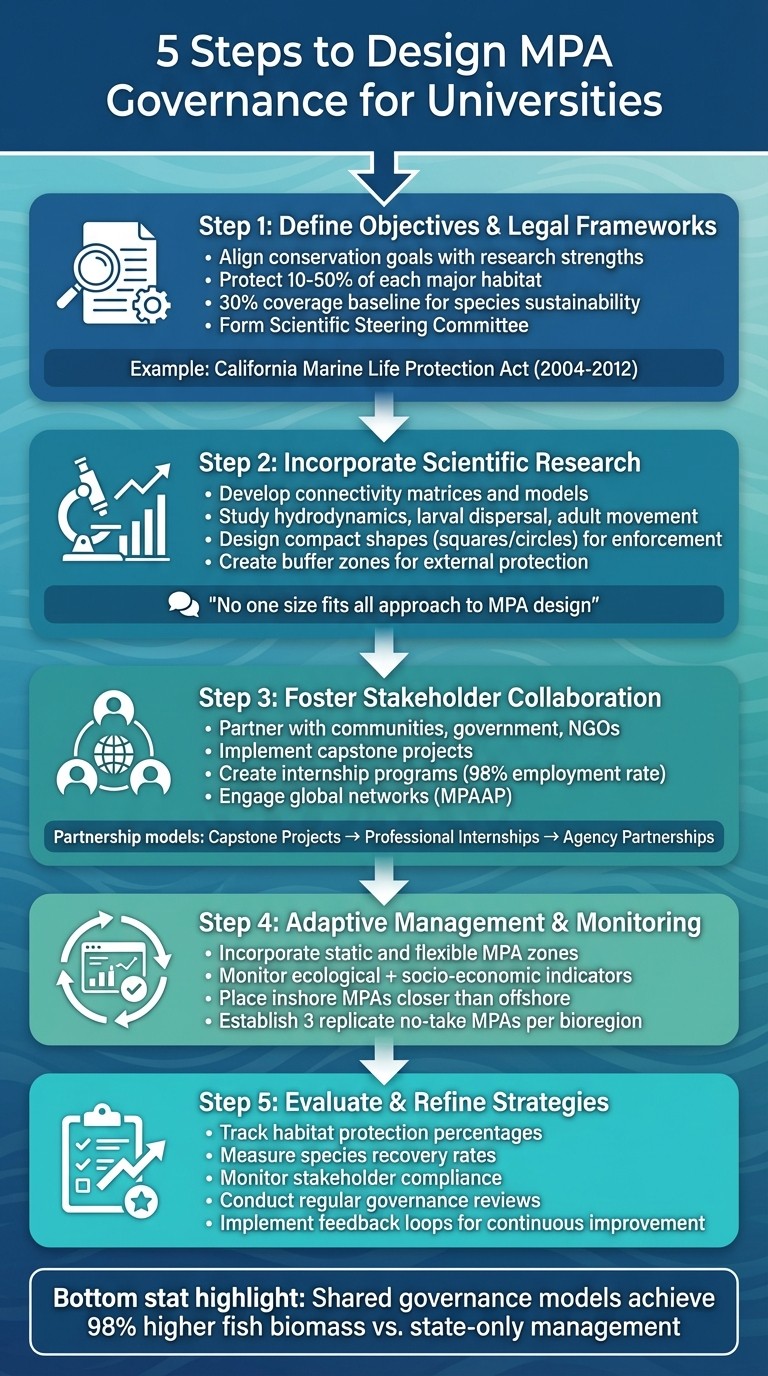
5-Step Framework for University-Led Marine Protected Area Governance Design
Creating effective governance for Marine Protected Areas (MPAs) within universities requires a thoughtful approach that bridges academic expertise with actionable conservation strategies. By following five interconnected steps, institutions can ensure that their research efforts lead to meaningful ecological and community outcomes.
Step 1: Define Objectives and Understand Legal Frameworks
Start by aligning conservation goals with your institution's research strengths and legal obligations. Objectives should address key ecological priorities like habitat representation, species preservation, and minimizing human impact. Research suggests that safeguarding 10%–50% of each major habitat is essential for biodiversity, with 30% coverage often serving as a baseline for species sustainability [2].
Universities must also navigate legal and regulatory landscapes. A notable example is the California Marine Life Protection Act, which from 2004–2012 relied on academic input to design a network of MPAs that balanced ecological connectivity with legal requirements [2]. This process demonstrated how academic research could guide stakeholder-driven conservation efforts through strategies like spacing MPAs evenly.
To strengthen governance, universities might form a Scientific Steering Committee of faculty experts. The redesign of the Great Barrier Reef Marine Park serves as a prime example - scientists ensured that at least 20% of three reefs per bioregion were protected, ultimately achieving over 22% fully protected status for the park [2].
Step 2: Incorporate Scientific Research into Decision-Making
Universities are uniquely positioned to bring data and technical expertise into governance processes. Tools like connectivity matrices and models, which often pose challenges in MPA planning, can be developed using university resources [2].
Key research areas include hydrodynamics, larval dispersal, and adult species movement to ensure genetic and population connectivity [2]. In regions with consistent currents but limited genetic data, MPAs should be placed upstream of other protected areas to support gene flow.
Designing MPAs with compact shapes like squares or circles simplifies enforcement and improves compliance. Buffer zones can further protect MPAs from external risks, such as sediment runoff from mining or trawling activities [2].
"There is no one size fits all approach to MPA design, but general rules of thumb and best-practice planning principles are useful to achieve long-term conservation objectives" [2].
With research integrated into governance, the next step is building partnerships to refine and implement these strategies.
Step 3: Foster Stakeholder Collaboration
Collaboration with diverse stakeholders is essential for successful MPA governance. Universities can create structured partnerships with local communities, government bodies, NGOs, and private organizations to ensure broad support. One effective strategy is leveraging capstone projects, where students and faculty work with external partners like government agencies or NGOs to address specific governance challenges [7]. These projects not only provide practical solutions but also build enduring relationships.
Internship programs can also connect academic research with policy-making. For instance, Rockefeller MPA graduates participating in stakeholder-aligned internships report a 98% employment rate within a year [6]. Such programs link students with organizations like NOAA or state legislatures, enhancing both career prospects and governance outcomes.
Partnership Model | Primary Stakeholders | University Role | Outcome |
|---|---|---|---|
Capstone Project | Local Agencies, International NGOs | Technical Consultant | Data-driven solutions for policy issues [7] |
Professional Internship | State Legislatures, Federal Agencies, NGOs | Talent & Research Provider | Direct integration of expertise into governance [6] |
Agency Partnership | National MPA Agencies, IUCN | Knowledge Hub / Secretariat | Shared practices and policy guidance [8] |
Engaging with global networks like the Marine Protected Area Agency Partnership (MPAAP) can further enhance collaboration by facilitating knowledge exchange with senior officials and international organizations [8].
"The MPA program's focus on developing qualitative and quantitative competencies, and on working in teams will be invaluable to me as I begin my fellowship with the New York State government" [6].
Step 4: Use Adaptive Management and Monitoring
To address dynamic ocean conditions, governance structures should incorporate both static and flexible MPA zones [2]. This adaptability allows for adjustments as environmental factors evolve.
Monitoring protocols should evaluate both ecological and socio-economic indicators. For example, while biological benefits are critical, governance models must also consider impacts on stakeholders like fishers or dive tourism operators. General guidelines recommend placing inshore MPAs closer together than offshore ones to maintain connectivity [2].
Experts also advocate for three replicate no-take MPAs within each bioregion to ensure resilience against localized threats like oil spills. This redundancy supports ecosystem health while enabling comparative monitoring across sites [2].
Step 5: Evaluate and Refine Governance Strategies
Performance metrics are vital for assessing the success of MPA governance. Metrics might include habitat protection percentages, species recovery rates, or compliance levels among stakeholders. These benchmarks help gauge whether conservation goals are being met [2].
Regular governance reviews can identify areas for improvement. Rotating leadership roles among partners, as practiced by MPAAP with NOAA and other agencies, promotes shared responsibility and sustained engagement [8]. Feedback loops, informed by monitoring data and stakeholder input, allow governance structures to evolve. Adjustments to boundaries, regulations, or management approaches can ensure that ecological goals remain aligned with community needs.
Case Studies: University-Led MPA Governance Models
Oregon State University played a pivotal role in the development of "The MPA Guide", a project led by Distinguished Professor Jane Lubchenco alongside Associate Professors Kirsten Grorud-Colvert and Jenna Sullivan-Stack. Spanning from September 2021 to January 2026, this guide became the scientific foundation for the UN High Seas Treaty, formally known as the Biodiversity Beyond National Jurisdiction Agreement. The treaty officially came into force on January 17, 2026, following its ratification by Morocco as the 60th nation on September 19, 2025 [9]. The guide's adoption by the UN-affiliated World Database on Protected Areas and MPAtlas highlights how university-led research can directly influence global ocean policy.
"The guide was the culmination of decades of work by hundreds of scientists and stakeholders and established a structure for an evidence-based understanding of where we stand on ocean protection." - Kirsten Grorud-Colvert, Associate Professor, Oregon State University [9]
Another example of university-driven impact comes from California's coastline. Reflecting the role of academic institutions in connecting science with policy, California Sea Grant collaborated with Moss Landing Marine Laboratories to address fragmented Marine Protected Area (MPA) management along California's 1,100-mile coastline. This initiative traces its roots to foundational research by Rick Starr in 1997, which laid the groundwork for the Marine Life Protection Act (MLPA) network. By 2023, this network comprised 124 MPAs, covering 16% of California's state waters, and became the world’s first ecologically connected MPA network. Between 2007 and 2018, California Sea Grant distributed $29.3 million in monitoring funds through independent peer-reviewed processes. The International Union for Conservation of Nature is now considering this network for its "Green List" designation [11].
A multi-university collaboration further illustrates the power of academic partnerships. The National Center for Ecological Analysis and Synthesis (NCEAS) at UC Santa Barbara coordinated an effort from September 2008 to April 2009 involving eight universities, including California State University Monterey Bay, University of Hawai'i, and University of Washington. Partnering with National Marine Sanctuaries, these institutions developed Ecosystem-Based Management tools. Each university conducted site-specific case studies, with findings synthesized during a meeting in April 2009. This collaborative approach demonstrated that marine sanctuaries are particularly effective at facilitating stakeholder engagement compared to traditional regulatory models [10].
California also addressed inclusivity in MPA management by launching the Tribal Marine Stewards Network in 2020. This initiative funded tribal groups, including the Amah Mutsun Tribal Band, Kashia Band of Pomo Indians, Resighini Rancheria, and Tolowa Dee-ni' Nation, to monitor and manage MPAs in alignment with tribal priorities. This move toward co-management reflects a broader commitment to inclusive governance [11].
These examples highlight the critical role universities play in advancing science-based MPA governance, offering practical solutions to complex environmental challenges.
How Council Fire Supports MPA Governance Implementation
Council Fire takes a practical approach to turning academic MPA governance frameworks into actionable results. Rather than relying on static reports, the focus is on empowering decision-making authority, a factor shown to enhance MPA success by 1.5 times compared to other strategies [3]. This hands-on methodology connects research insights directly to effective conservation practices.
Shared governance models present a compelling opportunity for universities managing MPAs. Studies reveal that these collaborative approaches can lead to a 98% increase in fish biomass [3]. Council Fire prioritizes helping institutions transition from traditional top-down management to cooperative frameworks, drawing on a broad range of expertise and resources.
"Shared governance arrangements that include diverse groups throughout the design and implementation process (e.g., planning, monitoring, adaptation) may foster collaboration, support community interests, instill responsibility across multiple groups, and increase management capacity by leveraging shared resources." - Mast et al., PLOS One [3]
By incorporating local and traditional knowledge into conservation rules, Council Fire strengthens legitimacy and encourages cooperation [3]. This is especially critical as universities work to balance biodiversity conservation with the needs of the communities most affected by marine protection measures. Through inclusive planning processes, Council Fire helps institutions design governance structures that respect existing practices and rights, aiming for long-term resilience rather than short-term compliance.
Building on the collaborative and adaptive strategies discussed earlier, Council Fire also supports universities in implementing adaptive management systems. These systems are designed to respond to changing ecological and social conditions, integrating climate resilience planning and systems thinking. With proven technical and communication skills, Council Fire ensures that governance efforts deliver measurable environmental, social, and economic benefits while contributing to the global goal of protecting 30% of the ocean by 2030 [3].
Conclusion
Universities and research institutions play a crucial role in advancing marine conservation through effective management of Marine Protected Areas (MPAs). The evidence speaks for itself: fully or highly protected MPAs consistently yield the best outcomes for biodiversity and human well-being alike [1][2]. These academic bodies provide the scientific expertise necessary to design and monitor such areas, from modeling larval dispersal to tracking the long-term health of ecosystems and species.
The challenge is to balance ecological precision with the social conditions needed for success. This involves protecting 10% to 50% of each major habitat within bioregions, ensuring at least three no-take MPAs per habitat to mitigate localized risks, and designing straightforward boundaries to simplify enforcement [2]. However, science alone cannot drive success. The California MLPA Initiative (1999–2012) showed that stakeholder engagement and public-private partnerships are critical to overcoming the pitfalls of top-down approaches [1].
Achieving the global goal of protecting 30% of the ocean by 2030 requires academic institutions to go beyond theoretical research and contribute to practical governance strategies. This includes blending Indigenous ecological knowledge with Western science, creating adaptive management systems to address climate change, and using tools like The MPA Guide to evaluate protection quality rather than focusing solely on spatial coverage [1].
FAQs
How do we choose the right MPA governance model for our university?
To determine the most suitable Marine Protected Area (MPA) governance model for your university, start by examining your institution's unique roles, research objectives, and conservation priorities. Consider governance structures that encourage collaboration among stakeholders, incorporate scientific research, and allow for flexible, adaptive management. Additionally, explore case studies and tools that can help pinpoint a model that leverages your university's strengths while effectively balancing conservation efforts with educational goals.
What data do we need to design an MPA that actually works?
To establish an effective Marine Protected Area (MPA), several types of data play a crucial role. Understanding the governance structure is essential, as approaches like shared governance often lead to better ecological results. Equally important is assessing the ecological status, which involves tracking species populations and evaluating habitat health. Details about the MPA itself, such as its age and the presence of no-take zones, also contribute to its success.
Additionally, the economic context, such as the region's GDP, and the roles of various stakeholders are key factors. These elements help encourage collaboration and align conservation efforts with local and regional priorities. By gathering and analyzing this comprehensive data, governance strategies can be tailored to meet both ecological objectives and stakeholder requirements effectively.
How can we share decision-making with communities without losing compliance?
To balance shared decision-making with compliance, it's crucial to involve communities early in the planning stages. This allows their values and knowledge to be integrated meaningfully. Science-based tools, such as the MPA Guide, can help align community engagement with conservation objectives and regulatory requirements. By prioritizing transparency and maintaining open lines of communication, trust and shared responsibility are strengthened. This approach not only ensures adherence to regulations but also encourages collaboration and effective governance.
Related Blog Posts
Latest Articles
©2025



FAQ
01
What does it really mean to “redefine profit”?
02
What makes Council Fire different?
03
Who does Council Fire you work with?
04
What does working with Council Fire actually look like?
05
How does Council Fire help organizations turn big goals into action?
06
How does Council Fire define and measure success?
Mar 27, 2026
How to Design Marine Protected Area Governance for Universities & Research Institutions
Capacity Building
In This Article
Universities must lead evidence-based, inclusive MPA governance—pairing science, shared decision-making, and adaptive management.
How to Design Marine Protected Area Governance for Universities & Research Institutions
Marine Protected Areas (MPAs) are critical zones in oceans designed to protect ecosystems, prevent overfishing, and support biodiversity. Universities and research institutions are uniquely positioned to improve MPA governance by combining scientific expertise with practical management strategies. Here’s a quick breakdown of key insights from this article:
Current Gaps: While 26% of U.S. waters are protected, 96% of this is in the central Pacific, leaving most regions underprotected.
Governance Models: Two key frameworks - MPAG (legal, institutional, and participatory focus) and IUCN (categorization by governance authority) - guide effective MPA management.
University Role: Academic institutions can:
Provide research on habitat connectivity, species preservation, and effective MPA design.
Collaborate with governments, NGOs, and local communities to ensure stakeholder involvement.
Develop tools like connectivity models and monitoring systems to inform decision-making.
Success Metrics: MPAs managed through shared governance see up to 98% higher fish biomass compared to state-only management.
Case Studies: Examples include California's Marine Life Protection Act and The MPA Guide from Oregon State University, showcasing how universities can influence both local and global marine policies.
Social Aspects of MPA Management – Building Effective and Equitable Ocean Conservation
Governance Frameworks for MPAs
Effective governance of Marine Protected Areas (MPAs) hinges on clear structures and well-defined responsibilities. Governance in this context refers to the organizations, decision-making processes, and frameworks that establish the rules, rights, and duties within a specific marine area [3]. Familiarity with established governance models is essential for guiding effective conservation efforts.
Two major frameworks shape MPA governance globally: the Marine Protected Area Governance (MPAG) framework and the IUCN (International Union for Conservation of Nature) classification system. The MPAG framework highlights the importance of legal, institutional, and participatory components in ensuring stakeholder compliance and sustainable resource management. On the other hand, the IUCN system categorizes MPAs based on governance authority and management objectives, offering a globally recognized standard that is increasingly integrated into national policies [4]. These frameworks serve as a foundation for universities and other institutions looking to design effective governance models.
The MPAG Framework
The MPAG framework focuses on three key elements: legal, institutional, and participatory components. Each plays a vital role in ensuring effective governance:
Legal foundations: Define the regulatory structure, specifying activities that are allowed or restricted within the protected area.
Institutional coordination: Clarifies the roles and responsibilities of organizations involved and ensures collaboration among stakeholders.
Inclusive participation: Ensures that all relevant stakeholders, including local communities, have a voice in decision-making.
The IUCN framework complements MPAG by identifying four governance types: state-led, shared, private, and Indigenous/local. Shared governance models, in particular, are often adopted by research institutions, as they allow collaboration with government agencies while maintaining a focus on research and conservation.
Evidence underscores the effectiveness of shared governance. Data from 217 MPAs worldwide show that shared governance arrangements result in 98% higher fish biomass compared to areas managed solely by state agencies [3]. Collaborative governance, where multiple agencies work together, achieves fish biomass levels 49% higher than those managed exclusively by national governments [3]. These outcomes highlight the benefits of integrating diverse knowledge systems, balancing conservation with local needs, and fostering trust among stakeholders. Universities can leverage shared governance to bring scientific expertise to the table while benefiting from these collaborative advantages.
IUCN Categories and Their Application
The IUCN categorization system offers academic institutions a structured approach to governance, with six categories (IA through VI) defined by their primary management objectives. Categories IA and IB are particularly relevant for institutions focused on research and conservation [5].
Category IA (Strict Nature Reserve): Prioritizes scientific research and monitoring. Governance strategies in this category aim to preserve habitats in an undisturbed state, restricting human access to maintain ecological baselines [5].
Category IV (Habitat/Species Management Area): Requires active management efforts, such as habitat restoration, to protect specific species [5].
A critical guideline across all categories is the 75% Rule, which mandates that at least three-quarters of the MPA must be managed for its primary objective, with any remaining activities not interfering with that goal [5]. Categories II through V also allow for educational and outreach opportunities alongside scientific objectives, making them well-suited for institutions with public engagement missions [5].
How to Design MPA Governance for Universities
5-Step Framework for University-Led Marine Protected Area Governance Design
Creating effective governance for Marine Protected Areas (MPAs) within universities requires a thoughtful approach that bridges academic expertise with actionable conservation strategies. By following five interconnected steps, institutions can ensure that their research efforts lead to meaningful ecological and community outcomes.
Step 1: Define Objectives and Understand Legal Frameworks
Start by aligning conservation goals with your institution's research strengths and legal obligations. Objectives should address key ecological priorities like habitat representation, species preservation, and minimizing human impact. Research suggests that safeguarding 10%–50% of each major habitat is essential for biodiversity, with 30% coverage often serving as a baseline for species sustainability [2].
Universities must also navigate legal and regulatory landscapes. A notable example is the California Marine Life Protection Act, which from 2004–2012 relied on academic input to design a network of MPAs that balanced ecological connectivity with legal requirements [2]. This process demonstrated how academic research could guide stakeholder-driven conservation efforts through strategies like spacing MPAs evenly.
To strengthen governance, universities might form a Scientific Steering Committee of faculty experts. The redesign of the Great Barrier Reef Marine Park serves as a prime example - scientists ensured that at least 20% of three reefs per bioregion were protected, ultimately achieving over 22% fully protected status for the park [2].
Step 2: Incorporate Scientific Research into Decision-Making
Universities are uniquely positioned to bring data and technical expertise into governance processes. Tools like connectivity matrices and models, which often pose challenges in MPA planning, can be developed using university resources [2].
Key research areas include hydrodynamics, larval dispersal, and adult species movement to ensure genetic and population connectivity [2]. In regions with consistent currents but limited genetic data, MPAs should be placed upstream of other protected areas to support gene flow.
Designing MPAs with compact shapes like squares or circles simplifies enforcement and improves compliance. Buffer zones can further protect MPAs from external risks, such as sediment runoff from mining or trawling activities [2].
"There is no one size fits all approach to MPA design, but general rules of thumb and best-practice planning principles are useful to achieve long-term conservation objectives" [2].
With research integrated into governance, the next step is building partnerships to refine and implement these strategies.
Step 3: Foster Stakeholder Collaboration
Collaboration with diverse stakeholders is essential for successful MPA governance. Universities can create structured partnerships with local communities, government bodies, NGOs, and private organizations to ensure broad support. One effective strategy is leveraging capstone projects, where students and faculty work with external partners like government agencies or NGOs to address specific governance challenges [7]. These projects not only provide practical solutions but also build enduring relationships.
Internship programs can also connect academic research with policy-making. For instance, Rockefeller MPA graduates participating in stakeholder-aligned internships report a 98% employment rate within a year [6]. Such programs link students with organizations like NOAA or state legislatures, enhancing both career prospects and governance outcomes.
Partnership Model | Primary Stakeholders | University Role | Outcome |
|---|---|---|---|
Capstone Project | Local Agencies, International NGOs | Technical Consultant | Data-driven solutions for policy issues [7] |
Professional Internship | State Legislatures, Federal Agencies, NGOs | Talent & Research Provider | Direct integration of expertise into governance [6] |
Agency Partnership | National MPA Agencies, IUCN | Knowledge Hub / Secretariat | Shared practices and policy guidance [8] |
Engaging with global networks like the Marine Protected Area Agency Partnership (MPAAP) can further enhance collaboration by facilitating knowledge exchange with senior officials and international organizations [8].
"The MPA program's focus on developing qualitative and quantitative competencies, and on working in teams will be invaluable to me as I begin my fellowship with the New York State government" [6].
Step 4: Use Adaptive Management and Monitoring
To address dynamic ocean conditions, governance structures should incorporate both static and flexible MPA zones [2]. This adaptability allows for adjustments as environmental factors evolve.
Monitoring protocols should evaluate both ecological and socio-economic indicators. For example, while biological benefits are critical, governance models must also consider impacts on stakeholders like fishers or dive tourism operators. General guidelines recommend placing inshore MPAs closer together than offshore ones to maintain connectivity [2].
Experts also advocate for three replicate no-take MPAs within each bioregion to ensure resilience against localized threats like oil spills. This redundancy supports ecosystem health while enabling comparative monitoring across sites [2].
Step 5: Evaluate and Refine Governance Strategies
Performance metrics are vital for assessing the success of MPA governance. Metrics might include habitat protection percentages, species recovery rates, or compliance levels among stakeholders. These benchmarks help gauge whether conservation goals are being met [2].
Regular governance reviews can identify areas for improvement. Rotating leadership roles among partners, as practiced by MPAAP with NOAA and other agencies, promotes shared responsibility and sustained engagement [8]. Feedback loops, informed by monitoring data and stakeholder input, allow governance structures to evolve. Adjustments to boundaries, regulations, or management approaches can ensure that ecological goals remain aligned with community needs.
Case Studies: University-Led MPA Governance Models
Oregon State University played a pivotal role in the development of "The MPA Guide", a project led by Distinguished Professor Jane Lubchenco alongside Associate Professors Kirsten Grorud-Colvert and Jenna Sullivan-Stack. Spanning from September 2021 to January 2026, this guide became the scientific foundation for the UN High Seas Treaty, formally known as the Biodiversity Beyond National Jurisdiction Agreement. The treaty officially came into force on January 17, 2026, following its ratification by Morocco as the 60th nation on September 19, 2025 [9]. The guide's adoption by the UN-affiliated World Database on Protected Areas and MPAtlas highlights how university-led research can directly influence global ocean policy.
"The guide was the culmination of decades of work by hundreds of scientists and stakeholders and established a structure for an evidence-based understanding of where we stand on ocean protection." - Kirsten Grorud-Colvert, Associate Professor, Oregon State University [9]
Another example of university-driven impact comes from California's coastline. Reflecting the role of academic institutions in connecting science with policy, California Sea Grant collaborated with Moss Landing Marine Laboratories to address fragmented Marine Protected Area (MPA) management along California's 1,100-mile coastline. This initiative traces its roots to foundational research by Rick Starr in 1997, which laid the groundwork for the Marine Life Protection Act (MLPA) network. By 2023, this network comprised 124 MPAs, covering 16% of California's state waters, and became the world’s first ecologically connected MPA network. Between 2007 and 2018, California Sea Grant distributed $29.3 million in monitoring funds through independent peer-reviewed processes. The International Union for Conservation of Nature is now considering this network for its "Green List" designation [11].
A multi-university collaboration further illustrates the power of academic partnerships. The National Center for Ecological Analysis and Synthesis (NCEAS) at UC Santa Barbara coordinated an effort from September 2008 to April 2009 involving eight universities, including California State University Monterey Bay, University of Hawai'i, and University of Washington. Partnering with National Marine Sanctuaries, these institutions developed Ecosystem-Based Management tools. Each university conducted site-specific case studies, with findings synthesized during a meeting in April 2009. This collaborative approach demonstrated that marine sanctuaries are particularly effective at facilitating stakeholder engagement compared to traditional regulatory models [10].
California also addressed inclusivity in MPA management by launching the Tribal Marine Stewards Network in 2020. This initiative funded tribal groups, including the Amah Mutsun Tribal Band, Kashia Band of Pomo Indians, Resighini Rancheria, and Tolowa Dee-ni' Nation, to monitor and manage MPAs in alignment with tribal priorities. This move toward co-management reflects a broader commitment to inclusive governance [11].
These examples highlight the critical role universities play in advancing science-based MPA governance, offering practical solutions to complex environmental challenges.
How Council Fire Supports MPA Governance Implementation
Council Fire takes a practical approach to turning academic MPA governance frameworks into actionable results. Rather than relying on static reports, the focus is on empowering decision-making authority, a factor shown to enhance MPA success by 1.5 times compared to other strategies [3]. This hands-on methodology connects research insights directly to effective conservation practices.
Shared governance models present a compelling opportunity for universities managing MPAs. Studies reveal that these collaborative approaches can lead to a 98% increase in fish biomass [3]. Council Fire prioritizes helping institutions transition from traditional top-down management to cooperative frameworks, drawing on a broad range of expertise and resources.
"Shared governance arrangements that include diverse groups throughout the design and implementation process (e.g., planning, monitoring, adaptation) may foster collaboration, support community interests, instill responsibility across multiple groups, and increase management capacity by leveraging shared resources." - Mast et al., PLOS One [3]
By incorporating local and traditional knowledge into conservation rules, Council Fire strengthens legitimacy and encourages cooperation [3]. This is especially critical as universities work to balance biodiversity conservation with the needs of the communities most affected by marine protection measures. Through inclusive planning processes, Council Fire helps institutions design governance structures that respect existing practices and rights, aiming for long-term resilience rather than short-term compliance.
Building on the collaborative and adaptive strategies discussed earlier, Council Fire also supports universities in implementing adaptive management systems. These systems are designed to respond to changing ecological and social conditions, integrating climate resilience planning and systems thinking. With proven technical and communication skills, Council Fire ensures that governance efforts deliver measurable environmental, social, and economic benefits while contributing to the global goal of protecting 30% of the ocean by 2030 [3].
Conclusion
Universities and research institutions play a crucial role in advancing marine conservation through effective management of Marine Protected Areas (MPAs). The evidence speaks for itself: fully or highly protected MPAs consistently yield the best outcomes for biodiversity and human well-being alike [1][2]. These academic bodies provide the scientific expertise necessary to design and monitor such areas, from modeling larval dispersal to tracking the long-term health of ecosystems and species.
The challenge is to balance ecological precision with the social conditions needed for success. This involves protecting 10% to 50% of each major habitat within bioregions, ensuring at least three no-take MPAs per habitat to mitigate localized risks, and designing straightforward boundaries to simplify enforcement [2]. However, science alone cannot drive success. The California MLPA Initiative (1999–2012) showed that stakeholder engagement and public-private partnerships are critical to overcoming the pitfalls of top-down approaches [1].
Achieving the global goal of protecting 30% of the ocean by 2030 requires academic institutions to go beyond theoretical research and contribute to practical governance strategies. This includes blending Indigenous ecological knowledge with Western science, creating adaptive management systems to address climate change, and using tools like The MPA Guide to evaluate protection quality rather than focusing solely on spatial coverage [1].
FAQs
How do we choose the right MPA governance model for our university?
To determine the most suitable Marine Protected Area (MPA) governance model for your university, start by examining your institution's unique roles, research objectives, and conservation priorities. Consider governance structures that encourage collaboration among stakeholders, incorporate scientific research, and allow for flexible, adaptive management. Additionally, explore case studies and tools that can help pinpoint a model that leverages your university's strengths while effectively balancing conservation efforts with educational goals.
What data do we need to design an MPA that actually works?
To establish an effective Marine Protected Area (MPA), several types of data play a crucial role. Understanding the governance structure is essential, as approaches like shared governance often lead to better ecological results. Equally important is assessing the ecological status, which involves tracking species populations and evaluating habitat health. Details about the MPA itself, such as its age and the presence of no-take zones, also contribute to its success.
Additionally, the economic context, such as the region's GDP, and the roles of various stakeholders are key factors. These elements help encourage collaboration and align conservation efforts with local and regional priorities. By gathering and analyzing this comprehensive data, governance strategies can be tailored to meet both ecological objectives and stakeholder requirements effectively.
How can we share decision-making with communities without losing compliance?
To balance shared decision-making with compliance, it's crucial to involve communities early in the planning stages. This allows their values and knowledge to be integrated meaningfully. Science-based tools, such as the MPA Guide, can help align community engagement with conservation objectives and regulatory requirements. By prioritizing transparency and maintaining open lines of communication, trust and shared responsibility are strengthened. This approach not only ensures adherence to regulations but also encourages collaboration and effective governance.
Related Blog Posts
FAQ
01
What does it really mean to “redefine profit”?
02
What makes Council Fire different?
03
Who does Council Fire you work with?
04
What does working with Council Fire actually look like?
05
How does Council Fire help organizations turn big goals into action?
06
How does Council Fire define and measure success?
Mar 27, 2026
How to Design Marine Protected Area Governance for Universities & Research Institutions
Capacity Building
In This Article
Universities must lead evidence-based, inclusive MPA governance—pairing science, shared decision-making, and adaptive management.
How to Design Marine Protected Area Governance for Universities & Research Institutions
Marine Protected Areas (MPAs) are critical zones in oceans designed to protect ecosystems, prevent overfishing, and support biodiversity. Universities and research institutions are uniquely positioned to improve MPA governance by combining scientific expertise with practical management strategies. Here’s a quick breakdown of key insights from this article:
Current Gaps: While 26% of U.S. waters are protected, 96% of this is in the central Pacific, leaving most regions underprotected.
Governance Models: Two key frameworks - MPAG (legal, institutional, and participatory focus) and IUCN (categorization by governance authority) - guide effective MPA management.
University Role: Academic institutions can:
Provide research on habitat connectivity, species preservation, and effective MPA design.
Collaborate with governments, NGOs, and local communities to ensure stakeholder involvement.
Develop tools like connectivity models and monitoring systems to inform decision-making.
Success Metrics: MPAs managed through shared governance see up to 98% higher fish biomass compared to state-only management.
Case Studies: Examples include California's Marine Life Protection Act and The MPA Guide from Oregon State University, showcasing how universities can influence both local and global marine policies.
Social Aspects of MPA Management – Building Effective and Equitable Ocean Conservation
Governance Frameworks for MPAs
Effective governance of Marine Protected Areas (MPAs) hinges on clear structures and well-defined responsibilities. Governance in this context refers to the organizations, decision-making processes, and frameworks that establish the rules, rights, and duties within a specific marine area [3]. Familiarity with established governance models is essential for guiding effective conservation efforts.
Two major frameworks shape MPA governance globally: the Marine Protected Area Governance (MPAG) framework and the IUCN (International Union for Conservation of Nature) classification system. The MPAG framework highlights the importance of legal, institutional, and participatory components in ensuring stakeholder compliance and sustainable resource management. On the other hand, the IUCN system categorizes MPAs based on governance authority and management objectives, offering a globally recognized standard that is increasingly integrated into national policies [4]. These frameworks serve as a foundation for universities and other institutions looking to design effective governance models.
The MPAG Framework
The MPAG framework focuses on three key elements: legal, institutional, and participatory components. Each plays a vital role in ensuring effective governance:
Legal foundations: Define the regulatory structure, specifying activities that are allowed or restricted within the protected area.
Institutional coordination: Clarifies the roles and responsibilities of organizations involved and ensures collaboration among stakeholders.
Inclusive participation: Ensures that all relevant stakeholders, including local communities, have a voice in decision-making.
The IUCN framework complements MPAG by identifying four governance types: state-led, shared, private, and Indigenous/local. Shared governance models, in particular, are often adopted by research institutions, as they allow collaboration with government agencies while maintaining a focus on research and conservation.
Evidence underscores the effectiveness of shared governance. Data from 217 MPAs worldwide show that shared governance arrangements result in 98% higher fish biomass compared to areas managed solely by state agencies [3]. Collaborative governance, where multiple agencies work together, achieves fish biomass levels 49% higher than those managed exclusively by national governments [3]. These outcomes highlight the benefits of integrating diverse knowledge systems, balancing conservation with local needs, and fostering trust among stakeholders. Universities can leverage shared governance to bring scientific expertise to the table while benefiting from these collaborative advantages.
IUCN Categories and Their Application
The IUCN categorization system offers academic institutions a structured approach to governance, with six categories (IA through VI) defined by their primary management objectives. Categories IA and IB are particularly relevant for institutions focused on research and conservation [5].
Category IA (Strict Nature Reserve): Prioritizes scientific research and monitoring. Governance strategies in this category aim to preserve habitats in an undisturbed state, restricting human access to maintain ecological baselines [5].
Category IV (Habitat/Species Management Area): Requires active management efforts, such as habitat restoration, to protect specific species [5].
A critical guideline across all categories is the 75% Rule, which mandates that at least three-quarters of the MPA must be managed for its primary objective, with any remaining activities not interfering with that goal [5]. Categories II through V also allow for educational and outreach opportunities alongside scientific objectives, making them well-suited for institutions with public engagement missions [5].
How to Design MPA Governance for Universities
5-Step Framework for University-Led Marine Protected Area Governance Design
Creating effective governance for Marine Protected Areas (MPAs) within universities requires a thoughtful approach that bridges academic expertise with actionable conservation strategies. By following five interconnected steps, institutions can ensure that their research efforts lead to meaningful ecological and community outcomes.
Step 1: Define Objectives and Understand Legal Frameworks
Start by aligning conservation goals with your institution's research strengths and legal obligations. Objectives should address key ecological priorities like habitat representation, species preservation, and minimizing human impact. Research suggests that safeguarding 10%–50% of each major habitat is essential for biodiversity, with 30% coverage often serving as a baseline for species sustainability [2].
Universities must also navigate legal and regulatory landscapes. A notable example is the California Marine Life Protection Act, which from 2004–2012 relied on academic input to design a network of MPAs that balanced ecological connectivity with legal requirements [2]. This process demonstrated how academic research could guide stakeholder-driven conservation efforts through strategies like spacing MPAs evenly.
To strengthen governance, universities might form a Scientific Steering Committee of faculty experts. The redesign of the Great Barrier Reef Marine Park serves as a prime example - scientists ensured that at least 20% of three reefs per bioregion were protected, ultimately achieving over 22% fully protected status for the park [2].
Step 2: Incorporate Scientific Research into Decision-Making
Universities are uniquely positioned to bring data and technical expertise into governance processes. Tools like connectivity matrices and models, which often pose challenges in MPA planning, can be developed using university resources [2].
Key research areas include hydrodynamics, larval dispersal, and adult species movement to ensure genetic and population connectivity [2]. In regions with consistent currents but limited genetic data, MPAs should be placed upstream of other protected areas to support gene flow.
Designing MPAs with compact shapes like squares or circles simplifies enforcement and improves compliance. Buffer zones can further protect MPAs from external risks, such as sediment runoff from mining or trawling activities [2].
"There is no one size fits all approach to MPA design, but general rules of thumb and best-practice planning principles are useful to achieve long-term conservation objectives" [2].
With research integrated into governance, the next step is building partnerships to refine and implement these strategies.
Step 3: Foster Stakeholder Collaboration
Collaboration with diverse stakeholders is essential for successful MPA governance. Universities can create structured partnerships with local communities, government bodies, NGOs, and private organizations to ensure broad support. One effective strategy is leveraging capstone projects, where students and faculty work with external partners like government agencies or NGOs to address specific governance challenges [7]. These projects not only provide practical solutions but also build enduring relationships.
Internship programs can also connect academic research with policy-making. For instance, Rockefeller MPA graduates participating in stakeholder-aligned internships report a 98% employment rate within a year [6]. Such programs link students with organizations like NOAA or state legislatures, enhancing both career prospects and governance outcomes.
Partnership Model | Primary Stakeholders | University Role | Outcome |
|---|---|---|---|
Capstone Project | Local Agencies, International NGOs | Technical Consultant | Data-driven solutions for policy issues [7] |
Professional Internship | State Legislatures, Federal Agencies, NGOs | Talent & Research Provider | Direct integration of expertise into governance [6] |
Agency Partnership | National MPA Agencies, IUCN | Knowledge Hub / Secretariat | Shared practices and policy guidance [8] |
Engaging with global networks like the Marine Protected Area Agency Partnership (MPAAP) can further enhance collaboration by facilitating knowledge exchange with senior officials and international organizations [8].
"The MPA program's focus on developing qualitative and quantitative competencies, and on working in teams will be invaluable to me as I begin my fellowship with the New York State government" [6].
Step 4: Use Adaptive Management and Monitoring
To address dynamic ocean conditions, governance structures should incorporate both static and flexible MPA zones [2]. This adaptability allows for adjustments as environmental factors evolve.
Monitoring protocols should evaluate both ecological and socio-economic indicators. For example, while biological benefits are critical, governance models must also consider impacts on stakeholders like fishers or dive tourism operators. General guidelines recommend placing inshore MPAs closer together than offshore ones to maintain connectivity [2].
Experts also advocate for three replicate no-take MPAs within each bioregion to ensure resilience against localized threats like oil spills. This redundancy supports ecosystem health while enabling comparative monitoring across sites [2].
Step 5: Evaluate and Refine Governance Strategies
Performance metrics are vital for assessing the success of MPA governance. Metrics might include habitat protection percentages, species recovery rates, or compliance levels among stakeholders. These benchmarks help gauge whether conservation goals are being met [2].
Regular governance reviews can identify areas for improvement. Rotating leadership roles among partners, as practiced by MPAAP with NOAA and other agencies, promotes shared responsibility and sustained engagement [8]. Feedback loops, informed by monitoring data and stakeholder input, allow governance structures to evolve. Adjustments to boundaries, regulations, or management approaches can ensure that ecological goals remain aligned with community needs.
Case Studies: University-Led MPA Governance Models
Oregon State University played a pivotal role in the development of "The MPA Guide", a project led by Distinguished Professor Jane Lubchenco alongside Associate Professors Kirsten Grorud-Colvert and Jenna Sullivan-Stack. Spanning from September 2021 to January 2026, this guide became the scientific foundation for the UN High Seas Treaty, formally known as the Biodiversity Beyond National Jurisdiction Agreement. The treaty officially came into force on January 17, 2026, following its ratification by Morocco as the 60th nation on September 19, 2025 [9]. The guide's adoption by the UN-affiliated World Database on Protected Areas and MPAtlas highlights how university-led research can directly influence global ocean policy.
"The guide was the culmination of decades of work by hundreds of scientists and stakeholders and established a structure for an evidence-based understanding of where we stand on ocean protection." - Kirsten Grorud-Colvert, Associate Professor, Oregon State University [9]
Another example of university-driven impact comes from California's coastline. Reflecting the role of academic institutions in connecting science with policy, California Sea Grant collaborated with Moss Landing Marine Laboratories to address fragmented Marine Protected Area (MPA) management along California's 1,100-mile coastline. This initiative traces its roots to foundational research by Rick Starr in 1997, which laid the groundwork for the Marine Life Protection Act (MLPA) network. By 2023, this network comprised 124 MPAs, covering 16% of California's state waters, and became the world’s first ecologically connected MPA network. Between 2007 and 2018, California Sea Grant distributed $29.3 million in monitoring funds through independent peer-reviewed processes. The International Union for Conservation of Nature is now considering this network for its "Green List" designation [11].
A multi-university collaboration further illustrates the power of academic partnerships. The National Center for Ecological Analysis and Synthesis (NCEAS) at UC Santa Barbara coordinated an effort from September 2008 to April 2009 involving eight universities, including California State University Monterey Bay, University of Hawai'i, and University of Washington. Partnering with National Marine Sanctuaries, these institutions developed Ecosystem-Based Management tools. Each university conducted site-specific case studies, with findings synthesized during a meeting in April 2009. This collaborative approach demonstrated that marine sanctuaries are particularly effective at facilitating stakeholder engagement compared to traditional regulatory models [10].
California also addressed inclusivity in MPA management by launching the Tribal Marine Stewards Network in 2020. This initiative funded tribal groups, including the Amah Mutsun Tribal Band, Kashia Band of Pomo Indians, Resighini Rancheria, and Tolowa Dee-ni' Nation, to monitor and manage MPAs in alignment with tribal priorities. This move toward co-management reflects a broader commitment to inclusive governance [11].
These examples highlight the critical role universities play in advancing science-based MPA governance, offering practical solutions to complex environmental challenges.
How Council Fire Supports MPA Governance Implementation
Council Fire takes a practical approach to turning academic MPA governance frameworks into actionable results. Rather than relying on static reports, the focus is on empowering decision-making authority, a factor shown to enhance MPA success by 1.5 times compared to other strategies [3]. This hands-on methodology connects research insights directly to effective conservation practices.
Shared governance models present a compelling opportunity for universities managing MPAs. Studies reveal that these collaborative approaches can lead to a 98% increase in fish biomass [3]. Council Fire prioritizes helping institutions transition from traditional top-down management to cooperative frameworks, drawing on a broad range of expertise and resources.
"Shared governance arrangements that include diverse groups throughout the design and implementation process (e.g., planning, monitoring, adaptation) may foster collaboration, support community interests, instill responsibility across multiple groups, and increase management capacity by leveraging shared resources." - Mast et al., PLOS One [3]
By incorporating local and traditional knowledge into conservation rules, Council Fire strengthens legitimacy and encourages cooperation [3]. This is especially critical as universities work to balance biodiversity conservation with the needs of the communities most affected by marine protection measures. Through inclusive planning processes, Council Fire helps institutions design governance structures that respect existing practices and rights, aiming for long-term resilience rather than short-term compliance.
Building on the collaborative and adaptive strategies discussed earlier, Council Fire also supports universities in implementing adaptive management systems. These systems are designed to respond to changing ecological and social conditions, integrating climate resilience planning and systems thinking. With proven technical and communication skills, Council Fire ensures that governance efforts deliver measurable environmental, social, and economic benefits while contributing to the global goal of protecting 30% of the ocean by 2030 [3].
Conclusion
Universities and research institutions play a crucial role in advancing marine conservation through effective management of Marine Protected Areas (MPAs). The evidence speaks for itself: fully or highly protected MPAs consistently yield the best outcomes for biodiversity and human well-being alike [1][2]. These academic bodies provide the scientific expertise necessary to design and monitor such areas, from modeling larval dispersal to tracking the long-term health of ecosystems and species.
The challenge is to balance ecological precision with the social conditions needed for success. This involves protecting 10% to 50% of each major habitat within bioregions, ensuring at least three no-take MPAs per habitat to mitigate localized risks, and designing straightforward boundaries to simplify enforcement [2]. However, science alone cannot drive success. The California MLPA Initiative (1999–2012) showed that stakeholder engagement and public-private partnerships are critical to overcoming the pitfalls of top-down approaches [1].
Achieving the global goal of protecting 30% of the ocean by 2030 requires academic institutions to go beyond theoretical research and contribute to practical governance strategies. This includes blending Indigenous ecological knowledge with Western science, creating adaptive management systems to address climate change, and using tools like The MPA Guide to evaluate protection quality rather than focusing solely on spatial coverage [1].
FAQs
How do we choose the right MPA governance model for our university?
To determine the most suitable Marine Protected Area (MPA) governance model for your university, start by examining your institution's unique roles, research objectives, and conservation priorities. Consider governance structures that encourage collaboration among stakeholders, incorporate scientific research, and allow for flexible, adaptive management. Additionally, explore case studies and tools that can help pinpoint a model that leverages your university's strengths while effectively balancing conservation efforts with educational goals.
What data do we need to design an MPA that actually works?
To establish an effective Marine Protected Area (MPA), several types of data play a crucial role. Understanding the governance structure is essential, as approaches like shared governance often lead to better ecological results. Equally important is assessing the ecological status, which involves tracking species populations and evaluating habitat health. Details about the MPA itself, such as its age and the presence of no-take zones, also contribute to its success.
Additionally, the economic context, such as the region's GDP, and the roles of various stakeholders are key factors. These elements help encourage collaboration and align conservation efforts with local and regional priorities. By gathering and analyzing this comprehensive data, governance strategies can be tailored to meet both ecological objectives and stakeholder requirements effectively.
How can we share decision-making with communities without losing compliance?
To balance shared decision-making with compliance, it's crucial to involve communities early in the planning stages. This allows their values and knowledge to be integrated meaningfully. Science-based tools, such as the MPA Guide, can help align community engagement with conservation objectives and regulatory requirements. By prioritizing transparency and maintaining open lines of communication, trust and shared responsibility are strengthened. This approach not only ensures adherence to regulations but also encourages collaboration and effective governance.
Related Blog Posts
FAQ
What does it really mean to “redefine profit”?
What makes Council Fire different?
Who does Council Fire you work with?
What does working with Council Fire actually look like?
How does Council Fire help organizations turn big goals into action?
How does Council Fire define and measure success?