
Mar 23, 2026
How to Implement Fisheries Co-Management for Municipalities & Government Agencies
Capacity Building
In This Article
Step-by-step 5-stage guide for municipalities and agencies to implement fisheries co-management: stakeholder mapping, capacity building, joint plans, monitoring, and legal pilots.
How to Implement Fisheries Co-Management for Municipalities & Government Agencies
Fisheries co-management is a shared approach where governments and local communities collaborate to manage aquatic resources. This strategy improves compliance, reduces overfishing, and combines scientific research with local knowledge for better decision-making. Here's how to implement it:
Identify Stakeholders: Map all involved parties, from fishers to government agencies, and understand community dynamics.
Build Capacity: Train communities on management practices and engage local leaders for support.
Develop Plans: Create joint management plans that define goals, boundaries, and rules.
Monitor and Enforce: Use tools like fishery monitors, data tracking, and clear enforcement mechanisms.
Secure Legal Backing: Gain government approval and test the system with pilot projects.
This approach addresses overfishing, builds trust, and ensures long-term resource management. By working together, municipalities and agencies can protect fisheries and support local livelihoods.
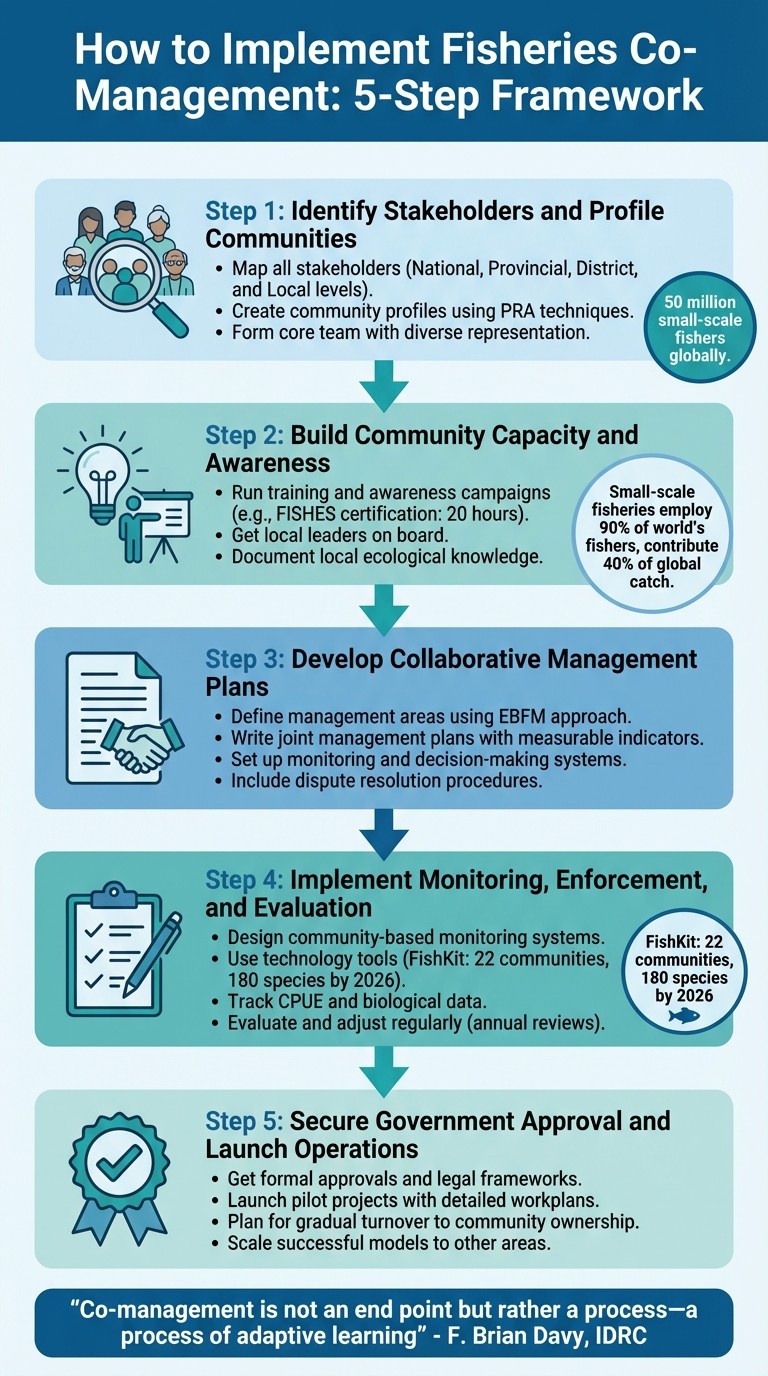
5-Step Fisheries Co-Management Implementation Framework for Municipalities
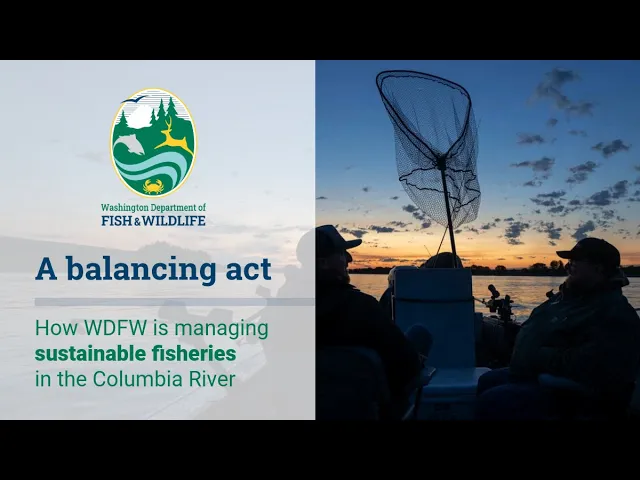
A balancing act: Managing sustainable fisheries in the Columbia River
Step 1: Identify Stakeholders and Profile Communities
To build an effective co-management system, it's essential to start by identifying the key stakeholders and understanding the communities involved. This goes beyond simply listing names - it requires a deep dive into the social, economic, and ecological factors that influence fisheries management.
Map All Stakeholders
The first step is to pinpoint everyone who has a vested interest in the fisheries. This group includes around 50 million small-scale, subsistence, and artisanal fishers, as well as fish traders, boat owners, and households that rely on fishing as a primary resource [4][5]. On the government side, stakeholders span from municipal governments and village police to state fisheries departments and law enforcement agencies [4][5]. NGOs, research institutions, civil society organizations, and development agencies also play a critical role, often acting as facilitators and agents for change.
To ensure thorough mapping, use tools like courtesy calls, community meetings, and interviews with key informants [4]. A good example comes from the Masinloc municipality in the Philippines, where partnerships with village police and marine guards led to the implementation of a Basic Fishery Ordinance by 1995. This ordinance banned harmful fishing practices like muro-ami, reducing community conflicts and enforcing sanctions against violators [5]. Identifying respected local leaders or "champions" can further strengthen these efforts. Criteria such as fishing dependency for income and residency status can help verify legitimate participants [4].
After completing stakeholder mapping, the next step is to create detailed community profiles to align local knowledge with management strategies.
Create Community Profiles
Community profiling involves gathering baseline data to understand the local context. Participatory Rural Appraisal (PRA) techniques can be used to engage community members in identifying challenges and assessing institutional dynamics. Fishery mapping can help outline boundaries, gear usage, and seasonal patterns, while resource mapping with fishers highlights areas of overlapping use [4][6].
For instance, in Southern Bangladesh, an FAO/UNDP project took a broader approach by addressing sanitation, health care, and education alongside fisheries concerns. By forming village organizations for both men and women and addressing these immediate needs, the project gained community trust, ultimately enabling ecological improvements like increasing mesh sizes and removing destructive shrimp fry nets [5]. Effective profiling goes beyond ecological data; it also considers household income, job satisfaction, and broader community priorities. Tools like Problem Trees and Solution Trees can help stakeholders identify the root causes of fishery decline and agree on actionable solutions [4].
When data is scarce, tools such as Stock Health Trackers can provide valuable insights into catch data and stock conditions. Documenting traditional practices, social norms, and internal conflicts also adds crucial context to management efforts. Once stakeholders are mapped and communities profiled, the focus shifts to forming a core team to drive collaboration.
Form a Core Team
With stakeholders identified and communities understood, the next step is to assemble a core team that represents a diverse range of perspectives, including fishers, local government, NGOs, and marginalized groups [5][6]. These teams often work through national, provincial, and district committees [5]. For example, in Cambodia’s Tonle Sap region, fishers' groups were mobilized to ensure that marginalized voices were included in the planning process [5].
Trained facilitators, often from NGOs, play a key role in bridging the gap between scientific data and local knowledge while managing logistics [6]. Clearly defining roles within the team helps prevent overlapping responsibilities. Initial meetings can be used to establish a shared vision and collective values, providing a foundation for technical management. Japan offers a strong example of this model, where the government covers up to 70% of management costs, with fishers contributing the remaining 30% [5].
Team Level | Key Participants | Key Roles |
|---|---|---|
National | Fishery Department, National Fishers Federation, NGOs | Review legislation, allocate budgets, manage international links |
Provincial/State | Provincial Fisheries Department, Advisory Committees | Approve management plans, monitor and evaluate progress |
District/Subdistrict | Local Government, Enforcement Staff, NGOs, User Representatives | Develop and implement district-level management plans |
Local/Community | Village groups, occupational/gender subgroups | Create local rules, handle community-level implementation |
Step 2: Build Community Capacity and Awareness
After identifying stakeholders and forming a core team in Step 1, the focus shifts to developing practical skills and awareness for collaboration. This stage emphasizes turning plans into action by training communities on co-management practices and gaining support from local leaders. Here's how training, leadership engagement, and knowledge documentation come together to build capacity.
Run Training and Awareness Campaigns
Training programs should combine scientific principles with hands-on experiences to make fisheries management understandable and actionable. For example, the FISHES (Fishermen Interactive Training) certification course, spearheaded by Mississippi State University (2024–2028), offers 20 hours of blended classroom and field sessions in coastal Mississippi and Alabama. Open to participants aged 18 and older, the program aims to improve understanding of fisheries science and legal frameworks [9]. This mix of learning styles ensures that technical concepts stick.
Technology also plays a key role in building consensus. Tools like the FishKit Stock Health Tracker let communities visualize the trade-offs between management choices, such as size limits versus overall catch volume [6]. Simple follow-up materials, like waterproof rulers or boat stickers, help fishers apply new regulations immediately. In remote areas, translating materials and providing offline resources - such as printed guides or pre-loaded screenshots - ensures critical information remains accessible. Hosting these sessions in familiar locations, like beaches or local meeting halls, rather than formal offices, fosters trust and participation.
"Co-management offers opportunities to improve sustainability efforts through inclusive participation of all stakeholders"
Get Local Leaders on Board
Training alone isn’t enough - local leadership support is critical for turning knowledge into action. Securing the backing of government and community leaders helps ensure long-term success. Begin by meeting with both formal and informal leaders to explain the project and gain their approval before starting activities. Local organizers can serve as vital connectors, bridging gaps between communities and external agencies [4].
Supporting "local champions" - individuals with influence and dedication - can also help overcome historical mistrust. These leaders act as liaisons, ensuring smooth communication between government bodies and local groups [4][10]. Highlighting tangible benefits, such as resource replenishment and food security, can motivate broader participation [1][2]. Establishing clear rules for negotiation and decision-making early on minimizes potential conflicts. For instance, while Hawaii’s Hā'ena community process eventually succeeded, it took seven years longer than initially expected due to the complexities of collaborative rulemaking [10]. Patience, persistence, and strategic use of social marketing can build public support for co-management initiatives.
"Co-management is not an end point but rather a process - a process of adaptive learning"
F. Brian Davy, Senior Program Specialist at the International Development Research Centre[4]
Document Local Ecological Knowledge
Local ecological knowledge provides insights that traditional monitoring methods often miss - such as spawning cycles, maturity sizes, and habitat trends [11][6]. Incorporating these observations into scientific assessments not only enhances the credibility of regulations but also builds trust between fishers and regulatory agencies [3][11][1].
A notable example comes from a two-year program led by the University of Hawai'i Fisheries Ecology Research Lab, Conservation International, and local groups like Hui Aloha Kīholo. Fishers used affordable ($10) smartphone microscopes and specialized "lawaiʻa" logbooks to collect data on 2,595 fish across 57 species. Their Gonadosomatic Index findings for species like the convict tang aligned closely with histological assessments, allowing communities to integrate this data into "Moon Calendars" for sustainable harvesting [11].
Similarly, the Wildlife Conservation Society has collaborated with Afro-Colombian clam fisherwomen to incorporate traditional knowledge into formal monitoring systems [7]. Standardized logbooks and consistent training ensure reliable data collection. In Myanmar, a tailored business and financial management program for women in fishing communities has strengthened local capacity while encouraging sustainable practices [7].
Given that small-scale fisheries employ over 90% of the world’s fishers and contribute 40% of the global fish catch [2], integrating local knowledge into fisheries management is essential. This documented information will play a key role in shaping the collaborative management plans in Step 3.
Step 3: Develop Collaborative Management Plans
Creating management plans that blend scientific research with community input is key to effective fisheries management. This involves defining precise boundaries, setting up governance structures, and designing systems that adapt to real-world changes.
Define Management Areas and Boundaries
Start by mapping species interactions and environmental factors using the Ecosystem-Based Fisheries Management (EBFM) approach [13]. This ensures that fishing one species doesn’t unintentionally disrupt the broader food web of predators and prey.
Collaborate with government agencies that share responsibilities, such as fisheries managers and environmental authorities, to map overlapping jurisdictions and open communication channels [13]. For fisheries spanning multiple jurisdictions, cooperative governance and scenario planning tools can help address challenges, such as shifting fish stocks caused by climate change [12]. Spatial indicators should also be employed to monitor the balance between harvested species and their predators, ensuring sustainable fishing practices [13].
Decide how boundaries will be established - whether by amending national fisheries laws, creating international agreements, or drafting new EBFM road maps [13]. Combine scientific data with traditional ecological knowledge to ensure these boundaries reflect both biological realities and community usage patterns [1]. Once boundaries are clearly defined, move forward with joint management protocols that align all stakeholders.
Write Joint Management Plans
Building on community profiles, the next step is to create a joint management plan. Begin by forming a co-management body to represent stakeholders and oversee negotiations [4]. Before drafting the plan, establish clear rules for how discussions will be conducted and how potential conflicts will be resolved [4].
Organize visioning workshops to bring stakeholders together and outline long-term goals for the fishery [4]. The plan should include specific objectives and the steps required to achieve them, such as implementing gear restrictions or seasonal closures. It should also define measurable indicators - like catch per unit effort or the number of enforcement patrols - to track progress effectively [4].
"Fisheries management should focus on people, not fish, per se."
Robert S. Pomeroy and Rebecca Rivera-Guieb, Authors of Fishery Co-Management: A Practical Handbook[4]
Finalize the plan with a detailed Co-management Agreement that outlines roles, responsibilities, and provisions for revenue generation, such as landing fees or tourism permits, to support sustainability [4]. After the agreement is signed, use targeted communication and public education to ensure all community members understand the rules and their purpose [4]. It’s worth noting that small-scale fisheries dominate globally, with nearly 98% of the world’s fishers - approximately 50 million - working in small-scale, subsistence, or artisanal operations [4]. Once the plan is in place, establish monitoring systems to evaluate and adapt as needed.
Set Up Monitoring and Decision-Making Systems
Create a co-management organization that includes representatives from government, user groups, and other stakeholders to oversee structured decision-making [4]. This group should meet regularly and operate transparently [4].
Develop a monitoring strategy that clarifies what will be tracked, who will collect and analyze the data, and how findings will influence decisions [4]. Use biological, socio-economic, and institutional indicators to measure progress. Conduct annual evaluations of the management plan, workplan, and budget to ensure the system continues to meet local needs [4].
"Co-management is not an end point but rather a process – a process of adaptive learning."
F. Brian Davy, Senior Program Specialist, International Development Research Centre [4]
Include clear procedures for resolving disputes, such as negotiation, mediation, or community-based law enforcement [4]. Periodically review and adjust the governance framework to maintain transparency and ensure it functions effectively [14]. Modern co-management systems must also uphold human rights, gender equality, and principles of justice to achieve long-term success [2]. With these systems in place, the management plan becomes a flexible tool that evolves alongside changing conditions and new information, paving the way for the implementation and enforcement steps detailed in Step 4.
Step 4: Implement Monitoring, Enforcement, and Evaluation
Once co-management plans are in place, the next step is putting them into action through consistent monitoring, enforcement, and evaluation. This phase ensures that plans are actively followed and adjusted as needed to achieve long-term fisheries sustainability.
Design Community-Based Monitoring Systems
Collaborating with local communities to create monitoring systems is far more effective than imposing external frameworks. For example, the Hawaiʻi Department of Land and Natural Resources (DAR) worked with the Coastal Zone Management Program to develop the Kōkua Community-Based Monitoring Project. This project offers a tiered system that supports communities at varying levels of monitoring expertise. One success story is the Hoʻōla Hāniʻo community, which used this framework to monitor limu (algae) in Ko Olina lagoons [15].
"Community ownership of the data and the process by which it is collected are important elements that set [Community-based monitoring] apart from other monitoring efforts."
Hawaiʻi Department of Land and Natural Resources [15]
Training respected local fishers as "fishery monitors" has proven effective. These monitors organize community efforts, collect biological samples, and record standardized data. In partnership with groups like Hui Aloha Kīholo and Mālama Maunalua, the University of Hawaiʻi trained fishers to use tools like $10 smartphone microscopes and "lawaiʻa" logbooks. This effort tracked 2,595 fish across 57 species, helping identify spawning peaks for species such as manini and kole. The data even led to the creation of moon calendars tailored to sustainable harvesting practices [11].
By combining traditional observation with modern tools, communities can pinpoint seasonal patterns and spawning cycles. For instance, the Gonadosomatic Index (GSI) - which measures the relative mass of fish gonads - helps determine spawning seasons and size at maturity (L50). Research shows that using 5% of the maximum GSI as a maturity marker achieves accuracy close to professional histological methods, making it a practical tool for setting harvest rules [11].
In addition, maintaining updated registers of Fishing Economic Units (FEUs) - which include vessel details, gear types, and licenses - is critical for enforcing local regulations. These records help track who is fishing, where, and with what equipment [17].
Use Technology and Data Tools
Digital tools can streamline data collection and make analysis more efficient. The FishKit software suite offers tools like the Stock Health Tracker, Size Limit Builder, Bag Limit Builder, and Temporary Closures Tool to help design and evaluate management actions. By 2026, FishKit had engaged 22 fishing communities and trained 34 facilitators across 180 species [6][18][19].
Electronic Monitoring (EM) systems, which use on-vessel cameras and sensors, are another game-changer. These systems are particularly useful in areas where human observers are impractical. Incorporating artificial intelligence into EM systems allows for automated flagging of key events, reducing the volume of footage that needs to be reviewed. Standardized video formats ensure compatibility across different software platforms [20].
Tracking Catch Per Unit Effort (CPUE) is a crucial metric for assessing stock health. CPUE measures fishing success relative to effort, such as hours fished or traps used. Analytical tools like ARTFISH and Netica assist in evaluating these metrics. ARTFISH supports sample-based surveys, while Netica uses Bayesian Network models to diagnose strengths and weaknesses in management systems [17][21].
Data Type | Variables to Monitor | Purpose |
|---|---|---|
Identifiers | Name, address, FEU ID number | Enforce licensing requirements |
Vessel Power | Sail type, engine horsepower | Measure fishing capacity |
Gear Details | Mesh size, gear type, traps used | Standardize fishing effort |
Biological | Gonad weight, fish length, GSI | Identify spawning seasons |
Socio-economic | Household income, conflicts | Assess well-being and equity |
These tools not only improve data collection but also support adaptive management - an approach that adjusts strategies based on real-world outcomes.
Evaluate and Adjust Regularly
To understand how well a plan is working, it's essential to differentiate between performance indicators (e.g., CPUE, yield, species richness) and explanatory variables (e.g., fishing effort, environmental changes, compliance levels). A hypothesis matrix can help focus monitoring on variables most likely to impact outcomes, ensuring efforts are targeted where they matter most [17].
Cyclical adaptive management involves regularly reviewing and refining goals. Ideally, managers revisit objectives annually, using new data and lessons learned to adjust strategies. Statistical models can link management actions to ecological and social outcomes, allowing for simulations of "what-if" scenarios. A standard significance level (α ≤ 0.05) ensures robust analysis [17][22].
Pre-defined Harvest Control Rules (HCRs) can simplify decision-making by setting automatic responses to specific conditions. For instance, if biomass falls below a certain threshold, Total Allowable Catch limits can be reduced. Mobile tools like FishKit enable stakeholders to explore the trade-offs of different management options in real time during community discussions [6][22].
"Fewer management programs implemented well might achieve far more than many implemented poorly, and poorly implemented co-management can be worse than no management."
As climate change shifts fish stocks across boundaries, managers must stay flexible. This could involve opening talks with neighboring regions or adapting fishers' practices to include different species. Fisheries management is a dynamic process, requiring constant adaptation to environmental changes, fishing behaviors, and market demands [22].
Step 5: Secure Government Approval and Launch Operations
To move forward with co-management, formalizing your plan and testing it through pilot projects are essential steps. These actions ensure that the groundwork laid through community-driven planning and monitoring transitions into enforceable and practical operations.
Get Formal Approvals and Legal Frameworks
Legal recognition is crucial to turning co-management plans into actionable policies. Without it, these plans remain informal guidelines without the authority to enforce regulations. Co-management integrates community-created rules into national legislation, making them enforceable by law and ensuring their legitimacy. This step validates the collaborative efforts made during earlier stages, creating a foundation for sustainable and scalable fisheries management.
Start by reviewing current laws and policies to identify gaps or necessary changes. In many cases, new legislation is needed to establish a legal basis for shared responsibility between government agencies and fishing communities [1]. The level of government involvement can vary, from instructive (where the government sets the rules) to cooperative (shared decision-making) to advisory (where the government endorses community recommendations) [1].
"Enabling legislation is key to formalising and scaling up existing, community-based fisheries management (CBFM) systems and practices."
Sofia O'Connor, Ariella D'Andrea, Xiao Recio-Blanco, and Solene Devez [23]
To navigate this process, involve third-party facilitators like NGOs or research institutions. These groups can help bridge communication gaps, build trust, and guide both communities and government agencies through bureaucratic hurdles [1]. Draft legal frameworks that are flexible enough to adapt to the dynamic nature of coastal fisheries [1].
When creating formal agreements, include provisions that address human rights, gender equality, and social justice. Small-scale fisheries contribute 40% of the global fish catch and employ over 90% of the world’s fishers, making it essential to balance ecological goals with social priorities [2].
Once legal backing is secured, pilot projects become the next step to test and refine the co-management model.
Launch Pilot Projects
Pilot projects serve as a testing ground for your co-management approach, allowing you to refine strategies based on real-world feedback. These projects operate as a cycle of planning, implementation, and evaluation, ensuring that the model evolves through adaptive management [4].
Start by creating a detailed workplan that outlines objectives, activities, timelines, and budgets [4]. Choose pilot sites carefully - look for areas where resource challenges are evident, the fishery is critical to the community, and local leadership is strong. These factors increase the likelihood of success and provide valuable insights for future scaling [4].
Establish a core co-management body early in the process. This team will act as the primary decision-making group and serve as a bridge between the community and government [4]. Clearly define the management area and target resources, such as specific reefs or species, to prevent jurisdictional conflicts [4]. Even during this trial phase, secure a legal framework that grants the co-management body authority to enforce rules [4].
Involve local fishers in data collection during the pilot. This not only builds trust in the data but also ensures that their ecological knowledge plays a role in shaping management decisions [4]. Once the pilot demonstrates success, the model can be expanded to larger areas or replicated in other communities with similar needs [4].
To ensure long-term sustainability, plan for a gradual "turnover" from the start. External organizations, such as NGOs, should phase out over time, allowing the community and government to take full ownership of the operations [4].
Conclusion
Fisheries co-management relies on a shared commitment between government agencies and fishing communities. By combining scientific research with traditional ecological knowledge, policies can be crafted to address both environmental challenges and the specific needs of local communities. Engaging fishers in the regulatory process often leads to stronger compliance and better outcomes.
The strategies discussed earlier outline a practical approach to improving fisheries governance. Success hinges on four key principles: ensuring legal fishing rights, fostering strong fisher organizations, creating effective participation mechanisms, and balancing rights with responsibilities [8]. As Patrick Smallhorn-West and colleagues emphasize:
"Fewer management programs implemented well might achieve far more than many implemented poorly, and poorly implemented co-management can be worse than no management." - Patrick Smallhorn-West et al., WorldFish [2]
To achieve these goals, it’s essential to officially register all fishers and vessels, invest in leadership development for fishers, and establish formal systems that enable inclusive decision-making. Building trust through open and consistent communication between agencies and communities is equally critical.
Co-management is not static - it’s an evolving process [4]. As environmental conditions shift, management strategies must adapt to remain effective. Securing long-term funding early on and collaborating with NGOs or research institutions can provide the technical expertise needed for successful implementation.
The stakes couldn’t be higher. Small-scale fisheries contribute 40% of the global fish catch and support over 90% of the world’s fishers [2]. For these communities, sustainable fish stocks are vital - not just economically, but also for nutrition and cultural heritage. By adopting collaborative governance and the strategies outlined here, municipalities and government agencies can turn fisheries into sustainable assets while safeguarding marine ecosystems and ensuring community resilience.
FAQs
What’s the fastest way to start stakeholder mapping?
To get started with stakeholder mapping in fisheries management, begin by identifying and categorizing the key groups involved. These typically include government agencies, local communities, fishers, and conservation organizations. Tools such as stakeholder matrices can help visualize roles and levels of influence, while brief interviews provide quick insights into their perspectives.
Start with a broad overview of community and institutional actors to ensure no one is overlooked. From there, refine your understanding through more focused methods like workshops or consultations. This approach strikes a balance between thoroughness and efficiency, helping you build a clear picture of the stakeholders involved.
How do we fund co-management long term?
Long-term funding for co-management relies on a mix of strategic approaches, including allocations from government budgets, contributions from local communities, and support from external grants or partnerships. By employing adaptive management practices and maintaining open channels for feedback and stakeholder collaboration, organizations can uncover funding pathways that endure over time. Additionally, fostering strong leadership and enhancing organizational capacity among stakeholders ensures access to varied funding sources and promotes consistent resource sharing, which is essential for the sustained management of fisheries.
What legal steps make co-management enforceable?
To ensure co-management is effective and enforceable, supportive legislation and formal agreements play a crucial role. These frameworks help define shared responsibilities between government agencies and resource users, while also acknowledging local and traditional rights. Tools like joint management agreements are essential for outlining roles, responsibilities, and mechanisms for compliance. Legal recognition of fishing rights, the formalization of agreements, and policies designed to encourage compliance and enforcement further reinforce the system’s effectiveness.
Related Blog Posts
Latest Articles
©2025



FAQ
01
What does it really mean to “redefine profit”?
02
What makes Council Fire different?
03
Who does Council Fire you work with?
04
What does working with Council Fire actually look like?
05
How does Council Fire help organizations turn big goals into action?
06
How does Council Fire define and measure success?
Mar 23, 2026
How to Implement Fisheries Co-Management for Municipalities & Government Agencies
Capacity Building
In This Article
Step-by-step 5-stage guide for municipalities and agencies to implement fisheries co-management: stakeholder mapping, capacity building, joint plans, monitoring, and legal pilots.
How to Implement Fisheries Co-Management for Municipalities & Government Agencies
Fisheries co-management is a shared approach where governments and local communities collaborate to manage aquatic resources. This strategy improves compliance, reduces overfishing, and combines scientific research with local knowledge for better decision-making. Here's how to implement it:
Identify Stakeholders: Map all involved parties, from fishers to government agencies, and understand community dynamics.
Build Capacity: Train communities on management practices and engage local leaders for support.
Develop Plans: Create joint management plans that define goals, boundaries, and rules.
Monitor and Enforce: Use tools like fishery monitors, data tracking, and clear enforcement mechanisms.
Secure Legal Backing: Gain government approval and test the system with pilot projects.
This approach addresses overfishing, builds trust, and ensures long-term resource management. By working together, municipalities and agencies can protect fisheries and support local livelihoods.
5-Step Fisheries Co-Management Implementation Framework for Municipalities
A balancing act: Managing sustainable fisheries in the Columbia River
Step 1: Identify Stakeholders and Profile Communities
To build an effective co-management system, it's essential to start by identifying the key stakeholders and understanding the communities involved. This goes beyond simply listing names - it requires a deep dive into the social, economic, and ecological factors that influence fisheries management.
Map All Stakeholders
The first step is to pinpoint everyone who has a vested interest in the fisheries. This group includes around 50 million small-scale, subsistence, and artisanal fishers, as well as fish traders, boat owners, and households that rely on fishing as a primary resource [4][5]. On the government side, stakeholders span from municipal governments and village police to state fisheries departments and law enforcement agencies [4][5]. NGOs, research institutions, civil society organizations, and development agencies also play a critical role, often acting as facilitators and agents for change.
To ensure thorough mapping, use tools like courtesy calls, community meetings, and interviews with key informants [4]. A good example comes from the Masinloc municipality in the Philippines, where partnerships with village police and marine guards led to the implementation of a Basic Fishery Ordinance by 1995. This ordinance banned harmful fishing practices like muro-ami, reducing community conflicts and enforcing sanctions against violators [5]. Identifying respected local leaders or "champions" can further strengthen these efforts. Criteria such as fishing dependency for income and residency status can help verify legitimate participants [4].
After completing stakeholder mapping, the next step is to create detailed community profiles to align local knowledge with management strategies.
Create Community Profiles
Community profiling involves gathering baseline data to understand the local context. Participatory Rural Appraisal (PRA) techniques can be used to engage community members in identifying challenges and assessing institutional dynamics. Fishery mapping can help outline boundaries, gear usage, and seasonal patterns, while resource mapping with fishers highlights areas of overlapping use [4][6].
For instance, in Southern Bangladesh, an FAO/UNDP project took a broader approach by addressing sanitation, health care, and education alongside fisheries concerns. By forming village organizations for both men and women and addressing these immediate needs, the project gained community trust, ultimately enabling ecological improvements like increasing mesh sizes and removing destructive shrimp fry nets [5]. Effective profiling goes beyond ecological data; it also considers household income, job satisfaction, and broader community priorities. Tools like Problem Trees and Solution Trees can help stakeholders identify the root causes of fishery decline and agree on actionable solutions [4].
When data is scarce, tools such as Stock Health Trackers can provide valuable insights into catch data and stock conditions. Documenting traditional practices, social norms, and internal conflicts also adds crucial context to management efforts. Once stakeholders are mapped and communities profiled, the focus shifts to forming a core team to drive collaboration.
Form a Core Team
With stakeholders identified and communities understood, the next step is to assemble a core team that represents a diverse range of perspectives, including fishers, local government, NGOs, and marginalized groups [5][6]. These teams often work through national, provincial, and district committees [5]. For example, in Cambodia’s Tonle Sap region, fishers' groups were mobilized to ensure that marginalized voices were included in the planning process [5].
Trained facilitators, often from NGOs, play a key role in bridging the gap between scientific data and local knowledge while managing logistics [6]. Clearly defining roles within the team helps prevent overlapping responsibilities. Initial meetings can be used to establish a shared vision and collective values, providing a foundation for technical management. Japan offers a strong example of this model, where the government covers up to 70% of management costs, with fishers contributing the remaining 30% [5].
Team Level | Key Participants | Key Roles |
|---|---|---|
National | Fishery Department, National Fishers Federation, NGOs | Review legislation, allocate budgets, manage international links |
Provincial/State | Provincial Fisheries Department, Advisory Committees | Approve management plans, monitor and evaluate progress |
District/Subdistrict | Local Government, Enforcement Staff, NGOs, User Representatives | Develop and implement district-level management plans |
Local/Community | Village groups, occupational/gender subgroups | Create local rules, handle community-level implementation |
Step 2: Build Community Capacity and Awareness
After identifying stakeholders and forming a core team in Step 1, the focus shifts to developing practical skills and awareness for collaboration. This stage emphasizes turning plans into action by training communities on co-management practices and gaining support from local leaders. Here's how training, leadership engagement, and knowledge documentation come together to build capacity.
Run Training and Awareness Campaigns
Training programs should combine scientific principles with hands-on experiences to make fisheries management understandable and actionable. For example, the FISHES (Fishermen Interactive Training) certification course, spearheaded by Mississippi State University (2024–2028), offers 20 hours of blended classroom and field sessions in coastal Mississippi and Alabama. Open to participants aged 18 and older, the program aims to improve understanding of fisheries science and legal frameworks [9]. This mix of learning styles ensures that technical concepts stick.
Technology also plays a key role in building consensus. Tools like the FishKit Stock Health Tracker let communities visualize the trade-offs between management choices, such as size limits versus overall catch volume [6]. Simple follow-up materials, like waterproof rulers or boat stickers, help fishers apply new regulations immediately. In remote areas, translating materials and providing offline resources - such as printed guides or pre-loaded screenshots - ensures critical information remains accessible. Hosting these sessions in familiar locations, like beaches or local meeting halls, rather than formal offices, fosters trust and participation.
"Co-management offers opportunities to improve sustainability efforts through inclusive participation of all stakeholders"
Get Local Leaders on Board
Training alone isn’t enough - local leadership support is critical for turning knowledge into action. Securing the backing of government and community leaders helps ensure long-term success. Begin by meeting with both formal and informal leaders to explain the project and gain their approval before starting activities. Local organizers can serve as vital connectors, bridging gaps between communities and external agencies [4].
Supporting "local champions" - individuals with influence and dedication - can also help overcome historical mistrust. These leaders act as liaisons, ensuring smooth communication between government bodies and local groups [4][10]. Highlighting tangible benefits, such as resource replenishment and food security, can motivate broader participation [1][2]. Establishing clear rules for negotiation and decision-making early on minimizes potential conflicts. For instance, while Hawaii’s Hā'ena community process eventually succeeded, it took seven years longer than initially expected due to the complexities of collaborative rulemaking [10]. Patience, persistence, and strategic use of social marketing can build public support for co-management initiatives.
"Co-management is not an end point but rather a process - a process of adaptive learning"
F. Brian Davy, Senior Program Specialist at the International Development Research Centre[4]
Document Local Ecological Knowledge
Local ecological knowledge provides insights that traditional monitoring methods often miss - such as spawning cycles, maturity sizes, and habitat trends [11][6]. Incorporating these observations into scientific assessments not only enhances the credibility of regulations but also builds trust between fishers and regulatory agencies [3][11][1].
A notable example comes from a two-year program led by the University of Hawai'i Fisheries Ecology Research Lab, Conservation International, and local groups like Hui Aloha Kīholo. Fishers used affordable ($10) smartphone microscopes and specialized "lawaiʻa" logbooks to collect data on 2,595 fish across 57 species. Their Gonadosomatic Index findings for species like the convict tang aligned closely with histological assessments, allowing communities to integrate this data into "Moon Calendars" for sustainable harvesting [11].
Similarly, the Wildlife Conservation Society has collaborated with Afro-Colombian clam fisherwomen to incorporate traditional knowledge into formal monitoring systems [7]. Standardized logbooks and consistent training ensure reliable data collection. In Myanmar, a tailored business and financial management program for women in fishing communities has strengthened local capacity while encouraging sustainable practices [7].
Given that small-scale fisheries employ over 90% of the world’s fishers and contribute 40% of the global fish catch [2], integrating local knowledge into fisheries management is essential. This documented information will play a key role in shaping the collaborative management plans in Step 3.
Step 3: Develop Collaborative Management Plans
Creating management plans that blend scientific research with community input is key to effective fisheries management. This involves defining precise boundaries, setting up governance structures, and designing systems that adapt to real-world changes.
Define Management Areas and Boundaries
Start by mapping species interactions and environmental factors using the Ecosystem-Based Fisheries Management (EBFM) approach [13]. This ensures that fishing one species doesn’t unintentionally disrupt the broader food web of predators and prey.
Collaborate with government agencies that share responsibilities, such as fisheries managers and environmental authorities, to map overlapping jurisdictions and open communication channels [13]. For fisheries spanning multiple jurisdictions, cooperative governance and scenario planning tools can help address challenges, such as shifting fish stocks caused by climate change [12]. Spatial indicators should also be employed to monitor the balance between harvested species and their predators, ensuring sustainable fishing practices [13].
Decide how boundaries will be established - whether by amending national fisheries laws, creating international agreements, or drafting new EBFM road maps [13]. Combine scientific data with traditional ecological knowledge to ensure these boundaries reflect both biological realities and community usage patterns [1]. Once boundaries are clearly defined, move forward with joint management protocols that align all stakeholders.
Write Joint Management Plans
Building on community profiles, the next step is to create a joint management plan. Begin by forming a co-management body to represent stakeholders and oversee negotiations [4]. Before drafting the plan, establish clear rules for how discussions will be conducted and how potential conflicts will be resolved [4].
Organize visioning workshops to bring stakeholders together and outline long-term goals for the fishery [4]. The plan should include specific objectives and the steps required to achieve them, such as implementing gear restrictions or seasonal closures. It should also define measurable indicators - like catch per unit effort or the number of enforcement patrols - to track progress effectively [4].
"Fisheries management should focus on people, not fish, per se."
Robert S. Pomeroy and Rebecca Rivera-Guieb, Authors of Fishery Co-Management: A Practical Handbook[4]
Finalize the plan with a detailed Co-management Agreement that outlines roles, responsibilities, and provisions for revenue generation, such as landing fees or tourism permits, to support sustainability [4]. After the agreement is signed, use targeted communication and public education to ensure all community members understand the rules and their purpose [4]. It’s worth noting that small-scale fisheries dominate globally, with nearly 98% of the world’s fishers - approximately 50 million - working in small-scale, subsistence, or artisanal operations [4]. Once the plan is in place, establish monitoring systems to evaluate and adapt as needed.
Set Up Monitoring and Decision-Making Systems
Create a co-management organization that includes representatives from government, user groups, and other stakeholders to oversee structured decision-making [4]. This group should meet regularly and operate transparently [4].
Develop a monitoring strategy that clarifies what will be tracked, who will collect and analyze the data, and how findings will influence decisions [4]. Use biological, socio-economic, and institutional indicators to measure progress. Conduct annual evaluations of the management plan, workplan, and budget to ensure the system continues to meet local needs [4].
"Co-management is not an end point but rather a process – a process of adaptive learning."
F. Brian Davy, Senior Program Specialist, International Development Research Centre [4]
Include clear procedures for resolving disputes, such as negotiation, mediation, or community-based law enforcement [4]. Periodically review and adjust the governance framework to maintain transparency and ensure it functions effectively [14]. Modern co-management systems must also uphold human rights, gender equality, and principles of justice to achieve long-term success [2]. With these systems in place, the management plan becomes a flexible tool that evolves alongside changing conditions and new information, paving the way for the implementation and enforcement steps detailed in Step 4.
Step 4: Implement Monitoring, Enforcement, and Evaluation
Once co-management plans are in place, the next step is putting them into action through consistent monitoring, enforcement, and evaluation. This phase ensures that plans are actively followed and adjusted as needed to achieve long-term fisheries sustainability.
Design Community-Based Monitoring Systems
Collaborating with local communities to create monitoring systems is far more effective than imposing external frameworks. For example, the Hawaiʻi Department of Land and Natural Resources (DAR) worked with the Coastal Zone Management Program to develop the Kōkua Community-Based Monitoring Project. This project offers a tiered system that supports communities at varying levels of monitoring expertise. One success story is the Hoʻōla Hāniʻo community, which used this framework to monitor limu (algae) in Ko Olina lagoons [15].
"Community ownership of the data and the process by which it is collected are important elements that set [Community-based monitoring] apart from other monitoring efforts."
Hawaiʻi Department of Land and Natural Resources [15]
Training respected local fishers as "fishery monitors" has proven effective. These monitors organize community efforts, collect biological samples, and record standardized data. In partnership with groups like Hui Aloha Kīholo and Mālama Maunalua, the University of Hawaiʻi trained fishers to use tools like $10 smartphone microscopes and "lawaiʻa" logbooks. This effort tracked 2,595 fish across 57 species, helping identify spawning peaks for species such as manini and kole. The data even led to the creation of moon calendars tailored to sustainable harvesting practices [11].
By combining traditional observation with modern tools, communities can pinpoint seasonal patterns and spawning cycles. For instance, the Gonadosomatic Index (GSI) - which measures the relative mass of fish gonads - helps determine spawning seasons and size at maturity (L50). Research shows that using 5% of the maximum GSI as a maturity marker achieves accuracy close to professional histological methods, making it a practical tool for setting harvest rules [11].
In addition, maintaining updated registers of Fishing Economic Units (FEUs) - which include vessel details, gear types, and licenses - is critical for enforcing local regulations. These records help track who is fishing, where, and with what equipment [17].
Use Technology and Data Tools
Digital tools can streamline data collection and make analysis more efficient. The FishKit software suite offers tools like the Stock Health Tracker, Size Limit Builder, Bag Limit Builder, and Temporary Closures Tool to help design and evaluate management actions. By 2026, FishKit had engaged 22 fishing communities and trained 34 facilitators across 180 species [6][18][19].
Electronic Monitoring (EM) systems, which use on-vessel cameras and sensors, are another game-changer. These systems are particularly useful in areas where human observers are impractical. Incorporating artificial intelligence into EM systems allows for automated flagging of key events, reducing the volume of footage that needs to be reviewed. Standardized video formats ensure compatibility across different software platforms [20].
Tracking Catch Per Unit Effort (CPUE) is a crucial metric for assessing stock health. CPUE measures fishing success relative to effort, such as hours fished or traps used. Analytical tools like ARTFISH and Netica assist in evaluating these metrics. ARTFISH supports sample-based surveys, while Netica uses Bayesian Network models to diagnose strengths and weaknesses in management systems [17][21].
Data Type | Variables to Monitor | Purpose |
|---|---|---|
Identifiers | Name, address, FEU ID number | Enforce licensing requirements |
Vessel Power | Sail type, engine horsepower | Measure fishing capacity |
Gear Details | Mesh size, gear type, traps used | Standardize fishing effort |
Biological | Gonad weight, fish length, GSI | Identify spawning seasons |
Socio-economic | Household income, conflicts | Assess well-being and equity |
These tools not only improve data collection but also support adaptive management - an approach that adjusts strategies based on real-world outcomes.
Evaluate and Adjust Regularly
To understand how well a plan is working, it's essential to differentiate between performance indicators (e.g., CPUE, yield, species richness) and explanatory variables (e.g., fishing effort, environmental changes, compliance levels). A hypothesis matrix can help focus monitoring on variables most likely to impact outcomes, ensuring efforts are targeted where they matter most [17].
Cyclical adaptive management involves regularly reviewing and refining goals. Ideally, managers revisit objectives annually, using new data and lessons learned to adjust strategies. Statistical models can link management actions to ecological and social outcomes, allowing for simulations of "what-if" scenarios. A standard significance level (α ≤ 0.05) ensures robust analysis [17][22].
Pre-defined Harvest Control Rules (HCRs) can simplify decision-making by setting automatic responses to specific conditions. For instance, if biomass falls below a certain threshold, Total Allowable Catch limits can be reduced. Mobile tools like FishKit enable stakeholders to explore the trade-offs of different management options in real time during community discussions [6][22].
"Fewer management programs implemented well might achieve far more than many implemented poorly, and poorly implemented co-management can be worse than no management."
As climate change shifts fish stocks across boundaries, managers must stay flexible. This could involve opening talks with neighboring regions or adapting fishers' practices to include different species. Fisheries management is a dynamic process, requiring constant adaptation to environmental changes, fishing behaviors, and market demands [22].
Step 5: Secure Government Approval and Launch Operations
To move forward with co-management, formalizing your plan and testing it through pilot projects are essential steps. These actions ensure that the groundwork laid through community-driven planning and monitoring transitions into enforceable and practical operations.
Get Formal Approvals and Legal Frameworks
Legal recognition is crucial to turning co-management plans into actionable policies. Without it, these plans remain informal guidelines without the authority to enforce regulations. Co-management integrates community-created rules into national legislation, making them enforceable by law and ensuring their legitimacy. This step validates the collaborative efforts made during earlier stages, creating a foundation for sustainable and scalable fisheries management.
Start by reviewing current laws and policies to identify gaps or necessary changes. In many cases, new legislation is needed to establish a legal basis for shared responsibility between government agencies and fishing communities [1]. The level of government involvement can vary, from instructive (where the government sets the rules) to cooperative (shared decision-making) to advisory (where the government endorses community recommendations) [1].
"Enabling legislation is key to formalising and scaling up existing, community-based fisheries management (CBFM) systems and practices."
Sofia O'Connor, Ariella D'Andrea, Xiao Recio-Blanco, and Solene Devez [23]
To navigate this process, involve third-party facilitators like NGOs or research institutions. These groups can help bridge communication gaps, build trust, and guide both communities and government agencies through bureaucratic hurdles [1]. Draft legal frameworks that are flexible enough to adapt to the dynamic nature of coastal fisheries [1].
When creating formal agreements, include provisions that address human rights, gender equality, and social justice. Small-scale fisheries contribute 40% of the global fish catch and employ over 90% of the world’s fishers, making it essential to balance ecological goals with social priorities [2].
Once legal backing is secured, pilot projects become the next step to test and refine the co-management model.
Launch Pilot Projects
Pilot projects serve as a testing ground for your co-management approach, allowing you to refine strategies based on real-world feedback. These projects operate as a cycle of planning, implementation, and evaluation, ensuring that the model evolves through adaptive management [4].
Start by creating a detailed workplan that outlines objectives, activities, timelines, and budgets [4]. Choose pilot sites carefully - look for areas where resource challenges are evident, the fishery is critical to the community, and local leadership is strong. These factors increase the likelihood of success and provide valuable insights for future scaling [4].
Establish a core co-management body early in the process. This team will act as the primary decision-making group and serve as a bridge between the community and government [4]. Clearly define the management area and target resources, such as specific reefs or species, to prevent jurisdictional conflicts [4]. Even during this trial phase, secure a legal framework that grants the co-management body authority to enforce rules [4].
Involve local fishers in data collection during the pilot. This not only builds trust in the data but also ensures that their ecological knowledge plays a role in shaping management decisions [4]. Once the pilot demonstrates success, the model can be expanded to larger areas or replicated in other communities with similar needs [4].
To ensure long-term sustainability, plan for a gradual "turnover" from the start. External organizations, such as NGOs, should phase out over time, allowing the community and government to take full ownership of the operations [4].
Conclusion
Fisheries co-management relies on a shared commitment between government agencies and fishing communities. By combining scientific research with traditional ecological knowledge, policies can be crafted to address both environmental challenges and the specific needs of local communities. Engaging fishers in the regulatory process often leads to stronger compliance and better outcomes.
The strategies discussed earlier outline a practical approach to improving fisheries governance. Success hinges on four key principles: ensuring legal fishing rights, fostering strong fisher organizations, creating effective participation mechanisms, and balancing rights with responsibilities [8]. As Patrick Smallhorn-West and colleagues emphasize:
"Fewer management programs implemented well might achieve far more than many implemented poorly, and poorly implemented co-management can be worse than no management." - Patrick Smallhorn-West et al., WorldFish [2]
To achieve these goals, it’s essential to officially register all fishers and vessels, invest in leadership development for fishers, and establish formal systems that enable inclusive decision-making. Building trust through open and consistent communication between agencies and communities is equally critical.
Co-management is not static - it’s an evolving process [4]. As environmental conditions shift, management strategies must adapt to remain effective. Securing long-term funding early on and collaborating with NGOs or research institutions can provide the technical expertise needed for successful implementation.
The stakes couldn’t be higher. Small-scale fisheries contribute 40% of the global fish catch and support over 90% of the world’s fishers [2]. For these communities, sustainable fish stocks are vital - not just economically, but also for nutrition and cultural heritage. By adopting collaborative governance and the strategies outlined here, municipalities and government agencies can turn fisheries into sustainable assets while safeguarding marine ecosystems and ensuring community resilience.
FAQs
What’s the fastest way to start stakeholder mapping?
To get started with stakeholder mapping in fisheries management, begin by identifying and categorizing the key groups involved. These typically include government agencies, local communities, fishers, and conservation organizations. Tools such as stakeholder matrices can help visualize roles and levels of influence, while brief interviews provide quick insights into their perspectives.
Start with a broad overview of community and institutional actors to ensure no one is overlooked. From there, refine your understanding through more focused methods like workshops or consultations. This approach strikes a balance between thoroughness and efficiency, helping you build a clear picture of the stakeholders involved.
How do we fund co-management long term?
Long-term funding for co-management relies on a mix of strategic approaches, including allocations from government budgets, contributions from local communities, and support from external grants or partnerships. By employing adaptive management practices and maintaining open channels for feedback and stakeholder collaboration, organizations can uncover funding pathways that endure over time. Additionally, fostering strong leadership and enhancing organizational capacity among stakeholders ensures access to varied funding sources and promotes consistent resource sharing, which is essential for the sustained management of fisheries.
What legal steps make co-management enforceable?
To ensure co-management is effective and enforceable, supportive legislation and formal agreements play a crucial role. These frameworks help define shared responsibilities between government agencies and resource users, while also acknowledging local and traditional rights. Tools like joint management agreements are essential for outlining roles, responsibilities, and mechanisms for compliance. Legal recognition of fishing rights, the formalization of agreements, and policies designed to encourage compliance and enforcement further reinforce the system’s effectiveness.
Related Blog Posts
FAQ
01
What does it really mean to “redefine profit”?
02
What makes Council Fire different?
03
Who does Council Fire you work with?
04
What does working with Council Fire actually look like?
05
How does Council Fire help organizations turn big goals into action?
06
How does Council Fire define and measure success?
Mar 23, 2026
How to Implement Fisheries Co-Management for Municipalities & Government Agencies
Capacity Building
In This Article
Step-by-step 5-stage guide for municipalities and agencies to implement fisheries co-management: stakeholder mapping, capacity building, joint plans, monitoring, and legal pilots.
How to Implement Fisheries Co-Management for Municipalities & Government Agencies
Fisheries co-management is a shared approach where governments and local communities collaborate to manage aquatic resources. This strategy improves compliance, reduces overfishing, and combines scientific research with local knowledge for better decision-making. Here's how to implement it:
Identify Stakeholders: Map all involved parties, from fishers to government agencies, and understand community dynamics.
Build Capacity: Train communities on management practices and engage local leaders for support.
Develop Plans: Create joint management plans that define goals, boundaries, and rules.
Monitor and Enforce: Use tools like fishery monitors, data tracking, and clear enforcement mechanisms.
Secure Legal Backing: Gain government approval and test the system with pilot projects.
This approach addresses overfishing, builds trust, and ensures long-term resource management. By working together, municipalities and agencies can protect fisheries and support local livelihoods.
5-Step Fisheries Co-Management Implementation Framework for Municipalities
A balancing act: Managing sustainable fisheries in the Columbia River
Step 1: Identify Stakeholders and Profile Communities
To build an effective co-management system, it's essential to start by identifying the key stakeholders and understanding the communities involved. This goes beyond simply listing names - it requires a deep dive into the social, economic, and ecological factors that influence fisheries management.
Map All Stakeholders
The first step is to pinpoint everyone who has a vested interest in the fisheries. This group includes around 50 million small-scale, subsistence, and artisanal fishers, as well as fish traders, boat owners, and households that rely on fishing as a primary resource [4][5]. On the government side, stakeholders span from municipal governments and village police to state fisheries departments and law enforcement agencies [4][5]. NGOs, research institutions, civil society organizations, and development agencies also play a critical role, often acting as facilitators and agents for change.
To ensure thorough mapping, use tools like courtesy calls, community meetings, and interviews with key informants [4]. A good example comes from the Masinloc municipality in the Philippines, where partnerships with village police and marine guards led to the implementation of a Basic Fishery Ordinance by 1995. This ordinance banned harmful fishing practices like muro-ami, reducing community conflicts and enforcing sanctions against violators [5]. Identifying respected local leaders or "champions" can further strengthen these efforts. Criteria such as fishing dependency for income and residency status can help verify legitimate participants [4].
After completing stakeholder mapping, the next step is to create detailed community profiles to align local knowledge with management strategies.
Create Community Profiles
Community profiling involves gathering baseline data to understand the local context. Participatory Rural Appraisal (PRA) techniques can be used to engage community members in identifying challenges and assessing institutional dynamics. Fishery mapping can help outline boundaries, gear usage, and seasonal patterns, while resource mapping with fishers highlights areas of overlapping use [4][6].
For instance, in Southern Bangladesh, an FAO/UNDP project took a broader approach by addressing sanitation, health care, and education alongside fisheries concerns. By forming village organizations for both men and women and addressing these immediate needs, the project gained community trust, ultimately enabling ecological improvements like increasing mesh sizes and removing destructive shrimp fry nets [5]. Effective profiling goes beyond ecological data; it also considers household income, job satisfaction, and broader community priorities. Tools like Problem Trees and Solution Trees can help stakeholders identify the root causes of fishery decline and agree on actionable solutions [4].
When data is scarce, tools such as Stock Health Trackers can provide valuable insights into catch data and stock conditions. Documenting traditional practices, social norms, and internal conflicts also adds crucial context to management efforts. Once stakeholders are mapped and communities profiled, the focus shifts to forming a core team to drive collaboration.
Form a Core Team
With stakeholders identified and communities understood, the next step is to assemble a core team that represents a diverse range of perspectives, including fishers, local government, NGOs, and marginalized groups [5][6]. These teams often work through national, provincial, and district committees [5]. For example, in Cambodia’s Tonle Sap region, fishers' groups were mobilized to ensure that marginalized voices were included in the planning process [5].
Trained facilitators, often from NGOs, play a key role in bridging the gap between scientific data and local knowledge while managing logistics [6]. Clearly defining roles within the team helps prevent overlapping responsibilities. Initial meetings can be used to establish a shared vision and collective values, providing a foundation for technical management. Japan offers a strong example of this model, where the government covers up to 70% of management costs, with fishers contributing the remaining 30% [5].
Team Level | Key Participants | Key Roles |
|---|---|---|
National | Fishery Department, National Fishers Federation, NGOs | Review legislation, allocate budgets, manage international links |
Provincial/State | Provincial Fisheries Department, Advisory Committees | Approve management plans, monitor and evaluate progress |
District/Subdistrict | Local Government, Enforcement Staff, NGOs, User Representatives | Develop and implement district-level management plans |
Local/Community | Village groups, occupational/gender subgroups | Create local rules, handle community-level implementation |
Step 2: Build Community Capacity and Awareness
After identifying stakeholders and forming a core team in Step 1, the focus shifts to developing practical skills and awareness for collaboration. This stage emphasizes turning plans into action by training communities on co-management practices and gaining support from local leaders. Here's how training, leadership engagement, and knowledge documentation come together to build capacity.
Run Training and Awareness Campaigns
Training programs should combine scientific principles with hands-on experiences to make fisheries management understandable and actionable. For example, the FISHES (Fishermen Interactive Training) certification course, spearheaded by Mississippi State University (2024–2028), offers 20 hours of blended classroom and field sessions in coastal Mississippi and Alabama. Open to participants aged 18 and older, the program aims to improve understanding of fisheries science and legal frameworks [9]. This mix of learning styles ensures that technical concepts stick.
Technology also plays a key role in building consensus. Tools like the FishKit Stock Health Tracker let communities visualize the trade-offs between management choices, such as size limits versus overall catch volume [6]. Simple follow-up materials, like waterproof rulers or boat stickers, help fishers apply new regulations immediately. In remote areas, translating materials and providing offline resources - such as printed guides or pre-loaded screenshots - ensures critical information remains accessible. Hosting these sessions in familiar locations, like beaches or local meeting halls, rather than formal offices, fosters trust and participation.
"Co-management offers opportunities to improve sustainability efforts through inclusive participation of all stakeholders"
Get Local Leaders on Board
Training alone isn’t enough - local leadership support is critical for turning knowledge into action. Securing the backing of government and community leaders helps ensure long-term success. Begin by meeting with both formal and informal leaders to explain the project and gain their approval before starting activities. Local organizers can serve as vital connectors, bridging gaps between communities and external agencies [4].
Supporting "local champions" - individuals with influence and dedication - can also help overcome historical mistrust. These leaders act as liaisons, ensuring smooth communication between government bodies and local groups [4][10]. Highlighting tangible benefits, such as resource replenishment and food security, can motivate broader participation [1][2]. Establishing clear rules for negotiation and decision-making early on minimizes potential conflicts. For instance, while Hawaii’s Hā'ena community process eventually succeeded, it took seven years longer than initially expected due to the complexities of collaborative rulemaking [10]. Patience, persistence, and strategic use of social marketing can build public support for co-management initiatives.
"Co-management is not an end point but rather a process - a process of adaptive learning"
F. Brian Davy, Senior Program Specialist at the International Development Research Centre[4]
Document Local Ecological Knowledge
Local ecological knowledge provides insights that traditional monitoring methods often miss - such as spawning cycles, maturity sizes, and habitat trends [11][6]. Incorporating these observations into scientific assessments not only enhances the credibility of regulations but also builds trust between fishers and regulatory agencies [3][11][1].
A notable example comes from a two-year program led by the University of Hawai'i Fisheries Ecology Research Lab, Conservation International, and local groups like Hui Aloha Kīholo. Fishers used affordable ($10) smartphone microscopes and specialized "lawaiʻa" logbooks to collect data on 2,595 fish across 57 species. Their Gonadosomatic Index findings for species like the convict tang aligned closely with histological assessments, allowing communities to integrate this data into "Moon Calendars" for sustainable harvesting [11].
Similarly, the Wildlife Conservation Society has collaborated with Afro-Colombian clam fisherwomen to incorporate traditional knowledge into formal monitoring systems [7]. Standardized logbooks and consistent training ensure reliable data collection. In Myanmar, a tailored business and financial management program for women in fishing communities has strengthened local capacity while encouraging sustainable practices [7].
Given that small-scale fisheries employ over 90% of the world’s fishers and contribute 40% of the global fish catch [2], integrating local knowledge into fisheries management is essential. This documented information will play a key role in shaping the collaborative management plans in Step 3.
Step 3: Develop Collaborative Management Plans
Creating management plans that blend scientific research with community input is key to effective fisheries management. This involves defining precise boundaries, setting up governance structures, and designing systems that adapt to real-world changes.
Define Management Areas and Boundaries
Start by mapping species interactions and environmental factors using the Ecosystem-Based Fisheries Management (EBFM) approach [13]. This ensures that fishing one species doesn’t unintentionally disrupt the broader food web of predators and prey.
Collaborate with government agencies that share responsibilities, such as fisheries managers and environmental authorities, to map overlapping jurisdictions and open communication channels [13]. For fisheries spanning multiple jurisdictions, cooperative governance and scenario planning tools can help address challenges, such as shifting fish stocks caused by climate change [12]. Spatial indicators should also be employed to monitor the balance between harvested species and their predators, ensuring sustainable fishing practices [13].
Decide how boundaries will be established - whether by amending national fisheries laws, creating international agreements, or drafting new EBFM road maps [13]. Combine scientific data with traditional ecological knowledge to ensure these boundaries reflect both biological realities and community usage patterns [1]. Once boundaries are clearly defined, move forward with joint management protocols that align all stakeholders.
Write Joint Management Plans
Building on community profiles, the next step is to create a joint management plan. Begin by forming a co-management body to represent stakeholders and oversee negotiations [4]. Before drafting the plan, establish clear rules for how discussions will be conducted and how potential conflicts will be resolved [4].
Organize visioning workshops to bring stakeholders together and outline long-term goals for the fishery [4]. The plan should include specific objectives and the steps required to achieve them, such as implementing gear restrictions or seasonal closures. It should also define measurable indicators - like catch per unit effort or the number of enforcement patrols - to track progress effectively [4].
"Fisheries management should focus on people, not fish, per se."
Robert S. Pomeroy and Rebecca Rivera-Guieb, Authors of Fishery Co-Management: A Practical Handbook[4]
Finalize the plan with a detailed Co-management Agreement that outlines roles, responsibilities, and provisions for revenue generation, such as landing fees or tourism permits, to support sustainability [4]. After the agreement is signed, use targeted communication and public education to ensure all community members understand the rules and their purpose [4]. It’s worth noting that small-scale fisheries dominate globally, with nearly 98% of the world’s fishers - approximately 50 million - working in small-scale, subsistence, or artisanal operations [4]. Once the plan is in place, establish monitoring systems to evaluate and adapt as needed.
Set Up Monitoring and Decision-Making Systems
Create a co-management organization that includes representatives from government, user groups, and other stakeholders to oversee structured decision-making [4]. This group should meet regularly and operate transparently [4].
Develop a monitoring strategy that clarifies what will be tracked, who will collect and analyze the data, and how findings will influence decisions [4]. Use biological, socio-economic, and institutional indicators to measure progress. Conduct annual evaluations of the management plan, workplan, and budget to ensure the system continues to meet local needs [4].
"Co-management is not an end point but rather a process – a process of adaptive learning."
F. Brian Davy, Senior Program Specialist, International Development Research Centre [4]
Include clear procedures for resolving disputes, such as negotiation, mediation, or community-based law enforcement [4]. Periodically review and adjust the governance framework to maintain transparency and ensure it functions effectively [14]. Modern co-management systems must also uphold human rights, gender equality, and principles of justice to achieve long-term success [2]. With these systems in place, the management plan becomes a flexible tool that evolves alongside changing conditions and new information, paving the way for the implementation and enforcement steps detailed in Step 4.
Step 4: Implement Monitoring, Enforcement, and Evaluation
Once co-management plans are in place, the next step is putting them into action through consistent monitoring, enforcement, and evaluation. This phase ensures that plans are actively followed and adjusted as needed to achieve long-term fisheries sustainability.
Design Community-Based Monitoring Systems
Collaborating with local communities to create monitoring systems is far more effective than imposing external frameworks. For example, the Hawaiʻi Department of Land and Natural Resources (DAR) worked with the Coastal Zone Management Program to develop the Kōkua Community-Based Monitoring Project. This project offers a tiered system that supports communities at varying levels of monitoring expertise. One success story is the Hoʻōla Hāniʻo community, which used this framework to monitor limu (algae) in Ko Olina lagoons [15].
"Community ownership of the data and the process by which it is collected are important elements that set [Community-based monitoring] apart from other monitoring efforts."
Hawaiʻi Department of Land and Natural Resources [15]
Training respected local fishers as "fishery monitors" has proven effective. These monitors organize community efforts, collect biological samples, and record standardized data. In partnership with groups like Hui Aloha Kīholo and Mālama Maunalua, the University of Hawaiʻi trained fishers to use tools like $10 smartphone microscopes and "lawaiʻa" logbooks. This effort tracked 2,595 fish across 57 species, helping identify spawning peaks for species such as manini and kole. The data even led to the creation of moon calendars tailored to sustainable harvesting practices [11].
By combining traditional observation with modern tools, communities can pinpoint seasonal patterns and spawning cycles. For instance, the Gonadosomatic Index (GSI) - which measures the relative mass of fish gonads - helps determine spawning seasons and size at maturity (L50). Research shows that using 5% of the maximum GSI as a maturity marker achieves accuracy close to professional histological methods, making it a practical tool for setting harvest rules [11].
In addition, maintaining updated registers of Fishing Economic Units (FEUs) - which include vessel details, gear types, and licenses - is critical for enforcing local regulations. These records help track who is fishing, where, and with what equipment [17].
Use Technology and Data Tools
Digital tools can streamline data collection and make analysis more efficient. The FishKit software suite offers tools like the Stock Health Tracker, Size Limit Builder, Bag Limit Builder, and Temporary Closures Tool to help design and evaluate management actions. By 2026, FishKit had engaged 22 fishing communities and trained 34 facilitators across 180 species [6][18][19].
Electronic Monitoring (EM) systems, which use on-vessel cameras and sensors, are another game-changer. These systems are particularly useful in areas where human observers are impractical. Incorporating artificial intelligence into EM systems allows for automated flagging of key events, reducing the volume of footage that needs to be reviewed. Standardized video formats ensure compatibility across different software platforms [20].
Tracking Catch Per Unit Effort (CPUE) is a crucial metric for assessing stock health. CPUE measures fishing success relative to effort, such as hours fished or traps used. Analytical tools like ARTFISH and Netica assist in evaluating these metrics. ARTFISH supports sample-based surveys, while Netica uses Bayesian Network models to diagnose strengths and weaknesses in management systems [17][21].
Data Type | Variables to Monitor | Purpose |
|---|---|---|
Identifiers | Name, address, FEU ID number | Enforce licensing requirements |
Vessel Power | Sail type, engine horsepower | Measure fishing capacity |
Gear Details | Mesh size, gear type, traps used | Standardize fishing effort |
Biological | Gonad weight, fish length, GSI | Identify spawning seasons |
Socio-economic | Household income, conflicts | Assess well-being and equity |
These tools not only improve data collection but also support adaptive management - an approach that adjusts strategies based on real-world outcomes.
Evaluate and Adjust Regularly
To understand how well a plan is working, it's essential to differentiate between performance indicators (e.g., CPUE, yield, species richness) and explanatory variables (e.g., fishing effort, environmental changes, compliance levels). A hypothesis matrix can help focus monitoring on variables most likely to impact outcomes, ensuring efforts are targeted where they matter most [17].
Cyclical adaptive management involves regularly reviewing and refining goals. Ideally, managers revisit objectives annually, using new data and lessons learned to adjust strategies. Statistical models can link management actions to ecological and social outcomes, allowing for simulations of "what-if" scenarios. A standard significance level (α ≤ 0.05) ensures robust analysis [17][22].
Pre-defined Harvest Control Rules (HCRs) can simplify decision-making by setting automatic responses to specific conditions. For instance, if biomass falls below a certain threshold, Total Allowable Catch limits can be reduced. Mobile tools like FishKit enable stakeholders to explore the trade-offs of different management options in real time during community discussions [6][22].
"Fewer management programs implemented well might achieve far more than many implemented poorly, and poorly implemented co-management can be worse than no management."
As climate change shifts fish stocks across boundaries, managers must stay flexible. This could involve opening talks with neighboring regions or adapting fishers' practices to include different species. Fisheries management is a dynamic process, requiring constant adaptation to environmental changes, fishing behaviors, and market demands [22].
Step 5: Secure Government Approval and Launch Operations
To move forward with co-management, formalizing your plan and testing it through pilot projects are essential steps. These actions ensure that the groundwork laid through community-driven planning and monitoring transitions into enforceable and practical operations.
Get Formal Approvals and Legal Frameworks
Legal recognition is crucial to turning co-management plans into actionable policies. Without it, these plans remain informal guidelines without the authority to enforce regulations. Co-management integrates community-created rules into national legislation, making them enforceable by law and ensuring their legitimacy. This step validates the collaborative efforts made during earlier stages, creating a foundation for sustainable and scalable fisheries management.
Start by reviewing current laws and policies to identify gaps or necessary changes. In many cases, new legislation is needed to establish a legal basis for shared responsibility between government agencies and fishing communities [1]. The level of government involvement can vary, from instructive (where the government sets the rules) to cooperative (shared decision-making) to advisory (where the government endorses community recommendations) [1].
"Enabling legislation is key to formalising and scaling up existing, community-based fisheries management (CBFM) systems and practices."
Sofia O'Connor, Ariella D'Andrea, Xiao Recio-Blanco, and Solene Devez [23]
To navigate this process, involve third-party facilitators like NGOs or research institutions. These groups can help bridge communication gaps, build trust, and guide both communities and government agencies through bureaucratic hurdles [1]. Draft legal frameworks that are flexible enough to adapt to the dynamic nature of coastal fisheries [1].
When creating formal agreements, include provisions that address human rights, gender equality, and social justice. Small-scale fisheries contribute 40% of the global fish catch and employ over 90% of the world’s fishers, making it essential to balance ecological goals with social priorities [2].
Once legal backing is secured, pilot projects become the next step to test and refine the co-management model.
Launch Pilot Projects
Pilot projects serve as a testing ground for your co-management approach, allowing you to refine strategies based on real-world feedback. These projects operate as a cycle of planning, implementation, and evaluation, ensuring that the model evolves through adaptive management [4].
Start by creating a detailed workplan that outlines objectives, activities, timelines, and budgets [4]. Choose pilot sites carefully - look for areas where resource challenges are evident, the fishery is critical to the community, and local leadership is strong. These factors increase the likelihood of success and provide valuable insights for future scaling [4].
Establish a core co-management body early in the process. This team will act as the primary decision-making group and serve as a bridge between the community and government [4]. Clearly define the management area and target resources, such as specific reefs or species, to prevent jurisdictional conflicts [4]. Even during this trial phase, secure a legal framework that grants the co-management body authority to enforce rules [4].
Involve local fishers in data collection during the pilot. This not only builds trust in the data but also ensures that their ecological knowledge plays a role in shaping management decisions [4]. Once the pilot demonstrates success, the model can be expanded to larger areas or replicated in other communities with similar needs [4].
To ensure long-term sustainability, plan for a gradual "turnover" from the start. External organizations, such as NGOs, should phase out over time, allowing the community and government to take full ownership of the operations [4].
Conclusion
Fisheries co-management relies on a shared commitment between government agencies and fishing communities. By combining scientific research with traditional ecological knowledge, policies can be crafted to address both environmental challenges and the specific needs of local communities. Engaging fishers in the regulatory process often leads to stronger compliance and better outcomes.
The strategies discussed earlier outline a practical approach to improving fisheries governance. Success hinges on four key principles: ensuring legal fishing rights, fostering strong fisher organizations, creating effective participation mechanisms, and balancing rights with responsibilities [8]. As Patrick Smallhorn-West and colleagues emphasize:
"Fewer management programs implemented well might achieve far more than many implemented poorly, and poorly implemented co-management can be worse than no management." - Patrick Smallhorn-West et al., WorldFish [2]
To achieve these goals, it’s essential to officially register all fishers and vessels, invest in leadership development for fishers, and establish formal systems that enable inclusive decision-making. Building trust through open and consistent communication between agencies and communities is equally critical.
Co-management is not static - it’s an evolving process [4]. As environmental conditions shift, management strategies must adapt to remain effective. Securing long-term funding early on and collaborating with NGOs or research institutions can provide the technical expertise needed for successful implementation.
The stakes couldn’t be higher. Small-scale fisheries contribute 40% of the global fish catch and support over 90% of the world’s fishers [2]. For these communities, sustainable fish stocks are vital - not just economically, but also for nutrition and cultural heritage. By adopting collaborative governance and the strategies outlined here, municipalities and government agencies can turn fisheries into sustainable assets while safeguarding marine ecosystems and ensuring community resilience.
FAQs
What’s the fastest way to start stakeholder mapping?
To get started with stakeholder mapping in fisheries management, begin by identifying and categorizing the key groups involved. These typically include government agencies, local communities, fishers, and conservation organizations. Tools such as stakeholder matrices can help visualize roles and levels of influence, while brief interviews provide quick insights into their perspectives.
Start with a broad overview of community and institutional actors to ensure no one is overlooked. From there, refine your understanding through more focused methods like workshops or consultations. This approach strikes a balance between thoroughness and efficiency, helping you build a clear picture of the stakeholders involved.
How do we fund co-management long term?
Long-term funding for co-management relies on a mix of strategic approaches, including allocations from government budgets, contributions from local communities, and support from external grants or partnerships. By employing adaptive management practices and maintaining open channels for feedback and stakeholder collaboration, organizations can uncover funding pathways that endure over time. Additionally, fostering strong leadership and enhancing organizational capacity among stakeholders ensures access to varied funding sources and promotes consistent resource sharing, which is essential for the sustained management of fisheries.
What legal steps make co-management enforceable?
To ensure co-management is effective and enforceable, supportive legislation and formal agreements play a crucial role. These frameworks help define shared responsibilities between government agencies and resource users, while also acknowledging local and traditional rights. Tools like joint management agreements are essential for outlining roles, responsibilities, and mechanisms for compliance. Legal recognition of fishing rights, the formalization of agreements, and policies designed to encourage compliance and enforcement further reinforce the system’s effectiveness.
Related Blog Posts
FAQ
What does it really mean to “redefine profit”?
What makes Council Fire different?
Who does Council Fire you work with?
What does working with Council Fire actually look like?
How does Council Fire help organizations turn big goals into action?
How does Council Fire define and measure success?