
Mar 19, 2026
How to Communicate ESG Progress Credibly for Foundations & Philanthropic Organizations
ESG Strategy
In This Article
Foundations build trust by aligning ESG reporting to stakeholder values using standards, data, and transparent storytelling.
How to Communicate ESG Progress Credibly for Foundations & Philanthropic Organizations
Foundations and philanthropic organizations must communicate their ESG (Environmental, Social, and Governance) progress transparently to build trust and meet rising stakeholder expectations. With 88% of institutional investors rigorously evaluating ESG factors and only 13.7% of the public understanding what foundations do, clear and honest communication is essential. Here's how to align your reporting with stakeholder needs:
Understand Stakeholder Expectations: Tailor messages for donors, partners, and communities. For example, donors prioritize measurable ROI, while communities value localized impact stories.
Use Standardized Frameworks: Adopt GRI, TCFD, or ISSB reporting standards to ensure data accuracy and comparability.
Focus on Data and Outcomes: Report on meaningful results, such as improved graduation rates, rather than just activities like books distributed.
Leverage Multiple Channels: Share updates consistently across platforms like websites, social media, and reports.
Avoid Greenwashing: Back all claims with verifiable data and seek third-party validation when possible.
The fundamentals of ESG reporting and verification
Know What Your Stakeholders Expect
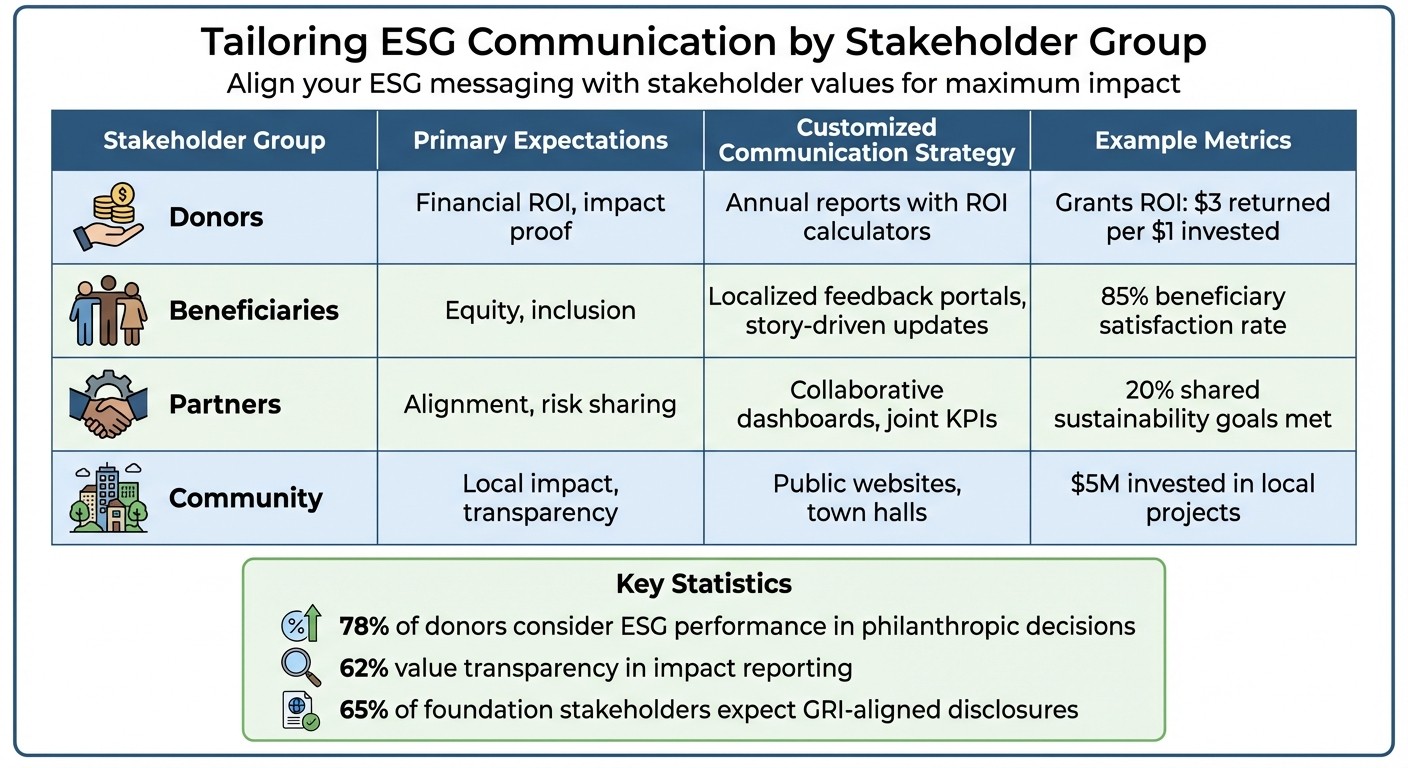
ESG Communication Strategies by Stakeholder Group for Foundations
Stakeholder priorities aren’t the same across the board. For instance, a major donor assessing your foundation’s climate-focused grants will have different concerns than a local community group monitoring how your funding impacts employment in their area. 78% of donors now consider ESG (Environmental, Social, and Governance) performance when making philanthropic decisions, and 62% specifically value transparency in impact reporting [4]. On the other hand, community stakeholders play a significant role in shaping 45% of foundation ESG strategies through public scrutiny, with over half (52%) emphasizing the need for localized metrics [6].
Recognizing the expectations of your stakeholders - and how they influence your organization - is critical. Dr. Elena Martinez, an ESG expert from Stanford Social Innovation Review, emphasizes this point: "Philanthropic ESG success hinges on stakeholder-centric communication - donors want numbers, communities want stories" [6]. In other words, a one-size-fits-all approach won’t cut it when communicating your ESG progress.
Map Your Key Stakeholder Groups
Start by identifying all the stakeholder groups connected to your organization. A power-interest grid can help you categorize these groups based on their level of influence and interest in your ESG initiatives. For example:
High-power, high-interest stakeholders: These include board members and major donors who require detailed updates and active collaboration.
High-power, low-interest stakeholders: Regulators might fall into this category, where periodic updates suffice.
Low-power, high-interest stakeholders: Volunteers or advocacy groups often fit here, benefiting from regular engagement through newsletters or events.
Take inspiration from the Bill & Melinda Gates Foundation’s 2025 strategy. They mapped 1,200 stakeholders and focused on 150 high-influence donors and partners. By launching tailored ESG portals, they showcased $2.4 billion in climate grants and highlighted a 15% emissions reduction among grantees. For beneficiaries, they provided impact stories in Spanish and other local languages, boosting engagement rates from 42% to 54%. This thoughtful approach led to a 12% increase in donor retention and a 35% rise in partner collaborations [7].
Tailoring ESG metrics to each stakeholder group is equally important. Donors with an environmental focus might prioritize carbon reduction figures, while community organizations might value equity-related data. The Rockefeller Foundation demonstrated this in early 2026 by identifying community groups as high-interest stakeholders. Through 50+ local town halls, they reported $150 million invested in equity-focused initiatives, which created 40,000 jobs in underserved areas. This effort increased their community trust score from 67% to 89% and brought in an additional $300 million in donor pledges [8].
By clearly mapping stakeholders, you can craft ESG messages that resonate with their specific values.
Match Your ESG Message to Stakeholder Values
Once you’ve mapped your stakeholders, the next step is to align your ESG messaging with their unique expectations. For example:
Donors often want to see measurable returns on their investment, such as the dollar impact of each grant.
Partners are more focused on shared sustainability goals and risk alignment.
Beneficiaries care about equity, inclusion, and whether they have a voice in your processes.
Communities value transparency and want to understand how decisions affect their local areas.
Surveying your donors can help pinpoint their priorities. If 70% express interest in measurable social ROI, focus your reports on those figures. For emotionally driven donors, include narrative stories that highlight the human impact of your work. Meanwhile, partners may benefit from detailed dashboards tracking joint KPIs. A 2025 Philanthropy Impact survey revealed that 65% of foundation stakeholders expect ESG disclosures aligned with GRI (Global Reporting Initiative) standards for credibility [5]. Meeting these expectations can strengthen trust and engagement.
Here’s a breakdown of how to tailor communication strategies for different groups:
Stakeholder Group | Primary Expectations | Customized Communication Strategy | Example Metrics |
|---|---|---|---|
Donors | Financial ROI, impact proof | Annual reports with ROI calculators | Grants ROI: $3 returned per $1 invested |
Beneficiaries | Equity, inclusion | Localized feedback portals, story-driven updates | 85% beneficiary satisfaction rate |
Partners | Alignment, risk sharing | Collaborative dashboards, joint KPIs | 20% shared sustainability goals met |
Community | Local impact, transparency | Public websites, town halls | $5M invested in local projects |
Use Standardized ESG Reporting Frameworks
Using a recognized ESG framework isn't just a procedural step - it's about building credibility and trust. Standardized reporting methods allow stakeholders to evaluate your progress against industry benchmarks, giving them confidence in your data. More than 70% of leading companies worldwide have adopted GRI as their primary framework for ESG disclosures [9], showing that these frameworks have become a key part of responsible organizational practices.
Standardized frameworks help translate ambitious ESG goals into measurable and comparable outcomes. By aligning your reporting with stakeholder expectations, you ensure that your data is both credible and actionable. For foundations and philanthropic organizations, choosing a framework that aligns with your mission and stakeholder priorities is essential. Some frameworks emphasize broad social and environmental impacts, while others focus on climate risks or financial metrics. This approach ensures your reporting is tailored to your objectives.
Before selecting a framework, conduct a materiality assessment to pinpoint the topics most relevant to your organization and stakeholders. This includes examining "double materiality" - how your activities affect the world and how sustainability issues impact your operations and financial health. Once you've identified these topics, you can choose a framework that effectively communicates your priorities.
Start by implementing foundational standards that address governance, human rights, and environmental due diligence. Gradually expand to more specific areas as needed. Treat ESG data with the same rigor as financial data, ensuring accuracy and transparency. If there are gaps in your data, acknowledge them openly in your reports. This transparency reinforces your commitment to improvement and strengthens stakeholder trust.
GRI Standards for Impact Reporting
The Global Reporting Initiative (GRI) framework is ideal for organizations looking to provide a comprehensive view of their social and environmental impact. It’s especially valuable for foundations, as it enables detailed reporting on labor practices, community investments, resource use, and emissions.
GRI operates through Universal Standards (GRI 1, 2, and 3), which cover reporting principles, governance, and stakeholder engagement. Additional topic-specific standards are chosen based on your materiality assessment. For instance, if equity and inclusion are key priorities, you’d incorporate GRI’s social standards. If your work focuses on environmental grants, you’d use the relevant environmental standards.
This framework is particularly effective for foundations with diverse stakeholders, as it offers a holistic view of your impact. Whether it's donors, beneficiaries, or community partners, GRI-aligned reports provide accessible and relevant information for all. It also allows you to track your progress over time, showcasing how your ESG performance evolves alongside your mission.
TCFD for Climate Disclosures
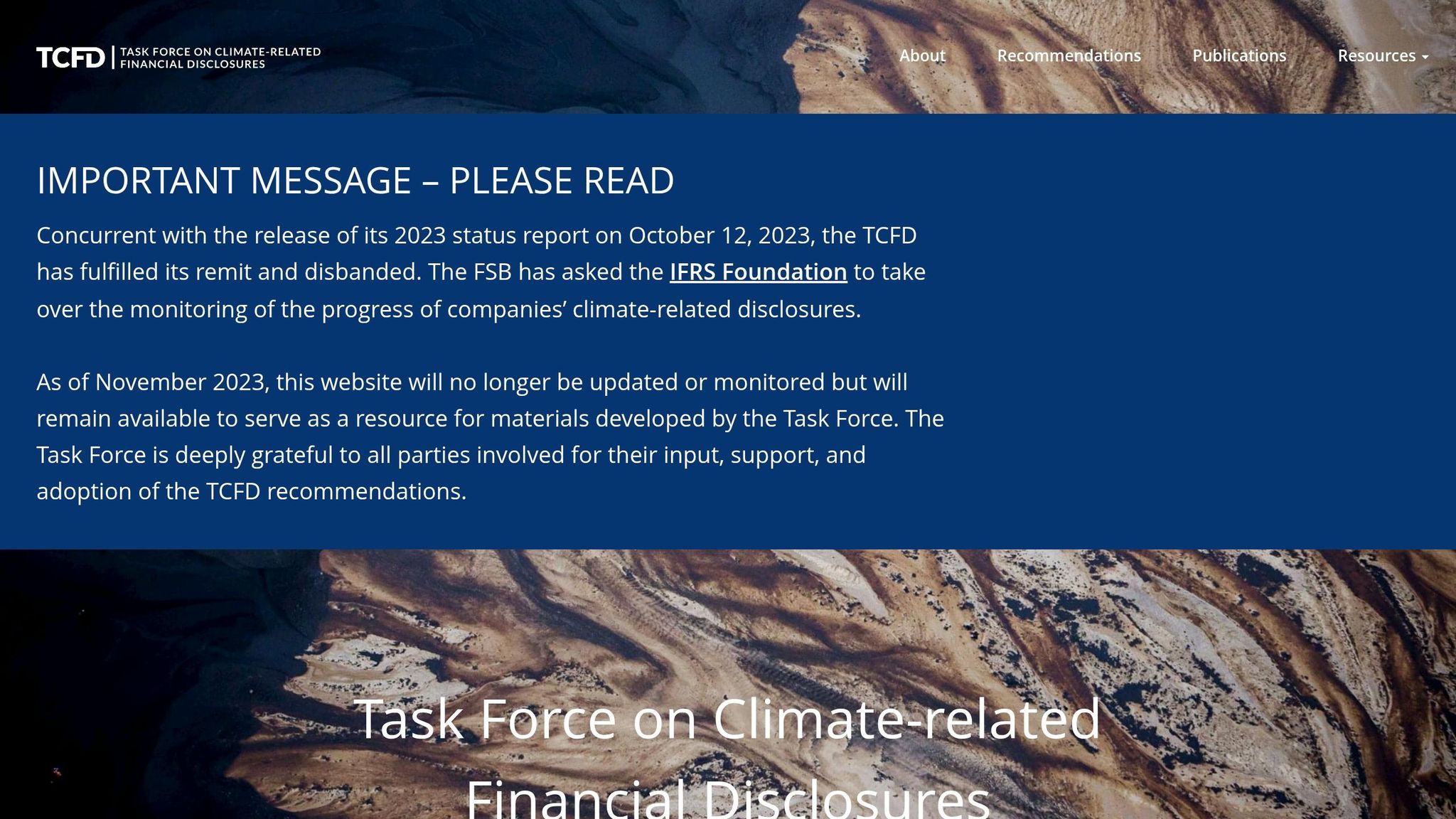
The Task Force on Climate-related Financial Disclosures (TCFD) framework is tailored to organizations addressing climate risks and opportunities. If your foundation focuses on climate-related grants, green initiatives, or operates in areas vulnerable to climate change, TCFD offers a structured way to report on these issues.
TCFD organizes disclosures into four key areas: governance, strategy, risk management, and metrics/targets. This includes detailing how your board oversees climate risks, integrating climate considerations into strategic decisions, and outlining processes for identifying and managing these risks. You’ll also report on metrics and targets, such as carbon reduction goals or the proportion of grants aimed at climate resilience.
This framework is particularly useful for foundations looking to demonstrate both environmental responsibility and financial foresight. It reassures donors and partners that your organization is planning for the long term and safeguarding its resources.
ISSB Standards for Investor-Focused Metrics
Building on the climate focus of TCFD, the International Sustainability Standards Board (ISSB) provides a broader framework designed for stakeholders who need to evaluate financial and sustainability performance together. While originally aimed at investors, ISSB is also valuable for foundations with endowments or those seeking institutional funding.
ISSB prioritizes consistency and comparability, enabling stakeholders to assess your ESG performance against others. Its standards include both general sustainability disclosures and climate-specific metrics, ensuring you address issues that could affect your financial health and mission.
For foundations, ISSB is particularly effective when communicating with board members, major donors, or institutional partners who expect rigorous, investment-grade reporting. By aligning with ISSB, you demonstrate that your disclosures meet the highest standards of accountability and precision.
Measure and Show ESG Progress with Data
Data takes ESG commitments from words on paper to evidence of real change. Without clear metrics, stakeholders are left guessing whether efforts are making a difference. It's crucial to track outcomes that highlight tangible progress, rather than just listing completed actions [10]. For example, reporting a 23% improvement in literacy scores demonstrates impact, while stating that 500 books were distributed only describes an activity. The key is to focus on metrics that validate your results.
Define Your Key ESG Metrics
The right metrics should reflect your mission and align with what matters most to your stakeholders. For environmental goals, this might mean tracking reductions in carbon emissions across your projects or measuring the percentage of funds directed toward climate resilience. On the social side, consider metrics like changes in employment rates in target communities or improvements in health outcomes among those you serve. Governance metrics could include indicators like board diversity percentages, the inclusion of equity considerations in grants, or the transparency of decision-making processes.
The difference between activities and outcomes is crucial. If your foundation supports education programs, don’t just count the number of students who participated. Instead, measure improvements in graduation rates, skill development, or long-term employment outcomes. Similarly, for health initiatives, track reductions in disease prevalence or increased access to healthcare rather than simply tallying the number of clinics opened. This approach demonstrates to stakeholders that your investments are driving meaningful change, not just funding well-intentioned projects. Once these metrics are established, they can be effectively shared through clear and impactful data visualization.
Use Data Visualization to Communicate Impact
Visuals are a powerful way to make ESG data understandable and engaging. Tailor your visualizations to your audience: detailed charts and data tables for researchers, and simplified infographics for donors or broader audiences [11]. You might even create multiple versions of your reports - one with in-depth data for analytical stakeholders and another with visually appealing summaries for others.
Design your visuals for quick comprehension, as most stakeholders form an impression of a report in under 30 seconds [10]. Highlight key metrics in callout boxes, use clear headers every couple of paragraphs, and ensure your most critical findings stand out immediately. Context is essential - single data points mean little on their own. Use bar charts or line graphs to show trends over time, progress against baselines, or comparisons to regional benchmarks [10]. For example, if you’ve achieved a 15% reduction in operational emissions, illustrate where you started, where you are now, and where you aim to be. This approach makes your progress both relatable and credible.
Build Transparent Communication Strategies
Building trust in ESG data hinges on transparent and honest reporting. For foundations and philanthropic organizations, this means moving past vague claims and crafting communication strategies that are clear and accessible.
The challenge is significant. Many people are unfamiliar with how foundations operate, which can lead to skepticism. Your role is to bridge this gap with messaging that clearly outlines your actions and their significance. To do this effectively, you need a unified ESG narrative that resonates with all stakeholders.
Create a Consistent ESG Narrative
Aligning ESG efforts with your core values - whether those are compassion, innovation, or resilience - reinforces credibility and ensures your messaging feels sincere [3]. When your environmental, social, and governance initiatives reflect these values, your narrative becomes more relatable and trustworthy.
Consistency is critical across all audiences. The information shared with your board should match what you communicate to donors and the public [3]. Discrepancies, even if unintentional, can create an impression of dishonesty. Additionally, use clear, straightforward language that everyone can understand [1]. Stakeholders shouldn’t need specialized knowledge to grasp your impact.
Before making any ESG claims, especially future commitments like carbon reduction goals, have them reviewed by internal and external experts [3]. This step minimizes the risk of greenwashing accusations and ensures your statements are accurate and credible. Regular updates and feedback from partners and funders can help keep your messaging relevant and up-to-date [1].
Use Multiple Communication Channels
Once your ESG story is cohesive, the next step is sharing it effectively across various platforms. Adopting an "always-on" communication approach keeps stakeholders informed year-round through channels like your website, intranet, and social media [2].
"E.SUN Financial Holding Co., Ltd. demonstrates this approach effectively by disclosing all ESG news across multiple platforms and holding quarterly investor conferences to report on 'sustainability as a service,' linking their financial expertise with ESG products" [2].
This continuous engagement is essential, especially since 88% of institutional investors now evaluate ESG issues with the same rigor as operational and financial factors [2].
Tailor your content to suit different audiences while maintaining consistent facts. For investors, incorporate ESG updates into tools they already use, such as earnings calls or dashboards [2, 3]. For broader audiences, leverage social media and your website to share concise updates. Highlighting employee participation in ESG initiatives can also make your message more relatable, as their involvement often feels more genuine than corporate statements [3]. A well-organized content calendar can help coordinate messaging and maintain a steady flow of updates [12]. With 64% of people basing investment decisions on an organization’s values [2], consistent and multi-channel communication is key to building and sustaining trust.
Solve Common ESG Communication Challenges
Foundations often encounter hurdles that can erode trust when ESG progress is not reported in a credible manner. Tackling these challenges head-on is essential to maintaining stakeholder confidence.
Avoid Greenwashing Perceptions
One of the fastest ways to lose trust is by making claims that can't be substantiated. Every ESG statement must be backed by verifiable data, with clear documentation of its sources. Transparency is key - stakeholders should be able to trace the origins of your numbers and verify their accuracy when questions arise [13].
True commitment to ESG starts at the top. Leadership must integrate these efforts into the organization's overall strategy and operations. It's not about achieving perfection but showing genuine effort supported by measurable actions [13].
Maintain Data Accuracy and Audit-Readiness
Reliable ESG communication depends on data that can stand up to scrutiny. Begin by documenting all data sources to ensure completeness and uncover any gaps. Trace each metric from its origin to the final report to confirm accuracy and establish robust internal controls. Regularly test calculations and clean up datasets to maintain reliability. For added credibility, seek independent validation from external parties.
For organizations aiming to build the highest level of trust, third-party attestation offers formal verification of ESG claims. Whether opting for limited or reasonable assurance, this process has become a standard expectation as investors and donors increasingly demand accountability.
Align ESG Communication with Mission-Driven Goals
Data alone isn’t enough - context and storytelling make it meaningful. Pair key metrics with personal stories, vivid details, and even photos to make your ESG achievements more relatable and memorable [14][1].
Consistency in messaging is critical. Ensure your ESG narrative aligns with your core mission and resonates across all audiences, from your board to donors and the public. Avoid jargon and use straightforward language to reduce skepticism [1]. When your environmental, social, and governance efforts clearly tie back to your mission, your communication feels sincere rather than performative [3].
Work with Experts for Tailored ESG Strategies
Crafting effective ESG (Environmental, Social, and Governance) strategies requires more than just transparent data and consistent messaging - it demands expertise to turn goals into measurable outcomes. Many organizations face challenges in aligning their sustainability objectives with actionable plans that resonate with stakeholders while staying true to their mission. Collaborating with seasoned experts can bridge this gap, providing the technical know-how and strategic insight needed to operationalize ESG goals effectively.
Council Fire's Approach to Turning Strategy into Action
Council Fire specializes in transforming sustainability strategies into tangible results by leveraging systems thinking and data-driven methods. Unlike static reports that often gather dust, their approach integrates actionable insights into areas like climate resilience, stakeholder engagement, and ESG initiatives. This not only meets compliance requirements but also creates a competitive edge.
Their work spans a variety of areas, from analyzing carbon footprints to building circular supply chains. By combining technical rigor with strategic communication, they help organizations translate ambitious sustainability goals into practical, verifiable actions. The result is ESG communication that is not only credible but also backed by thorough analysis and measurable outcomes.
This blend of expertise and strategic execution sets the stage for meaningful, ongoing collaboration.
Build Long-Term Partnerships for Lasting Impact
Addressing complex sustainability challenges requires more than short-term solutions - it calls for sustained, long-term partnerships. These relationships allow organizations to build institutional knowledge, adapt to evolving reporting standards, and refine strategies as stakeholder expectations shift over time.
With ongoing collaboration, organizations can move beyond transactional reporting to create systemic impact. Consultants who truly understand your mission can help identify risks, uncover opportunities, and continuously adapt your ESG communication to align with your evolving goals. This kind of consistency fosters trust and ensures that your messaging remains aligned with your long-term vision - something that one-off projects simply cannot achieve.
Conclusion
Effective ESG communication for foundations and philanthropic organizations doesn't demand flawlessness - it calls for honesty, alignment with values, and measurable progress. As Corinne Graper, CEO of The Uplift Agency, puts it: "Just tell the truth." [3] This straightforward approach sets the foundation for everything, from choosing reporting frameworks to engaging stakeholders in meaningful ways.
The key is to focus on what truly matters. Identify 3–5 critical metrics that align closely with your mission and drive impactful decisions. Use well-established frameworks like GRI and ISSB to ensure your metrics are comparable across organizations. Then, complement these numbers with qualitative elements - stories, testimonials, and visuals that bring your impact to life and resonate with diverse audiences.
Transparency means sharing both wins and challenges. A "learning agenda" that openly discusses obstacles fosters far greater trust than reports that only highlight achievements. Treat your ESG data with the same level of care as financial data by implementing strong governance protocols and considering independent assurance. Start with limited verification, and over time, work toward reasonable assurance to strengthen credibility.
While data and metrics are essential, expertise ensures long-term success. As the shift toward investment-level reporting and digital formats gains momentum, stakeholder expectations will continue to evolve. Partnering with experts who understand your mission helps you navigate changing standards while maintaining consistent and meaningful messaging. This isn't just about compliance - it's a chance to lead and drive systemic change.
Take the first step today. Refine your existing practices or build a strategy from the ground up. Map out your stakeholders, define your most critical metrics, and commit to transparent reporting that reflects your organization's real impact and values. These actionable steps will help you communicate your ESG progress with clarity, integrity, and purpose.
FAQs
Which ESG framework should our foundation use first?
When building a foundation for your ESG efforts, Council Fire advises beginning with a framework that aligns with your organization's mission, the expectations of your stakeholders, and your reporting objectives. A popular choice is the Global Reporting Initiative (GRI), which prioritizes transparency and stakeholder involvement. If your focus leans more toward financial materiality and investor-driven reporting, SASB offers a strong alternative. However, GRI often serves as an excellent starting point, thanks to its wide-ranging applicability and its ability to establish trust and credibility with stakeholders.
How do we pick 3–5 ESG metrics that matter most?
To identify the most relevant ESG metrics, concentrate on those that resonate with your organization's mission and the priorities of your stakeholders. Metrics should be practical to measure, aligned with your goals, and capable of driving meaningful insights. Frameworks like GRI or SASB can serve as helpful guides in this process. Aim to keep your dashboard focused, with 10–15 key indicators that address significant concerns and objectives. Involving stakeholders such as donors and beneficiaries in the selection process ensures the metrics chosen are both reliable and meaningful.
What proof do we need to avoid greenwashing claims?
To steer clear of greenwashing accusations, it's crucial to back ESG (Environmental, Social, and Governance) efforts with clear, trustworthy evidence. This means relying on transparent, verified, and measurable impacts. Use audit-ready data, precise metrics, and third-party validation to build trust. Aligning reports with established frameworks like the Global Reporting Initiative (GRI) or Sustainability Accounting Standards Board (SASB) adds further credibility. Additionally, openly share both achievements and areas for improvement to engage stakeholders meaningfully. Strong data systems and metrics that align with your organization's mission provide a solid foundation for demonstrating legitimate ESG commitments.
Related Blog Posts
Latest Articles
©2025



FAQ
01
What does it really mean to “redefine profit”?
02
What makes Council Fire different?
03
Who does Council Fire you work with?
04
What does working with Council Fire actually look like?
05
How does Council Fire help organizations turn big goals into action?
06
How does Council Fire define and measure success?
Mar 19, 2026
How to Communicate ESG Progress Credibly for Foundations & Philanthropic Organizations
ESG Strategy
In This Article
Foundations build trust by aligning ESG reporting to stakeholder values using standards, data, and transparent storytelling.
How to Communicate ESG Progress Credibly for Foundations & Philanthropic Organizations
Foundations and philanthropic organizations must communicate their ESG (Environmental, Social, and Governance) progress transparently to build trust and meet rising stakeholder expectations. With 88% of institutional investors rigorously evaluating ESG factors and only 13.7% of the public understanding what foundations do, clear and honest communication is essential. Here's how to align your reporting with stakeholder needs:
Understand Stakeholder Expectations: Tailor messages for donors, partners, and communities. For example, donors prioritize measurable ROI, while communities value localized impact stories.
Use Standardized Frameworks: Adopt GRI, TCFD, or ISSB reporting standards to ensure data accuracy and comparability.
Focus on Data and Outcomes: Report on meaningful results, such as improved graduation rates, rather than just activities like books distributed.
Leverage Multiple Channels: Share updates consistently across platforms like websites, social media, and reports.
Avoid Greenwashing: Back all claims with verifiable data and seek third-party validation when possible.
The fundamentals of ESG reporting and verification
Know What Your Stakeholders Expect
ESG Communication Strategies by Stakeholder Group for Foundations
Stakeholder priorities aren’t the same across the board. For instance, a major donor assessing your foundation’s climate-focused grants will have different concerns than a local community group monitoring how your funding impacts employment in their area. 78% of donors now consider ESG (Environmental, Social, and Governance) performance when making philanthropic decisions, and 62% specifically value transparency in impact reporting [4]. On the other hand, community stakeholders play a significant role in shaping 45% of foundation ESG strategies through public scrutiny, with over half (52%) emphasizing the need for localized metrics [6].
Recognizing the expectations of your stakeholders - and how they influence your organization - is critical. Dr. Elena Martinez, an ESG expert from Stanford Social Innovation Review, emphasizes this point: "Philanthropic ESG success hinges on stakeholder-centric communication - donors want numbers, communities want stories" [6]. In other words, a one-size-fits-all approach won’t cut it when communicating your ESG progress.
Map Your Key Stakeholder Groups
Start by identifying all the stakeholder groups connected to your organization. A power-interest grid can help you categorize these groups based on their level of influence and interest in your ESG initiatives. For example:
High-power, high-interest stakeholders: These include board members and major donors who require detailed updates and active collaboration.
High-power, low-interest stakeholders: Regulators might fall into this category, where periodic updates suffice.
Low-power, high-interest stakeholders: Volunteers or advocacy groups often fit here, benefiting from regular engagement through newsletters or events.
Take inspiration from the Bill & Melinda Gates Foundation’s 2025 strategy. They mapped 1,200 stakeholders and focused on 150 high-influence donors and partners. By launching tailored ESG portals, they showcased $2.4 billion in climate grants and highlighted a 15% emissions reduction among grantees. For beneficiaries, they provided impact stories in Spanish and other local languages, boosting engagement rates from 42% to 54%. This thoughtful approach led to a 12% increase in donor retention and a 35% rise in partner collaborations [7].
Tailoring ESG metrics to each stakeholder group is equally important. Donors with an environmental focus might prioritize carbon reduction figures, while community organizations might value equity-related data. The Rockefeller Foundation demonstrated this in early 2026 by identifying community groups as high-interest stakeholders. Through 50+ local town halls, they reported $150 million invested in equity-focused initiatives, which created 40,000 jobs in underserved areas. This effort increased their community trust score from 67% to 89% and brought in an additional $300 million in donor pledges [8].
By clearly mapping stakeholders, you can craft ESG messages that resonate with their specific values.
Match Your ESG Message to Stakeholder Values
Once you’ve mapped your stakeholders, the next step is to align your ESG messaging with their unique expectations. For example:
Donors often want to see measurable returns on their investment, such as the dollar impact of each grant.
Partners are more focused on shared sustainability goals and risk alignment.
Beneficiaries care about equity, inclusion, and whether they have a voice in your processes.
Communities value transparency and want to understand how decisions affect their local areas.
Surveying your donors can help pinpoint their priorities. If 70% express interest in measurable social ROI, focus your reports on those figures. For emotionally driven donors, include narrative stories that highlight the human impact of your work. Meanwhile, partners may benefit from detailed dashboards tracking joint KPIs. A 2025 Philanthropy Impact survey revealed that 65% of foundation stakeholders expect ESG disclosures aligned with GRI (Global Reporting Initiative) standards for credibility [5]. Meeting these expectations can strengthen trust and engagement.
Here’s a breakdown of how to tailor communication strategies for different groups:
Stakeholder Group | Primary Expectations | Customized Communication Strategy | Example Metrics |
|---|---|---|---|
Donors | Financial ROI, impact proof | Annual reports with ROI calculators | Grants ROI: $3 returned per $1 invested |
Beneficiaries | Equity, inclusion | Localized feedback portals, story-driven updates | 85% beneficiary satisfaction rate |
Partners | Alignment, risk sharing | Collaborative dashboards, joint KPIs | 20% shared sustainability goals met |
Community | Local impact, transparency | Public websites, town halls | $5M invested in local projects |
Use Standardized ESG Reporting Frameworks
Using a recognized ESG framework isn't just a procedural step - it's about building credibility and trust. Standardized reporting methods allow stakeholders to evaluate your progress against industry benchmarks, giving them confidence in your data. More than 70% of leading companies worldwide have adopted GRI as their primary framework for ESG disclosures [9], showing that these frameworks have become a key part of responsible organizational practices.
Standardized frameworks help translate ambitious ESG goals into measurable and comparable outcomes. By aligning your reporting with stakeholder expectations, you ensure that your data is both credible and actionable. For foundations and philanthropic organizations, choosing a framework that aligns with your mission and stakeholder priorities is essential. Some frameworks emphasize broad social and environmental impacts, while others focus on climate risks or financial metrics. This approach ensures your reporting is tailored to your objectives.
Before selecting a framework, conduct a materiality assessment to pinpoint the topics most relevant to your organization and stakeholders. This includes examining "double materiality" - how your activities affect the world and how sustainability issues impact your operations and financial health. Once you've identified these topics, you can choose a framework that effectively communicates your priorities.
Start by implementing foundational standards that address governance, human rights, and environmental due diligence. Gradually expand to more specific areas as needed. Treat ESG data with the same rigor as financial data, ensuring accuracy and transparency. If there are gaps in your data, acknowledge them openly in your reports. This transparency reinforces your commitment to improvement and strengthens stakeholder trust.
GRI Standards for Impact Reporting
The Global Reporting Initiative (GRI) framework is ideal for organizations looking to provide a comprehensive view of their social and environmental impact. It’s especially valuable for foundations, as it enables detailed reporting on labor practices, community investments, resource use, and emissions.
GRI operates through Universal Standards (GRI 1, 2, and 3), which cover reporting principles, governance, and stakeholder engagement. Additional topic-specific standards are chosen based on your materiality assessment. For instance, if equity and inclusion are key priorities, you’d incorporate GRI’s social standards. If your work focuses on environmental grants, you’d use the relevant environmental standards.
This framework is particularly effective for foundations with diverse stakeholders, as it offers a holistic view of your impact. Whether it's donors, beneficiaries, or community partners, GRI-aligned reports provide accessible and relevant information for all. It also allows you to track your progress over time, showcasing how your ESG performance evolves alongside your mission.
TCFD for Climate Disclosures
The Task Force on Climate-related Financial Disclosures (TCFD) framework is tailored to organizations addressing climate risks and opportunities. If your foundation focuses on climate-related grants, green initiatives, or operates in areas vulnerable to climate change, TCFD offers a structured way to report on these issues.
TCFD organizes disclosures into four key areas: governance, strategy, risk management, and metrics/targets. This includes detailing how your board oversees climate risks, integrating climate considerations into strategic decisions, and outlining processes for identifying and managing these risks. You’ll also report on metrics and targets, such as carbon reduction goals or the proportion of grants aimed at climate resilience.
This framework is particularly useful for foundations looking to demonstrate both environmental responsibility and financial foresight. It reassures donors and partners that your organization is planning for the long term and safeguarding its resources.
ISSB Standards for Investor-Focused Metrics
Building on the climate focus of TCFD, the International Sustainability Standards Board (ISSB) provides a broader framework designed for stakeholders who need to evaluate financial and sustainability performance together. While originally aimed at investors, ISSB is also valuable for foundations with endowments or those seeking institutional funding.
ISSB prioritizes consistency and comparability, enabling stakeholders to assess your ESG performance against others. Its standards include both general sustainability disclosures and climate-specific metrics, ensuring you address issues that could affect your financial health and mission.
For foundations, ISSB is particularly effective when communicating with board members, major donors, or institutional partners who expect rigorous, investment-grade reporting. By aligning with ISSB, you demonstrate that your disclosures meet the highest standards of accountability and precision.
Measure and Show ESG Progress with Data
Data takes ESG commitments from words on paper to evidence of real change. Without clear metrics, stakeholders are left guessing whether efforts are making a difference. It's crucial to track outcomes that highlight tangible progress, rather than just listing completed actions [10]. For example, reporting a 23% improvement in literacy scores demonstrates impact, while stating that 500 books were distributed only describes an activity. The key is to focus on metrics that validate your results.
Define Your Key ESG Metrics
The right metrics should reflect your mission and align with what matters most to your stakeholders. For environmental goals, this might mean tracking reductions in carbon emissions across your projects or measuring the percentage of funds directed toward climate resilience. On the social side, consider metrics like changes in employment rates in target communities or improvements in health outcomes among those you serve. Governance metrics could include indicators like board diversity percentages, the inclusion of equity considerations in grants, or the transparency of decision-making processes.
The difference between activities and outcomes is crucial. If your foundation supports education programs, don’t just count the number of students who participated. Instead, measure improvements in graduation rates, skill development, or long-term employment outcomes. Similarly, for health initiatives, track reductions in disease prevalence or increased access to healthcare rather than simply tallying the number of clinics opened. This approach demonstrates to stakeholders that your investments are driving meaningful change, not just funding well-intentioned projects. Once these metrics are established, they can be effectively shared through clear and impactful data visualization.
Use Data Visualization to Communicate Impact
Visuals are a powerful way to make ESG data understandable and engaging. Tailor your visualizations to your audience: detailed charts and data tables for researchers, and simplified infographics for donors or broader audiences [11]. You might even create multiple versions of your reports - one with in-depth data for analytical stakeholders and another with visually appealing summaries for others.
Design your visuals for quick comprehension, as most stakeholders form an impression of a report in under 30 seconds [10]. Highlight key metrics in callout boxes, use clear headers every couple of paragraphs, and ensure your most critical findings stand out immediately. Context is essential - single data points mean little on their own. Use bar charts or line graphs to show trends over time, progress against baselines, or comparisons to regional benchmarks [10]. For example, if you’ve achieved a 15% reduction in operational emissions, illustrate where you started, where you are now, and where you aim to be. This approach makes your progress both relatable and credible.
Build Transparent Communication Strategies
Building trust in ESG data hinges on transparent and honest reporting. For foundations and philanthropic organizations, this means moving past vague claims and crafting communication strategies that are clear and accessible.
The challenge is significant. Many people are unfamiliar with how foundations operate, which can lead to skepticism. Your role is to bridge this gap with messaging that clearly outlines your actions and their significance. To do this effectively, you need a unified ESG narrative that resonates with all stakeholders.
Create a Consistent ESG Narrative
Aligning ESG efforts with your core values - whether those are compassion, innovation, or resilience - reinforces credibility and ensures your messaging feels sincere [3]. When your environmental, social, and governance initiatives reflect these values, your narrative becomes more relatable and trustworthy.
Consistency is critical across all audiences. The information shared with your board should match what you communicate to donors and the public [3]. Discrepancies, even if unintentional, can create an impression of dishonesty. Additionally, use clear, straightforward language that everyone can understand [1]. Stakeholders shouldn’t need specialized knowledge to grasp your impact.
Before making any ESG claims, especially future commitments like carbon reduction goals, have them reviewed by internal and external experts [3]. This step minimizes the risk of greenwashing accusations and ensures your statements are accurate and credible. Regular updates and feedback from partners and funders can help keep your messaging relevant and up-to-date [1].
Use Multiple Communication Channels
Once your ESG story is cohesive, the next step is sharing it effectively across various platforms. Adopting an "always-on" communication approach keeps stakeholders informed year-round through channels like your website, intranet, and social media [2].
"E.SUN Financial Holding Co., Ltd. demonstrates this approach effectively by disclosing all ESG news across multiple platforms and holding quarterly investor conferences to report on 'sustainability as a service,' linking their financial expertise with ESG products" [2].
This continuous engagement is essential, especially since 88% of institutional investors now evaluate ESG issues with the same rigor as operational and financial factors [2].
Tailor your content to suit different audiences while maintaining consistent facts. For investors, incorporate ESG updates into tools they already use, such as earnings calls or dashboards [2, 3]. For broader audiences, leverage social media and your website to share concise updates. Highlighting employee participation in ESG initiatives can also make your message more relatable, as their involvement often feels more genuine than corporate statements [3]. A well-organized content calendar can help coordinate messaging and maintain a steady flow of updates [12]. With 64% of people basing investment decisions on an organization’s values [2], consistent and multi-channel communication is key to building and sustaining trust.
Solve Common ESG Communication Challenges
Foundations often encounter hurdles that can erode trust when ESG progress is not reported in a credible manner. Tackling these challenges head-on is essential to maintaining stakeholder confidence.
Avoid Greenwashing Perceptions
One of the fastest ways to lose trust is by making claims that can't be substantiated. Every ESG statement must be backed by verifiable data, with clear documentation of its sources. Transparency is key - stakeholders should be able to trace the origins of your numbers and verify their accuracy when questions arise [13].
True commitment to ESG starts at the top. Leadership must integrate these efforts into the organization's overall strategy and operations. It's not about achieving perfection but showing genuine effort supported by measurable actions [13].
Maintain Data Accuracy and Audit-Readiness
Reliable ESG communication depends on data that can stand up to scrutiny. Begin by documenting all data sources to ensure completeness and uncover any gaps. Trace each metric from its origin to the final report to confirm accuracy and establish robust internal controls. Regularly test calculations and clean up datasets to maintain reliability. For added credibility, seek independent validation from external parties.
For organizations aiming to build the highest level of trust, third-party attestation offers formal verification of ESG claims. Whether opting for limited or reasonable assurance, this process has become a standard expectation as investors and donors increasingly demand accountability.
Align ESG Communication with Mission-Driven Goals
Data alone isn’t enough - context and storytelling make it meaningful. Pair key metrics with personal stories, vivid details, and even photos to make your ESG achievements more relatable and memorable [14][1].
Consistency in messaging is critical. Ensure your ESG narrative aligns with your core mission and resonates across all audiences, from your board to donors and the public. Avoid jargon and use straightforward language to reduce skepticism [1]. When your environmental, social, and governance efforts clearly tie back to your mission, your communication feels sincere rather than performative [3].
Work with Experts for Tailored ESG Strategies
Crafting effective ESG (Environmental, Social, and Governance) strategies requires more than just transparent data and consistent messaging - it demands expertise to turn goals into measurable outcomes. Many organizations face challenges in aligning their sustainability objectives with actionable plans that resonate with stakeholders while staying true to their mission. Collaborating with seasoned experts can bridge this gap, providing the technical know-how and strategic insight needed to operationalize ESG goals effectively.
Council Fire's Approach to Turning Strategy into Action
Council Fire specializes in transforming sustainability strategies into tangible results by leveraging systems thinking and data-driven methods. Unlike static reports that often gather dust, their approach integrates actionable insights into areas like climate resilience, stakeholder engagement, and ESG initiatives. This not only meets compliance requirements but also creates a competitive edge.
Their work spans a variety of areas, from analyzing carbon footprints to building circular supply chains. By combining technical rigor with strategic communication, they help organizations translate ambitious sustainability goals into practical, verifiable actions. The result is ESG communication that is not only credible but also backed by thorough analysis and measurable outcomes.
This blend of expertise and strategic execution sets the stage for meaningful, ongoing collaboration.
Build Long-Term Partnerships for Lasting Impact
Addressing complex sustainability challenges requires more than short-term solutions - it calls for sustained, long-term partnerships. These relationships allow organizations to build institutional knowledge, adapt to evolving reporting standards, and refine strategies as stakeholder expectations shift over time.
With ongoing collaboration, organizations can move beyond transactional reporting to create systemic impact. Consultants who truly understand your mission can help identify risks, uncover opportunities, and continuously adapt your ESG communication to align with your evolving goals. This kind of consistency fosters trust and ensures that your messaging remains aligned with your long-term vision - something that one-off projects simply cannot achieve.
Conclusion
Effective ESG communication for foundations and philanthropic organizations doesn't demand flawlessness - it calls for honesty, alignment with values, and measurable progress. As Corinne Graper, CEO of The Uplift Agency, puts it: "Just tell the truth." [3] This straightforward approach sets the foundation for everything, from choosing reporting frameworks to engaging stakeholders in meaningful ways.
The key is to focus on what truly matters. Identify 3–5 critical metrics that align closely with your mission and drive impactful decisions. Use well-established frameworks like GRI and ISSB to ensure your metrics are comparable across organizations. Then, complement these numbers with qualitative elements - stories, testimonials, and visuals that bring your impact to life and resonate with diverse audiences.
Transparency means sharing both wins and challenges. A "learning agenda" that openly discusses obstacles fosters far greater trust than reports that only highlight achievements. Treat your ESG data with the same level of care as financial data by implementing strong governance protocols and considering independent assurance. Start with limited verification, and over time, work toward reasonable assurance to strengthen credibility.
While data and metrics are essential, expertise ensures long-term success. As the shift toward investment-level reporting and digital formats gains momentum, stakeholder expectations will continue to evolve. Partnering with experts who understand your mission helps you navigate changing standards while maintaining consistent and meaningful messaging. This isn't just about compliance - it's a chance to lead and drive systemic change.
Take the first step today. Refine your existing practices or build a strategy from the ground up. Map out your stakeholders, define your most critical metrics, and commit to transparent reporting that reflects your organization's real impact and values. These actionable steps will help you communicate your ESG progress with clarity, integrity, and purpose.
FAQs
Which ESG framework should our foundation use first?
When building a foundation for your ESG efforts, Council Fire advises beginning with a framework that aligns with your organization's mission, the expectations of your stakeholders, and your reporting objectives. A popular choice is the Global Reporting Initiative (GRI), which prioritizes transparency and stakeholder involvement. If your focus leans more toward financial materiality and investor-driven reporting, SASB offers a strong alternative. However, GRI often serves as an excellent starting point, thanks to its wide-ranging applicability and its ability to establish trust and credibility with stakeholders.
How do we pick 3–5 ESG metrics that matter most?
To identify the most relevant ESG metrics, concentrate on those that resonate with your organization's mission and the priorities of your stakeholders. Metrics should be practical to measure, aligned with your goals, and capable of driving meaningful insights. Frameworks like GRI or SASB can serve as helpful guides in this process. Aim to keep your dashboard focused, with 10–15 key indicators that address significant concerns and objectives. Involving stakeholders such as donors and beneficiaries in the selection process ensures the metrics chosen are both reliable and meaningful.
What proof do we need to avoid greenwashing claims?
To steer clear of greenwashing accusations, it's crucial to back ESG (Environmental, Social, and Governance) efforts with clear, trustworthy evidence. This means relying on transparent, verified, and measurable impacts. Use audit-ready data, precise metrics, and third-party validation to build trust. Aligning reports with established frameworks like the Global Reporting Initiative (GRI) or Sustainability Accounting Standards Board (SASB) adds further credibility. Additionally, openly share both achievements and areas for improvement to engage stakeholders meaningfully. Strong data systems and metrics that align with your organization's mission provide a solid foundation for demonstrating legitimate ESG commitments.
Related Blog Posts
FAQ
01
What does it really mean to “redefine profit”?
02
What makes Council Fire different?
03
Who does Council Fire you work with?
04
What does working with Council Fire actually look like?
05
How does Council Fire help organizations turn big goals into action?
06
How does Council Fire define and measure success?
Mar 19, 2026
How to Communicate ESG Progress Credibly for Foundations & Philanthropic Organizations
ESG Strategy
In This Article
Foundations build trust by aligning ESG reporting to stakeholder values using standards, data, and transparent storytelling.
How to Communicate ESG Progress Credibly for Foundations & Philanthropic Organizations
Foundations and philanthropic organizations must communicate their ESG (Environmental, Social, and Governance) progress transparently to build trust and meet rising stakeholder expectations. With 88% of institutional investors rigorously evaluating ESG factors and only 13.7% of the public understanding what foundations do, clear and honest communication is essential. Here's how to align your reporting with stakeholder needs:
Understand Stakeholder Expectations: Tailor messages for donors, partners, and communities. For example, donors prioritize measurable ROI, while communities value localized impact stories.
Use Standardized Frameworks: Adopt GRI, TCFD, or ISSB reporting standards to ensure data accuracy and comparability.
Focus on Data and Outcomes: Report on meaningful results, such as improved graduation rates, rather than just activities like books distributed.
Leverage Multiple Channels: Share updates consistently across platforms like websites, social media, and reports.
Avoid Greenwashing: Back all claims with verifiable data and seek third-party validation when possible.
The fundamentals of ESG reporting and verification
Know What Your Stakeholders Expect
ESG Communication Strategies by Stakeholder Group for Foundations
Stakeholder priorities aren’t the same across the board. For instance, a major donor assessing your foundation’s climate-focused grants will have different concerns than a local community group monitoring how your funding impacts employment in their area. 78% of donors now consider ESG (Environmental, Social, and Governance) performance when making philanthropic decisions, and 62% specifically value transparency in impact reporting [4]. On the other hand, community stakeholders play a significant role in shaping 45% of foundation ESG strategies through public scrutiny, with over half (52%) emphasizing the need for localized metrics [6].
Recognizing the expectations of your stakeholders - and how they influence your organization - is critical. Dr. Elena Martinez, an ESG expert from Stanford Social Innovation Review, emphasizes this point: "Philanthropic ESG success hinges on stakeholder-centric communication - donors want numbers, communities want stories" [6]. In other words, a one-size-fits-all approach won’t cut it when communicating your ESG progress.
Map Your Key Stakeholder Groups
Start by identifying all the stakeholder groups connected to your organization. A power-interest grid can help you categorize these groups based on their level of influence and interest in your ESG initiatives. For example:
High-power, high-interest stakeholders: These include board members and major donors who require detailed updates and active collaboration.
High-power, low-interest stakeholders: Regulators might fall into this category, where periodic updates suffice.
Low-power, high-interest stakeholders: Volunteers or advocacy groups often fit here, benefiting from regular engagement through newsletters or events.
Take inspiration from the Bill & Melinda Gates Foundation’s 2025 strategy. They mapped 1,200 stakeholders and focused on 150 high-influence donors and partners. By launching tailored ESG portals, they showcased $2.4 billion in climate grants and highlighted a 15% emissions reduction among grantees. For beneficiaries, they provided impact stories in Spanish and other local languages, boosting engagement rates from 42% to 54%. This thoughtful approach led to a 12% increase in donor retention and a 35% rise in partner collaborations [7].
Tailoring ESG metrics to each stakeholder group is equally important. Donors with an environmental focus might prioritize carbon reduction figures, while community organizations might value equity-related data. The Rockefeller Foundation demonstrated this in early 2026 by identifying community groups as high-interest stakeholders. Through 50+ local town halls, they reported $150 million invested in equity-focused initiatives, which created 40,000 jobs in underserved areas. This effort increased their community trust score from 67% to 89% and brought in an additional $300 million in donor pledges [8].
By clearly mapping stakeholders, you can craft ESG messages that resonate with their specific values.
Match Your ESG Message to Stakeholder Values
Once you’ve mapped your stakeholders, the next step is to align your ESG messaging with their unique expectations. For example:
Donors often want to see measurable returns on their investment, such as the dollar impact of each grant.
Partners are more focused on shared sustainability goals and risk alignment.
Beneficiaries care about equity, inclusion, and whether they have a voice in your processes.
Communities value transparency and want to understand how decisions affect their local areas.
Surveying your donors can help pinpoint their priorities. If 70% express interest in measurable social ROI, focus your reports on those figures. For emotionally driven donors, include narrative stories that highlight the human impact of your work. Meanwhile, partners may benefit from detailed dashboards tracking joint KPIs. A 2025 Philanthropy Impact survey revealed that 65% of foundation stakeholders expect ESG disclosures aligned with GRI (Global Reporting Initiative) standards for credibility [5]. Meeting these expectations can strengthen trust and engagement.
Here’s a breakdown of how to tailor communication strategies for different groups:
Stakeholder Group | Primary Expectations | Customized Communication Strategy | Example Metrics |
|---|---|---|---|
Donors | Financial ROI, impact proof | Annual reports with ROI calculators | Grants ROI: $3 returned per $1 invested |
Beneficiaries | Equity, inclusion | Localized feedback portals, story-driven updates | 85% beneficiary satisfaction rate |
Partners | Alignment, risk sharing | Collaborative dashboards, joint KPIs | 20% shared sustainability goals met |
Community | Local impact, transparency | Public websites, town halls | $5M invested in local projects |
Use Standardized ESG Reporting Frameworks
Using a recognized ESG framework isn't just a procedural step - it's about building credibility and trust. Standardized reporting methods allow stakeholders to evaluate your progress against industry benchmarks, giving them confidence in your data. More than 70% of leading companies worldwide have adopted GRI as their primary framework for ESG disclosures [9], showing that these frameworks have become a key part of responsible organizational practices.
Standardized frameworks help translate ambitious ESG goals into measurable and comparable outcomes. By aligning your reporting with stakeholder expectations, you ensure that your data is both credible and actionable. For foundations and philanthropic organizations, choosing a framework that aligns with your mission and stakeholder priorities is essential. Some frameworks emphasize broad social and environmental impacts, while others focus on climate risks or financial metrics. This approach ensures your reporting is tailored to your objectives.
Before selecting a framework, conduct a materiality assessment to pinpoint the topics most relevant to your organization and stakeholders. This includes examining "double materiality" - how your activities affect the world and how sustainability issues impact your operations and financial health. Once you've identified these topics, you can choose a framework that effectively communicates your priorities.
Start by implementing foundational standards that address governance, human rights, and environmental due diligence. Gradually expand to more specific areas as needed. Treat ESG data with the same rigor as financial data, ensuring accuracy and transparency. If there are gaps in your data, acknowledge them openly in your reports. This transparency reinforces your commitment to improvement and strengthens stakeholder trust.
GRI Standards for Impact Reporting
The Global Reporting Initiative (GRI) framework is ideal for organizations looking to provide a comprehensive view of their social and environmental impact. It’s especially valuable for foundations, as it enables detailed reporting on labor practices, community investments, resource use, and emissions.
GRI operates through Universal Standards (GRI 1, 2, and 3), which cover reporting principles, governance, and stakeholder engagement. Additional topic-specific standards are chosen based on your materiality assessment. For instance, if equity and inclusion are key priorities, you’d incorporate GRI’s social standards. If your work focuses on environmental grants, you’d use the relevant environmental standards.
This framework is particularly effective for foundations with diverse stakeholders, as it offers a holistic view of your impact. Whether it's donors, beneficiaries, or community partners, GRI-aligned reports provide accessible and relevant information for all. It also allows you to track your progress over time, showcasing how your ESG performance evolves alongside your mission.
TCFD for Climate Disclosures
The Task Force on Climate-related Financial Disclosures (TCFD) framework is tailored to organizations addressing climate risks and opportunities. If your foundation focuses on climate-related grants, green initiatives, or operates in areas vulnerable to climate change, TCFD offers a structured way to report on these issues.
TCFD organizes disclosures into four key areas: governance, strategy, risk management, and metrics/targets. This includes detailing how your board oversees climate risks, integrating climate considerations into strategic decisions, and outlining processes for identifying and managing these risks. You’ll also report on metrics and targets, such as carbon reduction goals or the proportion of grants aimed at climate resilience.
This framework is particularly useful for foundations looking to demonstrate both environmental responsibility and financial foresight. It reassures donors and partners that your organization is planning for the long term and safeguarding its resources.
ISSB Standards for Investor-Focused Metrics
Building on the climate focus of TCFD, the International Sustainability Standards Board (ISSB) provides a broader framework designed for stakeholders who need to evaluate financial and sustainability performance together. While originally aimed at investors, ISSB is also valuable for foundations with endowments or those seeking institutional funding.
ISSB prioritizes consistency and comparability, enabling stakeholders to assess your ESG performance against others. Its standards include both general sustainability disclosures and climate-specific metrics, ensuring you address issues that could affect your financial health and mission.
For foundations, ISSB is particularly effective when communicating with board members, major donors, or institutional partners who expect rigorous, investment-grade reporting. By aligning with ISSB, you demonstrate that your disclosures meet the highest standards of accountability and precision.
Measure and Show ESG Progress with Data
Data takes ESG commitments from words on paper to evidence of real change. Without clear metrics, stakeholders are left guessing whether efforts are making a difference. It's crucial to track outcomes that highlight tangible progress, rather than just listing completed actions [10]. For example, reporting a 23% improvement in literacy scores demonstrates impact, while stating that 500 books were distributed only describes an activity. The key is to focus on metrics that validate your results.
Define Your Key ESG Metrics
The right metrics should reflect your mission and align with what matters most to your stakeholders. For environmental goals, this might mean tracking reductions in carbon emissions across your projects or measuring the percentage of funds directed toward climate resilience. On the social side, consider metrics like changes in employment rates in target communities or improvements in health outcomes among those you serve. Governance metrics could include indicators like board diversity percentages, the inclusion of equity considerations in grants, or the transparency of decision-making processes.
The difference between activities and outcomes is crucial. If your foundation supports education programs, don’t just count the number of students who participated. Instead, measure improvements in graduation rates, skill development, or long-term employment outcomes. Similarly, for health initiatives, track reductions in disease prevalence or increased access to healthcare rather than simply tallying the number of clinics opened. This approach demonstrates to stakeholders that your investments are driving meaningful change, not just funding well-intentioned projects. Once these metrics are established, they can be effectively shared through clear and impactful data visualization.
Use Data Visualization to Communicate Impact
Visuals are a powerful way to make ESG data understandable and engaging. Tailor your visualizations to your audience: detailed charts and data tables for researchers, and simplified infographics for donors or broader audiences [11]. You might even create multiple versions of your reports - one with in-depth data for analytical stakeholders and another with visually appealing summaries for others.
Design your visuals for quick comprehension, as most stakeholders form an impression of a report in under 30 seconds [10]. Highlight key metrics in callout boxes, use clear headers every couple of paragraphs, and ensure your most critical findings stand out immediately. Context is essential - single data points mean little on their own. Use bar charts or line graphs to show trends over time, progress against baselines, or comparisons to regional benchmarks [10]. For example, if you’ve achieved a 15% reduction in operational emissions, illustrate where you started, where you are now, and where you aim to be. This approach makes your progress both relatable and credible.
Build Transparent Communication Strategies
Building trust in ESG data hinges on transparent and honest reporting. For foundations and philanthropic organizations, this means moving past vague claims and crafting communication strategies that are clear and accessible.
The challenge is significant. Many people are unfamiliar with how foundations operate, which can lead to skepticism. Your role is to bridge this gap with messaging that clearly outlines your actions and their significance. To do this effectively, you need a unified ESG narrative that resonates with all stakeholders.
Create a Consistent ESG Narrative
Aligning ESG efforts with your core values - whether those are compassion, innovation, or resilience - reinforces credibility and ensures your messaging feels sincere [3]. When your environmental, social, and governance initiatives reflect these values, your narrative becomes more relatable and trustworthy.
Consistency is critical across all audiences. The information shared with your board should match what you communicate to donors and the public [3]. Discrepancies, even if unintentional, can create an impression of dishonesty. Additionally, use clear, straightforward language that everyone can understand [1]. Stakeholders shouldn’t need specialized knowledge to grasp your impact.
Before making any ESG claims, especially future commitments like carbon reduction goals, have them reviewed by internal and external experts [3]. This step minimizes the risk of greenwashing accusations and ensures your statements are accurate and credible. Regular updates and feedback from partners and funders can help keep your messaging relevant and up-to-date [1].
Use Multiple Communication Channels
Once your ESG story is cohesive, the next step is sharing it effectively across various platforms. Adopting an "always-on" communication approach keeps stakeholders informed year-round through channels like your website, intranet, and social media [2].
"E.SUN Financial Holding Co., Ltd. demonstrates this approach effectively by disclosing all ESG news across multiple platforms and holding quarterly investor conferences to report on 'sustainability as a service,' linking their financial expertise with ESG products" [2].
This continuous engagement is essential, especially since 88% of institutional investors now evaluate ESG issues with the same rigor as operational and financial factors [2].
Tailor your content to suit different audiences while maintaining consistent facts. For investors, incorporate ESG updates into tools they already use, such as earnings calls or dashboards [2, 3]. For broader audiences, leverage social media and your website to share concise updates. Highlighting employee participation in ESG initiatives can also make your message more relatable, as their involvement often feels more genuine than corporate statements [3]. A well-organized content calendar can help coordinate messaging and maintain a steady flow of updates [12]. With 64% of people basing investment decisions on an organization’s values [2], consistent and multi-channel communication is key to building and sustaining trust.
Solve Common ESG Communication Challenges
Foundations often encounter hurdles that can erode trust when ESG progress is not reported in a credible manner. Tackling these challenges head-on is essential to maintaining stakeholder confidence.
Avoid Greenwashing Perceptions
One of the fastest ways to lose trust is by making claims that can't be substantiated. Every ESG statement must be backed by verifiable data, with clear documentation of its sources. Transparency is key - stakeholders should be able to trace the origins of your numbers and verify their accuracy when questions arise [13].
True commitment to ESG starts at the top. Leadership must integrate these efforts into the organization's overall strategy and operations. It's not about achieving perfection but showing genuine effort supported by measurable actions [13].
Maintain Data Accuracy and Audit-Readiness
Reliable ESG communication depends on data that can stand up to scrutiny. Begin by documenting all data sources to ensure completeness and uncover any gaps. Trace each metric from its origin to the final report to confirm accuracy and establish robust internal controls. Regularly test calculations and clean up datasets to maintain reliability. For added credibility, seek independent validation from external parties.
For organizations aiming to build the highest level of trust, third-party attestation offers formal verification of ESG claims. Whether opting for limited or reasonable assurance, this process has become a standard expectation as investors and donors increasingly demand accountability.
Align ESG Communication with Mission-Driven Goals
Data alone isn’t enough - context and storytelling make it meaningful. Pair key metrics with personal stories, vivid details, and even photos to make your ESG achievements more relatable and memorable [14][1].
Consistency in messaging is critical. Ensure your ESG narrative aligns with your core mission and resonates across all audiences, from your board to donors and the public. Avoid jargon and use straightforward language to reduce skepticism [1]. When your environmental, social, and governance efforts clearly tie back to your mission, your communication feels sincere rather than performative [3].
Work with Experts for Tailored ESG Strategies
Crafting effective ESG (Environmental, Social, and Governance) strategies requires more than just transparent data and consistent messaging - it demands expertise to turn goals into measurable outcomes. Many organizations face challenges in aligning their sustainability objectives with actionable plans that resonate with stakeholders while staying true to their mission. Collaborating with seasoned experts can bridge this gap, providing the technical know-how and strategic insight needed to operationalize ESG goals effectively.
Council Fire's Approach to Turning Strategy into Action
Council Fire specializes in transforming sustainability strategies into tangible results by leveraging systems thinking and data-driven methods. Unlike static reports that often gather dust, their approach integrates actionable insights into areas like climate resilience, stakeholder engagement, and ESG initiatives. This not only meets compliance requirements but also creates a competitive edge.
Their work spans a variety of areas, from analyzing carbon footprints to building circular supply chains. By combining technical rigor with strategic communication, they help organizations translate ambitious sustainability goals into practical, verifiable actions. The result is ESG communication that is not only credible but also backed by thorough analysis and measurable outcomes.
This blend of expertise and strategic execution sets the stage for meaningful, ongoing collaboration.
Build Long-Term Partnerships for Lasting Impact
Addressing complex sustainability challenges requires more than short-term solutions - it calls for sustained, long-term partnerships. These relationships allow organizations to build institutional knowledge, adapt to evolving reporting standards, and refine strategies as stakeholder expectations shift over time.
With ongoing collaboration, organizations can move beyond transactional reporting to create systemic impact. Consultants who truly understand your mission can help identify risks, uncover opportunities, and continuously adapt your ESG communication to align with your evolving goals. This kind of consistency fosters trust and ensures that your messaging remains aligned with your long-term vision - something that one-off projects simply cannot achieve.
Conclusion
Effective ESG communication for foundations and philanthropic organizations doesn't demand flawlessness - it calls for honesty, alignment with values, and measurable progress. As Corinne Graper, CEO of The Uplift Agency, puts it: "Just tell the truth." [3] This straightforward approach sets the foundation for everything, from choosing reporting frameworks to engaging stakeholders in meaningful ways.
The key is to focus on what truly matters. Identify 3–5 critical metrics that align closely with your mission and drive impactful decisions. Use well-established frameworks like GRI and ISSB to ensure your metrics are comparable across organizations. Then, complement these numbers with qualitative elements - stories, testimonials, and visuals that bring your impact to life and resonate with diverse audiences.
Transparency means sharing both wins and challenges. A "learning agenda" that openly discusses obstacles fosters far greater trust than reports that only highlight achievements. Treat your ESG data with the same level of care as financial data by implementing strong governance protocols and considering independent assurance. Start with limited verification, and over time, work toward reasonable assurance to strengthen credibility.
While data and metrics are essential, expertise ensures long-term success. As the shift toward investment-level reporting and digital formats gains momentum, stakeholder expectations will continue to evolve. Partnering with experts who understand your mission helps you navigate changing standards while maintaining consistent and meaningful messaging. This isn't just about compliance - it's a chance to lead and drive systemic change.
Take the first step today. Refine your existing practices or build a strategy from the ground up. Map out your stakeholders, define your most critical metrics, and commit to transparent reporting that reflects your organization's real impact and values. These actionable steps will help you communicate your ESG progress with clarity, integrity, and purpose.
FAQs
Which ESG framework should our foundation use first?
When building a foundation for your ESG efforts, Council Fire advises beginning with a framework that aligns with your organization's mission, the expectations of your stakeholders, and your reporting objectives. A popular choice is the Global Reporting Initiative (GRI), which prioritizes transparency and stakeholder involvement. If your focus leans more toward financial materiality and investor-driven reporting, SASB offers a strong alternative. However, GRI often serves as an excellent starting point, thanks to its wide-ranging applicability and its ability to establish trust and credibility with stakeholders.
How do we pick 3–5 ESG metrics that matter most?
To identify the most relevant ESG metrics, concentrate on those that resonate with your organization's mission and the priorities of your stakeholders. Metrics should be practical to measure, aligned with your goals, and capable of driving meaningful insights. Frameworks like GRI or SASB can serve as helpful guides in this process. Aim to keep your dashboard focused, with 10–15 key indicators that address significant concerns and objectives. Involving stakeholders such as donors and beneficiaries in the selection process ensures the metrics chosen are both reliable and meaningful.
What proof do we need to avoid greenwashing claims?
To steer clear of greenwashing accusations, it's crucial to back ESG (Environmental, Social, and Governance) efforts with clear, trustworthy evidence. This means relying on transparent, verified, and measurable impacts. Use audit-ready data, precise metrics, and third-party validation to build trust. Aligning reports with established frameworks like the Global Reporting Initiative (GRI) or Sustainability Accounting Standards Board (SASB) adds further credibility. Additionally, openly share both achievements and areas for improvement to engage stakeholders meaningfully. Strong data systems and metrics that align with your organization's mission provide a solid foundation for demonstrating legitimate ESG commitments.
Related Blog Posts
FAQ
What does it really mean to “redefine profit”?
What makes Council Fire different?
Who does Council Fire you work with?
What does working with Council Fire actually look like?
How does Council Fire help organizations turn big goals into action?
How does Council Fire define and measure success?