
Mar 21, 2026
How to Develop a Blue Economy Strategy for Universities & Research Institutions
Capacity Building
In This Article
Guide for universities to build blue-economy strategies: assess assets, launch research centers and programs, form partnerships, and measure impact.
How to Develop a Blue Economy Strategy for Universities & Research Institutions
The blue economy focuses on using ocean and coastal resources to boost economic growth, create jobs, and protect marine ecosystems. Universities and research institutions play a key role in advancing this field by combining research, policy expertise, and workforce training. Here's how they can develop effective blue economy strategies:
Assess Strengths and Gaps: Evaluate existing resources, such as research facilities, faculty expertise, and regional priorities. Use tools like the Blue Economy Capacity Assessment Framework to identify areas for improvement.
Create Research Centers: Establish dedicated hubs for marine energy, aquaculture, or ocean mapping. Collaborate across institutions and industries to maximize impact.
Offer Specialized Programs: Develop degree programs and hands-on learning opportunities that prepare students for careers in marine science, renewable energy, and related sectors.
Foster Partnerships: Work with government agencies, NGOs, and industry to secure funding and expand research impact.
Measure Progress: Use frameworks like Equity → Health → Wealth to track social, ecological, and economic contributions.
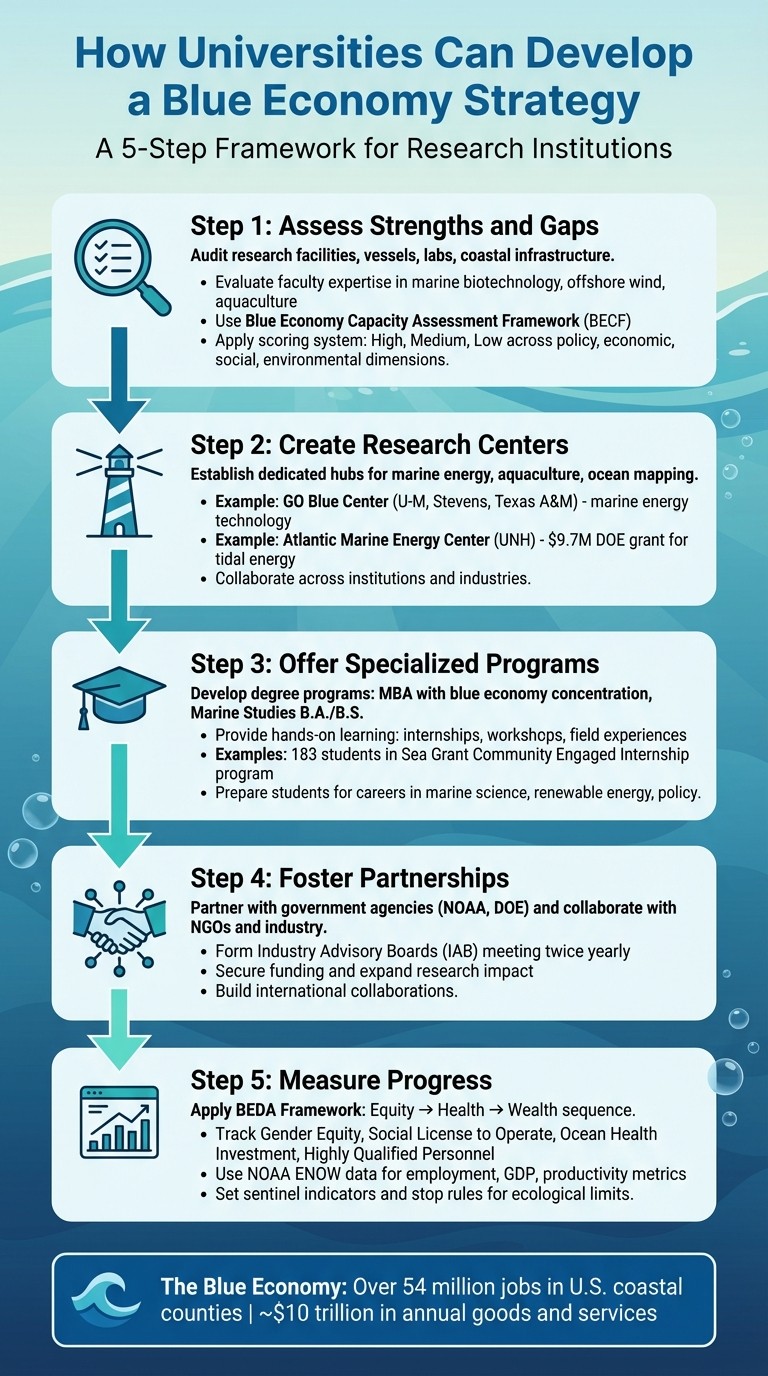
5-Step Blue Economy Strategy Framework for Universities
Blue Frontiers explores the intersection of ocean innovation, sustainability, & community impact.
Evaluating Your Institution's Blue Economy Readiness
Before diving into new programs or launching research centers, it’s crucial to evaluate your institution’s current strengths, identify areas for improvement, and ensure alignment with its mission. For instance, the University of North Carolina Wilmington's Center for Marine Science introduced a 5-year Strategic Plan in 2024, outlining clear goals like utilizing existing aquaculture facilities and conducting coastal environment mapping to establish baseline data on potential risks [8]. A thorough assessment of your resources can reveal where your institution stands and where it can grow.
Auditing Resources and Capabilities
Start by cataloging the tools and infrastructure already at your disposal, such as research vessels, laboratories, and coastal facilities. A practical example comes from the Tar-Pamlico River Basin Project, where researchers used community-based asset mapping and appreciative inquiry to highlight quality-of-life assets in eastern North Carolina. They even created a digital, interactive map to share with partners [4].
Faculty expertise is another critical area to evaluate. Focus on fields like marine biotechnology, offshore wind energy, and sustainable aquaculture. One helpful tool is the Blue Economy Capacity Assessment Framework (BECF), which suggests using the UN Sustainable Development Goals to zero in on around 10 key targets relevant to blue economy initiatives [7]. A simple scoring system - High, Medium, Low - can also be applied to assess your institution’s performance in policy development and its impact across economic, social, and environmental dimensions [6]. These insights can guide your strategy for growth.
Finding Gaps and Opportunities
Pinpointing gaps is essential for meaningful progress. The Blue Economy Development Approach (BEDA) emphasizes a sequence of priorities - Equity → Health → Wealth [5]. This ensures that social equity and ecosystem health are addressed before focusing on economic outcomes, helping institutions avoid the pitfalls of "blue washing."
"For the blue economy to be an effective, sustainable alternative to the regular ocean economy, clear criteria for ocean business must be established to reduce the risk of blue washing." – Ronnie Noonan-Birch, Marie-Chantal Ross, et al. [7]
Another common challenge is the presence of disciplinary silos. While many institutions boast strong marine science programs, they often lack integration with economics and policy studies. Bridging these divides by incorporating disciplines like microeconomics, natural resource economics, and cost-benefit analysis into marine science programs can be transformative [11]. Additionally, high-growth sectors like marine renewable energy, blue biotechnology, sustainable aquaculture, and maritime transport present opportunities for capacity building [9][10].
Connecting to Sustainability Goals
Your blue economy strategy should align closely with existing sustainability and climate resilience commitments. The "Social Well-being Logic Model" offers a useful framework, prioritizing Ocean Equity → Ocean Health → Ocean Wealth to ensure a balanced focus on social, ecological, and economic objectives [5].
Screening new research partnerships for compliance with Free, Prior, and Informed Consent (FPIC) through an "Equity Gate" process is another step toward ensuring ethical collaboration [5]. For example, the University of Maine has tailored its strategy to reflect regional priorities, concentrating on sectors like lobster and groundfish fisheries, shellfish and seaweed aquaculture, and offshore renewable energy research [1]. By tailoring your approach to the specific needs and characteristics of your coastal region, you can create a strategy that reflects both local culture and ecological realities.
Creating Research and Collaboration Structures
Advancing a blue economy strategy begins with understanding institutional strengths and addressing gaps. Once this groundwork is laid, the next step is to build well-defined research and collaboration frameworks to drive meaningful progress.
Setting Up Blue Economy Research Centers
Dedicated research centers signal a strong commitment to advancing the blue economy. One standout example is the GO Blue Center (Center for Growing Ocean Energy Technologies and the Blue Economy), launched in August 2024 by the University of Michigan, Stevens Institute of Technology, and Texas A&M University-Corpus Christi. This initiative, part of the National Science Foundation's Industry-University Cooperative Research Centers (IUCRC) program, focuses on marine energy technology, blue economy power solutions, and impact assessments under the leadership of Prof. Lei Zuo.
The IUCRC model offers significant cost efficiencies, reducing indirect research costs from around 60% to less than 10%. Industry partners benefit from early, royalty-free access to intellectual property and receive $90,000 worth of research value for a $60,000 membership contribution [12][13].
Another noteworthy example is the Atlantic Marine Energy Center (AMEC) at the University of New Hampshire, led by Prof. Martin Wosnik. With a $9.7 million Department of Energy grant, AMEC collaborates with East Coast universities and DOE National Laboratories to test tidal energy converters at Portsmouth's Memorial Bridge, where peak flows reach nearly six knots. The center has also developed open-source tidal turbine models to help private developers refine their designs [3].
Building Cross-Disciplinary Teams
The challenges of the blue economy require expertise from multiple disciplines. Effective teams combine knowledge from engineering, physics, economics, environmental science, and social sciences. For example, the GO Blue Center unites specialists in marine hydrodynamics, coastal climate modeling, and resilience from three universities [12][13].
Collaboration across institutions also provides access to diverse marine environments and regional insights. The GO Blue Center, for instance, spans the Great Lakes, Atlantic Coast, and Gulf Coast, leveraging unique geographic expertise [12][13]. To ensure alignment with industry needs, establishing an Industry Advisory Board (IAB) is key. These boards meet twice a year to evaluate progress, mentor students, and guide research priorities [12][13].
Encouraging faculty to engage with policy and public outreach is another critical step. Recognize such efforts in tenure and merit reviews, and promote sabbaticals in government agencies or think tanks to bring fresh perspectives back to campus [2].
Partnering with External Organizations
External partnerships amplify research efforts by providing additional funding, facilities, and networks. For instance, the University of New Hampshire's Center for Coastal and Ocean Mapping, under Larry Mayer's direction, has operated an industry consortium since 2000. This collaboration brings together scientists and commercial developers to advance ocean mapping technology, offering students valuable hands-on experience while partners gain early access to innovative tools [3].
Government agencies also play a crucial role. Work with your institution’s government affairs office to communicate research priorities and navigate funding cycles. As Alexandra A. Phillips and Elizabeth D. Hetherington emphasize in Nature:
"Scientists must shift to truly two-way communication models that prioritize relationship-building with elected officials, their staff, and the wider policy ecosystem of agencies, non-governmental organizations (NGOs), think tanks, and journalists" [2].
International collaborations further extend reach and impact. For example, the Center for the Blue Economy at the Middlebury Institute of International Studies partnered with the World Bank, Duke University, and the European Union to produce a baseline study for Bangladesh's blue economy. Domestically, its research influenced the U.S. Department of Commerce to include the economic contributions of oceans and Great Lakes in national income accounts for the first time [14].
Aligning these partnerships with long-term sustainability goals ensures a cohesive and impactful strategy.
Designing Academic Programs and Career Pathways
As the blue economy grows, academic programs must adapt to equip students for careers in a sector that employs over 54 million people in U.S. coastal counties and generates approximately $10 trillion in goods and services annually [15]. Despite its importance, awareness of blue economy careers remains low. Debbie Thomas, Founding Dean of the College of Marine Sciences & Maritime Studies at Texas A&M University, highlights this gap:
"One of the most critical trends is a growing shortage of coastal, marine and maritime professionals. In spite of the role that the Blue Economy plays in our daily lives, there still is remarkably little understanding or awareness of the rewarding Blue Economy careers" [15].
Launching Specialized Degree Programs
Some universities are taking steps to address this challenge by creating degree programs tailored to blue economy careers. For example, the University of Maine's Business School offers an MBA program with a blue economy concentration, blending business fundamentals with courses in marine biology, oceanography, fisheries policy, and aquaculture. Executive Dean Jason Harkins explains the program's guiding principle:
"We have to steward those resources, our oceans and our marine ecosystems, in ways that allow for effective engagement in the generation of revenue and profit – but in ways that don't trade off today's profit against tomorrow's consequences" [15].
Other institutions are offering similar programs:
Arizona State University: B.S. in Ocean Futures, focusing on coastal and marine science.
Oregon State University: B.A./B.S. in Marine Studies with a liberal arts foundation.
NC State University: MEA 439/539, an interdisciplinary course on blue economy innovation.
University of Washington: SMEA 515 U.S. Coastal and Ocean Law for regulatory expertise.
University of Miami: Marine Policy Minor.
These programs are designed to combine academic knowledge with practical skills, preparing students for diverse roles in the sector.
Adding Hands-On Learning Opportunities
Classroom education alone isn’t enough to prepare students for the challenges of the blue economy. Practical experiences are essential. For example, NC State's Blue Economy Innovation Program (BEIP) hosted its 5th annual "Creating Solutions for the Global Blue Economy" workshop in October 2025. This event brought together students, industry experts, and international delegates to solve real-world problems in marine renewable energy and sensor technology [16].
Another impactful initiative is the Sea Grant Community Engaged Internship (CEI) program. This program offers paid internships to undergraduates from historically underrepresented communities, integrating local and Indigenous knowledge with coastal science, law, and policy. So far, 183 students from all 34 Sea Grant programs have participated [18].
Institutions can also embed policy-focused assignments into science courses, helping students develop communication and analytical skills tailored to policy environments [2]. High-impact opportunities like the first-ever Ocean Pavilion at UNFCCC COP27, attended by students and faculty from Scripps Institution of Oceanography and Woods Hole Oceanographic Institution, expose participants to international ocean governance [2].
Connecting Graduates to Blue Economy Jobs
Preparing students academically and practically is only part of the equation - helping them transition into careers is equally important. In January 2020, the University of Massachusetts Boston partnered with SeaAhead, Inc. to create a New England "bluetech cluster." This initiative connects students with job opportunities while supporting startups through the Massachusetts Innovation Voucher program [19].
Fellowships are another key pathway for graduates. Programs like the Knauss Marine Policy Fellowship and AAAS Science & Technology Policy Fellowship have produced over 4,000 alumni, forming a robust network of professionals [2]. Universities can support students by organizing career panels and alumni-led office hours to navigate these opportunities.
Collaboration with university government affairs offices can also open doors. These offices help students understand how ocean science informs policy and can arrange briefings with legislative staff and agencies [2]. For entrepreneurial students, examples like Marin Skincare - a startup founded by University of Maine graduates using lobster byproducts for skincare - showcase how academic innovation can lead to private-sector success [15].
Institutions should also consider funding student participation in events like Capitol Hill Ocean Week or offering grants for international conferences. These experiences expand professional networks and introduce students to the vast array of blue economy careers beyond academia [2].
Putting Your Blue Economy Strategy into Action
Creating a blue economy strategy is just the starting point - making it happen is where the real challenge lies. Success requires clear metrics, organizational commitment, and often, outside expertise to navigate the intricate balance of economic, environmental, and social goals.
Using Measurement Frameworks
To track the progress of blue economy initiatives, institutions need frameworks that go beyond traditional metrics. The BEDA sequence (Equity → Health → Wealth) provides a structured approach to measure impact. This involves prioritizing local hiring, Indigenous procurement, and funding for stewardship before focusing on financial results [5].
The Blue Economy Capacity Framework (BECF) evaluates contributions across four key areas: Gender Equity (GE), Social License to Operate (SLO), Ocean Health Investment (OHI), and Highly Qualified Personnel (HQP) [7]. This framework helps prevent "blue washing", where sustainability claims lack substantive actions.
For monitoring regional impacts, institutions can leverage federal data from NOAA's Economics: National Ocean Watch (ENOW) program. This tool tracks employment, GDP, and productivity in blue economy sectors. In Rhode Island, ENOW data revealed that the Blue Economy contributes 8.8% of the state's GDP, even though it accounts for just 5.7% of total employment. This highlights the sector's strong value-added per worker [21].
Once measurable benchmarks are in place, the focus shifts to adapting and refining strategies over time.
Expanding and Maintaining Impact
Ensuring long-term success means regularly evaluating and adjusting programs. Establishing "sentinel indicators" - environmental triggers and early-warning signs - enables adaptive management. These indicators also help enforce "stop rules" to halt activities that risk crossing ecological limits [5].
Sustained impact also depends on faculty involvement. Updating tenure and merit review processes to value public-facing work, such as policy briefs, media contributions, and community initiatives, encourages ongoing engagement [2]. Offering policy sabbaticals - where faculty collaborate with government agencies or NGOs - can bring fresh perspectives back to campus and enhance institutional capabilities [2].
Scaling successful programs often relies on industry clusters - regional hubs of interconnected businesses and institutions. These clusters fuel local economies and foster specialized research and innovation [21]. Universities can amplify their influence by aligning with these clusters and forming strategic partnerships.
When internal resources are stretched thin, outside expertise can help push initiatives forward.
Working with Consulting Partners
Executing a comprehensive blue economy strategy can strain internal capacities. Consulting firms like Council Fire specialize in turning strategies into actionable plans. They provide critical services such as data analysis, stakeholder coordination, and systems-level planning. This external support helps institutions assess employment trends, workforce productivity, and overall economic contributions - key insights for evidence-based decisions [20].
Consultants also tackle major obstacles, including outdated technology and limited leadership support. Tools like the Analytic Hierarchy Process (AHP) help prioritize these challenges and allocate resources effectively [20].
The best partnerships blend technical know-how with strategic communication, aligning sustainability goals with tangible outcomes in natural resource management, infrastructure, and community engagement. This ensures that blue economy initiatives deliver lasting economic, environmental, and social benefits - not just impressive reports.
Conclusion: Leading Blue Economy Development Through Higher Education
Universities and research institutions sit at the heart of advancing ocean conservation while fueling economic growth. By establishing interdisciplinary research hubs, creating specialized degree programs, and collaborating with industry, these institutions have the power to shape the next generation of ocean leaders and boost regional economies. The blue economy isn't just a theoretical framework; it’s a recognized economic powerhouse. For instance, it generates over $7 billion annually in Santa Barbara County and more than $5 billion in Rhode Island, supporting thousands of jobs in coastal communities [17][23]. This underscores the urgent need for academia to not only educate but also lead real-world advancements in the blue economy.
To truly make an impact, institutions must go beyond traditional approaches. They should prepare scientists to engage directly with policymakers, create living laboratories for hands-on learning, and encourage student involvement in international forums to influence global ocean governance [2][3]. This shift in academic priorities reflects the broader vision of a sustainable blue economy. Diane Foster, Director of UNH's School of Marine Science and Ocean Engineering, captures this balance perfectly:
"The blue economy characterizes the critical nexus between ocean conservation and economics, because we can't continue to draw from the ocean's resources if we don't conserve them" [3].
To achieve measurable progress, universities should focus on innovative research and align their strengths with clear objectives. This could mean launching centers for sustainable seafood, forming strategic energy partnerships, or co-developing marine management strategies with local communities [3][22]. As Martin Wosnik of the Atlantic Marine Energy Center aptly puts it:
"The energy transition away from fossil fuels and toward more sustainable solutions is a massive undertaking and will require all hands on deck" [3].
The time to act is now. Institutions should evaluate their resources, pinpoint areas for improvement, and assemble cross-disciplinary teams. Bringing in expert guidance and leveraging data to measure outcomes can amplify results. The blue economy presents an extraordinary chance for universities to lead innovation, strengthen local economies, and safeguard ocean ecosystems for generations to come - but only through decisive and strategic action.
FAQs
Where do we start a blue economy strategy?
To effectively support sustainable ocean resource use, begin by grasping its core principles and pinpointing the sectors that require attention. Craft a roadmap that balances economic growth with environmental stewardship. This roadmap should actively involve stakeholders and leverage data-driven tools to identify and prioritize ocean activities that align with sustainability goals. By doing so, your approach will remain focused, collaborative, and firmly rooted in practices that promote long-term ocean health.
How do we avoid “blue washing” in partnerships?
To avoid the pitfalls of "blue washing", it's essential to set clear, measurable standards aligned with the UN Sustainable Development Goals (SDGs). These standards should serve as a foundation for ensuring authentic efforts in sustainability and equity. Equally important is the establishment of transparent monitoring and reporting systems that openly track progress and outcomes. Actively engaging stakeholders - especially local communities - in decision-making processes ensures their voices are heard and their needs are addressed. These measures not only promote accountability but also help build trust, ensuring that partnerships make a genuine impact on sustainable ocean and coastal development.
What metrics should we track to prove impact?
Tracking the right metrics is crucial for evaluating the impact of a blue economy strategy. Key economic indicators include ocean-related GDP, employment levels, and growth across sectors like marine transportation, seafood industries, and tourism. On the environmental front, metrics such as ecosystem health, natural resource use, and coastal resilience provide insight into sustainability efforts.
Beyond these, it’s important to measure innovation outputs, such as new technologies or practices that support ocean health, and to assess stakeholder engagement to ensure collaboration and community involvement. Regularly monitoring progress toward defined sustainability goals helps to clearly demonstrate the strategy's effectiveness and long-term benefits.
Related Blog Posts
Latest Articles
©2025



FAQ
01
What does it really mean to “redefine profit”?
02
What makes Council Fire different?
03
Who does Council Fire you work with?
04
What does working with Council Fire actually look like?
05
How does Council Fire help organizations turn big goals into action?
06
How does Council Fire define and measure success?
Mar 21, 2026
How to Develop a Blue Economy Strategy for Universities & Research Institutions
Capacity Building
In This Article
Guide for universities to build blue-economy strategies: assess assets, launch research centers and programs, form partnerships, and measure impact.
How to Develop a Blue Economy Strategy for Universities & Research Institutions
The blue economy focuses on using ocean and coastal resources to boost economic growth, create jobs, and protect marine ecosystems. Universities and research institutions play a key role in advancing this field by combining research, policy expertise, and workforce training. Here's how they can develop effective blue economy strategies:
Assess Strengths and Gaps: Evaluate existing resources, such as research facilities, faculty expertise, and regional priorities. Use tools like the Blue Economy Capacity Assessment Framework to identify areas for improvement.
Create Research Centers: Establish dedicated hubs for marine energy, aquaculture, or ocean mapping. Collaborate across institutions and industries to maximize impact.
Offer Specialized Programs: Develop degree programs and hands-on learning opportunities that prepare students for careers in marine science, renewable energy, and related sectors.
Foster Partnerships: Work with government agencies, NGOs, and industry to secure funding and expand research impact.
Measure Progress: Use frameworks like Equity → Health → Wealth to track social, ecological, and economic contributions.
5-Step Blue Economy Strategy Framework for Universities
Blue Frontiers explores the intersection of ocean innovation, sustainability, & community impact.
Evaluating Your Institution's Blue Economy Readiness
Before diving into new programs or launching research centers, it’s crucial to evaluate your institution’s current strengths, identify areas for improvement, and ensure alignment with its mission. For instance, the University of North Carolina Wilmington's Center for Marine Science introduced a 5-year Strategic Plan in 2024, outlining clear goals like utilizing existing aquaculture facilities and conducting coastal environment mapping to establish baseline data on potential risks [8]. A thorough assessment of your resources can reveal where your institution stands and where it can grow.
Auditing Resources and Capabilities
Start by cataloging the tools and infrastructure already at your disposal, such as research vessels, laboratories, and coastal facilities. A practical example comes from the Tar-Pamlico River Basin Project, where researchers used community-based asset mapping and appreciative inquiry to highlight quality-of-life assets in eastern North Carolina. They even created a digital, interactive map to share with partners [4].
Faculty expertise is another critical area to evaluate. Focus on fields like marine biotechnology, offshore wind energy, and sustainable aquaculture. One helpful tool is the Blue Economy Capacity Assessment Framework (BECF), which suggests using the UN Sustainable Development Goals to zero in on around 10 key targets relevant to blue economy initiatives [7]. A simple scoring system - High, Medium, Low - can also be applied to assess your institution’s performance in policy development and its impact across economic, social, and environmental dimensions [6]. These insights can guide your strategy for growth.
Finding Gaps and Opportunities
Pinpointing gaps is essential for meaningful progress. The Blue Economy Development Approach (BEDA) emphasizes a sequence of priorities - Equity → Health → Wealth [5]. This ensures that social equity and ecosystem health are addressed before focusing on economic outcomes, helping institutions avoid the pitfalls of "blue washing."
"For the blue economy to be an effective, sustainable alternative to the regular ocean economy, clear criteria for ocean business must be established to reduce the risk of blue washing." – Ronnie Noonan-Birch, Marie-Chantal Ross, et al. [7]
Another common challenge is the presence of disciplinary silos. While many institutions boast strong marine science programs, they often lack integration with economics and policy studies. Bridging these divides by incorporating disciplines like microeconomics, natural resource economics, and cost-benefit analysis into marine science programs can be transformative [11]. Additionally, high-growth sectors like marine renewable energy, blue biotechnology, sustainable aquaculture, and maritime transport present opportunities for capacity building [9][10].
Connecting to Sustainability Goals
Your blue economy strategy should align closely with existing sustainability and climate resilience commitments. The "Social Well-being Logic Model" offers a useful framework, prioritizing Ocean Equity → Ocean Health → Ocean Wealth to ensure a balanced focus on social, ecological, and economic objectives [5].
Screening new research partnerships for compliance with Free, Prior, and Informed Consent (FPIC) through an "Equity Gate" process is another step toward ensuring ethical collaboration [5]. For example, the University of Maine has tailored its strategy to reflect regional priorities, concentrating on sectors like lobster and groundfish fisheries, shellfish and seaweed aquaculture, and offshore renewable energy research [1]. By tailoring your approach to the specific needs and characteristics of your coastal region, you can create a strategy that reflects both local culture and ecological realities.
Creating Research and Collaboration Structures
Advancing a blue economy strategy begins with understanding institutional strengths and addressing gaps. Once this groundwork is laid, the next step is to build well-defined research and collaboration frameworks to drive meaningful progress.
Setting Up Blue Economy Research Centers
Dedicated research centers signal a strong commitment to advancing the blue economy. One standout example is the GO Blue Center (Center for Growing Ocean Energy Technologies and the Blue Economy), launched in August 2024 by the University of Michigan, Stevens Institute of Technology, and Texas A&M University-Corpus Christi. This initiative, part of the National Science Foundation's Industry-University Cooperative Research Centers (IUCRC) program, focuses on marine energy technology, blue economy power solutions, and impact assessments under the leadership of Prof. Lei Zuo.
The IUCRC model offers significant cost efficiencies, reducing indirect research costs from around 60% to less than 10%. Industry partners benefit from early, royalty-free access to intellectual property and receive $90,000 worth of research value for a $60,000 membership contribution [12][13].
Another noteworthy example is the Atlantic Marine Energy Center (AMEC) at the University of New Hampshire, led by Prof. Martin Wosnik. With a $9.7 million Department of Energy grant, AMEC collaborates with East Coast universities and DOE National Laboratories to test tidal energy converters at Portsmouth's Memorial Bridge, where peak flows reach nearly six knots. The center has also developed open-source tidal turbine models to help private developers refine their designs [3].
Building Cross-Disciplinary Teams
The challenges of the blue economy require expertise from multiple disciplines. Effective teams combine knowledge from engineering, physics, economics, environmental science, and social sciences. For example, the GO Blue Center unites specialists in marine hydrodynamics, coastal climate modeling, and resilience from three universities [12][13].
Collaboration across institutions also provides access to diverse marine environments and regional insights. The GO Blue Center, for instance, spans the Great Lakes, Atlantic Coast, and Gulf Coast, leveraging unique geographic expertise [12][13]. To ensure alignment with industry needs, establishing an Industry Advisory Board (IAB) is key. These boards meet twice a year to evaluate progress, mentor students, and guide research priorities [12][13].
Encouraging faculty to engage with policy and public outreach is another critical step. Recognize such efforts in tenure and merit reviews, and promote sabbaticals in government agencies or think tanks to bring fresh perspectives back to campus [2].
Partnering with External Organizations
External partnerships amplify research efforts by providing additional funding, facilities, and networks. For instance, the University of New Hampshire's Center for Coastal and Ocean Mapping, under Larry Mayer's direction, has operated an industry consortium since 2000. This collaboration brings together scientists and commercial developers to advance ocean mapping technology, offering students valuable hands-on experience while partners gain early access to innovative tools [3].
Government agencies also play a crucial role. Work with your institution’s government affairs office to communicate research priorities and navigate funding cycles. As Alexandra A. Phillips and Elizabeth D. Hetherington emphasize in Nature:
"Scientists must shift to truly two-way communication models that prioritize relationship-building with elected officials, their staff, and the wider policy ecosystem of agencies, non-governmental organizations (NGOs), think tanks, and journalists" [2].
International collaborations further extend reach and impact. For example, the Center for the Blue Economy at the Middlebury Institute of International Studies partnered with the World Bank, Duke University, and the European Union to produce a baseline study for Bangladesh's blue economy. Domestically, its research influenced the U.S. Department of Commerce to include the economic contributions of oceans and Great Lakes in national income accounts for the first time [14].
Aligning these partnerships with long-term sustainability goals ensures a cohesive and impactful strategy.
Designing Academic Programs and Career Pathways
As the blue economy grows, academic programs must adapt to equip students for careers in a sector that employs over 54 million people in U.S. coastal counties and generates approximately $10 trillion in goods and services annually [15]. Despite its importance, awareness of blue economy careers remains low. Debbie Thomas, Founding Dean of the College of Marine Sciences & Maritime Studies at Texas A&M University, highlights this gap:
"One of the most critical trends is a growing shortage of coastal, marine and maritime professionals. In spite of the role that the Blue Economy plays in our daily lives, there still is remarkably little understanding or awareness of the rewarding Blue Economy careers" [15].
Launching Specialized Degree Programs
Some universities are taking steps to address this challenge by creating degree programs tailored to blue economy careers. For example, the University of Maine's Business School offers an MBA program with a blue economy concentration, blending business fundamentals with courses in marine biology, oceanography, fisheries policy, and aquaculture. Executive Dean Jason Harkins explains the program's guiding principle:
"We have to steward those resources, our oceans and our marine ecosystems, in ways that allow for effective engagement in the generation of revenue and profit – but in ways that don't trade off today's profit against tomorrow's consequences" [15].
Other institutions are offering similar programs:
Arizona State University: B.S. in Ocean Futures, focusing on coastal and marine science.
Oregon State University: B.A./B.S. in Marine Studies with a liberal arts foundation.
NC State University: MEA 439/539, an interdisciplinary course on blue economy innovation.
University of Washington: SMEA 515 U.S. Coastal and Ocean Law for regulatory expertise.
University of Miami: Marine Policy Minor.
These programs are designed to combine academic knowledge with practical skills, preparing students for diverse roles in the sector.
Adding Hands-On Learning Opportunities
Classroom education alone isn’t enough to prepare students for the challenges of the blue economy. Practical experiences are essential. For example, NC State's Blue Economy Innovation Program (BEIP) hosted its 5th annual "Creating Solutions for the Global Blue Economy" workshop in October 2025. This event brought together students, industry experts, and international delegates to solve real-world problems in marine renewable energy and sensor technology [16].
Another impactful initiative is the Sea Grant Community Engaged Internship (CEI) program. This program offers paid internships to undergraduates from historically underrepresented communities, integrating local and Indigenous knowledge with coastal science, law, and policy. So far, 183 students from all 34 Sea Grant programs have participated [18].
Institutions can also embed policy-focused assignments into science courses, helping students develop communication and analytical skills tailored to policy environments [2]. High-impact opportunities like the first-ever Ocean Pavilion at UNFCCC COP27, attended by students and faculty from Scripps Institution of Oceanography and Woods Hole Oceanographic Institution, expose participants to international ocean governance [2].
Connecting Graduates to Blue Economy Jobs
Preparing students academically and practically is only part of the equation - helping them transition into careers is equally important. In January 2020, the University of Massachusetts Boston partnered with SeaAhead, Inc. to create a New England "bluetech cluster." This initiative connects students with job opportunities while supporting startups through the Massachusetts Innovation Voucher program [19].
Fellowships are another key pathway for graduates. Programs like the Knauss Marine Policy Fellowship and AAAS Science & Technology Policy Fellowship have produced over 4,000 alumni, forming a robust network of professionals [2]. Universities can support students by organizing career panels and alumni-led office hours to navigate these opportunities.
Collaboration with university government affairs offices can also open doors. These offices help students understand how ocean science informs policy and can arrange briefings with legislative staff and agencies [2]. For entrepreneurial students, examples like Marin Skincare - a startup founded by University of Maine graduates using lobster byproducts for skincare - showcase how academic innovation can lead to private-sector success [15].
Institutions should also consider funding student participation in events like Capitol Hill Ocean Week or offering grants for international conferences. These experiences expand professional networks and introduce students to the vast array of blue economy careers beyond academia [2].
Putting Your Blue Economy Strategy into Action
Creating a blue economy strategy is just the starting point - making it happen is where the real challenge lies. Success requires clear metrics, organizational commitment, and often, outside expertise to navigate the intricate balance of economic, environmental, and social goals.
Using Measurement Frameworks
To track the progress of blue economy initiatives, institutions need frameworks that go beyond traditional metrics. The BEDA sequence (Equity → Health → Wealth) provides a structured approach to measure impact. This involves prioritizing local hiring, Indigenous procurement, and funding for stewardship before focusing on financial results [5].
The Blue Economy Capacity Framework (BECF) evaluates contributions across four key areas: Gender Equity (GE), Social License to Operate (SLO), Ocean Health Investment (OHI), and Highly Qualified Personnel (HQP) [7]. This framework helps prevent "blue washing", where sustainability claims lack substantive actions.
For monitoring regional impacts, institutions can leverage federal data from NOAA's Economics: National Ocean Watch (ENOW) program. This tool tracks employment, GDP, and productivity in blue economy sectors. In Rhode Island, ENOW data revealed that the Blue Economy contributes 8.8% of the state's GDP, even though it accounts for just 5.7% of total employment. This highlights the sector's strong value-added per worker [21].
Once measurable benchmarks are in place, the focus shifts to adapting and refining strategies over time.
Expanding and Maintaining Impact
Ensuring long-term success means regularly evaluating and adjusting programs. Establishing "sentinel indicators" - environmental triggers and early-warning signs - enables adaptive management. These indicators also help enforce "stop rules" to halt activities that risk crossing ecological limits [5].
Sustained impact also depends on faculty involvement. Updating tenure and merit review processes to value public-facing work, such as policy briefs, media contributions, and community initiatives, encourages ongoing engagement [2]. Offering policy sabbaticals - where faculty collaborate with government agencies or NGOs - can bring fresh perspectives back to campus and enhance institutional capabilities [2].
Scaling successful programs often relies on industry clusters - regional hubs of interconnected businesses and institutions. These clusters fuel local economies and foster specialized research and innovation [21]. Universities can amplify their influence by aligning with these clusters and forming strategic partnerships.
When internal resources are stretched thin, outside expertise can help push initiatives forward.
Working with Consulting Partners
Executing a comprehensive blue economy strategy can strain internal capacities. Consulting firms like Council Fire specialize in turning strategies into actionable plans. They provide critical services such as data analysis, stakeholder coordination, and systems-level planning. This external support helps institutions assess employment trends, workforce productivity, and overall economic contributions - key insights for evidence-based decisions [20].
Consultants also tackle major obstacles, including outdated technology and limited leadership support. Tools like the Analytic Hierarchy Process (AHP) help prioritize these challenges and allocate resources effectively [20].
The best partnerships blend technical know-how with strategic communication, aligning sustainability goals with tangible outcomes in natural resource management, infrastructure, and community engagement. This ensures that blue economy initiatives deliver lasting economic, environmental, and social benefits - not just impressive reports.
Conclusion: Leading Blue Economy Development Through Higher Education
Universities and research institutions sit at the heart of advancing ocean conservation while fueling economic growth. By establishing interdisciplinary research hubs, creating specialized degree programs, and collaborating with industry, these institutions have the power to shape the next generation of ocean leaders and boost regional economies. The blue economy isn't just a theoretical framework; it’s a recognized economic powerhouse. For instance, it generates over $7 billion annually in Santa Barbara County and more than $5 billion in Rhode Island, supporting thousands of jobs in coastal communities [17][23]. This underscores the urgent need for academia to not only educate but also lead real-world advancements in the blue economy.
To truly make an impact, institutions must go beyond traditional approaches. They should prepare scientists to engage directly with policymakers, create living laboratories for hands-on learning, and encourage student involvement in international forums to influence global ocean governance [2][3]. This shift in academic priorities reflects the broader vision of a sustainable blue economy. Diane Foster, Director of UNH's School of Marine Science and Ocean Engineering, captures this balance perfectly:
"The blue economy characterizes the critical nexus between ocean conservation and economics, because we can't continue to draw from the ocean's resources if we don't conserve them" [3].
To achieve measurable progress, universities should focus on innovative research and align their strengths with clear objectives. This could mean launching centers for sustainable seafood, forming strategic energy partnerships, or co-developing marine management strategies with local communities [3][22]. As Martin Wosnik of the Atlantic Marine Energy Center aptly puts it:
"The energy transition away from fossil fuels and toward more sustainable solutions is a massive undertaking and will require all hands on deck" [3].
The time to act is now. Institutions should evaluate their resources, pinpoint areas for improvement, and assemble cross-disciplinary teams. Bringing in expert guidance and leveraging data to measure outcomes can amplify results. The blue economy presents an extraordinary chance for universities to lead innovation, strengthen local economies, and safeguard ocean ecosystems for generations to come - but only through decisive and strategic action.
FAQs
Where do we start a blue economy strategy?
To effectively support sustainable ocean resource use, begin by grasping its core principles and pinpointing the sectors that require attention. Craft a roadmap that balances economic growth with environmental stewardship. This roadmap should actively involve stakeholders and leverage data-driven tools to identify and prioritize ocean activities that align with sustainability goals. By doing so, your approach will remain focused, collaborative, and firmly rooted in practices that promote long-term ocean health.
How do we avoid “blue washing” in partnerships?
To avoid the pitfalls of "blue washing", it's essential to set clear, measurable standards aligned with the UN Sustainable Development Goals (SDGs). These standards should serve as a foundation for ensuring authentic efforts in sustainability and equity. Equally important is the establishment of transparent monitoring and reporting systems that openly track progress and outcomes. Actively engaging stakeholders - especially local communities - in decision-making processes ensures their voices are heard and their needs are addressed. These measures not only promote accountability but also help build trust, ensuring that partnerships make a genuine impact on sustainable ocean and coastal development.
What metrics should we track to prove impact?
Tracking the right metrics is crucial for evaluating the impact of a blue economy strategy. Key economic indicators include ocean-related GDP, employment levels, and growth across sectors like marine transportation, seafood industries, and tourism. On the environmental front, metrics such as ecosystem health, natural resource use, and coastal resilience provide insight into sustainability efforts.
Beyond these, it’s important to measure innovation outputs, such as new technologies or practices that support ocean health, and to assess stakeholder engagement to ensure collaboration and community involvement. Regularly monitoring progress toward defined sustainability goals helps to clearly demonstrate the strategy's effectiveness and long-term benefits.
Related Blog Posts
FAQ
01
What does it really mean to “redefine profit”?
02
What makes Council Fire different?
03
Who does Council Fire you work with?
04
What does working with Council Fire actually look like?
05
How does Council Fire help organizations turn big goals into action?
06
How does Council Fire define and measure success?
Mar 21, 2026
How to Develop a Blue Economy Strategy for Universities & Research Institutions
Capacity Building
In This Article
Guide for universities to build blue-economy strategies: assess assets, launch research centers and programs, form partnerships, and measure impact.
How to Develop a Blue Economy Strategy for Universities & Research Institutions
The blue economy focuses on using ocean and coastal resources to boost economic growth, create jobs, and protect marine ecosystems. Universities and research institutions play a key role in advancing this field by combining research, policy expertise, and workforce training. Here's how they can develop effective blue economy strategies:
Assess Strengths and Gaps: Evaluate existing resources, such as research facilities, faculty expertise, and regional priorities. Use tools like the Blue Economy Capacity Assessment Framework to identify areas for improvement.
Create Research Centers: Establish dedicated hubs for marine energy, aquaculture, or ocean mapping. Collaborate across institutions and industries to maximize impact.
Offer Specialized Programs: Develop degree programs and hands-on learning opportunities that prepare students for careers in marine science, renewable energy, and related sectors.
Foster Partnerships: Work with government agencies, NGOs, and industry to secure funding and expand research impact.
Measure Progress: Use frameworks like Equity → Health → Wealth to track social, ecological, and economic contributions.
5-Step Blue Economy Strategy Framework for Universities
Blue Frontiers explores the intersection of ocean innovation, sustainability, & community impact.
Evaluating Your Institution's Blue Economy Readiness
Before diving into new programs or launching research centers, it’s crucial to evaluate your institution’s current strengths, identify areas for improvement, and ensure alignment with its mission. For instance, the University of North Carolina Wilmington's Center for Marine Science introduced a 5-year Strategic Plan in 2024, outlining clear goals like utilizing existing aquaculture facilities and conducting coastal environment mapping to establish baseline data on potential risks [8]. A thorough assessment of your resources can reveal where your institution stands and where it can grow.
Auditing Resources and Capabilities
Start by cataloging the tools and infrastructure already at your disposal, such as research vessels, laboratories, and coastal facilities. A practical example comes from the Tar-Pamlico River Basin Project, where researchers used community-based asset mapping and appreciative inquiry to highlight quality-of-life assets in eastern North Carolina. They even created a digital, interactive map to share with partners [4].
Faculty expertise is another critical area to evaluate. Focus on fields like marine biotechnology, offshore wind energy, and sustainable aquaculture. One helpful tool is the Blue Economy Capacity Assessment Framework (BECF), which suggests using the UN Sustainable Development Goals to zero in on around 10 key targets relevant to blue economy initiatives [7]. A simple scoring system - High, Medium, Low - can also be applied to assess your institution’s performance in policy development and its impact across economic, social, and environmental dimensions [6]. These insights can guide your strategy for growth.
Finding Gaps and Opportunities
Pinpointing gaps is essential for meaningful progress. The Blue Economy Development Approach (BEDA) emphasizes a sequence of priorities - Equity → Health → Wealth [5]. This ensures that social equity and ecosystem health are addressed before focusing on economic outcomes, helping institutions avoid the pitfalls of "blue washing."
"For the blue economy to be an effective, sustainable alternative to the regular ocean economy, clear criteria for ocean business must be established to reduce the risk of blue washing." – Ronnie Noonan-Birch, Marie-Chantal Ross, et al. [7]
Another common challenge is the presence of disciplinary silos. While many institutions boast strong marine science programs, they often lack integration with economics and policy studies. Bridging these divides by incorporating disciplines like microeconomics, natural resource economics, and cost-benefit analysis into marine science programs can be transformative [11]. Additionally, high-growth sectors like marine renewable energy, blue biotechnology, sustainable aquaculture, and maritime transport present opportunities for capacity building [9][10].
Connecting to Sustainability Goals
Your blue economy strategy should align closely with existing sustainability and climate resilience commitments. The "Social Well-being Logic Model" offers a useful framework, prioritizing Ocean Equity → Ocean Health → Ocean Wealth to ensure a balanced focus on social, ecological, and economic objectives [5].
Screening new research partnerships for compliance with Free, Prior, and Informed Consent (FPIC) through an "Equity Gate" process is another step toward ensuring ethical collaboration [5]. For example, the University of Maine has tailored its strategy to reflect regional priorities, concentrating on sectors like lobster and groundfish fisheries, shellfish and seaweed aquaculture, and offshore renewable energy research [1]. By tailoring your approach to the specific needs and characteristics of your coastal region, you can create a strategy that reflects both local culture and ecological realities.
Creating Research and Collaboration Structures
Advancing a blue economy strategy begins with understanding institutional strengths and addressing gaps. Once this groundwork is laid, the next step is to build well-defined research and collaboration frameworks to drive meaningful progress.
Setting Up Blue Economy Research Centers
Dedicated research centers signal a strong commitment to advancing the blue economy. One standout example is the GO Blue Center (Center for Growing Ocean Energy Technologies and the Blue Economy), launched in August 2024 by the University of Michigan, Stevens Institute of Technology, and Texas A&M University-Corpus Christi. This initiative, part of the National Science Foundation's Industry-University Cooperative Research Centers (IUCRC) program, focuses on marine energy technology, blue economy power solutions, and impact assessments under the leadership of Prof. Lei Zuo.
The IUCRC model offers significant cost efficiencies, reducing indirect research costs from around 60% to less than 10%. Industry partners benefit from early, royalty-free access to intellectual property and receive $90,000 worth of research value for a $60,000 membership contribution [12][13].
Another noteworthy example is the Atlantic Marine Energy Center (AMEC) at the University of New Hampshire, led by Prof. Martin Wosnik. With a $9.7 million Department of Energy grant, AMEC collaborates with East Coast universities and DOE National Laboratories to test tidal energy converters at Portsmouth's Memorial Bridge, where peak flows reach nearly six knots. The center has also developed open-source tidal turbine models to help private developers refine their designs [3].
Building Cross-Disciplinary Teams
The challenges of the blue economy require expertise from multiple disciplines. Effective teams combine knowledge from engineering, physics, economics, environmental science, and social sciences. For example, the GO Blue Center unites specialists in marine hydrodynamics, coastal climate modeling, and resilience from three universities [12][13].
Collaboration across institutions also provides access to diverse marine environments and regional insights. The GO Blue Center, for instance, spans the Great Lakes, Atlantic Coast, and Gulf Coast, leveraging unique geographic expertise [12][13]. To ensure alignment with industry needs, establishing an Industry Advisory Board (IAB) is key. These boards meet twice a year to evaluate progress, mentor students, and guide research priorities [12][13].
Encouraging faculty to engage with policy and public outreach is another critical step. Recognize such efforts in tenure and merit reviews, and promote sabbaticals in government agencies or think tanks to bring fresh perspectives back to campus [2].
Partnering with External Organizations
External partnerships amplify research efforts by providing additional funding, facilities, and networks. For instance, the University of New Hampshire's Center for Coastal and Ocean Mapping, under Larry Mayer's direction, has operated an industry consortium since 2000. This collaboration brings together scientists and commercial developers to advance ocean mapping technology, offering students valuable hands-on experience while partners gain early access to innovative tools [3].
Government agencies also play a crucial role. Work with your institution’s government affairs office to communicate research priorities and navigate funding cycles. As Alexandra A. Phillips and Elizabeth D. Hetherington emphasize in Nature:
"Scientists must shift to truly two-way communication models that prioritize relationship-building with elected officials, their staff, and the wider policy ecosystem of agencies, non-governmental organizations (NGOs), think tanks, and journalists" [2].
International collaborations further extend reach and impact. For example, the Center for the Blue Economy at the Middlebury Institute of International Studies partnered with the World Bank, Duke University, and the European Union to produce a baseline study for Bangladesh's blue economy. Domestically, its research influenced the U.S. Department of Commerce to include the economic contributions of oceans and Great Lakes in national income accounts for the first time [14].
Aligning these partnerships with long-term sustainability goals ensures a cohesive and impactful strategy.
Designing Academic Programs and Career Pathways
As the blue economy grows, academic programs must adapt to equip students for careers in a sector that employs over 54 million people in U.S. coastal counties and generates approximately $10 trillion in goods and services annually [15]. Despite its importance, awareness of blue economy careers remains low. Debbie Thomas, Founding Dean of the College of Marine Sciences & Maritime Studies at Texas A&M University, highlights this gap:
"One of the most critical trends is a growing shortage of coastal, marine and maritime professionals. In spite of the role that the Blue Economy plays in our daily lives, there still is remarkably little understanding or awareness of the rewarding Blue Economy careers" [15].
Launching Specialized Degree Programs
Some universities are taking steps to address this challenge by creating degree programs tailored to blue economy careers. For example, the University of Maine's Business School offers an MBA program with a blue economy concentration, blending business fundamentals with courses in marine biology, oceanography, fisheries policy, and aquaculture. Executive Dean Jason Harkins explains the program's guiding principle:
"We have to steward those resources, our oceans and our marine ecosystems, in ways that allow for effective engagement in the generation of revenue and profit – but in ways that don't trade off today's profit against tomorrow's consequences" [15].
Other institutions are offering similar programs:
Arizona State University: B.S. in Ocean Futures, focusing on coastal and marine science.
Oregon State University: B.A./B.S. in Marine Studies with a liberal arts foundation.
NC State University: MEA 439/539, an interdisciplinary course on blue economy innovation.
University of Washington: SMEA 515 U.S. Coastal and Ocean Law for regulatory expertise.
University of Miami: Marine Policy Minor.
These programs are designed to combine academic knowledge with practical skills, preparing students for diverse roles in the sector.
Adding Hands-On Learning Opportunities
Classroom education alone isn’t enough to prepare students for the challenges of the blue economy. Practical experiences are essential. For example, NC State's Blue Economy Innovation Program (BEIP) hosted its 5th annual "Creating Solutions for the Global Blue Economy" workshop in October 2025. This event brought together students, industry experts, and international delegates to solve real-world problems in marine renewable energy and sensor technology [16].
Another impactful initiative is the Sea Grant Community Engaged Internship (CEI) program. This program offers paid internships to undergraduates from historically underrepresented communities, integrating local and Indigenous knowledge with coastal science, law, and policy. So far, 183 students from all 34 Sea Grant programs have participated [18].
Institutions can also embed policy-focused assignments into science courses, helping students develop communication and analytical skills tailored to policy environments [2]. High-impact opportunities like the first-ever Ocean Pavilion at UNFCCC COP27, attended by students and faculty from Scripps Institution of Oceanography and Woods Hole Oceanographic Institution, expose participants to international ocean governance [2].
Connecting Graduates to Blue Economy Jobs
Preparing students academically and practically is only part of the equation - helping them transition into careers is equally important. In January 2020, the University of Massachusetts Boston partnered with SeaAhead, Inc. to create a New England "bluetech cluster." This initiative connects students with job opportunities while supporting startups through the Massachusetts Innovation Voucher program [19].
Fellowships are another key pathway for graduates. Programs like the Knauss Marine Policy Fellowship and AAAS Science & Technology Policy Fellowship have produced over 4,000 alumni, forming a robust network of professionals [2]. Universities can support students by organizing career panels and alumni-led office hours to navigate these opportunities.
Collaboration with university government affairs offices can also open doors. These offices help students understand how ocean science informs policy and can arrange briefings with legislative staff and agencies [2]. For entrepreneurial students, examples like Marin Skincare - a startup founded by University of Maine graduates using lobster byproducts for skincare - showcase how academic innovation can lead to private-sector success [15].
Institutions should also consider funding student participation in events like Capitol Hill Ocean Week or offering grants for international conferences. These experiences expand professional networks and introduce students to the vast array of blue economy careers beyond academia [2].
Putting Your Blue Economy Strategy into Action
Creating a blue economy strategy is just the starting point - making it happen is where the real challenge lies. Success requires clear metrics, organizational commitment, and often, outside expertise to navigate the intricate balance of economic, environmental, and social goals.
Using Measurement Frameworks
To track the progress of blue economy initiatives, institutions need frameworks that go beyond traditional metrics. The BEDA sequence (Equity → Health → Wealth) provides a structured approach to measure impact. This involves prioritizing local hiring, Indigenous procurement, and funding for stewardship before focusing on financial results [5].
The Blue Economy Capacity Framework (BECF) evaluates contributions across four key areas: Gender Equity (GE), Social License to Operate (SLO), Ocean Health Investment (OHI), and Highly Qualified Personnel (HQP) [7]. This framework helps prevent "blue washing", where sustainability claims lack substantive actions.
For monitoring regional impacts, institutions can leverage federal data from NOAA's Economics: National Ocean Watch (ENOW) program. This tool tracks employment, GDP, and productivity in blue economy sectors. In Rhode Island, ENOW data revealed that the Blue Economy contributes 8.8% of the state's GDP, even though it accounts for just 5.7% of total employment. This highlights the sector's strong value-added per worker [21].
Once measurable benchmarks are in place, the focus shifts to adapting and refining strategies over time.
Expanding and Maintaining Impact
Ensuring long-term success means regularly evaluating and adjusting programs. Establishing "sentinel indicators" - environmental triggers and early-warning signs - enables adaptive management. These indicators also help enforce "stop rules" to halt activities that risk crossing ecological limits [5].
Sustained impact also depends on faculty involvement. Updating tenure and merit review processes to value public-facing work, such as policy briefs, media contributions, and community initiatives, encourages ongoing engagement [2]. Offering policy sabbaticals - where faculty collaborate with government agencies or NGOs - can bring fresh perspectives back to campus and enhance institutional capabilities [2].
Scaling successful programs often relies on industry clusters - regional hubs of interconnected businesses and institutions. These clusters fuel local economies and foster specialized research and innovation [21]. Universities can amplify their influence by aligning with these clusters and forming strategic partnerships.
When internal resources are stretched thin, outside expertise can help push initiatives forward.
Working with Consulting Partners
Executing a comprehensive blue economy strategy can strain internal capacities. Consulting firms like Council Fire specialize in turning strategies into actionable plans. They provide critical services such as data analysis, stakeholder coordination, and systems-level planning. This external support helps institutions assess employment trends, workforce productivity, and overall economic contributions - key insights for evidence-based decisions [20].
Consultants also tackle major obstacles, including outdated technology and limited leadership support. Tools like the Analytic Hierarchy Process (AHP) help prioritize these challenges and allocate resources effectively [20].
The best partnerships blend technical know-how with strategic communication, aligning sustainability goals with tangible outcomes in natural resource management, infrastructure, and community engagement. This ensures that blue economy initiatives deliver lasting economic, environmental, and social benefits - not just impressive reports.
Conclusion: Leading Blue Economy Development Through Higher Education
Universities and research institutions sit at the heart of advancing ocean conservation while fueling economic growth. By establishing interdisciplinary research hubs, creating specialized degree programs, and collaborating with industry, these institutions have the power to shape the next generation of ocean leaders and boost regional economies. The blue economy isn't just a theoretical framework; it’s a recognized economic powerhouse. For instance, it generates over $7 billion annually in Santa Barbara County and more than $5 billion in Rhode Island, supporting thousands of jobs in coastal communities [17][23]. This underscores the urgent need for academia to not only educate but also lead real-world advancements in the blue economy.
To truly make an impact, institutions must go beyond traditional approaches. They should prepare scientists to engage directly with policymakers, create living laboratories for hands-on learning, and encourage student involvement in international forums to influence global ocean governance [2][3]. This shift in academic priorities reflects the broader vision of a sustainable blue economy. Diane Foster, Director of UNH's School of Marine Science and Ocean Engineering, captures this balance perfectly:
"The blue economy characterizes the critical nexus between ocean conservation and economics, because we can't continue to draw from the ocean's resources if we don't conserve them" [3].
To achieve measurable progress, universities should focus on innovative research and align their strengths with clear objectives. This could mean launching centers for sustainable seafood, forming strategic energy partnerships, or co-developing marine management strategies with local communities [3][22]. As Martin Wosnik of the Atlantic Marine Energy Center aptly puts it:
"The energy transition away from fossil fuels and toward more sustainable solutions is a massive undertaking and will require all hands on deck" [3].
The time to act is now. Institutions should evaluate their resources, pinpoint areas for improvement, and assemble cross-disciplinary teams. Bringing in expert guidance and leveraging data to measure outcomes can amplify results. The blue economy presents an extraordinary chance for universities to lead innovation, strengthen local economies, and safeguard ocean ecosystems for generations to come - but only through decisive and strategic action.
FAQs
Where do we start a blue economy strategy?
To effectively support sustainable ocean resource use, begin by grasping its core principles and pinpointing the sectors that require attention. Craft a roadmap that balances economic growth with environmental stewardship. This roadmap should actively involve stakeholders and leverage data-driven tools to identify and prioritize ocean activities that align with sustainability goals. By doing so, your approach will remain focused, collaborative, and firmly rooted in practices that promote long-term ocean health.
How do we avoid “blue washing” in partnerships?
To avoid the pitfalls of "blue washing", it's essential to set clear, measurable standards aligned with the UN Sustainable Development Goals (SDGs). These standards should serve as a foundation for ensuring authentic efforts in sustainability and equity. Equally important is the establishment of transparent monitoring and reporting systems that openly track progress and outcomes. Actively engaging stakeholders - especially local communities - in decision-making processes ensures their voices are heard and their needs are addressed. These measures not only promote accountability but also help build trust, ensuring that partnerships make a genuine impact on sustainable ocean and coastal development.
What metrics should we track to prove impact?
Tracking the right metrics is crucial for evaluating the impact of a blue economy strategy. Key economic indicators include ocean-related GDP, employment levels, and growth across sectors like marine transportation, seafood industries, and tourism. On the environmental front, metrics such as ecosystem health, natural resource use, and coastal resilience provide insight into sustainability efforts.
Beyond these, it’s important to measure innovation outputs, such as new technologies or practices that support ocean health, and to assess stakeholder engagement to ensure collaboration and community involvement. Regularly monitoring progress toward defined sustainability goals helps to clearly demonstrate the strategy's effectiveness and long-term benefits.
Related Blog Posts
FAQ
What does it really mean to “redefine profit”?
What makes Council Fire different?
Who does Council Fire you work with?
What does working with Council Fire actually look like?
How does Council Fire help organizations turn big goals into action?
How does Council Fire define and measure success?